




Abstract
Vietnam has transitioned from one of the poorest countries globally into a middle-income nation in three decades since the 1986 Economic Renovation (Doi Moi).However, this economic reform miracle has been widely supported by extensive urbanization and industrialization, leading to severe deterioration in environmental quality. While the effect of economic growth on environmental degradation has been extensively investigated, previous studies on Vietnam have largely ignored the role of urbanization and industrialization, the two key pillars in supporting economic growth in Vietnam. As such, this study focuses on the effect of urbanization and industrialization on environmental quality from 1985 to 2021 using the ARDL estimation. Our overall finding confirms that urbanization in Vietnam leads to further environmental degradation in the short run. However, this negative effect disappears in the long run. However, industrialization deteriorates environmental quality in both the short- and long-run. Our empirical results confirm the validity of the environmental Kuznets curve (EKC) hypothesis in the presence of urbanization and industrialization in the Vietnamese context in the long run, implying that Vietnam’s environmental quality may be improved in the long run when a certain income level is met. These findings imply that the Vietnamese government should reconsider the priority of its industrialization strategy to ensure that sustainable economic growth is not at the expense of environmental quality in the long run.
Plain language summary
Vietnam has transitioned from one of the poorest countries globally into a middle-income nation in three decades since the 1986 Economic Renovation (Doi Moi). However, this economic reform miracle has been widely supported by extensive urbanization and industrialization, leading to severe deterioration in environmental quality. While the effect of economic growth on environmental degradation has been extensively investigated, previous studies on Vietnam have largely ignored the role of urbanization and industrialization, the two key pillars in supporting economic growth in Vietnam. We that urbanization in Vietnam leads to further environmental degradation in the short run. However, industrialization deteriorates environmental quality in both the short- and long-run. Our empirical results also imply that Vietnam’s environmental quality may be improved in the long run when a certain income level is met.
Background
Urbanization is the process through which people migrate from rural to urban regions, resulting in the expansion and development of cities (Ojo et al., 2017). Since the second half of the twentieth century, the globe has witnessed the fastest rate of urbanization, particularly in developing countries (Chadchan & Shankar, 2009). United Nations (2019) statistics indicate that the worldwide urban population was approximately 4.2 billion in 2018, accounting for around 55% of the world’s population, and is expected to increase to 68% of the total population by 2050. Furthermore, dense urbanization has the potential to shape economic patterns of resource consumption and ecological quality worldwide. Most developing nations have experienced economic transformation via urbanization in recent decades and thus have a significant demand for energy consumption. Environmental deterioration is an issue (Shahbaz et al., 2015).
While urbanization enhances economic growth and higher living standards, it can also have serious environmental consequences (Cui & Shi, 2012). Such growth is detrimental to the environment and public health. Energy, on the other hand, is a critical component of economic growth as a production input. Increased CO2 emissions are unavoidable and deteriorate environmental quality (Ongan et al., 2021). Shahbaz et al. (2015) consider that 50% of the world’s population residing in cities have used more than half of the total energy and emitted more than 60% of CO2 emissions, contributing to global warming. In addition, since 2001, the South and Southeast Asian (SSEA) countries have been emitting ever-increasing levels of carbon dioxide, accounting for more than 50% of global CO2 emissions (Behera & Dash, 2017). Excessive urban density may also affect resource usage patterns and global environmental quality (Martínez-Zarzoso & Maruotti, 2011). Urbanization provides industrial economies of scale but also needs transportation. Indeed, urbanization heavily depends on energy use. The augmentation of energy consumption will ultimately lead to rising greenhouse gas emissions, contributing to global warming. Specifically, findings from various studies show that cities account for two-thirds of total energy demand and carbon emissions (derived from transport, industry, construction, and building activities).
Vietnam has had rapid and spectacular economic progress during the previous three decades. Vietnam is now regarded as one of Asia’s most successful and dynamic economies. The Renovation Reform, known as Doi Moi in Vietnamese, set the ground for Vietnam from one of the world’s poorest countries to a lower-middle-income economy in three decades. This economic reform includes several major political and economic transformations to improve business conditions. As presented in Figures 1 and 2 below, Vietnam’s economic growth was at 8% per year in 2022, just after the COVID-19 pandemic. Vietnam’s economic growth increased 12 times, income per capita increased 8.3 times, and export-import turnover increased 29.5 times. The national poverty rate fell from 58% in 1993 to only 2.23% in 2021 (Van, 2022). In Vietnam, cities contribute 70% of the GDP. By the end of 2020, there were 862 cities of various types around the country. The urbanization rate was approximately 12% in 2022, a slight reduction compared to previous decades.
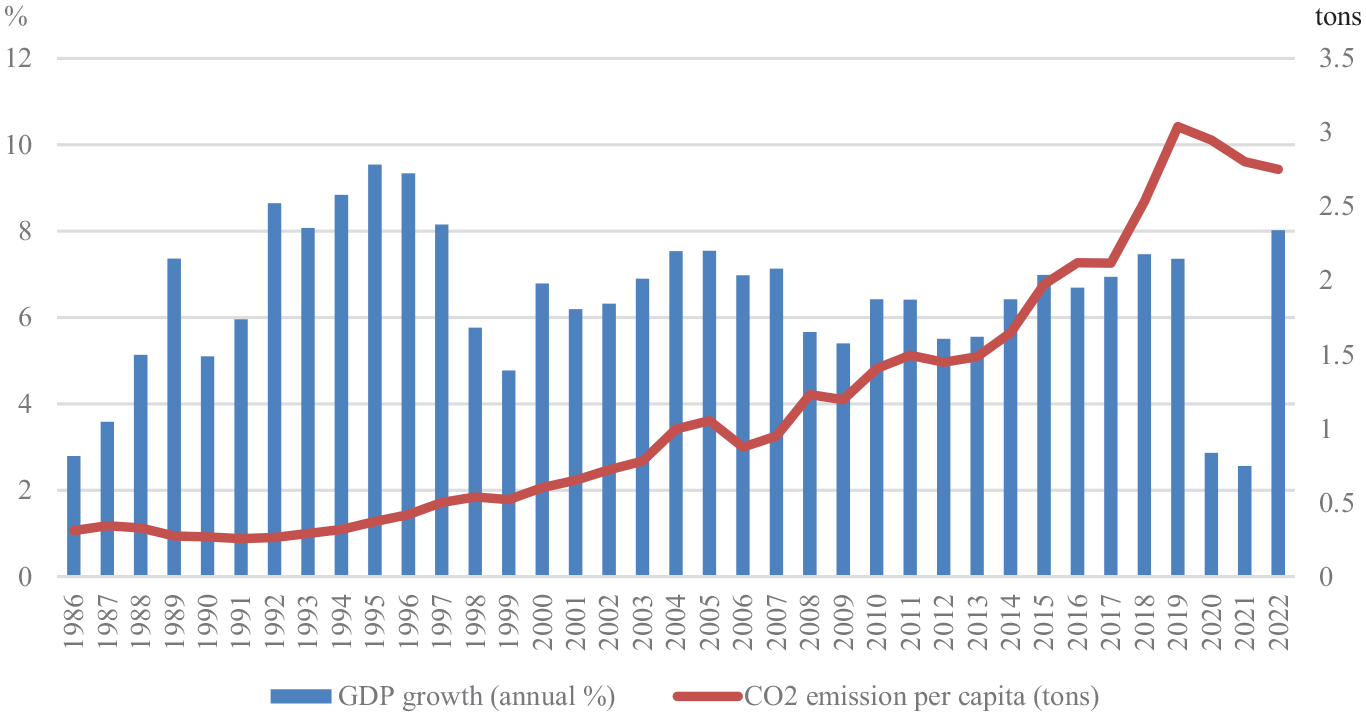
Economic growth and CO2 emission in Vietnam, 1986 to 2022.

Economic growth, urbanization, and industrialization in Vietnam, 1986 to 2022.
Environmental pollution, incidents, and climate change have occurred in Vietnam mainly because of the country’s dramatic boost in socioeconomic development activities, urbanization, and industrialization. This can be seen by the CO2 emissions, which increased more than 15 times, from 17.4 million tons in 1985 to 272.7 million tons in 2021 (Figure 3). Figure 1 also presents a remarkable rise in the urban population, from approximately 12 million residents to more than 37 million in 2021. The Vietnamese government has provided various initiatives to reduce environmental damage via the Poverty Reduction Support Credits (PRSC). The PRSC advocates various ways to enhance environmental management, including environmental valuation activities, pollution prevention and control, and sustaining sustainable forest and water resource management (World Bank, 2022).

CO2 emissions and urban population in Vietnam from 1985 to 2021.
The country’s industrialization has supported a fast urbanization process in Vietnam. Industrial parks where production activities have been mainly located at two ends of the countries—provinces in the North such as Ha Noi capital city, Hai Phong, Bac Giang and Quang Ninh provinces. In the southern end of the country, they are located in Ho Chi Minh City—the largest economic hub of the nation, Binh Duong, Dong Nai, Long An, and Ba Ria Vung Tau provinces. These industrial activities have attracted labor into these cities for employment, leading to speedy urbanization in these regions and provinces. Overcrowded cities have demanded and put significant pressure on infrastructure, leading to a fast deterioration in environmental quality. As such, understanding environmental quality in the Vietnamese context without incorporating urbanization and industrialization is incomplete.
This study focuses on the effect of urbanization and industrialization on environmental quality in Vietnam in both the short- and long-run. In addition, we also revisit the validity of the EKC hypothesis in the Vietnamese context because environmental quality has attracted significant attention from policymakers and the public. The Vietnamese government has pledged a firm commitment regarding the country’s commitment to phase out coal power generation by the 2040s and achieve net-zero carbon emissions by 2050 at the UN Climate Change Conference in Glasgow (COP26) in 2021. Identifying key contributors to environmental degradation is important in the next phase of sustainable economic growth and social transformation in Vietnam. Unlike prior studies, the contributions of this study to the existing literature on the EKC hypothesis in Vietnam are twofold. First, our study investigates the effect of urbanization and industrialization—the two key pillars supporting Vietnam’s economic growth and social transformation on environmental quality in the short- and long-run from 1990 to 2021. Second, we use the auto-regressive distributed lags (ARDL) technique to revisit the validity of the EKC hypothesis in the Vietnamese context with the presence of urbanization and industrialization, which has been ignored in previous studies.
Following this introduction, the remainder of the paper is organized as follows. Section “Literature Review” reviews the existing literature. Section “Data and Methodology” presents the data and methodology used in this research. Section “Results and Discussions” presents and discusses descriptive statistics and the unit-root test results. Empirical findings on the effect of urbanization and industrialization on environmental quality are presented and discussed in section “The Effects of Urbanization and Industrialization on Environmental Quality in Vietnam,” followed by the conclusions and policy implications in section “Conclusions and Policy Implications.”
Literature Review
Climate change has attracted significant attention from international organizations such as the United Nations, the World Bank, the Organisation for Economic Co-operation and Development (OECD) and governments globally. Tackling climate change has become the utmost important task in achieving sustainable economic growth for all countries in the future. Economic policies should not be formulated and implemented at the expense of environmental degradation. In achieving these dual objectives, the Environmental Kuznets Curve (EKC) has been considered an effective, albeit arbitrary, tool. The EKC hypothesis presents an inverted-U-shaped relationship between economic growth and environmental degradation. This hypothesis means that environmental pressure will increase when income per capita increases. However, when income per capita increases up to a certain level, a threshold, as income goes up, environmental quality will improve. This EKC hypothesis sheds light on the expectation that countries globally should be cautious with their economic development strategies with a long-term focus. This hypothesis is particularly relevant to developing countries such as Vietnam. The country has achieved a miracle of economic growth in the past four decades since 1986. However, its economic growth has been associated with environmental degradation, and it is time for the Vietnamese government to reconsider its economic growth models and strategies.
Over the past 50 years, various studies have been conducted to examine the relationship between economic growth, urbanization, and environmental degradation using multi-country panel data. Martnez-Zarzoso and Maruotti (2011) examine how urbanization affects CO2 emissions in developing countries from 1975 to 2003. The results illustrate that urbanization and CO2 emissions follow an inverted U-shaped relationship. The authors also point out that urbanization affects three groups of nations classified based on their income level differently. For the two groups of countries with a higher threshold level of income and higher, the emission-urbanization elasticity is negative and further urbanization does not increase emissions. Le and Quah (2018) investigated the link between carbon emissions, energy consumption, and economic growth for 14 Asian and Pacific nations from 1984 to 2012 using the panel co-integration tests. Their analysis confirms a long-term link between carbon emissions, energy consumption, and economic growth. However, the validity of the EKC hypothesis can only be confirmed in high-income countries. Aydoğan and Vardar (2020) examine the relationships between CO2 emission per capita, economic growth, renewable and non-renewable energy usage, and agricultural value-added for E7 nations from 1990 to 2014. The inverted U-shaped EKC relationship is confirmed in these nations. Their findings also confirm a long-term bi-directional Granger causality between non-renewable energy usage and CO2 emissions. Shahbaz et al. (2017) revisit the economic growth-CO2 emissions relationship for the G7 nations using nonparametric econometric approaches. Their findings confirm the validity of the EKC hypothesis in six of the G7 nations, except Japan. Shi (2003) confirms a significant link between population and carbon dioxide emissions in 93 countries between 1975 and 1996. The findings indicate that the effect of population on emissions is more significant in low-income nations than in higher-income countries.
The link between economic growth and environmental degradation in a particular country has also attracted significant attention from policymakers and scholars. Congregado et al. (2016) use co-integration and quarterly data between 1973 and 2015 to examine this relationship in the United States. Their findings support the validity of the EKC only when they allow a structural break in their analysis. However, Baek (2016) employs the autoregressive distributed lag (ARDL) technique and the U.S. data from 1960 to 2010 to confirm limited support for the validity of the EKC hypothesis. Ahmad et al. (2016) examine the correlation between carbon emissions, energy consumption, and economic growth from 1971 to 2014 at India’s aggregated and disaggregated levels. The results indicate a long-term co-integration and the EKC validity at aggregated and disaggregated levels. In addition, their findings support a feedback effect of carbon emissions on economic growth.
On the other hand, other studies have found mixed evidence of the validity of the EKC hypothesis. Using nonparametric additive regression models and provincial panel data from 1990 to 2011, Xu and Lin (2015) examine the link between urbanization and CO2 emission in China. Their findings indicate that industrialization and CO2 emissions follow an inverted U-shaped nonlinear relationship. Urbanization follows an inverted U-shaped pattern with CO2 emissions in the Eastern provinces, whereas it follows a positive U-shaped pattern in the Central region. Urbanization provides a nonlinear effect on CO2 emissions in the Western provinces. They argue that China’s CO2 emissions should be reduced by considering the dynamic impacts of industrialization and urbanization. Heidari et al. (2015) provide evidence to confirm no link between economic growth, carbon dioxide emissions, and energy consumption in five ASEAN countries, including Indonesia, Malaysia, Philippines, Singapore, and Thailand.
Empirical findings in various studies confirm the bidirectional causality between economic growth, carbon dioxide emissions, and energy consumption. Al-Mulali et al. (2013) examine the link between urbanization, energy consumption, and CO2 emissions in the MENA (Middle East and North Africa) nations. Their findings confirm a long-run bi-directional association between these countries’ urbanization, energy consumption, and CO2 emissions. Their findings, however, do not conclude the validity of the EKC theory. Using simultaneous-equation panel data techniques, Omri et al. (2015) examine the association between financial development, trade, economic growth, and CO2 emissions in 12 MENA nations from 1990 to 2011. The findings confirm a bidirectional causality between CO2 emissions and economic growth. Economic growth and trade openness are linked. There is evidence of unidirectional causality from financial development to economic growth and from trade openness to CO2 emissions. Finally, the existence of the EKC hypothesis is confirmed using the GMM system. Acaravci and Ozturk (2010) investigated the link between CO2 emissions, economic development, and energy consumption in 19 European nations from 1960 to 2005. Their results confirm the validity of the EKC hypothesis, especially noticeable in Denmark and Italy.
In their studies for the OECD countries, Duc, Ho, Le, et al. (2022) and Duc, Ho and Vo (2023) examined the energy-growth-environment nexus, focusing on trade openness, financial development, and urbanization. Their empirical findings indicate that trade openness, financial development, and urbanization play different roles in the energy-growth-environment nexus for the OECD countries and that urbanization plays a limited role in this nexus. Some of their key findings align with those of B. L. Tran et al. (2022) and T. Tran et al. (2023). In an interesting study, Doan et al. (2023) investigate whether the economic benefits of electricity consumption outweigh the environmental cost globally. Their study used unique emissions data and prices for carbon dioxide (CO2) of power plants from 33 countries between 2007 and 2018. Their findings support the important role of renewable energy consumption. In detail, they concluded that (i) renewable and nuclear plants bring more economic benefits than thermal power; (ii) renewable generates lower emission costs than thermal energy; (iii) the benefit-to-cost ratios for nuclear and renewable are higher than thermal energy, and (iv) wind and solar power plants show the largest economic benefit-cost ratio. Similar findings are also reported in Vo and Vo (2022).
In addition, Shen and Ren (2023), in a study for China, investigate the relationship between renewable energy, financial development, urbanization, and growth in China along with technology from 1965 to 2021. They concluded that urbanization is positively associated with economic growth and development in China. In another study for Pakistan, Sufyanullah et al. (2022) investigate how urbanization affects the emission of CO2 using both the auto-regressive distributed lag (ARDL) approach and the vector error correction model (VECM). They concluded that the emission of CO2 increases with an increase in urbanization. Zou et al. (2023) use data from the world’s three major carbon emitters from 1980 to 2020 and the nonlinear autoregressive distributed lag (NARDL) approach to examine the dynamic nexus between energy consumption, economic growth, and CO2 emissions. They concluded that energy consumption matters for economic growth and that the nexus between oil consumption and economic growth exhibits a similar asymmetric pattern in China and the United States in the long run.
In summary, previous studies have examined the relationship between urbanization, economic growth, and CO2 emissions. However, few empirical studies have been conducted in Vietnam (Al-Mulali et al., 2015; Shahbaz et al., 2019; Tang & Tan, 2015; Vo & Ho, 2021). However, these studies have used outdated data and/or ignored the important roles of urbanization and industrialization on environmental quality in Vietnam. Al-Mulali et al. (2015) examined the validity of the EKC hypothesis in Vietnam between 1981 and 2011 using the ARDL model. Their findings indicate that renewable energy usage has no substantial impact on pollution, whereas fossil fuel energy consumption increases it. Their findings reject the validity of the EKC hypothesis in the Vietnamese context. Shahbaz et al. (2019) conclude that the EKC hypothesis only exists in the long run in Vietnam, using Vietnam’s 1974 to 2016 yearly data. However, they argue that the N-shaped relationship between income and pollution is more appropriate for Vietnam in the long run.
Tang and Tan (2015) explore the relationship between CO2 emissions, energy consumption, FDI, and economic growth in Vietnam from 1976 to 2009, utilizing the co-integration and Granger causality techniques. The findings support long-run equilibrium among the variables of interest. Energy use and income, up to a threshold, increase CO2 emissions. These findings confirm the inverted U-shaped relationship between CO2 emissions and economic growth and the two-way causality between them. Finally, using the ARDL and threshold regression techniques over 35 years from 1986 to 2017, Vo and Ho (2021) confirm a U-shaped link between economic growth and environmental degradation in the long term in Vietnam. Similar findings can also be confirmed by Vo et al. (2022) for Vietnam.
Abdulqadir (2021, 2022, 2023) recently examined various issues regarding the relationship between urbanization, renewable energy, and carbon dioxide emissions in sub-Saharan Africa. The author concluded that strong evidence of the Kuznets curve exists in the nexus between urbanization, economic growth, and renewable energy in these countries. In addition, their findings also confirm a single threshold effect of economic growth on renewable energy consumption in sub-Saharan African countries.
Our literature review confirms that urbanization and industrialization have largely been ignored in previous studies to examine the validity of the EKC hypothesis—the relationship between economic growth and environmental degradation. Little is known about Vietnam, particularly urbanization and industrialization, which are generally considered two key pillars to support Vietnam in achieving the miracle of economic growth in the past three decades. This observation warrants our analysis to be conducted.
Data and Methodology
Data
Data are collected from the World Bank’s database from 1985 to 2021 for CO2 emissions per capita (million tons), GDP per capita Industry, energy consumption, and Urban population growth (annual %).
CO2 emissions per capita represent the amount of carbon dioxide emitted per person in Vietnam in millions of tons. This variable reflects the level of carbon emissions produced by various economic activities, including industrial production, transportation, and residential energy use. GDP per capita is proxied for economic growth. Industry representing the industrial sector’s contribution to Vietnam’s GDP is used as a proxy for industrialization. Manufacturing, another proxy for industrialization, measures the value added by the manufacturing sector as a percentage of Vietnam’s GDP. Urban population growth (annual %) measures the change in the proportion of the population residing in urban areas, representing urbanization. Table 1 shows descriptive statistics for these selected variables.
The Descriptive Statistics of Variables, 1985 to 2021, Vietnam.

Table 1 presents the descriptive statistics of variables used in the current study. CO2 emissions have increased approximately 10 times, from 0.25 to 3.03 tons of CO2 per capita, with the average per capita CO2 emissions of 1.06 tons. Meanwhile, economic growth increased approximately five times from 1985 to 2021. Economic growth in Vietnam is also accompanied by the growth of Industry and Manufacturing (% of GDP). Industry and manufacturing have increasingly taken up a high share of Vietnam’s GDP structure, with a maximum of 40.21% and 22.37%, respectively. In addition, urban population growth also increased gradually during the period, from 2.53% to 3.96%. Besides, the statistics demonstrate a faster increase in CO2 emissions compared to the growth of the urban population in Vietnam (Figure 1).
Research Methodology
This study employs the autoregressive distributed lag (ARDL) model to examine the effect of urbanization and industrialization on environmental quality proxied by CO2 emissions. Our study also revisits the validity of the EKC hypothesis in the presence of urbanization and industrialization in Vietnam. The ARDL model is suitable for investigating the long-run relationships among variables with different orders of integration. This model is also flexible to handle both stationary and non-stationary data. The ARDL regression model is described as follows:

where:
First, we conduct a co-integration test to identify the potential long-run relationship between environmental quality proxied by the CO2 emissions per capita and various independent variables, including urbanization (proxied by urban population growth), industrialization (proxied by the value added (% of GDP) of the industry sector, and the value added (% of GDP) of the manufacturing sector), and GDP per capita (annual %). We use the bounds test approach to co-integration, suitable for small sample sizes. The results of the co-integration test, as presented in Table 3, confirm a long-run relationship between CO2 emissions per capita and GDP per capita, urbanization and industrialization in Vietnam.
Equation 1 is used to investigate the effect of urbanization, industrialization, and economic growth on CO2 emissions per capita in Vietnam. We used the model’s max lag lengths of up to two for each variable to capture the relationships’ short-term dynamics. In addition, we also examine the goodness of fit of the model using standard diagnostic tests, such as Durbin’s alternative test for autocorrelation, the LM test for autoregressive, the Breusch-Godfrey test for autocorrelation, and the White test for heteroscedasticity.
Our study aims to identify the long-run and short-run effects of urbanization industrialization on environmental quality in Vietnam. We also revisit the validity of the EKC hypothesis in the presence of urbanization and industrialization in the Vietnamese context in the last four decades, from 1985 to 2021. As such, the ARDL model and co-integration tests allow us to account for the dynamic nature of the relationships among the variables and provide robust estimates of the empirical results.
Results and Discussions
Empirical Results from the Unit-Root Tests
We first investigate if the data series is stationary before the ARDL estimation technique can be used to investigate the co-integration among variables. The augmented Dickey-Fuller (ADF) test and Phillips-Perron (PP) test are used for this analysis. Table 2 presents the findings of these two tests. Results from Table 2 confirm the mixed orders at I(0) or I(1) integration of variables. As such, the ARDL technique is appropriate for our analysis.
Empirical Results from the Unit-Root Tests.
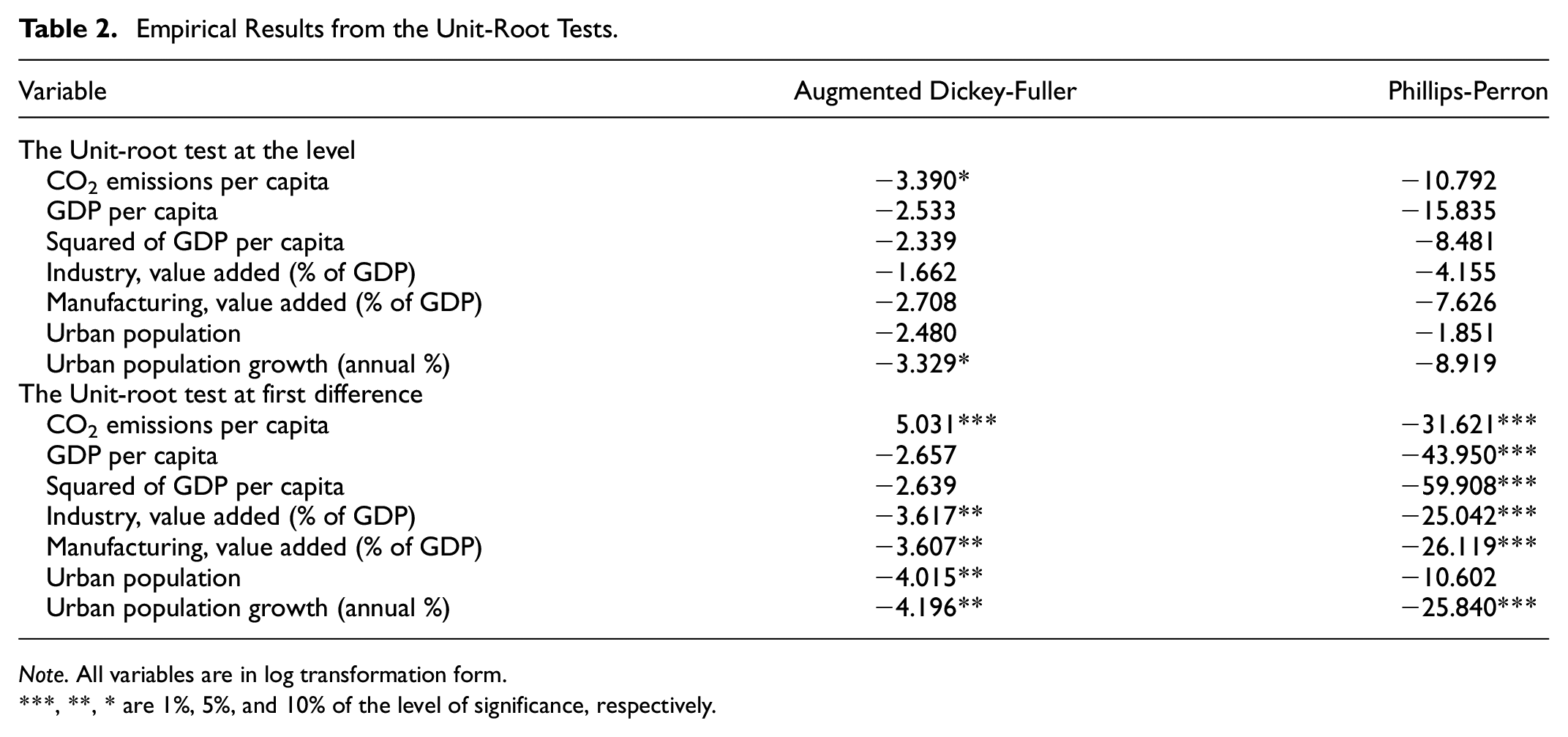
Note. All variables are in log transformation form.
, **, * are 1%, 5%, and 10% of the level of significance, respectively.
Empirical Results from the Co-Integration Tests
The empirical findings using the Engle-Granger test for co-integration are shown in Table 3. The findings confirm the long-run co-integration between explanatory variables such as urbanization and industrialization with the dependent variable (CO2 per capita).
Engle-Granger Test for Co-Integration.

Note. All variable is used in log transformation form.
Denotes 5% of the level of significance.
The Effects of Urbanization and Industrialization on Environmental Quality in Vietnam
Table 4 presents the long-run and short-run effects of urbanization and industrialization on environmental quality in Vietnam using the ARDL technique. Empirical results on investigating the validity of the EKC hypothesis in the Vietnamese context are also presented. In the short run, we find that a 1% increase in urban population growth is associated with a 1.1% increase in CO2 emissions. However, urbanization reduces CO2 emissions in the long run. Our results also indicate that industrial activities decrease CO2 emissions in the short run, even though the effect is very weak. However, we find that a 1% increase in the industry (% of GDP) is associated with a 1.67% increase in CO2 emissions per capita in the long run. In contrast, manufacturing activities are associated with decreased CO2 emissions per capita in both the short- and long-run.
The Effects of Urbanization, Industrialization, and Economic Growth on Environmental Quality in Vietnam using the ARDL Estimation Technique.

Note. All variable is used in log transformation form.
, **, and * are 1%, 5%, and 10% level of significance, respectively.
In addition, our empirical results confirm a U-shaped EKC relationship between economic growth (proxied by GDP per capita) and environmental degradation (proxied by CO2 emissions per capita) in the long run. Our findings indicate that CO2 emissions increase during the first stage of economic growth and decrease in the long run. This result aligns with the findings of Tang and Tan (2015) and Vo and Ho (2021). Our findings are robust to all four robustness checks, including Durbin’s alternative test for autocorrelation, the LM test for autoregressive, White’s test for homoscedasticity, and the Breusch-Pagan/Cook-Weisberg test for heteroscedasticity, as presented in Table 4 below.
We also use the CUSUMsq tests to examine the consistency of the parameters in the ARDL model. Figure 4 shows that CUSUM and CUSUMsq are between the upper and lower critical limits at the 5% significance level. These results confirm the validity of the ARDL estimates’ stability.

Results from the CUSUM squared test.
Conclusions and Policy Implications
Vietnam has made important progress in economic growth and social transformation since the economic reform in 1986. The country has now become one of the emerging economies in Asia. Vietnam has experienced a rapid increase in GDP per capita. Vietnam’s economic growth and social transformation have been supported by a speedy process of urbanization and industrialization— two fundamental pillars in the Vietnamese context. However, the environment in Vietnam has also been severely damaged by urbanization and industrialization. As such, the Vietnamese government should balance the two objectives simultaneously: achieving sustainable economic growth and improving the quality of the environment. Contemporary literature has extensively investigated the relationship between economic growth and environmental deterioration. However, few attempts have been made using dated data focusing on Vietnam. Furthermore, the effects of urbanization and industrialization on environmental quality in Vietnam have largely been underexamined in previous studies. As such, our study is conducted to revisit these effects from 1985 to 2021.
The key results of this study can be summarized as follows. First, urbanization increases CO2 emissions in the short run. The rise in the number of roads, modes of transportation, buildings, and facilities supplying urban facilities reduces air circulation, resulting in hazardous waste build-up and air pollution in urban areas, particularly dust pollution. In the long term, however, this negative effect disappears. Second, industrialization reduces CO2 emissions in the short term. However, continuing industrialization as expected without proper policies may lead to further environmental degradation in Vietnam in the long run. Industrial activities contribute to a rise in CO2 emissions in the short run. Smoke and dust are being discharged into the air, untreated wastes are released into the environment, and fuel and energy from the industry are being leaked. As such, fast economic growth in industrial output is linked with increased soil, water, and air pollution. In contrast, manufacturing reduces CO2 emissions in the short and long term. Third, the findings confirm a long-run U-shaped link between economic growth and environmental deterioration. This finding confirms the validity of the EKC hypothesis in the Vietnamese context. Environmental quality is negatively affected by economic growth up to a certain level of income. Once this income threshold has been surpassed, economic growth in Vietnam is associated with improved environmental quality. Vietnam is now a middle-income country. In improving environmental quality, economic policies in Vietnam should not be formulated and implemented at the expense of environmental quality.
The empirical results from this study confirm the Vietnamese government’s need to reconsider the economic model in achieving the dual objectives: sustainable economic growth and improved environmental quality. Environmental issues should be placed at the center of any economic and social policies formulated and implemented in the future. The protection of natural resources and the environment has come into order. Urbanization is an issue in Vietnam today since all major economic activities are centered in Hanoi and Ho Chi Minh City, significantly increasing the number of motorcycles and vehicles in these two cities. The situation can be remedied if the infrastructure in the countryside areas is improved. Carbon taxes on motorcycles and automobiles might be another option for the Vietnamese government to consider regarding Vietnam’s urban-environmental problem. The Vietnamese government should invest more in clean or renewable energy sources such as solar and wind power. This investment can also help mitigate the impacts of urbanization on the environment and reduce the dependence on fossil fuel usage.
The U-shaped relationship between economic growth and environmental degradation has suggested that Vietnam may benefit from a later stage when increased economic growth is associated with decreased CO2 emissions. From a policy perspective, a new economic growth model and development strategy for Vietnam should be established and implemented as soon as feasible to minimize the trade-off between economic growth and environmental deterioration. Vietnam should prioritize technological development by transitioning from carbon-intensive infrastructures and adopting efficient technologies that may cut costs and boost productivity, significantly accelerating economic growth and environmental benefits. For instance, Vietnam is promoting a low-carbon transition. Since December 2021, the government has committed to the goal of “Net Zero” by 2050 in the COP26 in Scotland. Vietnam should also consider green transition and energy transition as a consistent policy and a new economic model. Furthermore, Vietnam has also participated in the COP27 agreement with a global goal to control the global temperature increase below the threshold of 1.5°C. The Vietnamese government should continue working with countries globally to exchange and consolidate mechanisms and policies to mobilize resources in combating climate change. These resources from developed nations should only be used for reducing-climate-change activities, and they should be allocated transparently and balanced to achieve greenhouse gas emission reduction and adaptation efforts. For industrial production and manufacturing activities, it is important to employ cleaner and green production solutions to save materials, electricity, and water and promote waste recycling. Effective recycling and waste management can help reduce the amount of waste generated by cities and minimize the impact of waste disposal on the environment. Recycling and waste management can also help reduce greenhouse gas emissions and conserve natural resources.
Footnotes
Declaration of Conflicting Interests
The author(s) declared no potential conflicts of interest with respect to the research, authorship, and/or publication of this article.
Funding
The author(s) disclosed receipt of the following financial support for the research, authorship, and/or publication of this article: This study is funded by the Ministry of Education and Training of Vietnam under Grant B2023-MBS-07.
