




Abstract
University faculty play a crucial role in shaping pedagogical outcomes through their teaching approaches (TA). Despite extensive research on teaching methodologies, most studies have predominantly focused on European or Anglo-Saxon universities, with minimal representation from Latin American contexts. This study addresses this gap by exploring the influences on teaching approaches among faculty members (n = 385) in Ecuador, highlighting significant differences between the “hard” and “soft” sciences. Using structural equation modeling to analyze responses from an online survey, the researchers found that professional development influences teaching approaches more than pedagogical training. Furthermore, findings indicated that educational background and area of specialization are critical in determining teaching approaches, with correlations observed among age, gender, and campus locations. This study analyzes the interrelationship of multiple demographic and pedagogical variables, offering a comprehensive understanding of their combined impact on teaching approaches—a feature often lacking in prior research. The results suggest a predominant alignment with student-centered teaching approaches, advocating for educational policies that accommodate students’ diverse needs and contexts. While the insights are context-specific, they underscore the potential for broader implications in academic practices and policy formulation in similar settings.
Plain Language Summary
This study analyzes how various factors, such as age, gender, specialization, pedagogical training, and campus location, affect teaching approaches among university professors in Ecuador. The results indicate that structured pedagogical training has a greater influence on teaching approaches than traditional training through sporadic courses. Additionally, differences are observed across areas of knowledge, with student-centered approaches being more common in the social sciences and humanities, while the exact sciences tend to emphasize information transmission. These findings suggest the need for educational policies that adapt to the diverse needs of students and promote student-centered teaching. Although this study was conducted within the Ecuadorian context, its conclusions could be applied to similar educational environments, potentially contributing to the improvement of pedagogical practices and educational policies globally.
Introduction
In recent years, interest in improving the quality of university academic teaching has increased notably. Various initiatives have been implemented, from courses, programs, and specialized centers for the pedagogical development of teachers (Ödalen et al., 2019) to the issuance of regulations (Magnússon & Rytzler, 2023) that regulate the academic career based on pedagogical training. Academic results obtained have been deployed in several countries worldwide. The aim is to improve how university teachers teach, enabling students to achieve deeper learning and develop the skills and knowledge necessary to tackle the increasingly complex demands of a globalized, hyperconnected, and digitized world, where information and knowledge are key to development and well-being of citizens (Van Dijk, 2020).
Research has consistently highlighted that teaching approaches have a decisive role in shaping the quality of learning. Researchers have associated student-centered methodologies with developing critical thinking, autonomous learning, and a deeper understanding of knowledge (Gibbs & Coffey, 2004; Prosser & Trigwell, 1999). Conversely, teacher-centered approaches, although helpful in transmitting structured content, limit students’ engagement and encourage surface learning strategies such as memorization and reproduction of information (Postareff & Lindblom-Ylänne, 2008; Trigwell et al., 1999). Case (2019) argues that the teacher–student-centered dichotomy fails to capture the actual complexity of teaching in engineering. These findings reinforce the need to analyze how university teachers’ instructional decisions are shaped by personal and contextual factors, given their direct impact on learning.
The literature reveals considerable research on teaching practices (Lauer & Wilkesmann, 2019; Lindblom-Ylänne et al., 2006; Mladenovici et al., 2022). Two teaching approaches are distinguished (Jacobs et al., 2020; Prosser & Trigwell, 1999): teacher-centered/information transmission (ITTF) and student-centered/conceptual change (CCSF). The first approach emphasizes content, with the teacher as an expert and students as receivers, limiting interaction. When associated with this, learning is superficial: memorization and reproduction of content. In the second approach, learning is conceived as the active construction of knowledge, promoting deepening and discussion of ideas. Here, deep learning occurs when students understand, connect it to prior knowledge, and generalize it to other contexts.
On the other hand, one of the central concerns in higher education is identifying the factors that influence university teachers’ adoption of different teaching approaches. Previous research indicates that variables such as the area of expertise (Lindblom-Ylänne et al., 2006), pedagogical training (Kálmán et al., 2020; Ödalen et al., 2019), peer interaction, and educational context (class size, level of education) can impact teaching approach (Lauer & Wilkesmann, 2019; Mladenovici et al., 2022). However, some studies find no significant relationships between factors such as class size or individual characteristics of faculty and teaching approaches (Mladenovici et al., 2022).
In Latin America, two primary research directions are prominent: the adaptation and validation of tools for assessing teaching approaches (Fernández Castillo et al., 2015; Montenegro Maggio & González Ugaldeb, 2013), and the examination of the prevalent pedagogical approaches in the university context, alongside their impact on student learning (Arechabala-Mantuliz et al., 2018; Tricio et al., 2017; Villalobos Clavería, 2018; Yunga-Godoy et al., 2016). These studies highlight a preference for student-centered and conceptual change approaches but also reveal that teacher-centered practices remain prevalent, especially in STEM disciplines. However, a closer examination reveals the persistence of traditional instructional models coexisting with emerging active learning methodologies.
For instance, Yunga-Godoy et al. (2016) found that while many university professors self-identified as student-centered in their teaching, a deeper analysis of their strategies revealed a firm fostering more profound shifts in reliance on teacher-centered practices. Similarly, Arechabala-Mantuliz et al. (2018) highlighted that although institutional policies promote active learning, traditional lecture-based methods remain dominant, particularly in STEM fields. Villalobos Clavería (2018) further examined the relationship between teaching and learning approaches, emphasizing that although educators increasingly advocate student-centered strategies, their implementation varies depending on institutional culture and faculty training opportunities. Additionally, recent studies indicate that faculty development programs can significantly shift teaching approaches toward student-centered methodologies, as evidenced by Tricio et al. (2017), who reported a measurable reduction in teacher-centered instruction following structured pedagogical training.
Despite these insights, research in the region remains limited in examining how demographic variables, institutional contexts, and professional development intersect to shape university teaching approaches. While institutional policies and technological infrastructure have been identified as drivers of pedagogical change (Heredia et al., 2025; Tricio et al., 2017), the influence of demographic factors—such as age, gender, and length of service—remains inconclusive (Mladenovici et al., 2022; Stes et al., 2014). Our findings corroborate this lack of clarity, as variables like age and gender showed no significant direct impact on teaching approaches, reinforcing the need for further investigation into these complex interrelations.
Comparing these findings with our study, we observe that while Latin American universities increasingly advocate for student-centered approaches, traditional lecture-based methods persist, particularly in STEM fields. Our results align with prior studies indicating that faculty training programs are critical in shifting teaching approaches. However, unlike previous research, our study provides a multidimensional analysis incorporating demographic and institutional factors, which adds depth to understanding how these variables interact. Given these patterns, future research should explore the interplay between institutional policies, faculty development, and demographic variables to develop a more comprehensive framework for understanding teaching approaches in Latin American higher education.
The selection of Universidad Politécnica Salesiana as the locus of the study is strategic. Its presence across Ecuador’s three largest cities—Quito, Guayaquil, and Cuenca—provides a comprehensive national perspective on the influences shaping educational practices. This geographic scope enriches the study’s contextual depth and enhances the generalizability of the findings across diverse urban educational settings in Ecuador.
This study focuses on contributing to this endeavor. It aims to identify potential interconnections among factors such as age, tenure within the institution, field of expertise, pedagogical training, gender, geographical location, and their correlation with adopting a specific teaching approach. This approach sets it apart from previous literature due to its multidimensional analysis of variables. Moreover, this study takes place within the context of a Latin American university, where the teaching workload is substantial—on average, 20 classroom hours per week—compared to the European or North American context and where the impact of academic outcomes significantly influences the professor’s work.
Factors Influencing Teaching Approach in Higher Education
Several studies have shown that factors such as institutional environment (Kálmán et al., 2020; Lauer & Wilkesmann, 2019; Minerick & Schneider, 2007; Muhammad et al., 2022; Romo, 2021; Taye et al., 2019), pedagogical training (Kálmán et al., 2020; Ödalen et al., 2019; Wilkesmann & Lauer, 2015), scientific discipline (Wilkesmann & Lauer, 2015), gender, and age influence teaching approach (Mladenovici et al., 2022). This section details these factors, exploring how each contributes to selecting teaching approaches, ranging from teacher-centered to student-centered approaches.
The institutional environment plays a key role through tacit norms and formal structures. Many departments establish informal expectations regarding course design, evaluation, student interaction, and workload distribution, shaping teaching approaches, particularly for junior faculty (Kálmán et al., 2020; Minerick & Schneider, 2007; Romo, 2021). Broader institutional governance promotes specific pedagogical cultures through leadership and strategic planning (Lauer & Wilkesmann, 2019; Muhammad et al., 2022). These efforts shape policies, resource allocation, and faculty incentives aligned with institutional priorities (Ruge & Mackintosh, 2020; Taye et al., 2019; Wilkesmann & Lauer, 2015). Moreover, recent work highlights that the structure of governance bodies can shape the diffusion of teaching models across campuses (Zhuang et al., 2023).
Within institutional strategies, pedagogical training and professional development are distinct yet complementary pathways to improve teaching (Kálmán et al., 2020; Jacob et al., 2015; Ödalen et al., 2019). Pedagogical training often consists of short-term activities, such as workshops, aimed at delivering specific techniques, which tend to be more impactful for novice instructors but may have limited long-term effects (Ödalen et al., 2019). In contrast, professional development is a continuous, embedded process involving mentoring, reflective practice, and engagement in faculty learning communities, fostering more profound shifts in teaching practices (Kálmán et al., 2020; Wilkesmann & Lauer, 2015).
Differences across disciplines are also well documented. Faculty in “hard” sciences, such as engineering and medicine, often favor teacher-centered approaches, while those in social sciences and humanities lean toward student-centered practices (Allendoerfer et al., 2014; Lindblom-Ylänne et al., 2006; Stes et al., 2014; Wilkesmann & Lauer, 2015). These tendencies emerge from the epistemological characteristics and knowledge production methods typical of each field (Lindblom-Ylänne et al., 2006).
Finally, researchers have examined sociodemographic factors, reporting mixed results. Some studies find that female instructors may be more inclined to adopt student-centered teaching (Nevgi et al., 2004; Stes et al., 2014; Wilkesmann & Lauer, 2015), though this varies by institutional and cultural context (Mladenovici et al., 2022). Similarly, age and length of service may affect teaching approaches indirectly through participation in professional development activities (Kálmán et al., 2020; Stigler & Miller, 2018), although findings remain inconclusive in some studies (Postareff & Lindblom-Ylänne, 2008).
Conceptual Model and Hypothesis Development
As discussed in the previous section, exploring factors influencing faculty teaching approaches underscores the complexity of educational dynamics within higher education settings. These findings have led us to pose pivotal research questions that specifically address how such factors manifest within the Universidad Politécnica Salesiana in Ecuador:
What differences are observed in faculty teaching approaches in terms of age, gender, length of service at the institution, campus location, area of knowledge, and education training?
What are the relationships between factors such as length of service at the institution, knowledge area, gender, and age regarding pedagogical training or professional development and teaching approach of university teachers?
Building on these questions and the reviewed literature, this study proposes a conceptual model to examine how institutional, disciplinary, and individual variables influence the teaching approaches adopted by university faculty. The model is structured to account for confirmatory and exploratory hypotheses, reflecting well-established and context-dependent relationships identified in prior research.
Prior studies suggest that faculty in social sciences and humanities are more likely to adopt student-centered approaches and engage more frequently in pedagogical training compared to those in STEM fields, who tend to favor teacher-centered methods (Lindblom-Ylänne et al., 2006; Stes et al., 2014; Wilkesmann & Lauer, 2015). Similarly, researchers have linked the length of service and age to variations in faculty engagement with pedagogical training and professional development (Kálmán et al., 2020; Wilkesmann & Lauer, 2015), with younger faculty often more engaged in such activities (Stigler & Miller, 2018).
Furthermore, professional development appears to play a significant role in prompting student-centered practices (Kálmán et al., 2020; Ödalen et al., 2019). However, evidence regarding the influence of gender, campus location, and specific interactions involving age and tenure on teaching approaches remains mixed and context-dependent (Mladenovici et al., 2022; Nevgi et al., 2004; Postareff & Lindblom-Ylänne, 2008; Romo, 2021; Stes et al., 2014).
This model is operationalized through the following hypotheses (see Figure 1):
Confirmatory hypotheses:
Exploratory hypotheses:
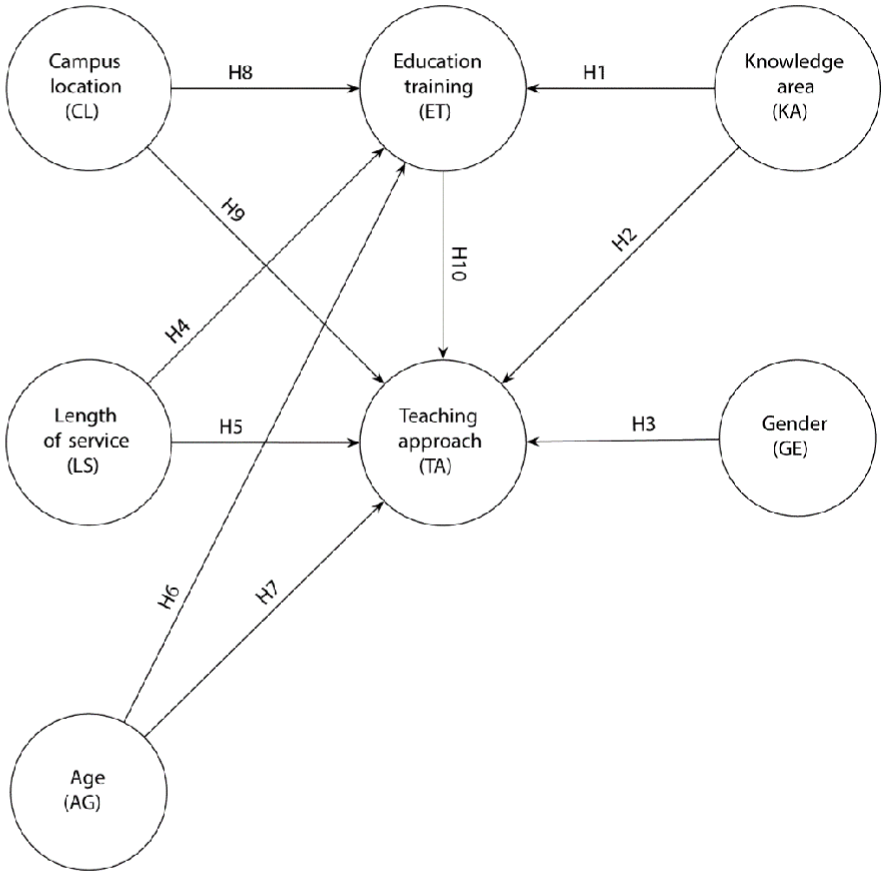
Structural equation model diagram.
Method
Sample
The data for this study were collected through an online questionnaire administered between November and December 2022 to professors at the Universidad Politécnica Salesiana del Ecuador (UPS). With the authorization of the university’s rectorate, the team sent 989 emails to the institutional accounts of the academics (338 women and 651 men), from which 385 responses were obtained. These responses represent a 38.9% response rate, ensuring a 95% confidence level and a margin of error of less than 5% concerning the target population. In accordance with ethical standards, the researchers informed participants about the study’s objectives, procedures, and the voluntary nature of their participation, as well as the anonymity of data collection.
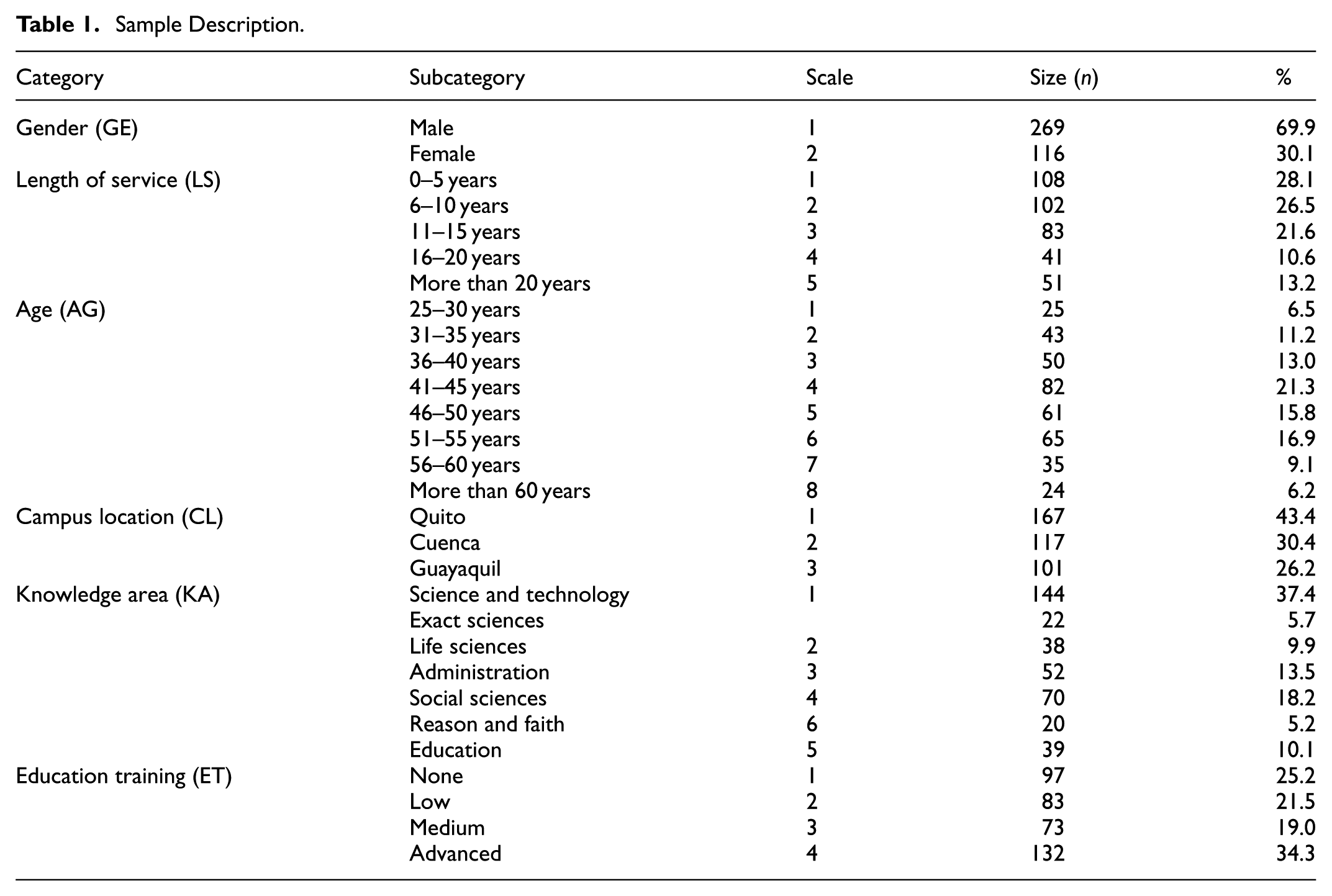
To facilitate the identification of disciplinary fields, the researchers followed the university’s official categorization of knowledge areas. Thus, responses were distributed across the following disciplines: Science and Technology (37.4%), Exact Sciences (5.7%), Life Sciences (9.9%), Administration and Economics (13.5%), Social and Behavioral Sciences (18.2%), Reason and Faith (5.2%), and Education (10.1%). Participation comprised 69.9% men and 30.1% women. Regarding length of service at the institution, 28.1% of the sample fell within the range of 0 to 5 years, 26.5% between 6 and 10 years, 21.6% between 11 and 15 years, 10.6% between 16 and 20 years, and 13.2% with over 20 years of service. Similarly, the age of respondents ranged between 25 and 30 years at 6.5%, between 31 and 35 years at 11.2%, between 36 and 40 years at 13%, between 41 and 45 years at 21.3%, between 46 and 50 years at 15.8%, between 51 and 55 years at 16.9%, between 56 and 60 years at 9.1%, and over 60 years at 6.2%. Given that UPS has campuses in the main cities of Ecuador, the geographical distribution was as follows: Quito, with 43.4%; Cuenca, with 30.4%; and Guayaquil, with 26.2%. Education background was structured into four levels: none (no education background), low (participation in teacher training courses only), medium (holds a bachelor’s degree and/or continuous postgraduate education up to the specialist level), and advanced (holds a master’s or doctoral degree). Regarding education, 25.2% of respondents lacked an education background, 21.5% had a low level, 19% had a medium level, and 34.3% had an advanced level. Table 1 provides a summary of the sample description.
Sample Description.
Instruments and Data Analysis
The data collection instrument for this study consisted of an online questionnaire divided into two sections. The first part gathered data on age, gender, length of service, education background, field of knowledge, and the location of the university campus. In the second part of the survey, to determine the teaching approach, the Approaches to Teaching Inventory (ATI; Trigwell & Prosser, 2004) was employed in its revised, adapted, and translated into Spanish version (S-ATI-20) (Monroy et al., 2015). This instrument consists of 20 items that allow the analysis of a two-factor structure: teacher-centered/information transmission (ITTF) and student-centered/conceptual change (CCSF).
Before implementing the instrument, the Academic Writing Center of UPS analyzed the terms used in the Spanish version to detect comprehension issues related to the Latin American context and potential lexical variations. Additionally, a pilot test involving 20 university professors from various areas of expertise was conducted. This process led to the questionnaire’s wording adjustments to enhance comprehension and improve the scale used for collecting personal data.
The researchers analyzed the data collected from the online questionnaire using the statistical package R version 4.2.2. Initially, an ANOVA analysis was conducted to examine the influences of each variable on the teaching approach. Subsequently, based on the findings reported in the literature regarding the relationship among the investigated factors, the conceptual model and the proposed hypotheses were evaluated through a structural equation modeling approach (see Figure 1).
Structural Equation Modeling (SEM) was selected as the primary analytical technique for this study because it enables the simultaneous examination of multiple relationships among demographic, disciplinary, and institutional variables and their impact on faculty teaching approaches. Unlike regression-based approaches, which typically assess relationships sequentially, SEM allows for modeling complex systems in which factors interact directly and indirectly to influence outcomes (Aldás & Uriel, 2017). Given that our conceptual model integrates both observable variables (e.g., gender, age, campus location) and latent constructs (e.g., professional development, teaching approach orientation), SEM provides a comprehensive analytical framework that is particularly well-suited for capturing such multidimensional relationships (Aldás & Uriel, 2017).
Model fit was assessed using standard indices, including RMSEA, SRMR, TLI, and CFI, following the cutoff criteria recommended by Hu and Bentler (1999). Specifically, RMSEA values below .06, SRMR values below .08, and CFI and TLI values equal to or above .95 indicate a good model fit. These criteria are widely adopted in the literature to validate the adequacy of structural equation models.
The selection of SEM also supports the integration of both confirmatory and exploratory hypotheses within a unified framework, which aligns with the mixed nature of the relationships derived from the literature review.
Results
Measurement Properties of the S-ATI-20 Questionnaire
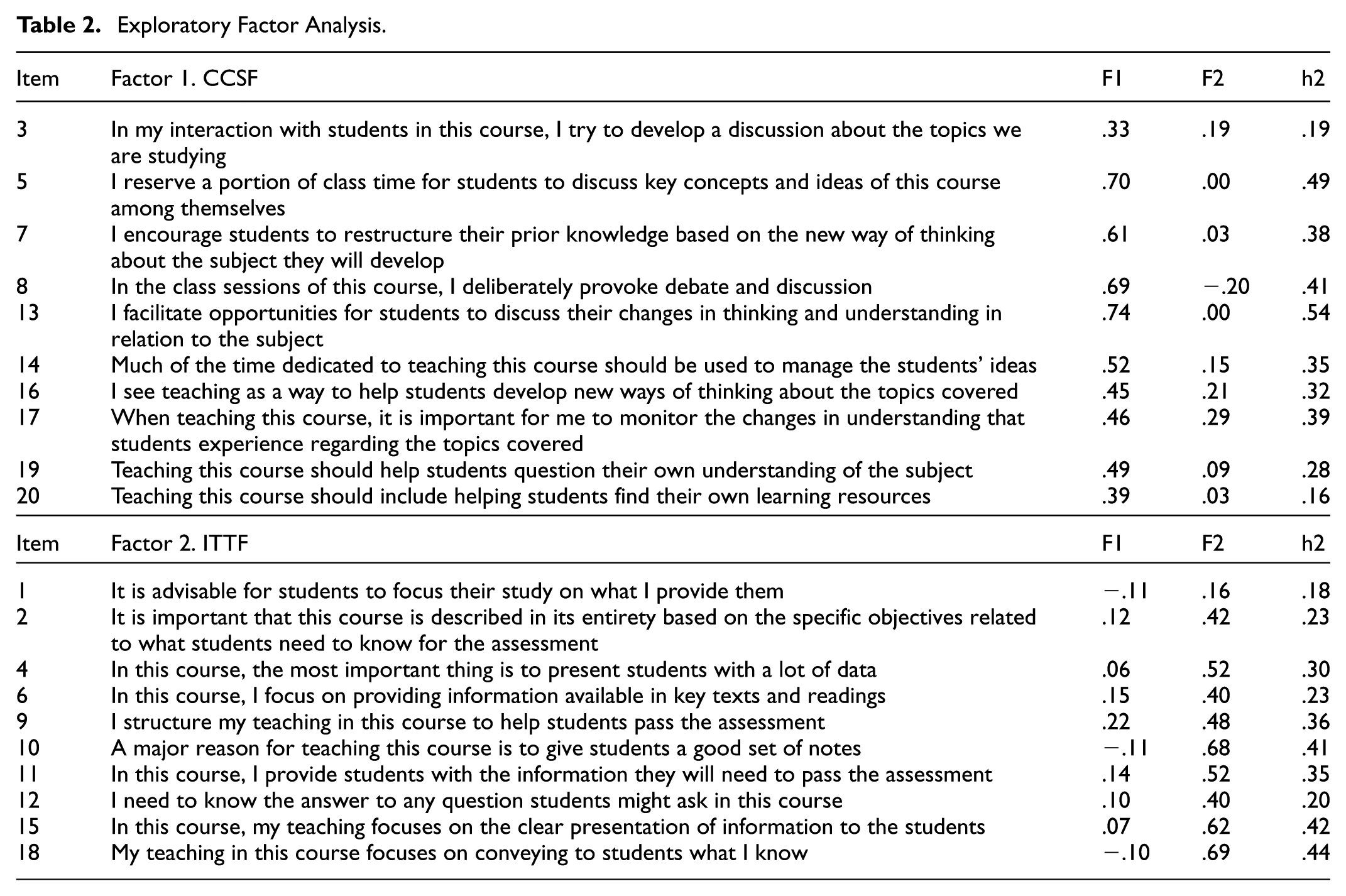
Initially, an exploratory factor analysis was conducted to verify the measurement properties of the S-ATI-20 questionnaire. This analysis used the maximum likelihood estimation method with oblique rotation, identifying two main factors. The results revealed two distinct dimensions: ITTF, comprising questions 1, 2, 4, 6, 9, 10, 11, 12, 15, and 18, and CCSF, including questions 3, 5, 7, 8, 13, 14, 16, 17, 19, and 20. Subsequently, the instrument’s reliability was assessed using Cronbach’s alpha, showing high internal consistencies, with
Sample adequacy for factor analysis was verified using the Kaiser–Meyer–Olkin test (
Exploratory Factor Analysis.
A confirmatory factor analysis (CFA) was implemented to examine the proposed scale’s internal structure, and the Diagonally Weighted Least Squares (DWLS) estimator was selected for its suitability to the data distribution. This analysis focused on two specific scales, assessing their reliability through Cronbach’s alpha and squared omega values of
The model fit indices reflected good adequacy: (

CFA model of two correlated factors.
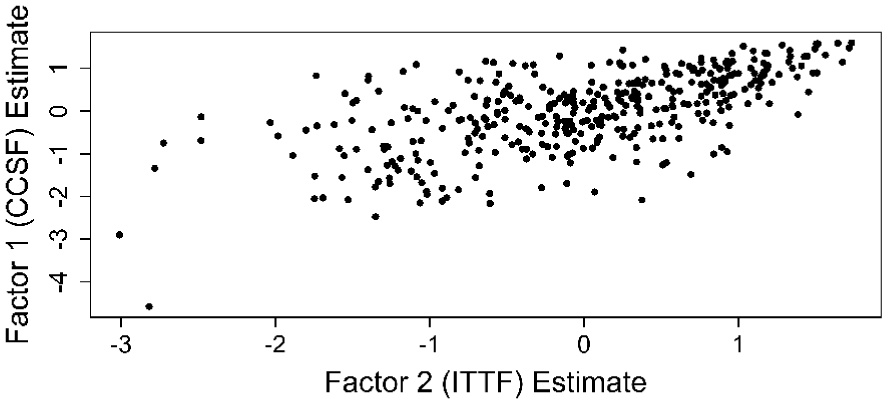
Dispersion patterns of the scores of the two latent factors ITTF and CCSF.
Differences in Teaching Approach Across Fields of Knowledge, Educational Background, and Length of Service at the Institution
The groups according to the field of knowledge and their statistics regarding the teaching approach (CCSF) or (ITTF) were formed as follows: Science and Technology and Exact Sciences (Group 1)
Differences in Teaching Approach Between Areas of Knowledge.

Signif. codes: *p < .05. ***p < .001. ****p < .0001.
In terms of educational attainment, four groups were established, each with the following statistics related to the assumed teaching approach: none (Group 1)
Differences in Teaching Approach Between Groups with Different Levels of Educational Training.

Signif. codes: *p < .05. **p < .01. ****p < .0001.
The groups, according to their length of service at the institution and their statistics regarding the teaching approach for university faculty, were organized as follows: For faculty with 0 to 5 years of service (Group 1), the statistics are
Differences in Teaching Approach Based on Age, Gender, and Location of the University Campus
In the study investigating the correlation between participants’ ages and their pedagogical approaches, participants were categorized into eight age groups, from 25 to over 60 years. This categorization facilitated a comprehensive statistical analysis of teaching method preferences. The groups are as follows: Group 1, ages 25 to 30 (
Differences in the Teaching Approach Between Groups of Different Ages.

Signif. codes: *p < .05. **p < .01.
Regarding gender, the Levene test (
Meanwhile, the Levene test (
Structural Equation Modeling
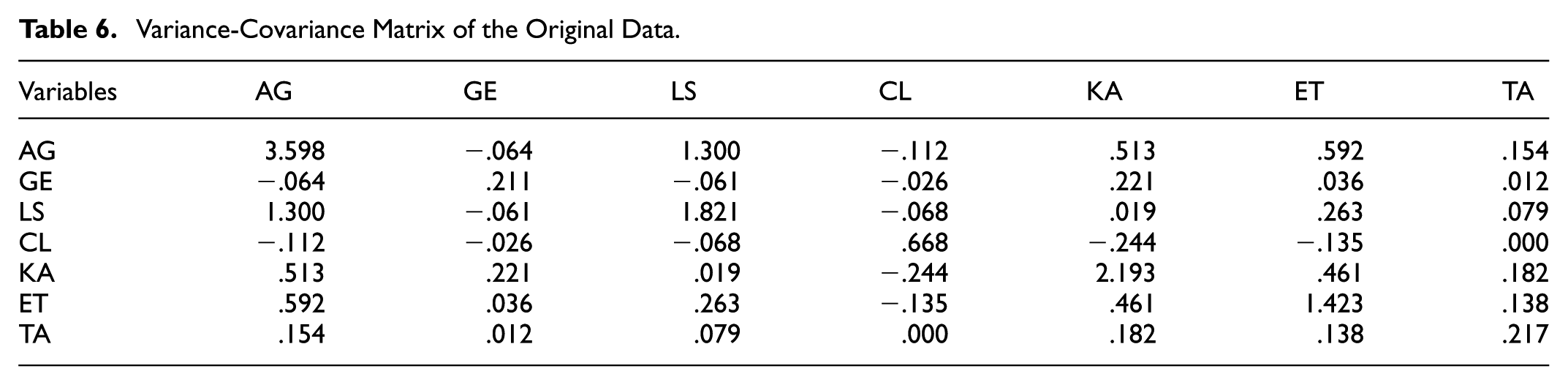
Below, we analyze the conceptual model’s results and the hypotheses posed regarding the relationships between the variables (see Figure 1). Table 6 presents the variance-covariance matrix of the original data of the model variables.
Variance-Covariance Matrix of the Original Data.
As mentioned in previous sections, the measurement model fit was reviewed before beginning the hypothesis testing and after validating the instrument. A good fit of the model is observed,
We used the Maximum Likelihood estimator with Robust Standard Errors (Huber–White) and a Satorra–Bentler scaled test statistic (MLM) for the model data analysis. This approach enhanced the estimates’ robustness, ensuring more reliable and valid statistical inferences.
The empirical estimates of the main results of the proposed model are presented in Figure 4 and Table 7.

Hypothesis testing.
Summary of Hypothesis Testing.

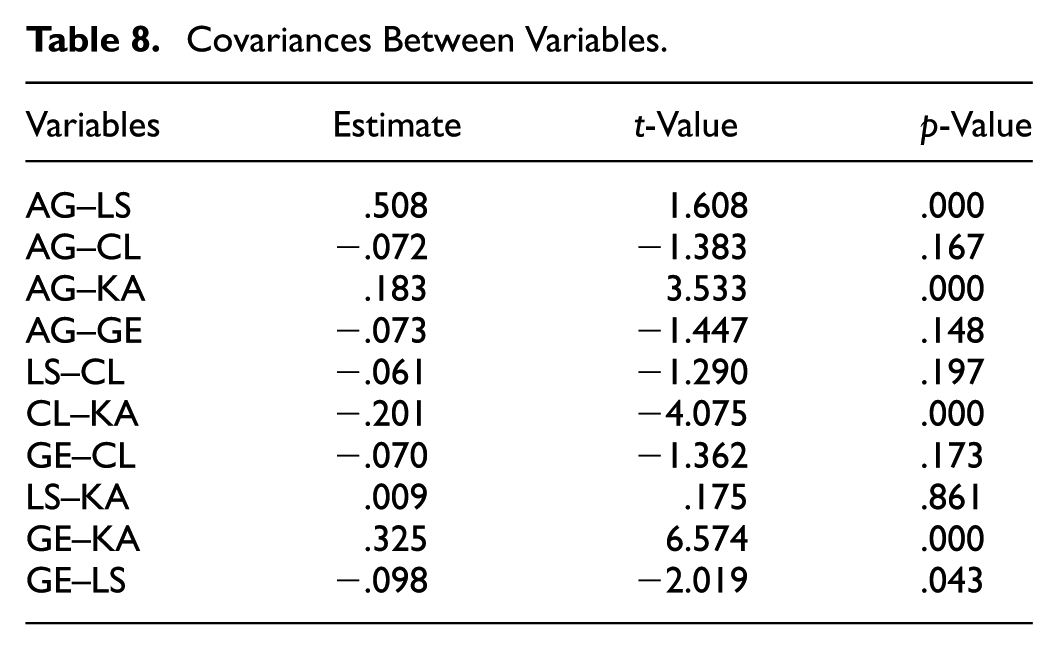
Additionally, the results reveal significant covariances
Covariances Between Variables.
Discussion
This research analyzes the interrelationships and influences of multiple factors, such as age, length of service, gender, campus location, area of expertise, and education training, on adopting teaching approaches in higher education. The results may offer valuable insights for the academic community and university administrators seeking to understand and support improvements in teaching practices and faculty development.
The data obtained through the S-ATI-20 questionnaire reveal a plurality of teaching approaches among UPS faculty. Rather than a clear-cut dichotomy between teacher-centered (ITTF) and student-centered (CCSF) orientations, we observed a convergence towards non-extreme positions on both dimensions, as shown in Figure 3. This convergence may reflect an adaptive, hybrid teaching style that combines content delivery with efforts to engage students, aligning with Case (2019), who argues for a more nuanced understanding of contemporary teaching strategies. The absence of a polarized distribution reinforces the notion of faculty flexibility and adaptability in shaping learning environments according to student needs and course objectives. Supporting this, most respondents cluster around lower middle values on both scales, highlighting the importance of reflective training programs that prepare educators to navigate diverse educational contexts with competence and creativity.
The ANOVA results further reveal that disciplinary background plays a significant role in shaping teaching approaches. Social sciences and humanities faculty display higher average CCSF scores (Social Sciences and Reason and Faith,
The lack of significant differences in teaching approaches across gender, age, and campus location variables indicates a shared institutional culture favoring CCSF adoption. This interpretation aligns with Romo (2021) and Postareff and Lindblom-Ylänne (2008), who emphasize the role of institutional culture in reducing variability in teaching orientations across faculty demographics.
Further analysis underscores that professional development plays a more decisive role in adopting student-centered approaches than pedagogical training. Instructors with medium (
The structural model results further confirm the influence of disciplinary background (
Regarding the teaching approach, the model also validates
Although gender (
Lastly, the positive correlation between the area of knowledge and campus location suggests that certain campuses specialize by discipline, reflecting broader socio-economic and cultural patterns. The observed correlation between area of knowledge and campus location reinforces the need for university governance structures that promote interdisciplinary collaboration and flatten hierarchical divisions between academic units to facilitate the broader diffusion of CCSF approaches.
These findings suggest that universities should implement sustained, discipline-sensitive professional development frameworks prioritizing mentoring, peer-learning structures, and reflective practice. In addition, reviewing faculty workload policies to create space for pedagogical innovation and course redesign may facilitate a more sustainable transition toward student-centered teaching practices. However, such institutional recommendations should be considered cautiously in light of the study’s contextual limitations, including its single-university scope and cross-sectional design.
Conclusions
The generalizability of our findings, drawn from a comprehensive analysis within a Latin American university context, may extend beyond regional confines, offering valuable insights into the global discourse on teaching approaches in higher education. The study methodology and the diverse academic backgrounds of the participating faculty members provide a sound basis for considering these conclusions in a broader academic audience. Specifically, the identified interconnections between faculty characteristics and their pedagogical approaches highlight the common challenge of aligning teaching practices with the evolving needs of students across different educational contexts. These findings emphasize the importance of fostering adaptable teaching strategies that accommodate a range of learning environments, from those heavily influenced by traditional teaching paradigms to those eager to embrace innovative pedagogical methods.
Our findings indicate that professional development has a more decisive influence than pedagogical training on adopting student-centered approaches associated with conceptual change and deep learning. These results highlight the importance of promoting sustained faculty development initiatives that prepare educators to create learning environments where students engage with knowledge in a more meaningful and integrated way. Within this context, mentoring and peer collaboration may be effective mechanisms to facilitate this pedagogical shift across various disciplines.
The observed disciplinary differences—most notably between STEM fields and the social sciences—suggest that faculty development should be responsive to the distinct epistemological and pedagogical traditions of each academic domain. In STEM, where information transmission remains dominant, targeted support is needed to foster practices that promote critical thinking, integration of knowledge, and conceptual restructuring, all of which are foundational to deep learning. Moreover, the absence of significant effects from demographic variables such as age, gender, and campus location points to an overarching institutional culture that may encourage faculty to adopt student-centered approaches. Reinforcing this culture through policies that explicitly recognize and support teaching practices that promote deep learning could further enhance the quality and consistency of teaching, particularly in areas where surface learning persists.
This study contributes by providing a multidimensional analysis of how demographic, disciplinary, and institutional factors influence teaching approaches. By applying structural equation modeling, we offer an integrative perspective that allows for a simultaneous examination of these variables. This approach has been underexplored in prior research on Latin American higher education.
Finally, given the high teaching load identified in our institutional context, universities must reassess workload policies to provide faculty with sufficient time and resources to design and implement strategies that foster deep learning. Supporting educators is crucial to ensuring the sustainable and effective integration of such pedagogical approaches. In conclusion, our study highlights the need for discipline-sensitive faculty development and institutional strategies that facilitate adopting teaching practices aligned with deep learning objectives.
Limitations and Future Research
Despite the valuable insights, this study presents several limitations that must be acknowledged. First, while the structural equation modeling (SEM) approach allowed for a comprehensive examination of multiple variables simultaneously, like any statistical method, it relies on specific assumptions regarding measurement models and sample characteristics. While SEM is well-suited for capturing complex relationships, parameter estimates can be influenced by sample size and distributional properties. Additionally, potential measurement error in latent constructs is a common consideration in SEM analysis, underscoring the importance of construct validation in future research to refine the robustness of findings further. Second, the data were collected from a single university within Ecuador, which may limit the generalizability of the findings to other institutional or cultural contexts, particularly outside Latin America.
Additionally, although the study incorporated a wide range of demographic and institutional factors, other relevant variables—such as departmental leadership styles, faculty personality traits, or informal peer dynamics—were not included and could also influence the adoption of teaching approaches. Finally, the study’s cross-sectional nature prevents the analysis of how teaching practices and professional development may evolve.
Future research could address these limitations by including additional contextual and personal variables, expanding the sample to multiple universities or regions, and employing longitudinal designs to examine how teaching approaches change in response to faculty development initiatives and institutional reforms.
Footnotes

Ethical Considerations
This study consisted of a minimal-risk, non-invasive questionnaire and did not require formal ethics committee approval. Ethical review and approval were waived due to the study's minimal-risk nature, the absence of personally identifiable data, and the non-invasive procedures. The potential benefits of generating evidence to inform teaching development outweighed any negligible risk to participants. All questions were non-sensitive, and no personally identifiable information was collected.
Consent to Participate
Participants were informed that their participation was voluntary and anonymous. The study questionnaire comprised two sections: (1) demographic information (age, gender, area of expertise, level of education, and years of service) and (2) twenty items assessing teaching approach preferences. Informed consent was obtained electronically from all participants before survey initiation.
Consent for Publication
Not applicable.
Funding
The authors received no financial support for the research, authorship, and/or publication of this article.
Declaration of Conflicting Interests
The authors declared no potential conflicts of interest with respect to the research, authorship, and/or publication of this article.
Data Availability Statement
Data will be made available on reasonable request.