




Abstract
Globally, educators and researchers use different terms to describe instructors’ approaches when presenting instructional material in formal and informal settings. Terms commonly used to describe instructional approaches include teaching/instructional strategy, teaching/instructional method, and teaching/instructional technique. Although practicing educators and researchers use these words interchangeably, they have different meanings, leading to confusion regarding the relationship between these approaches and their proper usage when describing instructional practices. The research-to-practice gap in all fields exacerbates the issue, as practitioners and researchers may use different terms. As a result, there is a need for consistency in the terms used to describe instructional approaches across all fields and a shared understanding of the correct meaning of the terms and the relation between the terms. Practitioners and researchers need a resource that includes the correct terms and provides information on instructional approaches for classroom application and research purposes. This paper presents a framework consisting of the definitions, the relationship, and the taxonomy for the terms: instructional strategies, methods, and techniques. This framework can help educators and researchers locate information about instructional approaches for classroom application and can serve as a catalog presenting the most common instructional strategies, instructional methods, and instructional techniques used in formal instruction.
Keywords
Instructional approaches refer to educators’ planned teaching and instructional activities. Instructors often specify the instructional approaches in their lesson plans and shared resources or when disseminating their work. Likewise, researchers often specify instructional approaches when searching for information or publishing research on instructional practices. The terms commonly used to describe instructional approaches include teaching/instructional strategy, teaching/instructional method, and teaching/instructional technique (Jones et al., 1979; Larson & Keiper, 2013; Treagust & Tsui, 2014; Wallace, 2008; Weston & Cranton, 1986) although many other terms have also been used, such as educational methods, instructional practice, and pedagogical strategy. The term used in a lesson plan, shared resource, published article, or library database search is often based on context (i.e., higher education, K-12, and corporate), personal preference, academic and professional background, or previous experience. For example, a high school science teacher may refer to their instructional approach for a lesson on genetics as their “teaching method.” On the other hand, a grant specialist in a company or university may search for instructional approaches used by high school science teachers using the term “instructional strategy.” The terms are also used interchangeably (Bruner, 1960; Gagné, 1977; Weston & Cranton, 1986) across the various places educators and researchers search or share their work (e.g., teacher resource websites, journals, and conferences), although they have different meanings (Akdeniz, 2016; Gündüz, 2016; Lang & Evans, 2006). Practitioners’ and researchers’ use of different terms across and between disciplines and fields has led to confusion regarding their connotation and correct usage when describing instructional practices (Akdeniz, 2016; Lang & Evans, 2006). The use of different terms also perpetuates a lack of clear and shared understanding of the meaning and relation of these terms.
To try and assist educators and researchers with locating information and selecting instructional approaches, scholars have developed frameworks of instructional strategies, instructional methods, and instructional techniques (Cheng & Yeh, 2009; Dean & Marzano, 2012; Kozma et al., 1978; D. M. Merrill, 2013; Reigeluth, 2012). However, the terminology used in these frameworks is inconsistent (e.g., strategies referred to as methods or the terms used interchangeably), causing other misperceptions when presenting, organizing, selecting, and researching instructional strategies, methods, and techniques.
The results of exchanging and/or incorrectly using these terms include (a) variations in and confusion about the meaning of the terms and (b) challenges for educators and researchers when investigating potential strategies, methods, and techniques to use in their classrooms or when completing research. As few researchers have addressed the differences among these terms (Akdeniz, 2016; Lang & Evans, 2006), it is essential for both educational practice and research that accurate and precise terms for instructional approaches be identified and consistently used to avoid confusion when discussing, designing, or researching instruction. Our goal is to address the need for accurate and consistent use of terms describing instructional approaches and encourage the use of correct terms to reduce confusion and improve shared understanding of the meaning of the terms within and across disciplines and research areas.
Purpose
This paper proposes a framework focusing on instruction and how the facilitator conducts instruction in formal learning settings. The purpose of the proposed framework is to: clarify the terms: instructional strategy, instructional method, and instructional technique; describe the relationship between these terms; and present a taxonomy to classify and use the terminology within instructional and research practices. By providing the framework, we hope to reduce confusion and improve shared understanding of the terms’ meanings. The taxonomy is based on hierarchical and whole-part relationships (National Information Standards Organization, 2005), in which the differences between the terms instructional strategy, instructional method, and instructional technique are presented together with some examples of instructional methods and techniques that could apply to different educational settings, including K-12, higher education, training programs, and professional development programs.
To achieve a clear conceptual understanding and usable definitions of these pedagogical terms, we will:
discuss and provide clarification of the terms teaching and instruction since these terms determine the types of strategies, methods, and techniques that are used within different settings (as portrayed in Figures 1 and 2);
discuss the common terms used in discussing instructional approaches strategy, method, and technique and provide clarification for each of these instructional approaches based on their application or use in the instructional process;
present our perspective on the relationship between these terms, and then,
provide structured guidance and a taxonomy for educators and researchers to refer to when discussing instructional approaches for presenting instruction.

Teaching and instruction comparison by settings.

Strategies, methods, and techniques within instruction.
Teaching and Instruction: What Is the Difference?
We start our discussion with the terms teaching and instruction, as these two terms encompass the various situations in which learning occurs. The terms teaching and instruction are used interchangeably (Bruner, 1960; Gagné, 1977; Garman, 2010), including when referring to a teacher’s actions in a classroom setting. Nevertheless, these two concepts differ in the setting in which they occur (Bengtsson, 2011; Molenda & Subramony, 2020; Wright, 2011).
Teaching
The term teaching has been used for centuries and can be traced to Confucius (561 B.C.), the first-mentioned private teacher (Hirsch, n.d.). Over the centuries, teaching has been referred to as a practice in any pedagogical setting. Today, teaching can be seen as both an activity or performance (i.e., teaching) and a profession (i.e., teacher). In teaching, a person shares knowledge and experience so that another can learn (Lanford, 1978). Teaching can occur in any setting, including during formal instructional activities in formal education settings (e.g., school), or in other settings, for example, at home when teaching a child to grab a spoon or at a stadium when explaining the rules of a sport. As the most general term for an attempt to help someone learn, teaching can be defined as:
actions by which one person intends that another person learn a certain content of knowledge. Teaching occurs in everyday situations in the family or in the street, but most teaching occurs in institutionalized settings with a predefined curriculum. The most common teaching institution is the school, but teaching is also an institutionalized activity in hospitals and companies. (Bengtsson, 2011, p. 459)
Instruction
The term instruction was first used in education in the 15th Century (Vocabulary.com, n.d.). At that time, the term was presented as instruccioun, and defined as “action or process of teaching” (Harper, 2020). More recently, Wright (2011) defined instruction as “guided exercises, lessons, and materials used to teach a subject” and “the formal act of imparting knowledge or developing skills: teaching” (p. 239). Therefore, we contend that instruction refers to the act of teaching in a didactic setting to foster student interaction and aid learning (Arends & Castle, 2002). Extending this line of thought, we state that all instruction is a form of teaching. However, as instruction is more specific than teaching, and instruction is exclusive to formal learning settings (e.g., K-12 classrooms, digital marketing training, and marching drills), some teaching forms are not forms of instruction (e.g., He is teaching the children to fish at the lake.). As displayed in Figure 1, the larger circle of “teaching,” includes the act or process of teaching in all settings. The smaller circle, which is “instruction,” refers to the act of teaching within a formal learning setting. Examples are provided to provide further clarification.
Clarifying and correctly identifying the terms teaching and instruction are essential steps toward the discussion on differentiating instructional strategies, methods, and techniques. The following section will discuss the terms instructional strategy, instructional method, and instructional technique based on their breadth and specificity in the instructional process to further clarify the meaning of the terminology used for discussing instructional approaches.
Strategy, Method, and Technique: What Is the Difference?
We noted that a common issue with teaching and instruction is the interchangeable use of these terms by researchers, theorists, and educators. We also see this issue with strategy(ies), method(s), and technique(s). For example, Wallace (2008) defines a method as “a strategy, activity, or procedure for teaching or supporting learning” (p. 179), while Jones et al. (1979) define a strategy as “[a]n educational method for turning knowledge into learning” (p. 1). In each case, the author has used the term method or strategy to describe the other term. In addition, the terms instructional strategy and instructional method are used interchangeably with the term technique. For example, Larson and Keiper (2013) include the methods and techniques of lecture/interactive presentations, cooperative learning, simulations, and discussion and debate, as instructional strategies.
Strategies, methods, and techniques are planned ways to provide instruction to learners. In Figure 2, we can see how strategies, methods, and techniques fit into instruction. In the same figure, when the terms strategies, methods, and techniques are used to describe teaching in a formal learning setting, the most appropriate attribute is the characteristic of being instructional (an adjective used to describe when something is intended or used for instruction), resulting in instructional strategy, instructional method, and instructional technique.
As displayed in Figure 2, the larger circle of “instructional” operates as an umbrella characteristic of strategies, methods, and techniques. The colored circles of strategies, methods, and techniques in Figure 2 are positioned to show that instructional strategies are the focus of the instruction that a student experiences (that focus may be instructor-centered or student-centered), and as instructional methods and techniques each provide more specific instructional details and options; the circles representing methods and techniques are larger and are inclusive of the instructional strategy. We can also see that techniques are situated within methods, which are situated within strategies.
Instructional Strategy(ies)
Dick et al. (2015) define instructional strategies as “the general components of a set of instructional materials and the procedures used with those materials to enable student mastery of learning outcomes” (p. 174). In contrast, Elam (2011) argues that instructional strategies are the procedures used by instructors to show that their energies “assist learners with their study efforts for each performance objective” (p. 240). Other authors have other definitions (e.g., Jonassen et al., 1990; M. D. Merrill & Wood, 1975), each providing a different viewpoint on the term’s meaning. As we can see, there are significant differences in the definitions used to describe and classify instructional strategies (i.e., Dick et al. focused on the materials and the procedures used for student mastery, while Elam focused on the energies of the instructor to assist with student performance), which leads to confusion about the meaning of the term and its correct usage. Thus, there needs to be more consistency in the taxonomies used to classify instructional strategies.
Taxonomies that have been established for the term instructional strategy are based on the different models of teaching (“a description of a learning environment, including our behavior as teachers when that model is used”; Joyce et al., 2004, p. 25), and learning theories (Akdeniz, 2016). For example, Akdeniz (2016) provided a table (see Table 2.2, p. 64) that summarizes how instructional strategies have been labeled. In this table, Akdeniz (2016) included instructional strategies from 11 different taxonomies (or frameworks) researchers have developed since 1985. However, although some of these frameworks are presented as instructional strategies, they inaccurately include the instructional activities that should be classified as instructional methods and techniques, such as lectures, cooperative learning, and questioning (e.g., Larson & Keiper, 2013). Due to the lack of consistency, Akdeniz (2016) argued that instructional strategies have been inaccurately classified by researchers and then used by researchers and educators to refer to different taxonomies resulting in confusion with strategies, methods, and techniques in educational settings.
Akdeniz (2016) and Lang and Evans (2006) have addressed the ambiguity and agree that instructional strategies are not synonyms of instructional methods and techniques, and they have depicted the whole-part relationship among these three terms proposing their own frameworks of instructional approaches. However, the conceptual structures proposed by Akdeniz (2016) and Lang and Evans (2006), do not show how the subordinate terms (methods and techniques) refer to other members or parts. In the frameworks proposed by Akdeniz (2016) and Lang and Evans (2006), instructional strategies can be used globally in any field when the primary purpose is to instruct people.
As we can see, instructional strategies have been defined as the most general component by Dick et al. (2015), as an approach (such as direct instruction) by Lang and Evans (2006), and by other authors as an aid for learning. However, we view instructional strategies for our taxonomy and framework as the focus or orientation of the instruction the student is experiencing. We also view instructional methods and instructional techniques as providing more specific instruction information. As explained in detail in the following sections, these terms have a hierarchical and whole-part relationship that impacts the organization and structure of our taxonomy and framework. Hierarchical and whole-part relationships of words are based on degrees or levels of superordination and subordination. In this type of relationship, a superordinate term represents a class or a whole, and a subordinate term refers to a member or part. Thus, we propose that instructional strategy be considered the focus or orientation of the classroom. This focus can be referred to as the center of the instruction (e.g., instructor/teacher-centered or student/learner-centered). We also propose that an instructional strategy be classified as the focus of the classroom, such as instructor-oriented and student-oriented.
Instructional Method(s)
Compared to instructional strategies, instructional methods are more specific and are derived from a strategy (Lang & Evans, 2006; Vural, 2016). Methods represent a narrower and more specified instruction, which is more systematic than an instructional strategy (Vural, 2016). As shown in Figure 3, as instructional methods are secondary to strategy, they are at a lower level than instructional strategies in the hierarchy of instructional approaches. Further, as an instructional method is more specific, one instructional strategy can comprise one or more instructional methods (Lang & Evans, 2006).

Proposed taxonomy of the three concepts: strategy, methods, and techniques.
Wallace (2008) wrote that a method is any “…activity or procedure for teaching or supporting learning” (p. 179). Shatzer (1998) asserted that instructional methods could also be considered as the “how” of the teaching process since they “… translate the content of the curriculum and the intent of the faculty into action” (p. S38). Clark and Starr (1976) and Vural (2016) alluded that an instructional method is a systematic plan of what to teach, how to teach, and what tools to use. Considering these previous descriptions, we combined key elements (i.e., activity or procedure, teaching process, with consideration of topic, materials, and students) of those definitions and adopt the following definition: An instructional method is an activity or procedure of teaching or supporting learning while considering the subject to be taught, the materials that will be used, and the characteristics of the student(s).
Examples of instructional methods are lectures, problem-solving, case studies, demonstrations, and learning through discovery (Lang & Evans, 2006; Wallace, 2008). Although these methods generally correspond directly to one strategy, a strategy can be composed of many methods, and depending on how the method is conducted, it could be performed either from an instructor-oriented or a student-oriented approach. For example, an instructor can perform lab experiments in front of a class as a demonstration method. In this instance, the lab experiments would be classified as instructor-oriented because the instructor would be the focus of the learning as they provide the instruction. In contrast, if the students were required to experiment by themselves, this method would be approached from a student-oriented strategy to reach the desired learning objectives (Gündüz, 2016). Each instructional strategy can be delivered through many different methods. Instructors can choose one method or use various methods in a class (Vural, 2016; Wallace, 2008). For example, an instructor can dedicate the whole class time to a lecture. In the following class, the instructor can initially use the instructional method of questioning, continue with a small lecture, and finish with a cooperative project. Methods are selected based on the students’ needs and motivation, the content to be taught, and the instructor’s experience and beliefs (Vural, 2016; Wallace, 2008). Moreover, Brown and Atkins (2002) stated a continuum in which instructional methods could be placed from the most instructor-centered to the most student-centered. For instance, although lectures and questioning belong to instructor-centered strategies, teachers have less control over student participation and how communication occurs in these methods. Implementing a method in a class requires an even more specific level within the systematic plan: instructional techniques.
Instructional Technique(s)
Methods are composed of smaller units of instruction called techniques. Techniques are instructional experiences or tools designed to deliver instruction. Compared to methods, techniques are narrow and specific instructional experiences or tools (e.g., simulation in virtual reality). In addition, although some techniques can be used to deliver instruction independently of a teacher (e.g., brainstorming), instructional methods require instructional techniques (Gündüz, 2016). Techniques are more specific than methods, and one instructional method can comprise one or more instructional techniques. For example, a teacher may use the instructional method of collaborative learning with the technique of brainstorming. In this example, students will work together to brainstorm ideas for a project they may work on together. The technique of brainstorming is the process learners will use for learning through a collaborative learning method. Examples of techniques include field observation, group investigation, and brainstorming. Table 1 shows the alignment between the strategies, some methods, and several techniques.
Techniques, Methods, and Strategies within Instruction.

The Relationship Between Strategies, Methods, and Techniques
Strategies, methods, and techniques represent conceptualizations of instructional approaches. Although these are abstract concepts, they represent observable behaviors related to their conceptual meaning and real activities. To better understand the association between these terms and the conceptualizations they represent, we will look at the meaning of each term and how each term relates to the other terms.
Semantic relationships are word associations based on the meaning of words (National Information Standards Organization, 2005). Semantic relationships are based on equivalent, hierarchical, or associative relationships (National Information Standards Organization, 2005). Confirming the relationship between the terms instructional strategy, instructional method, and instructional technique, and establishing a principle for consistent use, will lead to precedent and help resolve the ambiguity between these terms. It will also encourage appropriate labeling of instructional strategies, methods, and techniques in databases and web navigation tools. Furthermore, when educators and researchers search for information on instructional approaches, it will improve their findings and thus improve instructional practices and research related to instruction.
The relationship between these concepts is hierarchical and is “based on degrees or levels of superordination and subordination, where the superordinate term represents a class or a whole, and subordinate terms refer to its members or parts” (National Information Standards Organization, 2005). Hierarchical relationships are classified into three types: the generic relationship, the instance relationship, and the whole-part relationship. The relationship between instructional strategy, method, and technique is a partitive or whole-part relationship. The whole-part relationship is characterized by including one concept within another one “with the whole treated as a broader term” and its parts as narrower terms (National Information Standards Organization, 2005). This relationship can be depicted as a taxonomy and defined as an organization of terms in a hierarchical structure showing broader-narrower term relationships. This taxonomy has three levels: strategy is the broader term, followed by methods, and then techniques, which is the narrower term. We presented the proposed taxonomy for these terms in Figure 3.
Taxonomy and Structural Framework
The proposed taxonomy presents a structural framework describing the organization and relationship between the terms instructional strategy, method, and technique. As a structural framework, the purpose is to illustrate the relationship structure of these terms and include some examples. Note that this taxonomy is not meant as a procedural framework to guide instructors in selecting instructional strategies, methods, and techniques for their educational practice. The proposed structural framework presents not only the whole-part relationships that other authors have addressed (Lang & Evans, 2006; Saskatchewan Education Department, 1991), but also the hierarchical relationship showing how the superordinate term (instructional strategies) comprises other subordinate terms (instructional methods and techniques; National Information Standards Organization, 2005). Further, this taxonomy includes one more level of specificity compared to the frameworks presented by Lang and Evans (2006) and Saskatchewan Education Department (1991); we added instructional techniques consisting of actions, procedures, and skills, which are considered a subcomponent of an instructional method (Gündüz, 2016). Instructional techniques were not included in the frameworks presented by Lang and Evans (2006) and Saskatchewan Education Department (1991); instead, they included instructional skills, which are specific teacher behaviors (Lang & Evans, 2006). These behaviors are contained within our framework’s definition of instructional techniques. The techniques are activities that could support the cognitive process involved in the instructional process (Gündüz, 2016).
Figure 3 presents the hierarchical relationship established for these three terms. Instructional strategies, which are the most limited in number, are at the top. Techniques encompass the largest number of approaches and are placed at the bottom. To further explain and exemplify the taxonomy using the instructor-oriented strategy, methods, and techniques, we provide an example in Figure 4.

Examples of the proposed taxonomy of three concepts: strategy, methods, and techniques.
Figure 4 depicts the hierarchical relationship between these three concepts and their approaches. Although instructional strategies are described as the most general term, they represent the lowest number of approaches as there are only two (instructor-oriented and student-oriented). Instructional techniques, on the other hand, represent the highest number of approaches. Therefore, they are placed in the broadest section of the cone. Even though this graphical representation is from a side view, the relationship can also be seen from a top-down perspective, in which Vural’s (2016) point of view is shown. Vural (2016) emphasized the differences between teaching strategies, methods, and techniques by stating that although these terms appear to have a hierarchical relation, they are also embodied within each other (see Figure 5).
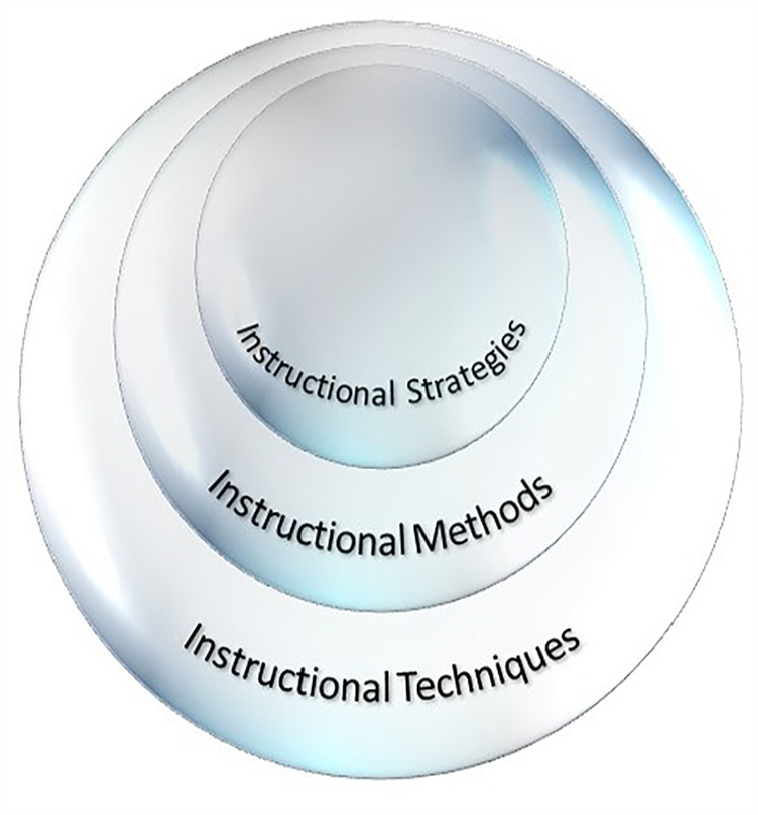
The whole-part relationship between the three concepts: strategy, methods, and techniques.
As shown in Figure 5 (a top-down and concave view of the relations of these concepts), instructional strategy is the broader term and is therefore placed at the top as it includes methods and techniques within its purview. Methods are one level lower and within the strategies, implying that they are more specific but have more options than strategies. Then, we present techniques with the most specific and smallest units but the most numerous options for composing a lesson.
Regardless of the order in which the decision or planning process in instruction occurs (defining the strategy or the techniques first), we do not view this relationship as one term being better, higher, or more important than another. Rather this default hierarchy is applied as we examine the concepts of teaching and learning and the design of teaching and learning in a formal context.
As displayed in Table 1, some instructional techniques can be part of one or more methods depending on how they are developed in instruction. For example, problem-solving projects can be part of discovery, project-based, or collaborative learning methods. On the other hand, some instructional techniques conform to one method exclusively; for instance, an oral presentation corresponds to lectures as an instructional method. Nevertheless, both methods can be used during the same lesson. Lang and Evans (2006) asserted that an effective lesson might have several instructional strategies and methods to achieve specific learning objectives. The instructor is responsible for deciding which instructional strategies, methods, and techniques to use based on their experience, beliefs, learning objectives, and the student’s needs (Vural, 2016).
Implications
The implications of the consistent use of the terms describing instructional approaches and the taxonomy for classifying them have many benefits for practitioners and researchers.
Conclusion
The proposed taxonomy defines the distinction between these terms to resolve the inconsistent use of the terms, strategy, method, and technique for instruction (Akdeniz, 2016; Lang & Evans, 2006). There are several benefits of using the correct terms for practitioners and researchers. By using correct terms when searching for, inquiring about, writing about, or researching instructional approaches, practitioners and researchers will locate information on instructional approaches more efficiently and precisely. This taxonomy can serve as a basis for educators to identify appropriate instructional approaches for their classrooms based not only on the learners’ culture, language, ability, learning preferences, and interests but also on the time and resources available, the learning objectives, and standards set for the instructors (Dean & Marzano, 2012; Lang & Evans, 2006). It will also help researchers search, review, and write literature and complete studies on instructional approaches. The proposed framework can serve as a catalog that presents most instructional strategies, methods, and techniques available in instruction. As new methods and techniques are used, they can be included in the catalog for further application or research.
Footnotes
Declaration of Conflicting Interests
The author(s) declared no potential conflicts of interest with respect to the research, authorship, and/or publication of this article.
Funding
The author(s) disclosed receipt of the following financial support for the research, authorship, and/or publication of this article: Publication of this article was funded in part by Purdue University Libraries Open Access Publishing Fund.
Ethical Statement
This paper does not include human subjects’ research content
