




Abstract
Africa’s journey toward sustainable development continues to face persistent challenges linked to resource dependency, weak institutional frameworks, and uneven progress in human capital formation. This study explores how education, natural resource exploitation, banking sector development, and economic complexity interact to shape sustainability across 39 African countries between 2007 and 2022. Relying on robust econometric approaches—Feasible Generalized Least Squares (FGLS), Driscoll–Kraay estimators, and Quantile-on-Quantile regression—the analysis uncovers diverse effects depending on countries’ income levels and degrees of sustainability. The results show that education consistently promotes sustainability, whereas natural resource extraction tends to undermine it in less developed contexts but becomes a positive driver where governance and institutional quality are stronger. Similarly, banking sector development plays a dual role: it constrains sustainability in shallow financial systems yet fosters green investment and inclusive growth in more mature markets. These findings offer practical insights for policymakers across Africa seeking to align national priorities with the Sustainable Development Goals (SDGs) and the African Union’s Agenda 2063. Strengthening education, improving transparency in resource governance, and promoting innovative and inclusive finance emerge as key levers to advance long-term sustainability on the continent.
Plain Language Summary
Africa is facing growing challenges from climate change, industrial growth, and the use of natural resources. As countries on the continent continue to develop, it becomes more important to understand how we can achieve progress without harming the environment. This study looks at 39 African countries between 2007 and 2023 to explore how factors like education, natural resource use, banking systems, and the complexity of national economies affect sustainability. The findings show that education plays a consistent and positive role in helping countries grow in a sustainable way. On the other hand, over-reliance on natural resources and certain types of economic development can sometimes harm the environment. The study uses advanced statistical methods to uncover how these factors influence sustainability in different ways depending on a country’s specific context. This research highlights the importance of investing in education, managing natural resources carefully, and designing smart financial and economic policies. These steps are essential for building a greener, more resilient future for Africa.
Keywords
Introduction
Over the past decades, Africa has continued to grapple with enduring sustainability challenges rooted in structural economic dependence, weak industrial bases, and the dominance of informal activities. These difficulties stem largely from the continent’s colonial legacy of extractive growth and its uneven integration into global markets, which still influence patterns of development and resource governance today. Unlike early industrialized regions, Africa’s sustainability concerns are deeply intertwined with institutional capacity, resource management, and the quality of education systems—factors that ultimately determine how countries reconcile economic expansion with environmental stewardship. Recent global shocks such as the COVID-19 pandemic and the Russo-Ukrainian conflict have further exposed Africa’s structural vulnerabilities by disrupting food and energy supply chains and constraining public investment. In this context, understanding how education and natural resource governance interact to support sustainable development is essential for advancing the Sustainable Development Goals (SDGs) and realizing the aspirations of Africa’s Agenda 2063.
The relationship between education, natural resource management, and sustainability has been widely theorized (Chen & Guo, 2023; Gylfason, 2001; Hu & Zheng, 2023; S. Li et al., 2024; Tàbara & Pahl-Wostl, 2007), yet it still calls for broader empirical confirmation. Since the 1960s, education has been recognized as a crucial means of fostering environmental awareness and technical capacity, an idea later institutionalized in the Tbilisi Declaration (UNESCO, 1977). Environmental education seeks to cultivate both knowledge and responsibility toward the planet by linking social, economic, and ecological perspectives; laying the groundwork for what is now known as sustainability education (Kopnina, 2012; Pavlova, 2013).
Youth, as future decision-makers, consumers, and educators, remain central to this transition, a reality underscored by the global climate movements of 2019 (United Nations Sustainable Development Goals, 2015). Across different contexts, initiatives have introduced environmental education into schools and local communities through participatory and experiential learning approaches designed to strengthen environmental literacy and practical competencies (Eshach, 2007). Recent global crises, including the COVID-19 pandemic and the Russo-Ukrainian conflict, have further revealed vulnerabilities in food, energy, and education systems—particularly in Africa—highlighting the importance of human capital and innovation in building sustainable resilience (United Nations Development Programme [UNDP], 2023; United Nations Economic Commission for Africa, 2024). In this regard, education functions as a transformative force aligning environmental, social, and economic objectives, consistent with the Triple Bottom Line 1 framework (Elkington, 1994) and the aspirations of Africa’s Agenda 2063. Higher education institutions play an indispensable role in shaping eco-conscious attitudes and responsible citizenship (Meyer, 2015; Nguyen et al., 2019; O’Flaherty & Liddy, 2018; Patel et al., 2017). To reinforce this role, universities are encouraged to integrate sustainability across their curricula, governance models, and institutional practices (Estellés & Fischman, 2020; Gombert-Courvoisier et al., 2014).
Therefore, this research aligns with Goal 1 of Africa’s Vision 2063, which aspires to build a prosperous and inclusive continent (African Union Commission, 2015). The recent acceleration of industrial activities across several African economies highlights the pressing need to adopt sustainable and responsible production models. For example, manufacturing output grew notably in South Africa (39.3%), Rwanda (30.2%), and Nigeria (4.6%) during 2021 (Moll de Alba & Todorov, 2022), reflecting both the region’s industrial potential and the environmental challenges associated with its expansion. Africa’s rapid economic expansion has led to a sharp increase in energy demand needed to sustain industrial and service activities, raising important questions about the continent’s long-term prosperity in the absence of sustainable practices. Many scholars argue that Africa’s development challenges must be understood through the lens of the three pillars of sustainability—economic, social, and environmental. From an economic perspective, Collier and Goderis (2007) identify the “resource curse” as a major obstacle to sustained growth, a finding further confirmed by Akinlo (2012) in the case of Nigeria’s oil-dependent economy. On the social front, Oketch (2006) underscores the contribution of human capital to growth, while Verspoor (2008) stresses the urgent need for reforms in secondary education to prepare young people for inclusive development. Environmentally, Shahbaz et al. (2016) provide evidence of an Environmental Kuznets Curve in several African economies, illustrating the complex interaction between globalization, growth, and ecological quality. More recent studies have adopted integrated frameworks: Hickel (2020) introduced the Sustainable Development Index to measure ecological efficiency, and the World Bank (2018) incorporated natural, human, and produced capital into a unified sustainability assessment model. Collectively, these contributions point to the necessity of a multidimensional approach in Africa—one that balances economic resilience, social progress, and environmental stewardship, particularly through sound governance of natural resources.
In recent years, the growing demand for natural resources has been largely propelled by industrialization both within Africa and in global markets. The continent possesses nearly 30% of the world’s mineral wealth (United Nations Environment Programme [UNEP], 2024), including around 40% of global gold reserves and nearly 90% of chromium and platinum deposits (Aladejare, 2020). The continent also accounts for approximately 12% of global oil and 8% of natural gas resources (UNEP, 2024).
Although Africa remains the world’s lowest emitter, its CO2 emissions have increased markedly—from 401,805 kt in 1990 to 760,868 kt in 2020 in Sub-Saharan Africa, and from 860,056 to 2,416,065 kt in the MENA region (World Bank, 2024). This upward trend reflects energy-intensive growth paths heavily dependent on non-renewable resources, which in turn exacerbate environmental pressures (Aquilas & Atemnkeng, 2022). According to Aladejare (2022), excessive exploitation of natural resources has resulted in significant ecological degradation, with extraction rates in Sub-Saharan Africa rising from 5% of GNI in 1990 to 6% in 2020, and reaching peaks as high as 11% (World Bank, 2024). Rapid demographic expansion—averaging 2.4% annually over the past 3 decades—combined with accelerated urbanization, has further intensified these pressures Walther (2021) and AfDB (2024). As a result, African economies are increasingly exposed to climate-related shocks, underscoring the need for research that can inform policies on sustainable resource management and the role of education in fostering green development. Against this background, the present study investigates how education, natural resource use, banking sector development, and economic complexity influence sustainability across 39 African countries between 2007 and 2022. Consistent with the United Nations Sustainable Development Goals (2015), it seeks to provide evidence-based insights to guide sustainable strategies and policy practices on the continent.
Building on the global policy framework, this study explicitly aligns its objectives with the Sustainable Development Goals (SDGs). Education directly advances SDG 4 (Quality Education) and indirectly supports SDG 1 (No Poverty) and SDG 10 (Reduced Inequalities) by strengthening human capital and promoting inclusive growth. Effective natural resource management contributes to SDG 12 (Responsible Consumption and Production) and SDG 13 (Climate Action), reflecting the environmental dimension of sustainability. Positioning the analysis within these SDGs highlights the policy relevance of this research for promoting multidimensional sustainability across Africa. Despite growing global interest in the SDGs, research focused specifically on African sustainability remains limited. Much of the existing literature adopts a single-dimensional perspective, emphasizing either economic, social, or environmental outcomes, rather than employing composite indicators that integrate all three. Moreover, advanced econometric approaches such as the Quantile-on-Quantile (QQ) method are still seldom applied, even though they allow for the identification of heterogeneous effects across different levels of sustainability performance. Another limitation concerns the neglect of structural diversity among African economies—differences in resource endowments, governance systems, and financial development that can shape sustainability dynamics. To address these gaps, the present study investigates how education, natural resource management, banking sector development, and economic complexity jointly influence sustainable development in 39 African countries over the period 2007 to 2022, using a QQ regression framework. By doing so, it strengthens methodological rigor and provides context-sensitive evidence to guide sustainability policies. Although centered on Africa, the study also contributes to broader global discussions on the green transition, inclusive development, and the realization of the SDGs, offering insights relevant to other developing regions such as Latin America and Asia.
This study is grounded in four complementary theoretical frameworks. First, the endogenous growth theory highlights the central role of education and human capital as engines of long-term and sustainable progress (Lucas, 1988; Romer, 1990). Second, the Environmental Kuznets Curve (Grossman & Krueger, 1995) explains how economic growth can initially worsen but eventually improve environmental quality as income levels rise. Third, the resource-curse hypothesis (Sachs & Warner, 2001) cautions that excessive dependence on natural resources may hinder diversification and long-term sustainability. Finally, the theory of economic complexity (Hidalgo & Hausmann, 2009) links productive sophistication and knowledge intensity to broader development outcomes. By integrating these perspectives, this paper develops an analytical framework that connects education, natural resources, financial development, and productive sophistication as interdependent drivers of sustainable development. It contributes to the existing literature by examining these dimensions simultaneously within the African context, using robust econometric approaches such as Feasible Generalized Least Squares (FGLS), Driscoll–Kraay estimators, and Quantile-on-Quantile Regression (QQR).
Building on these theoretical insights and the identified empirical gaps, this study formulates the following hypotheses to guide the subsequent analysis:
After the introductory section, the second part of the paper reviews the existing literature, followed by the third section, which outlines the research methodology. The fourth section presents and interprets the empirical findings, while the final section concludes the study and offers policy recommendations.
Review of Past Studies
Economic Sustainability and Structural Transformation
Economic sustainability goes beyond maintaining macroeconomic stability—it reflects an economy’s capacity to innovate, diversify, and invest in human capital to ensure long-term resilience. Classical economists such as Lewis (1954) and Kuznets (1971) emphasized that sustained growth depends on a structural shift from low-productivity primary sectors toward more diversified, higher value-added industries. In the modern era, this transformation increasingly depends on education and technological advancement as key drivers of productivity.
In Africa, this structural transformation has progressed slowly and unevenly. Despite an average GDP growth rate of 3.8% between 2010 and 2022, the African Development Bank (2024) reports that manufacturing still accounts for less than 12% of GDP, while extractive industries continue to dominate export structures. Although tertiary enrollment rose from 8% in 2000 to 21% in 2022 (UNESCO, 2021), this expansion in education has not yet translated into industrial diversification. Quixina and Almeida (2014) underscored this limitation in the case of Angola, where oil-driven growth failed to generate broad-based economic development.
A growing body of research has examined the relationship between structural change and sustainability. Neagu (2019) and Danish and Ulucak (2020) identified what they termed the “complexity paradox,” suggesting that industrial sophistication may initially increase environmental pressures in economies lacking access to clean technologies. Omri and Afi (2020) showed that in North Africa, education and entrepreneurship promote sustainable activities, though their impact depends largely on governance quality and financial inclusion. Similarly, Saqib et al. (2020) highlighted weak implementation of Education for Sustainable Development (ESD) programs in Pakistani universities, calling for stronger integration of sustainability principles at the undergraduate level.
Recent empirical evidence underscores the importance of adopting a multidimensional perspective on sustainability. Feng et al. (2023) examined the interplay among eco-digitalization, green finance, and renewable energy in China, revealing that these factors substantially reduce CO2 emissions, whereas rapid urbanization continues to intensify environmental degradation. Although their analysis centers on China, the findings offer valuable lessons for shaping Africa’s emerging green policy agendas. Stojkoski et al. (2023) further argue that economic sustainability is inherently multidimensional, requiring a holistic and coordinated transformation process. Likewise, Asif et al. (2024) demonstrate that eco-digitalization, green finance, and innovation jointly foster sustainability in BRICS economies by aligning technological advancement with environmental policy frameworks. Together, these studies point to the need for strategies that integrate education, technological innovation, and green policies to achieve sustainable long-term growth. Complementary research also highlights the central role of education in reinforcing sustainability outcomes. Baierl et al. (2022) and Wetering et al. (2022) find that environmental education cultivates pro-environmental behavior and strengthens sustainability awareness among individuals and communities.
Beamond et al. (2024) contend that business schools should embrace holistic, values-based education to cultivate ethical and socially responsible leaders. Similarly, Leal Filho, Viera Trevisan, et al. (2024) emphasize the role of sustainable innovation in industrial production, underscoring how academic research can advance low-carbon technologies and processes. Parallel to these perspectives, studies on economic complexity reinforce the case for a knowledge-driven transformation. Hoeriyah et al. (2022) found that higher economic complexity fosters structural transformation and sustainable growth, with human capital and innovation serving as key enablers. Olaniyi and Odhiambo (2023), employing quantile regression, demonstrated that institutional quality moderates the relationship between financial development and economic complexity across 29 African countries. These findings highlight the importance of context-specific policy frameworks—an idea that underpins the present research. Nevertheless, resource-based sectors continue to represent nearly 70% of Africa’s total exports (World Bank, 2024), revealing an urgent need to strengthen the links among education, innovation, and industrial diversification. In sum, the literature consistently points to the necessity for African economies to integrate human-capital development, technological innovation, and industrial diversification within coherent and forward-looking policy frameworks to achieve sustainable economic transformation.
Environmental Sustainability and Carbon Intensity
Environmental sustainability has become a central pillar of development policy, particularly in resource-dependent economies. Grounded in the Ecological Modernization Theory, it suggests that economic growth and environmental protection can complement each other through technological innovation, regulatory reform, and investment in human capital (Mol & Sonnenfeld, 2000). However, in developing regions such as Africa—where industrialization remains heavily reliant on extractive sectors—the challenge lies in achieving low-carbon growth without constraining economic progress. Historically, natural resource exploitation has represented a double-edged sword. Tilton (1996) and Wellmer and Becker-Platen (2002) observed that, while natural endowments can spur industrialization, they frequently lead to environmental degradation. More recent studies, including those by K. Khan et al. (2022) and Nwani et al. (2024), confirm the existence of a “carbon curse,” showing that resource wealth tends to intensify emissions through excessive consumption and limited diversification. These findings reinforce the urgency of accelerating renewable energy adoption and promoting sustainable resource governance. Africa’s situation is particularly pressing: fossil fuels still supply nearly 80% of the continent’s total energy mix, while renewables account for less than 10%, despite its vast solar and wind potential (World Bank, 2024). According to the IEA (2023), Africa contributes only 3.5% of global CO2 emissions, yet 9 of the 10 most climate-vulnerable nations are located on the continent—an imbalance that underscores the need for adaptive, low-carbon development strategies.
Empirical evidence also highlights the critical role of governance and resource management in shaping environmental outcomes. Afolabi (2023) and Sibanda et al. (2023) found that weak institutions exacerbate the ecological damage associated with natural resource rents in Sub-Saharan Africa, whereas stronger governance structures help to mitigate these effects. Extending this line of inquiry to advanced economies, Ibrahim et al. (2023) applied second-generation estimators (CS-ARDL, DCCE-MG, AMG) to G7 countries and validated the Environmental Kuznets Curve (EKC) hypothesis, demonstrating that renewable energy use and ICT exports reduce CO2 emissions, while urbanization and dependence on non-renewable energy sources aggravate them. In the same vein, Charfeddine et al. (2024) confirmed that digitalization, renewable energy, and financial development jointly enhance environmental sustainability across the world’s most polluted economies. Moreover, Omri and Kahia (2024) showed that effective governance strengthens the positive relationship between resource wealth and human well-being in Saudi Arabia. while Omri and Omri (2025) demonstrated that governance and foreign direct investment (FDI) moderate the effect of resource abundance on sustainability—oil and mineral rents promote growth, but gas rents still exhibit features of a partial “resource curse.” Recent contributions have broadened the assessment of environmental sustainability through multidimensional indicators. Jain and Mohapatra (2023) developed a Composite Environmental Sustainability Index for 20 emerging economies over 1990 to 2020, revealing substantial disparities in environmental performance. Bilgili et al. (2023) found that in the MENA region, forest rents enhance environmental quality, whereas oil and mineral rents degrade it. In the African context, Deka (2024) confirmed that technological innovation, trade openness, and good governance strengthen environmental sustainability, while resource rents and rapid economic growth continue to worsen emissions.
Taken together, these studies converge on the view that achieving environmental sustainability demands integrated policy frameworks that harmonize governance quality, technological innovation, and the expansion of renewable energy with the broader goal of ecological preservation.
Social Sustainability, Inequality, and Human Welfare
Social sustainability refers to a society’s capacity to maintain equity, inclusion, and well-being over time. Drawing on Sen’s capabilities approach, which conceptualizes development as the expansion of human freedoms through access to education, health, and social justice, this perspective underscores that social sustainability depends on the extent to which economic growth is translated into equitable outcomes that enhance human dignity and quality of life (Rajapakse, 2016). Education has long been recognized as a cornerstone of inclusive social progress. Monroe and Krasny (2016) argued that education fosters civic responsibility and environmental awareness, while Ardoin et al. (2020) demonstrated that environmental education nurtures pro-environmental attitudes and conservation-oriented behavior. In the North African context, Omri and Afi (2020) showed that education and entrepreneurship jointly strengthen social and environmental outcomes, particularly when supported by sound governance and innovation. Likewise, Wetering et al. (2022), in a meta-analysis of 169 studies, confirmed that sustainability-oriented education significantly enhances civic engagement among youth.
Despite notable progress, inequality remains one of the most persistent barriers to social sustainability in Africa. Deep income disparities, unequal access to education, and limited social mobility continue to reinforce exclusion, undermining the social foundations of sustainable development. Both the UNDP (2024) and the World Bank (2024) emphasize that inclusive and redistributive policies are essential to transform economic growth into shared prosperity. Nearly 34% of the population in Sub-Saharan Africa still lives below the international poverty line, while the region’s Gini coefficient—exceeding .43—remains the highest in the world (UNDP, 2024). Although primary school enrollment exceeds 95%, participation drops to 45% at the secondary level and only 21% in tertiary education (UNESCO, 2021). Omri and Kahia (2024) further note that effective resource management and strong institutional frameworks are key to improving welfare and overall life quality. Recent scholarship also highlights that equitable education and inclusive governance are central pillars of human well-being. Reimers (2024) underscores that SDG 4 identifies education as a catalyst for equality and human rights, while Leal Filho, Viera Trevisan, et al. (2024) describe universities as “civic incubators” that nurture community engagement and social responsibility. Complementing this view, Leal Filho, Sigahi, et al. (2024) demonstrate that active student participation in sustainability initiatives strengthens alignment with the SDGs and promotes intergenerational inclusion.
In Africa, Asongu et al. (2024) find that lifelong and gender-inclusive education strengthens governance effectiveness in advancing social sustainability. Similarly, Tafese and Kopp (2025) argue that embedding social sustainability into education systems—through inclusion, participation, and institutional reform—is essential for building equitable and resilient societies.
Empirical evidence from the UNDP (2024) indicates that countries such as Mauritius, Seychelles, Botswana, Cabo Verde, Tunisia, Morocco, and Rwanda achieve higher sustainability scores due to stronger education systems, inclusiveness, and institutional quality (World Bank, 2024; World Governance Indicators, 2023). Lwesya (2025) further emphasizes that green finance and institutional reforms are vital for inclusive and sustainable development, although their effectiveness remains constrained by weak governance and limited participation.
Overall, the literature converges on the view that Africa’s pathway toward sustainable development depends on reconciling human welfare, inclusion, and governance reform. Persistent poverty and inequality continue to undermine both environmental and economic progress. Building on these insights, the present study explores how education and natural resource management jointly influence social sustainability and welfare across African economies, addressing a key empirical gap by integrating equity considerations into the broader sustainability framework.
Methodological Gaps in African Panel Studies
Despite the growing body of research on sustainability in Africa, methodological limitations continue to affect the robustness and comparability of findings. Many studies rely on mean-based regressions, Ordinary Least Squares (OLS), or first-generation panel estimators such as FMOLS, DOLS, and ARDL, which assume cross-sectional independence and parameter homogeneity. However, African economies are structurally diverse and economically interconnected, violating these assumptions and potentially biasing long-run estimates (Pedroni, 1999; Pesaran, 2000). Early contributions—such as Quixina and Almeida (2014) on Angola and Balsalobre-Lorente et al. (2018) on EU-5 economies—provided valuable insights but remained constrained by first-generation estimation techniques. Subsequent work by M. A. Khan et al. (2020) introduced threshold and moderating models to analyze institutional quality within the natural-resource–finance nexus, while Ucan et al. (2023) employed the Common Correlated Effects Mean Group (CCEMG) estimator to account for cross-sectional dependence and structural heterogeneity in BRICS countries. Nevertheless, these approaches still tended to overlook the multidimensional character of sustainability.
Second-generation econometric models have been developed to address issues of cross-sectional dependence and dynamic heterogeneity. Karangwa and Su (2023) proposed a multidimensional sustainability model for African economies (1990–2020), confirming that governance effectiveness, environmental quality, and inequality jointly determine the sustainable impact of foreign direct investment (FDI). Jain and Mohapatra (2023) constructed a Composite Environmental Sustainability Index (CESI) for 20 emerging economies over the same period, emphasizing the importance of multidimensional assessment. Similarly, Asif et al. (2024) applied second-generation estimators within a STIRPAT framework to BRICS economies (1995–2019), showing that green policies, renewable energy, and eco-digitalization foster sustainability, whereas urbanization and affluence tend to exacerbate environmental pressures.
More recent studies have shifted attention toward distributional heterogeneity. Debonheur et al. (2024) examined 41 African countries (1996–2019) using quantile regression and system GMM, finding that the impact of resource rents on human development differs by resource type: forestry and gas rents have beneficial effects, whereas oil and coal rents remain detrimental. Institutional quality was found to mitigate these negative outcomes, highlighting the need for stronger governance and economic diversification. Likewise, Niu et al. (2023) analyzed E7 economies (1995–2019) using PMG, MG, DFE, and Quantile Regression, revealing that resource dependence increases CO2 emissions, while financial development reduces them only when supported by coherent green-policy frameworks.
Nevertheless, important empirical gaps persist. Few studies on Africa employ robust estimators such as Feasible Generalized Least Squares (FGLS), Driscoll–Kraay, or Dynamic Driscoll–Kraay, which effectively correct for autocorrelation, heteroskedasticity, and cross-sectional dependence. Moreover, most analyses continue to examine finance, education, or natural resources in isolation rather than considering their joint interactions within an integrated sustainability framework.
Addressing these gaps requires both analytical innovation and contextual understanding of Africa’s ongoing transformation—driven by human-capital expansion, industrial diversification, and a gradual shift toward service-oriented economies. By 2050, Africa is projected to lead in resource-linked service industries such as mining finance, engineering design, and environmental assessment (United Nations Conference on Trade and Development, 2023). Many countries are therefore investing in education and vocational training while advancing green industrialization. Figure 1 illustrates the upward trend in school and tertiary enrollment across 39 African countries (2007–2022), reflecting steady progress but also persistent challenges in higher education.

Trends in school enrollment and tertiary education (% gross) from 2007 to 2022.
Building on these observations, the present study develops a composite Sustainable Development Index tailored to Africa’s multidimensional realities and employs robust estimators—panel quantile regression, Feasible Generalized Least Squares (FGLS), and Dynamic Driscoll–Kraay—to capture heterogeneous relationships between education, natural resources, and sustainability. This methodological approach enhances statistical reliability and provides deeper insight into how education and resource management jointly influence sustainable development trajectories.
Overall, the literature spanning economic, environmental, social, and methodological dimensions reveals progress but also enduring gaps. Few empirical studies have simultaneously examined education, natural resources, and finance. To the best of our knowledge, this is the first to analyze their combined effects on sustainability across 39 African countries (2007–2022). By integrating these dimensions within a unified framework, the study offers new evidence on the interplay between human development and environmental performance and contributes to evidence-based policymaking aligned with the Sustainable Development Goals (SDGs).
Materials and Methods
This study investigates how education and natural resources jointly influence sustainable development across 39 African countries over the period 2007 to 2022. The sample—detailed in Appendix A, was determined by data availability. All variables were compiled from the World Development Indicators (WDI), the African Development Bank (AfDB), and the Economic Complexity Observatory (OCE). A composite Sustainable Development Index (SDI), computed as the geometric mean of the poverty rate, economic growth, forest loss, and CO2 emissions, is used to capture the Triple Bottom Line (TBL) dimensions of economic, social, and environmental sustainability. Education and natural resources constitute the core explanatory variables, while banking development and economic complexity are included as controls. The empirical framework builds on previous works by Savelyeva and Douglas (2017), Alola et al. (2019), Can and Ahmed (2022), S. Khan et al. (2023), and Leal Filho, Viera Trevisan, et al. (2024).
The analysis is grounded in three complementary theoretical perspectives. The Triple Bottom Line (TBL) framework (Elkington, 1998; Isaksson, 2018) emphasizes the need to balance economic prosperity, social inclusion, and environmental preservation. The Inclusive Growth Theory (Asongu et al., 2024; Rauniyar & Kanbur, 2010; Tafese & Kopp, 2025) highlights the importance of equitable education and effective governance in ensuring shared welfare. Finally, the Environmental Kuznets Curve (EKC) hypothesis (Dinda, 2004; Grossman & Krueger, 1995; Ibrahim et al., 2023; Niu et al., 2023) explains the nonlinear relationship between economic growth, resource use, and environmental quality, suggesting that green finance and renewable energy can help reverse degradation trends.
Together, these theoretical frameworks provide a coherent rationale linking education, equity, and resource management to sustainability outcomes. Figure 2 presents the conceptual model, illustrating how structural factors (governance and education), financial dimensions (green finance and inclusion), and technological drivers (innovation and digitalization) interact through resource management and inclusive education to advance multidimensional sustainability in Africa.

Conceptual framework linking education, resource management, and sustainability in Africa.
In line with the research objectives outlined above, this study develops an econometric specification designed to capture the dynamic interactions among education, natural resources, financial development, and economic complexity as key drivers of sustainable development. This formulation ensures full consistency between the conceptual framework, the stated hypotheses, and the empirical design. Based on this structure, the econometric model is presented as follows:

Where SDI it denotes the Sustainable Development Index—EDU it represents education, measured by gross school and tertiary enrollment (%)—and NRR it indicates natural resource rents. X it is a matrix of control variables including banking sector development and the economic complexity index. β0 is the constant term, while β1 and β2 capture the coefficients of education and natural resource rents, respectively. γ i represents a vector of coefficients for the control variables. μi refers to the country-specific fixed effects, τ denotes the time-specific effects, and ξ it is the idiosyncratic error term. Detailed descriptions and expected signs of all variables are provided in Table 1 below.
Definition, Measurement, and Expected Signs of Variables.

Note. OEC = observatory of economic complexity; WDI = World Bank Indicator; ADB = African Development Bank.
The Sustainable Development Index (SDI) is constructed as the geometric mean of four dimensions—poverty reduction, economic growth, deforestation, and CO2 emissions—following the multidimensional approach proposed by Hickel (2020) and Sachs et al. (2021). This composite index captures the balance among the economic, social, and environmental pillars of sustainability. The SDI was constructed using data from the World Bank’s World Development Indicators (WDI, 2024) and the UN Sustainable Development Reports. All component indicators were normalized through the min–max standardization method, converting each variable into a unit-free scale ranging from 0 to 1. This approach ensures comparability across African economies and over time. Higher SDI values indicate better performance in sustainable development outcomes, reflecting improvements in social inclusion, environmental protection, and economic diversification.
Education (EDU) is measured by gross school and tertiary enrollment rates, consistent with Q. Li (2025) and Xu et al. (2025), who emphasize the importance of human capital formation and educational access in driving sustainable growth. Although this indicator reflects educational access rather than quality, it remains the most comprehensive and consistent measure available for African countries. Natural resource rents (NRR)—expressed as a share of GDP—combine oil, gas, coal, mineral, and forest rents following the World Bank (WDI) methodology. As highlighted by Hacıimamoğlu and Cengiz (2024), this measure captures both the economic benefits and the ecological costs associated with resource dependence. Banking sector development (BANK) is proxied by domestic credit to the private sector (% of GDP), in line with Byaro et al. (2024) and Musah et al. (2024), who underline its dual role in fostering investment while potentially increasing environmental pressures under weak regulatory frameworks. Finally, the Economic Complexity Index (ECI)—sourced from the Observatory of Economic Complexity (OEC)—reflects the knowledge intensity and technological sophistication of an economy. As emphasized by Tabash et al. (2024) and Ageli (2025), higher economic complexity supports innovation and facilitates sustainable structural transformation.
Panel datasets frequently exhibit cross-sectional interdependence, which can bias the estimates produced by traditional econometric methods. Dogan et al. (2017), Latif et al. (2018), and Ngangnchi et al. (2024) attribute this phenomenon to the increasing interconnectedness of national economies, where policy shocks or macroeconomic changes in one country may spill over to others. Consequently, robust estimation techniques must account simultaneously for autocorrelation, heteroskedasticity, and cross-sectional dependence to ensure valid inference.
To maintain methodological rigor, this study employs three complementary estimators. The Feasible Generalized Least Squares (FGLS) estimator is used for its efficiency in panels with moderate cross-sectional dependence (39 countries, 2007–2022), where more complex estimators such as CCEMG or AMG may lose precision. The Driscoll–Kraay (1998) estimator further corrects for both autocorrelation and heteroskedasticity in a fixed-T, large-N context typical of African data structures. Finally, the Quantile-on-Quantile Regression (QQR) model captures heterogeneous and nonlinear relationships across different levels of sustainability, uncovering distributional dynamics between education, natural resources, and development that are often overlooked by mean-based estimators.
Accordingly, the study specifies the following linear Equation 2:

Assembling the complete set of observations as indicated by Equations 3 and 4:


This new method accommodates unbalanced panels at the individual level i only a subset ti1, …, Ti with 1 ≤ ti ≤ Ti ≤ T of all T observations might be accessible. It is presumed that FIti are not correlated with the scalar error term ζ is for all s. However, the literature highlights another issue. ζ ti can display features such as autocorrelation, heteroskedasticity, and dependencies across sections. In such scenarios, λ i can be determined through ordinary least squares regression, as shown in Equation 5.

By examining averages and estimated standard errors, this method remains consistent regardless of the panel’s cross-sectional size. Driscoll and Kraay (1998) noted that this consistency holds even as N→∞. The resulting covariance matrix yields standard errors that are robust to both cross-sectional and temporal dependence. As demonstrated by Ditzen (2018), this technique is particularly effective for unbalanced panels and datasets characterized by potential structural breaks.
Results and Discussion
Descriptive Statistics and Pairwise Correlations
Table 2 presents the descriptive statistics for all variables, summarizing their central tendencies, dispersion, and distributional characteristics. The Sustainable Development Index (SDI)—constructed as the geometric mean of poverty, economic growth, deforestation, and CO2 emissions—exhibits moderate variability across countries, reflecting structural differences in sustainability performance. The education variable (EDU), measured by gross school and tertiary enrollment rates, displays a wider spread, indicating uneven progress in human capital development across African economies.
Descriptive Statistics and Pairwise Correlations.

Note. This table presents descriptive statistics, the Jarque–Bera (J–B) normality test, and pairwise correlations. The J–B probabilities (p < .05) indicate mild departures from normality, supporting the use of robust estimators. Correlations below |.80| and VIF values under 3 confirm the absence of multicollinearity, ensuring the reliability of subsequent regressions.
To complement the descriptive statistics, Figure 3 depicts the kernel density distributions of the Sustainable Development Index (SDI) and the Education Index for 39 African countries over the period 2007 to 2022. The smooth density curves highlight pronounced disparities in both sustainability and education levels across countries and over time. Education appears more symmetrically distributed, suggesting steady improvements in human capital formation, whereas sustainability outcomes remain skewed toward lower levels—reflecting persistent heterogeneity and the continuing challenge of balancing economic growth, environmental protection, and social equity across the continent.

Kernel density of SDI and education (2007–2022).
The indicators of banking sector development and economic complexity also exhibit considerable variation, reflecting cross-country differences in financial depth and innovation capacity. Although normality tests reject the assumption of a perfectly normal distribution, the pairwise correlation coefficients and VIF statistics indicate no evidence of multicollinearity, thereby supporting the reliability and robustness of the model estimates.
Unit Root and Cointegration Tests
Before estimating the model, a series of diagnostic tests were conducted to ensure the robustness of the panel analysis. Evidence of heteroskedasticity, autocorrelation, and cross-sectional dependence was detected, warranting the use of robust estimation techniques. The Feasible Generalized Least Squares (FGLS) estimator was applied for its efficiency in correcting heteroskedasticity and serial correlation, while the Driscoll–Kraay estimator was additionally employed because it produces robust standard errors under cross-sectional dependence.
Although dynamic estimators such as the Generalized Method of Moments (GMM) are commonly used to address potential endogeneity, this study focuses on long-run structural relationships. Diagnostic results indicated no significant endogeneity bias. Given that both FGLS and Driscoll–Kraay are robust to heteroskedasticity, autocorrelation, and cross-sectional dependence, these estimators were deemed appropriate for the analysis. Multicollinearity was examined through the Variance Inflation Factor (VIF), which confirmed the absence of collinearity issues. Furthermore, Westerlund’s (2007) cointegration test validated the presence of long-run relationships among the variables, while Pesaran’s (2004) CD test confirmed cross-sectional dependence, thereby justifying the application of the second-generation CIPS unit root test (Pesaran, 2007).
The second-generation CIPS test of Pesaran (2007) was then used to assess stationarity while accounting for cross-sectional dependence. The test was performed under both intercept and trend specifications, with optimal lag lengths selected according to the Schwarz Information Criterion (SIC) to ensure model parsimony. As reported in Table 3, the Sustainable Development Index (SDI) and banking sector development were found to be stationary at level, whereas education, natural resource rents, and the Economic Complexity Index (ECI) became stationary after first differencing. Therefore, all variables satisfy the panel-stationarity requirement for further analysis.
Panel Unit Root Test Results for Stationarity of Variables.

Notes. Unit root results are based on the CIPS second-generation panel test (Pesaran, 2007). A p-value < .05 indicates stationarity. Variables integrated at I (0) are stationary at level, while I (1) variables become stationary after first differencing, confirming their suitability for panel estimation. SDI = sustainable development index; EDU = education (tertiary enrollment, % gross); BANK = banking sector development; ECI = Economic Complexity Index; NRR = natural resource rents (% of GDP).
To verify the existence of a long-run equilibrium among the variables, the Westerlund (2007) panel cointegration test was applied. Table 4 presents the results, which account for cross-sectional dependence and heterogeneity across African countries. All four test statistics are significant at the 1% level, rejecting the null hypothesis of no cointegration and confirming a stable long-run relationship among sustainable development, education, natural resources, banking development, and economic complexity. These findings therefore justify the use of long-run panel estimators—FGLS, Driscoll–Kraay, and QQR—in the subsequent analysis.
Westerlund (2007) Panel Cointegration Test Results.

Notes. Gt (Group-t) – tests cointegration for individual countries; Ga (Group-α) – tests the average cointegration across all countries; Pt (Panel–t) – tests the null hypothesis of no cointegration for the entire panel; Pa (Panel-α) – provides a global measure of the panel’s long-run equilibrium. A p–value < .05 leads to rejection of the null hypothesis, confirming that the variables share a long-run relationship.
Econometric Estimates
Table 5 presents the results of the Hausman test, which is statistically significant at the 1% level, confirming that the fixed-effects specification is appropriate for interpretation. However, further diagnostics—including the Breusch–Pagan LM test for cross-sectional independence and the Modified Wald test for groupwise heteroskedasticity—are also significant at the 1% level, indicating the presence of heteroskedasticity that may affect the reliability of fixed-effects estimates. To account for potential cross-sectional dependence within the panel, the Pesaran (2004) and Chudik and Pesaran (2015) CD tests were also applied. As emphasized by Chudik et al., (2013), such dependence often arises from inter-country linkages and unobserved global shocks.
Baseline Panel Estimation Results: Pooled OLS, Fixed Effects, and Random Effects Models.
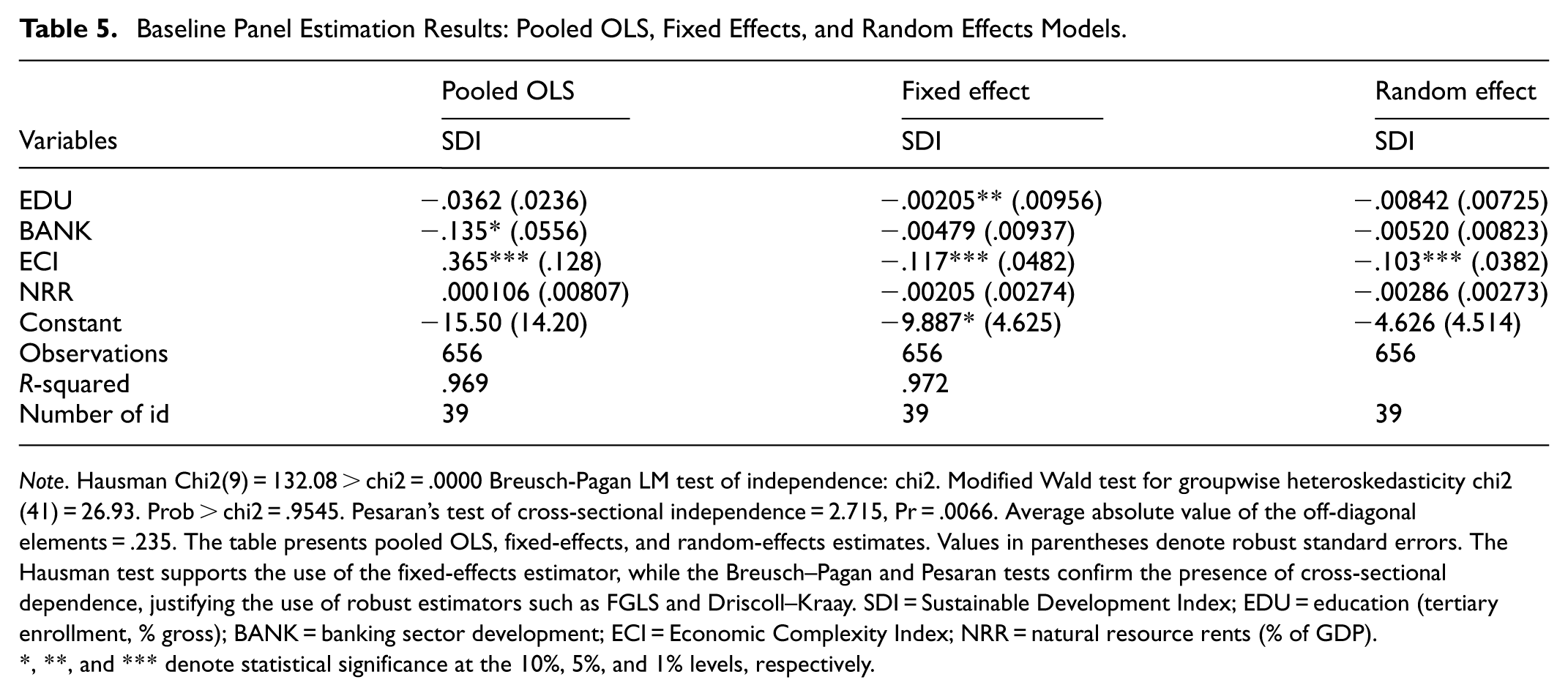
Note. Hausman Chi2(9) = 132.08 > chi2 = .0000 Breusch-Pagan LM test of independence: chi2. Modified Wald test for groupwise heteroskedasticity chi2 (41) = 26.93. Prob > chi2 = .9545. Pesaran’s test of cross-sectional independence = 2.715, Pr = .0066. Average absolute value of the off-diagonal elements = .235. The table presents pooled OLS, fixed-effects, and random-effects estimates. Values in parentheses denote robust standard errors. The Hausman test supports the use of the fixed-effects estimator, while the Breusch–Pagan and Pesaran tests confirm the presence of cross-sectional dependence, justifying the use of robust estimators such as FGLS and Driscoll–Kraay. SDI = Sustainable Development Index; EDU = education (tertiary enrollment, % gross); BANK = banking sector development; ECI = Economic Complexity Index; NRR = natural resource rents (% of GDP).
, **, and *** denote statistical significance at the 10%, 5%, and 1% levels, respectively.
Table 5 reports the results of the cross-sectional dependence test, which strongly reject the null hypothesis of cross-sectional independence. The table also indicates a relatively high average absolute correlation (.235), providing further evidence of cross-sectional dependence under the fixed-effects framework. Consequently, the Feasible Generalized Least Squares (FGLS) and Driscoll–Kraay estimators—both robust to heteroskedasticity, autocorrelation, and cross-sectional dependence—are employed to estimate the model parameters. The outcomes of these estimations are summarized in Table 6.
Robust Panel Estimation Results: FGLS, Driscoll–Kraay, and Dynamic Driscoll–Kraay Models.

Note. Values in parentheses denote robust standard errors. The inclusion of the lagged SDI in the dynamic model captures persistence and adjustment effects in sustainability outcomes. Wald χ2 and F-statistics confirm overall model significance (p < .01).
, **, and *** denote significance at the 10%, 5%, and 1% levels, respectively.
Table 6 reports the robust panel estimation results using the Feasible Generalized Least Squares (FGLS), Driscoll–Kraay, and dynamic Driscoll–Kraay estimators. The adjusted R-squared of .967 suggests that approximately 97% of the variation in sustainable development is explained by education, natural resource rents, and the included control variables. Despite this high explanatory power, the Variance Inflation Factor (VIF) diagnostics confirm the absence of multicollinearity, indicating stable and statistically reliable coefficient estimates. Furthermore, the F-statistic (6,320.07, p < .01) confirms the overall significance of the Driscoll–Kraay model, implying that the explanatory variables exert a strong and statistically significant influence on sustainability outcomes.
The regression results show that the previous year’s level of sustainable development (SDI) has a positive and statistically significant effect on current SDI at the 1% level. A 1% increase in sustainability performance in the previous period leads to an estimated .72% rise in the following year, highlighting strong path dependence in Africa’s sustainability dynamics. This finding underscores intertemporal persistence, where current sustainability outcomes are largely shaped by past institutional and structural achievements. Fadiran and Sarr (2017) observed similar institutional path dependence in Nigeria, while Osinubi and Simatele (2024) emphasized that governance quality mediates the long-run impact of inclusive participation on sustainable development.
Beyond institutional influences, both shocks and nonlinear dynamics further shape the persistence of sustainability outcomes. Asongu (2018) identifies CO2 emission thresholds beyond which environmental degradation constrains inclusive human development, suggesting that once critical ecological limits are exceeded, subsequent sustainability trajectories evolve along less favorable paths. Similarly, Kyne and Kyei (2024) find that disaster shocks exert delayed negative effects on sustainability and resilience, confirming that past disturbances continue to influence future SDI performance. In the same vein, Topf et al. (2023) introduce the Sustainable Development Pathway Index (SDPI) to capture deviations from optimal development routes, emphasizing that each country follows a path-dependent trajectory shaped by historical endowments and structural transformations.
Taken together, these findings, along with the dynamic SDI estimates, reveal that sustainability in Africa is strongly shaped by historical, institutional, and environmental factors. History continues to influence sustainability trajectories, creating persistence and potential lock-in effects that make structural transformation difficult. Institutional quality also determines how past achievements are translated into future progress, while shocks and ecological thresholds can alter or constrain long-term development paths. These dynamics underscore the importance of path-sensitive policies—particularly early and sustained interventions, sound governance, disaster-risk management, and effective emissions control—to guide low-SDI economies toward more resilient and inclusive sustainability pathways.
According to the results obtained from the Cross-Sectional FGLS, Driscoll–Kraay, and Dynamic Driscoll–Kraay estimations, both education and the Economic Complexity Index (ECI) exert positive and statistically significant effects on sustainable development, as measured by the Sustainable Development Index (SDI) across African economies. In contrast, natural resource extraction and banking sector development show negative associations with sustainability performance. These findings lend support to H1, confirming that education consistently enhances sustainability outcomes in Africa. This result is consistent with the evidence presented by Meyer (2015) and O’Flaherty and Liddy (2018), who demonstrated that education fosters environmental awareness, innovation, and inclusive growth. Similarly, UNESCO (2021) and Reimers (2024) underscore that broadening access to quality education accelerates progress toward several Sustainable Development Goals (SDGs) by strengthening institutional capacity and promoting civic engagement.
The quantitative results indicate that a 1% increase in education and economic complexity raises the Sustainable Development Index (SDI) by 1.429% and .168%, respectively, at the 5% and 10% significance levels. This relatively high coefficient reflects the long-term cumulative impact of education, which strengthens innovation, productivity, and institutional effectiveness, thereby amplifying sustainability outcomes. Banking sector development shows a modest but statistically significant negative association with sustainability, implying that without adequate regulation, financial deepening may amplify environmental pressures rather than promote green investment. These findings confirm that education and technological sophistication are among the strongest drivers of sustainability in Africa, supporting improvements in living standards and social well-being. This interpretation is consistent with Faludi and Gilbert (2019), who emphasize the role of education in fostering environmental stewardship through institutional collaboration. However, Ajaps (2023) cautions that formal education may also reinforce unsustainable consumption patterns, calling for curriculum reforms that promote ecological justice and inclusive development. Our results are consistent with those of Can and Gozgor (2017), who reexamined the drivers of CO2 emissions and found that higher economic complexity tends to suppress emissions in the long run—particularly in developed economies such as France—confirming that structural sophistication can eventually foster cleaner growth. However, they partially diverge from the findings of Neagu (2019), who reported that greater economic complexity can increase CO2 emissions due to energy-intensive production structures. Regarding the financial sector, the evidence remains inconclusive. S. Khan and Rehan (2022) observed that banking development promotes renewable energy adoption in China, while Samour et al. (2022) reported the opposite pattern in South Africa. Aydin et al. (2024) found no statistically significant relationship. Finally, natural resource extraction exerts a significant negative impact on sustainability at the 5% level: a 5% increase in resource utilization reduces SDI by about .0097%. This confirms that Africa’s dependence on extractive industries continues to constrain long-term sustainability. Hence, hypothesis H2 is conditionally supported, in line with Kwakwa et al. (2020) and Afolabi (2023), who demonstrated that excessive exploitation and weak management practices undermine environmental quality across the continent. However, when governance and regulatory quality improve, resource rents can contribute positively to sustainability, as shown by Sibanda et al. (2023), Ji et al. (2023) and Narh (2023) similarly argues that effective institutional frameworks and transparent resource management can mitigate the traditional “resource curse,” turning natural wealth into a catalyst for sustainable and inclusive development. In line with Alola and Adebayo (2023), our findings suggest that while unregulated extraction—especially of metallic ores—intensifies emissions, countries with stronger institutions can offset these effects by reinvesting rents in renewable energy and human capital development.
To deepen the analysis, a Quantile-on-Quantile (QQR) regression was performed using panel data to examine how the relationships among variables vary across different levels of sustainability, beyond their average effects. The results, summarized in Table 7, show that education exerts a consistently positive influence on the Sustainable Development Index (SDI) across all quantiles. This suggests that education acts as a key driver of sustainability in Africa, fostering progress in both lower- and higher-performing countries. These findings are consistent with Juma and Mangeni (2018), who found that education at all levels—primary, secondary, and tertiary—advances the Sustainable Development Goals (SDGs) by enhancing economic performance, reducing inequality, and strengthening environmental stewardship.
Quantile Regression Results Across the Conditional Distribution of Sustainable Development (SDI).
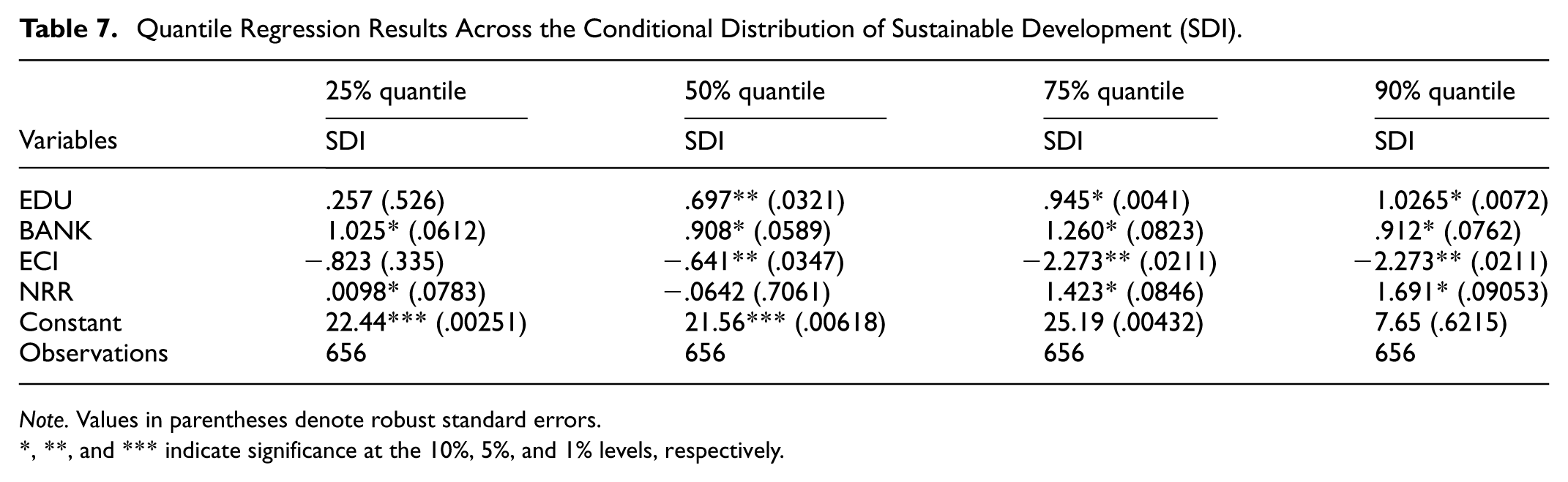
Note. Values in parentheses denote robust standard errors.
, **, and *** indicate significance at the 10%, 5%, and 1% levels, respectively.
The results for banking sector development indicate that, beyond mean effects, domestic credit to the private sector exerts a positive influence on sustainability in African countries. Accordingly, hypothesis H3 is supported, although the effects remain heterogeneous across development stages. This outcome is consistent with S. Khan and Rehan (2022) and Byaro et al. (2024), who found that deeper financial intermediation promotes green investment and facilitates renewable energy financing. In contrast, Samour et al. (2022) observed that shallow credit markets often channel funds toward resource-intensive activities that hinder sustainability progress.
The quantile analysis further reveals a stage-dependent relationship. In African economies with more mature financial systems, higher levels of domestic credit enhance sustainability by supporting green technologies and environmentally responsible enterprises. At lower credit levels, however, the relationship weakens or even turns negative, as limited financing tends to favor short-term consumption over long-term productive investment. These findings align with Shahbaz et al. (2015), who reported that financial development contributed to improved air quality in India, but diverge from Aydin et al. (2024), who found no significant effect in the case of China.
The divergence between the FGLS and QQR results likely reflects the structural heterogeneity of financial systems across African economies. In countries with shallow banking depth, credit tends to finance short-term consumption and resource-intensive activities, thereby generating adverse sustainability outcomes. In contrast, in economies with more mature financial sectors, credit is more often directed toward productive and environmentally friendly investments, leading to improved sustainability performance. This nonlinear relationship, captured by the QQR model, underscores the mediating role of financial maturity in shaping how banking development influences sustainability (S. Khan & Rehan, 2022; Shahbaz et al., 2013).
Additionally, natural resource extraction (NRR), which exhibits a negative effect under the FGLS, Driscoll–Kraay, and dynamic Driscoll–Kraay estimators, becomes positive when evaluated at the mean values of NRR and the Sustainable Development Index (SDI) for the 25th, 75th, and 90th quantiles. The divergence between the FGLS and QQR results for natural resources can largely be attributed to differences in governance and institutional quality. At lower levels of sustainability, resource exploitation tends to exacerbate environmental degradation and economic dependence. In contrast, at higher quantiles—where governance structures, infrastructure, and regulatory frameworks are stronger—resource utilization can generate positive outcomes through improved regulation, efficient revenue management, and reinvestment in human capital and renewable energy (Kwakwa et al., 2020). Overall, these results suggest that the effect of natural resource extraction on sustainable development critically depends on a country’s SDI level and institutional capacity.
To better illustrate these nonlinear and heterogeneous dynamics, Figure 4 presents the QQR surface plot showing how education and natural resource dependence jointly shape sustainability outcomes across different quantiles. The three-dimensional plot highlights the nonlinear nature of this relationship and how it evolves with varying levels of education and sustainability. This visual evidence complements the statistical findings in Table 7, revealing that higher education levels consistently enhance sustainability, while greater resource dependence tends to reduce it at lower sustainability quantiles. However, at higher levels of both education and sustainability, the interaction becomes positive, suggesting that education mitigates the environmental and social costs associated with resource dependence by strengthening human capital and institutional awareness. As depicted in Figure 4, the sustainability index rises steadily with education, whereas resource intensity exerts downward pressure primarily at lower quantiles—confirming the compensatory role of human capital in shaping sustainable development trajectories across African economies.

QQR surface plot: Interaction between education, natural resources, and sustainability.
At higher SDI levels, stronger institutions and infrastructure enable countries to manage their natural resources more effectively, transforming extraction into positive economic and social outcomes. In contrast, economies with lower SDI tend to experience environmental degradation and dependency, largely due to weak governance and limited absorptive capacity. For instance, South Africa and Botswana have successfully converted resource wealth into sustainable gains, while the Democratic Republic of Congo and Niger continue to face persistent ecological damage and dependence. As shown in Figure 5, fluctuations in natural resource extraction mirror global price movements and domestic policy shifts, underscoring the importance of sound resource management, institutional strength, and economic diversification to reduce vulnerability to commodity shocks.
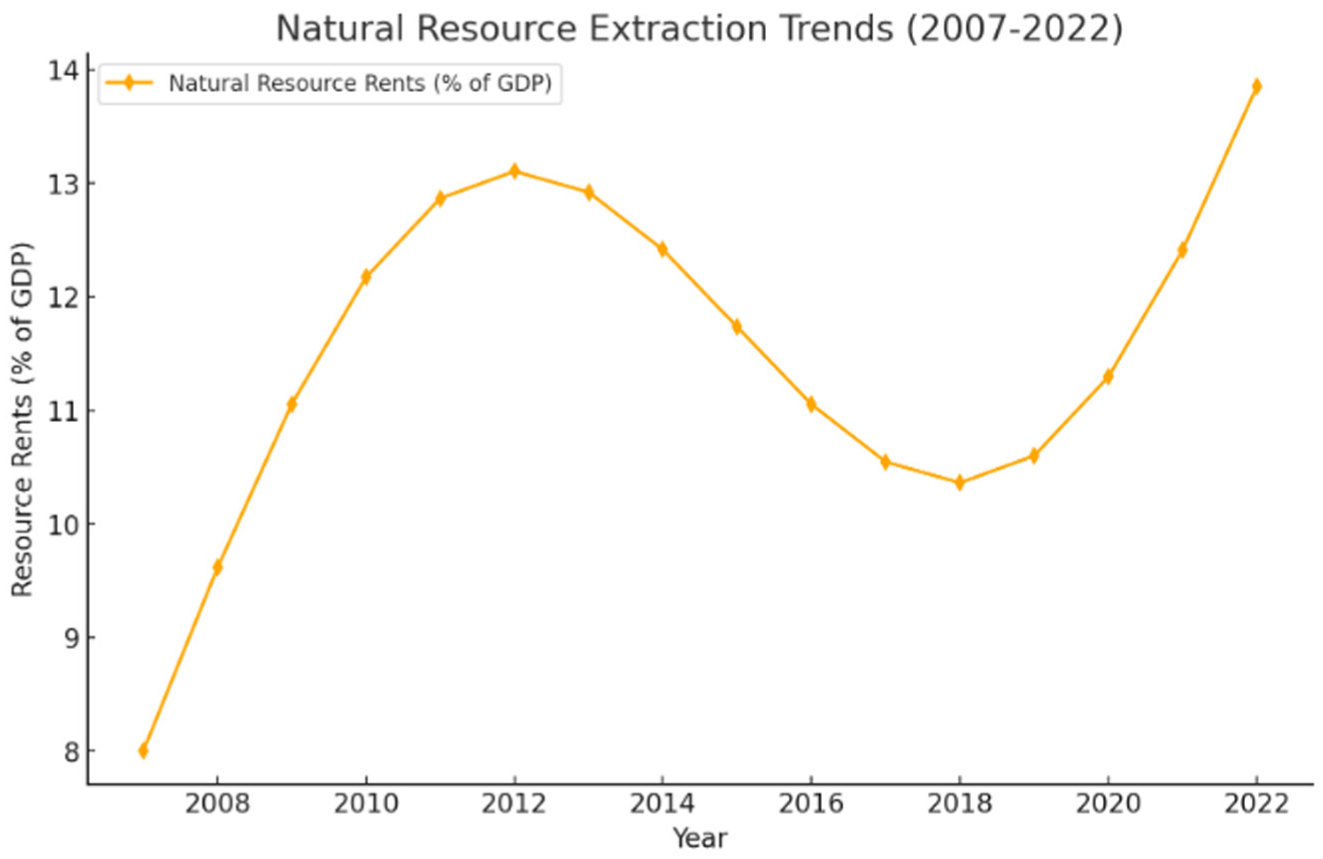
Fluctuations in natural resource rents (% of GDP) from 2007 to 2022.
In our analysis, the Economic Complexity Index (ECI), which initially shows a positive association over the full sample, turns negative when examined at higher sustainability quantiles (50%, 75%, and 90%). Thus, hypothesis H4 receives only partial support. While higher economic complexity can foster technological innovation and energy efficiency (Boleti et al., 2021; Lee et al., 2023), our results are consistent with Neagu (2019) and Romero and Gramkow (2021), who argue that when complexity remains tied to resource-intensive industries, it can amplify environmental pressures. In many African economies, where industrial sophistication still depends heavily on extractive sectors, growing complexity does not yet translate into sustainable outcomes.
This negative association observed at higher quantiles illustrates the persistent challenge of reconciling economic expansion with environmental and social objectives. Although economic complexity is gradually increasing, it may currently come at the expense of sustainability, suggesting that structural transformation without corresponding green innovation risks undermining long-term development progress. From a policy standpoint, these results emphasize the importance for African governments to strengthen institutional quality, diversify energy sources, and reinvest resource revenues in human capital and green innovation. Nevertheless, these findings should be interpreted within the specific structural context of African economies, and further cross-regional analyses are encouraged to validate their broader applicability.
Conclusion and Policy Implications
This study examined how education and natural resources influence sustainable development across 39 African countries from 2007 to 2022. The findings show that education consistently enhances sustainability, while natural resource exploitation generally hinders progress—although this relationship becomes positive at higher sustainability levels. These results illustrate the complex, context-dependent nature of Africa’s development trajectory. Resource dependence remains a double-edged sword: it stimulates economic growth but intensifies deforestation, CO2 emissions, and ecological degradation. Achieving a balance between growth and environmental responsibility requires stronger institutions and transparent governance of natural wealth.
Education remains a key driver of inclusive and long-term progress, though its impact remains limited in low-income economies with weaker industrial bases. Expanding access to technical, vocational, and environmental education can help break poverty cycles and promote a knowledge-based, green economy. Financial development also plays an important role. In advanced systems, private credit fosters green investment, whereas in shallow markets it often finances short-term consumption. Regulators should align financial flows with sustainability objectives and systematically integrate environmental criteria into credit risk assessments. Similarly, greater economic complexity does not automatically guarantee sustainability. Many African economies remain resource-intensive despite increasing sophistication. Embedding renewable energy, circular-economy principles, and eco-innovation within industrial strategies can ensure that complexity supports long-term environmental and social goals.
This study contributes to bridging the empirical gap in multidimensional sustainability research by integrating education, finance, and natural resources within an African context. In doing so, it extends the existing literature beyond single-dimensional analyses and provides new evidence on the interactive effects of human capital, financial development, and resource governance on sustainable development.
These insights resonate with the ambitions of Agenda 2063 and the African Continental Free Trade Area (AfCFTA), which emphasize diversification, inclusive growth, and environmental resilience. Governments should enhance transparency in resource governance, reinvest extraction revenues in human capital and green infrastructure, and promote domestic value chains to reduce export dependency. Policy differentiation is crucial. Low-income, resource-dependent countries should prioritize institutional reform, education, and environmental regulation, while middle- and higher-income economies should accelerate green industrialization and renewable energy transitions. The success of these reforms depends largely on governance quality, institutional capacity, and sound debt management. Innovative financing mechanisms—such as green bonds, blended finance, Islamic finance, and public–private partnerships—offer promising avenues to mobilize long-term capital for climate-smart infrastructure, clean energy, and sustainable agriculture. Development banks can further advance these goals through tax incentives, guarantees, and green credit ratings to attract private investment.
Regional cooperation remains essential. The African Union, the AfDB, and UNECA should harmonize sustainability metrics, promote knowledge exchange, and coordinate capacity-building initiatives to ensure coherent progress and maximize the shared benefits of continental integration.
From a policy perspective, the results underscore the need for African governments to strengthen institutions, diversify energy sources, and channel resource revenues into education, innovation, and green technologies. Nevertheless, the findings remain context-specific to African economies with comparable structural and institutional conditions. Future research may extend this analysis to other regions and employ advanced dynamic approaches to better address potential endogeneity.
Beyond its regional focus, this study contributes to global sustainability debates by illustrating how education and resource governance jointly drive green transitions and inclusive growth in developing regions. Further research could replicate the analysis using alternative indicators—such as the Ecological Footprint or the SDG Index—to test the robustness of these findings. Exploring the role of digital and environmental education as catalysts for human capital development may also shed new light on how resource-dependent economies can transition toward a resilient, low-carbon future.
Footnotes
Appendix A. List of Countries Selected for Analysis
Algeria, Angola, Benin, Botswana, Burkina Faso, Cameroon, Chad, Côte d'Ivoire, Democratic Republic of Congo, Egypt, Ethiopia, Gabon, Ghana, Guinea, Kenya, Liberia, Madagascar, Malawi, Mali, Mauritania, Morocco, Mozambique, Namibia, Niger, Nigeria, Republic of Congo, Rwanda, Senegal, Sierra Leone, Somalia, South Africa, Sudan, Tanzania, Togo, Tunisia, Uganda, Zambia, Zimbabwe, Eswatini (Swaziland).
Acknowledgements
The researchers would like to thank the Deanship of Graduate Studies and Scientific Research at Qassim University for financial support (QU-APC-2026).

Funding
The authors received no financial support for the research, authorship, and/or publication of this article.
Declaration of Conflicting Interests
The authors declared no potential conflicts of interest with respect to the research, authorship, and/or publication of this article.
Data Availability Statement
Data sharing not applicable to this article as no datasets were generated or analyzed during the current study.