




Abstract
The purpose of this study is to effectively establish an evaluation framework for green development in the tourism industry. A novel evaluation index system for green tourism development based on “society-economy-environment” that incorporates environmental protection values is constructed firstly. Subsequently, a comprehensive assessment framework was established using a combination of entropy weight and Complex Proportional Assessment (COPRAS) methods. Taking Zhejiang Province as an example, the numerical results show that between 2013 and 2023, the level of green development in Zhejiang Province’s tourism industry followed an “N” pattern of “rise-fall-rise,” with overall performance improving. However, the four specific dimensions of development exhibit characteristics of “strong economy, weak ecology, and a need to strengthen investment and environmental awareness.” Finally, several valuable suggestions are proposed, such as strengthening crisis management and optimizing investment factors, to promote the improvement of green development levels.
Keywords
Introduction
Since the reform and opening up, China has created the “China miracle” in the history of human economic development. However, during the long-term process of reform and opening up, the extensive economic development model that China implemented in the early stage, characterized by high input, high energy consumption, and low efficiency, has led to a series of adverse consequences, such as ecological imbalance and environmental pollution, which also have posed significant threats and impacts on the quality of national life and the health of residents. Under the increasingly severe situation of ecological resource conditions, such a development model is no longer sustainable, which has forced China to continuously explore new development models. The Chinese government first proposed the outline of green development at the Fifth Plenary Session of the 18th CPC Central Committee. It introduced national strategies and relevant policies oriented toward ecology and actively promoted industrial transformation and upgrading. By adhering to the principle of harmonious coexistence between humans and nature, China sought to transform its economic development model. So far, China has made great changes in its economic development model, shifting from an extensive to an intensive model, and the battle against environmental pollution has also achieved brilliant results, promoting harmonious coexistence between humans and nature. However, as China’s economy and society have entered a period of high-quality development, more comprehensive and profound requirements are put forward for green development. Promoting green development will remain the starting point and theme of China’s work for quite a long time in the future.
To further promote green development, industries are required to accelerate the green transition. Compared to other industries, tourism is characterized by a higher degree of dependence on the environment, making it more directly and effectively reflective of the achievements of green development. On the other hand, it is also closely connected with other industries, and has become an important part of economic development. Zhejiang Province in China, as the birthplace of the conception that “clean waters and lush mountains are invaluable assets,” has consistently adhered to this philosophy. In 2019, Zhejiang passed the pilot acceptance of the national ecological province construction and built the first ecological province in China. In terms of green development, this region serves as an important window to showcase China’s achievements in ecological civilization construction to the world.
Currently, numerous scholars have delved into the assessment of green tourism development, mainly focusing on expounding the concept of green development, analyzing the improvement pathways, and discussing the factors influencing green development (K. Liu et al., 2022; Lu et al., 2023; Lun et al., 2022). Unfortunately, studies on the measurement of tourism development are seldom mentioned. The limitations of insufficient indicators in existing research make us difficult to examine the comprehensive and complex factors involved in current green tourism development, such as ecological degradation, resource scarcity, and economic decline. Therefore, with the rapid progress of green development, it is urgent to accurately and scientifically measure the level of green development of tourism, and thus a reasonable evaluation index system needs to be established, which is also the main objective of this study.
This study has two main contributions: Firstly, we construct a practical evaluation system for assessing the level of green development in tourism based on the national and provincial green development policies and strategies. Secondly, a multi-attribute comprehensive assessment based on Complex Proportional Assessment (COPRAS) and entropy weight is constructed to measure the green development level of tourism. Specifically, the green development level of tourism in Zhejiang Province is calculated from 2013 to 2023, and a horizontal comparative analysis within the Yangtze Delta region is conducted to clarify the evolutionary process of green development in Zhejiang’s tourism sector. Moreover, some targeted countermeasures and recommendations are proposed to improve the construction of a beautiful Zhejiang. These findings contribute to the theoretical development of green tourism and enrich the literature on tourism ecology.
The rest of this research is organized as follows: the second part provides a review of relevant literature, the third and fourth parts are the construction of system index and the elaboration of evaluation methods, respectively. The fifth part presents the empirical analysis, which analyzes and explains the evaluation results. Part 6 conducts a sensitivity analysis to test the robustness of the proposed assessment method. The last part includes conclusions, recommendations, and explanations of limitations.
Literature Review
Green development has attracted scholars’ attention as early as the end of the 20th century. Although the academic community has not yet reached a unified definition of its conceptual content, there is growing consensus on its essence—the essence of green development lies in pursuing the coordinated development of the economy, society, and ecology to achieve sustainable development (Hu & Zhou, 2014).
Existing research not only provides conceptual explanations of green development (Tang et al., 2017; Waligo et al., 2013), but also focuses on analyzing the path of green development (Lee et al., 2022) and exploring the factors influencing green development (Xu et al., 2022). It is worth noting that, relatively little attention has been paid to measuring the green tourism development level. Especially in the tourism industry, systematic measurement is scarce. Therefore, this paper will take green development in the tourism industry as its research entry point and conduct measurements accordingly.
The green development of the tourism industry refers to the development of the tourism industry guided by the concept of green development, focusing on the connotation and quality of tourism, and is an extension of the connotation and improvement of the concept of green tourism. In the process of development, we need to adhere to the principles of low-carbon, green and sustainable development, innovate and develop tourism resources reasonably through green technology, and create a harmonious, green and friendly tourism environment (Qu & Xia, 2011; Tang et al., 2022). As a sub-concept of green development, it should also be the result of coordinated development in the economic, social, and ecological spheres.
To effectively measure the level of green development in the tourism industry, it is necessary to establish an evaluation indicator system that can reasonably describe the level of green tourism development. However, the indicator systems constructed by scholars are diverse at present. Tang et al. (2022) constructed a model for the green development level of tourism to analyze and assess the spatial–temporal evolution in ecological conservation areas. Y. J. Liu and Tang (2022) emphasized the need to consider the new conception of high-quality development, and proposed that the quality of tourism development should be reflected at three levels: benefit, quality and structure, and included in the first-class indicators such as tourism sharing development. B. F. Shi et al. (2016) established three levels of economic development, social livelihood, resources and environment, and on this basis created six secondary standards of economic growth. M. X. Wang et al. (2018) constructed an evaluation index system of urban green development, incorporating five distinct aspects: enhancement of living environment, improvement of ecological efficiency, treatment and utilization of pollutants, development of innovative potential and optimization of economic growth. Generally speaking, the evaluation index system is mostly based on the social-economic-environmental model, supplemented by other innovation subsystems and new indexes like policy and investment.
Several evaluation methods have been proposed to assess the level of green development accurately and scientifically, such as entropy weight and TOPSIS (Ma et al., 2023), difference and correlation analysis (Huang et al., 2023), vertical projection distance-set pair analysis (W. X. Yang et al., 2023) and network hierarchy model (W. Wang et al., 2023). In addition, a range of methods are employed to assess and analyze the level of tourism development, including the propensity score matching method (Thanh, 2020), the ecological security assessment method (Tang et al., 2018) and the partial least squares method (Oviedo-García et al., 2019).
The existing research lays a solid theoretical and practical foundation for the green development of the tourism industry. However, these studies also have some shortcomings, with room for improvement in assessment methods and indicator systems. On one hand, existing evaluation indicator systems for the green development of the tourism industry are mostly based on the “socio-economic- environmental” model, which is a classic and effective model. However, the selection of specific indicators often only covers material indicators, such as resources, environment, economy, and technology, while paying less attention to spiritual-level indicators including environmental protection value concepts, which are the intrinsic driving force behind the green development of the tourism industry, supporting its sustainable optimization. To overcome this limitation, this study innovatively incorporates the dimension of environmental protection values, combining three core dimensions-ecological environment status, industrial economic benefits, and investment factors to construct a scientific evaluation indicator system for the green development of the tourism industry. The specific construction process will be detailed in the next chapter.
On the other hand, existing tourism assessment research primarily employs classical methods, such as TOPSIS and AHP for analysis. Compared to multi-attribute evaluation methods like TOPSIS and VIKOR, the COPRAS method offers some advantages: It can simultaneously consider the proportions of “benefit-oriented” and “cost-oriented” indicators during ranking; Its logical operations are straightforward; Ranking results can be obtained within a relatively short time frame (L. Wang & Liu, 2017). Furthermore, this method analyzes data by comparing relative utility values, making it suitable for gap diagnosis. Unlike approaches that merely provide isolated evaluation data, it emphasizes the relative relationships among alternatives. By integrating relative utility with entropy, it reveals deeper underlying relative differences between evaluation objects, thereby enhancing the guidance value of evaluation results. Currently, the combined entropy-weighted COPRAS method has been successfully applied in various fields. For instance, Zeng et al. (2022) proposed a comprehensive evaluation method for port logistics levels based on entropy and COPRAS, conducting empirical analysis on Ningbo Zhoushan Port’s logistics performance. Nicolalde et al. (2024) employed the COPRAS method driven by the objective entropy-weighted approach, demonstrating that oak from Loja is the optimal choice due to its superior modulus of elasticity. Emel and Eren (2023) employed a MCDM process incorporating entropy-based COPRAS and additive ratio assessment (ARAS) methodologies to evaluate technologically smart cities. Building upon these experiences, this study will also utilize a combined entropy-weighted COPRAS method for evaluation.
In summary, the main innovations of this study are as follows:
Innovative evaluation system. Based on the classic “social-economic- environmental” framework, the environmental protection values dimension is incorporated, together with the three core dimensions of ecological environmental conditions, industrial economic benefits, and investment factors, to construct a scientific set of evaluation indicators for the green development of the tourism industry. This indicator system is centered on “competitiveness-potential,” which is conducive to reflecting the green development of the tourism industry from both static and dynamic perspectives.
Combination of entropy weighting and COPRAS methods to measure the green development status of the tourism industry: The entropy weighting method is an objective weighting method that minimizes subjective interference; the COPRAS method offers flexibility in modeling decision-makers’ preferences, and has the advantage of high applicability to various problems (Radulescu & Radulescu, 2024). On basis of the integration of relative utility degree and entropy information, the proposed combined method can uncover underlying relative differences more profoundly, thereby making the evaluation results more instructive and more reasonable.
Case study in Zhejiang Province: This study applies the proposed evaluation system in Zhejiang Province. Zhejiang Province became the first province in China to pass the national ecological province construction pilot program evaluation in 2019. In terms of green development, the province serves as an important window for showcasing China’s ecological civilization development and construction to the world, hence the decision to conduct a case study on Zhejiang Province. This case analysis provides empirical insights into the dynamic changes in the green development of Zhejiang Province’s tourism industry. Based on the research findings, this study also proposes targeted recommendations to promote the green development of Zhejiang Province’s tourism industry.
Evaluation Index System of Green Development Level of Tourism
Principles of Selecting Indicators
The formulation of a set of feasible and effective comprehensive evaluation index systems is fundamental to the level measurement of green development of the tourism industry. To scientifically and reasonably establish evaluation indicators, this study will choose indicators based on the following principles: (1) Principle of scientific. The selection of evaluation indexes for the construction of a comprehensive evaluation system must be in accordance with the requirements of the connotation of green development. The requirement is that the indicators should be classified accurately and comprehensively. In addition, the definition of indexes should be clear and concise. Finally, every stage of data processing must have a strong theoretical support and realistic scientific basis; (2) Principle of comprehensiveness. The selected indexes for tourism green development level should not only include basic indexes such as resource status and industrial economic benefits, but also incorporate innovative indexes that can reflect the potential of sustainable green development of tourism, such as environmental protection values and the number of green technology patents in tourism; (3) Principle of operability. In the process of designing an index system, not only the comprehensiveness of indicators but also the feasibility are considered, such as the possibility of collecting index data and the most appropriate method for doing so, etc.
Construction of the Index System
Guideline Layer
Based on the “socio-economic environment” framework, a scientific evaluation index system was constructed by selecting factors such as ecological environment conditions, industrial economic benefits, investment factors, and environmental protection values. These indicators are also consistent with the main theme of competitiveness potential. The competitiveness of the green development of the tourism industry is expressed in the ecological environment of the tourism industry and the economic benefits of the industry, which show the harmonious development of the ecology and economy of the tourism industry; The potential of the green development of the tourism industry is expressed in the investment factors and environmental protection values, which show the support of society for the green development of the tourism industry. Although the potential level cannot immediately promote the green development of tourism and is unrealistic, it helps to continuously guarantee the green development of tourism and ultimately improve the competitiveness of green development of tourism.
In addition, it should be noted that environmental protection value has been innovatively incorporated into the indicator system. The introduction of this indicator aligns with the requirements outlined in the report of the 20th National Congress of the Communist Party of China and the Implementation Opinions on Comprehensively Deepening the Construction of a Beautiful Zhejiang issued by the Zhejiang Provincial Government. These two policy documents provide for the future development of the region, and in the dimension of green development, both emphasize the need to firmly establish and practice the concept that green water and green mountains are golden mountains, cultivate the mainstream values of ecological civilization, and accelerate the formation of ecological consciousness of the entire population. This study argues that the establishment of correct environmental protection values is a deep-seated driving force to promote the green development of the tourism industry, which can positively contribute to the improvement of environmental conditions, industrial efficiency, and optimization of investment factors by guiding people’s behavioral choices.
Therefore, based on the connotation of green development of tourism, combined with the national policy and the research of many scholars, this study constructs an evaluation system based on the main line of competitiveness-potential, and selects the four dimensions of ecological environmental conditions, industrial economic benefits, investment factors, and environmental protection values.
Indicator Layer
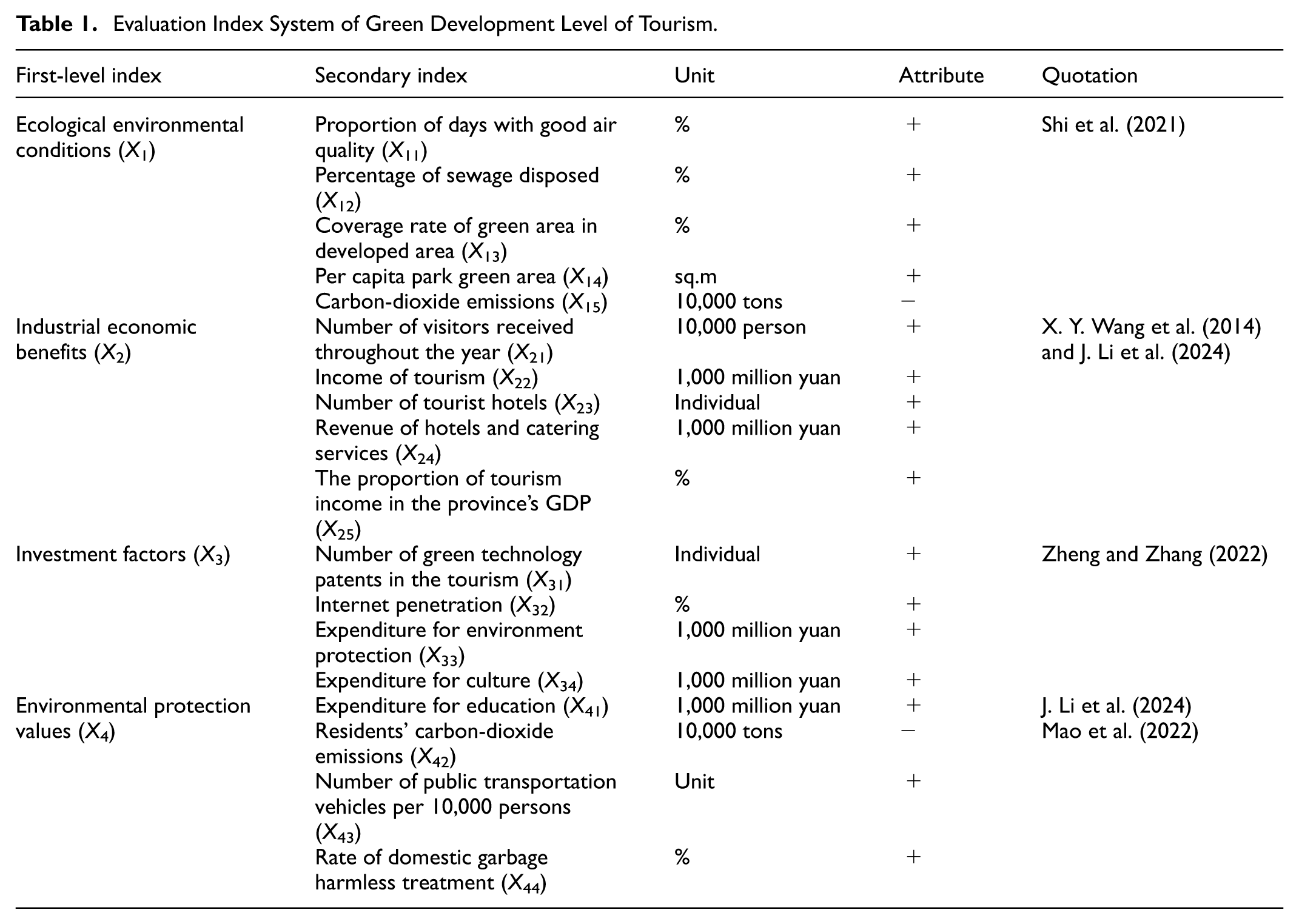
Based on the principles of science, comprehensiveness and operability, and with reference to the research of related scholars, this paper constructs the evaluation indicators under the four core dimensions of ecological environment status, industrial economic benefits, investment factors, and environmental protection values. The specific indicators are shown in the Table 1.
Ecological environmental conditions: The resource status is the foundation of tourism development, reflecting the green ecological situation (including green resources, water resources, air and other aspects) in the process of tourism development. This paper selects five indexes to measure the basic situation of tourism resources: the proportion of days with good air quality, the percentage of sewage disposed of, the coverage rate of green area, per capita park green space area and the amount of carbon-dioxide emissions.
Industrial economic benefits: The industrial economic benefit is defined as the direct or indirect economic stimulus generated by the output of a particular industry, which is a vital basis for assessing the development level of tourism. At the same time, in the process of green transformation, energy-saving and efficient allocation of resources have also further promoted the prosperity and development of tourism. Using this indicator can also reflect the effectiveness of green transformation of tourism to some extent. This paper selects five indicators to measure the industry’s financial performance, including the number of visitors received throughout the year, income of tourism, number of tourist hotels, revenue of hotels, and catering services and the proportion of tourism income within the province’s GDP.
Investment factors: The investment factor is an essential factor to foster sustainable green development in the tourism sector. To facilitate green development, Zhejiang Province has proposed that, based on specific foundations, it will combine digital empowerment, enhance innovation, accelerate green transformation, and promote high-quality development. The development of tourism also requires accelerated environmental pollution control and the construction of cultural values to enhance people’s sense of belonging and identity to the city, and thus achieving green sustainability and high-quality development. Therefore, in this study, the number of green technology patents in tourism, internet penetration, expenditure for environment protection and expenditure for culture are selected to measure the investment situation.
Environmental protection values: The environmental protection values are of great significance for the sustainable green development of tourism. The establishment of the concept of environmental protection and low-carbon on environmental protection values ensures the sustainable green development of tourism and directly highlights the implementation of the concept of harmonious coexistence between humans and nature. It selects educational expenditure, per capita carbon emissions, the number of public transport vehicles per 10,000 people (unit) and the rate of domestic garbage harmless treatment to measure the residents’ awareness of low-carbon environmental protection.
Evaluation Index System of Green Development Level of Tourism.
Multi-Attribute Evaluation Framework Based on ENTROPY-COPRAS
Determination of Evaluation Index Weight
The method for determining weights can be generally categorized into two types: subjective weighting method and objective weighting methods. Since determination of the subjective indicator weights requires a large amount of past accumulation and the participation of experts, it is quite cumbersome in practical application and highly subjective, which can easily lead to large deviations. Therefore, this study will adopt the objective weighting model and choose the entropy weight method to determine the weights of indicators. This approach is deemed to provide a more objective and accurate evaluation of the research object.
The steps for determining the indicators’ weights using the entropy weight method are shown below:


where


obviously,
COPRAS Method
After obtaining the weights of indicators, it is necessary to integrate the evaluations of individual indicators into an overall assessment. The COPRAS method raised by Zavadskas et al. (1994) is a computationally sound and computationally straightforward multi-indicator comprehensive evaluation method that does not require the conversion and unification of attribute categories during the calculation process, and comprehensively considers the importance and effectiveness of indicator attributes. Currently, this method has gained wide recognition among researchers and has been extensively applied to address various comprehensive evaluation and decision-making problems. For instance, Roozbahani et al. (2020) assessed Iran’s water resource allocation method employing fuzzy COPRAS. To scientifically and reasonably measure the development of renewable resources, Alkan et al. (2020) proposed a complex COPRAS method to evaluate and analyze the renewable energy situation in 26 regions of Türkiye. Hezer et al. (2021) applied COPRAS to study the regional security level under the influence of COVID-19 virus, and conducted a comparative analysis using the VIKOR method. Sagiroglu et al. (2024) employed COPRAS method to evaluate the cooperation performance of Türkiye’s non-governmental organizations in disaster management. H. L. Yang et al. (2025) proposed a novel probabilistic linguistic term three-way evaluation approach based on the COPRAS framework.
Given the excellent properties of the COPRAS method, this study also employs it to measure the development level of green tourism. The main steps are summarized below:

where


where
Similarly, regarding the reverse indicators of each year, the comprehensive cost values are calculated:

where

where,

where,
Evaluation of Green Development Level of Tourism in Zhejiang Province
In this section, the Entropy-COPRAS method is employed to calculate the tourism green development level of Zhejiang province in 2013 to 2023, thereby elucidating the green development level trend and path of Zhejiang province’s tourism, and providing targeted suggestions and countermeasures for its new development.
Data Sources and Methods of Processing
The majority of the indicators data come from the following publications: China Statistical Yearbook, Zhejiang Statistical Yearbook, Bulletin on Environmental Conditions in Zhejiang Province. In addition, some data have been converted for calculation. For example, the carbon dioxide emissions are counted by multiplying the total energy consumption of the province by the carbon emission coefficient of standard coal (0.67); the number of green technology patents in the tourism industry is calculated by multiplying the total number of patents granted by the ratio of tourism revenue to the province’s GDP and the proportion of green patents (6.2%), based on the China Green Patent Statistical Report (2014–2017); the Internet penetration is the number of Internet users as a proportion of the resident population; the carbon dioxide emissions of residents are calculated by multiplying the total electricity consumption of urban and rural residents by the carbon emission coefficient for electricity (0.785); the international tourism revenue is converted using an exchange rate of 7. All units have been unified. The missing data will be linearly interpolated to fill in the few missing data.
Measurement of Green Development Level of Tourism in Zhejiang Province
The process of measuring the green development level of tourism in Zhejiang Province is as follows.
Initially, according to Equations 1 to 6, the original data are standardized, and the entropy value and difference coefficient of each index are calculated to obtain the weight of each index. Results are displayed in Table 2.
Weights of Index of Green Development Level of Tourism.

Then, according to Equations 7 to 12, the COPRAS method was used to calculate the utility degree corresponding to each year of each subsystem evaluation index of the green development of tourism in Zhejiang Province, as the evaluation result of each subsystem evaluation index of the green development of tourism in Zhejiang Province. The results are presented in Table 3.
Evaluation Results of Subsystem Level of Tourism.

Similarly, on basis of the methods outlined in Equations 7 to 12, benefit value, cost value, comprehensive evaluation value and utility degree corresponding to the green development of the tourism industry in Zhejiang Province in each year are calculated respectively, and ranked by the final utility degree obtained. The results can be seen in Table 4.
Results of Green Development Level of Tourism in Zhejiang Province.

Analysis of the Results of the Assessment of Green Tourism Development in Zhejiang Province
The evaluation results of the subsystem indicators and comprehensive level of green development of tourism in Zhejiang Province from 2013 to 2023 are clearly presented in Figure 1.
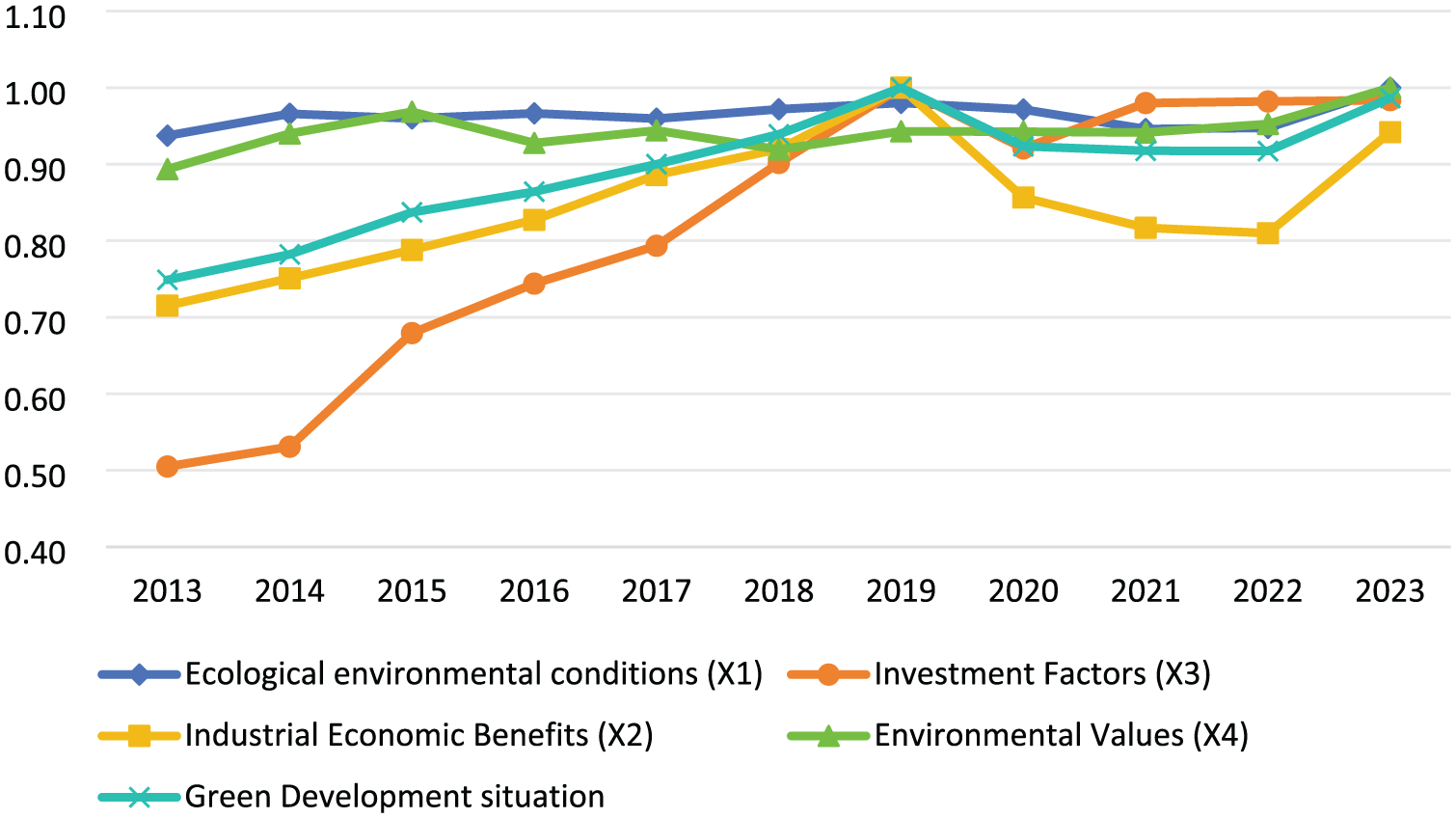
Utility degree of tourism green development level of Zhejiang Province.
The analysis of the changes in the utility of the evaluation indicators of the green development of tourism in Zhejiang Province shows that during the period of 2013 to 2023, the two indicators of investment factors and industrial economic benefits have changed the most significantly, with a change rate of 94.80% and 31.68%, respectively. In comparison, the two indicators of ecological conditions and environmental protection values have changed relatively mildly, with a change rate of 6.69% and 11.91%, respectively. Since the four subsystems are generally on the rise during the 11-year period, the green development system as a whole also shows an increase, with a growth rate of 31.74%. In addition, Zhejiang Province had the highest level of green development in the tourism in 2019.
Further exploration reveals that the green development level of tourism in Zhejiang Province from 2013 to 2023 shows an overall “N” trend of “rising-declining-rising.” Accordingly, it can be divided into three stages.
The first stage is the “growth period” from 2013 to 2019. In this stage, the green development effectiveness of tourism in Zhejiang Province increased by 33.53%, which is a period of high speed development, and is in the stage of coordinated development of ecology, economy and society.
During this period, as pointed out by Tian and Zhang (2018), the green development of the tourism industry is no longer limited to tourism economic growth and ecological governance, but focuses on the green growth of the tourism industry in practice as a three-pillar ecological-economic-social indispensable economic model. This is confirmed by the significant change in the investment factors, whose utility has rapidly increased from 51% to 100%, which is closer to the ideal solution. This positive change is closely related to a number of policies introduced by Zhejiang Province, such as in 2013, Zhejiang Province promulgated the “Decision on Comprehensively Implementing the Innovation-driven Development Strategy and Accelerating the Construction of Innovative Provinces,” vigorously creating a favorable atmosphere for innovation, accelerating the promotion of scientific and technological innovation, and soaring the amount of patent research and development. In 2018, the Zhejiang Provincial Government deployed the action of building a large garden, which puts forward the need for high-quality construction of the “Poetry and Painting Zhejiang,” adhering to the protection first, pollution prevention and control attack, beauty as the foundation, culture as the soul, so that tourism, ecology, culture and other elements are integrated (Yuan, 2018). From the raw data can also be found in this period of environmental protection expenditures, cultural and tourism resources, such as a substantial increase in investment. For environmental protection values, the starting level is high, showing a small increase but accompanied by dynamic fluctuations. This reflects that the government pays special attention to the establishment and cultivation of environmental protection concepts. With publicity and education, residents’ environmental protection concepts have also been improved and transformed into practical actions, but the solidity of the concepts needs to be strengthened. Competitiveness in terms of ecological environmental conditions maintains a high and stable growth, with an average utility of 96.30%. And the industrial economic benefit shows a significant optimization, which is partly attributed to the transformation of the elements of the potential level in the previous period and the support of good ecological conditions.
The second stage is the “decline period” of 2019 to 2020. In this period, the green development effectiveness of tourism in Zhejiang Province decreased by 7.65%, which is a period of stagnation.
This period breaks the positive situation before 2019, and the main dimensions show a decreasing trend. A major factor contributing to this situation is the outbreak of the new crown epidemic. After the outbreak of the new crown epidemic, the government took the initiative of “home” and restriction of “movement of people,” which directly led to a sharp decline in the number of tourists, a sharp decline in tourism revenue, and the closure of some tourism enterprises due to low revenues, which significantly impacted the economic performance of the tourism industry. In Figure 1, the trend of the industrial economic benefits clearly shows this result, and the industry’s economic efficiency is the most affected, with a decrease of 14.30%. This effect is also confirmed by Shang et al. (2022) and Riccardo et al. (2023). In addition, the investment factors are the dimension with the second largest decrease of 7.93%. The investment element mainly involves the investment of various types of funds (e.g., cultural resources, environmental protection, and patent research and development), and the early stage of the epidemic led to a decrease in the investment in culture and environmental governance due to the large financial expenditure in the field of public health and the limited development of the financial sector. In addition, ecological environmental conditions and environmental protection values were also affected, but to a lesser extent. The main reasons for this issue may include: the correlation between these two indicators and the epidemic is relatively low; at the same time, the expected decrease in environmental protection values during the pandemic will be less when people are more closely connected to nature (Sneddon et al., 2022).
The third stage is the “recovery period” from 2020 to 2023. During this period, the green development effectiveness of tourism in Zhejiang Province rose by 6.83%, entering a new stage of sustainable green development.
In this stage, affected by the epidemic, the utility of some subsystems still declined at the beginning, but the decline has been significantly narrowed. Since 2022, all subsystems have shown a sustained growth trend. It is worth noting that the growth in this recovery phase is different and more sustainable than in the first phase. This is reflected not only in the obvious difference between the relative utility of this stage and the first stage, but also, as noted by Schmidt et al. (2021), COVID-19 has been recognized as an opportunity to build a more resilient and sustainable industry in the post-pandemic era. The new crown epidemic, in addition to bringing long-term negative impacts, it has also brought some positive impacts. On the one hand, the pandemic shifted the tourism industry toward more creative and sustainable dimensions by encouraging the use of technological solutions such as virtual reality, internet tours, and the use of the Internet as virtual reality, internet tours, augmented reality, artificial intelligence, and other cutting-edge technologies that comply with the COVID-19 protocols (Treimikien & Korneeva, 2020). Zhejiang Province released the Culture and Tourism Digitalization Reform Program of the Department of Culture and Tourism of Zhejiang Province in 2021, which also proposes to build a new system for the development of the digital culture and tourism industry, and to construct a personalized tourism supply, which will have a positive effect on the rational planning of tourism trips (and the reduction of excessive and unsustainable tourism practices), and on the enhancement of the traveler’s experience. This is corroborated by the extremely rapid growth trend of investment factors containing indicators such as patent R&D and Internet penetration in the wake of the epidemic. On the other hand, the epidemic prompted a greater focus on crisis management, advancing it to adopt more responsible behaviors, such as addressing environmental issues, using active transportation, and adopting green practices (Cláudia & Ketan, 2022). As shown in Figure 1, the two subsystems of ecological environmental conditions and environmental protection values show an increasing trend at this stage. Under the influence of these factors, the industrial economic benefits were also gradually restored.
Comparison of Tourism Green Development Level Among Yangtze Delta Region
On the basis of analyzing the level of green development of tourism in Zhejiang Province vertically by time, next we carry out a horizontal comparison among the four provinces of Zhejiang, Shanghai, Jiangsu, and Anhui in the Yangtze Delta region, which is conducive to further clarifying the current status of green development of tourism in Zhejiang Province.
Of which, the majority of the index data are from Shanghai Statistical Yearbook, Jiangsu Statistical Yearbook, Anhui Statistical Yearbook, and the corresponding reports. At the same time, it is consistent with the data processing method of Zhejiang Province, and some of the data are converted. Note that the missing data will be linearly interpolated to fill in the few missing data.
By processing the original data of indicators collected in Shanghai, Jiangsu, Zhejiang, and Anhui provinces, the corresponding benefit value, cost value, comprehensive evaluation value and utility degree are obtained, and sorted by the final utility degree. The results are displayed in Table 5.
Results of Green Development Level of Tourism in Yangtze Delta Region.

Similarly, the utility of the four provinces of Shanghai, Jiangsu, Zhejiang, and Anhui on the four subsystems of green development in tourism was calculated and ranked. The results are presented in Table 6.
Assessment Results at the Tourism Subsystem Level in the Yangtze Delta Region.

As shown in Tables 5 and 6, during the 11-year period from 2013 to 2023, the utility degree of the green development level of tourism in Zhejiang Province reaches 98.56%, with an overall excellent performance, second only to Jiangsu Province in the Yangtze River Delta region. However, an in-depth analysis of the performance of its subsystems reveals that its development is characterized by “strong economy, weak ecology, and the need to strengthen the awareness of inputs and environmental protection.”
Among the subsystems, the economic performance of Zhejiang Province’s industries is particularly outstanding, and its utility is in the leading position in the region. In sharp contrast, its ecological environment has significant shortcomings. The data show that the utility of Zhejiang Province in this subsystem is only 86.57%, significantly behind Anhui Province and Shanghai City. Further analysis of the raw data shows that Zhejiang Province’s carbon dioxide emissions are significantly higher than those of Anhui and Shanghai, and the difference in this indicator may be one of the important reasons for the poor ecological condition. In addition to the ecological factor, Zhejiang Province is also relatively insufficient in investment factor input, second to Jiangsu Province. Comparison of the raw data reveals that Jiangsu Province is higher than Zhejiang Province in each of the indicators invested in investment factors, and although capital investment is not absolutely positively correlated with efficiency improvement, the difference in this data reflects to a certain extent the importance Jiangsu Province attaches to social support in the green development of the tourism industry. In addition, the popularity of environmental protection values in Zhejiang Province has to be further improved.
Comparison With Existing Methods
The results obtained by different evaluation methods may be different, which makes it impossible to reach a consensus on the evaluation results and unreasonable conclusions will appear. This paper will analyze the green development status of Zhejiang Province’s tourism industry using a method that combines CRITIC-COPRAS and Entropy-TOPSIS in this section. The results will be compared with those of the original method to verify the robustness of the results in this study.
Comparison With CRITIC-COPRAS Method
CRITIC is an objective weighting method based on the correlation and conflict between indicators. Its core idea is to determine the objective weight of indicators through the intensity of comparison and conflict between indicators, thereby achieving objective weighting of evaluation indicators (Du et al., 2024). This method can explore the complex relationships between criteria and reduce reliance on subjective judgment.
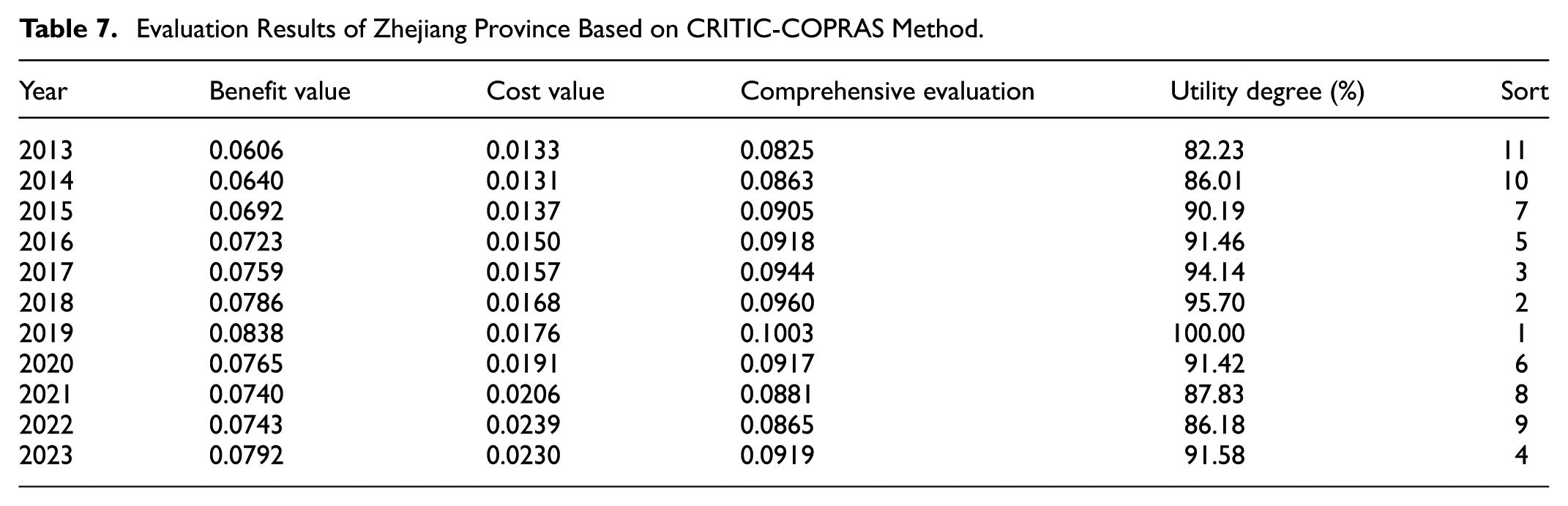
First, we will replace the weights and use the CRITIC-COPRAS method for evaluation. The specific results are shown in Table 7 with a visual comparison of the rankings generated by the CRITIC and entropy value methods illustrated in Figure 2.
Evaluation Results of Zhejiang Province Based on CRITIC-COPRAS Method.
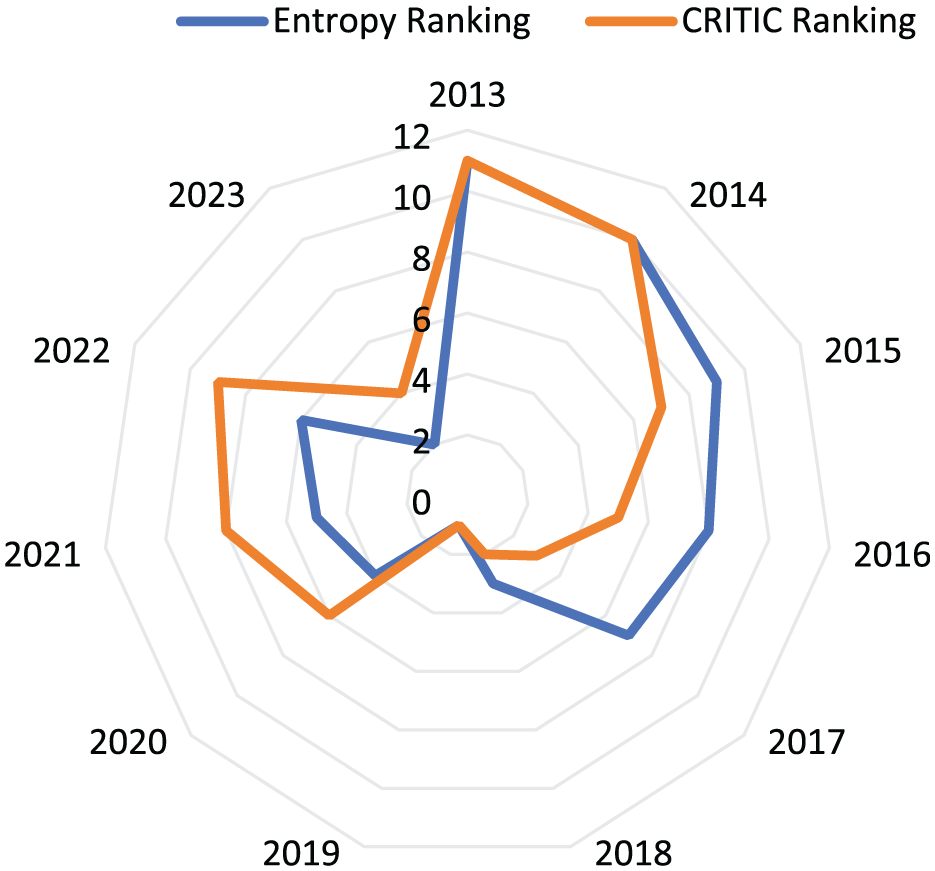
Rankings under entropy and CRITIC evaluation methods in Zhejiang.
As shown in Table 7, the trend in the comprehensive evaluation value of Zhejiang Province’s tourism industry green development level from 2013 to 2023 is consistent with that of the Entropy-COPRAS method, experiencing an “upward- downward-upward” change, with consistent time points. However, there are differences in the specific rankings compared to the original rankings. The years showing the highest combined level of green development in tourism are all 2019, with 2013 and 2014 having the lowest combined level of green development in tourism. The ranking changes for the remaining years.
Therefore, further analysis using Spearman’s correlation coefficient revealed that the two sets of rankings for Zhejiang Province from 2013 to 2023 exhibit strong correlation in both the longitudinal (ρ = .745), indicating that the evaluation results demonstrate strong robustness to method changes.
Comparison With Entropy-TOPSIS Combined Method
The TOPSIS is a widely used ranking method designed to approximate the ideal solution by simultaneously considering the positive and negative ideal solutions within an evaluation framework (Hwang & Yoon, 1981). This method determines the degree of variation by calculating the Euclidean distances between each evaluation object and the ideal solutions. One of the primary advantages of TOPSIS lies in its minimal reliance on subjective input from decision-makers, making it a robust and versatile tool for decision-making across various domains (Conejero et al., 2021; Y. Li et al., 2023; Susmaga et al., 2024; Zeng et al., 2020, 2023).
First, the entropy method was used to calculate the objective weights. Based on this, the relative proximity scores were obtained by calculating the relative distance between each year/province and the positive and negative ideal solutions. These scores were used as the basis for ranking. The results are shown in Table 8 with a visual comparison of the rankings generated by the COPRAS and TOPSIS methods illustrated in Figure 3.
Evaluation Results of Zhejiang Province Based on Entropy-TOPSIS Method.


Rankings under COPRAS and TOPSIS evaluation methods in Zhejiang.
Comparing the results in Table 8 with the rankings derived from COPRAS, it can be seen that the consistency of the vertical evaluation of Zhejiang Province’s tourism industry’s green development is relatively high, with the bottom 5 years remaining consistent. However, the rankings changed between 2018 and 2023 (excluding 2020).
Further analysis using Spearman’s rank correlation coefficient revealed that the two sets of rankings for Zhejiang Province from 2013 to 2023 showed strong correlation in the longitudinal comparison (ρ = 0.941), indicating that the evaluation results exhibit strong robustness to changes in the method.
In summary, by changing the weights and modifying the evaluation model, the robustness of the evaluation results in this study has been verified.
Conclusions, Suggestions, Implications and Limitations
Conclusion
This study focuses on the evaluation of the level of green development of tourism. On the basis of summarizing the research achievements of existing scholars, and in combination with the report of the 20th National Congress of the CPC and the development planning of provinces and cities, the first-level indicators of environmental protection values and the second-level indicators of scientific selection are innovatively included. Taking the competitiveness-potential as the main line, the resource status, investment factors, environmental protection values and industrial economic benefits are used as the four subsystems of the index system to build the index system of green development level of tourism.
On the basis of this index system, the entropy weight and COPRAS combination method ware used to vertically measure the green development level of tourism in Zhejiang Province from 2013 to 2023 and horizontally compare the provinces in the Yangtze Delta region. It is found that:
From the vertical perspective, during the period of 2013 to 2023, the four subsystems and the comprehensive level of green development of the tourism industry in Zhejiang Province have shown a general trend of improvement.
From a vertical perspective, from 2013 to 2023, the level of green development of tourism in Zhejiang Province specifically presents an “N” trend of “rising-declining-rising,” and has experienced the “growth-declining-recovery period” of green development of tourism. In the growth period, the tourism industry is in the stage of coordinated development of ecology, economy and society, with each dimension showing significant growth and interacting with each other. The decline period is mainly affected by the strong impact of the epidemic and the stagnation of green development, in which the impact on industrial economic efficiency is the most direct and serious. The recovery phase differs from the growth phase in that, although the dimensions are also on the rise, this phase enters a new phase of sustainable green development, emphasizing digital technology, crisis management and other elements that will shift the tourism industry to more creative and sustainable dimensions.
From a horizontal perspective, Zhejiang Province’s tourism green development level is excellent in the Yangtze River Delta region as a whole, second only to Jiangsu Province. However, it is worth noting that in each sub-dimension, compared with other provinces, its development is characterized by “strong economic performance, weak ecological construction, and the need to strengthen investment and environmental awareness.”
In addition, it should be noted that in the longitudinal analysis, the green development of tourism in Zhejiang Province has entered a new stage of sustainable development, which is not contradictory to the imbalance between its indicators. And after sensitivity analysis, the results are robust.
Meanwhile, through the analysis of the vertical and horizontal development of green tourism in Zhejiang Province, in addition to the above findings, reflections that are instructive for the development of measures have been formed:
Further recognizing the value of crisis management. As mentioned earlier, the epidemic has had a huge impact on the tourism industry, even leading to a phased shutdown of the industry. This is a profound warning that we must attach great importance to crisis management, and effective prevention mechanisms need to be established in response to potential crises such as natural disasters, social unrest, safety accidents, and public opinion risks in order to minimize losses. At the same time, the crisis should be viewed from a dialectical perspective. While the epidemic has brought challenges, it has also accelerated the integration of digital technology and tourism, which indicates that crises often contain opportunities for transformation, and the key lies in accurately identifying and grasping the point of focus, so as to turn the crisis into a driving force for sustainable development of the tourism industry.
Look at the subsystems from a comprehensive perspective. As mentioned earlier, the ecological environment subsystem in the green development of tourism in Zhejiang Province has remained relatively stable over the past 11 years. However, the horizontal comparison of the Yangtze River Delta region reveals a key issue: this stability hides the fact that its actual level is significantly behind that of Anhui and Shanghai, making it an urgent shortcoming for Zhejiang Province to improve. This suggests that when assessing the effectiveness of green development of tourism in Zhejiang Province, it is necessary to take into account both horizontal and vertical analyses, to fully grasp the real performance of each subsystem, and to propose more effective enhancement measures on the basis of a comprehensive analysis.
Deepen regional collaboration. Although this study focuses on Zhejiang Province, horizontal comparison reveals the advantages and shortcomings of each province in different subsystems. Based on this, inter-regional collaboration should be actively promoted, through the sharing of governance experience, technical programs and policy measures, combined with their own reality, so as to more effectively promote the overall green development level of regional tourism.
Suggestions
Based on the above analysis results, the following recommendations are proposed.
Promoting coordinated development. First, enhance environmental improvement. In addition to strengthening ecological governance, the government also needs to strengthen the construction of ecological security systems, such as promoting green certification and supervision, to ensure the improvement of the ecological environment. Additionally, optimize investment inputs. For example, the government should make good use of local cultural resources, develop tourism products with local characteristics and entertainment features, form unique selling points, and transform potential resource advantages and cultural advantages into actual competitive advantages, so as to promote the prosperous development of tourism. In addition, they should grasp the development of digital technology, strengthen the integration of tourism and digital economy, and promote the green development of tourism in a sustainable way. In the same way, it is important to continue internalization of environmental protection values.
Pay attention to the crisis. First, relevant departments should develop emergency response plans covering scenarios, such as natural disasters and public health emergencies, clearly defining procedures for closing tourist attractions and managing tourist flows, and conducting joint practical drills with all departments on a quarterly basis to prevent the consequences of crises. Second, when facing crises, the government should promptly assess the situation and adjust development strategies. For example, emerging technologies can be utilized to develop online tourism.
Deepen regional cooperation. Actively promote cooperation between regions by sharing governance experiences, technical solutions, and policy measures to more effectively promote the overall green development of the regional tourism industry.
Implications and Limitation
This study provides a comprehensive diagnostic tool for evaluating green tourism development in Zhejiang Province by integrating environmental protection values into a three-dimensional “society-economy-environment” evaluation framework and employing a combination of entropy weight and COPRAS methods. This exploration yields two implications for future research.
The constructed evaluation index system not only enriches the evaluation criteria of the tourism industry, but also serves as a basic framework for extending to other regions or tourism types, providing convenient references for related evaluation issues.
It validates the feasibility of the Entropy-COPRAS method for addressing multi-indicator green tourism evaluations, offering a valuable quantitative approach for related studies.
This study also has some limitations that could be explored in greater depth in the future.
Although the Entropy-COPRAS method can effectively reveal the relative utility differences and overall evolutionary trends within the sample set, its evaluation results are highly dependent on the selected sample range. When the sample size is expanded or adjusted, the final utility and ranking may change significantly. By nature, it is a relative evaluation tool and cannot directly quantify the absolute level of green development in tourism. This characteristic makes it more suitable for static cross-section comparisons, while dynamic tracking over time (e.g., analyzing annual changes in the same region) requires a fixed sample size and complementary time-series analyses, otherwise the ability to analyze dynamics will be limited.
The assessment in this study mainly focuses on vertical and horizontal comparisons of “quantity,” failing to analyze in depth the transformation process of green development of the tourism industry from quantitative change to qualitative change. Taking Zhejiang Province as an example, combined with policies and literature, it is stated that there is a qualitative difference between the first phase and the third phase of tourism green development. This qualitative difference may also exist in the same period, however, due to the limitations of the existing assessment methodology, this study is unable to analyze this aspect.
Footnotes

Funding
The authors disclosed receipt of the following financial support for the research, authorship, and/or publication of this article: The study was supported by the by the project of Economic Forecasting and Policy Simulation Laboratory, Zhejiang Gongshang University (No. 2024SYS034), Zhejiang Provincial Natural Science Foundation of China (No. LMS25G010002) and Philosophy and Social Science Foundation of Colleges and Universities in Jiangsu Province (No. 2022SJYB1021).
Declaration of Conflicting Interests
The authors declared no potential conflicts of interest with respect to the research, authorship, and/or publication of this article.
Data Availability Statement
The data used to support the findings of this study are available from the corresponding author upon request.