




Abstract
This study investigates the interplay of socially responsible human resource management (SRHRM) and employee green behaviour (EGB) in the public healthcare sector. It examines how personal moral norms (PMN) and public service motivation (PSM) mediate this relationship, as well as how environmental transformational leadership (ETL) moderates it. The study applies Social Information Processing Theory (SIPT) to analyse these dynamics. We conducted a quantitative study using a questionnaire-based survey and a quota sampling technique. Our sample consisted of 334 nurses in Vietnamese public hospitals. We performed data analysis using structural equation modelling (SEM). The findings reveal a strong relationship between SRHRM and employee green behaviour. SRHRM influences employee green behaviour indirectly through the mediating roles of PMN and PSM. In addition, ETL plays a significant role in moderating the link between SRHRM and EGB. However, the moderating of ETL in this relationship through PMN and PSM was not statistically significant. This study is among the first to explore the interplay of SRHRM and EGB using SIPT in a healthcare context, offering theoretical insights and practical guidance for sustainable HRM practices in developing economies.
Plain Language Summary
This study explores how socially responsible human resource management (SRHRM) practices influence employee green behaviour (EGB) in the public healthcare sector. Drawing on Social Information Processing Theory, we investigate the mediating roles of personal moral norms and public service motivation, as well as the moderating role of environmental transformational leadership (ETL). A survey of 334 nurses in Vietnamese public hospitals was conducted using a structured questionnaire. The findings suggest that SRHRM positively influences EGB both directly and indirectly through the two mediators. Moreover, ETL enhances the positive effect of SRHRM on EGB. These results highlight the importance of responsible human resource management practices and environmentally focused leadership in promoting sustainable behaviours among healthcare employees.
Keywords
Introduction
Healthcare is not only one of the most trustworthy industries, but also one of the largest, employing hundreds of thousands to provide healthcare to millions of people. Healthcare administrators have a social responsibility and opportunity (Ozkan et al., 2024). Concerns about long-term sustainability rank high among healthcare stakeholders (Berniak-Woźny & Rataj, 2023). Given the gravity and consequences of environmental issues, environmentally conscious individuals are more likely to embrace ecological behaviours (Ha, 2023; Ozkan et al., 2024). Green behaviours are quantifiable personal actions that support environmentally sustainable work–life balance objectives (Norton, Parker, et al., 2015). Aslan and Yildiz (2019) recommended healthcare managers to adopt eco-friendly practices for social responsibility. Since healthcare spending is high, efforts should be made to find healthy, environmentally friendly strategies. Vietnam’s healthcare industry has grown to meet its population’s needs, but inefficient production and consumption, as well as inadequately treated medical waste, are causing environmental pollution. The Vietnamese healthcare industry has made significant contributions to the promotion of healthcare. However, the presence of more hospitals impacts human health, the environment, and medical waste. Present medical facilities are not at their full potential. Concerns are also mounting over industry pressure to acquire resources (Tseng et al., 2022). Nurses can help organisations implement green policies and initiatives. Indeed, the existing literature has documented several environmentally conscious nursing practices, including turning off computers when not in use, putting used items in their proper bins, sharing transportation, teleconferencing in place of staff meetings, editing files electronically rather than printing them, and printing drafts using waste paper. Sustainable practices also include asking leaders to strengthen the creation of a less polluted workplace and reducing waste during care (Akore Yeboah et al., 2024). Consequently, it is essential to understand how nurses are contributing to green initiatives at work (Zhou & Zheng, 2024). Employee green behaviour (EGB) has been defined as ‘scalable actions and behaviours that employees engage in that are linked with and contribute to environmental sustainability’ (Ones & Dilchert, 2012, p. 87). Incorporating corporate social responsibility (CSR) into human resource management (HRM) practices by fostering a positive work environment and offering various HRM modules for professional development can help socially responsible HRM (SRHRM) achieve its goals (Ha & Doan, 2024; Shen & Benson, 2016). This, in turn, can motivate employees to participate in EGB that aligns with the organisation’s CSR objectives. More research into the effects of SRHRM on environmentally conscious management is needed, as Zhao and Zhou (2021) have recently acknowledged. Through an analysis of SRHRM’s impact on EGB from a responsibility-oriented HRM standpoint, Zhou and Zheng (2024) clarified the conditions in which SRHRM promotes such actions. The extent to which SRHRM affects EGB in the workplace is largely unclear, despite the expanding corpus of scholarly work conceptualising SRHRM and EGB. Therefore, we investigate the societal effect of SRHRM practices on EGB among nurses to address this knowledge gap.
Using the SIPT (Salancik & Pfeffer, 1978), we elucidate the potential impact of SRHRM practices on EGB. SIPT proposes: ‘individuals, as adaptive organisms, adapt attitudes, behaviour and beliefs to their social context’ (Salancik & Pfeffer, 1978, p. 226), and cognitive processes mediate the nexus of social information and employee attitudes (Zhang et al., 2022). A personal moral norm (PMN) is the ‘moral obligation to perform or refrain from a specific action’ (Schwartz, 1977), with examples including recycling and energy conservation. Several studies have found a direct correlation between PMN and EGB, making it a crucial variable within organisations (Fawehinmi et al., 2020). PMN offers a conceptual bridge between broad principles and concrete deeds (Schwartz & Howard, 1984). Nurses are motivated to conduct their work in an environmentally conscious manner by PMN, an obligation-based intrinsic motivation (Fawehinmi et al., 2020; van der Werff et al., 2013). According to Fawehinmi et al. (2020), organisations’ responsible practices can improve EGB by affecting nurses’ moral norms. However, PMN may well be the understudied variable in the relationship between SRHRM and EGB. Nurses become intrinsically aroused and broaden their remit by participating in EGB, which enables them to positively impact the environment as a result of being inspired by the social values and goals behind CSR (Tang et al., 2024). According to Rainey and Steinbauer (1999, p. 23), public service motivation (PSM) is ‘a general altruistic motivation to serve the interests of a community of people, a state, a nation or humankind’. Academics have previously explored how PSM affects prosocial behaviour because many of its definitions emphasise altruism (Piatak & Holt, 2020). Ha and Doan (2024) demonstrated recently that PSM functions as a positive mediator in the nexus of SRHRM and civil servants’ moral behaviour. However, there is currently a shortage of research regarding the mediating appearance of individual-level factors (PMN and PSM) in the relationship between SRHRM and EGB. It is essential to comprehend the individual and organisational factors that are frequently interconnected with ethical behaviour. Studies have also examined macro-level factors, including the socio-political environment, culture and external stakeholders, in ethical decision-making (Chan & Ananthram, 2020). In this investigation, we primarily conceive of nurses as agents whose EGB is influenced by their PMN and PSM. Their capacity for EGB is activated and reinforced by such organisational practices as SRHRM and environmental transformational leadership (ETL). In the context of a developing nation’s healthcare sector, the integration of specific variables (SRHRM, PMN, PSM, ETL) into a single empirical model is crucial for the purpose of closing these gaps and offering a unique contribution to the literature. Environmental concerns in Vietnam have attracted growing attention from both domestic and international firms, driven by governmental efforts towards sustainable development. However, the implementation of effective environmental management systems has been hindered by weak infrastructure, ineffective legislation and inconsistent policies (Pham et al., 2020). As resource-intensive institutions, hospitals consume large amounts of energy, water and materials. Nevertheless, adopting simple and sustainable practices can significantly reduce their environmental impact (Nguyen et al., 2024). These context-specific challenges and opportunities make Vietnam a relevant setting for studying EGB in healthcare.
An organisational setting can influence an employee’s thoughts, feelings, and actions, as stated in the SIPT (Liu et al., 2023; Salancik & Pfeffer, 1978). As a crucial component of any organisation, leadership plays a role in communicating organisational expectations to employees, creating an atmosphere of shared perceptions, and aligning employees’ needs with said expectations through relationship-focused leadership behaviours. This, in turn, significantly impacts organisational outcomes (Liu et al., 2023; Piccolo et al., 2010). According to Robertson and Carleton (2017, p. 962), environmental transformational leadership (ETL) is ‘a type of transformational leadership that is focused on influencing corporate environmental responsibility’. Leaders who adopt a transformational approach that is tailored to environmental issues are likely to inspire their teams with a unified environmental vision (Crucke et al., 2022). Therefore, we emphasise the importance of ETL’s moderating role in enhancing the beneficial impact of SRHRM practices. Simply put, the present paper aims to clarify the interplay of SRHRM and EGB among nurses in public hospitals in Vietnam, using PMN and PSM as mediators and ETL as a moderator in light of the aforementioned gaps.
Literature Review and Formulation of Hypotheses
Social Information Processing Theory (SIPT)
Salancik and Pfeffer’s (1978) SIPT proposes that the workplace social environment affects behaviour and performance. Social interactions help employees understand their workplace. The workplace influences employee attitudes, perceptions and motivation. According to Salancik and Pfeffer (1978), the social environment – in this case, the organisation – provides cues for constructing and interpreting events related to positive organisational attitudes and behaviours. Managers’ HRM use helps employees understand their workplace (Aryee et al., 2012; Cooper et al., 2019) in terms of important information, desired behaviour and results (Cooper et al., 2019). HRM policies should be firmly established within the organisation with effective communication and unwavering organisational backing to maximise the societal advantages of environmentally conscious employee actions (Dumont et al., 2017). According to SIPT, adaptive people change their mindsets in response to their social surroundings. Cognitive processes link social information to individual attitudes (Zhang et al., 2022).
Social cues and personal needs influence workplace behaviour (Salancik & Pfeffer, 1978). When making behavioural decisions, employees often consult their superiors (Boekhorst, 2015), who, in turn, shape culture and inform employees (Huhtala et al., 2013; Liu et al., 2021). SIPT posits that a nurse’s understanding of their work environments and interactions with co-workers influences their work attitudes and behaviours (Salancik & Pfeffer, 1978). Scholars have consistently shown the relevance of SIPT to organisational leadership studies (Wadei et al., 2021). According to the theory, employees’ impressions of the organisation are heavily influenced by its leaders. Leaders represent their organisations because of the authority and prestige they possess (Mohammed Sayed Mostafa & Shen, 2020). This leads employees to believe that the organisation is responsible for their actions (Gilbert et al., 2011). Leaders are responsible for understanding and implementing the organisation’s policies and practices. To make sense of these policies and procedures, followers consult the data supplied by their leaders (Mohammed Sayed Mostafa & Shen, 2020). Employees can learn the organisation’s rules, regulations and expectations through their leaders’ everyday interactions with them. Employees’ attitudes and behaviours on the job will be impacted by this (Jiang et al., 2015).
Socially Responsible Human Resource Management and Employee Green Behaviour
Green behaviour refers to personal actions and choices that positively influence the environment (Fawehinmi et al., 2020). These actions lessen the human impact on the environment (Stern, 2000) and promote long-term environmental sustainability (Ones & Dilchert, 2012). Organisations should establish formal procedures for promoting environmentally friendly behaviour (Fawehinmi et al., 2020). EGB highlights the actions and behaviours of employees in managing the environment, as aligned with the organisation’s expectations (Paillé & Boiral, 2013; Zhou & Zheng, 2024). By aligning employees with organisational CSR goals, SRHRM provides a new perspective on responsible management and provides additional micro-theory to explain the link between SRHRM and individual outcomes (Zhou & Zheng, 2024). Implementing a human resources practice that fosters CSR enhances employees’ sense of affiliation with the organisation (Lee et al., 2023; Shen & Benson, 2016). SIPT states that nurses’ work environment perceptions, attitudes and behaviours are socially constructed. Nurses proactively acquire information and comprehend their environment (Salancik & Pfeffer, 1978). Nurses may interpret SRHRM using social information processing, which includes both internal and external stakeholders, ultimately impacting their EGB.
SRHRM is ‘CSR policies and practices directed at employees. As such, SRHRM is not only an integral part of CSR initiatives but also an important tool for its successful implementation as it is through employees that the objectives of CSR are achieved’ (Shen & Benson, 2016, p. 1724). SRHRM can help nurses process social information and assess the organisation’s external image (Lee et al., 2023). Norton, Zacher, et al. (2017) found that EGB generates value and is prosocial, thereby helping an organisation achieve its CSR goals. When hospitals implement SRHRM strategies, nurses often believe that external stakeholders are being prioritised. These SRHRM practices help nurses recognise how their work benefits others and boost prosocial motivation (Wang et al., 2023). Hu and Liden (2014) defined prosocial employees as givers who place others before themselves and strive to improve their communities. Thus, prosocial employees are more inclined to engage in EGB (Wang et al., 2023). SIPT suggests prioritising sustainable values during recruitment, improving employees’ communication and engagement skills with external stakeholders related to promotion, rewards, and compensation to encourage EGB (Zhou & Zheng, 2024). These fundamentals influence nurses’ decisions as organisational cues. After reviewing the literature, we formulated the following hypothesis (H1):
The Mediating Role of Personal Moral Norms
Nurses are more inclined to view their employer as moral when they feel that they are internally accountable (Abdelmotaleb & Saha, 2020). Ellemers et al. (2011) found that socially responsible organisational practices and actions strongly influence employee morality. According to Abdelmotaleb and Saha (2020), nurses view SRHRM practices as a reflection of the moral and ethical character of their hospital. These practices include hiring and retaining socially responsible individuals, offering CSR training, and incorporating nurses’ social contributions into promotions, performance reviews and rewards. The SIPT states that observations, job behaviour, and others’ opinions are the main sources of information (Zhang et al., 2022). Managers portray the organisation as a social actor who upholds norms (Yam et al., 2018). Therefore, SRHRM practices communicate the organisation’s values and norms to nurses, which helps them understand how their organisations interact with stakeholders (Cooper et al., 2019; De Roeck & Farooq, 2018). Workplace practices and standards can strengthen or weaken morality (Elango et al., 2010). Victor and Cullen (1988) argued that individual traits cannot predict mortality. Organisational predictors significantly affect individual decisions. Organisational culture, rewards and beliefs strongly influence employee ethics (Elango et al., 2010). PMN are significant moral imperatives that compel employees to participate in pro-social behaviour (Schwartz, 1977), such as helping to protect the environment (Fawehinmi et al., 2020). Thøgersen (2006) defined PMN as an individual’s values-based inclination towards right and wrong. In this context, these feelings relate to environmental concerns (Fawehinmi et al., 2020). Accordingly, we argue that nurses’ SRHRM views can predict PMN.
Staddon et al. (2016) found that EGB has long-term economic and social benefits for the organisation; thus, EGB must be voluntarily adopted. Simply reminding workers of their environmental responsibilities can induce EGB (Fawehinmi et al., 2020). Bamberg and Möser (2007) stressed that EGB is ethically driven. Social discourse influences PMN, making it an individual duty. Schwartz and Howard (1981) defined taking responsibility as setting self-expectations for beneficial deeds and then feeling obligated to perform them. PMN is obligation-based intrinsic motivation. Energy conservation and recycling are part of this duty – employees may not enjoy it, but can derive satisfaction from it. While PMNs appear crucial to organisations, little research has linked them to EGB (Fawehinmi et al., 2020). Hence, we propose the following hypothesis:
The Mediating Role of Public Service Motivation
Some scholars have perceived PSM as a collection of beliefs and values (Ha & Doan, 2024). Vandenabeele (2007) characterised PSM as beliefs and attitudes transcending self and organisational interests, driving individuals towards actions benefiting broader entities. Given the SIPT framework, we can deduce that SRHRM initiatives stimulate PSM. The notion of working for a socially impactful organisation (SRHRM) can enhance nurses’ sense of purpose (Ha & Doan, 2024). For example, when nurses sense their organisation’s larger societal contribution, they experience enhanced job meaningfulness. By focusing on nurses’ well-being through SRHRM strategies, hospitals signal a loftier mission to their staff (Glavas & Kelley, 2014). SRHRM undertakings also convey pivotal messages about organisational morals and trustworthiness (Hansen et al., 2011). Building on this notion and the SIPT, this study posits a link between nurse perceptions of SRHRM and PSM.
The function of PSM as a mediator between HRM practices and employee outcomes has been the subject of several recent empirical investigations (Abdelmotaleb & Saha, 2019). The PSM studies discussed here have improved our comprehension of the idea. However, several academics have called for additional research to fully understand how organisational practices and policies affect the growth of PSM (Gould-Williams et al., 2014). PSM ‘may be formed by socio-historical factors before employees enter the organisation, but it will also be influenced by the work environment in which employees find themselves’ (Moynihan & Pandey, 2007, p. 42). This forms the basis of our hypothesis that nurses’ positive views of SRHRM are associated with PSM. Intrinsically motivated nurses have a higher chance of taking actions that benefit the workplace environment. EGBs taken by intrinsically motivated workers are likely to align with their values and priorities (Sabbir & Taufique, 2022). Put differently, green practices are more commonly employed by nurses when they have ‘a general altruistic motivation to serve the interests of a community of people’ (Piatak & Holt, 2020). Building upon the foundation provided by SIPT, we anticipate that the improved PSM, resulting from perceived SRHRM, will enhance nurses’ EGB.
Successive Mediation of PMN and PSM
As a set of principles for how one ought to act in one’s social environment, moral values encourage individuals to put their interests aside and work towards the greater good. Similarly, PSM encourages public servants to behave compassionately, put public values ahead of their interests, and act for the common good (Wang et al., 2020). The moral stance is intrinsic to and related to PSM-relevant beliefs and norms (Stazyk & Davis, 2015). Through socialisation, environmental reinforcement and value congruence, nurses with high levels of PSM can link institutional values to their morals (Stazyk & Davis, 2015; Wang et al., 2020). According to Piatak and Holt (2020), an example of a higher norm is the ‘commitment to the public interest or civic duty’. As a result, PSM’s results ought to align with the accepted social norms and values. Accordingly, it would make sense to assume that PMN can improve nurses’ workplace PSM.
Research has demonstrated that PSM extends beyond public institutions and encompasses a universal, selfless desire to serve the public (Wang et al., 2020). Regardless of whether one works in a public organisation, PSM is a combination of factors that motivate them to uphold social responsibility, stifle selfishness, and advance society – indeed, a range of prosocial behaviours have been linked to PSM (Piatak & Holt, 2020). We suggest a serial mediation model that connects SRHRM and EGB by taking into account the aforementioned arguments. Specifically, SRHRM, via cue signalling, will enhance nurses’ PMN, which, in turn, will benefit nurses’ PSM and promote EGB.
The Moderating Role of Environmental Transformational Leadership
According to SIPT, leaders influence their employees’ thoughts and actions (Boekhorst, 2015). Leaders’ positive information exchanges change employees’ attitudes, behaviours and perceptions, thus improving the relationship between SRHRM and EGB. Leaders send these signals to ensure employees understand the organisation’s environment and then use that knowledge to shape their thoughts (Gu et al., 2018). ETL, according to Chen and Chang (2013, p. 109), is ‘leaders’ behaviours that inspire followers to perform beyond expected levels of environmental performance and motivate followers to achieve environmental goals’. ETL can inspire followers and set a positive example for environmental values and behaviour (Asghar et al., 2022). ETL can also consider environmental remedies (Robertson & Barling, 2017) and inspire their subordinates to improve sustainability and engage in more long-term thinking (Asghar et al., 2022). SIPT states that employees’ perceived social information affects their behaviour. SRHRM and ELT practices affect employees’ attitudes and behaviours, and the expectations placed on them, thus making them important pieces of social information (Liu et al., 2023; Salancik & Pfeffer, 1978). As stated in the SIPT, nurses are better able to comprehend the hospital’s expectations, goals, and direction when they receive highly consistent cues from leadership and the organisational level. When nurses’ values match ETL and SRHRM practices, EGB rates rise (Liu et al., 2023). Leadership that prioritises environmental sustainability has the potential to increase intrinsic motivation among nurses (Graves & Sarkis, 2018). Nurses who are morally committed to sustainability and higher ideals are more likely to accept organisational goals (Graves & Sarkis, 2018). Moreover, ETLs have the potential to boost morale from within by giving nurses greater confidence in their ability to solve environmental problems (Asghar et al., 2022; Graves & Sarkis, 2018).
Employees perceive both formal HR practices and leadership behaviours as signals of their psychological contract with the organisation. These two elements of the employee management system may interact in ways that are either mutually reinforcing, conflicting, or functionally substitutive, depending on their alignment. When contract makers’ signals are inconsistent, there is a greater chance of unfavourable synergistic effects throughout the broader set of employee management systems (McClean & Collins, 2019). These effects can occur when ETL and SRHRM practices convey conflicting messages, creating a weak environment where employees are unclear about the firm’s values (Bowen & Ostroff, 2004). Additionally, an ETL can take the place of SRHRM procedures by giving more casual feedback, being considerate of members’ needs and skills, or rewarding staff in other, less conventional ways. By appreciating EGB in the lack of official SRHRM procedures, they might also inherently encourage independence and discretion (McClean & Collins, 2019). Consequently, the consistent informational cues shared by SRHRM and ETL can be seen as trustworthy ethical signals (Lv et al., 2024). When combined, they can impact nurses’ thinking and decision-making in a way that promotes ethics, helps them better understand moral issues, and ultimately improves their PMN and EGB. These earlier hypotheses point to a paradigm of moderated mediation. In particular, the various levels of ETL determine the indirect impact of SRHRM on EGB through PMN and PSM. Based on the above, we propose the following hypotheses:
The current research model is presented in Figure 1.

Conceptual framework of the relationships among SRHRM, PMN, PSM, ETL, and EGB.
Methodology
Data Collection and Sample
Data for the study were gathered from nurses working in Vietnamese public hospitals between October and December, 2023. Before the data collection, a pre-test was conducted in person with a small but representative sample of respondents (n = 20). The objective was to verify the questionnaire’s construct validity by determining whether any of the statements were difficult to understand (Colton & Covert, 2007; Ha et al., 2022; Shadish et al., 2002). Pre-testing serves as an initial step to gather empirical feedback on the appropriateness of the draft instrument. Participants are first asked to complete the questionnaire, after which they evaluate its format, content, clarity, terminology, usability and completion time. They are also invited to suggest specific additions or removals. Based on their feedback, the instrument should be reviewed and revised accordingly to improve its validity and usability. The questionnaire was pretested for participant comprehension (Lewis et al., 2005). Responses to the pre-test revealed that some SRHRM items were unclear. In every question, ‘company’ was changed to ‘hospital’. Moreover, the terms ‘social performance’ and ‘social responsibility’ were also ambiguous, so we provided examples to elucidate. For instance, a hospital’s social responsibility goes beyond providing quality medical examination and treatment services to protect and improve public health, ensure fair and humane working conditions for medical staff, and protect the environment through safe medical waste management. Besides, ‘social performance’ measures how well an organisation manages its social responsibilities and helps stakeholders and society flourish sustainably. Subsequently, we incorporated these clarifications into the questionnaire.
The survey sought to gather information from public nurses employed in 10 public hospitals in Vietnam. To sufficiently reflect the population, the sampling reflected the demographic features of nurses. Specifically, we employed the quota sampling technique, which aims to include a specific number of respondents from subgroups within the population. We then used a non-random selection mechanism to continue until each subgroup had the required number or quota of completed interviews (Acharyya & Bhattacharya, 2020). Quotas were established based on hospital affiliation, departmental designation (e.g., internal medicine, surgery, emergency, obstetrics and gynaecology), and gender distribution, mirroring essential demographic and structural characteristics of the nursing workforce. The distribution of quotas was informed by workforce data supplied by the hospitals’ administrative divisions and publicly accessible health sector reports. Samples can then be conveniently drawn during this second stage. Nevertheless, quota sampling is not a suitable substitute for probability sampling. Quota sampling is prone to favour those who are eager, readily available, and interested in the research issue. Therefore, representative samples that are comparable to those obtained using probability sampling cannot be obtained through quota sampling (Yang & Banamah, 2014). Ultimately, 334 nurses representing 10 public hospitals in Vietnam answered the questionnaires (66.8% of the 500 that were distributed). Demographic information of the survey participants is summarised in Table 1. According to Garver and Mentzer (1999), a ‘critical sample size’ of 200 yields reliable parameter estimations and has enough power to test a model. Although the response rate was 66.8%, we did not perform a formal non-response bias test, such as comparing early versus late respondents (Armstrong & Overton, 1977), due to limitations in time-stamped data collection or lack of access to full demographic information for all participants. We acknowledge this as a limitation of the study and recommend future research to include such an assessment in order to enhance the robustness of survey findings.
The Respondents’ Demographics.

We thoroughly briefed the participants on the study’s objectives, methodologies, potential hazards and advantages. All participants submitted written consent before engaging in the study. The privacy and confidentiality of participant data were fully ensured following applicable regulations.
Measurement of Constructs
An evaluation was conducted for each question using a five-point Likert scale, where strong disagreement (1) represented the lowest score and strong agreement (5) the highest. We used a distinct scale to evaluate each construct. Orlitzky and Swanson (2006) developed the six-item unidimensional scale, which Shen and Benson (2016) further enhanced, to assess SRHRM. PMN was assessed using four items adapted from Fawehinmi et al. (2020) and Steg and de Groot (2010). ETL was assessed using five items derived from Graves et al. (2013) and Asghar et al. (2022). The five-item PSM scale was measured according to that used by Wright et al. (2013). Wesselink et al. (2017) developed the five-item scale for EGB assessment, which they adapted from Fawehinmi et al. (2020).
Data Analysis
Using structural equation modelling (SEM), this study analyses survey data from 334 nurses. While multiple regression and SEM are fairly similar, the latter is far more robust and offers more analytical flexibility. Error terms, correlations, interactions, and other independent and dependent variables can all be modelled using SEM (Collier, 2020). Through model validation and visualisation, SEM is typically used to explain multiple statistical correlations at once. This method makes it easy to explain complex models. It is an expansion of conventional linear modelling methods, such as multiple regression analysis, which are necessary to master SEM. Simply put, it is the simultaneous combination of multiple regression analysis and factor analysis (Dash & Paul, 2021).
One of the most significant limitations of SEM is the required sample size, which is widely considered extensive (Collier, 2020). Indeed, even the most basic models require extensive samples, let alone intricate structures (Hair et al., 2019). Study reliability, power and generalisability are compromised by inadequate sample sizes (Martínez-López et al., 2013). The sample quantity is a critical factor in the use of SEM. Despite the widespread consensus regarding the necessity of a large sample size for SEM, there is no definitive guideline for the selection of an appropriate sample size. Additionally, normality is a concern in SEM analysis. General least squares and maximum likelihood estimation are the most widely used methods for SEM estimation, which presume that the data follow a normal distribution. Goodness-of-fit measures may be impacted and standard error terms may be undervalued if this restriction is violated (MacCallum et al., 1992). Thus, researchers must confirm multivariate normality and rectify non-normality, and calculate the skewness and kurtosis of the data to evaluate their normality (Kline, 2016).
Empirical Findings
The Sample’s Demographics
Evaluation of Measurement Model
We eliminated Items 5 and 6 from the SRHRM scale, Item 5 from the ETL scale, and Item 4 from the PSM scale due to cross-loading issues, as well as Items 4 and 5 from the EGB scale due to factor loading under .5 before evaluating the measurement model (Hair et al., 2019). That the data follow a normal distribution is a crucial assumption to make at the outset (Collier, 2020; Ha et al., 2022). Skewness and kurtosis tests are used to determine the normality of the data. A kurtosis of less than 7.0 and a skewness of less than 3.0 are indicators of data normality (Collier, 2020). The normality test confirmed that the data follow a normal distribution, which showed that kurtosis ranged from −.101 (EGB3) to 3.805 (ETL2) and skewness between −1.559 (EGB1) and −.578 (PSM2). Following this, we examined common method variance (CMV) through Harman’s single-factor test because the same instrument was used to collect all indicators (Jordan & Troth, 2019; Podsakoff & Organ, 1986). The results showed that one factor explained 46.753% of the variation in the 19 variables, well below the 50% threshold. Consequently, the dataset seemed unaffected by CMV (Podsakoff & Organ, 1986). It is important to note that although Harman’s single-factor test was conducted to evaluate common technique bias, relying entirely on this approach has several drawbacks. CMV is not adequately evaluated by this analysis, and it frequently allows researchers to assert support for data that is, in fact, unduly skewed by CMV (Fuller et al., 2016). Thus, more robust approaches, such as the marker variable test (Lindell & Whitney, 2001) or a full collinearity test (Kock, 2015), should be used in future research, as they may boost the reliability of the results.
To ensure the validity and accuracy of the measurement tools, Hair et al. (2019) suggested examining composite reliability (CR), average variance extracted (AVE), and standardised regression weights, among other factors. According to Table 2, every AVE value exceeded the recommended threshold of .50, with ETL having the lowest value at .560 and PMN having the highest at .809. Furthermore, the CR values for all measures were higher than the recommended threshold of .70, with ETL having the lowest value at .835 and PMN having the highest at .944. All items also had standardised regression weights that were higher than the .5 threshold (Hair et al., 2019).
The Constructs and their Corresponding Measures.

Note. d = indicator failed. EGB = employee green behaviour; ETL = environmental transformational leadership; PMN = personal moral norms; PSM = public service motivation; SRHRM = socially responsible human resource management.
Significant at p < .001.
Henseler et al. (2015) suggested a method for evaluating a scale’s discriminant validity that involves assessing the Heterotrait–Monotrait (HTMT) ratio of correlations, which measures the degree of association between related concepts. If the ratio exceeds .85, the discriminant validity is compromised (Kline, 2016). The constructs’ satisfactory discriminant validity was confirmed by our study’s results (HTMT values < .85). The particular HTMT values derived from our study are displayed in Table 3.
Heterotrait–Monotrait Ratio Results.
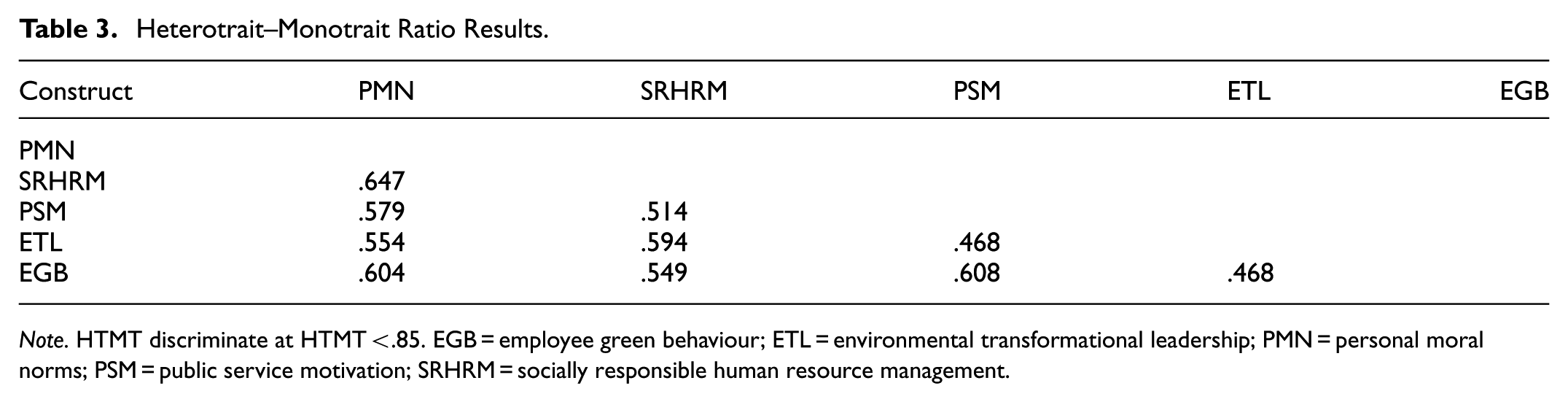
Note. HTMT discriminate at HTMT < .85. EGB = employee green behaviour; ETL = environmental transformational leadership; PMN = personal moral norms; PSM = public service motivation; SRHRM = socially responsible human resource management.
With χ2 = 367.351 (df = 142, p = .000), χ2/df = 2.587, standardised root mean squared residual (SRMR) = .0565, comparative fit index (CFI) = .953, Tucker–Lewis Index (TLI) = .944, and root mean square error of approximation (RMSEA) = .069, the model fit statistics showed an excellent fit. This allowed us to confirm that the constructs were valid and reliable.
Evaluation of the Structural Model
A maximum likelihood estimation was then performed on the structural model to validate the hypotheses (Collier, 2020). The metrics used to evaluate the model’s fit are as follows: SRMR = .0701; CFI = .950; TLI = .940; RMSEA = .069; χ2 = 408.069 (df = 158; p = .000). The fact that the χ2/df value of 2.583 fell between the 2 and 5 thresholds further demonstrates the model’s acceptability (Hu & Bentler, 1999). Therefore, the model’s goodness of fit was in the range of acceptable to excellent, as indicated by all of the fit indices (Ha et al., 2022). Different levels of statistical significance were demonstrated for each of the hypotheses. Table 4 shows the outcomes of the structural mode hypothesis testing.
Hypothesis Testing Using the Structural Model.

Note. EGB = employee green behaviour; ETL = environmental transformational leadership; PMN = personal moral norms; PSM = public service motivation; SRHRM = socially responsible human resource management.
p < .001. **p < .010.
Direct Effect
H1 posits a positive correlation between nurses’ EGB and SRHRM. The path analysis results indicated a positive and significant regression relationship between SRHRM and EGB (β = .210, p < .010). Consequently, H1 was confirmed (see Table 4).
Mediation Analysis
A bootstrapping mediation analysis revealed the relationships between SRHRM, PMN and EGB. The permutation methods used approximately 1,999 permuted samples, while the bootstrap methods used 2,000 bootstrap samples per sample (Taylor & MacKinnon, 2012). The data showed that PMN significantly affects EGB and that SRHRM correlates with it. It appears that PSM mediates the SRHRM–EGB relationship. The bootstrap test also demonstrated that SRHRM indirectly influenced EGB consecutively via PMN and PSM. Table 5 summarises the mediation test results.
Results from a Mediation Evaluation.

Note. EGB = employee green behaviour; ETL = environmental transformational leadership; PMN = personal moral norms; PSM = public service motivation; SRHRM = socially responsible human resource management.
p < .001. **p < .010.
Moderation Analysis
The models used contained all of the relevant variables, including those acting as moderators, dependents, and independents, as well as an interaction term (Collier, 2020). A strong positive effect of SRHRMxETL on EGB was found through these models (β = .187, p < .001), thus supporting H5. To distinguish between the high and low values of SRHRM and to identify the two degrees of this variable, the moderating effects of ETL were mapped out (Dawson, 2014). As shown in Figure 2, the relationship between SRHRM and EGB was positively moderated by ETL, especially at higher ETL levels. Furthermore, H6 was not supported by the insignificant effect of SRHRM × ETL on PMN.

The moderating effect of ETL on the link between SRHRM and EGB.
Moderated Mediation Analysis
Using SPSS PROCESS Macro 4.2 Model 86, the moderated mediation model (H6) was analysed and tested with 5,000 bootstrapping re-samples and 95% confidence intervals (CI). Table 6 presents the results of the moderating effect of ETL on the indirect effects of SRHRM on EGB via the sequential path PMN and PSM. For the sequential indirect path (SRHRM → PMN → PSM → EGB), the index of moderated mediation was −.0111, SE = .0072, with a 95% confidence interval (BootLLCI = −.0274, BootULCI = .0006) that narrowly included zero, indicating that the moderated mediation effect was not statistically significant. H6 was therefore not substantiated.
The Moderated Mediation Effect of ETL.
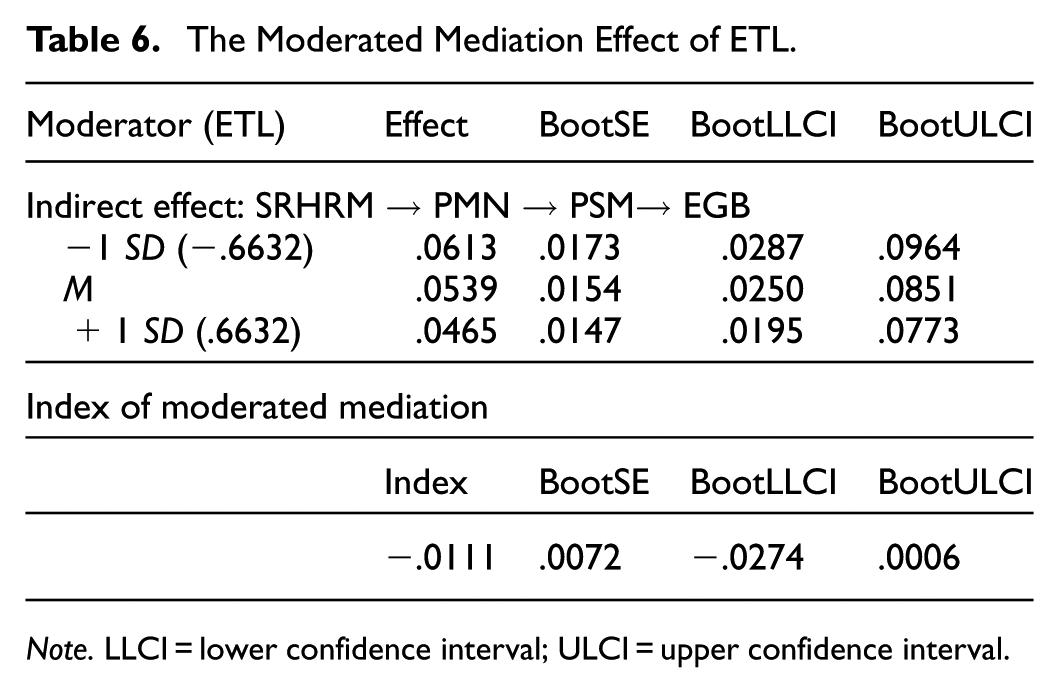
Note. LLCI = lower confidence interval; ULCI = upper confidence interval.
Discussion
This study sought to incorporate and expand upon current understandings of the interplay between SRHRM, PMN, PSM, ETL and EGB as related to the healthcare sector. Our findings from the SIPT show that EGB is more likely to emerge when nurses have a positive impression of SRHRM. Furthermore, PMN and PSM mediate the positive SRHRM–EGB link, and our findings lend credence to the idea that ETL moderates this interplay.
We can confirm a significant correlation between SRHRM and EGB (H1) based on our results. Zhou and Zheng (2024) found a positive correlation between SRHRM and EGB taken by employees in the workplace, which aligns with our results. Nurses have a better chance of experiencing belonging to a hospital that values CSR initiatives and prioritises them in HRM policies and procedures (Lee et al., 2023; Shen & Benson, 2016), which in turn boosts EGB. The SIPT posits that nurses’ views, beliefs, and actions stem from their collectively formed interpretations of the work setting (Salancik & Pfeffer, 1978).
Second, the findings confirm the substantial correlation between SRHRM and EGB, with PMN playing a partially mediating role (H2). This discovery is consistent with Fawehinmi et al.’s (2020) finding that PMN serves as an important mediator in the HRM–EGB link. Nevertheless, to the best of our knowledge, no investigation has yet determined whether there is a connection between SRHRM and employees’ ethical attributes, such as PMN. According to prior research, it is crucial to analyse ethical issues as they are linked to the process of making ethical decisions (Fawehinmi et al., 2020; Trevino, 1986). Nurses’ EGBs are influenced by both internal (PMN) and external factors (SRHRM; Zhao & Zhou, 2021). The primary objective of SRHRM is to streamline the implementation of CSR and establish a conducive and safe workplace for nurses. This is achieved through various HRM practices, including offering comprehensive CSR training and taking into account nurses’ CSR contributions (Shen & Benson, 2016; Zhao & Zhou, 2021). These ethical endeavours could certainly help nurses establish ‘moral-cognitive frameworks’ (Zhao & Zhou, 2021).
Third, we also verified that PSM mediates the connection between SRHRM and EGB. Consistent with previous research (Abdelmotaleb & Saha, 2019; Ha & Doan, 2024), the results demonstrate a strong correlation between SRHRM and PSM. When nurses have a positive impression of SRHRM, they are more motivated to help the public. According to SIPT, which is supported by Zhang et al. (2022), SRHRM practices provide nurses with valuable insights into the organisation’s values. This finding expands the role of PSM as a mediator in the connection between SRHRM and EGB among nurses (Abdelmotaleb & Saha, 2019).
Fourth, the results demonstrate that SRHRM influences EGB via a sequential mediation process, bolstering PMN and PSM; this is an original discovery in the existing literature on PSM. A person’s moral code provides a framework for their behaviour in various social contexts, including those involving the public domain and other people (Wang et al., 2020). High PSM individuals are seen as ‘moral exemplars’ who strive to achieve their moral goals by deeply integrating self and public morality (Perry, 2000). The highest level of PMN is associated with public service motives, such as selflessness, helping others and working for the community interest. This is because public service transcends private interest and is grounded in personal principles (Lim Choi, 2006).
Fifth, this study found that ETL positively impacts the relationship between SRHRM and EGB, thus confirming H5. Despite the lack of research suggesting that ETL moderates the SRHRM–EGB link, previous works have shown a positive correlation between ETL and EGB (Asghar et al., 2022; Graves & Sarkis, 2018; Kura, 2016). ETL has a substantial impact on fostering EGB within organisations, both directly and indirectly, due to the inspiring attributes of ETL. Our work demonstrates the moderating effect of ETL on the interaction between SRHRM and EGB.
Last but not least, the moderating effect of ETL on the relationship between SRHRM and EGB via PMN and PSM is insignificant (H6 was not supported). The interaction between HRM systems and leadership behaviours may depend on cultural circumstances; therefore, we cannot conclude that leadership styles can always replace HRM (Zhao & Zhou, 2021). In Vietnam, where collectivism and power distance are prevalent, our findings support the idea that leadership can replace HRM. Because nurses can be attracted and encouraged to engage with the organisation through either one, investing in both SRHRM practices and ETL does not bring any further advantage and may even cost more (McClean & Collins, 2019). Thus, the relationship between leadership and HRM practices in different backgrounds remains unexplored. Additionally, the moderated mediation effect was non-significant (H6 was not supported), which can be explained by the characteristics of the study population. Nursing staff in public hospitals are required to comply with the code of ethics and other pertinent regulations (Bordbar et al., 2025). The present study suggests that nurses in public hospitals act in accordance with their personal moral convictions, guided by a thoughtfully considered set of principles. Having internalised core public service values, nurses in public hospitals are therefore more likely to demonstrate ethical behaviours (Mai et al., 2025). As a result, the moderating effect of ETL on the nexus between SRHRM and EGB via PMN and PSM was non-significant. Our study may have overlooked crucial elements; therefore, further research is necessary.
Conclusion and Implications
Conclusion
This study sought to use the SIPT to investigate the relationship between SRHRM practices and EGB in Vietnam’s public healthcare sector. We found strong evidence for the positive relationship between SRHRM practices and nurses’ EGB. Additionally, our findings add credence to the idea that nurses’ PMN and PSM play mediating roles in the positive correlation between SRHRM and EGB. Finally, ETL was shown to play a moderating role between SRHRM practices and nurses’ EGB. However, the moderating of ETL in this relationship through PMN and PSM was not statistically significant. Our research shows that SRHRM practices and ETL style are useful tools for healthcare organisations to encourage environmentally conscious actions among their staff. This is especially true for organisations with environmental sustainability goals and objectives. Furthermore, the behaviours assessed by EGB are relatively simple and may exert little influence. Subsequent research should replicate the model to explain more complex behaviours.
Theoretical and Practical Implications
Theoretical Implications
Our results carry substantial theoretical contributions. First, our findings strengthen the case for merging HRM with leadership practices (Liu et al., 2023). The literature on SRHRM and transformational leadership has primarily centred on the effects of ETL or SRHRM on organisational performance. Leadership and HRM research must immediately merge because both practices significantly affect organisational outcomes (Liu et al., 2023). Moving forward, strategic HRM should primarily focus on this area (Liu et al., 2023; Steffensen et al., 2019). As a result, the SIPT is enhanced by this study. According to Salancik and Pfeffer (1978), employees can pick up clues about what is expected of them in the workplace from their social surroundings. Organisations promote socially acceptable attitudes and behaviours by using the social context to construct meaning (Graves & Sarkis, 2018; Salancik & Pfeffer, 1978). Aryee et al. (2012) found that when managers use HRM, it gives workers an indication about how to interpret their work environment from a contextual perspective. HRM practices enable supervisors to direct employees’ attention towards key priorities, including relevant data, desired actions, and their outcomes. SIPT elucidates how interactions with important others, like leaders, impact cognitive and behavioural responses (Mohammed Sayed Mostafa & Shen, 2020; Wadei et al., 2021). Leadership signals like these help employees validate their perceptions of the organisation’s environment, which they use to shape their thoughts and actions (Gu et al., 2018). Due to the rarity of using SRHRM and ETL for EGB prediction, this study’s results substantially advance the SIPT.
Second, by delving further into the connection between SRHRM and EGB, our study adds to what is already known about this relationship (Zhou & Zheng, 2024) and its potential implications. PMN, an obligation-based intrinsic motivation, stimulates employees to conduct their work in an environmentally conscious manner (Stern et al., 1999; van der Werff et al., 2013). Our results imply that SRHRM improves PMN, which may influence EGB. According to Zhou and Zheng (2024), our research reaffirms scholars’ demands for a deeper dive into the inner workings of the connection between SRHRM and environmentally conscious actions taken by nurses. Indeed, our study is the first to examine the mediating effect of PMN on this relationship.
Third, this is the first study to explain how PSM mediates the nexus between SRHRM and EGB. Doing so satisfies Ripoll and Ballart’s (2020) request for studies examining the evolution of PSM and workplace ethics. Workers can acquire PSM throughout their careers, in addition to whatever PSM they may have before starting work (Vandenabeele, 2014). Research on PSM has helped us better understand the concept. To fully grasp how organisational policies and practices impact the development of PSM, many scholars have called for more research (e.g., Abdelmotaleb & Saha, 2019). In addition, no prior studies have established a connection between SRHRM, PSM and EGB.
Finally, as far as we are aware, this study is the first to investigate how ETL acts as a moderator between SRHRM and EGB. Additionally, our research agrees with previous calls for further investigations into the limits of the link between SRHRM and environmentally conscious actions taken by employees (Zhou & Zheng, 2024). Based on our findings, a stronger ETL used by the organisation’s leaders amplifies the impact of SRHRM practices on EGB. Leadership and HRM have been the subject of prior research (Liu et al., 2023; Steffensen et al., 2019), which this study builds upon. Employees’ perceptions of the organisation’s expectations for members are shaped by SRHRM practices and ETL behaviours, which are significant social cues within organisations (Liu et al., 2023). Leadership that is environmentally conscious, and especially transformational leadership, is essential for inspiring people to do their part to preserve the planet and bolster existing environmental protection programmes (Asghar et al., 2022). We hope that other scholars will find our work encouraging, and we intend to keep digging into the intersection of leadership styles and HRM. The effect of ETL behaviours on the correlation between SRHRM and EGB has been the subject of surprisingly little research. Hence, additional research on the impact of leadership on the relationship between HRM content and outcomes is needed (Liu et al., 2023; Steffensen et al., 2019). Therefore, this is a pioneering study exploring the moderating role of ETL in the SRHRM–EGB relationship.
Practical Implications
The results of this study have substantial practical implications for healthcare organisations that are interested in enhancing the EGB performance of their employees by implementing SRHRM and using an ETL style. Our study suggests a connection between organisational practices and individual pro-environmental behaviours, and that SRHRM has the potential to encourage nurses to participate in EGB. Healthcare organisations need to make SRHRM a part of their internal CSR strategy in order to motivate nurses to fully involve themselves in green and socially responsible activities. These actions not only support external CSR efforts, but also create a social-interest community that brings together internal and external stakeholders for everyone’s benefit. First, HRM departments should ensure that nursing staff understand SRHRM regulations and what is expected of them. For instance, training sessions and onboarding materials should talk about the hospital’s CSR goals, environmental programmes, and the parts nurses can play in reaching those goals. Clear communication increases awareness of, and motivation for, participating in green and prosocial activities. Second, hiring procedures should put applicants with a strong moral identity and desire to help society at the front of the list. Interview questions or screening methods may look at how motivated applicants are to work in public service and how involved they have been in social or environmental concerns in the past. Third, nurses should be given the knowledge and skills they need to be involved in CSR through regular training programmes. These could focus on how to run a sustainable clinic, seminars on health equity and community impact, or peer-led sessions on how to make ethical decisions in healthcare settings. Fourth, performance rating systems should officially include metrics for social and environmental performance. For example, nurses who help with hospital-led community health programmes or suggest eco-friendly measures should be recognised and rewarded. Hospitals can tie these contributions to yearly reviews, bonuses, or choices about promotions. Lastly, hospital administrators should create a work environment that supports prosocial norms by setting an example of ethical and sustainable behaviour and supporting team-level projects. One method to give nurses more power and responsibility is to create specific CSR task forces or green teams inside departments. This will allow them to take an active role in designing socially responsible practices. Healthcare organisations can guarantee the centrality of their CSR agenda by implementing SRHRM through these specific actions. This will improve both employee motivation and the long-term success of the organisation.
Our findings highlight the crucial role of ETL in enabling SRHRM to foster EGB. ETL should not be confined to upper management or sustainability units, but rather be embedded across all levels, particularly among frontline supervisors. Hospitals should prioritise leadership development programmes that equip nurse managers with the necessary skills to communicate environmental values, align team goals with hospital sustainability objectives, and address day-to-day environmental challenges. Supporting managers to lead by example in green initiatives can significantly enhance the effectiveness of SRHRM and the success of hospital-wide environmental efforts.
Limitations and Implications for Further Research
Naturally, this study carries certain limitations. First, we gathered our datasets from a cross-section of Ho Chi Minh City nurses working in the public healthcare system. Consequently, future research should include samples from different locations to assess the totality of the experimental findings. Second, this study merely examined PMN’s function as a go-between for SRHRM and EGB. No other variables were considered for their possible effects. Subsequent studies can undertake further investigations into the internal workings of the SRHRM–EGB relationship. Third, because intrinsic motivation is considered a strong predictor of job performance, motivational theories, such as self-determination theory (Deci & Ryan, 1985), can be applied (Norton, Parker, et al., 2015). Future research could address different levels of employee engagement with EGB by exploring whether different types of formal motivation can do so. Finally, our use of a cross-sectional design may have presented endogeneity as a potential weakness. Consequently, future studies may wish to use longitudinal or experimental methodologies to establish causality more definitively.
Footnotes

Ethical Considerations
The Ethics Committee of Ho Chi Minh City Open University waived the need for ethics approval for this non-interventional study.
Consent to Participate
The participants were informed of the research’s purpose, duration and procedures; their right to decline and withdraw from it; the foreseeable consequences of declining or withdrawing; and reasonably foreseeable factors that may influence their willingness to participate, such as potential risks, discomfort or adverse effects.
Funding
The authors received no financial support for the research, authorship, and/or publication of this article.
Declaration of Conflicting Interests
The authors declared no potential conflicts of interest with respect to the research, authorship, and/or publication of this article.
Data Availability Statement
The datasets generated during and/or analysed during the current study are available from the corresponding author on reasonable request.