




Abstract
Leadership style is considered one of the critical factors in employee engagement with the leader, the organization, and the organization’s success. So far, there have been studies on the relationship between leadership style and employee engagement. However, there has been no research on the relationship between leadership style and the engagement of civil servants in Vietnam’s provincial public sector, which is a gap that needs to be researched. Therefore, this study examines the relationship between three leadership styles, namely transformational leadership, transactional leadership, and laissez-faire leadership concerning engagement to work and performance of public sector employees, and at the same time determines the relationship of leadership styles with demographic variables and with employee engagement in the Vietnamese public sector. The study data were collected from a convenient sample of leaders from the departmental level to the board of directors, and the survey sample was also collected from employees in state agencies who were feedback by answering questionnaires at a time. A total of 325 people, who are leaders and civil servants in the provincial public sector in Vietnam, responded. SPSS statistical software version 26.0 was used to process the data obtained through surveying the opinions of respondents in the leadership style questionnaire and the employee participation questionnaire. The results of the analysis show that leadership styles are closely related to employee engagement. The study also discovered that the level of an employee’s engagement to work depends largely on leadership style. Recommendations are made when a leader practices the right leadership style to increase employee engagement and vice versa.
Introduction
Recent studies have acknowledged that leaders are seen as decisive factors for the strategy and success of the organization (Kotter, 1995). Innovation or the ability of an organization to adapt to the changing leadership landscape is related to leadership style, so organizations are always looking for influential and trustworthy leaders (Judge, 2011). Each leader will practice a different leadership style, which is most important when considering the extent to which subordinates strive for innovation, creativity, and organizational engagement (Amabile et al., 2004; Panuwatwanich et al., 2008). Choosing the right leadership style has a significant impact on employees, guiding them to realize leadership goals, motivating employees to choose, providing attitudes and behaviors consistent with the direction, and ensuring change according to the rules of leadership activities (Northouse, 2007). Choosing the right leadership style has a significant impact on employees. It guides them to realize leadership goals, motivates employees to choose, provides attitudes and behaviors consistent with the direction, and ensures change according to the rules of leadership activities (Judge et al., 2006).
Puffer’s (1990) research shows that style determines the performance of leadership tasks, to the role and engagement of employees. Leaders can use different leadership styles to make decisions and influence employees. However, organizational rigidity in the public sector can significantly impact leadership style selection, which significantly affects leadership performance and the relationship between leaders and employees. Even when practicing the right leadership style, it can lead to undesirable effects (Felix et al., 2016). The leader has the highest responsibility in the organization; when employees leave the organization, it also means the failure of the leader; support or opposition to leadership decisions related to leadership style, so a trustworthy leader is a leader who practices the right leadership style for employees to engage with the organization, accompany and contribute to the organization (Avolio et al., 2009; Shin & Zhou, 2003; Yasir et al., 2016).
In addition to studies showing that authentic leaders will have authentic leadership styles, several studies have found that leaders are more prone to administrative orders and are criticized for practicing rigid leadership styles, always checking and controlling all employees’ activities and causing negative reactions, reducing positive interactions, making employees do not share their vision and lost motivation to work (Akinbode & Fagbohungbe, 2012). With this leadership style, employees’ engagement to work is quickly diminished as employees’ trust is eroded when they are no longer seen as part of the organization, they also realize that they are not. If there are promotion opportunities, negative feelings toward the organization, with the leader turning them away from the organization, sooner or later leaving the organization is a warning (Nasurdin et al., 2014). It proves the importance of leadership style has been confirmed through leadership performance as well as employee’s work engagement and dedication to the organization, so the research on leadership style continues to be conducted to discover the right leadership style practice and find authentic leaders although this is not a new topic (Daučianskaitė & Žydžiūnaitė, 2020; Hallinger et al., 2019). Therefore, the relationship between leadership style and employee engagement has received extensive research attention from academia (Abasilim et al., 2019). This is also the reason why researchers focus a lot on leadership styles, to find out the optimal leadership style and the most suitable aspects of leadership styles to gather, build trust, engagement of employees in the context that both public and private sector organizations have many strategies to find leadership talent (Kelly & MacDonald, 2019; Sudha et al., 2016).
The evidence shows that the leadership context in countries, especially emerging countries, is undergoing rapid changes and unpredictable developments. State agencies are making efforts to respond to the leadership background changes. Some organizations have had strong development, but there are also organizations that, despite the support of the state, still operate inefficiently due to the lack of innovation, and appropriate leadership style in the context of many leadership background changes (Higgs & Rowland, 2000; Judge, 2011). Although public sector organizations have changed quite slowly, change is inevitable to effectively respond to impacts from the external environment, and the main driver of change is the leadership of the activities. Therefore, discovering effective leadership styles to become a successful leader has essential implications in the development strategy of all organizations, all levels to lead change well, bring the country to prosperity (Abasilim et al., 2019).
Recent studies have provided important evidence that transformational leadership, transactional leadership, and laissez-faire leadership styles are widely accepted, becoming topics of interest to many scholars focused on research on adaptive organizational development in leadership contexts with many challenges (Abasilim et al., 2018; Rehman et al., 2012). Along with the study of leadership styles, employee work engagements with affective engagement, normative engagement, and continuity have been developed (Othman et al., 2012). Studies have found that there is a definite association between transformational leadership, transactional leadership, and laissez-faire leadership styles and employee work engagements; in which transformational leadership style and transactional leadership styles have a positive relationship with employee engagement, whereas laissez-faire leadership styles have a negative relationship with employee engagement (Abasilim et al., 2018; Dariush et al., 2016; Yasir et al., 2016).
In Vietnam, an emerging country is promoting the state administrative reform strategy by streamlining the apparatus, building a contingent of civil servants that meet the criteria for priority employment positions, and strongly implementing strong (The Central Committee of the Communist Party of Vietnam, 2017; The Government of Vietnam, 2011). Therefore, the search for leaders who have the right leadership style, meet the requirements of the new leadership context, can lead to the development of the organization and the capacity to work in an international environment and become an urgent matter (The Central Committee of the Communist Party of Vietnam, 2018). Before this reality, there have been exploratory studies on leadership styles (Giao & Hung, 2018; Huyen et al., 2019). This study focuses on analysis, exploring democratic, authoritarian, and laissez-faire leadership styles developed based on the views of Lewin et al. (1939).
Studies on transformational leadership, transactional leadership, and laissez-faire leadership styles with employee engagement have been widely conducted in many countries, in different cultures (Abasilim et al., 2019; Avolio & Yammarino, 2003; Xirasagar, 2008; Yasir et al., 2016). Is this true for the public sector in Vietnam as well as for the provincial public sector administration in Vietnam? This is also a gap in research in Vietnam that has not been conducted so far, therefore, this study aims to explore among the three leadership styles, which leadership style prevails as well as the relationship between the three leadership styles. religious style of provincial public sector leaders in Vietnam with the participation of civil servants. Moreover, this study will become meaningful in filling the gaps that previous studies have conducted, especially in terms of leadership context in Vietnam, studying leadership styles mainly conducted outside the public sector (Huyen et al., 2019). On the other hand, this study will enrich the system of practical knowledge on transformational leadership style, transactional leadership style, laissez-faire leadership style in the public sector in general, and the provincial public sector in particular. especially in Vietnam conditions, helps leaders identify and develop the right leadership style to increase employee engagement, thereby improving leadership performance.
Literature Review
Leadership Style
Up to now, many theories of leadership style have been born and developed. However, within the limitation of this study, we focus on clarifying the theoretical and practical basis from the review of research works on transformational leadership style, transactional leadership style, and laissez-faire leadership style about the employee’s level of engagement. The three transformational, transactional, and laissez-faire leadership styles were selected for this study because of their recent extensive research (Abasilim et al., 2019; Xu et al., 2022) and key measures. Based on the Multifactor Leadership Questionnaire developed by Avolio and Bass (2004). Therefore, we continue to study these three leadership styles to fill the gap in the research on leadership styles in the public sector in Vietnam.
Transformational Leadership Style
Transformational leadership style has become a topic of interest to many scholars, and it is believed that leaders who practice transformational leadership are open-minded leaders who always know how to lead, motivate, share the vision and inspire employees, motivate employees to work hard, and create new competencies for them (Bass & Avolio, 1990, 1994; Bass & Riggio, 2006; Chou et al., 2013; Judge & Piccolo, 2004; Sudha et al., 2016). Transformational leaders are seen as inspirational, motivating employees to be motivated to work with high performance and be able to overcome their previous limits. (Abasilim et al., 2019; Burns, 1978). Some authors consider the transformational leadership style as holistic leadership style (Avolio et al., 1988) or multi-factor leadership style (Tejeda et al., 2001). When practicing transformational leadership style, leaders actively create changes in awareness, attitudes, and behaviors in themselves, becoming attractive role models to create cognitive change, behaviors, attitudes, and even value orientations in employees (Bass, 1985).
According to Bass and Riggio (2006), The transformational leadership style achieves high leadership performance and can exceed expectations because it also focuses not only on leadership performance but also on the human factors and the development of employees. This is considered the main motivation for leaders to create employee engagement with the organization. Transformational leaders are attractive because they always believe in employees, are change agents and always pay attention to improving the working capacity of employees in the organization, and organize the learning process so that the organization can cope with complexity as well as being very proactive in building an atmosphere of job satisfaction and engagement to leadership performance (Agarwal & Gupta, 2021). According to Burns (1978) transformational leadership has some values such as justice, fairness, honesty, and honor, which are the ultimate values that cannot be bargained or exchanged so that they can unleash their creativity, so leaders get great power through the mobilization of collective intelligence, new ideas and are an important condition for building learning organizations practice that not all leadership styles create these values (Moradi Korejan & Shahbazi, 2016).
According to Bass and Avolio (1997), the transformational leadership style has five manifestations. The five manifestations of transformational leadership style are idealized attributes, idealized behavior, intellectual stimulation, inspirational motivation, and individualized consideration. Influence is idealized, leadership vision is shared, employees voluntarily follow shared visions, leaders become role models for employees, always putting the collective interests first (Avolio & Bass, 2004). Inspiring motivation, leaders make employees aware of the urgency of leadership goals and motivate employees, arouse in employees the desire and confidence to realize the goals and organization vision as a whole (Yukl, 2013). Personal considerations, leaders respect differences, care about the needs of employees, become mentors, coach trusted employees before employees (Winkler, 2010).
Transactional Leadership Style
Kuhnert and Lewis (1987) argue that transactional leadership is the substitution of one goal for another to increase leadership performance, to encourage change in leadership employees to become ethical leaders of the future, by coaching them to recognize the challenges of leadership situations to lead the organization to increase employee performance. Another view is that transactional leaders identify employees’ needs and reward them for satisfying those needs so that they perform better (Arnold et al., 1998).
The transactional leadership style is considered to be an exchange of rewards based on completion, which has been likened to the carrot and stick method for employees to complete their leadership tasks (Bass, 1997). Transactional leaders can use punishment when the work is poor, or the results are negative but can achieve rewards when the work is positive. The transactional leadership style is criticized for being more management-oriented than strategic in leadership (Hargis et al., 2001), even though this is a partnership relationship agreement between leaders and employees (Winkler, 2010). This indicates the employee’s compliance based on the punishment or reward they receive, the employee’s level of work engagement will depend greatly on the reward or punishment, the organization will be difficult to change because leaders are more interested in processes than progressive ideas, in finding faults to punish, and achievements for rewarding rather than motivating employees to work. Leaders exchange rewards or punishments with employees based on task completion in return for employee productivity (Naidu & Van der Walt, 2005).
Transactional leaders are less attracted to subordinates solely with the rewards they achieve; employees work for rewards rather than work goals or focus on mistakes to avoid intervenes until an abnormal development occurs (Howell & Avolio, 1993). According to Avolio and Bass (2004) in transactional leadership, there are two forms of reward and one punishment: Contingent reward provides rewards for effort and recognizes good performance random reward (contingent positive reinforcement) or contingent punishment (contingent negative reinforcement), clearly established leadership processes and procedures, work performance, and employees who exceed expectations will be rewarded (Akram et al., 2016). Management-by-exception, employees are subject to inspection and supervision with work procedures followed to ensure leadership tasks are completed (Gill, 2012). This way of creating rewards is difficult for employees to be creative when they are always under close supervision, and leaders are more interested in working processes than creative improvements to improve performance. According to Johnson and Hackman (2018) contingent reward provides rewards for employees’ efforts, which contribute to affirmation and recognition of their achievements, while management-by-exception aims to maintain the status quo. participation of employees, and can intervene when employees do not meet assigned tasks well, leaders can give suggestions and encouragement for employees to achieve a satisfactory level of performance. acceptable, so that employees can improve their ability to work to meet the set leadership goals. Contingent rewards and management-by-exception active are ways to increase leadership performance, but in a flexible work environment, these rewards can reduce employee engagement (Sosik & Jung, 2009). Even management-by-exception passive leaders do not monitor employee performance and wait for serious issues to come up before taking any corrective actions (Bass, 1998). Contingency penalties (such as suspension) are given when an employee’s performance falls below a standard or target or task does not meet leadership requirements (Yahaya & Ebrahim, 2016). Contingency penalties are often given on a latent reward basis, with the leader waiting for problems to emerge instead of actively detecting them. Therefore, the transactional leadership style is adopted in favor of management, which is seen as the foundation for the transformational leadership style applied to complex leadership situations (James & Ogbonna, 2013).
Laissez-faire Leadership Style
The laissez-faire leadership style often does not represent the role of the leader, but employees can maximize the laissez-faire to make most decisions and do work in a way that is most convenient for them (Lewin et al., 1939) while encouraging personal growth, employees can express themselves especially before difficult tasks. On the other hand, the laissez-faire leadership style encourages innovation and creativity and allows for faster decision-making, autonomy to make decisions without waiting for the approval process (Amanchukwu et al., 2015). Laissez-faire leaders do not interfere in the thought and actions of employees, even in difficult situations where the role of the leader is required, but they avoid it, the decision belongs to the employees (Giao & Hung, 2018; Goodnight, 2011). However, this seems to be suitable for employees with self-discipline, high responsibility, and in contrast, this style will be difficult to achieve leadership goals with employees having a low sense of discipline.
Besides some views in favor of the laissez-faire leadership style, others argue that it is a leadership style that leads to low productivity among team members (Anbazhagan & Kotur, 2014). Laissez-faire leaders often avoid making decisions, hesitate, avoid making decisions instead of actively responding to the leadership situation needed (Piccolo et al., 2012). Laissez-faire leadership style is the most unsatisfactory and least effective leadership style, and non-interference in tasks, complete laissez-faire of engagement can lead to ineffective, hard-to-achieve ways of working target (Bass & Bass, 2008). Evaluations of the limitations of the laissez-faire leadership style have mainly focused on the direct effects of laissez-faire leadership, and the mechanisms and contextual boundaries associated with the effects of this style are less noticed (Bass & Bass, 2008). Laissez-faire leadership style depends a lot on the ability of employees; if they lack knowledge and skills, their work performance will be poor. This style will not be suitable if high performance is the main goal. Employees are less guided, motivated, inspired; in some cases, they will be in a mood that is not sure about their role in the organization.
Employee’s Engagement
Employee engagement is related to individual variables such as age, gender, leadership style, and trust. The level of engagement is highly dependent on the organization’s goals and values, and the leader’s efforts to bring employees together for the common good of the organization (Morrow, 1983). Employee engagement is a useful metric to evaluate leadership performance and organizational performance, the higher the level of engagement, the better the relationship between leadership and employees is being maintained good, promotes a stable working environment, and has a positive impact on employees’ willingness to innovate and create (Suliman & Iles, 2000).
Employee engagement is also determined by the responsibility to actively increase their value to accomplish the organization’s goals, the perception of opportunities for advancement, and the motivation for employees to work from their jobs. Each person is inspired by the role model created by the leader (Akanbi & Itiola, 2013). Employee engagement to work is also reflected in the employee’s recognition of being a member of the organization with a positive attitude and voluntarily contributing to the development of the organization. Based on different components of work engagement, Meyer and Allen (1997) classified work engagement into (1) Affective engagement, positive work based on affection. (2) Ongoing engagement, employee obligations as a result of organizational socialization, and pressure to stay with the organization. (3) Engagement to standards and ethical obligations in complying with established organizational standards and rules. The employee’s emotional engagement to the organization is deeply meaningful, the leader is more attractive than the transactional as well as other leadership styles, the leader as a servant, the dedication Silent dedication and devotion make employees feel that the leader is trustworthy (Hansbrough & Schyns, 2018).
Based on reviewing leadership studies, Bass (1990) pointed out, the higher the employee’s work engagement, the more loyal it is, which has a stronger effect than all words. Employees’ engagement to work with the organization is stronger if the organization has reliable leaders who inspire employees to accompany the growth of the organization and vice versa (Price, 1997). From tracking and analyzing different perspectives on employee engagement to the organization (Abasilim et al., 2018) believes that employees work engagement must be based on emotional attachment, an individual’s belief in the development strategy of the organization, and the opportunities that students can gain for them to work hard.
The Relationship Between Leadership Style and Employee’s Engagement
The relationship between leadership style and employee engagement has attracted many researchers, and, many studies have been conducted in different countries, different contexts, and cultures (Abasilim et al., 2018). Transactional leadership style and transformational leadership style can help employees meet expectations of work engagement and organizational engagement, the more employees contribute to the development of the organization. Organizations also demonstrate maintaining engagement, also demonstrate their trust in the leader (Bass, 1997). Employee loyalty and engagement to work always exist in a consistent relationship with the use of the right leadership style, becoming a powerful motivator that attracts employees to perform tasks, leadership goals (Bass, 1990). When leaders practice the right leadership style, it also means that they will build and maintain employee engagement based on a firm belief in the leader (Price, 1997). Many empirical studies have shown that transformational leaders have an advantage in maintaining and creating employee engagement, so leadership performance is also improved (Avolio, 1999; Avolio & Yammarino, 2003; Bass, 1998; Elsan Mansaray, 2019).
Along with the outstanding advantages of the transformational leadership style, some studies also show that the transformational leadership style and the transactional leadership style with employee work engagement show that the transformational leaders have significantly higher employee engagement, compliance, and leadership performance than transactional leaders (Fuller et al., 1996). Transformational leadership style easily brings satisfaction and intellectual stimulation to employees, so it often produces higher leadership performance than transactional leadership style (Jung, 2001). Experimentally, Lee (2005) shows that leadership performance of transformational leadership style has a strong positive correlation with the engagement to work not only among employees but even professionals in Singapore, while transactional leadership style is realized, and employees’ engagement to work in the organization is significantly reduced. Therefore employee’s working engagement is a vivid and clear reflection of leadership performance, the organization’s development strategy, and leadership style (Stum, 2001).
Bass and Riggio’s (2006) transformational leadership style can create two goals at the same time, the leader achieves the leadership goal, while the employees are motivated, work performance can be improved exceed expectations, so they are very willing to commit to work. Therefore, employees are more inspired to work with transformational leaders to achieve a higher common goal than practicing other leadership styles (Berson & Avolio, 2004). Bono and Judge (2003) suggest that employees have confidence in their engagement to work if the organization has a transformational leader, their hope of promotion is also greater than the use of rewards or in other difficulties they need support but the leader avoids, the trust of the employees in the leader becomes fragile. Therefore, feeling that one’s values are recognized, the stable and strong organization is positively correlated with transformational leadership style (Hannah et al., 2016). Breevaart and Zacher (2019) examined how the combination of transformational leadership and laissez-faire leadership styles had the opposite effect, with increased intention to quit rather than engagement to work. For the organization, employees feel less empathy, positive energy to work from the leader because they always want to know who they are working for, what attracts them (Panahbehagh & Hosseini Shakib, 2018).
Although it is acknowledged that transformational leadership styles have outstanding advantages in building trust and loyalty in employees, there are still new studies that continue to explore attachment, engagement to work in different leadership contexts, and leadership styles. What leads in these studies with fairly similar answers about values such as trust, loyalty, self-worth being appreciated, the leader’s sense of appreciation for employee’s contributions to the organization, the stability, and growth of the organization; when the organization has events, the transformational leader is easier to share than the leader with other leadership styles and safe, open working environment (Avey et al., 2008; Dust et al., 2014; Wang et al., 2011; Zhu et al., 2013). Employees have a dialog with the leader, the leader shares with them the vision, strategic directions, employees feel they are an integral part of the mission of the organization (Chun et al., 2016; Nohe & Hertel, 2017).
Transformational leadership style is a useful style that can be applied at all levels of leadership, including public and private sectors; transformational leaders become typical examples, shaping employees’ initiative to work and accompanying the leader to overcome leadership challenges (Lai et al., 2020). As engagement to work increased, employees also expressed a preference for the transformational leader, while the transactional leader was less likely to express sympathy or support as well as the style of the transformation. Employee-laissez-faire leaders were quite apathetic (Raja & Palanichamy, 2011). Along with studies on the relationship of leadership style to employee engagement, leadership style also affects organizational culture and employee engagement (Echezona, 2018). Transactional leadership style and transformational leadership style both have an influence on work engagement, in which transformational leadership style is more influential.
However, there are differences in leadership styles and work engagement, Garg and Ramjee (2013) in the South Vietnamese public sector. Phi has revealed the relationship of transformational leadership style with three types of employee engagement: affective engagement, ongoing engagement, and normative engagement have a positive but faint relationship. Transactional leadership style is positively correlated with normative engagement but also rather weakly. In contrast, the laissez-faire leadership style had a negative but rather weak relationship with emotional engagement and normative engagement. The author comes to affirm that the level of engagement depends on the leadership style, the employee’s stay or leave the organization is an expression to determine the leadership style, the employees’ feelings about the leader. This is quite similar to the analysis of Wiza and Hlanganipai (2014) conducted in universities; transformational leaders are easy to form and maintain the motivation that motivates employees to make the emotional engagement and continuous engagement. The transactional leader also shaves off the engagement to work but only the relationship within the normative engagement. Research by Othman et al. (2012) conducted in Nigerian public universities confirmed that transformational leadership and transactional leadership both have a positive impact, and engagement to work is quite similar for lecturers. Research by Khan, Anjam et al. (2020) in a university in Pakistan also shows that transformational leadership style and transactional leadership style have a positive relationship with creative work behavior, organizational culture. Even in banking, transactional leaders create a greater engagement to work than transformational leaders.
In the public sector, transformational leaders always have a clear mission orientation as well as support employees to be aware of the urgency of the mission of the organization, so it is easy to create trust for employees (Gabris et al., 2001). This makes leadership performance in the public sector significantly increased because leaders, as well as employees, are aware of their contributions not only for themselves but for the great meaning of the organization (Wright & Pandey, 2010). Wright et al. (2012) also reveal that transformational leaders contribute to organizational culture building and innovation, even when bureaucracy, administrative orders are dominant, the presence of a transformational leadership style is not obvious, but the leader is still willing to empower and guide employees, stimulating creativity and innovation (Park & Rainey, 2008). Research by Dariush et al. (2016) indicates that transactional leadership style also has a positive influence on the relationship. The relationship between leadership style and employee engagement to work, on the contrary, the authors argue that the laissez-faire leadership style is detrimental to the organization when employees have a low level of engagement, employees are always in a bad mood, want to leave the organization, while the laissez-faire leadership style has a weak or no relationship between affective engagement, ongoing engagement, and normative engagement (Mulugeta & Hailemariam, 2018).
In Vietnam, there have been some recent studies on leadership styles with employee engagement in both the public and private sectors, but these studies are just the beginning. Research by Huyen et al. (2019) in the private sector has provided some results about the concern of transformational leadership styles that positively affect employees’ psychology, their ability to work, and the stability and development of the organization. Research in the private sector by author Ngoc (2019) shows that transformational leadership style and transactional leadership style have an inverse relationship with intention to quit, but in self-directed leadership style because there is a positive relationship with intention to quit.
Research on leadership style in the public sector by author Duat (2013) on democratic leadership style, authoritarian leadership style, and laissez-faire leadership style has revealed that the authoritarian leadership style hurts work engagement, while democratic leadership styles and laissez-faire leadership styles have a positive relationship with organizational retention. Ho Ngoc Truong (2011) said that along with leadership style, it also affects the ethics, lifestyle, behavior, and personality characteristics of employees. Research by Giao and Hung (2018) in the public sector at the district level shows that democratic leadership style, transformational leadership style, and laissez-faire leadership style leaders have a positive effect on employee engagement. This is very different from many studies conducted in many other countries and cultures when asserting that laissez-faire leadership style has a negative relationship with employee engagement. But in the district public sector in Vietnam, the above findings have contradictory results, not always the laissez-faire leadership style brings negative results. In contrast, the authoritarian leadership style hurts employee satisfaction and intention to quit.
Through analyzing the relationship between leadership style and employee engagement to work from available data, it can be seen that studies have been conducted on many leadership styles to assess the level of employee engagement. The degree of impact of leadership styles on work engagement is also very different, according to leadership context, culture, and geography also bring different results. However, so far in Vietnam, it seems that empirical studies on the effects of leadership styles on employee engagement are rather modest and no research has been provincial scope. Therefore, the article will add more scientific evidence on the relationship between transformational leadership style, transactional leadership style, and laissez-faire leadership style to employees’ work engagement in the context of Vietnam.
Gaps in the Literature in Research on Leadership Styles With Employee’s Engagement
Studies on the relationship between leadership style and employee engagement around the world show that the common point is that the transformational leadership style has a positive impact on employees’ engagement to work. Studies on multiple leadership styles show that in the private sector it seems that transactional leadership has little impact on work engagement, whereas laissez-faire leadership styles hurt working engagement. However, in the context of Vietnam, this seems to be less tested and there is no research on the impact of transformational leadership styles, transactional leadership styles, and laissez-faire leadership styles on working engagement of civil servants in provincial administrative agencies, to be able to confirm the solidity of published studies or refute existing research results. This is also one of the efforts to provide evidence to public sector leaders in general as well as at the provincial level in the context of leadership in Vietnam.
Research Problem
Studies on the relationship between leadership style and employee engagement can be found in many countries and most of the private sector, and in many leadership contexts and cultures (Dariush et al., 2016; Echezona, 2018; Yahaya & Ebrahim, 2016). The number of studies in the public sector is significantly less (Abasilim et al., 2019; Daučianskaitė & Žydžiūnaitė, 2020; Khan, Anjam et al., 2020; Khan, Ismail et al., 2020; Sudha et al., 2016) compared with studies conducted in polar regions private. Given the limited number of studies on the relationship between leadership style and employee’s engagement, both in the private and public sectors, even very little research on this topic has been implemented in the public sector and only one report has been carried out at the district (Giao & Hung, 2018). Studies have made certain contributions in discovering and showing the relationship between leadership styles and employee engagement to work, providing insights for leaders, but there are still problems. The gap is not clearly defined in that the results of previous research have contributed to providing insights into the relationship between leadership style and employee engagement to work in high-level administrative agencies in a province in Vietnam. On this basis, the study identifies the research results to determine the leadership style affecting the level of work engagement of administrative civil servants in the provincial public sector in Vietnam.
Hypotheses Development
The main objective of this study was to examine the relationship between transformational leadership style, transactional leadership style, and laissez-faire leadership style to the work engagement of civil servants in the provincial administration. Therefore, to achieve the stated research objectives, hypotheses have been raised and tested (Figure 1).
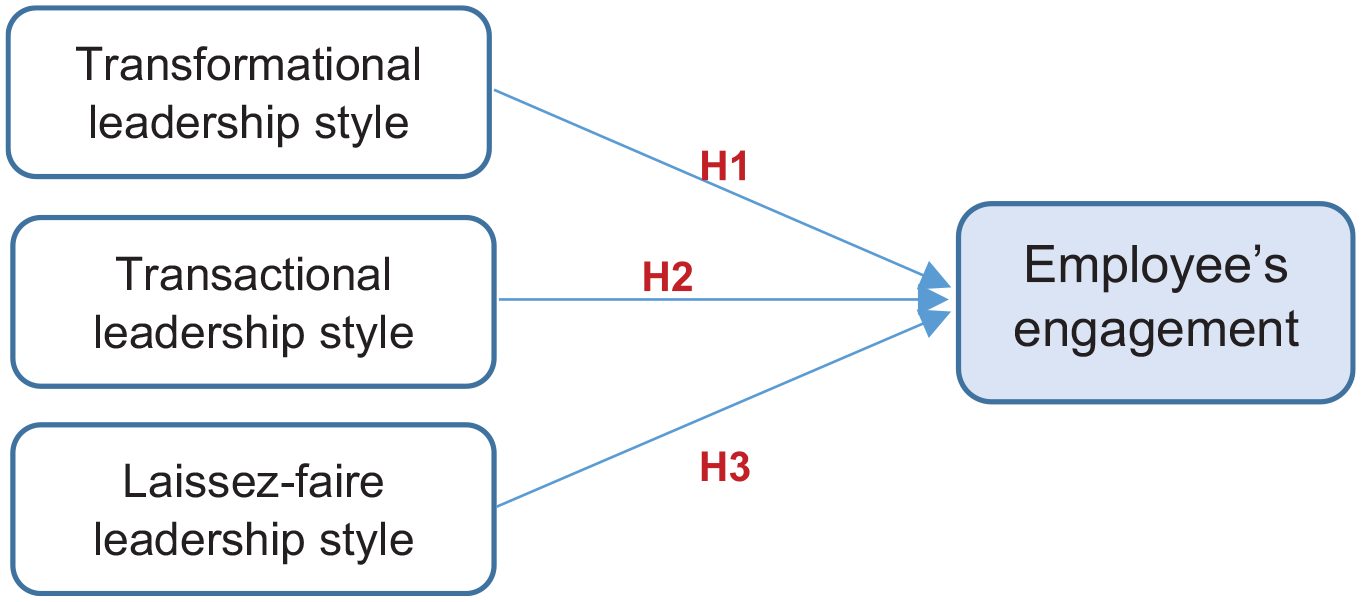
Hypothesized research model.
Methodology
The purpose of this study is to explore the expression level of transformational leadership style, transactional leadership style, laissez-faire leadership style, the relationship between leadership styles and public participation, positions in state agencies at the provincial level, including those under the provincial People’s Committees of Vietnam. The data in the study were collected through a survey of civil servants working at provincial agencies and studying political theory at the Ho Chi Minh National Academy of Politics, Vietnam. The subjects of this study included 325 respondents who are working in government agencies in Vietnam. Therefore, a cross-sectional survey design was used.
To assess the relationship between leadership style and employee engagement, the “Multi-Factor Leadership Questionnaire” (MLQ) by Bass and Avolio (1995) was developed and used for this study. This tool includes 36 items, 20 items for transformational leaders, 12 items for transactional leaders, and four items for laissez-faire leadership and Organizational Commitment Questionnaire (OCQ) developed by Meyer and Allen (1997). This tool includes 18 items. However, this questionnaire has been refined to adapt to the leadership context as well as to the characteristics of the public sector in Vietnam. The multi-factor leadership questionnaire has been shortened, how to evaluate questions based on a Likert scale from 0 to 4 points, divided as follows (ranging from 0 to 4) where 0 = not at all, 1 = once in a while, 2 = sometimes, 3 = fairly often, and 4 = frequently, if not always. The Organizational Commitment Questionnaire, built on a five-point Likert scale from 1 to 5, where 1 = strongly disagree, 2 = disagree, 3 = undecided, 4 = agree, and 5 = totally agree.
The Multi-Factor Leadership Questionnaire and Organizational Commitment Questionnaire are divided into three parts, the first part focuses on answering demographic issues, the second part focuses on analyzing the leadership styles of leaders in public sector agencies, and the third part focuses on analyzing and evaluating the level of work engagement of employees in public sector agencies of Vietnam (Table 1).
Questionnaire Design.

Note. NA = not at all; FA = frequently, if not always; 1 = SD, 5 = totally agree.
The Cronbach’s alpha coefficient was analyzed to determine the reliability of the MLQ measuring tool as .84 and the OCQ measuring tool with the Cronbach’s alpha coefficient of .81. According to Finch and French (2018), the value of Cronbach’s alpha coefficient is meaningful only if the deleted item α ≥ .3, the coefficient α is closer to 1, the best value. The higher the consistency, the better the Cronbach’s Alpha coefficient on the sum variable when α ≥ .7. Thus, Cronbach’s Alpha MLQ and OCQ coefficients ensure reliability. The data were analyzed with the help of the Statistical Package for Social Sciences 26.0.
Demographic Data of Respondents
Demographic characteristics of the respondents related to gender, age, education level, working position, working seniority, and field of study and occupation are presented in Table 2 below.
Demographic Characteristics of Respondents.

Source. Field survey April 2021.
The results of demographic statistics in Table 2 show that the proportion of respondents is 184 men (65.62%), 132 outnumbered women (40.62%). The age of the respondents under 30 is 63 (19.38%), from 31 to 40 years old 162 (49.85%), accounting for the largest proportion of the three age groups, the age of over 40 is 91 (28%). The majority of respondents with the highest level of education are university 232 (71.38%), while the number of respondents with graduate education is 84 (25.85%). The results of demographic statistics in Table 2 also show that the number of leaders polled is 146 (44.92%), the number of employees polled is 179 (55.08%). Working seniority is divided into three groups, the group with less than 5 years of seniority 16 (4.92%) accounts for a relatively small proportion, mostly focusing on two groups of working seniority from 5 to 10 years 142 (43.69%) and the group with more than 10 years working seniority is 167 (51.38%). And the demographic variable by field of occupational learning shows that the field of humanities and social sciences accounts for the outstanding number and proportion, with 153 (47.08%), the number of respondents has studied in the field of natural and applied sciences is 124 (38.15%) and the proportion is quite small with 47 (14.46%) having studied in other fields. Statistical results in Table 2 show the diversity of demographic characteristics of the respondents, especially with the participation of staff in state agencies to have the clearest verification evidence on work engagement in the relationship between employee work engagement and leadership style.
Results and Analysis
To determine the relationship between leadership style and employee engagement in the public sector, correlation and regression were used in this study. The t-test is used to evaluate the difference between the score of leadership style and the score of assessing the work engagement of public sector employees based on the variables of gender, highest professional qualifications, job position. However, in testing the difference of demographic variables in terms of age, working seniority, and training field, it is based on comparison and evaluation of variance. Duncan’s (1955) test was used to explore the difference in assessment results between leadership styles and employee engagement. The results of correlation statistics are presented in Table 3.
Correlation of Leadership Style with Employee’s Engagement to Work.

Source. Author’s statistics.
Significant at 1% (p < .01).
The correlation coefficient between the employee’s work engagement assessment results and the transformational leadership style assessment results (r = .663**), with the transactional leadership style assessment results (r = .483**) and with the results of the assessment of the laissez-faire leadership style (r = .657**) listed in Table 3 based on the analysis of Finch and French (2018). The above correlation results are positively correlated and have good statistical significance (p = .000, p < .01). The results of the t-correlation coefficient test on the relationship between work engagement and transformational leadership styles, transactional leadership styles, and laissez-faire leadership styles in Table 3 show the relationships positive relationships. This means that the proposed hypotheses are accepted and are positively correlated, in which the work engagement of civil servants with the transformational leadership style and the laissez-faire leadership style have quite similar t-test results. The results showed a stronger correlation than the correlation between employee engagement and transactional leadership style.
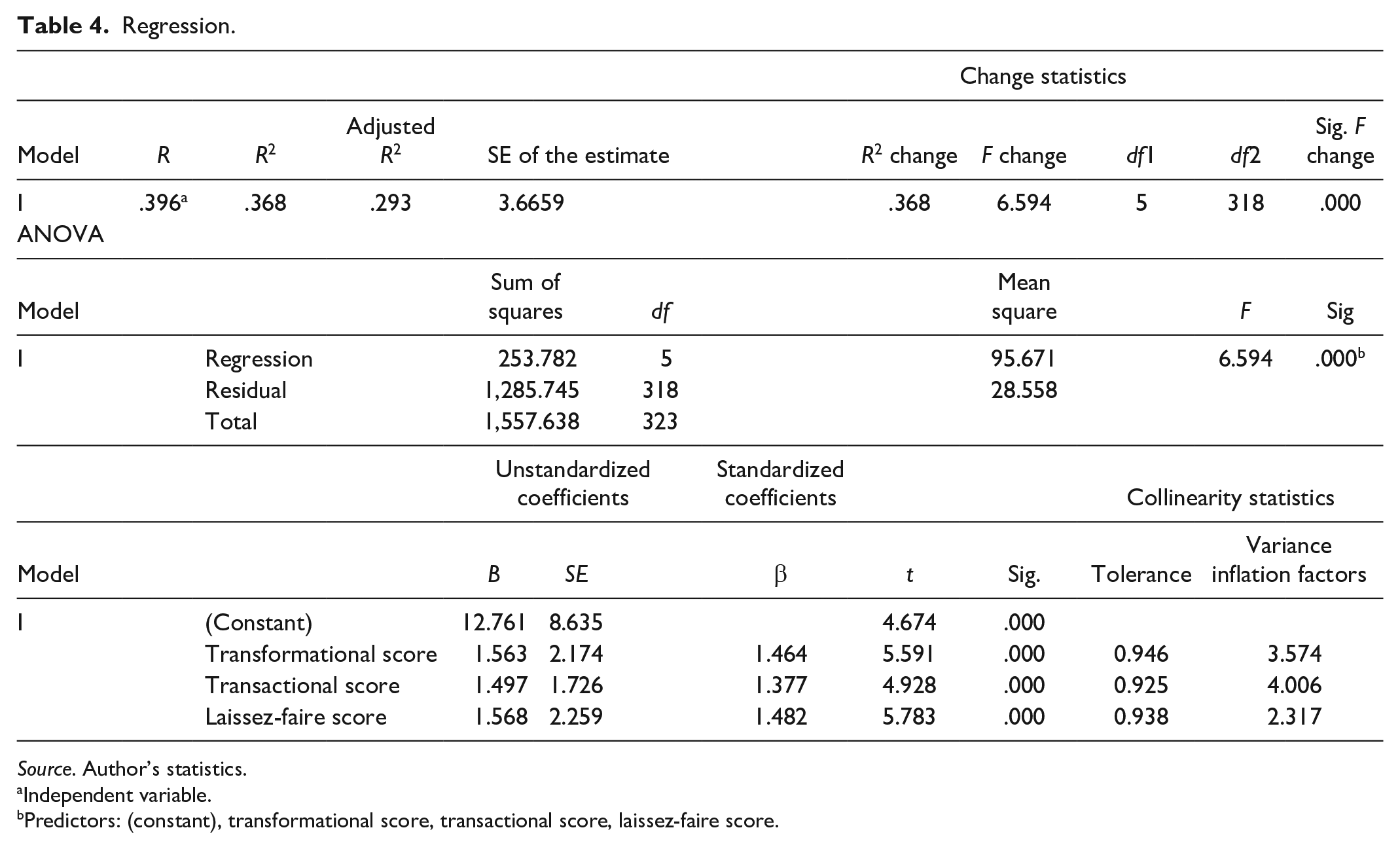
Assessing the difference in employee work engagement based on the impact of leadership style, multiple regression is used in the study. Diversity inflation factor (VIF) is used as an indicator to test the multicollinearity between the independent variables and VIF of transformational leadership style, transactional leadership style, and autonomous leadership style is 3.574, 4.006, and 2.317 respectively. This has a basis to confirm that VIF on leadership styles are all <10, showing that the predictors do not have multicollinearity. Besides, the adjusted R2 is .368, with this result means that the difference in work engagement of employees in Vietnam’s public sector can be explained with 36.8% being due to the impact of leadership style. On the other hand, with the value F = 6.594, and the significance level p = .000, p < .01 indicates that this is a suitable model for research in exploring the relationship between leadership style and work engagement of the employees.
Research results in Table 3 also show that in the three leadership styles, it can be seen that at the same time, transformational leadership styles, transactional leadership styles, and laissez-faire leadership styles all have a significant positive relationship for employee’s work engagement, specifically with transformational leadership style β = 1.464, t = 5.591, p = .000, p < .01; with transactional leadership style β = 1.377, t = 4.928, p = .000, p < .01 and with laissez-faire leadership style β = 1.482, t = 5.783, p = .000, p < .01. From this result, there is a basis to affirm that three leadership styles, namely transformational leadership, transactional leadership, and laissez-faire leadership styles, have positive relationship to engagement of public sector employees p < .05. The results are illustrated through regression in Table 4.
Regression.
Source. Author’s statistics.
Independent variable.
Predictors: (constant), transformational score, transactional score, laissez-faire score.
The results of evaluating scores on the demographic variable of leadership style are shown in Table 5, showing that: According to the gender variable and according to the job position, there is no statistically significant difference p = .327 > .05. In contrast, there is a difference in scores in the results of assessing leadership style based on the age of the respondents (F = 4.25, p = .000, p < .05), education level the highest (F = 3.97, p = .000, p < .05), seniority (F = 4.46, p = .000, p < .05) and training major (F = 3.58, p = .000, p < .05). Among the results of assessing leadership style, it can be seen that the group has a post-graduate education (M = 3.06) in the age variable and the group has worked for more than 10 years in the seniority work (M = 3.18). The results of leadership style assessment scores based on demographic characteristics are shown in Table 5.
Leadership Style Scores on Demographic Variables.

Source. Author’s statistics.
Note. Different superscript letters mean significant difference in leadership style score (p < .05), whereas similar superscript letters mean no significant difference in leadership style score (p > .05). NA = not applicable.
Values are significant when p < .05.
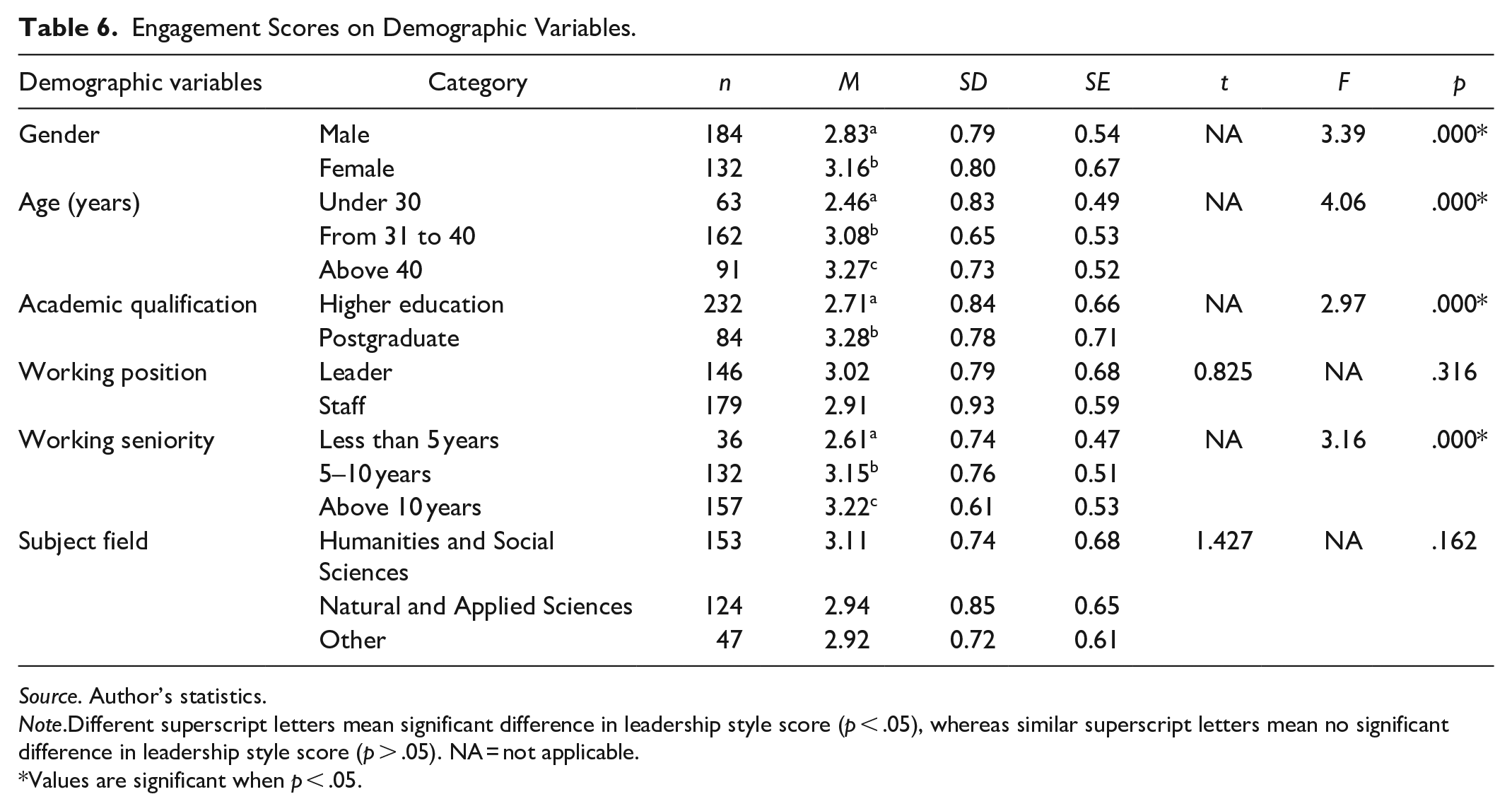
The results of assessing the difference in employee work engagement by demographic variable show that, by job position variable and by training field variable, there is no statistical difference with p respectively is .316 and .162, p > .05. In contrast, there is a statistically significant difference according to the gender variable (F = 3.39, p = .000, p < .05), it seems that women tend to commit to stable work more than men. The evaluation results based on the age variable showed that (F = 4.06, p = .000, p < .05), the age group from 31 to 40 and over 40 had a similar and more stable level of engagement to work compared to the age group under 30. According to the educational level variable (F = 2.97, p = .000, p < .05), the higher the education, the more stable the engagement to work. According to the working seniority variable (F = 3.16, p = .000, p < .05), the older the age, the more stable the job tends to be. The results of the score-based assessments on demographic variables show that women, those aged 31 to 40 and over 40 years old, who have worked in government agencies for 10 years or more tend to be relatively committed to the organization. The results of the above analysis are illustrated in Table 6.
Engagement Scores on Demographic Variables.
Source. Author’s statistics.
Note.
Different superscript letters mean significant difference in leadership style score (p < .05), whereas similar superscript letters mean no significant difference in leadership style score (p > .05). NA = not applicable.
Values are significant when p < .05.
The results of the evaluation of scores showing a positive relationship according to the demographic variable between leadership style and the score of employees’ work engagement are presented in Table 7 showing that each variable has a specific and positive correlation. According to the gender variable, male employee’s work engagement with leadership style (r = .462, p = .000, p < .05), female employee’s work engagement with leadership style (r) = .728, p = .000, p < .01). By age variable, under 30 years old (r = .451, p = .000, p < .05), from 31 to 40 years old (r = .659, p = .000, p < .05) and from over 40 age (r = .762, p = .000, p < .01). According to the variable of education level, university degree (r = .583, p = .000, p < .05), graduate level (r = .327, p = .000, p < .05). According to the working position variable, the leader’s rating (r = .739, p = .000, p < .01), employee’s rating (r = .614, p = .000, p < .05). According to the working seniority variable, the assessment of the respondents has less than 5 years of seniority (r = .417, p = .000, p < .05), from 5 to 10 years (r = .493). p = .000, p < .05) and seniority working in state agencies from 10 years or more (r = .658, p = .000, p < .05). According to the training field variable, the opinions of people majoring in social sciences and humanities (r = .725, p = .000, p < .01), those majoring in natural sciences nature and applications (r = .458, p = .000, p < .05) and those studying in other majors (r = .474, p = .000, p < .05). The results of the above analysis are illustrated in Table 7.
Relationship between Leadership Style and Engagement Across Demographic Variables.

Source. Author’s statistics.
Values are significant when p < .05. **Values are significant when p < .01.
The results of the correlation test in Table 7 also show that women tend to commit to stable and sustainable work more than men, the older the age, the tendency to commit to work also increases compared to the previous ages. Those with a graduate degree tended to be more committed to work than respondents with a university degree. Those polled as leaders are more committed to working than civil servants, moreover, people who have worked in state agencies for a long time tend to have a more stable engagement than those with more seniority. Younger workers spend less time writing, and those studying careers in the humanities and social sciences have a greater engagement to work than in other disciplines.
Limitations and Future Research
Firstly, the findings through research on the expression level of leadership styles are limited to three transformational leadership styles, transactional leadership styles, and laissez-faire leadership styles about participatory relationships. of civil servants in state agencies at the provincial level of Vietnam, while determining the relationship between leadership styles and civil servant participation on demographic variables. Therefore, this study has not filled the gap in research on leadership styles with the participation of employees at the commune, district, socio-political organizations, recommendations for future research should be considered. It has been widely conducted in discovering and experimenting with factors that influence and decrease or increase employee’s work commitment such as leadership institutions and the cultural context of Vietnam.
Second, so far there have been very few studies on the relationship between leadership style and employee engagement in the public sector in Vietnam. to supplement, enrich or refute the research results already conducted. Furthermore, it is possible to conduct studies in the private sector and in different industry sectors to get more evidence on the relationship between leadership style and employee engagement.
Third, this study mainly explores the relationship between the transformational leadership style, transactional leadership style, and the laissez-faire leadership style based on the test of Avolio and Bass (2004) and employee engagement based on the test of Meyer and Allen (1997). Therefore, in the future, there is a need for more studies to be conducted on other tests as well as research on portraits, structured interviews, semi-structured or group discussions, to gain a deeper understanding from the leader’s point of view as well as from the employee’s point of view.
Fourth, this study was conducted in a cross-sectional manner at one point in time, so there is not much evidence to compare and contrast over time the change and stability of leadership styles in the relationship with the engagement of employees working in Vietnam’s public sector. However, this limitation is greatly mitigated when the independent and dependent variables can be measured simultaneously. In the future, more studies are needed to assess the relationship between leadership style and work engagement of civil servants at a variety of times.
Conclusion and Recommendations
This study has examined and analyzed the relationship between leadership style and work engagement of public sector employees in Vietnam. We hypothesized that transformational leadership, transactional leadership, and laissez-faire leadership styles have a positive, positive influence on employee engagement. The research results have confirmed that the proposed hypotheses are accepted, which means that within the three studied leadership styles, all have a positive and positive impact on work engagement, employees almost always have no intention of leaving the organization. Furthermore, the research results are evidence that employees’ respect is not only for the leader but also in the three different leadership styles that the leader practices. In addition, the research results also show employee compliance in performing tasks whether they are led by transformational leaders, transactional leaders, or laissez-faire leaders (Giao & Hung, 2018), showing the unique characteristics of employees in public sector agencies in Vietnam, which is echoed in a small number of studies conducted simultaneously in the public sector (Felix et al., 2016).
The finding in this study seems to be similar to other studies conducted in different cultures in the public and private sectors, that transformational leadership has a positive effect on engagement. Employee performance, such as latent rewards, contingencies, or penalties, has a positive effect on emotional engagement, ongoing engagement as well as normative engagement (Agarwal & Gupta, 2021; Moradi Korejan & Shahbazi, 2016; Xirasagar, 2008). A small number of studies indicate that transactional leadership style has a positive influence on work engagement (Gumah et al., 2021), whereas the majority of studies reveal that the leadership style is laissez-faire; employees tend to leave the organization or commit to working less clearly (Abasilim et al., 2018; James & Ogbonna, 2013). However, this finding points out that even with a laissez-faire leadership style, employees in Vietnam’s public sector have a fairly sustained engagement to work with the organization, transformational leaders, transactional leaders, and laissez-faire leaders both have a positive relationship with employee’s engagement. As a result, public sector leaders in Vietnam practice transformational leadership, transactional leadership, and laissez-faire leadership styles while having a positive impact on employee engagement.
The results of the exploratory study have shown that there is a positive relationship between the three leadership styles and the work engagement of public sector employees in Vietnam, in which the relationship between transformational leadership style and the laissez-faire leadership style had a higher level of engagement than the respondents’ rating of the transactional leadership style. Employees both need encouragement, encouragement, inspiration, motivation, sharing the vision from the leader and also prefer the laissez-faire in decision making as well as carrying out leadership tasks, to achieve successful leadership goals with expected performance, thereby determining the relationship between transformational leadership style, transactional leadership style, laissez-faire leadership style and employee’s engagement to work in the region and identify demographic variables in the relationship between leadership style and work engagement of public sector employees in Vietnam.
Transactional leadership style has a positive relationship with employee’s work engagement, but the score is lower than that of the transformational leadership style and the laissez-faire leadership style, but the expectations to be rewarded, or possibly punished, for failing to meet the leadership task, so respondents may give lower scores on work engagement than engagement in transformational leadership style and laissez-faire leadership style, but the score results show that this style has a positive relationship with employee engagement to work. Moreover, this result has many similarities with the study of Giao and Hung (2018). This is much different in the findings from previous studies, in other cultures, there are, every few studies showing that the laissez-faire leadership style of the public sector positively affects employee engagement to work. Furthermore, there are few recommendations from studies conducted in the Vietnamese public sector on developing transformational and laissez-faire leaders because there is not enough empirical evidence studied in the public sector in Vietnam to emphasize the need to develop leaders who are inclined to practice transformative and laissez-faire leadership styles. However, according to Abasilim et al. (2019), leaders can still consider rewards as one of the positive ways to motivate and motivate employees when they achieve achievements. Time is a way for leaders to recognize employees’ work efforts to exceed expectations.
Discoveries from this study also show similarities with previous research results of authors such as (Duat, 2013; Ho Ngoc Truong, 2011; Huyen et al., 2019; Ngoc, 2019), these studies all agree that transformational leadership style has a relationship with the work engagement of public sector employees in Vietnam. Therefore, recommendations on developing transformational leaders have been made, as well as in training and retraining, it is necessary to pay attention to training capable leaders to practice transformational leadership style. Transformational leaders create trust and work engagement of civil servants, in companionship with the growth, vision, and mission of the organization. In the public sector, transformational leaders who can empower employees are an advantage for them to demonstrate their capabilities, not only that but the transformational leadership style is also considered an inspirational style.
The study also discovered that each culture may have specific characteristics that influence the relationship between leadership style and employee engagement, criticism of the transactional leader, or the laissez-faire leader. However, this is consistent with Vietnam’s public sector leadership landscape. In Vietnam, more experiments are needed to get more evidence to help leaders apply leadership styles well into practice, creating employee engagement to work with positive performance.
The score of leadership style according to the demographic variable is dominant in the group with graduate education, in the group of people over 40 years old, in the group with more than 10 years of dedication. A rating of work engagement based on the scores of respondents shows that women, those aged over 40 years, and those with 10 years or more working time are more likely to commit to working closely related to the organization. The results of the assessment of leadership style and work engagement of civil servants show that the respondents are women, people over 40 years old, leaders, and those who have graduated from social science majors, society, and humanity to Vietnam’s engagement to working for public sector employees with outstanding results.
Along with the new findings that have been pointed out, this study only focuses on studying the relationship between leadership style and work engagement of public sector employees, conducted in slice at a time, but could add more empirical evidence on the impact of leadership styles on employee engagement for leaders in the public sector in Vietnam, as well as the demographic relationship within the relationship between leadership style and employee engagement. These research results both enrich the theoretical and practical bases, to increase the work engagement of Vietnam’s public sector employees. However, we also recommend that to have more scientific evidence and a practical basis for leadership styles and employee engagement, more research related to leadership styles and culture, communication, traditions, and customs of the Vietnamese people, thereby seeing the influence and interference of the political culture and the culture of Vietnamese civil servants on the appropriate level. Helping leaders choose a leadership style suitable to the practice of the public sector as well as the cultural characteristics of Vietnamese civil servants.
Footnotes
Declaration of Conflicting Interests
The author(s) declared no potential conflicts of interest with respect to the research, authorship, and/or publication of this article.
Funding
The author(s) received no financial support for the research, authorship, and/or publication of this article.
