




Abstract
Work motivation in the public service (WMPS) was proposed to address street-level bureaucrats’ work motivation based on the self-determination theory (SDT). Using mixed methods, the present study developed the WMPS scale within a Chinese context. A series of analyses supported the construct validity, reliability, content validity, convergent and discriminant validity, and criterion validity of the WMPS scale. The scale includes 20 scale items in six dimensions: intrinsic motivation, identified regulation, instrumental regulation, introjected regulation, external regulation, and amotivation. Correlation analysis demonstrated that a supportive work climate such as perceived autonomy and relatedness would positively associate with autonomous motivation and negatively associate with controlled motivation and amotivation. Besides, autonomous motivation was positively associated with positive outcomes such as higher job satisfaction and lower turnover intention, while external regulation and amotivation were more likely to relate to negative outcomes (e.g., lower job satisfaction and higher turnover intention). This study contributes to the literature by providing a theory-based measurement instrument for future studies on public employees’ motivation and work-related behavioral outcomes.
Keywords
Introduction
In the past three decades, public employees’ motivation has been one of the most compelling topics for public management scholars (Mussagulova & Van der Wal, 2021; Perry & Vandenabeele, 2015) as seen from the exponentially growing literature (Xu & Chen, 2016). Most existing studies focus on the motivations of public employees’ career selection (e.g., public service motivation and motivation for a public service career; Chen et al., 2018; Perry & Wise, 1990; Xu & Chen, 2021). There is a dearth of studies paying attention to public employees’ work motivation in the public service (WMPS). Hence, there is an urgent need to fill up this academic gap and examine public employees’ work motivation and its impact. Since measurement instruments are the fundamental building blocks for motivation studies (Li et al., 2016; Tremblay et al., 2009), the present study aims to develop a measurement instrument for WMPS. More importantly, given the fast-growing research interest and prominent cultural characteristics of East Asia (Barney & Zhang, 2009; Gries & Peng, 2002; Ko & Jun, 2015; Mau, 2000), it is important to develop a work motivation scale that is appropriate for the use in an East-Asian context.
Building on the extant literature and self-determination theory (SDT), this present study proposed a multi-dimensional WMPS to address the aforementioned issue. Specifically, both interviews and a questionnaire survey were conducted to collect data from Chinese street-level bureaucrats to develop and validate the WMPS scale. Mixed methods were adopted due to several reasons:
Most studies tend to measure a concept by borrowing scale items from related scales in the literature. Thus quantitative methods were preferred for scale validation while qualitative methods were not applied in many existing studies. Although using existing scale items saves researchers’ time and budget, the scale may not be able to precisely capture the targeted population’s understanding of the concept, especially when the scale is to be applied in a new context.
As researchers indicated (e.g., Xu & Chen, 2021), public employees’ motivation may vary across different cultural and institutional contexts. Scale-item generation from interviews in the present study could address this issue.
WMPS is a new construct building on SDT and there is limited literature to support the creation of an inclusive item pool.
A grounded-theory approach allows scholars to avoid item-selection bias and to generate a comprehensive scale. And quantitative methods are useful for examining scale credibility and validity.
The present study is organized as follows: first, it briefly reviews the related literature of public employees’ work motivation and introduces the SDT framework; then a scale of the WMPS is developed through a series of qualitative and quantitative analyses; third, the scale is validated by establishing the evidence of criterion-related validity using various antecedents, and behavioral and attitudinal outcomes. In the last section, the implications of the present study are discussed.
Work Motivation in the Public Service: Definition
Scholars have employed a variety of approaches to investigate the motivation behind public employees’ decision to remain in the public sector, such as reward preference (Crewson, 1997; Davis & West, 1980; Rainey, 1982; Snyder & Osland, 1996; Wittmer, 1991), goal theory (Perry & Porter, 1982; Wright, 2001), need-based theories (Graham & Renwick, 1972; Rhinehart et al., 1969), and public service motivation (Perry, 1996, 2000, 2014; Perry & Wise, 1990; Perry et al., 2010). Most public management scholars concluded that public employees place a higher value on intrinsic motivation and a lesser value on extrinsic motivation (Houston, 2000). Alternatively, some social scientists debated that public employees may also value extrinsic motives such as job security and stability, social status, prestige, the opportunities to learn new things, the prospect for advancement (Gabris & Simo, 1995; Jurkiewicz et al., 1998; Snyder & Osland, 1996), work-family balance (Buelens & Van den Broeck, 2007), and financial rewards (Hotchkiss et al., 2015).
WMPS refers to the various motives that drive public employees to retain and serve in the public service (Gagné et al., 2010; Madsen, 1974; Xu & Chen, 2016). Based on Self-Determination Theory (SDT) (Deci & Ryan, 2008) and the Motivation at Work Scale (MAWS) (Gagné et al., 2010, 2015), WMPS is grounded in SDT and considers both intrinsic and extrinsic motivation (Xu & Chen, 2016).
Self-Determination Theory and Motivation Types
This section will briefly introduce SDT and the proposed subscales of the WMPS scale. SDT is “an empirically derived theory of human motivation and personality in social contexts that differentiates motivation in terms of being autonomous and controlled” (Deci & Ryan, 2012, p. 416). SDT plays a significant role in investigating human behaviors such as physical activities, family interaction, healthy behaviors, learning, and education (Xu & Chen, 2016). The motivation typology of SDT has been widely used in organizational behavior studies, especially in testing how various motivation types impact job performance and work attitudes (Deci et al., 1989; Deci & Ryan, 2008; Fernandez & Moldogaziev, 2015; Gagné & Deci, 2005; Kaplan, 2021; Kim, 2018; Moran et al., 2012; Zheng et al., 2021). Moreover, SDT provides a multi-dimensional framework to develop motivation scales (e.g., Gagné et al., 2010, 2015). It goes beyond the traditional intrinsic-extrinsic dichotomy and views an individual’s motivation as a continuous spectrum, ranging from intrinsic motivation, four types of extrinsic motivation (integrated regulation, identified regulation, introjected regulation, and external regulation), to amotivation (Deci & Ryan, 2000; Ryan & Deci, 2000). In the present study, integrated regulation is removed since it is highly correlated with identified regulation (Chen & Bozeman, 2013; Gagné et al., 2010, 2015; Vallerand et al., 1992).
Intrinsic motivation and identified regulation belong to the category of autonomous motivation while introjected regulation and external regulation belong to controlled motivation (Chen et al., 2018; Gagné et al., 2015; Tremblay et al., 2009). Studies demonstrate that some motives may fall into a blurry zone between autonomous and controlled motivation (De Cuyper & De Witte, 2008; Xu & Chen, 2021). This type of motivation is defined as instrumental motivation. Hence, the proposed subscales of the WMPS scale are intrinsic motivation, identified motivation, instrumental motivation, introjected motivation, external motivation, and amotivation. Each of these subscales is defined in the next section.
Intrinsic Motivation
Intrinsic motivation implies that behaviors are initiated for “its inherent satisfaction” rather than separable consequence (Ryan & Deci, 2000, p. 71). People with this type of motivation see themselves as initiators who can select their own desired goals, and the means to achieve them (Deci & Ryan, 1987). Intrinsically motivated people show real interest in actions and their consequences. Participation in public service can be exciting and remarkable to employees (Perry, 1996). For example, many people work in the public sector because of the opportunity to learn new things (Jurkiewicz et al., 1998; Rainey, 1982). People motivated by this type of motivation possess the highest level of self-determination.
Identified Regulation
Identified regulation refers to doing an activity because one identifies the value or meaning of an action and integrates it into oneself (Chen & Bozeman, 2013). The activities driven by identified regulation can either be meaningful for the self or the community. Alternatively, some people believe that pursuing a public service career is meaningful for society (Jurkiewicz et al., 1998; Rainey, 1982) or doing public service may be deemed as a type of social responsibility (Chen & Bozeman, 2013). Whilst they may not have an interest in public service itself but their identification with the value of service and responsibility compels them to pursue a career in the public service.
Instrumental Regulation
Instrumental motivation is a blurry zone between autonomous and controlled motivation (Chen et al., 2018; De Cuyper & De Witte, 2008). For example, job security and income stability, pension and retirement plan, work-life balance, and good work conditions are important factors that drive employees to stay and serve in the public sector (Chen & Bozeman, 2013; Jurkiewiczet al., 1998; Rainey, 1982; Rashid & Rashid, 2012). In these cases, public service jobs may not fit employees’ interests but only serve as an instrument to guarantee other external conditions.
Introjected Regulation
Introjected regulation refers to conducting an action to avoid anxiety, shame, or pressure (Chen & Bozeman, 2013; Vallerand & Ratelle, 2004). The behavior driven by introjected regulation is not associated with self-endorsement but is controlled by extrinsic conditions. Chen and Bozeman (2013) found that the desire for a low conflict work environment may motivate American public servants to remain in the public sector. In Chinese society, the attitudes and expectations of parents and peers have significant influences on individuals’ career decision making (Buunk et al., 1990; Chen et al., 2022; Fouad et al., 2016; Mau, 2000; Tang et al., 1999). For example, some employees may choose to remain in the public sector because their parents hope for them to stay. Career investment and emotional cost (e.g., friendly and congenial colleagues) also influence employees’ decision to stay (Blau, 2010; Carson et al., 1995; Chen & Xu, 2021; Jurkiewicz et al., 1998). Skills and experiences attached to current occupation increasingly restrain individuals’ possibility of changing occupation (Dlouhy & Biemann, 2018).
External Regulation
External regulation refers to doing an activity to avoid punishments or to receive rewards. This type of regulation displays the least autonomy to initiate an activity. Public employees with external regulations are controlled by external factors such as a high salary (Jurkiewicz et al., 1998), or low cost of living in the region (Chen & Bozeman, 2013). Studies also indicate that public employees sometimes continue to work in the public service simply because of very limited career alternatives (Carson et al., 1995; Chen & Bozeman, 2013). For example, studies found that older public sector employees have a higher intention to stay because of the limited opportunities in the job market if they were to leave public service (Buelens & Van den Broeck, 2007; Snyder & Osland, 1996).
Amotivation
Amotivation refers to doing an activity without motivation or not valuing the behavior (Ryan & Deci, 2000). Amotivated people may not believe their actions would yield desired outcomes. Public employees driven by amotivation would feel helpless and doubt the meaning of their job. Amotivation may lead to the most negative outcomes (Vallerand & Ratelle, 2004). For example, employees may possess a high propensity to quit their current job (Chen & Bozeman, 2013).
The Relationship Between the Six Types of Motivation, Determinants, and Outcomes
According to the existing empirical analysis of SDT (e.g., Chen & Bozeman, 2013; Gagné et al., 2010), it is expected that the correlations of the sub-types of SDT-based motivation would show a quasi-simplex pattern whereby any two adjacent types of motivation have a stronger correlation than two distant ones. Instrumental regulation may have positive correlations with all other types of motivation (Chen et al., 2018). Beyond the motivation typology, scholars care more about how to promote autonomous motivation because of its positive outcomes. For example, it has been proved that the basic psychological needs (e.g., autonomy competence and relatedness) would facilitate autonomous motivation and decrease controlled motivation (Brunelle & Fortin, 2021; Deci & Ryan, 2000; Xu & Chen, 2016). Studies demonstrate that autonomous motivation may lead to positive outcomes (e.g., job satisfaction; Deci & Ryan, 2008; Gagné et al., 2010; Tadić Vujčić et al., 2017) while controlled motivation would associate with negative outcomes (Gagné et al., 2015; e.g., turnover intention). The outcomes of instrumental motivation are mixed. Some scholars asserted that instrumental motivation may lead to positive outcomes such as organizational citizenship behavior and well-being (Kausto et al., 2005; Moorman & Harland, 2002). However, Chen et al. (2018) found that instrumental regulation positively correlates with negative perceptions toward government (perhaps due to being forced to implement policies against their values and beliefs).
Research Strategy
Based on the discussion above, it could be speculated that WMPS can be classified into six sub-dimensions: intrinsic motivation, identified regulation, instrumental regulation, introjected regulation, external regulation, and amotivation. It is expected that the relationships among the six sub-dimensions would show a quasi-simplex pattern. And the relationships between each WMPS sub-dimension and other organizational behavior variables would show the same patterns as mentioned above.
The present study aims to create an SDT-based measurement scale for WMPS. Following the methods of scale development in existing literature (Gagné et al., 2010; Hollebeek et al., 2014; Sung et al., 2019; Tremblay et al., 2009), a two-phased study was conducted from the end of 2015 to July 2016. In Step 1, an initial pool of WMPS items was created through a series of semi-structured interviews. The goal of Step 2 was to validate the newly created WMPS scale. Data were collected from 405 Chinese public employees. Construct validity was examined by Exploratory Structural Equation Modeling (ESEM; Asparouhov & Muthén, 2009) via Mplus (version 8; Muthén & Muthén, 2017). Then, additional analyses were conducted to further examine the reliability and validity of the WMPS scale.
Step 1: Creation of the WMPS Scale Items
The purpose of Step 1 is to create a pool of WMPS items. Following the methods in existing studies (e.g., Hollebeek et al., 2014; Sung et al., 2019), the research team compiled the items based on a qualitative analysis of the interviews. Thirty-seven interviews were conducted at the end of 2015. Our main interview question was “Why did you choose to remain and keep serving in the public sector?” Before asking this main question, the researchers collected some basic information such as age, work tenure, education background, and job description.
Participants
Most participants worked in government service centers (GSC) in three cities in western China (i.e., Xi’an, Xian Yang, and Shang Luo). In each GSC, there were around 60 to 100 public employees from various government agencies such as tax bureaus, education bureaus, marriage registration bureaus, etc. Mostly, interviewers randomly approached those employees who were free during our visits and asked whether they would accept an interview. In most of the cases, the interviews took around 45 minutes. Most participants did not want the conversations to be recorded except for one. Instead, interviewers wrote down the key points during the interview and documented the conversation immediately after it was over. The research team continued to interview new participants until no more new motivation statements were raised by the interviewees, which means data saturation was achieved. Hence it was decided that no further interviews were deemed necessary. In total, 37 public employees were interviewed, 21 of which were male (56.76%), and 16 were female (43.24%); 1 from the township (2.70%), 29 of which were from the county-level centers (78.38%), 4 from city-level (10.81%), and 3 from the provincial level (8.11%). Seven participants are above 40 years old (18.92%) and the rest are below 40 (81.08%). About 11 participants have been in the public sector for less than 3 years (29.73%), 17 between 4 and 7 years (45.95%), and 7 for more than 8 years (18.92%).
Analysis
The present study followed the four steps of analysis in Sung et al. (2019) to analyze the textual data collected from the 37 interviews. The first step was reading transcripts. The 37 pieces of transcripts were read sentence by sentence. Answers related to WMPS of every response were entered into a table for the following steps.
The second step was open coding. Three researchers who had research experiences in public organizational behavior read the table and searched for statements about WMPS. Similar statements were merged.
The third step was axis coding. The three researchers interpreted and categorized all the statements. Item labels were created to capture the implications of the related statements. The wording of each item was checked carefully to make sure it was easy to be understood. Twenty items were identified eventually. The final step was selective coding. Researchers assessed each item and assembled it into an SDT-based motivation dimension.
Findings
The four-step text analysis generated 20 WMPS items (see Table 1). These items were assembled into six dimensions: four items belong to intrinsic motivation, two items fall into identified regulation, five fall into instrumental regulation, three belong to introjected regulation, external regulation contains four items, and amotivation has two items.
Items of the WMPS Scale.

Step 2: Validating the WMPS Scale
Respondents
The aim of Step 2 was to test the factorial structure, internal consistency, and validity of the WMPS scale. A questionnaire survey was conducted in three western cities of China in June 2016. The survey questions included the 20 WMPS items, needs for autonomy and relatedness (adapted from La Guardia et al., 2000), job satisfaction (Kim et al., 2012), and turnover intention (Gagné et al., 2010). Before conducting the survey, six public administration doctoral students pilot-tested the questionnaire. The questionnaire took about 10 to 18 minutes to complete. The target respondents were those from various front-line public service departments of local governments. During the survey, researchers directly walked into the government offices and requested permission from the managers to conduct a survey. Once the researchers had permission, the research team started to distribute questionnaires to all the staff in the same office except those who were not willing to participate. At least one researcher was around to answer questions and collect complete questionnaires when respondents were filling in the questionnaire. Eventually, the research team distributed 572 questionnaires and received 405 valid responses. Among the 405 respondents, 66% are male, 60% had a bachelor’s degree, and 49% were below 40 years old. Regarding public service tenure, 32.2% of the 405 respondents have been in the government for 1 to 3 years, 22.9% for 4 to 7 years, and 45% for 8 years or longer.
Variables
All the 20 WMPS items were measured by a 6-point Likert scale (1 = strongly disagree, 2 = disagree, 3 = slightly disagree, 4 = slightly agree, 5 = agree, and 6 = strongly agree). To test the criterion validity, two types of psychological needs (e.g., autonomy and relatedness) were included. The measure of autonomy and relatedness were adapted from La Guardia et al. (2000). Job satisfaction was rated by three items that are from Xu and Chen (2021). Turnover intention was assessed by one item adapted from Gagné et al. (2010): “It is possible that I will leave public sector.” The full list of measurement scale items for autonomy, relatedness, job satisfaction, and turnover intention can be found in Table A1. The ordinal alpha of autonomy, relatedness, and job satisfaction is .64, .67, and .82, respectively.
Analysis
Testing construct validity through exploratory structural equation modeling (ESEM)
Studies generally employ confirmatory factor analysis (CFA) to examine the construct validity of SDT-based scales (e.g., Xu & Chen, 2021). Nevertheless, CFA has drawbacks. The independent clusters model routinely specified in CFA where each item is only allowed to load on one factor and cross-loadings on other factors are constrained to be zero, is thought to be too restrictive especially in personality measurement (e.g., Church & Burke, 1994). As a result, CFA usually would produce an unacceptable data-model fit (Asparouhov & Muthén, 2009). It is common to observe items to have a degree of cross-loadings on conceptually related factors due to between-constructs associations (Morin et al., 2016).
The Exploratory Structural Equation Modeling (ESEM; Asparouhov & Muthén, 2009) framework was developed to integrate the features of exploratory factor analysis (EFA) and structural equation modeling (SEM; Hukkelberg et al., 2016). Within the ESEM framework, researchers can obtain the regular SEM parameters and model-fit indices. An application of ESEM is the semi-confirmatory factor analysis that allows the presence of cross-loadings which can be achieved via the use of target rotation (Browne, 2001) along with a pre-specified number of factors. Target rotation allows the researcher to specify an a priori expectation of the factor loadings (in which all factor loadings are estimated, but cross-loadings are usually “targeted” to be as close to zero as possible). The usefulness of the ESEM framework in psychological measurement has been widely recognized by researchers (e.g., Ellison et al., 2012; Guay et al., 2015; Joshanloo, 2016; Marsh et al., 2010).
Analyses were conducted in Mplus (version 8; Muthén & Muthén, 2017) using Maximum Likelihood estimation with robust standard error (MLR). This analysis aimed to examine the factor loadings and the factor correlations of the hypothesized six-factor model. A total sample of 405 responses was included in the analysis, missing data were assumed to be missing-at-random under the implementation of MLR in Mplus.
Four goodness-of-fit indices were used to evaluate the model fit: root mean squared error of approximation (RMSEA), standardized root mean squared residual (SRMR), comparative fit index (CFI), and chi-square to the degree of freedom ratio (χ2/df; Kenny, 2015; Li et al., 2016; MacCallum et al., 1996). Values smaller than 0.5 for RMSEA indicate excellent fit, values between 0.5 and 0.8 indicate good fit, and values between 0.8 and 0.1 are acceptable (Gagné et al., 2010; Sung et al., 2019). The cutoff value for SRMR is 0.08 (Hu & Bentler, 1999). Values of CFI greater than 0.90 demonstrate adequate fit (Gagné et al., 2010). Values of χ2/df lower than three also show a good fit (Kline, 2015). It should be noted that there is yet to be a comprehensive evaluation of the use of traditional CFA fit indices cut-offs on ESEM (Marsh et al., 2009).
Reliability
This study examined the reliability of each subscale by calculating ordinal alpha (Xu & Chen, 2021). Values of alpha greater than .70 are deemed as good internal consistency while values between .50 and .70 can be acceptable when the scale is new and contains a limited number of variables (Peterson, 1994; Streiner & Norman, 2003).
Content validity
The content validity of the WMPS scale was examined by inspecting the correlations among its six subscales (Chen et al., 2018). According to the existing studies on SDT-based scale development (e.g., Gagné et al., 2010), the relationships of the WMPS subscales should display a quasi-simplex pattern.
Convergent and discriminant validity
A correlation matrix was used to test the convergent and discriminant validity (Courvoisier et al., 2008; Xu & Chen, 2021). The scale can be deemed adequate if within-scale item-to-total correlations are stronger than between-scale item-to-total correlations.
Criterion validity
Following the traditional approaches of SDT-based scale validation (Chen et al., 2018; Tremblay et al., 2009), the present study examined the criterion-related validity of the WMPS scale by correlating the six subscales to various organizational behavioral variables. For example, needs for autonomy and relatedness, job satisfaction, and turnover intention were included in the analysis.
Results
Construct validity
The ESEM results produced a good data-model fit: RMSEA = 0.047 (90% CI [0.036, 0.058]); SRMR = 0.021; CFI = 0.960; χ2 (85) = 162.269, p = .000, χ2/df = 1.91. Thus, the six-factor measurement model for the WMPS scale is adequate. All 20 items were retained in the final scale. As shown in Table 2, the primary (standardized) factor loadings range from 0.34 to 0.89, while the averaged absolute (standardized) cross-loadings for each item range from 0.04 to 0.25 which are smaller than the primary loadings. The pattern of the factor correlations is also as expected, which range from −.52 to .59 (see Table 3). Consequently, the construct validity of the WMPS scale is supported.
Factor Loadings.
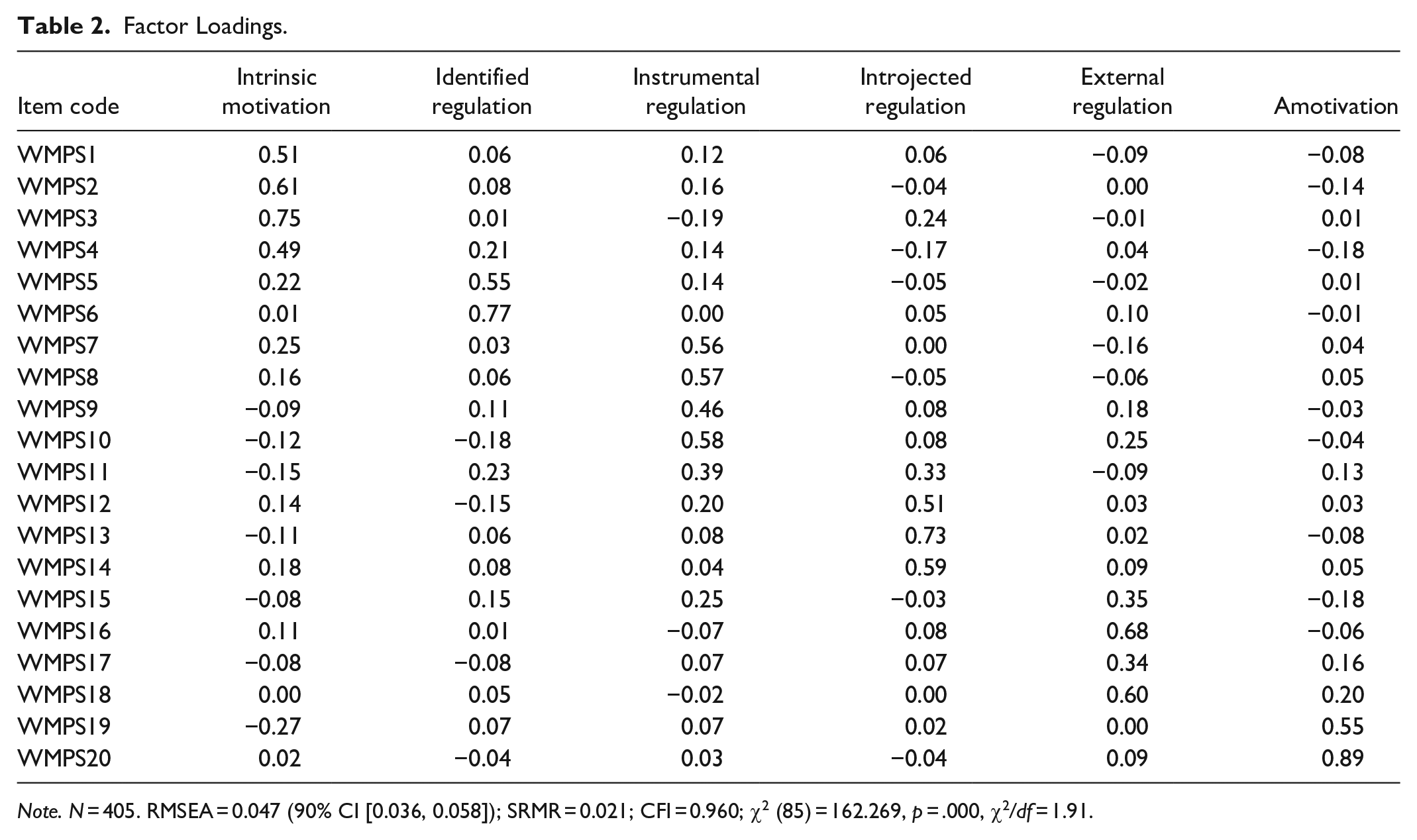
Note. N = 405. RMSEA = 0.047 (90% CI [0.036, 0.058]); SRMR = 0.021; CFI = 0.960; χ2 (85) = 162.269, p = .000, χ2/df = 1.91.
Descriptive Statistics, Ordinal Alpha, and Correlations.
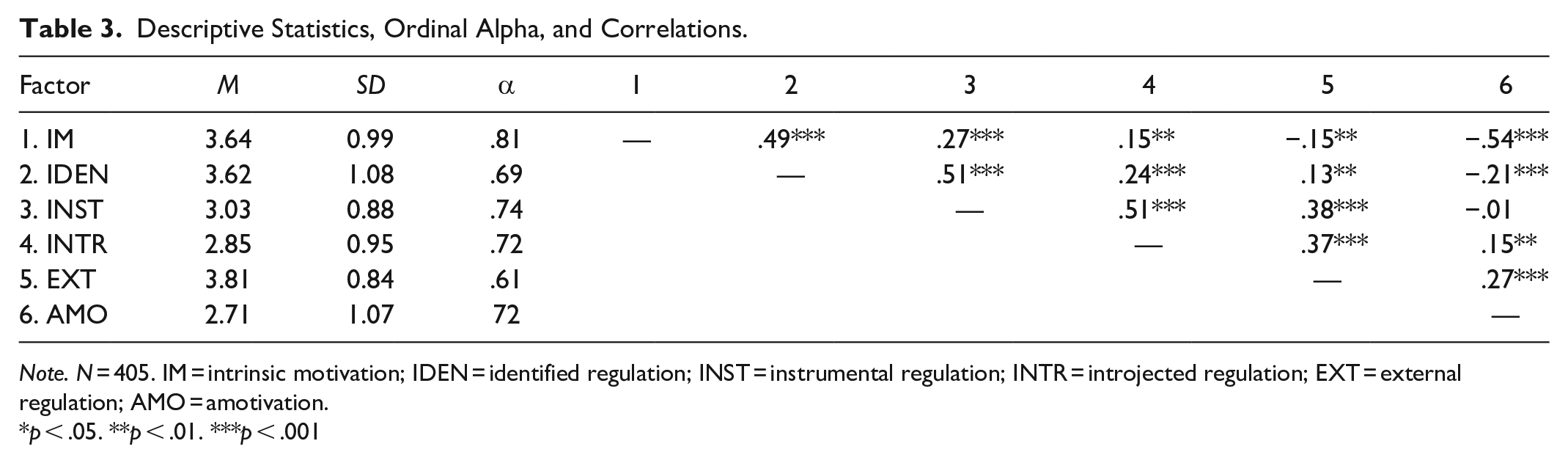
Note. N = 405. IM = intrinsic motivation; IDEN = identified regulation; INST = instrumental regulation; INTR = introjected regulation; EXT = external regulation; AMO = amotivation.
p < .05. **p < .01. ***p < .001
Reliability
Most alpha values of the six subscales are higher than .60 (see Table 3; intrinsic motivation = .81; identified regulation = .69; instrumental regulation = .74; introjected regulation = .72 external regulation = .61; amotivation = .72). The results demonstrate adequate reliability (Tremblay et al., 2009).
Content validity
According to the results presented in Table 3, the subscales are in the order of the self-determination continuum whereby two adjacent subscales are more strongly and positively correlated than two distant ones. Intrinsic motivation positively correlates with identified, instrumental, and introjected regulation while negatively correlates with external regulation and amotivation. Identified regulation presents positive associations with all WMPS subscales except amotivation. Instrumental regulation and introjected regulation show positive associations with all other types of motivation when significant. External regulation shows positive associations with all subscales except intrinsic motivation. Amotivation presents positive associations with two types of controlled motivation (r = .15 and .27, respectively) but negative associations with distant subscales (r = −.54 and −.21, respectively). Thus, the results demonstrate adequate content validity.
Convergent and discriminant validity
As shown in Table 4, within-scale item-to-total correlations are greater than between-scale item-to-total correlations in all six subscales. For example, the within-scale item-to-total correlations between the four IM items range from .75 to .84 which are stronger than any of the between-scale item-to-total correlations ranging from −.48 to .47. Therefore, convergent and discriminant validity are supported.
Item to Total Correlations for the Six WMPS Dimensions.

Note. The bold values are significant at p < .001.
Criterion validity
The results are presented in Table 5. Correlation coefficients display a spectrum-like pattern. First, the top panel of Table 5 shows the relationships between the WMPS subscales and needs for autonomy and relatedness. Both autonomy and relatedness are positively associated with both types of autonomous motivation (rs ranging from .11 to .36, p < .05) but negatively associated with the two types of controlled motivation (rs ranging from −.36 to −.12, p < .05). The association between instrumental regulation and autonomy is also negative (r = −.13, p < .05). Amotivation shows negative associations with autonomy and relatedness (the respective r = −.42 and −.33, p < .001). Second, the bottom panel of Table 5 shows the associations between the WMPS subscales and outcome variables. Results show that the two types of autonomous motivation and instrumental regulation present positive associations with job satisfaction (rs ranging from .28 to .73, p < .05). Introjected regulation is positively associated with job satisfaction (r = .10, p = .06). External regulation and amotivation are negatively related to job satisfaction (the respective r is −.18 and −.55, p < .001). Turnover intention shows negative correlations with intrinsic motivation (r = −.34, p < .001), identified regulation (r = −.10, p = .06), and instrumental regulation (r = −.15, p < .01). The correlations of introjected regulation and external regulation with turnover intention are not statistically significant. Amotivation yields a positive association with turnover intention (r = .45, p < .001). Therefore, following suggestions from the existing studies (e.g., Chen et al., 2018; Li et al., 2016; Tremblay et al., 2009), the criterion validity is supported.
Correlations Between Subscales With Antecedents and Outcomes.
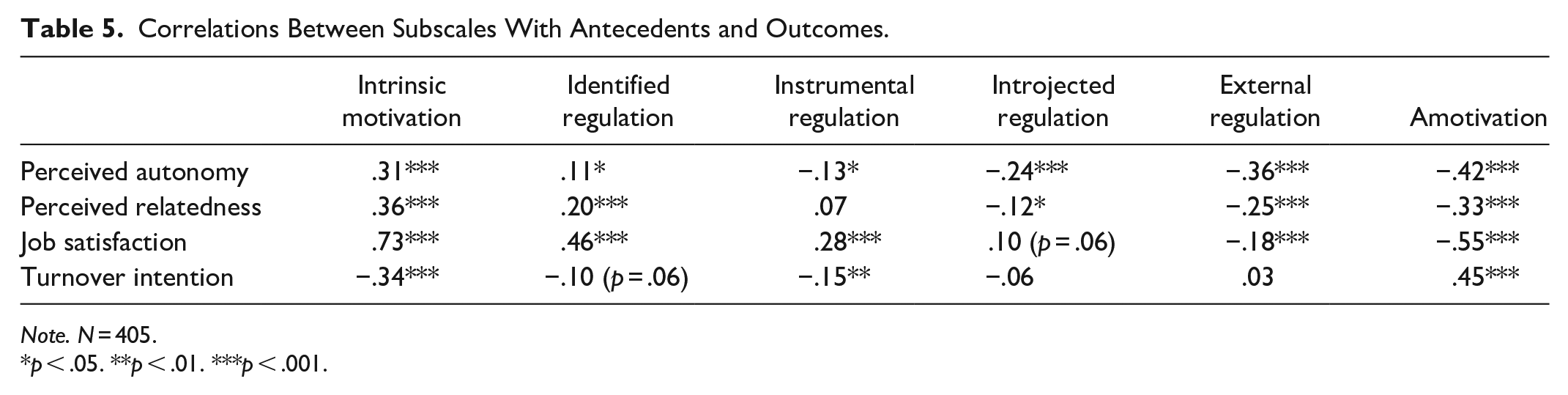
Note. N = 405.
p < .05. **p < .01. ***p < .001.
Discussion
This study utilized mixed methods to establish a measurement instrument to capture Chinese public employees’ WMPS. Building on SDT, a WMPS scale consisting of six dimensions and 20 items was validated by ESEM. The six dimensions are intrinsic motivation, identified regulation, instrumental regulation, introjected regulation, external regulation, and amotivation. A series of tests supported the new scale’s construct validity, reliability, content validity, convergent and discriminant validity, and criterion validity. The relationships between the WMPS subscales followed the simplex pattern where adjacent subscales were more strongly and positively correlated than distant ones. In line with the expectations, the basic psychological needs for autonomy and relatedness were positively related to intrinsic motivation and identified regulation but negatively related to controlled motivation and amotivation. Additionally, intrinsic motivation, identified regulation, and instrumental regulation showed significant associations with higher job satisfaction and lower turnover intention, while external regulation and amotivation significantly associated with negative outcomes (e.g., lower job satisfaction or stronger turnover intention).
Literature Implications
This study contributes to the literature in several ways. Firstly, the newly developed WMPS scale offers a theory-based view on the working motivation of public employees. Beyond the literature mainly focusing on public employee’s autonomous motivation and career motivation (e.g., Chen et al., 2018; Xu & Chen, 2021), the current study was based on the motivation typology of SDT and provided a multi-dimensional approach for future motivation research on public employees’ work motivation. The WMPS views public employees’ work motivation as a dynamic spectrum. For example, an employee’s work motivation may gradually change from controlled to autonomous motivation when basic psychological needs are supported. This approach echoes the proposition made by Xu and Chen (2016) that public management researchers should ground scale development in SDT and build different scales for unique public service actions. Second, as behavioral public administration (BPA) draws on increasing research attention and the literature increases extensively (Bhanot & Linos, 2020), scholars called for a greater emphasis on measurement through the psychological perspective (Grimmelikhuijsen et al., 2017). Thus, this study can be taken as a response to that call. By using a more comprehensive SDT-based motivation framework, the current study targets to stimulate more interdisciplinary research. This scale also has the potential to be used in future organizational studies in other East-Asian countries/regions that share the same cultural roots, such as Hong Kong, Japan, South Korea, and Taiwan (Frederickson, 2002; Hofstede & Bond, 1988; Yum, 1988). Lastly, the current study used ESEM for scale validation instead of CFA which was commonly used in previous studies. The main reason for the preference toward ESEM in this study was because the CFA model only allows each item to be loaded onto one factor and cross-loading is constrained to be zero, consequently making it more restrictive in comparison to ESEM. However, as cross-loadings are common among behavioral variables, especially among SDT-based motivation styles which fall into a continuous spectrum, ESEM is thus the preferred model and is even strongly recommended by researchers for future scale development (e.g., Marsh et al., 2010).
Practical Implications
The findings of the current study have two practical implications for public managers. Firstly, public managers could use the WMPS scale to identify distinct types of employees and to develop targeted management strategies accordingly, that is, employees with autonomous motivation would be preferred. The present study shows that employees driven by intrinsic motivation and identified regulation would yield more positive work attitudes than those driven by controlled regulation or amotivation. Public employees motivated by instrumental regulation may also present positive work morale (e.g., job satisfaction). Employees driven by external regulation and amotivation are more likely to have negative work attitudes (e.g., lower job satisfaction and higher turnover intention). Public managers should employ personalized incentives and targeted training programs to promote employees’ work morale and job performance.
Secondly, public managers could promote employees’ autonomous motivation through building a need-supportive environment. The respondents driven by external regulation may present negative work attitudes. However, the good news for managers is that the locus of control could move from controlled regulation toward autonomous motivation when the basic psychological needs are supported (Gagné, 2003). Through building a need-supportive working context, the extrinsic regulations can be gradually internalized into autonomous motivation such that both the employees and employers would be better off.
Limitations
This research also has several limitations. First, due to the limited time and budget, the interview participants were mainly recruited from the local governments. Few interviewees were from higher-rank public managers whose WMPS might be different from the WMPS of street-level bureaucrats (Jurkiewicz et al., 1998). Future studies should include more senior managers and central government employees in the sample. Second, social desirability could not be ruled out. However, it was minimized by conducting the interviews in a separate room and after rapport was built. Lastly, the cross-sectional and self-reported survey data may lead to common method bias problems. The present study followed the suggestions of Podsakoff et al. (2003) to minimize the biases. For example, the questionnaire separated the different measurements of the predictors and outcome variables. It would be more robust if future research could use the longitudinal research design to examine the association between SDT-based WMPS scale and organizational behavioral variables.
Future Research Directions
Several future research avenues merit attention. First, the recent trend shows that public management researchers have been continuously applying psychological theories and methods to study public employees’ motivation. With the gap of most studies focusing on public employees’ intrinsic motives, scholars have called for a more inclusive approach to include both intrinsic and extrinsic motivation (e.g., Ritz et al., 2016; Xu & Chen, 2016). Future studies could follow the perspective of SDT to further examine the nomological network of WMPS (e.g., testing its linkage with various antecedents and organizational outcomes). Second, the WMPS scale developed with Chinese public employees has the potential to be used in other East-Asian countries/regions that share the same cultural roots (e.g., Japan, Korea, Taiwan, Hong Kong, etc.). Additionally, future studies can use this tool for international comparison studies. However, given the unique institutional context of each country, scholars should be cautious when applying measurement scales developed from a different culture. Our last recommendation is to link motivation for a public service career (e.g., Chen et al., 2018) to WMPS. Based on SDT, motivation may change over time. Future studies can investigate how a public employee’s WMPS change from the first day he or she joined the public service.
Conclusion
In conclusion, the present research conceptualized public employees’ work motivation through the lens of SDT and developed a 20-item measurement instrument. Our results confirmed six sub-dimensions of the WMPS scale: intrinsic motivation, identified regulation, instrumental regulation, introjected regulation, external regulation, and amotivation. This thereby complements the literature which mainly focuses on autonomous motivation and career selection motivation. Findings also suggested that a need-supportive work environment could facilitate autonomous motivation which is more likely to lead to positive work attitudes. Instrumental motivation shows positive associations with positive work attitudes. External motivation and amotivation are more strongly associated with negative work attitudes. Given the fast-growing research attention to public employees’ motivations and behaviors, the WMPS scale enables researchers to measure the level and types of work motivation. It is recommended that future research should continue to examine this scale by linking it to various antecedents and outcomes in a different cultural and political context.
Footnotes
Appendix
Measures of Relatedness, Autonomy, Job Satisfaction, and Turnover Intention.

| Relatedness (ordinal alpha = .64) |
| The citizens who come to me often have unreasonable requirements. |
| Some citizens may cheat when they need my help. |
| The citizens understand my situation and collaborate with me. |
| My colleagues are friendly. |
| The relationship between colleagues is hypocritical and problematic. And people won’t share their real thoughts. |
| The politics within government are complicated and disturbing. |
| Autonomy (ordinal alpha = .67) |
| Government officials are autocratic. My thoughts can never be heard and respected. |
| The rules and regulations in government agencies are stereotyped and rigid, which bring many obstacles to my job. |
| I feel suffering because my supervisor often required me to do works that are contradictory to my beliefs. |
| Job satisfaction (ordinal alpha = .82) |
| I find real enjoyment in my work |
| I feel satisfied with my present job |
| I have a great sense of achievement in my job |
| Turnover intention |
| It is possible that I will leave the public sector |
Note. All variables are rated by a 6-point Likert scale (1 = strongly disagree and 6 = strongly agree).
Acknowledgements
The author thanks the three anonymous reviewers for their insightful comments. The author is also grateful to colleagues Dr. Chung-An Chen, Dr. Jie Xin Lim, and Dr. Pan Liu for their support in questionnaire design, data collection, and data analysis.
Declaration of Conflicting Interests
The author declared no potential conflicts of interest with respect to the research, authorship, and/or publication of this article.
Funding
The author received no financial support for the research, authorship, and/or publication of this article.
