




Abstract
This study presents a groundbreaking exploration of the nexus between Ethical Leadership (ETL) and Moral Voice (MV) in Vietnam’s public sector, a context that has been underexplored in existing literature. It specifically examines the mediating roles of Public Service Motivation (PSM), Person-Organization Value Congruence (POV), and the moderating role of Behavioral Integrity (BI). This research is significant as it addresses the gap in understanding how ETL influences MV through these specific mediating and moderating mechanisms. Utilizing Self-Determination Theory (SDT), Social Learning Theory (SLT), and Structural Equation Modeling (SEM) on data from 434 employees, using a cluster sampling method, in Tien Giang Province, Vietnam, the study reveals that ETL significantly impacts MV, with PSM and POV serving as partial mediators. Notably, this research pioneers in investigating the sequential mediating effects of POV and PSM, as well as the moderating effect of BI in the ETL-MV link. The work’s contribution lies in its comprehensive examination of the interplay of PSM, POV, and BI in the relationship between ETL and MV within the public sector in Vietnam. This provides both theoretical advancement in leadership studies and practical insights for enhancing ethical behavior and moral courage in public organizations.
Keywords
Introduction
Public sector organizations face serious challenges due to unethical behavior and ethical violations in the workplace (Molines et al., 2025; Ripoll, 2019). Even though systems and structures are in place to prevent or address unethical practices, they continue to exist. This is particularly true in developing and transitional countries, where the effects of these behaviors are more noticeable (Hossain et al., 2020). Consequently, unethical behavior in public service has garnered the attention of academic, professional, and public organizations (Ripoll, 2019). In Vietnam, despite laws and regulations setting ethical standards for civil servants, issues of moral degradation and superficial self-criticism are prevalent. According to Communist Party of Vietnam (2021, p. 222): “A part of cadres and party members have not been pioneers and exemplary; degradation in political ideology, morality, lifestyle, and internal “self-evolution” and “self-transformation” expressions are still complicated. Self-criticism and criticism in many places are formal. Exercising the responsibility of setting an example, especially that of the head, has not yet created a far-reaching effect.” Therefore, to promote the positive role of civil servants, Vietnamese public sector leaders must have policies in place to encourage and protect people who are “dynamic, creative, dare to think, dare to speak, and dare to do for public benefit” (Doan, 2024, p. 1). In this context, MV is an important employee behavior (Molines et al., 2025; Zheng et al., 2021). MV refers to “communicating concerns about violations of societal ethical standards and/or suggestions about upholding ethical standards, to people who might be able to effect changes” (Chen & Treviño, 2023, p. 1316). MV is considered an essential ethical behavior, enabling unethical problems to be identified and resolved at early stages (Lee et al., 2017), the ethical standards of society associated with the common good are invoked by these behaviors (Chen & Treviño, 2023). However, public servants often worry about the consequences and doubt management’s willingness to help and take action when things go wrong (Molines et al., 2025).
ETL has received more and more attention in public management studies and practices as of late, largely as a result of scandals stemming from instances of unethical leadership (Aunin et al., 2024). Researchers have found ETL to be a possible predictor of employees’ propensity to speak out on ethical issues, which could shed light on the factors that motivate workers to do so (Ha & Doan, 2024; Huang & Paterson, 2014; D. Kim & Vandenberghe, 2020; Lee et al., 2017; Molines et al., 2025; Zheng et al., 2021). Even though this line of research has produced valuable insights, questions about how and under what circumstances ETL behaviors encourage MV in public employees remain (Molines et al., 2025). Our literature search on ETL and MV revealed that most prior studies had focused on the cognitive aspects of ETL (D. Kim & Vandenberghe, 2020; Lee et al., 2017; Molines et al., 2025). This cognitive process approach, which solely sees ETL as a risk-reducing or ethical role model, may fail to explain why people adopt positive behaviors. This approach may overlook ETLs’ effects on followers’ motivation (Li & Bao, 2020). Zheng et al. (2021) found that followers’ values and personal identities play a significant mediating role in the nexus of ETL and MV. Nevertheless, the various reasons and motivations behind this internalization process were not investigated. Meanwhile, motivation is a key psychological mechanism that explains how organizations impact individual behavior (Zhao et al., 2023). To better understand the processes that lead to an increase or decrease in ethical violations, studying motivation is one potential avenue to pursue (Ripoll, 2019; Ripoll & Ballart, 2020). Based on SLT (Bandura, 1977), this paper proposes that ETL motivates public servants by giving them faith in their capacity to behave ethically via leaders’ role modeling, enacting and modeling, and verbal persuasiveness (Brown & Treviño, 2006). From a moral perspective, the SDT (Deci & Ryan, 1985) account primarily aims to comprehend the conditions under which an individual’s will drives their support for moral decisions. SDT posits that an individual’s external environment can influence their work motivation and subsequent actions (Arvanitis, 2017). For this reason, the paper goes beyond the prior theoretical framework and uses SDT and SLT to clarify the connection between ETL and MV. There have been several requests for research on follower-based mechanisms that are separate from the concept of ETL, although the majority of studies on ETL and follower ethics have taken diverse viewpoints (Zheng et al., 2021). To further understand the connection between ETL and behavioral outcomes like MV, the paper broadens the scope of ETL research to include a focus on employees’ POV and PSM. ETL encourages constructive actions from a variety of viewpoints, and the mediating role of POV and PSM deepens our theoretical comprehension of this relationship. A popular framework for understanding organizational actors’ attitudes and behavior is POV (Kristof-Brown et al., 2005). Value congruence is often seen as guiding principles that “organize people’s attitudes, emotions, and behaviors and typically endure across time and situations” (Kasser, 2002, p. 123). POV affects psychological need satisfaction and employee motivation, according to SDT (Gagné, 2014). PSM is an identified or integrated motive in SDT because it helps identify and internalize public service values (Ripoll & Ballart, 2020). A set of values known as PSM is likely to align with the public interest (Ripoll, 2019), hence “PSM serves as the moral compass” (Wright et al., 2016, p. 648). The degree to which employees internalize these values can potentially affect their PSM and ethical conduct (G. J. Kim et al., 2023).
In these situations, ETLs may still help employees develop their PSM and POV, but this process may not always lead to moral behavior or engagement with MV behaviors. Furthermore, the literature rarely discusses the boundary conditions that might influence the mechanisms underlying MV in public organizations (Molines et al., 2025). Previous research has demonstrated that leader BI, which involves aligning one’s words and actions, has a significant positive impact on followers (Simons et al., 2022). Recent findings by Simons et al. (2022) highlight the ineffectiveness of advocating policies without BI in achieving successful implementation. Supervisor guidance alone enhances follower organizational citizenship behavior when paired with supervisor BI (Dineen et al., 2006). The study thus argues that BI acts as a moderator increasing the relationship between ETL and MV.
To address the aforementioned challenges, this study, drawing upon SDT and SLT, aims to examine the mediating roles of PSM and POV, as well as the moderating role of BI in the relationship between ETL and MV. The work makes numerous contributions to the existing body of literature. This study adds to the existing literature on ETL by combining SDT and SLT theories to examine the role of POV, PSM, and BI as potential explanatory mechanisms for the connection between ETL and MV. Besides, the paper has contributed to the understanding of the morality between the MV of public servants and ETL by investigating the mediating functions of POV and PSM, which in turn illuminate the psychological mechanisms of motivation (Vandenabeele, 2007). Our research also contributes to the existing literature on BI by establishing the first moderating mechanism of BI in the connection between ETL and MV in an organizational setting.
Literature Review and Hypotheses Development
Self-Determination Theory (SDT)
SDT posits that the internalization of values and behaviors is positively linked to the fulfillment of basic psychological needs: competence, belonging, and autonomy. These needs play a crucial role in the development of personality and the formation of ethical and moral codes (Ryan & Deci, 2005). Furthermore, Van Den Broeck et al. (2016) emphasize that the satisfaction of these needs is pivotal for improving mental health and well-being, with a specific emphasis on autonomous motivation as a key variable influencing workplace outcomes. The theory underscores the importance of leadership practices in fostering employee autonomy, suggesting that leaders can effectively promote this by catering to basic psychological needs, valuing employee input, offering options for expression, and avoiding imposing restrictive practices and language (Deci & Ryan, 1985). SDT provides a foundational framework for understanding PSM within organizational contexts (Corduneanu et al., 2020). This alignment between individual motivations and organizational ethos underscores the relevance of SDT in explaining why and how individuals in public service organizations are driven by motives beyond personal gain, focusing instead on broader societal values and objectives (Jensen et al., 2019). In the realm of ETL, SDT plays a critical role in elucidating how ethical leaders can foster an environment that promotes MV. The theory’s emphasis on autonomy, competence, and relatedness provides a lens through which the impact of ETL on employee motivation (Ouakouak et al., 2020), and ultimately on MV, can be understood. The integration of SDT in this context offers a comprehensive understanding of the mechanisms through which ETL influences employee behavior, highlighting the importance of a value-driven approach (Lord & Brown, 2001) in the development of moral courage and ethical decision-making in public sector organizations. Therefore, SDT is an appropriate theory for elucidating the psychological mechanisms of the relationship between ETL and MV.
Social Learning Theory (SLT)
SLT (Bandura, 1977) serves as a theoretical framework for comprehending the factors that shape the ethical standards of organizational leaders across diverse cultures (Hanna et al., 2013). SLT posits that ETLs shape the ethical behavior of society and individuals (Brown et al., 2005), indicating that individuals acquire norms of appropriate conduct through personal experience and observation of others (Bandura, 1986). Typically, individuals acquire such norms by observing and imitating credible and appealing role models (Brown & Treviño, 2006). Brown et al. (2005, p. 120) defined ETL from a social learning perspective as “the demonstration of normatively appropriate conduct through personal actions and interpersonal relationships, and the promotion of such conduct to followers through two-way communication, reinforcement and decision-making.” To foster ethical conduct within organizations, the process is crucial, as role modeling affects the workforce’s understanding of expectations, organizational advantages, and the repercussions of members’ behavior (Junaidi, 2024). ETLs gain appeal and credibility as role models by exhibiting integrity and establishing elevated ethical standards for themselves and others (Brown et al., 2005). Employees are therefore more inclined to imitate and assimilate the value-driven behaviors exhibited by their ETLs who serve as role models (Brown & Treviño, 2006). Role modeling affects ethical conduct via motivational and informational mechanisms (Bandura, 1977). This work therefore suggests that SLT serves as a theoretical foundation for comprehending the relationship between ETL and MV.
ETL and MV
SLT states that people learn by watching and copying their leaders’ values, beliefs, and behavior (Bandura, 1977). Due to their status and power over followers, leaders are important role models in the workplace, especially credible ones (Schwarz et al., 2016). A social learning approach to ETL suggests that leaders model moral behavior for followers. Bandura (1986) asserts that one can learn almost anything directly through vicarious experience, which involves observing others’ actions and the resulting outcomes. This procedure is especially crucial when the behavioral target is ethical behavior in organizations. Role modeling instructs employees on the expected, rewarded, and penalized conduct (Brown et al., 2005). According to Brown et al. (2005, p. 120), ETL involves “the demonstration of normatively appropriate conduct through personal actions and interpersonal relationships, and the promotion of such conduct to followers through two-way communication, reinforcement, and decision-making.” This definition of ETL uses Bandura’s (1977) SLT to explain that followers learn ethical behavior by observing, retaining, and reproducing their leaders’ moral behavior. This work argues that social learning activates the civil servant’s MV. By observing and interacting with their leaders, employees assess the favorableness of their organizational context. Thus, ETL behaviors affect employees’ risk assessments, message choices, and speaking-up decisions (Detert & Burris, 2007). MV involves employees assessing workplace events and deciding whether to speak up to correct normatively inappropriate behavior. Research has also shown that employees may stay silent to avoid management repercussions if they are unsure if challenging the status quo is acceptable (Morrison, 2014; Morrison & Milliken, 2000).
Employees probably perceive ETLs as ethical role models because of their morally admirable behaviors and attributes, and their higher position in the organizational hierarchy. According to STL, the follower will behave like an ethical role model. As a result, employees encode and learn that certain behaviors, like MV, are encouraged (Bai et al., 2019; Brown et al., 2005). Witnessing and imitating their ETL should inspire public servants to discuss and internalize the importance of advancing ethical values in work practices. Therefore, when ETLs are in charge, civil servants are more likely to speak up, challenge, and try to address ethical issues (Huang & Paterson, 2014). ETLs can positively influence subordinates to refrain from unethical behavior and to bring ethical issues and problems to the attention of management by modeling ethical behavior themselves and holding others accountable for both ethical and unethical actions (Hassan et al., 2014). According to earlier research (Hassan et al., 2014; Lee et al., 2017; Zheng et al., 2021), ETL encourages MV among employees. In light of this reasoning, the research hypothesis was formulated:
The Mediating Role of PSM
According to SDT, positive outcomes, like motivation, are likely to result from leader behaviors that encourage the fulfillment of employees’ basic psychological needs. Managers can foster an atmosphere where workers thrive and love what they do by attending to their fundamental psychological needs (Gagné, 2014). This enjoyment may make participating in work tasks more enjoyable. By taking specific measures to address these fundamental needs, leaders can create an environment that is more conducive to the growth and well-being of their employees (Ryan & Deci, 2002). This can lead to employees who are more highly motivated and function more effectively. Employees may be more inclined to exhibit superior performance and act following their leader’s intentions when they establish optimistic associations with their leader. Followers generally perceive ETL more favorably, which may serve as a motivating factor (Gagné, 2014). When ETLs take concrete actions to try to meet these basic employee needs, they make the work environment conducive to employee development and happiness (Ryan & Deci, 2002), leading to increased employee motivation, productivity, and stability (Gagné, 2014). When employees view their leaders as advocates for their fundamental requirements, they tend to indicate greater levels of motivation, dedication, and active involvement. Regarding ETL and employee PSM, Ouakouak et al. (2020) argued that ETL tends to boost employee motivation through systematic communication, honoring their autonomy preferences, and furnishing the necessary resources for improving their outcome.
SLT emphasizes role modeling to develop work behavior. ETLs are believable role models, so followers may imitate normatively acceptable actions. Organizational leadership that demonstrates public service behaviors inspires followers to serve (Hameduddin & Engbers, 2022). ETL thus encourages followers to demonstrate greater levels of PSM. This work expects ETL to influence followers’ MV through the mediating mechanism of PSM, and social learning processes (Bandura, 1977). Since it implies that ETLs serve as role models for followers, this expectation aligns with SLT (Bai et al., 2019). Therefore, this behavior should increase followers’ PSM, inspire them to exert more effort in supporting the organization, and establish stronger ethical behavior among followers (Schwarz et al., 2016).
When employing ethics terminology, the virtuous public servant is defined by their values, which are consistent with those encapsulated in the concept and dimensions of PSM (Ripoll, 2019). PSM’s ability to facilitate the identification and internalization of public service values primarily positions it as an identified or integrated type of motivation within the context of SDT theories (Pedersen, 2015). The outcomes should be more consistent with public values and norms, as they are self-determined and based on internalized public logic rather than autonomous methods. Motivation that reflects a public identity and the associated virtues should influence the negative evaluation of unethical behavior (Ripoll & Ballart, 2020). Public servants who are driven by PSM frequently go above and beyond in the workplace (Piatak & Holt, 2020). Many find that extra-role and organizational citizenship behaviors are displayed by those with higher PSM levels (Boyd et al., 2018; Piatak & Holt, 2020). Furthermore, studies have linked PSM to increased ethical obligations for employees reporting unethical behavior (Wright et al., 2016). PSM can be interpreted as a public service moral identity, and Ripoll (2019) contends that ethics and motivation are inextricably linked to an individual’s identity. Using SDT, recent research has found that high levels of motivational autonomy positively influence employees’ MV (Zhao et al., 2023). Despite the lack of empirical studies on the mediating effects of PSM on the relationship between ETL and MV, there is growing evidence linking ETL, PSM, and MV in the public sector. The study accordingly proposes the following hypothesis:
The Mediating Role of POV
Values can be defined as “explicit or implicit, specific to individual or group characteristics, a perception of desirability influenced by the availability of characteristics, means, and ends of action on choice” (Kluckhohn, 1951, p. 395). An organization’s culture and ethics are shaped by its values. Social learning and socialization shape shared cognitions, including values, shared understandings, beliefs, and expectations (Lawrence & Lawrence, 2009). The more employees absorb the socially constructed values that underpin activities, the more they satisfy their needs for “relatedness” (a sense of belonging), “autonomy” (a sense of independence), and “competence” (a sense of mastery over one’s actions; Gagné, 2014). Leaders can further enhance the internalization process by modifying employee interactions. One popular model for analyzing the mindset and actions of individuals is the concept of POV (Kristof-Brown et al., 2005). The most crucial way that ETL may inspire employees is by providing a clear vision for achieving its goals. Additionally, setting goals can give stakeholders hope that their work is having favorable effects in the future, thus increasing job clarity. Through comprehending and affirming employees’ emotions regarding their work, supervisors can foster trusting relationships and demonstrate empathy toward their team members. Through these important social and contextual managerial actions that support self-determination, employees can come to internalize the value of their actions at work (Gagné, 2014). Multiple research studies support the fact that different styles of leadership can significantly predict POV (Tran, 2024). Prior studies (Sudibjo & Prameswari, 2021; Tran, 2024) provide evidence to support this claim. According to Sudibjo and Prameswari (2021), organizations with ethical leaders have more equitable work environments where everyone contributes and everyone benefits. As a result, moral values can help workers feel more connected to their organization. Consequently, research indicates that ETL has a significant impact on POV.
Greguras and Diefendorff (2009) suggested using SDT to study POV and outcomes. They claimed that POV may help employees satisfy their needs, which predicts well-being and success. POV is usually operationalized by comparing employee values to organizational values. POV has many positive employee effects. Since values determine what is personally beneficial and supervisors shape employees’ work environments (Lord & Brown, 2001), POV based on value congruency may help employees meet their needs and achieve positive results. Positive behaviors may be facilitated by an employee’s belief in the organization when there is a fit between them and it. Workers will adhere to these standards because they think their organization follows set procedures. The mediating role of POV between leadership behaviors and organizational citizenship behaviors is demonstrated by Tran (2024). In sum, the work expects ETL to engage followers’ MV by increasing POV. Therefore, the following hypothesis is proposed:
The Mediating Roles of POV and PSM
POV is “the compatibility between people and organizations that occurs when (a) at least one entity provides what the other needs, (b) they share similar fundamental characteristics, or (c) both” (Kristof, 1996, pp. 4–5). Much research has been conducted on leadership theories and the extent to which followers feel their values align with those of their supervisor or organization (Hannah et al., 2016). SLT suggests that individuals learn appropriate behavior by imitating attractive and credible role models (Brown & Treviño, 2006). Leading with integrity and ethics makes ETLs credible role models (Brown et al., 2005). Employees internalize the values of ETLs, leading to perceived value congruence (Brown & Treviño, 2006). Furthermore, according to SDT, motivations are linked to identities (Vandenabeele, 2007). Identities are formed naturally or through interactions with others or institutions. Social interaction forms identities, and institutional logics internalize them based on the satisfaction of three basic needs: autonomy, competence, and relatedness (Ripoll, 2019). PSM is defined as “an individual’s predisposition to respond to motives grounded primarily or uniquely in public institutions and organizations” by Perry and Wise (1990, p. 368). According to Vandenabeele (2007), this definition suggests that PSM has its roots in social structures that are imbued with public values and norms, which the individual internalizes to form a public service identity. An employee with PSM reflects a set of acquired institutional logic from a public institution and has a public service moral identity (which varies depending on the degree of self-regulation). This is consistent with the research on PSM cultivation conducted within the SDT framework (Corduneanu et al., 2020). Individuals with PSM adhere to a deductive approach to morality, which entails adhering to the rule of advancing the public interest. The virtues that they possess serve as the fuel for the application of this rule (Ripoll, 2019). Therefore, as PSM increases, so do the expectations for ethical outcomes (MV). Hence, this study proposes:
The Moderating Role of BI
BI is “the perceived pattern of consistency between an actor’s words and actions” (Simons, 2002, p. 19). According to Simons (2002), The BI model comprises two distinct components: perceived conformity to promoted and prescribed standards, and perceived promise fulfillment. Within the organizational background, leader BI encompasses how members perceive whether leaders genuinely and accurately portray their “values, beliefs, priorities, and expectations”—that is, whether they authentically follow through on their words. In addition, BI also includes the concepts of behavioral fulfillment of psychological contracts and promise fulfillment (Ete et al., 2022; Simons, 2002). According to SLT (Bandura, 1977), employees learn morality, beliefs, and prosocial behavior from their role models. Subordinates choose their role models based on their credibility, prestige, and trustworthiness (Bandura, 1977). Integrity is a key factor that enables leaders to build trusting relationships with employees, which in turn can enhance positive employee behavior (Ete et al., 2022). Leaders can be viewed as constructively leading BI. Additionally, it seems pertinent to include BI as a moderator of the impact of leadership style (Simons et al., 2022).
While individual personalities and preferences can vary, fundamental psychological needs hold significance for everyone (Greguras & Diefendorff, 2009). Although fundamental requirements outlined in SDT have been suggested to be universally applicable, the prevailing needs are shaped by how individual traits align with their surroundings (Deci et al., 2017). Employees tend to satisfy their basic psychological needs by providing appropriate resources, and where employees feel well qualified, employees are more able to satisfy their basic needs (Greguras & Diefendorff, 2009). Leader BI not only talks about their values but also lives them and demonstrates them, making them role models (Ete et al., 2022). If a person is honestly locked in, the consistency of their behavior will reflect their morally-based behavior. This quality of authenticity can be a key factor for a person engaged in ETL to influence the MV of their followers (Ete et al., 2022). The study, therefore, predicts that the most beneficial effects on MV can be achieved through the combination of ETL and leader BI.
Figure 1 presents the hypothesized model along with the correlations between the relevant variables.
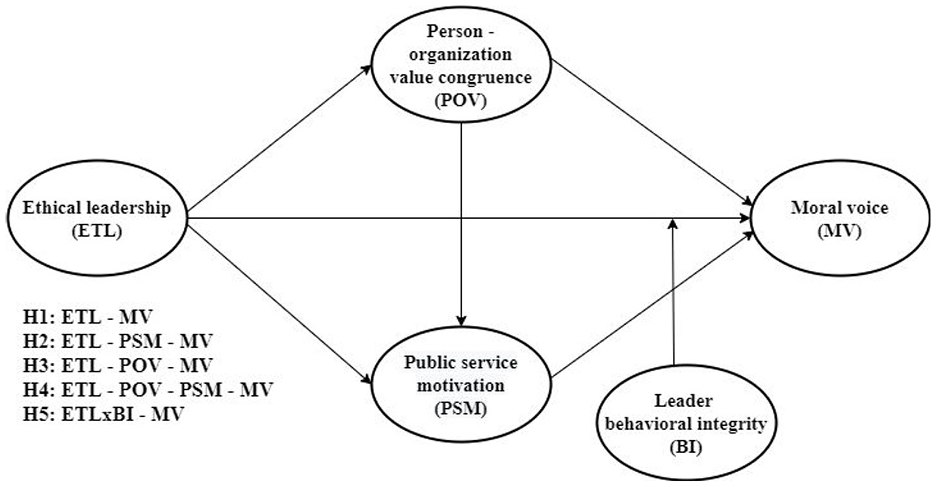
Hypothesized model.
Methodology
Data Collection and Sampling
This work employs a survey design, utilizing a questionnaire to validate the suggested hypotheses. The respondents are from Tien Giang Province, which is one of the largest regions in Vietnam’s Mekong Delta. In Vietnam’s public sector, the Provincial Department operates as an agency under the Provincial People’s Committee, tasked with advising and assisting the Committee in the state management of local sectors and fields, under legal provisions and the assignments or authorizations of the Provincial People’s Committee. Tien Giang province comprises 20 Provincial Departments, employing 992 civil servants as of 2023. Public employees from Provincial Departments and their managers participated in our study. To begin gathering data, we first spoke with and requested approval from the manager or head of each Provincial Department. Then, we explained the study’s goal to them and showed respect for their choice to agree or disagree to participate. Before the primary data collection, we conducted face-to-face interviews with a select group of participants (n = 10) to test the clarity of our questionnaire (Ha et al., 2022). This pre-test aimed to identify any potentially challenging issues in language, grammar, or phrasing (Colton & Covert, 2007), and to confirm the questionnaire’s construct validity (Shadish et al., 2002). Feedback from the pre-test indicated confusion around the term “leader behavioral integrity” Accordingly, we incorporated its definition and examples into the final questionnaire.
Data collection was conducted via questionnaires distributed in person at the workplace (Ha et al., 2022; Malhotra, 2020). This interviewing method helps to reduce non-sampling errors during data collection (Malhotra, 2020). This study employs cluster random sampling to randomly select 11 of the 20 Provincial Departments in Tien Giang (Malhotra, 2020). Public servants were eligible for this study if they possessed a minimum of 2 years of experience in their current roles. Subsequently, a survey was conducted involving 600 public servants who had worked at units within these 11 Provincial Departments during weekdays at various times of the day (Ha et al., 2022). If the characteristics of the sample closely resemble those of the larger population of interest, researchers can conclude that the findings apply to the larger population. Cluster sampling is one of the most popular methods for obtaining more generalizable results (Shadish et al., 2002). This work separates the population into clusters (Provincial Departments), and all participants in the randomly chosen clusters participate. In other words, external validity can be improved through the utilization of cluster random sampling (Shadish et al., 2002). Data collection occurred from October to December 2023. The response rate was 72.33%, resulting in 434 valid responses due to the explicit instructions. The elevated response rate mitigates response bias (Malhotra, 2020). The high response rate also enhances external validity (Blair & Zinkhan, 2006).
Measurement of Constructs
The measurement scales included in this study have been widely used, validated, and demonstrated as having good psychometric qualities in various contexts. Each question was scored on a 5-point Likert scale, with strongly disagree (1) being the lowest and strongly agree the highest (5). First, we used the 5-item ETL scale which was measured following Ren and Chadee (2017). Second, the 7-item public service motivation (PSM) scale was measured based on Taylor (2014). Third, the 4-item POV scale was measured following Cable and Judge (1996) and Al Halbusi et al. (2020). Fourth, the 6-item behavioral integrity (BI) scale was measured using Simons et al. (2007) as proposed by Moorman et al. (2013). Finally, the 3-item moral voice (MV) scale was measured based on Lee et al. (2017).
Empirical Findings
Description of Sample Characteristics
Regarding gender, males comprised 53.9% of the participants and females 46.1%. In total, 7.1% were under the age of 30, 37.3% were between the ages of 31 and 40, 40.2% were aged between 41 and 50, and the remainder were over the age of 50. In terms of educational attainment, 29.2% had more than 16 years of education, 67.6% had completed up to 16 years, and 3.2% had only completed up to 14 years. Furthermore, 12.1% of the respondents had served in their organizations for over 15 years, 21% had served between 10 and 15 years, 35.5% had served between 5 and 10 years, and the remainder had worked in their organizations for less than 5 years.
Common Method Bias
This study collected data using a cross-sectional method at a single point in time, therefore common method bias (CMB) may exist (Fuller et al., 2016). Consequently, the CMB may have influenced the results (Jordan & Troth, 2019; Podsakoff et al., 2003). The study used procedural strategies and statistical method to minimize CMB (Podsakoff et al., 2003, 2012). To control for method biases, respondents were given descriptions for each construct along with explicit instructions for completing the item assessment to avoid any ambiguity. We assured the participants of the study’s academic integrity and the confidentiality of their identities. We also informed them that there were no right or wrong answers to alleviate their evaluation anxiety (Jordan & Troth, 2019; Podsakoff et al., 2003). Chang et al. (2010) advocated for integrating mediation and moderation effects, as suggested by good theory, into the model to mitigate CMB. CMB will probably be mitigated in these circumstances, as the respondents’ theory-in-use is unlikely to encompass such a complex relationship. The theory developed in this study suggests that an exploration of mediation-moderation effects is warranted, which is also anticipated to be advantageous in minimizing CMB. The study then uses “Harman’s single-factor test” to evaluate CMB, as the study collected all variables using the same instrument (Jordan & Troth, 2019; Podsakoff & Organ, 1986). The test result shows that the single factor accounts for 46.5% of the variance of the 22 variables, which is not a majority. Thus, CMB appears to be unproblematic in the data set (Podsakoff et al., 2003; Podsakoff & Organ, 1986).
Measurement Model Assessment
Before examining into the measurement model, the ETL5 item was removed from the ETL scale, and the BI5 and BI6 items were removed from the BI scale due to cross-loading (Hair et al., 2019). First, according to Kline (2015), the study assessed if the above data could be considered as normally distributed. This was done through the use of skewness and kurtosis tests. When the indicator of a kurtosis test is lower than 7.0 and the skewness is smaller than the value of 3.0, data normality is confirmed (Kline, 2015). This study’s data was normally distributed as the kurtosis ranged from 0.544 to 3.786, and the skewness extended from −1.324 to −0.666.
All loadings are statistically significant at the .001 stage, as shown in Table 1. The composite reliability (CR) is well above the cut-off values, ranging between 0.821 (BI) and 0.944 (POV; Bagozzi & Yi, 1988). Furthermore, the average variance extracted (AVE) surpasses the 0.50 threshold at all times, ranging between 0.515 (PSM) and 0.810 (POV; Fornell & Larcker, 1981), indicating that the convergent requirements have been met. None of the correlations between the construct exceed the square root of the AVE of each construct (see Table 2), implying that all latent variables or constructs receive adequate discriminant validity (Fornell & Larcker, 1981).
Constructs and Their Associated Measurements.
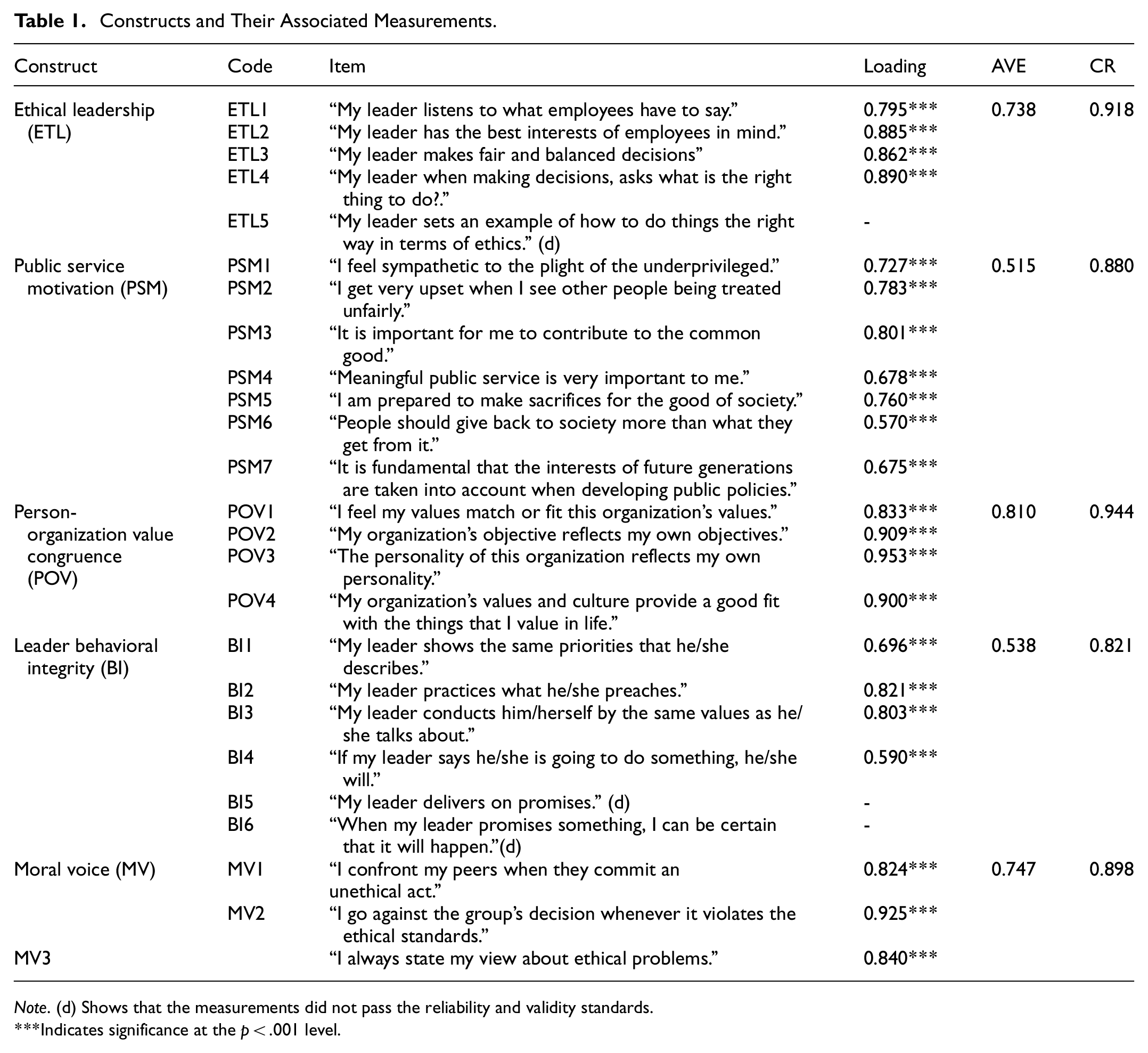
Note. (d) Shows that the measurements did not pass the reliability and validity standards.
Indicates significance at the p < .001 level.
Discriminant Validity Results.

Note. Diagonal figures are the square roots of AVE. The other numbers in the table are the correlation coefficients.
Indicates significance at the p < .001 level.The bold part on the diagonal are the square roots of AVE
To assess the discriminant validity of the scale, the heterotrait-monotrait (HTMT) ratio of correlations was also examined, following the method proposed by Henseler et al. (2015). The HTMT ratio provides an estimate of the correlation between two similar constructs. A value of ≥0.85 is considered a violation of discriminant validity (Kline, 2015). The results of this study indicated that the HTMT values were below the threshold of 0.85, thus confirming the satisfactory discriminant validity of the constructs. Table 3 presents the specific HTMT values obtained in our analysis.
Heterotrait-Monotrait Ratio Results.

Note. The number in the table represents the correlation between two constructs; HTMT discriminates at HTMT < .850.
The current study found no multicollinearity between predictor variables, but Structural Equation Model (SEM) applications often raise concerns about it. Recently introduced SEM regularized estimation methods may provide more stable estimates in multicollinearity. Research shows that Ridge and Elastic net regularized SEMs have more stable estimates and statistical power than nonregularized ones. When genuine multicollinearity between predictors, not model misspecification, causes unstable estimates, the study should estimate and interpret an Elastic net regularized SEM (Scharf et al., 2021).
The empirical data fit the model excellently, as per the model fit statistics, specifically, chi-square (χ2) = 59.131 (df = 196, p = .000), Minimum Discrepancy per Degree of Freedom (CMIN/df) = 2.751, Standardized Root Mean Square Residual (SRMR) = 0.0512, Comparative Fit Index (CFI) = 0.952, Tucker–Lewis index (TLI) = 0.944, and Root Mean Squared Error Approximation (RMSEA) = 0.064. As a result, it can be inferred that the hypothesized model’s constructs are not only valid and reliable but are also distinct from one another (Hair et al., 2019).
The main goal of SEM is to assess how well the data supports the researcher’s model. Goodness-of-fit usually decreases with smaller sample sizes. Interpreting goodness-of-fit in such cases requires caution. As the number of observed variables increases, goodness-of-fit becomes worse. The study can reduce the number of observed variables to improve goodness-of-fit. SEM analysis validates the hypothetical theory, not the model fit. Increasing goodness-of-fit can lead to incorrect model settings, which will not reflect reality and weaken the researcher’s argument (Kang & Ahn, 2021).
Structural Model Assessment
Subsequently, the structural model is examined to validate all proposed hypotheses. The next stage entails an estimation that uses maximum likelihood estimation to verify all the hypothesized relationships posited from the research model (Collier, 2020). Model fit measures reveal that χ2 = 680.108, p = .000 with 237 df. With the χ2/df value of 2.870 being within the thresholds of 2 and 5, the model proves to be parsimoniously acceptable (Hu & Bentler, 1999). The SRMR is 0.0605 and the RMSEA is 0.066, while CFI is 0.940 and TLI is 0.930. Overall, all fit indices reveal that the model renders absolute and incremental goodness of fit from an acceptable to an excellent level (Hair et al., 2019; Hu & Bentler, 1999). The results of the hypothesis testing from the structural model assessment are shown in Table 4. All hypotheses are statistically significant at different levels.
Results of Path Analysis.

Note. BI = leader behavioral integrity; ETL = ethical leadership; POV = person-organization value congruence; PSM = public service motivation; MV = moral voice; SRW = standardized regression weights.
p < .001. **p < .010. *p < .050.
Direct Effect
According to H1, public servants’ MV and ETL would be positively correlated. The results of the path analysis demonstrated that there was a positive and significant regression coefficient between MV and ETL (β = .145, p < .050). Thus, H1 was validated (see Table 4). Besides, the impact of gender on ethical conduct has been the subject of much study, with contradictory results (Mubako et al., 2021). Hence, when analyzing regression results, incorporating gender as a control variable into the structural model allowed us to understand the effect of gender on MV better. Significantly, MV was affected by the gender of civil servants, with a value of 1 for females and 0 for males (β = −.125; p < .001).
Mediation Analysis
In addition, the paper applied a bootstrapping approach for conducting mediation analyses to understand the relationships between ETL, PSM, POV, and MV (Hayes, 2009). The bias-corrected confidence interval’s 95% level was selected, and 2,000 bootstrap samples were used in the analysis. The second hypothesis states that PSM will act as a mediator between ETL and MV of workers. The results show that the indirect effect via PSM was significant for the ETL-MV link (β = .166, p < .001). Therefore, H2 was supported (see Table 4). Table 4 also depicts that POV would mediate the relationship between ETL and employee MV behavior. The indirect effect of ETL on MV through POV is also significant (β = .139, p < .010). Thus, H3 was supported.
The work used a bootstrapping technique to redraw 2,000 samples and calculate a confidence interval to test if POV and PSM are mediators. Table 4 depicts that the relationship between ETL and MV through POV and PSM has yielded a significant indirect effect (β = .268, p < .001). Thus, the ETL-MV relationship was sequentially mediated by POV and PSM. Therefore, H4 was supported.
Moderation Analysis
H5 predicted that leader BI would moderate the nexus between ETL and MV. The paper constructed an interaction term involving ETL and BI to examine Hypothesis 5 (Dawson, 2014). The interaction between ETL and leader BI has a notable and positive impact on the MV (β = .148; p < .001). Figure 2 shows the joint impact of ETL and BI on MV. There is a strong correlation between ETL and MV at high levels of leader BI, but the regression line for the interplay between ETL and MV is lower at low levels of BI. This means that when followers perceive low levels of leader BI, ETL has less of an impact on MV. Thus, the results corroborated H5.

The moderating effect of BI.
Discussion
The work investigated the connection between ETL and employee MV using SDT and SLT. This paper treated PSM and POV as mediators, and leader BI as a moderator in the theoretical model. ETL was found to influence MV positively. PSM and POV positively mediated the relationship between ETL and MV. The results suggest that leader BI facilitates the link between ETL and MV.
First, the results validate the hypothesis that, in the public sector, employee MV is positively correlated with ETL. These results are consistent with earlier studies (Lee et al., 2017; Zheng et al., 2021). Notably, the measurement of MV serves as a particularly valuable variable in ETL research due to its unique nature in addressing ethical dilemmas with potential personal risks. Consequently, ETL has a positive and considerable impact on encouraging employee voice, as evidenced by prior scholars. Given that MV acts are discretionary and risky, depending on the workplace and whether it encourages speaking up, employees may be more willing to engage in MV acts (Morrison, 2023).
Second, the paper examined the motivational process mediating the link between ETL, PSM, and employee MV. The study’s findings support the assertion made by Uluturk et al. (2023, p. 1522) that “ETL can influence employee outcomes through PSM as a motivational component.” The present findings are in line with previous research (Ouakouak et al., 2020) indicating that the concept of ETL aligns with the underlying principles of PSM. This alignment is expected, as previous studies have demonstrated that public employees are encouraged to exhibit desirable outcomes as advocated by PSM (Piatak & Holt, 2021; Uluturk et al., 2023; Wright et al., 2016).
Third, this study found that ETL was favorably associated with POV, and POV was favorably associated with MV. The results of this study align with the theoretical arguments put forth by Kristof (1996) regarding the concept of POV. These findings are consistent with the research conducted by Tran (2024), who found that POV serves as a mediator in the link between positive leadership and organizational citizenship behaviors of employees. Moreover, the study revealed a positive relationship between POV and employees’ proactive behavior toward the organization.
Fourth, this study shows that ETL increases followers’ POV, which in turn increases followers’ PSM and consequently encourages followers’ MV. The key characteristics underpinning the liberal approach are curiosity, openness, and understanding of empathy, which enable ETL to interact with follower agendas so that followers feel that they can be themselves around their leaders (Vansteenkiste et al., 2018). In the context of PSM, this suggests that civil servants will be inclined to demonstrate public service behavior to the extent that their organization espouses and prioritizes public service values (Vandenabeele, 2007). Empirical findings support the theoretical expectations, showing a positive relationship between ETL, POV, PSM, and MV.
Fifth, this work investigated the relationships between leader BI and ETL on employee MV. Leader BI moderates the positive link between employee MV and ETL—a relationship that is higher when leader BI is high. The greater a leader’s BI, the more reliable followers perceive their actions and responses to be (Simons et al., 2022). Previous research has predominantly focused on the role of BI as a predictor of employee voice behavior (Zeng et al., 2020). However, the potential moderating effect of BI on the relationship between ETL and MV has yet to be investigated. Erkutlu and Chafra (2017) found that BI moderated the negative relationship between leader narcissism and subordinate job embeddedness. The findings align with the perspective put forth by Zeng et al. (2020), which suggests that individuals with conventional moral reasoning rely on societal expectations to determine ethical standards, thereby allowing leaders to shape perceptions of morality and ethics based on their integrity.
Finally, Vietnamese culture, characterized by collectivism and high power distance (Truong et al., 2016), likely impacts the relationship between ETL and MV. In collectivist cultures, individuals prioritize group harmony and conformity to societal norms (Hofstede, 1991; Truong et al., 2016). This cultural orientation might amplify the role of ETL, as leaders are viewed as authoritative role models whose ethical behavior strongly influences followers (Hoang et al., 2023). High power distance further enhances the hierarchical dynamic, where employees may feel more compelled to align their behavior (e.g., MV) with the ethical standards demonstrated by leaders (Peng & Kim, 2020). These cultural attributes could lead to stronger mediating roles for POV and PSM in Vietnam compared to less collectivist and lower power-distance cultures.
Furthermore, managers from other cultural settings should interpret these findings with cultural variations in mind. In low power-distance cultures, employees may feel less obligated to emulate their leaders and more empowered to exercise individual judgment (Truong et al., 2016). Similarly, in individualistic cultures, the alignment between personal and organizational values might not play as critical a role in fostering ethical behaviors (Hofstede, 1991). Managers should consider adapting strategies to their specific cultural context. For instance, in more individualistic settings, fostering autonomy and emphasizing individual moral accountability (Hofstede, 2001) could be more effective than relying on hierarchical influence (Truong et al., 2016).
Several significant theoretical contributions can be attributed to this study, including the following:
First, the study’s findings provide further evidence for the significance of SDT and SLT in the underlying relationship between ETL and MV among public employees. Integrating SDT and SLT provides new insights into the influence processes of ETL. Research on ETL and followers’ ethical behavior has primarily focused on the mechanisms implied by the definition of ETL (Moore et al., 2019). However, the present work discovered that followers’ PSM and POV play a significant mediating role. SDT posits that leader behaviors that fulfill employees’ fundamental psychological needs are likely to yield positive outcomes such as increased motivation. By enforcing both internalized and introjected regulations, ETLs help their followers internalize their values and act in a way that pleases their leader (Zheng et al., 2021). In addition to internalizing and identifying with the leader’s ethical values, employees may engage in a social learning process (Bandura, 1977). It is commonly believed that ETLs serve as role models for their followers, which in turn influences their ethical behavior through social learning processes (Brown & Treviño, 2006). This, in turn, motivates followers to act ethically.
Second, the theoretical foundation of SDT may be the most suitable ground for choosing potential moderators in future studies. In this case, one can measure the conceptual distance between the independent, moderator, and dependent variables; the closer the conceptual distance, the easier it is to identify networks (Vansteenkiste et al., 2020). SDT claims that environmental impacts on human attitudes and actions can be broadly characterized as elements that either support or obstruct the fulfillment of fundamental needs (Deci & Ryan, 1985). More specifically, environments that facilitate the satisfaction of all three psychological needs for greater internalization and integration have more positive outcomes than those that do not. Leaders with high BI can create transparent, predictable, and reliable situations (Simons, 2002; Simons et al., 2022). As little is known about the contextual factors that may moderate the impacts on need satisfaction (Vansteenkiste et al., 2020), our study adds significantly to the body of knowledge on SDT by exploring the moderating role of BI.
Third, by examining the mediating roles of POV and PSM, we have helped shed light on the psychological mechanisms of motivation (Vandenabeele, 2007) in explaining the morality between the MV of civil servants and ETL. Regarding PSM, perhaps the POV is the most promising approach (Vandenabeele, 2007). Researchers are especially curious about whether PSM is a fixed personality attribute or a variable situation (G. J. Kim et al., 2023). Recent research has increasingly concentrated on the function of socialization in PSM, despite definitive results having yet to be obtained (G. J. Kim et al., 2023). The theory posits that organizational behavior achieves a heightened level of motivation when alignment exists between the individual and the organization (Kristof-Brown et al., 2005). Consequently, motivation is absent, and behavior cannot manifest in the absence of individual–organization interaction (Vandenabeele, 2007). This study demonstrates that PSM originates from an organization with institutionalized public service principles. PSM can easily be defined as this type of public service personality, as “going beyond self-interest and organizational self-interest, taking into account the interests of the larger political class and motivating individuals to act accordingly whenever appropriate” (Vandenabeele, 2007, p. 547). Thus, this is among the very first studies to investigate the impact of ETL in the public sector through the mediating mechanisms of POV and PSM.
Finally, to the best of our knowledge, our study is the first to define a moderating mechanism of BI in the relationship between ETL and follower MV. Thus, this work adds to the body of knowledge on BI through its expanded use in organizational contexts. Simons et al. (2022) noted that, if BI is successful in an organizational setting, other outcomes should be investigated. Thus, our study clarifies how BI contributes to follower behavior outcomes that are advantageous to the organization. Research has rarely been undertaken to empirically investigate social learning (i.e., SLT theory) as a mechanism for elucidating how leader BI influences potential boundary conditions pertinent to ETL. While prior research has considered BI solely as a significant determinant of follower preference outcomes (Ete et al., 2022), the current study extends SLT through the influence of leader BI in enhancing the interplay of ETL and MV.
Practical Implications
This work finds that there is strong evidence linking ETL to increased MV among followers in Vietnamese public organizations. To enhance the generalizability of these findings, future studies should replicate the research in culturally distinct environments. Cross-cultural comparative studies could reveal whether the observed mediating and moderating mechanisms, such as POV and PSM, or leader BI, are universally applicable or culturally contingent. This would provide valuable insights into the adaptability of ETL frameworks across different cultural and organizational settings. Replicating the study in private sector organizations could reveal whether the relationships between ETL, PSM, POV, and MV differ outside the public sector. The implications of this work are as follows: Listening to employees is an important leadership skill. For a leader to be effective, an organization leader must be able to empathize with their team members and understand their goals and challenges, so that they can help each person reach his or her full potential. These days, leaders aren’t the only ones who succumb to the “big boss” mentality; many also think highly of themselves, which makes them receptive to compliments but resistant to criticism. Therefore, hearing out their employees is a surefire way to boost MV. It also helps them seem more trustworthy and credible to their subordinates.
Leaders must consider workers’ interests. Leaders must care, pay attention, understand, and evaluate subordinates’ expertise, personalities, outstanding qualities, and some skills. Leaders must also analyze each job position’s requirements to place employees in positions that will help them perform well and develop their skills. Building a positive climate helps leaders motivate employees. A positive workplace climate makes employees proud of their work. Leaders must identify cultural factors that need to change to match the organization’s core value orientation, identify leadership’s role in leading change and developing organizational culture, and institutionalize, model, strengthen, and continuously improve cultural change.
Fair and balanced decision-making is a leadership necessity. Workplace fairness impacts several aspects, including equality, transparency, and belonging. Prestige is essential for every leader; without it, it’s impossible to sway followers, recruit talent, and steer a group or organization in the right direction. Efficiency in both leadership and work is a measure of a leader’s decision-making capacity, which stems from the leader’s ability to make beneficial choices. Leaders rely heavily on knowledge when making decisions; as a result, they must commit to lifelong learning to keep up with demands and complete practical assignments.
Leaders constantly consider the right course of action when making decisions. In making decisions, leaders must take full responsibility for the outcomes. A key component of leadership is earning the respect and trust of subordinates. Effective leaders can control their emotions and make rational decisions after carefully considering all relevant factors. Another benefit of emotional control for leaders is improved subordinate interaction, particularly under pressure. Leaders can benefit from this because it facilitates the gathering of information and opinions, as well as considering different viewpoints when making decisions.
The results imply that, in the public sector, employee MV and leader BI are related. Therefore, leaders must understand the significance of keeping their word and delivering on their promises as a way to enhance employees’ MV. For public organizations with an urgent need to enhance the MV of their employees, this study suggests that BI should be considered as the most important leadership criterion and one which should be encouraged and tested for within the public sector. In addition, these findings generally confirm that BI is highly valued in organizations. Our research suggests that it is vital for managers and organizations to consider the alignment of their values ;with those of their employees, and that their employees feel rewarded for their efforts through top-down reciprocal actions. It would be beneficial for leadership development programs to make BI capabilities a key component. Public organizations should work to improve leader BI across governance given its importance in boosting employee MV. For instance, companies should exert efforts in selecting, hiring, and inspiring leaders with high integrity by including integrity as an input in the appraisal process. These entities should also strive to promote leader BI through training initiatives. In the public sector, managers need to encourage the MV of subordinates and foster a culture of honesty and integrity in their organizations. Managers should also take care when making promises. People need to be honest in their commitments as doing so is a key factor in proving the truth of a statement. Managers, therefore, should honor their commitments to enhance employees’ moral attitudes.
Lastly, since this study primarily focuses on the Vietnam context, it is necessary to provide additional evidence demonstrating the results’ applicability to other cultures. Future studies could expand this study to encompass other cultures, facilitating comparisons, and enhancing the model’s applicability in diverse settings.
Limitations and Implications for Further Studies
Although the research offers several contributions to the existing literature, it does have several limitations. First, the work collected data from Tien Giang’s public servants, in Vietnam. To strengthen the robustness and generalizability of the findings, future research should expand the sample size and include participants from diverse geographical locations. It would be interesting to explore further similarities and differences in employee perceptions of ETL and BI throughout different cultures to boost the findings’ external validity. Second, moral identity was primarily discussed as a form of self-regulation that motivates ethical behavior (Zheng et al., 2021). To further explore these hypotheses, subsequent studies could use experimental designs to establish causal directions between POV and PSM and emphasize the tension between moral identity and MV. Finally, the present study employed cross-sectional data using a cluster sampling method, which has mitigated the issue of bias. Nonetheless, employing cross-sectional data alongside cross-lagged data to illustrate the direction of the effect can alleviate concerns regarding causality and potential interactions among mediating variables (Zheng et al., 2021). Consequently, employing time lags to evaluate our model may represent a promising direction for future investigation.
Conclusions
ETL is an essential area of research, especially in Vietnam, as practices show that many employees and team members, including leaders, do not lead by example due to cultivation and lack of training. Moreover, it has been demonstrated that ETL significantly improves the attitudes and actions of followers. This research employed SDT and SLT approaches to shed light on how ETL influences employee MV and further investigated the mediating role of POV and PSM. Moreover, leader BI is considered a moderator to explain why ETL facilitates employees’ MV. The results suggest that POV and PSM strongly influence the relationship between ETL and subordinates’ MV. Additionally, this study found that BI is an important boundary condition in this effect. These results are intended to motivate additional research efforts to investigate the mechanisms by which ETL influences follower MV.
