




Abstract
Improving corporate labor investment efficiency (LABEFF) is necessary for achieving high-quality economic development. The rapid advancement of artificial intelligence (AI) has profoundly impacted the labor force. However, there remains a lack of theoretical discussion and empirical analysis regarding how AI influences corporate LABEFF. Using a multi-period difference-in-differences (DID) model and data from Chinese A-share-listed companies from 2010 to 2023, this study examines the impact and mechanism of China’s National New Generation Artificial Intelligence Innovation and Development Pilot Zone (NAIPZ) policy on LABEFF. The results indicate that the NAIPZ policy enhances corporate LABEFF within pilot zones. The validity of these findings was confirmed through several rigorous tests. The mechanism analysis indicates that the NAIPZ policy improves corporate LABEFF within pilot zones by optimizing human capital structure, alleviating financial constraints, and reducing agency problems. Heterogeneity analysis suggests that the NAIPZ policy significantly improves corporate LABEFF within pilot zones in the eastern region, highly competitive industries, and high-tech enterprises. Further analysis reveals that the NAIPZ policy primarily alleviates labor under-investment, with a less pronounced effect on suppressing labor over-investment. Additionally, it improves corporate productivity within pilot zones by enhancing LABEFF. Therefore, it is imperative to implement and expand the NAIPZ policy, promote AI adoption across enterprises, and foster its synergistic integration with optimized labor resource allocation. Such efforts will facilitate the deep convergence of AI and the real economy, advancing enterprises toward high-quality and sustainable development.
Keywords
Introduction
As the world enters a period of unprecedented transformation, high-quality economic development has emerged as a crucial anchor for China to address multifaceted risks and challenges, and an essential pathway to realizing Chinese modernization. Central to this process is the efficient allocation of labor resources, a foundational prerequisite for sustainable, high-quality economic growth. However, China is increasingly confronted with a growing demographic challenge characterized by rapid population aging and a concurrent decline in both the size and quality of its labor force. According to the National Bureau of Statistics, China’s working-age population peaked in 2013 and has since fallen steadily from 1.01 billion in 2013 to 858 million in 2024. With the erosion of the demographic dividend, labor shortages have intensified, accompanied by a sharp escalation in labor costs (X. Li et al., 2019). In this context, as microeconomic actors within the market system, enterprises often struggle to optimize human capital configurations. Such inefficiencies undermine operational effectiveness (Tao et al., 2022) and deteriorate corporate performance, ultimately hindering investors’ value assessments and decision-making processes (Ghaly et al., 2020; Pinnuck & Lillis, 2007). Consequently, enhancing corporate labor investment efficiency (LABEFF) and improving labor resource allocation have become pressing concerns for both scholarly inquiry and managerial practice.
As a strategic technology spearheading a new wave of scientific and industrial revolutions, Artificial Intelligence (AI) is crucial for empowering high-quality economic growth. In 2025, the Chinese Government Work Report underscores the necessity to stimulate innovation in the digital economy and to continue advancing the “AI +” initiative. To create a conducive environment for AI development, augment innovative capabilities, and facilitate the profound integration of AI with socio-economic advancement. In 2019, the Chinese government introduced the NAIPZ policy. By 2024, 18 cities in China, including Beijing, Shanghai, and Tianjin, had established NAIPZs. The primary tasks of the NAIPZ policy include conducting research on AI technology, demonstrating its applications, creating a supportive institutional environment for AI innovation, and strengthening the conditions underlying AI development. As fundamental drivers of economic growth, enterprises play a crucial role in researching, developing, and applying AI technologies.
AI not only drives high-quality economic development but also profoundly influences the labor force. Existing studies have revealed that AI technologies generate both substitution and creation effects in the labor market. On the one hand, some scholars argue that AI negatively affects employment (Acemoglu & Restrepo, 2020; Frey & Osborne, 2017), particularly by displacing workers who lack core skills (Agrawal et al., 2019). On the other hand, as AI technologies advance, new forms of employment continue to emerge, increasing the demand for high-skilled labor (Acemoglu & Restrepo, 2019). The transformation of the labor market driven by AI technologies has also reshaped corporate labor demand. Existing studies have shown that AI adoption tends to enhance corporate labor income share (Fan et al., 2025; C. Wang & Jiao, 2025)and labor productivity (Damioli et al., 2021); however, limited attention has been paid to how AI influences corporate LABEFF. In contrast to the labor income share, which captures income distribution, and labor productivity, which reflects output per unit of labor input, LABEFF emphasizes the effectiveness of labor allocation. Fundamentally, it represents the optimal alignment between labor input and firm production, serving as a pivotal determinant of corporate value creation and core competitiveness development (Jung et al., 2014). Moreover, the existing literature has primarily measured corporate AI adoption through indicators such as industrial robot usage (Y. Liu et al., 2024), AI-related patents (K. Chen et al., 2024), and the frequency of AI-related terms(C. Wang & Jiao, 2025). Whether the National New Generation Artificial Intelligence Innovation and Development Pilot Zone (NAIPZ) policy improves corporate LABEFF and through which mechanisms remains insufficiently addressed in theoretical and empirical studies.
Accordingly, this study employs the formation of China’s NAIPZ as a quasi-natural experiment to rigorously examine policy’s influence on LABEFF, and its underlying transmission mechanisms. The aim is to promote the deep integration of AI with the real economy and support the high-quality development of enterprises. The primary contributions of this study compared with the existing literature are as follows. First, this study contributes to the growing body of research on the economic implications of AI for micro-level enterprises by investigating its influence on corporate LABEFF. Existing research on the impact of AI on firm labor outcomes has primarily focused on indicators such as labor income share (Fan et al., 2025; C. Wang & Jiao, 2025)and labor productivity (Damioli et al., 2021), with comparatively limited attention paid to LABEFF. As a critical determinant of corporate value creation and core competitiveness, LABEFF plays a central role in firm performance. By investigating the impact of the NAIPZ policy on corporate LABEFF, this study advances the literature on the economic implications of AI adoption. Second, this study broadens existing research on the variables affecting corporate LABEFF by incorporating the perspective of AI policy. Prior research has primarily examined factors such as digital transformation (S. Liu et al., 2023; S. Wang et al., 2024) and industrial robotics (Y. Liu et al., 2024), while the influence of macro-level AI policies has received little attention. This study explores the causal link between the NAIPZ policy and corporate LABEFF, offering new perspectives to the current body of literature and deepening our knowledge of how advancements in AI relate to corporate human capital investment. Finally, the findings of this study offer valuable insights for improving the development of the NAIPZ policy and enhancing corporate LABEFF. Based on rigorous empirical analysis, this study uncovers the underlying mechanisms and heterogeneous effects through which the NAIPZ policy influences corporate LABEFF, thereby deepening understanding of how such policies shape micro-level corporate behavior. The results provide important policy implications for optimizing and refining the NAIPZ policy. Moreover, this study offers new perspectives for policymakers on achieving a balanced relationship between AI advancement and labor force dynamics.
Theoretical Analysis and Research Hypotheses
The NAIPZ Policy and Corporate LABEFF
The implementation of the NAIPZ policy markedly enhances corporate LABEFF within pilot zones. First, governments can attract high-quality workers to enterprises within these zones, enhance their human capital, and improve LABEFF by implementing preferential policies regarding remuneration, benefits, and housing for talent (Y. Liu et al., 2024). Moreover, the NAIPZ policy encourages firms within pilot zones to adopt AI technology to enhance LABEFF. These zones focus intensively on the research, development, and implementation of AI technology, enhancing new infrastructure while mandating local governments to improve talent acquisition, taxation, and financial support. They also encourage enterprises to strengthen collaboration with academic institutions, research institutes, and R&D organizations, while incentivizing increased investment in intelligent equipment and innovation-related research and development. Therefore, the NAIPZ policy facilitates the advancement and application of AI within firms, improving corporate LABEFF. On the one hand, enterprises use big data algorithms to analyze internal and external environments during production and operations, enabling precise predictions of market fluctuations and consumer demand, flexible adjustments to production strategies, optimization of labor factor allocation, and enhancement of labor resource allocation efficiency (S. Wang et al., 2024; Zhao & Wang, 2025). Furthermore, deploying intelligent robots may replace certain low-skilled labor roles, while elevating the demand for highly skilled professionals, compelling firms to strengthen employee training in digital intelligence competencies and recruit digital intelligence talent, thereby augmenting the overall quality of enterprise human capital (Acemoglu & Restrepo, 2020), which subsequently enhances LABEFF. On the other hand, in management, enterprises employ AI technologies to perform comprehensive analyses and integrate extensive data, thereby reducing data transmission and decision-making cycles, streamlining organizational management processes and decision outcomes, enhancing information transparency, and effectively mitigating information asymmetry (Cui et al., 2022). Consequently, shareholders and other oversight entities can better identify managerial opportunism and restrain inefficient labor investments by management (Le & Tran, 2022). Based on this analysis, we propose
The NAIPZ Policy, Human Capital Structure, and Corporate LABEFF
The optimization of human capital structure is essential for improving corporate LABEFF. Drawing on human capital theory, individuals with high-quality human capital are more adept at absorbing and applying technological advancements and at exhibiting superior labor productivity. Moreover, by leveraging their extensive knowledge reserves and professional expertise, high-quality talent can accurately interpret valuable information and facilitate its effective dissemination within firms. This process helps mitigate information imbalances between firms and employees by minimizing the likelihood of divergences from optimal labor investment choices (Zhai et al., 2022). Accordingly, a company’s human capital allocation can significantly enhance LABEFF.
The NAIPZ policy enhances corporate LABEFF within pilot zones by optimizing human capital structure. On the one hand, enterprises within pilot zones attract high-caliber talent to advance the research and development (R&D) of AI technology. The pilot zones provide policy incentives and financial support for talent recruitment and promote dynamic adjustments in university training programs to align with evolving market demands. These policies and measures have established a favorable talent ecosystem for enterprises, which is conducive to attracting high-quality employees, thereby enhancing corporate LABEFF. On the other hand, enterprises within the pilot zones modify their human capital structure to strengthen the application of AI technology. Initially, the automation and intelligence facilitated by AI technology can substitute for low-skilled labor. At the same time, the “substitution effect” compels workers to adapt to new production modes and demands, thereby necessitating continuous self-improvement to transform and enhance labor quality (H. Liu et al., 2024). Furthermore, enterprises must align technology with high-quality human capital to fully leverage the potential of AI technology (Y. B. Guo & Hu, 2022). The “matching effect” incentivizes companies to attract and retain top talent, ultimately generating competitive advantages. Consequently, implementing AI technology in enterprises can improve labor quality, thereby increasing LABEFF. Based on this analysis, we propose
The NAIPZ Policy, Financial Constraints, and Corporate LABEFF
Financial constraints represent a critical determinant of corporate LABEFF (Khedmati et al., 2020). According to financial constraints theory, labor investment entails substantial costs, including expenses related to recruitment, training, and compensation, as well as adjustment costs such as severance pay in the event of workforce downsizing. Under severe financial constraints, managers cannot promptly and accurately adjust the scale of labor force employment in response to the evolving needs of business operations. Consequently, labor resource allocation may deviate from a firm’s optimal configuration, leading to labor investment inefficiency (Jung et al., 2014).
The NAIPZ policy enhances corporate LABEFF within pilot zones by alleviating financial constraints. On the one hand, enterprises within these zones apply AI technology to production, sales, and management processes to enhance profitability, ease internal financial constraints, and improve corporate LABEFF. First, applying AI technology to the production process enables intelligent and automated manufacturing, which reduces labor input, enhances production efficiency, and helps enterprises lower costs and increase output in the production phase (Graetz & Michaels, 2018). Second, integrating AI technology into enterprise management transforms traditional management models, facilitates the intelligent evolution of managerial processes, optimizes organizational structures, enhances managerial efficiency, and reduces administrative costs (Jin & Zhang, 2023). Third, implementing AI technology in sales process enhances sales operations and strategies and strengthen enterprises’ capabilities in data analysis, demand forecasting, and decision-making, thereby reducing sales-related costs and increasing revenue generation (K.-L. Wang et al., 2023; Wu & Zhu, 2025). Consequently, firms within pilot zones can augment their profitability by incorporating AI technology across all facets of production and operational management, thereby bolstering their endogenous financing capacity and improving LABEFF. Furthermore, the NAIPZ policy can alleviate enterprises’ external financial constraints by enhancing their debt financing capacity and increasing financial support from local governments, thereby raising labor investment efficiency. First, financial institutions within pilot zones may harness AI technologies to obtain more timely and accurate information regarding enterprises’ financial conditions and operational performance. This mitigates information asymmetry between financial institutions and companies, increases financial institutions propensity to extend credit, lowers the risk premium imposed by financial institutions on enterprises, and consequently reduces corporate debt financing costs (Jiang & Jiang, 2021). Second, the governments of pilot zones enhance financial support mechanisms to facilitate regional development, including providing direct financial subsidies to enterprises and implementing tax incentives to increase corporate earnings retention. Sufficient capital enables enterprises to overcome fixed cost barriers when employing high-quality labor and dismissing low-skilled workers, thereby reducing the likelihood of underinvestment or overinvestment in labor, optimizing labor resource allocation, and enhancing LABEFF. Based on this analysis, we propose
The NAIPZ Policy, Agency Problems, and Corporate LABEFF
Agency problems between management and shareholders are a significant element contributing to labor investment inefficiency (Jung et al., 2014). According to agency theory, on the one hand, managers driven by a desire for a “quiet life” and job security may demonstrate short-termism, neglecting labor investment initiatives with positive net present value (NPV). Instead, they tend to adopt conservative employment strategies, resulting in suboptimal labor inputs and, consequently, under-investment in labor. On the other hand, managers driven by ambitions to expand a “business empire” may undertake labor investment projects with negative NPV for self-interested purposes and excessively hire employees, leading to over-investment in labor.
The NAIPZ policy enhances corporate LABEFF within pilot zones by reducing agency problems. The pilot zones strengthen the development of new infrastructure, thereby reducing the costs for enterprises implementing AI technology, expanding the application scenarios of AI within firms, facilitating the transition from a hierarchical to a networked information structure, removing the limitations of hierarchical information transmission, enhancing internal information transparency, improving transmission efficiency, and effectively curbing opportunistic managerial behavior (Gao & Liu, 2018). Moreover, the knowledge graph generated by AI technology enables the principal to comprehensively understand management functions; provides thorough, objective, and precise data for evaluating managerial performance; incentivizes management to act in the best interests of the enterprise; mitigates moral hazards within management; alleviates the agency dilemma between management and shareholders (H. Chen et al., 2023); and improves corporate LABEFF. Based on this analysis, we propose
The theoretical mechanism of the NAIPZ policy’s effect on corporate LABEFF is illustrated in Figure 1.

Mechanism pathway of the NAIPZ policy on corporate LABEFF.
Research Design
Sample Selection and Data Sources
The year 2010 marked a significant turning point in AI development, as the rise of mobile internet and breakthroughs in deep learning algorithms drive rapid advancements. Subsequently, countries worldwide have increasingly recognized AI’s transformative impact on society and the economy, making its development a strategic priority. Accordingly, we employ an unbalanced panel dataset of A-share-listed firms in China from 2010 to 2023 to empirically assess the influence of the NAIPZ policy on corporate LABEFF. The sample is constructed based on the following criteria: (1) observations from the financial sector are removed; (2) companies with insufficient data for key variables are eliminated; and (3) companies classified as ST, ST*, or PT are omitted. Applying these filters yields a final dataset comprising 25,291 firm-year observations. The list of cities designated as NAZPZ and their approval dates is sourced from the Ministry of Science and Technology of China (https://www.most.gov.cn/index.html), while firm-level financial data are drawn from the CSMAR database (https://data.csmar.com/). To reduce the impact of extreme values, continuous variables are Winsorized at the 1% and 99% levels. Additionally, to enhance the robustness of the empirical findings, standard errors are adjusted by clustering at the firm level. Empirical analyses are conducted using Stata 18, a widely used statistical software for econometric and data analysis.
Definition of Variables
Dependent Variable
Labor investment efficiency (LABEFF) was quantified following the approach of Pinnuck and Lillis (2007). Specifically, we first use firms’ net hiring, the ratio of the change in the number of corporate employees from year t−1 to t to measure observed labor investment

Where the subscripts i and t denote the firm and year, respectively. Hire represents the ratio of a firm’s total number of employees to its annual average market capitalization. Net_Hire is the rate of change in Hire. Sales_Growth reflects the percentage increase in a firm’s sales revenue. ROA denotes the return on assets. ΔROA is the annual change in return on assets. Size_R indicates the percentile ranking of a firm’s market capitalization relative to all listed firms in the same year. Quick is the quick ratio, and ΔQuick represents its annual variation. Lev measures leverage, defined as the proportion of total liabilities to total assets. LossbinX variables categorize firms based on prior-year ROA within five negative intervals ranging from 0 to −0.025, each with a width of 0.005. For example, if a firm’s ROA lies between −0.005 and 0, Lossbin1 equals 1; otherwise, it equals 0. The same logic applies to Lossbin2 through Lossbin5. Meanwhile, according to the industry classification standard of the China Securities Regulatory Commission (CSRC) in 2012, the manufacturing industry uses secondary code classification to set dummy variables, and the regression for Model (1) is conducted by year by industry.
Independent Variable
The NAIPZ policy (Treati×Postt) refers to the designation of 18 pilot zones, announced in multiple phases by the Chinese government between 2019 and 2021. The initial batch in 2019 included Beijing, Shanghai, Tianjin, Shenzhen, Hangzhou, Hefei, and Huzhou. In 2020, additional cities such as Chongqing, Chengdu, Xi’an, Jinan, Guangzhou, and Wuhan were incorporated. The final round in 2021 saw the inclusion of Suzhou, Changsha, Zhengzhou, Shenyang, and Harbin as newly approved pilot zones. The independent variable is the interaction term of Treati and Postt, where Treati is a dummy variable equal to 1 if a firm is located in a city designated as part of the NAIPZ, and 0 otherwise. Postt captures the timing of policy implementation; it equals 1 for the year in which a city’s NAIPZ status becomes effective and all subsequent years, and 0 for years prior to the policy’s rollout. Since the NAIPZ policy was introduced in stages during 2019, 2020, and 2021, Postt varies accordingly based on the specific year of policy adoption.
Control Variables
To mitigate the impact of omitted variables, we control for multiple variables at the enterprise level. We select control variables based on three aspects: fundamental business characteristics, financial status, and governance structure. First, following Jung et al. (2014), Lee and Mo (2020), fundamental business characteristics variables include:(1) Enterprise Size (Size): Larger companies tend to have more complicated organizational structures and are more likely to experience employee mobility, which may increase the possibility of inefficient labor investment. (2) Enterprise Age (Age): As firms mature, their organizational structures may become more rigid and less responsive to market changes, leading to inertia and potential inefficiency in labor allocation. (3) Enterprise ownership (Soe): State-owned enterprises with state ownership are often subject to government intervention, social responsibility objectives, and soft budget constraints, which may reduce the sensitivity of labor investment decisions to market signals and result in labor redundancy or delayed workforce adjustments. Second, following Ma et al. (2023), financial status variables include:(4) Leverage ratio (Lev): Firms with a higher leverage ratio face stronger external supervision and debt-servicing pressure, which motivates managers to allocate labor resources more prudently and avoid overstaffing or inefficient employment. (5) Enterprise growth (Growth): A higher revenue growth rate may reduce labor investment efficiency because rapid expansion often leads firms to hire excessively or allocate labor resources hastily in response to optimistic growth expectations. When revenue growth outpaces managerial and organizational capacity, the mismatch between labor input and actual output demand increases, resulting in lower labor investment efficiency. (6) Return on assets (Roa): Higher Roa indicates stronger profitability and management efficiency, which can improve corporate LABEFF. Profitable firms tend to allocate labor resources more effectively, invest more in employee training and performance incentives, and maintain better alignment between labor input and output demands. Finally, following Khedmati et al. (2020), governance structure variables include:(7) Largest shareholder’s shareholding ratio(Top1): From the standpoint of governance structure, different structures may lead to varying hiring and firing regimes within a firm, which can also affect LABEFF (Table 1).
Meaning and Description of Variables.

Empirical Modeling
To empirically examine

Where the dependent variable LABEFFi,t denotes labor investment efficiency of firm i at time t. The independent variable Treati×Postt is the interaction term. Controlsi,t represents the control variables.
Empirical Results and Analysis
Descriptive Statistics
Table 2 presents the descriptive statistics for the principal variables used in Model (2). The average corporate LABEFF is 0.2338, accompanied by a standard deviation of 0.2371. The variable exhibits considerable dispersion, ranging from a minimum value of 0.000 to a high value of 1.3920, indicating substantial variation in LABEFF across enterprises. The interaction term Treati×Postt has a mean value of 0.1709, suggesting that 17.09% of the enterprises in the sample are located in the NAIPZ during the sample period. The characteristics of the remaining control variables are consistent with findings reported in previous research.
Descriptive Statistics.

Univariate Analysis
To evaluate the effect of the NAIPZ policy on corporate LABEFF, the sample was partitioned based on NAIPZ construction, and group comparisons were conducted using t-tests and z-tests. The findings are presented in Table 3, where Treai×Postt = 0 indicates the period prior to NAIPZ construction, and Treai×Postt = 1 represents the period following NAIPZ construction. The average LABEFF before NAIPZ construction is 0.2389, while the average after construction is 0.2093, with both t-test results demonstrating statistical significance at the 1% level. The median LABEFF before NAIPZ construction is 0.1720, while the median value after construction is 0.1549, with both z-test results demonstrating statistical significance at the 1% level. These findings reveal a statistically significant disparity between the two groups, with enterprises exhibiting higher LABEFF following NAIPZ construction. Moreover, firm-level covariates demonstrate statistically significant differences across groups. Therefore, the results provide preliminary support for
Univariate Analysis Results.

, **, and * represent 1 %, 5 %, and 10 % significance levels, respectively.
Benchmark Regression Analysis
Table 4 presents the regression outcomes assessing the influence of the NAIPZ policy on corporate LABEFF. In Column (1), only firm and year fixed effects are controlled for, and the estimated coefficient for the NAIPZ policy (Treati×Postt) is −0.0169, statistically significant at the 1% level. Column (2) extends the model by adding additional control variables, with the coefficient of the NAIPZ policy (Treati×Postt) recorded at −0.0191, maintaining significance at the 1% level. The data demonstrate that the NAIPZ policy positively impacts corporate LABEFF within pilot zones, thereby supporting hypothesis
Benchmark Regression Results.

Note. t-Values are in parentheses.
, **, and * represent 1%, 5%, and 10% significance levels, respectively.
Robustness Tests
Parallel Trend Test
The validity of the parallel trend assumption is a key requirement when using DID models. Following Zhao and Wang (2025), this study employs an event study methodology to conduct parallel trend testing. To implement this approach, Model (2) includes an interaction between the indicators for the treatment group and time. To address potential multicollinearity, the fifth year and all preceding years prior to the introduction of the NAIPZ policy are uniformly consolidated into a single period, denoted as Year −5. As illustrated in Figure 2, corporate LABEFF remained statistically similar across the treatment and control groups before the introduction of the NAIPZ policy. Following policy adoption, the treatment group exhibits a pronounced upward trend in corporate LABEFF. These findings corroborate the initial regression analysis and provide evidence that the parallel trend condition holds.

Parallel trend examination.
Sensitivity Analysis of Parallel Trend
Recent studies have indicated that traditional parallel trend tests may exhibit limited statistical power in the absence of explicit criteria for identifying bias. Moreover, such tests often attribute all post-policy differences in trends solely to policy effects, overlooking the possible influence of other confounding factors (Roth et al., 2023).To address these limitations, this study adopts the method proposed by Rambachan and Roth (2023) for testing potential violations of the parallel trend assumption. Specifically, inference and sensitivity analyses are performed on the confidence intervals of the post-treatment point estimates. We set Mbar = 1× standard errors to assess the sensitivity of the estimated treatment effects to deviations from the parallel trend assumption. Figures 3 to 7 show the parallel trend sensitivity test results for the treatment effects of the NAIPZ policy on corporate LABEFF using the Bounds on Relative Magnitude method. As shown in Figures 3 to 7, the confidence intervals under the constrained deviation bounds do not include zero, suggesting that the core conclusion of this study still holds true.

Bounds on relative magnitude test for Current.

Bounds on relative magnitude test for After1.

Bounds on relative magnitude test for After2.

Bounds on relative magnitude test for After3.

Bounds on relative magnitude test for After4.
Placebo Test
A placebo test is conducted to reduce possible bias and evaluate the extent to which random variation might influence the policy’s effect on corporate LABEFF. Following the methodology of Y. Huang et al. (2024), pseudo-treatment and control groups were generated by randomly assigning pilot cities and NAIPZ policy start times from the original dataset. A multi-period DID regression is then performed according to Model (2), and the simulation is rerun 500 times. The computed coefficients of the placebo policy variable and the corresponding distribution of p-values are subsequently visualized using probability density plots. As shown in Figure 8, the density distribution of the placebo estimates approximates a normal distribution and is clearly separated from the benchmark coefficient (−0.0191). Accordingly, the results indicate that random factors do not account for the impact of the NAIPZ on corporate LABEFF, reinforcing the reliability of the previous analysis.

Placebo test.
PSM-DID Test
To address potential estimation bias caused by sample selection, we adopt the propensity score matching (PSM) method. Following the methodology of Zhang and Zhou (2025), we apply one-to-one nearest neighbor matching to align treatment and control groups, incorporating all control variables in model (2) as covariates. After matching, the absolute standardized mean differences for all covariates across the treatment and control groups fall within 10%, signifying a satisfactory balance and an effective matching outcome. As shown in Table 5, Column (1) displays the DID outcomes derived from the sample after matching. A significantly negative coefficient at the 1% level is still observed for the interaction term (Treati×Postt), supporting the initial regression results and strengthening the credibility of the policy effect.
Results of Robustness Test.

Note.t-Values are in parentheses.
, **, and * represent 1%, 5%, and 10% significance levels, respectively.
Narrow the Sample Interval
Research results are more susceptible to external interference when the sample interval is prolonged. Considering that the initial set of pilot zones was instituted in 2019, we restrict the sample period to 2015 to 2023 to ensure temporal symmetry before and after policy implementation. As shown in Table 5, Column (2), a significantly negative coefficient at the 5% level continues to exist for the interaction term (Treati×Postt), which further validates the stability of the baseline estimates.
Change the Measurement of the Dependent Variable
We also employ alternative proxies for corporate LABEFF. First, building on the methodology proposed by Jung et al. (2014), this study recalculates corporate LABEFF by incorporating the annual stock return from cash dividends (Return) and macroeconomic conditions (GDP) into Model (1) to account for the influence of stock liquidity and macroeconomic factors, and then re-estimates the results using Model (2). As reported in Column (3) of Table 5, the outcomes are consistent with the original estimates. Second, following Khedmati et al. (2020), we use labor cost, calculated as the natural logarithm of wages and other benefits paid to employees and managers, as the unexplained variable in Model(1) to recalibrate corporate LABEFF, and then re-estimate using Model (2). As reported in Column (4) of Table 5, the results remain consistent with the original estimates. The consistency of the findings may be attributed to the stable identification of factors influencing LABEFF across the different models, with these factors exerting a relatively uniform impact on the results.
Controlling for Other Policy Effects
To account for the possible effects of concurrent policy initiatives, the National AI Innovation and Application Pioneer Zone policy is included in the empirical framework. Since 2019, the Chinese government has designated four batches of cities as pilot zones for AI innovation and application. To address possible confounding factors arising from overlapping policy objectives, particularly those impacting labor investment efficiency, Model (2) incorporates a dummy variable for regions identified as National AI Innovation and Application Pioneer Zones. Column (5) of Table 5 shows that results align with the baseline estimates, underscoring the stability of the policy effect.
Mechanism Analysis
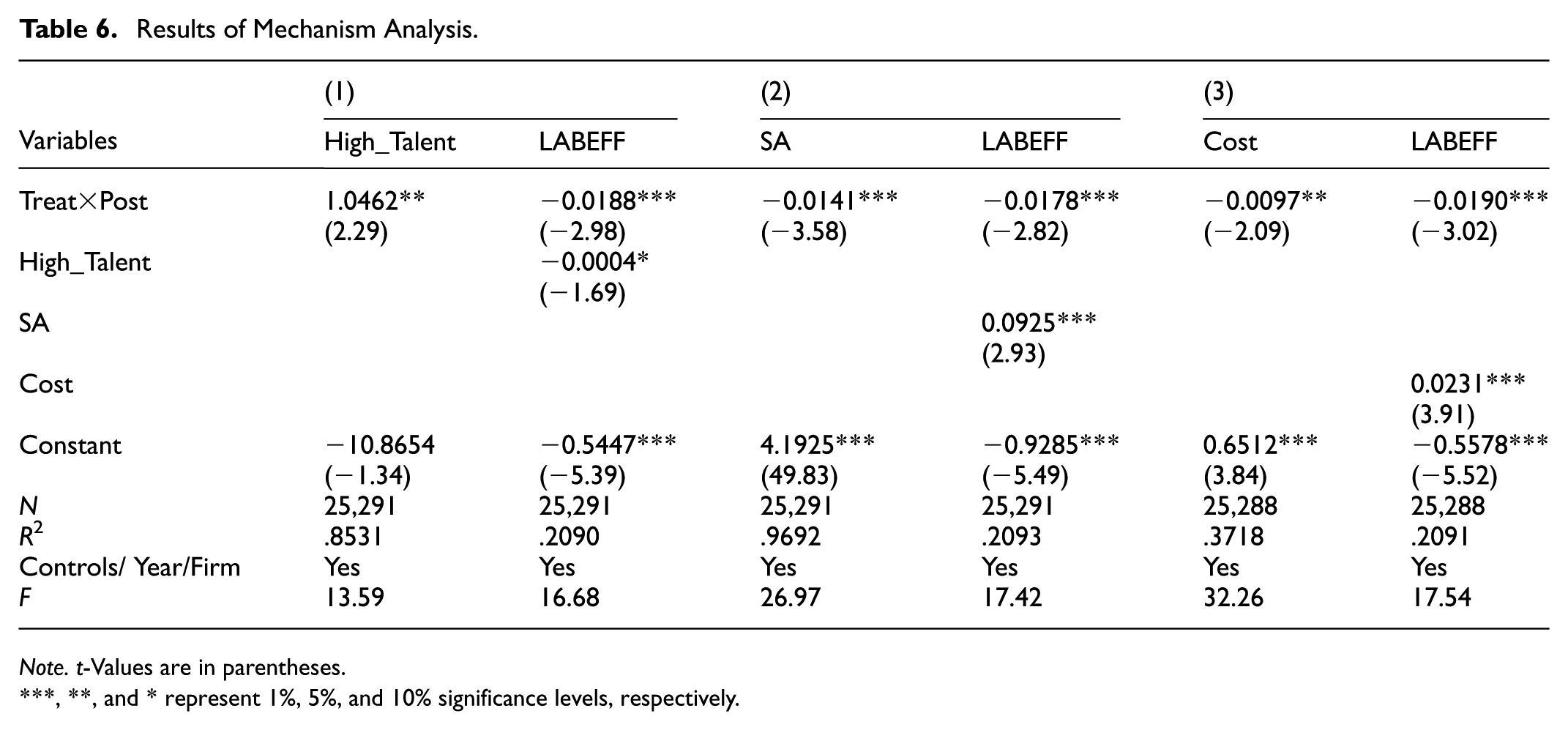
As previously noted, the NAIPZ policy enhances corporate LABEFF within pilot zones. Therefore, the question arises of whether the NAIPZ policy enhances it by optimizing human capital structure, alleviating financial constraints, and reducing agency problems. Building on Baron and Kenny (1986), we construct a model to empirically analyze the mediating effect.


Where MV denotes the mechanism variable, representing human capital structure (High_Talent), financial constraints (SA), and agency problem (Cost). The remaining variables are defined in a manner similar to those in Model (2). If the coefficients
Human Capital Structure
Based on Ma et al. (2024), the human capital structure of firms (High_Talent) is evaluated by calculating the ratio of workers with a bachelor’s degree or above to the total workforce. A higher value of this indicator reflects a more optimized human capital structure, whereas a lower value indicates a less favorable structure. As shown in Column (1) of Table 6, the NAIPZ policy (Treati×Postt) and human capital structure (High_Talent) exhibit significant positive coefficients at the 5% level. Moreover, human capital structure (High_Talent) and labor investment efficiency (LABEFF) exhibit significant negative coefficients at the 10% level. Consequently, human capital structure mediates the relationship between the NAIPZ policy and corporate LABEFF within pilot zones, supporting
Results of Mechanism Analysis.
Note. t-Values are in parentheses.
, **, and * represent 1%, 5%, and 10% significance levels, respectively.
Financial Constraints
Based on Hadlock and Pierce (2010), the degree of financial constraint was calculated using the formula SA = 0.043×size2−0.737×size −0.04×age, where size is the natural logarithm of firm size in millions of dollars and age is years of firm survival. Considering that the values of SA index are all negative, this study takes absolute values. A higher value signifies greater financial constraints, while a lower value indicates fewer constraints. As shown in Column (2) of Table 6, the NAIPZ policy (Treati×Postt) and financial constraints (SA) are significant negative coefficients at the 1% level. Moreover, financial constraints (SA) and labor investment efficiency (LABEFF) exhibit significant positive coefficients at the 1% level. Consequently, financial constraints mediate the relationship between the NAIPZ policy and corporate LABEFF within pilot zones, supporting
Agency Problems
Based on Frattaroli (2020), agency problems are measured using the administrative expense ratio (administrative expenses /primary operating income). A higher ratio reflects more pronounced agency problems, whereas a lower ratio indicates relatively mitigated agency issues. As shown in Column (2) of Table 6, the NAIPZ policy (Treati×Postt) and agency problems (cost) are significant negative coefficients at the 5% level. Moreover, agency problems (cost) and labor investment efficiency (LABEFF) exhibit significant positive coefficients at the 1% level. Consequently, agency problems mediate the relationship between the NAIPZ policy and corporate LABEFF within pilot zones, supporting
Heterogeneity Analysis
Eastern and Central-Western Regions
The influence of the NAIPZ policy on corporate LABEFF appears to depend on regional disparities in economic development. The eastern region of China is distinguished by a relatively sophisticated economic foundation and a strong capacity to attract and nurture high-quality talent. This facilitates a better match between enterprises and the skilled labor required for AI technology adoption (Dai et al., 2022), thereby enhancing the effectiveness of the NAIPZ policy in improving LABEFF. In contrast, companies in the central and western regions face relatively underdeveloped economic conditions, limited attractiveness to high-quality talent, and weaker mechanisms for human capital development and collaboration. These limitations hinder the optimal utilization of AI technologies and constrain improvements in LABEFF. Alternatively, the eastern region also benefits from advantages such as industrial agglomeration, a larger market scale, higher levels of marketization, and more modernized infrastructure. These conditions contribute to an enabling environment that accelerates the deployment and utilization of AI technologies under the pilot zone policy. Conversely, the central and western regions exhibit deficiencies in economic growth and AI-related infrastructure, coupled with a scarcity of high-quality resources and lower levels of marketization (J. Liu & Ma, 2024). These conditions may weaken the beneficial impacts of the NAIPZ policy on corporate LABEFF in these regions.
This study adopts Zhao and Wang (2025)’s regional classification approach, dividing the sample into two groups: eastern and central-western regions. Regression analysis is performed using Model (2). Columns (1) and (2) of Table 7 show that the coefficient of Treati×Postt shows a significantly negative at the 1% level in the eastern region, implying that the NAIPZ policy contributes positively to the enhancement of LABEFF in this area. In contrast, the coefficient for the central-western region is positive but not statistically significant. Moreover, the empirical p-value reflecting the coefficient difference across the two regions reaches statistical significance, indicating that the NAIPZ policy exerts a more substantial impact on LABEFF in the eastern region.
Results of Heterogeneity Analysis.

Note. p-Values for coefficient differences were computed using bootstrap sampling 1,000 times.
t-Values are in parentheses.
and ** represent 1% and 5% significance levels, respectively.
Industry Competition Degree
The effectiveness of the NAIPZ policy in enhancing corporate labor LABEFF may differ according to the prevailing level of industry competition. In industries characterized by high competition, firms face greater market pressure and heightened uncertainty. Under such conditions, human capital becomes an essential asset for sustaining a competitive advantage. Consequently, enterprises tend to allocate resources toward skills and knowledge that can rapidly enhance productivity and reduce operational costs (Zhao & Wang, 2025). Additionally, enterprises may allocate more resources to employee training and retention to prevent the outflow of valuable human capital to rival firms. The NAIPZ policy facilitates this process by offering enhanced access to data resources and technological support. Moreover, the fiscal and tax incentives provided under the policy alleviate financial constraints, enabling firms in highly competitive industries to invest in employee welfare and strategically apply AI technologies to optimize human capital allocation in line with firm-specific needs. By contrast, firms operating in less competitive industries typically face more stable market environments, restricted labor mobility, and limited flexibility in labor allocation. Consequently, the effectiveness of the NAIPZ policy in improving LABEFF is comparatively muted in these contexts.
Drawing on the methodology of Z. Li et al. (2024), this study employs the Herfindahl-Hirschman Index (HHI) as a metric to evaluate the intensity of industry competition. Firms with HHI values exceeding the sample median are classified as low-competition sectors, while those below the median are classified as high-competition sectors. Regression analysis is performed using Model (2), and the results are presented in Columns (3) and (4) of Table 7. For the low-competition group, the coefficient of Treati×Postt is statistically insignificant. By contrast, the coefficient is markedly negative at the 5% significance level for the high-competition group. Moreover, the empirical p-value associated with the difference in coefficients between the two groups confirms statistical significance. These results indicate that the NAIPZ policy exerts a stronger effect on enhancing corporate LABEFF within highly competitive industries.
Enterprise Technology Attributes
The NAIPZ policy may exert heterogeneous effects on corporate LABEFF depending on the enterprise’s technological attributes. From the perspective of human capital demand, high-tech enterprises are characterized by a persistent need for R&D to maintain technological leadership, which drives a strong demand for high-end talent. In contrast, non-high-tech enterprises typically do not prioritize continuous technological advancement and thus exhibit a relatively lower demand for highly skilled personnel (Yuan & Han, 2024). The NAIPZ policy facilitates the formation of a talent agglomeration effect aimed at attracting top-tier talent in fields such as AI and big data. This enables high-tech firms to match talent supply with job requirements more effectively, enhancing labor quality and improving LABEFF. Moreover, considering the developmental foundation of enterprises, high-tech firms generally possess more mature digital infrastructure and robust R&D systems. Given the policy emphasis on advancing and applying AI technologies, these firms are better positioned to incorporate such technologies into their production processes, thereby enabling automation and intelligent management. This not only promotes cost reduction and operational efficiency but also significantly enhances LABEFF. In contrast, non-high-tech enterprises often lack the technical infrastructure and skilled personnel necessary to implement and benefit from AI applications. Consequently, they face greater constraints in leveraging pilot zone policies to improve LABEFF.
Utilizing the methods established by Shi et al. (2021), firms are categorized as either high-tech or non-high-tech. This classification adheres to the 2012 industry classification standards of the China Securities Regulatory Commission (CSRC) and the “High-tech Fields with National Key Support” policy. Subsequently, separate regressions were conducted for each group, and the results are presented in Columns (5) and (6) of Table 7. In the non-high-tech enterprise sample, the coefficient of Treati×Postt is not significant, indicating no notable effect. Conversely, in the high-tech enterprise sample, the coefficient of Treati×Postt is significantly negative at the 1% level. Moreover, the empirical p-value associated with the difference in coefficients between the two groups confirms statistical significance. These findings indicate that, relative to non-high-tech firms, the NAIPZ policy markedly enhances LABEFF in high-tech enterprises.
Further Analysis
Distinguish Between Labor Over-investment and Under-Investment
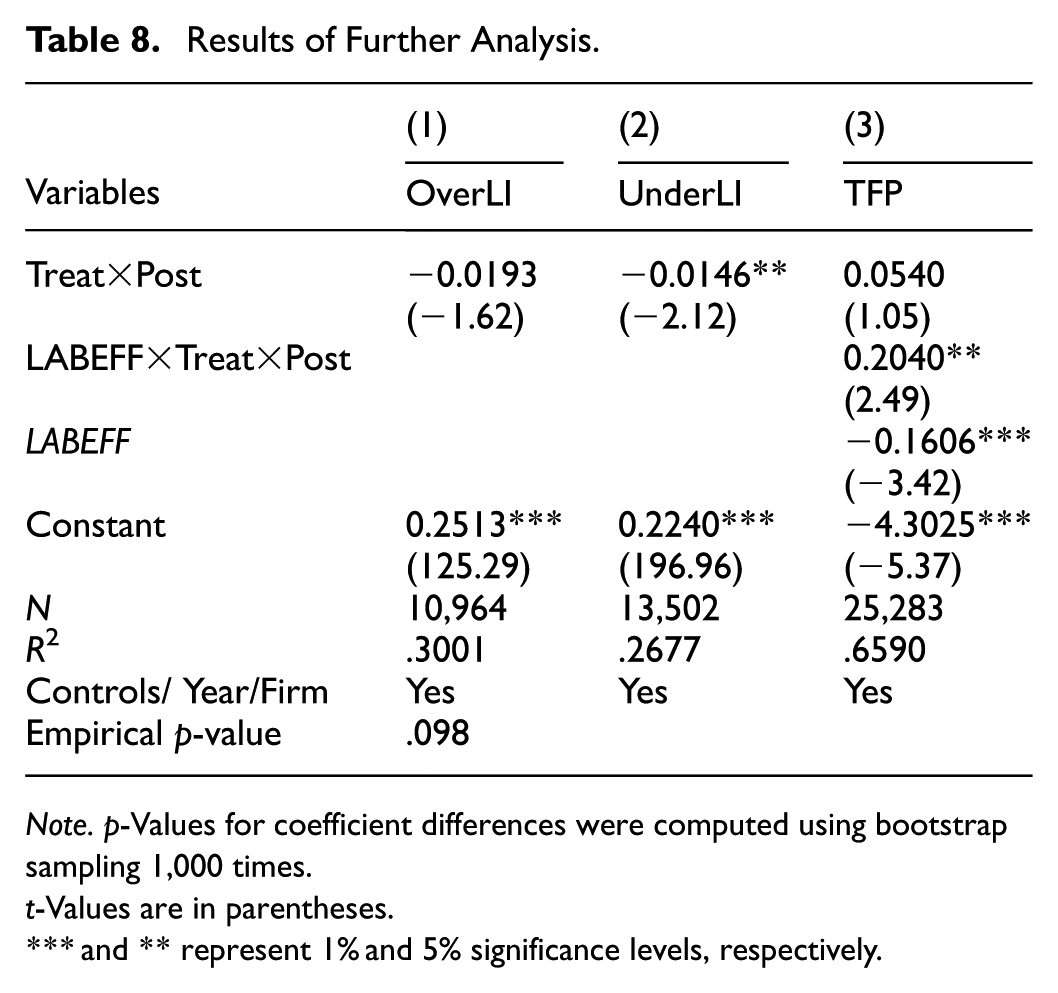
Drawing on Khedmati et al. (2020), this study further disaggregates labor investment efficiency (LABEFF) into labor over-investment (OverLI) and labor under-investment (UnderLI), based on the sign of the residuals from Model (1). In particular, a positive residual implies that labor input exceeds the benchmark estimate, signifying over-investment, whereas negative residuals indicate that actual labor input falls short of the expected level, reflecting under-investment. To enhance the comparability of results, the absolute values of negative residuals are used to represent labor under-investment. Subsequently, Columns (1) and (2) of Table 8 provide the results of independent re-estimations of Model (2) for the over-investment and under-investment subsamples. The coefficient of Treati×Postt is statistically insignificant in the over-investment sample (OverLI), but significantly negative at the 5% level in the under-investment sample (UnderLI). Furthermore, the empirical p-value for the coefficient difference across the two groups is statistically significant. These findings indicate that the NAIPZ policy significantly alleviates labor under-investment but has a limited impact on restraining labor over-investment.
Results of Further Analysis.
Note. p-Values for coefficient differences were computed using bootstrap sampling 1,000 times.
t-Values are in parentheses.
and ** represent 1% and 5% significance levels, respectively.
The NAIPZ policy can substantially mitigate labor under-investment by enhancing the human capital structure and facilitating the employment of more educated and qualified personnel. Additionally, the government establishes a range of favorable programs for firms within these pilot zones, including tax exemptions and financial subsidies. With increased financial support, firms can allocate additional resources to personnel investment. The minimal impact of the NAIPZ policy on mitigating labor over-investment may be attributed to the Labor Contract Law implemented in China in 2008, which strengthened the protection of workers’ rights and interests, thereby complicating the termination of employment contracts during layoffs and increasing the rigidity of labor expenses (J. Guo et al., 2021). The enhancement of labor protection limits firms’ ability to optimize staffing and improve efficiency through AI technology.
Economic Consequence Research
The preceding analysis confirmed that the NAIPZ policy has a substantial influence on enhancing corporate LABEFF. Specifically, it found that AI substantially boosts firms’ total factor productivity (K.-L. Wang et al., 2023). Nevertheless, the question remains whether the NAIPZ policy augments enterprise productivity through improvements in LABEFF. To evaluate the economic implications of the NAIPZ policy aimed at enhancing LABEFF, this study develops the following triple difference model (DDD):

Building on the methodology of B. Huang et al. (2022), the Levinsohn-Petrin (LP) method is employed to estimate total factor productivity(TFP). All other variables maintained their definitions as in the preceding analyses. As shown in Column (3) of Table 8, the estimated coefficient of the interaction term between the NAIPZ policy and LABEFF is 0.2040, and statistically significant at the 5% level. This finding suggests that improvements in LABEFF driven by the NAIPZ policy further enhance enterprise productivity.
Conclusions and Policy Recommendations
Conclusions
The NAIPZ has emerged as a pivotal policy initiative, driving the deep integration of digital and real economies, and serving as a key engine for high-quality economic growth. Drawing on Chinese A-share listed companies spanning 2010 to 2023, we explore the influence of the NAIPZ policy on corporate LABEFF by bridging macro-level AI policy frameworks with micro-level corporate behavioral dynamics.
First, the research findings demonstrate that the NAIPZ policy enhances corporate LABEFF within pilot zones. This result suggests that the NAIPZ policy has exerted a positive and substantial influence on the optimization of labor resource allocation, enabling firms to achieve greater efficiency in labor utilization and a closer alignment between labor inputs and productive outcomes. The validity of the findings was confirmed through several rigorous tests.
Second, three primary mechanisms underpin the improvements in corporate LABEFF. The NAIPZ policy helps optimize corporate human capital structures by attracting and cultivating high-skilled workers, thereby enhancing workforce quality and productivity. It also alleviates financial constraints through preferential credit support and improved financial access, enabling firms to allocate labor resources more effectively and make better-informed investment decisions. Moreover, the NAIPZ policy reduces agency problems by strengthening internal governance mechanisms and promoting a more scientific allocation of corporate resources, thereby fostering a closer alignment between labor inputs and productive outcomes.
Third, heterogeneity analysis suggests that the NAIPZ policy significantly enhances corporate LABEFF within the pilot zone in the eastern region, highly competitive industries, and high-tech enterprises. This finding suggests that the NAIPZ policy exerts stronger effects in environments where innovation factors are concentrated and market mechanisms are more mature.
Finally, further analysis reveals that the NAIPZ policy mainly alleviates labor under-investment, with less apparent impact on suppressing labor over-investment. This indicates that it primarily exerts an incentive effect rather than a constraining effect. Additionally, the NAIPZ policy improves corporate productivity within pilot zones by enhancing LABEFF. This reflects the policy’s comprehensive effect in promoting high-quality corporate development.
Theoretical Significances
First, from the perspective of labor allocation efficiency, this study systematically examines the impact of the NAIPZ policy on corporate LABEFF, thereby extending the theoretical scope of research on AI and labor economics. Second, by focusing on human capital structure, financial constraints, and agency problems, this study empirically identifies the mechanisms through which the NAIPZ policy influences corporate LABEFF. The findings provide a solid theoretical basis for maximizing the policy’s effectiveness in enhancing corporate LABEFF. Third, this study provides an in-depth examination of the heterogeneous effects of the NAIPZ policy on corporate LABEFF across three dimensions: firm’s technological attributes, industry competition intensity, and regional characteristics. This analysis not only enriches and extends the theoretical understanding of the relationship between the NAIPZ policy and LABEFF but also offers valuable theoretical guidance for optimizing policy design and improving corporate LABEFF.
Practical Significances
First, this study provides valuable insights for policymakers seeking to further advance the NAIPZ policy and promote high-quality economic development. As the core driving force behind the new wave of technological revolution and industrial transformation, AI has become a key engine for reshaping economic development models and enhancing resource allocation efficiency. The empirical evidence shows that the NAIPZ policy significantly improves corporate LABEFF by optimizing human capital structures, alleviating financial constraints, and mitigating agency problems. These findings suggest that governments should continue to refine the AI innovation and development policy framework, foster a high-level innovation ecosystem within pilot zones, and promote the deep integration of AI with the real economy to facilitate the efficient flow of production factors and sustain high-quality economic growth.
Second, this study provides important practical implications for firms seeking to optimize labor resource allocation, enhance the effective supply of labor, and fully leverage the potential of human capital. As population aging in China continues to intensify, both the quantity and quality of the labor supply are declining. In the context of the deep integration of AI and the real economy, firms should seize the development opportunities created by the NAIPZ policy, accelerate the research, development, and application of AI technologies, and optimize managerial decisions, including those related to labor input, to further enhance LABEFF and strengthen long-term competitiveness.
Policy Recommendations
Based on our findings, we propose four policy recommendations. First, the government should continue advancing the development of the NAIPZ policy and implement differentiated regional policies. To maximize the policy’s effectiveness in enhancing corporate LABEFF, the government can gradually increase the number of pilot zones. Additionally, the government should further select and evaluate eastern regions with suitable conditions for policy trials to fully leverage their geographical and talent advantages. Meanwhile, for central and western regions with less pronounced policy effects, the government should adjust pilot zone policies according to regional strengths and characteristics, continuously improve AI infrastructure, and establish a supportive institutional environment for AI invention and advancement.
Second, the government should formulate supporting policies and measures to promote the research, development, and implementation of AI technologies in enterprises. On the one hand, fiscal incentives and tax reduction policies should be designed to encourage enterprises to allocate more resources toward AI development. On the other hand, government departments should strengthen talent cultivation and recruitment by establishing talent reward programs and providing professional training to attract high-quality talent to enterprises in the pilot zone, thereby creating a talent pool for enterprises to better apply AI technology.
Third, enterprises should capitalize on the opportunities presented by the NAIPZ policy. In particular, enterprises in highly competitive and high-tech industries should actively promote the research, development, and implementation of AI technology, and optimize production and operational decisions, including those related to labor investment. On the one hand, enterprises should promptly adjust resource allocation, increase investment in AI technology, integrate AI technology into all aspects of management and operations, enhance profitability, reduce agency costs, and improve LABEFF. On the other hand, enterprises should align AI technology with high-quality talent, improve talent development models, promote the deep integration of human capital and AI, upgrade human resource management, optimize human capital structures, and build momentum for high-quality corporate development.
Limitations and Future Research
First, the measurement of LABEFF primarily follows the model proposed by Pinnuck and Lillis (2007), which uses the absolute difference between actual and expected employee turnover rates as a proxy. However, this model does not account for other firm-specific characteristics or external environmental factors that may also influence corporate labor investment decisions, presenting certain limitations. Future research could explore more comprehensive and multidimensional measurement approaches to capture labor investment efficiency more accurately and objectively. Second, although the empirical results confirm that the NAIPZ policy can improve firms’ labor investment efficiency, this conclusion is derived from China’s AI policy framework. Therefore, the findings may not be directly generalizable to other countries or regions. Future studies should consider the institutional and economic contexts of different countries and adopt a broader international perspective to better understand the relationship between AI policies and LABEFF.
Footnotes
Acknowledgements

Author Contributions
Conceptualization, Z.W. and M.X.; methodology, M.X. and Y.L.; software, M.X. and Y.L.; validation, Z.W. and M.X.; formal analysis, M.X.; investigation, M.X.; resources, Y.L.; data curation, M.X.; writing—original draft preparation, M.X.; writing—review and editing, Z.W.; All authors have read and agreed to the published version of the manuscript.
Funding
The authors received no financial support for the research, authorship, and/or publication of this article.
Declaration of Conflicting Interests
The authors declared no potential conflicts of interest with respect to the research, authorship, and/or publication of this article.
Data Availability Statement
The datasets used and/or analyzed during the current study are available from the sources informed in the article or from the corresponding author on reasonable request.