




Abstract
The current research attempts to determine the degree to which three primary elements (Human, Structural, and relational capital) and intellectual capital are related to profitability of SMEs technological inventions in China’s Jiangsu province of as part of the country’s intellectualization process in the post-industrial era. The research utilizes data from 1,450 SME listings on the Shenzhen stock market between 2012 and 2020. The VAICTM model was used in this inquiry. Using PLS-SEM, the study evaluated four significant hypotheses. The research indicates that human and structural capital have a substantial meaningful correlation regarding SMEs success. The research also discovered a favorable association between human and structural capital and technological innovation in Jiangsu province throughout the post-industrial period. However, a strong negative correlation occurred between relational capital and the financial performance of small and medium-sized enterprises (SMEs). The research uncovered a substantial positive relationship between the technological innovation of SMEs and their financial success. The link between intellectual capital (HC, SC, and RC) and company performance was shown to be mediated and moderated by technological innovation. According to the findings, technical innovation considerably moderates the link between Human Capital and firm performance. The research indicated that Technical Innovation (TI) moderates the association between Structural Capital (RC) and firm performance. In contrast, Technical Innovation (TI) does not alter the association between Relational Capital (RC) and firm success in a substantial way.
Introduction
Global economic development has faced numerous challenges lately, including a slowdown in global commerce, limited investment, and policy uncertainties (Deng, 2022; Nyantakyi et al., 2023). However, amidst these global trends, China has emerged as a notable exception, with its economy continuing to grow steadily (Xu & Li, 2022). China’s remarkable economic growth over the past decade, which led to its position as the world’s second best economy overtaking Japan in 2010 (Nye, 2023), highlights the country’s resilience and potential. China’s economic success can be attributed to its transition to a market-based economy in 1978, coupled with various government programs and policies that promoted economic growth (Cao & Suttmeier, 2017). Nevertheless, this conventional labor-intensive growth model has also given rise to environmental and social challenges, necessitating the pursuit of sustainable development (Cao & Suttmeier, 2017). Currently, economic growth rate of China has moderated, emphasizing the need for structural reform and transformation.
Recognizing the significance of innovation in driving sustainable economic growth, the Chinese government launched initiatives aimed at fostering a culture of innovation and positioning China as a global leader in research and technology (Keqiang, 2016). These efforts have yielded remarkable results, with China’s advancements in science and technology capturing global attention (Keqiang, 2016). The emphasis on innovation has positioned intellectual capital as a crucial factor in organizational performance and competitiveness (Subramaniam & Youndt, 2005).
Intellectual capital is increasingly acknowledged as a crucial success element in the context of China’s innovation push (Subramaniam & Youndt, 2005; Ting & Lean, 2009; Xu, Liu, & Xie, 2022). Small and medium-sized enterprises (SMEs), both Cutting-edge technology and simple technology, in China have acknowledged the need to strengthen their intellectual capital in order to stimulate innovation and enhance their performance. To assess the exact contribution of intellectual wealth on innovation and the success of SMEs, however, further study is required. Intellectual capital might furnish enterprises in the knowledge-based economy a dominant position and elevated effectiveness (Barkat et al., 2018; Papíková & Papík, 2022; Xu & Li, 2022; Xu & Wang, 2019b). Intellectual Capital augments material and monetary assets (Bueno et al., 2004). Some scholars (Kafetzopoulos & Psomas, 2015; Raymond et al., 2013; Yam et al., 2011) assert that technological innovation may boost manufacturing enterprises. Innovation impacts the success and survival of a business (Mejia & Kajikawa, 2021; Y. Wang et al., 2019). By adopting product innovation, manufacturing companies may differentiate their items and save production costs and time. Made in China 2025 promises to revamp China’s manufacturing industry for small and medium-sized businesses. To preserve a competitive edge in the face of increased labor costs and inadequate energy efficiency, manufacturers are investigating innovative ways (Xu & Sim, 2017).
Intellectual capital is a company’s key to success and competitiveness, yet its influence on innovation is hard to assess (Yousaf, 2022). According to Xu, Haris and Irfan (2022), intellectual capital affects innovation, although additional research is needed. Innovation management studies levels, kinds (product vs. process), and sources (incremental vs. revolutionary) (generation vs. adoption). Causes and consequences vary by degree, type, and origin (Atuahene-Gima & Murray, 2007; Murat Ar & Baki, 2011; Subramaniam & Youndt, 2005). Innovation research hasn’t yielded consistent results, and we know little about its origins and effects (Damanpour & Wischnevsky, 2006). Pérez-Luño et al. (2014) suggest investigating the various impacts of intangible assets on idea creation as well as implementation to overcome this research problem. Human resources, social value, and managerial skills outcome is examined in this research. Frequently, manufacturers invent (H. Y. Zhang & Lv, 2015). Intellectual capital may contribute novel ideas to industrial enterprises. Does intellectual capital influence the innovation and success of SME businesses?
Assessing the correlation between intellectual capital, innovation, and SME success in China, this research seeks to bridge current research gaps. Specifically, we employ Pulic’s VAICTM approach to ascertain the effectiveness of Intellectual wealth in Jiangsu SMEs, focusing on the three parameters: relational capital human capital and structural capital. By analyzing these components, we aim to uncover their influence on technological innovation and overall business success. To have insight into the importance of IC’s importance in driving innovation and impacting SME performance is crucial for sustainable economic growth in emerging economies as illustrated in the conceptual framework in Figure 1.

Conceptual framework.
Additionally, this model investigates whether technological innovation mediates the interaction firms’ performance has with intellectual capital. This study used PLS-SEM to examine these relationships. In four different ways, this study advances our understanding of intellectual capital. Firstly, the study at hand examines Intellectual C’s efficacy of state of the art and unsophisticated techno among SMEs. Contemporary ideas of Intellectual Capital are descriptive rather than comparative. Second, it illustrates the connectedness of IC and company value creation with examples from Chinese SME businesses. Uncertainty surrounds how IC affects SMEs’ performance. Few studies examine how IC components impact the performance of SMEs.
There are practical and theoretical research gaps which this study aimed to fill. First, there is a dearth of research on the prevailing circumstances innovation dynamics of establishment in Chinese SMEs. Prior studies focused primarily on creative accomplishments at the national level, as measured by spectacular technological advancement, the growth of the research’s domains, along with the accomplishments of a fewer major and prominent enterprises. Mid-sized businesses (SMEs) in China’s Industrial sectors, a large portion of the country’s economy, have been poorly studied and comprehended. The study addresses a research gap by examining the impact of Intellectual Capital (IC) in the manufacturing field in Jiangsu province of China, which has received limited attention in previous studies. While some studies have explored IC in manufacturing, this study contributes to the literature by specifically focusing on the manufacturing industry in Jiangsu province.
Another gap worth mentioning pertains to a conceptual deficiency in previous work, namely the absence of profound inquiry into SMEs’ innovation strategies and their relationship to exterior flows. Prior scholarly delved into innovation approaches in small and medium enterprises (SMEs) using quantitative research methods and explored the correlation between networking strategies and innovation. Nevertheless, there remains a dearth of knowledge concerning the internal adoption and integration of creative strategies within organizations, as well as the intricate relationships between exploratory and exploitative innovation strategies and networking tactics, such as lateral and hierarchical networks. The research outcomes should help us comprehend Intellectual Capital and its impact on SME growth in emerging economies. This study uses VAICTM to evaluate the Intellectual Capital effectiveness of firms. This study assists firm managers in managing Intellectual Capital effectively. By utilizing these models, the study enhances the understanding of IC and expands the measurement approaches within the manufacturing industry in Jiangsu province. This empirical contribution adds to the existing knowledge base and offers insights into the evaluation and management of IC resources in manufacturing companies operating in this region.
The third contribution of the study is that the study’s findings have practical relevance for business top executives in the manufacturing industry in Jiangsu province. By providing insights into the effective utilization and management of IC resources, the study offers valuable guidance for enhancing business performance and competitiveness in this sector. Our findings are significant for institutional investors that use Intellectual capital; efficiency to evaluate the value generation of businesses. It expands IC measurement approaches through empirical research and provides practical insights for business managers and policymakers operating in this region. The remainder of the report examines pertinent literature, research methodology, empirical results, conclusions, and recommendations.
Literature Review
Concept of Intellectual Capital (IC)
In 1836, Intellectual Capital was described as the sum of one’s talents and knowledge. Stewart (1994) defined intangible capital as a person’s knowledge and abilities that give a business a competitive advantage. In 1969, Galbraith defined “intellectual capital” as the intellectual contribution of a person. Intellectual Capital includes suppliers, clients, employees, and technical innovation investment. The discrepancy between the balance sheet and investor appraisal, per Edvinsson and Malone (1997), reflects Intelligent Capital. Sullivan (2000) defined intellectual capital as a company’s profit-generating skill. Concepts and Ideas, info, trademarks, patents, and expertise in the capacity of adding value to corporations are all examples of what Stewart (1997) refers to as intellectual capital.
Intellectual Capital is an extension of traditional capital consisting of immaterial assets that may generate value (L. Zhang et al., 2021). It is challenging to identify, quantify, and report Intellectual Capital. There are various ways to measure intellectual capital, according to academics in the domains of accounting, economics, finance, strategy, human resources, and psychology. Three subcomponents—human capital, structural capital, and relationship capital—make up Stewart’s (1997) model of intellectual capital. The human customer and structural capital components of intellectual capital are separated by the value-added intellectual coefficient (VAIC) model developed by Pulic (1998, 2000). VAICTM measures how effectively a company creates both tangible and intangible value. According to Pulic, other Intellectual Capital measurement techniques lack comparability and breadth. McElroy (2002) substituted consumer capital for social capital. Crema and Verbano (2016) developed a method for measuring Intellectual Capital, which encompasses Human Capital, Internal Structural Capital, and Relational Capital (RC), in Small and Medium-Sized Enterprises (SMEs).
Despite the widespread acceptance of his concept of intellectual capital, there is no agreed-upon definition (Dzenopoljac et al., 2017; Sardo et al., 2018). According to Andriessen (2004), Intellectual Capital includes Human Capital, Structural Capital, and Relational Capital. Knowledge, skills, fulfillment, and motivation make up human capital (Ahmed et al., 2022). Human Capital is a crucial corporate asset (Bayraktaroglu et al., 2019). Human Capital represents the competencies and knowledge acquired by individuals or departments. Employee development may increase company effectiveness.
Structural Capital is a company’s knowledge after its employees have left. It consists of organizational structures, procedures, administrative programs, and culture (Subramaniam & Youndt, 2005; Vaz et al., 2019). Structural Capital helps Human Capital develop value. Even if all employees leave, it will continue to exist.
Relational Capital focuses on the loyalty of an organization’s workers and external groups (Bontis et al., 2000; Khalique et al., 2015; Vaz et al., 2019). Customers are Relational Capital’s most valuable asset (Jin & Xu, 2022). In several studies, customer capital is used rather than relational capital (Ferreira & Martinez, 2011).
A multitude of scholars, including Xu, Haris and Irfan (2022), Tran and Vo (2018), and Xu and Wang (2018), employ Pulic’s VAICTM model as a tool for evaluating intellectual capital. This approach is supported by Mohammadi and Taherkhani (2017) and Phusavat et al. (2011). Data from the VAICTM model are said to be unbiased since they are taken from verified business accounting records by Bornemann (1999). VAICTM is extensively used in empirical research owing to its usability and data availability. VAICTM indicates a company’s efficiency in producing value. The model examines how people, structural, and physical resources influence an organization’s performance and value growth. Some specialists doubt VAICTM deficiencies. By demonstrating its computations and dissecting its theoretical “misconceptions,”Veltri and Silvestri (2011) contended that the VAICTM model represents labor and capital investment efficiency rather than intellectual capital. Intangible and tangible assets do not work together well in the plan (Dzenopoljac et al., 2017). Innovation capital and relational capital are not taken into account. The model starts with zero inventory and ends with zero inventory. Regarding the limitations of the VAICTM model, we substituted marketing, selling, and advertising costs for Relational Capital and added it to Intellectual Capital. comprehensive review of empirical research investigating the interplay between intellectual capital, its components, innovation, and the success of SMEs is presented in the ensuing section.
Empirical Review and Hypothesis Development
Relationship Between SME’s Intellectual Capital and Performance
The research focuses on how SME intellectualization affects intellectual capital and profitability of firm. In Malaysian banks (physical capital, human capital, and structural capital), Ting and Lean (2009) discovered a link between intellectual capital and profitability. Structural capital may raise the product and process integrity at low cost, resulting in economic achievement. The hypothesis presented by Barkat et al. (2018) suggests that all Intellectual Capital components, except SC, play a role in influencing the performance of textile companies. Haris et al. (2019) revealed how much IC’s dimensions (human, innovation, and physical capital) significantly influenced company performance. Nadeem et al. (2019) further unveiled that IC and the individual parts (physical innovation, and human capital) negatively influenced corporate efficiency. Xu and Li (2019) studied IC’s influence on Chinese SMEs (SMEs). HC, SC, and RC increase profitability. SC, HC and RC was uncovered by Xu and Wang (2019b) to benefit textile enterprises in two developing nations (i.e., South Korea and China). HC impacts Chinese agricultural listed firms’ profitability (Xu & Wang, 2019a).
SMEs emphasize independence, flexibility, entrepreneurship, and innovation compared to big corporations. SMEs work directly with customers and suppliers and have a long-term outlook. They lack organization, resources, and consistency in decision-making, administration, and accounting. IC is crucial for SMEs given that it exposes concealed resources that might affect future profitability or survival. No study has compared China’s advanced technology and low-tech SMEs’ IC performance. Advanced and low-tech solutions SMEs have varied IC efficiency. High-tech SMEs spend more on IC to compete (Buenechea-Elberdin et al., 2018; Nimtrakoon, 2015; Skhvediani et al., 2023). More IC study is needed to understand two SMEs’ IC performance. Yang (2019) claimed high-tech has superior physical capital efficiency to conventional industry but poorer people and structural capital efficiencies (HCE, SCE). Knowledge-intensive companies had greater HCE and RCE (Barkat et al., 2018).
Many researchers have examined how IC influences financial success (e.g. profitability and market performance). IC and company earnings, especially for SMBs, have received little investigation. This research examines IC’s impact on pretax profits (EBIT). Dženopoljac et al. (2016) surveyed 100 Serbian enterprises and found insignificant relationship among EBIT and SCE, HCE and CEE. HC doesn’t affect Arab company profitability, while SC and CE do. CEE, HCE, and SCE impact earnings quality, Xu and Wang (2019b) postulated. Log EBIT measures company profitability per Dženopoljac et al. (2016), Dzenopoljac et al. (2017), and Xu and Wang (2019a).
There is discussion in the literature on whether IC affects company profitability. Many research use return on equity (ROE) and return on assets (ROA) to explore the relationship between IC and profitability (M. C. Chen et al., 2005; Dzenopoljac et al., 2017; Maditinos et al., 2011). It feels IC is a competitive advantage and should boost business performance. M. C. Chen et al. (2005) in Taiwan showed that IC boosts revenues. Ting and Lean (2009), Zéghal and Maaloul (2010), found a favorable correlation between VAIC and profitability in Malaysia’s banking industry (Li & Zhao, 2018). In this work, we analyze ROA and NPM.
Without complementary assets, SMEs struggle to innovate. Asset complementarity may boost economic performance, according to Teece (1986). Knowledge-based economies favor IC’s company efficiency. ATO measures an organization’s asset utilization efficiency (Mondal & Ghosh, 2012; Pal & Soriya, 2012). Mondal and Ghosh (2012) found ATO and IC positive in all years except 2002. Dzenopoljac et al. (2017) found that CE affected ATO in the Arab area. ATO efficiency is negatively correlated, Shiu (2006). IC has a negligible influence on company efficiency based on research conducted by Pal and Soriya (2012).
High-tech SMEs grow faster than non-tech SMEs, say Nunes et al. Non-high-tech SMBs are more growth-focused. Innovation and knowledge creation generate company value. In high-tech companies, innovative skill attributes have a proportional influence on creating value, whereas, in low techno companies, brainstorming is more critical (Sáenz et al., 2009). IC is needed to compare and appraise enterprises (Montequín et al., 2006). The analysis compares IC and SMEs’ performance. Pharmaceutical IC performance generates a greater ROE than textile (Pal & Soriya, 2012). As indicated by the following assumptions, the evaluation and comparison of IC performance involve all three elements:
H1a: Human Capital (HC) has strong influence on SME performance in Jiangsu.
H1b: Structural Capital (SC) positively influences SME’s performance in Jiangsu
H1c: Relational Capital (RC) significantly impacts performance of SMEs in Jiangsu.
Nexuses Between Intellect Capital Intellectualization and Technological Innovation
Innovations are driven by the intellectualization of Intellectual Capital (J. Chen et al., 2015; J. Li & Yu, 2018; H. Y. Zhang & Lv, 2015). According to Hsu and Fang (2009), Intellectual Capital drives business innovation via organizational learning. Human Capital is a necessity and guarantee for the technical innovativeness of an organization (Soo et al., 2017). Human Capital framework is subjected to the competency and standard of employees. Continuous staff training may expeditiously transfer organizational knowledge into corporate value and stimulate technological innovation. Technology innovation requires new knowledge and technology. This strengthens Human Capital. According to Rhyne et al. (2002), technicians and executives more or less present strongly correlates with the success of latest production innovation. On the basis of Park et al.’s (2019) study staff abilities and actions encourage ambidextrous technology innovation. According to Duodu and Rowlinson (2019), Human Capital and innovation in Hong Kong construction firms are not closely related.
Structural Capital establishes the environment and conditions for individuals to acquire new skills and knowledge while igniting their enthusiasm for creativity. Corporate culture may facilitate the development of innovation strategies, which may facilitate technical innovation (Teece, 1996). Because companies utilize knowledge and experiences to generate new products and services may stimulate innovation inside the firm (Kianto et al., 2017). The bulk of the study (Buenechea-Elberdin et al., 2018; Cabrilo & Dahms, 2018; Cabrilo et al., 2018; Tseng & Goo, 2005) indicated that Structural Capital positively affected the effectiveness of innovation. Nonetheless, H. Y. Zhang and Lv (2015) discovered a poor relationship between structural capital and technical innovation in Chinese high-techno manufacturing enterprises.
Companies may innovate via the examination of information and data. By using Relational Capital, businesses may learn from the experiences of others (Barkat et al., 2018) and share their knowledge with vendors, suppliers, and consumers. Internal Relational Capital may develop connections, facilitate the flow and transformation of information, and maximize Structural Capital. Effective departmental communication is required for technological innovation initiatives, and Relational Capital may reduce resistance (Castro et al., 2013; Ghorbani et al., 2012; J. Li & Yu, 2018). External Social Assets may assist businesses in acquiring new knowledge and enhancing existing resources. Patnerships with external entities may be advantageous for SMEs (Verbano & Crema 2016). Companies should focus on Relational Capital to increase product acceptance. In turn, we come up with the subsequent argument:
H2a: Human Capital of SMEs is positively associated with innovation in Jiangsu
H2b: Structural Capital of SMEs is highly related to innovation in Jiangsu
H2c: Relational Capital of SMEs is strongly related to Jiangsu’s innovation
Relationship Between Technical Innovation of SMEs and Organization Performance
Companies with a strong capacity for technical innovation may attain great success (Nasir et al., 2015; Vila & Kuster, 2007). Companies having significant amounts of innovation typically see performance improvements more quickly than those without inventiveness (Tiwari et al., 2023; Zemlyak et al., 2022). In the opinion of Bigliardi (2013), the financial growth of small and medium-sized businesses (SMEs) in the food machinery sector is favorably correlated with the amount of innovation. According to Bockova and Zizlavsky (2016), enterprises in the Czech industrial manufacturing sector that invest more in innovation are likely to create a more robust financial performance. In line with Bistrova et al.’s (2017) analysis of immaterial resources as an analogy for innovation, businesses with greater possibilities for creativity may have more profitable revenue levels. According to research by Jancenelle et al. (2017) on the relationship between business ownership and marketplace performance, some creativity traits have a favorable effect on the performance of the market.
In Vietnam, a developing nation, Ho et al. (2018) discovered that the inventiveness of a business corresponds strongly with its economic success across the value chain of agricultural products. According to Lee et al. (2019) Innovative leadership substantially affects how well South Korean low-tech companies perform. Moreover, Ramadani et al. (2019) showed a positive correlation between innovation activities and corporate success in transition economies. Using SMBs as a sample, Innovation and business performance have a beneficial relationship, as determined by D. S. Wang (2019). Thus, the following is our third hypothesis:
H3: Technical innovation of SMEs positively influences firm performance in Jiangsu
The Moderating Effect of Technical Innovation on the Relationship Between Intellectual Capital and Firm Performance
Intellectual and physical capital contribute to a corporation’s development. Modern technology is fuelled by the capital of intellect. In the event technologically advanced firms cease to innovate, the market will eliminate their products and service. Human Capital with diverse knowledge, ideas, and abilities helps produce products. Human Capital is the foundation of inventive talents, and its development takes years. Human Capital influences the inventive capacities of a company (Barkat et al., 2018). A good working environment may reduce working hours, and venues for exchanging information may motivate employees to share business objectives. Knowledge and originality may be fostered via structures. Well-organized Structural Capital facilitates innovation inside enterprises. Close customer ties boost innovation in businesses (Barkat et al., 2018). Structural and relational capital may guarantee technological innovation from the inside out and business success. Barkat et al. (2018) and Zemlyak et al. (2022) discovered how innovation mediates the connection between Human Capital and corporate success in Pakistan. According to McDowell et al. (2018), innovativeness impacts the relationship between human and organizational capital and SME achievement.
Here are our hypotheses:
H4a: Technical innovation moderates the association between the performance of SMEs and Human Capital in Jiangsu.
H4b: Technical innovation moderates the relationship between Structural Capital and SME performance in Jiangsu.
H4c Correlation between SME performance and Relational Capital in Jiangsu is moderated by Technical innovation
Research Methods
Sampling Procedure
The research at hand utilizes a cross-sectional research design to gain insight into how SME success in Jiangsu province, China relates with intellectual capital and innovation, SMEs in Jiangsu particularly. His design facilitates acquisition of information from a diverse sample of participants, representing different segments of the population, to provide a snapshot of their characteristics and behaviors (T. Sarpong & Sarpong, 2020; F. A. Sarpong, Wang, et al., 2020; T. Sarpong, Sarpong, & Asor, 2020). The aim is to address the existing gaps in knowledge regarding the effectiveness of intellectual capital components, including human capital, structural capital, and relational capital, in influencing SME performance. Jiangsu Province’s strong commitment to environmentally conscious growth, is demonstrated by the promotion of high-tech enterprises and resource-efficient practices, makes it an ideal setting for this study. Specifically, manufacturing businesses in Jiangsu province were selected due to their significant economic contribution and environmental challenges. By examining the interactions between the environment, the economy, and sustainable development, this study intends to give insight on the complexities of achieving environmental sustainability in key sectors (Ahakwa et al., 2023; Ahmed et al., 2022; Xu & Li, 2020). Prior studies have demonstrated that this sampling methodology is accurate and provides reliable outcomes (Cobbinah et al., 2020; Kir et al., 2021; Owusu et al., 2022; Sappor et al., 2023; F. A. Sarpong et al., 2022, 2023). The sample includes Jiangsu-based manufacturing SMEs listed between 2012 and 2020. Chinese public companies must publish R&D expenditures after 2012. The China Stock Market Accounting Research (CSMAR) information repository is used to get the data for the years of interest. After excluding firms with incomplete information, those listed after 2013, those with five consecutive years of no R&D expenditure, those offering various types of dividends, and special treatment (ST) firms (Donate et al., 2016; McDowell et al., 2018), the current analysis has 13,050 observations for 1,450 manufacturing listed companies. RESSET (2019) provides financial information.
Variable Selection and Measurement




VA = total costs minus personnel expenses total revenue. Total employee expenditures as a measure of human capital; relational capital efficiency (RCE), structural capital efficiency (SCE) relational capital measured by selling costs. The income statement includes administrative, selling, and interest expenditures under the new Chinese Accounting Standards. Advertising, exhibitions, sales commissions, and shipping are selling costs. Sales expenditures influence RC in this research.
Main Results and Discussion
The four principal suggested research hypotheses were evaluated using descriptive statistics, correlation analysis, and multiple regression models. The descriptive statistics of the empirical data are shown in Table 1, which gives significant new information on the investigated variables.
Descriptive Statistics of Empirical Data.

The profitability of Small and Mid-Sized Enterprises (SMEs) in Jiangsu province varies noticeably; the mean Return on Asset (ROA) value is 0.1753. Notably, the highest recorded figure is 0.4013, while the lowest number is −0.0219. The Net Profit Margin has a mean value of 2.4451, which indicates that it is a fairly consistent indicator of profitability. The fluctuation range is between 0.5142 and 0.1357. The research underlines the mean values of human capital effectiveness (0.3413), structural capital effectiveness (0.7426), and relational capital effectiveness (0.7426) when addressing the aspects of intellectual capital intellectualization among SMEs is modest, with a maximum value of (0.4012). These findings demonstrate the value of human capital in generating value and the roles played by structural and relational capital in the intellectualization process. Research and Development (R&D) play a crucial function as a moderator for technological innovation. The mean value for R&D is reported at 0.4013, indicating its considerable importance in fostering intellectualization among SMEs in Jiangsu province. Additionally, the descriptive statistics shed light on the characteristics of the SMEs in the study. The median values of Firm’s Size, Debt Ratio, and Sales are reported as 0.2994, 0.3619, and 0.1753, respectively. These statistics provide further insights into the composition and performance of the SMEs in Jiangsu province. These results support the consistency and validity of the study’s conclusions by correlating with earlier research carried out by academics such as Bayraktaroglu et al. (2019) and Phusavat et al. (2011).
Normality testing is one of the pre-SEM fundamental assumptions. Using skewness and kurtosis, the dataset’s normality was evaluated. Hair, Sarstedt, et al. (2012) state that Z-Skewness is a crucial parameter. Following the preceding data analysis, the PLS test was applied to identify data abnormalities. Table 1 demonstrated that the fundamental premise of normalcy was satisfied. The excess kurtosis and skewness requirements (±2.58 and 1.96, respectively) satisfy the normalization assumption.
Correlation Matrix
Researchers evaluated dependent and independent factors using SPSS and SMART PLS. The data were first examined for mistakes, outliers, and completeness. Since enough data points were available, PLS-SEM was used to evaluate the innovativeness of small and medium-sized enterprises in Jiangsu. PLS covers structural and measurement models and the evaluation of internal model validity and dependability (Kir et al., 2021; Owusu et al., 2022). In the past three decades, PLS has grown in importance in business research (Hair, Ringle, & Sarstedt, 2012). Between 1985 and 2010, the PLS method was used extensively in the corporate sector (Hair, Ringle, & Sarstedt, 2012). The dependent, independent, and control variables’ multicollinearity was assessed using the correlation matrix. Table 2 shows the discriminant validity of each valid notion that was legitimately assessed.
Correlation Matrix.

Note. ROA = Return on Asset; HCE = Human Capital Effectiveness; SCE = Structural Capital Effectiveness; RCE = Relational Capital Effectiveness; RD = Research and Development; FS = Firm Size; DR = Debt Ratio.
, **, and *** denotes 1%, 5%, and 10% respectively.
Structural Model Fitness
The model fit of the structural equation model (SEM) was assessed to determine its suitability for the data in the study. This assessment examines the parameters of the theoretical model and ensures its compatibility with the observed data. The significance of assessing model fit has been highlighted by multiple investigations (Benah & Li, 2020; Kir et al., 2021; Owusu et al., 2022).
Using t-statistics and path coefficient values, bootstrapping was applied to evaluate the relevance of the linkages between model components and the strength of associations between these structures. For a t-statistic to be considered significant, it should exceed the threshold of 1.96 (Chin et al., 2018). Our analysis incorporated multiple evaluation metrics, including adjusted R2, Q2, and F2, to assess the effectiveness and accuracy of our proposed models. To assess the adequacy of the fit, we compared the resulting values to Table 3’s suggested criteria. The quality of the model was determined by the R2 values for the dependent variables, which showed the strength of each structural route. In general, R2 values larger than or equal to 0.1 are desirable. Table 3 presents R2 values above 0.1, indicating predictive relevance. Furthermore, the Q2 statistic has been employed to estimate the predictive significance of the endogenous construct. A Q2 score larger than 0 denotes model predictiveness, the model’s capacity to correctly anticipate the result. Overall, the evaluation of model fit and the R2 and Q2 values offer critical insights into the suitability and prognostic usefulness of the SEM in the present investigation.
Regression Model Goodness and Fitness.

Note. Where predictive relevance = Q2 (= 1−SSE/SSO).
The application of the Bootstrapping method, as observed in Figure 2, facilitates the analysis of how model components are interconnected. This analysis involves interpreting t-statistics and thoroughly investigating path coefficient values to understand the correlation between these constructs. The structural model and route analysis from the study are shown in Figure 2 and Table 3. We found an R2 value of 0.390 and an adjusted R2 of 0.408 in Model 1, which considered control variables such firm’s size, age, and geography. The F2 value of 0.383 above the suggested threshold of 0.35, while the Q2 value of 0.1212 demonstrated good predictive relevance. These results indicate that the model demonstrates both predictive capability and an acceptable level of goodness of fit. The research produced important conclusions about the effects of many control parameters, such as the size of SMEs, the length of time they in operation, debt ratios, and sales growth, on intellectual capital and SMEs’ development. It was discovered that these control parameters had positive effects on the general performance and intellectual capital of SMEs in the Jiangsu region of China.
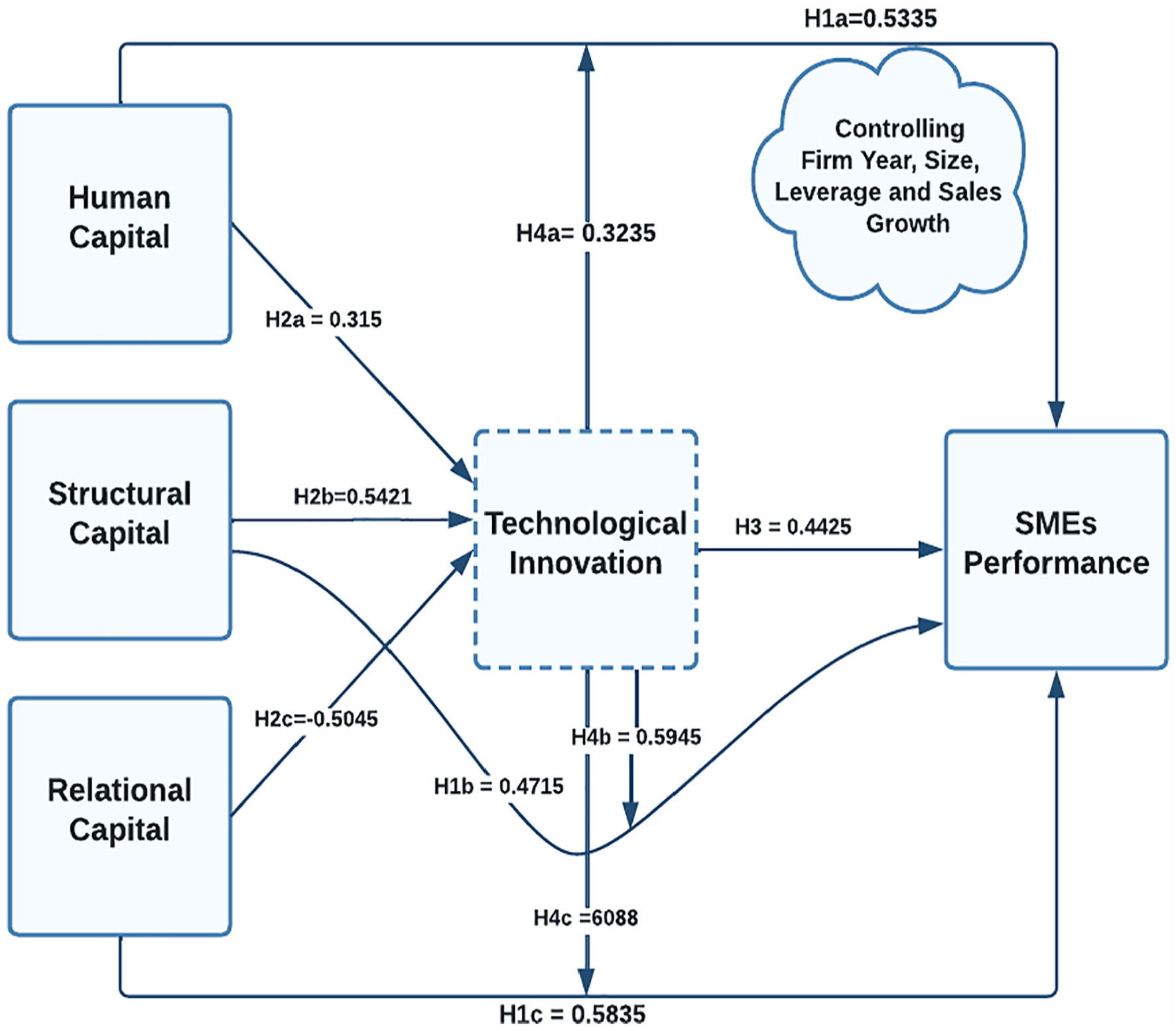
Path analysis of structural model.
In the first study hypothesis, the performance of 1,450 manufacturing SMEs in Jiangsu province was compared to their human capital. The outcomes supported the hypothesis shown in Table 3 by showing a statistically positive significant interaction between human capital and SMEs performance (1 = 0.5335, t = 5.2618, p .05). Similarly, the study looked into how structural capital affected SMEs’ performance in Jiangsu throughout the post-industrial era. The findings supported the hypothesis by demonstrating a strong effect of structural capital on performance of SMEs in urban areas, as shown in Table 3 (2 = 0.4715, t = 1.7268, p .05). The study also looked at how intellectual capital, which includes relational capital, influences the economic progress (ROA) of Jiangsu SMEs. The results supported the hypothesis by showing a substantial positive impact of relational capital on how SMEs perform financially in the metropolitan area (3 = 0.5835, t = 4.0185, p .05).
Secondly, the research hypothesis explored the connection involving human, structural, and relational (model 2) intellectual capital and technological innovation. This theory’s initial component investigated the potential of a relationship between human capital and technical innovation. The results indicated a high association with human capital and technical innovation (4 = 0.3215, t = 7.1198, p .01), which offered strong support for the hypothesis. The study then looked at how structural capital affected technical innovation as a result of Jiangsu province’s intellectualization process. The results, however, did not support the prediction, with no significant relationship between structural capital and technological innovation (5 = 0.5421, t = 6.2285, p > .05). The study also examined how technological innovation and relational capital in SMEs in Jiangsu province interact. Interestingly, the data corroborated the hypothesis by demonstrating a significant negative effect of relational capital on the financial performance of SMEs (6 = −0.5045, t = 6.3565, p .05). Hypothesis three (3), which looked at how technological innovation affects SMEs’ financial performance, was also examined by the study. The results provided substantial support for the hypothesis by showing a clear relation between technical innovation and monetary growth (7 = 0.4425, t = 5.4082, p .05). The statistics displayed in the fourth Table support these findings.
Moderation Analysis
The third research hypothesis focused on how technological innovation influences the relation intellectual capital has with SMEs’ performance. It sought to determine whether the strength of this link is influenced by technological advancement. The research indicated that technical innovation performs a substantial moderating function in the performance of SMEs, amplifying intellectual capital’s impact. To evaluate the association between intellectual capital (HC, SC, and RC) and company well doing, the research adopted the ideas of Preacher and Kelley (2011) and performed mediation analysis. Presented in Figure 2 and model 3 are outcomes showing that technological innovation functions in this relationship as both a mediator and a moderator. Human capital, structural capital, and relational capital have a substantial effect on the performance of small and medium-sized enterprises (SMEs) in Jiangsu Province, with technological innovation playing a crucial mediating role. Particularly, both an indirect and direct effect (HC → FP) of human capital on the performance of SMEs were clearly discernible. Similarly, structural capital revealed strong direct and indirect effects on the performance of Small and mid-sized ventures (SC → FP). Relational capital had a considerable implication on the performance of small and medium-sized enterprises (RC → FP), while its indirect effect was limited (RC → FP). The researchers first carried out the mediation analysis, then they went on to estimate the moderation analysis, concentrating on the function of technological innovation.
The Kappa-squared (K2) statistic was used by Preacher and Kelley (2011) to gauge the size of the mediating impact. The results show that technical innovation mediates the association between HC, SC, and RC and business performance with K2 values of 0.018, 0.021, and 0.011 (Cohen et al., 2013). Particularly, technical advancement serves as an intermediary in the favorable interconnecting HC, SC, and RC and business performance. In addition, Table 4 illustrates the moderating effect of technological innovation in the interrelation of human capital, structural capital, and relational capital and the performance of small and medium-sized enterprises (SMEs) in Jiangsu province. The objective of the fourth hypothesis (Mod HC → TI → FP, Mod SC → TI → FP, and Mod RC → TI → FP) was to discover how technological innovation affects the relationship linking human capital and business performance for small and medium-sized enterprises (SMEs) in Jiangsu, China. The results indicated that Technological Innovation (TI) acted as a significant mediator between Human Capital (HC) and Firm Performance (FP) (8 = 0.3235, t = 7.4848, p .05). The research also found that technological innovation moderated the association between structural capital and firm success (9 = 0.5945, t = 8.1145, p = .05). Technological innovation did not substantially alter the relationship between Relational Capital (RC) and Firm Performance (FP) (10 = 0.8088, t = 5.6765, p > .05).
Hypothesis Testing and Decision.
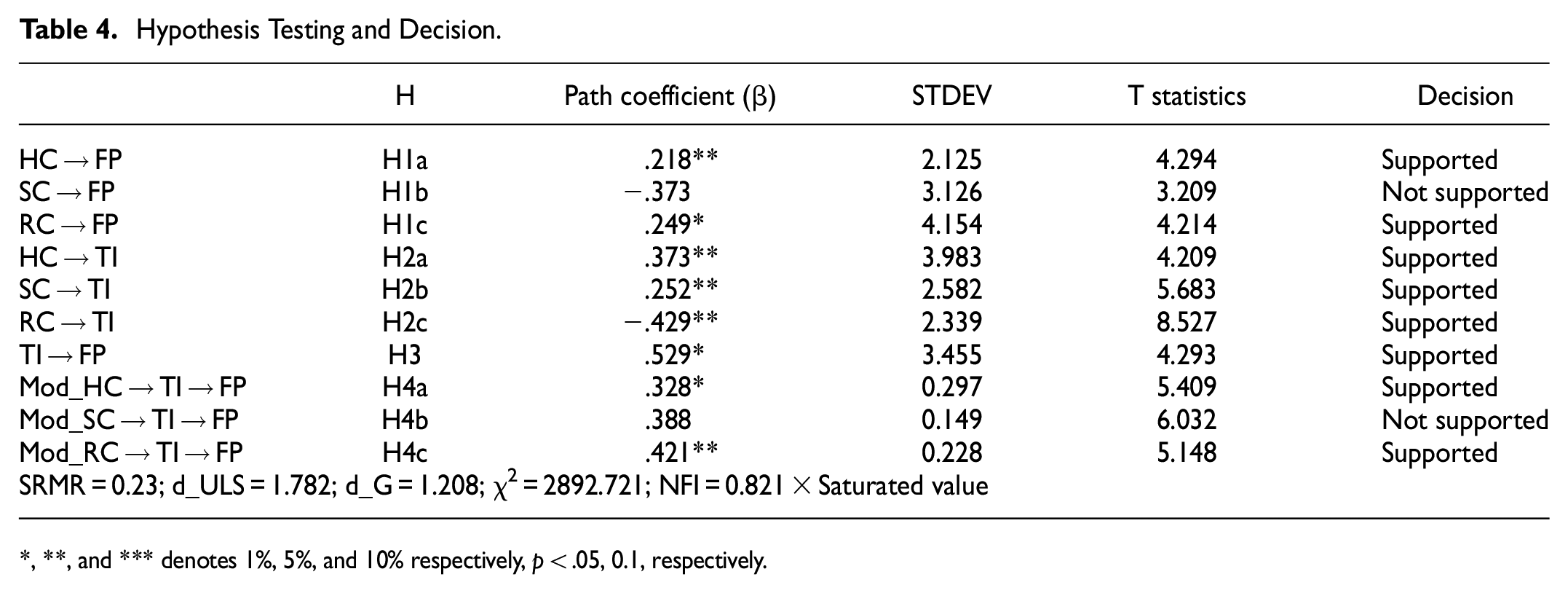
, **, and *** denotes 1%, 5%, and 10% respectively, p < .05, 0.1, respectively.
Further Analysis
To guarantee the credibility of the inquiry, the dependent variable used to evaluate SME performance was Net Profit Margin (NPM). Furthermore, a fixed effect analysis was employed to examine the relationships between intellectual capital, technological innovation, and SME success. Notably, Table 4 demonstrated that when return on assets (ROA) was utilized as the dependent variable, similar outcomes were obtained. As a consequence, the research concluded that the results are credible since they were consistent across many performance criteria.
The outcomes of the robustness assessment using fixed effect analysis for two models are shown in Table 5. Model 1’s coefficients for human capital, structural capital, relational capital, and RD (Research and Development) are reliant on the variable Return on Assets (ROA), which is the dependent variable, and their interactions with RD exhibited meaningful statistics. The coefficient for Human Capital*RD indicated a significant interaction effect. The constant term was also statistically significant, and the R-squared value of 0.823 demonstrated a good fit. Control variables and year fixed effects were included in Model 1. The coefficients for human capital, structural capital, relationship capital, RD, and their interactions with RD were all statistically significant in Model 2 with the dependent variable Net Profit Margin. The coefficient for Structural Capital*RD showed a significant interaction effect. The constant term was also significant, and the R-squared value of 0.682 indicated a satisfactory fit. Control variables and year fixed effects were incorporated in Model 2. The F(Wald) values for both models indicated the overall statistical significance of the models. In addition, the findings of the Hausman Test indicated that fixed effect models were favored over random effect models, with p-values below the significance threshold. Overall, the robustness test using fixed effect analysis validates the relevance of the correlations between the variables in both models, lending further credence to the conclusions of this research.
Robust Check Using Fixed Effect.

, **, and *** denotes 1%, 5%, and 10% respectively.
Discussions
In the post-industrial age, the research examined innovation in intellectual capital intellectualization of small and medium-sized firms in Jiangsu. Four principal research hypotheses were developed and evaluated.
Intellectual Capital and SMEs’ Performance
Initially, hypothesis one looked into whether SMEs in Jiangsu’s intellectual capital and its aspects had a great implication on their post-industrial performance. Using ROA as the dependent variable and HC, LC, and RC as the independent variables, we created and assessed three main sub-goals. The study’s findings demonstrated that human capital significantly improves the performance of post-industrial firms (H1a). This signifies the essence of developing human capital in ensuring companies’ success, as reflected in the study findings. The study’s findings align with (M. C. Chen et al., 2005; Maditinos et al., 2011; Nadeem et al., 2019; Ting & Lean, 2009; Xu & Li, 2019; Xu & Wang, 2018).
The research also found that the addition of structural capital improved SME performance in Jiangsu, China. In light of this, H1b was approved. This finding, which is at odds with and contradictory with the findings of other studies, demonstrates that SMEs in Jiangsu reaped substantial financial benefits from post-industrial-era investments in intangible capital such as structures and practices (Andreeva & Garanina, 2016; Haris et al., 2019; Mondal & Ghosh, 2012; Ting & Lean, 2009; Tran & Vo, 2018). Chinese publicly listed manufacturers have learned the value of Structural Capital during this period of economic transition.
Empirical evidence that Relational Capital has a substantial advantageous consequence on SME participants’ return on assets supports H1c. This runs counter to earlier studies (Nimtrakoon, 2015; Tripathy et al., 2015). The findings are consistent with those of Xu and Wang (2019a), who revealed that Relational Capital increases Chinese enterprises’ profitability. RC is the most important aspect in the performance of the manufacturing industry, according to Xu and Wang (2019b). Important social networks, such as Jiangsu, have a strong cultural foundation in traditional Chinese society (Du et al., 2019; Shi & Cheng, 2016).
Technical Innovation and Intellectual Capital Intellectualization
The second hypothesis examined how, after the industrial revolution, technological developments impacted Jiangsu Province’s corporate success. The researchers found a high linkage between human and relational capital and the technological innovation of SMEs in Jiangsu, supporting Hypotheses H2a and H2c. This confirms that human capital investments are crucial to R&D as an innovation element for enhancing the innovation capacities of the SMEs engaged in the study. This implies that most firms paid attention to boosting employees’ technical talents in boosting their company’s innovation (research and development). This is in line with (J. Chen et al., 2015; Duodu & Rowlinson, 2019; J. Li & Yu, 2018; Park et al., 2019; Soo et al., 2017; H. Y. Zhang & Lv, 2015) that human resources are a prerequisite in firm’s technical innovation.
The relational capital of SMEs in the Jiangsu province also significantly contributed to the firms’ innovations. The findings connect with findings of studies such as (Barkat et al., 2018; Castro et al., 2013; Ghorbani et al., 2012; J. Li & Yu, 2018; Verbano & Crema, 2016) that relational capital (learning from others’ experiences, building long-lasting relationships promote knowledge exchange and transformation in achieving long term innovation. Hence, the SMEs benefited from relational capital in research and development.
The research found no statistically significant relationship between structural capital and technological innovation. H2b was so disregarded. In contrast to the results of previous studies (Buenechea-Elberdin et al., 2018; Cabrilo & Dahms, 2018; Cabrilo et al., 2018; Tseng & Goo, 2005) structural capital played a promising role in enhancing the innovation performance of the SME sample.
Technical Innovation and SMEs Performance
Research aim three, during the post-industrial period in Jiangsu province, the study’s results demonstrated a considerable positive correlation between technological innovation and SME success. During the post-industrial period in Jiangsu province, the study’s results demonstrated a considerable positive correlation between technological innovation and SME sought to evaluate the linkage between research and development (technical innovation) and SMEs’ performance from 2012 to 2016 in Jiangsu province. As per the discoveries from the study, a notable and advantageous interconnection was unveiled between technical innovation and the performance of SMEs in Jiangsu province during the post-industrial era. Hence, H3 was supported. This implies that SMEs in the Jiangsu province utilized modern technological innovation via research and development to achieve a competitive advantage in boosting their performance. This study confirmed prior findings (Bigliardi, 2013; Bockova & Zizlavsky, 2016; Ho et al., 2018; Nasir et al., 2015; Ramadani et al., 2019; D. S. Wang, 2019) indicating that innovation favorably affects the success of businesses. Most organizations’ financial success may be attributed to organizational innovation.
Technical Innovation, Intellectual Capital Intellectualization, and SMEs Performance
Hypothesis four, which proposed that technological innovation among SMEs in China’s Jiangsu province regulated the interaction between human, structural, and relational types of intellectual capital and business performance, served as the basis for this study’s testing. The study’s conclusions that R&D is crucial in facilitating communication between human capital, structural capital, and firm performance support both H4a as well as H4b. This showed that, between 2012 and 2016, technology innovation had a strong direct and indirect impact on the relationship between human and structural capital and SME performance. Other research (Barkat et al., 2018; McDowell et al., 2018) has shown that human and structural capital have direct effects on the performance of small and medium-sized enterprises (SMEs) via the intervention of technological innovation. The research also revealed that innovation did not act to attenuate the correlation between relational capital and ROA for SMEs.
Conclusions
The study examined the post-industrial intellectualization of small and medium-sized firms in Jiangsu in terms of innovation in intellectual capital. It may be said that the study was directed by four key research hypotheses. To investigate the four primary research hypotheses, the study used PLS-Sem. In the 2012 to 2020 study, 1,450 manufacturing firms represented on the Shanghai and Shenzhen stock exchanges. The key model for categorizing intellectual capital intellectualization (Human, Structural, and Relational Capital) in the study was the VAICTM model by Pulic (2000). As stated in the study, structural capital effectiveness had a mean value that was greater (0.7426) than human capital effectiveness (0.3413) and relational capital effectiveness (0.4012). Thus, the following deductions were made:
In the Jiangsu province, the performance of SMEs throughout the post-industrial age is significantly correlated with human capital, structural capital, and relational capital.
The technical innovation of the SMEs engaged in the study is highly correlated with human capital and relational capital. However, in Jiangsu Province, structural capital was unrelated to the company’s financial performance.
During the post-industrial era, technical innovation considerably improved the financial performance of SMEs in the Jiangsu province of China.
During the post-industrial age in the Jiangsu province of China, technological innovation considerably modifies the link between human and structural capital and the financial performance of SMEs. nonetheless, had no effect on how well SMEs performed in relation to relational capital.
Theoretical and Practical Implications
Based on these conclusions, practical recommendations were drawn:
The implications of this research are applicable. Both inexperienced and futuristic tech SMEs still rely on tangible assets; as a result, managers should make effective use of both financial and tangible resources to increase profitability. In order to improve employee performance in high-tech SMEs, managers should invest in HC. Profits for both unsophisticated tech and state of the art tech SMEs are increased by SCE. In order to effectively acquire, develop, exchange, record, and use knowledge, top executives of Chinese high technology and non-technological SMEs should provide appropriate techniques, tools, and opportunities. Training, rotation, compensation policies, work design, and the use of info devices and programs (Andreeva & Garanina, 2016; Leonardi, 2014).
Given that RC makes a negligible impact on SMEs’ efficacy in China, we propose the use of collaborative techniques to create effective coalitions by sophisticated and inexperienced technological SMEs. Mid Enterprises should learn from partners and suppliers through social networks. SMEs should build client loyalty by connecting intimately. IC’s position in Chinese SMEs is clarified. The future plan must include IC.
The management of manufacturing listed businesses may find this study useful for allocating ICs and innovating to improve firm performance.
To increase employees’ talents, motivation, and experience, Chinese manufacturing businesses should prioritize HC and increase their HR spending. Share your skills and knowledge.
Chinese manufacturers should construct their SC by implementing information systems, tools, and HR practices. They should encourage innovation.
Corporate managers should maintain strong supplier and customer connections to boost brand image and consumer loyalty. Social networks should foster creativity.
Chinese firms should participate in more innovation activities and use agile innovation management to increase their competitive advantage. Corporate R&D should employ IC to improve production management.
Investors must gain understanding and concern about IC to help them choose businesses for their portfolio by examining the value-generating capabilities of IC at diverse enterprises. Policymakers should stimulate the growth of Chinese SMEs by educating personnel and boosting management knowledge of IC-performance links.
Our conclusions have enormous implications for managers in these organizations and governments to support innovation in SMEs, which are essential for regional economies. Inefficient open innovation may prevent SMEs from receiving its advantages. Open innovation becomes more efficient as organizations acquire expertise, which is why big firms profit more from it. Managers and policymakers may desire to speed SMEs’ open innovation experience curve. As Chinese enterprises participate in minimal open innovation, other nations may be farther down the experience curve. Both regions and corporations may become more efficient by learning from past creative collaborations. Companies may wish to start small with open innovation to acquire experience and see whether and how they may profit. As open innovation matures, managers may take courses and read learning materials to understand how to use it effectively. Since our study emphasizes the necessity of practical open innovation and the proper coupling of open innovation, managers should seek training.
External partnerships, such as open innovation, must be included in a plan for gaining external information. The study results have substantial implications for knowledge-innovation and knowledge-management theories and managerial practices. This study makes three theoretical contributions. First, its results challenge the literature on innovation and its genesis and adoption. Current research is rich in invention but little in generation and acceptance. This study looked at the influence of three intellectual factors on the adoption and incorporation of innovations. According to our analysis, the Chinese government should start funding industrial development efforts so that businesses can borrow money for working capital.
Limitations and Further Studies
This research contains shortcomings. This research solely covers China’s industrial sector. Include sectors with different investment environments in future research. Second, product and process innovations should be considered. They’ll be studied further.
Following COVID-19, enterprises will have a competitive advantage because to IC’s skills, expertise, productivity, knowledge, strategy, and structure. These firms expand more quickly.
Post-COVID-19 and IC development should be studied. Only a tiny number of companies reported R&D investment in their financial statements. China can’t employ the enlarged model. This is the first study to employ the VAIC model in Jiangsu province of China utilizing linear mixed-effects model to predict its coefficients, adding new empirical data from CEE during the economic crisis to the IC literature.
Future research should examine factors (GDP, CPI, organizational culture) that affect IC and company performance. Second, long-term IC impacts aren’t examined using time-lagged performance data. Also, compare Chinese SME statistics to other nations or geographical samples.
Future studies should investigate additional variables (GDP, CPI, organizational culture) that may impact IC and business success. Second, this research doesn’t use time-lagged performance data to examine long-term IC effects. Also, other country or area sample data should be compared to Chinese SME data. Further study is needed. Future research may retest theories using objective markers. Future research may conduct a longitudinal examination of construction firms’ intellectual capital. Fourth, technology innovation drives SME project innovation. Future research may focus on technical innovation. Future study may explore potential mediators linking intellectual assets and corporate innovation achievement with the aim of getting a deeper understanding of how intellectual capital drives innovation effectiveness of SMEs.
Qualitative or quantitative research may determine which management methods are helpful, ineffective, or onerous to workers and the organization. Ambidextrous open innovation or “multi-dexterous” innovation antecedent factors might also be considered. More study gives IC and TI management advice. SME managers must be aware of their companies’ intangible assets and spend heavily on growing HC and RC. SMEs should be proactive and inventive in their entrepreneurial operations, including exploring new consumer demands, encouraging staff to explore new ideas, and leading the market with unique, high-value-added customer offerings.
Future academics might evaluate how intellectual capital affects innovation development and uptake in various sectors. Future studies might examine how innovation creation and adoption affect a firm’s performance to understand better how it is implemented. Age, size, innovation creation, and adoption should also be studied.
Footnotes
Acknowledgements
This research is part of [1] Innovation team construction of “low carbon economy and industrial development,” supported by the excellent innovation team construction project of philosophy and “Social Sciences in Colleges and universities of Jiangsu Province.” [2] The Humanities and Social Sciences Research Program of the Ministry of Education: Research on the Formation Mechanism and Breakthrough Path of “Low-end Capture” in the Global Value Chain of High-tech Industry (18YJA630105).
Declaration of Conflicting Interests
The author(s) declared no potential conflicts of interest with respect to the research, authorship, and/or publication of this article.
Funding
The author(s) disclosed receipt of the following financial support for the research, authorship, and/or publication of this article: The Humanities and Social Sciences Research Program of the Ministry of Education: Research on the Formation Mechanism and Breakthrough Path of “Low-end Capture” in the Global Value Chain of High-tech Industry (18YJA630105).
Ethical Statement
Not applicable.

Availability of Data and Materials
The data of this manuscript will be provided by the corresponding author upon request.