




Abstract
This study examines the effect of intellectual capital (IC) on innovative performance. The data were collected from the public organizations located in the Addis Ababa City Administration, federal institutions, and Sheger City State. A structured questionnaire was distributed to 384 employees. Out of these, 369 valid responses were analyzed using PLS SEM. The findings indicate that human capital, structural capital, and relational capital all positively and significantly influence the innovative performance of the public sector. The findings demonstrate that the educational level, training, and skills of employees in innovative activities, along with their personal values and attitudes, are crucial for enhancing innovative performance. The innovative activities of an organization can also be improved by expanding interactions with external networks, such as customers and other stakeholders. Moreover, the organizational philosophy, management systems, and knowledge management methods all contribute to the innovative performance of organizations.
Keywords
Introduction
Background of the Study
In modern economies, the significant role of the public sector is undeniable. Although the size of the public sector varies by country, according to the report of UNECE (2021), the size of the public sector in the average country is listed as a third of that country’s economy. This size indicates that innovation performance in the public service sector tends to enhance economic growth by reducing costs, improving service quality, and indirectly supporting private sector performance through essential infrastructure and facilities. Through innovation, for example, public service delivery costs can be reduced, service quality improved, and private sector performance indirectly supported by providing essential infrastructure and facilities (Leyden, 2016).
The public sectors are under increasing pressure to demonstrate dynamic and adaptive governance, driven by a continuous pursuit of innovation (Organisation for Economic Cooperation and Development [OECD], 2024). There are many reasons why public sectors are so innovative. These include a culture that encourages strong competition, the need for optimization of internal and external processes, the use of different service delivery models, and the rapid pace of technological advancement (Qiyamullaily et al., 2024). Innovation has become a major force that changes how organizations work and how public services are delivered (OECD, 2024). It depends on the challenges the government organization aims to address, its competencies, and the circumstances (Demircioglu & Audretsch, 2024; OECD, 2024).
Ethiopia’s 10-year strategic development plan (2021–2030) prioritizes institutional capacity building, innovation, and efficient public service delivery as essential for attaining the country’s socio-economic goals (Federal Democratic Republic of Ethiopia [FDRE], 2021). Despite the ongoing reforms, the Ethiopian public sector has substantial obstacles in several aspects of intellectual capital, which directly limit its innovative performance and organizations’ effectiveness (Geru et al., 2025). With regard to human capital, Ethiopia’s public sector is constrained by skill gaps, limited professional development opportunities, and insufficient innovation-related competencies (OECD, 2017). According to the World Bank (2021), Ethiopia’s Human Capital Index (HCI) remains low at 0.38, indicating severe gaps in foundational skills required for innovation.
The bureaucratic systems and fragile knowledge management practices also undermine structural capital (Ferede et al., 2024). Weak institutional capacity, limited autonomy, and performance management issues further affect the development of innovative organizational cultures (Ferede et al., 2024; Tadesse, 2019). Similarly, limited collaborations with external stakeholders and partnerships among government organizations show a lack of relational capital (Sube et al., 2025). Weak transparency and accountability mechanisms further reduce the trust between public organizations and their stakeholders, preventing knowledge sharing and joint innovation efforts (Hagos, 2023).
Although there has been some progress in the digitization of tax systems and e-government initiatives, most institutions struggle to institutionalize innovation as a routine organizational capability (Sube et al., 2025). According to the Global Innovation Index 2024, Ethiopia ranked 130th out of 133 countries, with particularly weak scores in human capital (World Intellectual Property Organization [WIPO], 2024). This report indicates the urgent need to strengthen intellectual capital to foster public sector innovativeness.Intellectual capital (IC), an essential intangible asset, is pivotal in transforming individual expertise into corporate knowledge and fostering innovation (Edvinsson & Malone, 1997). In the contemporary knowledge-driven economy, organizations are under considerable pressure to innovate competitively. To prosper, they must acknowledge, execute, and administer IC proficiently (Gogan et al., 2016; Hung, 2004). Intellectual capital, including human, structural, and relational components, establishes the foundation for organizational innovation and competitiveness. Therefore, enhancing IC through strategic interventions is essential for attaining higher performance levels and enduring innovation.
Despite the clear relevance of intellectual capital to public sector innovation, few empirical studies have systematically examined how its core dimensions—human, structural, and relational capital—affect innovative performance in the Ethiopian public sector context. Therefore, this study aims to address this gap by empirically investigating the relationships between intellectual capital and innovative performance, adding valuable insights to the growing discourse on public sector reform and innovation in developing countries like Ethiopia.
Statement of the Problem
Innovation is an important factor for organizations to increase value, create sustainable competitive advantage, and improve performance. In addition, to survive in the competition currently observed among organizations, it is imperative to consider innovative performance as a fundamental strategy and to identify internal and external factors, such as IC, that influence organizational innovativeness. It encompasses the implementation of innovative methods of public service delivery, collaboration with external partners, and technological advancements (Bandauko, 2022).
Despite the prevalent belief that the public sector is not receptive to innovation, research has shown that it is indeed occurring in a variety of ways (Leyden & Link, 2015; Sahni et al., 2013). As studies show, public sectors differ from the private sectors in terms of motivation, incentives, attitude toward risk, and resource allocation (Borins, 2001). These distinctions often result in an organizational environment less conducive to identifying and seizing opportunities for innovativeness. Addressing these challenges needs the integration of organizational structure, external relationships, and human capital (Mariz-Perez et al., 2012).
In Ethiopia, the government has demonstrated its commitment to promoting innovation through various programs led by the Ministry of Innovation and Technology. These programs seek to boost Ethiopia’s innovation and entrepreneurial ecosystems, increase productivity, create jobs, and promote economic development (Sube et al., 2025). However, scarce research exists on the significance of IC in encouraging innovation in Ethiopia’s public sector. Existing research focuses mostly on the private sector (Behaylu & Gizaw, 2020; Mekete, 2015), leaving a significant gap in understanding how IC enhances the creative performance of public organizations. Therefore, this study examines the impact of IC on innovative performance within Ethiopia’s public sector. It aims to offer valuable insights regarding the use of IC to enhance innovative performance in developing nations such as Ethiopia.
Literature Review
Intellectual Capital (IC)
IC includes all intangible assets that stimulate the organization’s performance (Roos & Roos, 1997; Subramaniam & Youndt, 2005). Three components make up an organization’s IC: Structural Capital (SC), Human Capital (HC), and Relational Capital (RC; Obeidat et al., 2021).
Public Sector Innovative
Public sector innovation is the process of generating and implementing ideas, new and significantly modified, to create value for society, whether they have an internal or external approach to public administration (Heichlinger et al., 2014). It is a significant improvement in public administration. This study classifies innovative performance based on the characteristics that provide solutions to various public challenges. Recent literature, for instance, identifies five types of innovation pertinent to the public sector: administrative process, technological process, new service, conceptual, and governance innovation (Cinar et al., 2024). This study looked at both what resources are put in, like money spent on new technologies and training, and what results come out, such as launching new services, quicker project timelines, and better administrative processes. Therefore, indicators include the frequency of new service introductions, alignment of innovation with strategic priorities, speed of implementation, and the use of advanced technologies or external knowledge sources (Y. Li et al., 2019; Castro & Verde, 2012). These reflect both the organization’s internal readiness and its external responsiveness to innovation demands (Walker, 2007; Windrum, 2008).
HC and Innovative Performance
According to Stewart (1997), HC is one of the elements of IC. It includes all aspects, such as the abilities and competencies of employees. Ekemam and Okpara (2021) defined HC as knowledge, skill, and attributes embodied by staff members in their capacity to perform their responsibilities. It includes their education, life, and work experience. Organizations can use human capital effectively by encouraging knowledge sharing and providing training (Y. Li et al., 2019).
Different scholars, like G. S. Becker (1993) and Carvache-Franco et al. (2022), hypothesized that education level improves individuals’ productivity. In other words, as employees attain a higher level of education, their productive capacity will not be at the same level compared to others (Ezilmez & Çalışkan, 2025). Furthermore, education stimulates innovation and the absorption of new ideas (Lenihan et al., 2019; W. Li et al., 2024). HC also significantly impacts a company’s competitive position, particularly in technology-intensive activities (Mariz-Perez et al., 2012). Here, employees can be tangible assets, and the knowledge and skill they have is a key factor in their value.
Similarly, Van Uden et al. (2014) measured human capital by considering employee schooling or the educational experience recorded by the staff members to review the current knowledge and support the organization toward success. Mariz-Perez et al. (2012) also classified the indicators of HC into two large groups. The focus of one group is on employee competency, while another group discusses the value and attitude of strategic employees.
The study considered employees’ educational levels, access to innovation-relevant training, employees’ ability to develop new ideas and knowledge, the proportion of highly educated personnel within the organization compared to competitors, and their active engagement in creative problem-solving (Castro & Verde, 2012; Subramaniam & Youndt, 2005). These indicators reflect the human capability and motivational factors influencing public organizations’ innovative performance (Y. Li et al., 2019). For example, organizations where staff are routinely involved in developing new ideas and knowledge and receive training are better positioned to implement innovation (Subramaniam & Youndt, 2005). Hence, the study developed the following hypothesis:
RC and Innovative Performance
RC refers to the capacity to acquire and apply essential knowledge by exploring external knowledge within the company’s value chain. It captures the value derived from an organization’s relationships with external factors such as suppliers, partner organizations, and other stakeholders (Roos & Roos, 1997; Valladares et al., 2014). From an innovation capacity perspective, RC highlights how organizations leverage the diverse skills, knowledge, and perspectives of these external actors throughout the innovation process (Cabrilo & Dahms, 2020; Laursen & Salter, 2006).
In general, recent studies claim that organizations’ success compared with their competitors depends on their ability to interact with external networks (Dar & Mishra, 2020; Ramírez-Solis et al., 2022). These studies revealed that the involvement of customers, as well as having close relationships with them, can improve the performance of an organization (Al-Jinini et al., 2019). Close relationships with customers, suppliers, and competitors can also positively affect the innovative performance of organizations (Cabrilo & Dahms, 2020). Accordingly, the study measured RC using indicators that reflect the organization’s external knowledge acquisition and collaborative efforts (Al-Jinini et al., 2019; Cabrilo & Dahms, 2020; Hagos, 2023; Laursen & Salter, 2006; Truong et al., 2024). Moreover, the relational capital’s indicators include the extent to which valuable market information is obtained from customer portfolios, the frequency of new product/service developments carried out in collaboration with customers and suppliers, and the degree to which employees work jointly with other stakeholders to develop solutions (Castro & Verde, 2012). Hence, the study developed the following hypothesis:
SC and Innovative Performance
SC encompasses all knowledge retained by the organization, considering it the organization’s knowledge repository. Organizations primarily acquire SC via their organizational frameworks, methodologies, information systems, and documentation (Y. Li et al., 2019). The organization will institutionalize and retain its experiences and practices (Y. Li et al., 2019). Numerous studies have consistently highlighted the positive effect of SC on an organization’s capacity to innovate (Pangidoan & Nawangsari, 2022; Ur Rehman et al., 2022). Belmonte da Silva et al. (2021) identify the structural conditions for innovation as the granting of autonomy, effective communication and flexible control, recognition of knowledge and experience, and friendly personal relationships. An organization that works in such an environment will have a positive role in making fast decisions to change in the internal as well as external environments (Valladares et al., 2014). Moreover, SC includes internal structures, processes, databases, organizational culture, intellectual property, and technological infrastructure that enable employees to perform their tasks effectively (Belmonte da Silva et al., 2021; Castro & Verde, 2012; Y. Li et al., 2019).
This study measures SC using indicators that capture the organization’s internal infrastructure and supportive environment for innovation (Belmonte da Silva et al., 2021; Haris et al., 2019). Particularly, the structural capital’s indicators include the extent to which the organization favors the flow of information and knowledge among employees, the perceived openness of managers and employees to new ideas and changes, and the organizational structure and working culture. Thus, the study suggests the following hypothesis:
Conceptual Framework
This study primarily focuses on the components of IC: HC, SC, and RC. Additionally, the public sector’s innovative performance was measured by four typologies: new service innovative, administrative innovative, technological innovative and systematic innovative (Figures 1 and 2).

Conceptual framework reviewed from literature.

Structural model.
Methodology
Research Design
The design of this research is descriptive and explanatory in nature. The researchers used these designs to provide a clear picture of the study population and to examine the relationships between both dependent and independent variables to get more insight into the factors at play (Creswell, 2014; Saunders et al., 2019).
Population and Sampling Procedure
The target population of this study was employees working in public organizations located in Addis Ababa city administration, federal organizations, and Sheger city. First, Addis Ababa city administration, federal organizations, and Sheger city were selected as initial clusters. The researchers then applied a stratified sampling technique to select specific organizations. The stratification was based on the Ministry of Planning and Development (MoPD, 2021)’s classification of organizations into three distinct sectors (social, economic, and financial). Based on the stratification, three public organizations were randomly selected from each stratum, resulting in a total of nine public organizations included in the study (Table 1).
Distribution of Sample Organizations.

Sample Size Determination
Given the unknown large target population, the method suggested by Cochran (1977) for calculating sample size in the absence of population data was used. The formula is as follows:

Where:
no = the desired sample size
Z = the desired confidence level (1.96 for a 95% confidence level)
p = the estimated proportion of the population (typically 0.5 for maximum variability when unknown)
q = 1 − p
e = the level of precision (0.05 for ±5%)
After determining the sample size and type of organizations, the survey questionnaire was proportionally distributed. Within each of the nine selected public organizations, participants were purposefully selected to ensure representation across key functional areas and diverse hierarchical levels. Respondents included staff from essential departments such as finance, planning, human resources, procurement, and information systems. The study deliberately included four job levels, such as technical experts, professionals, middle-level managers, and senior leaders. This design allowed the study to assess innovation as practiced comprehensively across the organizational hierarchy, providing a rich understanding of the phenomenon.
Data Collection and Analysis
The questionnaire consists of two parts. The first part is intended to obtain demographic information about the respondents. Part two consisted of statements designed to evaluate the extent to which respondents agreed about the effect of intellectual capital (IC) on the innovative performance of their organizations. The study designed a 5-point Likert scale (1 = strongly disagree–5 = strongly agree) to measure the respondents’ views. Finally, the questionnaires were distributed to a sample of 384 respondents, and 369 valid responses were considered for analysis, resulting in a response rate of 96.1%.
After the data cleansing process, the researchers tested the data’s normality using Marida’s (critical ratio) and kurtosis values for each variable. The test result revealed that the data’s normality lacks support. This situation necessitates the use of PLS-SEM, a non-parametric analysis tool that does not need to meet all normality assumptions (Hair et al., 2021). To analyze the data, the study used two-stage assessment models: the first stage examines the measurement model, while the second stage evaluates the structural model.
Results
Demographics Results
Respondents’ profiles include information about their sex, age, education, job level, department, and work experience (Table 2). More than half (57.5%) of the respondents were male, while 42.5% were female. About 49.6% were between the ages of 35 and 45, followed by 42.5% aged less than 35, and the remaining (4.1%) were over 45 years old. In terms of education, 43.4% were first degree holders, 29.5% held a master’s degree, 23.8% of them were diploma holders, and the remaining 3.3% had PhDs.
The Profile of Respondents.

Regarding the job level, 36.3% were professionals, 26.1% middle managers, 23.8% technical staff, and the remaining 13.8% were senior leaders. The respondents came from a range of departments, including Human Resources (20.3%), Finance (24.4%), Procurement (23.6%), Planning and Monitoring (17.3%), and ICT (14.4%). Regarding work experience, 43.4% had 5 to 10 years of experience, 36.9% had more than 10 years, and 19.8% had less than 5 years of experience.
Measurement Model Tests
Convergent Validity
The results of the three measurement model tests conducted in this study are factor loadings, CR, and AVE, as shown in Table 3 (Fornell & Larcker, 1981; Hair et al., 2012). The result shows that most of the indicator values have loadings beyond the suggested threshold of 0.7. Indicators with loadings below this threshold are considered for removal only if deleting them results in an increase in internal consistency above the recommended threshold. The other factor considered for the removal of low loadings was the AVE value. Here, the loading between 0.4 and 0.7 can be tolerated if the indicator has a CR greater than 0.7 and an AVE beyond 0.5 (Hair et al., 2012). The result shows that the AVE of innovative performance (INOV) is 0.469, which is below the acceptable level. Moreover, one of the factor loadings for RC (RC5 = 0.375) is very low. Therefore, to improve these metrics, two items from INOV (IN2 and IN3) and one item from RC (RC5) were removed due to their low loadings. After these deletions, a second-order validity test was conducted (see Table 4).
Convergent Validity: First-order Validity Test.

Second Order Validity Test.

Note.α = Cronbach’s alpha.
As shown in Table 4, after removing the three outer loadings (INOV 2, INOV 3, and RC5), the AVE value for INOV improved from 0.469 to 0.520, surpassing the recommended threshold. The results for α and rho_C also meet the necessary criteria for reliability testing.
Discriminant Validity
The discriminate validity represents whether constructs are measuring what is intended to measure. The acceptable threshold value of this test is less than 0.9. The results of this test (Table 5) show that the constructs represent more variance with their respective indicators than others, confirming that all the results are acceptable. We also conducted a cross-loading analysis of the indicators (Kock & Lynn, 2012), and the results revealed that they had loadings above 0.6 and low loadings with another construct. This further supports the validity of our measurement model.
Discriminate Validity (HTMT).

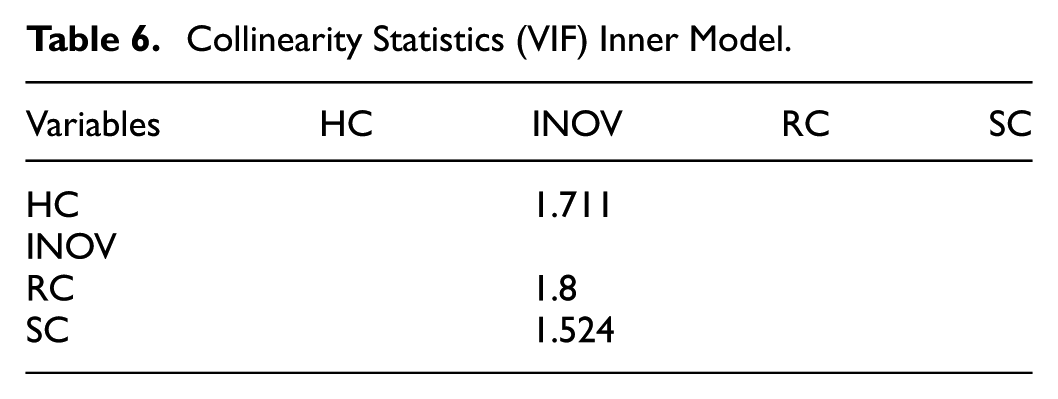
To detect the problem of collinearity, the inner model was carried out (Table 6). It is suggested that the collinearity issue can occur at lower value of Variance Inflation Factor (VIF) of 3 to 5 (J. M. Becker et al., 2015; Hair et al., 2021). The collinearity values are less than three; this displays that the predictor variables are not correlated with other predictors in the model, which implies there are no collinearity issues among predictor constructs (Rammal et al., 2025).
Collinearity Statistics (VIF) Inner Model.
Structural Model Result
After the measurement model assessment, the next step is to estimate the stability and reliability of path coefficients within the structural model. We estimated the path coefficients using a 5000 bootstrapping sub-sample procedure (Hair et al., 2021; Ramayah et al., 2018). Table 5 depicts the bootstrapping results of the structural model. The first hypothesis (
The second hypothesis in this study suggests that RC has a positive impact on innovative performance. The path coefficient of this relationship is β = .181, p = .001, which shows that an increase in relational capital leads to increased innovative performance. The third hypothesis of this study was to examine SC and innovative performance. The path coefficient result (β = .204) shows a positive and statistically significant effect (Table 7).
Path Coefficient.

R2 is a measure of how well the predictor(s) explain the variation in an endogenous construct. It shows how well the independent variable explains the variation in the dependent variable (Hair et al., 2012). In this study, the R2 value of .56 shows that 56% of the variance in the dependent variable (INOV) is explained by the independent variables (Table 8), showing an acceptable explanatory power.
The Value of R2 and Adjusted R2.

The f2 values of HC, SC, and RC were 0.33, 0.064, and 0.044, respectively (Table 9). This result denotes that the relationship between IC and INOV ranged from medium effect to small effect (Cohen, 1988). In other words, the exclusion of an exogenous variable in the model has no significant impact on the endogenous variable, which is within an acceptable level.
Effect Size, f2.

In addition to R2 and f2, it is important to consider other metrics as a measure of predictive accuracy. Thus, the Ston Geisser test of predictive accuracy (Q2) is one of the common tests in PLS-SEM. This test evaluates the power of a model or model fit and predictive relevance (Geisser, 1974; Stone, 1974). Here, Q2 is 0.55 (Table 10), indicating the model has predictive relevance (Q2 > 0).
Predictive Relevance, Q2.

Discussion and Implications
Discussion
This study examined the effect of IC on innovative performance in the case of the Ethiopian public sector. The results show that all three dimensions of IC, such as HC, RC, and SC, positively and significantly contribute to enhancing innovative performance. HC demonstrated the strongest effect on innovative performance. Indicators such as the perceived excellence of employees in innovation activities, their creativity, their ability to develop new ideas and knowledge, and their job-specific expertise, coupled with the organization’s investment in training and the educational attainment of its workforce, are essential for enhancing the innovative performance of the public sector. This finding addresses the challenges related to skill gaps and the need for a more dynamic workforce in the Ethiopian public sector, demonstrating that cultivating these human capital elements is a direct pathway to improved innovation outputs such as new service introduction and efficient implementation (OECD, 2017; World Bank, 2021). Through continuous education, improved recruitment strategies, and targeted innovation training, public sectors may mitigate workforce deficiencies that impede innovation (Y. Li et al., 2019; Ekemam & Okpara, 2021). Furthermore, the focus on employee values and educational achievement corresponds with G. S. Becker’s (1993) argument that education improves productivity and the ability to assimilate innovation.
The second hypothesis (
The finding also shows a positive relationship between SC and innovative performance. The promotion of knowledge sharing, organizational openness to new ideas and changes, the facilitation of idea exchange, a participative work environment, the presence of formalized innovation support mechanisms, and systems that support idea generation are crucial. In Ethiopia, public institutions often suffer from bureaucratic systems and fragile knowledge management practices (Ferede et al., 2024; Tadesse, 2019). Therefore, an organization that works in such an environment will have a positive role in making prompt decisions to change in the internal as well as external environments (Valladares et al., 2014). Moreover, by creating participative environments, recognizing knowledge and experience, and fostering friendly personal relationships, public sector organizations can reduce resistance to change and institutionalize innovation as part of daily operations.
Implications
Most previous studies have focused on the dimensions of IC in private organizations. However, this study demonstrates the significant contribution of IC to the innovative performance of public organizations. Accordingly, this study bridges a critical gap in the literature by applying the intellectual capital framework traditionally associated with private sectors.
Firstly, given the strong positive effect of HC on innovative performance, public sector organizations should strategically invest in their workforce. This implies prioritizing initiatives that enhance employee excellence in innovation, foster creativity and knowledge development, and build job-specific expertise. Public sectors should focus on designing and implementing the promotion of concepts that encourage creativity, offering training that specifically targets innovative thinking and problem-solving skills, and creating incentive structures that recognize and reward employees for generating and implementing new ideas.
Secondly, the confirmed positive relationship between RC and innovative performance highlights the necessity of fostering robust external connections. Public sector managers should actively cultivate relationships with suppliers and customers to facilitate valuable information acquisition and engage in collaborative service development. Collaborations with various governmental and non-governmental organizations can also result in notable advancements in service quality and process design. Such external connections will allow organizations to access varied knowledge resources and adapt more efficiently to changing societal demands.
Lastly, the significant positive effect of SC on innovative performance suggests that companies require a conducive internal environment. Leaders need to prioritize the enhancement of internal knowledge transfer through the implementation of efficient knowledge management systems and the promotion of interdepartmental communication. Moreover, instituting explicit, institutionalized methods for innovation support, including allocated funds, resources, and structured processes for idea development, would facilitate the institutionalization of innovation.
Conclusion
This study examined intellectual capital (IC) and its effect on innovative performance by taking the Ethiopian public sector as a focus of investigation. The result confirms the significant role of all three components of IC in driving innovative performance.
The result shows that HC significantly and positively influences innovative performance. This underscores that the excellence, creativity, and knowledge development of employees, their job-specific expertise, and the organization’s investment in training and highly educated personnel are paramount. These elements are direct drivers for the introduction of new services, efficient innovation implementation, and overall public sector modernization. The results highlight that fostering a skilled and adaptive workforce is fundamental to enhancing innovation.
Furthermore, RC was found to have a positive effect on innovative performance. This indicates that effective engagement with external stakeholders, including customers/citizens and suppliers, and the ability to acquire valuable information, collaborate on service development, and engage in joint problem-solving are crucial. Strong external networks facilitate the flow of new ideas and resources, enabling the public sector to respond more effectively to societal needs and innovate collaboratively.
Finally, structural capital also demonstrated a positive influence on innovative performance. This emphasizes that robust internal systems, a culture of openness to change, effective knowledge flow, and formalized support mechanisms for innovation (such as recognition and reward systems) are essential. Hence, prioritizing continuous employee development, fostering robust external partnerships, and cultivating an agile and supportive internal organizational environment are critical steps toward enhancing the public sector’s capacity to innovate and deliver improved public value.
Despite its benefits, this research has drawbacks. First, the research examined nine public organizations from Addis Ababa City Administration, Sheger City, and federal institutions, limiting its applicability to rural or lower-tier government bodies. Second, a structured questionnaire measured latent variables using well-acknowledged indicators, although self-reporting biases or lower-level staff’s lack of innovation awareness may have influenced replies. Finally, the cross-sectional nature of this study makes it difficult to determine the long-term causal link between IC and innovative performance. Future research may include a wider variety of public institutions across regional states, use longitudinal designs to study IC evolution, or use qualitative methodologies to better understand contextual dynamics affecting innovation.
Footnotes
Appendix: Questionnaires
This appendix provides the full list of questionnaire items used to measure the study’s variables: Innovative Performance (INOV), Human Capital (HC), Structural Capital (SC), and Relational Capital (RC). Respondents were asked to rate their agreement with each statement, typically on a Likert scale (e.g., 1 = Strongly Disagree–5 = Strongly Agree).
Acknowledgements
Not applicable.

Ethical Considerations
Before any attempt to collect the data, ethical approval to conduct the study was obtained from the Ethiopian Civil Service University Ethical Review Committee. Informed consent was also obtained from all study participants.
Consent to Participate
Informed consent was obtained from the participants involved in the study. Participants were provided with comprehensive information about the study’s purpose and benefits. They were assured of the anonymity and confidentiality of their responses. Participation was entirely voluntary, and participants were informed of their right to withdraw from the study at any time without facing any penalties.
Funding
The authors received no financial support for the research, authorship, and/or publication of this article.
Declaration of Conflicting Interests
The authors declared no potential conflicts of interest with respect to the research, authorship, and/or publication of this article.
Data Availability Statement
The data that support the findings of this study are available from the authors upon request.