



Abstract
Socioeconomic disparities play a significant role in shaping children’s psychological resilience, but the underlying mechanisms remain underexplored. This study investigates the potential mediating roles of prosocial behavior and belief in a just world in the relationship between childhood socioeconomic status and resilience. A sample of 955 Chinese college students completed self-report measures assessing their childhood socioeconomic status (parental education and family income), prosocial tendencies (Prosocial Tendencies Measure), belief in a just world (Belief in a Just World Scale), and psychological resilience (Connor-Davidson Resilience Scale). Path analysis revealed that higher childhood socioeconomic status was directly associated with greater resilience. Indirect effects were also found, with socioeconomic advantage linked to heightened prosocial orientations and stronger just world beliefs, which in turn predicted higher resilience. A significant serial mediation pathway emerged, whereby economic resources fostered prosocial behavior, reinforcing just world perceptions and ultimately enhancing resilience. The findings underscore the importance of promoting prosocial values, creating opportunities for prosocial engagement, cultivating adaptive beliefs, and addressing socioeconomic inequalities to support positive youth development and psychological resilience across diverse contexts. Targeted interventions and policies informed by these insights can contribute to more equitable and supportive environments for all children.
Plain Language Summary
What did the researchers study? This study looked at how growing up in families with different income levels affects young people’s ability to cope with difficulties and bounce back from tough situations. The researchers wanted to understand not just whether family income matters, but how it makes a difference. Who participated? The study involved 955 Chinese college students who answered questions about their childhood family income, their tendency to help others, their beliefs about whether the world treats people fairly, and how well they handle stress and challenges. What did they find? Students from higher-income families were generally better at bouncing back from difficulties. However, the researchers discovered this wasn’t just because of money itself. Instead, growing up with more economic resources helped young people in two important ways: (1) they had more opportunities to help others and develop caring behaviors, and (2) they were more likely to believe that the world is generally fair and that good things happen to good people. These two factors—helping others and believing in fairness—then helped them become more resilient. Why does this matter? These findings suggest that programs aimed at helping young people cope better with life’s challenges should do more than just provide financial support. They should also create opportunities for young people to help others and develop positive beliefs about fairness and justice. This could include volunteer programs, community service, and activities that help young people see how their efforts can make a positive difference. Understanding these connections can help educators, parents, and policymakers design better support systems for all children, regardless of their family’s income level.
Keywords
Introduction
Research Background
Economic inequality and its impact on child development are pressing concerns in today’s society. Specifically, children from economically disadvantaged families often face numerous challenges, such as limited resources, poor living conditions, and chronic stress, which can hinder their academic, cognitive, and social-emotional development (Bradley & Corwyn, 2002; Evans & Kim, 2013). Conversely, children from affluent families typically have access to more opportunities and supportive environments. However, it is important to note that economic advantage alone does not guarantee positive developmental outcomes (Conger & Donnellan, 2007; Luthar & Latendresse, 2005). Amidst these socioeconomic disparities, psychological resilience—the ability to adapt and thrive despite adversity—has emerged as a critical factor in promoting positive youth development and long-term well-being (Luthar et al., 2000). While the role of family socioeconomic status (SES) in influencing resilience has garnered significant attention, the underlying mechanisms through which SES affects resilience remain underexplored (Washburn et al., 2011). This gap highlights the need to investigate potential mediating factors that bridge SES and psychological resilience.
Beyond the general relationship between SES and resilience, there are compelling reasons to specifically investigate these mechanisms within the Chinese context. China’s rapid socioeconomic transformation has created unique developmental circumstances for its youth. With over 200 million children under 14 years old, recent national surveys indicate that 17% of urban children and 45% of rural children experience significant socioeconomic disparities, particularly in educational resources and family support (China Children’s Development Report, 2023). These disparities, coupled with China’s intense academic competition and traditional emphasis on educational achievement, create a distinct developmental environment that warrants specific investigation.
The Chinese educational and family context presents unique features that may significantly modify how socioeconomic factors influence psychological resilience. The educational landscape is characterized by the dual influence of Confucian values emphasizing effort and perseverance, alongside intense competitive pressures centered on the gaokao college entrance examination system. Recent national studies report that 76% of Chinese parents invest over one-third of household income in children’s education (Chi & Qian, 2016; Mu & Hu, 2023), highlighting the exceptional priority placed on educational advancement. This creates unique family dynamics where economic resources are disproportionately channeled toward educational investments, potentially altering how SES impacts psychological development compared to Western contexts.
Furthermore, China’s distinctive social beliefs and rapidly changing economic structure create practical urgency for this research. The growing urban-rural divide in China has resulted in a 30% gap in college admission rates (Ministry of Education, 2022), while parental education levels significantly influence children’s psychological adaptation in ways that may differ from Western patterns. These contextual factors potentially modify how prosocial behavior and just world beliefs develop and function. Understanding these culturally specific pathways is crucial not just for theoretical advancement but for designing effective interventions within China’s educational system, where mental health challenges among students have increased by 24% over the past decade (Xin et al., 2022). This research thus addresses pressing practical needs in Chinese youth development while filling important theoretical gaps in our cross-cultural understanding of resilience formation
Theoretical Frame and Research Gap
Previous research has established a link between family economic status and children’s psychological resilience, indicating that higher SES is generally associated with greater resilience (Bruno et al., 2023). However, the underlying mechanisms explaining this relationship deserve further investigation. Studies suggest that prosocial behavior and belief in a just world may foster resilience through adaptive meaning-making and effective coping strategies (Dalbert, 2009; Eisenberg et al., 2015). Children from higher-income families often have more opportunities to engage in prosocial activities, develop prosocial skills, and cultivate a stronger belief in a just world, which may contribute to their enhanced resilience (Kraus et al., 2012; Piff et al., 2010). Despite these insights, research has primarily focused on direct effects of SES on resilience, overlooking potentially important indirect pathways that could provide a more comprehensive understanding of this relationship.
A serial mediation model examining how family economic status influences resilience through prosocial behavior and belief in a just world offers a promising approach to address this gap. This model enables exploration of how these psychosocial factors interact and collectively influence resilience development (Bem, 1972; Zuckerman, 1979). Such an approach not only advances theoretical understanding of resilience development across socioeconomic contexts but also has practical implications for intervention design. By identifying specific psychosocial mechanisms that link SES to resilience, we can develop targeted interventions that foster prosocial values, cultivate adaptive beliefs, and ultimately enhance resilience in children, particularly those from disadvantaged backgrounds (Kraus et al., 2012; Masten, 2014). Moreover, this investigation illuminates how environmental and sociocultural factors shape children’s attitudes, beliefs, and coping strategies, with implications for their overall well-being and positive development (Bronfenbrenner & Morris, 2006; N. Park & Peterson, 2009).
This study therefore examines the mediating roles of prosocial behavior and belief in a just world in the relationship between family economic status and psychological resilience. The findings can guide parenting practices, educational approaches, and social policies by highlighting specific pathways through which socioeconomic factors influence children’s resilience. By identifying these mechanisms, we can develop more effective strategies to promote resilience across diverse socioeconomic contexts, thereby contributing to the reduction of disparities in children’s well-being and positive development.
Hypothesis Development
Drawing on established theoretical frameworks and empirical evidence, we propose four hypotheses concerning the relationships among family economic status, belief in a just world, prosocial behavior, and psychological resilience in children.
Direct Effect: Family Economic Status and Psychological Resilience
The relationship between family economic status and children’s psychological resilience unfolds through multiple intricate pathways. The Family Stress Model (Conger et al., 2010; Masarik & Conger, 2017) explains how economic disadvantage heightens family stress, ultimately compromising children’s development of resilience. Low-income families routinely face an array of stressors—from financial hardship and housing instability to limited access to essential resources—creating an environment characterized by stress and chaos (Wadsworth et al., 2008). These persistent stressors take a significant toll on parental mental health and well-being, manifesting in elevated levels of conflict, harsh parenting practices, and reduced emotional availability (Conger et al., 2002; Neppl et al., 2016). As a result, children from economically disadvantaged backgrounds often lack the crucial elements needed for resilience development: emotional support, nurturing environments, and positive role models.
Conversely, families with greater economic resources can cultivate environments that actively promote resilience. These families typically access high-quality childcare, diverse educational opportunities, and enriching extracurricular activities, all of which contribute to positive youth development (Bondi & Matthews, 2017; Duncan & Magnuson, 2013). Beyond mere exposure to these resources, children in affluent families benefit from environments characterized by lower stress levels and reduced conflict. This emotional climate enables parents to provide consistent emotional support, maintain stable routines, and model effective parenting practices (Conger et al., 2010; Neppl et al., 2016). So, we yield
The Mediating Role of Belief in a Just World
The relationship between economic status and resilience appears to be partially mediated by belief in a just world (BJW). System Justification Theory (Jost et al., 2004; Jost & Banaji, 1994) explains why children from different socioeconomic backgrounds develop varying levels of belief in a just world. Children from higher socioeconomic backgrounds often internalize stronger just world beliefs through parental socialization, educational experiences, and media messages that emphasize individual responsibility and meritocracy (Kraus et al., 2009; Kraus & Tan, 2015). In contrast, children from disadvantaged backgrounds frequently develop weaker BJW, shaped by their lived experiences of inequality and limited opportunities.
The Meaning-Making Model (C. L. Park, 2010) suggests that BJW provides individuals with a fundamental sense of predictability, control, and fairness, thereby facilitating adaptive meaning-making and coping strategies during adversity (J. Park & Baumeister, 2017). Individuals with strong BJW appear better equipped to derive meaning from negative experiences. This belief system fosters a sense of control and an understanding that effort will ultimately be rewarded, thereby promoting perseverance and effective coping strategies (Dalbert, 2009; Hafer & Bègue, 2005).
However, we expect partial rather than full mediation because socioeconomic status affects resilience through multiple pathways beyond belief systems. Economic resources directly provide material advantages, educational opportunities, and reduced exposure to chronic stressors that contribute to resilience independently of belief systems. Additionally, SES shapes multiple psychological resources simultaneously, including self-efficacy, optimism, and social skills, which contribute to resilience through mechanisms unrelated to just world beliefs. Then
The Mediating Role of Prosocial Behavior
Prosocial behavior emerges as another significant mediating pathway. According to Bioecological Theory (Bronfenbrenner & Morris, 2006), children’s development is profoundly influenced by their immediate environments, particularly their family context. Families with greater economic resources typically create more enriching environments that foster prosocial values through modeling, reinforcement, and exposure to positive social interactions (Dunn et al., 2002; Piff & Robinson, 2017). Such families often provide access to activities that cultivate prosocial skills, including volunteering opportunities, community service programs, and team-oriented extracurricular activities (Eisenberg et al., 2015; Piff et al., 2010).
The Broaden-and-Build Theory (Fredrickson, 2001, 2013) explains how prosocial engagement generates positive emotions that expand thought-action repertoires and build enduring personal resources, including social connections, coping strategies, and self-efficacy. Moreover, prosocial behavior strengthens social connections and support networks (Eisenberg et al., 2015). Children engaging in prosocial acts typically develop more positive relationships across their social spheres, fostering a sense of belonging and ensuring access to social support during challenging periods (Laible et al., 2004; Wentzel et al., 2004).
We predict partial rather than full mediation because economic status influences resilience through multiple concurrent pathways beyond prosocial behavior. Resource advantages from higher SES directly contribute to resilience through better nutrition, healthcare, educational opportunities, and reduced exposure to environmental stressors—all mechanisms unrelated to prosocial tendencies. These direct effects are expected to remain significant even after accounting for the mediating role of prosocial behavior. Here we formed
Serial Mediation Through Prosocial Behavior and Belief in a Just World
The proposed serial mediation pathway integrates these theoretical perspectives, suggesting that economic resources shape environments that foster prosocial development, which subsequently reinforces just world beliefs through positive experiences (Bem, 1972). Children who regularly engage in prosocial acts often internalize these experiences, developing stronger BJW as they witness the positive outcomes of their actions (Bègue, 2014; Bierhoff et al., 1991). This enhanced BJW can strengthen resilience through adaptive meaning-making and coping mechanisms (C. L. Park, 2010).
This serial pathway represents one specific mechanism among several through which economic status influences resilience. Given the complex nature of psychological development, this pathway likely explains part, but not all, of the relationship between family economic status and resilience. Multiple concurrent developmental processes mean that direct effects and alternative pathways likely remain significant beyond this serial mediation. Family economic status shapes multiple psychological, social, and material resources simultaneously, many of which contribute to resilience through pathways unrelated to the prosocial behavior-just world beliefs sequence. And we set
These hypotheses are grounded in various theoretical frameworks, including the family stress model, resource dilution model, bioecological theory, broaden-and-build theory, system justification theory, belief in a just world theory, self-perception theory, and meaning-making model. These theories provide a comprehensive understanding of how economic factors can shape social-cognitive processes, such as prosocial behavior and belief in a just world, which in turn contribute to psychological resilience in children through mechanisms such as broadening thought-action repertoires, building personal resources, facilitating adaptive meaning-making, and promoting effective coping strategies. The overall theoretical model assumptions are shown in Figure 1.

The proposed theoretical model.
Methodology
This study employed a cross-sectional, quantitative research design to investigate the relationships between childhood socioeconomic status, prosocial behavior, belief in a just world, and psychological resilience. Data collection occurred between May and July 2023 at multiple universities in Sichuan Province, China. Self-report questionnaires were administered to assess the primary constructs. The research methodology followed a three-phase process: (1) instrument selection and validation for the Chinese context, (2) participant recruitment and data collection using standardized procedures, and (3) data analysis using bootstrapped mediation techniques. The study received ethical approval from the Ethics Review Committee of the Sichuan Psychological Association prior to data collection.
Psychometric Tools
Family Socioeconomic Status in Childhood
Family socioeconomic status (SES) in childhood is a multifaceted construct that reflects a family’s economic and social standing. It is commonly assessed using indicators such as parental education levels, occupations, and household income or wealth (Braveman et al., 2005; Ensminger & Fothergill, 2003). Widely recognized composite measures like the Hollingshead Four Factor Index of Social Status (Hollingshead, 1975) and the Barratt Simplified Measure of Social Status (Barratt, 2006) integrate parental education and occupation data into a total score, categorizing SES into low, medium, or high levels. In instances where composite measures are unavailable, researchers often rely on single indicators, such as the highest parental education level or specific income brackets, to approximate childhood SES. Assessing childhood SES is crucial as it has been linked to various outcomes in health, cognitive development, academics, and psychosocial functioning, with lower SES associated with an increased risk of adverse outcomes (Bradley & Corwyn, 2002; Hackman et al., 2015). When measured retrospectively in adolescents or adults, researchers typically use self-reported estimates of parents’ education, occupation, and income during childhood years, which have shown reasonable reliability and validity (Ensminger et al., 2000; Krieger et al., 1997).
In this study, participants’ parental education levels and family monthly income during childhood were assessed using self-report measures, consistent with established approaches to measuring childhood socioeconomic status (SES; Devenish et al., 2017). Father’s education level and mother’s education level were rated on a scale from 1 to 5, where 1 represented elementary school or below, 2 indicated middle school, 3 corresponded to high school or vocational school, 4 denoted a bachelor’s degree, and 5 signified a graduate degree or above. Family monthly income was similarly scored on a scale from 1 to 7, with higher scores indicating higher income levels. These three scores were then aggregated to form a composite score, reflecting the participant’s socioeconomic status during childhood.
Prosocial Tendencies Measure
To evaluate participants’ helping behaviors across multiple contexts, this study employed the Prosocial Tendencies Measure (PTM), originally created by Carlo and Randall (2002) and subsequently adapted for Chinese populations by Kou et al. (2007). The cultural adaptation process incorporated specific behavioral patterns and social norms relevant to Chinese adolescents, ensuring measurement validity within collectivistic cultural frameworks. The PTM contains 26 items measuring six distinct categories of helping behavior, with responses recorded on a five-point scale from 1 (“not at all like me”) to 5 (“very much like me”). The Chinese adaptation exhibits strong measurement reliability across all dimensions: the public subscale achieved Cronbach’s alpha of .71, the anonymous subscale demonstrated α = .78, the altruistic subscale showed α = .76, the compliant subscale exhibited α = .74, the emotional subscale achieved α = .73, and the emergency subscale demonstrated α = .76. These reliability coefficients confirm the instrument’s suitability for investigating prosocial behavior patterns in Chinese university populations.
Belief in a Just World Scale
Justice-related cognitions were assessed using the Belief in a Just World Scale (BJWS), originally constructed by Dalbert (1999) and later adapted for Chinese contexts by Su et al. (2012). This instrument evaluates individuals’ perceptions regarding fairness and deservingness in both societal and personal contexts, capturing important cognitive frameworks that influence coping and adaptation processes. The scale comprises 13 items organized into two conceptually distinct subscales measured on a 6-point scale ranging from 1 (“strongly disagree”) to 6 (“strongly agree”). The General Belief in a Just World subscale examines perceptions of societal fairness through items such as “I believe that, by and large, people get what they deserve in the world” and “I think basically the world is a just place.” The Personal Belief in a Just World subscale focuses on individual experiences of fairness, including items like “I believe that I usually get what I deserve” and “I am usually treated fairly.” This bifactor structure reflects theoretical distinctions between universal and personal justice perceptions, which research indicates may function differently in psychological processes. The Chinese version demonstrates excellent psychometric properties, with overall Cronbach’s alpha of .89, while the Personal Belief in a Just World and General Belief in a Just World subscales achieved Cronbach’s alphas of .79 and .85, respectively.
Connor-Davidson Resilience Scale
Psychological resilience was measured using the Connor-Davidson Resilience Scale (CD-RISC), initially developed by Connor and Davidson (2003) and adapted for Chinese populations by Hu and Gan (2008). This instrument assesses individuals’ capacity to cope effectively with adversity, stress, and challenging life circumstances through multiple adaptive mechanisms. The Chinese version encompasses 27 items distributed across five theoretical dimensions: goal-oriented behavior, interpersonal assistance, family support, emotion control, and positive cognition. Participants respond using a 5-point scale ranging from 1 (“not true at all”) to 5 (“true nearly all the time”), indicating the frequency with which they experience resilience-related thoughts and behaviors. The adapted scale demonstrates robust psychometric stability with test-retest reliability of 0.83, supporting its utility for both cross-sectional and longitudinal research designs in Chinese populations.
Research Procedure
The sample size determination was guided by both statistical power considerations and methodological requirements for mediation analysis. A priori power analysis conducted using G*Power indicated that a minimum sample of 782 participants would provide sufficient statistical power (0.95) to detect small-to-medium effects (f2 = 0.15, α = .05) in the proposed mediation model. This sample size satisfies established recommendations for structural equation modeling, which suggest a minimum of 200 cases for complex models (Kline, 2023). Additionally, the current sample size aligns with comparable studies examining resilience through mediation analyses in Chinese populations (Wu et al., 2011).
Following instrument validation, survey administration was conducted through the Wenjuanxing (Questionnaire Star) digital platform, which facilitated efficient electronic distribution and participant access via generated web links. The recruitment phase spanned from May and July 2023, during which questionnaires were systematically distributed across psychology health courses representing diverse academic disciplines at multiple universities throughout Sichuan Province. This multi-site approach ensured broad participant representation across different institutional contexts and academic backgrounds. The initial distribution targeted 1,000 potential participants, ultimately securing 955 completed survey responses, achieving a response rate of 95.5%. Data quality assurance protocols resulted in the exclusion of responses failing to meet validity criteria, including submissions with excessively rapid completion patterns (averaging less than 3 seconds per item), substantial incomplete sections with numerous missing items, or cases where participants elected to withdraw during survey completion or requested data removal following submission. These stringent quality control measures produced a final analytical dataset of 955 valid responses with complete data across all measured variables, eliminating concerns regarding missing data imputation and enabling robust statistical analyses. Survey administration protocols emphasized participant autonomy and voluntary engagement. Clear instructions guided participants to complete assessments independently while responding authentically according to provided guidelines. Throughout the process, participants maintained complete discretion to discontinue participation or request data deletion at any stage, whether during active completion or following survey submission. As acknowledgment for their contribution, participants received modest stationery items upon completion. Ethical oversight was secured through formal approval from the Ethics Review Committee of the Sichuan Psychological Association prior to data collection initiation. Comprehensive informed consent procedures ensured participants received detailed information regarding study objectives, procedures, and their rights, guaranteeing voluntary participation under fully informed conditions.
The participant cohort demonstrated considerable academic diversity, encompassing undergraduate students from multiple disciplinary areas including education, mathematics, medicine, management, and additional fields, reflecting the broad educational landscape of Chinese higher education institutions. Gender distribution showed 65.6% female participation, with participant ages averaging 19.5 ± 1.3 years, consistent with typical undergraduate demographic patterns in Chinese universities. Academic progression analysis revealed concentration among earlier university years, with first-year students comprising 47.3% of the sample and second-year students representing 27.7%, while third and fourth-year students constituted the remaining proportion. This distribution pattern aligns with typical enrollment demographics in Chinese higher education, where earlier cohorts generally demonstrate higher participation rates in psychological research. The resulting sample composition exhibits demographic characteristics broadly consistent with the general Chinese college student population within comparable age ranges, thereby supporting reasonable generalizability of findings to similar undergraduate populations across Chinese higher education contexts. This demographic alignment enhances confidence in the external validity of observed relationships and their potential applicability to broader student populations sharing similar characteristics and cultural contexts.
Data Analysis
Data analysis encompassed descriptive statistics and correlation analyses. Descriptive statistics provided a summary of the data, while correlation analyses examined the relationships between variables. Bootstrapping techniques with 5,000 resamples were used to estimate indirect effects and assess the significance of the serial mediation pathways (Preacher & Hayes, 2008). This approach provides robust estimates of indirect effects without assuming normal distribution of the sampling distribution, which is particularly important for testing complex mediation pathways. Analyses were performed using SPSS 25, following appropriate procedures to handle missing data and ensure robustness (Ungar & Liebenberg, 2011). Statistical significance was evaluated at p < .05 for all analyses.
Considering the exclusive reliance on self-report questionnaire measures across all study variables, systematic evaluation of potential common method bias became methodologically essential. To address this concern, we implemented Harman’s single-factor test through comprehensive exploratory factor analysis (EFA) encompassing all measurement items within the study protocol. The analytical procedure involves examining the factor structure that emerges when all items are simultaneously subjected to factor extraction without rotation. According to established methodological guidelines outlined by Podsakoff et al. (2003), the presence of common method bias is indicated when either a single dominant factor emerges from the analysis or when the initial extracted factor captures a substantially large percentage of total variance, specifically exceeding the conventional 50% benchmark. Our empirical analysis revealed that the first extracted factor accounted for 38.09% of the total variance in the dataset. This proportion falls clearly below the established 50% threshold commonly utilized in methodological literature for identifying problematic levels of common method bias. Based on these analytical results, we can confidently conclude that severe common method bias does not substantially compromise the integrity of our data, thereby supporting the validity of subsequent statistical analyses and interpretations derived from these measurements.
Result
Descriptive Statistics and Correlation Analysis
The descriptive statistics and correlations among the key study variables are presented in Table 1. On average, participants reported moderate levels of socioeconomic status in childhood (M = 16.763, SD = 5.754), belief in a just world (M = 42.102, SD = 9.651), prosocial behavior (M = 88.606, SD = 15.919), and psychological resilience (M = 77.927, SD = 16.977).
Descriptive Statistics and Correlation Analysis (N = 955).

Note. *p < .05. **p < .01. ***p < .001.
Correlation analyses revealed significant positive associations among all variables. Specifically, socioeconomic status in childhood was positively correlated with belief in a just world (r = .127, p < .01), prosocial behavior (r = .127, p < .01), and psychological resilience (r = .207, p < .01). Belief in a just world was positively correlated with prosocial behavior (r = .367, p < .01) and psychological resilience (r = .469, p < .01). Furthermore, prosocial behavior was positively correlated with psychological resilience (r = .479, p < .01). These correlations provide preliminary support for the hypothesized relationships among the variables, suggesting that higher socioeconomic status in childhood, stronger belief in a just world, and greater prosocial behavior are associated with higher levels of psychological resilience.
Mediation Analysis
For examining indirect pathway effects within the proposed theoretical model, we employed AMOS software to conduct comprehensive mediation analyses. Statistical significance evaluation was performed using the bootstrap method, following procedures outlined by Preacher and Hayes (2008), implementing 5,000 bootstrap resamples with 95% confidence level specifications. Model estimation through AMOS yielded structural equation modeling fit indices that demonstrated satisfactory alignment with established acceptability criteria. The obtained fit statistics included: χ2/df = 6.411, IFI = 0.971, CFI = 0.963, TLI = 0.929, GFI = 0.981, AGFI = 0.933, and RMSEA = 0.044. These indices collectively fall within conventionally accepted ranges for structural equation models, indicating that the theoretical model demonstrates adequate fit to the observed data and supports proceeding with interpretation of parameter estimates. Indirect effect significance evaluation was conducted through the nonparametric percentage Bootstrap procedure with bias correction methodology. This analytical approach utilized 5,000 repetitive samples to generate robust parameter estimates, with 95% confidence intervals calculated to determine the statistical significance of mediating pathways. This bootstrap-based approach provides more accurate significance testing for indirect effects compared to traditional methods, particularly when dealing with non-normal sampling distributions characteristic of mediation analyses.
Table 2 presents the bootstrapped mediation analysis results (5,000 samples) examining indirect effects among childhood socioeconomic status (SES), belief in a just world, prosocial behavior, and psychological resilience. The total effect of childhood SES on resilience was significant (effect = 0.359, 95% CI [0.205, 0.513]), indicating higher SES associated with greater resilience. After accounting for mediators, the direct effect remained significant (effect = 0.107), suggesting partial mediation. Critically, the total indirect effect through the proposed mediators was 0.252 (95% CI [0.153, 0.357]), evidencing that prosocial behavior and just world beliefs partially mediate the SES-resilience link.
Mediating Effects Between Childhood SES, Prosocial Behavior, Belief in a Just World, and Psychological Resilience (N = 955).
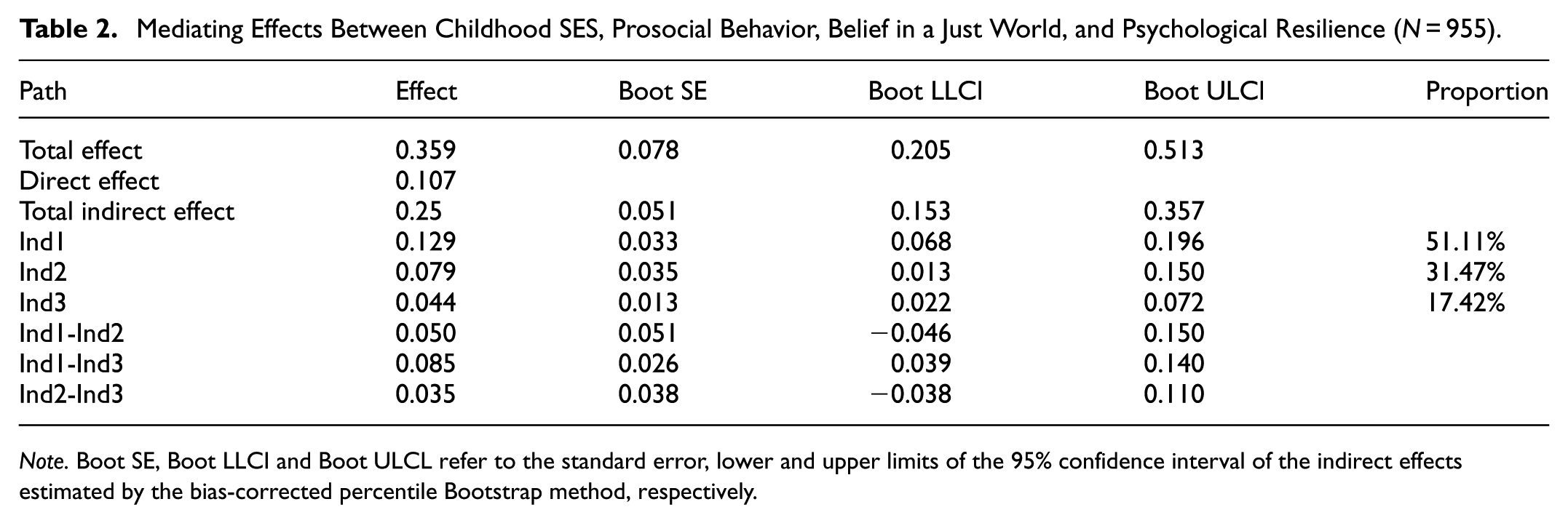
Note. Boot SE, Boot LLCI and Boot ULCL refer to the standard error, lower and upper limits of the 95% confidence interval of the indirect effects estimated by the bias-corrected percentile Bootstrap method, respectively.
Three specific indirect pathways were evaluated. The SES → prosocial behavior → resilience pathway was significant (indirect effect = 0.129, 95% CI [0.068, 0.196]), accounting for 51.110% of the total indirect effect. The SES → just world beliefs → resilience pathway was also significant (indirect effect = 0.079, 95% CI [0.013, 0.150]), accounting for 31.470%. Finally, the serial SES → prosocial behavior → just world beliefs → resilience pathway was significant (indirect effect = 0.044, 95% CI [0.022, 0.072]), accounting for 17.420% of the total indirect effect. We conducted comparisons between these three indirect effects to test if any pathway was significantly stronger than the others. These pairwise comparisons revealed no significant differences between the magnitudes of these indirect effects, indicating that all three pathways contributed similarly to the relationship between SES and psychological resilience.
In summary, bootstrap results provide strong evidence that prosocial behavior and just world beliefs significantly mediate the relationship between childhood SES and psychological resilience. This occurred through two single mediator pathways and one serial multiple mediator model as shown in Figure 2. Higher SES was associated with greater resilience both directly and indirectly by fostering prosocial tendencies and just world beliefs. The substantial indirect effects highlight the importance of these mediating mechanisms.

The chain mediation model.
Discussion
The present study aimed to investigate the direct and indirect pathways through which family economic status influences psychological resilience among college students. The results provide support for our hypotheses and shed light on the mediating roles of prosocial tendencies and belief in a just world. As predicted, higher family economic status was directly associated with greater psychological resilience, highlighting the protective role of socioeconomic resources in promoting positive adaptation (
Childhood Socioeconomic Status and Psychological Resilience
The present study sought to investigate the relationship between childhood socioeconomic status (SES) and psychological resilience among college students. Our findings robustly support the hypothesis that higher childhood SES is positively associated with greater psychological resilience in young adulthood. This result aligns with the Family Stress Model (Conger et al., 2010; Masarik & Conger, 2017) and Resource Dilution Model (Downey, 1995) that we introduced in our theoretical framework.
Consistent with the Family Stress Model, the direct effect of childhood SES on psychological resilience underscores how economic advantages reduce family stress and create environments conducive to resilience development. Growing up in a financially stable household ensures access to essential resources, such as quality education, healthcare, and extracurricular activities, that enhance the development of cognitive, social, and emotional skills vital for resilience (Duncan & Murnane, 2011). Moreover, as suggested by the Resource Dilution Model, higher SES families possess the means to provide these resources without dilution, fostering secure attachment, autonomy, and self-efficacy, which are fundamental components of resilience (Masten & Narayan, 2012).
The relationship between childhood SES and resilience is inherently complex and multifaceted. While our study emphasizes the positive influence of higher SES, it does not suggest that individuals from lower SES backgrounds are incapable of developing resilience. Indeed, research indicates that some individuals from disadvantaged backgrounds exhibit remarkable resilience, often driven by protective factors such as strong social support, positive parenting, and personal traits like grit and determination (Werner & Smith, 2001).
This study provides empirical evidence for the direct relationship between childhood SES and psychological resilience in college students. While higher SES appears to confer significant benefits for resilience, it is crucial to acknowledge the complexity of this relationship and the potential for resilience development among individuals from diverse socioeconomic backgrounds. By highlighting the role of childhood SES in shaping psychological resilience, our findings underscore the importance of addressing socioeconomic disparities and implementing policies and interventions that support the well-being of children from disadvantaged backgrounds.
The Mediating Role of Prosocial Behavior
One of the key findings of our study is the mediating role of prosocial behavior in the relationship between childhood socioeconomic status (SES) and psychological resilience. Our results indicate that higher childhood SES is associated with increased engagement in prosocial behaviors, which subsequently enhances resilience among college students. This finding aligns with our theoretical framework, particularly the Bioecological Theory (Bronfenbrenner & Morris, 2006) and Broaden-and-Build Theory (Fredrickson, 2001, 2013) that we proposed in our hypothesis development.
As predicted by Bioecological Theory, the mediating effect of prosocial behavior demonstrates how socioeconomic contexts shape developmental processes through proximal interactions. Individuals from higher SES backgrounds have access to more opportunities for prosocial engagement, including volunteering, community service, and participation in extracurricular activities that foster empathy, cooperation, and a sense of social responsibility (Lareau, 2018). These opportunities represent the kind of positive microsystem interactions that Bronfenbrenner’s theory suggests are crucial for positive development.
Further supporting our theoretical framework, the findings demonstrate the mechanisms proposed by the Broaden-and-Build Theory. Engaging in prosocial behaviors enables individuals to experience positive emotions that broaden their thought-action repertoires and build enduring psychological resources critical for resilience (Fredrickson, 2001). These prosocial experiences help individuals develop supportive relationships, a sense of purpose, and enhanced coping skills, all of which are essential components of resilience (Masten, 2014). The positive emotions generated through prosocial engagement create upward spirals of positivity that facilitate adaptive responses to adversity, as the theory suggests.
The relationship between SES, prosocial behavior, and resilience is not deterministic. Individuals from lower SES backgrounds can also develop prosocial tendencies and demonstrate resilience, often through alternative pathways such as strong family bonds, religious or cultural values, and community support (Ungar, 2012). Our study illuminates the mediating role of prosocial behavior in the relationship between childhood SES and psychological resilience. Through engagement in prosocial behaviors, individuals from higher SES backgrounds may develop social competence, empathy, and supportive relationships that contribute to resilience, consistent with our theoretical framework.
The Mediating Role of Belief in a Just World
Another significant finding of our study is the mediating role of belief in a just world (BJW) in the relationship between childhood socioeconomic status (SES) and psychological resilience. Our results demonstrate that higher childhood SES is linked to a stronger belief in a just world, which subsequently enhances resilience among college students. This finding is consistent with the System Justification Theory (Jost et al., 2004; Jost & Banaji, 1994) and Meaning-Making Model (C. L. Park, 2010) that we proposed in our theoretical framework.
As predicted by System Justification Theory, individuals from higher SES backgrounds develop stronger just world beliefs as they are motivated to perceive existing social systems and arrangements as fair and legitimate. Our findings support this theoretical proposition, showing that childhood socioeconomic advantage is associated with stronger BJW. This theory helps explain why individuals from privileged backgrounds tend to endorse beliefs that justify and legitimize existing social hierarchies, including the belief that the world operates according to principles of justice and fairness.
Complementing this perspective, the Meaning-Making Model (C. L. Park, 2010) that we introduced earlier helps explain how BJW contributes to resilience. According to this model, BJW aids individuals in making sense of their experiences and maintaining a sense of control and predictability in their lives. Growing up in a higher SES environment likely provides more opportunities for positive and equitable experiences, thereby reinforcing the belief that the world is just (Furnham, 2003). In turn, this belief fosters trust, optimism, and confidence in one’s ability to cope with challenges, which are essential components of resilience (Wu et al., 2011). The Meaning-Making Model suggests that these beliefs help individuals derive meaning from negative experiences and construct coherent narratives that facilitate adaptation—exactly the pattern our mediation analysis revealed.
It is important to note that the relationship between SES, BJW, and resilience is complex and may vary across different cultural and social contexts. Individuals from disadvantaged backgrounds can also develop a strong BJW as a coping mechanism to rationalize their experiences and sustain hope for the future (Furnham, 2003). Our study provides evidence for the mediating role of BJW in the relationship between childhood SES and psychological resilience, supporting the theoretical frameworks that guided our hypothesis development.
The Serial Mediation Pathway
A key contribution of our study is the identification of a serial mediation pathway linking childhood socioeconomic status (SES) to psychological resilience through prosocial behavior and belief in a just world (BJW). This finding suggests that the relationship between childhood SES and resilience is not solely direct but is also mediated by a sequence of psychosocial processes that shape an individual’s social interactions and worldviews. The serial mediation model posits that higher childhood SES facilitates the development of prosocial behavior, which in turn strengthens BJW, ultimately leading to greater psychological resilience.
This pathway integrates the multiple theoretical frameworks we proposed in our hypothesis development. Consistent with Bioecological Theory (Bronfenbrenner & Morris, 2006), our findings demonstrate how growing up in a higher SES environment provides more opportunities for positive social interactions and access to prosocial role models, thereby promoting the development of prosocial skills and values (Eisenberg et al., 2015). The subsequent link between prosocial behavior and BJW aligns with the self-perception theory (Bem, 1972) we mentioned in our theoretical framework, which suggests that individuals infer their attitudes and beliefs from observing their own behavior. Engaging in prosocial behavior reinforces the belief that the world is just and orderly, as individuals experience the rewards and reciprocity associated with helping others (Bègue, 2014).
The final link in our serial mediation model—from BJW to resilience—supports the Meaning-Making Model (C. L. Park, 2010) we outlined earlier. This belief in a just world provides individuals with a sense of meaning, control, and optimism, which facilitates effective coping and resilience in the face of adversity. The entire pathway illustrates how the various components of our theoretical framework work together in a coherent sequence to explain resilience development.
The serial mediation pathway highlights the intricate interplay between structural factors (e.g., SES), individual behaviors (e.g., prosocial behavior), and cognitive beliefs (e.g., BJW) in shaping resilience outcomes. It suggests that interventions aimed at promoting resilience should adopt a holistic approach, addressing not only socioeconomic conditions but also the psychosocial processes that link these conditions to individual well-being (Ungar, 2012). Our study reveals a serial mediation pathway linking childhood SES to psychological resilience through prosocial behavior and belief in a just world, underscoring the importance of considering the complex interplay of structural, behavioral, and cognitive factors in shaping resilience outcomes.
Theoretical Contribution
The findings of this study substantially advance the theoretical understanding of resilience development by clarifying the intricate mechanisms through which childhood socioeconomic status (SES) influences psychological resilience. By highlighting the roles of prosocial behavior and belief in a just world as key mediating mechanisms, our study provides empirical support for the theoretical frameworks that guided our hypothesis development.
First, our findings extend the Family Stress Model (Conger et al., 2010) and Resource Dilution Model (Downey, 1995) by demonstrating not only the direct effects of socioeconomic resources on resilience but also the psychosocial pathways through which these effects operate. The identification of prosocial behavior as a mediator aligns with Bioecological Theory (Bronfenbrenner & Morris, 2006), illustrating how socioeconomic contexts shape developmental processes through their influence on social interactions and opportunities. Similarly, the mediating role of just world beliefs supports System Justification Theory (Jost & Banaji, 1994), demonstrating how socioeconomic privilege shapes worldviews that subsequently influence adaptation to adversity.
The Broaden-and-Build Theory (Fredrickson, 2001, 2013) receives particular support from our findings on prosocial behavior. The results suggest that prosocial engagement generates positive emotions and builds psychological resources that enhance resilience, creating the upward spirals of positivity that the theory proposes. Similarly, the Meaning-Making Model (C. L. Park, 2010) is advanced by our findings on just world beliefs, demonstrating how these beliefs help individuals make sense of their experiences and maintain a sense of control and predictability that facilitates resilience.
Perhaps most significantly, the serial mediation pathway we identified integrates these theoretical perspectives into a cohesive developmental sequence. This pathway suggests that socioeconomic contexts shape prosocial behavior, which subsequently influences just world beliefs, ultimately contributing to resilience. This finding illustrates how the various theoretical frameworks we proposed work together in a coherent manner to explain the complex relationship between SES and resilience.
Our theoretical contributions have important implications for interventions aimed at promoting resilience, particularly among individuals from disadvantaged backgrounds. By identifying specific psychosocial processes that mediate the relationship between SES and resilience, our study suggests potential targets for intervention. Programs that create opportunities for prosocial engagement and foster adaptive belief systems may be particularly effective in enhancing resilience across diverse socioeconomic contexts.
Our study advances theoretical understanding of resilience development by elucidating the complex pathways through which socioeconomic factors influence psychological adaptation. By providing empirical support for our theoretical framework and identifying specific mediating mechanisms, this research contributes to a more nuanced and comprehensive model of resilience that acknowledges the interplay of structural, behavioral, and cognitive factors in shaping developmental outcomes.
The findings from this study have particular practical significance within the Chinese educational and social context. As China continues to experience rapid economic transformation and widening socioeconomic disparities, understanding the mechanisms that promote resilience across the socioeconomic spectrum becomes increasingly vital. The strong mediating role of belief in a just world in our results resonates with traditional Chinese cultural emphases on effort (努力) and acceptance of one’s circumstances, suggesting that resilience-building programs in Chinese schools might be particularly effective when they incorporate these cultural elements. Furthermore, the identified relationship between prosocial behavior and resilience offers practical direction for China’s recent educational reforms, which increasingly emphasize moral education and character development alongside academic achievement. School-based interventions that create opportunities for meaningful prosocial engagement may be especially valuable in the Chinese context, where collectivistic values traditionally emphasize social harmony and mutual assistance.
Limitations and Further Study
Despite the methodological strengths of our study, including the use of well-established measures and advanced statistical techniques that allowed us to disentangle complex mediation relationships (Hayes, 2017; Vanderbilt-Adriance & Shaw, 2008), several important limitations should be acknowledged. The cross-sectional design precludes causal inferences about the relationships between family economic status, prosocial behavior, belief in a just world, and psychological resilience, as the temporal sequence cannot be established with certainty. Our reliance on self-report measures may have introduced common method bias and social desirability effects, with participants potentially reporting higher levels of prosocial behavior or resilience to present themselves favorably (Podsakoff et al., 2003). Additionally, retrospective reports of childhood SES may be subject to recall bias. Furthermore, our sample of college students from a specific cultural context limits generalizability to other populations, particularly those from extremely disadvantaged backgrounds who did not access higher education or those from different cultural settings where prosocial behavior, just world beliefs, and resilience may be conceptualized differently.
Future research should address these limitations through longitudinal designs that track individuals from childhood through young adulthood to establish temporal sequence and causality in the relationships we observed. Incorporating multiple methods and informants—such as behavioral observations of prosocial behavior, objective SES indicators, and daily diary methods—would strengthen measurement validity and provide more ecological insights into resilience processes (Bolger et al., 2003). Studies should also examine these relationships across diverse populations, including different age groups, cultural contexts, and socioeconomic strata, with particular attention to severely disadvantaged individuals who may develop resilience through alternative pathways. Additionally, researchers should explore moderating variables such as parenting styles (Armstrong et al., 2005), individual temperament, and community resources that may influence the pathways identified in our model. Examining these multilevel influences would provide a more comprehensive understanding of resilience development and inform targeted interventions and policies to promote positive outcomes across diverse socioeconomic contexts.
Conclusion and Recommendation
Conclusion
This study significantly advances our understanding of how childhood socioeconomic status influences psychological resilience through both direct and indirect pathways involving prosocial behavior and belief in a just world. Higher socioeconomic advantage was associated with greater resilience not only directly but also indirectly by fostering prosocial tendencies and perceptions of the world as fair and just. The significant serial mediation pathway underscores the interplay between economic resources, prosocial acts that reinforce just world beliefs, and resilience development through adaptive meaning-making and coping mechanisms.
Our findings contribute to the theoretical literature by integrating perspectives from the Family Stress Model, Resource Dilution Model, Bioecological Theory, and Meaning-Making Model into a cohesive framework that explains how socioeconomic factors shape resilience through multiple pathways. The results demonstrate that while economic resources directly benefit resilience development, they also operate through important psychosocial mechanisms that can potentially be targeted through intervention. This integrated understanding enriches both resilience theory and developmental science more broadly by illuminating the complex interplay between structural factors and individual psychological processes.
These findings highlight the critical importance of promoting prosocial values, creating opportunities for prosocial engagement, cultivating adaptive beliefs, and addressing socioeconomic disparities to enhance resilience across diverse backgrounds. Recognizing these multiple pathways suggests that multi-component interventions addressing both socioeconomic constraints and psychosocial processes may be particularly effective for supporting positive youth development. While further research is necessary to address methodological limitations and explore cultural variations in these relationships, this study clarifies the complex interactions between socioeconomic factors, social-cognitive processes, and resilience trajectories, thereby informing evidence-based approaches to reducing resilience disparities associated with economic inequality.
Policy Recommendation
Drawing from our empirical findings on the mediating roles of prosocial behavior and belief in a just world, we propose targeted recommendations for enhancing psychological resilience, particularly among socioeconomically disadvantaged youth.
First, educational institutions should implement integrated interventions that combine prosocial skill development with cognitive-behavioral programs. These interventions should incorporate empirically validated components such as empathy training, cooperative learning activities, and attributional retraining techniques (Caprara et al., 2014; Eisenberg et al., 2015). For example, schools might adopt service-learning curricula that combine community engagement with structured reflection on social justice concepts, or peer mentoring programs that develop both prosocial skills and constructive belief systems. The dual focus on prosocial behavior and belief system development aligns with our findings on serial mediation pathways and promises enhanced effectiveness in resilience promotion (Yeager et al., 2019).
Second, family support programs should emphasize both economic resource management and psychological support strategies. These programs should include parent education components focusing on fostering prosocial behavior within family contexts and developing adaptive belief systems through parent-child interactions. For instance, programs might teach parents how to model prosocial behaviors, discuss concepts of fairness and justice in age-appropriate ways, and create opportunities for children to experience the positive outcomes of helping behaviors. This two-pronged approach addresses both the socioeconomic and psychological aspects of resilience development identified in our mediation analyses.
Third, community-based interventions should focus on creating supportive environments that facilitate resilience development through structured prosocial engagement opportunities while providing resources to address socioeconomic challenges (Wu et al., 2011). Community centers might offer youth volunteer programs paired with mentorship from successful community members, creating experiences that simultaneously develop prosocial skills and foster adaptive belief systems. These interventions should be implemented with regular monitoring using multi-method assessment approaches to ensure effectiveness and allow for adaptive modification based on empirical feedback.
By targeting the specific psychosocial mechanisms identified in our research—namely, prosocial behavior and belief in a just world—these recommendations offer evidence-based approaches to enhancing resilience across socioeconomic contexts. Importantly, while these interventions can help mitigate the impact of economic disadvantage on resilience, they should complement rather than replace broader policy efforts addressing structural economic inequalities that create disparities in the first place.
Footnotes

Ethical Considerations
Prior to commencement, approval was obtained from the Ethics Committee of the Sichuan Psychological
Funding
The authors disclosed receipt of the following financial support for the research, authorship, and/or publication of this article: This study is Supported by the Chengdu Medical College Sichuan Research Center of Applied Psychology project “Study on the influence of Internet celebrity economy on college students’ belief in a just world” (CSXL-21303), the Research on Psychological “Fatigue” Identification and Intervention Strategies for University Students Based on Traditional Chinese Medicine Emotion Theory (Grant No. GX25B004-2025) under the Sunflower University Student Mental Health Promotion Project, and the Research on Traditional Chinese Medicine Emotion-Based Identification and Mindfulness Intervention for University Students' Psychological Burnout (Grant No. FDYZD2025006) from the 2025 Chengdu University of Traditional Chinese Medicine “Xinglin Scholar” Project.
Declaration of Conflicting Interests
The authors declared no potential conflicts of interest with respect to the research, authorship, and/or publication of this article.
Data Availability Statement
The data that support the findings of this study are available from the corresponding author upon reasonable request.