




Abstract
In China, with the continuous advancement of urbanization, the size of the migrant population has significantly increased along with the challenging environments faced by them, drawing widespread societal attention to the parenting stress experienced by young children’s migrant parents. However, research on the mechanisms underlying the factors influencing such stress remains scarce. Therefore, based on the ABCX model of family crisis, this study investigates the relationships and underlying mechanisms among family socioeconomic status (SES), perceived social support, psychological resilience, and parenting stress using a sample of 2,533 migrant parents of preschool children in Guangdong Province, China. The results indicate that family SES negatively predicts the parenting stress of migrant parents of preschool children in China. Additionally, perceived social support and psychological resilience play a sequential mediating role in the relationship between family SES and parenting stress. This study provides valuable insights for government departments, social service agencies, and migrant families in exploring strategies to alleviate the parenting stress of preschool children’s migrant parents.
Keywords
Introduction
In China, migrant parents of preschool children are classified as those who have lived outside their registered household location for at least 6 months; may not yet have acquired urban citizenship (National Bureau of Statistics, 2018), and their children are between the ages of 3 and 6 years. In China, the migrant population is significantly affected by the household registration system (hukou). When migrant families relocate outside their registered household location, both migrant children and their parents cannot attain the same status as local urban residents. Consequently, they do not have equal access to education, healthcare, and other public services, which creates additional challenges for these families. In the past decade, with China’s continued urbanization, the migrant population has increased at an alarming rate, from 230 million in 2012 to 376 million in 2020—26.6% of China’s 1.41 billion population (National Bureau of Statistics, 2021). Most family mobility is the result of difficult circumstances, such as prolonged separation between husband and wife and children, lack of employment opportunities for parents of migrant families, incarceration of fathers, precarious housing tenure, and the family’s financial difficulties; this results in family members being forced to engage in mobility migration (Sampson & Sharkey, 2008).
Parenting stress is the result of their personality qualities, the relationship between them and their children, their children’s characteristics, and other aspects of their family environment that affect how they perform their job as parents and interact with their children (S.-T. Li et al., 2017). Frequent changes in living spaces and multiple breaks in social networks lead to adverse changes in individuals’ social environments (Fomby & Sennott, 2013). Additionally, the socioeconomic status (SES) of most young children’s migrant parents is not optimistic, and they face challenges such as meager income, low levels of education, and unreasonable working hours (Wong et al., 2007). All these challenges may lead to an increase in parenting stress. When they begin to feel anxious about not having enough time to take care of their children or enough money for education to promote their children’s development (León-Pérez et al., 2021), they are more likely to adopt negative parenting styles; this can lead to parent-child conflict (Raver, 2003)and increase children’s behavioral problems (Q. Chen et al., 2019), thus generating parenting stress. At the same time, parents of migrant children are influenced by traditional culture and values, and to help their children learn cooperation, obedience, and self-control (X. Y. Chen & French, 2008) in the place of migration, they are more likely to derive parenting characteristics that emphasize children’s dependence on their parents and obedience to parental authority (C. H. C. Wang & Phinney, 1998), which is not conducive to developing positive parent-child relationships. Their parenting approaches will lead to more parenting stress; not helpful for the growth of healthy parent-child interactions. Against this background, the childcare pressure faced by the migrant parents has received increasing attention, and the state’s call to alleviate childcare pressure on the parents has been widely supported by all sectors of society.
Parenting stress is influenced by various factors, including individual and societal. Family SES can affect parents’ abilities and social resources (Conger et al., 2011), which may further affect parenting stress (Kakhki et al., 2022; Maguire-Jack & Wang, 2016). However, to the best of my knowledge, in China, how the family SES of migrant parents affects parenting stress through societal and individual factors remains unclear. Therefore, this study is primarily concerned with the mechanisms underlying the relationship between familial SES and parenting stress among the primary caregivers of migrant preschool children. According to the theory of the ABCX family crisis model, the family system experiences stress or crisis (factor A), and its coping resources (factor B) and the family’s cognitive quality of the stressful event (factor C) likely affect the degree of family stress (factor X; Hill, 1958). In this study, migrant parents’ parenting stress (factor X) is triggered by family SES (factor A), which includes parental education level, occupation, and household income. It is also influenced by perceived social support (factor B), which encompasses support from family, friends, and other sources, as well as psychological resilience (factor C), which reflects the parents’ mental state and adaptability in the face of family crises. Therefore, when the family SES is a source of parenting stress, we explore the extent of its influence, reveal the intervention pathways of perceived social support and psychological resilience to parenting stress, and provide more comprehensive recommendations for reducing the parenting stress faced by young children’s migrant parents.
Literature Review
Family Socioeconomic Status and Parenting Stress
Family SES is a concept that represents a family’s social status and class attributes. It considers family income, parents’ occupation, and parents’ education level as objective measurement criteria (Bradley & Corwyn, 2002). A growing body of research has indicated that parents with low family SES encounter obstacles in accessing sufficient social resources to enhance family cohesion. Owing to their low income and low education, most of them do not have stable full-time jobs and good health, are more likely to be migrants, and worry about family economic problems (Parkes et al., 2015). This leads to intensified family conflicts, damaged parent-child relationships, and more parenting challenges and stress in the process of raising children (Teng et al., 2018). However, improving the family’s social status, creating a favorable working environment, and increasing the family’s economic income allows to moderate parent-child conflict and increase family intimacy, alleviating parenting stress (Conger & Donnellan, 2007). Therefore, we propose
The Potential Mediating Effect of Perceived Social Support
The term “perceived social support” describes an individual’s subjective feelings and evaluations of the support they receive from family, friends, or other sources (Chou, 2000). It can help individuals build self-confidence to face difficulties, solve problems, and enhance resilience and capacity to navigate and overcome adversity (Klink et al., 2008). The more social support parents perceive in parenting, the more they tend to establish good parent-child interactions for better parenting outcomes (Yan et al., 2023). Perceived social support may mediate the relationship between family SES and parenting stress. On one hand, it is more likely to be higher in families with higher SES (Jiang et al., 2020). Individuals’ capital defines their social trajectories, life opportunities, and possibilities (Bourdieu, 1989). As individuals accumulate more capital and attain higher family SES, they likely incur higher social support. Therefore, when parents with higher SES accumulate more social support, the stronger the subjective feeling of being able to gain social support, the higher the level of perceived social support. On the other hand, perceived social support can also alleviate parental stress. The risk-resource balance theory explains this phenomenon. It posits that parenting burnout emerges when parents lack sufficient resources to cope with stress, amplifying parental stress (Mikolajczak & Roskam, 2018). Perceived social support, as a social resource available to parents, plays a role in alleviating the level of parenting stress in parents of preschool children (Zhao et al., 2021) and reduces its risk (Driver & Shafeek Amin, 2019). In conclusion, perceived social support may serve as a potential mediator between family SES and parenting stress among the migrant parents of toddlers in China. Therefore, we propose
The Potential Mediating Effect of Psychological Resilience
Psychological resilience is an individual’s acquisition of social capacity, meaning that a person exposed to great adversity will not experience significantly negative developmental outcomes (Fergus & Zimmerman, 2005). Not only does it pertain to people’s adaptability, but it also affects their mental health (H. Cao et al., 2022) and quality of life (Tang et al., 2022). Parents’ psychological resilience levels directly affect their attitudes and behaviors in the face of parenting problems; the greater a parent’s level of psychological resilience, the more conducive they are to fulfilling their parental roles and forming a positive relationship with their child, which improves family intimacy (Russell et al., 2022). Psychological resilience may be a mediator in the relationship between family SES and parenting stress. First, family SES influences parental psychological resilience. Transformations in SES can result in alterations to an individual's emotional, cognitive, and physical functioning (Conger & Donnellan, 2007). Moreover, a decline in economic status may pose greater challenges to a family’s ability to develop resilience to adversity and reduce parent’ psychological resilience (Nam & Kim, 2022). Second, psychological resilience may negatively predict parenting stress, and directly influence the trajectory of daily parenting stress. When parents exhibit high levels of psychological resilience in their ability to effectively navigate the interplay between financial challenges and parenting stress by fostering enhanced communication with their family members, they develop good marital adjustment and positive parent-child relationships (Gerstein et al., 2009). This helps individuals reduce stress, overcome the negative consequences of parenting stress, and promote effective parenting (Taylor et al., 2012). Consequently, psychological resilience serves as an additional potential mediator in the correlation between family SES and parental stress experienced by migrant parents with young offspring in China. Therefore, we propose
The Potential Chain-Mediating Effect of Perceived Social Support and Psychological Resilience
Psychological resilience reflects the social adaptability that a person exhibits in the face of adversity, and social support serves as a protective factor of psychological resilience, furnishing individuals with sufficient environmental resources to cope with severe stress and facilitating the growth of their psychological resilience (X. Wang et al., 2014). Psychological resilience is influenced by perceived social support, and a positive correlation exists between them (Dey & Amponsah, 2020). When individuals perceive greater social support, they are better able to alleviate stress and trauma through communication and interaction in social environments, which enhances their psychological resilience (Huang et al., 2020). Compared to actual social support, perceived social support has a greater impact on vulnerable populations’ mental health (Shi, 2022). This finding implies that parents with reliable support resources are more resilient in the face of adversity and more likely to increase their psychological resilience. Thus, parents with low family SES may experience more parenting stress because of their perceived lack of social support, which affects their level of psychological resilience. In contrast, parents with high family SES may continuously increase their psychological resilience owing to the availability of more perceived social support, which reduces parenting stress. Thus, perceived social support and psychological resilience act as a sequential mediating mechanism in the correlation between SES and parental stress experienced by the migrant parents of preschool children in China. Therefore, we propose
The Present Study
The current research has laid a foundation for understanding the interrelationships among family SES, perceived social support, psychological resilience, and parenting stress among migrant parents. However, several limitations remain to be addressed. First, in terms of research subjects, most existing studies have focused on young children and their parents, with insufficient attention given to migrant populations. Second, while prior research has identified pairwise correlations among family SES, perceived social support, psychological resilience, and parenting stress, studies examining the comprehensive mechanisms involving all four variables are lacking. Finally, the existing research has not sufficiently utilized theoretical frameworks—particularly the ABCX model of family crisis—to elucidate the extent to which family SES influences parenting stress among migrant parents and reveal the intervention pathways of perceived social support and psychological resilience on parenting stress. Based on this analysis, this study focuses on the migrant parents of young children and employs the ABCX model of family crisis as its theoretical foundation to explore whether the relationship between family SES and parenting stress among the migrant parents of preschool children in China is influenced by the chain mediation effects of perceived social support and psychological resilience.
Therefore, the following four research hypotheses were proposed: (a) family SES has a negative predictive value for the parenting stress reported by the migrant parents of preschool children in China; (b) family SES is an indirect predictor of parenting stress among these parents, operating via its influence on perceived social support; (c) family SES can serve as an indirect predictor of parenting stress in these parents, operating through the intermediary role of psychological resilience; and (d) family SES serves as a promising indicator for predicting parental stress experienced by these parents, operating through a sequential mediating mechanism involving perceived social support and psychological resilience.
Methods
Participants and Procedure
This study employed a convenience sampling method within a cross-sectional survey design, selecting multiple kindergartens across Guangdong Province in southern China, including cities such as Guangzhou, Shenzhen, and Foshan, where a significant population of migrant children is concentrated.
As this study involved human participants, in order to limit the risk of harm to the study participants, this study was reviewed and approved by the ethics committee of the author’s institution prior to data collection, and subjects were informed that no monetary compensation was provided for this study and that participation was completely anonymous and voluntary. In this study, through the research assistant’s explanatory notes, participants were able to understand that the study was for academic purposes only, and that it would be of great significance for the improvement of the subjects’ personal parenting stress situation as well as for raising society’s awareness of the problems of the mobile group, which shows that the potential benefits of this study to society and the research participants outweighed the risk of harm to the research participants. Meanwhile, we also explained the contents of the informed consent form and the detailed instructions for filling out the questionnaire to each participant online, and obtained the unanimous consent of the research participants.
The questionnaires were distributed and collected by research assistants through an online survey platform. A total of 2,670 questionnaires were distributed to migrant parents. Invalid responses were screened based on completion time (e.g., excluding responses that were excessively long or short) and response patterns (e.g., removing samples with obvious random answers, such as those selecting the same option throughout). After applying these screening criteria, 2,533 valid questionnaires were retained, yielding a response rate of 94.9%. Among the participants, 2,050 were female (80.9%), and 483 were male (19.1%). 1dollar=6.9774 yuan. Detailed information about the sample is presented in Table 1.
Demographic Characteristics of Participants (N = 2,533).

Measures
Family Socioeconomic Status
Measurement of family SES was carried out considering the parental occupation, parental education level, and family’s income as the primary indicators (Bradley & Corwyn, 2002). Family’s income was determined on the basis of the annual household income, and was divided into six grades with a score of 1 to 6. For measuring parental occupation and education, they were divided into five levels and the scores 1 to 5 were assigned, respectively. Higher scores indicated higher family SES, and lower scores indicated lower family SES. In this study, parental occupation, education level, and annual family’s income were converted into standard scores for statistical analysis of the measurement indicators of the SES of migrant preschool children’s families.
Parenting Stress
The Parenting Stress Scale (PSI/SF), which was developed by Abidin to measure parenting stress (Abidin, 1995). It is a 5-point Likert-type scale with 36 items and scores ranging from “strongly disagree” (1) to “strongly agree” (5). The scale included three dimensions: Parental distress, Parent-child dysfunctional interaction, and the perception of the child as a “difficult child,” and each dimension comprised 12 questions. Scores on all items were summed to obtain the total score. Higher scores indicated that parenting stress was more significant. The scale demonstrated good reliability and validity in China (Si et al., 2020), with Cronbach’s α coefficient of .91.
Perceived Social Support
The Perceived Social Support Scale was developed by Zimet (Zimet et al., 1990). The scale is employed for the purpose of measuring the degree of perceived social support experienced by individuals. It is a 7-point Likert-type scale with 12 items, with scores ranging from: “does not conform completely” (1) to “completely in line with” (7). This scale comprises three dimensions: family support, friend support, and other support (leaders, relatives, and colleagues). Higher scores indicate a greater perception of social support. It has good reliability and validity in China (Han et al., 2021). The Cronbach’s α coefficient of the scale was .83.
Psychological Resilience
The Psychological Resilience Scale (ER89) created by Block and Kremen, was employed as the assessment tool (Block & Kremen, 1996). This scale is mainly designed for adults. The 14 items are of 4-point Likert-type with scores ranging from “strongly disagree” (1) to “strongly agree” (4). The scale is not divided into dimensions. The overall score was calculated by aggregating the individual scores for each item. Higher scores indicated stronger psychological resilience. The reliability and validity of this scale were demonstrated to be satisfactory in a sample of Chinese subjects (Q. Liu et al., 2021). The Cronbach’s α coefficient of the scale was .90.
Data Analysis
First, we used SPSS version 22.0 to calculate the frequency and percentage for describing the demographic characteristics of the respondents. Second, A Spearman correlation analysis was conducted to examine the correlation among all variables. Furthermore, the Harman single-factor test was employed for the purpose of controlling for common method bias and for hypothesis testing. Third, in the current study, we employed Mplus 8.3 to assess the hypothetical model. As a solution to the issue of the latent variable comprising numerous observed indexes, the approach put forth by Matsunaga (Matsunaga, 2008) was considered, the items of psychological resilience were parceled into two dimensions by using factorial algorithm. To evaluate the overall model fit, a number of appropriate indices were utilized. Previous researchers (Hu & Bentler, 1999) noted that χ2/df (<3), TLI (≥0.95), CFI (≥0.95), RMSEA (<0.06), and SRMR (<0.08) reflect a good fit. In light of the extensive data set, it was deemed inappropriate to employ the Chi-square test as a benchmark for model construction in this study. Finally, to determine the significance of the mediating effects, bootstrap methods incorporating robust standard errors were employed. This bootstrap procedure generated 95% bias-corrected confidence intervals (CIs) for the effects by utilizing a resampled dataset consisting of 5,000 iterations (Shrout & Bolger, 2002). The indirect effects were deemed statistically significant if the CIs did not encompass zero. All statistical analyses were conducted using two-tailed tests.
Results
Common Method Bias
All four primary variables in this study were derived from self-reports by migrant parents of young children. To ensure the objectivity and reliability of the data, we emphasized the anonymity and confidentiality of the questionnaire before distributing it to the participants. After data collection, we employed Harman’s single-factor test to examine the potential for common method bias. The results indicated that the eigenvalues of the 10 factors were all greater than 1.0. Furthermore, the first factor accounted for 23.395% of the variance, which is well below the critical threshold of 40%. These findings suggest that significant common method bias does not pose a substantial threat to this study, thereby further ensuring the reliability of the research outcomes.
Descriptive Statistics and Correlation Analysis
The data in Table 2 present the statistical means and standard deviations for each variable, along with the correlations between the latent variables. Except that Parental Education had no significant correlation with the perception of the child as a Difficult Child, other key variables were significantly correlated with one another (ps < .01). The latent variables of family SES, perceived social support, and psychological resilience (observed variable) were negatively correlated with the latent variables of parents (rs < 0), while all other correlations were positive (rs > 0).
Descriptive Statistics and Correlations Among Variables (N = 2,533).

Note. PO = Parental Occupation, PE = Parental Education, FI = Family Incomes, PFS = Perceived Friend support, PMS = Perceived Family Support, POS = Perceived Other Support, PD = Parenting Distress, PR = psychological resilience, PCDI = Parent-Child Dysfunctional Interaction, DC = the perception of the child as a Difficult Child.
p < .01, the following are consistent.
Chain Mediation Analysis
A test of the chain mediation model was conducted, in which family SES served as the independent variable, perceived social support and psychological resilience as the mediators, and parenting stress as the dependent variable. The results showed that all model-fitting indexes met the standards: CFI = 0.978, TLI = 0.967, RMSEA = 0.053, SRMR = 0.031. In the total effect model, family SES had a significant predictive effect on the parenting stress of Chinese migrant preschool children’s parents (β = −.207, p < .001). The data results are consistent with hypothesis (a), giving further support to hypothesis (a). When perceived social support and psychological resilience were included, the effect of family SES on the parenting stress of Chinese migrant preschool children’s parents was still significant (β = −.107, p < .001), and family SES had significant effects on perceived social support (β = .182, p < .001) and psychological resilience (β = .070, p < .001). Additionally, the influence of subjective perceptions of social support on psychological resilience reached a notable level of significance (β = .540, p < .001). Similarly, perceived social support and psychological resilience had a significant effect on Chinese migrant preschool children’s parents (β = −.409, p < .001; β = −.078, p < .001). The chain mediation effect model and path relationship among variables are shown in Figure 1.

Chain mediation model indicating the mediating roles of perceived social support and psychological resilience in the association between family SES and parenting stress.
The Bias-Corrected Bootstrap methodology was utilized to assess the statistical significance of the direct and indirect mediation effects between familial SES and parenting stress, employing a sample size of 5,000. The total indirect effect was significant (95% CIs [−2.712, −1.750], see Table 3), accounting for 42% of the total effect of family SES on parenting stress. The indirect effect of family SES through perceived social support and psychological resilience was also significant (95% CIs [−0.148, −0.041]), accounting for 3.9% of the total effect of family SES on parenting stress. The data results are consistent with hypothesis (d), giving further support to hypothesis (d). Each mediation path had a notable impact on parenting stress. (95% CIs [−1.084, −0.657], [−0.122, −0.027]), accounting for 35.7% and 2.4% of the total effect of family SES on parenting stress, respectively. The data results are consistent with hypothesis (b) and hypothesis (c), giving further support to hypothesis (b) and hypothesis (c).
Chain Mediating Paths Between Family SES and Parenting Stress.
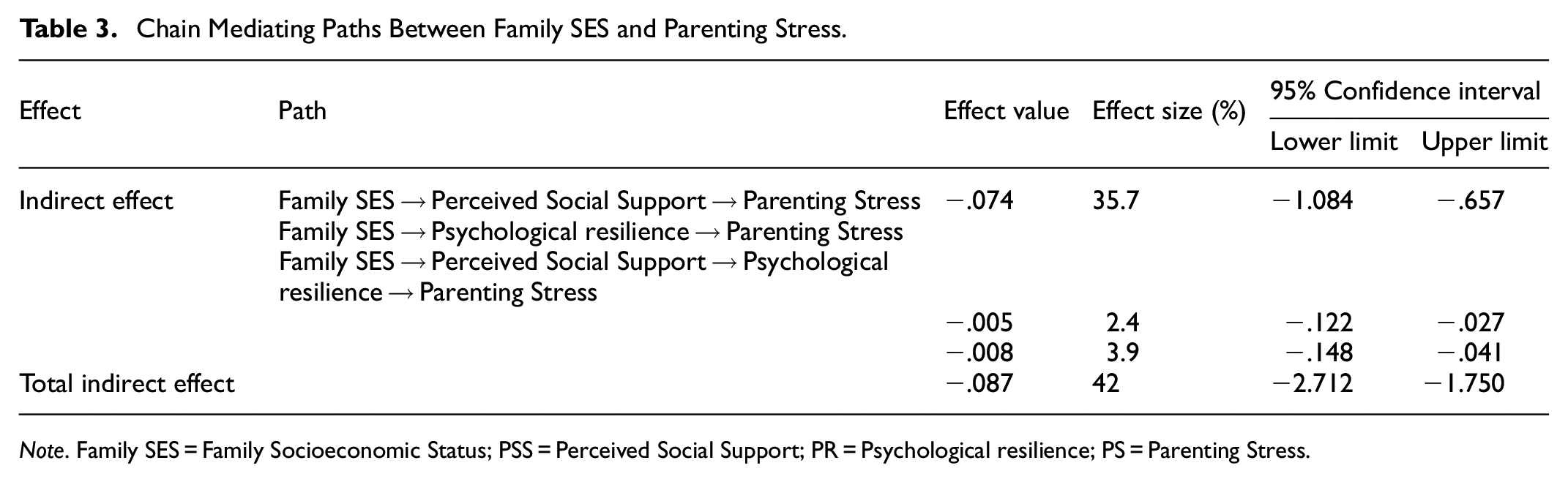
Note. Family SES = Family Socioeconomic Status; PSS = Perceived Social Support; PR = Psychological resilience; PS = Parenting Stress.
Discussion
The present study sought to examine the relationship between family SES and parenting stress in a cohort of young children’s migrant parents and to identify the potential mediating mechanisms underlying this relationship. Consistent with the hypotheses, the study identified two simple mediating effects: the first examines how perceived social support from the parents of children who are migrants from an early age impacts the relationship between family SES and parents’ stress. The second investigates how the psychological resilience of these parents affects that same relationship. Moreover, as hypothesized, the correlation between family SES and parental stress in young children’s migrant parents is mediated by a sequential process involving perceived social support and psychological resilience. These findings not only augment the existing literature on the nexus between family SES and parental stress within the migrant population of young children, but they also offer novel insights for prevention and intervention strategies targeting parental stress in this demographic.
Family SES and Parenting Stress
The present study demonstrated that family SES was a negative predictor of parenting stress in migrant families with young children (β = −.107, p < .001)—a result consistent with previous research. The migrant group is more likely to exhibit the qualities of low family income, unstable parental employment, and low education level, resulting in long-term low family SES (Gilman et al., 2003), Moreover, the SES of migrant families with toddlers is closely associated with parenting stress, which increases with the decrease in family SES (Teng et al., 2018); this substantiates the assertion that family SES constitutes a significant determinant of parenting stress among the migrant parents of young children. In this study, the meager income of toddlers’ migrant families can make parents feel economic pressure and foster negative emotions, resulting in dysfunctional parent–child interactions, which leads to poor parenting and parenting stress (Barnett, 2008). Meanwhile, the migrant parents do not usually have stable full-time jobs and work in industries that change frequently and have long daily working hours; this consumes much of their own energy, and a lack of energy in the parenting process resulting in parenting stress, which is more prevalent among this demographic (Roy et al., 2019). Additionally, in migrant families, parents are more likely to experience parenting anxiety and increase their own parenting stress because they know that education is a contributing factor in promoting children’s development (Fang et al., 2017). However, owing to their own low level of education, the parents lack the capacity to furnish their offspring with an appropriate level of educational assistance and direction in their pursuits (Nomaguchi & Brown, 2011).
The Mediating Effect of Perceived Social Support
The outcomes of the current investigation reveal that, for the migrant parents of young children, perceived social support partially acts as a mediator in the relationship between family SES and parenting stress. Moreover, it is identified as a paramount factor in reducing the parenting stress experienced by this cohort of parents. Social capital theory emphasizes that an individual’s capital determines their social trajectory, life opportunities, and possibilities (Bourdieu, 1989). As individuals accumulate more capital and achieve higher family SES, they are more likely to access greater social support to cope with parenting stress. Simultaneously, the risk-resource balance theory posits that when parents lack sufficient resources to manage stress, their stress accumulates and intensifies, leading to parenting burnout and heightened parenting pressure (Mikolajczak & Roskam, 2018). The establishment of positive parent-child relationships in families with low SES and economic hardship is inextricably linked to the high level of perceived social support available to parents (McConnell et al., 2011). Thus, the migrant group may perceive themselves as lacking a strong social support network owing to the restrictions imposed by the urban domicile, which prevents them from accessing the same resources of education and healthcare and social security as those in the place of entry (Chan, 1994), and are more prone to experiencing elevated degrees of stress in the processes of personal development and offspring parenting. In China, when the migrant parents of young children are at a disadvantage in terms of their family SES, they receive relatively less support from family, friends, or other sources (Y. Liu et al., 2019); this makes them even more deficient in their own perceived social support to mitigate the stress of parenting, and subsequently, they feel more helpless and anxious (Szkody & McKinney, 2019). For example, as families of migrant young children tend to focus on meeting their livelihood and material needs such as rent, food, clothing, and transportation, which consumes most of their energy, parents’ own spiritual needs are often neglected, and they find obtaining spiritual support from family members difficult. This leads to low family closeness, perceived inability to receive family support to raise their children, and increased parenting stress. Meanwhile, migrant parents of young children with low family SES generally choose to live in urban villages with lower rents (W. P. Wu, 2002); however, owing to their own mobility and exclusion from local residents, making friends is difficult for them (Dong & Blommaert, 2009), and they perceive that the support they can get from their friends decreases in the process of solving parenting challenges, while their own parenting stress increases. Additionally, because migrant groups work long daily hours in the workplace, with excessive physical commitment and insufficient objective support (Lu & Wang, 2013), the migrant parents have limited access to social resources in the process of parenting. This results in a decrease in perceived support from other sources and an increase in their own parenting stress. Therefore, when the family SES is low, and support from family, friends, and other sources decreases, the social support that parents of migrant children can perceive for themselves will continue to decrease, and parenting stress will gradually increase.
Mediating Effect of Psychological Resilience
The findings of the present study indicate that psychological resilience plays a partial mediating role in the relationship between family SES and parenting stress. Specifically, the lower the SES and psychological resilience level, the more the resilience of toddlers’ migrant parents decreases (M. Cao et al., 2021). This implies that the migrant parents of toddlers with a low family SES have poor mental health, face adversity with less adaptability, and feel more stress during parenting. Psychological resilience can help individuals reduce their perception of stress (Karabulak & Kaya, 2021); people with higher psychological resilience tend to perceive external stimuli positively and consciously filter out negative information, thus responding positively to stress (Peng et al., 2017). In China, the migrant parents of young children with low family SES are in a state of long-term living constraints owing to insufficient income, which allows negative emotions to grow and is not conducive to the development of their own psychological resilience; this prevents them from establishing positive parent-child relationships through good communication in their interactions with their young children, which makes them prone to parenting stress. At the same time, owing to their own occupational instability, working excessively long hours leads to a lack of energy, which may expose young children to more life risks, such as car accidents, burns, and drowning owing to the inability to receive more comprehensive and detailed care (Q. Chen et al., 2019). It may also expose them to being more easily rejected in peer interactions (Fang, 2020), which undermines the self-confidence of parents of itinerant young children in parenting. It inhibits the development of psychological resilience and causes parenting anxiety. Additionally, affected by their education level, parents of migrant children do not participate in many parent-child activities that help them acquire knowledge about parenting (Schwartz et al., 2019), and they cannot provide a high level of educational support for their children. Communication among family members is insufficient; this makes it easier for them to experience unhealthy emotions, affecting the development of parents’ own psychological resilience, and is not conducive to fostering positive marital dynamics and developing an optimal parent-child bond. Additionally, parenting anxiety may arise in such circumstances. This is not conducive to establishing good marital adaptability and cultivating positive parent-child relationships, and the pressure of parenting is not effectively relieved. Therefore, the lower the parents’ psychological resilience, the more challenging the experience of raising migrant children is likely to be for them, and the higher the stress of parenting when the family SES is low.
Mediating Effect of Perceived Social Support and Psychological Resilience
The study’s findings revealed that perceived social support and psychological resilience serve as mediating factors in the correlation between family SES and the level of parenting stress experienced by the migrant parents of preschool children in China. This implies that perceived social support can alleviate parenting stress by affecting psychological resilience. The family stress model suggests that when a family is in economic adversity, it can trigger parents’ perception of economic stress; reduce their perception of help and support from family, friends, and all levels of society; affect their level of self-regulation of emotions; cause psychological distress; be detrimental to the development of their own psychological resilience; and be more prone to parent-child conflict (Barnett, 2008); this, in turn, can lead to parenting stress. Psychological resilience, as an individual’s protective resource in the face of adversity, plays a decisive role in stress response (Xuemei et al., 2019). In contrast, psychological resilience is not constant and is affected by external and internal factors (Burnette et al., 2019). To reduce their parenting stress, migrant parents should improve their level of psychological resilience (Bitsika et al., 2013). As a protective factor against psychological resilience, perceived social support assists individuals in coping with crises, enhancing their adaptive capacity in the context of adversity, and facilitating the development of higher levels of psychological resilience (Putnam, 2018). When individuals perceive greater social support from family, friends, and society, they are better equipped to utilize their support networks to alleviate stress and negative emotions, gaining motivation to seek solutions to problems (Yang et al., 2024). As social support theory suggests, individuals with stronger perceived social support systems experience greater subjective well-being and confidence in their ability to handle challenges or setbacks, achieving psychological stress reduction (Z. K. Liu & Cheng, 2019). In China, if the migrant parents of toddlers with low family SES perceive increased social support and receive sufficient environmental resources to face difficulties, they are likely to develop higher levels of psychological resilience and effectively alleviate parenting stress (Liang et al., 2019). Therefore, with regard to their parenting stress, toddlers’ migrant parents must be provided with positive emotional experiences and supportive help from all strata of society to increase their level of psychological resilience and improve their chances to alleviate the parenting stress that arises from their parenting processes.
Limitations
The present study has limitations. Given its cross-sectional design, establishing a causal relationship between the variables under investigation was not feasible. Prospective longitudinal studies may be employed in the future to elucidate causal connections. Additionally, other variables may act as mediators in the relationship between family SES and parenting stress among the migrant parents of preschool children. The generalizability of the findings from this study is limited to Guangdong Province rather than being applicable nationwide. This is primarily due to the fact that Guangdong Province is one of the main regions in China with a high concentration of migrant populations, which makes it representative for studies focusing on migrant groups to a certain extent. Consequently, conducting further research into the underlying mechanisms linking family SES and parenting stress in this demographic in the years to come would be beneficial.
Implications
To effectively address the parenting stress experienced by the migrant parents of preschool children in China, this study proposes practical recommendations from three perspectives: government-related departments, social service agencies, and migrant families themselves. By leveraging policy support and intervention strategies, the family SES of migrant parents, their perceived social support in the host cities, and their psychological resilience can be enhanced. These measures aim to alleviate parenting stress among the parents. The following recommendations could have a tangible impact on improving the current situation of parenting stress among migrant parents in China. First, the government should provide financial support and professional skills training to migrant parents of young children whose families are at a disadvantage in terms of SES. On one hand, it can reduce parenting pressure owing to insufficient income in the process of childcare by utilizing tuition services and affordable daycare (Ho & Cheung, 2011). On the other hand, it can encourage social workers to provide professional skills training for migrant families to increase their employment opportunities (C. Chen & Zhao, 2017), cultivate the working ability of the parents, and improve their work efficiency. It indirectly increases the parent-child interaction time, forms positive parent-child relationships, and reduces their own parenting pressure. At the same time, free or low-cost educational counseling can also be initiated to provide educational support and activity guidance for migrant parents with insufficient education level in the process of child-rearing (Bornstein et al., 2010), enriching their own parenting knowledge, reducing parent-child conflict, solving the problematic behaviors of migrant toddlers in a more scientific manner, and alleviating the parenting burnout and stress.
Second, social service organizations should minimize the parenting stress faced by the migrant parents of young children by providing them with family guidance services, social communication opportunities, and corporate social work that generate employee benefits. Social support is an important source of moral support and material help for individuals under stress (Frisch et al., 2014). When the migrant parents have stronger subjective feelings about receiving social support from family, friends, or other sources during the parenting process, they will be better able to alleviate their parenting stress. Therefore, the community can take the initiative to provide professional family guidance services for migrant parents of toddlers, increase opportunities for communication among family members, and promote family harmony, so that they can perceive support from their families in the parenting process, which reduces their own parenting pressure (Halpern-Meekin &Turney, 2016). Simultaneously, social service organizations can increase socialization opportunities for migrant parents of young children by establishing communication platforms, hometown associations, and social skills training groups to expand the social circle, thus increasing the support from friends that they can perceive in the parenting process and alleviating parenting stress (Lee et al., 2021). Additionally, social service organizations can introduce corporate social work to companies with a large number of migrant group workers and strive for more occupational benefits for migrant parents in their workplaces to enhance their perception of social support from other sources in society to alleviate the stress generated by migrant parents of young children in the parenting process (To & Tam, 2016).
Finally, a high level of psychological resilience can serve as a critical resource for alleviating parenting stress. From an individual perspective, these parents can reframe their negative perceptions of parenting stress by actively participating in social activities and cultivating personal interests, discovering their strengths, enhancing self-confidence, and improving emotional regulation skills. Such efforts can elevate their psychological resilience, reducing parenting stress. Additionally, increased social engagement enables migrant parents to gain greater perceived social support from friends and the broader community. This, in turn, helps them utilize social support networks to mitigate negative emotions and enhance psychological resilience, creating opportunities to alleviate parenting stress (Yang et al., 2024). The social support theory emphasizes that external support is a critical factor in fostering higher levels of psychological resilience among migrant parents. When individuals perceive a stronger social support system, their subjective well-being increases, and they develop greater confidence in their ability to handle challenges or setbacks, achieving psychological stress reduction (Z. K. Liu & Cheng, 2019). Therefore, to alleviate the parenting anxiety of migrant parents, collaborative efforts from psychological associations, communities, and other external entities are essential. These efforts can provide migrant parents with enhanced perceived social support, contributing to maintaining their mental health. Psychological associations can offer one-on-one counseling, group workshops, and collective psychological consultations led by professionals to support the development of psychological resilience and reduce parenting stress. Communities should organize relevant activities to strengthen the connection between migrant parents and the community, fostering a safe and supportive environment that enhances psychological resilience and alleviates parenting stress (W. Li et al., 2019).
Conclusion
This study finds that family SES has a negative predictive value for the parenting stress reported by the migrant parents of preschool children in China. It serves as an indirect predictor of parenting stress through its influence on perceived social support. Additionally, family SES indirectly predicts parenting stress through the mediating role of psychological resilience. Furthermore, family SES emerges as a promising indicator for predicting parenting stress among these parents, operating through a sequential mediation mechanism involving perceived social support and psychological resilience. Based on these findings, the study elucidates the mechanisms underlying the relationship between family SES and parenting stress, offering valuable insights for government departments, social service agencies, and migrant families in exploring ways to alleviate the parenting stress of preschool children’s migrant parents.
Footnotes

Ethical Considerations
Ethical review and approval for this study was provided by the author’s University and related research ethics committee. All procedures followed were in accordance with the ethical standards of the Helsinki Declaration of 1975, as revised in 2000.
Consent to Participate
Consent was obtained from all individual participants included in the study.
Funding
The author(s) disclosed receipt of the following financial support for the research, authorship, and/or publication of this article: This work was supported by the Ministry of Education Youth Fund Project for Humanities and Social Sciences Research (23YJC880152).
Declaration of Conflicting Interests
The author(s) declared no potential conflicts of interest with respect to the research, authorship, and/or publication of this article.Data Availability Statement
Data Availability Statement
The datasets generated during and/or analyzed during the current study are available from the corresponding author on reasonable request.