




Abstract
Loneliness represents a serious health risk. However, studies investigating social inequalities in loneliness are rare. Thus, the current study investigates which socioeconomic groups are the most affected by loneliness. Data from the population-based German Aging Survey were used (N = 3,784), with participants being 40+ years old. Education, income, and occupational prestige were used as socioeconomic indicators. It was found that loneliness scores were descriptively higher in groups with lower educational attainment, lower income and lower occupational prestige. In a linear regression analysis, significant socioeconomic differences in loneliness emerged only for income and occupational prestige. Thus, individuals with a low occupational position and those with low income are systematically more affected by loneliness than higher status groups. Material and occupational resources are likely to constitute major socio-structural explanatory variables for loneliness and should be further investigated as such by future studies.
Plain language summary
Using data from the population-based German Aging Survey, it was found that people with lower incomes and less prestigious jobs are more likely to experience loneliness than those with higher socioeconomic status. While the less educated also reported higher rates of loneliness, income and occupational prestige were the key factors driving the differences once all three were analyzed together. The findings suggest that access to material resources and occupational status may play important roles in protecting against loneliness, a serious health risk. More research is needed to better understand how socioeconomic conditions influence loneliness.
Background
Overview and Health Consequences of Loneliness
Loneliness refers to the subjective experience of having inadequate social relationships (Hawkley & Cacioppo, 2010; Perlman & Pelau, 1981). Loneliness as a subjective feeling thus differs from social isolation which refers to objective lack of social connectedness (Beller & Wagner, 2018a). Although loneliness is a common and universal experience, it can have significant negative impacts on mental and physical health (Hawkley & Cacioppo, 2010; Holt-Lunstad et al., 2015; National Academies of Sciences, Engineering, and Medicine (U.S.) et al., 2020). For example, loneliness has been linked to an increased risk of depression, anxiety, cognitive decline, inflammation, reduced immune-function, and cardiovascular disease (Boss et al., 2015; Erzen & Çikrikci, 2018; Jaremka et al., 2013; Lara et al., 2019; Smith et al., 2020; Valtorta et al., 2018; Wang et al., 2018). Consequently, loneliness has also been linked to increased mortality, with some researchers suggesting that it may be as harmful to health as regular smoking or being obese (Beller & Wagner, 2018b; Holt-Lunstad et al., 2015). As such it seems important to investigate which groups are most vulnerable to experience loneliness.
Social Inequalities in Loneliness
Social inequalities refer to the unequal distribution of resources and burdens among groups within a society (Warwick-Booth, 2022). These inequalities can manifest across various socioeconomic dimensions, including age, gender, and the socioeconomic status. Among these, socioeconomic status inequality is one of the most widely studied forms of social inequality, as it has most consistently been linked to disparities in health outcomes (Bartley, 2017).
Despite the growing recognition of loneliness as a public health concern, studies investigating socioeconomic differences in loneliness, including differences according to age, gender, and socioeconomic status, are comparatively rare (Barjaková et al., 2023). Most studies have focused on age-differences in loneliness and generally found that older adults and younger adults seem to suffer from loneliness the most (e.g., Hawkley et al., 2022; Luhmann & Hawkley, 2016; Yang & Victor, 2011). For example, one study found that 7.0% of adults aged 60+ report frequent loneliness, whereas 4.4% of adults aged 30 to 59 and 5.1% of adults aged <30 report the same (Yang & Victor, 2011). Many studies have also investigated gender differences in loneliness, with meta-analytical evidence suggesting similar levels of loneliness in men and women (e.g., Barreto et al., 2021; Liu et al., 2020; Maes et al., 2019).
Besides age and gender, the socioeconomic status has often been used to examine subgroup differences in health, with individuals from lower socioeconomic status groups generally experiencing worse health outcomes (Geyer, 2006; Mackenbach, 2019; Schöllgen et al., 2010). Education, occupation, and income are typically used as the most prominent indicators of an individual’s socioeconomic position in society (Antonoplis, 2023; Galobardes et al., 2006; Winkleby et al., 1992). These three indicators are sometimes used interchangeably when examining social inequalities in health in the form of a socioeconomic status index; however, research suggests that education, income and occupation measure different aspects of one’s socioeconomic status (Darin-Mattsson et al., 2017; Geyer, 2006; Hoffmann et al., 2019; Michalski et al., 2022). Typically, education is seen as enhancing psychosocial resources and increasing knowledge of healthy lifestyles, while income serves as a material resource to potentially enable a healthier lifestyle and give access to health-related resources (Marmot, 2002; Ross & Wu, 1995). Lastly, one’s occupation can expose an individual to work-related hazards such as stress, but it can also provide resources such as occupational networks and prestige (Beller et al., 2024; Darin-Mattsson et al., 2017; Fujishiro et al., 2010). Therefore, it is essential to consider all three indicators simultaneously in order to gain a comprehensive understanding of socioeconomic inequalities in loneliness. Doing so will help to identify key target groups and provide a starting point for planning preventative interventions.
In the case of loneliness only few studies have examined the potential contribution of education, income or occupation (e.g., Gustafsson et al., 2022; Madsen et al., 2019; Niedzwiedz et al., 2016; Qualter et al., 2021). For example, in one study by Qualter et al. (2021) differences in the prevalence of loneliness in 14,077 school-aged adolescents in England were analyzed. The socioeconomic status was measures based on family affluence. Results regarding socioeconomic status showed that adolescents with lower socio-economic status were lonelier than their more well-off peers. In another study, Niedzwiedz et al. (2016) analyzed the relationship between household wealth and loneliness among older people in Europe using a sample of 29,795 participants. Material wealth and educational attainment were used as indicators of socioeconomic status. The results of the study indicated that the odds for higher loneliness scores were higher in the least wealthy groups; no significant differences according to educational attainment emerged. In a study by Hawkley et al. (2008), the authors tested a conceptual model of loneliness in which socio-economic factors were posited to operate through proximal factors to influence perceptions of loneliness. Using a sample of 225 participants, they found that higher levels of education and income were negatively associated with loneliness. Thus, based on the literature it seems that loneliness varies according to individuals’ socioeconomic status. However, given the scarcity of literature on the topic of social inequalities in loneliness, more studies are needed before firm conclusions can be drawn (Barjaková et al., 2023).
Aim of the Study
The purpose of this study is to examine social inequalities in loneliness among a population-based sample of middle-aged and older adults in Germany, using education, income, and occupational prestige as socioeconomic indicators. By investigating the differential effects of these indicators on loneliness, key socioeconomic groups that are most affected by loneliness are aimed to be identified.
It seems important to study social inequalities in loneliness because loneliness can have a significant negative impact on health. As loneliness might disproportionately affect vulnerable groups of people, individuals with a lower socioeconomic status might also be susceptible to increased levels of loneliness. By studying whether social inequalities in loneliness exist, further vulnerable groups to loneliness might be identified. However, studies examining socioeconomic differences in loneliness are lacking. Previous studies did not consider the differential effects of the three major socioeconomic indicators (e.g., Gaffney et al., 2021; Polak et al., 2019). Thus, the current study contributes to the literature by examining social inequalities in loneliness in a population-based German sample regarding education, income and occupation.
Methods
Sample
The data used in this study were taken from the public release of the German Aging Survey (DEAS), which is a study on Germans aged 40 and older that is conducted by the Research Data Center of the German Center of Gerontology (Engstler & Hameister, 2021). The participants in the DEAS are selected through probability sampling and previous participants are re-contacted for follow-up interviews. These interviews are conducted in-person at the participant’s residence and adhere to German law and the ethical standards of the 1964 Helsinki declaration (Klaus et al., 2017). The 2014 wave of the DEAS, which included a random stratified population-based sample, was used for this research as this was the last wave that included a population-based baseline sample. A total of 4,349 baseline participants in 2014 agreed to fill out a questionnaire, and after excluding those with missing values, the final sample size was 3,784 participants.
Measures
Loneliness
The six-item De Jong Gierveld Loneliness Scale was used to measure loneliness (Gierveld & Tilburg, 2006). This scale was developed specifically for the use in large surveys of older adults. Psychometric studies have validated its psychometric reliability and validity (De Jong Gierveld & Van Tilburg, 2010). Example items include “I often feel rejected” and “There are enough people that I feel close to” (reverse scored). Participants could choose to respond on a scale from “Strongly Disagree” [0] to “Strongly Agree” [3]. Thus, mean scores ranged from 0 (low loneliness) to 3 (high loneliness). In case of the regression analyses, z-scaled standardized loneliness scores were calculated.
Socioeconomic Status
Socioeconomic status was assessed using three indicators: education, income, and occupational prestige (Geyer, 2006). The German Aging Survey provides both continuous and categorical data for these indicators. For the main analyses, categorical variables are used to allow for better comparability with other studies. Education was measured by the highest level of school completed, with levels classified as “Low” (up to lower secondary), “Intermediate” (up to higher secondary), and “High” (general qualification for university entrance or higher). Income was based on participants’ self-reported monthly household net income, which was adjusted for household size and compared to the mean equivalent income in the general German population to improve comparability. It was then classified into three groups: “Low” (income below 80% of the mean), “Intermediate” (income between 80% and 120% of the mean), and “High” (income above 120% of the mean). Occupational prestige was assigned based on the respondent’s and their current or former spouse’s occupation using the SIOPS Standard International Occupation Prestige-Scale (Ganzeboom & Treiman, 1996; Hoffmeyer-Zlotnik & Warner, 2011; Treiman, 1977). It was classified into five categories: “Very Low” (prestige scores 6–32, mainly covering unskilled and semi-skilled manual work), “Low” (prestige scores 33–41, mainly covering undemanding, routine jobs), “Intermediate” (prestige scores 42–50, mainly covering work involving demanding tasks following general instructions), “High” (prestige scores 51–63, mainly covering work involving independent tasks in responsible jobs and limited personnel responsibility), and “Very High” (prestige scores 64–78, mainly covering work involving far-reaching leadership tasks and decision-making powers).
Data Analysis
Correlation and logistic regression analyses were conducted to examine the associations of socioeconomic indicators with loneliness. Due to the categorical nature of the socioeconomic status variables, ordinal Spearman correlations were calculated. In the linear regression analysis, loneliness scores were predicted based on education, income, occupational prestige, age and gender simultaneously.
Results
As depicted in Table 1, participants were on average 62.15 (SD = 11.44) years old, with 50% being female. The average loneliness score was 1.79 (SD = 0.55). As also depicted in Table 1, participants with a higher than average loneliness score were more likely to be male, had a lower educational level, lower income level and a lower occupational prestige score than participants with a lower or average loneliness score in univariate analyses. In line with these results, significant positive correlations (Spearman) emerged between loneliness and education, income and occupation, but correlation sizes were small (0.07 ≤ r ≤ 0.12; Appendix Table A1).
Loneliness, Age, Gender, and Socioeconomic Status (N = 3,784).

Linear Regression Analysis
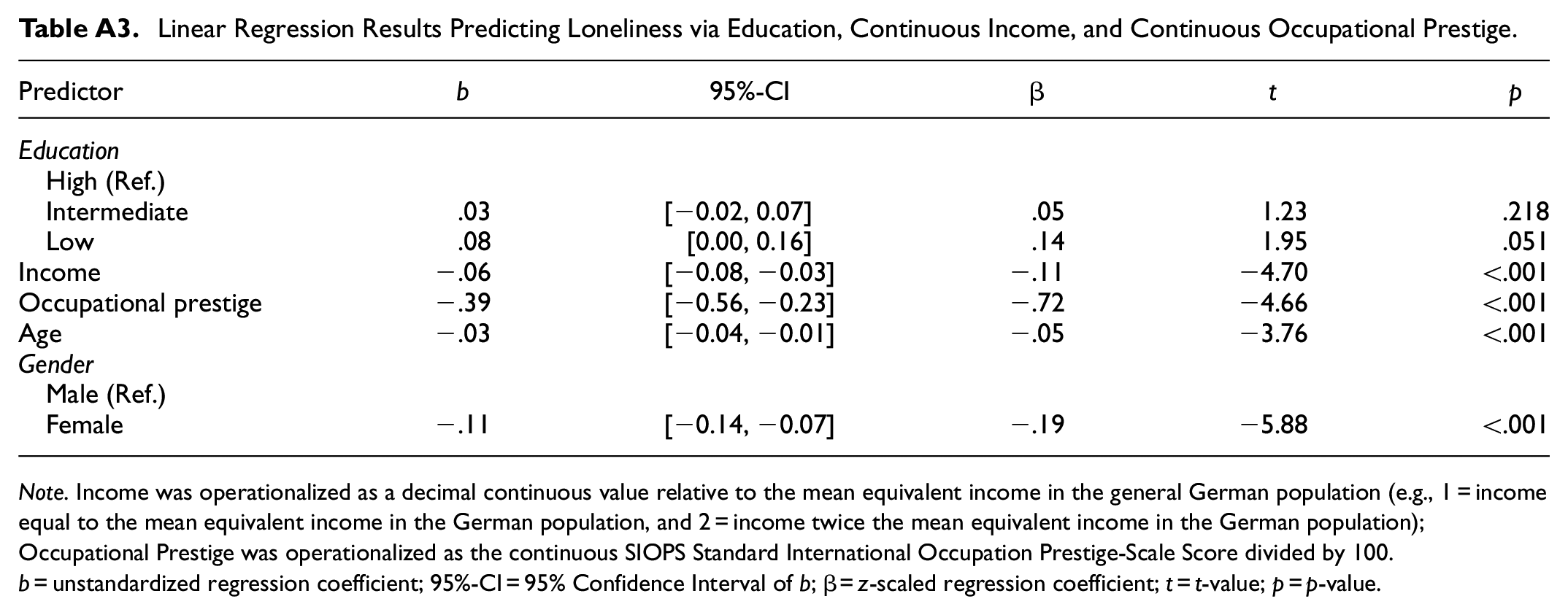
Next, linear regression analysis was used to study socioeconomic differences in loneliness via age, gender, education, income and occupational prestige. As depicted in Figure 1, significant socioeconomic differences emerged only for income and occupational prestige but not for education. In every case social gradients emerged, with lower socioeconomic status levels being associated with increasingly higher loneliness scores. Largest standardized regression coefficients emerged for those having a very low occupational prestige score (βVery Low = .25) and for those having a low income (βLow = .24). Full regression results are reported in the Appendix (please see the Appendix Table A2). As a robustness check, the linear regression analysis was also conducted using continuous variables for income and occupational prestige, with similar results (Appendix Table A3).
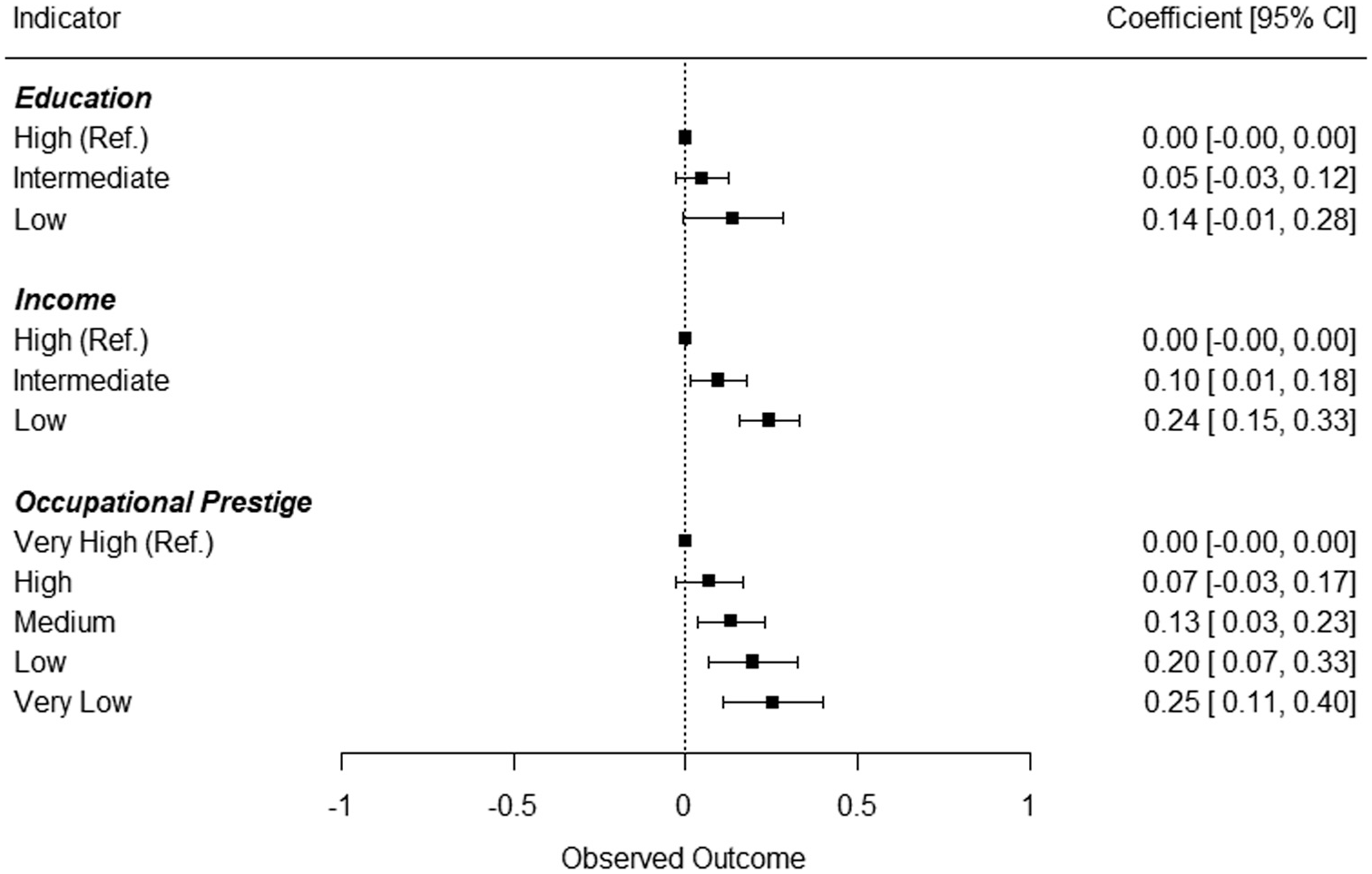
Standardized linear regression results: loneliness predicted by education, income, and occupational prestige.
Discussion
Given the importance of loneliness to health, socioeconomic differences in loneliness according to education, income and occupation among a population-based sample of middle-aged and older adults in Germany were analyzed. Social inequalities emerged for every indicator descriptively. However, the extent to which socioeconomic differences emerged in regression analyses differed: Education had no significant effect. Conversely, occupational prestige and income emerged as the indicators with larger effect sizes. These effect sizes were moderate in size: Standardized differences of up to β = .25 emerged, implying that compared to participants with a very high occupational prestige participants with a very low occupational prestige had about one fourth of a standard deviation higher loneliness scores on average. Thereby, social inequalities in loneliness are substantially larger than gender differences in loneliness and about the same size as age differences (Luhmann & Hawkley, 2016; Maes et al., 2019).
Comparison with Previous Studies
The finding that substantial socioeconomic differences exist for loneliness and health in general are in line with the literature (Gaffney et al., 2021; Geyer, 2006; Mackenbach, 2019; Polak et al., 2019) and replicates previous research on other mental health conditions (Allen et al., 2014; Richardson et al., 2020). Going beyond previous studies, this is the first study that investigated the effects of education, income and occupational prestige. It was found that, when analyzed together, the effect of education became non-significant. This suggests that all three indicators have common as well as individual associations with loneliness. While specific pathways and mechanisms linking these indicators to loneliness were not directly measured, it seems plausible that the indicators might be related to loneliness through different means. For example, education might be associated with loneliness through health competencies and knowledge, income through material resources and access to social activities, and occupational prestige through social status and work-related social networks. However, these potential explanations remain speculative and should be investigated in future studies that directly assess these mechanisms (Darin-Mattsson et al., 2017; Geyer, 2006). The fact that the largest effects emerged for income and occupational prestige suggests that risk and protective factors immanent to one’s material and job-based resources are most strongly associated with increased loneliness on the population level. This likely includes access to social resources and community building activities as well as access to occupation-based social networks and support.
Furthermore, the finding that education had no significant unique effect on loneliness in the regression analysis might be due to the relatively high correlations between education and the other two SES indicators, income and occupational prestige. These correlations suggest that the three indicators might share common variance in explaining loneliness. When all three indicators are entered simultaneously into the regression, the unique effect of education might be reduced due to its overlap with income and occupational prestige. This finding highlights the importance of considering the interrelations between different SES indicators when studying their associations with health outcomes. Future studies could further disentangle the unique and shared contributions of different SES indicators.
Implications
Loneliness constitutes one major risk factor for mental and physical health (Hawkley & Cacioppo, 2010). From a public health perspective, the differences in loneliness based on one’s social status at least partly represent a societal issue that should become a stronger focus of intervention in the future (Holt-Lunstad, 2017). The current study further suggests that interventions for loneliness might be especially tailored to low-prestige occupations and to people with limited income (Barjaková et al., 2023).
Future research should aim to replicate our findings in other populations and settings, as well as to investigate the potential mechanisms underlying the observed social inequalities in loneliness. This may include examining the role of access to social resources, community engagement, and occupation-based social networks in mediating the relationship between socioeconomic status and loneliness. Additionally, longitudinal studies are needed to better establish the causal nature of these relationships and to identify potential points of intervention across the life course.
It seems also important to examine the relationship between socioeconomic indicators and loneliness in even greater depth. For example, an intersectional approach acknowledges that socioeconomic inequalities in loneliness may be compounded by other social identities and inequities, such as ethnicity, disability status, and immigration status (Kapilashrami & Hankivsky, 2018; Maes et al., 2019). Individuals who experience multiple marginalized identities may face cumulative disadvantages that heighten their risk of loneliness. For instance, low-income older adults from ethnic minority backgrounds may encounter barriers to social engagement related to both their socioeconomic status and racial discrimination (Hawkley et al., 2008). Moreover, while the current study examines how socioeconomic status impacts loneliness, it is crucial to recognize the potential for bidirectional effects. Loneliness itself may have negative consequences for socioeconomic outcomes over time, such as limiting job opportunities, reducing productivity, and constraining social mobility. For example, the social disconnection and poorer mental health associated with chronic loneliness may make it harder to secure and maintain employment, leading to downward socioeconomic trajectories (Andreeva et al., 2015; Ozcelik & Barsade, 2018). Longitudinal research designs are needed to disentangle the complex interplay and directionality of these relationships.
Limitations
The results of the current study are subject to limitations. First, the sample did not include institutionalized older adults, such as those living in nursing homes. This omission likely leads to an underestimation of the true level of loneliness in the older adult population, especially because previous studies have consistently shown that survey samples tend to have health biases (Beller et al., 2022). For instance, older adults with more severe limitations, of which prevalence rates are rising, might be less likely to participate in surveys, resulting in samples skewed towards healthier individuals (Beller & Epping, 2020). Therefore, as loneliness is often associated with poorer health outcomes, excluding institutionalized older adults may provide an incomplete picture of severity of loneliness relating to socioeconomic differences.
Second, comparing the contribution of education, income, and occupation to loneliness might be complicated due to differences in their operationalization. While education and income were operationalized as comprising three categories, occupational prestige was operationalized on the basis of five categories, as recommended in the literature (Hoffmeyer-Zlotnik & Warner, 2011). These differences in categorization might make the comparison of the relative importance of each socioeconomic indicator in relation to loneliness more difficult. Future studies could strive for more consistent operationalization across socioeconomic variables to facilitate clearer comparisons.
Third, the cross-sectional nature of the study precludes any conclusions about the causal direction of the observed relationships between socioeconomic status and loneliness. While it might be assumed that lower socioeconomic status is associated with higher levels of loneliness, it is also possible that loneliness may contribute to lower socioeconomic status over time, creating a bidirectional relationship. For example, individuals who experience chronic loneliness may have reduced productivity and social connections, which could negatively impact their educational attainment, employment, and income. To disentangle the complex causal pathways linking socioeconomic status and loneliness, longitudinal studies that track individuals over extended periods are needed.
Finally, it is essential to recognize that both loneliness and social inequality indicators are heavily dependent on societal and cultural factors (Barreto et al., 2021; Beller & Wagner, 2020; Luhmann et al., 2023). For instance, collectivistic cultures that place a strong emphasis on family ties and social harmony may have different norms and expectations regarding social connections compared to more individualistic cultures (Hofstede et al., 2010). Similarly, the specific socioeconomic indicators that are most relevant for loneliness may differ depending on the social welfare systems, labor market structures, and educational opportunities available in a given society (Mackenbach, 2019). As such, further research must investigate cross-national differences in social inequalities in loneliness to gain a more comprehensive understanding of these relationships.
Conclusion
This study examined socioeconomic differences in loneliness among middle-aged and older adults, using education, income and occupational prestige as socioeconomic indicators. The results showed that social inequalities in loneliness were evident for all indicators, but the magnitude of the effects varied. Inequalities in loneliness were largest for occupational prestige and income. Thereby the current study highlights the importance of the social determinants of health for loneliness.
Footnotes
Appendix
Linear Regression Results Predicting Loneliness via Education, Continuous Income, and Continuous Occupational Prestige.
| Predictor | b | 95%-CI | β | t | p |
|---|---|---|---|---|---|
| Education | |||||
| High (Ref.) | |||||
| Intermediate | .03 | [−0.02, 0.07] | .05 | 1.23 | .218 |
| Low | .08 | [0.00, 0.16] | .14 | 1.95 | .051 |
| Income | −.06 | [−0.08, −0.03] | −.11 | −4.70 | <.001 |
| Occupational prestige | −.39 | [−0.56, −0.23] | −.72 | −4.66 | <.001 |
| Age | −.03 | [−0.04, −0.01] | −.05 | −3.76 | <.001 |
| Gender | |||||
| Male (Ref.) | |||||
| Female | −.11 | [−0.14, −0.07] | −.19 | −5.88 | <.001 |
Note. Income was operationalized as a decimal continuous value relative to the mean equivalent income in the general German population (e.g., 1 = income equal to the mean equivalent income in the German population, and 2 = income twice the mean equivalent income in the German population); Occupational Prestige was operationalized as the continuous SIOPS Standard International Occupation Prestige-Scale Score divided by 100. b = unstandardized regression coefficient; 95%-CI = 95% Confidence Interval of b; β = z-scaled regression coefficient; t = t-value; p = p-value.
Acknowledgements
The German Centre of Gerontology Research for providing the German Ageing Survey (DEAS) data is gratefully acknowledged.
Declaration of Conflicting Interests
The author declared no potential conflicts of interest with respect to the research, authorship, and/or publication of this article.
Funding
The author disclosed receipt of the following financial support for the research, authorship, and/or publication of this article: This paper was partly funded by a grant from the Ministry for Science and Culture of Lower Saxony awarded to Dr. Johannes Beller (“Modern Work—Healthy Work? Change in Work-Related Physical Activity as an Explanatory Factor in Physical and Psychological Morbidity Development”; Gefördert aus Mitteln SPRUNG).
Ethical Approval
The German Aging Survey was reviewed and approved by the Advisory Board of the German Aging Survey (https://www.dza.de/en/research/deas/advisory-committee). For the current study additional ethical approval was not needed, because only secondary data analysis of the completely anonymized questionnaire data was conducted, and ethical approval is not mandatory for general surveys in Germany when anonymized data are analyzed. This rationale is supported by the German Research Foundation-guidelines available at  . The German Aging Survey meets the ethical standards delineated in the 1964 Declaration of Helsinki and its amendments. Prior to the interview, written informed consent was given by all participants of the study.