




Abstract
There is growing evidence that infants display preferences for prosocial agents. However, recent studies have reported conflicting results about the impact of appearance on these preferences. The current study investigated the relative influence of behavior and face/race on 6-month-old infants’ evaluation of social agents when these two aspects are in competition. In a short research study featuring animated cartoons where agents interacted in a ball game, we used eye-tracking methodology to assess infants’ preferences (a) for prosocial behavior, (b) for one kind of appearance, represented by race, and (c) when the two aspects were pitted against one another. The two control conditions revealed preferences for prosocial agents and for other-race appearance. No preference could be found at group level in the third condition, where these two aspects competed with each other. However, a profile analysis revealed that when this situation was a source of conflict in terms of the preferences identified in the control conditions, infants prioritized appearance over behavior.
Introduction
In the past decade, there has been increasing interest in infants’ ability to produce sociomoral evaluations. How do infants process the social world and, in particular, social interactions? This research question has driven a number of studies dedicated to the understanding of infants’ early social cognition. These have shown that, by the age of 12 months, infants are able to evaluate the sociomoral valence of behavior (Kuhlmeier, Wynn, & Bloom, 2003; Premack & Premack, 1997). There is also growing evidence that infants assess-and also display-preferences for agents who adopt prosocial (vs. antisocial) behavior (for a recent review, see Holvoet et al., 2016a). A spontaneous tendency to prefer prosocial behavior has been observed in infants aged between 3 and 36 months, when they are exposed to a variety of competing social scenarios: helping versus hindering agents (e.g., involved in climbing a hill or opening a box); comforting versus threatening agents; fairly acting versus unfairly acting agents; or game-playing versus game-breaking agents (Holvoet et al., 2016a). In these studies, infants’ preferences for prosocial agents were demonstrated through their reaching behavior (Buon et al., 2014; Burns & Sommerville, 2014; Geraci & Surian, 2011; Hamlin & Wynn, 2011; Hamlin, Wynn, & Bloom, 2007; Scola, Holvoet, Arciszewski, & Picard, 2015) or their looking behavior (Hamlin & Wynn, 2011; Hamlin, Wynn, & Bloom, 2010). Other studies, however, adopted infant’s choice by reaching and geometric figures (or toys) as agents and failed to highlight a preference for prosocial agents (Cowell & Decety, 2015; Salvadori et al., 2015), thereby questioning the robustness of infants’ preference for prosocial agents.
Some elements that could have biased infants’ preference might be the appearance of the agents who perform pro- and antisocial behaviors. Indeed, adults’ social judgments and preferences are affected by facial appearance (Olson & Marshuetz, 2005), and we can easily assume the same phenomenon could be observed in infants. The only two studies that have explored the influence of appearance have gone through the influence of race (Burns & Sommerville, 2014; Scola et al., 2015). The authors made the hypothesis that the preference for prosocial agents may vary according to the appearance of the agents, namely, whether their race is familiar or more unusual to the infants. For instance, in a recent study by Burns and Sommerville (2014), 15-month-old Caucasian infants were exposed to real-life actors acting fairly or unfairly with regard to how they distributed food to a third partner. In one condition, both distributors were Caucasian (prosocial preference test controlling for race), and infants displayed a preference for the fair distributor. In another condition, the fair distributor was Asian and the unfair distributor was Caucasian (race pitted against prosociality to test whether the preference for prosociality resists a change in appearance). In this context, there was no preference for the fair actor, leading the authors to suggest that “infants attempt to incorporate information about the individuals’ race when making social selections, and may weight race and fairness as competing dimensions in their social selections” (Burns & Sommerville, 2014, p. 8). The role played by appearance, and specifically race, in infants’ evaluation of prosocial behavior is not entirely clear, however. In another recent study by Scola et al. (2015), 12- to 36-month-old infants were shown to prefer a prosocial character (game-player against game-breaker), despite changes in this agent’s physical features (dark skin or a scrambled face). In this study, infants were Caucasian and maintained their preference for the prosocial agent even when they saw an other-race character. At first sight, this appears to contradict Burns and Sommerville’s finding. It should, however, be noted that in Scola et al.’s study, infants were exposed not to real-life faces (as was the case in Burns and Sommerville’s study) but to short animated cartoons where they could see two characters engaged in a ball game with a third partner. Infants’ preferences between own-race and other-race people have mainly been explored using real faces or actors (Fassbender, Teubert, & Lohaus, 2016; Kinzler & Spelke, 2011; Liu et al., 2015). If infants primarily display a preference for own-race real faces at 3 months of age, this preference disappears at 6 months and reverses toward other-race faces at 9 months (Fassbender et al., 2016; Liu et al., 2015). Regarding social preferences in face–face interaction, Kinzler and Spelke (2011) observed that the “in-group bias” (i.e., a preference for own-race people) arises between 2.5 and 5 years of age. However, to our knowledge, only one study has tested infants’ preference for own-race versus other-race faces when those faces are drawings (Holvoet et al., 2016b). Results of this study show that Caucasian infants aged 6 to 18 months display a visual preference for other-race faces (African/Asian) when these are shown as cartoons but not when they are presented as photographs of real faces. Thus, the use of cartoons in Scola et al. (2015)’s study (rather than real-life faces in Burns & Sommerville, 2014) therefore probably modified the way race information was captured and processed by infants, possibly explaining differences in results across studies with dissimilar methodologies and materials.
Whatever the reason for these discrepancies, it is crucial to conduct additional research to investigate the role played by appearance in infants’ social evaluation and consequently in their visual preference for prosocial behavior as the two components are combined in real-life situations and may either compete or conflate to drive infants’ preferences for specific agents. One key research question to be addressed is whether infants display a visual preference for physical features over behavior, or the reverse, when these two aspects are in competition. This question, which motivated the design of the present study, is worth addressing for at least two reasons. First, and as mentioned above, in real-life situations, infants are likely to encounter people displaying specific physical features (e.g., own-race or other-race appearance) and who behave in specific social ways (e.g., prosocial, antisocial, or neutral behavior). It is therefore important to determine whether and how these different sources of information are processed by infants and to establish the relative weight given to behavior and to face/race in the final appreciation of the stimulus. Second, in addition, setting social behavior in competition with physical characteristics is methodologically sound in assessing the robustness of infants’ preferences for prosocial behaviors, which are still subject to discussion (see review by Holvoet et al., 2016a).
From this perspective, and in the same vein as the above-mentioned studies, we designed a short study featuring animated cartoons (a well-controlled medium for assessing infants’ prosocial preferences; see Gredebäck et al., 2015; Scola et al., 2015) to test the visual preferences of 6-month-old Caucasian infants for prosocial behavior and other-race characters. Compared with previous research in this area (Burns & Sommerville, 2014; Scola et al., 2015), we chose to observe far younger infants (6 months), so as to assess whether and how behavior and race are weighted in social evaluation at an early age. More specifically, our study involved the following three manipulations: (a) We tested infants’ preferences for prosocial behavior (contrasting game-player and game-breaker agents during a ball game); (b) We also tested infants’ preferences for other-race appearance (Caucasian vs. African/Asian cartoon faces), and (c) Finally, we tested infants’ preferences when prosocial behaviors and other-race appearance are pitted against one another (i.e., Caucasian game-player vs. African/Asian game-breaker).
The first two conditions served as control conditions, for which we predicted that the 6-month-old infants would show a baseline preference (a) for the game-player over the game-breaker agent (preference for prosociality; see also Scola et al., 2015, for a similar scenario but older infants) and (b) for the African/Asian cartoon character over the Caucasian character (preference for other-race cartoon characters; prediction based on recent findings by Holvoet et al., 2016b). African/Asian/Caucasian characters of our material were mainly differentiated by the color of their skin and hair. We cannot be absolutely sure that infants process our characters as African, Asian, or Caucasian. However, it has been shown that color of faces is a characteristic of great importance to categorize faces at an early age and was the main feature that allows the differentiation between children from different races in an animated cartoon used to assess the impact of a prejudice-prevention television program among children (Balas, Peissig, & Moulson, 2015; Persson & Musher-Eizenman, 2003). Thus, we can assume our participants would perceive these characters as belonging to these different ethnic groups. The third—experimental—condition was designed as a combined situation, in which one agent (Caucasian game-player) might prove attractive because of his prosocial action (but not his appearance), whereas the second agent (African/Asian game-breaker) might prove attractive because of his appearance (other-race) but repulsive because of his behavior (antisocial). How would the infants react to this bizarre combination? 1 There were three possible reactions. First, infants would prioritize behavior over appearance and show a visual preference for the Caucasian game-player. Second, infants would prioritize appearance over behavior and show a preference for the African/Asian game-breaker. Third, infants would be confused by the combination of information and not show any preference in the end.
We tested these predictions using an eye-tracking methodology. To date, all too few studies have used this technology to explore social evaluations in infants (for notable exceptions, see Cowell & Decety, 2015; Wallez, Scola, Holvoet, & Meunier, 2016). This dearth of research may partly be explained by the fact that, although more commonplace, eye-tracking is still challenging to use in infants (Oakes, 2012). We chose to use eye-tracking technology because it has the major advantage of allowing the duration of fixations to be measured during the scenario, so as to assess the infants’ visual preferences while they were watching the story unfold (i.e., the dynamic interplay between agents displayed on the screen). One specificity of our study was to consider both this new measure and the more conventional measure of visual preference, which was carried out at the end of the scenario (i.e., during a test phase when static pictures of the two characters were simultaneously shown to the infant for a few seconds to gauge his or her visual preference).
To summarize, the main aim of our study was to test whether and how 6-month-old infants process aspects of the behavior and appearance of agents interacting in animated cartoons. To this end, we examined whether infants displayed a visual preference for physical features over behavior, or the reverse, in the condition where these two aspects were in competition. The infants’ baseline preferences for prosocial behaviors and for other-race cartoon appearance were assessed in prior control conditions. A secondary aim of the study was to use eye-tracking methodology to compare visual preferences captured during the scenario and during the test phase, the assumption being that measures during the scenario would be more sensitive than measures during the test phase among young infants aged 6 months (e.g., Cowell & Decety, 2015; Wallez et al., 2016).
Method
Participants
Participants were 31 healthy, full-term infants aged 6 months. Of them, 11 were excluded from the analyses because of fussiness (<70% of total duration of the experiment spent looking at the screen), and we also had as criteria to exclude infants who have only paid attention to one character in the test phase (>98% of test phase 2 spent looking at one character), however, none of the infants displayed such a visual distribution of attention. In total, 20 infants (16 boys and 4 girls; mean age = 6.18 months, SD = 0.25 months; age range = 5 months 23 days to 6 months 18 days) were included in the final sample. Parents gave their written informed consent for their child to participate. Infants were given a token gift for their participation. This study was conducted in accordance with the principles laid down by the most recent version of the Declaration of Helsinki.
Material
The material consisted of three different color cartoons, built with Adobe Flash. Each cartoon showed three human-like characters against a simple background featuring two trees, one on either side of the screen. The cartoons came in two successive parts: a dynamic part (scenario; total duration = 20 s for Cartoon 2 and 40 s for Cartoons 1 and 3), featuring moving characters, and a short static part (test phase; total duration = 5 s per cartoon), in which the infants were tested for their visual preferences. More specifically, the test phase began with the disappearance of the central character and the trees, leaving two static, enlarged characters on the screen. This sequence also served as an “attention getter” to help focus infants’ visual attention. Two cartoons (Cartoon 1 and Cartoon 2) served as the material for the control conditions, and one (Cartoon 3) served as the material for the experimental condition. These are described below and illustrated in Figure 1.

Illustration of each condition during the scenario and in the test phase.
Cartoon 1 (see illustration in Figure 1A) was used in the prosocial control condition. It showed three characters interacting during a ball game. The central character played with a ball and then threw it alternately to each character (one on his right, the other on his left) to play with them. One character (game-player) behaved in a prosocial way and gave the ball back so that the game could continue. The antisocial character (game-breaker) kept the ball and kicked it into the tree next to him. This antisocial gesture was similar to the prosocial one, except that it was directed away from the central character. In this cartoon, the characters had green faces, like aliens, but normal facial features. Alien faces were used here to ensure that the characters all had the same neutral faces and differed solely with respect to their prosocial or antisocial behavior toward the central partner. We had to control race in order to test infants’ preference for prosociality independently of any preference for race. In other words, we wanted to avoid exposing infants to a choice between own-race or other-race characters in the prosocial control condition.
Cartoon 2 (see illustration in Figure 1B) was used in the race control condition. It featured three characters: one in the middle of the screen and one on either side, who alternately turned their faces toward the central character. One of these two moving characters had an own-race appearance (Caucasian), whereas the other had an other-race appearance (African or Asian). Both characters simply turned their faces toward the central character to look at him and did not display any behavior toward the latter that could be interpreted as being either pro- or antisocial. This was done to ensure that Cartoon 2 could properly assess infants’ preferences for own-race or other-race appearance, independently of any preference for prosocial or antisocial behavior.
We ran a pretest with 20 adults to ensure that the cartoon characters were actually perceived as “Caucasian,” “African,” or “Asian.” They were shown the three characters and asked to identify the race in each of them. 100% of them correctly identified the race.
Cartoon 3 (see illustration in Figure 1C) was used in the experimental condition. It featured a combined situation, in which three characters played the same ball game as in Cartoon 1. The game-player had a Caucasian appearance, and the game-breaker an African or Asian one. It should be noted that we combined prosociality with the own-race appearance rather than the other-race appearance, so as to create a bizarre situation regarding infants’ preferences for behavior (assumed to be in favor of prosociality) and their preferences for faces (assumed to be in favor of other-race characters; see our predictions in the “Introduction”).
Procedure
The experiment took place in a quiet room of our BabyLab. 3 If the infants did not demonstrate any signs of distress, they were placed in a car seat in front of the screen and their parents sat next to them, with their backs to the screen, so that they could not see the cartoons. Otherwise, they sat on their parents’ laps, and the parents were requested to keep their eyes closed. Parents were instructed not to interact with their infants during the experiment, so as to avoid any interference.
The cartoons were displayed on a 24-inch screen (1024 × 768 pixels), positioned approximatively 60 cm from the infant. Fixations were recorded with a Tobii X2-60 eye tracker (60-Hz data sampling rate). An experimenter adjusted the position of the car seat during the calibration procedure. To start with, infants were shown cartoons of animated pets to draw their attention to the screen. Once their eyes had been reliably detected, a noisy cartoon character sequentially popped up at five locations across the screen to calibrate the eye tracker. If the first calibration failed owing to insufficient data, the same calibration procedure was repeated with another character and another sound. This could be repeated once, if need to be, but if all three attempts failed, the experiment was abandoned.
We implemented a within-participants design, in which infants were shown all three cartoons and were therefore tested for their visual preferences both in the control conditions (prosocial control [Cartoon 1] and race control [Cartoon 2]) and in the experimental condition (prosocial combined with own-race character [Cartoon 3]). The control conditions always preceded the experimental condition, in a counterbalanced order across infants (i.e., half the infants watched Cartoon 1 first, then Cartoon 2, whereas the other half watched the two control cartoons in the reverse order). All the infants viewed Cartoon 3 last. In Cartoons 1 and 3, we controlled for side-bias of the game-player and game-breaker by switching left–right positions of the characters within infants; in these cartoons, the social nature of the first behavior (prosocial or antisocial) was counterbalanced across infants to prevent order presentation effects. In Cartoons 2 and 3, the other-race character (African/Asian) was used as a between-participants factor, with half the infants seeing cartoons featuring Caucasian versus African characters, and the other half seeing cartoons featuring Caucasian versus Asian characters.
Data Analysis
For each cartoon, we selected four dynamic areas of interest (AOIs) to analyze the duration of the infants’ fixations. The first two AOIs were the right and left characters in the scenario phase (game-player vs. game-breaker for Cartoon 1; Caucasian vs. African/Asian character for Cartoon 2; Caucasian game-player vs. African/Asian game-breaker for Cartoon 3), and the last two AOIs were the same characters in the test phase. This allowed us to examine the infants’ visual preferences during the scenario (i.e., when the characters were moving) and in the test phase (i.e., when the characters were enlarged and static on the screen).
To analyze whether the infants preferentially looked at one character, we computed an index of preference (IP) for each condition, which could vary from 0 to 1, with an IP of 0.50 indicating that the infants attended equally to both characters (preference at chance level). In the prosocial control condition, the IP was the time spent looking at the game-player divided by the total amount of time spent looking at the game-player and the game-breaker. An IP above 0.50 indicated that the infant focused longer on the game-player (i.e., prosocial character). By contrast, an IP below 0.50 indicated that the infant focused longer on the game-breaker or antisocial character. In the race control condition, the IP was the time spent looking at the Caucasian character divided by the total amount of time spent looking at the Caucasian and African/Asian characters. An IP above 0.50 therefore indicated that the infant focused longer on the Caucasian (i.e., own-race) character. Finally, in the experimental condition, the IP was the time spent looking at the Caucasian game-player divided by the total amount of time spent looking at the Caucasian game-player and the African/Asian game-breaker. Hence, an IP above 0.50 indicated that the infant focused longer on the Caucasian game-player (i.e., prosocial own-race character), whereas an IP below 0.50 indicated that the infant focused longer on the African/Asian game-breaker (i.e., antisocial other-race character).
Results
Preliminary analyses revealed no significant difference between boys and girls, and no significant effect of race (i.e., no difference between versions with competing Caucasian and African characters and versions with competing Caucasian and Asian characters) on IPs. We therefore collapsed the data across sex and race in all subsequent analyses.
Prosocial Control Condition (Game-Player vs. Game-Breaker Agents)
Shapiro–Wilk tests indicated that the distribution of IPs did not depart from normality either during the scenario (W = 0.99, p = .99) or in the test phase (W = 0.95, p = .39). Student’s t tests were therefore used to assess infants’ visual preferences in the prosocial control condition. Given that we had a directional prediction that the infants’ IP would be significantly above chance level, we report one-tailed p values (see Figure 2).
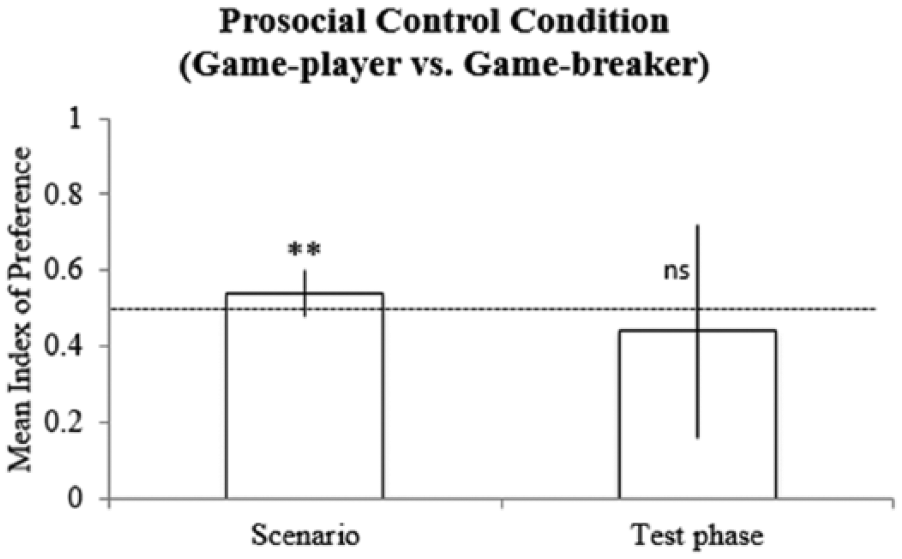
Mean IP in the prosocial control condition at age 6 months during the scenario and in the test phase.
During the scenario, the infants displayed a mean IP of 0.54 (SD = 0.06), which was significantly different from chance, one-tailed t test: n = 20, t(19) = 2.85, p = .005, d = 0.638, 95% confidence interval (CI) = [0.51, 0.565], and revealed a preference for the game-player. In the test phase, however, the observed IP did not differ significantly from chance, M = 0.44, SD = 0.28; t(19) = 0.89, p = .19. Thus, in line with our prediction, infants aged 6 months displayed a visual preference for the game-player (prosocial) over the game-breaker (antisocial), but only during the scenario.
Race Control Condition (Caucasian vs. African/Asian Characters)
Shapiro–Wilk tests indicated that IP distributions did not depart from normality either during the scenario (W = 0.91, p = .06) or in the test phase (W = 0.94, p = .28). We therefore used Student’s t tests to assess the infants’ visual preferences. Given that we had a prediction that the infants’ IPs would be significantly different from chance level (either above or below), we report two-tailed p values (see Figure 3).

Mean IP in the race-face control condition at age 6 months during the scenario and in the test phase.
During the scenario, the infants displayed a mean IP of 0.31 (SD = 0.26), which was significantly different from chance, two-tailed t test: n = 20, t(19) = −3.23, p = .004, d = −0.723, 95% CI = [0.194, 0.435], and revealed a preference for the African/Asian agent. In the test phase, the observed IP was still significantly different from chance (M = 0.39, SD = 0.22), t(19) = −2.31, p = .032, d = −0.518, 95% CI = [0.283, 0.489], and again revealed a preference for the African/Asian agent. Thus, consistent with our prediction, infants aged 6 months displayed a visual preference for the African/Asian character (or other-race character). This preference was observed both during the scenario and in the test phase.
Experimental Condition (Caucasian Game-Player vs. African/Asian Game-Breaker)
Shapiro–Wilk tests indicated that IP distributions departed from normality during the scenario (W = 0.90, p = .04), but not in the test phase (W = 0.91, p = .08). To maintain coherence across the three conditions in our statistical analyses, we decided to use Student’s t tests to assess the infants’ visual preferences, supplementing them with nonparametric tests. Given that we had a prediction that the infants’ IP would be significantly different from chance level (either above or below), we report two-tailed p values (see Figure 4).

Mean IP in the experimental condition at age 6 months during the scenario and in the test phase.
During the scenario, the infants displayed a mean IP of 0.48 (SD = 0.08), which was not significantly different from chance, two-tailed t test: n = 20, t(19) = 1.16, p = .25; Wilcoxon test: p = .18. In the test phase, the IP did not differ significantly from chance, M = 0.52, SD = 0.30; t(19) = 0.26, p = .79; Wilcoxon test: p = .41. Thus, in the experimental condition, infants’ visual preferences were at chance level, both during the scenario and in the test phase.
Our failure to find a significant preference may have been due to the nature our analysis, which was run at the group level and therefore did not take account of individual differences in visual preferences in the control conditions. To check this, we decided to run a profile analysis, as described below. First, we defined nine different possible (theoretical) profiles, according to how individual infants reacted to the prosocial control condition (i.e., looked longer at the game-player [IP > 0.50] vs. looked longer at the game-breaker [IP < 0.50] vs. looked equally long at both characters [IP = 0.50]) and the race control condition (i.e., looked longer at the Caucasian character [IP > 0.50] vs. looked longer at the African/Asian character [IP < 0.50] vs. looked equally long at both characters [IP = 0.50]). Table 1 below shows how the infants in our study were distributed across these theoretical profiles, which were not all observed in our sample of participants. As can be seen in Table 1, infants displayed Profile 1, Profile 2 (half of all infants), Profile 4, Profile 5, or Profile 8; none corresponded to Profiles 3, 6, or 7. Establishing these nine profiles was therefore worthwhile as it showed that infants may react differently to the experimental condition according to their profile. For instance, infants with Profiles 2 or 4 (n = 11) tended to consider the experimental condition as a conflicting combination of race and behavior, owing to their baseline visual preferences for Caucasian and game-breaker characters, and for African/Asian and game-player characters (the experimental condition contrasted a Caucasian game-player with an African/Asian game-breaker). By contrast, the combined situation featured in the experimental condition tended to be considered as non-conflicting by infants with Profiles 1, 5, or 8 (n = 9), as it coincided with their visual preferences.
Distribution of the 20 Infants Across the Nine Possible Visual Preference Profiles.

Note. IP = index of preference.
Second, we divided our sample of participants into two groups, according to whether their profile implied that the combination situation in the experimental condition was conflicting (n = 11) or neutral (n = 9). We then re-analyzed how individual infants with a conflicting or neutral profile reacted to the experimental condition. Table 2 shows the main findings. We found that eight of the 11 infants with a conflicting profile looked for longer at the African/Asian game-breaker (i.e., character with other-race face acting antisocially), suggesting that they prioritized race over behavior in their visual preferences. By contrast, six of the nine infants with a neutral profile looked for longer at the Caucasian game-player (i.e., prosocial character with own-race face). When we ran Fisher’s exact probability test on this distribution, it indicated that the preferences observed in the experimental condition varied significantly according to profile (p = 0.049).
Distribution of Infants’ Visual Preferences in the Experimental Condition According to Their Profile in the Control Conditions.

Conclusion
Using an eye-tracking technology, this study was primarily designed to assess whether and how 6-month-old Caucasian infants process aspects of the behavior and appearance of agents interacting in animated cartoons. A secondary aim of this study was to compare visual preferences measured during the scenario and in the subsequent test phase, the assumption being that the former measure might prove more sensitive. Our study yielded four main results, which we summarize and discuss below.
First, regarding aspects of behavior (prosociality), our findings showed that infants exhibited a visual preference for the game-player over the game-breaker when the two interacted with a central partner (prosocial control condition). This result confirmed our prediction and supports the recurrent observation that young infants display a preference for agents that act prosocially toward others in many different contexts (e.g., Hamlin et al., 2007; Scola et al., 2015).
Second, in the prosocial control condition, infants’ preferences for the prosocial agent were only observed during the scenario, not in the test phase. As suspected, measures of visual preferences during the ongoing scenario (compared with the test phase) proved more sensitive for detecting how young infants differentially allocate their attention toward game-player and game-breaker agents. The failure to observe a preference in the test phase can probably be attributed to the limited exposure time in the test phase (5 s only) compared with the scenario (40 s) as Houston-Price and Nakai (2004) showed that variations in infants’ visual preferences can be affected by factors such as stimulus complexity and duration of exposure. Similar observations have been reported by Cowell and Decety (2015) and Wallez et al. (2016) using helping/hindering social scenarios. In both studies, significantly more time was spent fixating the helping agent during the scenario. Measures carried out in the test phase (preferential reaching in Cowell and Decety, 2015 and preferential looking in Wallez et al., 2016) failed to reveal a preference for the prosocial agent. Moreover, measures conducted in the test phase were unrelated (as indicated by nonsignificant correlations) to measures conducted during the scenario. We can wonder whether infants process these two phases as a whole or as two completely different things. Indeed, in the scenario phase, characters are dynamic and infants have to process both information from appearance and behavior, whereas in the test phase, characters are totally static and display only information about appearance. We can ask if very young infants do not perceive the characters from the two phases as different because of this break between the information given in every phase. Thus, it seems important to consider several types of behavioral and visual preference measures when testing infants’ preferences for prosocial agents or scenes, including fixation times during the scenario assessed by eye-tracking. Future research will need to examine why these measures do not correlate.
Third, as far as appearance (race) is concerned, our findings showed that infants exhibited a visual preference for the African/Asian cartoon characters over the Caucasian ones (race control condition). Congruent with our prediction, these results confirmed previous observations that 6-month-old infants display a visual preference for other-race characters when shown as (static) cartoons (Holvoet et al., 2016b). Here, we found a visual preference for other-race characters using animated cartoons, both during the scenario and in the test phase. This result suggests that Caucasian infants aged 6 months process race information in both dynamic and static cartoons to the extent that the relevant characters remains static and exhibit a preference for unfamiliar (other-race) characters. It should be noted that our result suggest infants already display a preference for other-race characters at 6 months, whereas other works that have studied infants’ preference using photographs do not observe this until the age of 9 months (Fassbender et al., 2016; Liu et al., 2015). The reasons of this discrepancy should be investigated further to determine if these two types of faces (i.e., cartoon and photograph) are processed the same way by infants, particularly, through the analysis of infants’ eye paths and whether they differ between cartoons and photographs of other-race faces.
Fourth, when prosociality and race were pitted against one another (Caucasian game-player vs. African/Asian game-breaker), we failed to find a preference at the group level. We initially assumed that the infants struggled to incorporate multiple sources of information when making social selections, and randomly selected social partners when they varied on both prosociality and race (see also Burns & Sommerville, 2014). This explanation was, however, ruled out by the results of our profile analysis, which took individual infants’ preferences into account. We found that infants for whom the experimental situation was not a source of conflict (regarding their baseline preferences) preferentially looked at the Caucasian game-player, thus showing a visual preference for the prosocial character with an own-race appearance. By contrast, infants for whom the experimental situation appeared conflicting (regarding their baseline preferences for race and prosociality) demonstrated a preference for the African/Asian game-breaker, thereby prioritizing appearance over behavior.
These findings are new, and add to the literature by showing that at 6 months of age, infants already process aspects of the behavior and appearance of agents interacting in animated cartoons. When the two aspects were combined in a neutral way for infants (with respect to how they were attracted to each separate component), a preference for prosociality associated with an own-race appearance emerged. However, when the two aspects were combined in a conflicting way for infants (i.e., one agent attracted the infants’ attention for aspects of behavior, whereas the other agent attracted their attention for aspects of appearance), then appearance (other-race character) was prioritized over prosocial behavior. The latter finding suggests that infants’ preference for prosociality is not invariable: in some contexts, it may disappear in favor of a stronger attraction to appearance. An alternative explanation for this finding is that infants prioritized appearance over behavior because our scenario (game-player vs. game-breaker) was not sufficiently powerful to be perceived of as a prosocial versus antisocial scene and was simply seen as a collaborative versus selfish ball game between agents and a third partner. It would therefore be useful to run additional studies using different scenarios, such as helping/hindering and sharing/not-sharing contexts. Moreover, taking a developmental perspective would make it possible to ascertain whether and how the preference for prosociality and its robustness in the face of perceptual factors (e.g., appearance) vary during early ontogeny. We are currently designing studies from this perspective.
Footnotes
Declaration of Conflicting Interests
The author(s) declared no potential conflicts of interest with respect to the research, authorship, and/or publication of this article.
Funding
The author(s) received no financial support for the research, authorship, and/or publication of this article.