




Abstract
This study examined the mediating effect of meaning in life and the moderating effect of interpersonal trust on the relationship between regulatory emotional self-efficacy (RESE) and prosocial behavior among Chinese college students. RESE and prosocial behavior were evaluated via a survey of 942 participants (51.59% females), showing that RESE was linked to prosocial behavior, and meaning in life mediated the relationship between RESE and prosocial behavior. Additionally, the interpersonal trust could reinforce RESE and meaning in life. In summary, RESE can not only be directly related to the prosocial behavior of college students through the meaning in life, and interpersonal trust can promote the relationship between RESE and meaning in life.
Introduction
From the perspective of Social Cognitive Theory (SCT), people are considered to be self-organizing, self-reflective, and self-regulative in that they make judgments about themselves based on their activity (Luszczynska et al., 2005). Moreover, self-efficacy beliefs influence other cognitions, affect, and behaviors and may help deal with stressful circumstances (Bandura, 1997). Self-efficacy describes individuals’ beliefs in their capabilities to exercise control over challenging demands as well as their functioning (Luszczynska et al., 2005). Caprara et al. (2008) proposed the importance of regulating emotional self-efficacy beliefs in rejecting or regulating the expression of negative emotions and impulses and appropriately experiencing and expressing positive emotions (Bandura et al., 2003). In the face of a dangerous environment and stressors, people who cannot fully regulate their strong negative emotions may inappropriately externalize negative emotions (Eisenberg et al., 2001), whereas those who regulate emotions into a positive state have enhanced cognitive function, promoted adaptive coping (Alessandri et al., 2015; Folkman & Moskowitz, 2000), and prosocial behavior (Fredrickson & Joiner, 2002).
The research on regulatory emotional self-efficacy (RESE) and its outcomes is considerable (Jin et al., 2020; Li et al., 2020; Pan et al., 2016). Previous studies have demonstrated that RESE could forecast college students’ prosocial behavior, trait anxiety, and suicide risk (Ying et al., 2020). People’s thoughts and feelings about their RESE to control events influence their choices, the effort they invest, their motivation, and their behavior (Alessandri et al., 2009; Galicia-Moyeda et al., 2013; Mesurado et al., 2018). Ning (2017) pointed out that RESE is correlated with prosocial behavior and a longitudinal study illustrated that RESE is positively associated with prosocial behavior (Mesurado et al., 2018). Nevertheless, there is a lack of research on RESE and prosocial behavior among college students in China.
Self-efficacy is necessary for obtaining meaning in life. Moreover, meaning in life can be expressed through self-efficacy (Mo et al., 2013). The meaning maintenance model (MMM; Heine et al., 2006) believes that once individuals’ meaning in life is threatened, they find ways to maintain and seek meaning, and at this time, they are more likely to engage in prosocial behavior to compensate (Fang & Chang, 2019). Empirical studies support that meaning in life is positively associated with prosocial behavior (Chang & Xie, 2018; Fang & Chang, 2019; Wang et al., 2018). For instance, Chinese college students have demonstrated a positive link between meaning in life and prosocial behavior (Chang & Xie, 2018; Fang & Chang, 2019). The established links between RESE and meaning in life and between meaning in life and prosocial behavior imply that meaning in life may be the path to RESE and prosocial behavior; thus, we hypothesized that meaning in life mediates the linkage between RESE and prosocial behavior.
Based on the self-efficacy theory developed by Bandura, Caprara postulated the concept of regulatory emotional self-efficacy, and Caprara’s self-efficacy beliefs analysis (Caprara & Gerbino, 2001) links RESE with social relationships in the same way as the latter with the regulation of affections (Mesurado et al., 2018). Inspired by the self-efficacy theory, this study examined whether interpersonal trust moderates the relationship between RESE and meaning in life among college students. Self-Determination Theory (SDT; Ryan & Deci, 2000) asserts that psychological well-being and optimal relationship functioning are based on the satisfaction of three inherent psychological needs, relatedness, competence, and autonomy (Lear et al., 2020). According to SDT, individuals with a high interpersonal trust may meet their needs, interpersonal trust facilitates individual functioning (Gupta et al., 2016) and interpersonal trust is considered an essential aspect of human interactions and social relationships as well as a vital ingredient for developing and maintaining good interpersonal functioning (Jovanović, 2016), therefore promoting meaning in the life of individuals with high RESE. In other words, interpersonal trust may strengthen the positive association between RESE and its subsequent important consequences. Moreover, some studies have demonstrated that individuals with high interpersonal trust reported relatively good psychosocial adjustment (C. Li, Liu et al., 2019). Based on self-efficacy theory and SDT, interpersonal trust may moderate RESE and meaning in life.
Consequently, this study explored the mediating role of meaning in life between regulatory emotional self-efficacy and college students’ prosocial behavior, as well as whether interpersonal trust moderates the relationship between RESE and meaning in life. The following hypotheses were formulated (See Figure 1):
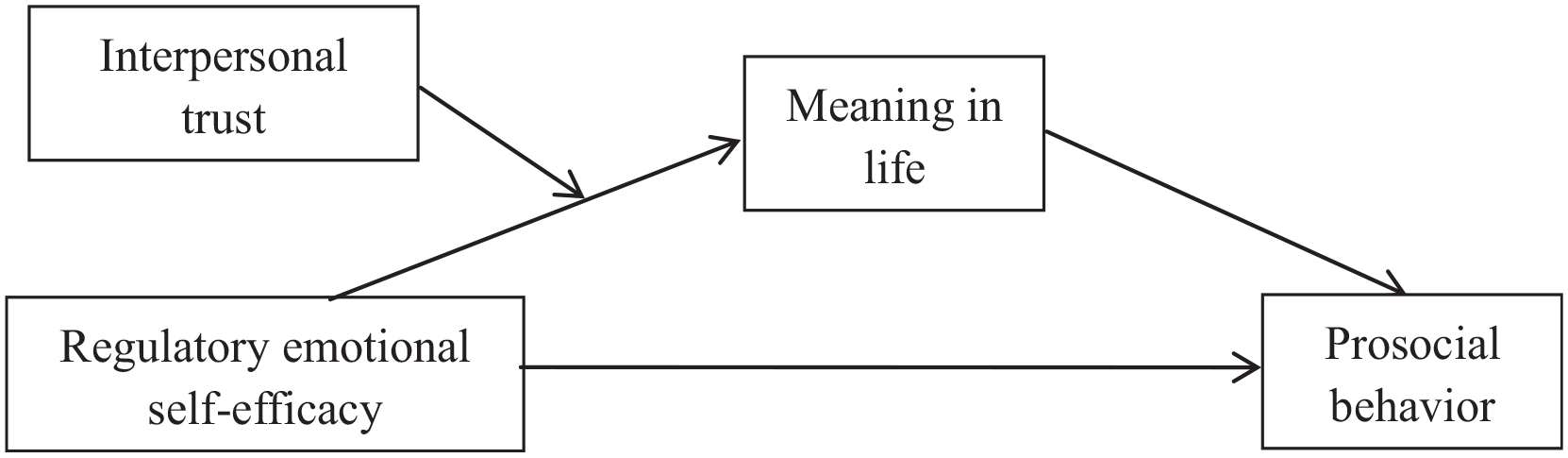
Path model of relationship between RESE and prosocial behavior.
Method
Participants and Procedures
Scales were distributed to 942 college students (486 females and 456 males, Mage = 20.16, SDage = 1.71): 240 were in their first year, 257 were in their second year, 217 were in their third year and 228 were in their fourth year. Participants responded to the online questionnaire in a space they felt comfortable in, and they could stop taking the questionnaire at any time during the process of filling out the questionnaire. The anonymity was emphasized before data collection.
Instruments
Regulatory Emotional Self-Efficacy
Participants filled in the Regulatory Emotional Self-Efficacy (RES) to evaluate their RESE (Caprara et al., 2008; Wen et al., 2009). It comprised 12 items,which was from 1 “not well at all” to 5 “very well,” higher scores denoted better RESE (Wang, 2020). In our study, its Cronbach alpha coefficient was .78.
Meaning in Life
Meaning in Life Questionnaire (MLQ) was adopted to calculate participants’ meaning in life (Steger et al., 2006; Wang & Dai, 2008). It involved 10 items, which was ranging from 1 “absolutely untrue” to 7 “absolutely true,” better scores denoted stronger meaning in life. In our study, its Cronbach alpha coefficient was .78.
Interpersonal Trust
Participants’ interpersonal trust was assessed using the Interpersonal Trust Scales (ITS) (Rotter, 1967). It involved 25 items, which was from 1 (extremely disagree) to 5 (extremely agree), higher scores denoted higher interpersonal trust. In our study, its Cronbach alpha coefficient was .66.
Prosocial Behavior
Participants filled in the Prosocial Tendencies Measure (PTM) to evaluate their prosocial behavior (Carlo & Randall, 2002). It involved 23 items, which was from 1 “does not describe me at all” to 5 “describes me greatly,” better scores denoted more prosocial behavior (Wang et al., 2018). In our study, its Cronbach alpha coefficient was .81.
Data Analysis
Firstly, primary analysis were employed by SPSS version 21.0. Then, using the PROCESS (Model 4 and Model 7; Hayes, 2013) to examine meaning in life and interpersonal trust in connecting regulatory emotional self-efficacy and prosocial behavior. All study variables were standardized in Model 4 and Model 7 before data analyses.
Results
Bias Test
Harman’s single-factor test was used to test the common method deviation of the collected data. The results show that eigenvalues of 18 factors are greater than 1. The variance explained by the first factor is 12.32%, which is less than the critical standard of 40%. Therefore, there is no serious common method deviation in this study.
Preliminary Analyses
Table 1 demonstrated that RESE was positively correlated with meaning in life, interpersonal trust and prosocial behavior. Meaning in life was positively correlated with interpersonal trust and prosocial behavior.
Means, Standard Deviations, and Correlations Among the Main Study Variables.

p < .01.
Examining RESE and Prosocial Behavior
The PROCESS 3.4 was used to test the significance of the mediating effect with RESE as the independent variable, meaning in life as the mediating variable and depression as the dependent variable. Model 4 and Bootstrap methods were used to test the significance of the mediating effect (95% confidence interval with sample size of 5,000). As Table 2 illustrated, RESE was positively associated with meaning in life (β = .36, t = 11.95, p < .001, 95% CI = [0.30, 0.43]), which in turn was positively related to prosocial behavior (β = .32, t = 10.17, p < .001, 95% CI = [0.26, 0.38]). Moreover, RESE was still positively connected with prosocial behavior (β = .18, t = 5.70, p < .001, 95% CI = [0.12, 0.24]). It means that meaning in life partially mediated in RESE and prosocial behavior (indirect effect = 0.12, SE = 0.02, 95% CI = [0.09, 0.15]).
Testing the Mediation Effect of RESE on Prosocial Behavior.

p < .001.
To further explore whether college students’ interpersonal trust played a moderating role in the relationship between RESE and meaning in life, Process3.4 was adopted in this study, with RESE as independent variable, meaning in life as mediating variable, prosocial behavior as dependent variable, and interpersonal trust as moderating variable. Model 7 and Bootstrap methods (sample size 5,000, 95% confidence interval) were used to test the moderating effect of interpersonal trust. As displayed in Table 3 and Figure 2, interaction term (RESE and interpersonal trust) predicted meaning in life (β = .07, t = 2.93, p < .05, 95% CI = [0.02, 0.12]) . Simple slope tests illustrated RESE on meaning in life was stronger with better interpersonal trust among participants (bsimple = 0.43, t = 10.77, p < .001, 95% CI = [0.35, 0.51]) than participants with worse interpersonal trust (bsimple = 0.29, t = 7.44, p < .001, 95% CI = [0.21, 0.36]). See Figure 3.
Testing the Moderated Mediation Effect of RESE on Meaning in Life.
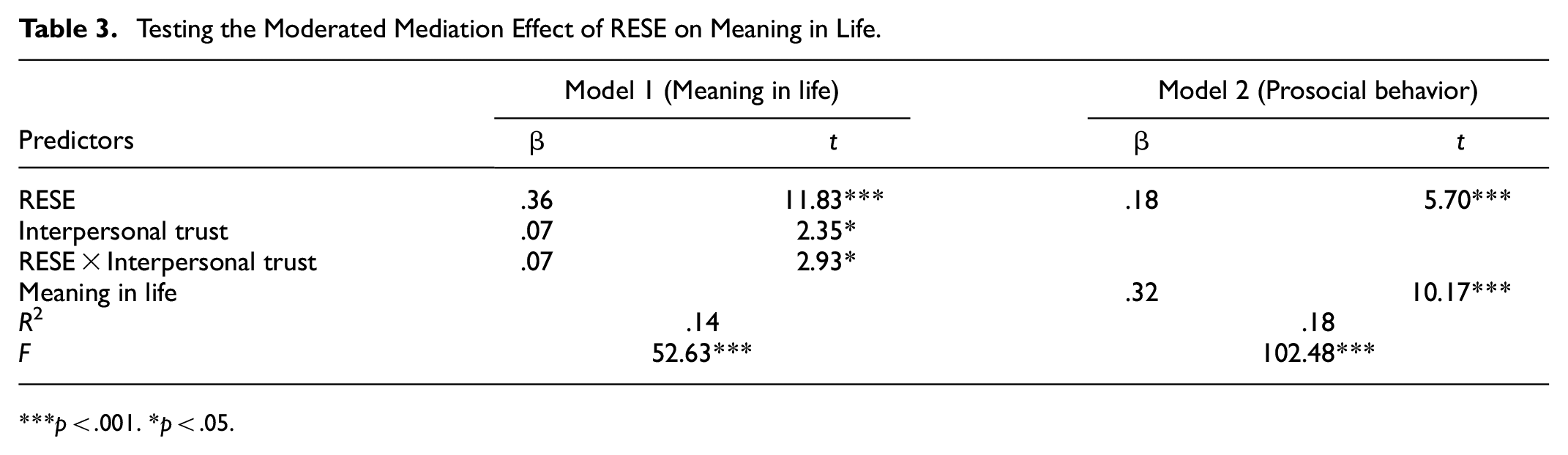
p < .001. *p < .05.

Interaction between RESE and interpersonal trust on meaning in life.

Standardized path coefficients for the relations of meaning in life, Interpersonal trust between RESE and Prosocial behavior.
Discussion
The main purpose of this study was to explore RESE effects on prosocial behavior, and the results confirm our hypothesis that each factor plays a certain role in college students’ prosocial behavior tendency. RESE could, directly and indirectly, be connected with college students’ prosocial behavior tendency through meaning in life. This indicates that it is very important to think that they can regulate emotions, which can make college students feel sufficiently self-confident and improve their pursuit of meaning in life to perform prosocial behavior in favor of others (Wentzel, 2014). These findings further support SCT (Bandura, 1997). Self-efficacy describes beliefs in individual capabilities to exercise control over challenging demands and their functioning, and self-efficacy is a necessary condition for obtaining meaning in life (Luszczynska et al., 2005; Mo et al., 2013). Additionally, meaning in life was associated with more prosocial behavior, in line with prior literature on meaning in life and prosocial behavior (Chang & Xie, 2018; Fang & Chang, 2019; Wang et al., 2018). According to MMM (Heine et al., 2006), once meaning in life is threatened, individuals are more likely to compensate by engaging in prosocial behavior (Fang & Chang, 2019). Notably, meaning in life only partially mediated RESE and prosocial behavior, implying that RESE remained a significant, direct predictor of prosocial behavior, even controlling for meaning in life. High self-efficacy means that individuals have the confidence needed to implement prosocial behavior (Caprara & Steca, 2005; Gini et al., 2008). Previous studies have revealed that individuals with high self-efficacy show more prosocial tendencies, such as cooperation, helpfulness, and sharing (Bandura, 2001; Wentzel, 2014). The remaining direct and positive association between RESE and prosocial behavior suggests that RESE could significantly increase the possibility of prosocial behavior. Besides meaning in life, there may be other factors that must be explored.
Another important conclusion of this study is that interpersonal trust can moderate emotion and the impact of self-efficacy on meaning in life. This shows that the individual’s meaning in life is affected not only by their psychological factors but also by external factors. Studies have found that individuals with higher interpersonal trust have more psychological resources (Gupta et al., 2016). According to the emancipation theory of trust, individuals with relatively high trust have relatively stable social networks and more social support (J.-J. Li, Dou et al., 2019), experiencing more meaning in life due to interpersonal trust. By contrast, individuals with low interpersonal trust do not have sufficient psychological resources and cannot meet their needs; thus, they are less likely to enhance meaning in life. In addition, high interpersonal trust can improve the well function of RESE on meaning in life. Our study found that for the lower level of interpersonal trust, the relationship between regulatory emotional self-efficacy and life meaning was weaker, with a better relationship between RESE and meaning in life for a higher level of interpersonal trust, consistent with the existing research results. Interpersonal trust is a kind of trust in the behavior of others and a key factor for individuals to adapt to society (Suedfeld et al., 2005). People who do not trust others will keep a further safe distance from others, which hinders the development, maintenance, and use of social support networks. Individuals who lack interpersonal trust are less likely to seek social support when needed and may even refuse other people’s support. They are also less likely to help others; therefore, interpersonal distrust will lead to the decline of happiness and meaning in life (Ross, 2003; Tokuda et al., 2008). It can be seen that enhancing the individual’s internal confidence (RESE) and trust in others (interpersonal trust) can improve the individual’s meaning in life, consequently improving the individual’s tendency for and to engage in prosocial behavior. This has not been confirmed in previous studies.
Limitations and Future Direction
The survey adopted a cross-sectional method, so future studies should use other methods to confirm the connection. Second, the current study investigated RESE and prosocial behavior. Later studies could identify other self-efficacy in prosocial behavior. Third, the data collected were based on college students’ self-reports, which may be influenced by response bias, a common finding in behavioral research (Rosenman et al., 2011). For example, social desirability bias may influence the collected data (Donkor et al., 2021). Finally, the respondents were Chinese students so that future studies could be conducted on participants of different ethnicities and nationalities.
Conclusion
RESE was connected to meaning in life, which in turn is associated with prosocial behavior. Furthermore, RESE and meaning in life were moderated by interpersonal trust, which was more considerable with better interpersonal trust. Therefore, to better promote the relationship between RESE and college students’ prosocial behavior, attention should be paid to the importance of meaning in life and interpersonal trust to develop corresponding intervention plans.
Footnotes
Acknowledgements
We would like to thank Weiwei and Dongxiao Hou for their contributions to the writing and data collection of this article.
Author Contributions
Lu Li: Conceptualization, Methodology, Writing-original draft. Long Huang and Hairong Liu: Data collection, Formal analysis, Writing—review & editing. Xiangping Liu: Conceptualization, Methodology, Writing—review & editing. Jiyu Zhang, Xiaoxi He, and Feng Hu: Data collection, Writing—review & editing.
Declaration of Conflicting Interests
The author(s) declared no potential conflicts of interest with respect to the research, authorship, and/or publication of this article.
Funding
The author(s) disclosed receipt of the following financial support for the research, authorship, and/or publication of this article: This study was supported by the MOE (Ministry of Education in China) Project of Humanities and Social Sciences (Grants No. 20YJC190006), the Science and Technology Plan Project of Wuhu city (Grants No. 2020ms3-20), the Philosophy and Social Science Planning Project of Anhui Provincial (Grants Nos. AHSKQ2019D059; AHSKF2021D21), and the Key Projects of Humanities and Social Sciences in Universities in Anhui Province (Grants Nos. SK2019A0224).
