




Abstract
STEM education is a cross-disciplinary approach that combines science, technology, engineering, and mathematics with practical applications. Although approximately 3,000 articles on STEM education have been published in core journals over the past decade (2014–2024), only a limited number of review articles have summarized the development and application of STEM education. To gain a clearer understanding of the current state, research trends, and future directions in STEM education, a comprehensive retrospective analysis is essential. This paper applies the bibliometric analysis method utilizing CiteSpace software for a quantitative analysis, visual review, and evaluation of articles published in the area of STEM education over the past decade. It quantitatively analyzes basic information such as authors, countries, and institutions to understand the essential state of development in STEM education. Then, it performs hotspot evolution analysis (co-occurrence, burst, and clustering) on keywords and highly cited articles, reviews highly cited articles to obtain a comprehensive insight into the evolution of key research hotspots and directions in different periods, and predicts emerging trends. This analysis aims to provide guidance for future research in the area of STEM education.
Plain Language Summary
This paper reviews STEM education research from 2014 to 2024 using CiteSpace software to analyze about 3,000 journal articles. It summarizes key authors, institutions, research topics, and their trends over time. The study highlights main developments, current hot topics, and emerging trends to guide future STEM education research.
Introduction
In recent decades, STEM education (science, technology, engineering and mathematics) has garnered more focus recently. For example, in Western countries and relatively wealthy Asian countries, due to concerns about the environment, sustainability, and economic stability, there is a growing emphasis on developing STEM capabilities to address global challenges in energy, economy, health, and the environment (Bybee, 2010; English, 2016), thereby improving issues including overpopulation, climate change, resource management, biodiversity, agricultural productivity, and depletion of water resources (Kelley & Knowles, 2016). A variety of review articles concerning STEM education have been released in high-profile journals like the “International Journal of STEM Education,” which systematically reviews and analyzes aspects such as the survey tools used in STEM education research (Maric et al., 2023), the combination of STEM initiatives (McLure et al., 2022), publication quantities and types, authors’ nationalities, readership of publications, and research topics (Li et al., 2019; Li et al., 2020; Li et al., 2022; Li & Xiao, 2022), to understand the measurement trends in STEM education, the characteristics of STEM projects, integration methods, and the evolving patterns in STEM education, providing reference for future research. However, most of these studies focus on research from 2014 to 2018, with one extending to 2021. This is insufficient for revealing the latest developments and the complete decade-long evolution of the field. This research gap motivates the present study to conduct a more comprehensive and in-depth bibliometric analysis of STEM education research from 2014 to 2024.
In the United States, STEM education was initiated by the National Science Foundation (NSF, 1986) publishing a report titled “Undergraduate Science, Mathematics, Engineering Education,” formally integrating engineering and technology, science, and mathematics into both undergraduate and K-12 educational programs. Both “Next Generation Science Standards” (NGSS Lead States, 2013) and “K-12 Science Education Framework” (NRC, 2012) highlight the importance of engineering and technology in science education, intending to involve all students in scientific inquiry and engineering design to enhance the connections between STEM disciplines. There has been a growing focus on STEM education in recent years. An article in Science (Mervis, 2009) called for evaluators to pay more attention to improving science education, stating that improving STEM education cannot be achieved solely through legislation and requires a more comprehensive examination of the entire education system. Since 2018, the number of master’s students in the fields of science and engineering in the United States has increased by 37.6% and 10.7% respectively; between 2021 and 2022, the enrollment rate of multidisciplinary and interdisciplinary science master’s students in the United States increased by 41.2%, the highest among graduate student enrollment surveys. The efforts made by educators in STEM education can improve their achievements in the context of international engagement and capacity development, offering students a high-quality education. Nevertheless, there is still a lack of global agreement on the definition of STEM, with three main perspectives. The first perspective views STEM education as a comprehensive integration of disciplines, encompassing science (biology, chemistry, computer and information science, earth science, and environmental science), technology, engineering, mathematics, and various combinations of these fields (English, 2016; Gonzalez & Kuenzi, 2012; Li, 2014; Martín-Páez et al., 2019). The second perspective regards STEM education as involving the combination of multiple disciplines, cross-disciplines, or an interdisciplinary combination of science, technology, engineering, and mathematics (STEM) disciplines (Honey et al., 2014; Kelley & Knowles, 2016; Li, 2018; Moore et al., 2014; Sanders, 2009), aiming to help students connect multiple STEM disciplines in authentic settings and to investigate teaching and learning strategies across any combination of STEM fields. This educational framework simulates real-world situations, where interdisciplinary teams of experts join forces to tackle practical problems. The third viewpoint regards STEM education as a unified discipline that eliminates conventional boundaries among the four fields, concentrating on innovation and the application process, employing modern tools and technologies to devise solutions for intricate contextual challenges (Kennedy & Odell, 2014). These multiple perspectives make the concept of STEM education more diverse and complex and challenge the research status of STEM education themes.
From the perspective of educational theory, the burgeoning development of STEM education is closely related to constructivism, sociocultural theory, and connectivism. Constructivism posits that learning is a process in which learners actively participate and interact in authentic contexts to construct knowledge (Papert, 1996; Valsecchi, et al., 2024). This theory emphasizes student-centered learning, where learners achieve deep integration of interdisciplinary knowledge and capability development through active exploration, collaboration, and reflection in challenging tasks (Anwar et al., 2022; Dolgopolovas & Dagiene, 2024). This precisely embodies the core concept of STEM education: breaking down disciplinary barriers and solving complex real-world problems. Concurrently, sociocultural theory provides another important perspective from the level of social interaction, emphasizing that learning is achieved through participation in learning communities and collaborative interaction with others and cultural tools (Lemke, 2001; Vygotsky, 1978). This perspective places cognitive processes at the heart of social activities, arguing that knowledge is co-constructed in dialogue and collaboration between individuals and their peers, teachers, and the wider community (Kelly & Crawford, 1997). Furthermore, connectivism emphasizes that in the digital age, learning is achieved through network connections, collaboration, and technological interactions, with knowledge distributed throughout the network, and learning being the ability to build and navigate these connections (Downes, 2020; Siemens, 2004). It promotes interdisciplinary learning, peer feedback, and cooperation through technology, and enables students to actively participate in the learning process by using multiple representations in project-based learning environments, with teachers acting as facilitators (Tan et al., 2020; Thoma et al., 2023), thereby providing a practical framework for STEM education that supports collaboration and networked knowledge construction. The above theories provide profound theoretical lenses for understanding knowledge construction and collaboration mechanisms in STEM education.
Given the complexity of STEM education in both concept and practice, and the limitations of existing reviews in terms of time span and analytical depth, this study employs bibliometric methods to conduct a systematic analysis of relevant research from 2014 to 2024. Bibliometrics is a field within library and information science that focuses on the quantitative analysis of the literature system and bibliometric characteristics, using mathematical, statistical, and other quantitative methods to analyze and anticipate the present state and trends within an academic field. Through the quantity and quality of STEM education literature output, using bibliometric analysis software for co-word analysis, social network analysis, cluster analysis, and knowledge graphing, it visually and intuitively displays the hotspots and frontiers of STEM education (Chen, 2004; Liu et al., 2022; Yao et al., 2020; Yuan et al., 2024), and comprehensively reviews the proposed research dimensions to make an objective evaluation of the advancement status and quality of STEM education. In this paper, the software CiteSpace is employed as a web-based Java application for data analysis and literature visualization within a particular domain, exploring the development trends of relevant fields (Chen, 2004), focusing on finding key points or turning points in a particular field or its development and facilitating a detailed analysis of the advancement of that discipline. Although there have been related visual analyses of STEM education research (Zhan et al., 2022), there remains a deficiency in comprehensive analysis regarding the evolution and trends of STEM education topics. This paper intends to use CiteSpace bibliometric analysis software to perform a bibliometric study of STEM education, visualizing and analyzing the data through a series of established indicators, thoroughly examining the progress state and orientation in the field. Compared with previous reviews that mainly focused on describing publication trends and the distribution of research topics (Li et al., 2020; Martín-Páez et al., 2019), this study conducts a systematic analysis of data from 2014 to 2024 and aims to go beyond describing “what” to provide a deeper interpretation of “why” and “how” things have evolved. Specifically, this paper not only seeks to identify research hotspots, but will also integrate analyses of the dynamic trajectories of these hotspots, the mechanisms shaping global collaboration patterns, and the educational theoretical frameworks implicit behind them, thereby revealing the internal logic and external structural connections that drive the development of STEM education research. This comprehensive interpretive perspective constitutes an important supplement and deepening of the existing literature.
Research Questions
This study focuses on a bibliometric analysis of leading academic journals in the realm of STEM education to illuminate the evolution trends within this field. In particular, we seek to explore the following seven research questions:
Data Source and Analysis Methods
Data Source and Selection
To ensure the representativeness and accessibility of the data and to guarantee the authority of the literature sources, we focused on the Web of Science Core Collection (WoSCC) database. Using the search term “TS=(stem education) NOT TS=cell,” we searched the indexes of SCI-EXPANDED and SSCI, with the language set to English. Given the rapid development of STEM education, this paper focuses only on research published from 2014 to 2024, resulting in a total of 6,581 documents retrieved. After strict screening and removal of non-educational literature based on titles and abstracts, we obtained 3,474 documents. These were then exported in the format of “Full Record and Cited References” and duplicate documents were identified and removed using Citespace software, resulting in 2,961 valid documents used as the raw data for visualization analysis.
Analysis Methods
For this study, we used version 6.3.R1 of CiteSpace software to process the collected data and conduct quantitative analysis through the creation of knowledge maps. By analyzing the volume of publications, countries, research institutions, and authorship, we can demonstrate the cooperation patterns among authors, institutions, and nations, and outline the overall situation of STEM education research at home and abroad. Co-citation analysis helps identify and confirm the knowledge framework in a subject. Co-occurrence analysis measures the correlation between several words present together in an article by analyzing their frequency, thereby studying the research hotspots and trends over the years. By creating cluster maps of “keywords” and “cited references,” as well as a timeline view, we can understand the development relationship between research focus areas and hotspots. Additionally, burst detection analysis helps detect the frontier areas of research. These visual analyses reveal the dynamics, hotspots, and trends of STEM education research, providing reference and inspiration for future STEM education research (Figure 1).

The data collection, retrieval and analysis strategy.
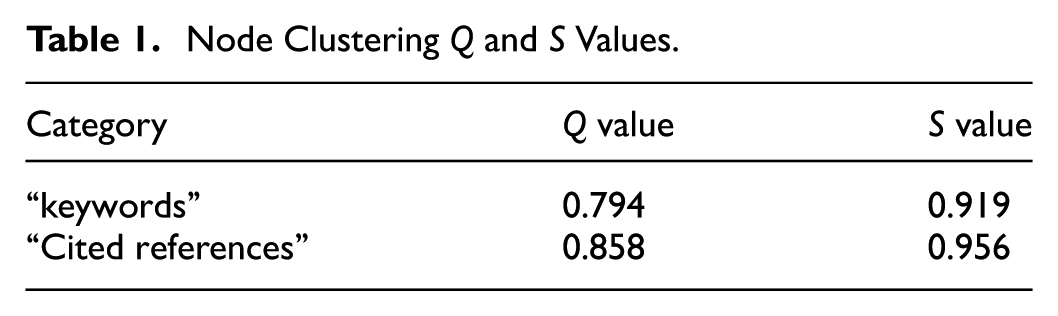
The data processing settings are as follows: the time slice is set to 1 year, with the data source containing all entries, including title, abstract, supplementary keywords (ID), and author keywords (DE). The node categories consist of authors, research institutions, countries, keywords, cited references, cited authors, and cited journals. Considering the extensive range of foreign literature, the G-index parameter scaling factor (K value) of the WoSCC retrieval for foreign literature was adjusted, and the network pruning method was used to trim and merge the visualization network, with other settings left as default. After running the CiteSpace software for visualization analysis, the modularity values (Q values) were 0.794 and 0.858, both greater than 0.30, indicating that the community structures partitioned in the view are significant. The average silhouette values (S values) were 0.919 and 0.956, both greater than 0.70, and close to 1, indicating that the clustering results of the literature research in this study have high credibility and homogeneity (see Table 1).
Node Clustering Q and S Values.
Results
Annual Trends in STEM Education-Related Publications
Analyzing publication trends over time in a specific discipline can provide insights into its growth and evolution. Understanding these trends is essential for grasping the current research status of a field. Figure 2 presents data on STEM education publications from 2014 to 2024. The annual statistics reveal a steady increase in publications, with foreign publications topping 300 annually since 2020 and reaching 530 by 2023. This rise reflects the growing global emphasis on STEM education for fostering innovation and its critical role in national development. Since 2022, there has been a marked increase in publication numbers. As of May 4, 2024, 246 foreign-language papers have already been published, with projections indicating the total for 2024 will surpass 500.

Annual publication volume of STEM education research from 2014 to 2024.
The Collaboration Network of Authors and Cited Authors in STEM Education Research, as Well as the Collaboration Network of Countries and Institutions in Journal Publications
Through the analysis of publication counts from different countries and institutions, key contributors to STEM education research can be identified, along with their collaborative relationships in producing influential papers. Our findings reveal that from 2014 to 2024, articles on STEM education were published by 95 countries and 290 institutions in journals indexed by SCI-EXPANDED and SSCI. As shown in Table 2, the top 10 countries/regions are, in order, the United States, China, Australia, the United Kingdom, Spain, Canada, Turkey, Germany, Taiwan (China), and Israel. The United States leads with 1,635 papers (55.22% of the total), significantly ahead of second-place China (200 papers), highlighting the United States’ prominent position in STEM education research.
STEM Education Studies the Geographical Distribution Table.

By conducting a co-occurrence analysis of cooperation relationships among countries using CiteSpace software. The node color corresponds to the publication year. A larger publication volume within a given year corresponds to wider annual rings and a larger publication volume overall corresponds to a larger node size. The lines between nodes represent cooperation relationships between two countries, with thicker lines indicating closer cooperation. The purple border around nodes indicates centrality, with a thicker purple border indicating stronger intermediary centrality and academic importance of that node. As shown in Figure 3, the United States has the highest centrality, is the largest knowledge producer, and is the absolute core of global STEM education research. Meanwhile, countries such as China, Australia, and the United Kingdom exhibit close cooperative relationships, playing important regional hub roles. National burst analysis (Figure 4) further reveals from a dynamic perspective that Malaysia has the highest burst potential in the past decade (burst strength of 4.22), while Iran has become a new burst point since 2022 (burst strength of 1.47). Although the United States and China dominate in terms of publication volume, research from other countries and regions also presents active and diverse contributions. Interestingly, none of the top 10 countries in terms of publication volume experienced a burst during this decade, which may be related to the time frame of our study, indicating that these countries started researching STEM education early and began to be valued by other countries globally, especially developing countries, in the past decade.

National network map.

State breakout view.
The statistical analysis of publication counts using CiteSpace indicates that the top 29 institutions in STEM education are all based in the United States (see Table 3), including Florida State University, the University of California and Georgia University, which constitute the core strength of STEM education research in the United States. Additionally, institutions with higher publication numbers exhibit strong collaborative relationships. From a collaboration network perspective, the University of Georgia and the University of California System demonstrate the strongest collaborative activity, indicating close academic interaction among top-tier institutions in the United States.
The First 10 Agencies of STEM Education in Foreign Countries.

The burst view reveals terminologies that have been frequently cited over a period. The blue line indicates this time interval, while the red line segment represents the start and end years of the burst. The institutional burst view (Figure 5) reveals a highly geographically concentrated spatiotemporal distribution of research impact. From 2014 to 2024, 22 of the top 25 institutions with high bursts are from the United States, with the remaining three from China, Canada, and Ireland.
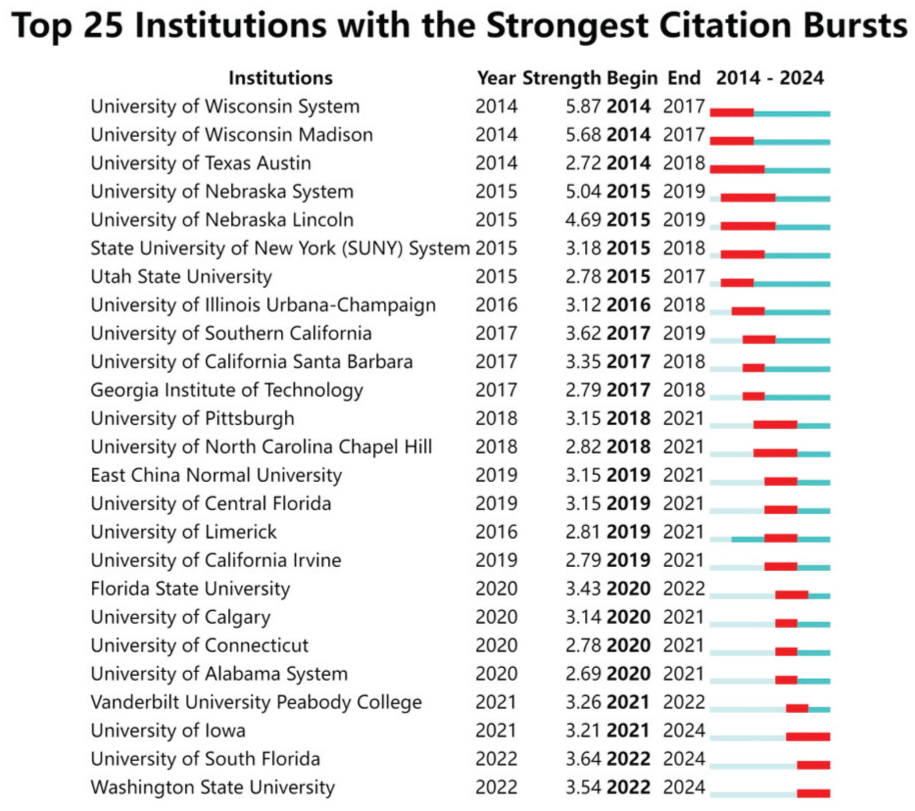
Universities with STEM programs during 2017 to 2024.
Analysis of author publication counts in the WoSCC and their collaboration networks reveal that 294 authors are engaged in STEM education research globally. Among the top 10 authors, 8 are from the United States and 2 from China, highlighting the dominance of American scholars in the field. However, analysis of the author collaboration network (Figure 6) reveals a dispersed structure, resembling a starry sky, in stark contrast to the close national and institutional collaborations. Its degree centrality is 0, indicating few close collaborative relationships. Charles Henderson has the most collaborations, working closely with 10 scholars. Furthermore, author burst analysis (Figure 7) identifies scholars with high impact during specific periods, such as Jiang Fengguang from Shanghai Jiao Tong University in China and Li Yeping from Texas A&M University in the United States. Both experienced a burst in 2019 to 2020, with burst strengths of 2.62 and 1.97, respectively, providing insights into the key individual contributors driving the field’s development. Additionally, Chiu from Hong Kong, China, has experienced a burst in the last 3 years, with a burst strength of 2.18, indicating that he is expected to conduct more in-depth research in the field of STEM education in the future.

Co-occurrence network of authors (a) and cited authors (b).

Burst detection view of authors (a) and cited authors (b).
Unlike the co-authorship network, the network of cited authors consists mainly of scholars who have made significant contributions in the field of education, with higher centrality. Among them, the most frequently cited is Bandura, a psychologist renowned for his foundational contributions to social cognitive theory, which highlights the significance of observational learning or imitation. His theory posits that individuals acquire new behavioral patterns by observing the actions and consequences experienced by others. Without necessarily experiencing any form of classical conditioning or reinforcement directly. This theory introduced the role of cognitive processes in learning and behavioral change, helping to understand the interplay between cognition, environment, and behavior, and how these factors influence an individual’s learning and development (Bandura, 2007). Ranked among the top 10 in citation frequency is Scholar English, who also experienced a burst in publications from 2017 to 2019, with a burst strength of 2.13, indicating ongoing activity and relevance in the field. Additionally, there are citations to national institutions, such as the National Research Council (NRC) in the United States. The NRC primarily develops policies and recommendations related to STEM education. For example, they advocate for schools and educational systems to adopt evidence-based teaching methods, providing standards for assessing the success of STEM education in schools (NRC, 2011). They also offer different types of STEM education for different student needs, including selective STEM schools for academically talented students (requiring application), inclusive STEM schools for all students, and vocational STEM schools, emphasizing the importance of improving the quality of education for all students. Furthermore, the NRC provides a framework and set of metrics for monitoring schools’ progress in implementing effective STEM education, aiding educational decision-makers, schools, and policymakers in assessing and improving the effectiveness of STEM education implementation (NRC, 2013). These policies and reports aim to promote the successful implementation of STEM education nationwide by offering effective educational strategies and assessment tools.
The burst analysis of cited authors (Figure 7) further reveals the dynamic changes in influence. The National Research Council (NRC) exhibited the highest citation burst intensity at 25.06, with a burst duration from 2014 to 2018, demonstrating the significant impact of their policies on STEM education. One of the burst-cited authors from 2022 to 2024 is Li, who also experienced a burst in publications from 2019 to 2020, indicating that his previous research is currently receiving significant attention and citations.
The Development of Key Topics and the Emergence of New Hotspots in STEM Education
Keyword co-occurrence serves as an effective indicator of research hotspots within a field while emerging keywords signify frontier topics. To investigate these research hotspots and frontier topics, we analyzed keyword distribution. Initially, we examined the co-occurrence network of keywords, which highlights those with high centrality and frequency. The size of each node corresponds to the overall frequency of the keyword. The keyword co-occurrence network (Figure 8) and its high-frequency word list (Table 4) together reveal that nodes like “science,”“education,” and “students” have the largest size and highest centrality, indicating that they are the core hubs connecting different research themes. The overall research framework is tightly focused on learners, teaching practice, and core disciplines.
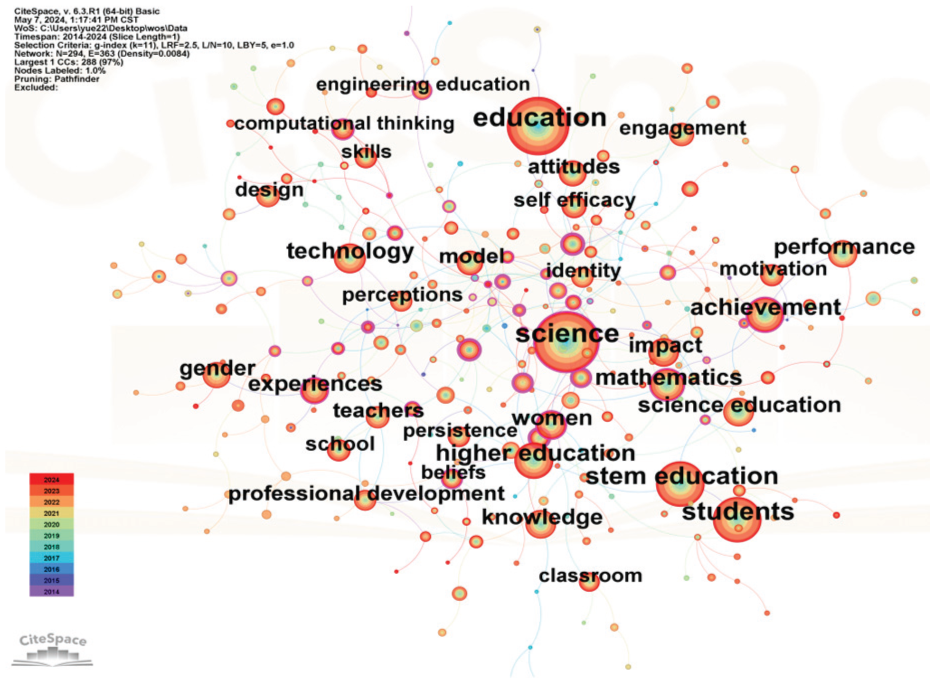
Co-occurrence network diagram of research keywords.
High-Frequency Keywords in STEM Education Research.

The higher the co-occurrence frequency of keywords in the same research field, the closer their relationship, thus aggregating into the same research field. Clustering analysis was performed on all articles in the STEM education field (2014–2024) using the LLR algorithm to generate cluster labels (Figure 9). Through the identification of these clusters, the various subfields of STEM education research can be more intuitively outlined. Combining the temporal changes in keyword clustering (Figure 10), we delineate the development process of STEM education research directions to understand the classic and popular keywords in STEM education research (Table 5). STEM education began early, and considering the literature we selected was published from 2014 onwards, the timeline graph shows that high-frequency keywords from 16 cluster labels were already present before 2014. Among them, the representative keywords within the clusters of “#3 computational thinking,”“#4 exploring student,”“#9 science technology engineering,”“#11 science classroom,”“#12 data-driven network,” and “#13 underrepresented minority student” are not entirely new, but their sustained popularity and evolutionary paths reveal a shift in research paradigms. Cluster themes like “#8 Comparative STEM,” however, have shown slow development and weak relevance, reflecting the failure of some early research directions to persist.
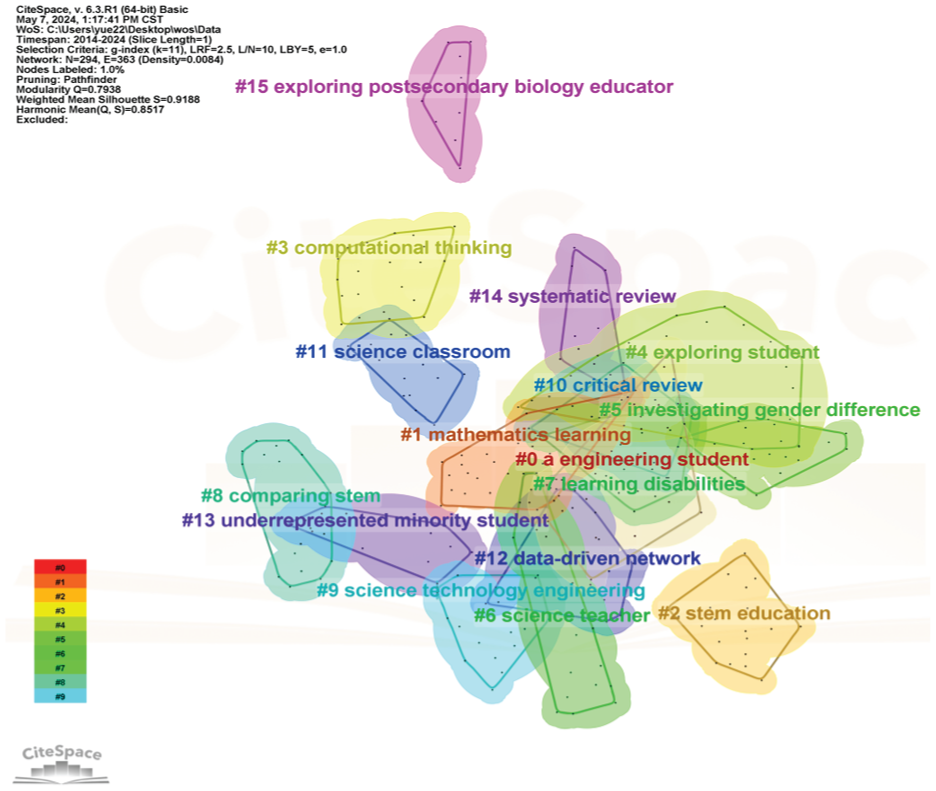
Clustering view of research keywords.

Timeline view of keywords.
High-Frequency Keyword Clusters in STEM Education Research, 2014 to 2024.

Emergent keywords are considered indicators of frontier topics in research. Keyword burst detection (Figure 11) illustrates the top 25 keywords with the highest burst strength at different times, revealing the active content of STEM education research over the entire span (2014–2024). The keyword “participation” began to burst in 2014 with a burst strength of 4.83. The keyword “policy” experienced a burst period from 2017 to 2021, having the highest burst strength (5.92) and lasting for 4 years. Recent (2022–2024) bursting keywords include “minorities in chemistry,”“robotics,”“undergraduate,” and “online learning,” among others.
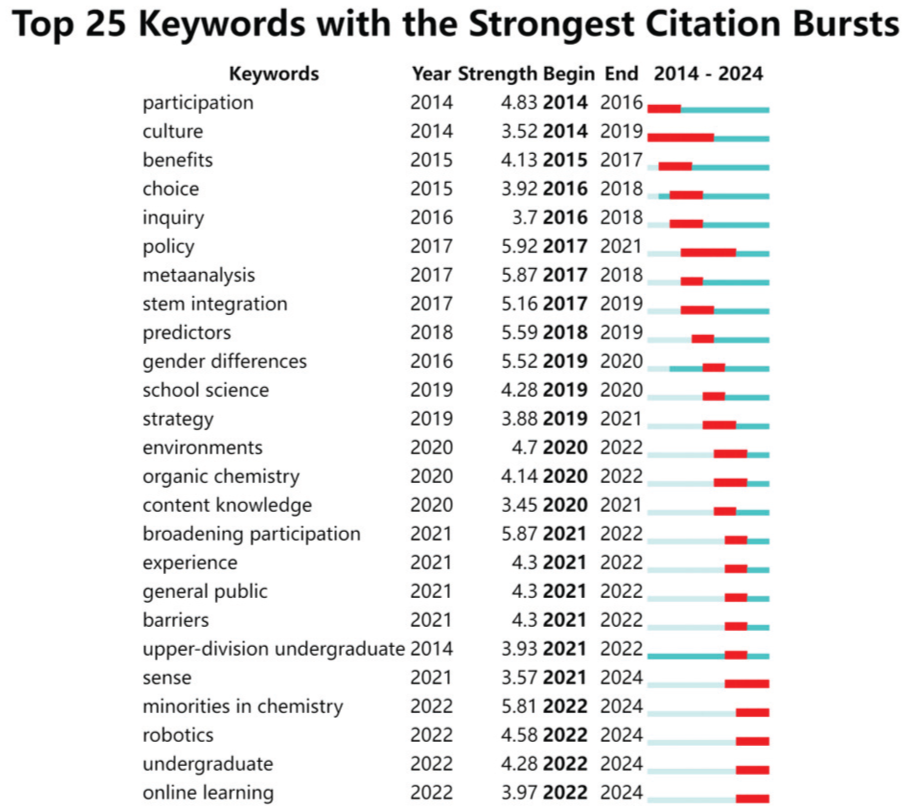
Keyword burst detection visualization.
Major Themes and Frontier Research in Highly Cited Papers and an Analysis of High-Impact Journals in STEM Education Research
Co-citation analysis of references and journals reveals the knowledge base and dissemination channels within the STEM education field. The reference co-citation network (Figure 12) illustrates that highly cited references constitute the intellectual core of this field, where larger nodes indicating more important references and more connections indicating higher centrality. Over the decade from 2014 to 2024, the top 10 most cited references in the WoSCC database include 1 book, 4 review papers, and 5 research papers.

Co-occurrence network map of references.
Review papers provide a retrospective summary of key discoveries and contributions in a field over a specific period and offer insights for future research, thereby promoting the field’s development. Among the most cited review papers, we found that these highly influential reviews primarily discuss theoretical frameworks, development status, teaching practices, and teacher development in STEM education. Regarding theoretical frameworks and development trends, Martín-Páez et al. (2019) systematically reviewed literature from 2013 to 2018, analyzing the theoretical frameworks, disciplinary integration, potential benefits, and intervention measures of STEM education. They pointed out inconsistencies between definitions and practices at the time, emphasizing the importance of interdisciplinary integration in real or virtual contexts. In terms of development trends and core issues, Li’s et al. (2020) analyzed articles published from 2000 to 2018, revealing a significant rise in recognition of STEM education research, particularly in the United States, Australia, Canada, and Taiwan. Researchers increasingly incorporate terms like STEM and STEAM in their work, focusing on themes such as K-12 teaching, teacher education, cultural issues, and STEM policies. In teaching practice and teacher development, two studies have had particularly profound impacts. First, Freeman et al.’s (2014) meta-analysis of 225 studies confirmed that active learning significantly improves STEM students’ academic performance. This finding provides strong empirical support for constructivist teaching strategies, greatly promoting the transformation of teaching practices from traditional lectures to student-centered models. Second, Margot and Kettler (2019) approached the topic from the perspective of teachers, identifying teaching and curriculum challenges faced in implementing STEM education in the classroom. They emphasized the crucial role of collaborative cultures, high-quality curriculum resources, and continuous professional development in successfully implementing STEM education, and pointed out that future research should focus on the effectiveness of programs among diverse student populations and strategies for supporting teachers.
In research papers, scholars primarily conduct qualitative and quantitative studies on teaching styles, teaching methods, and race to develop strategies for improving STEM education. For example, Stains et al. (2018) used the Classroom Observation Protocol for Undergraduate STEM (COPUS) to observe over 2,000 classes involving more than 500 STEM instructors at 25 institutions. They identified seven distinct teaching styles, including “lecture,”“interactive lecture,” and “student-centered,” finding that STEM courses are still predominantly lecture-based. Theobald et al. (2020) conducted Bayesian regression analyses on exam score data from 15 studies (9,238 students) and failure rate data from 26 studies (44,606 students), concluding that only evidence-based active learning course designs can close academic performance gaps. They proposed the “mind and heart” hypothesis, suggesting that meaningful practice combined with inclusive teaching is necessary to significantly reduce academic performance gaps. Ong et al. (2017) using the frameworks of Critical Race Theory (CRT) and intersectionality theory, interviewed 39 women of color to explore the challenges they face in STEM fields and how they seek or create “counterspaces” to support their persistence and success in STEM higher education. They described the functioning of counter spaces, including peer relationships, mentor relationships, national STEM diversity conferences, STEM and non-STEM campus student groups, and STEM departments, expanding the understanding of counter space types and functions.
Clustering the references cited in STEM education research from 2014 to 2024 using the LLR algorithm generated 15 cluster labels, arranged top-down by size in the timeline view (Figure 13). By integrating this timeline view with citation spans, the evolution of the field is depicted from the perspective of its knowledge base. This approach clearly identifies currently active emerging frontiers, as well as some less relevant past themes, providing historical depth for understanding the knowledge evolution of the discipline. Among them, clusters “#2 engineering design,”“#8 student effort,” and “#9 emerging STEM school” are classic topics; they may not be the latest, but they are intricately connected with other clusters. Clusters “#0 high school student” and “#5 first-year student” are relatively outdated topics with no continued research. Clusters “#3 computational thinking,”“#4 STEM education,”“#6 general chemistry,”“#7 evidence-based instructional practice,”“#11 innovative approach,”“#13 Latina college students identity,” and “#14 STEM education research” are emerging topics, as they have remained active on the timeline in recent years. This suggests that these areas will become research hotspots in the future. Notably, papers published between 2018 and 2020 in the STEM education field have garnered significant attention and citations from subsequent scholars, playing a crucial role in advancing the field of STEM education.

Reference cluster view and timeline view.
A total of 57 burst articles were identified from 2014 to 2024. The citation burst map (Figure 14) shows the top 25 references with the highest burst citation rates over the past decade. Miles et al.’s (2014) work was the first to exhibit a citation burst, with an intensity of 11.12, lasting from 2014 to 2019. This authoritative guide on qualitative data analysis offers a comprehensive resource, including methods, strategies, and techniques covering essential topics like research design, data collection, and data verification, focusing on systematically handling and analyzing qualitative data. The reference with the highest burst citation intensity was Freeman et al.’s (2014) review (burst intensity 19.64), indicating the significant impact of the active learning strategies he proposed on STEM education.

Reference highlight view.
Over the decade, Miles et al. (2014) and Theobald et al. (2020) garnered significant attention upon publication, entering the citation burst phase in the same year and the following year respectively. These works primarily provided empirical research on qualitative methods and teaching methods. Themes that continue to burst in 2024 represent the research frontier, exploring topics like teaching strategies, minorities, and gender studies, which may signify future hotspots in STEM education research. For instance, In 2018, Rainey K published “Race and gender differences in how a sense of belonging influences decisions to major in STEM.” The following year, several significant works emerged, including Martín-Páez T’s review on STEM education, Riegle-Crumb C’s examination of racial/ethnic gaps in persistence, and Canning EA’s study on the impact of faculty beliefs on student motivation. In 2020, Theobald EJ and McGee EO contributed important papers addressing active learning’s effects on achievement gaps and structural racism in STEM higher education, respectively, offering valuable references for future research.
From 2014 to 2024, the top 20 journals with the highest citation frequencies in the field of STEM education are listed in Table 6. Among them, the *Journal of Research in Science Teaching*, indexed by SSCI, has the highest citation frequency, having been cited 1,083 times, indicating that the literature published in this journal has a significant impact on the field of STEM education. The journal with the highest centrality is *Science*, indexed by SCIE, with a centrality of 0.52, suggesting a strong connection between this top-tier journal and the STEM field. Among these 20 highly cited journals, 6 journals are in the third quartile (Q3), 3 are in the second quartile (Q2), and 11 are in the first quartile (Q1). This distribution demonstrates that the literature quality and guidance for subsequent research are highest in top-tier journals. The top four journals all pertain to the field of science, indicating that science education holds a central position in STEM education research.
Top 20 Journals by Citation Frequency.

The burst detection view of cited journals (Figure 15) reveals the temporal changes in the influence of different journals. The journal *American Psychologist* began to experience a citation burst in 2014, with a burst strength of 15.75, lasting until 2018. Following this, in 2015, the journal *Thesis* began a citation burst, reaching the highest burst strength over the past decade (46.88) and continuing until 2020. The journal *Next Generation Science* had the second highest burst strength (26.04), which occurred between 2017 and 2021, indicating that these journals have published many classic papers on STEM education. From 2021/2022 to 2024, five journals experienced citation bursts: *Statistical Power Analysis for the Behavioral Sciences*, *Thinking Skills and Creativity*, *Frontiers in Education*, *TechTrends*, *The Coding Manual for Qualitative Researchers*, and *Journal of Baltic Science Education*. These journals were the most frequently cited during the 2021/2022 to 2024 period, suggesting that they are becoming important platforms for disseminating emerging research findings. It can be speculated that in the future, highly cited papers are likely to appear in the journals *Qualitative Research* and *Advances in Health Sciences Education*, which, as of May 4, 2024, are the top two journals with the highest citation frequencies.
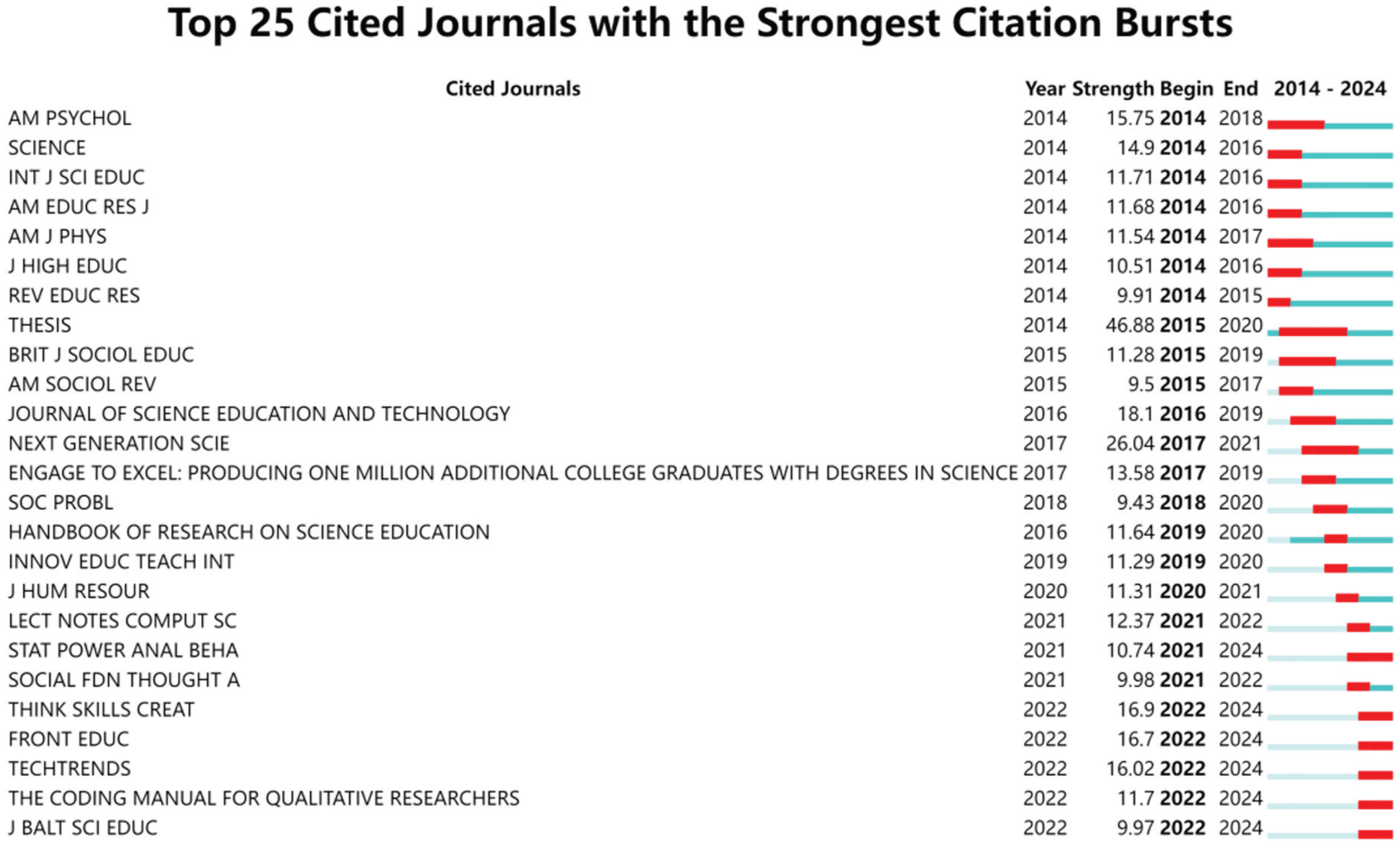
Highlighted view of cited journals.
Discussion
The annual trends observed in STEM education-related publications reveal a sustained increase in publication volume, with a particularly notable surge since 2020, reflecting the pressing global need for STEM education. This trend is closely linked to the policy orientation of various countries that view STEM education as a core strategy for national innovation capabilities and economic competitiveness. STEM education is not only tasked with cultivating students’ key abilities such as creativity and problem-solving (Hallström et al., 2023), but is also regarded as a core driver supporting future global economic prosperity, promoting social progress, and ensuring environmental sustainability (Kelley & Knowles, 2016).
The collaboration networks of authors and cited authors in STEM education research, along with the cooperation networks of countries and institutions in journal publications, reveal a structurally robust global ecosystem. This ecosystem exhibits a typical “core-periphery” structure, with the United States forming the core due to its absolute dominance in total publications, leading institution clusters, and international collaboration networks. This pattern aligns strongly with the “Matthew effect” in educational resource allocation (Merton, 1968; Soares, 2011), implying that the United States largely dictates the research agenda, knowledge production, and dissemination pathways in global STEM education. From a connectivism perspective, the entire ecosystem can be viewed as a dynamic global knowledge network. The United States’ central position stems from its powerful function as a key “information node,” efficiently connecting and filtering global knowledge flows. This theory, which sees learning as the ability to form and traverse network connections (Thoma et al., 2023), provides a crucial framework for understanding global collaboration in the STEM field. Despite the convergent macro-structure of global collaboration networks, significant regional differences exist in research focus. From a sociocultural perspective, groundbreaking knowledge production is highly dependent on “communities of practice” centered around leading U.S. institutions (Lave & Wenger, 1991), while regional communities exhibit different research orientations: Europe focuses on cutting-edge issues such as artificial intelligence and ethical reflection (Rejeb et al., 2024; Zawacki-Richter et al., 2019), Asia emphasizes the systematic advancement of STEAM education and national curriculum reform (Han et al., 2023; Kijima et al., 2021), and the Middle East focuses on the construction of localized teacher development models and assessment tools (Eltanahy & Mansour, 2022; Mansour et al., 2024). This diversified landscape of research topics reflects both the universal pursuit of improving STEM education quality across regions and their respective unique sociocultural contexts and developmental needs. Notably, despite close collaboration within the macro-level “community of practice,” author-level collaboration networks are relatively loose, indicating a need to strengthen in-depth and stable “collaborative inquiry” models at the micro-practice level. Simultaneously, the emergence of new research forces such as Malaysia and Iran suggests that research influence is gradually spreading, demonstrating a diversified development potential beyond traditional centers.
An analysis of key themes and emerging trends in STEM education reveals a knowledge structure centered on learners and practice, with a research paradigm undergoing profound transformation. Compared to the earlier review by Martín-Páez et al. (2019), this study finds that core issues such as “computational thinking” and “equity” have moved beyond conceptual discussions into a phase of extensive practical validation and intervention strategy research. Specifically, “computational thinking” is no longer confined to advocating ideas but is deeply integrated into curriculum design, becoming actionable teaching content (Özdinç et al., 2022). Research on “minority groups” has also shifted from revealing phenomena to evaluating and optimizing specific interventions (Aslan et al., 2024). This shift signifies the increasing maturity of STEM education research, dedicated to addressing complex educational problems at the practical level. Compared to the observations of Li et al. (2020), the aforementioned issues have moved from the periphery of disciplines to the center of research, constituting the most dynamic research field currently. From a theoretical perspective, this research landscape clearly reflects the triple influence of constructivism, sociocultural theory, and connectivism. On the one hand, constructivism has profoundly shaped the student-centered research paradigm. High-frequency keywords such as “student,”“participation,” and “performance” indicate a shift in research focus from teacher-centered instruction to student-centered knowledge construction. The rise of clusters such as “computational thinking” and “science, technology, engineering” reflects the in-depth practice of the “learning by design” concept, where learners integrate interdisciplinary knowledge and construct meaning in the process of solving real-world problems through designing algorithms, programs, or participating in complete engineering designs (Waterman et al., 2020; Xi et al., 2024). On the other hand, sociocultural theory provides a crucial perspective for understanding the deepening of educational equity issues. The refined focus on groups such as “minority ethnic groups” emphasizes the critical role of learning environments, cultural backgrounds, and social interactions in individual participation in STEM, driving research to shift from simply attributing disparities to individual ability toward reforming learning communities and cultural practices. Concurrently, connectivism provides a crucial perspective for understanding how emerging technologies are reshaping learning models. The evolution of prominent keywords reveals that the initial macro-level focus on “policy” and “participation” is gradually giving way to a more refined focus on specific technologies and methods such as “robotics” and “online learning.” These technologies are not only teaching tools but also the infrastructure for building distributed cognitive networks, enabling learners to access global knowledge bases, participate in cross-regional collaboration, and develop networked thinking skills in human-computer interaction (Siemens, 2004; Thoma et al., 2023). This indicates that technology-enhanced personalized learning, multidisciplinary integrated teaching, and in-depth educational equity practices will, within the networked learning landscape depicted by connectivism, jointly constitute the cutting-edge issues driving the development of STEM education.
The analysis of highly cited papers and journals collectively outlines a clear trajectory of knowledge evolution in STEM education research. This trajectory reveals a complete process, from the early theoretical construction arguing “why STEM integration is needed,” to the empirical validation of “what teaching methods are effective,” and further extending to the systemic challenges of “how to effectively implement” (such as teacher development and equitable policies). This indicates that the research paradigm in this field has transitioned from advocating concepts to seeking evidence-based solutions in complex educational ecosystems, thus reaching a mature stage. Specifically, the evolution of the literature reflects a deepening of research focus. Freeman et al.’s (2014) landmark study on active learning, with its highest citation burst intensity, powerfully demonstrates the profound impact of the “student-centered” teaching paradigm shift on the field. Meanwhile, the focus on teacher cognition (Margot & Kettler, 2019) and the experiences of minority students (Ong et al., 2017) marks a shift in research focus from purely pedagogical methods to a systemic examination of equity and inclusion across the entire educational ecosystem, deeply revealing the impact of sociocultural environments on learners’ identity and persistence, and extending the application of sociocultural theory from classroom collaboration to the broader fields of educational equity and social support systems. Stains et al. (2018) large-scale classroom observations provide direct evidence that teaching reforms still face challenges, while Theobald et al.’s (2020) meta-analysis offers crucial data supporting the argument that active learning can effectively promote educational equity. From the perspective of the structure of the knowledge base, a timeline view of citation clusters clearly demonstrates the dynamic development of the field. The continued activity of emerging clusters, such as “#7 Evidence-Based Teaching Practices” and “#13 Latina Women’s Identity,” corroborates the trends revealed by highly cited papers, indicating that “evidence-oriented teaching” and “refined equity research” constitute the most active research frontiers currently. Journal impact analysis corroborates the above trends from the perspective of knowledge dissemination. Top journals are concentrated in the field of science education, establishing its central role in STEM research. Recently, high burst-impact journals, such as *Thinking Skills and Creativity* and *TechTrends*, reflect the deep integration of the field’s forefront with issues such as creative thinking and educational technology. These findings collectively indicate future research directions: while deepening evidence-based teaching practices, greater attention will be paid to technology-enabled learning environments, inclusive educational design, and their effectiveness in diverse student populations.
Conclusion
This study, through a bibliometric analysis of data from the past decade (2014–2024), provides a valuable complement and extension to previous significant STEM education reviews by offering an in-depth look at research focuses and their evolution. Compared to Martín-Páez et al.’s (2019) early examination of theoretical frameworks and definitions, this study finds that issues such as computational thinking and online learning have evolved from emerging concepts into mature research areas. Furthermore, in contrast to Li et al.’s (2020) analysis of macro trends, this study further reveals that evidence of the effectiveness of active learning and teacher professional development has moved from theoretical advocacy to comprehensive practical validation. Simultaneously, concerns about educational equity have deepened from broad appeals to refined empirical explorations targeting specific groups (e.g., underrepresented minority students). Therefore, the unique contribution of this review lies in its systematic capture of the critical decade in STEM education’s evolution from the initial refinement of theoretical frameworks to a new stage of deepening practical application, strengthening technological integration, and pursuing nuanced equity.
Specifically, this study reveals a dynamic global research landscape: in terms of power distribution, it displays a “core–periphery” structure centered on the United States, reflecting a clear “Matthew effect”; regarding development dynamics, it presents a complex picture in which emerging research forces coexist with limited collaboration at the author level. In terms of knowledge structure, the field has formed a close-knit network centered on learners and oriented toward practice. This analysis shows that constructivism underpins student-centered teaching paradigms, sociocultural theory explains the central role of collaboration and community in knowledge construction, and connectivism offers a crucial perspective for understanding learning mechanisms in technology-enabled, interconnected environments. Together, these three theories provide a robust theoretical foundation for contemporary STEM education practices and research. The evolution of literature and journals further confirms that, on this foundation, the field’s leading edge focuses on evidence-based teaching practices, technology-enhanced learning environments, and inclusive designs for diverse student populations.
Based on the aforementioned findings, this study offers clear implications for future theoretical development, practical innovation, and policy formulation: At the theoretical level, it is necessary to further develop a new framework capable of systematically explaining the interdisciplinary integration mechanisms in STEM education and the networked learning patterns in the digital age, building upon classic theories such as constructivism, sociocultural theory, and connectivism. At the practical and policy levels, the hot topics and trends identified in this study provide a clear direction for educators and policymakers: (a) Classroom Practice and Curriculum Design: More emphasis should be placed on incorporating teaching strategies such as “active learning,”“computational thinking,” and “engineering design,” using project-based learning and real-world problem-solving to enhance student engagement and performance. (b) Teacher Professional Development: The research hotspot of “teacher professional development” indicates the need to continuously provide teachers with training and support in interdisciplinary teaching skills, evidence-based instructional practices (EBIP), and inclusive pedagogy. (c) Educational Equity and Policy: Hot topics such as “gender differences” and “minority groups” call for the development of more inclusive education policies, narrowing the participation and achievement gaps in STEM fields among different student groups through curriculum materials, teaching demonstrations, and interventions in campus culture. (d) Technology Integration: Emerging keywords such as “online learning” and “robotics” suggest that we should actively explore the application potential of emerging technologies such as artificial intelligence and virtual reality in creating personalized and immersive STEM learning environments.
Despite the relatively comprehensive and objective nature of bibliometric analysis, this study, like previous research, has some unavoidable limitations. First, regarding data sources, we selected only the WoSCC database. While this ensures the authority of the literature, it may systematically overlook important research published in non-English journals, conferences, or found in other databases such as Scopus and ERIC, particularly research from non-English speaking countries. Future research could employ cross-database validation to obtain a more comprehensive view. Second, at the methodological level, bibliometrics excels at revealing structural patterns of “who is researching what,” but this method cannot directly answer questions about the underlying reasons driving these trends or the “how effective” aspects of specific teaching interventions. This requires future research to combine macro-level bibliometric findings with micro-level qualitative studies, content analysis, or meta-analysis for in-depth exploration. Finally, and most importantly, the value of this study lies in providing a broad “research map,” while the detailed exploration of each specific area within the map (such as the key success factors of a particular teacher professional development program) depends on subsequent thematic empirical studies and reviews.
Therefore, future research can build upon cross-database comparisons, combined with qualitative research and content analysis, to conduct in-depth exploration of the specific areas identified by this “research map.” Particular emphasis should be placed on cross-cultural comparative studies, deepening the exploration of the influencing mechanisms of teaching strategies, and continuously paying attention to the paradigm shifts in learning under technological empowerment, thereby jointly promoting STEM education to effectively address the complex challenges of the globalization era.
Footnotes

Ethical Considerations
This article does not contain any studies with human participants or animals performed by any of the authors. Therefore, ethics committee approval was not required.
Author Contributions
Yueyue Ma analyzed the data, did the experiment, drafted the manuscript, and revised it. Xiaofei Li provided critical revisions to the manuscript regarding important intellectual content and made detailed revisions to the manuscript. Yuhan Dong polished the language.
Funding
The authors disclosed receipt of the following financial support for the research, authorship, and/or publication of this article: This work was supported by the Key Project of the Chongqing Education Science Planning Project 2025, entitled “Empirical Research on STEM Education Promoting the Development of Students’ Innovative Literacy under the New Curriculum Standards” [K25YB1100048], and the Key Project of the Chongqing Education Evaluation Research Association 2024, entitled “Evaluation Research on the Interdisciplinary Learning Literacy of Junior High School Students through Chemistry Interdisciplinary Teaching” [PJY2024065].
Declaration of Conflicting Interests
The authors declared no potential conflicts of interest with respect to the research, authorship, and/or publication of this article.
Data Availability Statement
The datasets generated during and analyzed during the current study are available from the corresponding author upon reasonable request.