




Abstract
“The Capability Approach” (CA) is a normative and critical framework for assessing the well-being of people and societies. It is a pluralistic methodology open to deliberation, with applications in various branches of the Social Sciences. The suitability of CA for social, economic, and political improvements in a wide variety of contexts is highlighted, assuming ethical principles of defence of freedom and justice. The growing interest in relation to CA is reflected in a large increase in scientific production, which makes it difficult to outline its main lines of research precisely. Our study has two goals: on the one hand, it will become a fruitful instrument to learn about the main areas of research that already exist on CA; on the other hand, it will serve to enrich them and incorporate new lines of research into the field. Having a panoramic view of the trends in CA will facilitate their work for future researchers. To this end, taking the Web of Science database from 1994 to 2022 as a reference, a bibliometric analysis based on citations is conducted using the CiteSpace program. Our findings show that 11 clearly differentiated clusters have been detected, which correspond to the essential lines of research on CA. Our bibliometric analysis contributes to revealing the evolution of the academic field of CA, with special emphasis on emerging areas.
Introduction
The intellectual influences of CA go back to the western philosophical tradition. Specifically, authors such as Aristotle, Adam Smith, John Stuart Mill and Karl Marx (Qizilbash, 2016; Walsh, 2000; Wei, 2022). The theoretical foundations of CA were first raised by the winner of the Nobel Prize in Economics Amartya Sen and later enriched by the prestigious philosopher Martha Nussbaum. Since the 1980s, a growing number of scholars have developed the theory in many directions. The essential elements of CA are formulated in some early works by Sen (1985, 1992, 1999) and Nussbaum (1999, 2000, 2003). Amartya Sen’s initial idea was to create a method to analyze people’s well-being, giving central importance to what they were capable of being and doing (Sen, 1993, p. 30). Thus, the expression “capability” refers to the real options that a person has when choosing his way of life (Nussbaum & Sen, 1993). The cornerstone of CA—its inalienable principle—is the freedom of people to choose their life projects (Alkire, 2005). The theory of freedom is the central element of CA, although various authors have discussed and qualified some of its postulates (see Nussbaum, 2003, 2006, 2009, 2011; Robeyns, 2017; Robeyns & Byskov, 2011). Certainly, the CA is one of the most influential and fruitful initiatives of ethics applied to the Social Sciences.
Since its inception in 1979, CA has been applied to a wide range of issues related to human development, welfare, and poverty reduction, based on an innovative conceptualization of justice (Alkire, 2005). CA goes beyond the realm of academia and provides a theoretical framework for analyzing societies and making institutional improvements (Robeyns, 2006a). It is well known that CA had a decisive influence on the development of the Human Development Index (HDI), which since 1990 has been part of the annual reports of the UNDP (United Nations Development Programme). The Pakistani economist Mahbub ul Haq—main supporter of the theory of human development—based his theoretical contributions on the CA proposed by Amartya Sen. Since then, the HDI has been a standard indicator used by all countries in their measurements of development and well-being. Since its appearance, the centrality of the development of capabilities in the areas of health, education, and income is considered essential (UNDP, 2015).
The academic world is keenly interested in CA, as evidenced by the enormous amount of literature on the subject. The discussion of various theoretical and methodological aspects of CA has attracted the attention of new researchers, who have continuously been joining this field of study. We found that CA has experienced an exponential increase in recent years, resulting in the accumulation of an overwhelming bibliography. This flood of publications on CA—which is practically unfathomable for the researcher—has made it essential to carry out a thorough periodic follow-up of its sources of knowledge. This is the purpose of this paper.
Since the first time the CA was formulated, numerous authors have studied, discussed, criticized, expanded or refuted different aspects of the theory. It is useful to cite some literature reviews that can serve as a guide for the reader. One of the most impactful was Bonvin and Orton (2009), who define and discuss the core concepts of CA, its main sources of knowledge and suggest possible applications. Mitchell et al. (2016) published a systematic review in which the concept of “capability” in the area of health care is discussed from various perspectives. More recently, a literature review by Vecchio and Martens (2021) delves into the evolution of the main approaches to CA proposed by Amartya Sen and Martha Nussbaum over time. These authors provide innovative perspectives in terms of transport planning and mobility policies. It is also worth consulting the literature review carried out in the same year by Batista and Correia (2021), in which they review the fundamental texts on CA and explore its link with social innovation, in the fields of management and socio-economic development. Each of these reviews shed light on the set of definitions, terms, variables, and theoretical constructs on CA. In short, they contribute to clarifying the field of study and constitute a top-rated tool for researchers who wish to delve into the scientific production on this subject.
Our work facilitates the understanding of the intellectual evolution of CA, from its beginnings to its current situation.
We will answer the following research questions:
RQ1: What is the original literature that inaugurated the field of CA and the main works that constitute its bibliographic core?
RQ2: What are the main research areas within the CA?
RQ3: What are the publications that have contributed to promote and disseminate this field of study?
RQ4: What works have aroused the greatest interest within the academic community?
RQ5: What research papers have set trends within CA?
RQ6: What are currently the most thriving lines of research in the field of CA?
RQ7: What could be the future lines of research in the field of CA?
The aim of this study is to identify and visualize the intellectual structure of the CA field. This task involves defining the main lines of research that exist on the subject, outlining their thematic composition, highlighting the investigations that has had the greatest influence on the area of study, as well as the pattern of their interrelationships (Shafique, 2013). Future scholars will be in a better position to identify targets, as well as to take on new perspectives and horizons in future research. This work represents a contribution to CA, since it enables a better conceptual understanding of all its theoretical and practical dimensions, its main research areas and the academic works that have led to its dissemination among researchers.
This article is organized according to the following sections: in the first section, the methodology used will be detailed. In the second section, the results of the bibliometric analysis will be analyzed. Finally, the scope and implications of these findings will be discussed, with special emphasis on indicating future lines of research.
Methodology
We conducted a bibliometric study of the academic field of CA in order to gain a deeper understanding of its intellectual structure. Bibliometric methods make it possible to discover and analyze the progression of different scientific disciplines (Zupic & Cater, 2015). Bibliometrics supports researchers in their efforts to understand the origin, foundations, and evolution of an academic discipline (Ramos-Rodríguez & Ruiz-Navarro, 2004). The era of digitization and connectivity is characterized by a permanent flow of data that is transferred through technological networks (Giannakis et al., 2019). In this context, the integration of knowledge from different areas is more necessary than ever. The magnitude of today’s challenges requires a cooperative effort between specialists from different research fields to process huge data sets. (Cao, 2017). Citation analysis is an effective procedure to form a global image of a discipline (Merigó et al., 2016) and rank the relevance of research (Ruan et al., 2016). In this study, we use bibliometric techniques of co-citation analysis. Co-citation is a very useful tool to show a schematic representation of a domain. Thus, two publications are considered to be co-cited when they are both included in the same document. By studying co-citations, descriptive maps of the intellectual structure of a subject area can be drawn up: to locate the most thriving research topics, to discover the most outstanding academic papers and those that have had a decisive impact on the academic community. For our bibliometric study we used the CiteSpace software program, specialized in producing co-citation networks by identifying, visualizing, and analyzing critical changes within a scientific research area (Chen, 2006).
In our research, we selected academic papers including the terms “capabilit* approach” within the title, abstract, or keywords. Given the multidisciplinary nature of CA, we conducted our search for scientific journals within the following categories: Social Sciences Citation Index (SSCI), Arts & Humanities Citation Index (AHCI), and Emerging Sources Citation Index (ESCI). The time period selected for our study is from January 1994 to January 2022. Academic papers published from 1994 onwards were examined, since this is the year in which the first article on CA appeared in WOS. These search criteria resulted in a total of 2,320 published articles, in which the search terms were referenced 36,905 times. The 2,320 academic articles were published in 1,085 journals in various fields. Some of the publications are highly specialized, while others have a multidisciplinary approach. Table 1 shows the number of articles that have been published in each of the top 10 academic journals addressing CA.
Top 10 Academic Journals That Have Published Research Articles Related to CA.

We conducted the bibliometric analysis on the bibliographic references linked to CA, included in the 2,320 articles previously mentioned. In our analysis, apart from academic articles, we included monographs, chapters of co-authored works, and non-journalistic articles, since they were co-cited within the 2,320 references in the sample. Table 2 includes a description of the parameters selected in the CiteSpace configuration. For the identification of clusters, a number of guidelines need to be introduced in CiteSpace. Thus, within the “term source” option, we choose the most extensive and complete option possible: “title,”“abstract,” and “author keywords.” It is essential to build cohesive networks in which clusters are clearly differentiated from each other. In turn, each cluster contains papers that are thematically related. The set of clusters represents the intellectual structure of a thematic area, organized in such a way that it is understandable to the human mind (Moya-Anegón et al., 2004). Within the CiteSpace program, we select the “g-index,” taking the positive evaluation we found in the specialized literature as a reference. According to researchers such as Chen and Song (2019), the g-index usually originates networks with a lower number of small clusters. In CiteSpace, the size of the resulting network also depends on a scaling factor called “k,” which is included in the g-index. The k can take any positive value. We decided to use k = 7, since it optimizes the consistency of the network structure for our data set. The measurement of the “silhouette” and “modularity” will facilitate our understanding of the network structure. Aggregation and subsequent analysis of the dataset allows us to obtain accurate knowledge about the structure of the scientific field (Zupic & Cater, 2015). The following section shows the results obtained.
Parameters for the Analysis.

Results
Research on CA has progressively increased in recent years (Figure 1). Numerous academic articles have been published in specialized journals in different areas of the Social Sciences and Humanities. The evolution in the number of publications is insightful: in 1994, only one article on CA was published. Two decades later, in 2014, there was a sharp increase, with the number of publications rising to 135. Since 2020, the number of publications on CA has exceeded 275 articles per year. This profusion of articles—many of them published in high-impact academic journals—is an indication of the good health of the academic field of CA.

Growth of publications on the Capability Approach (1994–2021).
Main Areas of Research Dealing with CA
Table 3 specifies the most relevant areas of research on CA. The network is divided into 11 main co-citation clusters (#0, #1, #2, #3, #4, #5, #5, #6, #7, #12, #14, and #19), each one corresponding to a different thematic area. After differentiating the clusters, a dynamic analysis of the subject matter needs to be carried out through a detailed examination of the network (Glänzel, 2012). The number of clusters chosen is justified by the value of the silhouette that characterizes each of the clusters. We can determine the quality of the internal structure of a cluster by its silhouette value. Chen et al. (2010) suggest that an ideal silhouette value of a cluster should be between 0.7 and 1. The silhouette values of the 11 clusters in our study fall within this range. The silhouette value measures the similarity of an element with respect to the cluster to which it belongs (cohesion), compared to clusters other than its own (separation) (Rousseeuw, 1987). In network analysis, modularity Q is the measure of the extent to which a network is capable of dividing into different component units or modules (Chen et al., 2010). In short, it is a measure of the quality of the overall network partitioning. CiteSpace calculates modularity through Newman’s method, which is used to locate the community structure, which can take values between 0 and 1 (Newman, 2006). The higher the value of modularity, the better. The closer it is to 1, the better structured the network tends to be (Chen et al., 2009).
Main Research Areas in CA.

Note. Silhouette: quality of a clustering configuration that allows for interpreting its coherence (Rousseeuw, 1987). The recommended parameters range from 0, 7, and 1 (Chen et al., 2010).
The current network is divided into moderately coupled clusters (modularity Q of 0.7492) and there is good articulation and homogeneity between the 11 main clusters (silhouette). The silhouette values (between 0.773 and 1) are high, indicating a well-defined and structurally adjusted network. These values allow for a highly accurate cluster analysis (Chen et al., 2010). We are interested in identifying the central theme that predominates within each of the co-citation clusters. We performed a cluster labeling procedure, which consists of analyzing the elements in common among the researchers belonging to each cluster. We also examined the citation information, that is, the academic articles in which the researchers in the cluster are cited. This method allows us to synthesize the nature of each co-citation cluster.
The main lines of research related to CA are described below. We highlight the depth of its theoretical development over the years, as well as its empirical applications in numerous scientific fields.
Cluster#0 consists of 77 articles dealing with the usefulness of CA for building a conceptual framework capable of understanding studies on disability in depth. Possible courses of action are explored to develop disability-specific policies (Trani et al., 2011) and to achieve genuine equality of political and civil rights for people with cognitive disabilities: access to education, housing and health care, among others (Nussbaum, 2009). The power of such an approach for the conceptualization and understanding of special needs education is emphasized (Reindal, 2009). The capabilities that contribute decisively to children’s well-being are defined, highlighting the relevance of education, love and care (Biggeri et al., 2006), forms of equity within the education field (Unterhalter, 2009), and the fulfillment of the institutional goal of equality in education for students with disabilities (Terzi, 2007). The application of CA also extends to economic and political implications in the analysis of personal autonomy and social barriers (Burchardt, 2004), the right to a dignified death (Anand, 2005), the allocation of healthcare resources (Nussbaum, 2009), and the ethical importance of equity and social justice in health care (Ruger, 2004). CA also provides valuable tools for training social workers dealing with people with disabilities (Saleeby, 2007) and formulates strategies to broaden people’s capabilities through education policies (Robeyns, 2006b). Emphasis is placed on the need for CA to give greater prominence to group identity, due to its significance in all human life (Stewart, 2005) and on some practical difficulties of socio-economic analysis within human development studies (Gasper, 2007). The nature and components of the social factors operating in CA are highlighted (Smith & Seward, 2009).
Cluster #1 emphasizes the universal perspective of CA proposed by Amartya Sen and Martha Nussbaum and highlights the convenience of keeping the list of capabilities open, given the ambivalent nature of the challenges and demands of the present (Robeyns, 2003). The universality of CA is not in contradiction with the fact that each context delimits a different political debate, so the relevant capabilities are open to discussion in order to adapt them to each particular social situation (Robeyns, 2003). In this line, the potential of CA to boost individual and social well-being by addressing multiple variables is emphasized (Robeyns, 2005). The process of public deliberation is irreplaceable in any compilation of a reasoned list of capabilities to be promulgated (Sen, 2004). The potential of CA to delimit an ideal based on universal values is highligthed, considering complexity, respect for difference and the plurality of existing conceptions of the good (Menon, 2002). The responsibility of public and private institutions for social inequality is also explored (Hill, 2003). A statistical measurement system is presented through a survey of capabilities in a case study on economic welfare, utility, and happiness (Anand & van Hees, 2006). Furthermore, the suitability and scope of CA to critically assess gender issues within a global normative framework based on social justice is demonstrated (Nussbaum, 2003). Regarding this issue, CA is proposed as a basis for the conceptual enrichment of feminist economics (Gasper & Staveren, 2003).
The predominant research of Cluster#2 revolves, to a large extent, around transport: it reveals the suitability of CA to study mobility and public transport resources (J. Ryan et al., 2015), equal opportunities in the provision of transport services (Hananel & Berechman, 2016), the additional costs that rural households have to face to obtain quality transport (Smith et al., 2012), as well as equity in access to transport and availability of infrastructure within societies (Hickman et al., 2017). It also highlights the performance of CA for the study of capability inequality and power analysis (Burchardt & Hick, 2017), the formation of aspirations (Hart, 2016), and the possibility of combining CA with the ICECAP measure to find new avenues for action in end-of-life care (Huynh et al., 2017). New possibilities and normative theories open up regarding the CA proposed by Nussbaum (Robeyns, 2016).
The main researchers of Cluster#3 emphasize the benefit of combining CA with other analytical methodologies to measure capabilities empirically (Anand et al., 2011). Multiple well-being metrics are proposed: the statistical measurement of individual capabilities (Anand et al., 2009), the performance of public health (Lorgelly et al., 2010), and mental health (Simon et al., 2013); Nussbaum’s core capabilities survey in public health through the OCAP-18 questionnaire (Lorgelly et al., 2015) and maternal health assessment and improvement through group discussions (Greco et al., 2015). Development policy designs with the O-Gap analysis method (Biggeri & Ferrannini, 2014) and multidimensional poverty measurement methodologies (Alkire & Foster, 2011) are also proposed. Noteworthy are empirical studies on children’s well-being based on CA, taking into account sensorial capabilities and of play (Addabbo et al., 2014).
Cluster#4 deals primarily with issues related to human vulnerability in the education field, focusing on thriving citizenship. CA makes it possible to analyze educational quality in societies with scarce economic resources, through a theoretical combination that brings social justice and capabilities together (Tikly & Barrett, 2011). The complexity of the capabilities-based education process and the desirablity of embracing critical thinking and practical reason are highlighted (Vaughan & Walker, 2012). Corrections to the education policies promulgated by the World Bank are also proposed (Manion & Menashy, 2013). Regarding citizenship, CA is highlighted as an ideal theoretical framework to reformulate the traditional concepts linked to poverty, social exclusion, and destitution (Hick, 2012). Within the framework of CA, the need to strengthen the structures and institutions that make up cohesive cultural meanings is emphasized (Deneulin & McGregor, 2010). Likewise, CA provides proposals to reinforce the collective dimension in the emancipatory discussion on Law (Dean, 2009). The practical feasibility of CA for measuring equality in countries is highlighted, taking into consideration human rights and direct participation (Burchardt & Vizard, 2011). Regarding the elimination of all paternalistic traces in CA, the centrality of the value of freedom is highlighted (Carter, 2014), as well as the role of individual responsibility in choices that result in the loss of some of the capabilities (Claassen, 2014).
Cluster#5 shows us to what extent CA provides a multidimensional framework for studying numerous aspects related to sustainability and the environment. Amartya Sen emphasizes the importance of consolidating the idea of sustainability in essential human freedoms and capabilities, through a process of reflection and reasoning (Sen, 2013). The potential of CA to establish itself as a regulatory basis for discussion on the economics of sustainability is evident (Ballet et al., 2011). Along these lines, a number of attempts are made to reconcile CA with the theory of sustainable development: the empowerment of the natural dimension of CA is proposed to complement the theory of sustainable development (Schultz et al., 2013), the combination between systemic and individual levels (Leßmann & Rauschmayer, 2013), the introduction of environmental aspects in CA to analyze the economics of sustainability (Rauschmayer & Leßmann, 2011) and the extension of the ecological dimension in CA based on the idea of collective agency (Pelenc et al., 2013). CA has proven to be successful in its mission to enrich and clarify many environmental debates: in particular, the analyses of the impact of ecosystem services for people’s well-being (Polishchuk & Rauschmayer, 2012) and deepening the notion of “strong sustainability” (Pelenc & Ballet, 2015). All of this without neglecting the role played by personal aspirations in human development (Conradie & Robeyns, 2013).
Cluster#6 provides an accurate line of research on the idea of “energy justice” in relation to CA. There is a broad theoretical discussion on this matter: its philosophical foundations are traced through a conceptual systematization (Pellegrini-Masini et al., 2020), and some of its moral implications are delved into in order to broaden our socio-political perspective (Wood & Roelich, 2020). It is worth noting the use of CA to conceptualize the link between energy and well-being, with a particular focus on energy poverty (Day et al., 2016). Regarding the latter, we highlight the usefulness of CA to analyze household energy access in selected countries (Bartiaux et al., 2018), the social impact of decentralized energy projects (de Wildt et al., 2020), and the degree of acceptance of energy technologies by indigenous communities (Velasco-Herrejon & Bauwens, 2020). Along these lines, corrections and alternatives to the Human Development Index (HDI) are proposed to measure progress in terms of the ecological sustainability of countries (Hickel, 2020). The social dimension of CA provides top-rated tools in the fight against energy poverty: the decisive influence of social relations and the dominant structural factors on access to energy services are emphasized (Middlemiss et al., 2019) and the need to adapt CA to different idiosyncrasies to overcome inequalities and enhance educational capabilities (Dejaeghere, 2019). The latter is emphasized to assess children’s quality of education, freedoms, well-being, and agency rights (Hart & Brando, 2018).
Cluster #7 establishes a link between CA and the world of technology. It highlights the theoretical framework that this approach provides for assessing e-Development (Zheng, 2009), computer ethics and the digital divide (Johnstone, 2007); as well as assessing technological progress in developing countries (Wresch, 2009). The importance of including technological devices within the spectrum of human capabilities (Oosterlaken, 2011) and the use of Information and Communication Technologies for Development to identify and reinforce specific development objectives, without neglecting a holistic conception (Kleine, 2010), are emphasized. The ethical tools provided by CA to delve deeper into the analysis of poverty are significant: designs and courses of action aimed at global justice are proposed (Oosterlaken, 2009) and their practical applications for planning and development are increasing (Frediani, 2010). The conceptual benefit that can be drawn from CA in combination with the critical theory is emphasized (Zheng & Stahl, 2011).
Cluster#12 provides official reports and documents in which CA has a decisive relevance. The scope of CA takes on special importance in the United Nations, an institution that makes extensive reference to the approach proposed by Amartya Sen and Martha Nussbaum. This is the case of several documents: “Human Development Report” (1999), “Standard Rules on the Equalization of Opportunities” (2000), “Division for Inclusive Social Development,” of the Department of Economic and Social Affairs and Social Inclusion (2000), as well as the report entitled “The United Nations and Disabled Persons—The First Fifty Years” (2000). We highlight the importance of CA in other documents issued by some of the world’s leading international organizations: the report of the Pan-African Parliament (1997), which promotes the integration and economic development of the peoples of Africa; the Report on Poverty and Development by the Department for International Development for foreign aid of the United Kingdom (2000) or the “World Report on Disability,” by the World Health Organization (2001).
Cluster#14 contains papers on organizational management and its possible link with CA. Most of the articles in this cluster have been published in strategic management journals. The most significant evolutions and debates regarding the industrial application of CA are detailed (Easterby-Smith et al., 2009). In addition, the relationship between capabilities and the main business variables is specified (Ambrosini & Bowman, 2009), and which ones must be promoted to achieve high long-term business performance (Teece, 2007). Finally, it is shown how to preserve the strategic power of capabilities in organizations (Schreyögg & Kliesch-Eberl, 2007), their different levels and their link with company resources (Ambrosini et al., 2009).
Cluster#19 shows the suitability of the theoretical framework of dynamic capabilities to analyze the performance of companies with a multidisciplinary approach. CA provides useful conceptual tools for analyzing strategic management, business management, and resource optimization (Teece, 2014b). We stress the importance of qualitative research and evaluation procedures to analyze various current social phenomena (Patton, 2015). It is worth noting the relevance of the so-called “managerial cognitive capability,” oriented towards dynamic business management and strategic change within organizations (Helfat & Peteraf, 2015), as well as the proposal of a dynamic theory of internalization for transferring technology and capabilities in multinational companies (Teece, 2014a).
Table 3 also indicates the average year in which academic papers were published in each of the clusters. In our sample, the latest is cluster #6 (2020) on energy justice, followed by cluster #2 (2019) on transport. At the other extreme, the clusters with the oldest publications are cluster #12 (2002) on international organizations and cluster #1 (2005) on universalism.
How Are The Different Research Areas Connected? Intellectual Turning Points
As previously mentioned in this paper, each of the co-citation clusters constitutes a line of research, with a common thematic structure. Each of the academic publications corresponds to a node (graphically represented as a point). Some nodes connect different clusters, which means that they establish bridges between different thematic structures. These nodes are considered “intellectual turning points”—influential articles with high impact—and play an intermediary role (Chen et al., 2009). The measure of betweenness centrality establishes the number of times that a node serves as a link between two nodes, following the shortest path. The betweenness centrality measures the relative importance of a node within a structure in which it is connected to more nodes. In this sense, a node with a high value of this index denotes that it is an essential connector, that is, a node that is highly interrelated with other nodes (Chen et al., 2009). In the field of bibliometrics, a highly intercommunicated node is particularly beneficial, since high values of betweenness centrality are associated with a greater impact of academic work and more citations in the long term (Shibata et al., 2007). According to social network theory, a node above a value of 0.1 is considered to have high betweenness centrality (Chen et al., 2009). Figure 2 shows the CA network. It includes the 22 papers that act as bridges connecting different thematic areas. Within the intellectual structure of CA, we found 10 publications with a betweenness centrality value greater than 0.1. These papers represent the core of the litrature on the subject. Our analysis takes these publications, which are considered the most important disseminators of knowledge on CA, as a reference (Figure 2). Table 4 shows the 10 papers with the greatest dissemination power on CA (betweenness centrality > 0.1). These works constitute high-performance sources of knowledge for researchers on the subject, since they connect numerous publications within the field. We describe the three works with the highest incidence within CA: (1). “The Idea of Justice” (Sen, 2009) is a key publication on CA (cluster#0). In this monograph, Amartya Sen discusses some of its fundamental concepts—alternative measures of well-being, capabilities, functionings, etc.—from a perspective that gives priority to freedom and human dignity. It is a decisive work on the subject. (2). The second publication with the highest betweenness centrality index is that by Robeyns (2016) (cluster #2). It is entitled “Capabilitarianism” and provides an alternative view on CA called “cartwheel view of the capability approach” by the author. In this paper, the author raises a number of objections to Martha Nussbaum’s arguments, which had great impact among CA researchers. (3). The third key point within the network is the work entitled “Creating capabilities: the human development approach,” by Nussbaum (2011) (cluster 4#). In this book, Nussbaum conducts an analysis of the central concepts of CA, emphasizing its origin, usefulness, scope, and limitations. Nussbaum provides a list of the 10 core capabilities that every decent society should promote. The work is a disseminator of knowledge on the subject.

Capability Approach network.
Top 10 Intellectual Turning Points Articles in CA.

Discussion
In this paper, we performed an analysis using co-citation bibliometric methods on the academic area of CA. The objective is to create a visual and easy-to-interpret map representing the intellectual structure of this subject. Our results provide quantitative precision, complementing previous qualitative studies. We take into account previously published literature reviews on CA: Bonvin and Orton (2009), Mitchell et al. (2016), Batista and Correia (2021), and Vecchio and Martens (2021) outline the core theoretical notions of CA and discuss some of its specific practical applications. We define the main research areas on CA. Systematic analysis of each of these lines of research sheds light on the field of study and favors the emergence of a number of suggestive revelations.
We can classify the current studies on CA by distinguishing two research approaches: (I) Academic works that enrich the wealth of knowlege on CA through ethical deliberation on contemporary problems related to justice; and (II) Incorporation of new practical applications of CA. (I) We verified that the theoretical knowledge on CA is in a stage of maturity, since it has a corpus of canonical texts widely established in the academic community. On the other hand, numerous articles that analyze, discuss, expand, or refute its main arguments continue to be published today. This is the case of Owens et al. (2022), who delve into the philosophical and ontological foundations of CA to refine certain conceptual ambiguities. Traditionally, CA has received some criticism for its excessively individualistic nature. To respond to this limitation, some authors try to reconcile individual agency and collective capabilities within the same theoretical framework (Leßmann, 2020; Rosignoli, 2018). Edgell and Robertson (2021) point out some conceptual ambiguities of CA when studying the exercise of employment guidance. Certain methodological inaccuracies of CA have also been pointed out: the measurement of capabilities in the field of health economics (Karimi et al., 2016), empirical research on sociology of work (Julhe, 2016), and the evaluation of quality of life in countries that suffer from great inequalities (Plagerson & Patel, 2019). Joshi (2021) analyzes the doctrinal dimension of CA, arguing that it is the prevailing ideology of the United Nations and that it serves as a vehicle for shaping shared imaginaries in global society. (II) Among its numerous practical applications at present, we highlight the following: Luz and Portugal (2022) highlight the usefulness of CA to promote inclusive transport. Along the same lines, Deka (2022) conducts an empirical study on the deprivation of transportation capabilities on a sample of elderly people in New Jersey. Janssen and Basta (2022) carry out a case study on urban planning, in the Buiksloterham&Co district (Amsterdam) based on CA. The authors use this conceptual framework to define the social sustainability objectives of this residential area and to put them into practice through specific interventions. In the business field, Sferrazzo and Ruffini (2019) produce a study on organizational ethics in human resource management within the so-called “liberated companies.”Lamers et al. (2022) use CA to understand the consequences of “Algorithmic Management” (AM) on the dignity of workers. Sahebalzamani et al. (2022) made an analysis of the transformation of business models in tourism companies to face the crisis, through innovation and dynamic capabilities. The CA has proven effective in studying issues of gender inequality in the business environment. Thus, Rajeev and Bhandarkar (2022) carried out a case study in which they evaluated the difficulties that Indian businesswomen have to face when they decide to open businesses online. Cheng and Silva (2022) apply the concepts of CA in a social utility framework with a feminist perspective, for the improvement of social and solidarity economy organizations (SSEOs). Social responsibility based on the CA framework is also being applied in university institutions (Alvarado, 2022). Till et al. (2022) analyze four previous empirical investigations and develop a theoretical model based on CA, with applications in the design, implementation, and evaluation of health promotion projects. Likewise, CA is being presented in current research as a theoretical support for in-depth understanding of the structural factors of the environment conducive to drug abuse (Rusk & Sarabia, 2022) and to reflect on ethical issues concerning non-human animals and the environment (Van Jaarsveld, 2021). Regarding studies on disability, Riddle (2021) emphasizes the urgency of building a theory of educational justice based on CA, which contributes to providing a decent education to intellectually disabled people.
Conclusions
In response to our research questions, we identified the works that constitute the bibliographic core on CA. The task of tracking these works and mapping their intellectual structure reveals their internal connections. These works are disseminators of knowledge on CA. Familiarization with these works will make it easier for future researchers to enter this field. For example, a researcher wishing to get started in this discipline should start by thoroughly studying Sen (2009), Robeyns (2016), Nussbaum (2011), Alkire (2005), Leßmann and Rauschmayer (2013), Anand et al. (2009), Robeyns (2017), Nussbaum (2003), Simon et al. (2013), and Day et al. (2016). All these works are turning points on CA, with a high index of betweenness centrality. They are all works that serve as the theoretical and methodological foundations of the discipline. An early understanding of these works saves time and effort when starting research on CA.
Knowledge of the trends within CA suggests future lines of research. Regarding education according to the capabilities model, Gracia-Calandín and Tamarit-López (2021) emphasize that every education process must be conceived simultaneously as a source of individual and collective human development. Recent research also focuses on child protection and welfare (Williams & Daniel, 2021) and points out the need to provide normative content to laws in order to ensure children’s genuine interests and go beyond commonly accepted standards (Thomson, 2021). Mahlo and Waghid (2022) developed a case study on the acquisition of new technologies in two public schools located in the Western Cape (South Africa). Both authors explain how some personal, social, and political factors influence the educational capabilities of a group of teachers. In this regard, it would be necessary to explore which current pedagogical concepts are more in line with CA. It would also be convenient to draw up a realistic map of the chances of success when implementing a common regulatory framework for education in more than one country. Furthermore, we believe that any discussion aimed at determining which skills should be strenghtened in schools would be useful.
Another current area of interest is related to the crisis situation currently afflicting most of the world’s countries. Thus, authors such as Corvino et al. (2021) resort to CA to explain the energy crisis through an assessment of damages caused by the deficiency in the provision of energy services in certain societies. Baard and Melin (2022) propose a way to increase the availability of energy resources for countries that consume less and establish a capability ceiling for those that waste energy. The refugee crisis is also currently being analyzed by CA scholars: Eichsteller (2021) develops a theory that qualifies and complements the classic debates on migration experiences and uprooting in host societies. Van Raemdonck et al. (2021) conduct qualitative and quantitative empirical research on the social services received by a sample of unaccompanied young adult refugees. Other situations of injustice are being examined in light of CA. For example, Ferschl et al. (2022) evaluate the well-being of young adults taking into account their social, cultural, and economic capital. Sánchez-Martí and Angoa-Pérez (2022) propose an original model of structural equations to analyze the phenomenon of social exclusion, applying this framework in a vulnerable area of Murcia (Spain). In addition, the CA is making significant methodological advances in the multidimensional measurement of poverty. Recently, Vollmer and Alkire (2022) have designed an indicator that makes it possible to compare measures of assets deprivation between different countries, which facilitates the identification of global poverty trends. We also highlight the case studies of Lambe et al. (2022) carried out in Kenya and Uganda, in which the usefulness of CA was made clear to delve into the values, needs, and capabilities of people with low incomes who live in these countries. In our opinion, CA should continue to provide ethical keys to understand and address today’s challenges. The current context of war, food, economic, and ecological adversities will require a scheme of shared values that favors cooperation for their solution. CA can provide an answer to this aspiration in order to face global challenges from a unitary normative paradigm. Future researchers should study the lack of capabilities derived from massive migrations of our time. The evaluation of human development should be promoted by establishing systematic comparisons between countries, with special attention on the possible undermining of capabilities due to the disturbing European war situation and excessive inflation. CA is transversal to ethics, politics, economics, and law. For this reason, future research must delve deeper into the pro-active and transformative dimension in each of these spheres of action.
Some CA researchers are currently focusing on the technological sphere. Thus, Forbat and Vargas (2021) propose using CA as an analytical framework for evaluating ethical problems linked to technology. Yoon (2021) emphasizes the potential of CA to analyze the foreseeable socio-economic inequalities, which in the author’s opinion will be generated by the advance of Artificial Intelligence and transhumanism. Other authors such as M. Ryan (2022) use CA to promote ethical uses of technological applications related to food. These are promising open lines, although we believe that some of the most cutting-edge technological issues are still not being adequately analyzed today. In our opinion, CA could provide extremely useful keys for the academic community regarding burning issues of the Information Society: metaverse, Artificial Intelligence, Big Data, social networks, digital divide, computer crime, privacy of Internet users, post-truth, information overload, political polarization brought about by fake news, etc. CA research can find a vast and suggestive field of study in the ethics of technology. In this regard, we propose three ways to investigate the future: (1) Assessing which capabilities may be affected by the context and particularities of the Information Society; (2) Considering to what extent these capabilities may experience a decline; (3) Testing specific capability-based ethical codes in the organizations involved: technology companies, media, cybersecurity agencies, etc.
CA scholars should not give up on further broadening the discussion on human flourishing based on empowerment of capabilities. Given that no axiological precept that is postulated as universal is exempt from controversy, a critical spirit and a willingness to compromise should prevail when addressing this debate. CA is nothing more than a normative claim, which highlights a series of ethical requirements of a universal nature. In our opinion, the idea of global citizenship postulated by CA is in advantageous conditions to meet the 17 Sustainable Development Goals set in 2015 by the United Nations General Assembly (UN-GA). Future research could delve deeper into this issue (Table 5).
Future Research Agenda for CA.

We examined the academic journals that publish the largest volume of work on CA. An increasing number of journals are boosting research on CA and inspiring new researchers in their work.
In conclusion, we highlight the following limitations inherent to any bibliometric analysis: (1) The results are inevitably conditioned by certain technical decisions that depend entirely on the researcher. (2) There is sometimes a delay between the time when a work is published and the time when it is cited. This discontinuity introduces a bias in co-citation-based techniques towards works that have been published for a longer period of time. This discrepancy could particularly influence leading or cutting-edge works (Vogel & Güttel, 2012). (3) Using exclusively citation databases (SSCI), (AHCI), and (ESCI). Authors such as Meho and Yang (2007) have pointed out that there are differences of about 20% to 30% in the number of references between the most important scientific databases. The results of our study could be somewhat imprecise due to this fact.
Footnotes
Appendix A
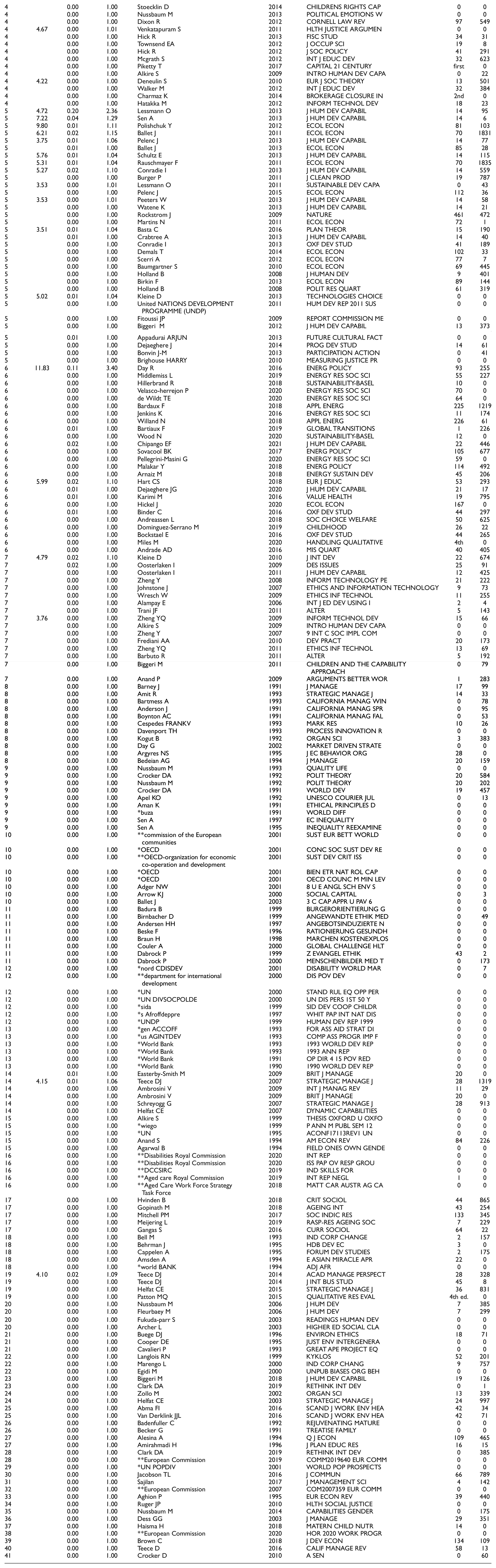
| 4 | 0.00 | 1.00 | Stoecklin D | 2014 | CHILDRENS RIGHTS CAP | 0 | 0 | |
| 4 | 0.00 | 1.00 | Nussbaum M | 2013 | POLITICAL EMOTIONS W | 0 | 0 | |
| 4 | 0.00 | 1.00 | Dixon R | 2012 | CORNELL LAW REV | 97 | 549 | |
| 4 | 4.67 | 0.00 | 1.01 | Venkatapuram S | 2011 | HLTH JUSTICE ARGUMEN | 0 | 0 |
| 4 | 0.00 | 1.00 | Hick R | 2013 | FISC STUD | 34 | 31 | |
| 4 | 0.00 | 1.00 | Townsend EA | 2012 | J OCCUP SCI | 19 | 8 | |
| 4 | 0.00 | 1.00 | Hick R | 2012 | J SOC POLICY | 41 | 291 | |
| 4 | 0.00 | 1.00 | Mcgrath S | 2012 | INT J EDUC DEV | 32 | 623 | |
| 4 | 0.00 | 1.00 | Piketty T | 2017 | CAPITAL 21 CENTURY | first | 0 | |
| 4 | 0.00 | 1.00 | Alkire S | 2009 | INTRO HUMAN DEV CAPA | 0 | 22 | |
| 4 | 4.22 | 0.00 | 1.00 | Deneulin S | 2010 | EUR J SOC THEORY | 13 | 501 |
| 4 | 0.00 | 1.00 | Walker M | 2012 | INT J EDUC DEV | 32 | 384 | |
| 4 | 0.00 | 1.00 | Charmaz K | 2014 | BROKERAGE CLOSURE IN | 2nd | 0 | |
| 4 | 0.00 | 1.00 | Hatakka M | 2012 | INFORM TECHNOL DEV | 18 | 23 | |
| 5 | 4.72 | 0.20 | 2.36 | Lessmann O | 2013 | J HUM DEV CAPABIL | 14 | 95 |
| 5 | 7.22 | 0.04 | 1.29 | Sen A | 2013 | J HUM DEV CAPABIL | 14 | 6 |
| 5 | 9.80 | 0.01 | 1.11 | Polishchuk Y | 2012 | ECOL ECON | 81 | 103 |
| 5 | 6.21 | 0.02 | 1.15 | Ballet J | 2011 | ECOL ECON | 70 | 1831 |
| 5 | 3.75 | 0.01 | 1.06 | Pelenc J | 2013 | J HUM DEV CAPABIL | 14 | 77 |
| 5 | 0.01 | 1.00 | Ballet J | 2013 | ECOL ECON | 85 | 28 | |
| 5 | 5.76 | 0.01 | 1.04 | Schultz E | 2013 | J HUM DEV CAPABIL | 14 | 115 |
| 5 | 5.31 | 0.01 | 1.04 | Rauschmayer F | 2011 | ECOL ECON | 70 | 1835 |
| 5 | 5.27 | 0.02 | 1.10 | Conradie I | 2013 | J HUM DEV CAPABIL | 14 | 559 |
| 5 | 0.00 | 1.00 | Burger P | 2011 | J CLEAN PROD | 19 | 787 | |
| 5 | 3.53 | 0.00 | 1.01 | Lessmann O | 2011 | SUSTAINABLE DEV CAPA | 0 | 43 |
| 5 | 0.00 | 1.00 | Pelenc J | 2015 | ECOL ECON | 112 | 36 | |
| 5 | 3.53 | 0.00 | 1.01 | Peeters W | 2013 | J HUM DEV CAPABIL | 14 | 58 |
| 5 | 0.00 | 1.00 | Watene K | 2013 | J HUM DEV CAPABIL | 14 | 21 | |
| 5 | 0.00 | 1.00 | Rockstrom J | 2009 | NATURE | 461 | 472 | |
| 5 | 0.00 | 1.00 | Martins N | 2011 | ECOL ECON | 72 | 1 | |
| 5 | 3.51 | 0.01 | 1.04 | Basta C | 2016 | PLAN THEOR | 15 | 190 |
| 5 | 0.01 | 1.00 | Crabtree A | 2013 | J HUM DEV CAPABIL | 14 | 40 | |
| 5 | 0.00 | 1.00 | Conradie I | 2013 | OXF DEV STUD | 41 | 189 | |
| 5 | 0.00 | 1.00 | Demals T | 2014 | ECOL ECON | 102 | 33 | |
| 5 | 0.00 | 1.00 | Scerri A | 2012 | ECOL ECON | 77 | 7 | |
| 5 | 0.00 | 1.00 | Baumgartner S | 2010 | ECOL ECON | 69 | 445 | |
| 5 | 0.00 | 1.00 | Holland B | 2008 | J HUMAN DEV | 9 | 401 | |
| 5 | 0.00 | 1.00 | Birkin F | 2013 | ECOL ECON | 89 | 144 | |
| 5 | 0.00 | 1.00 | Holland B | 2008 | POLIT RES QUART | 61 | 319 | |
| 5 | 5.02 | 0.01 | 1.04 | Kleine D | 2013 | TECHNOLOGIES CHOICE | 0 | 0 |
| 5 | 0.00 | 1.00 | United NATIONS DEVELOPMENT PROGRAMME (UNDP) | 2011 | HUM DEV REP 2011 SUS | 0 | 0 | |
| 5 | 0.00 | 1.00 | Fitoussi JP | 2009 | REPORT COMMISSION ME | 0 | 0 | |
| 5 | 0.00 | 1.00 | Biggeri M | 2012 | J HUM DEV CAPABIL | 13 | 373 | |
| 5 | 0.01 | 1.00 | Appadurai ARJUN | 2013 | FUTURE CULTURAL FACT | 0 | 0 | |
| 5 | 0.00 | 1.00 | Dejaeghere J | 2014 | PROG DEV STUD | 14 | 61 | |
| 5 | 0.00 | 1.00 | Bonvin J-M | 2013 | PARTICIPATION ACTION | 0 | 41 | |
| 5 | 0.00 | 1.00 | Brighouse HARRY | 2010 | MEASURING JUSTICE PR | 0 | 0 | |
| 6 | 11.83 | 0.11 | 3.40 | Day R | 2016 | ENERG POLICY | 93 | 255 |
| 6 | 0.00 | 1.00 | Middlemiss L | 2019 | ENERGY RES SOC SCI | 55 | 227 | |
| 6 | 0.00 | 1.00 | Hillerbrand R | 2018 | SUSTAINABILITY-BASEL | 10 | 0 | |
| 6 | 0.00 | 1.00 | Velasco-herrejon P | 2020 | ENERGY RES SOC SCI | 70 | 0 | |
| 6 | 0.00 | 1.00 | de Wildt TE | 2020 | ENERGY RES SOC SCI | 64 | 0 | |
| 6 | 0.00 | 1.00 | Bardaux F | 2018 | APPL ENERG | 225 | 1219 | |
| 6 | 0.00 | 1.00 | Jenkins K | 2016 | ENERGY RES SOC SCI | 11 | 174 | |
| 6 | 0.00 | 1.00 | Willand N | 2018 | APPL ENERG | 226 | 61 | |
| 6 | 0.01 | 1.00 | Bartiaux F | 2019 | GLOBAL TRANSITIONS | 1 | 226 | |
| 6 | 0.00 | 1.00 | Wood N | 2020 | SUSTAINABILITY-BASEL | 12 | 0 | |
| 6 | 0.02 | 1.00 | Chipango EF | 2021 | J HUM DEV CAPABIL | 22 | 446 | |
| 6 | 0.00 | 1.00 | Sovacool BK | 2017 | ENERG POLICY | 105 | 677 | |
| 6 | 0.00 | 1.00 | Pellegrini-Masini G | 2020 | ENERGY RES SOC SCI | 59 | 0 | |
| 6 | 0.00 | 1.00 | Malakar Y | 2018 | ENERG POLICY | 114 | 492 | |
| 6 | 0.00 | 1.00 | Arnaiz M | 2018 | ENERGY SUSTAIN DEV | 45 | 206 | |
| 6 | 5.99 | 0.02 | 1.10 | Hart CS | 2018 | EUR J EDUC | 53 | 293 |
| 6 | 0.01 | 1.00 | Dejaeghere JG | 2020 | J HUM DEV CAPABIL | 21 | 17 | |
| 6 | 0.01 | 1.00 | Karimi M | 2016 | VALUE HEALTH | 19 | 795 | |
| 6 | 0.00 | 1.00 | Hickel J | 2020 | ECOL ECON | 167 | 0 | |
| 6 | 0.01 | 1.00 | Binder C | 2016 | OXF DEV STUD | 44 | 297 | |
| 6 | 0.00 | 1.00 | Andreassen L | 2018 | SOC CHOICE WELFARE | 50 | 625 | |
| 6 | 0.00 | 1.00 | Dominguez-Serrano M | 2019 | CHILDHOOD | 26 | 22 | |
| 6 | 0.00 | 1.00 | Bockstael E | 2016 | OXF DEV STUD | 44 | 265 | |
| 6 | 0.00 | 1.00 | Miles M | 2020 | HANDLING QUALITATIVE | 4th | 0 | |
| 6 | 0.00 | 1.00 | Andrade AD | 2016 | MIS QUART | 40 | 405 | |
| 7 | 4.79 | 0.02 | 1.10 | Kleine D | 2010 | J INT DEV | 22 | 674 |
| 7 | 0.02 | 1.00 | Oosterlaken I | 2009 | DES ISSUES | 25 | 91 | |
| 7 | 0.00 | 1.00 | Oosterlaken I | 2011 | J HUM DEV CAPABIL | 12 | 425 | |
| 7 | 0.00 | 1.00 | Zheng Y | 2008 | INFORM TECHNOLOGY PE | 21 | 222 | |
| 7 | 0.00 | 1.00 | Johnstone J | 2007 | ETHICS AND INFORMATION TECHNOLOGY | 9 | 73 | |
| 7 | 0.00 | 1.00 | Wresch W | 2009 | ETHICS INF TECHNOL | 11 | 255 | |
| 7 | 0.00 | 1.00 | Alampay E | 2006 | INT J ED DEV USING I | 2 | 4 | |
| 7 | 0.00 | 1.00 | Trani JF | 2011 | ALTER | 5 | 143 | |
| 7 | 3.76 | 0.00 | 1.00 | Zheng YQ | 2009 | INFORM TECHNOL DEV | 15 | 66 |
| 7 | 0.00 | 1.00 | Alkire S | 2009 | INTRO HUMAN DEV CAPA | 0 | 0 | |
| 7 | 0.00 | 1.00 | Zheng Y | 2007 | 9 INT C SOC IMPL COM | 0 | 0 | |
| 7 | 0.00 | 1.00 | Frediani AA | 2010 | DEV PRACT | 20 | 173 | |
| 7 | 0.00 | 1.00 | Zheng YQ | 2011 | ETHICS INF TECHNOL | 13 | 69 | |
| 7 | 0.00 | 1.00 | Barbuto R | 2011 | ALTER | 5 | 192 | |
| 7 | 0.00 | 1.00 | Biggeri M | 2011 | CHILDREN AND THE CAPABILITY APPROACH | 0 | 79 | |
| 7 | 0.00 | 1.00 | Anand P | 2009 | ARGUMENTS BETTER WOR | I | 283 | |
| 8 | 0.00 | 1.00 | Barney J | 1991 | J MANAGE | 17 | 99 | |
| 8 | 0.00 | 1.00 | Amit R | 1993 | STRATEGIC MANAGE J | 14 | 33 | |
| 8 | 0.00 | 1.00 | Bartmess A | 1993 | CALIFORNIA MANAG WIN | 0 | 78 | |
| 8 | 0.00 | 1.00 | Anderson J | 1991 | CALIFORNIA MANAG SPR | 0 | 95 | |
| 8 | 0.00 | 1.00 | Boynton AC | 1991 | CALIFORNIA MANAG FAL | 0 | 53 | |
| 8 | 0.00 | 1.00 | Cespedes FRANKV | 1993 | MARK RES | 10 | 26 | |
| 8 | 0.00 | 1.00 | Davenport TH | 1993 | PROCESS INNOVATION R | 0 | 0 | |
| 8 | 0.00 | 1.00 | Kogut B | 1992 | ORGAN SCI | 3 | 383 | |
| 8 | 0.00 | 1.00 | Day G | 2002 | MARKET DRIVEN STRATE | 0 | 0 | |
| 8 | 0.00 | 1.00 | Argyres NS | 1995 | J EC BEHAVIOR ORG | 28 | 0 | |
| 8 | 0.00 | 1.00 | Bedeian AG | 1994 | J MANAGE | 20 | 159 | |
| 9 | 0.00 | 1.00 | Nussbaum M | 1993 | QUALITY LIFE | 0 | 0 | |
| 9 | 0.00 | 1.00 | Crocker DA | 1992 | POLIT THEORY | 20 | 584 | |
| 9 | 0.00 | 1.00 | Nussbaum M | 1992 | POLIT THEORY | 20 | 202 | |
| 9 | 0.00 | 1.00 | Crocker DA | 1991 | WORLD DEV | 19 | 457 | |
| 9 | 0.00 | 1.00 | Apel KO | 1992 | UNESCO COURIER JUL | 0 | 13 | |
| 9 | 0.00 | 1.00 | Aman K | 1991 | ETHICAL PRINCIPLES D | 0 | 0 | |
| 9 | 0.00 | 1.00 | *buza | 1991 | WORLD DIFF | 0 | 0 | |
| 9 | 0.00 | 1.00 | Sen A | 1997 | EC INEQUALITY | 0 | 0 | |
| 9 | 0.00 | 1.00 | Sen A | 1995 | INEQUALITY REEXAMINE | 0 | 0 | |
| 10 | 0.00 | 1.00 | **commission of the European communities | 2001 | SUST EUR BETT WORLD | 0 | 0 | |
| 10 | 0.00 | 1.00 | *OECD | 2001 | CONC SOC SUST DEV RE | 0 | 0 | |
| 10 | 0.00 | 1.00 | **OECD-organization for economic co-operation and development | 2001 | SUST DEV CRIT ISS | 0 | 0 | |
| 10 | 0.00 | 1.00 | *OECD | 2001 | BIEN ETR NAT ROL CAP | 0 | 0 | |
| 10 | 0.00 | 1.00 | *OECD | 2001 | OECD COUNC M MIN LEV | 0 | 0 | |
| 10 | 0.00 | 1.00 | Adger NW | 2001 | 8 U E ANGL SCH ENV S | 0 | 0 | |
| 10 | 0.00 | 1.00 | Arrow KJ | 2000 | SOCIAL CAPITAL | 0 | 3 | |
| 10 | 0.00 | 1.00 | Ballet J | 2003 | 3 C CAP APPR U PAV 6 | 0 | 0 | |
| 11 | 0.00 | 1.00 | Badura B | 1999 | BURGERORIENTIERUNG G | 0 | 0 | |
| 11 | 0.00 | 1.00 | Birnbacher D | 1999 | ANGEWANDTE ETHIK MED | 0 | 49 | |
| 11 | 0.00 | 1.00 | Andersen HH | 1997 | ANGEBOTSINDUZIERTE N | 0 | 0 | |
| 11 | 0.00 | 1.00 | Beske F | 1996 | RATIONIERUNG GESUNDH | 0 | 0 | |
| 11 | 0.00 | 1.00 | Braun H | 1998 | MARCHEN KOSTENEXPLOS | 0 | 0 | |
| 11 | 0.00 | 1.00 | Couler A | 2000 | GLOBAL CHALLENGE HLT | 0 | 0 | |
| 11 | 0.00 | 1.00 | Dabrock P | 1999 | Z EVANGEL ETHIK | 43 | 2 | |
| 11 | 0.00 | 1.00 | Dabrock P | 2000 | MENSCHENBILDER MED T | 0 | 173 | |
| 12 | 0.00 | 1.00 | *nord CDISDEV | 2001 | DISABILITY WORLD MAR | 0 | 7 | |
| 12 | 0.00 | 1.00 | **department for international development | 2000 | DIS POV DEV | 0 | 0 | |
| 12 | 0.00 | 1.00 | *UN | 2000 | STAND RUL EQ OPP PER | 0 | 0 | |
| 12 | 0.00 | 1.00 | *UN DIVSOCPOLDE | 2000 | UN DIS PERS 1ST 50 Y | 0 | 0 | |
| 12 | 0.00 | 1.00 | *sida | 1999 | SID DEV COOP CHILDR | 0 | 0 | |
| 12 | 0.00 | 1.00 | *s Afroffdeppre | 1997 | WHIT PAP INT NAT DIS | 0 | 0 | |
| 12 | 0.00 | 1.00 | *UNDP | 1999 | HUMAN DEV REP 1999 | 0 | 0 | |
| 13 | 0.00 | 1.00 | *gen ACCOFF | 1993 | FOR ASS AID STRAT DI | 0 | 0 | |
| 13 | 0.00 | 1.00 | *us AGINTDEV | 1993 | COMP ASS PROGR IMP F | 0 | 0 | |
| 13 | 0.00 | 1.00 | *World Bank | 1993 | 1993 WORLD DEV REP | 0 | 0 | |
| 13 | 0.00 | 1.00 | *World Bank | 1993 | 1993 ANN REP | 0 | 0 | |
| 13 | 0.00 | 1.00 | *World Bank | 1991 | OP DIR 4 15 POV RED | 0 | 0 | |
| 13 | 0.00 | 1.00 | *World Bank | 1990 | 1990 WORLD DEV REP | 0 | 0 | |
| 14 | 0.01 | 1.00 | Easterby-Smith M | 2009 | BRIT J MANAGE | 20 | 0 | |
| 14 | 4.15 | 0.01 | 1.06 | Teece DJ | 2007 | STRATEGIC MANAGE J | 28 | 1319 |
| 14 | 0.00 | 1.00 | Ambrosini V | 2009 | INT J MANAG REV | 11 | 29 | |
| 14 | 0.00 | 1.00 | Ambrosini V | 2009 | BRIT J MANAGE | 20 | 0 | |
| 14 | 0.00 | 1.00 | Schreyogg G | 2007 | STRATEGIC MANAGE J | 28 | 913 | |
| 14 | 0.00 | 1.00 | Helfat CE | 2007 | DYNAMIC CAPABILITIES | 0 | 0 | |
| 15 | 0.00 | 1.00 | Alkire S | 1999 | THESIS OXFORD U OXFO | 0 | 0 | |
| 15 | 0.00 | 1.00 | *wiego | 1999 | P ANN M PUBL SEM 12 | 0 | 0 | |
| 15 | 0.00 | 1.00 | *UN | 1995 | ACONF17113REV1 UN | 0 | 0 | |
| 15 | 0.00 | 1.00 | Anand S | 1994 | AM ECON REV | 84 | 226 | |
| 15 | 0.00 | 1.00 | Agarwal B | 1994 | FIELD ONES OWN GENDE | 0 | 0 | |
| 16 | 0.00 | 1.00 | **Disabilities Royal Commission | 2020 | INT REP | 0 | 0 | |
| 16 | 0.00 | 1.00 | **Disabilities Royal Commission | 2020 | ISS PAP OV RESP GROU | 0 | 0 | |
| 16 | 0.00 | 1.00 | **DCCSIRC | 2019 | IND SKILLS FOR | 0 | 0 | |
| 16 | 0.00 | 1.00 | **Aged care Royal Commission | 2019 | INT REP NEGL | 1 | 0 | |
| 16 | 0.00 | 1.00 | **Aged Care Work Force Strategy Task Force | 2018 | MATT CAR AUSTR AG CA | 0 | 0 | |
| 17 | 0.00 | 1.00 | Hvinden B | 2018 | CRIT SOCIOL | 44 | 865 | |
| 17 | 0.00 | 1.00 | Gopinath M | 2018 | AGEING INT | 43 | 254 | |
| 17 | 0.00 | 1.00 | Mitchell PM | 2017 | SOC INDIC RES | 133 | 345 | |
| 17 | 0.00 | 1.00 | Meijering L | 2019 | RASP-RES AGEING SOC | 7 | 229 | |
| 17 | 0.00 | 1.00 | Gangas S | 2016 | CURR SOCIOL | 64 | 22 | |
| 18 | 0.00 | 1.00 | Bell M | 1993 | IND CORP CHANGE | 2 | 157 | |
| 18 | 0.00 | 1.00 | Behrman J | 1995 | HDB DEV EC | 3 | 0 | |
| 18 | 0.00 | 1.00 | Cappelen A | 1995 | FORUM DEV STUDIES | 2 | 175 | |
| 18 | 0.00 | 1.00 | Amsden A | 1994 | E ASIAN MIRACLE APR | 22 | 0 | |
| 18 | 0.00 | 1.00 | *world BANK | 1994 | ADJ AFR | 0 | 0 | |
| 19 | 4.10 | 0.02 | 1.09 | Teece DJ | 2014 | ACAD MANAGE PERSPECT | 28 | 328 |
| 19 | 0.00 | 1.00 | Teece DJ | 2014 | J INT BUS STUD | 45 | 8 | |
| 19 | 0.00 | 1.00 | Helfat CE | 2015 | STRATEGIC MANAGE J | 36 | 831 | |
| 19 | 0.00 | 1.00 | Patton MQ | 2015 | QUALITATIVE RES EVAL | 4th ed. | 0 | |
| 20 | 0.00 | 1.00 | Nussbaum M | 2006 | J HUM DEV | 7 | 385 | |
| 20 | 0.00 | 1.00 | Fleurbaey M | 2006 | J HUM DEV | 7 | 299 | |
| 20 | 0.00 | 1.00 | Fukuda-parr S | 2003 | READINGS HUMAN DEV | 0 | 0 | |
| 20 | 0.00 | 1.00 | Archer L | 2003 | HIGHER ED SOCIAL CLA | 0 | 0 | |
| 21 | 0.00 | 1.00 | Buege DJ | 1996 | ENVIRON ETHICS | 18 | 71 | |
| 21 | 0.00 | 1.00 | Cooper DE | 1995 | JUST ENV INTERGENERA | 0 | 0 | |
| 21 | 0.00 | 1.00 | Cavalieri P | 1993 | GREAT APE PROJECT EQ | 0 | 0 | |
| 22 | 0.00 | 1.00 | Langlois RN | 1999 | KYKLOS | 52 | 201 | |
| 22 | 0.00 | 1.00 | Marengo L | 2000 | IND CORP CHANG | 9 | 757 | |
| 22 | 0.00 | 1.00 | Egidi M | 2000 | UNPUB BIASES ORG BEH | 0 | 0 | |
| 23 | 0.00 | 1.00 | Biggeri M | 2018 | J HUM DEV CAPABIL | 19 | 126 | |
| 23 | 0.00 | 1.00 | Clark DA | 2019 | RETHINK INT DEV | 0 | 1 | |
| 24 | 0.00 | 1.00 | Zollo M | 2002 | ORGAN SCI | 13 | 339 | |
| 24 | 0.00 | 1.00 | Helfat CE | 2003 | STRATEGIC MANAGE J | 24 | 997 | |
| 25 | 0.00 | 1.00 | Abma FI | 2016 | SCAND J WORK ENV HEA | 42 | 34 | |
| 25 | 0.00 | 1.00 | Van Derklink JJL | 2016 | SCAND J WORK ENV HEA | 42 | 71 | |
| 26 | 0.00 | 1.00 | Badenfuller C | 1992 | REJUVENATING MATURE | 0 | 0 | |
| 26 | 0.00 | 1.00 | Becker G | 1991 | TREATISE FAMILY | 0 | 0 | |
| 27 | 0.00 | 1.00 | Alesina A | 1994 | Q J ECON | 109 | 465 | |
| 27 | 0.00 | 1.00 | Amirahmadi H | 1996 | J PLAN EDUC RES | 16 | 15 | |
| 28 | 0.00 | 1.00 | Clark DA | 2019 | RETHINK INT DEV | 0 | 385 | |
| 28 | 0.00 | 1.00 | **European Commission | 2019 | COMM2019640 EUR COMM | 0 | 0 | |
| 29 | 0.00 | 1.00 | *UN POPDIV | 2001 | WORLD POP PROSPECTS | 0 | 0 | |
| 30 | 0.00 | 1.00 | Jacobson TL | 2016 | J COMMUN | 66 | 789 | |
| 31 | 0.00 | 1.00 | Sajilan | 2017 | J MANAGEMENT SCI | 4 | 142 | |
| 32 | 0.00 | 1.00 | **European Commission | 2007 | COM2007359 EUR COMM | 0 | 0 | |
| 33 | 0.00 | 1.00 | Aghion P | 1995 | EUR ECON REV | 39 | 440 | |
| 34 | 0.00 | 1.00 | Ruger JP | 2010 | HLTH SOCIAL JUSTICE | 0 | 0 | |
| 35 | 0.00 | 1.00 | Nussbaum M | 2014 | CAPABILITIES GENDER | 0 | 175 | |
| 36 | 0.00 | 1.00 | Dess GG | 2003 | J MANAGE | 29 | 351 | |
| 37 | 0.00 | 1.00 | Haisma H | 2018 | MATERN CHILD NUTR | 14 | 0 | |
| 38 | 0.00 | 1.00 | **European Commission | 2020 | HOR 2020 WORK PROGR | 0 | 0 | |
| 39 | 0.00 | 1.00 | Brown C | 2018 | J DEV ECON | 134 | 109 | |
| 40 | 0.00 | 1.00 | Teece D | 2016 | CALIF MANAGE REV | 58 | 13 | |
| 41 | 0.00 | 1.00 | Crocker D | 2010 | A SEN | 0 | 60 |
Acknowledgements
We would like to thank the Professor of Market Research at the Rey Juan Carlos University, Alicia Blanco, for her collaboration and support.
Declaration of Conflicting Interests
The author(s) declared no potential conflicts of interest with respect to the research, authorship, and/or publication of this article.
Funding
The author(s) received no financial support for the research, authorship, and/or publication of this article.
Ethical Approval
The authors declare that the study did not involve human participants. The authors declare that the informed consent of any person was not required.

Data Availability Statement
Data sharing not applicable to this article as no datasets were generated or analyzed during the current study.