




Abstract
Nowadays, science, technology, engineering, mathematics (STEM) education has been developed and implemented in many countries. To better understand the research progress in STEM education worldwide, we analyzed 1910 publications collected from the Web of Science Core Collection database. This bibliometric study was performed through software VOSviewer and CiteSpace. Results showed that the research on STEM education will remain thriving in the following years. The USA is the most active country in the research field of STEM education, and the whole world cooperated closely. The majorities of significant institutions in this field belong to the USA. International Journal of STEM Education, Journal of Science Education and Technology and Science Education are the main publications. According to the cluster results of keywords, STEM, STEM education, self-efficacy, technology constitute the knowledge base for STEM education studies. Based the analysis results of keywords and burst detection, STEM achievements, different approaches to discipline integration, educational equality, and teacher education will be the research hotspot in the future. The results give a comprehensive overview on STEM education for scholars quickly understanding the overall progress.
Introduction
Nowadays, science, technology, engineering, mathematics (STEM) education has been developed and implemented in many countries (e.g., China [W. Li & Chiang, 2019], Australia [Sharma & Yarlagadda, 2018], England [Wong et al., 2016], and Canada [Shanahan et al., 2016]). It is a concept where the teaching of science, technology, engineering, and mathematics is integrated as one discipline. Generally, there are two ways to define STEM education. One is to include education in any field defined as STEM. In this way, it aggregates several disparate disciplines on the idea that their common importance contributes to technological innovation, competitiveness, and long-term national prosperity and security (National Research Council, 2006). Another way is to focus on logical and conceptual connections across entirely different STEM fields in order to treat STEM education as a whole (Engineering & Council, 2014). This definition relates to curricular and pedagogical coherence in different STEM fields. This view is reflected in the new Next Generation Science Standards currently being adopted for K-12 education across the country (NGSS Lead States, 2022). It is well known that STEM education can not only improve students’ authentic problem-solving skills (Bybee, 2010) and learning outcomes (Mathis et al., 2018), but also promote individuals’ interest in STEM sub-subjects and pursuit in STEM careers (Vennix et al., 2018).
As a result, STEM education is sustainably concerned, and many articles have been published to investigate this issue. In these contexts, researchers concerned about theoretical frameworks of STEM concepts (Bybee, 2010; Xie et al., 2015), STEM teaching and learning (Y. Li, 2020; Murphy et al., 2019; Setyowati et al., 2021), teacher education (Nguyen Thi et al., 2020; Radloff & Guzey, 2016), racial and ethnic differences in STEM education (Blackwell et al., 2009; Morales et al., 2023; Snidal, 2021), evaluation of STEM education (Griffiths et al., 2021; Saxton et al., 2014), and self-efficacy in STEM education (Jaipal-Jamani & Angeli, 2017; Luo et al., 2021; Yang et al., 2023). However, no visual bibliometrics overview of research progress in STEM education has been reported to the best of our knowledge. Neither an overview of the current status of the study nor the development context was provided. This limits the systematical combination of different insights into STEM education. Bibliometrics is a research method to deal with a large amount of literature, which can be utilized to analyze their key information of a domain of literature, including cooperation networks, keyword co-occurrence, burst words and, etc. (Hong et al., 2020; W. Li & Zhao, 2015; Shiffrin & Börner, 2004). The research progress of a field and trends can be understood via analysis of the distribution laws, quantitative relationships, and internal relationships within the literature (Hassan et al., 2021; Hong et al., 2020; Zhang et al., 2022). Bibliometric analysis is a popular method for the analysis of large volumes scientific data, and bibliometric techniques are quantitative and statistical analysis tools that have been used in information retrieval and library practice over an extended period of time (Hassan et al., 2021; Zhang et al., 2022). It works by filtering and processing a large amount of information to discover knowledge associations between documents. To date, bibliometric analysis has been applied to a diverse range of research areas for panoramic presentation to help interested researchers carry out their follow-up research with a direction in mind. In view of this, this study conducted a bibliometric analysis of STEM education to provide the research progress, and aims to address the following questions:
(1)What is the research trend in terms of the number of publications?
(2)What countries, institutions and journals constitute the main forces in STEM education research?
(3)How do countries, institutions and journals connect with others?
(4)What are the current research hotspots?
(5)Which research directions deserve further study?
Data and Methods
Data Collection
According to previous studies, the data were collected in the following steps (He et al., 2018; Pang & Zhang, 2019). First, the selection of selecting an acceptable database forms the basis of the study (Dahlander & Gann, 2010). All the data used in this study were collected from Web of Science (WoS) Core Collection of Clarivate Analytics, owing to its comprehensiveness and strict selection criteria (Dehdarirad et al., 2014). WoS core collection is regarded as the most high-quality and frequently used database with diverse publications (Ivanitskaya et al., 2021), and search the world’s leading scholarly journals, books, and proceedings in the sciences, social science, as well as arts and humanities and navigate the full citation network. Secondly, considering that the topic of an article will fully and directly reflect its primary content (Yao et al., 2014), a search of the studied keywords within the theme line is necessary(Pang & Zhang, 2019). Nowadays, STEM is often accompanied by STEAM (STEM + Arts) variant (Aguilera & Ortiz-Revilla, 2021; Videla et al., 2021). Hence, the title was set to “STEM” or “STEAM.” Meanwhile, the topic was set to “education.” The topic includes the terms that appear in the title, abstract and keywords of the literature. Thirdly, the time span was set from January 1st 1985 to December 31st 2021 (The year 1985, the beginning year of WoS core collection, was employed here due to the time span of accessibility of all the related publications is unclear at the outset, and it is expected to collect all the information relating to the current topic as far as possible). A total of 217,865 records were initially retrieved. Afterward, records were refined by the categories, language and abstracts. The flow diagram showed the data extraction process and inclusion as well as exclusion criteria (Figure 1). Finally, we yielded 1,910 results, and their published time was from 2006 to 2021.

Flow diagram of the data extraction process.
Analytical Methods
Because the number of publications we have identified is too large, manually extracting their information could be prohibitively burdensome. Software needs to be employed. VOSviewer (van Eck & Waltman, 2010) and CiteSpace (C. Chen, 2006) are the most commonly used among the software with strong visualization tools. VOSviewer (www.vosviewer.com) is a freely available computer software developed for building and viewing bibliometric maps. It is supported by similarity visualization technology, in particular the similarity matrix with respect to the co-occurrence (existing in the same document) of countries, institutions, major source journals, keywords, etc. (Small, 1973). Applying the VOS mapping technique to the similarity matrix results in a two-dimensional map is made, which is then translated, rotated, mirrored, and the items are clustered into different colors of groups. The rounded nodes represent the occurrences of countries, institutions, main source journals, and keywords. The links refer to their relatedness (van Nunen et al., 2018). The distance of the connecting line between any two terms represents their similarity or relevance. In this study, VOSviewer software was employed to visualize and analyze the geographical and institutional distribution as well as their cooperation network, keyword co-occurrence, and clustering. CiteSpace (http://cluster.ischool.drexel.edu/~cchen/citespace/download/) could find the keywords and references with strongest bursts. Burst keywords and references appear suddenly and increase rapidly in frequency, reflecting the research trend. Citespace software was used to analyze the burst keywords and reference. The annual number of publications and citations, as well as quantitative data of main source journals were collected using the analytics function in the WoS Core Collection.
Results and Discussion
Annual Publication and Citations Trends
Changes in the number of publications citations can reflect the research trend and researchers’ focus on the field. Figure 2 presents the temporal distribution of publications and citations on STEM education from 2006 to 2021. While the STEM movement emerged in the early 1990s (Martín-Páez et al., 2019), the first article recorded in the WoS core collection dates from 2006 that is, “A systems model of innovation processes in university STEM education” by Porter and coworkers (C. Chen, 2006). Since much effort has gone into STEM education, and publication counts as well as the citations was increasing sustainably. This growth can be divided into three stages: embryonic (2006–2009), seedtime (2010–2014), blossom (2015–2021).
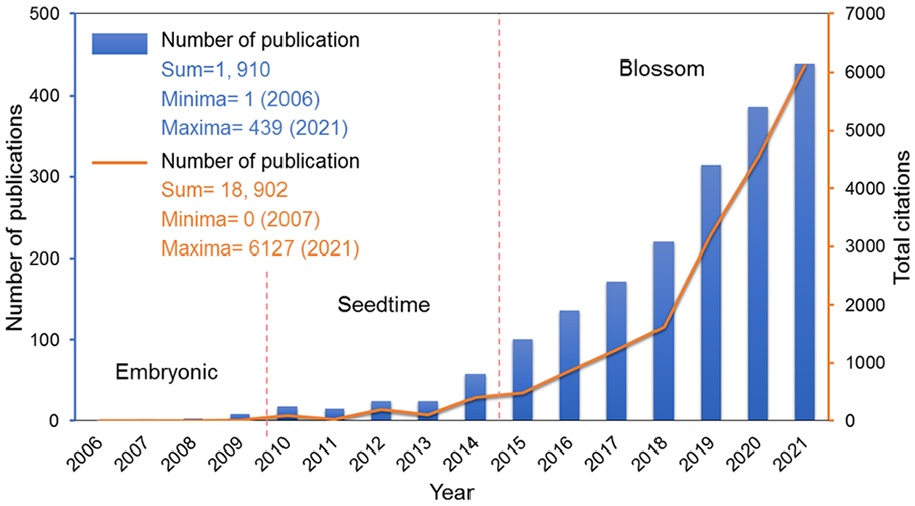
Temporal distribution of publications and citations on STEM education from 2006 to 2021.
Between 2006 and 2009, no more than 10 articles were published and cited each year. While the research during this stage was not plentiful, the acceptance of STEM education concept and research methods established a theoretical foundation for subsequent research (Cole & Espinoza, 2008; Crisp et al., 2009; Porter et al., 2006). As a consequence, these years were called the “embryonic” stage for STEM education research. Between 2010 and 2014, a small number of researchers began to focus on STEM education, and the average publications as well as citations was 20.25 and 105.75. These years represent what we refer to as the “seedtime” stage. During this stage, research cases of STEM education in many countries were reported by international scholars (Kokkelenberg & Sinha, 2010; Tseng et al., 2013). Since 2015, the study of STEM education has reached what we refer to as a “blossom” stage, with over 100 articles published each year. We were surprised to see an increase of 565.5% and1,027.4% in the number of publications and citations. As a result, STEM education has become an active area of research for many scholars. The peak annual publication emerges in 2021 with 439 publications and6,127 citations, which is not considered the end of the exponential growth. Judging by the trends in Figure 2, STEM education research will retain flourishing over the few years.
Geographical and Institutional Distribution
The cooperative relationships among countries and institutions were identified based on the basis of authors’ information. A total of1,467 institutions from 82 countries/regions have participated in STEM education research based on the results retrieved from the WoS Core database. Main countries/regions and institution collaboration network of the STEM education research were illustrated in Figures 3 and 4, respectively. USA was the dominant country in this research domain, followed by Australia, China, and Spain. Most of the significant institutions in this field belong to the USA, such as Texas A&M University System, University of North Carolina, University of Wisconsin System, and Michigan State University. Links represent cooperation, and the color of the rings refers to the cluster. Researchers in the USA have cooperated with those in many countries, especially China and Singapore. Australia is also an influential country in this field and frequently collaborates with South Korea and Malaysia. The same images of Figures 3 and 4 with a timeline are presented in Supplemental Figures S1 and S2, respectively. Nodes are colored to represent year of publication. China and Spain published quite a few articles in the last 2 years, depending on the color. In recent years, researchers at the Education University of Hong Kong and the Ohio State University have been fairly active in the field of STEM education research.

Main country/region collaboration network of the research on STEM education. An image of this figure under overlay visualization with a timeline is available as Supplemental Figure S1.

Main institution collaboration network of the research on STEM education. An image of this figure under overlay visualization with a timeline is available as Supplemental Figure S2.
Quantitative Analysis of Main Source Journals
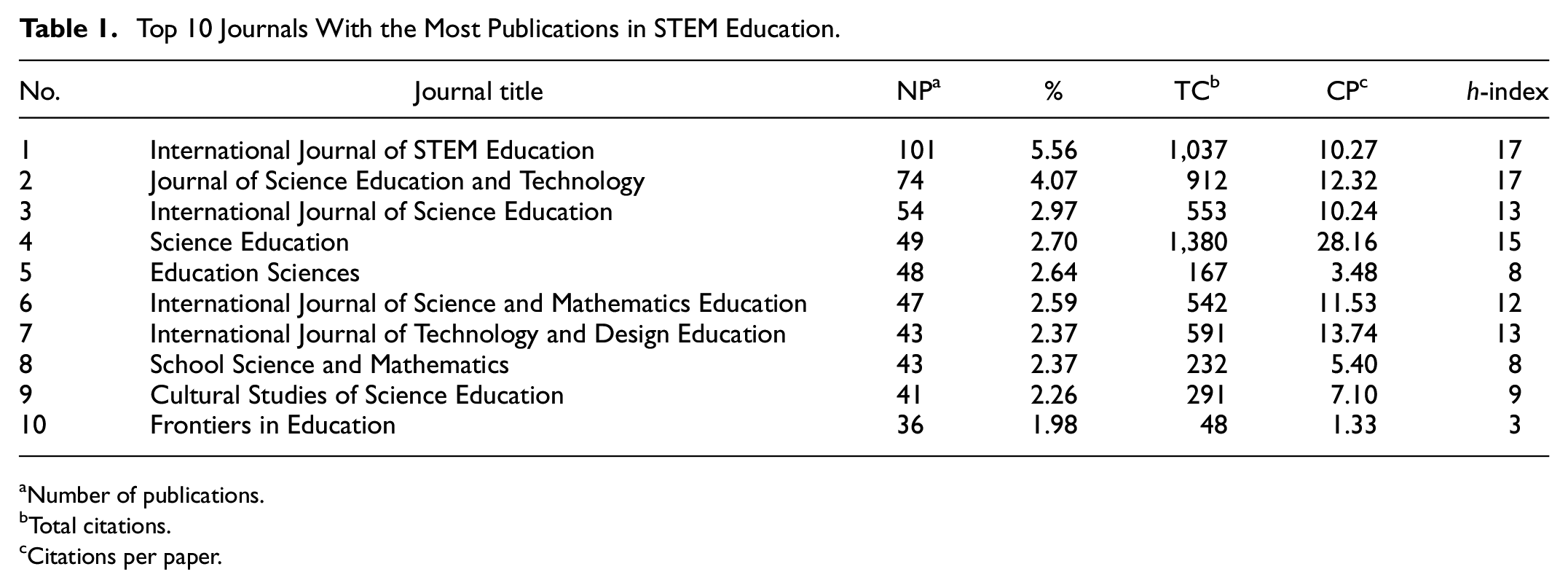
Journals are considered to be the most important sources of academic communication. The core journals for STEM education were identified by analyzing journal distribution, as displayed in Figure 5. Table 1 lists the top 10 journals with the largest number of publications in STEM education. International Journal of Stem Education ranks first with 101 publications (proportion 5.56%) and1,037 total citations (10.27 citations per paper). Journal of Science Education and Technology ranks secondly with 74 publications (proportion 4.07%) and 912 total citations (12.32 citations per paper). Although Science Education has fewer publications, the citations per paper rank first, demonstrating that it has strong influence in this domain. All these journals focus on education educational research and education scientific disciplines.

Main source journals of the article on STEM education. An image of this figure under overlay visualization with a timeline is available as Supplementary Fig. S3.
Top 10 Journals With the Most Publications in STEM Education.
Number of publications.
Total citations.
Citations per paper.
Analysis of Keywords
Keywords Clustering
High-frequency keywords and their co-occurrence can reflect the certain academic domains’ main content and structure. Here, the full counting method was employed rather than fractional counting (Sood et al., 2021). The problem of acronyms, plurals and dashes in the keywords was removed by the thesauruses file. Using VOSviewer, a certain number of items were divided into different groups the basis of these items degrees of similarity. We refer to these diverse as clusters (D. Lee & Lee, 2018). Items distributed within the same cluster have a higher similarity. Items distributed across different clusters have a lower similarity (J. Wang et al., 2021). We obtained a co-occurrence network with four clusters as illustrated in Figure 6. Each node refers to a keyword, and its size manifests the frequency of occurrence. The distance between nodes represents their correlation. The longer distance represents a weaker correlation. It is clear that four clusters were formed, denoted by cluster #1 (red), cluster #2 (green), cluster #3 (blue), and cluster #4 (yellow), respectively. Table 2 summarizes the top keywords in each cluster.

Keywords cluster of the research on STEM education. An image of this figure under overlay visualization with a timeline is available as Supplemental Figure S4.
Major Keywords in Each Cluster of Articles Related to STEM Education.


Note. The parentheses are frequency of each keyword.
Cluster 1 (Red): The red cluster is mainly centered around the keyword “STEM,” which is closely linked to keywords “retention,”“race,”“persistence,”“identity,”“gender,”“ethnicity,”“equity.” STEM retention refers to the activities that institutions perform to encourage students to return from one semester to next semester and increase the opportunity for students graduate. Persistence refers to students’ actions in continuing their educational pursuits until graduation (Park et al., 2020). More than half of first-year college students who choose a STEM major early in college are reported drop out prior to graduation in the United States (X. Chen, 2013). Besides, more than half of STEM bachelor’s degree holders go on to work or attend graduate school in non-STEM fields. Universities interested in providing equitable outcomes and experiences to students are suffering from high attrition in STEM. They also negatively influence a country’s ability to maintain competitiveness in the growing international labor market, which requires a greater number of STEM professionals (Soldner et al., 2012). Such as retention rates in STEM, persistence, influence factor, and promotion strategies, were areas concerned in recent years. It has been demonstrated that STEM retention and persistence were significantly impacted by race and gender (Carlone & Johnson, 2007). How gender and people of color are situated in admissions viewbook of STEM majors were examined. Results suggest that white males are usually considered better abilities and devotion to science. Most women in science are White, and if they are not White, they are Asian/Asian American (Osei-Kofi & Torres, 2015). In an effort to promote education equity, much attention has been paid to gender and race in STEM education. For example, Mindy Levine and coworkers designed and implemented a full-day outreach program for high school girls called Sugar Science Day. After the program, the applicability of science and the interest of the participating girls in scientific activities have been greatly improved (Levine & DiScenza, 2018).
Cluster 2 (Green): The green cluster is mainly centered around the keyword “STEM education,” which is closely linked to keywords “teacher education,”“steam,”“science education,”“project-based learning,”“professional development.” STEAM, which combines the arts with STEM subjects, offers a way to achieve STEM by integrating art with the principles of each discipline as interdisciplinary learning (Belbase et al., 2022). Teachers play important roles and are vital factors in the implementation of STEM or STEAM education (H. H. Wang et al., 2011). In a research, it was demonstrated that experienced teachers hold more positive views than beginning teachers in the field of STEM education (Thibaut et al., 2018). Teacher education, on the other hand, typically focuses on one or two subjects, and most teachers are unfamiliar with engineering content or processes (Nadelson et al., 2013). As consequence, there is a hunger for professional development. Professional development of a teacher is seen as significant fundamental to all types of educational reform (Fore et al., 2015). Therefore, there have been growing concerns about STEM teacher professional development. For example, Gardner et al. (2019) designed and implemented professional development for grades 6 to 12 mathematics teachers according to practices of STEM education. The self-efficacy of these teachers was visibly improved and effective changes can be seen in their classroom practices. Lately, an increasing number of science teachers are supposed to implement STEM education in their classrooms, and STEM has been pervasive for organizing new practices in science education. Typically, the STEM subjects were implemented according to the pedagogical framework: project-based learning (PBL) (Morrison et al., 2021). PBL is a student-centered, inquiry-based approach to teaching that involves students generating, designing, implementing, and evaluating ideas for projects (Tseng et al., 2013). This has proved to be an efficient approach to enhancing student problem-solving skills, conceptual knowledge, and motivation (Alozie et al., 2010; Nurbekova et al., 2020).
Cluster 3 (Blue): The blue cluster is mainly centered around the keyword “self-efficacy,” which is closely linked to keywords “motivation,”“higher education,”“assessment,”“active learning.” Self-efficacy was originally conceptualized by Bandura, and refers to “individuals’ beliefs about their capabilities to produce effects” (Bandura, 1978). STEM self-efficacy refers to students’ self-beliefs about their abilities to conduct STEM learning activities (Luo et al., 2021). STEM self-efficacy influences students’ academic performances and is significant in models of STEM retention as well as persistence (Miller, 2015). A considerable body of work has already been published related to STEM self-efficacy. For instance, Stewart et al. (2020) charted gender differences in the developmental track of STEM self-efficacy among science and engineering students and found that the development of self-efficacy within the class and between classes was the same for males and females. In another research, the authors found that peer, adult family, and mathematics courses/career persuasion were direct predictors of self-efficacy in STEM, which provided an approach to building students’ self-efficacy in STEM (Falco & Summers, 2021). Students’ STEM self-efficacy greatly influences their STEM motivation (Eccles & Wigfield, 2002), which is closely linked to the future career choices (Sadler et al., 2012). Recently, there is an increasing trend in exploring influence factors on students’ STEM motivation. For example, parent and teacher enthusiasm was verified to make a big difference in adolescent’s intrinsic motivation in STEM (Jungert et al., 2020). In a different study, the authors indicated that the teachers’ levels of STEM integration positively predicted students’ motivation for mathematics (Cheng et al., 2020). Implementing assessment is critical if the degree of effectiveness of STEM education is to be taken into account (Tsai et al., 2022). The purpose of the evaluation is to inspect the function of a particular program critically, so that specific improvement can be made to acquire desirable achievements (Reeves et al., 2020). Normally, evaluation was performed in STEM programs.
Cluster 4 (Yellow): The yellow cluster is mainly centered around the keyword “technology,” which is closely linked to keywords “science,”“mathematics,”“engineering.” STEM is composed of these four disciplines when first introduced. As a result, they were divided into a cluster.
Keywords With the Strongest Citation Bursts
Keywords with transition phenomenon have the innovative and prospective study. Inevitably, the rise of a research frontier will result in the explosion of its keywords within a short period of time. The keywords with citation bursts refer to the keywords that researchers pay attention to and increase suddenly in a certain period time. In general, there are two possibilities for keywords with citation bursts. One is noticed for some time and then disappears, and the other is becoming a research trend. They are therefore available to predict the research trend of research in a field (Picone et al., 2021). There are two ways can sort keywords with citation bursts using the existing functions of CiteSpace, that is, sorting by burst begin time and burst intensity. According to the burst intensity, the sorting method was chosen in this study, and the top 10 keywords from 2010 to 2021 are shown in Table 3. The time axis can intuitively display the historical length of the mutation word outbreak, which is shown as a blue line. A red segment on the blue timeline is the time interval that a keyword was found to have a burst, showing the beginning year, ending year, and burst duration. From 2010 to 2013, researchers mainly focused on “choice.” In particular, “choice” lasts for the longest time as burst terms. Much of the work has been conducted in STEM major choices during this period (A. Lee, 2015; Sjaastad, 2012). “Gender” was followed with interest from 2015 to 2018. Researchers have made great efforts to break the gender gap in STEM education (King Miller, 2017; Kordaki & Berdousis, 2017; Stoet & Geary, 2018). Noteworthy, “achievement” (Bazelais et al., 2018; Gouvea, 2021; Johnson & Sondergeld, 2023; Stieff & Uttal, 2015) started in 2015, and lasted up to now, which are undoubtedly the research hotspot in the future.
Top 10 Keywords With the Strongest Citation Bursts.


References With the Strongest Citation Bursts
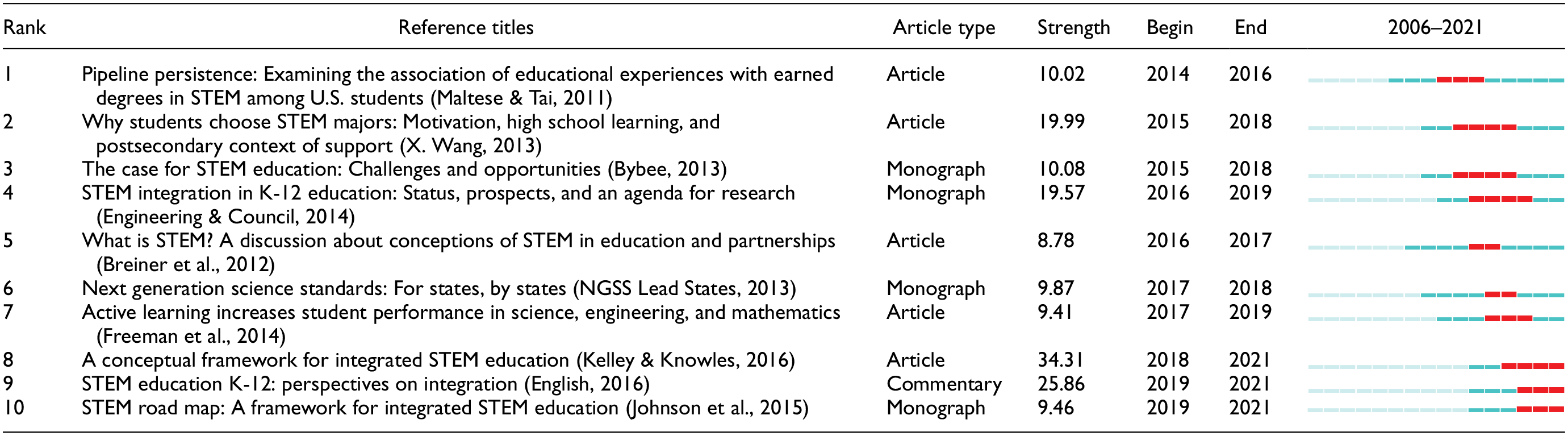
The experienced citation bursts were used to investigate the specific growth areas. The burst detection estimates whether entity’s frequency rises sharply in reference to its peers (C. Chen et al., 2014). If an article has a large increase in its citation numbers, it is referred to as a citation burst (Y.-C. Lee et al., 2016). We rank the top 10 references with the strongest citation bursts by beginning year and strength of burst, respectively (Table 4). The most recent bursts from 2015 to 2018 imply the new development in STEM education field. Among the 10 publications, four were monographs that comprehensively introduce the framework, status, prospects, challenges, and opportunities of STEM education. Notably, a book titled “STEM Integration in K-12 Education: Status, Prospects, and an Agenda for Research” (Engineering & Council, 2014) has a reasonably muscular burst strength (19.57) and four duration (2016–2019). The authors evaluate current works to introduce the STEM disciplines in K-12 education and propose a design proposal of design and document practical STEM education for designers, assessment developers, and researchers. Five journal articles are involved in the citation bursts, providing a literature review or a viewpoint or perspective. For example, an article titled “A conceptual framework for integrated STEM education” (Kelley & Knowles, 2016), which possesses the highest burst strength (34.31), constructs an integrated STEM education framework through the operationalization of key STEM education key concepts and the blending of learning theories. This could offer an assistance in further studying integrated STEM education. Besides, a commentary burst from 2019 up to now, with the strength of 25.86 (English, 2016). Few studies focused on the detail of the curriculum or activities being implemented, including the nature of the integration and the methods within which it was supported. Therefore, the author advocated paying more attention to two disciplines within STEM education research. In this literature, recommendations on addressing the challenges of integrating multiple disciplines were also offered.
Top 10 References With the Strongest Citation Bursts.

Conclusion
In this paper, a bibliometric analysis of STEM education publications was performed from the Web of Science Core database based on VOSviewer and CiteSpace. We quantitatively and visually reviewed the research progress in this arear. Based on the ever-increasing number of publications and an exponentially increasing number of citations annually, the research on STEM education will continue to flourish in the coming years. The entire world was cooperating closely. The USA is the most active country in the field of STEM education research. The majorities of significant institutions in this field belong to the USA, such as Texas A&M University System, University of North Carolina, University of Wisconsin System, and Michigan State University. Researchers in the USA have cooperated with those in many countries, especially China and Singapore. Australia is also an influential country in this field and frequently collaborated with South Korea and Malaysia. China and Spain published quite a few articles in recent 2 years. International Journal of Stem Education, Journal of Science Education and Technology and Science Education are the main source journals in this research field. The cluster results of keywords indicated that STEM, STEM education, self-efficacy, technology is the knowledge base for STEM education research.
With the development of STEM education research, there have been many accomplishments in terms of theory, methodology, frameworks, and case studies. Based on the analysis results of keywords and citations, we propose the following prospects:
(1)The keyword “achievement” burst from 2015 up to now. Much importance is placed on developing and implementing STEM education. A number of STEM achievements was obtained and introduced in the literatures. It is predicted that more and more achievements in STEM education will be reported in the future.
(2)STEM integration is emphasized in many curriculum documents and policy reports. However, the deep integration of the disciplines is scant, and this encourages researchers to explore different approaches to discipline integration.
(3)The emergence of educational equality in the co-citation clusters and occurrence of keywords, such as race, persistence, gender, ethnicity, equity, suggests that researchers are increasingly pursuing and promoting educational equality in STEM education. Therefore, educational equality will continue to be important topic for researchers.
(4)Teachers play essential roles are vital factors in the implementation of STEM or STEAM education. Hence, great attention will be paid to teacher education
In order to guarantee a high-quality bibliometric analysis, the literature data for this study was only based on the categories of education educational research and education special in the WoS core database. The WoS core database contains only literature published from 1985 to present. This would miss some literature published in journals not included in the WoS core database or published before 1985. The clustering of co-cited articles function in Citespace software only counts the most commonly used keywords or phrases and ignores the citation context analysis. Despite these limitations, it is believed that more accurate and significant conclusions will be found with the continuing efforts of the researchers in the future.
Supplemental Material
sj-docx-1-sgo-10.1177_21582440231200157 – Supplemental material for Research Progress of STEM Education Based on Visual Bibliometric Analysis
Supplemental material, sj-docx-1-sgo-10.1177_21582440231200157 for Research Progress of STEM Education Based on Visual Bibliometric Analysis by Zhiling Cai, Jinxing Zhu and Saiqi Tian in SAGE Open
Footnotes
Data Available
Data available on request from the authors.
Declaration of Conflicting Interests
The author(s) declared no potential conflicts of interest with respect to the research, authorship, and/or publication of this article.
Funding
The author(s) disclosed receipt of the following financial support for the research, authorship, and/or publication of this article: The authors thank the support by Introduce Talent Foundation of Wenzhou University (135010120719) and Graduate Scientific Research Foundation of Wenzhou University.
Ethics Statement
Not applicable.

Supplemental Material
Supplemental material for this article is available online.
References
Supplementary Material
Please find the following supplemental material available below.
For Open Access articles published under a Creative Commons License, all supplemental material carries the same license as the article it is associated with.
For non-Open Access articles published, all supplemental material carries a non-exclusive license, and permission requests for re-use of supplemental material or any part of supplemental material shall be sent directly to the copyright owner as specified in the copyright notice associated with the article.
