




Abstract
E-commerce has emerged as a key force driving global economic prosperity, profoundly transforming people’s consumption patterns and lifestyle habits. It not only exerts extensive positive impacts in creating employment opportunities, optimizing economic structures, promoting fairness and justice, protecting the ecological environment, and deepening cultural exchanges, but also carries profound social significance. This study aims to objectively and systematically describe the current status and development trends of e-commerce research, fill the research gaps in existing literature, and provide new perspectives for future research. Regarding the Web of Science database as the retrieval platform, this paper searched for relevant research literature published between 2014 and 2023 using “e-commerce,” “electronic commerce,” “electronic business,” and “internet commerce” as subject terms. The information visualization software CiteSpace was employed to draw knowledge maps of e-commerce research and conduct visual literature analysis. As has been found in this study, the overall number of published literatures related to e-commerce showed an upward trend: with China being the country with the highest number of publications, the Chinese Academy of Sciences being the most productive institution, and George Q. Huang being the author with the highest number of citations. Through keyword co-occurrence analysis, it was determined that e-commerce research primarily focuses on seven aspects: recommendation systems, word-of-mouth communication, system dynamics, information technology, modeling methods, digital marketing, and supply chain management. Additionally, analysis of the burst literature revealed that e-commerce research has undergone three distinct stages of development trends over the past decade. This study presents the first systematic review and quantitative analysis of a large body of academic literature in the field of e-commerce over the past decade. It reveals the current state of research, developmental trends, and the underlying knowledge structure, providing valuable insights and references for both academia and industry practitioners.
Introduction
The impact of e-commerce on today’s world is comprehensive and far-reaching. It not only drives global economic growth but also reshapes modern lifestyles, fosters cultural exchange, stimulates technological innovation, and raises new demands for environmental sustainability. However, this rapid development has also introduced complex policy challenges, such as consumer rights protection, data privacy, cross-border taxation, and market fairness.
In the past decade (2014–2023), global e-commerce has exhibited several significant characteristics: (1) exponential market growth (Ram et al., 2025); (2) the rise of mobile and social e-commerce (H. Cui et al., 2021), where social networks have been deeply integrated with e-commerce platforms, giving rise to new business models; (3) online-to-offline (O2O) leading to an omnichannel retail ecosystem (X. Zhang & Wang, 2021); (4) technological-driven innovation, with big data, artificial intelligence, cloud computing, and IoT playing increasingly important roles (B. Shen et al., 2025); (5) the flourishing of cross-bordere-commerce, driven by digital trade, improved platform services, and growing consumer demand for overseas products (H. Li & Miao, 2017); and (6) increased regulatory oversight, as governments worldwide strengthen laws and regulations to address emerging issues (Adam et al., 2020).
The rapid development of e-commerce has attracted widespread scholarly attention, resulting in research across multiple cutting-edge and practical domains. Key themes include the application of digital and intelligent technologies (Petrosanu et al., 2022), social e-commerce and new media marketing (Yadav & Rahman, 2017), customer experience and interaction design (Deng & Poole, 2012), e-commerce law and policy (Bieron & Ahmed, 2012), sustainability and corporate social responsibility (Olah et al., 2019).
These studies span various levels-from technological applications and business model innovations to legal frameworks and societal impacts-reflecting the complexity and multidimensional evolution of e-commerce as a critical component of the global economy. Commonly used methodologies include literature review and theoretical analysis (M. Zhang & Berghall, 2021), empirical research (Liu & Ai, 2019), technology evaluation (J. Shen, 2022), and comparative research and cross-cultural analysis (Qi et al., 2012). This diversity enables researchers to explore e-commerce phenomena from multiple angles. However, the increasing volume and fragmentation of publications make it difficult to obtain a holistic view of the discipline, especially regarding its policy relevance and future directions.
With the exponential increase in e-commerce-related publications and the diversification of research methods, gaining a comprehensive understanding of the field has become increasingly challenging. Fortunately, advances in digital literature management and data analysis techniques have enabled the use of bibliometric analysis as a powerful tool for exploring the intellectual landscape and thematic evolution of e-commerce research. Systematic reviews are crucial for summarizing the status of existing literature and theoretical construction (Paul et al., 2024). Scholars have used bibliometric analysis methods to study e-commerce supply chain management (P. He et al., 2024), cross-border e-commerce (Y. Cui et al., 2025), Sustainable Logistics for E-Commerce (Alejandro Cano et al., 2022), the research trends (Tsai, 2015). However, no recent bibliometric analysis articles on e-commerce research have been identified in the latest period. Drawing on publications indexed in the Web of Science Core Collection between 2014 and 2023—a period marked by significant technological advancements and policy reforms in the e-commerce sector—this study systematically maps the development trajectory, identifies emerging research frontiers, and examines the role of policy-related topics in shaping the discourse. By focusing on globally cited literature, our findings aim to offer insights that are broadly applicable across different national contexts, thereby contributing to both academic scholarship and evidence-based policy making.
Review Design
Review Framework
Regarding how to make better use of bibliometric tools for writing reviews, scholars have put forward many good suggestions, among which the Bibliometric Reviews Guidelines have been widely cited (Hulland, 2024). Completing systematic reviews based on specific framework structures can generate greater influence (Paul et al., 2024). Paul and Criado (2020) have provided examples of how to design and develop classic review articles. We thus discuss our literature review design following Callahan’s 6Ws—Who, When, Where, How, What, and Why (Callahan, 2014).
Identification
Who: All authors independently conducted searches for relevant articles. Two researchers were responsible for article retrieval.
When: The initial search was performed on January 1, 2024, covering publications from January 1, 2014, to December 31, 2023.
Where: Publications were sourced from the Web of Science (WoS) Core Collection database, focusing exclusively on SCIE and SSCI journal articles published in English.
Screening
How: The search strategy involved using keywords such as “e-commerce,” “electronic commerce,” “electronic business,” and “internet commerce.” Both open and advanced search options were utilized to maximize the number of retrieved articles.
Initial results: A total of 13,668 articles were identified through these searches.
Eligibility
Why: Final selection criteria were established to ensure high-quality and relevant studies. Articles from low-quality journals (flagged journals) were excluded, along with those not directly related to the field of e-commerce.
What: After removing duplicates (using the deduplication function of CiteSpace) and irrelevant papers, 12,481 articles remained for further analysis.
Inclusion
Final selection: The remaining 12,481 articles were deemed suitable for inclusion in the study based on their relevance and quality. These articles formed the dataset ready for the bibliometric analysis.
Bibliometric Analysis
Bibliometric analysis, or bibliometrics, is a statistical and mathematical method that belongs to the discipline of scientometrics, which is used to evaluate the scientific activities of a field of research or a specific journal (C. Gao et al., 2016). The main research methods include citation analysis, co-word analysis, collaboration network analysis, cluster analysis, and burst detection. The primary software tools include CiteSpace, VOSviewer, Bibliometrix (R language), Gephi, and Pajek. Luo Fansong conducted a bibliometric analysis to study the relationship between economic development and construction safety (Luo et al., 2022). Wang Shaobu et al. conducted a bibliometric analysis of port logistics research from 2000 to 2020, summarizing the research hotspots and trends (S.-B. Wang & Peng, 2023). The research framework is as follows (Figure 1).

Research framework.
Software Tools
CiteSpace is a software tool designed specifically for scientific bibliometrics and visualization analysis based on the theory of co-citation analysis, developed by Professor Chen Chaomei’s team (Chen, 2006). This tool is mainly used to explore the development and evolution of scientific knowledge structures, as well as emerging trends in the scientific field. CiteSpace is a powerful research management and analysis tool that transforms complex citation data into intuitive graphical representations, helping researchers conduct interdisciplinary comparisons, collaborative network analysis, and scientific policy research. Based on bibliometric analysis, this article uses CiteSpace software tools to draw co-occurrence graphs, keyword co-occurrence graphs, cluster graphs, as well as highly cited journals and papers of authors, institutions, and countries, to scientifically and comprehensively analyze the development trends of e-commerce research, and further understand the overall research progress in the field of e-commerce.
Distribution Capability and Research Strength
Distribution Capability
The dissemination ability of disciplinary research is one of the important indicators for measuring the influence of disciplinary research. By improving distribution capabilities, research results can be better disseminated to a wider audience, promoting the development of disciplinary fields and social progress. The number and fluctuation of publications not only reflect the prosperity of a research field, but also present its macro-level development trends. By collecting articles on e-commerce published between 2014 and 2023 (as shown in Figure 2), the overall number shows a rapid upward trend, which is consistent with the continuous expansion of e-commerce user scale and the growth rate of transaction volume in the past decade. Not only has it changed people’s shopping habits, but it has also driven economic growth and social change.
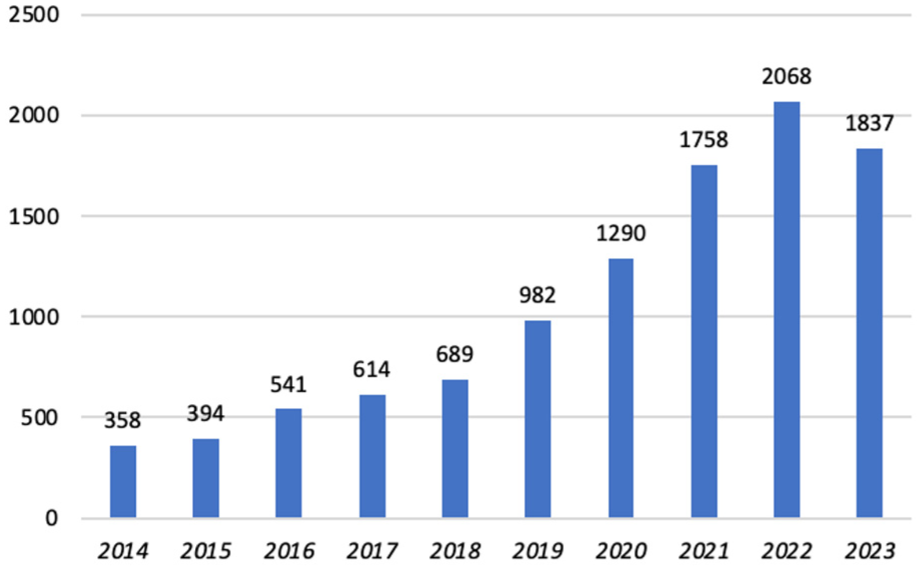
Number of research publications on e-commerce in the past decade.
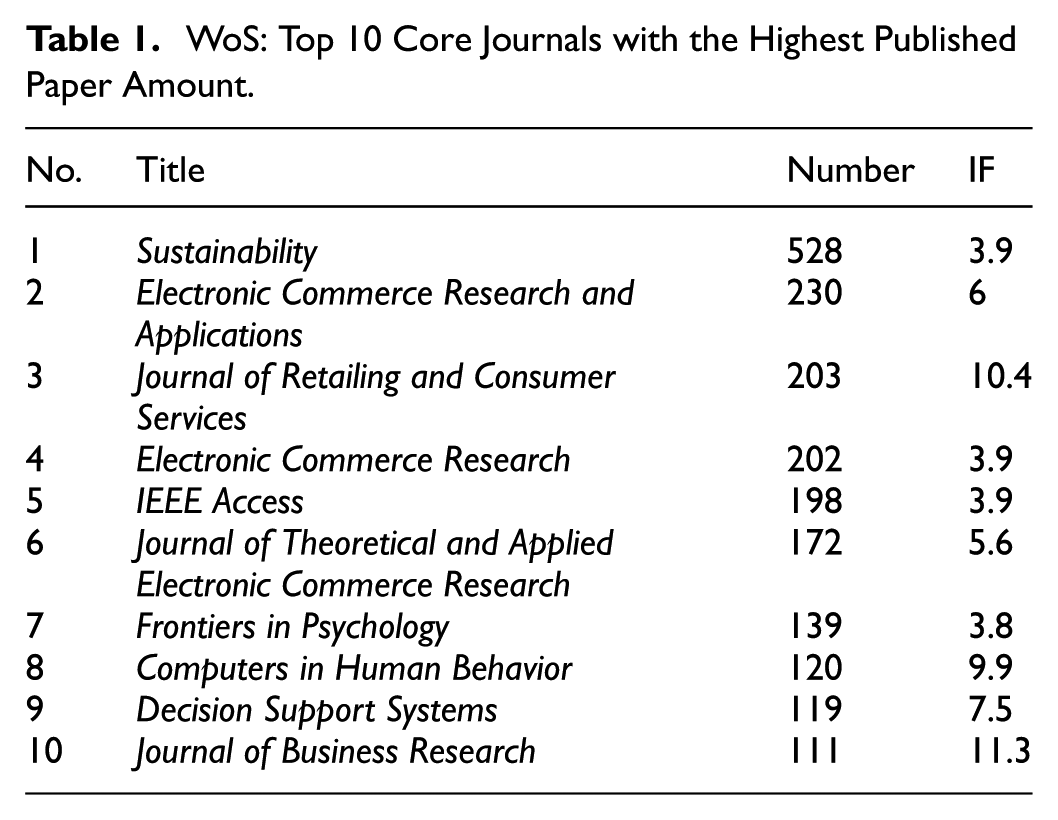
Journals are a tool for disseminating the latest research results, and e-commerce research papers are widely distributed in journals covering multiple fields such as computer science, business economics, and management science (Table 1). The journal with the most publications is Sustainability (528), an international, interdisciplinary, and open-access journal (Q2) published by MDPI Publishing, focusing on exploring issues related to environmental, cultural, economic, and social sustainability. Next is Electronic Commerce Research and Applications (230, Q1), which focuses on research in the field of e-commerce, including papers on e-commerce technology, business models, consumer behavior, and other aspects. Journal of Retailing and Consumer Services (203, Q1) and Journal of Business Research (119, Q1) are renowned in the academic community for its high-quality research papers and extensive coverage, and are regarded as an important platform for academic exchange.
WoS: Top 10 Core Journals with the Highest Published Paper Amount.
Research Strength: Core Countries, Institutions, and Teams
Country Cooperation Network Analysis
The distribution of articles published by a country or institution is an important indicator to measure its research capacity. Network analysis of cooperation between countries or institutions can detect the distribution and layout of the main research forces in a certain research topic. Using CiteSpace6.2. R6, a collaborative map of research countries or institutions, was drawn, and a total of 124 countries were identified to participate in the e-commerce research. The top three countries in terms of publication volume are China (4,920), the United States (1,912), and India (662), accounting for a total of 69%. The number of papers on e-commerce research in China is much higher than in other countries, indicating a high level of interest among Chinese researchers in this field. This is consistent with the rapid development and application of e-commerce in China in the past decade.
The nodes with purple outer circles in the figure have high intermediary centrality values. The centrality of a node is a graph-theoretical property that quantifies the importance of the node’s position in a network. As a structural metric, Betweenness centrality is commonly used to measure node centrality (Freeman, 1978). It measures the percentage of the number of shortest paths in a network to which a given node belongs. Nodes with high-betweenness centrality tend to be found in paths connecting different clusters. It has been applied in community detection, identification, and cluster separation (Girvan & Newman, 2002). Saudi Arabia has the highest intermediary centrality (1.44), serving as a good link for cooperation between countries. From the perspective of cooperative relationships, there is insufficient international cooperation among countries with a high volume of publications, as research collaboration mainly focuses on domestic partnerships. Countries with a small number of publications have obvious cooperation (Figure 3, Table 2).

Research on national cooperation networks in the field of e-commerce.
Top 10 Countries in Terms of Publications on E-commerce Research.

Institution Cooperation Network Analysis
Using institutions as node types, conduct a collaborative network analysis on the institutions participating in e-commerce research (as shown in the Figure 4); N = 173, E = 191, Density = 0.0128), 6,146 institutions are participating in the research, and the top three institutions in terms of publication volume are the Chinese Academy of Sciences (196), Hong Kong Polytechnical University (144), and Zhejiang University (136) in China. Six of the top ten institutions are from China, indicating that in the field of e-commerce, Chinese institutions have a significant advantage in research power.

Collaboration network of research institutions in the e-commerce field.
There are significant differences in cooperation between institutions, and institutions with a large volume of publications are mostly focused on internal cooperation (Table 3). The City University of Hong Kong has the highest intermediary centrality (0.75), which plays a good intermediary role between institutions.
Top 10 Institutions in Terms of Publications on E-commerce Research.

Author Collaboration Network Analysis
By analyzing the literature, authors, representative scholars, and core research forces in the field of e-commerce can be identified. Based on the distribution of first authors who have published papers related to e-commerce, and drawing on Price’s Law, the core author group in China’s e-commerce field in the past decade has been determined, which is m = 0.749 (nmax)0.5. Among them, nmax is the maximum number of papers published by authors during the statistical period. The minimum number of papers published by the core author should be m. According to statistics, the number of publications by the most prolific author in the past 10 years is 23, resulting in m = 3.59. Based on this result, when visualizing the article, the number of nodes selected is e = 3.0, indicating that the authors visualized in Figure 5 below can be recognized as core authors in this field of research. The total number of published papers by core authors is 1,290, far from reaching 50% of the total number of papers in the research field. E-commerce research has not yet formed a stable core author group.

Co-occurrence network of core authors in e-commerce research over the past decade.
From the perspective of the overall distribution structure of the network, there are five closely cooperating teams. The earliest cooperating team is Group A (Table 4). In 2014, a paper was published in the Computer Law & Security Review, summarizing the latest developments in the fields of information technology, e-commerce, telecommunications, and intellectual property (Allardyce et al., 2014). The team led by Professor George Q. Huang from the University of Hong Kong (Group B) and Professor Luo, Xin (Robert) from the University of New Mexico (Group C) has been cited more frequently. Professor George Q. Huang’s team studied the collaborative decision-making problemzero-burdenzero-burdencarriers in e-commerce logistics networks (M. Zhang et al., 2017). Professor Luo, Xin (Robert) and his team constructed a model based on the technical characteristics and stimulus organism response paradigm of social e-commerce websites to examine the impact of technical characteristics (interaction, recommendation, and feedback) on relationship quality (fast relationships and trust) and subsequent repurchase intention (Lin et al., 2017).
Top 10 Authors in Terms of Publications on E-commerce Research.

Thematic Clustering of the Research
The co-word analysis method mainly involves statistical analysis of the number of times a vocabulary pair or noun phrase appears together in the same literature. Based on this, these words are stratified and clustered to reveal the relationship between these words, and then analyze to reveal the structuralnges of the disciplines and themes they represent. Simplify the complex co-wordnetwork relationships among numerous analytical objects into a process that is visually represented by numerical and graphical representations. Keywords condense the core content of a paper, while keyword co-occurrence analysis can reveal the themes of interest in a research field.
In this study, we used Citespace to search for keywords in the literature and generated a knowledge graph for keywords that appeared at least three times (Figure 6, Table 5). Our research findings indicate that e-commerce research mainly focuses on seven aspects: recommendation systems, word of mouth, system dynamics, information technology, model, digital marketing, and supply chain.
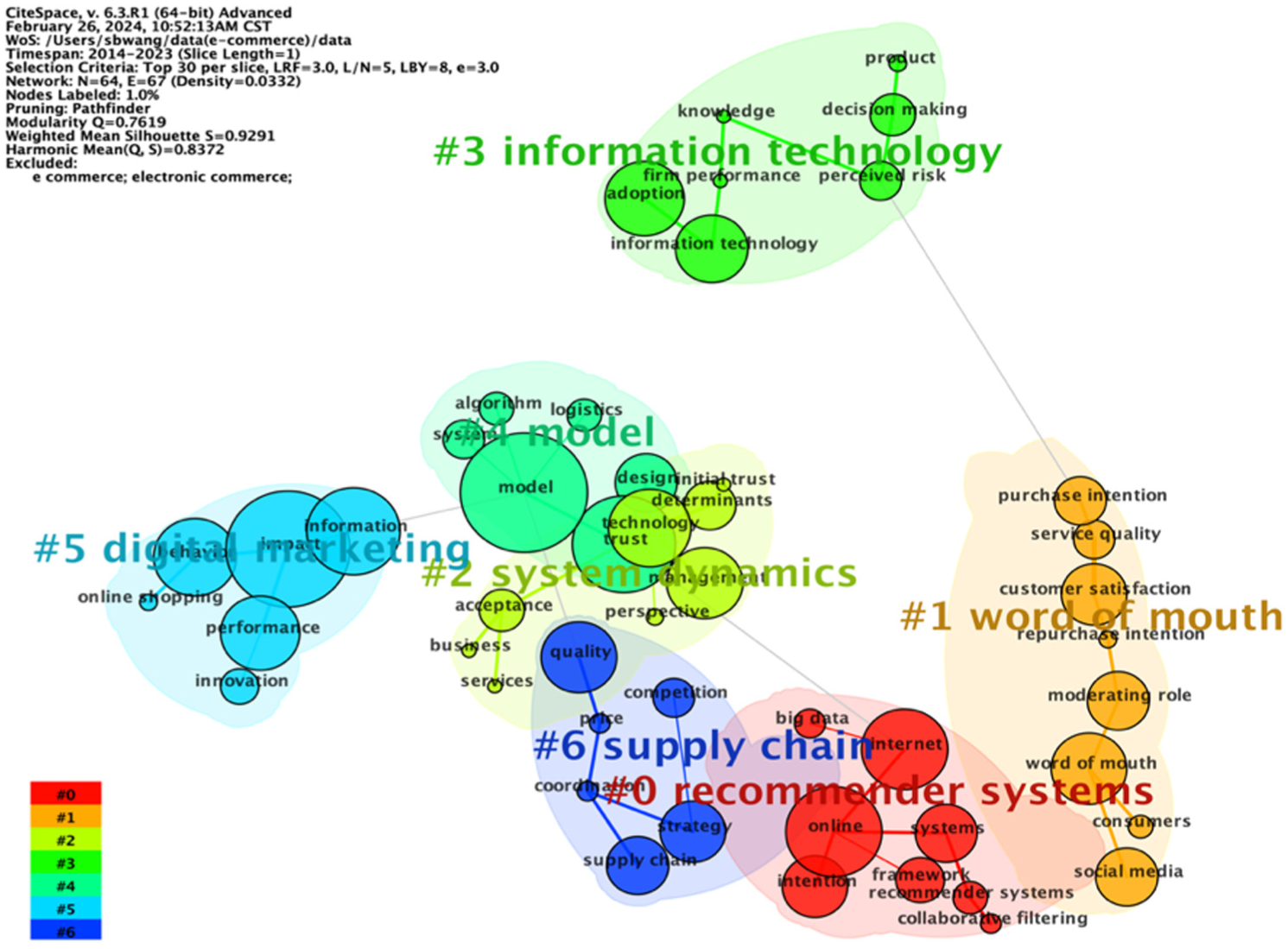
Cluster network of core keywords in e-commerce research.
Comparison Table of Clustering and Keywords.

Recommender Systems
Recommendation systems have emerged in the field of e-commerce and have been developed to actively recommend the right products to online users. The recommendation system of e-commerce provides personalized product recommendation services to users by collecting and analyzing user data, utilizing advanced algorithms and technologies, thereby improving user satisfaction and shopping experience. It is generally divided into a data collection module, a user analysis module, a recommendation algorithm module, and a feedback processing module. Nilashi et al. (2017) proposed a new recommendation method based on multi-criteriaCF, which utilizes clustering, dimensionality reduction, and prediction methods to improve the prediction accuracy of tourism recommendation systems. Azadjalal et al. (2017) proposed a method to identify implicit trust statements by applying specific reliability metrics, and the proposed recommendation algorithm showed significant improvements in accuracy and coverage metrics. In order to improve the success probability of recommendation systems, scholars have conducted research on various related models and algorithms, including a hybrid model based on comment texts and social communities (Ji et al., 2019). The future of e-commerce recommendation systems will continue to innovate and break through, providing users with more accurate and intelligent personalized, diversified, real-time, and mobile recommendation services.
Word of Mouth (WOM)
In e-commerce, Word of Mouth is a very important means of promotion and marketing. It mainly refers to the sharing of experiences and opinions about products or services among consumers through oral communication, social media, online comments, and other means. The impact of word-of-mouth on e-commerce is mainly reflected in influencing purchase decisions, shaping brand image, promoting sales growth, and improving customer satisfaction and loyalty. WOM has a direct impact on purchase intention, and has an indirect impact on purchase intention, which is modeled by consumers’ trust on the underlying product (See-To & Ho, 2014). Overall, word-of-mouth is positively correlated with sales (Babić Rosario et al., 2016). Word of mouth is more important in social e-commerce (Kim & Park, 2013). Word of mouth plays an important role in e-commerce and is one of the important factors for the success of e-commerce. E-commerce platforms need to attach importance to word-of-mouth marketing and establish a good word-of-mouth system by providing high-quality products and services, encouraging consumers to leave comments, and other means.
System Dynamics
In the field of e-commerce, system dynamics can be used to analyze the dynamic behavior of e-commerce systems, as well as the interaction relationships between various functional subsystems and systems. For example, it can be used to simulate and analyze supply chain management on e-commerce platforms (Cagliano et al., 2015), situational marketing (Irani et al., 2024), user behavior (Feng et al., 2019), transaction processes (Fu & Zhu, 2018), and so on. Through the modeling and simulation of system dynamics, it is possible to better understand the operational rules of e-commerce systems, predict future development trends, optimize system design, and improve system efficiency and user experience. Overall, system dynamics provides an effective analysis and research method for the field of e-commerce, which helps us better understand and respond to the complexity and dynamics of e-commerce systems.
Information Technology
The emergence and development of e-commerce cannot be separated from the progress of information technology. Information technology provides infrastructure for e-commerce (X. Wang & Wang, 2019), such as computer networks, databases, electronic payments, etc., making commercial activities possible on a global scale, achieving the digitization and networking of commercial activities. At the same time, the development of information technology has also driven innovation in e-commerce models. Information technology and e-commerce mutually promote and develop together. The advancement of information technology has provided better technical support for e-commerce and promoted its rapid development. The development of e-commerce has also put forward higher requirements for information technology, promoting continuous innovation and progress in information technology (Hua et al., 2019). The logistics supply chain is deeply integrated with information technology such as big data and Internet technology, and the logistics intelligent supply chain management mode is developed to meet the demand of e-commerce enterprises for logistics supply chain (Han & Wang, 2022). The future e-commerce environment will become more diversified, intelligent, and personalized driven by information, technology, while also facing greater challenges, including data security, privacy protection, and how to adapt to rapidly changing market demands and technological innovations.
Model
Model plays a core role in the field of e-commerce, running through different levels and dimensions of e-commerce from the theoretical framework to practical application. It not only guides practical operations and system development, but also provides theoretical support and analytical tools to help e-commerce enterprises better design their business processes, optimize service quality, and achieve sustainable growth. There are several types of model research in the field of e-commerce.
Business Model (Y. Wang et al., 2018), Refers to different types of e-commerce business models, such as B2B, B2C, C2C, C2B, O2O, etc. These patterns describe the roles and interactions of various parties involved in online transactions, such as businesses, consumers, governments, etc. Conceptual model (Susanty et al., 2020), It is a theoretical framework that abstractly describes the basic components and interaction processes of e-commerce activities. Business Process Model (Svatošová, 2021), to model the specific steps and links of online transactions to better design, optimize, and manage the e-commerce processes of enterprises. Data analysis model (Falk & Hagsten, 2015), used to predict consumer behavior, optimize product recommendations, and implement precision marketing. User Experience Design Model (Pandiyarajan & Shanmugavadivel, 2022), the model can be used to create user-friendly interface layouts and interaction processes, improving the usability and satisfaction of websites or applications. Risk management model (Qu et al., 2021), establish credit evaluation models, fraud detection models, etc. to effectively control various risks in e-commerce and ensure transaction security.
Digital Marketing
Digital marketing in e-commerce is a strategy that utilizes digital channels and tools to promote products and services, attract potential customers, and ultimately convert them into sales revenue. In the e-commerce environment, digital marketing plays a crucial role, not only helping businesses reach a wider online user base but also improving marketing efficiency and effectiveness through data-driven methods. The main forms of digital marketing in e-commerce include search engine optimization (Kritzinger & Weideman, 2013), search engine marketing (Pan et al., 2011), social media marketing (Yadav & Rahman, 2017), email marketing (Kumar, 2021), content marketing (Geng et al., 2020), video marketing (Yu et al., 2023), mobile marketing (Yin et al., 2019), alliance marketing and influencer marketing (Gu et al., 2024), data analysis and personalized marketing (Chandra et al., 2022). Digital marketing is one of the key components of successful e-commerce, ensuring that businesses can accurately target their target audience in the fiercely competitive online market, effectively disseminate brand value, and achieve sustainable business growth.
Supply Chain
E-commerce supply chain is a new form of supply chain that combines traditional supply chain management with the Internet and information technology under the e-commerce environment. It covers the entire process from raw material procurement, product production, warehousing, logistics distribution to the hands of the end consumers, and effectively integrates and optimizes information flow, logistics, and capital flow through digital means. The research content of e-commerce supply chain is extensive and in-depth, covering multiple levels and dimensions. The following are some main research directions: information sharing and collaboration (D. Gao et al., 2022), supply chain visualization and transparency (S. He, 2023), logistics management innovation (Hazen & Byrd, 2012), big data analysis and prediction (Dong, 2022), risk management and emergency response (Zhou, 2022), green sustainable development (S. Zhang et al., 2023), globalization and localization challenges (Wu & Wang, 2020). The e-commerce supply chain is not only a process of physical product flow, but also a process of information and value transmission, providing key support for the competitiveness of enterprises in the context of the information society.
Research Trends
Figure 7 shows 25 e-commerce research references with high citation highlighting intensity, with the red section representing the years when the citation frequency is relatively prominent, which can reflect the research hotspots. The research trend can be divided into three distinct phases:
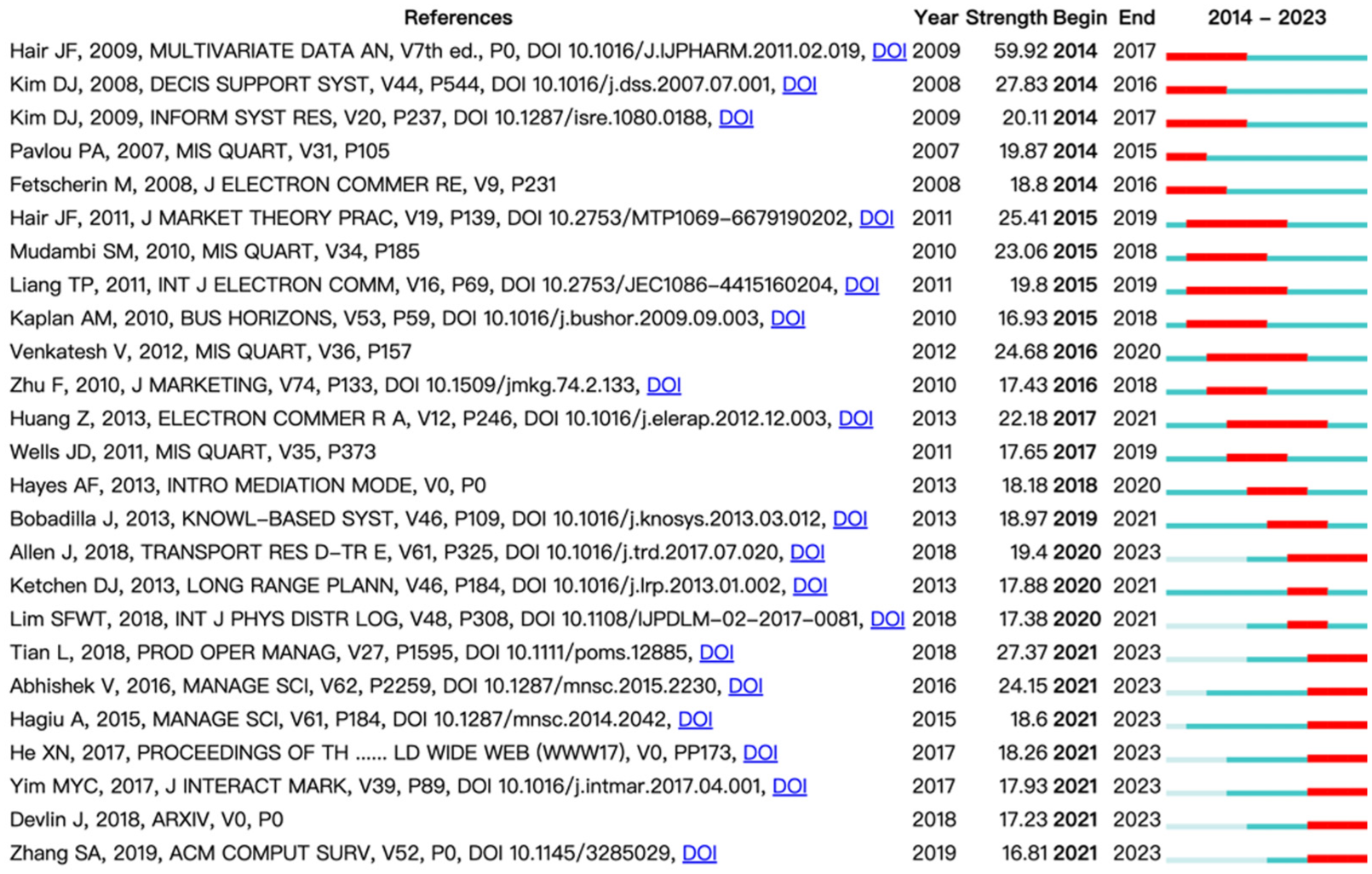
Trends in research on e-commerce.
Interval 1 refers to literature with high burst intensity cited in the early stage of e-commerce research, mainly discussing how the uncertainty of the online environment still makes many consumers unwilling to participate in online transactions. The main focus is on whether trust, risk, and satisfaction have an impact on consumer purchasing behavior. Scholars have verified the model, indicating that the trust and perceived risk of Internet consumers have a great impact on their purchase decisions. A set of four uncertainty mitigation factors—trust, website information, product diagnostic, and social presence—were proposed to overcome the agency problem of hidden information and hidden actions through the logic of signals and incentives, promoting online communication relationships.
The main focus in interval 2 is on literature with high citation intensity from 2015 to 2020, which mainly involves marketing, social e-commerce, social media, and recommendation systems in e-commerce. At this stage, the e-commerce market is huge. How to use various marketing concepts, strategies, and tools in the Internet environment to promote products and services through electronic network channels to achieve business goals. Social software and social environments are becoming increasingly mature, and how to conduct e-commerce through social networks has become a trend. The massive user data generated by social media nourishes recommendation systems, enabling them to provide higher-quality personalized recommendations. These recommendations, in turn, can promote the marketing effectiveness of e-commerce and the transaction efficiency of social e-commerce, forming a virtuous cycle. Social e-commerce is an innovative derivative of an e-commerce model that deeply integrates social media and e-commerce activities. In this mode, the shopping experience of users is no longer limited to the traditional online shopping mall, but extended to the social network platform. Utilize social media platforms such as TikTok, Facebook, Instagram, Weibo, WeChat, etc. to promote and sell product information. Utilize the power of social networks to promote the achievement of commodity transactions and services in a more humane, interactive, and contextualized manner.
Interval 3 is an emerging research question in e-commerce in the near future (2021–2023), mainly focusing on the last mile of e-commerce, cross-border e-commerce and globalization, and the integration of mobile e-commerce and OTO. With the advancement of globalization and the facilitation of international trade, more and more e-commerce companies are expanding overseas markets and achieving global operations. The integration of mobile e-commerce and O2O (online-to-offline) is an innovative business model. It uses mobile Internet technology to seamlessly connect e-commerce platforms with physical commerce, provide services through mobile applications (such as smartphone apps), enable consumers to browse, compare, purchase goods or book services online, and guide them to offline physical stores for consumer experience or services. The last mile of e-commerce is one of the most critical and costly links in the entire e-commerce logistics process, and it is also an important stage that directly affects the consumer shopping experience. Achieving a dynamic balance between improving service quality and reducing operating costs is a worthwhile research topic.
Discussion
The Expansion of E-commerce Applications Has Deepened the Depth and Breadth of Its Research
In the past decade, the support of governments in various countries for e-commerce has significantly increased, and e-commerce has become an important component of global economic activities. The expansion of the international e-commerce market is not only reflected in the accumulation of quantity, but also the qualitative leap, including technological innovation (Zhao, 2024), model innovation (Y. Wang et al., 2018), market structure optimization (S. Li, 2020), and policy environment improvement (Lee et al., 2023). This is consistent with the continuous growth of e-commerce research literature. E-commerce research provides a theoretical foundation and guidance for the healthy development of the e-commerce market. At the same time, the actual operation of the market and emerging problems also provide rich case studies and research materials for academic research, promoting the updating and improvement of theories.
The Vast Market Size of China Provides a Case Study for the Study of E-commerce
China has the world’s largest e-commerce market (Xiao et al., 2019), with a huge user base and continuously increasing transaction volume. This market size provides rich data sources and diverse case study opportunities for research, making it widely applicable and practically meaningful. This also explains why China has the most literature on e-commerce research. At the same time, the Chinese government attaches great importance to the development of e-commerce, and has issued a series of policies and plans to support the development of this field, including the “Internet plus” (Jin et al., 2020) action plan and the digital economy strategy. The government’s support not only promotes industry growth, but also provides direction and resources for academic research.
Recommendation Systems Have Become the Largest Cluster in E-commerce Research
There is a reason why recommendation systems can become the largest cluster in e-commerce research in keyword clustering analysis. The performance of e-commerce is influenced by various factors, which involve multiple dimensions such as technology, market, management, and resources. The importance of recommendation systems in e-commerce is particularly prominent (C. Cui et al., 2022). By using big data and artificial intelligence technology for user behavior analysis, personalized recommendations (K. Wang et al., 2020) can be achieved, which can improve conversion rates and user satisfaction (Sivaramakrishnan et al., 2020). It constitutes the core mechanism of user interaction and product discovery on modern e-commerce platforms. It not only affects the improvement of user experience, but also directly affects the profitability and market position of e-commerce enterprises, and is an important driving force for promoting continuous innovation and growth in the e-commerce industry.
Future Research Directions
As a continuously evolving and rapidly changing field, future research in e-commerce should encompass multiple dimensions including technology, market dynamics, policy frameworks, and social impacts. Below are several key areas for future exploration.
Enhancing Technological Support for E-commerce Development
Artificial intelligence (AI): Investigate how AI can be leveraged for precision marketing, intelligent recommendations, personalized services, and customer service automation. Future studies could focus on developing algorithms that better predict consumer behavior, optimize demand mining, and enhance supply chain efficiency (Cheng et al., 2023).
Big data analysis: Explore the potential of big data analytics in predicting consumer behaviors and optimizing supply chains. Researchers should aim to develop models that can process vast amounts of data in real-time to support decision-making processes (X. Zhang & Guo, 2024).
Blockchain technology: Examine the role of blockchain in enhancing product traceability, combating counterfeit goods, and building decentralized transaction systems. Future work could explore how blockchain can improve payment security, protect consumer rights, and streamline logistics operations (G. Li et al., 2023).
Internet of things (IoT): Investigate the application of IoT technologies to promote smarter, more scenario-based e-commerce experiences. This includes seamless shopping experiences and real-time tracking of goods, as well as intelligent warehousing management during the logistics process (Wei et al., 2021).
Exploring New E-commerce Models and Content
Social media platforms: Analyze how new media platforms such as social networks, short videos, and live streaming are reshaping e-commerce forms. Future research could explore strategies for integrating offline physical stores with online channels to create seamless, multi-dimensional consumer experiences.
Community operations and user engagement: Investigate effective community operation mechanisms, user participation strategies, and content generation tactics. Future studies should consider longitudinal designs to understand long-term user engagement and behavioral outcomes.
Global e-commerce systems: Address challenges related to cross-border payments, logistics, taxation, and compliance. Future research should aim to build a global e-commerce service system that overcomes these barriers and supports international trade.
E-commerce Regulations and Regulatory Innovation
Legal frameworks: As the e-commerce industry expands, new challenges such as data security, consumer rights protection, anti-monopoly regulations, and tax compliance arise. Future research should focus on improving relevant laws and regulations to adapt to the unique characteristics of e-commerce.
Cooperative governance mechanisms: Explore cooperative governance mechanisms involving government entities, platforms, merchants, and consumers. Future studies could investigate how different stakeholders can collaborate to address emerging risks and ensure sustainable industry growth.
Green E-commerce and Sustainable Development
Environmental practices: Focus on environmental practices and challenges within the e-commerce industry, such as green packaging, reverse logistics (returns and recycling), and low-carbon supply chain management. Future research should examine how technological innovations and business model changes can drive green transformation.
Policy guidance and corporate social responsibility (CSR): Investigate the role of policy guidance and CSR in promoting sustainable development within e-commerce enterprises. Future studies could explore best practices and case studies that demonstrate successful implementations of green initiatives.
Research Significance and Limitations
This article represents a methodological innovation by conducting, for the first time, a quantitative analysis of e-commerce research literature over the past decade using bibliometric analysis and visualizing the research outcomes. This approach breaks through the limitations of traditional qualitative reviews, enabling an objective and comprehensive revelation of the field’s knowledge structure, research hotspots, and development trends. The knowledge map generated by CiteSpace not only intuitively displays the collaboration networks among core authors, institutions, and countries but also precisely identifies the evolutionary pathways of research themes, providing a reliable methodological paradigm for future studies. In terms of theoretical contributions, this study constructs a knowledge map and theoretical framework for the research field, identifies the distribution of research strength, and offers deep insights into research themes and developmental trends, helping scholars quickly grasp the overall landscape of the discipline. Meanwhile, by identifying highly cited literature and burst terms, this research reveals potential directions for theoretical innovation and possible breakthroughs for future research, providing significant academic references for theoretical deepening and interdisciplinary integration. The practical value of this study is also substantial, as it can provide data support for enterprises in formulating e-commerce strategies, help assess their business value and application potential, guide them in model innovation. Furthermore, it serves as a scientific basis for governments and institutions in policy-making and legal regulation adjustments.
Despite these valuable achievements, certain limitations are acknowledged. Firstly, this study utilized the Web of Science database, although it has high academic quality, it may have missed important literature from other specialized databases, leading to potential bias in sample coverage. Secondly, it is difficult to exhaust all synonyms and variant forms of keywords during retrieval, which might result in the omission of some relevant literature. Additionally, the online publication of certain articles may lead to inconsistencies between collection dates and publication dates. Therefore, future research could consider integrating multi-source databases, optimizing retrieval strategies, and adopting more refined time calibration methods to further enhance the comprehensiveness and accuracy of the study.
Conclusion
This article uses CiteSpace to conduct a scientometric analysis of e-commerce research based on publications indexed in the Web of Science database, generating a knowledge graph of countries, institutions, keywords, and cited references. It reveals global trends and intellectual structures in e-commerce research over the past decade and provides a comprehensive overview and new perspective for scholars and practitioners.
Main Findings
Over the past 10 years, the capacity and intensity of e-commerce research have continued to grow, reflecting the rapid expansion of the user base and transaction volume in the e-commerce industry. Sustainability is the journal with the highest number of related publications. China leads in publication output, followed by the United States and the UK. The Chinese Academy of Sciences is the most productive institution, and George Q. Huang is the most cited author.
Through keyword co-occurrence analysis, a core network of e-commerce research themes has been identified. Major research areas include recommendation systems, word-of-mouth, system dynamics, information technology, modeling approaches, digital marketing, and supply chain management.
Burst detection analysis of cited literature shows three distinct phases of research evolution. Early-stage research (2009–2014) focused on consumer trust, risk perception, and satisfaction. Mid-stage studies (2015–2020) emphasized social commerce, social media marketing, and recommendation systems. Recent research (2021–2023) has shifted toward cross-border e-commerce, globalization, last-mile logistics, and the integration of mobile commerce with online-to-offline (O2O) strategies.
Theoretical Implications
From a theoretical perspective, this study contributes to the understanding of the evolving intellectual landscape of e-commerce research. Mapping the thematic evolution and identifying emerging research frontiers, it helps researchers identify underexplored areas and potential interdisciplinary opportunities. For example, the growing focus on sustainability and green e-commerce indicates a shift from purely technological concerns to more holistic and socially responsible perspectives. This provides a foundation for future conceptual and empirical work in these domains.
Practical Implications
Practically, the findings offer valuable insights for businesses and policymakers in the platform economy. First, the increasing emphasis on digital technologies such as AI, big data, and blockchain highlights the need for enterprises to invest in innovation and adapt to changing consumer expectations. Second, the rising importance of cross-border e-commerce and O2O integration suggests that companies should develop more flexible and customer-centric business models. Third, the growing regulatory attention to issues like data privacy, taxation, and anti-monopoly policies implies that platforms must proactively align their operations with legal frameworks and governance standards.
Future Research Directions
Future studies could extend this work by incorporating machine learning techniques for real-time trend prediction, conducting comparative analyses across different regions or industries, and exploring the policy impacts of emerging technologies in e-commerce ecosystems.
In summary, this study not only offers a systematic review of the global e-commerce research landscape but also provides actionable insights for both academic inquiry and practical decision-making in the rapidly evolving digital economy.
Footnotes

Funding
The authors disclosed receipt of the following financial support for the research, authorship, and/or publication of this article: Thanks to the Key Research Center of Philosophy and Social Science of Zhejiang Province: Modern Port Service Industry and Creative Culture Research Center for supporting this paper.
Declaration of Conflicting Interests
The authors declared no potential conflicts of interest with respect to the research, authorship, and/or publication of this article.
Data Availability Statement
Data sharing not applicable to this article as no datasets were generated or analyzed during the current study.