




Abstract
Research on language experience (LE) has covered numerous topics in psychology, linguistics, and other relative disciplines. Such research is based on people’s experiences of the world, and substantial attention has been paid to this subject. In order to investigate the foundation and influential works of LE studies, we adopt CiteSpace software to analyze 30,045 published articles/reviews from the Web of Science by focusing on the co-citation analysis in terms of discipline, articles, and journals. The results present that (1) language systems in LE research interact mutually rather than separate from each other and (2) bilingualism is always a hot topic in the past few decades and will be popular in the next decades. These findings further indicate some issues to be resolved. One is about the relations between language systems and the other is the psychological interpretation in language experiences conflicts in practical language use.
Introduction
The term language experience (LE) is broadly a popular research topic and broadly investigated in diverse disciplines. It refers to “the child’s own thoughts, ideas, and language as well as objects in the environment form the basis for his introduction to reading” (Batinich, 1970, p. 539). Hall (1985, p. 5) further pointed out that LE is more than an approach but “a perspective and a philosophy about language learning and about language teaching.” Batinich and Hall’s words indicate that researches of LE much concern with people’s experience of the world. From a biological perspective, a person’s experience is the primary precondition that determines how they perceive the world. From a cognitive perspective, an individual’s experience reflects their cognitive processes (Lakoff, 2012; Mandler, 1992), while a linguistic view holds that a person’s experience influences how they understand, use, learn, and teach language (Antovich & Graf Estes, 2018; Flege, 2005).
The research on experience can be traced back to Hume’s philosophical investigation of empiricism. Hume (2009) argued that ideas are constructed based on people’s impressions of the world, and such impressions are achieved via people’s sense experience (i.e., common sense or experience). This argument suggests that people’s experiences are crucial to advanced knowledge and ideologies. Specifically, a person acquires language knowledge through their language experiences, which occur because people participate in language activities. The participation in various language activities will include many processes such as mental, social, behavioral, or biological. LE studies therefore theoretically cover several disciplines such as psychology, linguistics, education, sociology, and neurology and address various related topics such as language learning, teaching, acquisition, usage, and neural signals in the brain. For instance, there are bilingualism studies that have explored language production (e.g., Gollan et al., 2007; Sadat et al., 2012; Zou et al., 2012), language processing (Macizo et al., 2010; Martín et al., 2010; Yudes et al., 2011), language acquisition (e.g., Canseco-Gonzalez et al., 2010; Kapa & Colombo, 2014; Vejnovic et al., 2010), neural signals and imaging (e.g., Fernandino & Iacoboni, 2010; Hanulová et al., 2011; Oberman & Ramachandran, 2007), and language pathology (e.g., Purdy & Hindenlang, 2005; Sebastian et al., 2012; van Mersbergen et al., 2001). These indicate that LE research includes both language studies (in the social sciences) and biological studies (in the natural sciences).
Further, numerous studies have explored the relationship between LE, language knowledge, and competence or between LE and language knowledge and between LE and competence in regard to language cognition (e.g., Downer & Pianta, 2006; Kuhl et al., 2006; Lee & van Hasselt, 2005), language competence (e.g., Farver et al., 2006; Slevc et al., 2016; Wong et al., 2007), and language usage (e.g., Coderre & van Heuven, 2014; Fan et al., 2017; Kapa & Colombo, 2014). Additional research in both the social and natural sciences have explored LE, focusing on various themes such as language learning and teaching, childcare, language switching, lexical decisions, and deaf children.
Most reviews or research of LE used to focus on language learning (or acquisition) and teaching in terms of the psychological processes (e.g., Antoniou & Katsos, 2017; Hambly et al., 2013; Ramírez-Esparza et al., 2020) or neural mechanisms (e.g., DeLuca et al., 2020; García-Pentón et al., 2016; Pliatsikas et al., 2020) while the relationship between disciplines in LE research is seldom touched by scholars. Questions like whether scholars from various disciplines investigate LE from the same perspective; whether the disciplinary research of LE is carried out around some hot topics; or whether there exit some conflicts between LEs in previous research are still uncovered in LE-related research. These questions require not only a generalization of ideas or concepts from articles of a particular topic of LE but also a bibliometric analysis to excavate the information flow in the investigation of LE based on co-citation, coupling, cluster analyses and the like. Answers to those questions will prove the interdisciplinary communication and help scholars have a sketch of the status quo of LE, especially for those who are not very familiar with LE but interested in it. On those accounts, this study carried out a bibliometric analysis of LE-related literature published from 2000 to 2019 via CiteSpace (5.6.R.3). In the process of performing the bibliometric analysis, this article aims to sort out the basis shared by various LE research in diverse disciplines, which helps to understand relations between those studies and some influential or primary LE research. The purpose of our research further elicits two research questions: (1) What is the basis of LE research shared by different disciplines in the first two decades of 21st century? and (2) What issues does the information flow of LE research indicate? The first question is to discover the generality and the second is to reveal the trend in LE research across disciplines.
To answer the two research questions, this study begins with a brief introduction to bibliometric analyses with the elaboration of the advantages of CiteSpace. The following three sections describe the results obtained from the analysis. In line with bibliometric analysis requirements, we collected published articles and reviews from the Web of Science (30,045 in total). The last section generalizes the findings and explains how they can be useful for researchers or scholars who are interested in LE.
Research Method
To understand how LE research has developed in the 21st century, this study collected articles/review from the following sources for the bibliometric analysis: the Advanced Search in the Web of Science (WOS) Core Collection of Thomson Reuters, Science Citation Index Expanded (SCIE), SSCI, A&HCI. All collected articles/reviews were written in English, and we retrieved the data using the following fields:
Topic = (“language experience*” OR “linguistic* experience*” OR “bilingual* experience*” OR “multilingual* experience*” OR “bilingual* effect” OR “multilingual* effect” OR “bilingual* advantage*” OR “multilingual* advantage*”). Thus, we retrieved articles/reviews that included these words in their titles, abstracts, or keywords.
Time span = 2000–2019
Document type = article OR review
(“*” is a wildcard in WOS that represents any group of characters, including no character. For instance, experience* = experience, experiences, experiencing, and experienced. Besides, in this article, the review articles do not include book reviews.)
Based on the search items listed above, this study collected 30,045 research and review articles from 1,765 journals that were distributed across approximately 246 WOS categories (e.g., psychology, computer science, linguistics, clinical neurology, and education; the list of those categories is displayed in Appendix). In order to guarantee the recall ratio, this study used the “remove duplicates (WOS)” function in CiteSpace to filter out duplicated studies from the collected data. The study did not remove any other articles/reviews from the dataset.
This study used CiteSpace to analyze the collected data based on Chen’s (2017) suggested analytical trajectory, namely, from a global/general analysis to a local/special one. CiteSpace is designed to synthesize and visualize the literature in the fashion of co-citation network where co-citated references are represented as nodes. Different types are groups into clusters based on the relativity and interconnectivity between references on a specific research topic (Chen, 2006). Each cluster, therefore, represented in the co-citation network depicts a specific research topic. The clusters (i.e., the different colored areas in Figures 3–5) are interpreted based on a series of parameters as following:
(1) Modularity Q: if Modularity Q > 3, then the separated social structures in the given field are clearly defined in terms of co-citation clusters (Chen, 2006; Chen et al., 2010);
(2) Silhouette: if Silhouette > 0.5, then the cluster effects are reasonable, and the level of homogeneity is relatively high, suggesting that each cluster is well matched to each other (Chen, 2006; Chen et al., 2010);
(3) Log-likelihood ratio (LLR): tests to recognize labels effectively within the cluster (Chen et al., 2010, 2012);
(4) Citation Burst (CB): a technique of identifying references attracting increased attention to the underlying research and to trace the development of study focus (Chen, 2017; Kleinberg, 2003);
Unlike other reviews of LE or other bibliometric analysis, we separated three epochs to conduct co-citation analyses. We separated the results into a 20-year depiction (2000–2019) and two 10-year depictions (2000–2009 and 2010–2019). The analysis was carried out around the most-cited references, which means even the articles in the second epoch cite some references published in the first epoch, those citations can hardly become the most cited ones in such a short period of time. Therefore, the data cutoffs will not be influence by whether the first epoch will impact the second epoch. The 20-year depiction aimed to paint an integral picture of the generality of LE research, while the two 10-year descriptions intended to illustrate the changes that occurred from one decade to another.
Results
We retrieved 30,045 publications (articles and reviews), and Figure 1 displayed the number of published article and review for every year. Generally, Figure 1 showed that the number of published LE works steadily increased from the year 2000 (less than 500) to the year 2019 (more than 3,000) especially after 2008.

Numbers of published articles (2000–2019).
Nevertheless, as depicted in Figure 2, the rate of growth differed by decade. Evidently, there was more growth during 2010 to 2019 than during 2000 to 2010. It indicated that the swift development of LE research. The phenomenon reflected, to some extent, that investigations of LE were highly extensive and complicated rather than in merely psychology or neural science, as argued by Arshavsky (2009, p. 336) with the statement that “it is hardly possible to understand the mechanisms of language production and comprehension within a concept that views cerebral neurons as simple elements whose function is limited to generating electrical potentials.” Therefore, LE research would inevitably attract scholars both from the inside and outside of neuroscience. The number of LE publications illustrated the popularity and significance of LE, and the following section will depict the development of LE from following aspects: category (i.e., discipline), co-citation, cited authors and journals.

Numbers of published articles in two decades.
Category Analysis
According to the results of category analysis, we listed the top 10 categories (given automatically in the software in line with the labels in WOS) in each period in Table 1 and provided their rankings based on the number of publications. This table illustrated that LE research was largely published in the following four categories: psychology, linguistics, education, and neurology (or neuroscience). For the ranking of first three categories, the number of published LE studies remained stable across the entire 20-year period. It indicated the most primary research field of LE at the beginning of this century, namely, psychology, linguistics, and education.
Top 10 Categories of LE Studies.
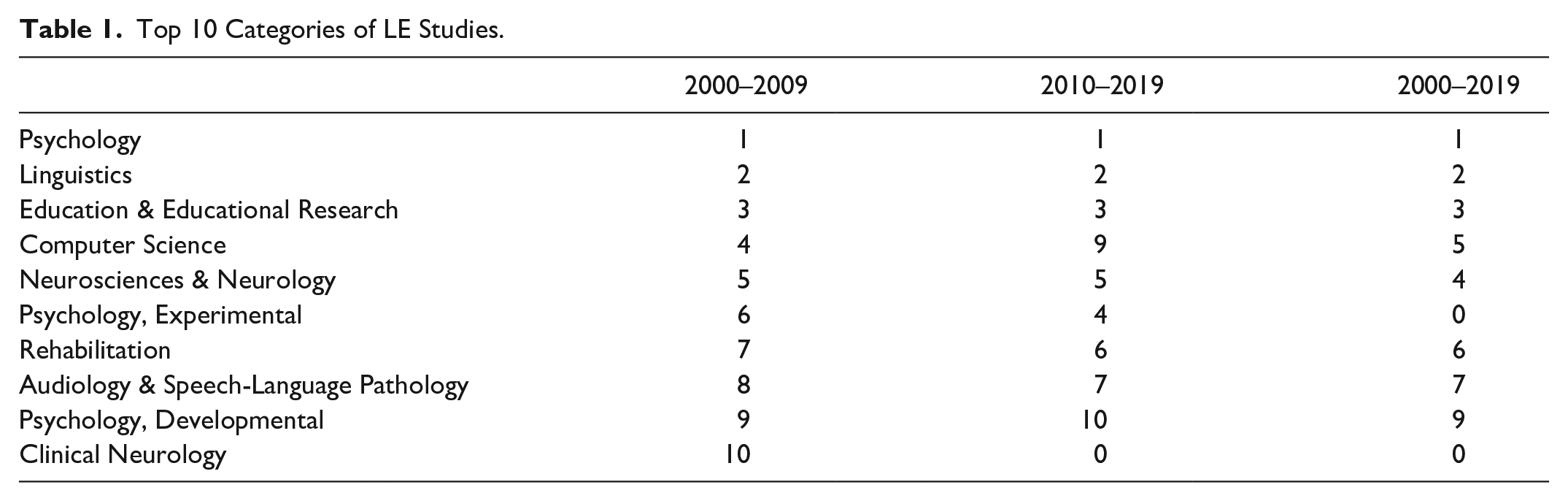
Further, Table 1 highlighted that LE in computer science displayed a downtrend in the second decade than in the first. It seemed that computer science research of LE did not attract much attentions as it did in the first decade. This phenomenon may be due to the swift development of computer and internet techniques at the beginning of this century in linguistics, especially in regard to computer-assisted learning or teaching (e.g., Loui, 2008; Sife & Lwoga, 2007; Thonus, 2004). Nevertheless, the ranking of computer science research of LE in 2000 to 2019 still showed an important status of such category in LE investigation.
Co-citation Analysis: Cluster Interpretations
Based on the analysis results of the co-citation, we used CiteSpace to conduct a cluster analysis. Figure 3 presented the general clusters (made through LLR algorithm in CiteSpace) of the collected articles from 2000 to 2019 with a modularity value of 0.7207 and a mean silhouette value of 0.982 based on the algorithms of path finder, pruning sliced networks, and pruning the merged network in CiteSpace. It illustrated an aggregated distribution in which most colorful areas overlapped, indicating that these clusters share some basic concepts or information (as suggested by Chen, 2004, 2017). Moreover, there were several marginal colorful clusters such as “healthcare” (#11) and “translanguaging space” (#14) that were separated from the aggregated ones. To provide more details about these clusters and to identify how the citations changed between the two decades, we visualized the co-citation results for the 2000 to 2009 and 2010 to 2019 decades in Figures 4 and 5, respectively. Figure 4 (modularity = 0.7223, mean silhouette = 0.7137) and 5 (modularity = 0.6315, mean silhouette = 0.6799) presented aggregated distributions of the clusters in Figure 3. In the method of introducing results of co-citation analysis through CiteSpace proposed by Chen and Song’s (2019), the two largest clusters in each epoch should be described to show the principal components in the co-citation analysis.
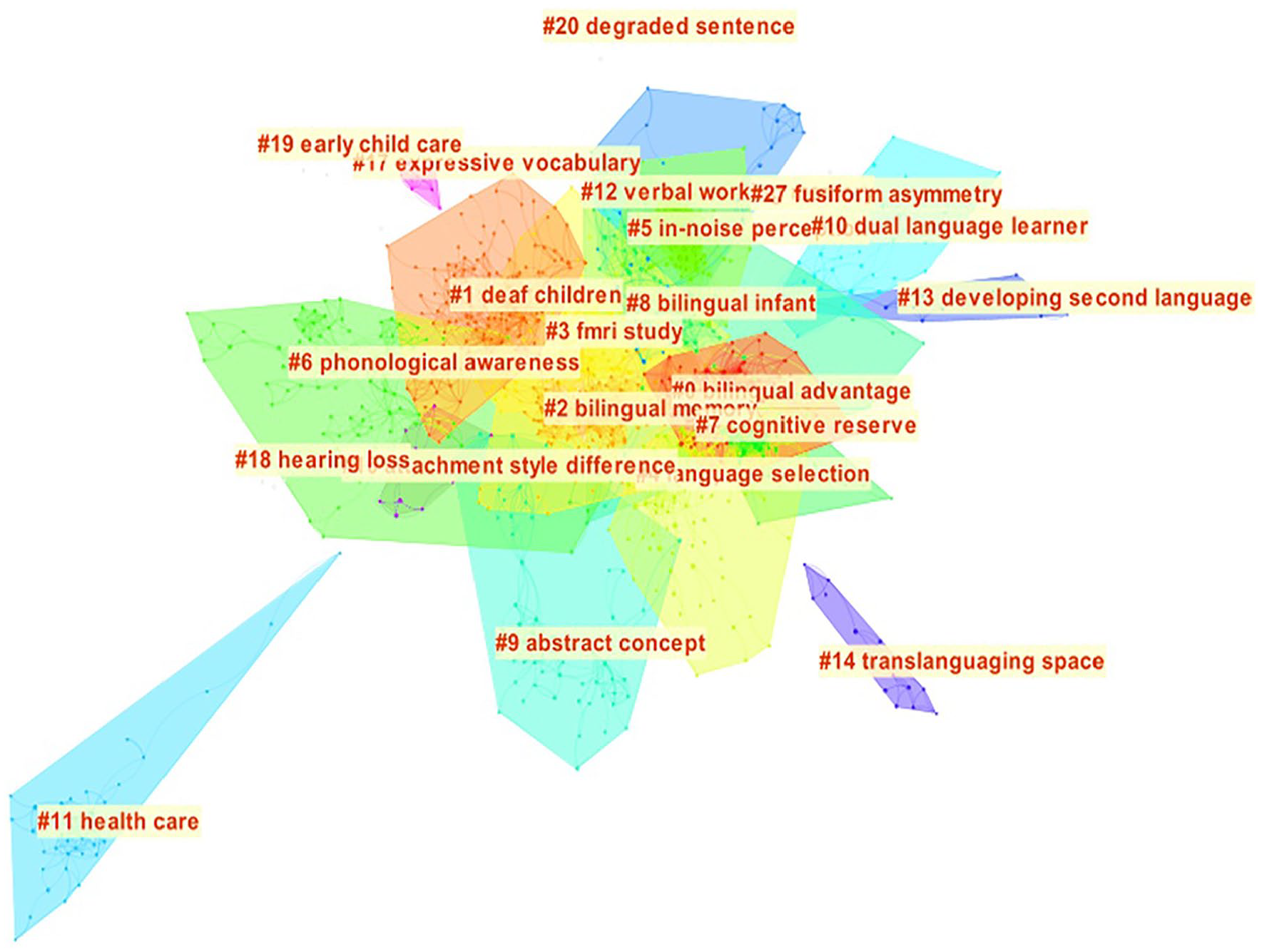
Co-citation clusters (2000–2019).
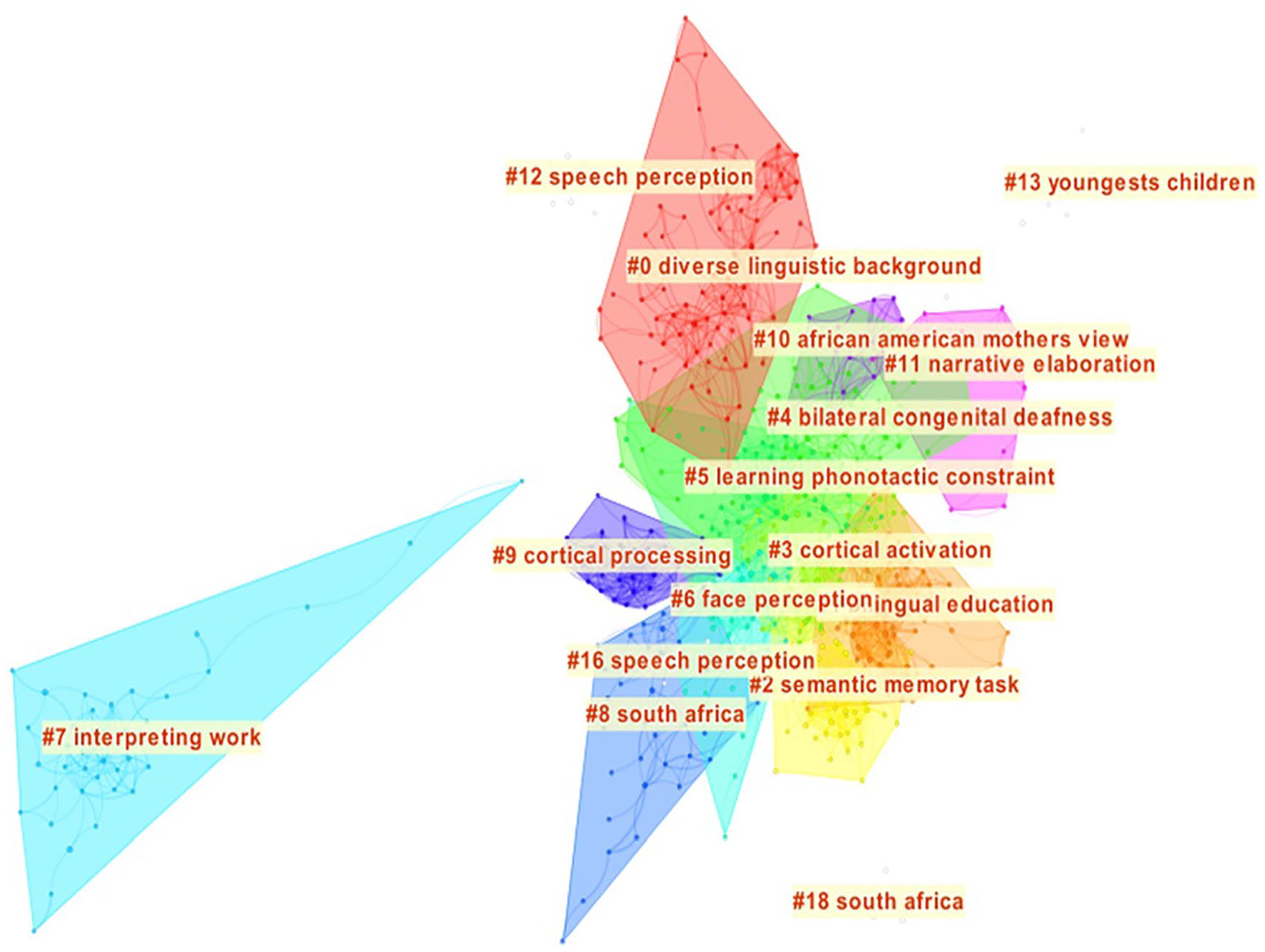
Co-citation clusters (2000–2009).

Co-citation clusters (2010–2019).
The largest cluster of Figure 4 in the 2000 to 2009 period contained 78 articles. This cluster was labeled as “teachers knowledge” by LLR and had a silhouette value of 0.923. The most active citer in this cluster was Hirsh-Pasek and Burchinal’s (2006) article entitled “Mother and caregiver sensitivity over time: Predicting language and academic outcomes with variable- and person-centered approaches.” The second largest cluster in Figure 4 contained 69 articles from 2000 to 2009 and was labeled as “lexical decision” by LLR. This cluster’s silhouette value was 0.778 and its most active citer was de Groot et al.’s (2000) article entitled “The processing of interlexical homographs in translation recognition and lexica decision: Support for non-selective access to bilingual memory.”
For the 2010 to 2019 periods, the cluster analysis produced 15 co-citation clusters. Of these, the two largest clusters were labeled as “bilingual advantage” (#0) and “executive function” (#1) by LLR (see Figure 5). The largest cluster, “bilingual advantage,” had a silhouette value of 0.687, contained 134 total articles, and its most active citer was Bialystok’s (2010) review entitled “Bilingualism,” describing the differences between bilingualism and monolingualism in terms of acquisition and usage and argued that these differences lead to changes in cognitive and linguistic processes. The second largest cluster, “executive function,” had a silhouette value of 0.764, contained 119 articles, and its most active citer was Degani and Tokowicz’s (2010) article entitled “Semantic ambiguity within and across languages: An integrative view,” focusing on cross-language ambiguity and highlighted the need for studies that test both within and cross-language ambiguity (for the same individuals) in regard to how frequency, semantic context, and language context interact.
Except for the most active citers in these two clusters, Figure 6 showed the development of the four clusters throughout their timelines. Larger circles on the timelines represented the references that scholars frequently cited. The first two timelines clearly illustrate that information and concepts published between 1995 and 2000 helped develop these clusters. Incorporating the two most active citers into the timelines (i.e., the two dotted lines in Figure 6) revealed that the most active citer in the first cluster (#0 teacher knowledge in Figure 4) appeared after the influential works were published (i.e., the large circles), while the most active citer in the second cluster (#1 lexical decision in Figure 5) appeared during the same time period wherein the influential works were published. This result suggested that the Hirsh-Pasek and Burchinal’s article depended much more on the existing research, while the Annette, de Groot, Delmaar, and Lupker’s article not only adopted existing knowledge but also provided a lot of information for the studies that were later published.

Timelines of the two largest clusters (2000–2019).
In addition, the two clusters in Figure 6 further manifested that they both had an influential position in the evolution processes from 2002 to 2019. Nonetheless, the timelines of the two clusters showed a prominent discrepancy in regard to the density of the citing lines. The first cluster (#0 bilingual advantage) contained highly dense citing lines, indicating that many more bilingual advantage studies were published from 2004 to 2016 in comparison to the second cluster (#1 executive function). In addition, the first cluster’s time span was longer than the second one.
Description of Figure 6 provided us with more details about LE studies in general. First, the analyses of the four timelines revealed that the last two citing lines were denser than the first two. This was consistent with the number of articles that had been published since 2000. The number of articles (see Figure 1) illustrated that the numbers of published articles in 2010 to 2019 increased from a fairly higher position than those in 2000 to 2009, which lead to the citing and cited articles increase positively in the same fashion. Second, the topic addressed by the four most active citers (i.e., the four example articles) matched the most common topic covered in LE studies between 2000 and 2019 (i.e., bilingualism), and all four articles were influential in the two clusters’ evolution processes. Third, in the co-citation cluster analysis, three of the most active citers were review articles, which was in line with the features of review articles. Finally, the visualizations were similar in regard to the two decades individually and aggregated.
Co-citation Analysis: The Most Cited Articles
Given the fact that co-citation is “frequency with which two documents are cited together” (Small, 1973, p. 265), it means “this measure in many cases reflects the existence of direct citation links and corresponds to significant intellectual connections within the field” and “co-citation could be used to establish a cluster or ‘core’ of earlier literature for a particular specialty” (Small, 1973, p. 268). In order to further probe into the intellectual connections of the collected articles, we analyzed the most cited references on the basis of cluster analysis results. Figure 7 visually displays the timelines of the clusters (from the co-citation analysis) based on the cited articles. This figure shows the top 20 clusters (i.e., the most cited) of the total 397 clusters. It illustrates the clusters of the collected articles from 2000 to 2019 through the timeline. This figure highlighted that the basis of research at the beginning could be traced back to 1990s, especially in the topic areas of deaf children, bilingualism, phonological awareness, and health care.
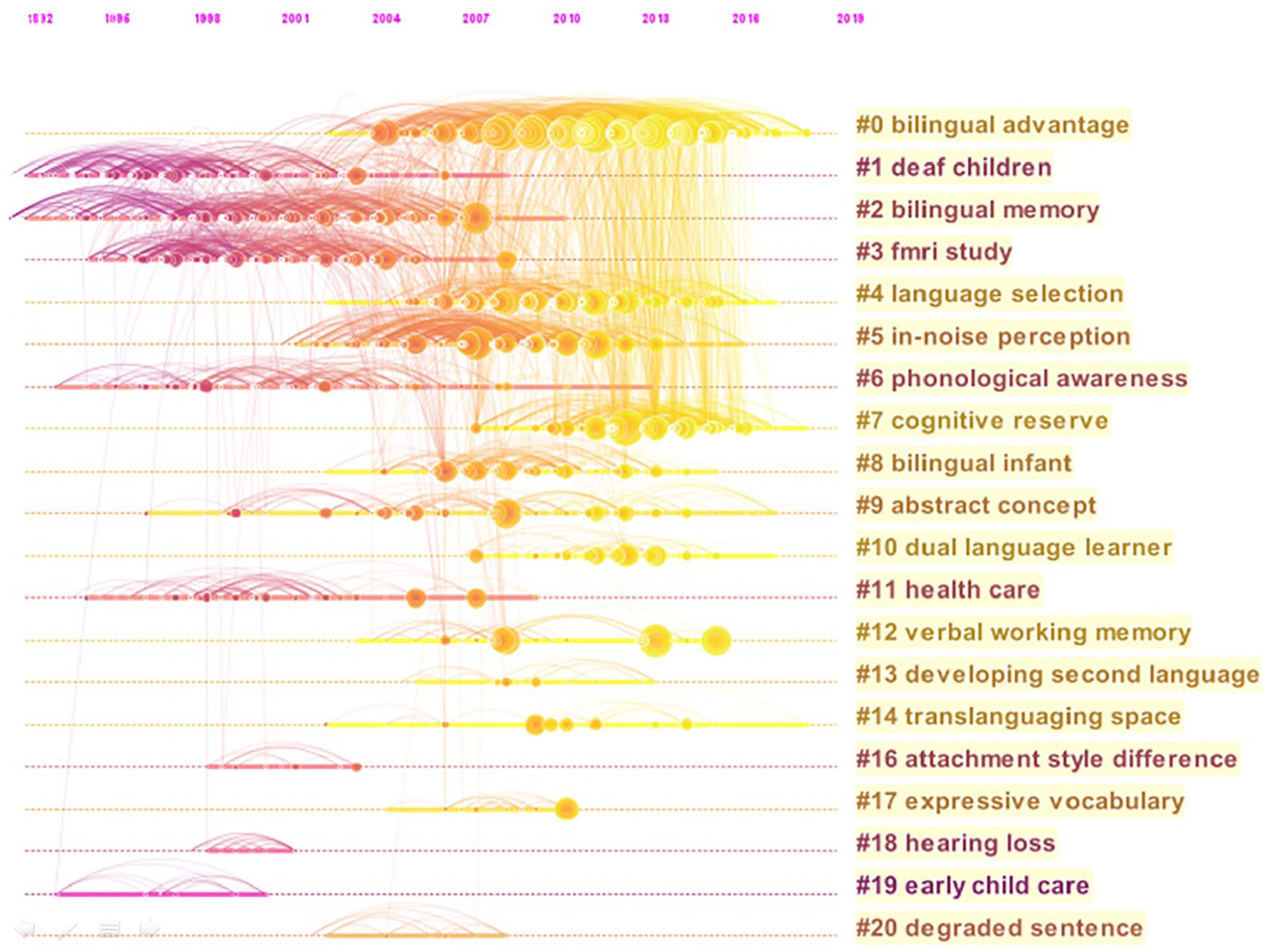
Timeline of clusters.
Figure 7 also illustrates that there had been a transition from clusters 1, 2, 3, and 6 to clusters 0, 4, 5, 7, 8, 9, and 10. This supported the category analysis results, which manifested that the major trends in LE research had been in the fields of psychology, linguistic, and education. In order to detail the transition between clusters in Figure 7, Table 2 displayed the 10 most cited articles for each decade.
Top 10 Cited Articles in Two Decades.

Theoretically, the most cited articles were based on specific research, and researchers in the same field should rely on some crucial articles. This meant that the underlying basis for LE research may differ between the two periods, which provided additional support that there was a transition in research hotspots from one field to another (or from one discipline to another). Therefore, this figure illustrates the flow of knowledge from one cluster to another.
Except for the flow of knowledge between clusters, the citation counts of each article also reflected a variation trend of LE research from the first to the second decade. The salient growth of the citation counts of articles published in 2010 to 2019 is apparently stimulated by the growth of the published articles in the second decade (see Figure 2). Notably, the growth of the published articles lead to another phenomenon that the difference values between the first and the last citation bursts in the two decades showed a great distance. In 2000 to 2009, the difference value between the first and the last citation counts was 12 while in 2010 to 2019 the value increased to 99. However, the difference values of citation counts can merely justify the growth of interests of scholars at the beginning of this century, rather than the academic status or influence of each article in Table 2. Thus, the information presented in Table 2 did not necessarily indicate that the 2010 to 2019 cited articles were more important than those published during 2000 to 2009.
Although each group of cited articles likely experienced a transition from one research hotspot to another, the articles had an obviously similar primary focus. Based on the titles of the 20 articles in Table 2, the most common LE research subject is bilingualism (or second language). For instance, the most cited article between 2000 and 2009 was Flege et al.’s (1999) “Age Constraints on Second-Language Acquisition,” which “evaluates the critical period hypothesis for second language acquisition and discover the evidence to support that age constrains the learning of L2 phonology to a greater extent than that of L2 morphosyntax” (Flege et al., 1999, p. 98). It contributed to a better understanding of the underlying effects of age constraints in regard to second language acquisition.
In Table 2, five highly-ranked articles were related to bilingualism published between 2000 and 2009 likewise. First, the third-most cited article was Dijkstra and van Heuven’s (2002) study that discussed the limitations of the Bilingual Interactive Activation (BIA) model and proposed a BIA+ model. Second, the fifth-most cited article was Bialystok et al.’s (2004) research wherein the authors investigated the relationships between the bilingual advantage, aging, and cognitive control to identify that bilingualism helps people offset age-related losses in particular executive processes. Third, Jared and Kroll’s (2001) study was ranked seventh; this study explored the phonological representations of bilinguals in both target and non-target languages in a word-naming process, and the authors presented evidence that confirmed the existence of this phenomenon. Fourth, Iverson et al.’s (2003, p. 47) research was ranked eighth, and they questioned “how early language experience can impede the acquisition of non-native phonemes during adulthood” and supported their answer with sufficient evidence. Fifth, Green (1998), which was the 10th-ranked study, investigated the means through which bilinguals control their two language systems, and the author constructed an inhibitory control model to illustrate this control. In addition to these studies that relied on statistical methods, Kim et al. (1997) was ranked fourth and explored bilinguals via functional magnetic resonance imaging (fMRI) to examine the spatial relationship between native and second languages within the human cortex.
Seven of the 10 articles listed in Table 2 for the years 2010 to 2019 are concerned with bilingualism. Similar to those published in 2000 to 2009, these later articles adopted the same research paradigm to investigate bilinguals. Specifically, the authors of these later studies also conducted several tests and relied on statistical methods for their analyses. The most cited articles from 2010 to 2019 focused on three primary aspects of bilingualism—its advantages, effects, and cognitive processes.
The first, fourth, and ninth ranked articles in Table 2 examined the advantages of bilingualism. The most-cited article belongs to Paap and Greenberg (2013), and these authors compared bilinguals and monolinguals along 15 indicators of executive processing (EP). They concluded that their research findings did not support the hypothesis that bilingualism improved EP. This finding highlighted that there were contradictory findings in the literature on the advantages of bilingualism. Hilchey and Klein’s (2011) article (rank 4) discussed the advantages of bilingualism regarding non-linguistic interference tasks, and the authors suggested that bilinguals had increasingly widespread cognitive advantages. Costa et al.’s (2009) study (rank 9) focused on the advantages of bilingualism regarding conflict processing, and they provided evidence from two experiments to justify that bilingualism likely influences the monitoring processes involved in executive control.
Green and Abutalebi’s (2013) study on bilingual cognitive processes (rank 5) explored speech comprehension and production, which are governed by the control process, and they hypothesized that a single, dual, or dense code-switching context will lead to adaptive changes in neural regions and circuits. Similarly, Costa et al. (2008) (rank 6) explored speech production and focused on how bilingualism can be useful in conflict resolution. These scholars compared bilinguals and monolinguals in terms of their performances with attentional network tasks, and they concluded that bilinguals were better at resolving conflicting information. This finding revealed that bilingualism was beneficial throughout an individual’s entire life.
Besides, Bialystok et al.’s (2008) study (rank 10) supplemented previous bilingualism research (e.g., Costa, 2005; Gollan et al., 2007) and compared bilingual and monolingual younger (20 years) and older (68 years) adults in terms of cognitive control and lexical access. Bialystok et al. (2012) conducted similar study (rank 7) with fMRIs to show that bilingualism’s effects were muted in adulthood and among the elderly.
The information in Table 2 regarding the most-cited articles clearly exemplified the status of bilingual research in LE studies from 2000 till present. Irrespective of the diversity among the most cited articles, their research fields and paradigms were fairly similar. This indicated that these studies relied more on statistical approaches (rather than brain imaging techniques), which corresponded to the top three categories (i.e., psychology, linguistics, and education).
Most-cited Journals
In addition to the principal co-citation analysis, we also included information on journals, and authors with the purpose of showing more details on LE’s influential aspects. We conducted an analysis to identify which journals had been cited most often in regard to LE studies since 2000 (see Table 3). It was possible to observe changes in the most-cited journals when we extracted the most-cited ones for both decades.
Top 15 Most Cited Journals in Each Decade.
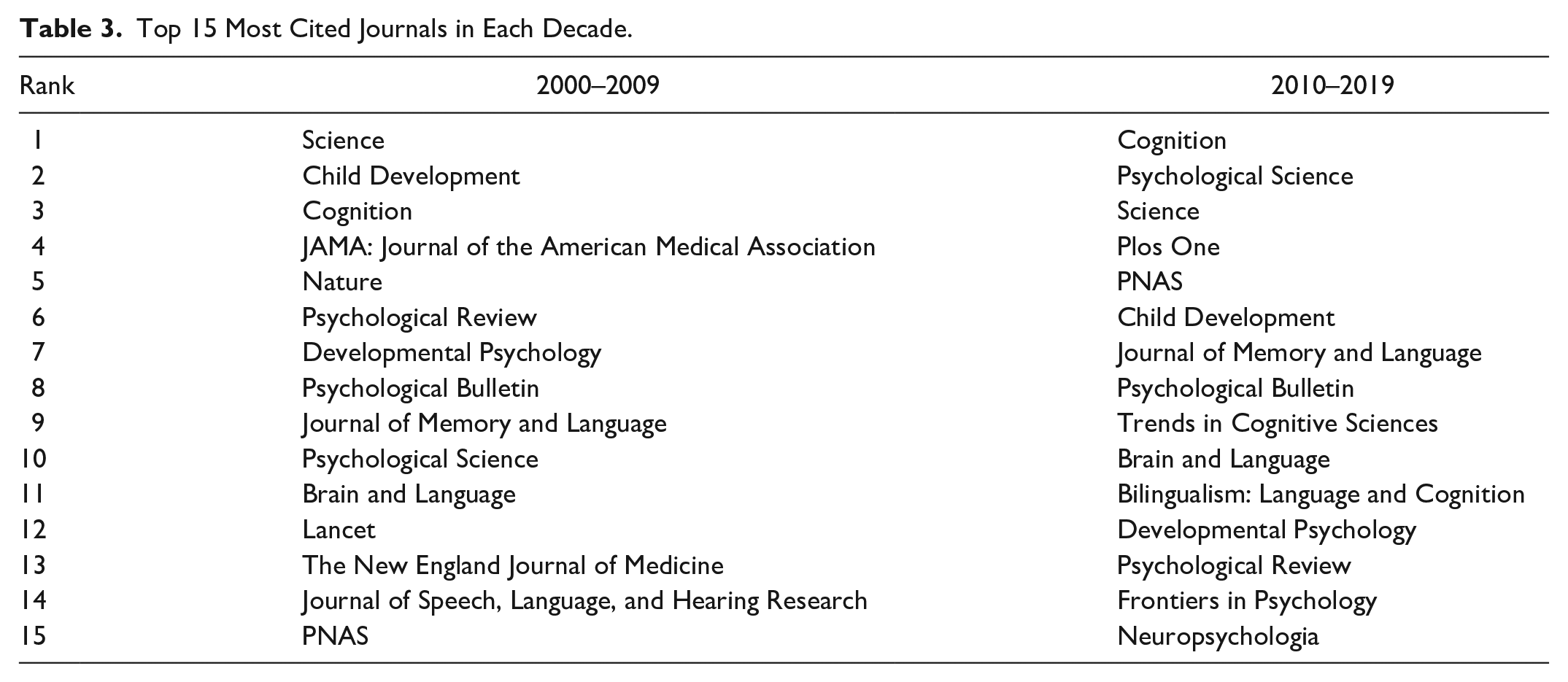
The top 15 most-cited journals in 2000 to 2009 were largely medical research ones (e.g., JAMA: Journal of the American Medical Association, Lancet, and The New England Journal of Medicine), which showed that LE research had adopted much information or information from medical or biological investigations. On the other hand, the top 15 most-cited journals in 2010 to 2019 contained some research related to psychology, as indicated by journal title names such as Trends in Cognitive Science, Bilingualism: Language and Cognition and Frontiers in Psychology. It hinted that some influential studies of bilingualism in psychology had occurred rather than only in medical or biological fields. Furthermore, the articles listed in Table 2 for this time period also supported that psychological research was popular during this time and these results can also be used to support the disciplinary and co-citation analysis findings.
Most-cited Authors
In order to identify the influential scholars in LE research during 2000 to 2019, we generated the top 25 most-cited authors who had the strongest citation bursts (Figure 8) based on a cluster analysis. According to Chen and Morris (2003), citation bursts provide evidence that a publication is associated with a surge in citations. In other words, Figure 8 illustrated the influence of each most-cited LE author. The results indicated that the most influential author based on 2000 to 2019 cited works was Sigmund Freud (Freud’s theories have led to many changes in psychological and neurological research). Other scholars such as Catherine E. Snow, Keith E. Stanovich, Gray L. Wells, Steven Pinker, etc. had all significantly contributed to LE studies. These scholars established the basic underlying research for LE studies in the first decade of the century (as shown by the red lines in Figure 8).

Top 25 cited authors with the strongest citation.
The information in Figure 8 revealed that the majority of the most cited authors were psychologists, which explained the category analysis results that the largest number of LE studies was psychological ones. Another point was that most of these influential scholars’ citation bursts were before 2010, which suggested that there may be a potential information flow in LE studies from psychology to another between the two decades. Based on Figure 7, this information will likely flow from behavioral research (e.g., memory, cognition, neurology) to language-oriented research (e.g., bilingual advantages, language selection, language learning, and language teaching).
Discussion
Because CiteSpace is a bibliometric analysis rather than a meta-analysis, the results of co-citation analysis can only reveal the general or potential tendency in LE research. Other conclusions like “how do these studies connect with each other” or “what are the links of LE studies” cannot be achieved merely via a co-citation analysis but require a deeper analysis of every influential reference. Therefore, the details interpretation of those influential articles will not be included in this section and we concern only the facts that can be interpreted in the bibliometric analysis.
This research started by totaling the number of LE publications and then focusing on co-citations, which is CiteSpace’s core function. Co-citation analyses concentrate on the most-cited aspects of the collected publications (i.e., articles, authors, and journals). The results of each analysis conducted in this study are complementary mutually.
In general, the results of category and co-citation analysis reveal that there has been a gradual increase in LE studies since 2000 (Figure 1) and especially since 2010 (Figure 2). Scholars focus more on LE research between the year 2010 and the year 2019 than between the year 2000 and the year 2010. These results also suggest that LE research has likely expanded to multiple disciplines, as evidenced by the co-citation analysis.
The gradual increasing tendency in the publications of each category of LE show diverse perspectives of the basis of doing LE. In the co-citation clusters, for instance, Figure 3 shows that LE has adopted information or knowledge from a linguistic perspective (e.g., #20: degraded sentence, #17: expressive vocabulary, or #12: verbal work), psychological perspective (e.g., #7: cognitive reserve and #5: in-noise perception), neuroscientific perspective (e.g., #3: fmir study), clinical perspective (e.g., #1: deaf children and #18: hearing loss), or nursing perspective (e.g., #19: early child care and #11: health care). Nonetheless, most of the colored clusters in Figure 3 clearly overlap and highly are aggregated with each other. The visualization of these clusters reflects the cohesiveness between LE research from different perspectives. It reveals that studies of LE may be carried out in various fields but the they share similar academic achievements by previous scholars, which further manifests that the systems of LE are not separate from one another but highly integrated.
The second generality revealed by the results based on the co-citation analysis is that bilingualism is a fairly popular topic from 2000 to 2019 and probably still hot in the next few decades due to the information flow between different categories and clusters in Figures 4 to 7. Such a tendency reflects the significance of bilingualism as stated by Ramírez-Esparza et al. (2020, p. 126) that “bilingualism has a positive impact on a wide range of cognitive and social aspects. Bilingualism is associated with having an open view of the world, as well as heightened social flexibility and empathy.” From neuroscientific perspective, “a growing body of research shows that the brain adapts functionally and structurally to specific bilingual experience” (DeLuca et al., 2020, p. 1) and “the field (i.e., bilingualism research) now needs to come together to relate the range of neurocognitive adaptations and experience-based factors which give rise to them” (DeLuca et al., 2020, p. 11). The social science scholars have claimed the significant status of bilingualism and the neuroscience scholars has stated the necessity of the combination between bilingualism research and neurocognitive methods. These comments on bilingualism present the vista of a long-term bilingualism research.
In the bilingualism research, co-citation also presents some high-profile topics. In the analysis of most-cited articles of Table 2, second language acquisition, special people (aging or disability), and mental mechanism are the three welcome research areas in bilingualism and a group of studies (in the cluster analysis) and journals (in the most-cited journals) have something to do with psychology more or less, which have implied the status of psychology in LE research. Although Table 3 highlights that there was a transition between the two decades and that medical LE research was more popular in 2000 to 2009, the trend in favor of medical research did not continue to 2010 to 2019, as psychological studies were more influential in the latter period. In fact, Figure 8 displays that the most cited authors in English literature are psychologists rather than doctors, linguists, or educational researchers, which indicates the strength of psychological LE research.
The two generalities of LE research display the connection between language systems in different disciplines and the significance of psychological investigations of bilingualism. Nevertheless, they indicate some controversial issues requiring further discussions. The interdisciplinary research of LE justifies that language systems are not separate from each other but highly aggregated. This result indicates that systems responsible for language are not separate from other cognitive systems; instead, they interact mutually. It overturns a dominant view on modularity from 80s to 90s (Fodor, 1983) influenced by computer science (Fodor, 1983; Zucker, 1981) and sheds light on the decreasing tendency of such domain in the two decades. From the end of last century, some scholars in computer science turn to the topics of language learning, syntactic/semantic analysis, word orders, written/aural interpretation in bilingualism and monolingualism (Grey, 2020) through the interaction between different language systems rather than regard them as isolated modulars. Consequently, the bibliometric analysis of LE research seems to support the interactive relations between language systems in bilingualism or monolingualism at present.
Another issue of LE research is also derived from bilingualism. The co-citation analysis has illustrated that a group of the influential literature in LE concerned the advantage, cognitive mechanism/model, and acquisition of bilingualism. These works have displayed the cooperation between different LEs or language systems. Nonetheless, it is necessarily to figure out that if two languages are active and competing, then how does a bilingual correctly choose the intended language in the moment. Such an issue is practically related to the application of bilingualism (or even monolingualism) and requires the investigation into the conflicts between languages or factors influencing the use of different languages. There are indeed a group of scholars carrying out research to probe into the factors influencing the language use of bilinguals in terms of pronunciation (Ohara, 2001), writing competence (Choi, 2015), and general proficiency (Moyer, 2004). These studies, however, are carried out from a perspective of language identify, cultural identity, or ethnic identity. Despite the fact that identify will impact the psychological state of people in social communication, the psychological process is still obscure in bilingualism research. Under the guidance of the co-citation analysis, the answer to this question may still lies in psychology, the basis of bilingualism and may require the assistance from neuroscience or biological science.
The general development tendency of LE in terms of its overturing point and hot topics further indicate some potential directions for LE researchers in the future. Nonetheless, those findings need further investigations to provide details and elaborate more on how to interpret and understand the tendency and issues. Those further investigations will be beneficial for proposing refined conclusions based on a specific topic of LE in the matter of theories or paradigms, which cannot be achieved via bibliometric analysis.
Conclusion
This article collected 30,045 academic articles and reviews from WOS, and it used CiteSpace to analyze the data to reveal that the knowledge trend of LE studies from 2000 to 2019 based on co-citation analysis. We focused on the most-cited articles, journals, and authors and visualized them in different forms. The analysis presented a tendency in LE research in respect of the interaction between language systems and bilingualism research. The tendency indicated some issues in relations between language systems and conflicts between different types of LEs. These findings provided a general depiction of LE research from several aspects and drew a macro-level picture of LE for the discussion of its future development. However, due to the limitations of bibliometric analysis, reviews of specific theoretical concepts, methods, and paradigms cannot be achieved in this paper. Therefore, those who are interested in LE need to have more particular knowledge of a specific sub-domain of LE prior to their investigations.
Footnotes
Appendix
Results of Categories of LE.

| 1. ACOUSTICS |
| 2. AGRICULTURAL ECONOMICS & POLICY |
| 3. AGRICULTURAL ENGINEERING |
| 4. AGRICULTURE |
| 5. AGRICULTURE, DAIRY & ANIMAL SCIENCE |
| 6. AGRICULTURE, MULTIDISCIPLINARY |
| 7. AGRONOMY |
| 8. ALLERGY |
| 9. ANATOMY & MORPHOLOGY |
| 10. ANDROLOGY |
| 11. ANESTHESIOLOGY |
| 12. ANTHROPOLOGY |
| 13. ARCHAEOLOGY |
| 14. ARCHITECTURE |
| 15. AREA STUDIES |
| 16. ART |
| 17. ARTS & HUMANITIES—OTHER TOPICS |
| 18. ASIAN STUDIES |
| 19. ASTRONOMY & ASTROPHYSICS |
| 20. AUDIOLOGY & SPEECH-LANGUAGE PATHOLOGY |
| 21. AUTOMATION & CONTROL SYSTEMS |
| 22. BEHAVIORAL SCIENCES |
| 23. BIOCHEMICAL RESEARCH METHODS |
| 24. BIOCHEMISTRY & MOLECULAR BIOLOGY |
| 25. BIODIVERSITY & CONSERVATION |
| 26. BIODIVERSITY CONSERVATION |
| 27. BIOLOGY |
| 28. BIOMEDICAL SOCIAL SCIENCES |
| 29. BIOPHYSICS |
| 30. BIOTECHNOLOGY & APPLIED MICROBIOLOGY |
| 31. BUSINESS |
| 32. BUSINESS & ECONOMICS |
| 33. BUSINESS, FINANCE |
| 34. CARDIAC & CARDIOVASCULAR SYSTEMS |
| 35. CARDIOVASCULAR SYSTEM & CARDIOLOGY |
| 36. CELL & TISSUE ENGINEERING |
| 37. CELL BIOLOGY |
| 38. CHEMISTRY |
| 39. CHEMISTRY, ANALYTICAL |
| 40. CHEMISTRY, APPLIED |
| 41. CHEMISTRY, MEDICINAL |
| 42. CHEMISTRY, MULTIDISCIPLINARY |
| 43. CHEMISTRY, PHYSICAL |
| 44. CLINICAL NEUROLOGY |
| 45. COMMUNICATION |
| 46. COMPUTER SCIENCE |
| 47. COMPUTER SCIENCE, ARTIFICIAL INTELLIGENCE |
| 48. COMPUTER SCIENCE, CYBERNETICS |
| 49. COMPUTER SCIENCE, HARDWARE & ARCHITECTURE |
| 50. COMPUTER SCIENCE, INFORMATION SYSTEMS |
| 51. COMPUTER SCIENCE, INTERDISCIPLINARY APPLICATIONS |
| 52. COMPUTER SCIENCE, SOFTWARE ENGINEERING |
| 53. COMPUTER SCIENCE, THEORY & METHODS |
| 54. CONSTRUCTION & BUILDING TECHNOLOGY |
| 55. CRIMINOLOGY & PENOLOGY |
| 56. CRITICAL CARE MEDICINE |
| 57. CULTURAL STUDIES |
| 58. DEMOGRAPHY |
| 59. DENTISTRY, ORAL SURGERY & MEDICINE |
| 60. DERMATOLOGY |
| 61. DEVELOPMENT STUDIES |
| 62. DEVELOPMENTAL BIOLOGY |
| 63. ECOLOGY |
| 64. ECONOMICS |
| 65. EDUCATION & EDUCATIONAL RESEARCH |
| 66. EDUCATION, SCIENTIFIC DISCIPLINES |
| 67. EDUCATION, SPECIAL |
| 68. ELECTROCHEMISTRY |
| 69. EMERGENCY MEDICINE |
| 70. ENDOCRINOLOGY & METABOLISM |
| 71. ENERGY & FUELS |
| 72. ENGINEERING |
| 73. ENGINEERING, AEROSPACE |
| 74. ENGINEERING, BIOMEDICAL |
| 75. ENGINEERING, CHEMICAL |
| 76. ENGINEERING, CIVIL |
| 77. ENGINEERING, ELECTRICAL & ELECTRONIC |
| 78. ENGINEERING, ENVIRONMENTAL |
| 79. ENGINEERING, GEOLOGICAL |
| 80. ENGINEERING, INDUSTRIAL |
| 81. ENGINEERING, MANUFACTURING |
| 82. ENGINEERING, MARINE |
| 83. ENGINEERING, MECHANICAL |
| 84. ENGINEERING, MULTIDISCIPLINARY |
| 85. ENGINEERING, OCEAN |
| 86. ENGINEERING, PETROLEUM |
| 87. ENTOMOLOGY |
| 88. ENVIRONMENTAL SCIENCES |
| 89. ENVIRONMENTAL SCIENCES & ECOLOGY |
| 90. ENVIRONMENTAL STUDIES |
| 91. ERGONOMICS |
| 92. ETHICS |
| 93. ETHNIC STUDIES |
| 94. EVOLUTIONARY BIOLOGY |
| 95. FAMILY STUDIES |
| 96. FILM, RADIO & TELEVISION |
| 97. FILM, RADIO, TELEVISION |
| 98. FISHERIES |
| 99. FOOD SCIENCE & TECHNOLOGY |
| 100. FORESTRY |
| 101. GASTROENTEROLOGY & HEPATOLOGY |
| 102. GENERAL & INTERNAL MEDICINE |
| 103. GENETICS & HEREDITY |
| 104. GEOCHEMISTRY & GEOPHYSICS |
| 105. GEOGRAPHY |
| 106. GEOGRAPHY, PHYSICAL |
| 107. GEOLOGY |
| 108. GEOSCIENCES, MULTIDISCIPLINARY |
| 109. GERIATRICS & GERONTOLOGY |
| 110. GERONTOLOGY |
| 111. GOVERNMENT & LAW |
| 112. GREEN & SUSTAINABLE SCIENCE & TECHNOLOGY |
| 113. HEALTH CARE SCIENCES & SERVICES |
| 114. HEALTH POLICY & SERVICES |
| 115. HEMATOLOGY |
| 116. HISTORY |
| 117. HISTORY & PHILOSOPHY OF SCIENCE |
| 118. HISTORY OF SOCIAL SCIENCES |
| 119. HORTICULTURE |
| 120. HOSPITALITY, LEISURE, SPORT & TOURISM |
| 121. HUMANITIES, MULTIDISCIPLINARY |
| 122. IMAGING SCIENCE & PHOTOGRAPHIC TECHNOLOGY |
| 123. IMMUNOLOGY |
| 124. INDUSTRIAL RELATIONS & LABOR |
| 125. INFECTIOUS DISEASES |
| 126. INFORMATION SCIENCE & LIBRARY SCIENCE |
| 127. INSTRUMENTS & INSTRUMENTATION |
| 128. INTEGRATIVE & COMPLEMENTARY MEDICINE |
| 129. INTERNATIONAL RELATIONS |
| 130. LANGUAGE & LINGUISTICS |
| 131. LAW |
| 132. LEGAL MEDICINE |
| 133. LIFE SCIENCES & BIOMEDICINE—OTHER TOPICS |
| 134. LINGUISTICS |
| 135. LITERATURE |
| 136. LITERATURE, ROMANCE |
| 137. LOGIC |
| 138. MANAGEMENT |
| 139. MARINE & FRESHWATER BIOLOGY |
| 140. MATERIALS SCIENCE |
| 141. MATERIALS SCIENCE, MULTIDISCIPLINARY |
| 142. MATERIALS SCIENCE, PAPER & WOOD |
| 143. MATERIALS SCIENCE, TEXTILES |
| 144. MATHEMATICAL & COMPUTATIONAL BIOLOGY |
| 145. MATHEMATICS, INTERDISCIPLINARY APPLICATIONS |
| 146. MECHANICS |
| 147. MEDICAL ETHICS |
| 148. MEDICAL INFORMATICS |
| 149. MEDICAL LABORATORY TECHNOLOGY |
| 150. MEDICINE, GENERAL & INTERNAL |
| 151. MEDICINE, LEGAL |
| 152. MEDICINE, RESEARCH & EXPERIMENTAL |
| 153. MEDIEVAL & RENAISSANCE STUDIES |
| 154. METEOROLOGY & ATMOSPHERIC SCIENCES |
| 155. MICROBIOLOGY |
| 156. MINING & MINERAL PROCESSING |
| 157. MULTIDISCIPLINARY SCIENCES |
| 158. MUSIC |
| 159. NANOSCIENCE & NANOTECHNOLOGY |
| 160. NEUROIMAGING |
| 161. NEUROSCIENCES |
| 162. NEUROSCIENCES & NEUROLOGY |
| 163. NUCLEAR SCIENCE & TECHNOLOGY |
| 164. NURSING |
| 165. NUTRITION & DIETETICS |
| 166. OBSTETRICS & GYNECOLOGY |
| 167. OCEANOGRAPHY |
| 168. ONCOLOGY |
| 169. OPERATIONS RESEARCH & MANAGEMENT SCIENCE |
| 170. OPHTHALMOLOGY |
| 171. OPTICS |
| 172. ORNITHOLOGY |
| 173. ORTHOPEDICS |
| 174. OTORHINOLARYNGOLOGY |
| 175. PARASITOLOGY |
| 176. PATHOLOGY |
| 177. PEDIATRICS |
| 178. PERIPHERAL VASCULAR DISEASE |
| 179. PHARMACOLOGY & PHARMACY |
| 180. PHILOSOPHY |
| 181. PHYSICAL GEOGRAPHY |
| 182. PHYSICS |
| 183. PHYSICS, APPLIED |
| 184. PHYSICS, FLUIDS & PLASMAS |
| 185. PHYSICS, MATHEMATICAL |
| 186. PHYSICS, MULTIDISCIPLINARY |
| 187. PHYSICS, NUCLEAR |
| 188. PHYSIOLOGY |
| 189. PLANT SCIENCES |
| 190. POLITICAL SCIENCE |
| 191. PRIMARY HEALTH CARE |
| 192. PSYCHIATRY |
| 193. PSYCHOLOGY |
| 194. PSYCHOLOGY, APPLIED |
| 195. PSYCHOLOGY, BIOLOGICAL |
| 196. PSYCHOLOGY, CLINICAL |
| 197. PSYCHOLOGY, DEVELOPMENTAL |
| 198. PSYCHOLOGY, EDUCATIONAL |
| 199. PSYCHOLOGY, EXPERIMENTAL |
| 200. PSYCHOLOGY, MATHEMATICAL |
| 201. PSYCHOLOGY, MULTIDISCIPLINARY |
| 202. PSYCHOLOGY, PSYCHOANALYSIS |
| 203. PSYCHOLOGY, SOCIAL |
| 204. PUBLIC ADMINISTRATION |
| 205. PUBLIC, ENVIRONMENTAL & OCCUPATIONAL HEALTH |
| 206. QUANTUM SCIENCE & TECHNOLOGY |
| 207. RADIOLOGY, NUCLEAR MEDICINE & MEDICAL IMAGING |
| 208. REGIONAL & URBAN PLANNING |
| 209. REHABILITATION |
| 210. RELIGION |
| 211. REMOTE SENSING |
| 212. REPRODUCTIVE BIOLOGY |
| 213. RESEARCH & EXPERIMENTAL MEDICINE |
| 214. RESPIRATORY SYSTEM |
| 215. RHEUMATOLOGY |
| 216. ROBOTICS |
| 217. SCIENCE & TECHNOLOGY—OTHER TOPICS |
| 218. SOCIAL ISSUES |
| 219. SOCIAL SCIENCES—OTHER TOPICS |
| 220. SOCIAL SCIENCES, BIOMEDICAL |
| 221. SOCIAL SCIENCES, INTERDISCIPLINARY |
| 222. SOCIAL SCIENCES, MATHEMATICAL METHODS |
| 223. SOCIAL WORK |
| 224. SOCIOLOGY |
| 225. SPECTROSCOPY |
| 226. SPORT SCIENCES |
| 227. STATISTICS & PROBABILITY |
| 228. SUBSTANCE ABUSE |
| 229. SURGERY |
| 230. TELECOMMUNICATIONS |
| 231. THEATER |
| 232. THERMODYNAMICS |
| 233. TOXICOLOGY |
| 234. TRANSPLANTATION |
| 235. TRANSPORTATION |
| 236. TRANSPORTATION SCIENCE & TECHNOLOGY |
| 237. TROPICAL MEDICINE |
| 238. URBAN STUDIES |
| 239. UROLOGY & NEPHROLOGY |
| 240. VETERINARY SCIENCES |
| 241. VIROLOGY |
| 242. WATER RESOURCES |
| 243. WOMENS STUDIES |
| 244. WOMEN’S STUDIES |
| 245. ZOOLOGY |
| 246. ZOOLOGY |
Acknowledgements
The authors would like to thank the anonymous reviewers for their invaluable comments and suggestions on all versions of this paper.
Declaration of Conflicting Interests
The author(s) declared no potential conflicts of interest with respect to the research, authorship, and/or publication of this article.
Funding
The author(s) disclosed receipt of the following financial support for the research, authorship, and/or publication of this article: This work was supported by the China Postdoctoral Science Foundation (2021M700497) and First-class Disciplines Project of Beijing Foreign Studies University (2020SYLZDXM040).
Ethics Statement
This article is a bibliometric analysis of literature which does not contain any animal and human studies.
