




Abstract
Improving the basic public service system and enhancing public service satisfaction are critical to achieving coordinated urban-rural development. Using data from the Chinese General Social Survey (CGSS), this study applies ordered logistic regression and fuzzy-set qualitative comparative analysis (fsQCA) to systematically investigate the enhancement paths of public service satisfaction among urban and rural residents across three dimensions: citizen characteristics, social perception, and government supply. The findings indicate that, except for educational attainment, other factors exhibit varying relationships with public service satisfaction in urban and rural areas. The improvement of public service satisfaction among urban residents can be accomplished through five paths: the “Resource Adequacy - Resource Balance” dual-core driven type, the “Class Identification - Resource Adequacy” driven type, the “Trust - Well-being - Resource Balance” leading type, the “Economy - Trust - Resource Balance” leading type, and the “Economy - Resource Adequacy” leading type. Rural residents’ satisfaction improves through three paths: the “Resource Adequacy - Resource Balance” leading type, the “Class Identification - Resource Adequacy” leading type, and the “Economy” leading type. While the enhancement paths differ between urban and rural residents, the shared aspect is the central role played by government supply efficiency. Strengthening public service facilities and infrastructure and enhancing the supply level of public services hold substantial practical implications for the planning and layout of public service facilities, industrial development, and infrastructure in both urban and rural areas.
Plain Language Summary
This research, grounded on the data from the Chinese General Social Survey, systematically investigates the enhancement paths of public service satisfaction among urban and rural residents within the theoretical framework of “citizen characteristics,”“social perception,” and “government supply.” Through the application of ordered Logistic regression analysis and fuzzy set qualitative comparative analysis (fsQCA), the study discovers that the public service satisfaction of urban and rural residents is influenced by multiple factors at three levels: individual characteristics of citizens, social perception, and government supply.
Keywords
Introduction
The “14th Five-Year Plan for Public Services” proposed to accelerate the establishment of a standardized public service system, address gaps, and reduce regional disparities in service levels. The “Rural Revitalization Promotion Law of the People’s Republic of China” (hereinafter referred to as the “Rural Revitalization Law”) further emphasized that administrative departments at all levels should implement the rural revitalization and new urbanization strategies, scientifically plan the layout of urban and rural public service facilities, industrial development and infrastructure, and improve the basic public service system. An efficient public service system strengthens government credibility and governance efficacy while fulfilling public needs, fostering constructive government-citizen interaction. Quality public services enhance social belonging and stability, serving as catalysts for holistic societal development. By aligning service quality with actual demands, such systems propel both economic growth and social progress.
As of 2024, China’s total population reached 1.41 billion, accounting for approximately 17.5% of the global population, dwarfing that of the United States (330 million) and the United Kingdom (68 million). China’s land area is 9.6 million square kilometers, about 1.02 times that of the United States and 39.3 times that of the United Kingdom, with rural areas accounting for 72%. The large population base and vast geographical space pose significant challenges to the supply of public services, and the demand differences among various regions far exceed those of other countries. Additionally, with an urbanization rate of 67% and a rural resident population of 465 million, China’s public service expenditure as a proportion of GDP is higher than the world average. This distinct urban-rural population distribution pattern not only provides a valuable research context for public service system development but also presents dual challenges: meeting urban residents’ increasingly diversified demands during rapid urbanization while addressing rural areas’ high service provision costs and low accessibility caused by geographical vastness and population dispersion. Simultaneously, the superimposed effect of population size differences and geographical space variations imposes higher technical requirements on the supply mode of public services, the efficiency of resource allocation, and the level of equalization.
Improving the public service system has always been a key area of national concern, and promoting the development of public services is at the core of the national strategy. Enhancing the balance and accessibility of resources is an important way to achieve common prosperity. This study evaluates urban and rural residents’ satisfaction with public service supply, analyzes the influencing factors, and proposes configurational paths for its enhancement. This not only supplements the existing research theories but also offers referential suggestions for improving the quality of government public services, constructing a modern and efficient government, and fulfilling people’s pursuit of a high-quality life.
Literature Review
The Connotation of Public Services and Its Satisfaction
The concept of public services originated from the theory of public goods in the domain of public economics. Samuelson and Nordhaus (1985) proposed that public services are public goods in the form of services. Since then, public services have gradually emerged as a core concept in the field of public management, in contrast to private services. This paper focuses on social public services provided by the state, including public healthcare, education, legal advocacy, and social insurance.
Emerging from the new public management movement, public service satisfaction extends the “customer satisfaction” concept and has reframed the government-public relationship with distinct characteristics. The role of citizens has shifted from passive subjects of management to “customers,” and the notion of “customer first” has become a crucial orientation for public services. The causal relationship model of satisfaction derives from the gap between expected and actual service outcomes (Oliver, 1980), with smaller gaps yielding higher evaluations (Anderson, 1973). Since the 1980s, it has served as a key governance performance metric (Hughes, 1998). Like customer satisfaction, public service satisfaction reflects psychological cognition and subjective evaluation, shaped by citizens’ expectations and their experiences of service delivery (James, 2007). Based on existing research, this paper defines public service satisfaction as residents’ subjective psychological judgment formed by comparing expected and actual service outcomes. This judgment is influenced by multiple factors and indirectly reflects government service performance.
Research on the Influencing Factors of Public Service Satisfaction
According to attribution theory (Heider, 2013), individuals attribute outcomes to two types of causes: internal factors, such as emotions and effort, and external factors, such as the environment and goal difficulty. When attributing outcomes, individuals often prioritize external circumstances over internal factors to maintain a favorable self-image. Based on this theory, public service satisfaction, as an outcome-oriented evaluation, is influenced by both internal and external factors. Citizens’ evaluations of government-provided services vary significantly due to perceived quality differences, which may stem from external conditions like the social environment or personal traits and actual government performance. While public attribution tendencies are difficult to change, governments can mitigate negative evaluations and their impacts by improving service quality and reducing situational factors that lead to dissatisfaction.
Existing literature typically analyzes the influencing factors of public service satisfaction across three dimensions: individual characteristics, external social environments, and government behavior. This classification highlights the multi-level and multi-dimensional nature of these influences. Given that rural development lags behind that of cities, the Rural Revitalization Law explicitly states: “Rural revitalization should adhere to the development concept centered on the people, safeguard the principal position of farmers, and fully respect their will.” This policy orientation underscores the importance of incorporating citizens’ demands into satisfaction assessments. Enhancing rural public service quality can strengthen farmers’ sense of belonging and identity. Therefore, this article categorizes “individual characteristics” as a separate analytical dimension.
At the micro level, individual characteristics represent micro-level factors influencing public service satisfaction, primarily manifested in individual variances in aspects such as demographic characteristics, socioeconomic status, and psychological cognition. Specifically, these characteristics encompass age, economic conditions, education level, family structure, gender, internet usage, and perceptions of government roles (Chatterjee & Suy, 2019; Shi & Guo, 2023). Furthermore, citizens’ perception of administrative burden can indirectly impact their assessment of government public services by shaping the image of the government (H. R. Wang, 2020).
Moving to the meso level, the external social environment represents a meso-level factor influencing public service satisfaction. Specifically, social environmental factors affect satisfaction through dimensions such as economic development levels and the trust relationship between society and the government (Bao, 2021; L. P. Zhang et al., 2020). Owing to differences in demand levels and relative sense of acquisition, in a comparative perspective, the influence of social class on public service satisfaction reveals a disparity between subjective evaluation and objective reality (X. Li et al., 2022). Additionally, factors like political participation, grassroots election involvement, and organizational structure shape residents’ assessments of public services (Jungjohann & Gebhardt, 2023; Pribadi, 2013).
At the macro level, government behavior serves as a macro-level factor influencing public service satisfaction, reflecting the government’s role and strategies in public service provision. The “Rural Revitalization Law” stipulates: “The state shall improve the urban-rural public service equalization mechanism, focusing on strengthening rural education, healthcare, culture, and elderly care services, and tilting public service resources toward rural areas.” This legal provision provides guidance for addressing urban-rural imbalances and a policy basis for analyzing government behavior influences. From the government’s perspective, exceeding public expectations can enhance citizens’ trust (Lanin & Hermanto, 2019), while prioritizing rural urgent needs and optimizing service structures narrows regional fiscal subsidy gaps and improves public perception (Cui et al., 2022; C. Zhang et al., 2024). Furthermore, promoting basic public service equalization and enhancing accessibility effectively improves well-being and people’s sense of gain (Z. Li et al., 2020).
Research Hypotheses and Conceptual Framework
Research Hypotheses
Based on the foregoing analysis, public service satisfaction is a comprehensive outcome of multiple internal and external factors. This paper designs core variables from three dimensions: citizen individual characteristics, external social environment, and government behavior.
The Dimension of Citizen Individual Characteristics
According to the life cycle theory, individuals’ demands for public services exhibit distinct staged characteristics, and their satisfaction levels are driven by the core demands of the life stage they are in (Elder et al., 2003). Young people who have newly entered the workforce have relatively limited demands for public services due to their limited social experience, and hence their satisfaction levels may be relatively high. Middle-aged individuals, facing pressures such as career development and family responsibilities, require more education and healthcare services, leading to increased dissatisfaction due to insufficient supply. In contrast, older adults, benefiting from stable lives and social security guarantees, exhibit relatively higher satisfaction (Van Ryzin, 2006). This “U-shaped” trajectory suggests that middle-aged individuals have higher expectations for basic public services, which are often unmet, while younger and older populations show higher satisfaction. Based on this, the study proposes the following hypothesis:
Furthermore, educational attainment significantly influences citizens’ cognitive abilities and evaluation logic regarding public services. While higher-educated groups have stricter requirements for service professionalism and convenience, their rational evaluations lead to more stable satisfaction judgments. Thus, there is a stable positive correlation between educational attainment and satisfaction with government public services (D. Z. Li et al., 2021). For instance, in the context of digital government services, residents with higher education can use online platforms more efficiently, whereas those with lower education may experience reduced satisfaction due to technical barriers (Alawadhi & Morris, 2009). Therefore, the study proposes:
According to Maslow’s Hierarchy of Needs Theory, individuals pursue higher-level needs once their basic needs are met. This implies that when the public’s basic public service needs are satisfied, they will seek higher-quality services (Xie et al., 2022). As family economic income increases, individuals perceive greater availability of public service resources, enhancing their satisfaction. However, high-income groups often have higher expectations for public services, which may lead to a gap between expectations and actual experiences, potentially reducing satisfaction. Existing studies also suggest that economic income has a significant positive effect on satisfaction with government public service supply, but the relationship between the two presents an inverted “U” shape, where the satisfaction of the highest-income group is instead the lowest (S. Chen & Gu, 2020). Thus, the study proposes:
The Internet significantly shapes public evaluations of government performance. Academic discussions have focused on two opposing perspectives regarding its role. The positive promotion theory argues that enhancing government information disclosure and e-government services through the Internet provides residents with more convenient services, improving their assessment of government performance and overall satisfaction (Bimber et al., 2015). Conversely, the negative inhibition theory suggests that the Internet contains adverse or false information, which may undermine public trust in government performance (Kaufhold et al., 2010). Specifically, the “audience-led” communication model grants the public greater discourse power, increasing democratic awareness and criticism of the government. Simultaneously, the lack of an effective information filtering mechanism weakens the traditional media’s “gatekeeper” role, making it difficult to manage and filter opposing voices and critical viewpoints effectively. Consequently, exposure to such information can lead to negative evaluations of the government (Im et al., 2014). Based on these viewpoints, this paper proposes:
The Social Psychological Perception Dimension
Class identification refers to an individual’s subjective perception of their position within the social class structure, based on specific criteria and their placement in the social stratification system (Jackman & Jackman, 1973). Existing studies show that class differences among the public may influence public service satisfaction (Zhou et al., 2021). According to Relative Deprivation Theory, individuals compare their current situation with their past or others’ situations. If they discover that they have obtained relatively fewer resources, they will experience a sense of relative deprivation, and this sentiment may further impact their evaluation of public service satisfaction. Consequently, those with low class identification may attribute dissatisfaction to insufficient public service supply, while those with a high class identification are more likely to attribute their satisfaction to the improvement and facilitation of public services. Overall, individuals from higher social classes tend to recognize the existence of class differences to a greater extent, while those from lower classes are more inclined to hope for a reduction in class differences and social inequality (Pratto et al., 2006). Based on this, the following hypothesis is put forward:
Social trust is a value judgment arising from the interactional behaviors of the public with the social system. As a factor of social capital, it exerts a significant influence on the performance evaluation of government public departments. Fukuyama (2020) pointed out that, despite variations in national capacity and health systems during the COVID-19 pandemic, public trust was a critical determinant of governance effectiveness across countries. Specifically, the higher the level of social trust, the narrower the gap between the public’s expectations of the external environment and the actual output, resulting in higher satisfaction with public services (Bao, 2021). Conversely, the public with a low level of trust may have difficulty perceiving the positive measures adopted by the government (Bouckaert & van de Walle, 2003). Thus, the study proposes:
Social well-being reflects individuals’ subjective evaluation of their social environment quality (Diener et al., 1999). Studies indicate that those with higher social well-being perceive public services as more fair and responsive, resulting in positive assessments. Veenhoven (2000) found that high well-being groups view public services as contributing to collective welfare, making them less sensitive to service shortcomings and more satisfied. Chinese research confirms this relationship: higher social well-being correlates with greater life satisfaction and improved public service evaluations (Shen et al., 2023). While public service satisfaction may reciprocally enhance well-being (Diener & Seligman, 2004), this study examines only the unidirectional effect. Based on this, the following hypothesis is put forward:
The Dimension of Government Supply Quality
The gap between supply and demand levels of public services at the government level affects residents’ evaluations (J. Chen et al., 2025). Satisfaction depends not only on increased fiscal funding but also on the government’s optimization of the supply model. L. Wang et al. (2021) noted that equalizing public service resources within a city significantly enhances social trust. In regions with a low level of social trust, local governments need to allocate more resources to fulfill the diverse demand preferences of the public. In China, local government expenditure on public services strongly correlates with service quality (Saich, 2008). Therefore, the adequacy and even distribution of government-provided resources directly influence public perception of service quality. If most residents can fully access these resources, satisfaction significantly increases. Based on this, the study proposes:
Conceptual Framework
If the individual characteristics of citizens, the external social environment, and government actions can effectively coordinate and function jointly, and the government enhances supply effects, optimizes the social environment, and pays attention to individual attributes such as family income, the satisfaction with public services will be enhanced sustainably (Zhao & Ding, 2020). However, existing studies have not fully utilized the symbiotic theory framework to explore the interaction mechanisms of internal and external factors across levels or explicitly analyzed long-term improvement paths for public service satisfaction. Additionally, there are substantial differences in the influencing factors of public service satisfaction between urban and rural residents, yet few studies have systematically examined the heterogeneity of public service satisfaction among urban and rural residents, and the regional coverage of empirical research is relatively limited. Consequently, it is necessary to adopt a comparative perspective to explore distinct mechanisms for enhancing public service satisfaction in urban and rural areas.
Based on this, the present study uses data from the Chinese General Social Survey (CGSS), focuses on the significant disparities between urban and rural areas, and grounded in attribution theory, constructs a conceptual model for enhancing urban and rural residents’ satisfaction with public services. This model encompasses three dimensions: “Individual Characteristics of Citizens,”“Social Psychological Perception,” and “Government Supply” (Figure 1). The theoretical framework centers on policies such as the Rural Revitalization Law as its core policy orientation, providing clear legal and policy foundations for identifying pathways to enhance public service satisfaction in both urban and rural contexts. The study combines Logistic regression analysis with fuzzy-set qualitative comparative analysis (fsQCA) using fuzzy sets to systematically explore satisfaction enhancement. From a micro-configurational perspective, it examines “multiple concurrent causal” relationships and differences in multi-factor condition combinations among urban and rural residents, identifying precise pathways for improving public service satisfaction and offering decision-making support for its comprehensive enhancement.

Conceptual model of public service satisfaction improvement: “Citizens - Society - Government.”
Variable Interpretation and Methodology
Sample Selection and Data Sources
The data for this research is derived from the Chinese General Social Survey (CGSS), which is one of the earliest nationwide continuous cross-sectional social survey projects in China. CGSS adopts a multi-stage stratified sampling method to systematically collect data at multiple levels, including the community, household, and individual, thereby comprehensively reflecting the changes in Chinese society and the situations in various domains such as the economy, politics, and social culture. To guarantee the representativeness and diversity of the research findings, this research selected urban and rural residents aged 18 and above from 28 provincial administrative units across the country as samples within the CGSS, covering areas with different levels of economic development and uncovering the differences in public service satisfaction and demands between urban and rural areas.
Given the notable disparities in resource endowments, economic structures, and institutional environments between urban and rural areas, these disparities inevitably result in significant differences in residents’ demand preferences for public services and their satisfaction evaluations. Hence, this research pays particular attention to urban-rural heterogeneity. Through the screening of valid questionnaires in the survey data, a total of 10,968 valid samples were obtained. The final analytical sample comprised 5,366 urban and 3,696 rural questionnaires, following the elimination of cases with missing core variables.
Variable Description
Dependent Variable
The outcome variable of this study is public service satisfaction (PSS). As the primary recipients of government services, the public’s demands should constitute the core focus of public sector work and reform efforts. In line with customer-oriented theory, public satisfaction serves as a key indicator for evaluating government service quality (Zhao & Ding, 2020). Drawing on Hou and Liu (2019) methodology, this study categorizes public service satisfaction into nine dimensions based on the China General Social Survey (CGSS): “public education,”“medical and health care,”“housing security,”“social management,”“labor employment,”“social security,”“basic social services,”“public culture and sports,” and “urban and rural infrastructure” (J. Chen et al., 2023). Residents rated their satisfaction across nine public service dimensions (0–100 scale). These scores were averaged to compute individual composite satisfaction scores. To further refine the analysis, this study divides residents’ satisfaction with public services into 10 ordered multi-classification levels according to a criterion of every 10 points, constructing a “Comprehensive Index of Public Service Satisfaction” with a value range of 0 to 9. A higher index value indicates greater satisfaction with public services.
Individual-Level Conditional Variables
(1) Age. Calnan et al.’s (2003) analysis of British Social Attitudes Survey data provides robust evidence of a significant positive association between age and satisfaction with general practitioner services, hospital care, and National Health Service performance. Based on this, the present study considers age as one of the conditioning variables and calculates the respondents” ages using the date of birth recorded in the CGSS household questionnaire. Additionally, the quadratic term of age is introduced to investigate the potential non-linear relationship between age and satisfaction with public services.
(2) Educational Attainment (EA). The education attainment of an individual directly affects their cultural literacy, and differences in cultural literacy may lead to variations in people’s experiences with public services (He & Liu, 2018). Therefore, this study selects education attainment as one of the explanatory variables and uses the item “Your current highest educational attainment” from the CGSS questionnaire as the measurement indicator. Specifically, the education attainment is categorized and assigned values ranging from 1 to 13, where 1 represents “No education at all” and 13 represents “Postgraduate degree or above,” with higher values indicating higher levels of educational attainment.
(3) Family Economic Level (FEL). A complex relationship exists between family economic level and satisfaction with public services. For this reason, this study selects the question “The economic situation of the resident’s family” from the CGSS as the measurement indicator. It is categorized into five levels: “far below average,”“below average,”“average,”“above average,” and “far above average,” assigned values of 1, 2, 3, 4, and 5, respectively. Additionally, a quadratic term of family economic level is introduced to examine the potential non-linear relationship between family economic level and satisfaction with public services.
(4) Internet Usage (IU). As an emerging information dissemination medium, the Internet has established a critical information bridge between the public and the government, serving as a key channel for disseminating and diffusing governmental affairs information (Earl Bennett et al., 1999). However, while the public uses the Internet to follow political news, they may also be exposed to negative reports. Based on this, this study measures Internet Usage using the CGSS question “Your usage of the Internet (including mobile Internet access) in the past year.” It is categorized into five levels: “never,”“rarely,”“sometimes,”“often,” and “very frequently,” assigned values of 1, 2, 3, 4, and 5, respectively.
Social-Level Conditional Variables
(1) Social Class Identification (SCI). Social class identification constitutes a significant social psychological cognition that reflects an individual’s subjective evaluation of their objective social status (Jackman & Jackman, 1973). In this study, the variable of social class identification is measured using the question “Which class do you think you belong to?” from the CGSS questionnaire. This question employs a scale ranging from 1 to 10, where a score of 1 represents the lowest stratum and a score of 10 represents the top stratum. Respondents’ answers will be directly assigned values from 1 to 10 based on the stratum they identify with.
(2) Social Trust (ST). While guaranteeing the supply of resources, the government can effectively enhance the public’s subjective evaluation of objective performance by establishing a sound trust mechanism (Bao, 2021). Based on this, this study selects the question “Residents’ trust in the majority of people in today’s society” from the CGSS as one of the measurement indicators. Responses are assigned values as follows: “Strongly Disagree” is assigned a value of 1, “Relatively Disagree” a value of 2, “Not Sure about Satisfaction or Dissatisfaction” a value of 3, “Relatively Agree” a value of 4, and “Strongly Agree” a value of 5.
(3) Social Well-being (SW). Inglehart (2020) indicated that when people perceive life under a certain regime as wonderful, it will strengthen their diffuse support for that regime. Based on this premise, this study utilizes the item “Residents’ Perception of Well-being” from the CGSS as one of the measurement indicators at the social environment level. Similar to social trust, it is measured on a five-point scale from “Very Unhappy” to “Very Happy,” with higher scores indicating greater well-being.
Government-Level Conditional Variables
(1) The Adequacy of Public Service Resources (APSR). By increasing financial investment in livelihood projects and optimizing the allocation of government functions, the comprehensiveness of provided public service resources can be enhanced, thereby improving residents’ evaluations of government public services (Hou & Liu, 2019). In this study, the item “Residents’ perception of the overall sufficiency of public service resources” from the CGSS is used as an indicator to measure the adequacy of public service resources. Specifically, responses are assigned values as follows: “Very Dissatisfied” is assigned a value of 1, “Somewhat Dissatisfied” is assigned a value of 2, “Unclear about Satisfaction” is assigned a value of 3, “Somewhat Satisfied” is assigned a value of 4, and “Very Satisfied” is assigned a value of 5.
(2) The Balance of Public Service Resources (BPSR). The variance in public service satisfaction partially stems from the imbalanced provision levels of public services in different regions (De Hoog et al., 1990). For example, prior research has demonstrated that overall public service satisfaction tends to be relatively low in black communities, which may be associated with the lower supply levels and quality of public services in these areas (Brown & Coulter, 1983). Consequently, this study employs the item “Residents’ evaluation of the balance of public service resource distribution” from the CGSS as one of the measurement indicators. The same value assignment method as described above is adopted: ranging from “Very Dissatisfied” (assigned a value of 1) to “Very Satisfied” (assigned a value of 5).
Research Methodology
This study constructs a dual verification framework by integrating ordered logistic regression with fuzzy-set qualitative comparative analysis (fsQCA). The regression analysis is employed to examine the independent effects of independent variables on the public service satisfaction of urban and rural residents and to identify key variables that significantly influence satisfaction. While regression analysis effectively assesses individual variable contributions, public service satisfaction is not determined by a single factor but results from complex interactions among multiple factors. Capturing the synergistic or substitutive relationships among these factors poses a challenge for regression analysis alone. To address this, fsQCA is incorporated. fsQCA identifies multiple conjunctural causations and explains how different combinations of conditions enhance satisfaction, aligning with the formation mechanism of public service satisfaction. This dual approach strengthens robustness and provides multi-level evidence for differentiated policies.
Logistic Regression Analysis
In this study, public service satisfaction is designated as the dependent variable, while the following variables are selected as independent variables: at the individual level of citizens, age, education attainment, family economic level, and internet usage; at the social psychological perception level, social class identification, social trust, and social well-being; and at the government supply level, the adequacy and balance of public service resources. An ordered multi-class logistic regression model is constructed to conduct an empirical analysis of the influencing factors of public service satisfaction among urban and rural residents, leading to the establishment of the following model:

In the equation: y is the explained variable (residents’ satisfaction with public services), whose assignment range is from 0 to 9; βk is the regression coefficient, used to measure the direction and magnitude of the influence of the explanatory variable on the explained variable; xk represents the independent variables; p denotes the probability that the dependent variable takes the value of 1 (y = 1), and p/(1−p) is the odds ratio.
Fuzzy-Set Qualitative Comparative Analysis
Qualitative comparative analysis (QCA), formally introduced by Charles C. Ragin in 1987, is an analytical approach grounded in configurational logic. Depending on variable types, QCA includes crisp-set (csQCA), multi-value-set (mvQCA), and fuzzy-set (fsQCA) approaches. FsQCA uses a case-oriented method to analyze the overall “configurational effect” of antecedent variables, addressing issues like autocorrelation and multicollinearity (Vilela et al., 2020).
Given that this study divides the research sample into urban and rural subgroups, the case-oriented nature of QCA enables counterfactual analyses for urban and rural sub-samples separately, thereby identifying multiple differentiated path combinations. Therefore, this study employs fsQCA, in line with the theoretical framework proposed earlier, to examine how various factors are organically combined to enhance public service satisfaction across the three dimensions of “citizen characteristics,”“social perception,” and “government supply.” Specifically, compared to traditional research methods, fsQCA offers the following advantages: First, it provides a more systematic explanation of social issues; Second, it avoids single-cause analyses and supports the investigation of multiple cause combinations; Third, it offers multiple equivalent solutions for practical problems.
In the application of fsQCA, it is necessary to perform the “non” (∼) operation on the fuzzy set logical remainder (Formula 2). For any fuzzy set A, the formula for calculating the membership score of the logical “non” fuzzy set A is as follows:

Moreover, the sufficiency analysis in fsQCA facilitates the determination of the consistency and coverage of data results. It is generally recommended that the consistency value should exceed 0.8, and for large samples it should be greater than 0.75. Here, the consistency value indicates the degree of similarity between the configuration sample and the original data, while the coverage measures the extent to which the final result of the sample is explained by a specific configuration. The calculation formulas for consistency and coverage are as follows:


In the formulas, Xi denotes the calibrated condition variable, representing the membership degree of the sample i in the combination X, and Yi represents the calibrated result, indicating the membership degree of the sample i in the outcome Y. The closer the consistency value is to 1, the higher the correlation between the combination of condition variables and the sample data. Similarly, the closer the coverage value is to 1, the stronger the explanatory power of the condition variables for the outcome.
Empirical Results
Logistic Regression Analysis
Based on the CGSS database, this study constructed separate “urban” and “rural” models using ordered logistic regression, thereby enabling a systematic analysis of the differential impacts of various factors on public service satisfaction. The corresponding results are presented in Table 1.
Analysis of the Influencing Factors of the Public Service Satisfaction of Urban and Rural Residents.

Note.***, **, and * respectively denote statistical significance at the 1%, 5%, and 10% levels.
The Dimension of Individual Characteristics Among Citizens
Model 1 shows that, besides educational attainment, all other variables significantly affect urban residents’ satisfaction with public services to varying extents. The impact of age on urban residents’ satisfaction with public services is statistically significant at the 1% level. And the negative coefficient for age and the positive one for its squared term form a U-shaped relationship. Specifically, young individuals in the educational phase or new to society have an indistinct cognition of public service standards, leading to higher satisfaction. As age progresses, however, the expectations of the urban middle-aged group escalate significantly. When a disparity exists between reality and expectations, their satisfaction declines and reaches the lowest point at this stage. This decline likely stems from intensified pressures related to childcare, education, and healthcare during these years. In old age, due to the support of social security policies and resource reallocation, their satisfaction will pick up. This trajectory suggests that middle-aged cohorts, as the primary workforce, are the most critical but also the most discerning assessors of public service quality. Therefore,
However, the impact of educational attainment on urban residents’ satisfaction with public services is not statistically significant. This may be attributed to the fact that while an increase in educational level raises citizens’ expectations for service quality, it also enhances their capacity for rational evaluation, leading to the mutual offsetting of these two effects. Additionally, the existing disparities in public service quality have not reached a threshold sufficient to trigger sensitivity related to educational attainment. Consequently,
Family economic level significantly affects urban residents’ public service satisfaction at the 1% level. The regression results confirm an inverted U-shaped relationship. Specifically, as household economic level ascends, satisfaction with public services also rises; however, after a peak, the trend reverses, as the most affluent residents become the most critical, their satisfaction undermined by expectations for premium service quality that surpass standard public offerings. Therefore,
Internet usage is significantly and negatively correlated with urban residents’ satisfaction with public services, achieving statistical significance at the 1% level. This phenomenon may be attributed to the high internet penetration rate and convenient information acquisition methods in urban areas, which tend to trigger an information amplification effect. As a result, this raises the public’s expectations regarding government public services, ultimately leading to a decline in satisfaction levels. Therefore,
In contrast to urban residents, among the factors influencing rural residents’ satisfaction with public services, only family economic level exhibits a significant effect, while the other three variables do not demonstrate statistically significant influences. Model 2 results indicate a significant inverted U-shaped relationship between family economic level and rural residents’ public service satisfaction (p < .05). Specifically, residents with lower economic levels have limited financial capabilities, making it difficult for them to access higher-level public services, which leads to lower satisfaction. Residents with moderate economic conditions possess sufficient material resources to effectively acquire and utilize public service resources, thereby enhancing their satisfaction. However, for residents at the highest economic level, their extremely high expectations for public services may result in dissatisfaction when reality fails to meet these expectations, leading to a sense of disparity. Hence,
However, regardless of the age group, the perceived differences in public service satisfaction among rural residents are relatively small, and there is no significant relationship between age and public service satisfaction. Consequently,
In conclusion, there are significant disparities in the influence of individual characteristics on the public service satisfaction of urban and rural residents. For urban residents, age, family economic status and internet usage significantly impact satisfaction evaluations. Rural residents’ satisfaction, however, is primarily influenced only by family economic status, suggesting greater dependence on external environmental and policy factors than individual conditions. This contrast highlights distinct improvement pathways: while urban satisfaction may respond to individual-focused interventions, rural satisfaction requires broader social improvements and government-led resource allocation optimizations.
The Dimension of Social Psychological Perception
A comprehensive analysis of the results from Model 1 and Model 2 indicates that social class identification, social trust, and social well-being positively influence the public service satisfaction of both urban and rural residents at the 1% significance level. This finding suggests that the higher the levels of social class identification, social trust, and social well-being, the greater the satisfaction of urban and rural residents with public services. Consequently,
Although these social perception factors significantly influence both groups, their impact intensity differs between urban and rural areas. Specifically, the public service satisfaction of urban residents is more strongly influenced by social trust and social well-being, whereas rural residents exhibit greater sensitivity to social class identification.
The Dimension of Government Supply
Regression results confirm that both the adequacy and balance of public service resources significantly boost resident satisfaction at the 1% level in all contexts, supporting
Robustness Test
To bolster confidence in our findings, we conducted a robustness check by re-estimating our models using an ordered probit specification, as shown in Table 2. This approach serves as a strong test for robustness because, while both ordered logit and ordered probit are designed for ordinal outcome variables, they make different assumptions about the distribution of the error term (logistic vs. normal). The results demonstrate that the direction and statistical significance of all key independent variables remain highly consistent with the main findings from the logistic regression. This provides strong evidence that our core conclusions are robust and are not sensitive to the choice of regression methodology.
Robustness Test.
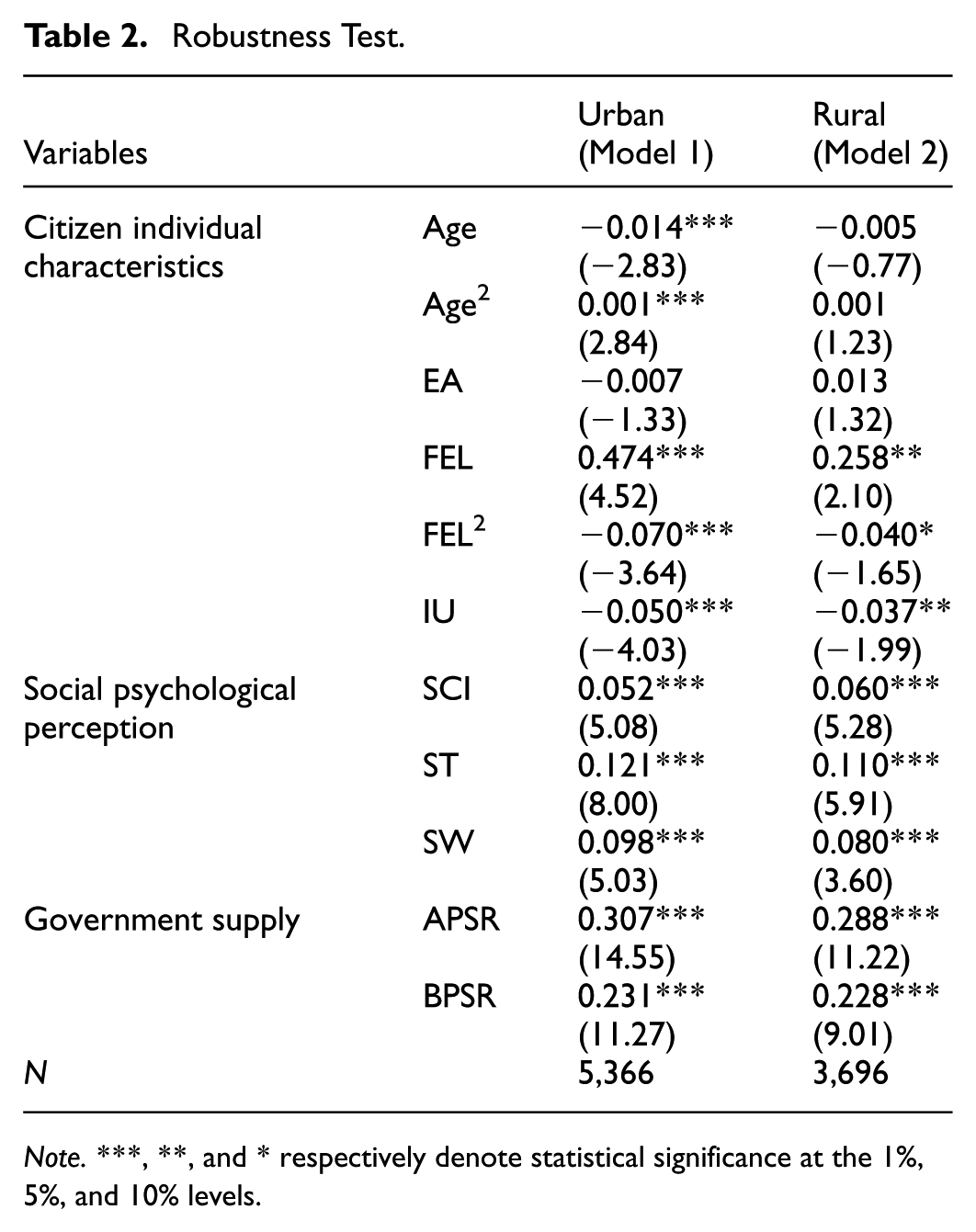
Note.***, **, and * respectively denote statistical significance at the 1%, 5%, and 10% levels.
Fuzzy-Set Qualitative Comparative Analysis (fsQCA)
In the regression analysis, we identified the factors that exert a significant influence on public service satisfaction and discovered that the effect of these variables varies in different regions. This part will further examine how the organic combination of these factors drives public service satisfaction in both urban and rural areas. For this purpose, the study selected eight variables that significantly affect the public service satisfaction of urban residents in the logistic regression analysis, namely age, family economic level, internet usage, social class identification, social trust, social well-being, resource adequacy, and resource balance, as the conditional variables for improving the public service satisfaction of urban residents. Similarly, for rural residents, six factors that significantly influence their public service satisfaction, including family economic level, social class identification, social trust, social well-being, resource adequacy, and resource balance, were selected as the conditional variables for the configuration analysis. All variables are measured using data from the Chinese General Social Survey (CGSS).
Calibration of Variables
FsQCA is grounded in set theory, regarding causal conditions and outcome concepts as sets and calibrating research objects based on specific criteria through a combination of theory and practice. We adopt this method to measure various variables, defining three qualitative anchors: complete affiliation, intersection point, and complete non-affiliation (Schneider & Wagemann, 2012). Simultaneously, referring to existing research findings, the calibration anchors for variables such as the satisfaction of urban and rural residents with public services, age, family economic level, internet usage, social class identification, social trust, social well-being, the adequacy of public service resources, and the balance of public service resources are respectively set at the 95%, 50%, and 10% of the sample data distribution.
Necessary Condition Analysis
Prior to conducting the conditional configuration analysis, it is essential to examine the necessity of each individual conditional variable for enhancing public service satisfaction among urban and rural residents. According to the fsQCA approach, if the consistency measure of a given antecedent condition exceeds 0.9, this condition can be considered necessary for the outcome variable. As shown in Table 3, the consistency values of all conditional variables are below 0.9, indicating that no single condition is sufficient to independently enhance public service satisfaction among urban and rural residents. Therefore, it is necessary to further investigate the combined pathways that contribute to improving public service satisfaction among urban and rural residents.
Results of the Necessary Condition Analysis.

Sufficiency Analysis of the Conditional Configuration
In conducting the sufficiency analysis of the conditional configuration, this study followed the recommendations of Ragin (2009), setting the consistency index threshold for the combination paths enhancing urban residents’ public service satisfaction at 0.8 and the frequency threshold at 3. Additionally, the PRI (the proportional reduction in inconsistency) was gaged against the criterion of being greater than 0.65 (Gupta et al., 2020). Considering the differences in conditional variables and their combination paths influencing public service satisfaction among urban and rural residents, as well as the actual circumstances, this study established the consistency index threshold for enhancing rural residents’ public service satisfaction at 0.8, the frequency threshold at 3, and required the PRI consistency to exceed 0.5 (Greckhamer et al., 2018). Following Ragin’s (2009) framework, the conditional configuration results are presented to delineate urban and rural enhancement pathways.
(1) Urban-based configuration identification. According to the data presented in Table 4, under the combined influence of citizen characteristics, social perception, and government supply factors, five distinct driving pathways have been identified for enhancing urban public service satisfaction. Among these, the consistency of the overall conditional configuration solution is 0.808, exceeding the threshold value of 0.8. This indicates that these five conditional configurations adequately explain the formation mechanism of urban public service satisfaction and can serve as sufficient conditions for its long-term establishment. Furthermore, the overall coverage of the solution is 0.710, implying that these five pathways collectively account for 71.0% of the cases exhibiting high urban public service satisfaction. The specific pathways are outlined below:
Path 1: APSR*BPSR. This path is denominated as “Resource Adequacy and Balance dual-core driven type.” This path, constituted solely by resource adequacy and balance without other conditions, explains 60% of the cases of high public service satisfaction.
Path 2: ∼IU*SCI*∼ST*SW*APSR. This path is designated as “Class Identification - Resource Adequacy driven type.” In this configuration, social class identification and public service resource adequacy serve as core existing variables, non-internet usage functions as a core absent variable, social well-being acts as a marginal existing variable, and lack of social trust operates as a marginal absent variable. This pathway accounts for 27.1% of the cases exhibiting high public service satisfaction.
Path 3: ∼Age*∼FEL*∼IU*∼SCI*ST*SW*BPSR. This path is named “Trust - Well-being - Resource Balance collaborative dominant type.” In this configuration, social trust, social well-being, and public service resource balance serve as core existing variables; age and family economic level function as core absent variables; while internet usage and social class identification act as marginal absent variables. This pathway accounts for 15.4% of the cases exhibiting high urban residents’ public service satisfaction.
Path 4: Age*FEL*∼IU*ST*∼SW*BPSR. This path is labeled as “Economic - Trust - Resource Balance dominant type.” In this configuration, family economic level, social trust, and public service resource balance serve as core existing conditions; social well-being functions as a core absent condition; age acts as a marginal existing condition; and internet usage operates as a marginal absent condition. This pathway accounts for 15.8% of the cases exhibiting high urban residents’ public service satisfaction.
Path 5: FEL*IU*∼SCI*APSR. This path is dubbed as “Economy - Resource Adequacy dominant type.” In this configuration, family economic level and public service resource adequacy serve as core existing variables; internet usage functions as a marginal existing variable; and social class identification operates as a marginal absent variable. This pathway accounts for 21.3% of the cases exhibiting high urban residents’ public service satisfaction.
(2) Rural-based configuration identification. Through the sufficiency analysis of the conditional configuration, it is found that there are three distinct pathways for enhancing rural residents’ satisfaction with public services. The consistency of the overall conditional configuration solution is 0.779, which is greater than 0.75, indicating that these configurations can effectively account for the sample situations of rural residents’ satisfaction with public services. The overall coverage of the solution reaches 0.693, signifying that these three pathways collectively explain 69.3% of the cases exhibiting high satisfaction with public services in rural areas. The specific pathways are detailed in Table 5 as follows:
Path 1: SCI*∼ST*∼SW*APSR*BPSR. This path is analogous to Path 1 for elevating the satisfaction of urban residents with public services and is denominated as “Resource Adequacy - Resource Balance driven type.” This path can elucidate 37.4% of the cases of high satisfaction with public services among rural residents. Here, the adequacy and balance of public service resources are the core existing conditions, social class identification is the marginal existing condition, while social trust and social well-being are the marginal missing variables.
Path 2: ∼FEL*SCI*ST*SW*APSR. This path is designated as “Class Identification - Resource Adequacy dominant type” and can explain 38.6% of the cases of high satisfaction with public services among rural residents. Specifically, social class identification and the adequacy of public service resources are the core existing conditions, social trust and social well-being are the marginal existing variables, and family economic level is the marginal missing condition.
Path 3: FEL*SCI*ST*SW*∼APSR*∼BPSR. This path is labeled as “Economy dominant type” and can explain 23.4% of the cases of high satisfaction with public services among rural residents. In this path, family economic level is the sole core condition; social class identification, social trust, and social well-being are the marginal existing variables; while the Adequacy and Balance of public service resources are the marginal missing conditions.
Conditional Configuration of Urban Public Service Satisfaction Improvement.

Note. ● means the core condition exists, • means the edge condition exists, ⊗ means the core condition is missing, ⨂ means the edge condition is missing, and space means both are missing.
Conditional Configuration of Public Service Satisfaction of Rural Residents.

Note. ● means the core condition exists, • means the edge condition exists, ⨂ means the core condition is missing, and space means both are missing.
Robustness Test
This research carried out robustness tests on configurations that yield high public service satisfaction among both urban and rural residents. The testing methods included: (1) Increasing case frequency by raising the threshold from 3 to 4; (2) Enhancing PRI consistency by elevating the urban threshold from 0.65 to 0.7 and the rural threshold from 0.5 to 0.65. The results demonstrated that the configurations generated in urban and rural areas remained fundamentally consistent with existing configurations, confirming the robustness of the study’s findings.
Discussion
Paths to Enhancing Urban Residents’ Public Service Satisfaction
According to the data presented in Table 4, through the interplay of citizen characteristics, social perception, and government supply factors, there are five driving pathways for enhancing urban public service satisfaction. Based on these findings, this study visualizes the analytical results as a path diagram (Figure 2) to clearly illustrate the feasible pathways for improving urban residents’ public service satisfaction.
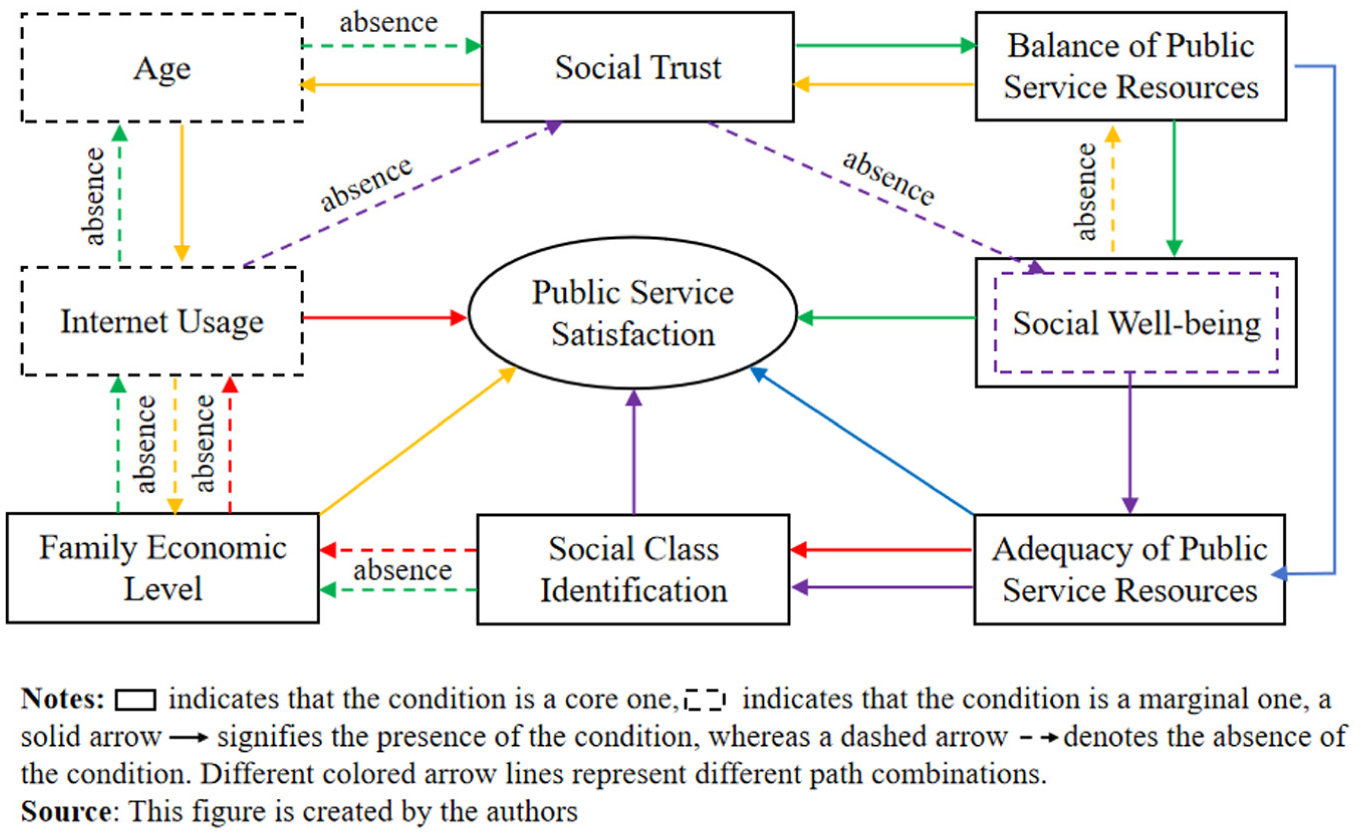
Paths for enhancing urban residents’ public service satisfaction.
The first “Resource Adequacy - Resource Balance” dual-core driven type suggests that urban residents’ evaluation of public service efficacy is more dependent on objective supply quality than on subjective perception differences. This indicates that when the government’s supply efficacy reaches a relatively high level, it can directly enhance urban residents’ satisfaction with public services. The strong alignment between this finding and China’s “14th Five-Year Plan for Public Services,” which prioritizes balanced allocation and expanded inclusive facilities, is noteworthy. This policy direction is highly congruent with this path: that is, resource sufficiency ensures the basic guarantee of service accessibility, while resource balance further elevates satisfaction by alleviating regional disparities. Therefore, continuing expansion of service volume and breadth to meet basic needs, coupled with targeted efforts to ensure equitable distribution, is key to unlocking higher levels of urban public satisfaction.
The second “Class Identity - Resource Adequacy” driven configuration reveals the influence mechanism of public service satisfaction for residents with a high social class identity (such as civil servants). This group tends to perceive public services as class-based privileged benefits, and their satisfaction is more contingent upon actual resource supply rather than the convenience provided by digitalized service channels. Their deeper understanding of government policies often leads to positive evaluations. An urban resident who does not rely on and even resists using the Internet may also exhibit a lower level of social trust. The resulting policy implication is twofold: first, to maintain their support by ensuring reliable, high-quality physical resource provision; and second, to actively integrate them into the digital ecosystem and bridge trust gaps, ensuring this influential group remains connected and does not become a source of resistance to modernization.
The third “Trust - Well-being - Resource Balance” co-dominant path’s core existing variables all stem from the social and government levels, delineating the enhancement path of public service satisfaction for urban disadvantaged groups. Young individuals new to society and those in economically deprived conditions have low social class identity, limited Internet sensitivity, and heightened sensitivity to resource distribution fairness. Policymakers should implement inclusive policies to alleviate material capital shortages and ensure equitable resource allocation to strengthen social trust. Simultaneously, cultivating a sense of social inclusion and well-being through supportive community environments can significantly amplify the positive impact of tangible resources.
Configuration four, termed the “Economy-Trust-Resource Balance” dominant path, presents a striking counterpoint to Configuration 3, particularly regarding demographic and economic profiles. This path elucidates the public service demand characteristics of middle-aged urban middle-class families. Drawing upon Maslow’s Hierarchy of Needs Theory, when basic survival needs are met, individuals seek higher-level needs like respect and self-actualization. This group’s strong economic capacity shifts their expectations from basic guarantees to high-quality, personalized services. However, the existing public service system has yet to fully accommodate this evolving demand, thereby resulting in diminished social well-being within this group and their satisfaction being minimally influenced by internet usage. To enhance public service satisfaction among this cohort, it is imperative to address minor livelihood-related issues with precision while considering both the objective efficacy and subjective expectations of public services, fostering social trust, and ensuring equitable distribution of public service resources.
The fifth “Economy - Resource Adequacy” leading path indicates that the differences in family economic conditions will, to a certain extent, influence residents’ perception of public services. Families with sound economic conditions are concerned not only with the scale of public services but also with their quality, and even their digital provision. Therefore, this path can be summarized as the demand pattern of the group willing to enjoy digitally empowered public services. In the context of the rapid development of digital technology, to improve the evaluation of public services by this group, it is necessary to ensure the sufficiency and accessibility of public service supply, enhance residents’ family economic level, appropriately integrate digital technology, and avoid the negative effects brought about by social class.
The aforementioned five paths collectively elucidate the diverse pathways for enhancing urban residents’ satisfaction with public services. The government supply dimension serves as a core element across all paths, while citizen characteristics and social perception factors exhibit differentiated combinations. This reflects the complexity of the urban social structure and the multi-layered nature of public service demands. These insights offer both theoretical foundations and practical guidance for developing differentiated urban public service policies.
Paths to Enhancing Rural Residents’ Public Service Satisfaction
Similarly, to present the configurational improvement paths of rural residents’ satisfaction with public services in a clearer and more intuitive manner, this study has constructed Figure 3 derived from the configuration analysis in Table 5, illustrating the specific pathways for improving rural residents’ satisfaction with public services.

Paths for enhancing rural residents’ public service satisfaction.
The first path is termed the “resource adequacy - resource balance” driven type. In this path, the deficiency of social trust and well-being reflect rural residents’ general distrust of the government or society. The Rural Revitalization Law directly addresses this challenge by mandating the prioritization of key resources—including education, healthcare, and social security—toward rural areas, with explicit goals of enhancing basic service levels and achieving urban-rural equalization. Therefore, governments at all levels should prioritize financial input for rural revitalization, ensuring increasing intensity and volume, focusing on infrastructure and public services. Adequate rural resource supply and equitable distribution by the government can mitigate psychological perception gaps. And social class identification amplifies this effect, as residents with higher identification are more likely to approve of resource distribution, enhancing satisfaction.
The second configuration, labeled “class identification-resource adequacy,” is particularly effective for rural residents with weaker economic conditions. Specifically, rural residents with limited family economic conditions have a stronger dependence on public service resources and are thus more likely to increase their satisfaction due to an abundance of resources. Rural residents with high social class identification are also more prone to view public services as the fruits of social progress, thereby enhancing their satisfaction. Therefore, policies must simultaneously enhance resource availability and cultivate positive social perceptions, as these elements form a mutually reinforcing cycle that boosts public satisfaction.
Path three, the “economy-driven type,” emphasizes the dominant position of the family economic level as a core condition in the absence of government-level factors. For financially secure rural residents, personal wealth can offset shortcomings in public service provision through private alternatives like private schooling and healthcare. This economic independence reduces their reliance on state-supplied services. Simultaneously, higher social class identification, social trust, and social well-being can enhance residents’ subjective evaluation of existing public services, forming a “psychological compensation” mechanism. Therefore, policymakers should not interpret the satisfaction of affluent groups as a sign of adequate public service provision, and must continue to prioritize investments in universal, high-quality public systems.
Overall, the paths for enhancing the satisfaction of rural residents with public services suggest that the adequacy and balance of public service resources play a core role in improving satisfaction, and there exists a significant synergy between resource adequacy and social perception factors. Additionally, in the situation of insufficient government resource supply, the family economic level plays an important compensatory role. Social-level influencing factors exhibit varying degrees of auxiliary functions in different paths. Therefore, when formulating relevant policies to enhance the satisfaction of rural residents with public services, it is necessary to holistically account for the interaction and complex relationships among multiple factors.
Conclusion
This study employs a combination of ordered logistic regression and fuzzy-set qualitative comparative analysis within the theoretical framework of “Citizen Characteristics - Social Perception - Government Supply” to comprehensively investigate the complex factors influencing urban and rural residents’ satisfaction with public services and their enhancement pathways. The core finding reveals that public service satisfaction is not determined by a single variable, and identifies significant disparities in the specific pathways for enhancing public service satisfaction between urban and rural residents. Urban residents’ satisfaction can be improved through five distinct pathways, which often involve the coordinated interaction of factors such as resources, class identity, trust, well-being, and economic conditions. In contrast, rural residents’ satisfaction relies on three primary pathways.
Specifically, The government should design differentiated policy combinations based on the demand characteristics of various groups to achieve a comprehensive improvement in public service satisfaction. For disadvantaged groups, it is essential to strengthen resource provision and subjective perception at both government and societal levels; for residents with superior economic conditions, satisfaction can be further enhanced by elevating their social trust and optimizing government resource supply; for groups with low levels of social trust, the government must prioritize ensuring basic supply and equitable distribution of public services.
Meanwhile, to enhance public service satisfaction, tailored strategies for urban and rural areas are essential. For urban areas, the focus should be on addressing individualized needs through community service programs such as public activity spaces and cultural events, while also optimizing basic service facilities including education, healthcare, and digital services to improve social perception and resource balance. For rural areas, efforts should prioritize infrastructure development in transportation, healthcare, and education, along with increased financial investment in broadband access and industrial revitalization, to strengthen economic conditions and social well-being. To bridge the gap, promoting integration through the sharing of high-quality medical and educational resources, as well as implementing differentiated performance evaluations—emphasizing service innovation in cities and basic coverage compliance in villages—will help narrow disparities and achieve equitable public service satisfaction.
Overall, this study offers empirically validated support for designing differentiated public service policies. Its contributions enrich the theoretical framework of public services and provide practical guidance toward achieving urban-rural equalization. While this study systematically identifies pathways to enhance public service satisfaction among urban and rural residents, it is not without limitations, which also point to directions for future research.Firstly, the use of cross-sectional data limits the establishment of causal inference. Future studies could employ panel data to track changes over time and further validate the causal effects of various factors on satisfaction.Secondly, despite controlling for multi-level variables, potential endogeneity issues stemming from omitted variables or bidirectional causality may persist. Investigating and addressing these potential endogeneity issues is a crucial direction for future research to deepen the understanding.Thirdly, concerning the generalizability of the findings, the results of this study are rooted in China’s unique context. Consequently, the generalizability of the findings requires further examination through cross-cultural comparative studies. Finally, the measurements of core variables such as public service satisfaction and social well-being are derived from residents’ subjective evaluations, which might cause measurement bias. Future research could attempt to integrate subjective perceptions with objective performance data to enhance measurement validity.
Footnotes
Acknowledgements
We appreciate the editors and anonymous reviewers for their efforts and valuable comments on this paper.

Ethical Considerations
This study does not involve human experiments, and the questionnaire does not involve ethics.
Consent to Participate
N/A.
Author Contributions
Yu Bai, Meihan Liu, Wanyi Wang, Jingdan Zhao, Jiao Yu: Conceptualization. Meihan Liu, Jiao Yu: Data curation. Yu Bai, Wanyi Wang: Formal analysis. Yu Bai, Meihan Liu: Methodology. Wanyi Wang: Validation. Yu Bai, Jiao Yu, Wanyi Wang: Visualization. Yu Bai, Meihan Liu: Writing - original draft. Jiao Yu, Jingdan Zhao: Writing - review & editing.
Funding
The authors disclosed receipt of the following financial support for the research, authorship, and/or publication of this article: This research was funded by the Project of Liaoning Social Science Planning Fund, with grant number L23BSH005.
Declaration of Conflicting Interests
The authors declared no potential conflicts of interest with respect to the research, authorship, and/or publication of this article.