




Abstract
Hidden champions are SMEs with strong global competitiveness in specialized fields but low profile. China’s hidden champions show less internationalization compared to their global peers, despite niche market dominance. Consequently, an exploration of the internationalization trajectories and determinants for China’s hidden champions is essential. This study utilizes fsQCA to investigate the internationalization strategies of 91 hidden champions, from China, using the “Efficiency-Structure-Environment” analytical framework. Five principal causal pathways for international operations are illustrated, categorized into three main driving models: “Efficiency-Environment,”“Efficiency-Structure,” and “System Interaction,” with the first model being the most dominant. The study further classifies hidden champions by ownership, finding that both state-owned and private enterprises predominantly follow the “Efficiency-Structure” driving model. Additionally, when classified by certification types, all categories are found to align with the “System Integration” model. Notably, the international path for cultivation hidden champions is also well-explained by the “Efficiency Dominance” model. Lastly, the study delineates industry-specific models: general equipment manufacturers employ the “Efficiency-Structure” model, special equipment manufacturers use the “Structure-Environment” model, and the computer industry follows the “System Integration” model.
Plain language summary
This research focuses on China’s hidden champions, which are small and competitive companies in specific fields that are not widely known. Despite their success in niche markets, these companies have not expanded internationally as their global counterparts. To understand why, the study examines the international strategies of 91 hidden champions using a method called fsQCA. The findings reveal five main paths that lead to internationalization, driven primarily by factors such as efficiency, the business environment, and organizational structure. The study also explores how ownership type and certification play a role in these strategies. Notably, it highlights different approaches for fostering the international growth of hidden champions. The research concludes by identifying industry-specific patterns, showing how companies in general equipment manufacturing, special equipment manufacturing, and the computer industry adopt distinct driving models for their international operations.
Introduction
In the global market, there exists a category of small yet sophisticated enterprises, known as Hidden Champions. These companies, despite not receiving widespread recognition in executive circles, command a significant share of the market, dominate various market segments, and emerge as leaders in global niche markets, thus playing a pivotal role in the global industries. Characterized by their high level of innovation and technological supremacy within their respective industries, these hidden champions—typically small and medium-sized enterprises (SMEs)—benefit from flexible organizational structures and strong adaptability (Ying et al., 2023). This enables them to cater to the diverse and specific demands of consumers in the global market, embodying a born-global nature. Therefore, hidden champions possess inherent capabilities for the international sphere by diversifying their global operations and have the potential to become prominent global corporations.
The concept of hidden champions, first introduced in 1996, gained significant interest in China in 2016 when the Ministry of Industry and Information Technology launched the “Implementation Plan for the Special Action to Cultivate and Enhance Manufacturing Hidden Champions.” The scheme aimed to cultivate 200 leading manufacturing hidden champions by 2025 and encourage the growth of a further 600, driving more companies towards specialization and distinction. By February 2023, China had identified 507 such entities through four different batches. However, these companies face challenges in enhancing their international operations. China’s hidden champions are comparatively less globalized, operate fewer international subsidiaries and face technical constraints in contrast to their German, Swedish and Japanese counterparts. The disparity is evident in China, as Mindray Medical has a presence in 42 countries, while Goldwind, Hikvision, and Lens Technology are present in fewer than 15 nations. On the other hand, German companies, including Germanischer Lloyd, Karcher, and Knauf, Wuerth, and Trumpf each operate in over 70 countries. According to data from the 2019 Sino-German Hidden Champions Summit, Chinese companies have an average of 6.4 international operations, compared with a worldwide average of 9.6. Andreeva et al. (2016) reveals the prominent presence of hidden champions globally, with Germany leading the pack with 1,307 companies, surpassing the USA, Japan, and China, which ranks eighth with 68 businesses. Germany has a higher density of hidden champions, with 16 firms per million inhabitants, compared to China’s 0.1 per million, placing it in 17th position. This underscores an enormous potential for growth in China’s international business arena.
As the world’s largest developing country, China plays a key role in the global economy as an initiator of the Belt and Road Initiative and a proponent of economic globalization. The international operations of Chinese industry leaders are imperative in achieving global interconnectedness. China’s open-economy strategy and the emerging concept of the dual circulation—integrating domestic and foreign markets— highlight the importance of these enterprises. The international efforts of China are crucial not only for realizing their global economic strategy and promoting positive development, but also for meeting the demands of the global market, developing the global value chain, and enhancing industrial chains. The triumphs of China’s hidden champions on the international stage provide valuable benchmarks and insights for other developing nations aiming to build leading international enterprises. Researching the international operations of China’s hidden champions is crucial for addressing the challenges posed by the post-pandemic era’s demand contraction, supply shocks, and weaker consumer expectations. Thus, it is important to investigate strategies to enhance the overseas development of these businesses, formulate effective international operational strategies, and identify the factors impacting their expansion into global markets.
Literature Review
Research into hidden champions began with Simon’s (1996) study of German companies that have a modest social profile but hold considerable global market shares with revenues of up to 1 billion dollars. Toften and Hammervoll (2009) identified the unique traits of niche markets. However, there remains insufficient exploration of the diversity among hidden champions in various national contexts, which are affected by economic, political, and cultural factors. Previous research has primarily concentrated on hidden champions in nations such as Switzerland (Din et al., 2013), China (Lei et al., 2017), and Germany (Simon, 2022). Research has also focused on internal elements, including logistics performance (Khadim et al., 2021), financial performance (Johann et al., 2021), and innovation leadership (Ge & Zhao, 2022), as well as external factors such as regional income and patent numbers (Benz et al., 2021), and the impact of urban digital technology (Liu et al., 2021).
Research on the theory of enterprise internationalization is currently focused on the pathways, with some scholars concentrating on direct internationalization methods, such as exporting and direct investment. The main factors include institutional distance (Xie & Li, 2018), digitalization (Denicolai et al., 2021), and advanced business education (M. Yang et al., 2021). Moreover, tax effects and FDI spillovers also have an impact on indirect methods such as investment and portfolio investment (Georg, 2011). The “born-global” concept, introduced by Rennie (1993), defines firms that begin international marketing soon after their establishment, distinguished by their emphasis on innovation and technology. Investigations into Chinese “born-global” firms have demonstrated the importance of factors such as policy resources and entrepreneurial competency (Pan, 2018).
While considerable research has been conducted on the internationalization of hidden champions, most studies primarily focus on classical theories concerning institutions and strategies (Wang & Gao, 2023) without explicitly delineating the influencing factors and specific pathways for the internationalization and growth of China’s hidden champions. In contrast, the application of Fuzzy-set Qualitative Comparative Analysis (fsQCA) is an advancement of Ragin’s (1987) analysis. FsQCA addresses issues of variable correlation and partial membership in complex phenomena and has been applied to areas including consumer behavior (Pappas et al., 2016) and business development (Kraus et al., 2018). Recent applications in hidden champions research have focused on corporate autonomy (L. L. Yang et al., 2021) and diversification strategies (J. J. Du et al., 2023). This approach offers several advantages over traditional regression analysis. Firstly, fsQCA is adept at handling both large and small datasets, making it ideal for multi-case comparative research, particularly applicable to the medium-sized sample in this study. Secondly, unlike Crisp-set Qualitative Comparative Analysis (csQCA), fsQCA accommodates partial membership values ranging between 0 and 1, which aligns well with the continuous nature of the data in this study. Finally, fsQCA effectively addresses issues of endogeneity and multicollinearity inherent in traditional regression methods, allowing for a more nuanced exploration of how various groups of antecedent conditions impact outcome variables, with a focus on equivalence and asymmetry. The study categorizes the factors influencing the international operations of hidden champions into three systems: efficiency, structure, and environment. Given the complex, non-linear interrelationships between these antecedent variables, fsQCA is particularly suited to unravelling the causality and combined effects arising from the interplay of multiple factors. It allows for a comprehensive analysis and interpretation of these dynamics from a group state perspective, providing valuable insights into the pathways of international operations of hidden champions.
In summary, this research aims to make incremental contributions in two main areas. First, in terms of data, this study manually matches the relevant indicators of the international operations of nearly 100 national-level hidden champion listed companies identified by China’s Ministry of Industry and Information Technology, and comprehensively analyses the interactions among these indicators from both qualitative and quantitative perspectives, providing a more comprehensive understanding of their internationalization paths and key factors. Second, in terms of methodology, this study adopts the fsQCA to establish an “efficiency-structure-environment” theoretical framework, in order to understand more comprehensively the driving forces and core influencing factors of the internationalization and development in hidden champions, and to provide valuable suggestions for enhancing the competitiveness of thus firms in emerging markets.
Research Design
Research Methodology
As of January 2023, China’s Ministry of Industry and Information Technology has identified 507 hidden champions through a comprehensive four-stage selection process. This group includes 256 exemplar hidden champions, 90 developing hidden champions, and 161 enterprises with champion products. Due to the strict criteria for international operations, specifically related to size and turnover, this analysis focuses on the listed hidden champions. The data, derived from the CSMAR database, were subjected to analysis using Stata 14. This entailed aligning companies based on their unique codes, yielding a refined sample of 91 companies after discarding those with incomplete data. The study conducts an empirical investigation into the diverse and complex motivations driving the international operations of hidden champions, using the fsQCA approach.
Basic Model
Outcome Variables
The primary variable of interest in this study is the international operation configurations of hidden champions. Commonly utilized indicators to assess a firm’s degree of internationalization include overseas operating income (Errunza & Senbet, 1984), number of overseas R&D subsidiaries (Li & Yu, 2016), and export density (Zheng et al., 2022). Additionally, several scholars have proposed composite indicators, encompassing six measurement dimensions (Dunning, 1977), a three-dimensional approach (Sullivan, 1994), and a two-dimensional approach (Goerzen & Beamish, 2003). However, this study’s approach is influenced by two key factors. First, there is no consensus on the choice of variables for firm internationalization, although foreign operating income is commonly used. Second, the limited number of China’s hidden champions requires a methodology that preserves the maximum number of sample firms. Therefore, this paper uses the single indicator of the sample enterprises’ overseas operating income to measure international activities. A higher overseas income indicates a greater share in foreign markets, successful foreign trade operations, and achievements in international development.
Antecedent Variables
This paper introduces a tripartite system termed Efficiency-Structure-Environment, drawing upon the diamond model. Within this framework (see Figure 1), six indicators are identified as antecedent variables for empirical analysis:

Theoretical framework diagram.
The Efficiency system highlights production Factors and Demand as vital elements for enterprise development. On the one hand, supply shocks imply intensified market competition, requiring the incorporation of more production factors in foreign direct investment and international trade, thus enhancing global operational vitality and improving top-tier enterprise supply efficiency. Production factors encompass both fundamental factors such as labor and capital, and advanced factors like skilled labor and research-based facilities. These advanced production factors are fundamental not only for enterprises to expand globally but also for boosting their rank in the global value chain. On the other hand, enterprise demand primarily reflects both domestic and international market needs. An enterprise’s ability to engage in international operations is determined by the transformation of domestic markets, while shifts in external markets can modify their international competitive advantage. Representative hidden champions from countries like Germany and Japan rely heavily on international markets, exhibiting inherent globalization traits. The strict quality demands of foreign markets have shaped the German hidden champions’ focus on quality, while niche market demands have led to the Japanese hidden champions’ refined industry development models. China’s hidden champions, with their broader domestic markets, adapt to changes in domestic demand by increasingly engaging in international operations. Robust and substantial market demand fuels the international competitiveness of hidden champions (Figure 2).

Cases analysis of high-level international operations.
In light of these insights, this study identifies Factors and Demand as the antecedent variables within the efficiency system. For Factors, Total Factor Productivity is employed using the LP method (Levinsohn & Petrin, 2003). This measure seeks to quantify the efficiency of human, material, and financial resources in production activities, where higher TFP implies a stronger competitive edge in international operations. Furthermore, this paper uses total business revenue as an indicator of the market Demand of the sampled enterprises, with data sourced from the CSMAR database.
In the Structure system, Strategy and Industry Clusters play a critical role in optimizing enterprise structures. On one hand, faced with contracting demands, enterprises must formulate development strategies in alignment with changes in the consumer environment. A healthy development of upstream and downstream businesses is also vital for international operations. On the other hand, hidden champions are typically surrounded by superior upstream suppliers and discerning downstream customers. The high-quality supportive industries within industry clusters facilitate economies of scale, which are instrumental in maintaining price advantages, mitigating risks, and bolstering innovation during international operations. Both tangible competitive resources and intangible non-competitive resources constitute the resources in real economic activities. These resources form the basis of maintaining a competitive edge, while the optimal combination of corporate strategy, enterprise structure, and industry competition directly contributes to the formation of competitive advantages.
Consequently, this study identifies corporate Strategy and Industry Clusters as the conditional variables of the structure system. Innovation, a crucial aspect of development strategies and particularly significant for hidden champions, is seen as the foundation of enterprise growth. Enterprises with a strong innovation profile have an enhanced position in the global market. To measure innovation, this paper employs the number of patents held by the sample enterprises, with data sourced from the IncoPat database. The concept of supply chain concentration is used to gauge Industry Clusters. This metric is calculated as the mean value of the combined purchasing and sales ratios of the top five suppliers and customers. A higher supply chain concentration suggests a more significant role of economies of scale in enhancing international competitiveness, with data for this analysis obtained from the CSMAR database.
The Environment system encompasses Opportunities and Government. The consistent growth trajectory of hidden champions is characterized internally by the maintenance of vertical specialization in production, while externally, their sensitivity and responsiveness to the environment are key determinants of their international operations. On the one hand, opportunities are elusive and not always attainable. Thus, aggressively nurturing hidden champions may not be suitable for most enterprises. Capitalizing on existing strengths, addressing weaknesses, seeking open development, undergoing gradual transformation, and aspiring to become top international enterprises represent more optimal pathways. The emergence of opportunities can significantly enhance elements that were not previously prominent in the open internationalization system, such as scarce production factors or limited demand conditions, disrupting the equilibrium of existing innovation systems and enabling the international operations of hidden champions. For instance, China’s leadership in the digital economy offers these enterprises opportunities for upgrading and transformation (Jiao, 2022). Widespread digitalization can enhance the efficiency of international operations and reduce costs. On the other hand, government guidance in economic activities is a major driver for the internationalization of hidden champions. Policies such as the orderly resumption of work and production during the COVID-19 pandemic and continuous public investment in infrastructure have facilitated the efficient utilization of production factors and impacted demand conditions through regulatory oversight of industry product standards.
Currently, methods to measure the digital transformation of enterprises predominantly involve text analysis, utilizing a data pool derived from annual reports of listed enterprises, as extracted by Wu et al. (2023). This includes references to artificial intelligence, big data and digital technology applications. The total word count reflects the degree of an enterprise’s digitalization. Furthermore, a region’s openness and conducive open environment positively influence enterprises’ motivation and confidence in global expansion. Data on import and export volumes and GDP of each province are sourced from the EPS global statistical data analysis platform.
According to the above system settings, the combination of all elements can realize the international operation of hidden champions, thus this paper assumes:
H1: The efficiency system, structure system, and environment system each have a positive relationship with the international operation of hidden champions.
H2: The combination of efficiency system, structure system and environment system can facilitate the international operation of hidden champions.
Calibration of Results and Antecedent Conditions
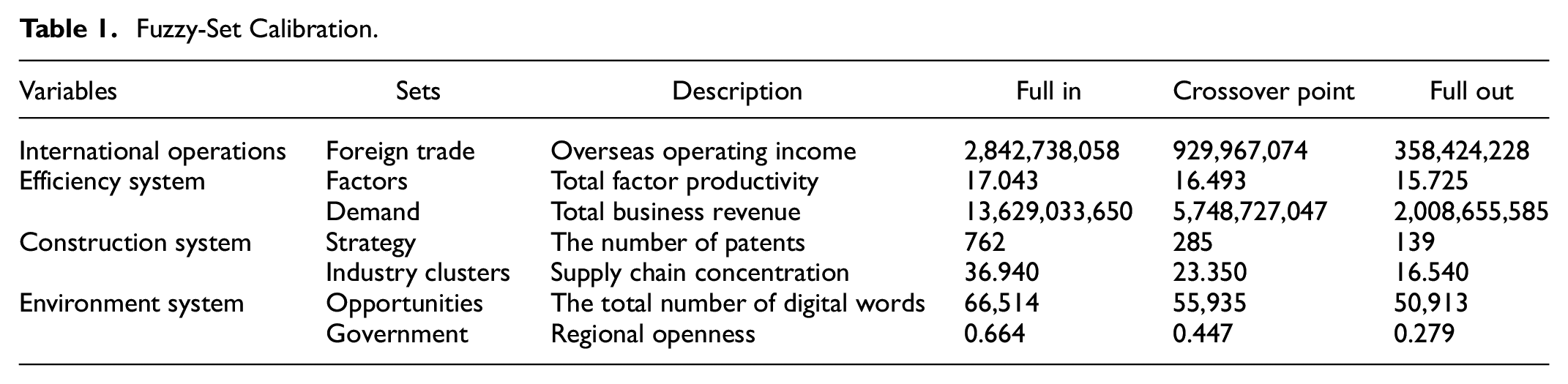
Using the direct calibration method (Ragin & Fiss, 2008) to convert the data into the concept of sets, the variables of Foreign Trade, Factors, Demand, Strategy, Industry Clusters, Opportunities, and Government are used as the threshold values for Full In, Crossover Point and Full Out for 75%, 50% and 25% of the quantile calibration, respectively, according to Fiss (2011). Each variable calibration’s information is shown in Table 1.
Fuzzy-Set Calibration.
Research Results
Test of Necessary Conditions
This study employs the fsQCA methodology to determine whether a singular condition, inclusive of the non-set, is indispensable for international operations. Specifically, it determines whether a condition is invariably present when international operations (the outcome) are observed, with a consistency level above 0.9 as the benchmark. The analysis of necessary conditions was carried out using the fsQCA 3.0 software, and the results are presented in Table 2. The consistency levels for all six antecedent variables, in relation to the outcome variable, fell below the threshold of 0.9. This outcome suggests that no single condition by itself is necessary for the international operations of hidden champions. H1 cannot be achieved solely. Therefore, a comprehensive explanation of these phenomena requires further analysis using the identified configurations.
Necessity Test of Single Conditions.

Note. Following the nomenclature, the symbol (~) represents the negation of the characteristic.
Test of Sufficient Conditions for Configurations
The paper follows Rihoux and Ragin (2009) and sets the consistency threshold to 0.8. Since there are 91 sample firms in this paper, which is medium-sized, the sample frequency threshold is set to 1. This study also adopts the suggestion of Y. Z. Du and Jia (2017) that the Proportional Reduction in Inconsistency (PRI) threshold should be no less than 0.75. The final analysis results follow Ragin and Fiss (2008), as shown in Table 3. International operations present a total of five driving paths, the consistency of each configuration is above 0.85, and the solution consistency is 0.876, all of which are higher than the minimum acceptance criterion of 0.75 and can be considered a sufficient combination of conditions for hidden champions to operate internationally. The coverage of the solution is 0.507, which indicates that the five configurations can explain 50.7% of the sample firms and proves the validity of the empirical analysis. The paper categorizes the configurations into three driving models.
Configurations of High-Level International Operations.

Note. ● indicates the core presence; ⨂ indicates the core absence; • indicates the conditional present; and ⊗ indicates the conditional absence.
“Efficiency-Environment” Driving Model. The first path (∼Factors × Demand × ∼Strategy × ∼Industry Clusters × ∼Opportunities × Government), the second path (Factors × ∼Strategy × ∼Industry Clusters ×Opportunities× ∼Government), and the third path (Factors × Demand × Opportunities ×∼Government) better illustrate the coupling effect of “Efficiency System + Environment System.” In this model, first, the hidden champions can combine Demand and Government conditions as the core conditions, they can accumulate customer resources through expanding international markets, maintain the continuity of demand, make full use of the government’s policy support, and grasp the advantages of the location to achieve high-level international operations more easily. Second, international operations can be improved by the combination of Factors and Opportunities, through making full use of production factors by improving production efficiency, vigorously improving the digitization of industry, strengthening the application of key technologies and improving their data mining and analysis capabilities to achieve a high-level internationalization. At the same time, the second path and the third path show a clear progressive relationship, with the third path further relaxing the missing conditions of the second path and making up for the missing restrictions of the structure system when domestic and international market conditions are improved. When applying the “Efficiency-Environment” model, several cases are investigated, including Goldwind, Zoomlion, Longi, Sungrow, Ganfeng Lithium, Weichai, Goertek, Zhongding Group, Sunward, CCGB, and Tri-Ring Group. Notably, Zhongding Group embodies the second and third tracks. As a multinational private hidden champion in the non-tire rubber sector, it has achieved significant growth in overseas business revenue. Zhongding Group’s success is attributed to its strategic mergers and acquisitions, which have secured global clients like Audi, Ford, and Bosch, thereby expanding its market and product reach. This strategy ensures a high-quality efficiency system. Concurrently, Zhongding Group’s focus on new energy vehicles and continuous enhancement of digital intelligence underscores its robust competitiveness in international operations.
“Efficiency-Structure” Driving Model. The fourth path (Factors × Demand × Strategy × ∼Industry Clusters×∼Opportunities) better illustrate the linkage effect of “Efficiency System + Structure System.” This model suggests that companies can achieve a high level of internationalization by optimizing the efficiency system and enhancing innovation capabilities when the economy of scale has not yet been established and the digital capabilities of the enterprise are low. This means that the hidden champions should not only improve their production levels and maintain stable customer resources, but also optimize their strategic structure, take innovation as the guide for enterprise development, move to the global stage through technological innovation, and maintain competitive advantages in the international market. CSG and Noblelift Group exemplify this model. In 2021, Noblelift Group generated 57.66% of its total revenue from overseas operations, indicative of its active involvement in international markets. This success is largely attributed to the company’s relentless focus on innovation. To enhance its innovation and R&D efforts, the Noblelift Group collaborates with distinguished institutions like Tsinghua University and Zhejiang University, in addition to maintaining its own research platforms such as a post-doctoral workstation. This strategy has boosted its capacity for innovation. At the same time, the organization has advanced significantly in research and development of forklifts, resulting in innovative products that include those with lithium batteries, for narrow warehouse aisles, and hydrogen fuel counterbalanced models. Proficiency in key technologies such as controlled hydraulic lifts and integrated control technology has established Noblelift Group as a leader in the global market. Furthermore, the continuous optimization of the industrial chain along with the expansion into the intelligent logistics industry have greatly improved the company’s efficiency system and resource integration capabilities, further strengthening its position in the global marketplace.
“System Interaction” Driving Model. The fifth path (Factors × Demand × Industry Clusters × Government) better illustrate the combined effect of “Efficiency System + Structure System + Environment System.” In this model, when enterprises optimize their efficiency system and strengthen cooperation with upstream and downstream industries, the improvement of the external environment of government policies can further realize the international operations of hidden champions. This means that the internationalization of some of the hidden champions not only depends on their promotion but also needs the support of external conditions. By collaborating with related industries, forming robust industrial clusters, engaging in mergers, acquisitions, and other joint ventures, scaling their operations offers significant export cost abatement opportunities. This will enable them to successfully seize the advantages of government policies to foster international operations. Examples of companies that exemplify this model include Avary Holding, Quectel, Leo, BOE, Wanward, Sanhua, Hepalink, XCMG, Jiuli, and LEAD. Avary Holding, a global leader in the printed circuit board (PCB) industry, exemplifies successful international operations. In terms of the efficiency system, Apple and Foxconn, as its foremost customers, account for over 75% of Avary Holding’s order volume. Additionally, collaborations with renowned firms like Google and OPPO ensure a stable production and demand base. Regarding the structure system, Avary Holding’s commitment to high-end development is evident in its significant investments in plant construction for industry chain centralization and extensive R&D, leading to mastery in technologies like MINILED backlight circuit boards and 5G. This approach has enabled Avary Holding to continually expand into new business areas. In the environment system, Avary Holding leverages the strategic location of Guangdong Province, effectively achieving global reach in markets such as Europe, America, and Japan. Furthermore, being selected for the first batch of the Shenzhen Quality and Brand Enhancement Project has fortified Avary Holding’s position, providing the confidence and support necessary to compete on the international stage.
Robustness Tests
Schneider and Wagemann (2012) proposed three QCA robustness testing methods: adjusting quantiles for calibration, altering case frequency, and refining consistency. Due to the limited research on the international operations of the hidden champions in the current academic community, there is no standard for adjusting the calibration anchor, it is difficult to conduct a robustness test by adjusting the calibration membership values. Besides, this paper is a sample case of medium size. Changing the case frequency may lead to a further decrease in coverage and affect the credibility of the configuration analysis, so adjusting the consistency is chosen as the test method.
By adjusting the consistency from 0.8 to 0.85, it is found that the solution consistency increases from 0.876 to 0.912 and the coverage of the solution decreases from 50.7% to 41.2%. Comparing Tables 3 and 4, it is evident that the first and fourth paths remain unchanged; the second path Strategy changes from lacking auxiliary conditions to lacking core conditions; the third path Demand evolves from having auxiliary conditions to having core conditions, with Industry Clusters becoming the core conditions for this path; the fifth path Demand, Industry Clusters, and Government shift from having core conditions to having auxiliary conditions. Although there have been slight modifications, the prior and subsequent arrangements maintain separate subset connections and identical explanatory procedures. Therefore, the results can be considered robust.
Robustness Tests.
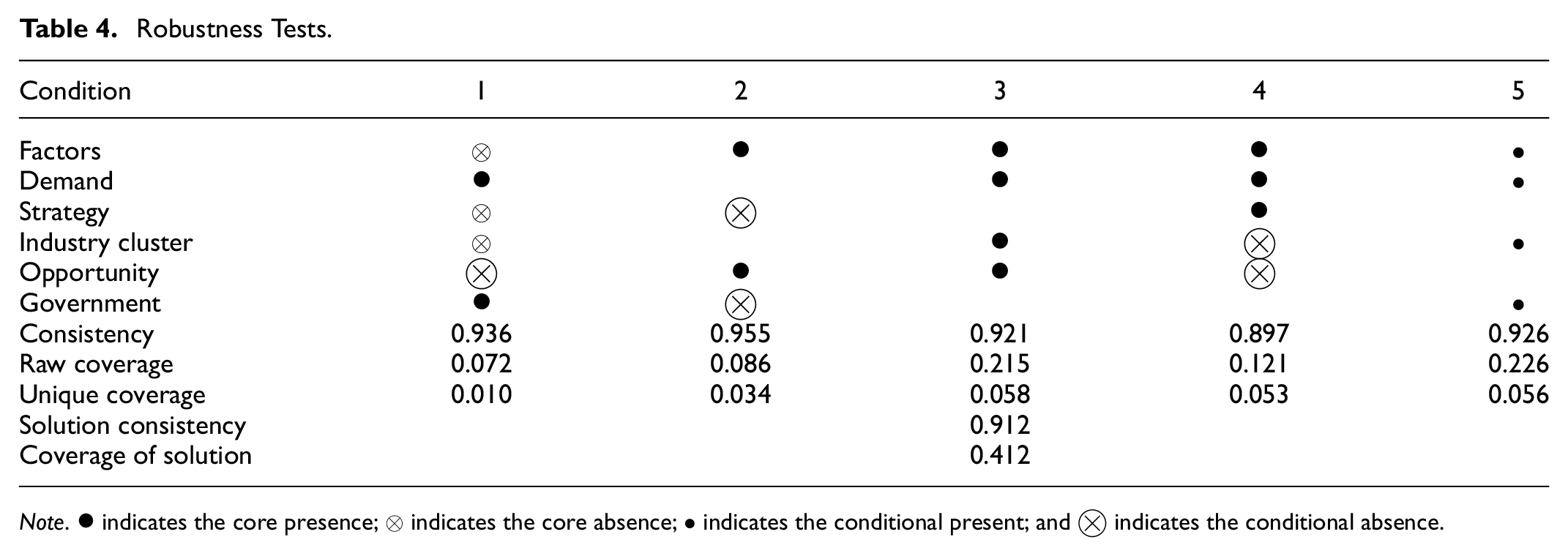
Note. ● indicates the core presence; ⊗ indicates the core absence; • indicates the conditional present; and ⨂ indicates the conditional absence.
Heterogeneity Analysis of the International Operations of Hidden Champions
Different Enterprise Ownership
China’s socialist economic system categories enterprises as state-owned (SOEs), private, or foreign-based on their ownership. Due to the limited number of foreign enterprises (fewer than 10), the analysis of heterogeneity focused on 23 state-owned and 63 private enterprises. According to Table 5, SOEs exhibit two configurations, while private enterprises display five. Notably, the coherence in private enterprises surpasses that of SOEs. This discrepancy may stem from the perception that SOEs are politically influenced, resulting in a heightened “country of origin disadvantage” in global markets compared to private enterprises. As a result, foreign trade is more receptive to products from private enterprises. Additionally, efficiency systems are crucial in both SOEs and private firms, highlighted by the presence of demand in all configurations. For these hidden champions, prioritizing development involves deeply engaging with niche markets, excelling in core technologies, understanding market trends, and producing leading products that dominate both domestic and international markets.
Configurations of Different Ownership.

Note. ● indicates the core presence; ⨂ indicates the core absence; • indicates the conditional present.
In the context of SOEs, the primary elements of their development are Factors, Demand, and Strategy. This can be summarized as the “Efficiency-Structure” driven model. The predominant advantages of SOEs include state support, substantial financial backing, and robust auxiliary support, fostering a stable and conducive environment for innovation. SOEs should leverage these innovation benefits, with a view to addressing critical technological challenges by establishing innovation platforms, attracting creative talent, and collaborating with universities. In scenarios where SOEs encounter comparable core conditions, Opportunities may be interchangeable with a synergy of Industry Clusters and Government support. This highlights that digitalization significantly influences the international operations of SOEs, facilitating their global expansion, particularly when influencing government policy or rapidly forming industry clusters is challenging. For private firms, the primary elements can also be seen as Factors, Demand, and Strategy, summarized as the “Efficiency-Structure” driven model. However, innovation has more significant impacts, and the government can play a more substantial role in facilitating it. Strategy can be interchanged with Industry Clusters and Opportunities under similar Demand conditions. Given that many private enterprises are constrained by limited capital and experience, their digital transformation and upgrading present substantial hurdles. Alternative strategies demonstrate that enhancing innovation capabilities and applying innovative transformations can address these challenges. When efficiency systems and innovation capacities are comparable, Industry Clusters can replace Government conditions. This implies that when private enterprises face an innovation stalemate, economies of scale formation and government aid can be pivotal in overcoming such impasses. Companies can reduce costs and augment efficiency by integrating closely with the supply chain, thereby creating a high-value industrial chain. Concurrently, the government’s responsibility in establishing and upholding intellectual property rights, providing tax incentives, expanding entry to markets, and simplifying administrative procedures is essential in fostering a growth-oriented atmosphere for the international activities of private firms.
Different Certification Categories of Hidden Champions
As of 2022, China’s Ministry of Industry and Information Technology has recognized four batches of hidden champions, classifying them into three categories: Hidden Champion Products, Cultivation Hidden Champions, and Model Hidden Champions. This paper categorizes the sampled enterprises based on these categories, which including 25 champion products, 16 cultivation hidden champions, and 50 model hidden champions. According to Table 6, it is evident that champion products exhibit two configurations, while both cultivation and model hidden champions display five configurations each. Notably, cultivation hidden champions demonstrate the highest solution consistency among the three categories. This heightened consistency can be attributed to their greater diversity and broader product range compared to single-product champions, enhancing their adaptability to consumer demands and facilitating entry into overseas markets. In contrast to the more mature model hidden champions, cultivation hidden champions possess greater potential for growth. Additionally, these enterprises can benefit from the experiences of established companies in international expansion, aiding in accumulating experience and easing their entry into global markets. Furthermore, the efficiency system is crucial for all three categories, particularly the Factors condition, which appears 11 times across 12 configurations, with 10 occurrences as core elements. This underscores that enhancing production efficiency is vital for their development.
Configurations of Certification Categories.

Note. ● indicates the core presence; • indicates the conditional present; and ⊗ indicates the conditional absence.
For both champion products and cultivation hidden champions, refining the efficiency system and advancing innovation capabilities are pivotal for achieving international operations. However, since all the three systems appear in paths 1, 2, 3, 5, 6, and 7, both types of firms can be summarized as the “System Interaction” driving model. Champion products, fundamentally reliant on their main products, face challenges in enhancing product technological content, updating offerings, and aligning products with market demands. To progress, champion products must diligently cultivate niche markets, establish a robust, multi-level innovation ecosystem, and expedite product innovation cycles. Analysis of alternative paths reveals that when champion products’ efficiency system and strategy are analogous, Demand and Government support can mutually substitute, suggesting that government assistance bolsters international operations when the vertical market reaches saturation.
For cultivation hidden champions, one of the models is similar to champion products “System Interaction” driving model, which are still in their growth stage. It is essential to pinpoint their unique digital requirements and systematically navigate through digital transformation and upgrades. This approach is key to developing a sustainable competitive edge in international markets. Another one can be summarized as “Efficiency Dominance” driving model with path 4. In this model, the Efficiency system, particularly in the realm of Factors, plays a more pronounced role compared to the champion product. Alternative path analysis indicates that when efficiency systems and opportunity conditions in cultivation hidden champions are comparable, Strategy and Industry Clusters are interchangeable. This highlights the necessity for these companies to not only implement effective on-ground digital transformation but also to consolidate their overseas advantages through collaboration.
For model hidden champions, their operational approach can be similarly categorized under the “System Integration” driving model. However, within this model, Factors emerge as a core presence across all pathways. Furthermore, the role of Industrial Clusters is significantly more pivotal for these enterprises compared to the other two categories. As leaders among hidden champions, model enterprises are tasked with spearheading industry integration. They should proactively engage in secondary and tertiary industry integration, providing experiential insights for other businesses aiming to transform and upgrade through cross-industry layout and industrial integration innovation. By utilizing an efficient innovation to capture global production factors, these enterprises should strategically position themselves in international operations, aspiring to global leadership. Even if the Government is only present in path 12, the government should play a twofold role. Firstly, it should create a conducive environment for model enterprises, offering policy incentives to high-level and high-quality companies, guiding healthy competition, and preventing unregulated expansion and production. Secondly, the government should leverage information-sharing platforms to enhance the spillover effect, unlocking the potential of exemplary enterprises and establishing benchmarks in international operations.
Different Industries of Manufacturing Hidden Champions
According to China’s National Economy Industry Classification, the sample enterprises in this study were classified into 20 industries. Given that most industries have a limited number of enterprises and are predominantly manufacturing-oriented, this study focused on those with ≥10 enterprises in manufacturing. General equipment manufacturing, special equipment manufacturing, and computer, communication, and other electronic equipment manufacturing were selected as the representative industries for analysis, as shown in Table 7. An in-depth analysis of the necessary conditions for each industry revealed significant findings. In the general equipment industry, the consistency of Factors is 0.940, surpassing the critical threshold of 0.9. The factors coverage is 0.895, confirming Factors as a necessary condition for explaining the general equipment industry’s dynamics. Similarly, in the computer, communication, and other electronic equipment manufacturing sector, the consistency of Factors is 0.901 and that of Demand is 0.934, both exceeding the 0.9 threshold. Their respective coverages of 0.895 and 0.888 indicate that both Factors and Demand are essential for understanding the computer industry.
Configurations of Different Industries.
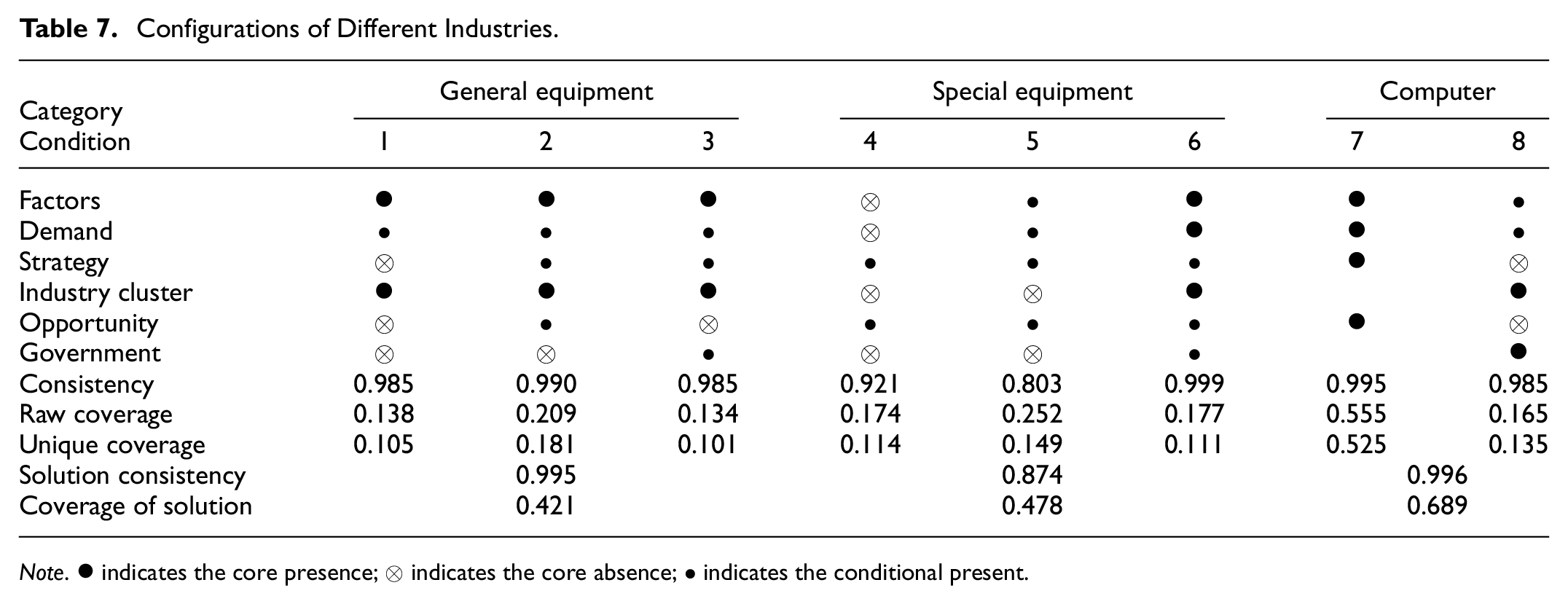
Note. ● indicates the core presence; ⊗ indicates the core absence; • indicates the conditional present.
In the general equipment manufacturing industry, comprising 10 enterprises, three distinct configurations for international operations have been identified. Core conditions for achieving international operations in this sector include Factors and Industrial Clusters. It can be summarized as an “Efficiency-Structure” driving model. This is primarily due to two reasons: firstly, as the industry is currently in a de-inventory phase, efficient production factors are crucial for enterprises to enhance their production, procurement, and logistics systems. This enables the development of new products and expansion into external markets, thereby alleviating inventory pressures and facilitating adaptability in both domestic and international markets. Secondly, as an upstream, pro-cyclical industry within manufacturing, the cost and demand of downstream industries significantly influence revenue growth. Therefore, tight integration of upstream and downstream industries can enhance the international operational advantages of these enterprises. When the Efficiency and Structure systems are comparable, any Environment system condition can synergize with other conditions to achieve high-level international operations, indicating that optimizing external conditions can compensate for internal condition limitations, thereby improving product and service quality and enhancing cost-efficiency.
The special equipment manufacturing industry comprises 15 companies and three international operational configurations are observed. The industry currently grapples with high-end supply shortages, low-end overcapacity, and saturated market demand. Furthermore, environmental protection policies pose a risk of obsolescence, necessitating urgent upgrades and transformations. Configuration analysis reveals that Strategy and Opportunities are prevalent in all three paths. It can be summarized as the “Structure-Environment” driving model. This suggests that enterprises should innovate to provide high-end products, circumventing the technological barriers imposed by developed countries on China’s manufacturing industry. Simultaneously, digitalization should be accelerated to upgrade high-pollution and high-energy-consuming enterprises, fostering high-end intelligence in the industry. For the computer, communication, and other electronic equipment manufacturing industry, which comprises 17 enterprises, two international operations configurations are present. In these two paths, the three systems complement each other, which can be summarized as the “System Integration” driving model. When efficiency systems are analogous, a combination of Strategy and Opportunities can replace the Industry Clusters and Government synergy. This implies that, first, amid trade policy suppressions and sanctions from European, American, Japanese, and Korean countries, robust upstream and downstream industrial chains, coupled with government support, can enable Chinese enterprises to overcome challenges and maintain their competitive edge in intense international markets. Secondly, addressing talent shortages and low innovation transformation efficiency through an innovation strategy-oriented approach and accelerated digital transformation of the industry chain can empower hidden champions to grow and establish a strong foothold in the global market.
Research Conclusions and Policy Recommendations
Research Conclusions
Based on the “Efficiency-Structure-Environment” theoretical framework, 91 China’s hidden champions were used as case studies to elaborate the path of international operations of hidden champions by the fsQCA method, and the following basic conclusions were drawn:
The necessity test results indicate that the efficiency, structure, and environment systems are integral to the international diversification of hidden champions. Key elements such as Factors, Demand, Strategy, Industrial Clusters, Opportunities, and Government form the core of their development. However, none of these elements alone constitute the necessary conditions for the international operations of hidden champions. This suggests a complex causal mechanism underpinning the international operations configurations of hidden champions. Nevertheless, when considering industry-specific dynamics, Factors emerge as crucial for the general equipment manufacturing industry, while both Factors and Demand are imperative for the computer manufacturing industry. This highlights the significance of the efficiency system in these industries, where vigorously enhancing efficiency is key to boosting international competitiveness and expediting their global outreach.
The sufficiency test results reveal that the international operations of hidden champions are characterized by five configurations, falling into three distinct driving models. The first model, termed the Efficiency-Environment driving model encompasses three paths, which is also the most common category, centering on Factors, Demand, Opportunities, and Government as core conditions. In scenarios where internal structural system conditions are absent, enhancing production efficiency and expanding both domestic and international markets can significantly improve enterprise efficiency. The second model, the Efficiency-Structure driving model, is represented by the fourth path and focuses on Factors, Demand, Strategy, and Industry Clusters. In the absence of digital automation within an enterprise, boosting innovation capacity can alleviate the pressures of industrial transformation and upgrading. Cutting-edge innovation technology is fundamental for hidden champions to sustain their international market advantage. The third model, the System Interaction driving model, identified in the fifth path, highlights the necessity of internal and external linkages for international operations. It prioritizes Factors, Demand, Industry Clusters, and Government as core conditions, underscoring the need for hidden champions to not only fortify their capabilities but also receive governmental support and protection.
The heterogeneity test reveals that regarding the ownership, both SOEs and private enterprises follows an “Efficiency-Structure” model. SOEs should leverage financial and technological strengths, overcoming the technological challenges, and commanding core technologies in their global operations. Private enterprises should endeavor to build scale economies through industrial clusters to foster growth. In terms of certification categories, all categories adopt a “System Integration” model. Both champion products and cultivation hidden champions are advised to refine their efficiency systems and adopt innovation targeting niche markets. Cultivation hidden champions can also use an “Efficiency dominance” model internationally, with productivity rooted in technology and innovation. Model hidden champions must lead the way in integrating industries, and sharing global operation insights. As for different industries, general equipment manufacturers adhere to an “Efficiency-Structure” model, enhancing downstream synergies and improving cost efficiency. Special equipment manufacturers can adopt a “Structure-Environment” model to expedite industrial upgrading and supply high-end products that meet market demands. In the electronics sector, a “System Integration” model can be adopted to advance intelligent capabilities and improve innovation efficiency.
Policy Recommendations
At the enterprise level, a dual approach encompassing both internal and external development is essential to augment international competitiveness. Internally, the efficiency system constitutes a fundamental component of hidden champions’ international operations. These enterprises should optimize the use of production resources and elevate production efficiency, aiming to establish an international brand within their market segments. Moreover, the structural system is pivotal in bolstering internal capabilities. Enterprises should prioritize innovation and establish a comprehensive, multi-dimensional industry-academia-research chain. This chain should be led by model enterprises and supported by government initiatives, involving the continuous recruitment and retention of scientific and technological talent through incentives such as subsidies and rewards. Externally, hidden champions need to understand digital development trends, proactively optimize their industrial chains, and enhance their value addition. The digital layout is crucial for improving the competitiveness of their international operations therefore, leveraging government support policies, including tax relief, project funding, and post-facto subsidies, can significantly reduce the cost and risk associated with digital transformation.
At the governmental level, implementing tiered support and optimizing the growth environment are crucial. Initially, the government should escalate the certification of specialized SMEs, and bolster their sustained development. However, this process must involve rigorous screening of potential enterprises to prevent the dilution and trivialization of hidden champions’ certification. The government should also develop nuanced cultivation policies for certified hidden champions of different types, focusing on refined development strategies. Furthermore, leveraging initiatives like the Belt and Road and free trade areas could significantly expand the export capabilities of hidden champions, mitigate the risks associated with internationalization and facilitating strategic global enterprise layouts. Secondly, strengthening intellectual property rights (IPR) protection for hidden champions is imperative. Promoting a societal ethos of respect and protection for enterprise IPR and rigorously combating counterfeit and infringement activities, are essential. Additionally, assisting enterprises in assimilating into international IPR systems, defending the legal rights of domestic enterprises abroad, establishing platforms for managing IPR disputes, and providing necessary support for rights defense are vital measures.
At the industrial level, a concerted effort to expedite industrial upgrading and foster coordinated regional industrial development is essential. Hidden champions should focus on integrating secondary and tertiary industries, enhancing product value by targeting both ends of the “smile curve,” and establishing a comprehensive global industrial marketing system. Promoting regional digital technology infrastructure, such as big data and cloud computing, is also crucial. These technologies can assist enterprises in refining intelligent, modern logistics and distribution systems, thus alleviating concerns associated with transformation. Additionally, there is a need to enhance the synergy between upstream and downstream industries, leverage the siphon effect of leading enterprises, and form industrial clusters driven by these entities. Optimizing the industrial layout of hidden champions involves establishing dedicated industrial parks and service platforms that facilitate industrial aggregation. This approach not only reduces costs through scale efficiency but also fosters mature and stable market competition mechanisms. By implementing these measures, hidden champions are well-positioned to drive the region’s coordinated development, enabling collective international expansion, cooperative ventures, and mutual success.
Footnotes
Authors’ Note
The authors claim that none of the material in the paper has been published or is under consideration for publication elsewhere.
Declaration of Conflicting Interests
The author(s) declared no potential conflicts of interest with respect to the research, authorship, and/or publication of this article.
Funding
The author(s) disclosed receipt of the following financial support for the research, authorship, and/or publication of this article: The author disclosed receipt of the following financial support for the research, authorship, and/or publication of this article: China National Social Science Fund Project (23BGL052).
Ethical Approval
This article does not contain any studies with human participants performed by any of the authors.
Informed Consent
This article does not contain any studies with human participants performed by any of the authors.

Data Availability Statement
The datasets generated during and/or analyzed during the current study are available from the corresponding author on reasonable request.