




Abstract
China’s e-commerce poverty alleviation initiatives have achieved significant progress, yet the mechanisms driving consumers’ ethical prioritization of agri-products remain poorly understood. Drawing on consumer value theory, this study employs fuzzy-set Qualitative Comparative Analysis (fsQCA) to investigate how six factors—quality attributes, price attributes, sense of social responsibility, sense of moral gain, public welfare attributes, and brand reputation—interact to shape ethical consumption behaviors. Through a configuration lens, this study identifies four distinct trade-off pathways: price-driven, responsibility-driven, price-ethics-driven, and brand-community-driven. Key findings reveal that price attributes synergize with ethical motivations as core drivers while uncovering a substitution effect where emotional value compensates for functional value gaps. The results challenge conventional linear value models, demonstrating how multidimensional value coexistence enables ethical consumption in e-commerce, thereby advancing theoretical frameworks for ethical decision-making and offering actionable strategies for aligning platform governance, product positioning, and consumer ethics in poverty-alleviation markets. This study repositions ethical consumption as a social-technical praxis rather than just an individual moral choice, offering transnational relevance for platform economies grappling with value plurality.
Introduction
The Chinese government has strategically leveraged e-commerce platforms to implement targeted poverty alleviation initiatives, particularly by promoting agri-products (Lai et al., 2021; Liu et al., 2017). These policies encourage e-commerce platforms to establish dedicated poverty alleviation channels targeting impoverished regions, while incentivizing vendors to market agri-products as tools for rural revitalization and sustainable development (Wang, Ning, et al., 2021). Poverty-alleviation agri-products (PAAP)—defined as goods receiving governmental and corporate support in pricing, taxation, branding, and distribution (Wu & Yuan, 2022)—aim to sustainably increase farmers’ incomes, break poverty cycles, and promote eco-conscious business practices (Alkon, 2008; Hartlieb & Jones, 2009).
Scholars continue debating the efficacy of ethical labeling schemes in guiding informed e-commerce purchases (Bradu et al., 2014; Borin et al., 2011). While these schemes enhance ethical product visibility and accessibility (Testa et al., 2015; Vecchio & Annunziata, 2015)—serving as critical connectors among consumers, retailers, and ethical producers (Hartlieb & Jones, 2009)—China’s sociopolitical emphasis on public welfare has overshadowed PAAP’s market-oriented attributes. Misleading labeling risks eroding consumer trust, undermining PAAP acceptance, and market competitiveness. This necessitates a critical reevaluation of agri-product attributes, particularly their alignment with genuine consumer needs.
The rapid growth of rural e-commerce platforms like Pinduoduo and Taobao has spurred diverse ethical marketing strategies to attract customers, raising a crucial question: how can PAAP authentically align consumer value expectations with societal goals, moving beyond sympathy-driven ethical consumption? While prior studies isolate individual factors influencing ethical choices (Casais & Faria, 2022; Li et al., 2022), they neglect the multidimensional value interplay shaping PAAP consumption decisions. Ethical consumerism inherently involves trade-offs between competing priorities—though consumers broadly endorse sustainability, ethical attributes rarely dominate purchasing preferences without balancing functional and emotional values (Herédia-Colaço et al., 2018). This study addresses this gap by applying Qualitative Comparative Analysis (QCA) to decode how consumers configurationally weigh six values (price, quality, morality, etc.) when purchasing PAAPs on e-commerce platforms.
Focusing on purchase decisions, we analyze certified PAAP transactions on integrated e-commerce platforms, excluding informal social commerce. Platform infrastructures (e.g., traceability systems, CSR displays) are treated as contextual facilitators rather than explanatory variables, ensuring analytical focus on consumer-centric value negotiations.
Literature Review
Connotation and Theory of Ethical Consumption
Early scholarship defined ethical products as goods delivering “morally labeled utility” through embedded values (Kutaula et al., 2024; Olson et al., 2016). Contemporary research reconceptualizes ethical consumers as actors systematically weighing socio-environmental impacts (Cheung & To, 2021). Recent studies emphasize fluid ethical consumption shaped by cultural and institutional contexts, where macro-level norms (e.g., sustainability certifications) inform micro-level behaviors (Li et al., 2024). Theoretical debates have shifted from linear decision models (Connolly & Prothero, 2003) to paradox frameworks reconciling ethical intentions with marketplace compromises. This evolving perspective challenges the notion of a “typical” ethical consumer, instead highlighting dynamic interactions among moral reasoning, socio-material constraints, and identity performance (Malik & Singh, 2025). However, the mechanism of these factors is still unclear and requires further exploration.
Influences on Ethical Consumption Behavior
Analysis of ethical consumption drivers operates at two analytical levels. Single-factor studies dominate existing scholarship, isolating impacts of price sensitivity, emotional triggers like empathy/guilt appeals (Hassan et al., 2021), and product ethics. Multi-factor analyses increasingly employ descriptive methods, structural equation modeling, and fuzzy-set QCA (fsQCA)—for instance, Alyahya et al. (2023) developed an fsQCA framework linking ethical constructs, threat appraisal, and values to consumption behavior, while Hasanzade et al. (2018) emphasized external enablers like labeling and marketing strategies. Complementary work identifies consumption barriers including price premiums and quality concerns (Chatterjee et al., 2021). Despite these advances, prior work insufficiently addresses interconnected causal configurations—how economic rationality, emotional drivers, and contextual enablers/barriers jointly shape decisions through nonlinear interactions, practically in complex e-commerce ecosystems.
The “Attitude-Behavior Gap” in Ethical Consumption Behavior
The attitude-behavior gap in ethical consumption reflects consumers’ frequent failure to translate ethical intentions into purchasing actions (Casais & Faria, 2022; Eckhardt et al., 2010). While consumption decisions systematically span motivation formation, preference crystallization, and post-purchase evaluation, this process is mediated by personality traits, product characteristics, and platform architectures. Dominant theoretical frameworks—value acceptance models, theory of reasoned action, and planned behavior (Pavlou, 2002)—partially explain these disconnects but inadequately address their configurational causality in e-commerce contexts. To mitigate this gap, scholars propose targeted interventions like simplified ethical labels and behavioral nudges (Young et al., 2009). However, such measures often oversimplify the complex trade-offs between moral aspirations and functional expectations inherent in PAAP consumption—a limitation this study addresses through a QCA lens.
Theoretical Framework
Consumers purchase products based on embedded value (Kushwah et al., 2019), with ethical consumption choices reflecting moral-functional synergies (Hiller & Woodall, 2019). Integrating Sheth et al.’s (1991) five value dimensions (functional, social, emotional, epistemic, conditional) with Kotler’s (2017) total customer value and Parasuraman and Grewal’s (2000) perceived value taxonomy, this study posits purchasing decisions as outcomes of combined value drivers—a configurational premise central to QCA.
The Functional Value in Poverty-Alleviation Contexts: Quality and Price
Consumers’ ethical purchases of agri-products hinge on functional value—their perceptions of a product’s utility and quality (Sheth et al., 1991). In e-consumers’ real sensory-limited environment (Spence & Gallace, 2011), buyers increasingly prioritize quality attributes (QAs) such as relating to environmental safety, health credentials, and food security (Burke et al., 2014), using these as proxies for ethical superiority (Vermeir & Verbeke, 2006). This reflects that functionality is still a practical need for e-consumers; therefore, this study incorporates quality attributes (QAs) into the QCA analysis framework for consumers’ online ethical consumption decisions.
As another habitual influencing factor, price attributes (PAs) play a dual yet contested role. While studies like Andorfer et al.’s (2015) natural field experiment demonstrate that price reductions (e.g., a 20% discount on Fair Trade coffee) significantly boost ethical purchases, millennials increasingly prioritize corporate social responsibility (CSR) over cost when ethical credentials are transparent (Tofighi et al., 2019; Young et al., 2009). This paradox positions price as a contextual moderator: cost-sensitive consumers respond strongly to discounts, whereas ethically-driven cohorts view price as secondary to verified CSR commitments. By integrating QAs and PAs, this study examines how functional and economic values configurationally interact—competing or converging—to shape ethical choices in poverty-alleviation contexts.
The Social Value of PAAP Consumption: The Sense of Social Responsibility
China’s rural revitalization strategy has amplified the social value of PAAPs through corporate commitments to poverty reduction, cause-driven marketing, and multi-stakeholder accountability, collectively heightening civic consciousness of ethical consumption. Altruism—particularly supporting impoverished communities—emerges as a primary driver of PAAP purchases (Wu & Yuan, 2022), with consumers deriving moral agency from recognizing their role in poverty alleviation and anticipating guilt reduction through ethical choices. This social responsibility mechanism enables consumers to internalize collective welfare into purchasing decisions (Van Loo et al., 2014; Young et al., 2009), fostering sustained PAAP engagement among ethically motivated buyers (Geum & Song, 2008). Central to this dynamic is a sense of social responsibility (SSR)—defined as prosocial behavior prioritizing communal benefit over self-interest (Berkowitz & Daniels, 1964)—which operates not merely as a transient motive but as a configurational pillar shaping ethical consumption in e-commerce ecosystems.
The Emotional Value of PAAP Consumption: The Sense of Moral Gain
Ethical consumption driven by emotional value—often termed conscience consumption—occurs when buyers consider not just products but their embedded moral implications (Hamelin et al., 2013). As consumers grow aware that their purchases impact market ethics, many shift toward certified ethical products (Pino et al., 2012; Oh & Yoon, 2014). However, moral experiences in consumption are complex: even unintended ethical purchases (e.g., circumstances forced choices) can evoke guilt or pride (Antonetti & Maklan, 2014; Thompson & Coskuner-Balli, 2007). Central to this dynamic is a sense of moral gain (SMG)—the psychological fulfillment consumers derive from aligning purchases with ethical principles. Whether through deliberate ethical choices or accidental compliance, SMG shapes post-purchase evaluations and future behavior. This study positions SMG as a pivotal yet understudied driver of agri-product consumption in poverty-alleviation contexts.
The Cognitive Value of PAAP Consumption: Public Welfare Attributes and Brand Reputation
PAAP consumption inherently embodies public welfare objectives, transforming poverty alleviation into a form of socially-conscious market engagement (Becker, 1974). Public welfare labels—such as poverty-alleviation certifications and low-carbon claims—signal ethical product attributes to consumers, activating market participation (Vecchio & Annunziata, 2015). For instance, consumers with strong low-carbon awareness tend to purchase more eco-friendly PAAPs (Shiksha et al., 2019), demonstrating how public welfare attributes (PWAs; e.g., environmental stewardship, community donations) translate ethical intent into measurable consumption behavior.
Brand reputation (BR) equally shapes PAAP consumption by mitigating information asymmetry in agricultural markets. Established brands reduce consumer search costs and adverse selection risks, particularly for geographically indicated products (Yoganathan et al., 2019). However, ethical branding only enhances loyalty when aligned with core brand values (Holbrook & Hirschman, 1982; Tofighi et al., 2019). This study thus examines BR through platform credibility, seller rankings, and origin authenticity—factors that collectively influence purchasing decisions by bridging ethical promises with functional reliability.
Grounded in consumption value theory (CVT), this study systematically examines six factors shaping consumers’ ethical agri-products consumption: quality attributes (QAs), price attributes (PAs), sense of social responsibility (SSR), sense of moral gain (SMG), public welfare attributes (PWAs), and brand reputation (BR), collectively forming an integrated analytical framework (see Figure 1). QAs and PAs embody functional value through product utility and cost considerations, whereas SSR and SMG capture social-emotional values via collective welfare commitments and moral self-reinforcement. PWAs and BR further denote cognitive value, reflecting consumers’ awareness of societal impacts and marketplace trust signals.

An antecedent configuration analysis framework.
Methodology
Qualitative Comparative Analysis of Fuzzy Sets
Qualitative Comparative Analysis (QCA) offers a unique approach to studying real-world issues by systematically linking theoretical conditions to contextual outcomes (Fiss, 2011; Ragin et al., 2008). This method examines how multiple factors combine to influence results, making it ideal for exploring consumer value trade-offs in ethical agri-product consumption on e-commerce platforms. By analyzing interactions among six value dimensions, QCA provides fresh insights into ethical consumption patterns. Three QCA variants exist: crisp set (csQCA), fuzzy set (fsQCA), and multi-valued set (mvQCA). This study adopts fsQCA because it handles non-binary conditions effectively (Mendel & Korjani, 2013)—critical for our study, where none of the six conditions are binary.
Data
Questionnaire
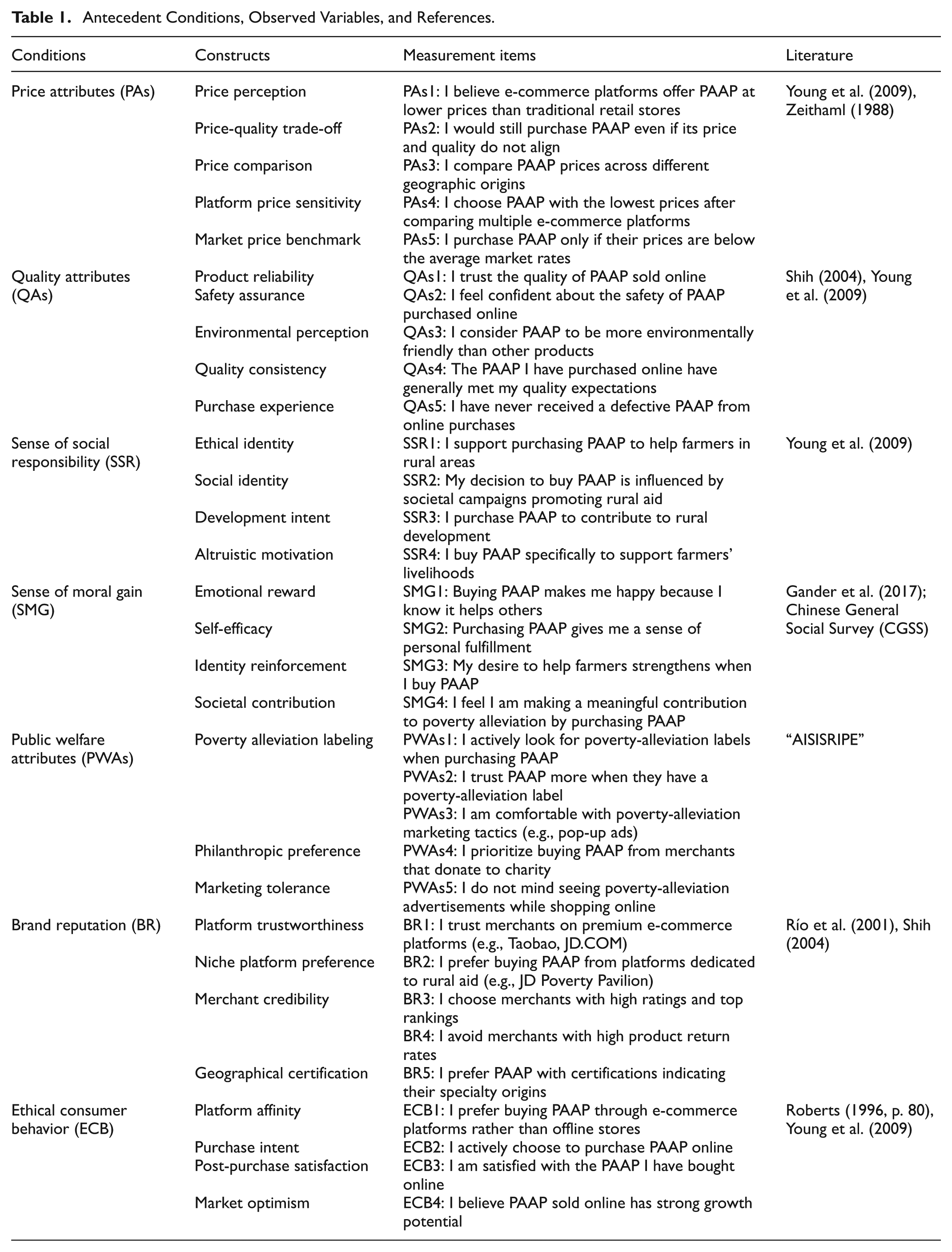
The study employed a structured questionnaire to collect empirical data. The instrument comprised three sections: demographic profile (e.g., gender, age, and education), behavioral patterns (purchase intention, shopping frequency, product categories), and scaled measurements. For enhanced clarity, visual aids accompanied the agri-products descriptions. All scale items adopted a 5-level Likert format (1 = strongly disagree to 5 = strongly agree), with detailed measures presented in Table 1. This multi-component design ensured comprehensive data collection while maintaining respondent engagement throughout the survey process.
Antecedent Conditions, Observed Variables, and References.
Data Collection
Before launching the formal survey, we randomly distributed 15 test questionnaires to consumers who had purchased agri-products on e-commerce platforms. We revised the questionnaire structure and items based on feedback. To minimize invalid responses, we distributed the final questionnaire through the Chime System, a professional platform with a sample database exceeding 4 million quality users in China. We selected respondents from this database who had previously purchased agri-products on major e-commerce platforms (e.g., JD.COM, Taobao.com, Pinduoduo.com). The Chime System initially screened eligible candidates and sent e-questionnaire links to qualified individuals, offering a three RMB incentive per completed response. To further verify eligibility, Question 4 in the questionnaire asked: “Have you ever purchased poverty alleviation agri-products on e-commerce platforms?” This dual screening process yielded 700 valid responses.
Data Analysis
Descriptive Statistical Analysis
The survey results revealed that all respondents (100%) had purchased agri-products via e-commerce platforms (Table 2). The sample consisted of 262 male participants (37.4%) and 438 female participants (62.6%), with the majority (90%) falling within the 21 to 40 age range, indicating a strong representation of young consumers. Seasonal factors influenced purchasing behavior for 60.4% of respondents. Among product categories, seasonal fruits ranked highest in purchase frequency (91.6%), followed by fresh vegetables and meat (56.9%), tea (38.6%), aquatic products (25.6%), and flowers and seedlings (15.1%). These findings highlight distinct consumer preferences and the impact of seasonality on purchasing patterns.
Composition of Valid Samples (n = 700).

Reliability and Validity Analysis
This study evaluated the reliability and validity of the scale using SPSS and AMOS (see Table 3). First, internal consistency was assessed via Cronbach’s α, yielding an excellent overall coefficient of .884, indicating high data reliability(α t.8). Exploratory factor analysis (EFA) demonstrated strong construct validity: the Kaiser–Meyer–Olkin (KMO) measure reached .851 (p 5.001), and six extracted factors cumulatively explained 83.21% of the variance, confirming robust dimensionality. Confirmatory factor analysis (CFA) further validated the scale: all item loadings exceeded .5, composite reliability (CR) values surpassed the .70 baseline (Fornell & Larcker, 1981), and average variance extracted (AVE) values exceeded the .50 threshold (Hair et al., 2019). While PA’s AVE (.576) slightly exceeded the minimum, it remains acceptable for theoretically critical constructs in emerging contexts (Kushwah et al., 2019; Peterson & Kim, 2013). The model demonstrated strong global fit (χ2/df 1.624, NFI = .920, CFI = .924, RMSEA = .079), all within recommended ranges. Descriptive statistics and inter-construct correlations are presented in Table 4.
Reliability and Validity Analysis.

Correlation and Descriptive Statistics.

p < .01. *p < .05.
Data Calibration
The fsQCA calibration process requires defining three fuzzy-set thresholds for an interval-scale variable: full membership (.95), full non-membership (.05), and an intermediate crossover point (.5; Ragin & Strand, 2008). For a 7-point Likert scale, studies typically use thresholds of 6, 4, and 2, while a 5-point scale employs either 4/3/2 or 5/3.5/1 thresholds. Given our 5-point Likert scale data collection method, we adopt the 5, 3.5, and 1 thresholds for calibration. The processed data were subsequently analyzed using the fsQCA software, with detailed calibration outcomes summarized in Table 5.
Results of Data Calibration.
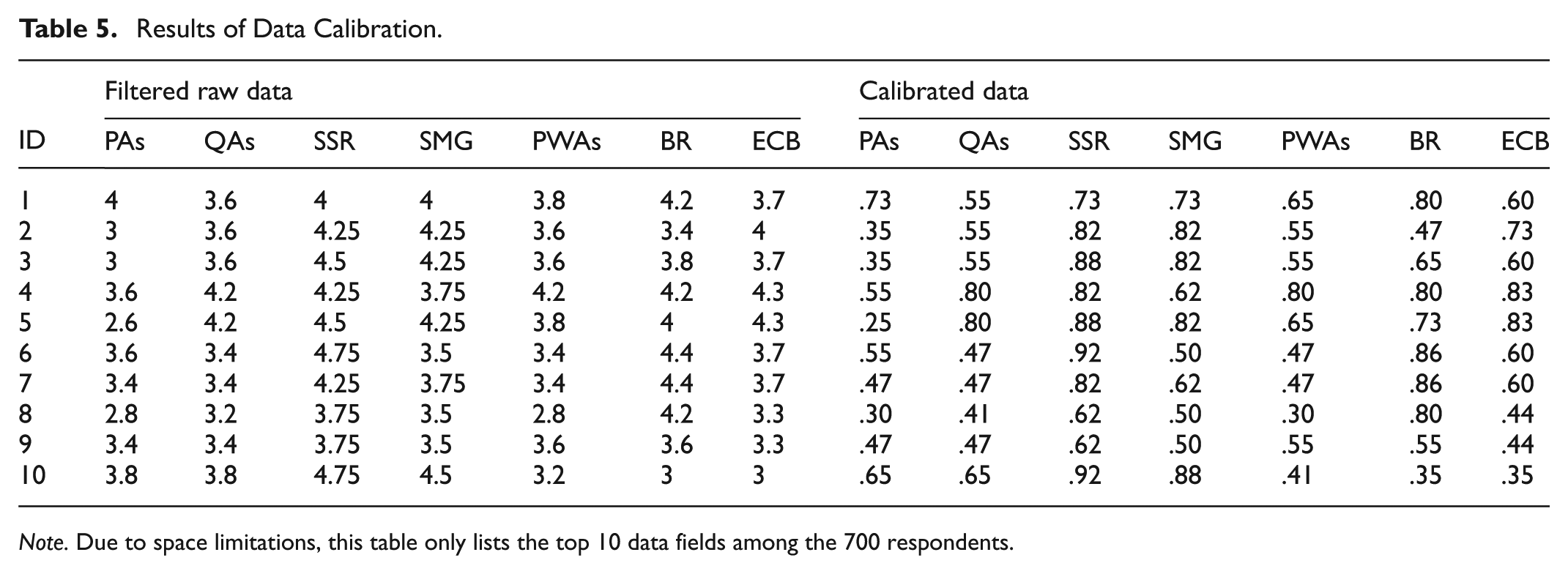
Note. Due to space limitations, this table only lists the top 10 data fields among the 700 respondents.
Conditional Necessity Test
The necessary conditions test evaluates whether specific conditions form prerequisite requirements by determining if a given set fully encompasses potential outcome configuration, preceding adequacy analysis. This analysis measures condition necessity through consistency scores, with values between .9 and 1.0 indicating essential prerequisites (Rihoux & Meur, 2009). As shown in Table 6, social responsibility, moral acquisition, and brand reputation displayed moderately high consistency levels yet remained below the .9 necessity threshold. Importantly, all conditions demonstrated coverage rates exceeding .80. While these factors significantly explain ethical consumption patterns, their consistency scores confirm they do not qualify as strictly necessary conditions for the phenomenon.
Result of the Necessary Condition Test.

Configuration Analysis
QCA configuration analysis evaluates both consistency levels and PRI values, with optimal consistency thresholds ranging from .8 to 1.0 and PRI thresholds typically set at .75 (Dwivedi et al., 2017; Gupta et al., 2020), though values should not drop below .5 (Thomas et al., 2018). Applying a threshold of .80 for consistency and .75 for PRI, this study generated complex, parsimonious, and intermediate solutions (Table 7). Core conditions include price attributes (PAs), sense of social responsibility (SSR), and sense of moral gain (SMG) are core conditions, while quality attributes (QAs) and public welfare attributes (PWAs) emerged as marginal factors. Research suggests that not all consumers are willing to compromise on quality (Herédia-Colaço et al., 2018), and ethical product choices may serve self-restorative purposes even when alternatives offer superior quality (Trudel et al., 2020). This suggests that product quality in rural agri-products influences—but does not dictate—ethical consumption behavior (Er-Peng et al., 2021). Similarly, PWAs represent optional platform strategies; consumers may view the pro bono label positively, yet their absence does not negatively impact perceptions (Vecchio & Annunziata, 2015).
Configuration Solutions.

The interplay of core and marginal conditions yields distinct configurations (Tables 7 and 8), including equivalent combinations formed by differing core conditions or shared cores with varying marginal elements, as seen in path H1a and H1b (Greckhamer, 2016). All configurations exceed the .80 consistency threshold, demonstrating robust explanatory power for ethical consumption. Notably, path H2a exhibited the highest unique coverage, reflecting its strong empirical relevance.
Configuration Path.

The QCA analysis required a counterfactual evaluation of the configurations’ validity. By cross-referencing configuration results (Table 8) with survey data and agri-products consumption patterns, four viable paths emerged: two single-driver paths (price-dominant and responsibility-driven) and two dual-driver paths (price-morality and brand-public welfare). Notably, the morality-driven path (H3) and morality-responsibility path (H4a, H4b) proved inconsistent with real-world consumer behavior and were excluded as non-viable solutions. Specifically, the H3 configuration (∼PAs * ∼QAs * SMG * ∼PWAs * ∼BR) suggests consumers prioritize moral satisfaction over price, quality, and brand reputation—a premise conflicting with market exchange principles (Carrington & Whitwell, 2010). Survey data reinforces this contradiction: 68.8% of respondents demanded refunds or compensation for defective products (35.7% requested “return and refund,” 33.1% sought “ask the merchant to make up the loss”), demonstrating limited willingness to sacrifice tangible benefits for moral motives (Casais & Faria, 2022). Similarly, the H4a/H4b configurations (SMG * SSR * ∼QAs and SMG * SSR * ∼PAs) imply compensatory purchasing by socially-conscious consumers (Lee-Wingate et al., 2014), yet such behavior risks exploiting ethical consumers’ empathy and destabilizing market equilibrium.
Price-Dominant Paths
The analysis identified three equivalent configurations (H1a, H1b, H1c) forming a price-dominant path, characterized by price attributes (PAs) as the sole core condition alongside marginal factors including price attributes (PAs), public welfare attributes (PWAs), and brand reputation (BR; Tables 7 and 8). This configuration suggests consumers prioritize agri-products purchases when prices meet expectations and at least one supplementary condition (QAs, PWAs, or BR) is satisfied, even with limited social responsibility awareness (∼SSR) or moral motivation (∼SMG). Survey data reinforces this pattern: 41% respondents purchased higher-priced items due to quality considerations, while 72.3% actively compared pricing across origins, aligning with rational consumer preferences for cost-quality balance (Eckhardt et al., 2010). Notably, integrating PWAs and BR enhancements may amplify ethical consumption incentives, demonstrating how strategic emphasis on supplementary attributes complements price-driven decision-making.
Responsibility-Driving Paths
The analysis identifies two responsibility-driven configurations (H5a and H5b) where sense of social responsibility (SSR) operates as the sole core condition alongside peripheral factors—quality attributes (QAs), sense of moral gain (SMG), and brand reputation (BR). Configuration H5a reflects consumers with strong SSR who willingly pay a price premium for poverty-alleviation agri-products from reputable brands despite higher costs, prioritizing ethical impact over economic rationality. Configuration H5b elucidates how SSR-driven purchase of geographically distinctive agri-products like National Geographical Indication goods or One Village One Product initiatives, on e-commerce platforms. These findings confirm that poverty-alleviation-oriented SSR fundamentally shapes ethical consumption behavior (Shaw et al., 2016), with the social value of agri-products compensating for functional limitations under a specific context. This value symbiosis is empirically evidenced by respondents’ unconventional strategy when not satisfied with the produce they received: one stated, “I complain to customer service to push for quality upgrades” (Respondent 188), while another emphasized, “I neither return items nor demand refunds but constructively critique issues to foster improvement” (Respondent 259), demonstrating how ethical consumers balance social responsibility with marketplace pragmatism.
“Price-Morality” Dual-Driving Paths
The “price-morality” dual-driving paths emerge through configurations H2a and H2b, combining price attributes (PAs) and sense of moral gain (SMG) as dual core conditions with quality attributes (QAs) and brand reputation (BR) as marginal factors. These configurations reveal that ethically motivated consumers prioritize agri-product purchases when prices are competitive, the quality is assured, and brands are reputable, with this path demonstrating the strongest correlation (highest unique coverage) to real-world ethical consumption patterns. Research underscores that sustainable agri-products sales depend on balancing affordability with quality and brand credibility (Auger et al., 2003), aligning with findings showing consumers’ heightened engagement under these dual drivers.
Brand-Public Welfare’ Dual-Driving Paths
The “Brand-public welfare” dual-driving paths reorient core conditions across configurations: H6b positions brand reputation (BR) and public welfare attributes (PWAs) as joint core drivers alongside marginal factors like quality attributes (QAs) and low social responsibility awareness (∼SSR), indicating consumers may purchase BR/PWA-associated products even with weak ethical commitments. H6b further demonstrates purchase decisions driven by BR or price rationality combined with PWAs, regardless of moral motivation levels, while H6c highlights BR and compromised quality (∼QAs) as core conditions. Collectively, these paths suggest consumers tolerate quality variances when influenced by brand trust or welfare associations, reflecting a tendency toward brand-referential rather than quality-avoidant purchasing behavior. This pattern emphasizes brand equity’s compensatory role in ethical consumption trade-offs.
Robustness Check
The robustness of QCA findings was verified through the consistency threshold and PRI value (Ragin et al., 2008). Parameter modifications (Table 9) generated modified configurations (Table 10), revealing minor shifts in solution composition: path H1b disappeared, while H2a, H5a, and H5b exhibited slight antecedent condition alterations. All solutions maintained high reliability, with adjusted coverage (.85) and consistency (.95) metrics. Stability across other configuration combinations confirmed the robustness of the result, as no significant deviations emerged from the original analysis.
Parameter Adjustment.

Robustness Test Results.

Findings
This study reveals four distinct configuration paths driving ethical agri-products consumption on e-commerce platforms: price-dominant,responsibility-driven, price-morality balanced, and brand-community synergistic. These pathways demonstrate that ethical decision-making emerges not from singular value prioritization but through dynamic trade-offs among six conditions—quality attributes (QAs), price attributes (PA), sense of social responsibility (SSR), sense of moral gain (SMG), public welfare attributes (PWAs), and brand reputation(BR). Core drivers include price attributes (PA), where consumers seek affordable quality, and a sense of moral gain (SMG), where responsibility toward marginalized producers triggers premium payments or personal need sacrifices despite functional trade-offs (Thompson & Coskuner-Balli, 2007). Contrary to linear ethical models, consumers navigate tensions between emotional values (e.g., farmer support) and functional expectations through context-dependent compromises.
Marginal conditions—quality attributes (QAs), brand reputation (BR), and public welfare attributes (PWAs) play secondary but contextually contingent roles. While QA remains critical for functionally-oriented consumers (Auger et al., 2003), ethically-driven buyers tolerate quality variances when aligned with moral imperatives, challenging prior assumptions of quality centrality (Newman et al., 2014). Similarly, BR and PWAs enhance—but do not determine—ethical consumption among responsibility-focused cohorts, operating as trust amplifiers rather than decision catalysts. This duality underscores the conditional asymmetry of ethical drivers: functional values dominate unless overridden by sufficiently strong moral-social motivations, revealing new complexities in value coexistence mechanisms.
Discussions
Existing scholarship on ethical consumption remains constrained by two critical limitations: (1) an over reliance on simplified value dichotomies (e.g., self-interest vs. civic-mindedness) that inadequately capture the multidimensional trade-offs inherent in platform-mediated contexts, and (2) a tendency to isolate motivational factors rather than interrogating their configurational synergies in shaping moral behaviors (Carrigan et al., 2004; Michaelidou & Hassan, 2010). These gaps persist despite growing recognition of the “competing priorities and paradoxical compromises” that define real-world ethical decision-making (Szmigin et al., 2010), particularly in emerging e-commerce ecosystems where price sensitivity, moral identity, and algorithmic governance interact unpredictably (Tseng, 2023).
Addressing these shortcomings, this study advances a dynamic analytical model moving beyond static categorizations. It demonstrate that consumers navigate ethical dilemmas through contextually embedded negotiations—where momentary price concessions may paradoxically reinforce long-term moral commitments, and platform-driven social recognition (e.g., brand-community rewards) compensates for product quality uncertainties. This framework challenges assumptions about the primacy of self-reflection in ethical agency (Adams & Raisborough, 2010), instead revealing how everyday platform interactions—from algorithmic pricing to CSR visibility—reconfigure moral calculus. By bridging granular behavioral insights (Papaoikonomou et al., 2012) with macro-level digital governance theories, our work repositions ethical consumption as a socio-technical praxis rather than just a traditional individual moral choice, offering transnational relevance for platform economies grappling with value plurality.
This study highlights ethical consumption as a complex balancing act among competing consumer values. To reconcile these tensions, coordinated innovation among stakeholders is imperative: businesses should create models addressing social responsibility, product functionality, and profit (Park, 2018; Sebastiani et al., 2013), while policymakers must balance moral consumption stimulation strategy with market functionality, incentivizing supply chain transparency over symbolic labeling to sustain rural e-commerce growth. Emerging platforms may strategically utilize ethical markers—such as agricultural aid certifications, government poverty-alleviation endorsements, and sustainability-aligned branding—to accelerate trust-building. However, long-term viability necessitates balancing moral positioning with functional value propositions, particularly price competitiveness.
Conclusions
E-commerce platforms, bolstered by government rural revitalization policies, have established an ethical ecosystem connecting producers, consumers, and operators in China. Within this framework, ethical consumption behavior emerges from dynamic interactions among utilitarian price considerations, communal social responsibility values, and moral motivations. Rather than adhering to singular drivers, consumers engage in multi-dimensional value calculus, strategically combining contextual factors to fulfill diverse needs through ethical purchasing decisions. This study advances the understanding of such behavior by identifying core conditions (price attributes, social responsibility, moral motivation) and marginal factors (quality, public welfare attributes, brand reputation) that shape ethical consumption configurations.
Notably, the motivations underlying ethical consumption exhibit causal asymmetry (Chatterjee et al., 2021), with non-purchase decisions potentially governed by distinct antecedent conditions. While this study focuses on active consumption patterns, limitations in scope preclude analysis of non-purchase causality—a critical gap future research could address through mixed-method approaches integrating interview data or longitudinal behavioral tracking. Such refinements would deepen insights into the complex interplay of ethical trade-offs and market dynamics in digital agri-product ecosystems.
Footnotes
Ethical Considerations
All procedures conducted in this study were in accordance with the ethical principles outlined in the Declaration of Helsinki (1964) and its later amendments. The research utilized exclusively anonymized and non-sensitive questionnaire data. In accordance with Article 32 of the “Measures for the Ethical Review of Life Sciences and Medical Research Involving Human Beings” (jointly issued by China’s National Health Commission, the Ministry of Education, the Ministry of Science and Technology, and the State Administration of Traditional Chinese Medicine on February 18, 2023; available at:  ), this study qualifies for exemption from ethical review, as it involves anonymized data that poses no risk of harm to participants, contains no sensitive personal information, and has no commercial implications. This work is purely academic in nature, intended to advance knowledge within its field, and is without any commercial or non-academic interests. All participants were thoroughly informed of the study’s purpose, procedures, and potential outcomes, and provided voluntary consent without coercion or undue pressure. The research strictly adhered to established academic ethical standards and upheld principles of integrity and ethical conduct.
Consent to Participate
Informed consent was obtained from all participants prior to data collection, which took place between April and June in 2023. In compliance with national regulations and institutional guidelines, written informed consent was not required for this study. Instead, an online informed consent procedure was implemented. Participants were provided ample time to review and comprehend the consent information before voluntarily indicating their agreement online. The questionnaire began with an introduction clearly stating: (1) the research objectives; (2) guarantees of anonymity and confidentiality; and (3) the strictly academic use of the data. Participants could only proceed to the survey after clicking the “I Agree” button. Those who did not agree were automatically directed to exit the survey, ensuring that consent was explicitly obtained before any data were collected.
Funding
The authors disclosed receipt of the following financial support for the research, authorship, and/or publication of this article: Supported by 2025 Guangdong Philosophy and Social Science Foundation—Youth Project (GD25YSH10); 2024 Dean’s Fund Research Project of the School of Public Administration, South China Agricultural University; Natural Science Foundation of Top Talent of Shenzhen Technology University (grant no. GDRC202430); 2023 Educational Research Project of the Shenzhen Education Society (YB2023014); 2023 Postdoctoral Research Funding Project of the Shenzhen Human Resources and Social Security Bureau (20241063010012); 2023 Research Project of the School of Humanities and Social Sciences at Shenzhen Technology University, “Center for the Study of Technological Development and Global Governance” (MY202301).
Declaration of Conflicting Interests
The authors declared no potential conflicts of interest with respect to the research, authorship, and/or publication of this article.
Data Availability Statement
The datasets generated and analyzed in this study are not publicly accessible to uphold the confidentiality assurances provided to survey participants. Data collection was conducted in strict adherence to privacy agreements, as specified in the informed consent documentation, which explicitly guaranteed the protection of respondents’ personal information. However, anonymized datasets may be shared with qualified researchers upon formal request to the corresponding author, pending ethical review and verification of compliance with applicable privacy and confidentiality safeguards.