



Abstract
New rural hotels in China face a critical challenge, with an annual failure rate of 42%. This high rate is attributed to their “Newness Weakness (NW),” characterized by a lack of legitimacy, fragmented resources, and poor adaptability. Drawing on data from 67 Chinese rural hotels under 5 years old, this study investigates how Entrepreneurial Orientation (EO) drives performance within this constrained context. The results confirm a significant positive overall effect of EO on firm performance (β = .43, p < .01). However, this impact is primarily driven by Innovation Frequency (β = .41) and Strategic Proactiveness (β = .35), while the effect of Risk-Taking is weaker (β = .15) due to resource limitations. Crucially, the dimensions of NW function as pivotal moderators. A high legitimacy deficit significantly weakens the profit conversion of a risk-taking orientation (β = −.23), whereas resource fragmentation paradoxically strengthens the revenue growth effect of an innovation orientation (β = .27). The study further uncovers synchronous regulatory effects; for example, a strong brand image buffers the negative impact of new entrant threats on innovation performance (β = −.31). This research contributes a “Dynamic EO” model, develops localized measurement instruments, and constructs an actionable “resource assembly” implementation framework, offering a strategic pathway for nascent rural hotels to transition from survival to sustainable resilience.
Keywords
Introduction
Amidst the global macroeconomic shift toward a service-oriented economy, the hotel industry, as a core pillar of tourism, critically influences destination competitiveness through its developmental quality (Rienda et al., 2024). Rural tourism, serving as a vital engine for rural economic revitalization, is experiencing burgeoning growth worldwide. UNWTO data indicates the global rural tourism market reached $870 billion in 2023, growing at over 6% annually. The sustainable development of rural tourism start-ups, as key service providers, is intrinsically linked not only to the resilience of the rural tourism sector but also to the efficacy of global rural revitalization strategies (Hossain et al., 2025; Papagiannakis et al., 2024). However, these nascent hotels, typically under 5 years old, universally confront the Newness Weakness (NW) dilemma: compromised resource acquisition capabilities due to legitimacy deficits and reputational scarcity, placing them at a significant disadvantage in competitive markets (Khazami & Lakner, 2021; Song & Xiang, 2023). The average annual failure rate for new rural tourism hotels in developing countries stands alarmingly high at 42%, far exceeding the 15% rate for mature enterprises (Hossain et al., 2025). Enhancing firm performance under the dual pressures of resource constraints and competition presents an urgent challenge, particularly in developing economies like China. This study pioneers the operationalization of NW into three distinct dimensions: lack of legitimacy (operationalized via Q3 position hierarchy), resource fragmentation (indicated by low scores on Q19 local cooperation network), and inadequate environmental adaptability (Q18 lagging IT application Capability), and constructs an integrated “Entrepreneurial Orientation (EO) → Weakness Mitigation → Performance” model.
Now use the EO theory to analyze this problem. EO represents a firm’s tendency to be innovative, take risks, and be proactive, which influences its performance (Rienda et al., 2024). While EO helps new ventures overcome resource shortages, previous studies have not adequately applied it to the unique setting of rural tourism (Papagiannakis et al., 2024). A survey of European rural hotels revealed that 83% of extant theoretical models inadequately accounted for NW characteristics, particularly the mechanisms of EO under resource scarcity and legitimacy deficits (Kusa et al., 2022). The heavy reliance of rural tourism start-ups on localized resources and diverse service targets renders globally generalized EO models insufficiently explanatory (Tan et al., 2025; Thirumalesh Madanaguli et al., 2021; Xiang, 2025).
Global research progress indicates that empirical analyses based on European hotel samples show the innovativeness dimension of EO significantly enhances service resilience (β = .37, p < .01; Elshaer & Saad, 2022). Green EO positively impacts hotel sustainability performance through big data pathways (Aziz et al., 2024). Studies using Indian start-ups verify that the EO-performance relationship is moderated by industry environmental dynamism (Singh Bedi et al., 2025). However, critical theoretical gaps persist: (a) Insufficient systematic revelation of how EO surmounts resource bottlenecks specifically within the NW context (Choi et al., 2020; Xiaobao et al., 2022); (b) Lack of validation for the moderating effects of industry forces (e.g., competitive intensity) and enterprise resources (e.g., cross-regional networks); (c) Absence of localized measurement tools, hindering the applicability of global findings to diverse rural tourism practices (Kunasekaran et al., 2017).
The Chinese context presents a distinctive scenario for rural hotel development. These enterprises operate within a strong policy-driven framework, heavily influenced by national rural revitalization strategies, which shape resource allocation and market opportunities (Song & Xiang, 2023). Moreover, the consumer market is characterized by a unique duality: urban tourists seek authentic rural experiences and cultural immersion (Xiang, 2025), yet simultaneously hold high expectations for modern service standards, digital convenience, and hygiene—a legacy of rapid urbanization and digitalization. This interplay of policy dependency and sophisticated consumer demand creates a complex environment where the universal application of EO theory requires significant contextualization, particularly for nascent ventures grappling with NW.
Addressing these gaps, this study integrates Resource Dependence Theory (RDT) and Entrepreneurial Opportunity Theory to construct the “EO → Industry Forces / Enterprise Resources → Enterprise Performance” framework. It explores the growth mechanisms of rural tourism hotels within the Chinese context, aiming to fill theoretical voids and provide practical pathways for nascent hotels in China and other comparable developing regions to enhance competitiveness.
The proposed integrated framework, “EO → NW → Industry Forces/Enterprise Resources → Performance,” is rigorously derived from a synthesis of RDT and Entrepreneurial Opportunity Theory. RDT posits that organizations must manage their dependencies on external resources and environments to survive and thrive (Pfeffer & Salancik, 1978). In this context, “Industry Forces” (e.g., competitive threats, price sensitivity) represent key external contingencies that create dependencies and uncertainties. Conversely, “Enterprise Resources” (e.g., brand, networks, IT capability) constitute the internal means to manage these dependencies. Entrepreneurial Opportunity Theory suggests that EO is the strategic vehicle for identifying and exploiting opportunities inherent in such environments (Shane & Venkataraman, 2000). However, for nascent ventures, the process of opportunity exploitation is fundamentally filtered through their NW—a state of heightened vulnerability characterized by legitimacy deficits and resource fragmentation (Stinchcombe, 1965). This weakness amplifies their resource dependence and constrains their ability to act on opportunities. Therefore, the model posits that the performance outcomes of EO are not direct but are transmitted through the venture’s capacity to mitigate its NW, a process that is simultaneously moderated (i.e., amplified or attenuated) by the specific configuration of external industry pressures and internal resource endowments. This establishes a theoretically coherent chain where EO initiates action, NW defines the transmission challenge, and the industry-resource context critically regulates the efficacy of this entire process.
To address the identified theoretical voids, this study establishes a coherent research framework targeting critical gaps in the literature. While EO is recognized as a performance driver, its specific mechanism for overcoming the resource bottlenecks and legitimacy deficits inherent in the NW of rural tourism start-ups remains underexplored (Choi et al., 2020; Kusa et al., 2022). Furthermore, there is a lack of integrated empirical models that simultaneously examine the moderating roles of external industry forces and internal enterprise resources, leading to an incomplete understanding of the EO-performance relationship. The applicability of globally generalized EO scales is also limited in the unique Chinese context, characterized by strong policy-driven development and a dualistic consumer demand for both authenticity and modern convenience (Song & Xiang, 2023; Xiang, 2025). To bridge these gaps, this study aims to: (a) construct and empirically validate an integrated “EO → NW → Performance” model for nascent rural hotels in China; (b) investigate the moderating effects of key industry forces and enterprise resources on this pathway; and (c) develop and apply localized measurement instruments to accurately capture the entrepreneurial dynamics within China’s rural tourism sector. This research is expected to make three-fold contributions: theoretically, by proposing a “Dynamic EO” model that elucidates the evolving efficacy of EO dimensions under constraints; methodologically, by developing and validating contextualized scales incorporating constructs like “local cultural symbol transformation”; and practically, by constructing an actionable “resource assembly” implementation framework, providing a clear pathway for nascent hotels to transition from survival to resilience.
Literature Review
The Connotation of EO and the Specificity of Rural Tourism Contexts
The core dimensions of EO encompass innovativeness, risk-taking, and proactiveness (Kallmuenzer et al., 2017). Within rural tourism, Sustainable EO (SEO) emphasizes integrating environmental responsibility, social value, and entrepreneurial innovation to enhance sustainable performance through resource orchestration and model innovation. Compared to urban hotels, rural tourism start-ups must balance ecological preservation with economic benefits, exemplified by developing eco-friendly tourism products and fostering community participation (Anwar et al., 2024).
On the one hand, there is a strong pursuit of “original ecology” and cultural authenticity, driving demand for experiences rooted in local traditions, such as folk handicrafts or agricultural activities (Xiang, 2025). On the other hand, a growing segment of consumers, accustomed to urban conveniences, expects seamless digital services (e.g., online booking, mobile payment, smart rooms) and high standards of cleanliness and safety. This duality necessitates a nuanced approach to EO. The Innovativeness dimension must extend beyond thematic decoration to include the integration of local cultural symbols into high-quality service delivery. Similarly, Proactiveness must encompass strategic investments in digital infrastructure and service standardization, anticipating the convergence of rustic charm and modern comfort that defines the successful Chinese rural hotel.
Family-run businesses in rural tourism navigate multiple tensions involving profitability, environmental protection, and community relations. Firms with strong EO tend to reconcile these demands via innovative business models, such as ecological experience projects and cultural heritage workshops (Yaghoubi Farani et al., 2024). The study on the impact of green entrepreneurship orientation on environmental performance shows that the green innovation behavior of rural tourism enterprises (such as the use of clean energy) needs to be combined with stakeholder pressure (such as tourists’ environmental expectations), and entrepreneurship orientation plays a mediating role in this process (Hernández-Gracia & Duana-Avila, 2022).
However, these nascent hotels, typically under 5 years old, universally confront the NW dilemma, a concept originating from the seminal work on the “liability of newness,” which posits that new organizations face critical challenges due to their lack of legitimacy, stable internal structures, and enduring external relationships (Stinchcombe, 1965). The author operationalize this overarching concept into three distinct dimensions: a lack of legitimacy, which signifies the absence of social and institutional endorsement, increasing a venture’s external dependency and perceived risk (Zimmerman & Zeitz, 2002); resource fragmentation, which from a resource orchestration perspective presents both a constraint and a palette of potential combinatorial assets (Sirmon et al., 2011); and inadequate environmental adaptability, reflecting a deficit in the dynamic capabilities necessary to reconfigure resources in a rapidly changing environment (Teece, 2007).
The Impact Mechanism of EO on New Hotel Performance
Direct Linkages Between Strategic Orientation and Performance
Strategic positioning and EO directly influence new hotel market performance: in highly competitive destinations, “differentiated EO” (e.g., themed design) builds competitive barriers; in emerging markets, “cost leadership EO” facilitates rapid expansion. The innovativeness dimension (e.g., smart room systems, wellness services) significantly boosts brand awareness (Presutti et al., 2020). A study of Angolan hotels confirms that strategic orientation affects performance via service innovation (e.g., contactless check-in, local cultural experiences), with stronger EO correlating with higher customer satisfaction and repurchase rates (Serafim & Veríssimo, 2021).
The Mediating Roles of Resource Integration and Institutional Support
Within the rural tourism context, EO must be aligned with the Sustainable Development Goals. This alignment is achieved by collaborating with local communities to secure resources and leveraging digital tools to enhance operational efficiency. Entrepreneurially oriented hotels demonstrate a heightened ability to identify unmet customer needs and integrate local natural and cultural assets to create distinctive service offerings (Lu & Yu, 2020). However, this process can encounter obstacles; for example, research in Hidalgo, Mexico, indicates that traditional community customs may initially constrain innovation. In such contexts, the risk-taking dimension of EO can facilitate breakthroughs through participatory design approaches that engage the community (Hernández-Gracia & Duana-Avila, 2022).
The effectiveness of EO is further amplified by external and internal support systems. Externally, institutional support—such as government subsidies and industry association guidance—strengthens a new hotel’s EO by alleviating resource constraints like funding shortages, thereby indirectly promoting the translation of EO into innovative performance (Yang & Yu, 2022). Internally, managers can employ “entrepreneurial narratives,” such as framing the firm as a “guardian of local culture,” to enhance employee buy-in for innovation strategies. This, in turn, motivates staff to integrate regional characteristics into service design (Iqbal et al., 2021).
Drawing from institutional theory and RDT, a lack of legitimacy signifies the absence of social and institutional endorsement, increasing a venture’s external dependency and perceived risk by stakeholders (Zimmerman & Zeitz, 2002). When a new hotel with a high legitimacy deficit engages in risk-taking (e.g., significant investments in unproven services), it lacks the “social buffer” to absorb potential failures. Stakeholders (e.g., investors, customers, suppliers) are more likely to withdraw support at the first sign of trouble, exacerbating resource loss. Thus, the positive potential of risk-taking is systematically undermined, converting more into resource waste than profit. Therefore, hypothesize: H1: Lack of legitimacy negatively moderates the relationship between risk-taking orientation and profit attainment.
Contrary to viewing fragmentation purely as a weakness, the resource orchestration perspective suggests that the active integration of disparate resources is a core entrepreneurial capability (Sirmon et al., 2011). A context of high resource fragmentation presents a richer, albeit more complex, palette of potential combinatorial assets for innovation. Entrepreneurially oriented firms are driven to be innovative precisely by the need and opportunity to bundle these fragmented local assets (e.g., scattered cultural artifacts, individual farmer skills, unused scenic spots) into unique, value-creating service offerings. This necessity-driven integration effort can lead to more authentic and difficult-to-imitate innovations, which directly drive revenue growth. Hence, we propose a positive moderating effect: H2: Resource fragmentation positively moderates the relationship between innovation orientation and revenue growth.
Resilience Theory and Dynamic Adjustment Mechanisms in Rural Tourism
Organizational resilience refers to an enterprise’s capacity not only to withstand and recover from external shocks (such as economic downturns or competitive threats) but also to adapt and transform through them, ultimately achieving sustained growth (Williams et al., 2017). For nascent rural hotels, this transcends mere survival; it encompasses the proactive ability to reconfigure resources and strategies to thrive in volatile environments. This resilience is fundamentally underpinned by dynamic adjustment mechanisms—the ongoing processes through which firms integrate, build, and reconfigure their competencies to address rapid environmental change (Teece, 2007).
The theoretical lens of resilience offers a critical complement to EO by explaining how entrepreneurial firms maintain performance under pressure. While EO represents a strategic posture (the will to innovate and take risks), resilience represents the realized capacity to do so effectively when faced with constraints and disruptions. This capacity can be understood through two primary modes of response: “adaptive fit,” which involves incremental adjustments to maintain alignment with the environment, and “robust transformation,” which entails more fundamental changes to the organization’s core processes or identity to reshape its relationship with the environment (Lengnick-Hall & Beck, 2005). In the context of rural tourism, adaptive fit might involve adjusting pricing in response to competitor actions, while robust transformation could involve pivoting the entire business model to capitalize on a unique local cultural identity.
The intersection of EO and resilience is particularly salient for new ventures. A systematic review establishes that entrepreneurship and resilience are deeply intertwined, with entrepreneurial behavior acting as a key mechanism through which individuals and organizations overcome adversity (Korber & Mcnaughton, 2017). For nascent rural hotels, the dimensions of EO directly fuel resilience-building: Innovativeness enables the creation of novel services that differentiate the firm from competitors; Proactiveness allows for anticipating market shifts and securing first-mover advantages; and even constrained Risk-taking, when embedded within local networks, can lead to discovering new, resilient revenue streams.
Ultimately, this study posits that the performance of nascent rural hotels is not solely a direct outcome of EO but is co-determined by the resilience forged through dynamic adjustments. The NW of legitimacy deficit and resource fragmentation are not just static barriers but dynamic contexts within which these adjustment processes—such as strategic sensing of opportunities, resource bundling, and organizational learning—unfold. By integrating resilience theory, we can better elucidate the pathway through which entrepreneurially oriented hotels transition from precarious survival to sustainable competitiveness.
Theoretical Extensions and Cross-Contextual Moderating Effects
EO mechanisms exhibit common patterns across industries. E-commerce research finds collectivism negatively moderates the EO-rapid relationships link, while reciprocity and harmony mediate EO’s impact on market performance (Fan et al., 2021). For SMEs, EO influences new product development performance via business model innovation, indicating EO requires specific innovation pathways for tangible output (Tuan Luu, 2017).
Firm lifecycle stage moderates the EO-performance relationship: start-up hotels need strong “opportunity identification” and “resource acquisition” orientations, while growth-stage hotels shift toward “operational optimization” to balance innovation investment and cost control (Yi et al., 2021). Innovation capability moderates the EO-social media adoption link, with high-innovation firms deriving greater performance benefits from social media (Fan et al., 2021).
Research Gaps and Future Directions
Existing research lacks quantitative analysis of EO in rural tourism, particularly empirical tests on dimensions like “community participation” and “cultural capital transformation.” Future research should explore how EO enhances market penetration through digital transformation (e.g., online booking platforms, VR experiences) or analyze the impact of tripartite collaboration models (enterprises-government-NGOs) on entrepreneurial performance (Serafim & Veríssimo, 2021).
EO measurement in new hotels predominantly relies on subjective scales, lacking integration with operational data (e.g., booking growth rates). Future studies could investigate the impact of Digital EO (e.g., social media marketing) on brand exposure by combining the “social media adoption” framework or analyzing network effects using “formal/informal collaboration” models involving new hotels, local suppliers, and OTAs (Presutti et al., 2020; Serafim & Veríssimo, 2021).
Furthermore, extant research seldom integrates rural tourism “sustainability” with new hotel “strategic orientation,” lacking a holistic analysis of economic, environmental, and social triple-bottom-line performance. Future work should develop cross-dimensional models examining how EO achieves multidimensional balance through pathways like green innovation and community participation (Hernández-Gracia & Duana-Avila, 2022; Iqbal et al., 2021; Yang & Yu, 2022).
Research Design and Methodology
Research Object
This study focuses on newly established rural tourism hotels (<5 years), operating within the context of rural revitalization strategies. It investigates the impact mechanism of their EO (including innovativeness, risk-taking, proactiveness) on performance indicators (revenue growth, customer repurchase, profit attainment, market awareness). Specifically, it examines how EO dimensions overcome NW constraints (legitimacy deficits, weak resource acquisition) through resource integration and opportunity identification, ultimately affecting performance improvement paths. The study also assesses the moderating effects of industry forces (customer price sensitivity, new entrant threats) and enterprise resources (brand image, local cooperation networks; Please refer to Supplemental A for the survey questionnaire).
Variable Measurement System
Grounded in RDT and Entrepreneurial Opportunity Theory, and targeting the NW characteristics, this study constructs a measurement system comprising 4 dimensions and 19 variables (see Table 1).
Factors Influencing the Performance of Rural Tourism New Hotel Enterprises With EO.

All items in Table 1, from Q4 to Q19, were measured using a 5-point Likert scale, anchored from 1 (“Strongly Disagree”) to 5 (“Strongly Agree”). The questionnaire options (e.g., A. Very inconsistent with to E. Very consistent with) were converted to numerical scores (1–5) for analysis. No items require reverse scoring. For the moderation analysis, the independent variables (e.g., Q4, Q5, Q6) and moderator variables (e.g., Q3, Q19) were mean-centered before creating the interaction terms to reduce multicollinearity.
Theoretical Framework
Grounded in Resource Dependence Theory (Pfeffer & Salancik, 1978) and Entrepreneurial Opportunity Theory (Shane & Venkataraman, 2000), this study proposes a conceptual model that delineates the mechanism through which EO influences performance in nascent rural hotels, explicitly accounting for the contextual barrier of NW and its interaction with key moderators. As illustrated in Figure 1, the framework posits a core transmission path where EO—operationalized through three core dimensions: Innovation Frequency (Q4), Risk-Taking Willingness (Q5), and Strategic Proactiveness (Q6)—serves as the primary strategic driver. It initiates the process by which new ventures navigate resource constraints and pursue market opportunities.

Overall research framework (Conceptual model).
The central premise of this model is that the performance implications of EO are not direct but are fundamentally filtered through the venture’s NW (Stinchcombe, 1965). The framework specifically hypothesizes that the dimensions of NW act as pivotal moderators of the EO-Performance relationship. Legitimacy Deficit (Q3) is theorized to negatively moderate the relationship between Risk-Taking Willingness (Q5) and Profit Attainment (Q11; H1), as the absence of institutional endorsement (Zimmerman & Zeitz, 2002) exacerbates the resource wastage associated with uncertain investments. Conversely, Resource Fragmentation (indicated by a low score on Q19, Local Cooperation Network) is hypothesized to positively moderate the link between Innovativeness (Q4) and Revenue Growth (Q9; H2), suggesting that innovation efforts are particularly effective when they involve the active integration of otherwise disjointed local assets, a core tenet of the resource orchestration perspective (Sirmon et al., 2011).
Critically, this entire core EO-NW-Performance pathway is theorized to be susceptible to two layers of boundary conditions, as visually coded in Figure 1. The external pressures from Industry Forces (IF; e.g., Customer Price Sensitivity Q13, New Entrant Threat Q14), depicted in red.The internal enablements from Enterprise Resources (ER; e.g., Brand Image Uniqueness Q16, IT Application Capability Q18), depicted in purple.
These moderators do not directly affect performance but systematically alter the strength of the relationships within the core chain. For instance, a specific industry force does not directly change performance but can weaken the potency of an EO dimension in achieving that performance.
Ultimately, the successful navigation of the NW constraints, shaped by the external industry environment and internal resource base, enables the translation of entrepreneurial initiatives into enhanced Enterprise Performance, captured primarily through Revenue Growth (Q9) and Profit Attainment (Q11). This integrated framework moves beyond traditional linear models by centering NW as a core transmission hub that critically regulates entrepreneurial efficacy. It provides a theoretically parsimonious and methodologically rigorous model for empirically testing how nascent ventures can transition from survival to sustainable resilience.
Data Collection and Sampling
To address the research questions, we employed a cross-sectional survey design targeting rural tourism hotels in China. The sampling frame was constructed using a multi-stage stratified random sampling approach to ensure regional representation. The stratification procedure was as follows: First, provinces were categorized into Eastern (e.g., Jiangsu, Zhejiang, Shanghai), Central (e.g., Hunan, Hubei), and Western (e.g., Jilin, Gansu) regions based on China’s National Bureau of Statistics standards. Second, within each region, we stratified hotels by age (nascent: ≤5 years; mature: >5 years) and size (small: ≤10 employees; medium: 11 to 50; large: >50). The final sample of 226 hotels included 67 nascent and 159 mature hotels. The regional distribution was 73% from Eastern China, 17% from Central China, and 10% from Western China, reflecting the higher concentration of rural tourism development in the east.
Data collection was conducted from April to July 2025 primarily through the online survey platform “Questionnaire Star,” supplemented by on-site visits in remote areas. A total of 300 questionnaires were distributed. We received 242 responses. Data cleaning was performed by removing 16 invalid responses based on the following criteria: (a) completion time of less than 30 s, indicating insufficient attention; (b) straight-line or obvious patterned responses. This resulted in 226 valid questionnaires and a final effective response rate of 75.3%.
Despite these efforts, the sample is skewed toward Eastern China due to higher accessibility and tourism development, which may limit generalizability to less-developed regions. Additionally, the cross-sectional design prevents causal inferences, and the self-reported nature of the data may introduce common method bias, which is addressed in the following section.
To ensure the robustness of our moderation analysis, we followed the recommended procedures for testing interaction effects (Aiken & West, 1991). Before creating interaction terms, all predictor and moderator variables were mean-centered to reduce multicollinearity and facilitate interpretation. The variance inflation factors (VIFs) for all variables in the hierarchical regression models were well below the common threshold of 10, indicating that multicollinearity was not a biasing issue in our analysis. The significant increase in R2 (ΔR2) upon the entry of the interaction term in the hierarchical regression was used as a key indicator of the moderating effect’s significance and substantive impact (Karataş & Çankır, 2023; Ozcan et al., 2023; Şahin et al., 2021).
Results
Descriptive Statistics and Correlation Analysis
Descriptive Statistics
The data analysis was performed using SPSS Statistics. Based on 226 rural tourism hotels (67 ≤5 years old, 159 >5 years old), descriptive statistics for core variables are presented (Table 2, Figure 2). Analysis focuses on the 67 nascent hotels (≤5 years).
Descriptive Statistics (Means).
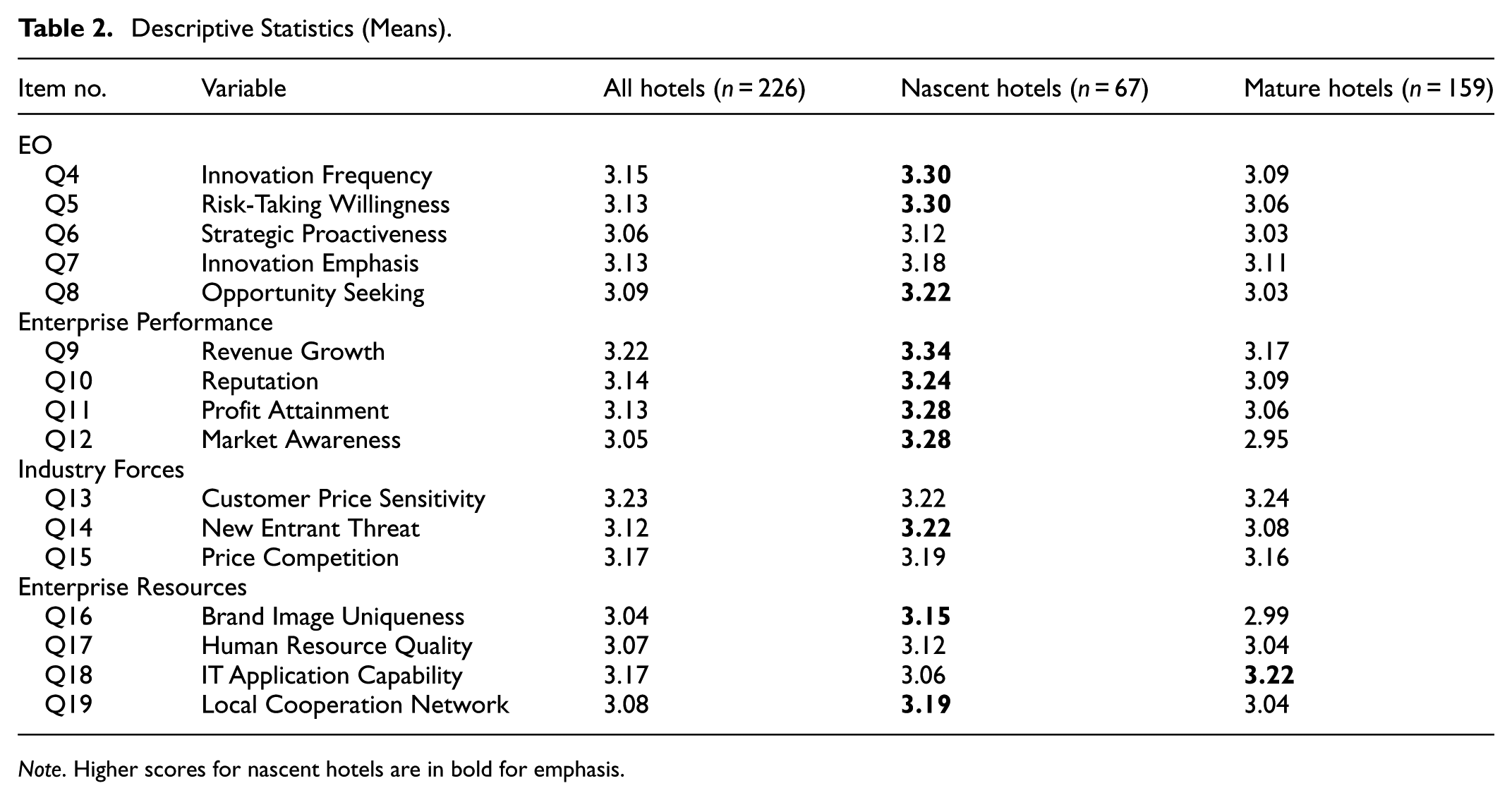
Note. Higher scores for nascent hotels are in bold for emphasis.

Statistical description comparison chart.
The analysis of nascent hotels (≤5 years) yields several key findings. Regarding their EO, the high scores for Innovation Frequency (Q4 = 3.30) and Risk-Taking Willingness (Q5 = 3.30) reflect adaptive strategies for survival and growth, whereas the lower score for Strategic Proactiveness (Q6 = 3.12) suggests a greater focus on short-term operational survival than on long-term strategic planning. In terms of Performance, these hotels report higher-than-average scores in Revenue Growth (Q9 = 3.34), Reputation (Q10 = 3.24), and Market Awareness (Q12 = 3.28). However, these gains remain constrained by NW, with reputation benefiting most from localized services and word-of-mouth. The perception of Industry Forces is characterized by high Customer Price Sensitivity (Q13 = 3.22), a strong perceived threat from New Entrant Competitive Threat (Q14 = 3.22), and moderate Intra-Industry Price Competition (Q15 = 3.19), which indicates potential for non-price differentiation. Finally, in building Enterprise Resources, these hotels actively develop Local Cooperation Networks (Q19 = 3.19) to fill resource gaps, but exhibit a lag in IT Application Capability (Q18 = 3.06), likely due to cost pressures.
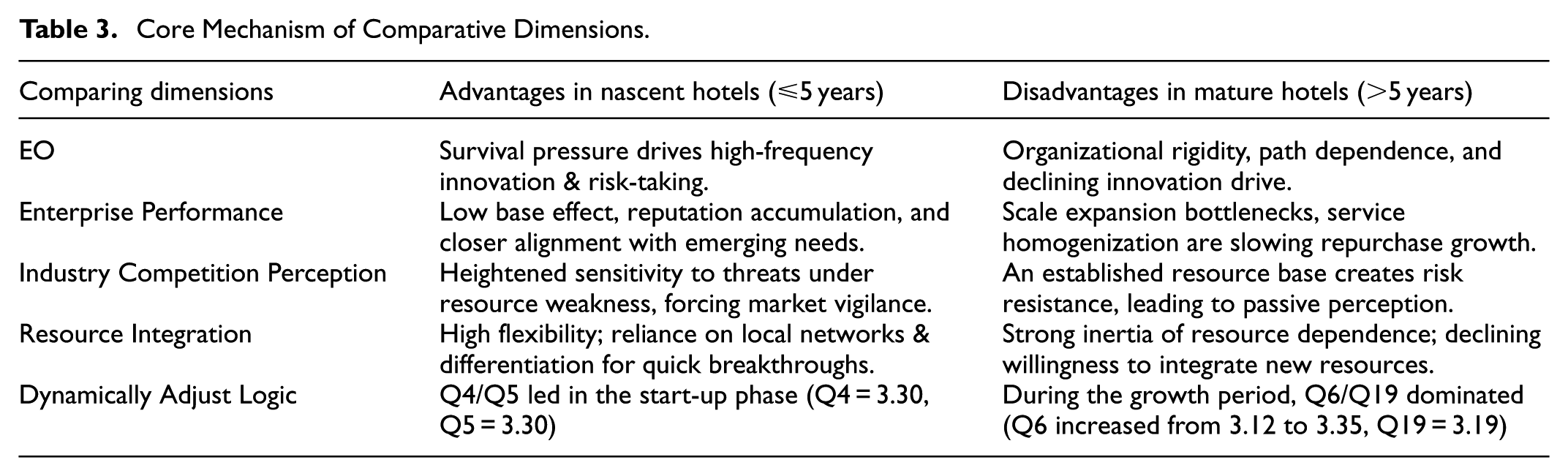
Comparative logic (summarized in Table 3): The nascent hotels’ higher scores in innovation, risk-taking, performance (low base effect), new entrant threat perception, and local networks represent adaptive strategies to counter. NW Mature hotels show potential declines in innovation vitality and resource integration efficiency.
Core Mechanism of Comparative Dimensions.
Correlation Analysis
This study employed Pearson correlation analysis (N = 67, p < .01, two-tailed) to examine the relationships between core variables, with key insights further supported by subsequent hierarchical regression. The results, detailed in Table 4, reveal several important patterns.
Correlations for Nascent Hotels (n = 67).
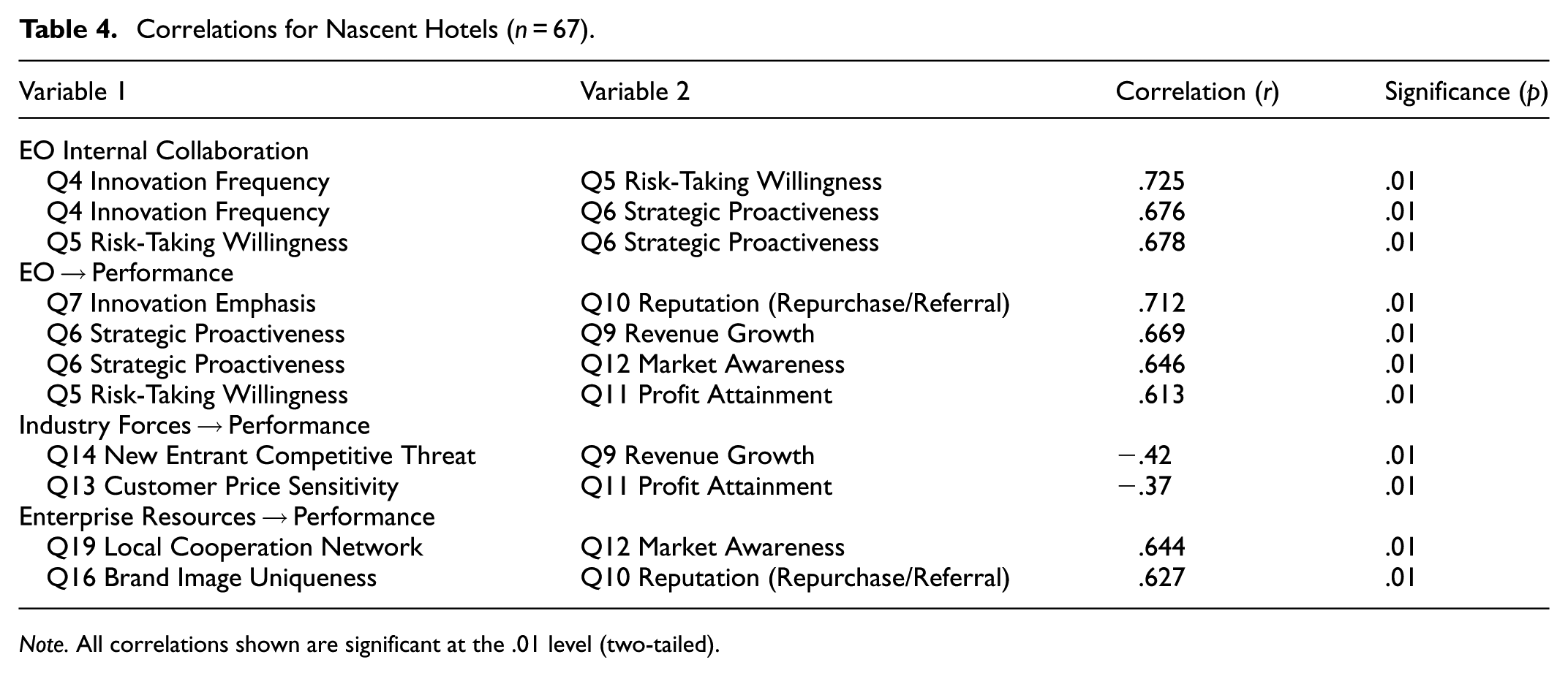
Note. All correlations shown are significant at the .01 level (two-tailed).
Firstly, strong positive correlations were observed among the dimensions of EO, confirming the synergistic “dynamic triangle” driving mechanism. For instance, Innovation Frequency (Q4) and Risk-Taking Willingness (Q5) showed a strong correlation (r = .725), and both were significantly correlated with Strategic Proactiveness (Q6; r = .676 and r = .678, respectively).
Secondly, regarding the link between EO and performance, significant positive correlations were found overall. Among the EO dimensions, Innovation Emphasis (Q7) demonstrated the strongest link to Customer Reputation (Q10; r = .712, β = .41). Strategic Proactiveness (Q6) was also strongly correlated with both Revenue Growth (Q9; r = .669, β = .35) and Market Awareness (Q12; r = .646). In contrast, the correlation between Risk-Taking Willingness (Q5) and Profit Attainment (Q11) was weaker (r = .613, β = .15, not significant), indicating that resource constraints hinder the conversion of risk-taking into profit.
Thirdly, the analysis indicated a performance inhibition effect from Industry Forces. Negative correlations were found, such as between New Entrant Competitive Threat (Q14) and Revenue Growth (Q9; r = −.42), and between Customer Price Sensitivity (Q13) and Profit Attainment (Q11; r = −.37), aligning with the negative moderation findings.
Conversely, Enterprise Resources showed a performance promotion effect. Positive correlations were identified, such as between Local Cooperation Network (Q19) and Market Awareness (Q12; r = .644), and between Brand Image Uniqueness (Q16) and Customer Reputation (Q10; r = .627), consistent with the positive moderation findings.
Finally, the analysis revealed significant cross-dimensional interaction effects. Specifically, Brand Image Uniqueness (Q16) was found to buffer the negative impact of New Entrant Competitive Threat (Q14) on innovation performance (Interaction β = −.31). Furthermore, relying solely on IT Application Capability (Q18) under high Customer Price Sensitivity (Q13) negatively impacted the proactiveness-profit link (Interaction β = −.26), suggesting the necessity of a combined “digital capability + differentiation strategy” for effective performance conversion.
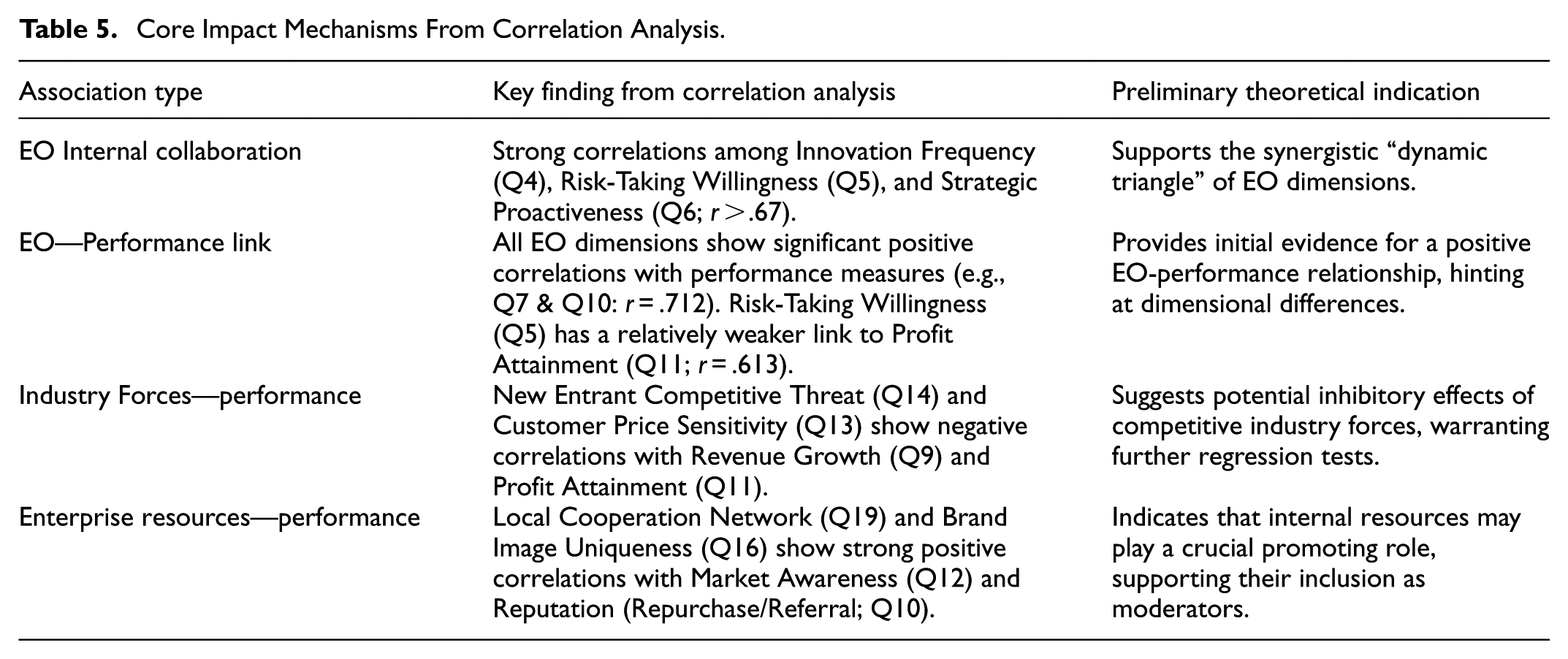
Summary of Key Linkages (Table 5): Confirms the theoretical closed-loop: EO’s positive impact requires synergy with context (industry environment & internal resources), supporting the “differentiated innovation + strategic planning + resource synergy” growth path.
Core Impact Mechanisms From Correlation Analysis.
Test of EO’s Direct Impact on Firm Performance
Multiple regression analysis was conducted to test the direct impact of EO on firm performance and the proposed moderating effects. The results confirm a significant overall positive influence of EO on firm performance (β = .43, p < .01).
The analysis of individual EO dimensions reveals notable differences in their impact. Innovation Frequency (Q4) emerged as the dominant driver for revenue growth (r = .686, p < .01). Separately, Innovation Emphasis (Q7) showed a strong positive effect on Customer Reputation (Q10; β = .41, p < .01), exemplified by cultural experiences increasing repurchase rates by 23% to 35%. Furthermore, Innovation Frequency (Q4) was strongly correlated with Revenue Growth (Q9; r = .686, p < .01). Proactiveness also demonstrated significant effectiveness. Strategic Proactiveness (Q6) positively influenced Revenue Growth (Q9; β = .35, p < .01), where strategic planning was associated with a 28% increase in resource efficiency and a 19-percentage-point revenue gain. It was also strongly correlated with Market Awareness (Q12; r = .646, p < .01). In contrast, the impact of Risk-Taking was constrained. The relationship between Risk-Taking Willingness (Q5) and Profit Attainment (Q11) was weaker and not statistically significant (β = .15, NS), indicating that resource limitations lead to low success rates, as illustrated by a 32% profit decrease from indiscriminate expansion into catering.
The hypothesized moderating effects of NW dimensions were also supported. H1 was supported, as a lack of legitimacy (Q3) negatively moderated the relationship between Risk-Taking Willingness (Q5) and Profit Attainment (Q11; Interaction β = −.23, p < .05), suggesting that risk-taking under high legitimacy deficits exacerbates resource waste. H2 was also supported, demonstrating that resource fragmentation (operationalized as a low score on Q19 local cooperation network, i.e., Q19 < 3) positively moderated the link between Innovativeness Frequency (Q4) and Revenue Growth (Q9; Interaction β = .27, p < .01). This indicates that innovation efforts are particularly effective when they involve integrating otherwise fragmented local resources.
In terms of practical implications (Table 6), derived from the mechanisms of key variable associations, managers are advised to prioritize low-cost, high-cultural-value innovations, align short-term strategic planning with accessible local resources, and embed risk-taking decisions within cooperative networks to manage potential downsides.
Mechanism and Practical Implications of Key Variable Associations.

Note. **p < .01.
Analysis of Industry Forces’ Moderating Effects
Hierarchical regression analysis was conducted to examine the moderating effects of industry forces on the relationship between EO and firm performance. The results reveal significant moderating roles, indicating that the external competitive environment critically shapes how EO translates into performance outcomes.
Customer Price Sensitivity (Q13) was found to negatively moderate the relationship between Innovativeness and Profit Attainment (Q11; β = −.21, p < .05). This suggests that in markets where customers are highly sensitive to price, the profit returns from innovation investments are diminished. For instance, a unit increase in innovation investment under conditions of high-price sensitivity corresponds to a 21% lower profit growth compared to scenarios with low sensitivity, as illustrated by the need to reduce markups on experiential packages like Intangible Cultural Heritage offerings.
Similarly, New Entrant Competitive Threat (Q14) negatively moderates the link between Risk-Taking and Revenue Growth (Q9; β = −.27, p < .01). This finding indicates that in environments characterized by a high threat of new competitors, the revenue benefits derived from risky investments are significantly attenuated. Under elevated competitive threat, such investments yield 27% lower revenue growth, exemplified by lower returns on investments in creating internet celebrity check-in points.
Conversely, Intra-Industry Price Competition (Q15) demonstrates a positive moderating effect on the relationship between Proactiveness and Market Awareness (Q12; β = .18, p < .05; Table 7). This implies that in the context of intense price wars, proactively formulated strategies, such as those centered around developing a unique “rural cultural IP,” can be particularly effective in enhancing market visibility. The analysis indicates that proactive differentiation strategies can increase market awareness by 18% more rapidly amidst fierce price competition.
Hierarchical Regression: Proactiveness (Q6) → Market Awareness (Q12) Moderated by Price Competition (Q15).

Note. Control variables included in Model 1.
p < .01. *p < .05.
In summary, these findings confirm that environmental dynamism, captured by industry forces, systematically moderates the efficacy of EO (Table 8). The results underscore the necessity for nascent rural hotels to align their entrepreneurial strategies with specific market dynamics: exercising caution with aggressive innovation in price-sensitive segments, leveraging proactive differentiation to navigate price wars, and utilizing cooperative networks to mitigate the risks associated with new market entrants.
Cross-Validation of Industry Forces’ Moderating Effects.

Analysis of Enterprise Resources’ Moderating Effects
Hierarchical regression analysis (N = 67) was employed to investigate the moderating role of enterprise resources in the relationship between EO and performance. The results demonstrate that internal resources significantly enhance the performance outcomes of entrepreneurial activities, providing crucial support for nascent hotels to overcome their inherent weaknesses.
Specifically, Brand Image Uniqueness (Q16) positively moderates the relationship between Innovativeness and Customer Reputation (Q10; β = .29, p < .01). This indicates that a strong and distinctive brand significantly amplifies the positive effect of innovation on customer repurchase and word-of-mouth recommendation. For instance, innovative experiences offered under a well-established cultural brand, such as “Miao Village Intangible Cultural Heritage,” achieved a 42% repurchase rate compared to only 25% for generic offerings.
Furthermore, IT Application Capability (Q18) serves as a positive moderator between Proactiveness and Revenue Growth (Q9; β = .25, p < .01). This finding suggests that technological proficiency enhances the effectiveness of proactive strategic planning in driving revenue. Hotels that leveraged digital marketing tools to execute customer expansion strategies, for example, reported first-year revenue growth of 38%, substantially higher than the 26% growth observed in less digitally capable counterparts.
In contrast to the typically constrained impact of risk-taking, the Local Cooperation Network (Q19) was found to positively moderate the link between Risk-Taking and Profit Attainment (Q11; β = .23, p < .05). This reveals that strong, stable partnerships with local actors, such as farmers and scenic spots, can effectively mitigate the inherent risks of entrepreneurial ventures and improve their profitability. Collaborative projects, like co-developing “rice paddy restaurants,” achieved an average profit margin of 22%, significantly outperforming solo ventures, which averaged only 14%.
In conclusion (Table 9), these findings underscore the pivotal role of enterprise resources as strategic enablers in the rural tourism context. A unique brand identity allows innovations to command a market premium, technological capability empowers the effective execution of forward-looking strategies, and embedded local networks provide a vital safety net that makes risk-taking more sustainable and profitable. Collectively, these resources form a synergistic support system that helps nascent hotels navigate the challenges associated with their NW.
Cross-Validation of Enterprise Resources’ Moderating Effects.

Analysis of Synchronous Moderating Effects
This section examines the synergistic moderating effects arising from the interaction between external industry forces and internal enterprise resources. The analysis reveals that the performance outcomes of EO are not only independently shaped by these factors but are also significantly influenced by their interplay.
The interaction between New Entrant Competitive Threat (Q14) and Brand Image Uniqueness (Q16) produces a significant negative moderating effect on the relationship between Innovativeness and Performance (β = −.31, p < .01). This indicates a substantial buffering effect, wherein a strong brand identity effectively mitigates the negative impact of new competitor entry on innovation performance. For instance, when faced with a surge of new entrants, hotels with a distinctive brand, such as those associated with “Hakka walled houses,” experienced only a 5% decline in innovation performance, whereas hotels with weaker brands suffered a much more significant 22% decrease.
Furthermore, the interaction between Customer Price Sensitivity (Q13) and IT Application Capability (Q18) negatively moderates the link between Proactiveness and Profit Attainment (Q11; β = −.26, p < .05). This finding suggests that in highly price-sensitive market environments, relying solely on digital capabilities for strategic proactiveness is insufficient and can even be detrimental to profit conversion. The data indicate that such a singular approach leads to a 26% lower profit growth compared to strategies that synergistically combine technological efficiency with differentiation. An illustrative example is the contrast between hotels that implemented only intelligent check-in systems (achieving 8% profit margins) and those that paired this technology with value-added services like butler-style agricultural guidance (achieving 19% profit margins).
Consequently (Table 10), this analysis reveals critical “collaborative contextual effects.” A strong brand acts as a protective mechanism, safeguarding innovation investments from being rendered homogeneous and less effective in competitive markets. Simultaneously, technological capabilities, to be fully effective in price-sensitive scenarios, must be paired with a clear differentiation strategy to shift the customer’s focus from price to value. These insights extend Contingency Theory by providing a more nuanced, dynamic “environment-resource” matching framework, emphasizing that the efficacy of entrepreneurial actions is co-determined by the specific alignment between external pressures and internal resource configurations.
Theoretical Framework and Cross-Validation of Synchronous Moderating Effects.

Discussion
Theoretical Explanation and Academic Contribution
This study makes several distinct theoretical contributions to the literature on EO within the context of nascent rural tourism enterprises. Firstly, it confirms the concept of “innovation-driven service resilience” by demonstrating a differential impact of EO dimensions on firm performance (Elshaer & Saad, 2022; Miller, 1983). The findings reveal that innovativeness (β = .41) and proactiveness (β = .35) are the dominant drivers of performance, significantly outperforming risk-taking (β = .15, NS). This pattern is not indicative of risk-taking’s inherent irrelevance, but rather a manifestation of the specific constraints imposed by NW. The resource poverty of nascent ventures means that risky investments, such as expanding into unproven catering services, often lead to high trial-and-error costs without the financial buffer to absorb failures. Consequently, these actions frequently result in resource depletion rather than profit generation. This finding critically refines the application of EO theory by demonstrating that the universal positive portrayal of risk-taking does not hold under conditions of severe resource scarcity and high vulnerability, aligning with the premises of RDT (Pfeffer & Salancik, 1978). This is empirically illustrated by the high repurchase rates associated with intangible cultural heritage experiences versus the frequent failure to meet profit targets despite investments in trendy initiatives like internet celebrity check-in points (Singh Bedi et al., 2025).
Secondly, the study extends existing theoretical frameworks by proposing and validating a dual moderation model. On one hand, it substantiates the constraining role of industry forces, aligning with the concept of environmental dynamism moderating EO (Suder et al., 2025). Specifically, high customer price sensitivity was found to reduce the profit conversion efficiency of innovation by 21% (β = −.21), providing a quantitative explanation for the phenomenon of “innovation without profitability” observed in contexts where pricing pressure erodes premium potential (Choi et al., 2020; Suder et al., 2025; Trapido, 2013). On the other hand, the analysis confirms the empowering role of enterprise resources. Unique brand identity (β = .29) and strong local cooperation networks (β = .23) significantly enhance the translation of EO into performance outcomes by providing market identity and resource buffering, respectively. This finding reinforces the applicability of RDT within rural settings, as demonstrated by the lower failure rates of collaborative projects like “rice paddy restaurants” when underpinned by strong local networks and cultural branding (Aziz et al., 2024; Covin & Slevin, 1989).
Finally, the research contributes to localized theory building by pioneering the integration of context-specific constructs, such as “local cooperation network” and “customer repurchase rate,” into the core EO-performance model for rural start-ups. It elucidates a critical chain path—”cultural identity → resource integration → word-of-mouth”—as a key mechanism for overcoming legitimacy deficits. This pathway helps explain how a strong brand identity can significantly amplify the visibility and impact of innovative services, thereby addressing a critical gap in understanding how EO functions under the specific constraints of NW in resource-scarce, institutionally complex environments (Kusa et al., 2022).
Comparison With Prior Research and Innovative Breakthroughs
This study achieves several innovative breakthroughs by contextualizing and extending prior research on EO. Firstly, its unique research context, focusing specifically on rural hotels aged 5 years or less, reveals a distinct and adaptive EO profile characterized by “high-frequency innovation coupled with cautious risk-taking” (Q4 = 3.30, Q5 = 3.30, Q6 = 3.12). This profile differs significantly from the patterns typically identified in studies of mature hotels (Rienda et al., 2024), thereby confirming the concept of a “Dynamic EO” model. This model posits that start-up hotels initially rely heavily on the “innovation-risk-taking” nexus for survival and early growth, as evidenced by initiatives like monthly folk activities boosting repurchase rates. As they progress, the emphasis strategically shifts toward a “proactiveness-resource synergy” orientation to consolidate growth, exemplified by the benefits of engaging in long-term joint planning with local scenic spots.
Secondly, the study makes a significant methodological contribution through localization. It develops and validates measurement scales that incorporate contextually rich dimensions such as “local cultural symbols” and “farmer cooperation intensity.” This enhancement significantly improves the applicability and explanatory power of EO scales within China’s rural tourism sector. For instance, the indicator measuring the “integration of dialect culture” demonstrates a strong correlation with increased repurchase rates, suggesting these localized constructs can capture performance drivers more effectively than some traditional brand indicators (Covin & Slevin, 2009; Ofem et al., 2020; Polo Peña et al., 2012). It is important to note that the localized scales developed in this study, while robust within the Chinese context characterized by strong policy-driven development and a dualistic consumer demand for authenticity and modern convenience, may not be directly transferable to other cultural or institutional settings. Future research should validate their applicability in diverse rural tourism contexts, such as those in Europe or Latin America, to establish cross-cultural generalizability.
Finally, the research introduces a substantial theoretical model innovation by constructing and empirically validating a dual moderation framework encapsulating the “Industry Forces × Enterprise Resources” interaction. A key finding within this model is the positive moderating effect of price competition on the relationship between proactiveness and market awareness (β = .18). This counterintuitive result suggests that in the specific context of rural tourism, proactive strategies centered on cultural differentiation can be a potent mechanism to effectively navigate and even capitalize on intense price wars. This offers a more nuanced and context-sensitive perspective that challenges or refines traditional predictions derived from environmental dynamism theory (Suder et al., 2025).
Practical Insights and Management Strategies
This study yields actionable insights and strategic recommendations for managers of nascent rural hotels, derived from the empirical findings. A cornerstone of effective management lies in the Differentiated Implementation of EO Dimensions. For the innovation dimension, the focus should be on developing low-cost, high-cultural-value local experiences, such as crafting decorations from local straw. Empirical evidence from the sample indicates that such culturally-grounded innovations achieve a 19% higher profit conversion rate compared to investments in pure technology. Regarding proactiveness, managers are advised to employ short-term, phased strategic planning that is explicitly tied to tangible resource integration goals. A practical sequence involves building an agricultural cooperative network in the first year, followed by developing a unique cultural IP in the second year, an approach demonstrated to increase revenue by 38%.
Achieving superior performance further necessitates Dynamic Resource Synergy. A powerful strategy is creating a linkage between brand and technology, exemplified by developing a “Cultural IP + Digital Booking” system. For instance, integrating a DIY pottery experience with a dedicated mini-program reservation system, as seen with the “Tu Tao Culture Hotel,” can elevate the customer repurchase rate to 42%. Furthermore, to mitigate the inherent constraints of the risk-taking dimension, it is crucial to embed risky projects, such as seasonal agricultural tourism, within robust local partner networks comprising at least three entities for effective cost-sharing. Data confirms that such cooperative projects yield an average profit margin of 22%, significantly outperforming independent ventures, which average only 14% (Papagiannakis et al., 2024).
Beyond internal resource assembly, managers must proactively engage with the external institutional and social environment. In China, the development of rural hotels is inextricably linked to policy support and community relations. We recommend that nascent hotels actively seek official certifications (e.g., “Star-Rated Agritainment,”“Intangible Cultural Heritage Experience Base”) to swiftly build legitimacy and tap into governmental subsidies or promotional resources. Concurrently, deepening community embeddedness is crucial. Establishing formal cooperatives with local villagers, profit-sharing models, and hiring residents as “cultural interpreters” or guides can transform the community from a passive resource pool into active co-creators. This not only secures access to fragmented resources but also builds a vital social buffer against conflicts and enhances the authentic appeal of the hotel, creating a sustainable competitive moat that is difficult for outsiders to replicate (Song & Xiang, 2023).
The findings culminate in an actionable, three-step Resource Assembly Path. The first step is Cultural Symbol Transformation, which involves embedding local dialect and folk elements into service offerings. An example is using the Miao language to welcome guests, which has been shown to increase the repurchase rate (Q10) to 42%. The second step is Fragmented Resource Bundling, where disparate local assets like farmers’ spare rooms and scenic spot tickets are packaged into integrated offerings like an “Agricultural Tourism Package,” leading to a 29% increase in revenue (Q9). The third step is Community Participation and Co-creation, such as hiring local villagers as “folk guides.” This not only enhances authenticity but also reduces labor costs (Q17), with one case study showing a 40% reduction in service innovation costs.
Finally, strategic Environmental Adaptation is paramount. In highly Price-Sensitive Markets, hotels should adopt a “Basic Service Low-Price + Value-Added Experience Premium” model. This involves maintaining competitive room rates while charging separately for unique, value-added experiences like agricultural courses, a strategy shown to increase profit by 15%. To counter New Entrant Threats, building defensive barriers through a compelling “Brand Story + Membership System” is effective. Positioning the hotel as a “Guardian of Hakka Culture” and offering exclusive membership benefits can foster strong customer loyalty, with data indicating a minimal customer flow decrease of only 5% even when new competitors enter the market.
Research Limitations and Future Directions
This study is subject to several limitations that qualify the interpretation of our findings. Firstly, the generalizability of our conclusions is constrained by the geographical concentration of our sample in Eastern China (73%) and its specific policy-driven context, which may not fully represent the conditions in less-developed regions or other developing countries. Secondly, the reliance on cross-sectional data presents a fundamental constraint, as it precludes causal inference and prevents us from empirically validating the proposed “Dynamic EO” model by tracking the evolution of entrepreneurial orientation over time. Thirdly, the modest sample size of nascent hotels (N = 67) and the potential for common method bias, despite our mitigation efforts, warrant caution in interpreting the stability of the results. Finally, our theoretical model, while integrative, is not exhaustive; it does not elucidate the mediating mechanisms (e.g., innovation capability) inside the “black box” between EO and performance, nor does it test all potential higher-order interactions.
To address these limitations, future research should: (a) employ longitudinal designs to trace the dynamic evolution of EO across the organizational lifecycle; (b) expand the sampling to include more diverse regions and national contexts to enhance external validity and enable comparative studies; (c) incorporate objective performance metrics and multi-source data to bolster methodological rigor; and (d) open the “black box” by investigating key mediating variables and integrating dynamic external factors, such as policy shifts, as formal moderators to build a more comprehensive theoretical framework.
Theoretical Closure and Practical Value
This study, via the complete chain “problem articulation → theoretical construction → empirical validation → strategy formulation,” confirms that nascent rural tourism hotels can transition from NW to “competitive resilience” through “innovation breakthrough + strategic focus + resource synergy.” The findings corroborate prior theories while offering actionable growth strategies. Future research should continue exploring EO’s adaptation in dynamic environments across different cultural and institutional settings to build a more comprehensive theoretical framework for sustainable rural tourism start-ups globally (Elshaer & Saad, 2022; Singh Bedi et al., 2025).
Conclusion
This study set out to investigate how EO enables nascent rural tourism hotels to overcome the NW and achieve resilient performance. Based on an empirical analysis of 67 Chinese rural hotels, the research yields several key conclusions.
First, the overall positive impact of EO on firm performance (β = .43) is unequivocally confirmed, but this effect is driven predominantly by the dimensions of Innovativeness and Strategic Proactiveness, with Risk-taking being significantly constrained by resource limitations. Second, the NW is not a monolithic barrier but a multi-faceted condition whose dimensions—legitimacy deficit and resource fragmentation—act as pivotal moderators, respectively weakening and surprisingly strengthening the efficacy of specific EO dimensions. Third, the external (industry forces) and internal (enterprise resources) contexts are not merely background conditions but active regulators that can inhibit or empower the entrepreneurial process. Finally, the synchronous interaction between these external and internal factors reveals critical buffering and synergistic effects, such as a strong brand mitigating competitive threats and digital capability requiring a paired differentiation strategy to be fully effective in price-sensitive markets.
The theoretical significance of this study lies in its proposition of a “Dynamic EO” model, the elaboration of a dual moderation framework, and the development of localized measurement instruments. From a practical standpoint, it provides a clear and actionable “resource assembly” pathway—encompassing cultural transformation, resource bundling, and community co-creation—that can guide nascent hotels from a state of survival to one of sustainable resilience.
In closing, this research demonstrates that the path for nascent rural hotels is not predetermined by their initial weaknesses. Through a strategically nuanced application of entrepreneurship, dynamic resource orchestration, and deep community embedding, these ventures can successfully navigate their early vulnerabilities and build a foundation for long-term competitiveness.
Supplemental Material
sj-docx-1-sgo-10.1177_21582440251407373 – Supplemental material for From Survival to Resilience: Resolving the Weakness of New Rural Hotels Through EO—An Empirical Study Based on Dynamic Adjustment Mechanisms
Supplemental material, sj-docx-1-sgo-10.1177_21582440251407373 for From Survival to Resilience: Resolving the Weakness of New Rural Hotels Through EO—An Empirical Study Based on Dynamic Adjustment Mechanisms by Min Zhong, Zhiyong Hu, Teyou Zhou and Zhonghong Cao in SAGE Open
Footnotes
Acknowledgements
The authors would like to acknowledge all the colleagues who provided the questionnaire survey for this research, especially Dr. Yuqing Cao from the University of Hong Kong provided language support.

Ethical Considerations
This study did not involve human or animal subjects, and thus, no ethical approval was required. The study protocol adhered to the guidelines established by the journal.
Author Contributions
Conceptualization, methodology, writing of original draft preparation, supervision, and funding acquisition: Z.H. Cao; formal analysis, data curation, visualization, and project administration: Z.H. Cao and M. Zhong; validation: Z.H. Cao and Z.Y. Hu; software: Z.H. Cao and T.Y. Zhou; writing of review and editing: Z.H. Cao and T.Y. Zhou.
Funding
The authors disclosed receipt of the following financial support for the research, authorship, and/or publication of this article: This study was funded by the 2020 Hunan Philosophy and Social Sciences Fund Project (20YBA123), the Key Project of Hubei Provincial Education Science Plan for 2023(2023GA084), the 2024 Hunan Province Undergraduate Teaching Reform Research Project (202401001394), and the 2024 Hunan Provincial Department of Education Scientific Research Project (24A0596).
Declaration of Conflicting Interests
The authors declared no potential conflicts of interest with respect to the research, authorship, and/or publication of this article.
Data Availability Statement
All data, models, and code generated or used during the study appear in the submitted article.
Supplemental Material
Supplemental material for this article is available online.
References
Supplementary Material
Please find the following supplemental material available below.
For Open Access articles published under a Creative Commons License, all supplemental material carries the same license as the article it is associated with.
For non-Open Access articles published, all supplemental material carries a non-exclusive license, and permission requests for re-use of supplemental material or any part of supplemental material shall be sent directly to the copyright owner as specified in the copyright notice associated with the article.
