




Abstract
This study examined the effects of team identification (TI) on entrepreneurial orientation (EO) and innovative work behavior (IWB) and its dimension (idea exploration, idea generation, idea promotion, and idea implementation). In addition, this research also studied the mediating role of entrepreneurial orientation in the relationship between team identification and innovative work behavior and its dimension. Data (n = 357) were collected from employees working in software companies of Pakistan by using a time lag research design. Results advocated that team identification was significantly associated with entrepreneurial orientation and innovative work behavior and its dimensions. Likewise, entrepreneurial orientation mediates the association of team identification and innovative work behavior and its dimensions. Thus, this study presents distinctive insight into team identification in the IT sector, how team identification impact on innovative work behavior of employees through entrepreneurial orientation.
Keywords
Introduction
Organizations require innovations to encounter evolving challenges and problems due to fluctuating marketing trends, high customer expectations, and growing global competition (Muchiri et al., 2020; Somech & Khalaili, 2014). These uncertain conditions need individuals to involve in innovative behaviors to uplift the existing state (Castro & Zermeño, 2020). Therefore, innovation assists the firms to remain effective and extensively recognized as a critical component for business prosperity (Janssen, 2004). One of the most acceptable approaches to inducing innovation is exploiting individuals’ innovative capabilities, guaranteeing continual and everlasting effectiveness (De Jong & Den Hartog, 2010), and exploiting individuals’ innovative capabilities that can impart most effectively to firm success by exploring, creating, championing, and executing unique and valuable ideas to enhance work practices, services, and products referred to as innovative work behavior (Janssen, 2000). Hence, firms need to recognize and improve the elements that stimulate individuals’ innovative behavior in the work setting (Afsar & Umrani, 2019). Innovative work behavior (IWB) can be considered an energetic multidimensional phenomenon that includes creativity (Khan et al., 2020).
Innovative work behavior is a multistage process that consists of four phases. First, the two phases’ idea exploration and idea creation, are related to creativity. The last two phases, idea championing and idea implementation, are related to innovation. Due to some organizational constraints, individual employees may not successfully exploit the opportunities to implement the ideas. Considering this, it is essential to independently evaluate each phase of innovative work behavior (Li et al., 2020). To attain and sustain a competitive advantage in the current complex and uncertain economic milieu, the firm needs to promote condition that encourages innovative behavior (Chang et al., 2021), that is, the creation, promotion, and recognition of practical new ideas (Chen et al., 2016; Janssen, 2000). Innovative work behavior demands both the cognitive and emotional involvement of employees (Janssen, 2004).
TI as a social identity process might be predominantly vital to determine employees’ innovative work behavior (Gumusluoglu et al., 2017) as identification promotes cognitive, evaluative, and affective components of employee involvement (Hogg, 2018). TI has arisen as a prominent variable that significantly influences individual attitudes and behavior (e.g., Van Dick, 2004). TI is defined as “a sense of oneness” (Johnson & Avolio, 2018). TI can also be referred to as the degree to which individual employees recognize themselves with a specific work team instead of the whole social group they belong to (Gundlach et al., 2006). TI stimulates team members to be involved in activities that work in the group’s best interest and fortify the bonds between them (Ruggieri & Abbate, 2013). TI is an essential element in developing team members’ loyalty that enhances satisfaction and commitment, eventually improving team performance (Guan et al., 2013). The effects of TI on the subsequent team (Litchfield et al., 2018) and individual innovative outcomes have been explored (Song et al., 2018). However, the intermediary mechanisms (EO) which transform these effects are needed to explore.
Entrepreneurship signifies one of the prominent facets of socio-economic success (Coulibaly et al., 2018) and plays a significant part in economic development (Mahfud et al., 2020). More specifically, entrepreneurship leads to competitiveness, increases productivity and job creation, motivates the organization to be innovative, and behaves effectively (Mortan et al., 2014), generating wealth and decreasing unemployment (Paul & Shrivatava, 2016). Therefore, EO has gained significant importance (Covin & Lumpkin, 2011; Ferreira et al., 2019; Wiklund & Shepherd, 2011). Furthermore, there is plenty of empirical evidence and consensus; EO increases an organizational, economic performance, and success rate (Martens et al., 2016).
In entrepreneurial research, EO is one of the essential variables of study needed to explore at the individual level (Covin & Lumpkin, 2011; Ferreira et al., 2019; Wiklund & Shepherd, 2011). Indicators recommended that EO endure a highly spirited research concept and demanded constant attention and vibrant argument of scholars (Martens et al., 2016; Wales, 2016). Previously EO has been seen at the corporate level (considered a firm-level or business unit level variable that cannot be analyzed individually; e.g., Song et al., 2019; Cuevas-Vargas et al., 2019). Very little empirical consideration has been given EO at the individual level (Rigtering et al., 2019). However, despite several calls to better comprehend how individuals may add to the entrepreneurship of an organization (Covin & Wales, 2019; De Clercq et al., 2010; Wales et al., 2011). Minute experimental research is devoted to individual EO (Rigtering et al., 2019). Therefore, there is a need to investigate the EO at the individual level (Covin et al., 2020). Individual EO can define a particular employee inclination to be involved in proactive, risk-taking, and innovative behavior (Jong et al., 2015). This conceptualization recognizes that those who work out with the latest technologies with promising ideas by taking the risk to exploit opportunities are entrepreneurial employees (Lee & Peterson, 2000). Therefore, entrepreneurial employees are more risk-taking and proactive in exploring and use available options and are more prone to innovative work behavior. Contrasting to conventional work performance, IWB is a resource-challenging effort that wants individuals to devote substantial resources in all stages of the innovation process. In addition to this, Bernoster et al. (2018) recommended identifying the driver of individual EO.
Our research adds and complements the current investigation in numerous ways. First, this research expands EO literature as there is a need to investigate EO at the individual level (Covin & Lumpkin, 2011; Ferreira et al., 2019; Wiklund & Shepherd, 2011). The first research examines the critical connection between TI and innovative work behavior through EO. Second, very few studies have investigated the dimensions of innovative work behavior (Bagheri & Akbari, 2018; Veenendaal & Bondarouk, 2015). A recent call for researchers examines the dimensions of innovative work behavior (Li et al., 2020). Correspondingly, this study will evaluate the dimensions of IWB. Third, this research aimed to complement the literature of the IT sector of Pakistan, as this is a most overlooked and under-research sector. The current paper investigates the relationships between TI, EO, and IWB of employees in the IT sector of Pakistan.
Literature Review
The social identity theory suggests that a significant element of self-concept (i.e., how we see ourselves) is connected with belongingness to social groups (Hogg & Rinella, 2018). Identification represents the perception of oneness within a team whereby the individual considers the team goals and objectives as their own (Hogg, 2018). Generating an influential individual motivation contributes to the team’s objectives and achievements (Linet al., 2017). Indeed, the most significant motivational element of identification is attached with cognitive processes; thus, individuals’ perception of self-concept is contingent on the perceived value and group’s status. Therefore, the highly identified individuals with their team will strive to achieve the team’s objectives (Lin et al., 2017) through involvement in the behavior required for team success, such as IWB.
Innovative Work Behavior
Generating and nurturing innovation has long been a prime task for all leading organizations, regardless of structure, culture, nature, or size (Kang et al., 2015). Specifically, in highly complex and challenging work environments (Chen et al., 2016), software companies have struggled with enthusiastic team members for IWB and producing a suitable climate for innovation (Ballein, 1998; Radaelli et al., 2014; Xerri, 2013). Innovative work behavior has been considered an essential element for an individual contribution toward an effective organization performance (Ng & Feldman, 2013; Weng et al., 2015). Researchers have frequently described innovative work behavior as the intentional initiations and struggle put by an employee to create novel ideas, promote, and execute these ideas to increase the success of their work (Chen et al., 2016; De Jong & Den Hartog, 2010; Kessel et al., 2012; Radaelli et al., 2014). Idea exploration and idea creation are the first two stages of the innovative process committed by individual cognitive capabilities. In these stages, individuals utilized existing knowledge to recognize problems and create novel ideas to resolve the issues. In idea promotion and idea implementation processes of innovation, an individual must promote and execute novel ideas. The success of the last two stages (idea promotion and idea implementation) depends on employees’ abilities to persuade top management and their colleagues to realize the worth of their ideas and construct their promise to implement these ideas (De Jong & Den Hartog, 2010; Mumford, 2003).
It is also valuable to understand that exploring, creating, championing, and implementing new ideas by an employee is a heavy task to manage (Bunce & West, 1994). However, all these activities demand cognitive and emotional involvement (Janssen, 2004). Contrary to routine work, innovative work behavior signifies a resource-challenging effort that needs individual employees to devote substantial resources in each stage of innovation (Bagheri & Akbari, 2018). For instance, the creative work related to idea creation infers involvement in various activities (e.g., identifying and defining the problem, collecting information, evaluating, and refining the idea) that need persistence effort over an extended period (Mumford et al., 2002). Furthermore, after developing creative ideas, more emotional endeavors are necessary for the idea promotion stage to reduce potential resistance of the team members toward new ideas and gain backup support from strategic decision-makers (Janssen, 2004). Lastly, individuals require devoting extra cognitive energies to analytical tasks to face unforeseen hurdles because unforeseen barriers may come during the implementation stage of innovation (Bledow et al., 2009). Consequently, a continuing extraordinary amount of resources are vital to produce innovative endeavors to respond to an augmented work-related task (Agarwal et al., 2012).
Team Identification
Researchers relate social identity theory to the innovation process to improve the understanding of the social-psychological processes by which individual TI stimulates employees’ innovative work behavior. Employees’ TI values impact employees’ behavior by inducing changes in the thinking process. They consider themselves part of the team and recognize the team goal as their own, modifying their identity or self-concept (Erez & Nouri, 2010; Ng & Lucianetti, 2016). Employees’ identity is an essential component of self-conception that individuals are related or affiliated with their team. The social identity approach also specified that identification with a group originated from the need for self-enhancement and self-categorization (Smidts et al., 2001).
Keeping in view this, researchers suggest that different amounts of TI among individuals will be associated with their intensity of affiliation and cognitive need. Thus, TI denotes the intensity of the psychological association perceived by employees toward their team (Bezrukova et al., 2009; Tang et al., 2014). Social identity premise further argues that identification with the particular team can observe as social identification that leads to both effect and cognition-based ties among team members (Gundlach et al., 2006; Tajfel, 2010). Thus, under the TI process, employee behaviors and emotions will be grounded based on team benefits instead of an individual (Herman & Chiu, 2014).
The team members who possessed TI have a strong willingness and motive to give up individual aims and objectives for the team (Tang et al., 2014). TI assists team members in orienting themselves behaviorally, affectively, and cognitively with the team. TI fosters the faith that individual self-worth is existed only in recognizing the team standards (Gundlach et al., 2006; Tang et al., 2014). Conclusively, TI provides individuals meaningfulness of their role and emotional perception of importance and triumph in building their role more desirable and attractive by linking this with individual needs and feelings. The higher the TI, the greater the individuals will embrace it in their self-conception and express themselves in the meanings of the team. Therefore, TI is an ingrained inclination of individual employees to identify with their team.
TI is an essential psychological component that impacts employee innovative work behavior (Dollinger et al., 2005; Farmer et al., 2003; Tang et al., 2014). The social identity premise suggests that TI pushes individuals to concentrate on valuable, favorable, and team interests, comprising information and knowledge sharing and collaborative teamwork. These enhance the innovative behavior of employees (Tang et al., 2014) and its dimension. Furthermore, strong TI team members dynamically exploit new ideas by using the information in hand, utilizing new opportunities, and creating innovative solutions (Hwang & Choi, 2020).
Hypothesis 1: Team identification is positively associated with the innovative work behavior of employees.
Hypothesis 2a: Team identification is positively associated with idea exploration.
Hypothesis 2b: Team identification is positively associated with idea generation.
Hypothesis 2c: Team identification is positively associated with idea championing.
Hypothesis 2d: Team identification is positively associated with idea implementation.
Entrepreneurial Orientation
Individual EO is an employee inclination toward entrepreneurial behavior (Antoncic & Hisrich, 2001), comprising three elements, that is, innovativeness, risk-taking, and pro-activeness (Covin & Slevin, 1989). Innovativeness comprises novelty, experimentation, creativity, and technological leadership in processes and product development (Lumpkin & Dess, 1996; Lyon et al., 2000). Risk-taking behavior is the willingness to create substantial and risky resource devotion and dedication for undertakings uncertain outcomes (Boohene et al., 2012; Lumpkin & Dess, 1996; Lyon et al., 2000). Moreover, Pro-activeness is an employee’s progressive (Wiklund & Shepherd, 2005) discretionary working behavior on potential business opportunities (Lumpkin & Dess, 1996) toward organizational performance.
Individual EO (IEO) is a consequence of entrepreneurial behavior commissioned by the firm and unstructured behaviors by the individual employees and unendorsed by the firm (Hayton & Kelley, 2006; Pinchot, 1985). Researchers suggest a lack of empirical indicators and theoretical foundation on how EO might improve firm performance (e.g., Covin & Wales, 2019; Wales et al., 2011), like innovative work behavior. However, the researchers recognize that the achievement of an organizational, entrepreneurial effort cannot be removed from the organization’s members that established the firm’s broader base (Covin & Wales, 2019).
The whole definition can be explained as; risk-taking is an individual readiness to carry out tasks that have uncertain outcomes via discretionary unconstitutional positive job-related behavior. Pro-activeness is an individual enthusiastic, self-initiative behavior that intends to respond and anticipate novel value-creating opportunities. Finally, innovativeness is individual flexibility to adopt novel ideas to avail opportunity in the organization’s best interest. To induce radical changes at workplace, these three dimensions are considered vital. We assume that an individual employee can willingly go beyond their said job and induce entrepreneurial behavior to improve organizational performance (Covin et al., 2020) by initiating IWB.
EO can be defined as “the strategy creating practices that assist the entrepreneur with a solid foundation for entrepreneurial decision and behaviors” (Rauch et al., 2009, p. 762). EO also involves consequences and management-associated values, principles, preferences, and actions demonstrated by top-level organization leaders (Covin et al., 2006). Initially, Lumpkin and Dess (1996) presented five dimensions of EO (pro-activeness, innovativeness, autonomy, risk-taking, and competitive aggressiveness). These dimensions are conceptually related to firm willingness and ability to be innovative proactively and respond to anticipate changes and risk-taking behavior (Covin & Slevin 1989). Pro-activeness denotes an organization’s capability to anticipate and work on evolving opportunities in a business scenario and frequently crafting a first-mover advantage against competing firms. Innovativeness represents a propensity to leave the existing methods by encouraging novel ideas and experimentation. Risk-taking is defined as an organizational willingness to allocate significant capital to plans where the price of defeat may be considerable and aftermaths are unclear. Two more dimensions of EOs are autonomy and competitive aggressiveness. Autonomy indicates that a firm can make an independent decision regarding a new venture (Balodi, 2014). Competitive aggressiveness denotes an organizational inclination to challenge rival firms to improve market share and block new market entrants. According to Laukkanen et al. (2013), various dimensions of EO can be in process based on different available opportunities.
Scholars theorized that EO help to cope with increased globalization, reduced product life cycles, and a fast-changing competitive situation that may lead to more incredible organizational performance (Kreiser et al., 2002; Tang et al., 2008; Wiklund & Shepherd, 2003). Entrepreneurial organizations are prone to identifying and utilizing opportunities more quickly than their competitors and are more enthusiastic about taking corporate financial risks by making courageous, competitive decisions (McGee & Peterson, 2019). Furthermore, TI promotes the oneness and unity of the team. Team members observe the team objectives and aim as their own and show more risk-taking, proactive, and innovative behavior to achieve the competitive edge by involving in EO.
Hypothesis 3: Team identification is positively related to entrepreneurial orientation.
Entrepreneurial Orientation as a Mediator
TI can increase an individual psychological safety that may induce EO, and employees may be more innovative (Farmer et al., 2015) proactive and risk-taking behavior. In sum, we suggest that EO can mediate the association between TI and IWB. Thus, employees’ TI increases EO and further stimulates innovative work behaviors and their dimensions. The research framework of the study presents in Figure 1.
Hypothesis 4: Entrepreneurial orientation mediates the relationships of team identification with the innovative work behavior of employees.
Hypothesis 5a: Entrepreneurial orientation mediates the relationships of team identification with idea exploration.
Hypothesis 5b: Entrepreneurial orientation mediates the relationships of team identification with idea generation.
Hypothesis 5c: Entrepreneurial orientation mediates the relationships of team identification with idea promotion.
Hypothesis 5d: Entrepreneurial orientation mediates the relationships of team identification with idea implementation.

Research framework.
Methodology
Participants and Procedure
Only permanent employees of software companies of Pakistan were included in the research to collect data. Time lag research design was applied to collect data from the employees of software companies. Data was gathered 3 weeks apart at two-time points. The objective of the time lag research design was to reduce common method biased effects. Outcome and criterion variables are measured separately (Podsakoff et al., 2012). They recommended that predictor and criterion variables be calculated independently, and there should be a suitable gap to reduce common method bias effects.
Similarly, 3 weeks measurement gap was executed in previous research studies (Demirtas & Akdogan, 2015; Kim & Beehr, 2017; Zohar & Polachek, 2014). The respondent feedback on study variables was collected in two phases; in the first phase, we collected data related to the independent variable (TI) and mediating variable (EO); in the second phase, we collected data of the dependent variable (IWB) and mediating variable (EO).
Out of these 550 respondents, only 452 filled the questionnaire in first phase that comprised of TI, and EO related items. Of these, 411 (74%) employees filled the second phase survey questionnaire (comprised of IWB, and EO-related items) 3 weeks later. Low effortful responding (respondents who take less than half the time to complete the questionnaire), incomparable survey forms of Time 1 and Time 2, missing data questionnaires were removed, and a total of 54 respondent data were eradicated. As a result, finally, 357 respondents answered both surveys. Out of these total respondents, 65.5% were male, 34.5% were female. 68% of employees have age less than 35 years. Only 9.5% of employees have age more than 45 years. Regarding education, only 10.4% of employees had high school or technical school diplomas, 38.3% had an associate degree, 27.4% had bachelor’s degrees, and 23.9% had master’s degrees and higher. The average tenure of the employees with current organizations was 4.52 years.
Measure
Time 1 (T1) measurement survey was comprised of TI and EO. The time 2 (T2) measurement survey was comprised of innovative work behavior and EO. Hence the mediator EO questionnaire was included in both surveys. The researchers took an average of both surveys’ questionnaire responses (selected as T1½ + T2½) of EO. Conceptually considering the temporal factor, the mediator has impacted the timing of independent and the outcome variables, which recommend that data be collected in three phases. However, to avoid excessive sample attrition, the researcher employed a measurement survey two times (T1 and T2) 3 weeks apart as previous researches (Demirtas & Akdogan, 2015; Kim & Beehr, 2017; Zohar & Polachek, 2014). Thus, the mediator EO was assessed in both measurement surveys and took the mean of both times point responses (selected as T1½ + T2½). To avoid too much biasness, we used to collect data two times, 3 weeks apart.
Innovative work behavior
To assess employees’ IWB, we used a ten-item scale developed by De Jong and Den Hartog’s (2010) applied in prior research to assess employee IWB and its dimension (Bagheri & Akbari, 2018). The dimensions of innovative work behavior include idea exploration, idea generation, idea promotion, and idea implementation. Two items were applied to measured idea exploration, e.g., “I pay attention to issues that are not part of my daily work?” Three items were applied to measured idea generation, e.g., “I find new approaches to execute tasks?” Similarly, idea promotion and implementation were measured by two (e.g., “I attempt to convince people to support an innovative idea?”) and three (e.g., “I put the effort in the development of new things?”) items, respectively. Respondents were asked to specify their consent on the items using a 5-point Likert scale (1 = strongly disagree to 5 = strongly agree). Cronbach’s alpha for this scale was .86.
Entrepreneurial orientation
To measure individual EO, we used Covin et al. (2020) 9-item measurement scale. The scale was used in a previous study to measure individual EO (Covin et al., 2020). An example item is “I have minimal problems with renewal and change.” Respondents were asked to specify their consent on the items using a 5-point Likert scale (1 = strongly disagree to 5 = strongly agree). Cronbach’s alpha for this scale was .89.
Team identification
TI was measured by the 5-item scale of Smidts et al. (2001). An example item is “I feel strong ties with my team.” In addition, respondents were asked to specify their consent (1 = Not at all to 5 = to a Very great extent) on a 5-point Likert scale. Cronbach’s alpha for this scale was .80. Reliability scores show that all measures were highly reliable and eligible for data analysis.
Control Variables
Demographic variables like education, tenure with current organization, age, and gender were examined as control variables. The researcher statistically analyzed the result with or without the control variable and found it statistically significant in both cases. Furthermore, Williams et al. (2009) recommended that results are reported without control variables; however, we will notify the result with control variables.
Common Method Variance (CMB)
CMB may concern the current study as self-reported scales were utilized. To minimize the likelihood of CMB, we ensure the confidentiality and anonymity of the respondent (Chang et al., 2010), which invigorated the respondents to be truthful while rating the survey. Furthermore, the survey questionnaires were kept clear and straightforward to comprehend the employees better (Podsakoff et al., 2003). Harman’s single factor test was executed to confirm the CMB (Podsakoff et al., 2003). The result revealed that the single-factor solution model is a poor fit. The single factor matrix explained 31.98% of the variance, which specified that CMB was not likely a threat for the current study (Podsakoff et al., 2012).
Data Analysis and Results
Validity Issues
Amos 20 was used to perform confirmatory factor analysis to evaluate the individuality among the study variables. To evaluate measurement model fit, we trusted several indices (Kline, 2005). An acceptable model fit can be deduced when the goodness of fit index (GFI), comparative fit index (CFI), and Tucker-Lewis Index (TLI) is above 0.90 and the χ2/df ratio is below 3.00, and the value of root mean square error of approximation (RMSEA) and root mean residual (RMR) are 0.05 or less. However, the model indicates adequate fit when the value is between 0.05 and 0.08 and mediocre fit when the value is between 0.08 and 0.10 (Browne & Cudeck, 1993). The three-factor measurement model results confirmed that model is reasonable fit as χ2 = 243.87, df = 87, RMSEA = 0.07, GFI = 0.92, CFI = 0.93, RMR = 0.04, and TLI = 0.92, as shown in Table 1. The statistical result indicates there are significant factor loadings (p < .01). We used multiple ways to detect discriminant validity. One factor measurement model result prove that data is poorly fit χ2 = 1,017.87, df = 90, RMSEA = 0.18, RMR = 0.16, TLI = 0.54, GFI = 0.64, and CFI = 0.61. Furthermore, researchers have executed three more confirmatory factor analysis models by merging different variables, as shown in Table 1. The χ2 variance comparative to the other factor models was significant (Δχ2 = 774, p < .01), therefore displaying markedly unrelated factors. The outcomes disclosed that the three-factor measurement model was robust than any other two-factor model. These results proved the discriminant validity of our research variables.
Measurement Model Comparison.
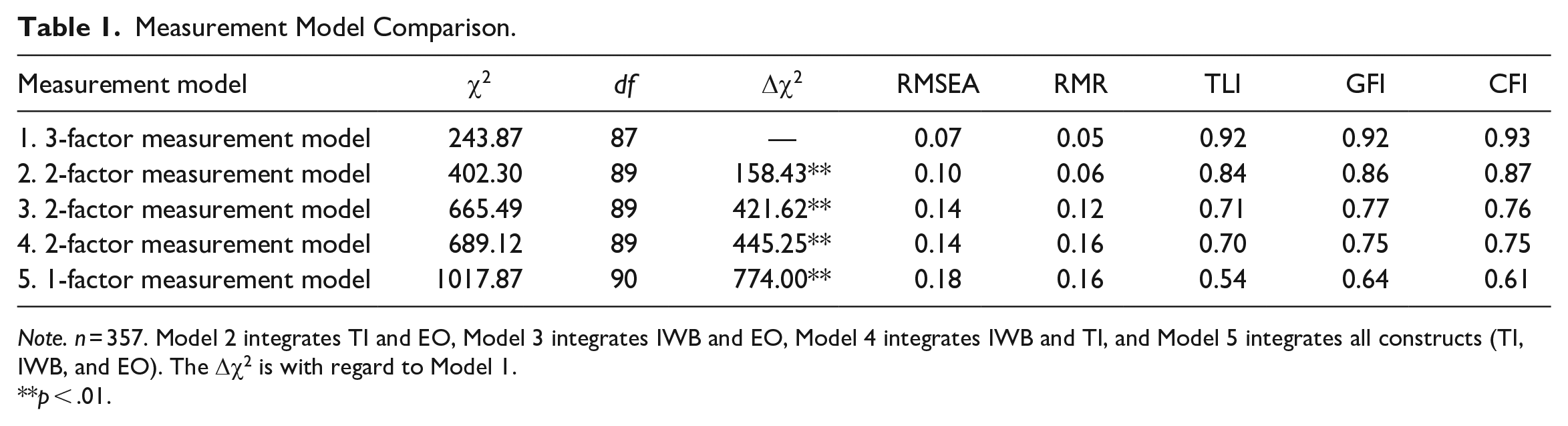
Note. n = 357. Model 2 integrates TI and EO, Model 3 integrates IWB and EO, Model 4 integrates IWB and TI, and Model 5 integrates all constructs (TI, IWB, and EO). The Δχ2 is with regard to Model 1.
p < .01.
The statistical package SPSS was used to analyze data and test study hypotheses. Mean and standard deviation was analyzed to describe the descriptive statistic of the variables presented in Table 2. To evaluate the correlation among study variables, correlation analysis was executed, as presented in Table 2. TI was positively associate with EO (r = .25, p < .01) and IWB (r = .52, p < .01). EO was positively associate with IWB (r = .48, p < .01). We observe that control variables like age and experience have interdependencies among themselves. Age has strong association with experience (r = .66, p < .01).
Descriptive Statics, Reliability, and Correlation Scores.

Note. n = 357; reliability coefficients are presented in parentheses.
p < .05. **p < .01.
To analyze the direct association between independent (TI) and dependent variables (EO, innovative work behavior, and dimensions of IWB) and mediation effect researcher used hierarchal regression.
Table 3 demonstrate the structural model analysis. The results demonstrate that the associations between TI, innovative work behavior, Idea exploration, Idea generation, Idea championing, Idea implementation, and EO were significant (β = .37, t = 11.32; β = .56, t = 11.83; β = .36, t = 8.54; β = .37, t = 6.44; β = .25, t = 6.62; β = .18, t = 4.78, respectively), supporting hypotheses H1, H2a, H2b, H2c, H2d, and H3. The R2 values presented in Table 3 define the explanatory power of the independent variables on the respective dependent variables. Innovative work behavior explains 28% of TI (R2 = .28), Idea exploration explains 29% of TI (R2 = .29), Idea generation explains 19% of TI (R2 = .19), Idea championing explains 11% of TI (R2 = .11), Idea implementation explains 13% of TI (R2 = .13), and EO explains 10% of TI (R2 = .10).
Regression Results.

Mediation and Bootstrapping
Additionally, bootstrapping analyses (a computational technique for mediation analysis) were conducted using Hayes and Scharkow’s (2013) PROCESS macro for more robust mediation assessments suggested in Hypothesis 4 and 5a, 5b, 5c, and 5d. The direct effects and indirect effects of bootstrapped estimates with 95% confidence intervals (CIs) are presented in Table 4. Researchers suggested that k2 (Kappa squared) can be used to report mediation effect size (Preacher & Kelley, 2011) as k2 is the ratio of the indirect effect (Hayes & Scharkow, 2013) k2 is impervious to sample size. Preacher and Kelley (2011) suggested Cohen’s guidelines (i.e., .01 for small, .09 for medium, and .25 for large) to measure the criteria for explaining the degree of effect size. EO significantly mediated the associations between TI and the IWB and its dimensions. Moreover, their CIs did not contain 0, endorsing mediation effects.
Bootstrapping Result for Estimating Direct and Indirect Effects With 95% CIs.
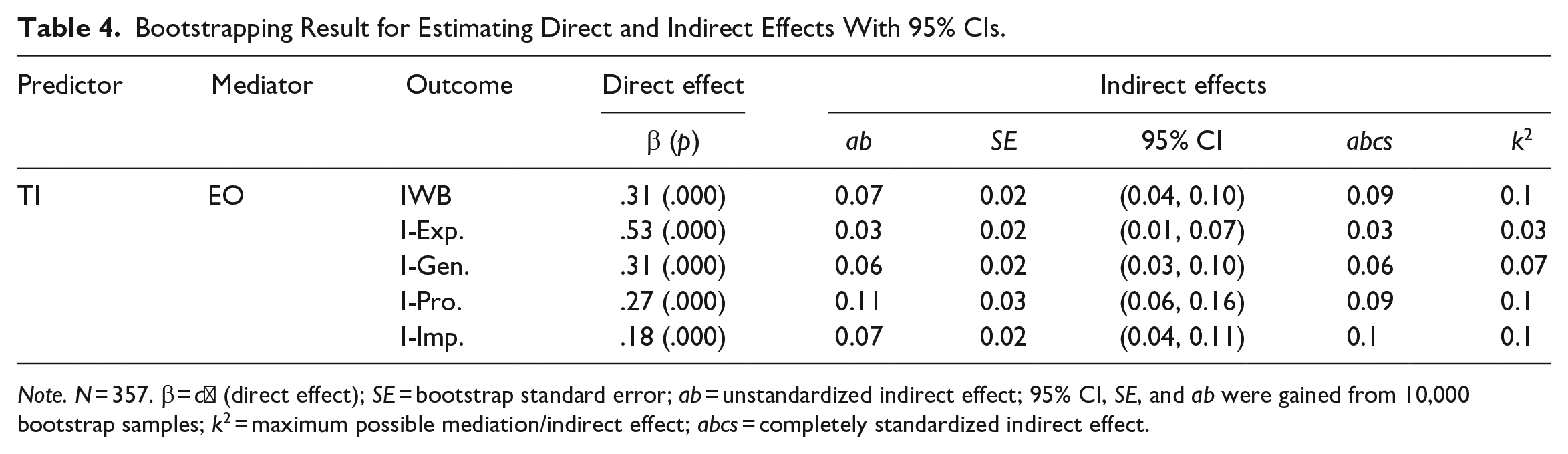
Note. N = 357. β = c′ (direct effect); SE = bootstrap standard error; ab = unstandardized indirect effect; 95% CI, SE, and ab were gained from 10,000 bootstrap samples; k2 = maximum possible mediation/indirect effect; abcs = completely standardized indirect effect.
For instance, the model comprised TI as a determinant and innovative work behavior as a criterion, and this association was mediated by EO. As glimpsed in the first row of Table 4, the direct effect from TI to innovative work behavior was significant (c′ = .31, p = .00). Furthermore, the indirect effect of TI on innovative work behavior via EO was significant (ab = 0.07, 95% CI [0.04, 0.10], k2 = 0.10), and the effect size of k2 can be inferred as medium with the recommendation to Cohen’s grades. Results support hypothesis 4.
Hypothesis 5a had also proved statistically significant because the CIs did not contain a 0, the mediation effects confirmed in second row of Table 4 (c′ = .53, p = .00; ab = 0.03, 95% CI [0.01, 0.07], k2 = 0.03) with small size effect. Hypothesis 5b had got statistical significance (c′ = .31, p = .00; ab = 0.06, 95% CI [0.03, 0.10], k2 = 0.07) with small size effect. Similarly, hypothesis 5c (c′ = .27, p = .00; ab = 0.11, 95% CI [0.06, 0.16], k2 = 0.10) and 5d (c′ = .18, p = .00; ab = 0.07, 95% CI [0.04, 0.11], k2 = 0.10) had also got statistical significance with medium size effect.
Discussion
Although social identity plays a vital role in entrepreneurship (Brändle et al., 2018) and innovative work behavior literature (Song et al., 2018). The relationship between TI with innovative work behavior has been studied (Song et al., 2018), but the dimensions of IWB have not been studied earlier. This research has also examined the TI as an antecedent of EO. Last but not least, the mediating role of EO between TI and innovative work behavior and its dimensions have not been studied yet. Our research inquiry led to numerous findings.
First, we found a significant positive relationship between TI and innovative work behavior. Thus, hypothesis 1 was convincingly established: TI is positively associated with employee IWB. This finding shows that TI enhances the IWB of employees. A robust sense of “belongingness encourages the employees to involve in creative and risk-taking ideas through self-initiative behavior (Chang et al., 2014; George, 2007). Therefore, TI permit employees to establish innovative opportunities for the organization (Huber, 1991). The significant positive relationship between TI and IWB is consistent with prior studies (Song et al., 2018).
Secondly, the prime goal of this study is to understand the association between TI and the dimensions of IWB. Hypothesis 2a, 2b, 2c, and 2d were persuasively proven that TI has a positive relationship with each dimension of IWB. TI was appeared to influence the EO as the statistical result was significant. TI may assist employees to involve in risk-taking behavior, which is an essential component of EO. These findings are also consistent with the previous study (Kollmann et al., 2020). Hence, hypothesis 3 was proved as well. The mechanism between TI and innovative work behavior through EO was also evaluated and found meaningful. The feelings of the individual are positive when TI is high (Lin et al., 2017). These positive feelings stimulate positive outcomes like proactive behaviors (Den Hartog & Belschak, 2007). TI can lead to creativity and innovation, which are prominent features of EO (Kollmann et al., 2020). A sense of belongingness among the team members provides such environment in which employees feel safe; this safety encourages them to involve in risk-taking behaviors (Chang et al., 2014; George, 2007). These arguments and results supported hypothesis 4. We also investigated how TI is associated with the dimensions of innovative work behavior through EO. Hypothesis 5a, 5b, 5c, and 5d were also significantly proved as each dimension of IWB was mediated by EO.
Theoretical Implication
The prime objective of this research is to inspect the potential of TI as a critical driver of EO that further leads to the IWB of employees. Furthermore, by investigating the uniqueness of entrepreneurship, this research empirically reinforced the belief that innovation and entrepreneurship are indivisible and concomitant (Gilad, 1984, p. 151). Therefore, EO and its role in arose creative (Rauch et al., 2009) and innovative behavior among the workforce must be evaluated deeply (Bernoster et al., 2018; Covin et al., 2020). Furthermore, EO is frequently related to organizational achievement (Rauch et al., 2009) through risk-taking, pro-activeness, and innovativeness.
This research empirically examined the role of TI on individual EO. This study further investigated the role of EO on individual IWB and its dimension. This study results show that EO is positively associated with each dimension of IWB. Similarly, TI is also associated with each dimension of IWB. The result of the study will add to the literature of IWB and entrepreneurship by presenting the positive impact of TI on EO and subsequently on each dimension of IWB.
Managerial Implications
The findings of this research give valuable insights into business and managerial practices in the informational technology sector. Team identification plays a significant role in increasing psychological ownership, developing a sense of responsibility and social interdependence to nurture innovativeness, risk-taking, and proactiveness. Considering this, software companies must develop interdependence work tasks to boost TI and provide training and development programs to improve the EO of employees. For the employees who focus on traditional and individualist approaches to working, training on entrepreneurial and integrative effort is crucial. The successful development of TI established positive attitudes and behavior (Van Dick, 2004), leading to high social interaction and trusting relationships among employees. This study supports the evidence that TI boosts psychological ownership and willingness to involve in innovative behavior through EO. Gau et al. (2009) argued the employees who have a high level of TI are inclined to behave proactively to initiate innovative ideas. In a similar vein, Liu and Li (2018) proposed the individuals who perceive a superior level of identification with their team are more likely to strengthen their positive behavior like innovative work behavior. Therefore, a strong EO training and development program will enhance employees’ proactiveness, innovativeness, and risk-taking behaviors (Fadda & Sørensen, 2017) that lead to superior innovative behavior.
Systematic training programs are essential for employees to improve entrepreneurial abilities and competencies that may improve idea exploration, idea generation, idea promotion, and idea implementation abilities. This research emphasizes the significance of EO, TI, and the innovative behavior of employees. This study proposes that managers hire such employees with the greater entrepreneurial inclination reflected through their innovativeness, pro-activeness, and risk-taking behavior. HR managers should ensure assessments of such behavior as standard during the selection process. After the selection, such an environment should be created that promotes employees’ entrepreneurial and innovative behavior.
Limitations
Like other research, this research also has some limitations that demand concentration to be focused on in future research. First, this study focused on the mediating role of EO on IWB. Further research should add the moderating role of entrepreneurial leadership on IWB in the IT sector. Second, this study measures the individual level innovative work behavior of employees. Future research should adopt the multilevel research design to measure the team and individual outcome of innovative behavior in the same study by considering TI as team level construct. TI is a potent stimulator of innovative behavior at both team and individual levels; it is essential to assess the predictors of TI. Employees’ risk-taking, pro-activeness, and innovativeness are in the firm’s best interest, and TI stimulates this behavior. Future research is needed to explore team and individual EO interaction with innovative climate.
Conclusion
In conclusion, this research work advocated the critical influence of TI on cultivating IWB in employees working in software companies of Pakistan and addressing the current challenges that software technology-related organizations face. Constantly maintaining the result of the prior studies (Litchfield et al., 2018; Song et al., 2018), this study focuses on the need to promote TI and include innovation-oriented behavior, that is, EO (Bernoster et al., 2018) in the research and theory development on innovative work behavior. This study also emphasized the need for software companies to employ TI principles in executing the jobs to develop IWB in their employees.
We examined that TI could create opportunities to generate more innovative behavior in the workplace. TI has certain features that encourage individuals to involve in TI, such as self-enhancement and uncertainty reduction, which permit them to involve in innovative work behavior through EO. We observed that TI produces positive outcomes like EO and innovative work behavior as well as it also has a positive impact on each dimension of innovative work behavior like idea exploration, idea generation, idea promotion, and idea implementation. We took samples of 357 employees working in software companies and analyze their involvement in innovative behavior for self-enhancement and to reduce uncertainty at work.
This research can help as a foundation for developing capabilities among employees from idea exploration to idea implementation. It can also be helpful for those organizations who want to introduce innovation in their system to remain competitive. This research attempts to fill the gap that there is a need to evaluate each dimension of innovative work behavior (Li et al., 2020) to introduce innovation as each stage of innovation is crucial and has its own importance. Furthermore, this research adds to the literature by responding to the call of the researchers to investigate the EO at the individual level (Covin & Wales, 2019; De Clercq et al., 2010; Rigtering et al., 2019; Wales et al., 2011). We seek to encourage more research on individual EO and innovative work behavior and propose to continue finding out the potential stimulators of individual EO.
To further confirm the significance of TI and EO, we suggest that the study with the same variables should be conducted in different cultural contexts. Another avenue is to conduct a study in organizations facing the COVID-19 crisis to identify how they behave innovatively. Consequently, this research can be helpful in identifying the cultural and non-cultural elements that can influence innovative work behavior. In addition, the elements identified can engender additional research, particularly in emerging economies and developing countries that need it, like Pakistan.
This research can be helpful to address the need of communities by providing more innovative things to bring ease to their life. It is expected that EO will be helpful in introducing more creative and innovative ideas. It is also essential to engage all individuals into the entrepreneurial ecosystem who are directly or indirectly affected by entrepreneurial activities to reinforce entrepreneurship in innovative climates that enhance the living standard of the region’s residents.
The investigations of this research need to be discovered and integrated into the organizations whose prime focus is to introduce innovation. Studies disclosed that belongingness, integration, proactiveness, innovativeness, and risk-taking behavior generated positive consequences; therefore, these findings can be practical and enforce into the organization where superior, innovative behaviors are required.
Footnotes
Declaration of Conflicting Interests
The author(s) declared no potential conflicts of interest with respect to the research, authorship, and/or publication of this article.
Funding
The author(s) received no financial support for the research, authorship, and/or publication of this article.
