




Abstract
This article identifies the mediating role of informal institutional frameworks upon the relationship between the international entrepreneurial orientation (IEO) behavior of small and medium-sized enterprises (SMEs), and their perceived financial performance, while operating within a volatile business environment. To reach the study’s aim, we conducted a regression analysis upon SMEs operating in Turkey and implemented structural equation modeling on the construct to specify the validity of the model. The findings are that the indicated relationship is indeed mediated by informal institutional frameworks. However, IEO and financial performance relationship is negative. The practical implementation of IEO activities is risky when target market financial conditions are difficult, and the nature of relevant informal institutional frameworks should be considered before full commitment to IEO activities.
Keywords
Introduction
Early and rapid internationalization of the relatively young and entrepreneurial firms are new phenomena (Cavusgil & Knight, 2015; Paul & Rosado-Serrano, 2019). Within this group of firms, there are businesses that have strong tendencies for innovation, risk taking, and proactive behavior in international business (Hernández-Perlines et al., 2016). The difference between traditional entrepreneurial orientation (EO) and international entrepreneurial orientation (IEO) is that the latter focuses upon firms’ international business activities and their strategic behavior in that context (Covin & Miller, 2014). There is a broad agreement within the entrepreneurship literature that EO behavior is mediated by the immediate and continuing business environment (Amankwah-Amoah et al., 2019; Karami & Tang, 2019; Rauch et al., 2009; Wiklund & Shepherd, 2005; Zahra & Garvis, 2000). Societies influence the creation and maintenance of entrepreneurial activities in multivariate ways (Carter & Wilton, 2006; Kreiser et al., 2010). There is considerable research positing that differences between cultural attributes and institutions constitute one of the main reasons for variation between national entrepreneurial performance (House et al., 2004; Kreiser et al., 2010), in both formal and informal ways (DiMaggio & Powell, 1983; North, 1990; Scott, 1995; Williamson, 2000).
Within this discussion, international corporate business tendencies become more important. Although the link between culture and entrepreneurial activities has been extensively explored, the relationship between informal institutional frameworks and entrepreneurial behavior continues to require attention (Hayton et al., 2002; Kreiser et al., 2010). Within that relatively new construct, there is a question that how might an IEO differ within various cultural environments (McDougall-Covin et al., 2014)? Alternatively stated, how does the business environment, including a country’s informal institutional framework, affect IEO and, consequently, performance? Little related literature is available regarding these questions (Covin & Miller, 2014). In fact, the relationship between IEO and performance is still inconclusive (Fernández-Mesa & Alegre, 2015). It is also not clear how IEO affects firms in the context of developing countries (Wales et al., 2019). It is for this reason that the main research question asked by the authors of this article follows: What is the mediating role of informal institutional framework upon the relationship between the IEO behavior of small and medium-sized enterprises (SMEs), and perceived financial performance, given the volatile business environment of a newly emerged, developing country? By doing so, the study aims to identify the relationship between IEO and perceived financial performance and mediating role of informal institutional framework.
To reach the study’s aim, the current research implements Schwartz’s (1994) cultural dimensions to measure the informal institutional framework in national level. Rather than focusing upon the corporate level, the study emphasizes the informal institutional framework at the national level. This is because cultural factors constitute most informal institutional frameworks and such factors can be observed across the borders of a country. Norms, values, traditions, and customs are part of culture. North (1990) contended that informal institutional frameworks are more comprehensive and that cultural studies constitute one of the best ways of capturing this variable. The study implements the cultural attributes identified by Schwartz (1994), as Knight and Cavusgil (2004) suggested. Schwartz’s (1994) study is also appropriate because it is concerned with differences in cultural values and institutional frameworks (Goodwin, 1999). There are two approaches to contextualize the IEO. The first uses traditional scales in international context. The second considered IEO as a subcategory of entrepreneurship (Covin & Miller, 2014). In this study, we opted for the latter because we consider IEO as a natural extension of entrepreneurship.
Our contribution to the literature is to identify whether there is a relationship between IEO behavior of firms and perceived financial performance about which there is still limited available literature (Thanos et al., 2017). We also identify whether this relationship is mediated by informal institutional frameworks at the national level. By identifying the relationship between these variables, the study enhances the understanding of informal institutional framework impacts on the IEO behaviors of firms. We implemented the study in a developing country to see whether an IEO/performance relationship exists in such context. By doing so, we answered a recent question asked by Wales et al. (2019) in regard to the future of IEO research: “What specific institutions, institutional theories and institutional considerations influence (International) EO and its consequences?” (p. 100) The study reveals the mediating role of informal institutional frameworks upon the relationship between IEO and perceived financial performance. Furthermore, the study also answers the research request made by Covin and Miller (2014) to analyze IEO and other variables that may mediate.
Theoretical Background: IEO
The concept of IEO stems from the entrepreneurship literature—most notably Miller’s (1983) and Covin and Slevin’s (1989) works—which form the fundamental base for much research. The general tendency in the related literature is to focus upon the original underlying concepts of risk-taking, proactiveness, and innovation and to evaluate firms operating in an international context upon such measures (Covin & Miller, 2014; McDougall-Covin et al., 2014; Ruzzier et al., 2020; Tayauva, 2011; Zhang et al., 2012). Another approach significantly modifies the three indicated elements of the EO concept, by describing IEO as “a combination of innovative, proactive and risk-seeking behaviour that crosses national borders, and is intended to create value in organizations” (McDougall & Oviatt, 2000, p. 903). Freeman and Cavusgil (2007) define the concept by stating, “international entrepreneurial orientation refers to the behaviour elements of a global orientation and captures top management’s propensity for risk taking, innovativeness, and proactiveness” (p. 3). The current study also considers Wach’s (2015) suggestion and describes IEO as being “meaningfully extended into the field of IE as a way of examining and explaining the cross-border internationalization of firms” (Glavas & Mathews, 2014, p. 230). Nevertheless, there is no clear consensus in the related literature as to whether the IEO construct is substantially different from the EO concept or not but argues that its emphasis is on the global business activities of the firms.
IEO is considered as one of the most important predictors of corporate performance (Jantunen et al., 2008). Firms with high level of IEO tend to be faster to internationalize and have a higher level of knowledge about the international market (Zhou, 2007). They also tend to operate in a higher number of foreign markets and have greater relative volumes of sales (Ripollés-Mélia et al., 2007). These firms also tend to possess high capabilities to identify new market opportunities in the international arena and to exploit them effectively (Knight & Cavusgil, 2004). It also appears that that there is a relationship between the national cultural context and the international entrepreneurial tendencies of the organizations (Muralidharan & Pathak, 2017).
Informal Institutional Frameworks
Institutional theory includes limitations, which are beyond individual control, that intentionally or unintentionally shape human interaction, so that individuals behave and act in certain ways (Scott, 2004). There are two different types of institutional framework: formal and informal. The former limits human behavior through enforcement, whereas the latter creates the same impact through cognitive limitations. Unlike formal institutional frameworks, informal frameworks are unwritten and created by the collective mind of society. They differ from context to context. Institutional theory indicates that culture is part of an informal institutional framework. The surrounding environment shapes individuals’ behaviors and attitudes, although an informal institutional framework is more comprehensive than culture itself (North, 1990). It is extremely difficult to measure informal institutional frameworks, as they slowly evolve and are very much context dependent. However, some studies use cultural attributes to capture the essence of informal institutional frameworks (Roxas, 2009).
Culture is the “collective programming of the mind” and can be described as a collection of values, norms, attitudes, and traditions that are shared by the members of a society (Hofstede, 1980). Hence, culture creates a framework that individuals within a society implicitly use as a reference point. In turn, these reference points help them to understand and more importantly interpret the organizations, the environment, and their interrelationship (Kreiser et al., 2010). Cultural values shape and justify individual and group action (Schwartz, 1999). Moreover, behavior always occurs within a given context and allows for identification of one of the possible meanings (Smith 2002). Culture is one of the strongest components that affects individual entrepreneurial behavior (Shinnar et al., 2012).
There are two main approaches to cultural studies. One is measuring work-related cultural values (Hofstede, 1980; House et al., 2004; Trompenaars, 1996). The other requires the measurement of national cultural attitudes (Schwartz, 1994). All related studies identify cultural dimensions to utilize statistical methods and theoretical reasoning (Schwartz, 1994). Some scholars critique simple masculine–feminine or individual–collectivist divides. Schwartz and Bilsky (1990) identified seven cultural dimensions—affective autonomy, intellectual autonomy, egalitarianism, mastery, hierarchy, embeddedness, and harmony—which can be observed among societies. This approach also resonates within the field of organizational culture. Three cultural levels, individual, organizational or group, and national, are interconnected and all are influenced by the general ethical values and norms of society (Hofstede, 1980).
Intellectual autonomy emphasizes creativity, whereas affective autonomy represents hedonism and a desire for an exciting life. Egalitarianism focuses upon equality and caring about other people. Hierarchy concerns power relations and provides legitimacy for holding power. Mastery is reflecting the abilities that help individuals to overcome social problem. Harmony shows how individuals unite with nature and fit congenially within their environments. Finally, embeddedness (conservatism) emphasizes social relationships and tradition (Schwartz, 1994).
Hypotheses
Combining the previous arguments regarding culture and the seven cultural dimensions as well as IEO and performance, we hypothesize the following:
EO literature suggests that there is a strong relationship between EO and organizational performance, where performance is primarily measured by financial performance (Lee et al., 2011; Wiklund & Shepherd, 2005). This study expects similar results in actualizing the IEO construct, as it is an extension of EO. Performance measures depend on corporate size and ownership type. For instance, there is a relationship between IEO and international performance of family-owned firms (Hernández-Perlines et al., 2016). It could be argued that each component of IEO may have different impacts on performance. Naldi et al. (2007) found a substantial correlation between risk-taking activities and proactiveness as well as innovation. Firms producing new products or services usually take risks, as the ratio between effective demand and supply has yet to be established. Moreover, risk-taking has an insignificant correlation with performance, compared with other factors. The correlation between innovation and performance and proactiveness and performance is greater than that between risk-taking and performance. However, in some business environments, risk-taking may be positively correlated with performance. Furthermore, risk-taking tends to improve firms’ prospects, although family-owned companies tend to take less risk. Finally, it is expected to be found that there is a relationship between IEO and performance, but this could be either negative or positive way according to circumstances that firms operate. For example, if there is a hostile environment, this could hamper level of investment, place fiscal and regulatory barrier, and dissuade individuals’ entrepreneurship spirit. In such environment, engaging into the IEO activities could provide a negative performance outcome. Accordingly,
The link between informal institutional framework and the strategic decision-making process has been widely explored in the related literature (Ingram & Silverman, 2002; Kreiser et al., 2010). Attitudes, values, and norms of individuals are inherited from the society in which they live. Informal institutional frameworks act as frames of reference in turbulent and complex business situations (Ahlstrom & Bruton, 2002). Informal institutional framework characterizes social collectives such as organizations. Values determine the appropriate unwritten rules, and leaders determine the goals and objectives stem from the organizational values. Organizational values deeply affect business operations (Sagiv et al., 2011).
The previous studies found strong relationship between EO and national culture (Lee et al., 2011). It is proposed and found that the country’s cultural propensity determines the firms’ innovation, proactiveness, and risk-taking behavior and only certain cultures would engender strong EO activities. This is because norms and values of a country will either converge or conflict with the country’s ability to develop EO activities (Lee & Peterson, 2000). Similarly, informal institutional framework has strong influence upon individual’s personalities and behaviors. SMEs are often described as “one-person games” (Daft et al., 2010), and such owners create the overall EO of SMEs (Lumpkin & Dess, 1996). In turn, the culture of a nation shapes the range of acceptable actions that can be taken by companies within its borders (Kreiser et al., 2010). Culture also intertwined with individuals’ behavior/attitudes, economic and legal system, and political conditions (Lee & Peterson, 2000).
For example, engaging in risk-taking activities might require high mastery and autonomy as individuals with these attributes tend to be more ambitious, courageous, and competent, and only certain countries with profiles that include high mastery would be able to support and accept risk-taking and innovation activities. In the same sense, societies with higher harmony and embeddedness expect a compliance with group and societal norms. However, if individuals do not, they may face social sanctions. Furthermore, such sanctions could be more severe in hierarchical societies where there is a clear social order (Schwartz, 1994).
There is a consensus in the entrepreneurial literature that informal institutional frameworks provide one of the most important considerations for entrepreneurship activities (Carter & Wilton, 2006), both at the individual level (Smith & Tian, 2014) and at the organizational level (Linan & Serrano, 2014; Rauch et al., 2009; Sahut & Peris-Ortiz, 2014; Turro et al., 2014). So, we expect to find that the relation between IEO and performance is mediated by informal institutional framework.
Sampling and Measurement
A probability sampling method is implemented for the purpose of the research, which was conducted in Istanbul, Turkey. The lists of SMEs are taken from the list of Istanbul Chamber of Union. SMEs are defined only by number of employees as it is difficult to access any financial data. So, the businesses with employees between nine and 249 are included in the study. Surveys are directly distributed and no e-mails or telephone is used. One of the main preconditions of the participating in the survey was to actively engage in international business activities, and a specific self-reported question was asked for that purpose. Most SMEs agreed to participate in the survey. It was necessary for the SMEs to participate in international business activities to be part of the research. Only high-level managers or owner could participate in the survey as in an SMEs’ relatively flat and simplistic structure, and they are the ones who involve in decision-making process. The study’s setting provides a unique outlook to a developing country. The country at hand, Turkey, has a relatively weaker formal institutional framework compared with European and North American context. The institutional framework tends to provide a limited range of positive market activities. However, the country also has a unique formal and informal institutional framework, which is the only secular-democratic Muslim country with Western-free market standards. In addition, when the formal institutional framework is relatively weak, it is expected that informal institutional framework will fill the gaps created. The research was conducted with SMEs carrying out international business activities and operating within the same institutional environment. In total, 180 SMEs participated in the study, and multiple regression analysis was conducted, together with structural equation modeling (SEM), on the chosen samples.
Knight and Cavusgil’s (2004) IEO questionnaire was implemented to measure IEO activities. The questionnaire is an extended version of Covin and Slevin’s (1989) initial EO measurement. This approach effectively captures the original EO concept and extends and enhances it with a focus upon the international area. They modified the questionnaire for measuring the international entrepreneurial behavior of firms. Twelve items were used (α = .851). The nature of the informal institutional framework was measured using Schwartz’s (1994) methodology. This was chosen instead of Trompenaar (1996), Hofstede (1980), and House et al. (2004), and represents an approach also followed by Knight and Cavusgil (2004). There are 57 items in this construct and seven independent variables. Items show strong reliability and internal consistency (α = .856). Finally, performance by the proxy is represented by the implementation of perceived financial performance of Roxas (2009). This is chosen because of the usual difficulties in collecting SME archival financial data in a form that is concisely presented and readily understood. There is also the factor that SMEs may not have complicated financial data or a Finance or Accounts Department. There are six items in this construct (α = .956).
Data Analysis
The key research aim of this study was the identification of the mediating role of informal institutional frameworks on the relationship between IEO of firms and performance. Multiple regression analysis was conducted for this purpose. This allowed the co-authors to assess the impact of the independent variables on the dependent variable (IEO) while controlling the size and international trade engagement of participants. However, the mediating effect of informal institutional frameworks on the variables of international strategic orientation and perceived financial performance is confirmed through SEM.
Informal institutional framework has a very strong correlation with IEO as it appeared on Table 1. SMEs engage strongly in IEO activities as the items show high means. IEO activities also show a correlation with perceived financial performance; thus, this relation is rather negative. Firms show a robust tendency to participate in IEO. Thus, their IEO results were high.
Means, Standard Deviations, and Correlations.

Note. IEO = international entrepreneurial orientation.
Significant at .05.
Regression Model 1 =
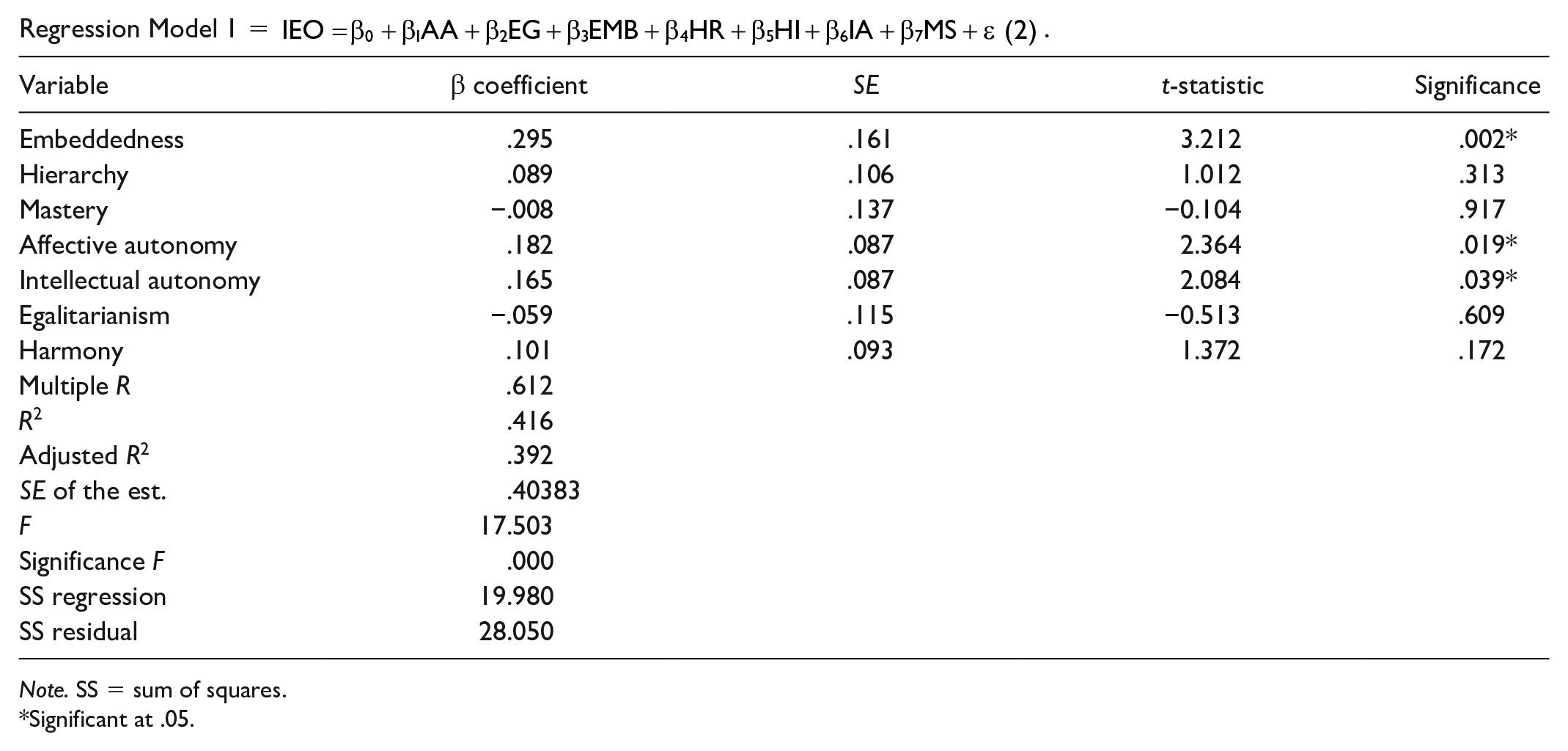
Note. SS = sum of squares.
Significant at .05.
Regression Model 2:

Note. IEO = international entrepreneurial orientation.
Analysis of the collected data revealed that there is a strong relationship between informal institutional frameworks and the IEO behavior of firms. It is also worth mentioning that the explanatory power of the regression is very strong as R2 is .416. The conducted regression shows a very strong and significant relationship as significance F is .000. Adjusted R2 shows that the there are other variables that influence performance. This is expected as an institutional framework consists of two separate parts—the formal and informal institutional framework. However, due to the purpose of this study, we have yet to focus upon the formal institutional framework.
Similarly, there is also a relationship between IEO activities of the firms and performance. However, this relationship is negative. Following the regression analyses, we conducted confirmatory factor analysis so to ensure model fit and that the mediating effect of informal institutional framework was evident. Our findings were supported (χ2 = 18.857, df = 7, χ2/df = 2.694; comparative fit index [CFI] = 0.981, Tucker–Lewis index [TLI] = 0.877, root mean square error of approximation [RMSEA] = 0.092). Alternatively stated, the model’s fit was within the recommended cutoff criteria as the RMSEA threshold was taken as 0.10, as Browne and Cudeck (1993) suggested. The chi-square is not significant (χ2 = 18.857). CFI and TLI are above 0.8, which means model fit. Results indicate the relationship between IEO and perceived financial performance and mediating effect of informal institutional framework. Therefore, it can be concluded that the findings confirm proposed hypothesis.
Discussion
Two hypotheses set for this study are empirically supported. The mediating role of informal institutional frameworks on the relationship between international entrepreneurial behavior and performance is clear. One of the important points regarding SMEs is that such firms are considered and often classified as one-person shows (Daft et al., 2010). Furthermore, EO and similarly IEO constructs are closely linked to the decision-making process (Lumpkin & Dess, 1996; Richard et al., 2004). Entrepreneurial individuals who lead SMEs are the most important components of the decision-making process regarding IEO, and the influence of environing institutional frameworks upon such individual leaders is evident.
Corporate size represents an important consideration, given this individual affects the IEO decision process. SMEs have unique organizational structures that are different from larger organizations (O’Regan & Ghobadian, 2005). In addition, Turkish culture—which provides the informal institutional framework context in this case—is highly centralized, and power orientation is significant, in that power is not shared among the members of the organization (Hofstede, 1980). This could strengthen the power holder’s position during IEO decision process. In addition, individual corporate leaders from high intellectual autonomy cultures tend to be more independent and to follow their own independent ideas and intellectual direction (Sagiv et al., 2011). However, their decisions and independence, in one way or another, are limited and directed by the institutional framework. Within that frame, informal institutional framework constitutes soft power. It is understood that individuals as a part of rather large group are influenced. Turkey is a high intellectual autonomy country, and accordingly, leaders or owners of SMEs tend to follow their own ideas independently with little expected influence from their surrounding business circle. This makes the influence of the informal institutional framework stronger, as the IEO decision-making process is particularly prone, inherently, to such influences from individual leaders.
In their meta-analysis, Rauch et al. (2009) indicated that in some cultures, high EO activities could be punished, and in some others rewarded. Turkey has a low masculinity score (Hofstede, 1980). It is a fact that firms with high IEO activities become rather aggressive and highly competitive. However, in some contexts, this might cause a negative return, as such behaviors are not valued and deemed rather inappropriate by the society or business environment, in which they live. This could be one of the reasons that why high the IEO activities of Turkish SMEs tended to generate negative performance outcomes. This is also in contrast with the findings of Brouthers et al. (2014) that high international EO activities stimulated increasing performance for American and U.K. SMEs in international business activities. This outcome provides further evidence that informal institutional frameworks mediate the IEO and performance relationships. In fact, both the United States and United Kingdom have low uncertainty avoidance and high masculinity scores (Hofstede, 1980). So, high competitiveness and risk-taking behaviors could be appreciated by the society that shapes and directs corporate leaders in certain ways, so that SMEs operating within this environment generate positive performance outcomes. Similarly, Sagiv et al. (2011) assert that organizations must adapt to national values to gain legitimacy and function effectively. If an organization does not comply with social values and norms, they face criticism, pressures to change, and constraints upon access to resources (Sagiv & Schwartz, 2007). One of the main challenges of investment in EO activities is that commitments of significant financial resources are usually needed (Rauch et al., 2009). Turkish SMEs might fail to comply with national norms, as Sagiv and Schwartz (2007) suggest, by being highly competitive and aggressive, in their IEO activities, and this may cause negative performance outcomes.
Furthermore, in low uncertainty avoidance countries, which are associated with high risk-taking behaviors (Kreiser et al., 2010), Mueller and Thomas (2001) identified a correlation with higher levels of innovation. However, the SMEs within the Turkish sample observed tended to show high IEO behaviors that are deemed risky under dire financial conditions. Turkey is a high uncertainty avoidance country—despite that, Turkish SMEs are willing to take greater risks than might be expected and to invest into IEO activities even in difficult financial conditions.
This study found that informal institutional frameworks constitute one of the main contributors to SMEs’ IEO behavior. It should be noted that the study was conducted in a complex and turbulent business environment. However, SMEs still had a strong proclivity toward IEO activities. The findings show that informal institutional frameworks, even in such negative environmental conditions, have a very strong impact on IEO attitudes of SMEs. Furthermore, IEO still has a strong impact on performance. Nonetheless, this impact is negative.
Conclusion and Suggestions
Prior research has indicated that corporate EO activities are mediated by environment and that culture is one of the important factors that influence EO behavior of firms (Kurtulmus & Warner, 2015; Rauch et al., 2009). This study found that the IEO behaviors of the SMEs observed were influenced by their informal institutional framework and that the IEO/performance relationship was mediated by this environment. However, the relationship between IEO and perceived financial performance is negative. This may mean that high IEO activities do not necessarily cause higher performance in turbulent and complex business environment. Nonetheless, engaging into IEO activities in local informal institutional framework may cause negative performance result. This leads to another lingering question, “If environment mediates firms’ IEO activities, in very turbulent and complex business situations, why do SMEs continue to invest into high IEO activities, despite the financial commitment levels required?” One possible answer, as this study found, is that informal institutional frameworks demonstrate a very strong influence on the IEO activities of these SMEs, although this relationship provided a negative performance outcome. This may be because local cultural environment may encourage owner of SMEs to take excessive risks within turbulent business environment. Perhaps, the local business context coexists well with intense competitive activities. Similar studies should be done in more stable and less turbulent business environments to see what, in different conditions and environmental contexts, mediating effects of informal institutional framework might be observed between IEO and financial performance. It should be also noted that the relationship between IEO and performance is not necessarily positive; therefore, context may play a very significant role whether it is created by formal means or in existing informally. In that, perhaps we should recognize Covin and Miller’s (2014) suggestion: In order to enrich our understanding of what an EO consists of in different societies, it may be useful to undertake qualitative studies of entrepreneurs at different levels of society: How do they differ in their beliefs, attitudes, preferences, and behaviors that might lead us to country or culture-specific predictions? (p. 33)
This study answers some of these sentiments but further studies needed to compare the differences and similarities.
Footnotes
Declaration of Conflicting Interests
The author(s) declared no potential conflicts of interest with respect to the research, authorship, and/or publication of this article.
Funding
The author(s) received no financial support for the research, authorship, and/or publication of this article.
