




Abstract
Recent apprehensions over the poor performance of secondary schools at ordinary level in Tanzania have given rise to concerns over the quality of education provided at this level. Addressing the issue of poor performance requires a gargantuan understanding of the environment under which these schools operate. This study explored how management of school internal mechanisms contributed toward enhancement of school performance for improved quality of secondary education in Tanzania. The article reports on the findings of a comparative case study conducted in six secondary schools in the Eastern Education zone of Tanzania. Findings revealed that, performance of schools was mainly attributed to the kind of management available in a particular school, which will ensure availability of workable and agreed on mechanisms of providing effective teaching and learning. The findings provide several important implications for education and school practitioners on how best to manage school internal mechanisms for improved performance.
Introduction
Concerns on improved performance in secondary schools are heightening and are becoming increasingly difficult to ignore due to its overall contribution in the success of schools and social-economic development of any country. However, learner performance cannot be divorced from the well-managed schools. It is the responsibility of school managers to make schools work and improve the learning outcomes for children (Moloi, 2003).
The trend of the performance reports for the past 5 years (2008-2012) from the Certificate of Secondary Education Examinations (CSEE) in Tanzania leave a lot of doubt on the effectiveness of school internal mechanisms to ensure high standards of performance. The uncertainties were also increased by the manner in which the internal mechanisms were managed for effective teaching and learning in secondary schools in Tanzania. The CSEE results indicate that the performance of students who scored Division I to III is far less than the percentage of students scoring Division IV and zero (Table 1).
Form Four Examination Results (CSEE) in Percentage by Division in Government and Non-Government Secondary Schools, 2008-2012.

Source. Basic Education Statistics in Tanzania (The United Republic of Tanzania [URT], 2011, 2012a).
Note. CSEE = Certificate of Secondary Education Examinations.
From the data in Table 1, it can be argued that there are great challenges in improving performance in secondary education. This article is concerned with school performance, in terms of results obtained through national assessment of Form IV students, as one of the indicators for quality education. The article attempts to show how effective management of school internal mechanisms (vision, mission, and school practices) contributes toward enhancement of performance and improved quality of education. The aim is to provide an insight to educational practitioners on how schools with similar characteristics can best manage their internal mechanisms for improved performance.
The study was conducted in the Eastern School Zone of Mainland Tanzania (Coast and Morogoro regions). Coastal region is on the Eastern part of Tanzania mainland and a large part of the region is situated along the Indian Ocean coastal belt. The region is located between latitudes 60° and 80° south of the Equator and between longitudes 370° 30″and 400° east of Greenwich. Morogoro Region, however, lies between latitude 5° 58″ and 10° 0″ to the south of the Equator and longitude 35° 25″ and 35° 30″ to the east (Figure 1).
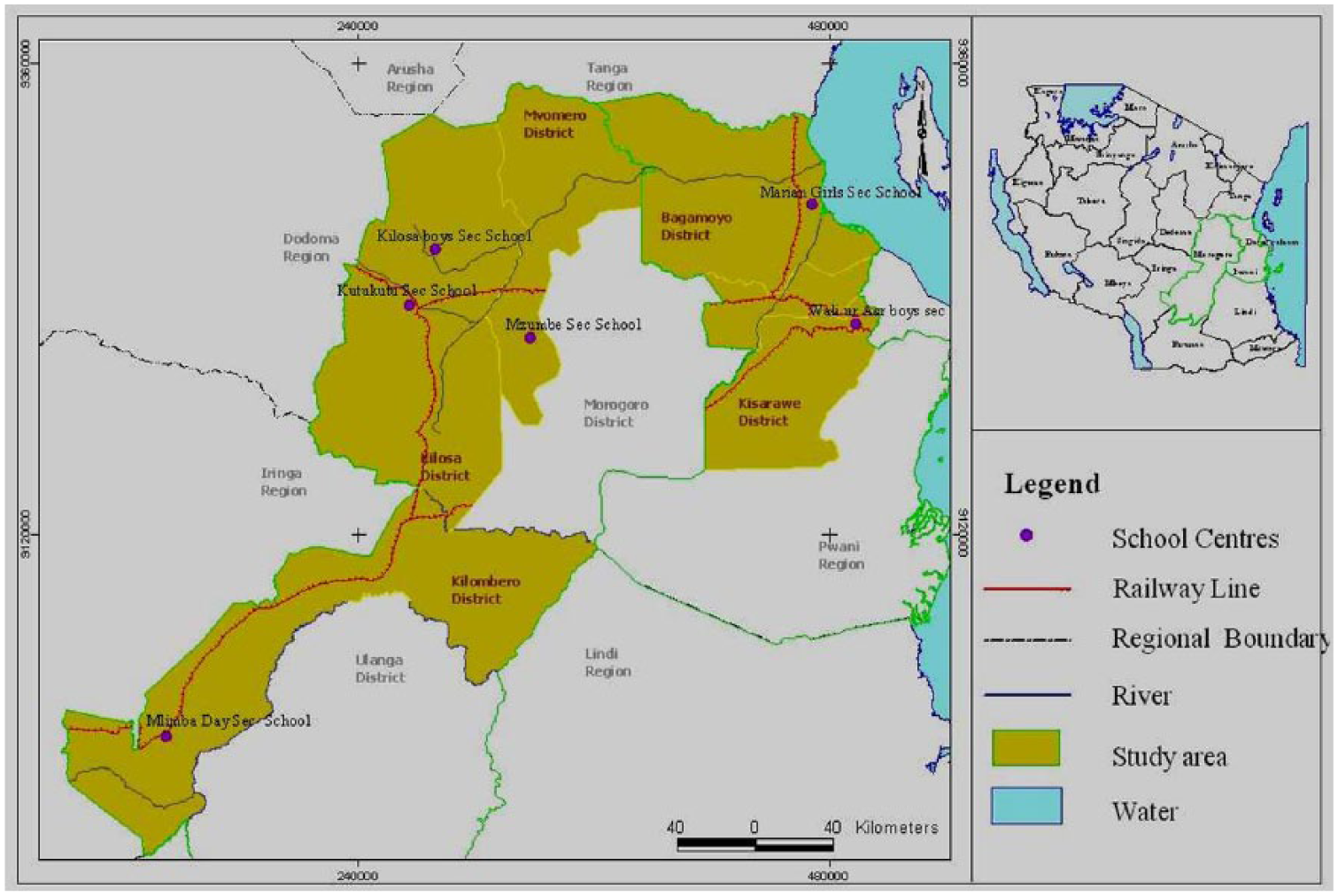
A map showing study area in the coast and Morogoro regions.
Review of Literature
The literature on school management reveals that, school managers play a central role in the success of the school and getting the system to operate effectively (Clarke, 2007; Van Deventer & Kruger, 2007). Their crucial role is explained by Palestini (2005), who offers that managers should provide strategy, vision, and strong leadership for the school. Apart from that, schools need to have in place a system of measuring learning outcomes of its learners and evaluating its results as a means of assessing the performance of the school in providing effective teaching and learning (Clarke, 2007). To achieve this goal, schools ought to have effective management which will ensure there are workable and agreed upon internal mechanisms where performance can be maximized. These roles seemed to be missing in six secondary schools investigated.
Management can be defined as a process of coordinating, directing, and guiding the efforts of members of the organization toward achievement of organizational goals (Mullins, 2005). It is a process because it comprises a series of actions that lead to the achievement of organizational objectives such as planning, organizing, staffing, directing, and controlling. Schools as organizations have set goals/performance standards which they want to achieve and therefore management becomes the key aspect through which these goals can be achieved for enhanced performance (Kapolesya, 2010; Nzigilwa, 2010). Schools therefore, ought to have effective management which will ensure there are feasible and established on internal mechanisms such as school vision, mission, and practices which guide implementation of the day-to-day activities of the school. Furthermore, the existence of experienced and committed leadership which will ensure that the school vision, mission, and practices are owned and shared by all stakeholders is of paramount importance.
A school vision is an aspiration of where the school wants to be and what it wants to achieve in future, hence gives a general picture of the work that needs to be done to attain it. Mission statement on the other hand stipulates how that vision is going to be achieved by stating what the school does right now in attaining the vision. It is from the school vision and mission that schools formulate strategic/action plans with targets to measure their progress toward attaining their vision (Gabriel & Farmer, 2009).
It is therefore the role of heads of schools to create a climate in their schools which will ensure that the vision and purpose of the school is clear to everyone (Nkosha & Mwanza, 2009) by encouraging and recognizing good performance from teachers and students through various forms of rewards so as to improve performance (Bottoms & Schmidt-davis, 2010; Mbiti, 2007; Nkosha & Mwanza, 2009).
Several studies have been carried out worldwide revealing the role of heads of schools as managers in improving school performance. Day et al. (2009) conducted a study on the impact of school leadership on student outcome carried out in sampled 20 primary and secondary schools in London. The findings revealed that actions taken by heads of schools to set, renew, and review the vision and direction of their schools had a significant impact on their schools’ climate, culture, approach to learning, leadership of teaching and learning, and above all on student attainment and progress. In another study performed in New York city on how school performance relates to the characteristics of school principals, Clark, Martorell, and Rockoff, (2009) found that there was a positive relationship between principal’s experience and school performance, implying that schools led by inexperienced principals would reveal poor performance.
According to Ngwako (2001), the management’s inefficiency to develop school vision and mission through a consultative process affects its implementation and subsequently the success of the school. These studies have one thing in common, which was revealing how important it was for the heads of schools to be competent enough to lead their schools in a visionary way for improved performance.
In Tanzania, studies on performance in secondary education have focused more on the extent to which the school inspectorate genuinely addresses the issue of poor performance in science and mathematics in secondary schools (The United Republic of Tanzania [URT], 2008); how the Ministry of Education and Vocational Training supervises the large number of public, private, and community secondary schools for quality education (Chediel, Sekwao, & Kirumba, 2000). Although there is general concern on the performance of secondary schools in general, community schools, which enroll the majority of the students have been found to have been performing very poorly as compared with public and private schools (URT, 2012b). Although all these studies dealt with performance issues, there is still a gap in literature on how internal school mechanisms are managed for performance improvement in secondary schools in Tanzania. To understand better on how management of internal mechanisms can influence performance, two management theories have been used to form the theoretical framework of this study.
The most influential theories in providing educational managers with the background from which decisions can be made as well as authority be practiced are the management theories. These theories include motivational theories, scientific management theory, bureaucracy theory, contingency theories, and systems approach theory. However, the focus of this article is on motivational theories and the systems approach theory, as they provide educational managers with basic understanding on how to successfully manage educational institutions for quality improvement.
Motivational theories generally advocate that managers have the responsibility of motivating people in their institutions to work hard and be committed to their tasks so as to attain the vision set for the organization (Clarke, 2007). Theory X and Y and Maslow’s theory are the two motivational theories which explain more on motivation from the management point of view. In Theory X, the assumption is that workers are naturally lazy and would work as little as possible because they do not like responsibilities and prefer to be led by someone to do their responsibilities (Robbins, 2005). This theory therefore suggests that for workers to perform their responsibilities, punishments, force, or threatening conditions must be used. Theory Y on the other hand believes that people are naturally not resistant or passive to the goals of the organization, rather they have the ability for assuming responsibilities, and exercise self-direction and self-control if they are committed to the objectives of the organization (Robbins, 2005). Thus, the attitude of any school manager on how he or she views people under him or her will have an impact on how those workers perform their responsibilities for achievement of the organizational goals.
Maslow’s theory of motivation assumes that individuals have a variety of needs, which need to be satisfied in sequence for them to work effectively. These needs according to Linstead, Fulop, and Lilley (2004) are categorized into high- and low-order needs. High-order needs include self-actualization, self-esteem, and the social acceptance needs, whereas the lower level needs are safety and security needs as well as basic physiological needs. This implies that school managers have the responsibility of not only understanding workers’ needs but also find ways in which those needs can be met for the workers to be able to work effectively and achieve school goals.
The importance of viewing schools as social systems being built up of interrelated parts which work together to achieve the objectives of the organization (Hoy & Miskel, 2008; Robbins, 2005) has roots in systems theory. These parts include the individuals in the organization, the departments, and even the environment which forms an important part of the survival of the organization. As such, school managers have the task of ensuring that every person and every part of the organization is of equal importance and works in harmony to achieve school goals.
Method
Research Design
A comparative case study design was used in this study by comparing best and least performing secondary schools in the two administrative regions (Eastern zone) of Tanzania. As the study used multiple data generation techniques to understand the present status of the quality of secondary school education in Tanzania, by linking the management of school internal mechanisms with students’ performance in secondary education, the use of a case study design was inevitable. This meant that the results and methodology of this study can only be used for generalization in areas with similar cases and characteristics.
Sample Size and Sampling Method
Eastern zone was purposively selected, based on data obtained from the National Examination Council of Tanzania (NECTA), which showed that the Eastern zone was one of the zones that had large schools with the best and worst results in the Certificate of Secondary Education Examination (CSEE). Out of 160 secondary schools in the Eastern zone, the three best and the three worst performing large secondary schools in the CSEE for 3 years (2010-2012) were selected and involved in the study. The rating is done at the zonal level by using students’ performance in the national examination. The sample size was 90 respondents, which included District Secondary Education Officers (DSEO), Secondary School Inspectors, Heads of Schools, teachers, students, and representatives of the School Boards (see Table 2).
Number of Respondents.
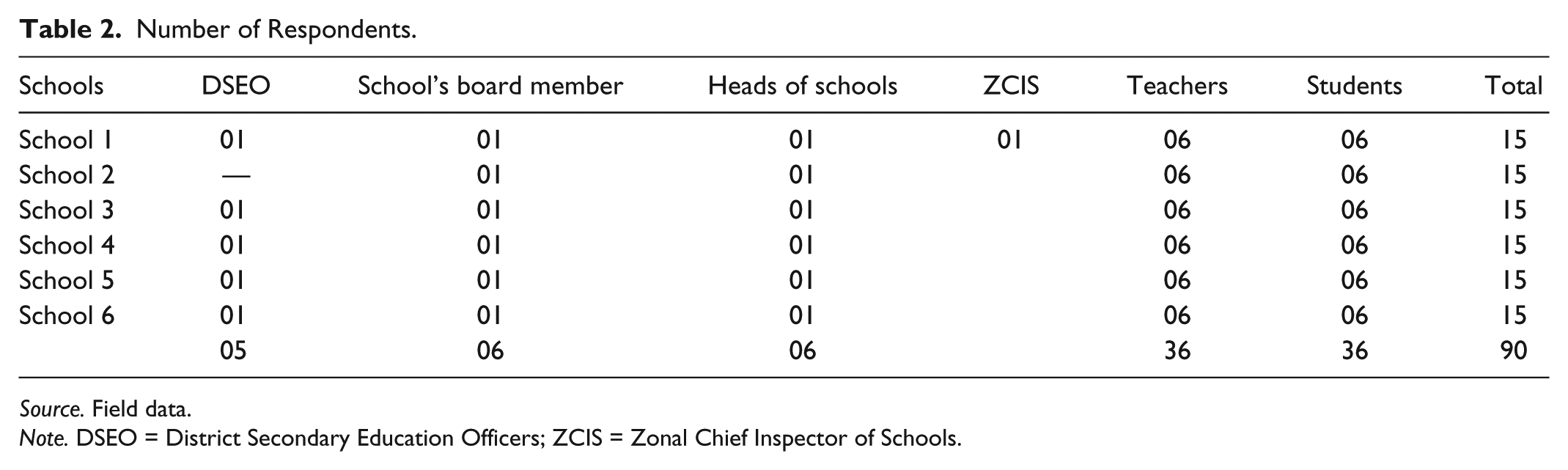
Source. Field data.
Note. DSEO = District Secondary Education Officers; ZCIS = Zonal Chief Inspector of Schools.
The sample size was considered sufficient for the purpose of the study, for in qualitative research the researcher’s intent is to describe a particular context in depth and not to generalize to a context or population.
DSEO, the Zonal Chief Inspector of Schools (ZCIS), and the Heads of the best and least performing secondary schools were chosen on the merit of their positions as they were expected to be conversant with and well informed about the school internal mechanisms in their zone, districts, and schools, as well as the extent to which they were working. Teachers, who had taught for at least 2 years in the same school, were involved in the study as they were expected to provide information on the practices in place for ensuring that there was effective teaching and learning for improved performance in their schools. Form IV students were also selected because they were the class that had stayed longest in the school hence they were able to provide a clear picture of how well the teaching and learning process was managed in their schools. School board members were selected because they represent members of the community in school matters and were expected to have knowledge on how school internal mechanisms were used to ensure effective teaching and learning was taking place in schools.
Data were gathered from documentary review, focus group discussions with teachers and students, and interviews with DSEOs, the ZCIS, representative member of the School Board, and Heads of Schools. Content analysis was the major tool for data analysis whereby information were put into a data spreadsheet and organized into themes of analysis based on research questions.
Research Findings and Discussion
The findings from interviews, focus group discussions, and documentary reviews of files in schools on management of school internal mechanisms revealed the following:
School Internal Mechanisms for Enhanced Performance
Information and data obtained through interviews with heads of schools and focus group discussions with teachers and students revealed that 60% of the respondents were aware of their schools’ vision and how they were used to ensure enhanced academic performance. Thirty-eight percent of respondents, majority of who were teachers and students from the least performing schools, were not aware of their school’s vision and therefore could not relate how it was used to ensure enhanced academic performance in their schools. Schools’ mottos were known as they were displayed in the school logo and/or on walls. Table 3 shows these findings.
Schools’ Visions and Missions for Enhanced Academic Performance.
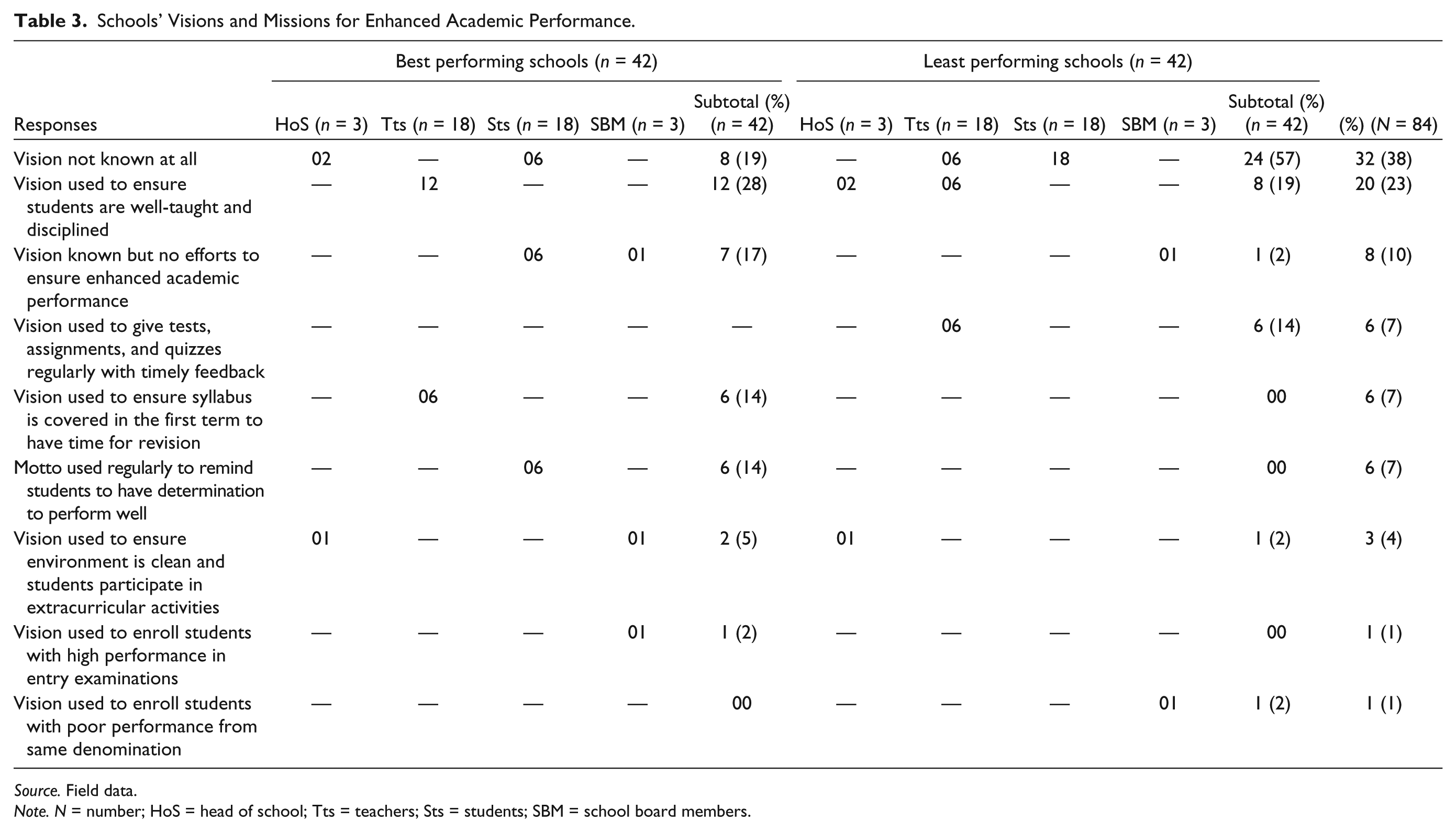
Source. Field data.
Note. N = number; HoS = head of school; Tts = teachers; Sts = students; SBM = school board members.
The findings in Table 3 were also supported by the documents reviewed in the schools. The files in schools revealed that some schools, which said their vision was not known, had school development and action plan files. The files stated the vision and mission of the schools, hence were translated into development plans for the schools. As the school development plans were supposed to reflect the vision of the schools, the implication is that schools had visions but were not communicated to all members of the school to ensure realizations of the vision is attained and quality of education is improved.
Focus group discussions with students from least performing schools indicated that teachers in their schools were not making enough efforts to ensure that the vision and mission were used to enhance academic performance. One student stated that We have not seen how the vision and mission are used to enhance academic performance because we have not seen any efforts made by teachers to ensure academic performance is enhanced. There are only few teachers who attend classes, we don’t get our progress reports at the end of term or year and therefore we do not even know how we have performed in the last year’s exams and how we should improve. (FGD-D2SC3STS)
These findings indicate that the vision and mission of this school were not shared with all implementers. This therefore shows that heads of schools who were the primary implementers and overseers of the school vision and mission had not done enough to ensure that all stakeholders shared and owned the vision so that it could lead to the formulation of a clear mission, aims, and goals of education at school level. The findings corroborate with Ngwako (2001) who found out that school management ability to involve stakeholders in the development of a vision affects its implementation and the performance of the school.
D’Souza (2001) also stressed that schools need to ensure that there is an endless articulation and reinforcement of what the institution honors, values, believes, and cherishes to accomplish its goals. The importance of the leader to strive for a shared vision is well documented by Hoyle (2007) who posits that a shared vision will enable everyone to know what the organization is trying to do and where it is going. Lack of a shared vision in schools creates conflicts in the implementation of school goals as members will be working without having a shared direction of where they want to go, what they aspire to attain, and how it is to be realized. It can therefore be concluded that the heads of schools who were supposed to be on the frontline to ensure the vision was known and shared by all members of the school lacked not only the knowledge of the importance of the vision in their schools but also an effective system of communicating the vision to the members of the schools.
Measures Set by Schools to Ensure Enhanced Academic Performance
Interviews with heads of schools and board members and focus group discussions with students and teachers revealed that frequent internal examinations, and a reward system for good performance motivated teachers, and strict adherence to rules and regulations were measures used to ensure enhanced academic performance in their schools.
In addition findings reveal that frequent internal examinations, which included weekly and monthly tests, were the most popular measure adopted by both best (64%) and least (67%) performing schools to ensure that there was enhanced academic performance in their schools. Table 4 shows these findings.
School Measures for Ensuring Enhanced Academic Performance.

Source. Field Data.
Note. N = number; HoS = head of school; Tts = teachers; Sts = students; SBM = school board members.
However, there was a difference in the way the internal examinations were carried out between the best and least performing schools. Focus group discussion with teachers of the one of the best performing schools revealed the following: We have examinations every month which are marked, and prompt feedback is given to students followed by corrections. The continuous assessment comprises monthly and end of term examinations. Students are also trained on speed as monthly exams are done in a shorter time than the normal national examinations. Parents get feedback quarterly on the progress of their children. (FGD-D5SC6Tt)
In the least performing schools, the internal examinations were used concurrently with quizzes and assignments. Apart from informing students and parents on their progress feedback was also used as a way of identifying weak students to be given remedial classes. During Focus Group Discussion (FGD), teachers had the following to say: We have monthly tests which account for 30% in each quarter while midterm tests carry 70% of the marks. These tests give feedback to the students on their performance and help teachers identify weak students for remedial classes. There are also quizzes given to weak students and performance is reported to the academic master. (FGD-D4SC5Tt)
The findings from both least and best performing schools indicated that at one point both schools had set equal strategies for improving performance, and yet there was a significant difference in performance between them. This implies that frequent tests and examinations alone could not contribute to improved performance. Giving tests alone to students, however, cannot bring about improvement if the feedback is not effectively used to improve students’ learning. Tests and examinations conducted at school level are meant to inform teachers and students on areas that need more attention so that teachers can make improvements on how they teach and how best to assist students learn (Ampiah, 2011). Furthermore, Thoonen, Peter, Frans, Thea, and Femke (2011) add that assessment should be an ongoing activity whereby an effective teacher can use different methods to monitor student’s learning and give meaningful feedback for making improvement.
Focus group discussion with students from best performing schools revealed the reasons for their excelling performance as compared with least performing schools. They maintained their schools had teachers who were motivated and hence contributed to improving their students’ performance.
. . . we have the best teachers most of whom are graduates and are enough in numbers. Our teachers are also very motivated as they volunteer to teach even at night where students also get a chance to ask questions on areas that need further clarifications . . .
In addition, the best performing schools mentioned strict adherence to school rules and regulations (48%) which helped in maintaining discipline and creating a favorable environment for learning to take place. This factor was not mentioned by the least performing schools as one of their measures for enhancing performance. In this regard, the best performing schools had managed to create a favorable environment for teaching and learning to be more effective. According to Van Deventer and Kruger (2007), schools with poor culture of teaching and learning have among other things poor school results, and weak management and administration. Teachers who were motivated were reported to be concerned with their students and therefore spent extra time helping students in areas where they faced difficulties as well as ensuring that school rules and regulations were followed. Rules and regulations were said to be of use in maintaining discipline at school and therefore improving students’ attention, striving for hard work and good performance. This implies that heads of schools had created a working climate in their schools where teachers felt comfortable and happy to do their work.
It has been noted by Nkosha and Mwanza (2009) that encouraging and recognizing good performance from teachers and students, through various forms of rewards, as well as creating good working climate for teachers ensure clarity of vision and purpose of the school to everyone. Improving professional development practices in terms of in house trainings, seminars, workshops, as well as providing them with necessary equipment and resources can also work as an effective motivational factor (Mbiti, 2007). These findings also concur with Clarke (2007) who advocated that leaders need to motivate their workers so as to work hard and be committed to their tasks to attain the vision set for the organization. The findings therefore imply that the use of regular examinations and tests alone do not contribute to enhanced performance in schools. Motivation for teachers and students, good discipline, and a favorable learning environment must also be present.
Conclusion and Recommendations
The study contributes toward enhancing our understanding of the school internal mechanisms used by secondary schools in Tanzania for performance improvement. Although schools had developed internal mechanisms such as the vision and mission of the school, the challenge lay on how these schools used them to ensure performance was enhanced. Similarly, the use of examinations and tests was still the major strategy used by both best and least performing schools to ensure performance was improved. However, the findings have shown that this strategy alone was insufficient; other supporting measures like the presence of motivated teachers and adherence to rules and regulations must be present.
Taken together, these findings suggest that management of school internal mechanisms play an important role in the improvement of school performance and ultimately the quality of education provided.
The study recommends that Heads of schools/school managers be trained and developed on the areas of developing, implementing, monitoring, and evaluation of school vision, mission, and development plans to ensure that realistic goals on teaching and learning are set and attained and continuously improved for realization of quality education. Furthermore, schools should institute their own mechanisms for ensuring that there is timely and effective feedback to both students and teachers on how they have performed. This will help in the overall improvement of teaching and learning practices. In addition, teacher professional development can work as an effective motivational factor for teachers to work toward realization of goals set by the school. This can include in house trainings, workshops, and seminars on issues related to school goals and objectives.
Footnotes
Declaration of Conflicting Interests
The author(s) declared no potential conflicts of interest with respect to the research, authorship, and/or publication of this article.
Funding
The author(s) received no financial support for the research and/or authorship of this article.