




Abstract
This research introduces Meta-Analysis Structural Equation Modeling (MASEM), a novel method that integrates meta-analysis (MA) and structural equation modeling (SEM). The method helps researchers to comprehensively understand issues in the strategic management field. Applying MASEM to analyze data from 112 papers, covering 101,981 observations, the results can be summarized as follows. (1) Entrepreneurial orientation (EO) is significantly positively correlated with firm performance (FP), which addresses the issue of inconsistency among prior studies’ findings. (2) There is a significantly positive correlation between EO and market orientation (MO) and a significantly positive relationship between MO and FP, indicating that MO is a mediator variable to the EO-FP. (3) Environmental dynamism (ED) increases a positive link exists between MO and FP; in other words, compared to low ED, the presence of high ED enhances the correlation between MO and FP significantly. (4) ED influences the slope of MO’s function as a mediator between EO and FP - that is, high ED increases the slope of the intermediary effect of MO on the MO-FP nexus, and low ED reduces the slope of the mediation effect of MO on the MO-FP nexus. These findings provide new thoughts and insights for studies on the correlation between EO and FP and offer substantial suggestions for enterprises. The aforementioned results indicate that besides providing deeper insights and a more comprehensive understanding, MASEM presents deeper insights for researchers and is more efficient than the traditional meta-analysis method. Moreover, MASEM can be applied to in other fields and used with other methods for greater in-depth analyses. Overall, the MASEM technique herein has high reliability and validity when utilized for discussing relationships among variables and gives more comprehensive and accurate conclusions in theoretical and practical aspects.
Plain Language Summary
This research proposes meta-analysis structural equation modeling (MASEM), which combines meta-analysis and structural equation modeling. The method helps researchers to comprehensively understand issues in the strategic management field. Applying MASEM to analyze data from 112 papers, covering 101,981 observations. (1) There is a significantly positive relationship between entrepreneurial orientation (EO) and firm performance (FP), which addresses the issue of inconsistency among prior studies’ findings. (2) There is a significantly positive relationship between EO and market orientation (MO) and a significantly positive relationship between MO and FP, indicating that MO is a mediator variable to the EO-FP. (3) Environmental dynamism (ED) increases the positive relationship between MO and FP; compared to low ED, high ED has a greater impact on the relationship between MO and FP. (4) ED influences the slope of the mediation effect of MO on the relationship between EO and FP—that is, high ED increases the slope of the mediation effect of MO on the MO-FP nexus, and low ED reduces the slope of the mediation effect of MO on the MO-FP nexus. These findings provide new thoughts and insights for studies on the correlation between EO and FP and offer substantial suggestions for enterprises.
Keywords
Introduction
In a complicated and changing business operation environment, enterprises are facing increasingly fierce competition. As a result, the lifecycles of their products and services are becoming shorter (Orcik et al., 2013; Rauch et al., 2009). Consumers are also presenting more diversified and complicated demands with new products and technologies springing up, greatly increasing survival and competitive pressures on enterprises (Hart & Sharma, 2004; Qian, 2002). In this context, enterprises need to continuously innovate their operation and management philosophies and seek new opportunities for the purpose of maintaining competitiveness. Therefore, the literature has paid more attention to EO as a successful strategy for enterprises to deal with an uncertain environment from both the theoretical and practical fields, making it necessary to analyze EO in entrepreneurial studies (Huang et al., 2018; Rauch et al., 2009).
Firm performance (FP) and EO form the best combination for a corporate to succeed (Saeed et al., 2014). Given the large strand of empirical inquiries about the EO and FP relationship (J. G. Covin & Lumpkin, 2011), its significance has been widely recognized (Lumpkin & Dess, 1996, 2001), yet varying empirical results are presented (Huang et al., 2018). For example, Wiklund and Shepherd (2003) proposed that there is a significantly positive association between EO and firm FP, while Renko et al. (2009) indicated a non-significant nexus between the two, and Slater and Narver (2000) found a significantly negative relationship. The cause of these inconsistent results is that researchers did not reach an agreement on the key issues and implemented weak measurements of the main variables. This means the development of the knowledge system in this field is slow and restricted (Huang et al., 2018). To address the inconsistent results among prior studies and in view of the greater number of them on the correlation between EO and FP, this study implements meta-analyses on the empirical results of the EO-FP nexus.
This study adopts meta-analysis as the primary research method, because it provides guidance for researchers in a specific field. By applying meta-analysis, researchers are able to see whether the field is mature and whether it is necessary to conduct further work in it. Researchers can also propose specific issues of additional concern that need to be resolved (Rauch et al., 2009). Accordingly, this study further surveys mediator or moderator variables possibly influencing the relationship between EO and FP. For example, market orientation (MO) is most commonly considered as a mediator variable in the EO-FP relationship (Bodlaj & Čater, 2022), whereas environmental dynamism (ED) is most commonly considered as a moderator variable in the MO-FP relationship (Alpkan et al., 2007; Frank et al., 2012). While meta-analysis processes the relationship between two variables in a single way (Churchill & Peter, 1984), this study utilizes MASEM to analyze the EO-FP nexus as well as potential mediation and mediated moderation effects on the relationship between the two, thus addressing the defect of meta-analysis that it cannot be applied on multiple research variables (Viswesvaran & Ones, 1995).
By reviewing the references on this topic in this paper, researchers will be able to find/identify potential defects in a research field. The method herein addresses the defect of the meta-analysis method and improves the research quality. The remaining sections of this paper as outlined below. Section 1 is the introduction. Section 2 provides a description of theories and hypotheses. Section 3 discusses the process for collecting and identifying research variables, variable coding and operationalization, and the meta-analytical procedures used. Section 4 reports the primary results. Section 5 presents the study’s findings, academic and managerial implications, limitations, and recommendations for future research. presents the study’s conclusions, academic and management implications, limitations, and suggestions for future works.
Theories and Hypotheses
EO is rooted in a strategy-making process (Mintzberg, 1973) that comprises planning, analysis, decision-making, organizational culture, the system of values, and the mission (Hart, 1992; Mintzberg et al., 1976) and can be geared for entrepreneurs. The key decision maker can utilize this process to reach the organizational objective of a company, maintain its vision, and establish a competitive advantage (Rauch et al., 2009). EO was first divided into three dimensions (Miller, 1983) and then five dimensions (Lumpkin & Dess, 1996). Various scholars used three-dimensional EO to analyze its relationship with performance (Kavana & Puspitowati, 2022; Khedhaouria et al., 2020; Kreiser & Davis, 2010). Others applied five-dimensional EO to analyze the same relationship ( Amin et al., 2012; Sutanto et al., 2019; Wadood et al., 2022; Zehir et al., 2015). Still others took EO as one dimension to analyze this relationship (J. G. Covin & Slevin, 1989; Knight, 1997). The present research combines EO as one dimension built upon the foundation of the methods of J. G. Covin and Slevin (1989) and Knight (1997) to analyze the EO-performance nexus and considers MO and ED as the mediating effect and mediated moderation, respectively. The research literature and research hypotheses are described as follows.
The Relationship Between EO and FP
Research on EO began in the 1970s. Since then, management scholars have presented in-depth explorations and discussions on the subject, yet there is still no unified definition of EO. For example, Bourgeois (1980) indicated that EO emphasizes on how to do. Therefore, EO can denote the level and stress concerning entrepreneurial methods, practices, and decision-making activities of management. Stevenson and Jarillo (1990) characterized EO as the process of creating, seizing, and seeking opportunities irrespective of whether current resources are sufficient. Naman and Slevin (1993) suggested that EO is the ability of an enterprise to innovate, start change, and quickly and resiliently respond to market changes. Woo et al. (1994) suggested that EO forms a series of decisions and activities generated by entrepreneurs as to their subjective perception of the environment. Lumpkin and Dess (1996) mentioned that EO is a process stressing how to do something, while Timmons (1999) found that EO is a process of creating, seizing, and seeking opportunities. Overall, EO refers to the way by which an enterprise takes proactive or reactive actions in response to market or competition changes (Miller, 1983). In an industrial environment with fierce competition, enterprises and entrepreneurs must employ EO to create sustainable competitive edges (Jennings & Lumpkin, 1989). EO drives enterprises to pursue economic and market growth (J. G. Covin & Slevin, 1991) and makes them more innovative and respond to market changes more proactively, while also being more willing to take potential risks that come along with innovation (Lumpkin & Dess, 1996).
In terms of the EO application field, EO and performance impact are both the largest streams in the field (Miller, 2011). The main argument is that EO plays a significant role in enhancing FP, but in terms of the relationship between the two, most scholars suggested that EO has a positive influence on improving FP (J. G. Covin & Miller, 2014; Ghantous & Alnawas, 2020; Hughes et al., 2022; Lumpkin & Dess, 1996; Wiklund, 1999). In other words, when an enterprise provides products and services, it will keep searching for new profitable areas (Arabeche et al., 2022; Chen et al., 2007; Morris et al., 2011) and be willing to take risks (Kreiser & Davis, 2010; Putniņš & Sauka, 2020), which tend to bring better performance and therefore a sustainable competitive edge. For example, Vaitoonkiat and Charoensukmongkol (2020a) explored the contribution of EO to the performance of small and medium-sized enterprises (SMEs) in the Thai steel manufacturing industry and suggested that it is appropriate to conduct an EO study on this industry, because its SMEs have recently faced the downturn in the overall manufacturing industry, and they are significantly impacted by the unrestricted export of low-cost steel products to Thailand under the Asian Free Trade Agreement (AFTA). Considering the difficulties encountered by SMEs in this sector, it is crucial to investigate whether EO can account for the competitive performance of this industry. It is argued that EO can be extended as a strategic resource effectiveness in EO studies to gain a complete perspective on firm performance. Furthermore, it has been verified that EO is acknowledged as a fundamental asset for SMEs in the steel manufacturing industry in Thailand.
However, some scholars suggested that EO does not improve firm profits (Walter et al., 2006; Wiklund & Shepherd, 2003), there exists a low correlation between EO and FP (Dimitratos et al., 2004), here is no statistically significant relationship between EO and FP ( J. G. Covin et al., 1994; George et al., 2001), and there is even a negative relationship (Aghajari & Amat Senin, 2014; Slater & Narver, 2000; Wanjiku et al., 2019). Overall, regardless of inconsistent research results, the prevailing viewpoint expressed in references within the field supports a positive association between EO and FP in the majority of situations (J. G. Covin & Miller, 2014; Hughes et al., 2022; Miller, 2011). Therefore, based on the research results of mainstream literature, this study proposes H1 as follows.
Mediation Effect of Market Orientation
Over the past several decades, the concept of MO has attracted greater attention and has even been considered as a key variable for improving FP (Kumar et al., 2011; Narver et al., 2004). As MO values customers, competitors, and internal function coordination, these features will help enterprises build their competitive edges and further improve entrepreneurial performance (Jaworski & Kohli, 1993). MO refers to a process where an organization systematically gathers market intelligence regarding existing and future customer demands, communicates the intelligence between all departments, and responds to the intelligence (Kohli & Jaworski, 1990). It is a kind of organizational culture that can quickly create superior values for customers and constantly create outstanding performance for the enterprise (Narver & Slater, 1990). Given shareholders’ interest, this culture gives the utmost priority to creating and upholding exceptional customer values and provides the organization with a code of conduct for developing and responding to market information (Slater & Narver, 1995). This type of corporate culture creates higher values for customers (Baker & Sinkula, 1999) and is also a key factor in the production, communication, and utilization of market knowledge and the deciding factor of FP (Zachary et al., 2011).
In the entrepreneurship research field, many empirical studies discussed the correlation between EO and MO. For instance, J. G. Covin and Slevin (1991) suggested that enterprises with high EO tend to utilize strategic variables of market trend prediction and marketing effort. Jaworski and Kohli (1993) found that if senior management shows a readiness to embrace risk and accept occasional failures, then middle management will be more willing to propose new schemes for responding to customer demands. Relatively speaking, if senior management tends to evade risks and does not tolerate failures, then subordinates will be less likely to proactively produce and communicate market information and respond to customer demand changes. Slater and Narver (1995) noted that successful innovators often maintain close cooperation with major customers to understand market demands and reduce business failure risks. Matsuno et al. (2002) stated that with reasonable organizational design and structure, there exists a positive correlation between EO and MO. Amankwah-Amoah et al. (2019), Diánez-González et al. (2020), Dutta et al. (2016), Klammer et al. (2017), Lans et al. (2016), and Roxas et al. (2017) show that EO positively influences MO. Therefore, this study proposes
Many empirical studies have examined the correlation between MO and FP. For example, Day (1994) suggested that enterprises can apply superior skills to understand and meet customer demands, thus creating competitive edges and further improving performance. (Baker & Sinkula, 1999) pointed out that if enterprises can keep a finger on the pulse of market trends and appropriately respond to customer demand changes in advance, then they will obtain higher customer satisfaction, reduce their product failure rate, and improve their market share and profit. Esteban et al. (2002) found that if enterprises can stay on top of customer demands in advance, then they can reduce business development uncertainties and business failure risks and further lower the costs of risks. However, some empirical studies have found that MO may not positively influence performance (Greenley, 1995; Slater & Narver, 1995). There are also studies suggesting that if enterprises attach excessive importance to customers’ voices, then certain negative effects may be generated. For example, Berthon et al. (1999) showed that if an enterprise deviates from its original innovativeness to short-term research and development activities, then it may lose its market leadership in the context of the long haul. Despite the inconsistent research findings regarding the correlation between MO and FP, there are numerous additional empirical studies available for reference, such as Diánez-González et al. (2020), Ghantous and Alnawas (2020), and Rodríguez Gutiérrez et al. (2014), which discovered a significantly positive correlation between MO and FP. Therefore, this study proposes
Prior studies on the relationship between EO and FP have reported positive findings (Wiklund, 1999), negative findings (Slater & Narver, 2000), as well as non-significantly positive relationships (J. G. Covin et al., 1994). This present research proposes that one of the reasons for the inconsistent research results might be that key variables in the external environmental context were ignored, such as MO. For example, J. G. Covin (1991), J. G. Covin and Adler (1989) empirically proposed that entrepreneurial enterprises simultaneously attach greater importance to industry awareness (to the prediction on customer demands and market trends) and strategic variables of customer service and support in order to obtain better performance. J. G. Covin and Slevin (1991) suggested that enterprises with high EO tend to take the strategic variable of market trend prediction to improve FP. Slater and Narver (1998) mentioned that enterprises adopting MO will collect customer information and identify and meet customer demands to improve FP. This signifies that enterprises with higher EO is more inclined to adopt MO so that key decision makers will comprehensively collect market intelligence about current and future customer demands during the decision-making process and respond to such intelligence, understand market demands, and reduce business failure risks (Esteban et al., 2002; Kohli & Jaworski, 1990). These MO features help an enterprise build a competitive edge (J. G. Covin & Slevin, 1991; Huang et al., 2018) and further improve FP. Based on the above discussion, this study presents
Mediated Moderation Effects of ED
ED relates to the agnostic of future market development (Miller & Friesen, 1983) and the unpredictability of changes in external environmental factors for enterprises (Eisenhardt, 1989). ED increases uncertainties in customer information (Gray et al., 1998) and makes the product mix and customer preference change constantly in the target market (Hanvanich et al., 2006). Such changes bring challenges to enterprise innovation (Wang et al., 2015).
Much empirical literature has applied ED to the MO-FP nexus. For example, Jaworski and Kohli (1993) noted that ED involves the level of change in customer preference. Enterprises under high ED are forced to frequently revise their products and services in response to the shifting customer tastes and preferences. In contrast, in a stable market an enterprise’s products and services may require relatively few modifications due to slight changes in customer preference. Gray et al. (1998) found that ED increases uncertainties in customer information. Therefore, enterprises are more sensitive to market changes when adapting to rapid changes in market conditions and customer demand change in order to gain an edge in fierce market competition. Wang et al. (2015) mentioned that ED forces enterprises to take proactive actions to gain a strong market position, fight for market share with existing competitors, or prevent the access of new potential competitors to the market. Wang et al. (2015) empirically showed under high market dynamism that existing customers frequently alter their current consumption preferences or tend to explore new products to meet their own demands. In order to thrive in a dynamic market environment, enterprises are expected to cater to ever-changing consumer desires so as to reach sustainable operations. Therefore, this study proposes
Based on
Therefore, enterprises in an ever-changing market environment have to frequently modify their products and services to satisfy evolving consumer preferences (Wang et al., 2015). For example, Vaitoonkiat and Charoensukmongkol (2020b) found in their study that with high perceived market uncertainty, a firm’s emphasis on customer orientation and competitive orientation tends to enhance its positive contribution. In the presence of noticeably perceived market unpredictability, a firm’s emphasis on “employee orientation” likely diminishes its positive contribution. Charoensukmongkol (2022), who described the impact of “the COVID-19 pandemic” on the global economy, particularly on SMEs, and examined the role of competition intensity in interfering with the correlation between improvisational behavior (IB) and FP. The positive influence of IB on FP is more pronounced when the intensity of competition is greater.
In contrast, in a stable market an enterprise may modify its products and services less frequently due to slight changes in customer preferences (Berthon et al., 1999). Such enterprises are less sensitive to market changes. Therefore, as compared to enterprises in a stable market environment, enterprises in a rapidly changing market environment may likely in greater need to adopt MO improving FP. ED can influence the mediation mechanism slope of MO in enterprises with EO to FP and is a mediator-moderator variable in research models (Edwards & Lambert, 2007). In view of the above, this study offers
Methods
Locating Studies
The data source in this study was consistent with that suggested by another meta-analysis study (Lowe et al., 1996), applying several strategies for locating studies and obtaining the research data (Rauch et al., 2009). First, it searched for papers on EO and FP from 2000 to 2020 in the electronic databases of EBSCOhost-BSC, WOS, JSTOR, and Science Direct. The procedure was done via EO-related keywords (such as entrepreneurial behavior, strategy orientation, strategic posture, and EO) and FP-related keywords (such as FP, performance, and firm performance). Next, variables such as MO (keywords such as strategic orientation and MO) and ED (keywords such as market dynamism) were added to reduce the number of papers. In total, 202 papers related to this study were searched and retained.
Second, this study manually checked the searched literature and removed qualitative study papers and papers with missing or incomplete research data, unclear division of dimensions, and unclear definitions and descriptions of variables to ensure accurate and reliable samples. For example, the manual check identified 13 qualitative study papers and 15 papers using the same samples. Moreover, 26 papers were found using EO as a predictor of “individual-level” performance or “organizational-level” performance rather than “firm-/enterprise-level” performance. Therefore, these papers were incompatible with the target variables of this study. Thirty-six studies did not provide the statistical information necessary to calculate the effect size of EO on FP; that is, the “zero-order” relationship between EO and FP was missing. Hence, through the manual check process, the number of papers was reduced to 112.
MA Method
In this section, this research adopted the suggestions on the MA(Meta-Analysis) research method suggested by Hedges and Olkin (2014), Hunter and Schmidt (2004) and converted statistical material to “r” statistical magnitude. In addition, it revised the sample size and reliability and computed weighted mean correlation, 95% confidence interval, heterogeneity Q test, and fail-safe N test. All of these were important for meta-analysis. If the “upper” and “lower” limits of “the 95% confidence interval” contain a zero, then the relationship is not significant (Whitener, 1990). The Q test is a common indicator used to test heterogeneity, while the fail-safe N test validates the level of divergence of the size of the effect dispersion from actual values (Hedges & Olkin, 2014; Rosenthal, 1991).
MASEM Method
In addition to conducting pairwise analyses, this study employed the MASEM (Multiple Analysis of Structural Equation Modeling) approach to simultaneously investigate the relationships among the most commonly reported antecedents and outcomes. MASEM combines the advantages of both MA(Meta-Analysis) and SEM (Structural Equation Modeling) methods. In other words, the most significant strength of MASEM is that it can analyze the effect size of each observed variable and validate the relationships between multiple potential variables at the same time (Furlow & Beretvas, 2005), thus saving time and reusing the research results of certain prior studies (Viswesvaran & Ones, 1995). Viswesvaran and Ones (1995) offered details about the procedure for combing MA and SEM.
Coding
Data coding was performed by “two authors” and “three independent coders who were not acquainted with this research.” For researches that presented multiple effect size estimations of the identical association, this study took the average to address statistical interdependence. When studies provided a separate effect size estimate for each relationship, this study considered them as individual effect size estimates for MA. Altogether, the MA method integrated 336 effect sizes derived from 28,872 participants across 212 independent samples obtained from 112 studies. Among the 112 papers on the EO-FP nexus, 30 papers have a significantly negative relationship between the two, 32 papers have a non-significantly positive relationship between the two, and 40 papers have a significantly positive relationship between them. MO and ED account for 50 among all 112 papers.
Analysis
MA
For data analysis, this study adopted the method suggested by Hunter and Schmidt (2004) and the procedure of R-Fisher’s Z-R. This study conducted distrust correction of the correlation coefficient using the sample size as the weighted mean to compute the mean effect size for each group of correlation (see Table 1).
Dual-variable Correlation Analysis.

To ensure the independence of effect size, this study obtained the mean correlation coefficient among multiple dimensions for each group of correlation in the studies. For studies that did not list reliabilities, this study used mean reliability instead and validated the heterogeneity of each effect size through I2 ( Higgins et al., 2003) and Q statistics (Hedges & Olkin, 2014). I2 ranged from 0% to 100%. Heterogeneity included 25% (low degree relationship), 50% (medium degree relationship), and 75% (high degree relationship) (Higgins et al., 2003). A Notable Q value signifies heterogeneity in the relationship between two variables (Hedges & Olkin, 2014).
When there is a heterogeneous relationship between two variables, the effect sizes are not from the same group, and therefore there is a moderation effect. This study adopted multiple-group analysis (MGA) for the case of moderation effects. In the last step of data analysis, to validate the conceptual model proposed herein this study built a correlation coefficient matrix (see Table 2) and applied the AMOS (version 29) software developed by SPSS (version 29) for structural equation modeling analysis.
Correlation Matrix for MASEM.

Indicates p < .001.
MASEM
Table 1 shows that the associations in each cell were determined by varying sample sizes. In this study, the harmonic mean of the total sample size of correlations was specified as the sample for MASEM. (Viswesvaran & Ones, 1995). Table 2 provides the correlation matrix for MASEM. Table 3 presents the outcomes of MASEM alongside this information.
Coefficients for the Direct-Effect Model.

In this study, the theoretical value of EO on FP is 0.22 ( Anderson et al., 2015), the theoretical value of EO on MO is 0.22 ( Mavondo et al., 2005), and the theoretical value of MO on FP is 0.239 (Mavondo et al., 2005). The marginal contribution values were also calculated, indicating the incremental impact of each factor. The marginal contribution value of entrepreneurial orientation on firm performance was reported as 0.263. The marginal contribution value of entrepreneurial orientation on market orientation was reported as 0.420. Lastly, the marginal contribution value of market orientation on firm performance was reported as 0.317.
Primary Effect Analysis
The primary effect variable had no real standard deviation or mean. Therefore, this study applied the standard setting (mean: 0; variance: 1) for the primary variable (Bollen, 1990; Lin & Aloe, 2021). In addition, all dimension variables in this study had only one measuring indicator. Therefore, the residual error was set as (1-α) * dimension variance, and its factor load was set to
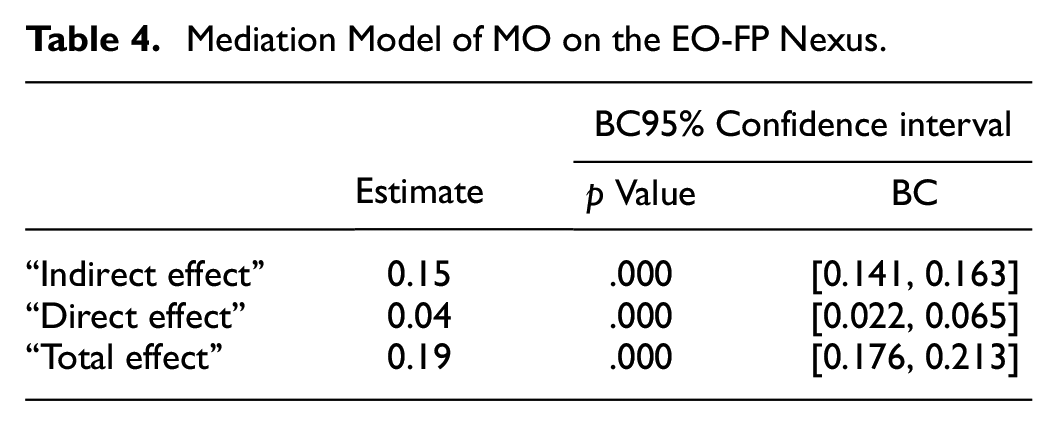
This study analyzed the EO-FP path before adding other variables. Therefore, it computed the relationship between EO and FP through sample size weighting and then rectified measuring and sampling errors. The obtained correlation between EO and FP was .19 (see Table 4), reaching a significantly positive relationship. Thus, H1 is supported.
Mediation Model of MO on the EO-FP Nexus.
Mediator Analyses
This study applied structural equation modeling to analyze the mediation effect. Therefore, it validated the overall goodness of fit of the SEM by referring to Bergh et al. (2016). Here, CFI, NFI, GFI was 1.000, and SRMR was 0.000, suggesting a strong goodness of matching between the conceptual model and sample data (see Table 5).
Test of Overall Model Fit Indicators.

The study then analyzed the mediator variable by referring to Baron and Kenny (1986) and Preacher and Hayes (2008). According to Baron and Kenny (1986), (1) an “independent variable” will significantly influence a “dependent variable” in the absence of a “mediator variable”; (2) an “independent variable” will significantly influence a “mediator variable”; and (3) a “mediator variable” will reduce the impact of an “independent variable” on a “dependent variable” after being imported. On such basis, this study validated the mediation effect. The following results were obtained: (1) in the absence of MO, the EO-FP relationship value was 0.19 (p-value < .001); (2) there was a significantly positive correlation between EO and MO (H2 is supported) and a significantly positive correlation between MO and FP (H3 is supported); and (3) after MO was imported, the EO-FP relationship value was reduced from .19 to .04 (p-value < .001).
This study further applied the causal steps and approaches of Preacher and Hayes (2008) to examine the mediator variable. The research result Demonstrated that: the “standardized effect size” of the indirect effect was 0.15 and the BC95% confidence interval did not contain 0; p was .000 (<.05), reaching the significant criterion and proving that MO was a mediator factor to EO-FP relationship (H4 is supported). In addition, as listed in Table 4, the model showed a significantly positive direct effect (the BC95% confidence interval did not contain 0).
Mediator-Moderator Analyses
In this part the study first applied the k-means clustering method to divide ED into high ED and low ED through the following procedures: (1) applied the k-means clustering method of SPSS to divide ED data into two groups (Tables 6 and 7); and (2) applied discriminant analysis (Table 8) and independent samples t-test was conducted to assess the validity of the grouping.
Cluster Center Point.

Observed Variables in Each Group.

Classification Result.

As listed in Table 8, after the grouping was cross-validated using discriminant analysis, the hit rate of the grouping in this study was 100%, representing that the grouping was valid.
As listed in Table 9, the significance value of Levene’s test was 0.395 (greater than 0.05), reaching the significance level. Therefore, it could be assumed that the variances of the two groups were equal. In addition, the t-value was −1.297 and the significance value was .00 (less than .05), indicating a distinction between high and low ED. Therefore, this study inferred that it was a significant distinction between high and low ED in this model. In addition, the 95% confidence interval field shows that the mean score of high ED was higher than that of low ED. In view of the above, the ED data grouping implemented in this study was valid and meaningful. This study then tested the moderation effects of high and low ED on the MO-FP nexus. Table 10 and Figure 1 show the test results.
ED Independent Samples’t-Test.

Indicates p < .001.
Analysis of Moderation Coefficients in High and Low ED Models.

Indicates p < .001.

Analysis of moderation coefficients in high and low ED models.
As listed in Table 10, under the single MO-FP condition, this study tested the estimates of path coefficients on the MO-FP nexus: 0.314 and 0.101. In other words, the positive impact of MO on FP was greater under high ED than that under low ED. This helped understand the moderator role played by ED on the relationship between MO and FP. Therefore, H5 is supported.
This study then tested the slope variation of ED on the MO-FP nexus in the whole model. Table 11 and Figure 2 show the test results. As listed in Table 11, the slope estimate of the mediation influence MO on the MO-FP nexus under high ED was 0.173; in contrast, the slope estimate of the mediating effect of MO on this same relationship under low ED was −0.061. Table 11 shows that H6 is supported.
Analysis of Slope Coefficients Under ED.
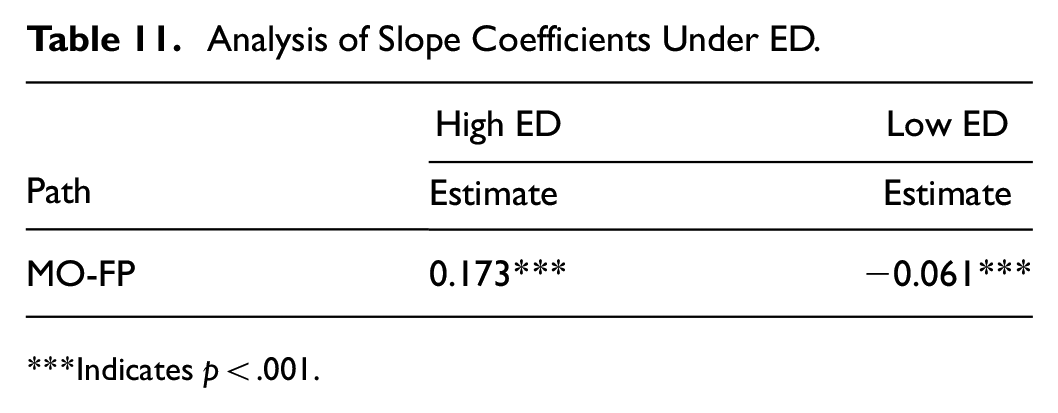
Indicates p < .001.

Analysis of slope coefficients in high and low ED models.
Results
Table 1 lists the traditional dual-variable random effect analysis results and shows that the two factors significantly relate to FP (i.e., the 95% confidence interval did not contain 0): EO-FP relationship (0.163) and MO-FP relationship (0.294). This is inconsistent with the research result of MASEM: EO-FP relationship (0.04) and MO-FP relationship (0.33) (Table 3). It indicates that traditional dual-variable MA and MASEM offer diverse results. Furthermore, the data of the “direct effect model” didn’t meet the model adaptation standard (GFI = 0.850, CFI & NFI = 1.000, and RMR = 0.210). In view of this result, this study considered expanding the structure of the EO-FP model by adding the mediation relationship in the conceptual framework to enhance comprehension and elucidate the association between EO and FP.
This research then constructed a model of mediation to test the causality and mediation relation between the variables. This mediation model allows researchers to understand different conceptual alternatives while testing possible endogenous relationships - that is, changes in one variable might influence other variables and further influence the estimation of mediation effects. This model could also improve the “reliability” and “validity” of research results. The data for this model met the model adaptation standard (GFI, CFI, NFI = 1.000, and RMR = 0.000). As listed in Table 4, the estimate of indirect effect size was .15 (significant), the estimate of “direct effect size” was .04 (significant), and the “total effect size” was .19, indicating that MO has “a partial mediation effect” on EO to FP relationship.
This study subsequently considered ED as a moderator variable and conducted Levene’s test to divide ED into high ED and low ED to examine the MO-FP relationship. As listed in Table 10, the estimates of path coefficients of high and low ED on the MO-FP nexus were 0.314 and 0.101, respectively. Table 10 shows that ED acts as a moderator in the association between MO and FP and also displays that the positive effect of MO on FP was greater under high ED than that under low ED (see Figure 1).
Table 11 presents that due to the mediation relationship of MO, ED caused variance in the slope of the MO-FP relationship. As listed in Table 11, the slope estimates of the mediation of MO on the MO-FP nexus under high and low ED were 0.173 and −0.061, indicating that when enterprises with EO adopt MO as the mediator variable to build a competitive edge for improving FP, they may have a greater need of adopting MO to improve FP under high ED (Wang et al., 2015). As a result, the slope of the MO-FP relationship showed a positive development trend; in contrast, in a stable market environment, enterprises will be less sensitive to market changes (Figure 1) due to slight changes in customer preferences (Berthon et al., 1999).
In view of the above, this study further discusses each research hypothesis based on the research results. First, according to the research results of prior studies on the EO-FP relationship, EO does drive enterprises to seek economic and market growth and further improve FP (J. G. Covin & Slevin, 1991). The result obtained by this study after applying MASEM is consistent with this proposition. However, most prior studies on EO focused on FP and also mentioned that enterprises with EO tend to adopt market trend prediction (J. G. Covin & Slevin, 1991). In addition, such enterprises can fully understand customer demand and market changes and prioritize creating and maintaining superior customer values while seeking business opportunities (Slater & Narver, 1995). As a result, they can respond to customer and market demands more efficiently (Baker & Sinkula, 1999), adjust to market shifts more swiftly (Kraus et al., 2012), create a rivalrous edge in the market, and improve FP (Huang et al., 2018). Therefore, MO helps enterprises with EO improving FP. Subsequently, it is also learned that MO takes on an influential intermediary responsibility in the EO-FP correlation.
Some empirical studies suggested that external ED helps enterprises adopting MO know about market trends and meet customer demands in advance and create a competitive edge to improve FP (Wang et al., 2015). However, some empirical studies stated it is doubtful that MO positively influences FP under the possible impact of external environments on enterprises (Slater & Narver, 1994). If an enterprise attaches excessive importance to customers’ voices in a stable market environment, then it may lose its leadership in the market in the long run (Berthon et al., 1999).
This study overall has addressed data deficiencies and increased accurateness of the estimates herein through the application of MASEM and a simulation (Bergh et al., 2016). This study validated the result of most prior papers (significantly positive relationship between EO and FP) (J. G. Covin & Miller, 2014; Ghantous & Alnawas, 2020; Hughes et al., 2022; Wiklund, 1999) and also validated MO as a key mediator variable in the EO-FP nexus in prior papers (J. G. Covin & Slevin, 1991; Esteban et al., 2002; Huang et al., 2018; Slater & Narver, 1998) and ED as the moderator variable in the EO-MO-FP nexus (Wang et al., 2015). This study also researched the moderation effect of ED on the MO-EO relationship and validated the impact of ED on the slope variation of mediation effect of MO on this relationship. It supports the hypotheses of Slater and Narver (1994) and Berthon et al. (1999) and fills the gap in the literature by discussing external ED’s influence on the slope variation of mediation effect of MO on the MO-FP nexus.
Discussion and Conclusion
This paper describes how to apply MASEM to study strategic management topics and provides empirical examples regarding the connections among EO, MO, ED, and FP. During the process, this study compared traditional meta-analysis with MASEM and found that MASEM helps researchers’ better study EO-FP relationship-related topics. In other words, compared to traditional meta-analysis, MASEM can better process complex relationships between multiple variables, provide more accurate and reliable results, and interact with the conclusions from theoretical development (Viswesvaran & Ones, 1995). Furthermore, MASEM involves specifying potential relationships. Therefore, this study quantified this method through simulations to provide additional explanatory power than traditional meta-analysis (Bergh et al., 2016) and to deepen the literature’s understanding of the relationship between EO and FP.
Although it has been confirmed herein that MASEM provides greater utility in identifying research differences than traditional meta-analysis, the size of the difference still depends on the efforts exerted by researchers in applying this method (Bergh et al., 2016). In other words, it is more valuable to apply MASEM to revisit the result of traditional meta-analysis when the difference is larger (Steinmetz & Block, 2022). In addition, MASEM provides strategic management researchers with an explanatory power by comparing different theoretical models (Davis, 2010). MASEM allows them to build various models to replace theories and aggregate data related to these theories. Researchers can directly test model parameters in order to ascertain which theory offers the most support (Bergh et al., 2016) for reaching a higher level of understanding.
When compared with traditional meta-analysis, MASEM provides new insights into important relationships based on existing strategic management papers (Bergh et al., 2016). From addressing inconsistency to expanding knowledge of phenomena and theoretical boundaries and testing possible moderator variables, MASEM helps increase or reduce understanding of the relationships between research variables (Lee & Madhavan, 2010). MASEM allows researchers to more clearly understand such relationships and changes in different contexts, further improves the reliability and applicability of theories, expands the application of existing theories, and identifies opportunities for exploring new research directions (Bergh et al., 2008; Hoskisson et al., 1994). From this perspective, the EO-MO and MO-FP relationships validated in this study presents novel avenues for knowledge development that may not be discerned through traditional meta-analysis methods.
Existing EO-FP studies have proposed many theories, and therefore scholars have proposed comparing these theories through different theoretical models to identify which ones explain and predict actual phenomena for the purpose of improving the accuracy and utility of EO-FP relationship studies (Rauch et al., 2009). Such issues can be addressed by applying MASEM. In other words, it enables researchers (such as Rauch et al. (2009) to accurately capture interactions and influences between key variables based on exploring different theoretical perspectives. Therefore, MASEM can provide the explanatory ability of different theories to studies. By testing the validity and utility of theoretical models and comparing them with the explanatory ability of other theoretical models (Drees & Heugens, 2013), researchers will be able to provide better guidance on empirical studies. Because they are able to offer more insights and findings for academia, theories will be simpler, more effective, and further developed and improved (Bergh et al., 2016).
MASEM overall integrates data from multiple studies into one large sample for reducing the impact of endogenous papers and improving the reliability and validity of statistical analyses. Therefore, MASEM offers a powerful tool for cross-study theoretical modeling and testing (Viswesvaran & Ones, 1995). In addition, MASEM method is able to be applied to expand prior study results obtained by applying the traditional meta-analysis method, thus assisting researchers in understanding the differences and inconsistencies in prior meta-analyses. By integrating multiple meta-analysis results, researchers can better understand the limitations of prior studies and propose new research issues and hypotheses.
MASEM also builds different models to represent different theories, aggregates data related to these theories, and directly tests model parameters to determine which theory is supported the most. MASEM can also help researchers evaluate the explanatory and predictive ability of different theories to determine which model best explains and predicts actual phenomena, improving the reliability and utility of theories. The multiple strengths of the MASEM research method make it a very useful approach for studying the EO-FP nexus. Therefore, this study’s test of the influence of “internal” and “external” factors on FP of enterprises with EO at the same time under different or similar theoretical models gives significant contributions to the theoretical development and empirical application in this field.
Footnotes
Declaration of Conflicting Interests
The author(s) declared no potential conflicts of interest with respect to the research, authorship, and/or publication of this article.
Funding
The author(s) received no financial support for the research, authorship, and/or publication of this article.
Ethical Approval
This article does not contain any studies with human participants performed by any of the authors.
Informed Consent
This article does not contain any studies with human participants performed by any of the authors.

Data Availability
The data that support the findings of this study are available from the corresponding author upon reasonable request.