




Abstract
In the context of China’s regional development imbalance and transformation toward innovation-driven growth, understanding how foreign direct investment (FDI), trade, and innovation jointly influence regional economies has become a pressing issue. This study focuses on Western China, a region crucial to the national strategy for coordinated development yet often underrepresented in empirical research. Using provincial-level panel data from 12 western provinces from 2001 to 2022, a panel vector autoregressive (PVAR) model is employed to examine the dynamic relationships among FDI, exports, imports, research and development (R&D) investment, human capital, and economic growth. The results indicate that FDI and exports exert significant and persistent positive effects on regional economic growth, while imports and R&D investment contribute indirectly by promoting technological progress and enhancing competitiveness. Human capital also supports growth with a time lag, reflecting its cumulative nature. The findings provide empirical support for endogenous growth and global value chain theories, revealing that innovation and trade are key transmission channels of regional growth. This study contributes to the understanding of regional dynamic mechanisms and offers practical policy implications for promoting high-quality FDI, strengthening innovation, and developing human capital to achieve sustainable and inclusive growth in Western China, and provides useful reference for other developing countries and regions.
Introduction
Globalization and the continuous restructuring of the world economy have made foreign direct investment (FDI) and foreign trade essential engines of economic growth and regional transformation, especially in developing countries. These external factors not only contribute capital and technology but also accelerate industrial upgrading and productivity growth through spillover effects. However, the extent and mechanism of these effects often depend on local economic structures, absorptive capacities, and institutional environments. In China’s context, although substantial literature has examined the nexus between FDI, trade, and growth at the national level, there remains insufficient understanding of how these dynamics operate within less-developed regions such as Western China, where industrial bases are weaker and openness levels remain low.
Western China, comprising 12 provinces, holds strategic significance under national policies such as the Belt and Road Initiative and the Western Development Strategy. Despite recent improvements, the region continues to lag behind Eastern and Central China in industrial structure, innovation capacity, and international integration. In August 2024, the Chinese government released the Policy Measures for Further Promoting the Development of Western China to Form a New Pattern, emphasizing scientific innovation, openness, and coordinated regional growth. This policy shift underscores the urgent need to understand how external drivers such as FDI, exports, and imports interact with endogenous factors like R&D investment and human capital to shape the region’s sustainable development trajectory.
Although previous research has analyzed the relationship between FDI, trade, and economic growth in China (Jahanger, 2021; C. Zhao & Du, 2007), most studies have concentrated on the eastern provinces or the national level, overlooking Western China’s distinct developmental context. Moreover, existing evidence on the growth effects of FDI and trade remains mixed, with some studies reporting positive spillovers (Li et al., 2021; Tian et al., 2019) while others find limited or even negative impacts (Zhang et al., 2024). This inconsistency highlights the need for a more nuanced, region-specific investigation that accounts for structural heterogeneity and dynamic interactions among key variables.
To this end, this study focuses on foreign direct investment (FDI), trade, and economic growth because these variables represent the main transmission channels through which openness, capital inflow, and technological diffusion affect regional development. Theoretically, according to endogenous growth theory (Lucas, 1988; Romer, 1990) and the global value chain framework (Gereffi et al., 2005), FDI and trade play crucial roles in promoting innovation diffusion, productivity improvement, and industrial upgrading, which are the fundamental mechanisms of sustainable economic growth. In the context of Western China, FDI and trade are also vital for narrowing regional disparities and enhancing integration into global production networks. Therefore, examining the dynamic interaction among FDI, trade, and economic growth helps reveal how external engagement and endogenous innovation jointly shape the region’s transformation and long-term growth trajectory.
This study aims to fill this research gap by systematically examining the dynamic linkages among FDI, exports, imports, R&D investment, human capital, and economic growth in Western China. Using a panel vector autoregressive (PVAR) model with system GMM estimation based on provincial-level data from 2001 to 2022, this paper explores how these factors interact and transmit over time. Unlike traditional regression models that assume unidirectional causality, the PVAR framework enables a simultaneous analysis of feedback effects, revealing both short- and long-run dynamics. In addition, this paper applies unit root, cointegration, Granger causality, impulse response, and variance decomposition analyses to ensure robustness and to uncover the direction, magnitude, and persistence of the relationships.
The main contributions of this study are threefold. First, it enriches the literature by focusing on Western China, an underrepresented but policy-critical region, and reveals how FDI and trade influence growth under conditions of structural disadvantage. Second, by integrating R&D investment and human capital into the PVAR framework, the study bridges the gap between external and endogenous growth drivers, contributing to the theoretical understanding of regional economic convergence. Third, it provides empirical evidence and region-specific policy insights that can guide local governments in designing strategies to attract high-quality FDI, optimize export structure, and strengthen innovation capacity. The findings also offer valuable implications for other developing regions pursuing balanced and sustainable growth.
The rest of this paper is organized as follows. Section 2 reviews the relevant literature and theoretical foundations. Section 3 describes the data, variables, and PVAR model specification. Section 4 presents the empirical analysis and results. Section 5 provides a discussion linking the findings to theory and prior studies. Section 6 concludes the paper and offers targeted policy recommendations for promoting sustainable economic growth in Western China.
Literature Review
Theoretical Foundations
This study builds on the endogenous growth theory and the global value chain (GVC) framework, which together provide the theoretical foundation for understanding how foreign direct investment (FDI) and foreign trade contribute to long-term economic development (Gereffi et al., 2005; Lucas, 1988; Romer, 1990). Endogenous growth theory emphasizes that technological innovation and human capital accumulation are the fundamental drivers of sustainable economic growth. FDI and trade act as channels for knowledge diffusion, technological spillovers, and productivity enhancement, thereby accelerating innovation within the host economy. Similarly, the global value chain theory explains that participation in international production networks enables countries and regions to move up the value chain through learning and upgrading processes. These frameworks jointly suggest that external openness through FDI and trade, when supported by endogenous innovation capacity, can promote structural transformation and regional convergence in developing economies. Building on these theoretical insights, this study investigates how FDI, trade, R&D investment, and human capital interact dynamically to drive regional growth in Western China.
Empirical Studies on FDI, Trade, and Economic Growth
A growing body of empirical research has examined the multifaceted impacts of FDI and trade on China’s economic growth. Numerous studies have confirmed that FDI plays a vital role in transferring capital, technology, and management knowledge to developing economies (Borensztein et al., 1998; Sultana & Turkina, 2020). The effect of FDI on growth has been found to depend on financial development and institutional quality (Abdul Bahri et al., 2017), while the sectoral composition of FDI critically determines its contribution to economic development (Alfaro, 2003). In the Chinese context, FDI has been shown to promote economic growth at the city level, particularly when aligned with innovation-oriented industrial policies (Wu et al., 2020). It also enhances China’s technological innovation capacity, especially in high-tech industries, through technology spillovers and improved management practices (S. Zeng & Zhou, 2021). Similar findings have been reported for BRICS economies, where FDI fosters technological innovation and indirectly supports economic growth through R&D expansion (Ali et al., 2023).
Recent research has extended the discussion toward high-quality economic development. FDI has been found to promote China’s innovative, green, and shared development but to have limited direct influence in the western region, suggesting that absorptive capacity remains a key constraint (Zhang et al., 2024). China’s structural transformation from low-cost manufacturing to an innovation-driven economy under the “Dual Circulation Strategy” also emphasizes that regional industrial clusters and innovation capacity are critical to maintaining competitiveness (Brühl, 2025). The interplay between FDI, e-commerce, and export growth further reveals that eastern provinces respond more positively to FDI and digital trade than western counterparts, reflecting persistent regional disparities (He, 2024). The distribution of FDI across China remains highly uneven, with the western region attracting relatively low levels of investment and showing weak convergence patterns (Y. Zeng et al., 2025). These results align with the New Economic Geography perspective, which suggests that regional inequality limits spatial spillovers from core to peripheral areas.
Trade openness has also been widely recognized as a growth driver (Awokuse, 2008; Balassa, 1985). International R&D spillovers through trade significantly improve productivity (Coe & Helpman, 1995). In China and other developing economies, FDI and trade often reinforce each other, forming a virtuous cycle of industrial upgrading. FDI has been found to facilitate export upgrading and diversification in European transition economies (Bayar & Diaconu, 2022), while its interaction with trade significantly enhances overall economic performance in South Asia (Chaudhury et al., 2020). However, in countries with weak financial systems, the growth effect of FDI is limited, as demonstrated in African economies, where institutional fragility constrains the spillover effect of foreign investment (Hagan & Amoah, 2020). This pattern is also evident in Western China, where infrastructural and institutional challenges may restrict the absorptive capacity of local industries.
Regional and spatial structures have also been identified as key mediating factors. Spatial agglomeration and industrial structure optimization significantly promote economic growth in Western China (J. Zhao et al., 2025). Institutional quality and infrastructure investment are crucial determinants of FDI and trade linkages under the Belt and Road Initiative (Wang et al., 2025). Furthermore, China’s engagement with neighboring Asian economies has had a significant regional integration effect, highlighting the importance of institutional connectivity and innovation linkages (Liu et al., 2024). Collectively, these studies suggest that the impacts of FDI and trade are not uniform but are shaped by regional heterogeneity, policy environments, and local innovation capacities.
Research Gap and Hypothesis Development
Despite extensive research on FDI and trade, several critical gaps remain. Most existing studies rely on national or aggregate data, overlooking the distinct characteristics of less-developed regions such as Western China, where industrial bases and absorptive capacities differ markedly from those in the eastern provinces (Y. Zeng et al., 2025; Zhang et al., 2024). While many studies have explored the direct effects of FDI or trade, few have examined their dynamic interrelationships or the synergistic roles of endogenous factors such as R&D investment and human capital in shaping these effects. Moreover, the mixed empirical findings across regions suggest that local conditions including innovation capacity, institutional support, and openness, may mediate the effectiveness of FDI and trade in driving economic growth.
To address these gaps, this study employs a Panel Vector Autoregressive (PVAR) model to capture both short-term and long-term interactions among FDI, trade, R&D investment, human capital, and economic growth in Western China. This dynamic framework allows for feedback effects among variables, offering a more comprehensive understanding of regional development mechanisms. Accordingly, the study proposes the following hypotheses:
Methodology
Data Sources and Variables Description
This study adopts a positivist research philosophy and a quantitative explanatory approach, aiming to empirically identify the dynamic interrelationships among FDI, trade, R&D, human capital, and economic growth in Western China. The research strategy is based on a panel econometric design, utilizing the Panel Vector Autoregressive (PVAR) model to capture both contemporaneous and lagged interactions among variables. The study covers a longitudinal time horizon from 2001 to 2022 across 12 provinces in Western China. Following this design, several empirical procedures are conducted, including unit root and cointegration tests, system GMM estimation, and diagnostic analyses such as model stability, impulse response, and variance decomposition to ensure robustness and reliability of results.
This study focuses on Western China, which comprises 12 provinces, autonomous regions, and municipalities: Xinjiang, Inner Mongolia, Tibet, Qinghai, Gansu, Ningxia, Shaanxi, Sichuan, Chongqing, Guizhou, Yunnan, and Guangxi. The provincial-level panel data are derived from National Bureau of Statistics of China and Provincial Statistical Yearbooks from 2001 to 2022, covering all provinces in Western China to ensure the timeliness and regional representativeness of the research. The data covered six variables: economic growth (GDP), FDI, export, import, R&D investment, and human capital. Human capital is proxied by the number of employed persons, which reflects the labor availability and skill level at the regional level. While this measure does not fully capture educational quality, it provides a consistent and observable indicator across provinces. The variables are described in Table 1, along with their notations, measurement, and data sources. To ensure data comparability and mitigate heteroscedasticity, all variables were transformed into their natural logarithmic forms before estimation. Given that the dataset covers a long time span, the potential non-stationarity of the panel data was examined using multiple panel unit root tests, including Levin-Lin-Chu (LLC), Im-Pesaran-Shin (IPS), Hadri-T (HT), Breitung, ADF-Fisher, and PP-Fisher tests. The tests were performed for first-differenced series to determine the appropriate form for subsequent estimation. Detailed test results are presented in the empirical section.
Variables Description.

Model Construction
Based on the above theories, this study selects GDP, FDI, export, import, R&D investment and human capital as core variables and reveals their dynamic interaction through the PVAR model. The PVAR model combines panel data’s diversity and vector autoregression’s dynamic characteristics, which can effectively capture the interaction and time series relationship between variables. The general form of the model is as follows.

where,
Empirical Analysis
Descriptive Statistical Analysis
This study conducts a descriptive statistical analysis of data from Western China to reveal economic characteristics and each variable’s basic statistics. The statistical analysis results in Table 2 provide basic support for further analysis of the model in Western China.
Descriptive Statistics.

Unit Root Test
Unit root tests were conducted for each variable in Western China to ensure data stationarity. The test results in Table 3 show that all variables pass the unit root test, indicating that data are stationary.
Results of Unit Root Test.
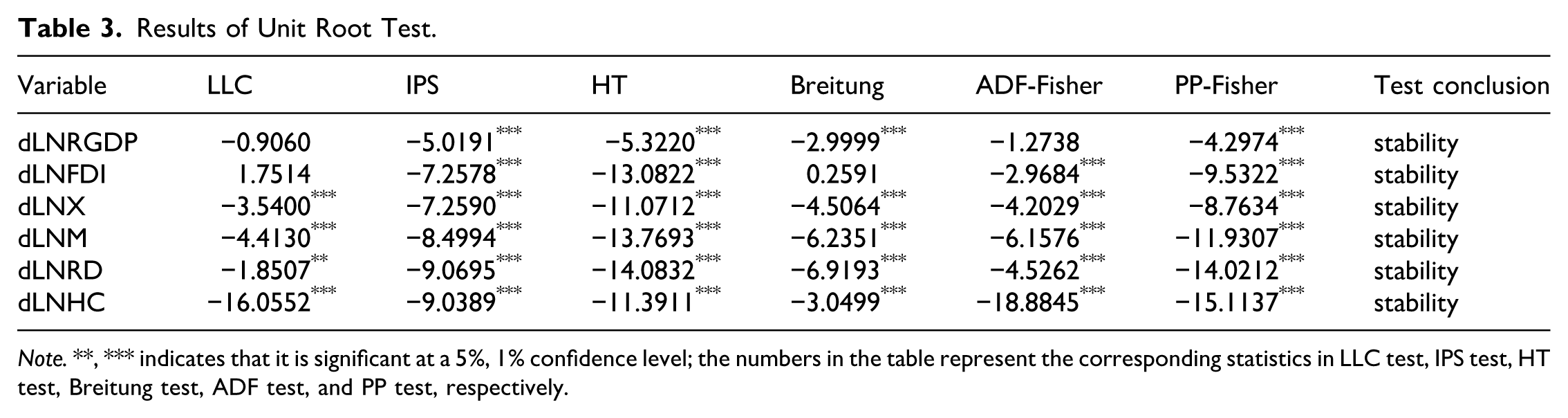
Note.**, *** indicates that it is significant at a 5%, 1% confidence level; the numbers in the table represent the corresponding statistics in LLC test, IPS test, HT test, Breitung test, ADF test, and PP test, respectively.
Cointegration Test
The cointegration relationship of variables in Western China was tested using Kao, Pedroni, and Westerlund methods. The results in Table 4 show that there is a long-term and stable cointegration relationship among the variables.
Cointegration Test Results.

Optimal Lag Order Selection
The optimal lag order of the PVAR model in Western China is selected using AIC, BIC, and HQIC criteria. The results in Table 5 show that the optimal lag order is 3, which is smallest and can ensure model estimation results’ validity and accuracy. Although the dataset includes 22 annual observations for 12 provinces, adopting three lags does not lead to overfitting. From an economic perspective, the transmission effects of foreign direct investment (FDI) and trade on industrial output and regional economic performance often exhibit medium-term dynamics, typically within a 3- to 5-year adjustment cycle. Thus, setting the lag length to three allows the model to capture the realistic propagation mechanism of policy and investment effects in China’s regional economy. After determining the optimal lag order, the PVAR model is estimated using the system GMM approach, and the stability test confirms that all characteristic roots lie within the unit circle, indicating that the three-lag specification produces a stable dynamic system.
The Optimal Lag Order Selection.

Note. AIC, BIC, and HQIC denote the Akaike Information Criterion, Bayesian Information Criterion, and Hannan-Quinn Information Criterion, respectively. * indicates the lag order that minimizes the corresponding information criterion.
GMM Estimation Results
In this study, the panel vector autoregression (PVAR) model for Western China is estimated using the system generalized method of moments (system GMM) estimator with three lags to reveal the dynamic relationships among variables. Because the baseline specification is just identified, meaning that the number of moment conditions equals the number of estimated parameters, the Hansen J statistic for overidentifying restrictions is not defined and therefore not reported by Stata. This feature is standard in system GMM estimation when the model is exactly identified. Table 6 shows estimation results in detail.
GMM Estimation Result.

Note. Standard deviation in brackets. h_ indicates that Helmert converted the variable.
,**,***Indicate significance at the significance level of 10%, 5%, and 1%, respectively.
The analysis of economic growth, export, import, foreign direct investment (FDI), and human capital in the context of Western China reveals several key relationships that can inform policy optimization and economic restructuring. The findings demonstrate strong dynamic persistence in economic growth, indicating that economic growth in the prior period significantly influences current growth. This positive feedback loop highlights the sustainability of growth, although exports are initially inhibitory in the short term. However, in the long run, exports contribute positively to economic growth, this supports
FDI also positively affects economic growth in Western China, particularly by fostering export growth, which supports
The results indicate a complex dynamic interaction between economic growth and exports, FDI, human capital, and R&D investment, emphasizing the need for policy synergy. FDI and human capital investment not only directly promote economic growth, but also positively enhance export competitiveness; R&D investment has significantly promoted technological progress and industrial upgrading. Based on these findings, this paper suggests adopting a comprehensive policy approach to coordinate the improvement of export quality and technology level, attract high value-added FDI, promote the accumulation of human capital, and increase the support for R&D investment in Western China. Although the dynamic effects may fluctuate to some extent in the short term, the long-term strategy oriented by technological progress and institutional improvement is expected to provide strong support for sustainable economic growth and industrial competitiveness in Western China.
Model Stability Test
In the stability test, the PVAR model in Western China shows that all unit root eigenvalues are less than 1, indicating that the model is stable and the relationship among variables remains stable in the long run. Table 7 and Figure 1 show the results of the model stability test in Western China.
Eigenvalue Stability Condition.
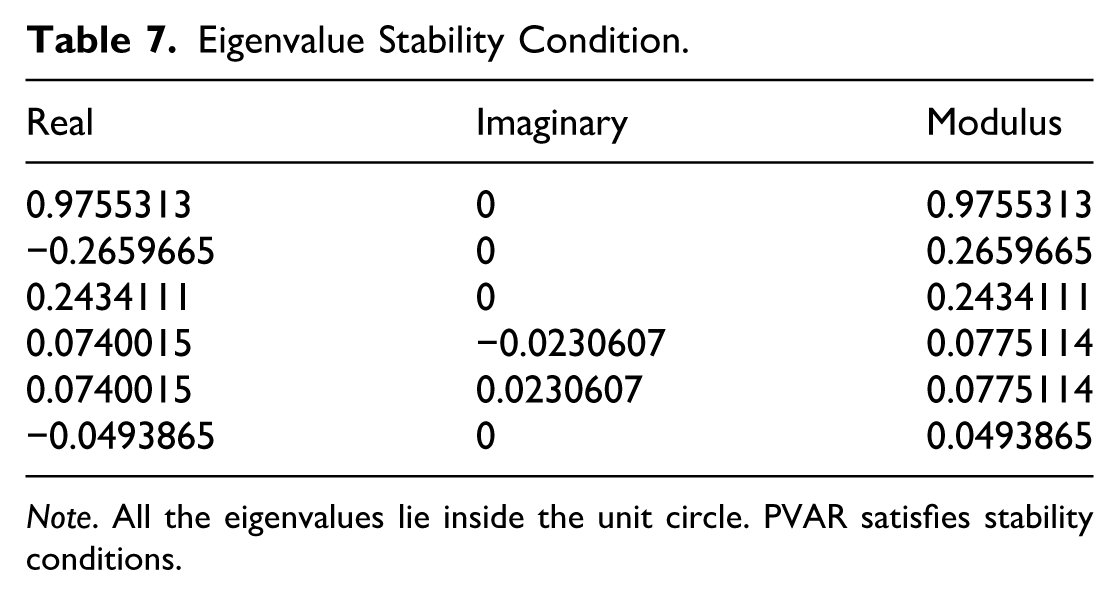
Note. All the eigenvalues lie inside the unit circle. PVAR satisfies stability conditions.

Unit circle test.
Granger Causality Test
Granger causality test is used to analyze Granger causality among variables in Western China. Table 8 shows Granger causality test results for Western China. FDI, export and import are significant Granger causes of economic growth, indicating that foreign capital inflow and external trade possess strong predictive power for regional economic performance. In contrast, R&D investment and human capital do not Granger cause economic growth, suggesting that their contributions to growth remain limited, possibly due to inefficiencies in technology absorption or underutilization of human resources. Further, Economic growth, human capital is found to Granger cause export, reflecting their crucial role in enhancing export competitiveness. Economic growth, export, and human capital also Granger cause import, implying that rising income levels and labor quality are key drivers of import expansion. However, FDI and R&D investment do not significantly affect import. In terms of technology development, economic growth and import Granger cause R&D investment, highlighting the demand-driven nature of innovation activities in the region. Export do Granger cause import, confirming a bidirectional trade linkage, whereas import Granger causes R&D investment, suggesting that imported technology or goods might stimulate domestic research and innovation. Economic growth is the only variable that Granger causes human capital, indicating that improvements in income and development levels may facilitate investment in education and training. Taken together, these findings underscore the pivotal role of trade and human capital in driving Western China’s economic growth, while pointing to the need for better integration of FDI and R&D investment into the region’s development strategy.
Granger Causality Test Results.

Note.***, **, * indicate significance at 1%, 5%, and 10%, respectively. Numbers in brackets are p-values.
Impulse Response Analysis
Impulse response analysis was used to assess the short- and long-run effects of each variable, revealing the interaction between variables and their transmission effects. Figure 2 shows impulse response analysis results. The impulse response functions trace the effects of one standard deviation shocks to each variable on the system over a 10-period horizon.
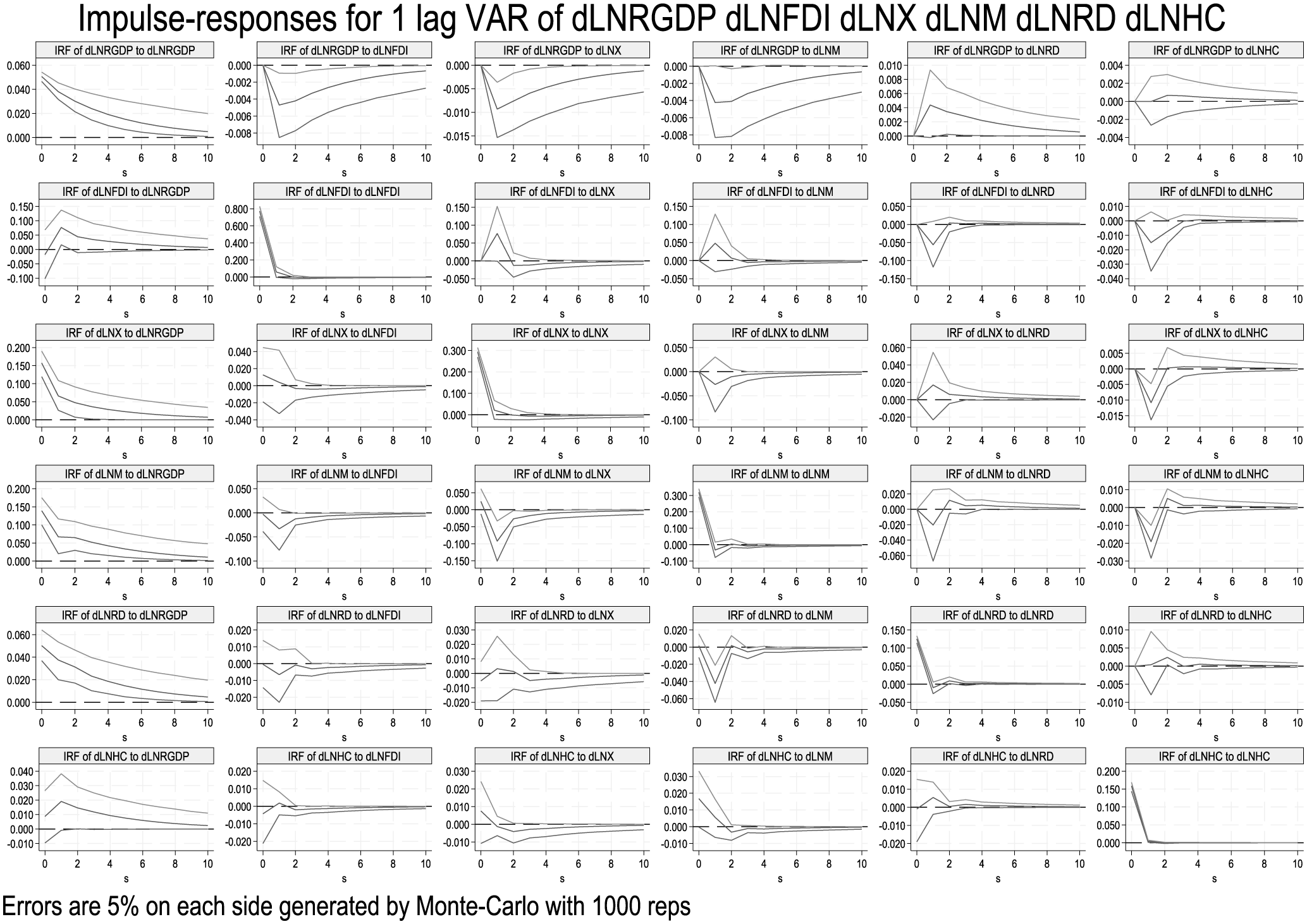
Impulse response analysis.
The response of economic growth to its own shock is immediate and strongly positive in the first period (approximately 0.15), gradually declining and stabilizing around zero by period five. Similarly, exports and R&D investment display strong initial positive responses (around 0.12 and 0.10, respectively) to economic growth shocks, while FDI, imports, and human capital show moderate initial responses (less than 0.05) that taper off within four to five periods. These results indicate that economic growth has a reinforcing short-term effect on innovation and external trade, particularly exports.
When the system is shocked by FDI, the response of economic growth is initially negative (around 0.03 in period one), but this effect diminishes quickly and vanishes by the 10th period. Exports exhibit a brief positive response to FDI shocks (about 0.05) that reverses to neutrality after period three, whereas R&D investment and human capital show mild negative or neutral reactions. This pattern implies that FDI may not always have an immediate positive effect on domestic innovation or labor quality, possibly due to absorptive capacity limitations or crowding-out effects.
A shock to exports leads to a short-lived negative effect on economic growth (around 0.02–0.03 in the first two periods) and imports, while its impact on FDI is initially positive but quickly weakens. The responses of R&D investment and human capital to export shocks are marginal (less than 0.01), suggesting limited immediate spillover from trade to innovation or human capital formation. These results indicate that the benefits of export expansion may not automatically translate into broader economic gains without supportive structural conditions.
In response to import shocks, economic growth again displays a obvious negative reaction in the short term (about 0.05 in period one), consistent with the possibility of import competition effects. Imports themselves exhibit self-dampening behavior, while their effects on R&D investment and human capital are initially negative and return to zero after about four periods, potentially indicating limited backward linkages or weak domestic learning effects from foreign inputs.
Shocks to R&D investment reveal a positive and immediate effect on economic growth (approximately 0.10 in period one), highlighting its crucial role as a driver of output. However, its influence on FDI and trade is relatively weak or even slightly negative in the short term. This may reflect the time-lagged nature of innovation benefits or a misalignment between R&D investment and trade or FDI flows. The response of human capital to R&D investment shocks is slightly positive and persistent for about three periods, suggesting some degree of synergy between technological advancement and labor development.
Shocks to human capital do not generate substantial or lasting responses from other variables. Economic growth exhibits a delayed positive response (around 0.03 in period three), indicating that human capital accumulation contributes to long-term development but with a lag. Most other variables, including FDI, exports, and R&D investment, respond weakly or negatively, suggesting that human capital alone may be insufficient to stimulate immediate changes in economic dynamics without complementary inputs.
Overall, the impulse response analysis highlights the short-term volatility and complex interdependence among economic growth, FDI, trade, innovation, and human capital. It reveals asymmetric impacts of different shocks, with most effects dissipating within five to six periods. The findings underscore the critical role of innovation and trade dynamics, particularly exports, in shaping China’s growth path. However, the limited and sometimes negative responses from FDI and imports suggest that the quality rather than the quantity of external engagement matters for sustainable development.
Variance Decomposition Analysis
In order to ascertain the sources of variance transformation among the key macroeconomic variables in this framework of Western China, this paper employed the variance decomposition technique derived from the moving average estimates of the PVAR model. Table 9 presents the summary of results at 10 periods ahead, revealing the proportion of forecast error variance in each endogenous variable that is attributable to its own innovations and to innovations in other variables in the system. In period 10, the variance of GDP is mainly explained by its own shocks, accounting for 93.9%, indicating a strong self-explanatory effect in the long run. At the same time, exports, foreign direct investment (FDI), imports and R&D investment contributed 3.4%, 1.0%, 0.9%, and 0.8%, respectively. The long-run role of exports is relatively more prominent among all external factors. For FDI, its own shocks explain 96.2% of the variation, GDP and export contribute 1.8% and 1.0% respectively, while the role of other factors is very limited, indicating that FDI fluctuations are mainly endogenous. The dynamic changes in exports are also mainly self-driven, accounting for 70.5%, followed by GDP contribution of 28.2%, further confirming the key forecasting role of macroeconomic activities on export changes. Own shocks explain 68.1% of import fluctuations, GDP contributes 23.4%, and exports 6.9%, indicating a close trade link. In terms of R&D investment, 65.5% of the variance comes from own shocks, GDP contributes 26.1%, and imports contribute 7.6%, showing that macroeconomic variables affect R&D activities to some extent. Finally, 94.4% of the variance of human capital is determined by itself, GDP contributes 3.8%, and the remaining factors have little influence, indicating that the fluctuation of human capital is limited by the impact of external factors.
Variance Decomposition Results.

These findings emphasize the importance of internal dynamics for most variables and verify endogenous growth theory that economic fluctuations are mainly driven by internal mechanisms (Lucas, 1988; Romer, 1990). The results also highlight the key role of GDP and trade activities, especially imports and exports, in affecting the long-term fluctuations of regional economies, which is consistent with the core proposition of the export-led growth hypothesis (Awokuse, 2008; Balassa, 1985). Western China’s economic growth is mainly driven by endogenous factors, while external factors such as trade and investment play an amplified role in specific stages. The long-term contribution of export to economic growth continues to rise, which further proves the important role of export-oriented development strategy in regional economic revitalization (Awokuse, 2008). Although the overall impact of FDI on regional economic growth is relatively limited, it shows a significant promoting effect in some periods, which supports the theoretical view of FDI as a phased growth accelerator (Alfaro, 2003; Borensztein et al., 1998). The direct promotion effect of import on economic growth is weak, but it has a potential impact on regional industrial upgrading and market expansion in the long run through the synergistic effect formed with export (Coe & Helpman, 1995). In addition, R&D investment, as an important indicator of technological innovation, has a sustained and significant positive effect on economic growth in Western China, which is consistent with the conclusion of endogenous growth theory that knowledge accumulation drives long-term growth (Aghion & Howitt, 1990; Romer, 1990). Although the contribution of human capital to economic growth is limited in the short term, its long-term importance as a fundamental driving force of growth cannot be ignored (Barro, 1991; Mankiw et al., 1992). In summary, these results reveal the interweaving relationship between endogenous and external drivers of economic growth in Western China, and emphasize the key role of export, technological progress and policy guidance in promoting regional sustainable development.
Discussion
Based on the empirical analysis, this study identifies the dynamic roles and interactions of FDI, trade, R&D investment, and human capital in Western China. The findings are consistent with and extend previous theoretical and empirical research.
The significant role of FDI in promoting economic growth and exports in Western China supports the conclusions of Sultana and Turkina (2020) and Abdul Bahri et al. (2017), who emphasized that FDI stimulates sustainable development through technology transfer and absorptive capacity. However, as Zhang et al. (2024) found, the effect of FDI on high-quality growth in Western China remains limited, largely due to insufficient innovation capacity and the weak integration of foreign firms into local supply chains. This study confirms that FDI’s technological spillover in Western China has not yet fully materialized. Therefore, consistent with Ali et al. (2023) and S. Zeng and Zhou (2021), policies should focus on attracting R&D-intensive and high-tech FDI and on fostering partnerships between local and foreign firms to enhance technology localization.
The results on exports reveal a short-term inhibitory effect but a long-term positive impact on growth. This pattern aligns with Awokuse (2008) and Balassa (1985), who argued that trade-led growth depends on export structure and technological content. The impulse response results further confirm that export upgrading plays a key role in long-run industrial transformation, which echoes Bayar and Diaconu (2022) and Chaudhury et al. (2020). Therefore, strengthening the technological content and market diversification of exports, especially under the Belt and Road Initiative, will consolidate Western China’s position in global value chains. Imports also play a crucial role in promoting technological upgrading and innovation. The positive contribution of imports to technological progress is consistent with Coe and Helpman (1995) and Li et al. (2023), who demonstrated that technology transfer through imports can enhance regional competitiveness. Given the regional context, improving intellectual property protection and promoting high-tech equipment imports are essential to fully leverage these effects. This result also aligns with He (2024), who emphasized that trade openness and digital integration jointly enhance export competitiveness and sustainable innovation.
R&D investment emerges as an endogenous driver of economic growth, confirming the theoretical propositions of Romer (1990) and Lucas (1988). Similar to Li et al. (2023) and Tian et al. (2019), this study finds that R&D promotes long-term growth by improving innovation capacity. Nevertheless, the efficiency of R&D in Western China remains low, and the transformation of scientific outcomes into productivity is limited. Strengthening collaborative innovation networks and enhancing research-industry linkages would further improve the regional innovation ecosystem. Human capital also plays a decisive role in supporting growth and export upgrading. The results support Barro (1991) and Mankiw et al. (1992), who highlighted human capital as a fundamental determinant of productivity. Consistent with Brühl (2025) and J. Zhao et al. (2025), Western China still faces a shortage of skilled labor, constraining the absorptive capacity of technology. Therefore, investing in vocational and higher education, particularly in science and engineering, is essential for fostering sustainable industrial development.
Finally, the strong interaction among variables underscores the importance of policy synergy. The complementarities between FDI, exports, and imports, as observed in the variance decomposition, indicate that openness and innovation reinforce each other. This is consistent with Wang et al. (2025), who found that coordinated investment and trade policies enhance long-term regional competitiveness. Future strategies should thus integrate FDI attraction, trade upgrading, innovation support, and human capital development to achieve balanced and high-quality growth in Western China.
Overall, these findings extend the existing literature by providing region-specific empirical evidence for Western China. The results not only support the endogenous growth and global value chain theories but also highlight the structural constraints that differentiate Western China from more developed regions. Comparative evidence from other developing economies (Hagan & Amoah, 2020; Miao et al., 2021) reinforces that institutional quality and absorptive capacity determine the extent to which FDI and trade can translate into sustainable growth. Hence, this study contributes both theoretically and practically by elucidating how external engagement and endogenous innovation jointly shape regional economic transformation.
Conclusion and Policy Recommendations
Conclusion
This study aimed to examine the dynamic interrelationships among foreign direct investment (FDI), trade, research and development (R&D) investment, human capital, and economic growth in Western China. Using provincial-level panel data from 2001 to 2022 and a Panel Vector Autoregressive (PVAR) model, the analysis provides a comprehensive understanding of how external openness and internal innovation jointly influence the region’s long-term economic development. The empirical findings indicate that FDI has a significant positive effect on Western China’s economic growth and export capacity, although its technology spillover effect remains limited due to weak absorptive capacity. Exports show a short-term inhibitory but long-term promotional effect on growth, underscoring the need to optimize export structure and improve product sophistication. Imports contribute positively through technological spillovers and improved resource allocation, while R&D investment plays a crucial endogenous role in driving innovation and competitiveness. Human capital also exerts a significant impact on exports and growth, highlighting the importance of education and skills upgrading. These findings further reveal strong dynamic interactions among the variables, suggesting that openness, innovation, and human capital reinforcement are mutually reinforcing mechanisms of regional development. The results support the endogenous growth theory and the global value chain framework, emphasizing that FDI and trade serve as channels for knowledge diffusion and technological upgrading.
Despite these valuable insights, this study has several limitations. Human capital is measured only by the number of employed persons, which captures the quantitative but not qualitative aspects of labor input. Future research should incorporate more refined indicators such as education levels, labor productivity, or composite human capital indices to better reflect its structural contribution. Furthermore, future studies may explore sub-sectoral or spatial heterogeneity within Western China and compare results with other developing economies to deepen understanding of FDI-trade-growth dynamics across different institutional contexts.
Policy Recommendations
Based on this study’s empirical findings, several policy recommendations can be proposed to promote higher-quality and more sustainable economic growth in Western China. The impulse response and variance decomposition results demonstrate that FDI, exports, and R&D investment play distinct yet interrelated roles in influencing regional economic performance, while human capital remains an important long-term driver of growth.
Firstly, the results show that FDI’s impact on economic growth is limited and sometimes even negative in the short term, suggesting that the mere expansion of investment scale does not automatically lead to growth. Therefore, policies should focus on attracting high-quality, technology-intensive, and innovation-oriented foreign capital. The government should prioritize the introduction of FDI projects with strong technological spillovers and higher value-added content, such as advanced manufacturing and digital industries. Incentives in the form of tax reductions, R&D subsidies, and preferential financing can enhance the quality of FDI inflows. Furthermore, strengthening cooperation between foreign investors and local firms can help build integrated regional industrial chains, promote technology diffusion, and foster an environment where “foreign capital drives domestic innovation.” Enhancing local firms’ absorptive capacity through deeper collaboration among enterprises, universities, and research institutions will also help sustain technology transfer and knowledge upgrading.
Secondly, the empirical results indicate that exports exert a significant and persistent positive influence on economic growth, confirming the importance of export-led development in Western China. To build on this advantage, it is essential to optimize the export structure by shifting from labor-intensive to technology- and capital-intensive industries. Government policy should support export-oriented enterprises through targeted R&D incentives and tax reductions that enhance product quality and technological content. Establishing export-oriented industrial clusters in key sectors such as electronic information technology, new materials, and high-end equipment manufacturing, can help strengthen the region’s position in the global value chain. Additionally, promoting export market diversification, particularly under the Belt and Road Initiative, will reduce dependency on a few trading partners, enhance external demand stability, and improve resilience to global market shocks.
Finally, the empirical evidence shows that R&D investment has an immediate and lasting positive effect on regional economic growth, underscoring technological innovation’s central role in driving long-term development. To leverage this potential, the government should increase funding for R&D projects that focus on green technology, intelligent manufacturing, and digital transformation. Strengthening the industry-university-research collaboration mechanism is crucial for promoting knowledge exchange and joint innovation. At the same time, improving intellectual property protection, technology transfer mechanisms, and the incubation environment will accelerate the commercialization of research achievements and foster a virtuous cycle between innovation and industrial upgrading. By combining innovation-driven growth with inclusive human capital development, Western China can build a more resilient, efficient, and sustainable regional economy.
Footnotes
Acknowledgements
The authors would like to thank Universiti Sains Malaysia for their support.

Ethical Considerations
Not applicable. This study does not involve human or animal subjects.
Funding
The authors received no financial support for the research, authorship, and/or publication of this article.
Declaration of Conflicting Interests
The authors declared no potential conflicts of interest with respect to the research, authorship, and/or publication of this article.
Data Availability Statement
If need, data sharing is applicable to this article.