




Abstract
This study investigated the determinants of human development across different income groups, including high-income, upper-middle-income, lower-middle-income, and low-income countries, using balanced panel data from 217 nations covering the period from 2000 to 2022. Employing the dynamic system Generalized Method of Moments to mitigate the heteroskedasticity and autocorrelation issues, our findings found that FDI significantly boosts the Human Development Index (HDI) across high-income, upper-middle, and low-income groups, driven by job creation and technical progress. Other factors exhibited diverse impacts across different income group levels: trade openness and poverty negatively correlated with HDI, while unemployment and inflation showed mixed effects. Conversely, population and economic growth consistently improved HDI. Based on these findings, countries should prioritize FDI-friendly policies that not only attract investment but also promote inclusive and sustainable human development, carefully balancing potential benefits and costs.
Keywords
Introduction
According to the World Bank (WB), Foreign Direct Investment (FDI) represents the net inflow of investment aimed at obtaining a significant management interest (at least 10% of voting shares) in a company operating in a foreign market. It includes equity capital, profit reinvestment, and long-term and short-term capital, as demonstrated in the balance of payments. FDI plays a vital role in a nation’s economic growth and development (Islam et al., 2021; Okada & Samreth, 2014; Pegkas, 2015; Zhang et al., 2010). Therefore, achieving sustainable high economic growth has been one of the main objectives of policymakers worldwide. The majority of research indicates that FDI has a major beneficial influence on economic growth and is a vital source of capital for many nations. Numerous nations, particularly developing ones, consider FDI as the main source of economic growth due to its role in transferring advanced technologies from developed to developing nations (Newman et al., 2015; Osano & Koine, 2016). FDI not only facilitates technology transfer and helps raise the level of domestic production technology, which increases productivity, but it also fosters learning through practice and labor training, which plays a major role in creating jobs for workers (Khan et al., 2023). Moreover, Burns et al. (2017) show that FDI aids infrastructure development and expands access to utilities, transportation, clean water, and medical and educational institutions.
Despite empirical research suggesting that FDI promotes economic growth, it has detrimental repercussions that cannot be disregarded. First, FDI does not demonstrate a country’s sustainable growth; in the long term, it makes the economy of the host country more dependent on this capital, resulting in social and environmental implications (H. V. Nguyen et al., 2019). Second, the presence of FDI companies can have a detrimental influence on domestic firms by causing a crowding-out effect; it might expose domestic firms to suffer from higher pressure, forcing them out of the industry. Third, the technological capital contributions made by foreign investors have resulted in an abundance of obsolete technology but a deficiency of contemporary technology (Praussello, 2005). Environmental contamination is caused by the fact that many FDI-related firms move obsolete machinery and equipment and employ less contemporary technologies (Caetano et al., 2022). Furthermore, FDI may violate human rights, labor laws, wage and social security rules, taxes, and social insurance policies (Cobham & Janský, 2018).
Our study’s primary goal is to investigate determinants of human development in 217 nations worldwide between 2000 and 2022, especially highlighting the impact of FDI on human development and analyzing the variation of these factors on different income group countries. This study contributes to the body of knowledge on international economics in the following ways:
First, the link between foreign direct investment and economic growth has been an ongoing concern of several studies (Acquah & Ibrahim, 2020; Islam et al., 2021; Osei & Kim, 2020); however, the question of how FDI and human development are related has received less attention. Djokoto and Wongnaa (2023) contribute to the limited body of research that investigates the impact of foreign direct investment across different stages of human development. Using panel data from 87 developing, 13 transition, and 34 developed countries between 1990 and 2019, they found that FDI positively influences human development in developing countries, while its impact is neutral in transition and developed economies. Moreover, when analyzing the effects of FDI across various stages of human development, this study reported that, except for the low human development stage in developing countries, all estimated impacts were positive. Our study differentiates from Djokoto and Wongnaa (2023) by providing a comprehensive analysis of the variation in the FDI effects on the human development of different income group countries. According to the Annual WB classification, our sample includes four income groups: (1) High-income countries; (2) Upper-middle-income countries; (3) Lower-middle-income countries; and (4) Low-income countries. Each country’s level of human development varies based on diverse social and physical factors such as healthcare accessibility, educational opportunities, and living standards. Therefore, by comparing the variation of FDI’s effects on human development among different income group levels, our findings will provide a comprehensive analysis and the policy implications for the governments in host countries to attract FDI sustainably.
Second, by using the HDI, this measurement allows us to provide a broad range of information because this index combines one economic data variable alongside two social data factors (health and education) and is not tied to only one aspect, as the previous studies (Burns et al., 2017; Gohou & Soumaré, 2012). We believe that this measurement provides a far more comprehensive picture of a nation’s level of living and overall quality of life. The HDI, which was initially developed by UNDP in 1990, accurately captures the income, life expectancy, literacy, and many other characteristics of developing nations worldwide. It assesses the average performance of a nation in three aspects: healthcare, education, and income (Figure 1).
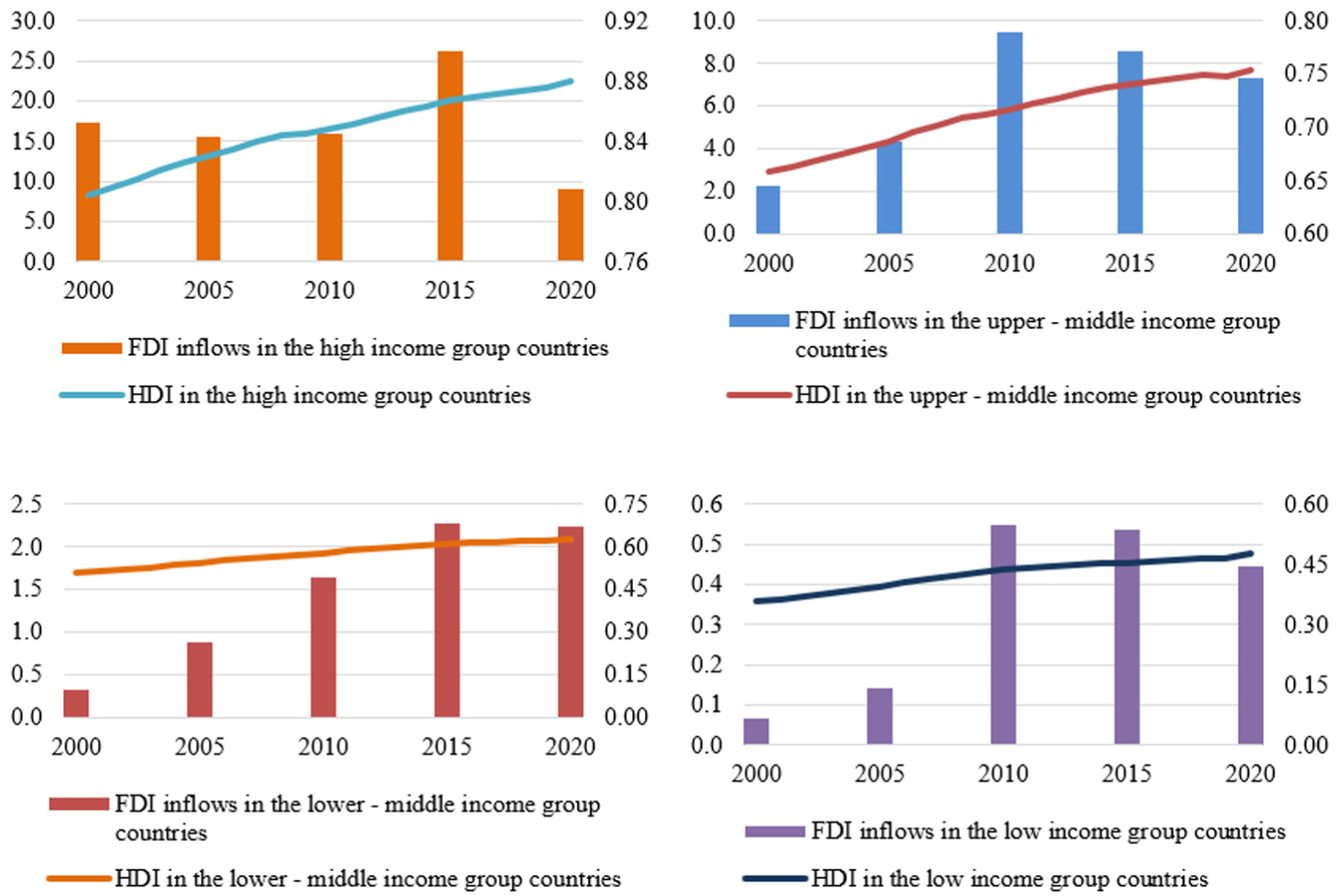
Net FDI inflows (in $ billion) and HDI (in scores) in each income group country from 2000 to 2020.
Human development is a major worldwide goal, as seen in its prominent placement in the 2015 Sustainable Development Goals (SDGs) of the United Nations. These goals encompass various aspects of human development, including eradicating poverty, improving the quality of education, promoting gender equality, protecting the environment, and ensuring good health and well-being. By gaining a deeper understanding of how FDI influences HDI, we can identify opportunities to optimize the benefits of FDI while addressing potential limitations. The findings from this research can be used to inform development initiatives and policy, ensuring that FDI promotes long-term sustainable development. This includes encouraging FDI in sustainable industries, promoting corporate social responsibility, and increasing public awareness of social and environmental protection. In this way, our research not only contributes to scientific knowledge but also provides crucial information for policymakers, investors, and development organizations, aiding in achieving comprehensive sustainable development.
This study is organized as follows. Section 2 begins with an overview of the literature study and the development of hypotheses. Next, in Section 3, we outline the study methodology and data collection. Section 4 presents the empirical data and a discussion of the findings of the previous authors. The last section concludes.
Literature Review and Hypothesis Development
Human Development Theory
At the beginning of the emergence of economic development theory, the research concentrated on efforts to improve quantitative economic performance and financial dimensions. The country’s economic performance is always reflected in the citizens’ high economic growth or Gross Domestic Product (GDP). However, as development accelerated, perceptions of development changed. UNDP emphasized that economic development should be evaluated not only by GDP, but also by people and their abilities. Economic development is only considered meaningful when increases in national income are accompanied by improvements in the quality of people’s lives in areas such as education, health, and social justice (Meidayati, 2017). The key to understanding national development is to move the traditional model—which focused only on economic growth—to one that also emphasizes human development.
Stewart et al. (2018) provided a comprehensive analysis of the progression in development thought over the second half of the 20th century, tracing key theoretical shifts and policy approaches from 1950 to 2000. Over this 40-year period, development thinking evolved through various stages, reflecting a wide range of perspectives on human development. During the late 1980s to the mid-1990s and 2000s, there was a noticeable emergence of new theories regarding development and trade, asymmetric information, diversified incentives, and the vital role of institutions. The purpose of these theories is to highlight the relevance of humans in poverty reduction, unemployment, and development capacity of the Millennium Development Goals (MDGs; Sen, 1975; Stewart, 1985; Streeten, 1981, 1994). As a result, the Sustainable Development Goals (SDGs) were established in 2015.
As a result, other metrics began to develop on a global scale, one of which was the Human Development Index (HDI). HDI was introduced in 1990 by the UNDP’s Human Development Report. This index combines GDP with measures of education and health to capture the broader aspects of human well-being. HDI is a simplified assessment of average attainment across key aspects of human development, including longevity, education, and living standards. The HDI, calculated as the geometric mean of normalized indexes for each dimension, integrates a variety of measurements. Life expectancy at birth is used to assess an individual’s health, whereas educational attainment takes into account both the average years of schooling for adults over the age of 25 and the estimated years of education for school-age children. Gross national income per capita is employed for evaluating living standards. The HDI utilizes a logarithm of income to demonstrate the diminishing significance of earnings as gross national product (GNP) increases. The scores from the three HDI dimensions are combined into a composite index using the geometric mean. Countries with very high human development indices (very high HDI) have the highest levels of human development, followed by those with high, medium, and low HDI. As a result, the HDI serves as an important instrument for analyzing national policy decisions, particularly understanding how different countries with the same GNP per capita might have variations in human development results, these disparities could lead to controversies over the prioritizing of government policies.
Foreign Direct Investment Theory
Early economic theories considered international capital flows as purely financial decisions influenced by interest rate differences and opportunities for arbitrage. However, these models failed to distinguish between foreign direct investment (FDI) and portfolio investment. The conceptual foundation of FDI was first established by Stephen Hymer in his PhD dissertation, which he later published in 1976. Hymer (1976) emphasized that FDI is not merely the transfer of capital across borders, but rather involves gaining control over foreign enterprises. This control enables firms to internalize transactions, reduce reliance on imperfect external markets, and address problems such as competition and information asymmetry.
Building on Hymer’s ideas, the theory of FDI developed significantly. In the 1970s, Internalization Theory suggested that firms choose to invest abroad directly when transaction costs in external markets are high. Later, Dunning’s Eclectic Paradigm (OLI model) combined three conditions necessary for FDI: Ownership advantages (O) such as unique technology or brand reputation; Location advantages (L) including market size, resources, and institutional stability in the host country; and Internalization advantages (I), where internal governance is more efficient than external contracting (Dunning, 1977, 1988). This model has become a central framework in FDI literature and continues to inform both theoretical and empirical studies (Dunning, 1988).
Over time, researchers and international organizations standardized the definition and measurement of FDI. According to the OECD and IMF, an investment is classified as FDI when a foreign investor holds at least 10% of the voting rights in a foreign enterprise (OECD, 2009). This threshold has become the global standard, helping to distinguish FDI from passive portfolio investments. In terms of measurement, FDI is typically categorized into two main types: inward and outward flows, which represent the capital movement over a defined period (IMF and OECD, 2003).
Within the context of human development, FDI plays a vital role due to its multidimensional effects on the host economy. Unlike portfolio investment, FDI is typically associated with long-term commitments and involves not only financial resources, but also the transfer of technology, managerial skills, and organizational practices. These elements may enhance productivity, workforce quality, educational attainment, infrastructure, and institutional capacity—all of which are closely connected to the key dimensions of the Human Development Index.
The Impact of FDI on Human Development
As discussed, previous research on FDI has indicated its positive effect on human development. Djokoto and Wongnaa (2023) used panel data from 87 developing, 13 transition, and 34 developed countries from 1990 to 2019 to research the relationship between FDI and the stages of human development (HD). They discovered a significant correlation between FDI and human growth in underdeveloped nations. However, the impact on transition and developed nations was insignificant. In addition, FDI may be encouraged in nations at the stages of human development. Similarly, Sharma and Gani (2004) examine the impact of FDI on human development (as defined by the HDI) for medium and low-income countries, both developed and developing countries, covering the period from 1975 to 1999. They found that FDI has a positive influence on human development in both groups of nations. In Africa, Korle et al. (2020) investigated the association between FDI and human development in 32 African nations between 1996 and 2017. According to the findings, FDI has a marginally beneficial impact on human development when absorptive factors are not taken into consideration. However, when combined with other aspects of economic freedom, including financial, commercial, and investment freedom, FDI has a favorable and substantial impact on human development.
According to Apinran et al. (2018), FDI has a considerable impact on HDI in Nigeria. Using the Johansen cointegration test and the Toda-Yamamoto test, they indicate that FDI has a positive, inelastic, and statistically significant influence on school enrollment and GNP. Nevertheless, there are other results when investigating the association between FDI and HDI in Asia. Feriyanto (2016) used the panel data regression analysis approach to analyze data from 33 provinces in Indonesia from 2006 to 2013. The results show that FDI has a strong positive influence on HDI.
On the other hand, some studies show the negative influence of FDI on human development. Nam and Ryu (2023) investigate the impact of FDI on HDI in ASEAN, covering the period 2001 to 2020. Their research revealed that FDI can have a detrimental effect on the environment, public health, and human development. FDI ends up resulting in greater usage of energy, depletion of natural resources, and higher levels of environmental pollutants, all of which pose serious risks to both human health and the environment. Furthermore, FDI can violate human rights and reduce labor standards, including minimum wage laws, maximum hours of work, regulations on safety and health at work, and prohibitions on child and forced labor. FDI may additionally address vital social issues like tax evasion and wealth inequality. Apinran et al. (2018) investigated the relationship between FDI and human development indices (e.g., school enrollment, life expectancy at birth, and gross national income) in Nigeria from 1972 to 2013. They show that FDI has a beneficial influence on school attendance and GNI, but a negative impact on life expectancy at birth in the long term. That is, FDI adds to the host country’s educational progress and revenue. By contrast, the negative impact of FDI on life expectancy, which is regarded as a proxy for public health, indicates that the country’s competitiveness has improved. Increased competition, which FDI contributes to, causes job stress and economic instability, both of which harm public health.
Besides direct impacts on human development, FDI also has indirect impacts through aspects such as poverty (Ahmad et al., 2019), income inequality (Li & Huang, 2023; V. B. Nguyen, 2021) and welfare (Adegboye et al., 2021). Numerous studies indicate that FDI assists in reducing poverty while stimulating economic growth (Ahmad et al., 2019; Magombeyi & Odhiambo, 2017; Shamim et al., 2014; Ucal, 2014). In the economies of the South Asian Association for Regional Cooperation (SAARC) and the Association of Southeast Asian Nations (ASEAN), Ahmad et al. (2019) investigated the impact of FDI inflows on welfare or poverty reduction. The authors found a statistically significant and positive correlation between the decrease of poverty in Asia and net foreign direct investment inflows. It does, however, highlight some key distinctions between Southeast and South Asia. Generally speaking, FDI affects well-being more in SAARC countries than in ASEAN ones.
Ucal (2014) supported the evidence that there is a statistically significant link between FDI and poverty and that FDI decreases poverty in developing countries. In the same year, Shamim et al. (2014) found that FDI lowers poverty in Pakistan, along with other control variables such as financial development, GDP, and public investment. Using time series data from 1980 to 2014, Magombeyi and Odhiambo (2017) examine the causal link between poverty reduction and FDI inflows in South Africa. Their results indicate poverty reduction is relevant to FDI in both the short and long run when poverty is assessed by life expectancy and infant mortality rate.
On the other hand, it is conceivable that FDI has adverse effects on income equality (Huang et al., 2020; Kaulihowa & Adjasi, 2018; V. B. Nguyen, 2021). Huang et al. (2020) used 543 empirical research from 1995 to 2019 to do a systematic review of the influence of FDI on inequality. They discovered that the study country’s level of development has the strongest effect on how FDI affects income inequality. Among different income groups, FDI demonstrates varying effects on inequality. It increases wage disparity for the low-income group, has no statistically substantial influence on the middle-income group, and reduces inequality for the high-income group. This implies a complicated pattern in which FDI may aggravate income disparity in the early stages of a country’s development but can eventually contribute to its reduction. Similarly, V. B. Nguyen (2021) examined the impact of FDI on income inequality in 24 affluent nations with good governance and 37 developing countries with poor governance from 2005 to 2018. The results reveal some intriguing insights. Firstly, FDI raises income inequality in developed countries while decreasing it in developing countries. Secondly, while economic development raises wealth disparity in both groups of nations, governance and education reduce it. Therefore, FDI is critical in the fight against poverty. Kaulihowa and Adjasi (2018) state that FDI improves income distribution equality in 16 African countries. However, as FDI grows, this influence reduces. The study implies that FDI helps economic growth but does not necessarily always increase income inequality.
FDI is a significant driver of global economic integration. With the correct policy framework in place, FDI may offer financial stability, stimulate economic progress, and improve societal well-being. Many international institutions, politicians, and economists regard it as a factor that promotes economic progress in the recipient/host country while also resolving the economic difficulties of emerging economies (Elakkad & Hussein, 2022).
By the mixed results in the literature, it is challenging to state that FDI promotes human development. Therefore, we hypothesize:
Data and Research Methodology
Data
Our sample is a panel of balanced data for 217 countries between 2000 and 2022, which we have divided into four income categories: low-income, lower-middle-income, upper-middle-income, and high-income. 4,991 observations total, comprising 730 low-income, 1,162 lower-middle-income, 1,081 upper-middle-income, and 2017 high-income, are included based on the Annual WB classification. The World Bank website, the International Monetary Fund (IMF), and the United Nations (UN) are our data sources.
Model Specification
This research estimates the impact of FDI on human development in 217 countries. We consider the following four hypotheses related to HDI. Moreover, we also highlight the role of poverty, unemployment, and trade openness on HDI; we define them as the main independent variables. In the conceptual model, we also include the traditional control variables that are known to have an impact on HDI, such as inflation, population, and GDP growth.

In this study, we use the standard estimation method of Panel Least Squares (POLS), Fixed Effects Model (FEM), and Random Effects Model (REM). We apply the Hausman Test and the Lagrange Multiplier Test to choose the most appropriate estimation method. However, standard panel regressions may violate the autocorrelation and heteroskedasticity assumptions. Thus, we apply Durbin-Watson and the Laplace Likelihood Ratio Test to check for Heteroscedasticity and autocorrelation issues. Finally, we implement dynamic system Generalized Methods of Moments (GMM) estimations to solve autocorrelation and heteroskedasticity problems (Table 1).
Description of Variables in the Linear Regression Model.

Source. By Authors.
Empirical Results and Discussions
The summary statistics for each variable included in the regression models are shown in Table 2. In all countries, the mean value of HDI was 0.68 with the min and max values of 0.25 and 0.96, respectively. The main variable of interest in our study is FDI inflows. FDI has an average value of 13.02, and the min and max values are −4.61 and 20.41, respectively. In addition, the average TO from 2000 to 2022 is 3.27. The average UNEM is 7.89, but it ranges from 0.09 to 37.32, which indicates we have a wide range in our study. A summary of all the variables is presented in Table 2.
Descriptive Statistics for Full sample.

Source Authors’ calculation.
Table 3 illustrates the correlation coefficients between the independent variables in our model. The direction and proportion of the linear relationship between the variables are measured by the expected correlation coefficients. All variance inflation factors (VIFs) are between 1 and 10, indicating no serious multicollinearity problem.
Pearson Correlation Matrix.

Source. Authors’ calculation.
Table 4 shows the result from GMM estimations. The Sargan and Hansan Test determines endogeneity, and the AR test determines autocorrelation. The model has no quadratic autocorrelation if the AR (2) probability is above 20%. Suppose the p-value of the Sargan and Hansan Test is above 20%. In that case, all instrument variables are valid, and the models have no endogeneity issues.
The Determinants of Human Development for the Full Sample and Different Income Group Countries.

Source. Authors’ calculation.
Note. The numbers in parentheses are standard errors. ***, **, and * denote statistical significance at the 1%, 5%, and 10% levels, respectively.
As can be seen from Table 4, we found a positive and significant impact of FDI on HDI in the high-income, upper-middle-income, and low-income groups and the full sample at 10% and 1% levels, respectively. There’s no evidence of this nexus between FDI and HDI with the lower-middle-income sub-sample. The explanation for this could be that FDI is known for creating new jobs, growing local skills, and stimulating technical progress. The development of local abilities and the stimulation of technical advances promote creation of employment opportunities. Income would rise as a result of FDI-related employment growth, whether autonomous or direct. While income is considered part of the HDI, some of the extra funds would be spent on health and education services. Furthermore, the government would receive tax revenue from the increased income, which would be used to fund health and education expenditures. Thus, FDI would have had an advantageous effect on human development (as displayed in Table A1). Our finding aligns with Djokoto and Wongnaa (2023). Thus, we accept hypothesis H1b and reject hypothesis H1a.
The results reveal that trade openness (TO) has a significantly negative effect on HDI in upper-middle-income and lower-middle-income countries, as well as across the full sample, at the 1% significance level. This adverse impact can be explained by the fact that Trade openness can harm human development by fostering competition that devastates domestic industries, causing job losses and lower living standards. It can also trap economies in low-value production, hindering skill development and human capital growth. Ultimately, poorly managed trade openness can worsen inequalities and impede a nation’s well-being. These findings are consistent with those of Omar (2020).
The estimated coefficient for poverty (POV) is negative in high-income, upper-middle-income and low-income groups and all countries. This indicates that the increase in the poverty index will directly correlate with a decrease in HDI. This adverse nexus can be explained that the number of poor persons provides insight into the quality of community welfare. Moreover, if the people’s purchasing power not being able to meet their basic needs, namely clothing, food, and shelter, so other needs, namely health, and education, will have an adverse impact on the HDI value. Our results are in line with earlier conclusions of Putri et al. (2022) and Fidella (2021).
We found the contrasted results between full sample and upper-middle-income sub sample. There is a negative relationship between unemployment (UNEM) and the HDI in upper-middle-income countries at 1% levels. This negative coefficient indicates that the increase in unemployment value corresponds to the decrease in the human development index. This adverse relationship can be explained by the fact that increases in unemployment undermine human dignity, accelerate poverty, inequality, and sprawling life cycle disadvantages. A country’s high unemployment rate can also lead to a rise in crime, social instability, poverty, and a lower level of human development. Furthermore, it can cause reductions in personal well-being, such as health deterioration, and low self-esteem, which frequently leads to suicide, and an increased propensity to participate in unlawful activities. Our result indicates consistency across four country groups and is in line with the results of Priambodo (2021), Taner et al. (2011), and Yusuf (2021). However, unemployment is found to have a positive and statistically significant impact on HDI at the 5% level across full sample. One possible explanation is that moderate levels of unemployment may coincide with structural transformation, government assistance, or increased investment in education and health, which can improve HDI despite rising joblessness. Our result is in line with the results of Maharani and Yuliana (2023).
We find evidence that inflation has a significantly negative impact on HDI with high-income groups at a 10% significance level. In contrast, inflation positively impacts HDI in full sample at a 1%. Inflation is an economic phenomenon that affects all countries, with both beneficial and adverse impacts on HDI depending on a country’s income level. In term of high-income countries, despite greater living standards, inflation can be disadvantageous since their stable economy and low inflation expectations make them vulnerable to price increases. Even modest price increases may reduce consumer confidence, create macroeconomic instability, and reduce investment in critical sectors like as education and healthcare, so hampering human development. In contrast, when all nations are considered, inflation may show a positive relationship with the HDI. This is because moderate inflation (e.g., less than 5%) is often associated with economic growth, increased national revenue, and greater incentives for individuals to work, save, and invest. This result is supported by research conducted by Djokoto and Wongnaa (2023) and Yolanda (2017).
Our research confirmed the population’s positive impact on the HDI in lower-middle-income and full samples. The positive impact of the population (POP) on the HDI states that the population is a development stimulation because the larger population is actually a potential market that becomes a source of demand for various goods and services that will then drive a variety of economic activities to create economies of scale in production that will benefit all parties, lower production costs, and create a source of support. As a result, it can be concluded that the enormous population is the driving force powering the development process (Wahyuningrum & Soesilowati, 2021).
We found that economic growth (GDP) has a positive and statistically significant impact on HDI across all income groups and the full sample at the 1% significance level. We found no evidence about this nexus in the low-income sub-sample. GDP growth contributes significantly to the HDI by improving key indicators such as income, education, and health. As the economy grows, national income rises, resulting in an increase in GDP per capita, which is one of the key components of HDI. Economic growth also allows governments to invest more resources in education and healthcare, resulting in greater levels of literacy, school enrollment, and life expectancy. Furthermore, a growing economy stimulates the creation of jobs, decreases poverty, and improves access to essential services, all of which lead to higher living standards and human development. Thus, GDP growth has been indicated to well effect HDI by improving living standards and enabling greater equality in access to social services. Our findings also align with the results of Arisman (2018), Komariyah et al. (2023), and Putri et al. (2022).
Conclusion
This study examines the determinants of human development, especially we highlight the impact of FDI on human development by employing panel data from 217 countries over the period 2000 to 2022. By classifying our sample in four different income group countries, this study adopts a more comprehensive approach by examining the impact of FDI, trade openness, population, poverty, inflation, and economic growth on both economic and social dimensions through the lens of the Human Development Index. The findings reveal that rising FDI inflows are associated with improvements in human development, especially in all income group levels. These results underscore the importance of adopting FDI-friendly policies that not only stimulate economic growth but also foster social development, including improvements in health, education, and overall quality of life.
The study found that FDI considerably increased the Human Development Index (HDI) in high-income, upper-middle-income, and low-income countries, as well as in the entire sample. This positive effect stems from FDI’s participation in job creation, local skill development, and technical innovation. In contrast, trade openness had a significant negative influence on HDI in upper- and lower-middle-income nations, as well as the total sample, frequently by harming domestic industries and reducing human capital. Poverty consistently exhibited an inverse association with HDI across most income levels, emphasizing the negative impact on community well-being. Surprisingly, while unemployment negatively impacted the HDI in upper-middle-income countries, it had a positive effect on the full sample, possibly due to broader economic trends. Inflation proved detrimental to HDI in high-income countries but beneficial across the full sample, implying that moderate inflation may coincide with economic growth. Finally, both population and economic growth (GDP) had a consistent and positive influence on HDI, emphasizing their crucial roles in raising living standards and facilitating greater investment in education and healthcare.
Our findings supported that foreign direct investment, by fostering economic growth and two infrastructure development, plays a vital role in enhancing human development in host nations. This underscores the importance of open economic policies and increased integration into the global economy as essential conditions for advancing human well-being. Therefore, countries aiming to achieve higher levels of human development should actively encourage and facilitate the entry of foreign investment. However, host economies need to approach FDI with more care and consider the potential costs and benefits to people’s lives as well as how host economies can reach particular levels of human development.
Although this study contributes to the understanding of the relationship between foreign direct investment and human development, the analysis is limited to identifying a directional association rather than establishing a causal relationship. Future research should therefore employ advanced econometric techniques to generate more robust evidence of causality. Moreover, while the Human Development Index serves as a valuable composite measure, its aggregate nature may conceal significant differences across dimensions. Examining how FDI influences income, education, health, and social equity separately would provide a more detailed understanding of the fundamental process and yield more precise policy implications.
Footnotes
Appendix
The Impact of FDI on Human Development for Full Sample and Different Income Group Countries—Robustness Test.

| (1) | (2) | (3) | (4) | (5) | |
|---|---|---|---|---|---|
| High income | Upper middle income | Lower middle income | Low income | Full sample | |
| Coefficient | Coefficient | Coefficient | Coefficient | Coefficient | |
| (Std. err.) | (Std. err.) | (Std. err.) | (Std. err.) | (Std. err.) | |
| L1.HDI | 0.935*** (0.0010) | 0.958*** (0.0014) | 0.929*** (0.0019) | 0.966*** (0.0083) | 0.991*** (0.0020) |
| FDI | 0.0014*** (0.0001) | 0.0006*** (0.0000) | 0.0020*** (0.0006) | 0.0008*** (0.0002) | 0.0004*** (0.0001) |
| Sargan test | Chi2 (37) = 27.68 | Chi2 (46) = 5.14 | Chi2 (28) = 30.21 | Chi2 (47) = 6.50 | Chi2 (50) = 10.29 |
| Prob = .867 | Prob = 1.000 | Prob = .353 | Prob = 1.000 | Prob = 1.000 | |
| Hansen test | Chi2 (37) = 27.78 | Chi2 (46) = 24.87 | Chi2 (28) = 16.26 | Chi2 (47) = 50.71 | Chi2 (50) = 62.75 |
| Prob = .864 | Prob = .995 | Prob = .962 | Prob = .329 | Prob = .106 | |
| Arellano-Bond test for AR(1) | Prob = .126 | Prob = .284 | Prob = .136 | Prob = .260 | Prob = .265 |
| Arellano-Bond test for AR(2) | Prob = .852 | Prob > z = .216 | Prob > z = .719 | Prob > z = .764 | Prob = .559 |
| Instrument rank | 46 | 55 | 37 | 56 | 53 |
| Constant | 0.0273*** (0.0006) | 0.0222*** (0.0012) | 0.0054*** (0.0010) | 0.0054*** (0.0013) | 0.0093*** (0.0023) |
| No. of observations | 2,017 | 1,081 | 1,163 | 730 | 4,991 |
Source. Authors’ calculation.
Note. The numbers in parentheses are standard errors.
, **, and * denote statistical significance at the 1%, 5%, and 10% levels, respectively.

Ethical Considerations
There are no human participants in this article.
Author Contributions
Thy Le-Bao: Conceptualization, Data curation, formal analysis, investigation, methodology, software, supervision, validation, writing—review & editing. Han Nguyen-Huynh-Bao: Data collection, formal analysis, writing—original draft. Thi Nguyen-Thi-Thanh: Data collection, formal analysis, writing—original draft.
Funding
The authors disclosed receipt of the following financial support for the research, authorship, and/or publication of this article: This research is supported by Ton Duc Thang University.
Declaration of Conflicting Interests
The authors declared no potential conflicts of interest with respect to the research, authorship, and/or publication of this article.
Data Availability Statement
Data will be made available on request.