




Abstract
This study examines the effects of foreign direct investment (FDI) on bilateral trade between East and South Asian emerging economies, including their related trading partners. We cover the bilateral data on trade and FDI from June 2001 to June 2019. We estimate an augmented gravity model of trade to examine the study sample. This study is the first to use the Mundlak approaches an alternative for the fixed effect model to empirically estimate the relationship between FDI and trade among the countries in the region. Results show that free trade agreements (FTAs) and the corruption perception index (CPI) significantly and positively affect bilateral trade. However, the distance variable has become insignificant after introducing the FTA variable to the model. This finding indicates that FTAs marginalize the effect of distance on bilateral trade between the member countries. Thus, policymakers in developing countries should encourage and liberalize FDI from developing countries to enhance the bilateral trade volume.
Keywords
Introduction
International trade is a significant source of technological innovation, competition, specialization, economic scale, and fundamental knowledge between countries. These factors play key roles in global economic development. International trade is an influential facilitator of economic enlargement globally (UNCTAD, 2019). The involvement of various countries in international trade helps them boost their economy and achieve broad developmental goals, such as poverty reduction, employment, food security, gender inclusiveness, health, and environmental sustainability.
In the present study, we define “trade” as trade activities between countries instead of domestic markets. Barker (1977) reported that the broad expansion of world production and trade excel have two main features in the post-war era. First, world trade has grown extensively as compared with world production. Second, the trade of developed countries has grown more extensively than the trade of developing economies. International trade plays a key role in the development of the global economy and the endorsement of competition, specialization, knowledge transfer, and economic scale across the borders (Ali et al., 2015; Wang, 2010). Hence, international trade is a source of skill advancement through importation and adoption of advanced and innovative technology and production processes (Belloumi, 2014). Amighini and Sanfilippo (2014) suggested that the use of imported goods is the best source of knowledge acquisition. Accordingly, local firms can effectively compete with foreign firms and gain knowledge and adopt advanced technology to be competitive in the market (Amighini & Sanfilippo, 2014). International trade encourages trading partners to communicate, which leads to learning and sharing of advanced technologies, the materials they use, and manufacturing processes and managerial skills (Ali et al., 2015).
Globalization is a significant economic growth factor among different countries. According to Fontagné (1999), “A major aspect of globalization is the contact between trade and foreign direct investment (FDI).” International trade and FDI have been playing progressively critical roles in the world economy. The literature on international economics has widely discussed the significance of FDI in developing economies. Sahoo and Sethi (2018) noted that foreign capital (FDI) assists in prevailing over the downsides that most developing economies encounter (inadequate capital). It augments adequate physical and financial capital, product innovations, market information, technical know-how, advanced production techniques, and foreign exchange.
The argument for the significance of FDI on economic growth has been persistent just as its effect on trade development is controversially diverse. The optimistic school believed that FDI does significantly improve the level of international trade (Zhang et al., 2018). For instance, Aizenman (2005) found strong feedback between FDI and trade from the manufacturing sector. Le (2017) showed similar results in his study on Vietnam’s trade inflow of FDI. Afterward, the literature regarding FDI has an essential and leading role in the expansion of developed and developing economies (Bhujabal, 2019). FDI occurs when an investor of one country (home country) has acquired an asset in another country (host country), intending to manage the acquired asset (World Trade Organization, 1996). Asset management is a key feature that makes FDI different from other foreign investments, such as foreign stocks, bonds, and other financial instruments. Generally, investors and their assets overseas are considered business firms. The investor is usually known as the parent firm. The asset overseas is affiliated or subsidiary of the parent firm (World Trade Organization, 1996). FDI plays a critical role in the economic development of many developed and developing countries. In 2019, the global FDI flow accounted for approximately USD 1.54 trillion. During the same year, East and South Asian economies received FDI flow that accounted for approximately USD 280 billion and USD 54 billion, respectively (UNCTD, 2019). Collectively, East and South Asian economies received approximately 18.1% of the global FDI flows in 2019. Empirical studies focus on the relationship between FDI and trade for developed and developing economies. However, they have failed to distinguish the relationship between FDI and trade in developed and developing economies. A general relationship that considers developing and developed countries misrepresents the relationship between FDI and trade (Kang, 2012). In the present study, we fill the gap by isolating the effects of South–South and North–South trading and investment relationship. In other words, we aim to identify the effect of FDI of home1 country on host2 country trade when the home country is a developed or developing country. We use South and East Asian countries for the empirical investigation to unearth the relationship between FDI and bilateral trade.
Literature Review
Previous literature on FDI and bilateral trade showed that they are either complement or substitute for each other. FDI and trade have a principal role in the fast-growing economies and the globalization process. The reason behind their significance could be that they are considered major influential resources of technological and economic development (Omri & Kahouli, 2014) and the globalization of the world economy (Metulini et al., 2017). FDI and trade have two main relationship types—substitute or complementary. The complementary relationship between FDI and trade are also known as vertical FDI (Helpman, 1984), and the substitute relationship between FDI and trade are also known as horizontal FDI (Markusen, 1984). Vertical FDI occurs when a firm combines its advanced technologies with cheap resources in less developed economies, also known as efficiency-seeking FDI (Kang, 2012). Cost consideration motivates such type of FDI (Fonseca & Passos, 2016). Horizontal FDI occurs when a firm desires to invest in the same advanced economy (Kang, 2012). It refers to bilateral investment between developed economies, also known as market-seeking FDI. Market consideration motivates such type of FDI (Fonseca & Passos, 2016). Scholars typically discussed trade and FDI concerning their complementary and substitute relationships. Previous literature showed that FDI increases the trade volume of a particular country when they are a complement. When FDI decreases the trade flows of a country, the relationship between them is called a substitute. Many empirical studies have explored the complementary or substitute relationship between FDI and trade. For instance, Chang and Gayle (2009) investigated the sales of US companies for 56 countries between 1999 and 2004. They found a substitute relationship between trade and FDI, indicating that multinational companies prefer FDI to export. They further argued that various factors, such as market demand growth, transportation costs, and start-up costs, affect their relationship. Among them, market demand volatility is a critical factor that affects the relationship between trade and FDI. Similarly, Bhasin and Paul (2016) observed a relationship between trade and FDI for 10 countries in Southeast Asia from 1991 to 2012. They confirmed the substitute relationship between trade and FDI in the selected countries of the region. Daniels and von der Ruhr (2014) explored the relationship between US trade and FDI between 1985 and 2010 across 53 countries. They also found a substitute relationship between FDI and trade.
Empirical studies also found a complementary relationship between FDI and trade. Ishigami (2016)investigated the effect of Japanese FDI on the bilateral trade of Asian countries. He revealed that Japanese FDI promotes the host economy exports. Likewise, the same relationship exists between the FDI from the UK, the US, Germany, and Japan and the trade of East and Southeast Asian countries. Extensive work observed a relationship between trade and FDI globally. Fontagné (1999) regarded their relationship as the main source of globalization. International trade plays the role of creator for FDI until the mid-1980s. Afterward, the whole scenario changed dramatically with the influence of FDI on international trade. Overall, scholars found varying results, with different factors affecting the relationship between trade and FDI. After reviewing the literature, we find three different kinds of relationships between trade and FDI. The relationship between them can be complementary, substitute, or even mixed. For each relationship type between FDI and trade, researchers gave theoretical and empirical evidence to support their results. Others also provided mixed evidence in the literature about the FDI and trade relationship. Swenson (2004) explored the relationship between trade and FDI. Using panel data from 1974 to 1994, he found that the US FDI and trade are complementary. However, using disaggregated data, he found mixed results. At the product and industry levels, FDI has a substitute relationship with trade, but in the case of overall manufacturing components, FDI and trade have a complementary relationship. Blonigen (2001)studied Japanese investment in automobiles and the consumer sector in the US. His empirical results supported the complex relationship between trade and FDI. Considering the production of Japanese automobile parts in the US, he did not come across any expansion in export volume from Japan. Simultaneously, FDI and export from Japan have a significant and positive relationship with the US in automobile production. Yet, Japanese consumer products demonstrate a negative relationship between FDI and trade in the US. Other studies also showed this mixed relationship (e.g., Dauti & Voka, 2016). Most studies observed the relationship between trade and FDI through the aggregated data level.
The proposed model of FDI–trade nexus includes some other variables that also affect bilateral trade. For all countries and exchange blocks, foreign trade volume is growing. Among others, Trefler (1995) stated that foreign trade flows are much less than they should be according to economic theory. New evidence came from the frictionless EU and MENA countries. However, these inequalities in the scale of foreign trade underscore the presence of obstacles to trade (De Groot et al., 2004). A UN study (2007) offered a possible explanation that trade flows in developed countries is relatively poor. This finding may point to obstacles, such as corruption, which are often impeding foreign trade and contributing to the “mystery of lost trade.” Prior literature (Bahoo et al., 2019; Ben Ali & Mdhillat, 2015) investigated various effects of corruption on economic activities. Here, we discerned two key strands of literature to deal with the corruption–economic growth nexus, as discussed in Saha and Ben Ali (2017). The “grease the wheel” strand views corruption as a greasing of corporations’ bureaucracy wheel. By contrast, the “sand the wheel” side claims that corruption is detrimental. It causes costs and inefficiencies and thus delays economic growth when the quality of institutions is poor. For instance, low customs service quality and long waiting hours at the border lead to fewer imports of a nation (Fesen, Z. T. 2021). This condition means that the gap would be low (Zheng & Xiao, 2020). Whether corruption is a factor that boosts international trade or hinders international transactions is a topic that needs special attention. The corruption perception index (CPI) is a general indicator of corruption in export and import economies.
The pessimistic school of thought might not rule out completely acquiring internal FDI but argued that it would not enhance international trade in any way. Using the ARDL approach, Sethi, N., Das, A., Sahoo, M., Mohanty, S., & Bhujabal, P. (2020) found a negative and significant influence of FDI on real exports in the long term but positive in the short term. Similarly, Burange et al. (2017) stated that FDI inflows in India have resulted in an increase in intra-industrial trade for the manufacturing sector. Other scholars believed that positive and often causal connections exist between FDI inflow and trade (Egger, 2001; Fontagné, L., & Pajot, M. (1997); Jayachandran & Seilan, 2010; Zhang & Felmingham, 2001). Business proximity or geographic distance is a significant determinant for the choice of trade activities in the economic geography literature (Disdier & Head, 2008). Distance directly raises the cost of transactions due to the transportation costs of shipping goods, the cost of obtaining knowledge regarding other economies, and the cost of choosing a partner and contracting away. Consequently, the greater the geographical gap between trading partners, the greater the cost of trading activities. Many experiments using gravity models affirmed the significance of geographic distance for foreign trade (e.g., Egger, 2000). Gopinath and Echeverria (2004) found that the physical gap is causing countries to move from exports to production on the basis of FDI. Thus, the main objective of the present study is to separately investigate the effect of FDI on the exchange of emerging economies from developed and developing economies. We explore the effect of FDI from the developed economy on the developing economy by complementing or replacing the trade in developing countries. Likewise, we explore the effect of FDI from economic growth to developed economy complements or replaces trade in the host nation. In light of the above literature and discussion, we propose the following hypotheses:
H1a: Flows of FDI from developed countries complement the trade of developing countries.
H1b: Flows of FDI from developed countries substitute the trade of developing countries.
H2a: Flows of FDI from developing countries complement the trade of developing countries.
H2b: Flows of FDI from developing countries substitute the trade of developing countries.
Research Methodology
Data Description
In this study, we employed the panel data approach for South and East Asian countries (see Appendices A1 and A2 for the list of the countries). We used financial data from June 2001 to June 2019 to evaluate the nexus between trade and FDI. Our data came from various sources (see Table 1): the bilateral trade (export/import) within the countries was from UN COMTRADE, and the FDI data were from UNCTAD. The variables of the common colony, landlocked, and distance were all from the Centre d’Études Prospective et d’Informations International data base. GDP per capita (GDP) was from world development indicators. WTO membership was a dummy variable for member countries. Trade freedom (TF) of the host country (i) was from the Heritage organization. The CPI for the host country (CPI-i) was from the transparency international database. The free trade agreement (FTA) was a dummy variable (j) for a bilateral FTA (FTA-j).
Variable Description and Sources.

Summary Statistics
Column 1 in Table 2 comprises the names of the variables used for the empirical analysis with statistical values of all observations. The mean value of the variables measures the central tendency. The higher the mean value, the more powerful it measures central tendency (Mchugh & Hudson-barr, 2003). The standard deviation (SD) of each variable presents the deviation of the data from the center (mean), which is the most important and reliable statistic (Mchugh & Hudson-barr, 2003). The smaller the value of SD, the closer its tendency toward the mean. The number of observations for some variables was different for almost every indicator. This discrepancy was due to the unavailability of data at a specific time. The mean of the bilateral trade flow was 6.91, with an SD of 2.83. The SD value showed that the trade data used in the analysis was close to the mean. The minimum and maximum flows of bilateral trade were −5.06673 and 13.09438, respectively. The average value of the host country’s GDP per capita (i) was 8.57826, with an SD of 1.32397 and minimum and maximum values of 5.995706 and 11.75931, respectively. Home country GDP per capita average value was 10.1072, with minimum and maximum values of 5.995706 and 11.80229, respectively, and an SD of 0.93375. Its SD value was a little bit far from the mean. The distance variable had an average value of 8.61006, an SD of 0.69651, and minimum and maximum values of 4.10711 and 9.57541, respectively. The TF variable had a mean value of 61.6729, an SD of 17.0275, and minimum and maximum values of 0 and 95, respectively. The mean value of CPI was 3.57002, with an SD of 1.48865 and minimum and maximum values of 0.4 and 8.4, respectively. Landlocked countries (home and host), WTO membership, FTAs, and common colony were dummy variables. Their mean values were the proportion of that observation coded as 1.
Summary Statistics of Variables in the Analysis.

Model Specification
We used the panel data approach by employing the fixed effect (FE) and random effect (RE) models. In light of the Hausman test, we regarded the FE model as more appropriate for the empirical analysis than the RE model. We could easily examine the specific effect of different countries by using the FE model (Kahouli & Maktouf, 2014). The FE estimates are also consistent, regardless of the correlation between specific effects and the explanatory variables. The FE model omits the time-invariant variables. The current study was the first to use time-invariant variables, such as geographical distance and landlocked. Prior studies failed to consider such variables. Here, not considering these variables at the time of measuring the effect of FDI on bilateral trade would create an issue. To overcome this issue, we used the Mundlak approach (Mundlak, 1978). The Mundlak approach uses the averages of the time-variant variables to help the regression process control for unobserved heterogeneity that might correlate with the time-invariant part of the error term. We also estimated the effect of the time-invariant variables (Bensassi et al., 2015). We used the gravity statistical model to examine the pattern of trade flows and FDI. The gravity statistical model uses the gravitation law of Newton as its basis. The gravitational law states that the attraction forces between two bodies are directly proportional to their masses and indirectly proportional to the distance between them. We used this approach as an alternative to the FE model in the gravity type framework (Ahmed & Martínez-Zarzoso, 2016). To examine the relationship between FDI and FTA in selected countries, we used the gravity statistical model (Tinberg, 1962)for empirical justification. On this basis, in economics, the gravity model explains that the flows of trade and FDI, as a mass of goods or labor or other factors of production supplied at origin i, Yi, has an attraction to a mass of demand for goods or labor at destination j, Ej. However, the distance between them, Dij, reduces the potential flow. By strictly applying the analogy, we obtained the following equation:

The equation (1) provides the predicted movement of goods or labor between i and j, Xij (Anderson & van Wincoop, 2001). Prior literature defined the gravity model as the workhorse of international trade and a fact of life in this research field (Deardorff, 1998). The gravity equation’s ability to approximate bilateral trade flows correctly makes it one of the most stable models for empirical estimation of trade in economics (Leamer & Levinsohn, 1995). The use of such a method proves the uniqueness of the current research in terms of hidden variable measures.
Using the gravity model, we could estimate some factors that influence the trade flows of a country (Chi & Kilduff, 2010). Hence, we introduced GDP, population, exchange rates, and trade union membership as variables to the gravity model (Gul & Yasin, 2011; Helpman, 2007). At first, the gravity model faced criticism because of its weak theoretical background support in mathematical economics. Researchers attempted to provide a theoretical background to the gravity model. Anderson (1979) was the first to provide a theoretical foundation for the gravity model. He explained the gravity model theory under two assumptions—products are distinguished countrywide, and consumers have identical homothetic preferences. Afterward, (Anderson & van Wincoop, 2001) formulated a theoretical foundation for the gravity equation. They found that national boundaries diminish the trade flows level between industrialized countries up to 20% to 50%. Therefore, distance has a significant role in trade flows between countries, wherein an increase in distance condenses the trade flows. After a few decades of developmental stages, the gravity model has become one of the most successful empirical analysis tools in economics with a strong theoretical background (Chi & Kilduff, 2010). Among the empirical models of economics, the gravity model is the most successful model to estimate the trade and FDI flows globally (Anderson, 2010). Consequently, the world business literature widely accepted and extensively used the gravity model to explain the relationship between trade and FDI flows at the country level (Zwinkels & Beugelsdijk, 2010). Given its extremely explanatory nature, most scholars used the gravity model for their empirical studies throughout the globe (Cheng & Wall, 2005). In the present study, we empirically justified our results by using a panel data analysis in the gravity model. Zhao (2008) concluded that researchers in the gravity model rather than cross-sectional data extensively employed the relationship between trade and FDI pooled datasets. Panel data for the estimation of trade and FDI flows between countries are more beneficial than a single year data (Koo, 1999). Gul and Yasin (2011) also reported that a single year data could not provide accurate information. By contrast, a panel dataset provides adequate information over a period. Nowak-Lehmann et al. (2007) added that panel data have numerous advantages. For instance, panel data analysis may capture the time-specific and individual effects between trading partners. In the present study panel, we used the data for East and South Asian countries from 2001 to 2019. The basic gravity equation for this study is as follows:

We extended the baseline model by including additional policy variables to observe the effect of these variables on bilateral trade flows between countries. These variables were the TF and CPI of the host economy and WTO membership. The extended equation for this study is as follows:

To determine the effect of FTAs on bilateral trade flows, we also used an FTA dummy variable in the extended model.

Results and Discussion
Table 3 presents the empirical results for the baseline model and consists of three different models. Model1 represents the whole sample of FDI flows to developed and developing countries to host economies. Models 2 and 3 differentiate the FDI flows to developing and developed countries, respectively. The coefficient of FDI is positive and significant at the 7% level in Models 1 and 2. The result reveals that a 1% increase in FDI flows results in an increase of 7% in trade flows to the developing countries. They confirm the complementary relationship between trade and FDI in these countries. These results are consistent with those of (Garnaut et al., 2010). He found a positive and significant relationship after discerning the effect of Chinese FDI on the trade of Asian economies (Pakistan, Thailand, Singapore, Hong Kong, Macao, India, South Korea, and Taiwan). The estimation results of the GDP per capita of home and host countries show positive and highly significant effects on trade flows in all three models. The results are consistent with the gravity model. The economic size of partner countries enhances the bilateral trade volume. GDP per capita indicates the size market potential; an increase in the potential market size will cause an increase in bilateral trade flows (Echeverria, 2004). The GDP per capita results are in line with those of Lankhuizen and de Groot (2014). They found a significant positive relationship between GDP per capita and trade flows. Accordingly, we regard GDP per capita as a critical determinant of bilateral trade in East and South Asian countries. The geographical distance coefficient is negative and significant in Models 1 and 2, indicating that distance has a negative effect on bilateral trade flows of an economy. The results are in line with the empirical literature. The geographical distance between home and host countries is an important resistant factor for trade flows. An increase in the distance between trading partners will increase the trading activity costs. However, the distance coefficient for developed countries has an insignificant effect on bilateral trade.
Baseline Model: FDI and Bilateral Trade.
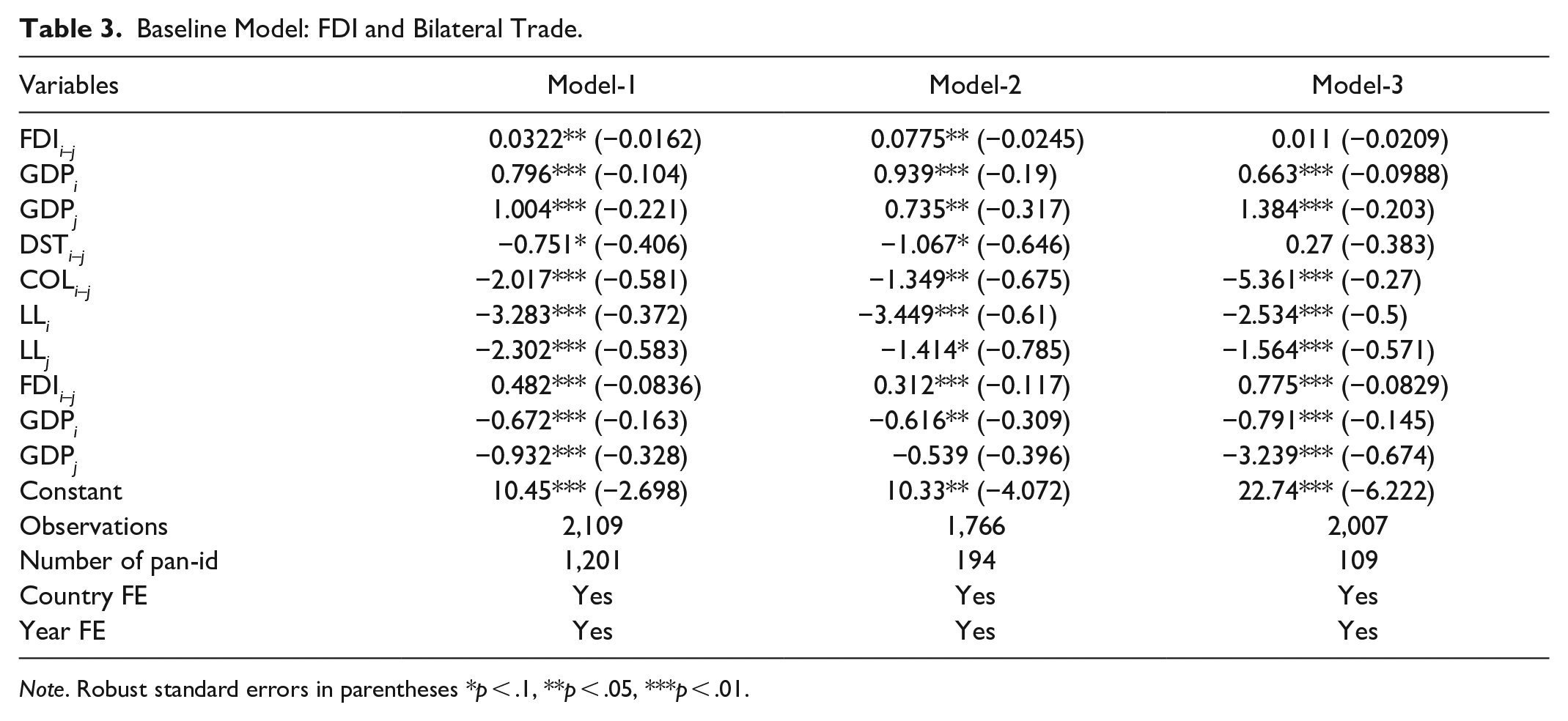
Note. Robust standard errors in parentheses *p < .1, **p < .05, ***p < .01.
The colonial linkage effect is significant and negative. This finding shows that colonial tie has a negative effect on trade flows. It corroborates with the finding of Harach et al. (2014), who showed that FDI affects trade in the gravity frame work. Their results suggested that colonial linkage decreases the level of trade. Zhou (2010) studied the trade gravity model with the extensions of cultural effects. He revealed that colonial linkage has a significant and negative effect on trade flows. He also explained that the relationship between colonial history and trade decreases with time, and the colonial effect has deep relations with language and religion-based civilization.
The landlocked coefficients of the host and home countries are significant and negative, indicating a negative effect on trade flows between them. Thus, the landlocked increases the trade cost, which decreases the level of trade flows between the countries. The results are consistent with those of Limão and Venables (2001). They concluded that landlocked affects both trade volume and cost. Specifically, it decreases the trade volume by 60% and increases the trade cost by 50% compared with a coastal country. They further suggested that the landlocked countries decrease these costs by improving the infrastructure of their country and the transit country. They also constructed a table for landlocked countries, consisting of percentages of improving the infrastructure of their country and transit country. They added that by improving their infrastructure to 25th, the cost could decrease to 41% among the landlocked countries. By improving transit country infrastructure, the cost could further decrease to 48%. A country can decline the trade cost by improving infrastructures. Batra (2004) also found a negative effect on trade flows of landlocked economies. Table 4 shows the extended baseline model with additional control variables. TF-i and CPI-i indicate the TF and CPI of the host country. The TF coefficient is positive and strongly significant. CPI-i shows a positive and significant effect on bilateral trade flows. Following the definition of the CPI, an increase in the index means a decrease in the corruption level. The results suggest that a 1% increase in the corruption index will increase the trade flows by 0.4% to 0.6%. A decrease in corruption also increases bilateral trade flows. The results are in line with those of Musila and Sigué (2010) and de Jong and Bogmans (2011). Countries should reduce corruption to increase trade flows. Corruption acts as something like a tax on trade, so the countries need to decrease the level of corruption to increase the level of trade. Besides solving corruption, a country also needs to decrease the other trade barrier (Dutt & Traca, 2010). The corruption perception variable becomes trivial when taking the sample for developed countries. Table 5 shows the results for FTAs for the selected countries. The results of the model become interesting after adding the FTA variable into the equation. The coefficient of FTA is positive for all three models but significant only in Models 1 and 2 at the 5% level as it increases the trade volume by up to 84% and 154%, respectively. Baier and Bergstrand (2006) found a positive relationship between trade and FTA. They suggested that the effect of FTA on trade increases with time. After 10 years, the effect of FTA becomes double on bilateral trade between the trading countries. The results are in line with those of Caporale (2009). The distance coefficient becomes insignificant with the inclusion of the FTA variable. FTA declines the effect of distance on bilateral trade. Baier and Bergstrand (2009) and Freeman and Pienknagura (2016) observed that with the inclusion of FTA, the log of the bilateral distance between the countries decreases. Freeman also studied the effect of economic integration agreements on the distance between two trading partners. They found that FTA diminishes the effect of distance on bilateral trade and helps the trading partners overcome this barrier. To sum up, the distance coefficient is negative and significant, indicating that distance reduces the trade volume. However, with the inclusion of FTA, the effect of distance weakens to influence the bilateral trade.
Extended Model: FDI and Bilateral Trade.

Note. Robust standard errors in parentheses *p < .1, **p < .05, ***p < .01.
An Extended Model With FTAs: FDI and Bilateral Trade.

Note. Robust standard errors in parentheses *p < .1, **p < .05, ***p < .01.
Conclusion
This study explores the relationship between FDI and bilateral trade flowing developing countries of Asia. This relationship obtained enormous attention from researchers and policy makers. An increase in the literature is evident in the past decade due to changes in global trade conditions. Empirical studies have explored this relationship with different aspects, such as factor endowment and technological development. However, most of them have failed to distinguish the effect of FDI flows for developed and developing economies. Developed countries are more competent and advanced in technology than in developing countries. Hence, proving the effect of FDI from developed countries like the FDI from developing countries is difficult. The present study examines the effects of FDI on bilateral trade in the context of South and East Asian countries. We examine whether the relationship between bilateral trade and FDI is substitute or complementary. To distinguish whether the relationship would differ between FDI from developing and developed countries and the volume of trade to South and East Asian countries, we use bilateral data on trade and FDI from June 2001 to June 2019. For empirical analysis, we apply the Mundlak approach to the gravity type trade model.
The analysis results reveal several novel observations. FDI flow positively influences the bilateral trade regardless of the inclusion of the other control variables. The finding corroborating with the previous empirical studies shows that both are complementary. Future works should modify these findings on the basis of the overall sample, as the analyses for different subsample reveal varying results following the economic development in the countries. FDI flows from developing countries have positively influenced the bilateral trade with developing countries. However, it becomes insignificant after introducing additional variables to the model. Regarding the subsample of FDI flows from developed countries and their influence on bilateral trade with developing countries, we find a trivial relationship between FDI and bilateral trade. The natural logarithm of distance traditionally used as a proxy for transportation costs has a negative effect on bilateral trade. This finding indicates that short distances between the trading partner countries promote bilateral trade. By contrast, long-distance reduces bilateral trade. In the same vein, the FTA variable is positive and significant, indicating that trade volume in these countries increases with FTAs. Likewise, the distance variable becomes insignificant after introducing the FTA variable to the model. The result suggests that FTAs decrease the effect of distance on bilateral trade between the member countries. Once the member countries signed the trade agreement, the effect of distance becomes unimportant. Policymakers should emphasize FDI from developing countries, which could encourage and liberalize foreign investment from other developing countries, enhancing the volume of bilateral trade and further promoting economic development in those countries.
Footnotes
Appendix
List of Host Countries (11).

| Bangladesh | Hong Kong | Mongolia | South Korea |
| Bhutan | India | Nepal | Sri Lanka |
| China | Macao | Pakistan |
Declaration of Conflicting Interests
The author(s) declared no potential conflicts of interest with respect to the research, authorship, and/or publication of this article.
Funding
The author(s) disclosed receipt of the following financial support for the research, authorship, and/or publication of this article: This This research was funded by National Social Science Fund of China (award number 19BGLO57).
