



Abstract
In this study, transformational leadership is conceptualized not as a managerial tendency but as an individual disposition, and the effect of transformational leadership tendency on digital entrepreneurial intention is examined through a serial mediation model. In this context, entrepreneurial passion and entrepreneurial intention are considered as mediating variables. The sample of the study consists of 136 individuals who are senior students at a faculty of a public university in Turkey. Data were collected at two different time points (Time 1 and Time 2). At Time 1, data related to demographic variables and transformational leadership tendency were gathered, while at Time 2, data concerning entrepreneurial passion, entrepreneurial intention, and digital entrepreneurial intention were collected. Subsequently, datasets containing personal codes were matched and merged. The data obtained were analyzed using Hayes’ Model 6 in the Process Macro program for hypothesis testing. The findings reveal that the effect of transformational leadership tendency on digital entrepreneurial intention occurs sequentially through entrepreneurial passion and entrepreneurial intention. Accordingly, it was determined how digital entrepreneurial intention is enhanced not only through leadership characteristics but also via intrinsic motivational mechanisms such as passion and intention. These results underscore the importance of entrepreneurship education and leadership development programs at the university level.
Plain Language Summary
This study explored whether an individual’s transformational leadership tendency influences their digital entrepreneurship intention. It also examined whether this influence works through entrepreneurial passion and general entrepreneurial intention. The findings show that individuals with stronger transformational leadership tendencies tend to have higher levels of entrepreneurial passion. This passion, in turn, increases their overall entrepreneurial intention, which then strengthens their digital entrepreneurship intention. Therefore, transformational leadership tendencies are important in increasing digital entrepreneurship intentions.
Keywords
Introduction
Entrepreneurs are key figures who contribute to a country’s economic, social, and technological development, thereby enhancing the overall quality of life. With the advent of technological advancement and transformation, these important actors have shifted their entrepreneurial activities from a general/traditional context to a digital one. Particularly in the aftermath of COVID-19, there has been a significant change in the way entrepreneurs conduct business, and the digital dimension of entrepreneurship has become increasingly prominent (Li et al., 2024). Consequently, as in other countries (Dutot & Van Horne, 2015; Muafi et al., 2021), digital entrepreneurial activities have shown a notable increase in Turkey as well (Boz & Serinkan, 2022), and this upward trend is expected to continue in the future (Nambisan, 2017). In this regard, several studies have called for the identification of variables that may foster the emergence and proliferation of digital entrepreneurship (Lopes et al., 2025). As in other countries, these characteristics are also of great importance in Turkey. This is because digital entrepreneurship has become a significant phenomenon in today’s socio-economic context, both socially and commercially. The rapid digitalization of industries has profoundly transformed labor markets, creating both new opportunities and uncertainties for younger generations preparing to enter professional life. Indeed, the youth unemployment rate in Turkey has risen to 16.2% and increased compared to previous years (TSI, 2025), revealing that employment opportunities in traditional sectors have been gradually shrinking, particularly for university graduates. In this regard, digital entrepreneurship is particularly noteworthy as a mechanism that offers chances for innovation, value creation, and social mobility through digital platforms and technology, in addition to being an alternative professional route for young people. Therefore, understanding digital entrepreneurial behavior, which has become crucial in addressing urgent social issues such as youth unemployment and economic adaptation within the current socio-economic conditions, holds particular importance.
Although various factors influence the emergence of digital entrepreneurship, having an individual entrepreneurial intention constitutes step in this process (Al-Mamary & Alraja, 2022). Indeed, Ajzen’s (1991) Theory of Planned Behavior posits that individuals’ tendencies to perform a certain behavior are shaped by their intentions toward that behavior. In this context, individuals’ digital entrepreneurship behavior begins with having a general and digital entrepreneurship intention. However, it is important to emphasize that while general entrepreneurial intention refers to the motivation to start or develop a new venture in any domain, digital entrepreneurial intention places specific emphasis on the use of digital technologies and tools in the entrepreneurial process. This distinction shows that digital entrepreneurship is not merely an extension of general entrepreneurship but rather a unique domain shaped by digital transformation and technological opportunities. Accordingly, this study addresses both general entrepreneurial intention and digital entrepreneurial intention, aiming to answer the question: “How can digital entrepreneurial intention be enhanced?” In this regard, the study focuses on the impact of individuals’ personal and psychological tendencies on digital entrepreneurial intention. Specifically, transformational leadership is considered as a personal tendency, while entrepreneurial passion and general entrepreneurial intention are examined as psychological tendencies. Therefore, a model is proposed and tested in which entrepreneurial passion and general entrepreneurial intention are hypothesized to sequentially mediate the relationship between transformational leadership tendency and digital entrepreneurial intention.
Within the scope of the model developed in this study, several potential contributions are anticipated. A review of the literature reveals that the concept of transformational leadership is predominantly addressed at the organizational level, typically in the context of managers’ behaviors toward employees (Abdul-Azeez et al., 2024; Bass & Avolio, 1990; Bass et al., 2003). However, studies that consider transformational leadership as an individual tendency are quite limited (e.g., Babadağ & Kerse, 2017), and to date, no research has examined how individuals’ internalized transformational leadership tendencies influence digital entrepreneurship. It is reasonable to assume that the fundamental elements of transformational leadership—vision, inspiration, and intellectual stimulation—can also manifest as dispositional tendencies at the individual level and be observed in informal contexts like student entrepreneurship, even though the practice has primarily been studied in formal organizational settings. This work fills a major gap in the literature by presenting transformational leadership as an individual propensity, expanding the use of leadership theory outside of conventional management domains. Based on this gap, it is proposed that possessing or lacking transformational leadership tendencies may affect individuals’ general and digital entrepreneurial intentions. Accordingly, by adopting an approach grounded in transformational leadership tendencies, this study aims to fill an important gap in the digital entrepreneurship literature.
Another contribution of this study lies in its attempt to explain the underlying mechanism through which digital entrepreneurial intention is formed. The study employed a two-wave data collection process (Time 1–Time 2), thereby offering a stronger basis for testing causal relationships. Within this framework, it is proposed that a sequential process takes place: from transformational leadership tendency to entrepreneurial passion, from entrepreneurial passion to general entrepreneurial intention, and ultimately from general entrepreneurial intention to digital entrepreneurial intention. Accordingly, the study seeks to identify how contributions can be made to the increasingly significant phenomenon of digital entrepreneurship, particularly among young individuals.
Finally, the study contributes to the literature by examining digital entrepreneurial intention not only in terms of the individual’s leadership characteristics but also through internal motivational mechanisms such as passion and intention. Notably, this research is the first to consider entrepreneurial passion and general entrepreneurial intention as sequential mediators in the pathway from individual leadership tendency to digital entrepreneurial intention.
The Conceptual Framework and Hypotheses
From a Managerial Tendency to an Individual Tendency: Transformational Leadership
Initially proposed by Burns (1978) to explain political leadership, transformational leadership was later adapted by Bass (1985) to a managerial and organizational context, ultimately shaping its contemporary conceptualization. Transformational leadership refers to leadership behaviors that involve a strong commitment to organizational goals and the provision of necessary support to employees in achieving those goals (Yukl, 1994). At its core, this form of leadership emphasizes responding to followers’ needs, enabling them to transcend their personal interests, encouraging acceptance of organizational goals, and inspiring them (Bass & Avolio, 1990). Transformational leaders are those who focus on followers’ capabilities, strive to develop and motivate them, and foster a belief in their ability to succeed (Bass et al., 2003). Accordingly, these leaders exhibit four key behaviors: idealized influence, intellectual stimulation, inspirational motivation, and individualized consideration (Bass & Avolio, 1990).
The idealized influence (charisma) exhibited by transformational leaders refers to behaviors that serve as a role model for followers, fostering respect and trust, and enabling them to achieve success through exemplary actions (Cetin & Kinik, 2015). Inspirational motivation involves behaviors through which the leader instills a sense of purpose and enthusiasm in followers, encouraging them to exert extra effort in achieving organizational goals (Abdul-Azeez et al., 2024). Intellectual stimulation refers to the leader’s ability to promote critical thinking and the development of new ideas among followers, as well as encouraging the enhancement of their knowledge and skills (Ali, 2024). Finally, individualized consideration pertains to the leader’s attentiveness to each follower’s specific needs, expectations, and characteristics, and the provision of tailored support accordingly (Bass & Avolio, 1990).
Transformational leaders who exhibit the behaviors described above strive to achieve organizational goals by inspiring, motivating, and empowering their employees, and by creating a supportive and enabling work environment (Abdul-Azeez et al., 2024). However, transformational leadership is not solely a managerial construct observed within organizational settings and exercised exclusively by those in formal leadership positions. It is believed that some individuals, even without holding managerial roles, may naturally exhibit transformational leadership behaviors. Therefore, in this study, transformational leadership is considered as a tendency of individuals, not a managerial attitude, taking into account the studies that address leadership in the context of trait (Daderman et al., 2023). Accordingly, transformational leadership tendency is defined as the potential of a non-managerial individual to play a transformative role toward others in their environment. In other words, drawing on Bass’s (1985) perspective, this tendency is characterized by the individual’s ability to influence others, inspire them, develop a vision, stimulate creative thinking, unlock others’ potential, and ultimately promote change.
In the study, the behaviors associated with the tendency toward transformational leadership were explained with reference to the behavioral dimensions outlined in Bass and Avolio’s (1990) transformational leadership model. In this context, idealized influence refers to an individual possessing charismatic qualities and instilling trust and respect in others by embracing strong personal values. Inspirational motivation involves delivering motivational messages, fostering optimism and enthusiasm among others, and serving as a source of inspiration. Intellectual stimulation is reflected in encouraging those around them to approach events and problems not through conventional frameworks but with innovative and creative thinking. Individualized consideration refers to being aware that individuals around oneself are different from one another and approaching each of them by taking their unique expectations and characteristics into account.
While transformational leadership has generally been studied in organizational settings where subordinate-superior relationships exist, the implications of such leadership characteristics as vision, inspiration, and individualized influence are not limited to the organizational context. In particular, in informal settings such as student entrepreneurship, problem-solving skills, and innovative thinking, individuals may motivate peers, develop a shared vision, encourage idea generation, and initiate collaborative actions. To be able to do so, however, individuals must first possess these personal tendencies themselves. In this sense, seeing transformational leadership as a personal trait shows that leadership is not just a hierarchical structure-reliant phenomena but also a personality trait that may influence individual behavior. The fact that transformational leadership has only been studied as an individual tendency in a small number of studies (e.g., Babadağ & Kerse, 2017) does not mean that it is inappropriate; rather, it is a reflection of the fact that traditional organizational contexts have received the majority of scholarly attention. This implies that the idea is still not well understood. This study adds a new viewpoint to the leadership literature that transcends organizational borders and beyond the current theoretical approach by treating transformational leadership as a human disposition.
The Relationship Between Transformational Leadership Tendency and (Digital) Entrepreneurial Intention
Entrepreneurial intention refers to an individual’s desire to either start a new venture or introduce changes to an existing venture (product, service, or organization) in the future (Ratnamiasih & Setia, 2016). This concept is commonly explained within the framework of the Theory of Planned Behavior developed by Ajzen (1991). According to the theory, entrepreneurial intention is shaped by individuals’ attitudes toward entrepreneurship, perceived behavioral control, and prevailing social norms. These components collectively influence the formation of entrepreneurial intention, which subsequently leads to entrepreneurial behavior (Polatcı & Yeloğlu, 2021). Thus, a process that begins with intention can transform into behavior, ultimately contributing to economic development and empowerment (Raposo et al., 2014). This transformation has shifted from the traditional understanding of entrepreneurship—characterized by physical infrastructure and face-to-face human interaction—toward a digital realm, where entrepreneurial activities are carried out through online platforms. This shift has led to the growing prevalence of digital entrepreneurship since the early 2000s (Biclesanu et al., 2021). In this context, digital entrepreneurial intention refers to the tendency to establish a new digital enterprise or to develop business activities within a digital environment (Dutot & Van Horne, 2015; Li et al., 2024). While digital entrepreneurial intention encompasses all the characteristics of traditional entrepreneurial intention, it places greater emphasis on the use of digital tools and technologies (Li et al., 2024). Accordingly, compared to traditional entrepreneurship, digital entrepreneurship offers advantages such as the rapid activation of business operations, reduced need for physical production/storage spaces, the ability to establish global virtual work units, swift and radical changes across processes, faster and more cost-effective product delivery, and enhanced post-delivery services (Kılınç, 2023).
General and digital entrepreneurial intentions represent a critical first step in the emergence of entrepreneurial behaviors and, consequently, in the realization of entrepreneurship in practice. While various factors may influence this initial step, this study posits that an individual’s transformational leadership tendency is a significant determinant. This proposition is grounded in Bandura’s Social Cognitive Theory (SCT; Bandura, 1986, 1999), which asserts that personal, behavioral, and environmental factors, along with their reciprocal interactions, influence individual behavior. In the context of entrepreneurial activity, individuals intending to initiate ventures are influenced by one or more of these interacting factors during the decision-making process (Bignetti et al., 2021).
Specifically, within SCT, self-efficacy is a critical component necessary for the manifestation of behavior. In this regard, the relationship between transformational leadership tendency and entrepreneurial intention (both general and digital) can be framed through the lens of self-efficacy. Self-efficacy refers to individuals’ beliefs in their own abilities to make decisions, initiate action, and sustain efforts in the face of challenges (Bandura, 1982). Considering that transformational leadership is a factor that enhances self-efficacy as a psychological resource (Bayraktar & Jiménez, 2020), it is reasonable to expect that individuals who possess transformational leadership traits also exhibit higher levels of self-efficacy—one of the foundational elements of SCT. Since entrepreneurial activity often involves uncertainty and risk, individuals with entrepreneurial intentions are likely to possess self-efficacy related to navigating such challenges (Pihie & Bagheri, 2013). Therefore, because transformational leadership inherently involves self-efficacy (Fitzgerald & Schutte, 2010), individuals with this leadership tendency are more likely to exhibit the determination required to initiate and sustain a business (i.e., entrepreneurial intention). This determination may manifest not only in general entrepreneurial contexts but also in digital entrepreneurship involving technological tools and platforms. Thus, transformational leadership, as one of SCT’s personal factors, is likely to activate individuals’ internal resources—such as vision, inspiration, and creativity—through the expression of idealized influence, inspirational motivation, intellectual stimulation, and individualized consideration. Ultimately, these behaviors enhance both self-efficacy and intrinsic motivation. Since self-efficacy is a well-documented predictor of both general and digital entrepreneurial intention (Pihie & Bagheri, 2013; Ridwan et al., 2024), it is expected that any construct that strengthens self-efficacy will positively influence both types of entrepreneurial intention. In this context, it is hypothesized that transformational leadership tendency positively influences both general and digital entrepreneurial intentions through the SCT framework.
Although this pattern has not been directly tested in empirical studies focusing on individual tendencies and entrepreneurial intentions, some evidence indirectly supports it. For instance, Tang and Cui (2024) found that the transformational leadership behaviors of entrepreneurial mentors positively influenced students’ entrepreneurial intentions. Similarly, Mali et al. (2019) reported a positive relationship between transformational leadership behaviors and employees’ entrepreneurial intentions. Based on SCT and these empirical findings, the following hypotheses have been developed:
The Mediating Role of Entrepreneurial Passion and Entrepreneurial Intention
Entrepreneurial passion is a powerful resource of motivation within individuals that activates thoughts and actions related to entrepreneurial activities (Fesharaki, 2019). According to Cardon et al. (2009), this resource is defined as the intense positive feelings experienced toward entrepreneurial activities that are meaningful and consistent with one’s self-identity. It has also been stated that it occurs in the form of identifying new opportunities and developing new products/services (passion for invention), providing resources to start a new venture (passion for resources), and growing and developing a business (passion for development; Cardon et al., 2013). Therefore, entrepreneurial passion is actually expressed as the individual’s ability to experience a sense of enthusiasm and meaning in their entrepreneurial activities.
Passion in individuals not only motivates them to persist in specific actions but also enables entrepreneurial individuals to experience strong and positive emotions toward entrepreneurial activities (Cardon et al., 2017). As such, it encourages entrepreneurs to recognize opportunities in their environment and to be motivated to pursue new entrepreneurial initiatives (Cardon et al., 2009). The significance of passion in entrepreneurship has been emphasized by Smilor (1997), who described it as “Perhaps the most observed phenomenon of the entrepreneurial process ….” Moreover, some researchers (Murnieks et al., 2014) have identified it as the most fundamental component of planning and launching a business, while others (Fellnhofer, 2017) have considered it a key differentiator between successful and unsuccessful entrepreneurs. Although these explanations demonstrate the close relationship between entrepreneurial passion and entrepreneurial intention, it should be remembered that they are conceptually distinct constructs. Passion refers to the strong positive emotions and enthusiasm toward entrepreneurship (Cardon et al., 2017), whereas intention denotes the deliberate planning or decision to start a business in the future (Ratnamiasih & Setia, 2016). The motivating energy comes from passion, but intention transforms it into tangible, goal-oriented action (Karimi, 2020). Therefore, passion might be a precursor to entrepreneurial intention, but the two concepts shouldn’t be confused. This study focuses on entrepreneurial passion and entrepreneurial intention, but other mediators or moderators, like digital skills, personality traits, or environmental factors, may also have the ability to affect the relationship between transformational leadership tendency and digital entrepreneurial intention. Indeed, these two constructs are emphasized in the entrepreneurship literature as psychological mechanisms for explaining leadership tendencies in the entrepreneurial context (Dong et al., 2018; Norena-Chavez & Thalassinos, 2022). Furthermore, a thorough framework for describing how personal dispositions are converted into entrepreneurial activity is provided by the fact that passion reflects the emotive domain and intention reflects the cognitive domain. This validates the choice of both variables as mediators. Therefore, transformational leadership tendency is considered a potential antecedent of these mediators, while digital entrepreneurial intention is treated as the outcome variable influenced at the end of the process and examined through the perspective of Social Cognitive Theory (SCT).
As previously noted, within the framework of SCT, individuals’ behaviors are shaped by the interaction between personal factors and environmental influences. Transformational leadership tendency can be regarded as a personal factor within the SCT framework. Individuals who possess this leadership tendency tend to develop a vision for others, inspire them, contribute to their personal growth, and foster creativity and innovation (Bass & Avolio, 1990). Moreover, they often exhibit characteristics such as high self-efficacy (Mesterova et al., 2015). This situation provides a suitable psychological ground for the development of entrepreneurial passion. High self-efficacy enables individuals to cope with challenges effectively, thereby fostering positive emotions and commitment toward entrepreneurial activities—in other words, increasing their passion (Fesharaki, 2019). Therefore, from the SCT perspective, transformational leadership tendency stimulates entrepreneurial passion through psychological mechanisms such as enhanced confidence, perceived competence, and the ability to reframe challenges as opportunities. This activation of passion then translates into intentional action, because positive affective states—when reinforced by self-efficacy—guide individuals toward concrete behavioral goals. In digital contexts, this means that both talented and inspired individuals can channel their passions toward entrepreneurial intentions, such as developing innovative apps, launching e-commerce platforms, or creating digital service solutions. Although this relationship has not been widely studied at the individual level, research in organizational settings has suggested that transformational leadership enhances employees’ entrepreneurial passion (Tahsildari, 2015; Tahsildari et al., 2014). Furthermore, individuals with high entrepreneurial passion are more likely to focus on the positive aspects of entrepreneurship rather than the risks and challenges when planning a venture (Cardon et al., 2009). Consequently, entrepreneurial passion can lead to the formulation of intentions to establish a business, whether through general means or by leveraging digital tools and platforms—namely, digital entrepreneurial intention. In support of this, Karimi (2020) found that entrepreneurial passion encourages individuals to seek information about new opportunities and design business plans. Furthermore, Al Halbusi et al. (2024) demonstrated a positive relationship between entrepreneurial passion and electronic (digital) entrepreneurial intention. Based on these theoretical insights and empirical findings, it is proposed that transformational leadership tendency influences digital entrepreneurial intention through entrepreneurial passion (as a mediator), and also through general entrepreneurial intention (as a mediator). Accordingly, the following hypotheses are proposed:
Serial Mediating Role
This study proposes that entrepreneurial passion and entrepreneurial intention sequentially mediate the relationship between transformational leadership tendency and digital entrepreneurial intention. In addition to the previously discussed relational network, it is also assumed that general entrepreneurial intention influences digital entrepreneurial intention. Specifically, individuals with entrepreneurial intention possess the desire to launch a new venture or to introduce new features to an existing business (Ratnamiasih & Setia, 2016). In the contemporary era, this general entrepreneurial intention has evolved—through the influence of advancing technology—into a digital entrepreneurial intention. That is, individuals who possess general entrepreneurial intention are inclined to identify and evaluate opportunities across various contexts. Given the rapid development of digital technologies and the proliferation of online platforms—such as social media, e-commerce, and digital services—these individuals are increasingly focused on opportunities that exist in the digital realm. As a result, they tend to engage in the creation, development, and delivery of business ideas that are driven by digital technologies. Therefore, it is expected that general entrepreneurial intention positively influences digital entrepreneurial intention.
Considering the explanations provided above and the perspective of SCT, it is proposed that transformational leadership tendency enhances entrepreneurial passion by reinforcing self-efficacy, which is recognized as a key psychological resource (Bayraktar & Jiménez, 2020). Through psychological mechanisms such as increased confidence, perceived competence, and the ability to reinterpret challenges as opportunities, transformational leadership tendency nurtures entrepreneurial passion. Entrepreneurial passion, in turn, fosters a positive outlook toward entrepreneurial activities (Fesharaki, 2019). This passion translates emotional energy into deliberate action, which strengthens the likelihood of forming entrepreneurial intentions. Individuals with high entrepreneurial passion are more likely to develop the intention to start a new venture (Liao et al., 2023). Furthermore, individuals who already possess entrepreneurial intention—aware that they live in a digital age and recognizing the numerous benefits of digital tools—tend to convert this intention into a digital entrepreneurial intention. Accordingly, transformational leadership tendency positively influences entrepreneurial passion; entrepreneurial passion positively influences entrepreneurial intention; and entrepreneurial intention positively influences digital entrepreneurial intention. Based on this rationale, the following hypothesis is proposed:
In line with these research hypotheses, the following conceptual model has been developed (Figure 1).

Research model (Model 6).
Methods
Participants
The participants of this study consisted of senior-year students enrolled in the Faculty of Economics and Administrative Sciences at a public university in Turkey. From a total of 381 senior students registered in this faculty, only those with active class attendance were selected. Data were collected from these entrepreneurial candidates at two separate time points (Time 1 and Time 2). At Time 1, data were gathered on demographic variables and items related to transformational leadership tendency. At Time 2, data were collected on entrepreneurial passion, entrepreneurial intention, and digital entrepreneurial intention.
After printing the questionnaire forms, the students were visited in their classrooms during Time 1. Participants were informed that participation was voluntary, that the study consisted of two phases, and that they could withdraw at any time. They were also instructed to create a unique participant code that would not directly identify them (e.g., not their full name), but one they could remember and reproduce in both Time 1 and Time 2 (e.g., initials and a lucky number such as “GK20”). As a result, 160 completed questionnaires were collected at Time 1. After a waiting period of approximately 2 to 4 weeks, the Time 2 questionnaires were distributed, and participants were reminded to write the same code they had used previously. Ultimately, 136 matched responses were obtained. Accordingly, analyses were conducted based on these 136 paired datasets from Time 1 and Time 2.
The demographic characteristics of the 136 matched responses were analyzed. Among the participants, 95 were male, and 93 reported that their family did not have an entrepreneurial background. The majority of participants (87) grew up in urban areas. Lastly, 110 participants were from Turkey, while 26 were international students from countries such as Chad and Azerbaijan.
Measures
In this study, validated and reliable scales were used to collect research data. To measure transformational leadership tendency, items from the transformational leadership scale in Bass and Avolio’s (1995) Multifactor Leadership Questionnaire (MLQ) were utilized. These items were previously adapted to reflect transformational leadership as a personal trait by Babadağ and Kerse (2017). Accordingly, a 17-item scale consisting of four dimensions—idealized influence, inspirational motivation, intellectual stimulation, and individualized consideration—was employed in the present study. Babadağ and Kerse (2017) reported a Cronbach’s alpha coefficient of .953 for this adapted scale.
To assess entrepreneurial passion, the five-item “invention” subscale from Cardon et al. (2013) was used. This scale was also employed in the study by Karimi (2020), who reported an alpha coefficient of .87. Entrepreneurial intention was measured using the five-item, single-dimension scale from Karimi (2020). The author reported a Cronbach’s alpha of .85 for this scale. Finally, digital entrepreneurial intention was measured using the seven-item, single-dimension scale developed by Wibowo et al. (2023). These researchers reported a Cronbach’s alpha coefficient of .89 for the scale.
Findings
Scale Reliability and Validity Results
To assess the construct validity of the research scales, Confirmatory Factor Analysis (CFA) was conducted using AMOS 18.0. For evaluating model validity, the following fit indices were used as references: CMIN/DF (0 < χ2/df ≤ 5), RMR (≤0.10), CFI (>0.90), IFI (>0.90), TLI (>0.90), and RMSEA (≤0.08). In the analysis, item regression weights above 0.40 were considered acceptable. Based on this criterion, two items—TLT1 from the transformational leadership tendency scale and DEI4 from the digital entrepreneurial intention scale—were excluded from the analysis due to inadequate factor loadings.
In the final model, all remaining items had factor loadings greater than 0.40, indicating satisfactory individual item reliability. Moreover, the scales demonstrated acceptable model fit values (see Table 1). Additionally, Average Variance Extracted (AVE) values were calculated to assess convergent validity. Although the conventional threshold for AVE is ≥0.50, some scholars suggest that AVE values may fall below this level and still be acceptable at ≥0.40 (Muñoz-Fernández et al., 2025; Sabo et al., 2024; Tavares et al., 2019). According to these scholars, when Composite Reliability (CR) exceeds 0.60, an AVE value of 0.40 or above can be considered acceptable (Byrne, 2013; Muhamad Safiih & Azreen, 2016; Muñoz-Fernández et al., 2025; Sabo et al., 2024). In this context, transformational leadership tendency (AVE = 0.519), entrepreneurial passion (AVE = 0.541), and entrepreneurial intention (AVE = 0.528) met the conventional AVE criterion. For digital entrepreneurial intention, the AVE value was 0.466; however, since the CR value exceeded the threshold specified by the scholars (CR = 0.838), it was considered acceptable. Therefore, all constructs demonstrated adequate convergent validity, and overall construct validity was confirmed.
Reliability and Validity Results.

Following the validation analyses, Cronbach’s Alpha and Composite Reliability (CR) values were calculated to assess the reliability of the scales. In accordance with the literature, a threshold of 0.70 or higher was used as a reference for acceptable reliability (Hair et al., 2017). Following the analyses and calculations, the Cronbach’s Alpha and Composite Reliability (CR) values were observed to be .893 and 0.944 for transformational leadership tendency, .851 and 0.851 for entrepreneurial passion, .828 and 0.843 for entrepreneurial intention, and .838 and 0.838 for digital entrepreneurial intention, respectively. These findings indicate that all scales met the recommended thresholds. Therefore, it was concluded that the measurement instruments used in this study demonstrate high internal consistency and reliability.
Findings Related to Common Method Bias
To address the issue of common method bias, which is frequently encountered in behavioral research and may arise from the measurement method itself, both procedural and statistical remedies were applied. As a preventive measure, a longitudinal research design was employed. Specifically, some variables were measured during Time 1, while others were measured during Time 2, thereby reducing the likelihood of bias stemming from common sources.
In addition, Harman’s single-factor test was conducted to statistically assess the presence of common method bias (Podsakoff et al., 2003). All items from the study’s variables were subjected to exploratory factor analysis. The results revealed a six-factor structure that collectively explained 60.089% of the total variance. Each factor accounted for between 8.890% and 11.624% of the variance. These findings indicate that the items loaded on multiple factors rather than a single dominant factor, suggesting that common method bias is not a serious concern in this study.
Hypothesis Testing Results
To test the research hypotheses, the PROCESS macro for SPSS, which incorporates bootstrapping procedures, was utilized. However, prior to conducting these analyses, the relationships between the variables were first examined. To begin, normality tests were performed to assess the distribution of the data. Based on the skewness and kurtosis values obtained—transformational leadership tendency (−0.880, 4.363), entrepreneurial passion (−0.427, −0.146), entrepreneurial intention (−0.457, −0.439), and digital entrepreneurial intention (−0.233, −0.305)—it was determined that all values fell within the acceptable range of −2 to +2, as suggested by George & Mallery (2019). Therefore, the assumption of normality was met. As a result, Pearson correlation analysis was conducted, and the findings are presented in Table 2.
Means and Correlations of the Variables.

Correlation is significant at the 0.05 level (2-tailed). **Correlation is significant at the 0.01 level (2-tailed).
As shown in Table 2, transformational leadership tendency was found to be positively correlated with entrepreneurial passion (r = .470, p < .01), entrepreneurial intention (r = .448, p < .01), and digital entrepreneurial intention (r = .285, p < .01). Additionally, significant positive correlations were identified between entrepreneurial passion and entrepreneurial intention (r = .565, p < .01), and between entrepreneurial passion and digital entrepreneurial intention (r = .482, p < .01). There was also a positive relationship between entrepreneurial intention and digital entrepreneurial intention (r = .496, p < .01).
Based on these significant correlations among the variables, hypothesis testing was conducted using the PROCESS macro with Model 6, as developed by Hayes (2013). In this model, transformational leadership tendency was designated as the independent variable (X), digital entrepreneurial intention as the dependent variable (Y), and entrepreneurial passion (M1) and entrepreneurial intention (M2) as sequential mediators. The analysis was carried out with 5,000 bootstrap resamples and a 95% confidence interval, as shown in Table 3.
Direct and Indirect Effects.
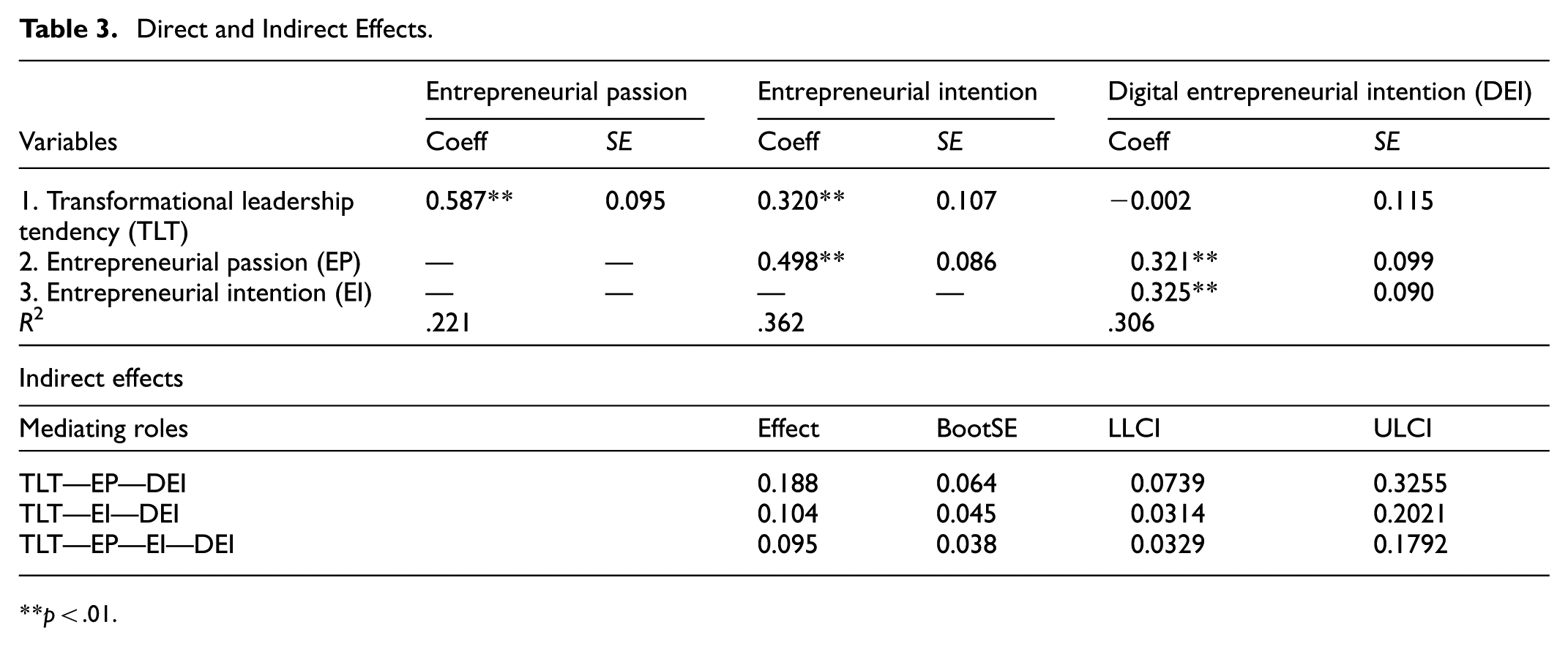
p < .01.
According to the first finding in Table 3, transformational leadership tendency has a direct and positive effect on entrepreneurial intention (coeff. = 0.320; p < .01), thus supporting Hypothesis H1. The second finding indicates that while transformational leadership tendency has a significant and positive total effect on digital entrepreneurial intention (coeff. = 0.386; p < .01), its direct effect is not statistically significant (coeff. = −0.002; p > .05). Therefore, Hypothesis H2 is not supported.
Another finding shows that transformational leadership tendency positively affects entrepreneurial passion (coeff. = 0.587; p < .01), and entrepreneurial passion in turn positively affects digital entrepreneurial intention (coeff. = 0.321; p < .01). Furthermore, the indirect effect of transformational leadership tendency on digital entrepreneurial intention through entrepreneurial passion was also found to be positive and statistically significant (effect = 0.188; 95% CI = [0.0739, 0.3255]). Thus, Hypothesis H3 is supported.
The findings of the study revealed that transformational leadership tendency positively affects entrepreneurial intention (coeff. = 0.320; p < .01), and entrepreneurial intention positively affects digital entrepreneurial intention (coeff. = 0.325; p < .01). Moreover, the indirect effect of transformational leadership tendency on digital entrepreneurial intention through entrepreneurial intention was found to be statistically significant (effect = 0.104; 95% CI = [0.0314, 0.2021]). Therefore, Hypothesis H4 is supported.
Finally, the results showed that the sequential indirect effect of transformational leadership tendency on digital entrepreneurial intention through both entrepreneurial passion and entrepreneurial intention was positive and significant (effect = 0.095; 95% CI = [0.0329, 0.1792]). Accordingly, Hypothesis H5 is supported, indicating the presence of a serial mediation effect.
Before proceeding to the discussion section, robustness checks were conducted. For this purpose, the serial mediation model (Model 6) was re-estimated by including control variables such as gender, family entrepreneurial background, place of upbringing, and country. The results remained consistent with the main analyses, with only minor changes in the effect coefficients (e.g., the direct effect of TLT on EI was 0.330, p < .01; the indirect effect of TLT on DEI was 0.203, p < .05), indicating that the hypothesized relationships are strongly supported even when demographic factors are controlled.
Finally, to ensure methodological diversity and further strengthen the robustness of the findings through a different statistical approach, the serial mediation model was tested using structural equation modeling (SEM) in AMOS. As shown in Table 4, the path coefficients were in the expected directions. Moreover, the model fit indices (Table 1) were found to be within acceptable ranges. Therefore, these additional analyses confirm that the research findings demonstrate consistency and robustness.
Additional Analyses (AMOS-SEM).

Note. TLT = Transformational leadership tendency; EP = Entrepreneurial passion; EI = Entrepreneurial intention; DEI = Digital entrepreneurial intention.
Discussion
This study examined the mechanism through which transformational leadership tendency influences digital entrepreneurial intention, focusing on the mediating roles of entrepreneurial passion and general entrepreneurial intention. The findings revealed that transformational leadership tendency affects digital entrepreneurial intention through both entrepreneurial passion and entrepreneurial intention. Based on the detailed results of the model, the following theoretical and practical implications have been drawn.
Theoretical and Practical Implications
First, the study found that transformational leadership tendency directly and positively affects entrepreneurial intention. This finding is consistent with previous research conducted in organizational contexts, such as the studies by Tang and Cui (2024) and Mali et al. (2019). However, this direct effect observed in the context of general entrepreneurial intention was not evident in the context of digital entrepreneurial intention. In other words, transformational leadership tendency did not directly influence digital entrepreneurial intention. This suggests that while individuals with a strong transformational leadership tendency may be inclined toward entrepreneurship in a general sense, this tendency does not necessarily translate into digital entrepreneurial intention. This finding supports studies that emphasize the importance of developing technical or cognitive digital competencies for fostering digital entrepreneurship (Lopes et al., 2025). Therefore, it clearly indicates that possessing transformational leadership qualities alone is not sufficient to drive entrepreneurial action in digital contexts. Nevertheless, the study also revealed that transformational leadership tendency affects digital entrepreneurial intention indirectly by increasing entrepreneurial intention. In other words, individuals with a transformational leadership tendency are likely to develop general entrepreneurial intentions, which, in today’s digitally oriented world, evolve into a desire to seek out and pursue digital opportunities. This mechanism demonstrates that leadership tendencies may be a trigger in individuals, but that a motivational stage is required in the digital context for entrepreneurial intention. In this context, entrepreneurial intention influenced by leadership tendencies acts as a psychological bridge for entrepreneurial intention in the digital domain.
Another key finding of the study demonstrated that transformational leadership tendency positively influences entrepreneurial passion, and entrepreneurial passion positively influences digital entrepreneurial intention. In other words, transformational leadership tendency enhances digital entrepreneurial intention through entrepreneurial passion. Although no prior research has examined the relationship between transformational leadership tendency and entrepreneurial passion at the individual tendency level, this finding supports previous studies conducted in organizational contexts (Tahsildari, 2015; Tahsildari et al., 2014). Moreover, the impact of entrepreneurial passion on both general and digital entrepreneurial intention aligns with prior research findings in the literature (Al Halbusi et al., 2024; Karimi, 2020; Neneh, 2022). Within the context of these results, it can be concluded that individuals with a strong transformational leadership tendency develop greater entrepreneurial passion, and this increased passion, in turn, fuels their desire to engage in entrepreneurship within digital environments. This result demonstrates that passion for entrepreneurship acts as an emotional driving force, transforming leadership-based tendencies into concrete entrepreneurial tendencies. Consequently, it can be said that transformational leadership tendencies in individuals can be converted into attitudes and behaviors related to entrepreneurship when passion comes into play.
Finally, the study found that entrepreneurial passion and entrepreneurial intention sequentially mediate the relationship between transformational leadership tendency and digital entrepreneurial intention. This finding provides empirical support for Bandura’s (1986, 1999) Social Cognitive Theory (SCT). In other words, within the SCT framework, transformational leadership tendency, as a personal factor, was shown to enhance entrepreneurial passion, which in turn increased general entrepreneurial intention, and ultimately led individuals toward digital entrepreneurial intention. This sequential pattern directly answers the central research question of this study: “How can digital entrepreneurial intention be enhanced?.” Moreover, employing a two-wave data collection design provided stronger support for inference regarding the relationships, suggesting that the process may begin with transformational leadership tendency, proceed through entrepreneurial passion and entrepreneurial intention, and eventually lead to digital entrepreneurial intention. This sequential process also reveals a dynamic mechanism. Namely, leadership tendencies in individuals provide a cognitive framework, passion fuels the individual’s emotional energy, and entrepreneurial intent comes into play as a motivational factor, supporting intent in the digital context.
One of the key contributions of this study lies in its conceptualization of transformational leadership not in the traditional organizational or managerial context—as commonly addressed in the literature (Abdul-Azeez et al., 2024; Bass & Avolio, 1990; Bass et al., 2003)—but rather as an individual tendency. In other words, it was assumed that transformational leadership behaviors can be exhibited even by individuals who are not in formal managerial positions, and that such behaviors may be displayed in various everyday environments. The findings suggest that considering transformational leadership as a personal trait can yield positive outcomes. In this regard, the study provides empirical support for research that conceptualizes leadership from a trait-based perspective (Daderman et al., 2023).
The findings related to the proposed research model contribute to identifying the mechanism linking individuals’ leadership tendencies to digital entrepreneurial intention. This mechanism incorporates not only leadership traits but also internal motivational variables—namely, entrepreneurial passion and entrepreneurial intention—which were evaluated together for the first time in this study. As a result, the synergistic interaction between personal traits (transformational leadership tendency) and motivational factors was revealed. Therefore, it can be seen that the intention to engage in digital entrepreneurship can be explained not only by leadership characteristics but also by the sequential interaction of cognitive tendencies, emotional passion and motivational intentions, that is, by a multi-stage mechanism. Based on the findings and implications of this study, several practical recommendations can be made to foster digital entrepreneurial intention: (a) Educational institutions should incorporate courses and content designed to enhance transformational leadership tendencies among students, (b) Incubation centers and mentorship programs that aim to boost entrepreneurial passion should be established and supported, (c) Individuals with general entrepreneurial intentions should be offered and encouraged to participate in training programs that develop digital skills, helping them translate their intentions into digital entrepreneurial action.
Limitations and Future Research Directions
The implications in this study should be considered within the scope of certain limitations. First, the sample was composed solely of senior-year students from a faculty at a public university in Turkey. Therefore, the generalizability of the findings is limited. Perceptions of the research variables -such as digital entrepreneurial intention- may vary depending on the university or geographic region. Hence, future studies are encouraged to include participants from multiple universities and diverse regions to enhance external validity.
Second, although a longitudinal data collection approach was employed, the data were collected through self-report measures, which may introduce social desirability bias. To minimize this limitation and improve generalizability, future research should aim to utilize multi-source data collection methods. For example, instructors could be asked to report on students’ transformational leadership tendencies. In addition, the limited number of studies that have addressed transformational leadership as an individual disposition clearly demonstrates that the concept has been less explored in non-organizational contexts. This may also be seen as a chance to step up research in these kinds of settings, rather than just a limitation. Indeed, transformational leadership attributes may be observed in individuals outside organizational settings, potentially extending beyond formal environments and influencing personal attitudes and behaviors. Therefore, rather than focusing just on management terms, further research that examines this style of leadership as an individual propensity both inside and outside of organizational contexts would be very beneficial to the discipline.
Third, although transformational leadership was treated as an individual tendency in this study, its subdimensions (e.g., individualized consideration, intellectual stimulation) were not analyzed separately. Future research may consider conducting more detailed analyses at the subdimension level to better understand their distinct effects. Additionally, the current model could be tested on different samples and expanded by incorporating new variables such as cultural orientation, entrepreneurship education or digital literacy.
Lastly, at the individual propensity level, this study aimed to ascertain the impact of characteristics associated with transformational leadership on general and digital entrepreneurial intention. However, an analysis could also have been conducted by comparing the differences in entrepreneurial intention between transformational leaders and those with other personality traits. Therefore, future studies may adopt such a comparative design to further expand the field.
Footnotes
Author’s Note
For more information on scientific qualifications: https://scholar.google.com/citations?user=8Uo-RVgAAAAJ&hl=tr&oi=ao.

Funding
The author received no financial support for the research, authorship, and/or publication of this article.
Declaration of Conflicting Interests
The author declared the following potential conflicts of interest with respect to the research, authorship, and/or publication of this article: On behalf of all authors, the corresponding author states that there is no conflict of interest.
Data Availability Statement
The data that supports the findings of this study are available from the corresponding author upon reasonable request.