




Abstract
In the context of rural resource constraints, how different dimensions of social capital and entrepreneurial passion affect entrepreneurial alertness is an important issue worth studying. The purpose of this study was to predict the entrepreneurial alertness of rural cooperative members based on social capital based on the mediator role of entrepreneurial passion. The research population was composed of 3,851 members of rural cooperatives in Kermanshah province, Iran. A standard questionnaire was used for data collection. Formal validity, convergent validity, and divergent validity were checked for the questionnaire, and its reliability was confirmed by a pilot test and the calculation of Cronbach’s alpha coefficient (.82–.90). The SPSS22 and SmartPLS1 software suites were used to analyze the data. The survey methodology was used to achieve the results and performance. The findings showed that social capital (p = .428) and entrepreneurial passion (p = .383) had a positive effect on entrepreneurial alertness. Also, the mediator role of entrepreneurial passion in the relationship between social capital and entrepreneurial alertness was confirmed. This study contributes to an understanding of the entrepreneurial alertness in rural cooperatives by asking members making up social capital how they perceive the main factors that can better enable sustainable ventures to thrive and play a role in sustainable transitions.
Plain language summary
The purpose of this study was to predict the entrepreneurial alertness of rural cooperative members based on social capital based on the mediator role of entrepreneurial passion. The research population was composed of 3851 members of rural cooperatives in Kermanshah province, Iran. A standard questionnaire was used for data collection. Formal validity, convergent validity, and divergent validity were checked for the questionnaire, and its reliability was confirmed by a pilot test and the calculation of Cronbach’s alpha coefficient (0.82-0.90). The SPSS22 and SmartPLS1 software suites were used to analyze the data. The survey methodology was used to achieve the results and performance. The findings showed that social capital (p = 0.428) and entrepreneurial passion (p = 0.383) had a positive effect on entrepreneurial alertness. Also, the mediator role of entrepreneurial passion in the relationship between social capital and entrepreneurial alertness was confirmed. This study contributes to an understanding of the entrepreneurial alertness in rural cooperatives by asking members making up social capital how they perceive the main factors that can better enable sustainable ventures to thrive and play a role in sustainable transitions. This study faced some limitations. First, the samples in this study were selected from a single province (Kermanshah province). Different provinces may have differences in culture, rural values, and social morality. Future research could obtain samples from multiple provinces to incorporate and compare these differences. Second, this study used cross-sectional data. Considering that the outcome of social capital may be delayed, cooperative members can take several years to prepare for entrepreneurship. Future research could conduct investigations over a more extended period to trace the effects of entrepreneurial passion and social capital on entrepreneurial alertness.
Keywords
Introduction
In recent years, researchers of entrepreneurship and organizational entrepreneurship have criticized most research in this field due to a major emphasis on identifying and characterizing entrepreneurial personality characteristics and focusing on the structural and environmental dimensions of entrepreneurship, as well as their inattention to the social communication network and more generally, social capital (Al-Muttar et al., 2022; X. Li et al., 2023; Reddy, 2022; Ulhoi, 2004). In this context, many scholars and researchers have argued that in addition to economic factors such as market and capital advantages that affect entrepreneurship, non-economic factors, in particular social capital, can also overshadow entrepreneurship significantly (Bilal et al., 2022; Liu et al., 2022; Mavi & Afshar, 2017; Scheepers et al., 2008; Wardana, 2022). Today, social capital plays a very important role in organizations and societies. Indeed, in the absence of social capital, other assets lose their effectiveness (Behnoosh, 2012; Liao & Welsch, 2005). Entrepreneurs find it possible to manage an inconsistent economic environment through individual communication networks because communication between individuals provides access to resources and information. In addition, it helps to find customers, suppliers, and investors and thus discover opportunities (Estrin et al., 2016).
Entrepreneurship plays an important role in economic growth, innovation, and poverty alleviation (Aliabadi et al., 2016a; Cao, 2022; Mousivand et al., 2016; Wahba & Zenou, 2012). Sociologists have emphasized social capital as a decisive factor for entrepreneurship (Yoon et al., 2015). Entrepreneurs rely on communication, information, and services (Greve & Salaff, 2003). Entrepreneurial environments mean that social capital is a form of capital (financial, human, and physical) that entrepreneurs can use to grow themselves in new investments (Abd Al Mahdi et al., 2022; Kelley et al., 2013; Tong et al., 2022). The entrepreneurial process is so complex that it combines a wide range of individual, organizational, and environmental dimensions (Alhamdi, 2022; Hu et al., 2022; Lee et al., 2016; Mousivand et al., 2016), among which social capital is one of the most influential environmental factors (Baum et al., 2001; Nugroho et al., 2022). To keep up with the competition and take advantage of new entrepreneurial opportunities, entrepreneurs need a set of resources that they may not already have. So, they have to create formal and informal relationships with other companies in order to obtain and access complementary resources needed from the external environment (Hitt & Ireland, 2000; Mamani et al., 2022).
In this context, studies have considered various factors, such as previous experiences, personality traits, peripheral changes, information access, and psychological issues, to illustrate how new entrepreneurs are aware of and develop new opportunities. In addition, the process of discovering opportunities has been linked to individual insights, skills, and awareness. Based on this view, entrepreneurial alertness is one of the most important factors in identifying entrepreneurial opportunities (Cavaliere et al., 2022; Tang et al., 2012). Empirical research has confirmed the effect of passion on the process of entrepreneurship, but researchers have not evaluated their nature and origin (Judge & Douglas, 2013). Entrepreneurship comes from the action of individuals with a particular personality, but it is crucial to understand why and how these people behave in understanding the whole process of entrepreneurship (Tang et al., 2010) and it is valuable to answer the question of what creates passion for entrepreneurs from a theoretical point of view (Akula & Singh, 2021).
Rural areas have shifted from production areas to multifunctional consumption areas for leisure, recreation, working, and living (Markantoni & van Hoven, 2012; Ridwansyah et al., 2021). Rural entrepreneurship is a preferable area of entrepreneurship study and practice, with various opportunities for community development (Fortunato, 2014). Rural cooperatives are one of the oldest rural institutions that can play a significant role in promoting people’s livelihoods by improving their economic conditions and encouraging social partnerships and presenting innovative and entrepreneurial activities (Ataei & Zamani Miandashti, 2017; Izadi et al., 2013; Zamani Miandashti et al., 2012). Social capital is one of the factors affecting the performance and success of cooperative companies, including rural cooperatives (Ataei & Izadi, 2015; Ataei et al., 2017) and has attracted the attention of many scholars of social science, social capital of development, and rural development in recent decades. Social capital is considered a suitable platform for human and physical capital productivity and a way to succeed. The social capital of the members of a cooperative has a positive and influential role in their better decision-making and management practices in a desirable manner and in increasing production. Therefore, the present study seeks to answer the questions of whether social capital is a criterion for entrepreneurial alertness and whether the employer’s passion plays a mediator role in the relationship between social capital and entrepreneurial alertness.
This study contributes to an understanding of the entrepreneurial alertness in rural cooperatives by asking members making up the social capital of rural cooperatives how they perceive the main factors that can better enable sustainable ventures to thrive and play a role in sustainable transitions. The findings of this study make a contribution to the literature on entrepreneurial alertness of the rural community. Whereas an entrepreneurship policy tends to focus on the entrepreneurial venture as its object, a rural cooperative policy should emphasize social capital, triple-bottom-line innovations, their diffusion between cooperative members, and their contribution to sustainable transformation as well.
Literature Review
Any kind of opportunity diagnosis by an entrepreneur is based on a kind of alertness that has been reinforced by information. Entrepreneurial alertness means understanding and taking advantage of opportunities that play an important role in the entrepreneurship of a community (Duong et al., 2021; Obschonka et al., 2017; Qing & Chen, 2010). Entrepreneurial alertness is considered one of the foundations of entrepreneurial intention (Edigbo et al., 2021; Lim et al., 2017). Entrepreneurial alertness can be defined as an individual’s ability to collect, transfer, and select the information that leads to potential business opportunities and profits (Kadile & Biraglia, 2022; Tang et al., 2012). It is the ability to understand and see things that others cannot see. The fact is that the creation of a new business is not exclusively an economic process; instead, it is closely related to the peripheral environment of the business (Anderson & Smith, 2007; Lanivich et al., 2022), and people in different environments adopt different entrepreneurial decisions (Chell, 2000) and in dealing with the environment, they identify a special position as an opportunity. On the other hand, people’s behavior is based on individual values and beliefs, personality traits, and capital (human, social, and financial). Such a field shapes the individual’s desires and capabilities and is known as “entrepreneurial alertness” (Nsereko et al., 2022). Sambamurthy et al. (2003) introduced two specific capabilities for entrepreneurial alertness: strategic forecasting and systematic insight. Entrepreneurial alertness has been considered a unique preparation for assessment and continuous scanning of the environment to explore entrepreneurial opportunities (Kaish & Gilad, 1991; Shiri et al., 2022). Kirzner (1999) defined alertness as an attitude toward affordable opportunities that had not been considered before. He also introduced entrepreneurial alertness as an inner sense to identify what has never been considered (Kirzner, 2008).
Vallerand (2008) regards passion as a strong desire for an activity that is of interest to the individual and defines his or her identity, and the individual invests his or her energy and time. A passion is a kind of positive feeling that does not quickly disappear and its effect is different from short emotions. Passion is a whole or part of strong feelings that move toward a particular subject or focus on a particular subject (ALSoud et al., 2021; Grichnik et al., 2010; Uddin et al., 2022; Zhou et al., 2022). Consequently, the concept of entrepreneurial passion can be distinguished from common types of passion, such as passion for work and general passion (Qian et al., 2022). Entrepreneurial passion is a special type of emotional entrepreneurial that differs from other entrepreneurial feelings in terms of intensity, durability, and association with individual identities (Adomako & Ahsan, 2022; Drnovsek et al., 2009). Chen et al. (2009) defined entrepreneurial passion as a severe emotional state in the entrepreneur, which is the highest of personal values. Entrepreneurial passion leads to a harmony of entrepreneurial perceptions and behavior (Cardon et al., 2017; J. Li et al., 2022). Its cognitive aspect has a positive relationship with the decision of venture capital investors. Biraglia and Kadile (2017) found in their research that entrepreneurial passion leads to entrepreneurial intent. Montiel-Campos (2017) confirmed the link between entrepreneurial passion, entrepreneurial alertness, and entrepreneurial intent. Vallerand (2008) showed that passion has an impact on entrepreneurial behavior, but it separates from internal and external motives and positive-negative feelings while few studies have so far been done on the effect of passion on entrepreneurship.
Some studies on entrepreneurial alertness have considered innovation and opportunity identification as its outcomes (Ardichvili et al., 2003; Tang et al., 2012). Also, entrepreneurial alertness could be improved with institutions’ knowledge, experiences, and some cognitive resources (Heavey & Simsek, 2013; Yang et al., 2022). Tang et al. (2012) considered three main dimensions for entrepreneurial alertness, including association and connection, scanning and search, and evaluation and judgment. They argued that entrepreneurial alertness could be enhanced as a characteristic shared by members of an organization if appropriately disseminated via the organization’s various actions.
Lans et al. (2010) examined the relationship of social capital and entrepreneurial alertness with entrepreneurial competence in small businesses active in the agricultural and food industries. The results indicated a positive and significant relationship between the two variables studied. Improving entrepreneurial passion leads to increasing entrepreneurial alertness in identifying and understanding entrepreneurial opportunities. During opportunity discovery and exploitation, individuals need to make use of their networks and collect resources (e.g., finance, information, and technology resources) to develop and implement their venture idea. Individuals with high social capital can obtain resources, influence, and sponsorship for entrepreneurship, thereby enhancing their confidence and ultimately promoting their entrepreneurial actions (De Carolis et al., 2009). Moreover, social capital creates an adequate and supportive social environment for people who want to have their own businesses (Liao & Welsch, 2005). The successful experience of family members and friends may reduce the perceived risk and enhance positive emotions toward entrepreneurship. The shared norms and values that encourage and support entrepreneurship in a community or society also motivate individuals to be active in entrepreneurship (Murnieks et al., 2014). Aliabadi et al. (2016b) considered strategic thinking and social capital effective in identifying entrepreneurial opportunities among rural youth. Judge and Douglas (2013) found that entrepreneurs’ faith and social orientation could be effective through passion, entrepreneurial motivation, and emotional tolerance in the business creation process. Tang et al. (2012) found that self-esteem, communication skills, and cognitive social capital had a positive and significant relationship with entrepreneurial alertness. Y. Li et al. (2015) confirmed the logical connection between opportunity diagnosis, entrepreneurial passion, and entrepreneurial experiences. Behnoosh (2012) concluded that there was a positive and significant relationship between the components of social capital (communicational, structural, and cognitive) and entrepreneurship. Also, Lee et al. (2016) contributed to expanding the concept of entrepreneurial alertness to a top management team context and recognizing their entrepreneurial alertness as an institutional capability.
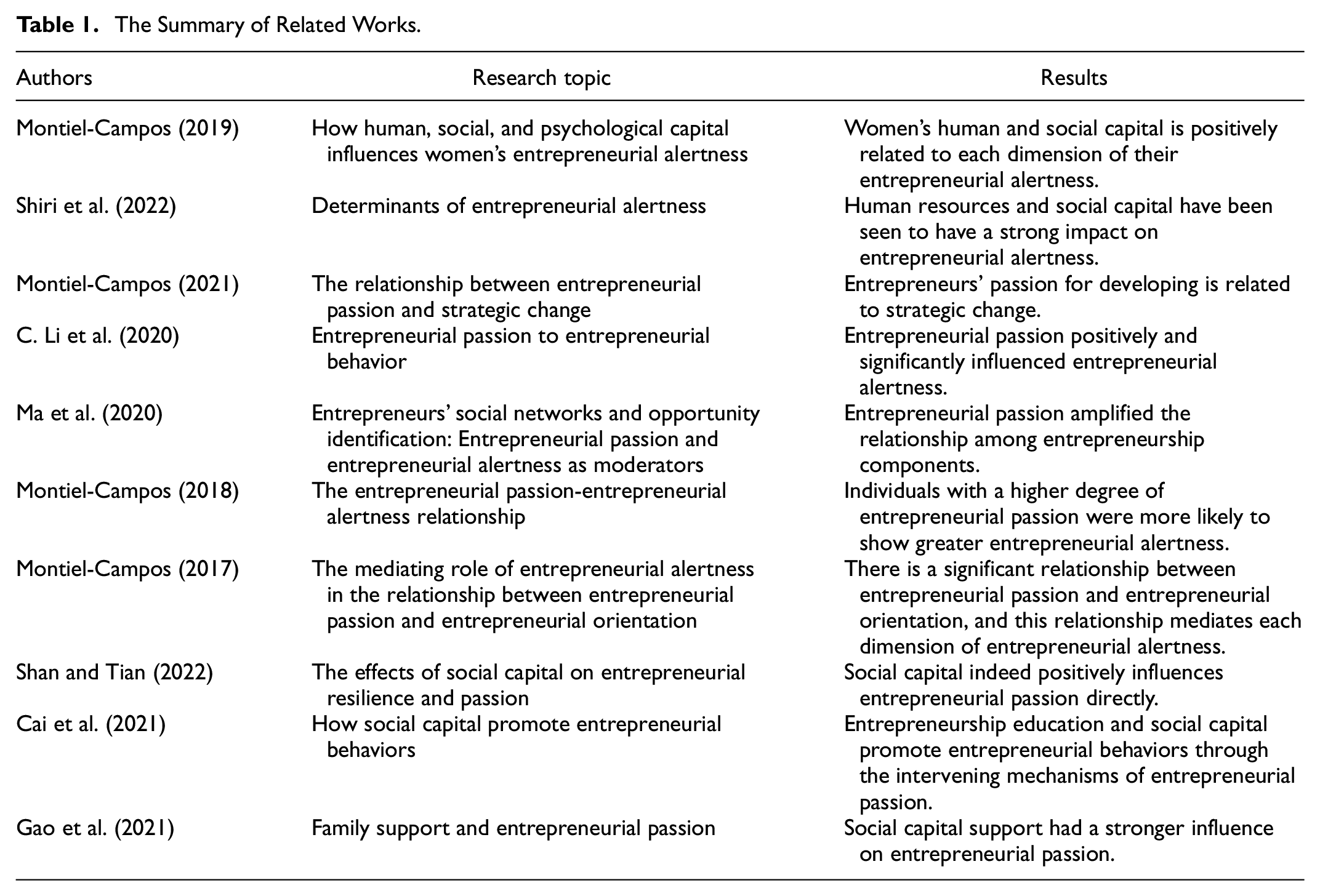
Aliabadi et al. (2016b), Behnoosh (2012), Montiel-Campos (2019), Lans et al. (2010), and Tang et al. (2012), have proposed that social capital can be embedded in the conceptual framework of the entrepreneurial process and can promote entrepreneurial alertness. On the other hand, entrepreneurial passion has been known as an important component in entrepreneurial research (e.g., Adomako & Ahsan, 2022; Biraglia & Kadile, 2017; Cardon et al., 2017; Drnovsek et al., 2009; J. Li et al., 2022) and can act as a mediator variable. Table 1 presents a summary of the relevant studies. With regard to the issues discussed in the theoretical and empirical research bases, the conceptual framework of the research (Figure 1) and its hypotheses are presented below:
The Summary of Related Works.

The conceptual framework of the research.
Research Methodology
This research is an applied study in terms of purpose and a descriptive and correlational study in terms of data collection. The research population was 3,851 members of rural cooperatives in Kermanshah province, Iran. Sampling in this study was done with the stratified random technique and the sample size was calculated to be 351 members according to Bartlett et al. (2001) (t = 0.94, t = 0.99, and error margin = 0.05). The data collection instrument was a standard questionnaire consisting of four sections and 58 items. The 5-point Likert scale (totally agree to completely disagree) was used to measure the research variables. The first section was related to demographic data, and other sections included items to measure entrepreneurship alertness (Tang et al., 2012), entrepreneurial passion (Cardon et al., 2013), and social capital (Nahapiet & Ghoshal, 1998). We can define entrepreneurial alertness as a mental activity of cooperative members from scanning for new information to associating with heterogeneous information from different sources in urban and rural areas and evaluating potential entrepreneurial opportunities related to cooperative activities, including scanning and search, association and connection, and evaluation and judgment. In other words, entrepreneurial alertness helps cooperatives identify market gaps and discover entrepreneurial opportunities in urban and rural communities. Entrepreneurial passion is a measure that is based on a strong sense of responsiveness of cooperative members to each of the activities of inventing, identifying, creating, and discovering new opportunities, establishing, commercializing, and productivity of opportunities, and developing existing businesses. Social capital can contribute to rural cooperatives’ success by building a sense of shared values and mutual respect among members. In other words, social capital allows cooperatives to work together effectively to achieve a common purpose or goal by improving social participation, trust, and solidarity. A pilot test was conducted to calculate Cronbach’s alpha coefficient to assess the reliability of the questionnaire (.82–.90). Cronbach’s alpha coefficient measures the internal consistency, or reliability, of a set of survey items. This statistic is used to determine whether a collection of items measures the same characteristic consistently. Convergent validity and divergent validity were used to assess the validity of the questionnaire. Convergent validity indicates whether a test that is designed to measure a particular construct correlates with other tests that assess the same or similar construct. Furthermore, the divergent validity of a survey instrument indicates that the results obtained by this instrument do not correlate too strongly with measurements of a similar but distinct trait. The data were analyzed using SPSS22 and SmartPLS1. SmartPLS was applied for variance-based structural equation modeling (SEM) using the partial least squares (PLS) path modeling method.
Results
Demographic Features
Among the respondents, 83% were male and 17% were female. In terms of education, 39% had degrees lower than the bachelor’s level, 45% had bachelor’s degrees, 12% had master’s degrees, and 4% had Ph.D. degrees. Also, 57% of respondents were in the age group of 25 to 35 years old, 33% in the age group of 35 to 45, and 10% in the range of 45 to 50 years old. In terms of work experience, 49% had 3 to 10 years of work history, 36% had 10 to 20 years of work history, and 15% had 20 to 26 years of work history.
Comparison of Variables’ Means With the Optimal Value
The means of the research variables were compared by the one-sample t-test. The comparison of the variables with the optimal value indicated a significant difference between the means of knowledge exploring, knowledge evaluation, passion establishment, innovation passion, communicational, and cognitive with optimal value. The confidence interval of the difference in structural and communicational variables is negative in the sense that the mean of the population is significantly lower than the optimal mean (Table 2).
The Comparison of Variables’ Means With the Optimal Value.

Model’s Fit Criteria
In structural equation modeling, before model implementation to test the hypotheses, the fit of the model is examined to ensure the accuracy of the findings. Composite reliability, average variance extracted, factor loadings, divergent validity, and R2 were used to measure the model (Table 3).
The Research Model’s Fit Criteria.

For composite reliability, a value greater than 0.7 indicates acceptable reliability (Hulland, 1999). Also, AVE was used to evaluate the convergent validity. The criterion’s value at the acceptance level is 0.5 (Fornell & Larcker, 1981). Also, the value of factor loading should be equal to or greater than 0.4 (Hulland, 1999). Therefore, the value obtained by factor loadings confirms that validity is acceptable for the measurement model. The R2 value also indicates the predictivity of the endogenous constructs in the research model. Chin (1998) introduced the three values of 0.19, 0.33, and 0.67 as the criterion value for weak, moderate, and strong values of R2 (Table 3). According to Fornell and Larcker (1981), divergent validity is at an acceptable level if the AVE rotational value for each dimension is greater than the value of R2 between that dimension and other dimensions in the model (Table 3).
The Relationship Between the Independent and Dependent Variables
Pearson’s correlation coefficient was used to investigate the relationship between the independent and dependent variables of the study. The results showed that the majority of the variables were correlated significantly and positively (Table 4). Among the variables, three variables including communicational with knowledge exploring (r = .51), innovation passion with establishing relationships and links (r = .41), and structural with knowledge evaluation (r = .41) had the highest correlation coefficient.
The Correlation Between the Research Variables.

: P < 0.05, **: P < 0.01.
Analysis of the Impact of Social Capital and Entrepreneurial Passion on Entrepreneurial Alertness
At this stage, the effect of social capital on entrepreneurship alertness was investigated, as well as the mediator role of entrepreneurial passion (using self-regulation) to examine hypotheses and standard estimates (using the PLS algorithm) to examine the severity of the effect of variables on each other. If the t-values are greater than 1.96, it is confirmed that the confidence level of 0.95 has a significant effect on the variables. According to Table 5 and Figure 2, the effect of social capital on entrepreneurial alertness (t-value = 4.653) is significant and positive. In addition, the path coefficient is 0.428; that is, if the social capital is increased by one unit, the entrepreneurial alertness will increase by 0.428 units (confirmation of hypothesis 1). Entrepreneurial passion has a positive and significant effect on entrepreneurial alertness (t-value = 5.429; path coefficient = 0.383) (confirmation of hypothesis 2), and social capital has a positive and significant effect on entrepreneurial passion (t-value = 5.689; path coefficient = 0.491).
The Results of the Structural Equation Modeling.


The effects of social capital and entrepreneurial passion on entrepreneurial alertness.
According to the results, the causal coefficients of the paths between the three main variables support the direct and indirect effects (the mediating role of entrepreneurial passion) on entrepreneurial alertness so that the direct effect of 0.408 and the indirect effect of (0.383 ×0.491 = 0.188) and also, the total effect has been equal to (0.188 + 0.428) = 0.61 (Figure 2).
The VAF statistics are used to determine the intensity of the indirect effect through the mediator variable, which is between 0 and 1 (Formula 1). The closer the value is to 1, the stronger the impact of the mediator is. In fact, this value measures the rate of the indirect effect of the total effect (Iacobucci & Duhachek, 2003).

The value of VIF showed that about 30% of the total social capital effect on entrepreneurial alertness was indirectly explained by entrepreneurial passion, which confirms the mediator role of entrepreneurial passion. Finally, the GOF criterion (Formula 2) was used according to Tenenhaus et al. (2004) to assess the overall fit of the model (Table 6).

Values of Communality Index and R2.

The result of the test for the model’s fit index was obtained to be equal to 0.717. Since the minimum acceptable value for this index is 0.36 (Wetzels et al., 2009), it can be claimed that the research model has a high and strong fit. The relationship between the mediator variable as the third hypothesis was tested using Preacher and Hayes’s (2008) and Walumbwa et al. (2008) five steps (Table 7).
Mediator Path.
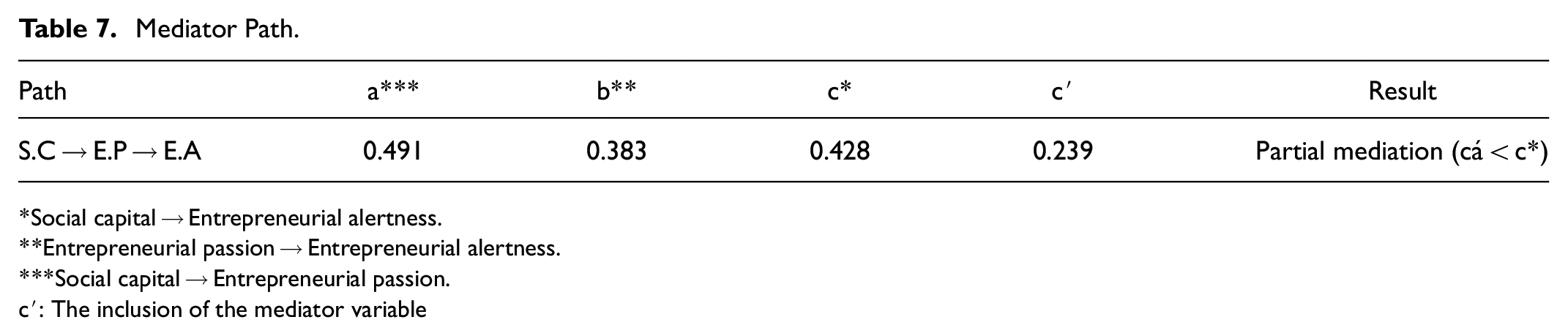
Social capital → Entrepreneurial alertness.
Entrepreneurial passion → Entrepreneurial alertness.
Social capital → Entrepreneurial passion.
c′: The inclusion of the mediator variable
Table 7 shows that in the first stage, the relationship between social capital and entrepreneurial alertness is significant. This provides the first condition for the mediator analysis. In the second and third stages, the relationship between entrepreneurial passion, entrepreneurial alertness, and social capital is significant. This also provides the second and third conditions for the mediator. In the fourth stage, with the presence of entrepreneurial passion, the path coefficient decreased from 0.428 to 0.239, but it was not significant. This shows that entrepreneurial passion plays the role of partial mediation between social capital and entrepreneurial alertness.

Discussion and Conclusion
By expanding entrepreneurial research in rural areas, opportunity recognition as a focal point of entrepreneurship has attracted the attention of researchers. One of the main factors influencing the process of opportunity diagnosis and development is entrepreneurial alertness. This research sought to investigate the effect of social capital and entrepreneurial passion on entrepreneurial alertness. The confirmation of the first to third hypotheses showed the positive impact of social capital on entrepreneurship alertness. In the process of alertness, all processes are done on social capital and entrepreneurial passion, so those who have more social capital and entrepreneurial passion can discover more opportunities, and this brings high entrepreneurial alertness. The findings of this study provided evidence that social capital can promote opportunity discovery and exploitation, making cooperative members actively engaged in actual entrepreneurial activities. Azadi et al. (2019), Judge and Douglas (2013), Lans et al. (2010), and Mirzaei et al. (2022), have emphasized the importance of the values and social capital of entrepreneurs in the formation of entrepreneurial intent and passion and alertness. Entrepreneurs’ social capital is effective in the formation of entrepreneurial alertness. Hence, it can be deduced that entrepreneurship education programs focused on social capital can be effective in fostering the identification of entrepreneurial opportunities and, as a result, entrepreneurial alertness. In other words, more opportunities are identified if the social capital of the entrepreneur is greater and entrepreneurial alertness is promoted (Bhagavatula et al., 2010; Rahimi-Feyzabad et al., 2022). Hence, social capital acts as energy or power that forms the structure of economic agents and focuses on a social field (entrepreneurial) in a particular context (discovery of opportunity). As a result, social capital leads to the creation of social networks. These social networks help the entrepreneur to have more resources and opportunities at his or her disposal and widen the scope of his or her choice. As a result, it is recommended to create strong social connections and links between cooperative members and other cooperatives so that useful and valuable sources are provided for sharing information, understanding business opportunities, and sharing resources. These interactions will bring about organizational legitimacy in the cooperative. Legitimacy not only raises the chances of attracting customers but also facilitates the access of young entrepreneurs to foreign sources.
Also, entrepreneurial passion plays an effective role in explaining entrepreneurial alertness. In this regard, the results of research by Behnoosh (2012) and Tang et al. (2012), which have examined the relationship between entrepreneurial passion and entrepreneurial alertness, confirm the findings of this study. The processes that were performed by entrepreneurial passion on social capital showed that it would have a greater impact on entrepreneurship alertness so that 30% of the impact of social capital is on entrepreneurship alertness by mediating entrepreneurial passion. Previous research has highlighted the mediating role of entrepreneurial passion in the process of entrepreneurial decision-making (Ma et al., 2020; Montiel-Campos, 2017) while neglecting the potential effect of entrepreneurial passion, which is also seen as a central element driving entrepreneurial alertness. Entrepreneurial alertness largely depends on individual abilities in collecting, transforming, and selecting information that leads to a potential business opportunity. Entrepreneurial passion encourages these abilities. Therefore, it can be admitted that alertness is not inherent talent, but also it is derived from passion, entrepreneurial experience, and the gathering of business experiences. On the other hand, Gaglio and Katz (2010) argue that entrepreneurial alertness is a mental basis. Entrepreneurial passion is also an entrepreneur’s inner and subjective characteristic, and when anxiety and passion can be linked together, they will discover the opportunity. In general, it can be concluded that entrepreneurship development in rural areas is increasingly argued as a promising alternative to the community’s economic improvement, as it detects the potential of local people to create jobs and serve local tastes and markets.
This research aimed to predict the entrepreneurial alertness of rural cooperative members based on social capital and entrepreneurial passion. The research was novel in the sense that few studies have investigated the effect of entrepreneurial passion and social capital on entrepreneurial alertness in rural cooperatives. In other words, previous studies have mostly dealt with the economic issues of these cooperatives, and our subject matter has been neglected. However, dealing with entrepreneurial activities, in addition to the economic issues of rural cooperatives, can be helpful in advancing the goals of these non-governmental institutions.
The results can be useful for developing countries because they contribute to making systemic policies for rural cooperatives and using the potential of social capital in promoting entrepreneurial alertness and activities. Therefore, policymakers and researchers in developing countries can use the results of the present work as a model.
This study faced some limitations. First, the samples in this study were selected from a single province (Kermanshah province). Different provinces may have differences in culture, rural values, and social morality. Future research could obtain samples from multiple provinces to incorporate and compare these differences. Second, this study used cross-sectional data. Considering that the outcome of social capital may be delayed, cooperative members can take several years to prepare for entrepreneurship. Future research could conduct investigations over a more extended period to trace the effects of entrepreneurial passion and social capital on entrepreneurial alertness.
Footnotes
Declaration of Conflicting Interests
The author(s) declared no potential conflicts of interest with respect to the research, authorship, and/or publication of this article.
Funding
The author(s) received no financial support for the research, authorship, and/or publication of this article.

Data availability statement
The datasets generated during and/or analyzed during the current study are available from the corresponding author on reasonable request.