




Abstract
Drawing upon social cognition theory and social support theory, this study investigates the impact of social support on entrepreneurial well-being. Using a valid sample of 228 entrepreneur respondents who are supported by Youth Business China (YBC), this study provides compelling evidence regarding the following key findings: Firstly, family support has a significantly positive impact on entrepreneurs’ entrepreneurial well-being. Partner support significantly and positively affects entrepreneurs’ subjective well-being, although it does not significantly impact objective well-being. The positive impact of social support from institutions on entrepreneurial well-being is not significant. Secondly, partner support and institutional support have significant positive impacts on entrepreneurial passion. However, family support does not exhibit a significant positive effect on positive emotions. Instead, it significantly contributes to entrepreneurial identity. Thirdly, entrepreneurial passion demonstrates a significantly positive impact on entrepreneurial well-being. Fourthly, entrepreneurship passion plays a mediating role between social support and entrepreneurial well-being. Finally, entrepreneurial efficacy positively moderates the relationship between social support and entrepreneurial passion. The study culminates with practical implications for entrepreneurs and policymakers in entrepreneurial practices.
Introduction
Well-being is an individual psychological state that encompasses both emotional experiences and cognitive judgments (Ryan & Deci, 2001). Entrepreneurial well-being refers to the well-being experienced during the entrepreneurial process, encompasses the subjective perceptions and comprehensive evaluations of their personal value, sense of achievement, and economic returns throughout the process of initiating and operating a startup enterprise (Hmieleski & Corbett, 2008; Shepherd et al., 2018). Entrepreneurship possesses distinctive inherent characteristics, including uncertainty and high rates of failure. Nevertheless, the inherent high levels of autonomy, task diversity, and independence in entrepreneurial activities can still contribute to varying degrees of entrepreneurial well-being. Research has provided evidence for the significant impact of well-being on entrepreneurial perseverance and entrepreneurial success (Stephan, 2018; Uy et al., 2017). Higher levels of well-being facilitate increased optimism, resilience, and motivation among entrepreneurs, empowering them to persist in tackling more demanding tasks and attain entrepreneurial success (White & Vishal, 2020). Conversely, the enduring sense of dissatisfaction and persistent feelings of frustration experienced by entrepreneurs can hinder their entrepreneurial drive. Entrepreneurial well-being serves as a crucial indicator for measuring the success of entrepreneurship and a key dimension for assessing social and economic development (Uy et al., 2017). Therefore, enhancing entrepreneurs’ entrepreneurial well-being is of great importance (M. H. Chen et al., 2018; Hugten et al., 2021).
Existing research has predominantly focused on objective entrepreneurial outcomes, such as entrepreneurial performance (Carlos et al., 2018), but overlooked the subjective utility that entrepreneurs derive from their entrepreneurial pursuits (Wiklund et al., 2019). In this study, entrepreneurial well-being refers to the comprehensive perception and assessment of entrepreneurs regarding the integrated material and psychological benefits derived from the process and outcomes of entrepreneurship. It encompasses improvements in wealth, income, and living standards, as well as the development of capabilities and the fulfillment of personal values, leading to a sense of achievement and satisfaction (Amorós et al.,2021). According to Amorós et al. (2021), entrepreneurial well-being can be divided into two dimensions, that is, entrepreneurial objective well-being and entrepreneurial subjective well-being. Objective well-being is manifested through quantifiable performance indicators, including personal income growth, increased profitability of new ventures, and business expansion (Smith & Johnson, 2017). Conversely, subjective well-being pertains to the subjective experiences reported by entrepreneurs, encompassing an elevated social status, heightened levels of job and life satisfaction, and the fulfillment of personal values (Rui, 2017).
Most researches have examined the factors influencing individuals’ sense of well-being and explored potential avenues for enhancing well-being through statistical demographic variables (Hmieleski et al., 2007; Shir et al., 2018). Additionally, objective environmental conditions, such as the quality of the living environment (Przepiorka, 2016), family relationships, and other factors (Carree & Verheul, 2011), have been extensively analyzed. While the significant influence of social support on well-being has received considerable attention in the past decade (Amorós et al., 2021), its impact on entrepreneurial well-being remains unresolved. Social support involves the provision of assistance and support from individuals’ social relationships, including family members, friends, and government institutions, in terms of information, material resources, and emotional aspects (Jacobson, 1986).
According to social support theory, individuals with higher levels of social support are more likely to receive functional support and emotional care from their social networks. In China, there is a greater emphasis on “strong ties” such as family and close partners, as well as “weak ties” with institutions such as the government and banks. Social support plays a crucial role for entrepreneurs in this context. However, the specific mechanisms by which social support influences entrepreneurial well-being remain uncertain. Therefore, the objective of this study is to examine the impact of social support on entrepreneurial well-being among entrepreneurs. According to social cognition theory, external environmental factors can influence the behavior and outcomes of entrepreneurs by altering their cognition (Bandura et al., 1977). Social support is an important social environmental factor that triggers a unique cognitive process in entrepreneurs before influencing entrepreneurial outcomes (Amsal et al., 2014). Specifically, entrepreneurs who receive higher levels of social support exhibit enhanced confidence and passion in their entrepreneurial pursuits, which subsequently contribute to improved entrepreneurial outcomes and goal attainment. Consequently, they experience greater intrinsic and extrinsic rewards, such as increased income, higher sense of achievement, and personal value, which positively contribute to entrepreneurial well-being (Kruse et al., 2023).
Drawing upon social cognitive theory and social support theory, the availability of resources assists entrepreneurs in developing self-confidence in their abilities and cultivating a greater passion for achieving entrepreneurial success, ultimately leading to enhanced well-being (Marshall et al., 2020). The primary aim of this study is to examine the mechanisms that influence entrepreneurial well-being by integrating both social environmental and individual factors. Specifically, it seeks to explore the impact mechanism of social support on entrepreneurial well-being, examining how social support influences the formation of entrepreneurial well-being through the mediating effect of entrepreneurial passion and the moderating effect of entrepreneurial efficacy.
This study is expected to make several significant contributions. Firstly, it focuses on entrepreneurial well-being, broadening the traditional research perspective that primarily emphasizes objective outcomes such as entrepreneurial performance. Secondly, it highlights the social support provided by “strong-weak tie” relationships, including family, partners, and institutions, which is highly valued in the Chinese society. By utilizing local samples, it offers a new perspective on the factors influencing entrepreneurial well-being in the Chinese context. Thirdly, by incorporating both social support and individual factors into the discussion framework of entrepreneurial well-being, it provides a novel and comprehensive perspective for studying entrepreneurial well-being.
Hypothesis Development and Research Model
The Impact of Social Support on Entrepreneurial Well-being
Based on the theory of social support, in a supportive atmosphere, entrepreneurs receive enhanced understanding and support from their family members (Xu et al., 2020). They acquire entrepreneurial capital and information through their partnerships (Pitrus, 2018). Furthermore, they benefit from training, funding, taxation, and other entrepreneurial policy support provided by local governments, banks, and institutions closely associated with entrepreneurial activities (Estrin et al., 2013). These resources and support systems help alleviate the pressure faced by entrepreneurs, enabling them to achieve greater success, accumulate more material wealth, and experience a heightened sense of pride and accomplishment (J. Zhang & Zhou, 2019). Ultimately, these outcomes contribute to entrepreneurial well-being.
The goal-setting theory holds that the realization of ideal goal is an effective source to activate entrepreneurs’ entrepreneurial well-being (Baron, 2008; Diener & Fujita, 1995). Strong emotion-based family relationships, reciprocity-based business relationships, and government relationships between entrepreneurs and officials at different administrative and regulatory levels can offer valuable resources in terms of information, funding, and emotional support for the development and growth of entrepreneurial enterprises. Such support effectively address the challenges faced by entrepreneurs and help overcome resource deficiencies (M. H. Chen et al., 2018). Ultimately, these support play a crucial role in fostering entrepreneurial success and enabling entrepreneurs to achieve their goals of material prosperity and self-fulfillment, which in turn generates a strong sense of entrepreneurial well-being (Mo & Beehr, 2021). To sum up, this study hypothesizes that:
H1a: Family support has a significant positive impact on entrepreneurial subjective well-being.
H1b: Family support has a significant positive impact on entrepreneurial objective well-being.
H1c: Partner support has a significant positive impact on entrepreneurial subjective well-being.
H1d: Partner support has a significant positive impact on entrepreneurial objective well-being.
H1e: Institution support has a significant positive impact on entrepreneurial subjective well-being.
H1f: Institution support has a significant positive impact on entrepreneurial objective well-being.
The Impact of Social Support on Entrepreneurial Passion
Passion is defined as a compelling inclination to engage in specific activities (Aiken & Walker, 2018). In the context of entrepreneurship, entrepreneurial passion entails experiencing intense positive emotions and a deep sense of identification with the entrepreneurial activities that evoke such emotions (Cardon et al., 2009). Entrepreneurs’ positive emotions, including happiness, satisfaction, confidence, and excitement, contribute to their motivation and initiative, thereby enhancing their commitment and determination towards entrepreneurial activities (Cardon et al., 2009). Entrepreneurial identity refers to an individual’s sense of identification and belongingness as an entrepreneur. It drives entrepreneurs to engage more actively in entrepreneurial activities and enables them to maintain a steadfast and persistent effort when faced with challenges and difficulties (Cardon et al., 2013).
Social cognitive theory suggests that social support, as an external environmental factor, exerts an influence on entrepreneurs’ cognition, emotions, and even their entrepreneurial performance (Sripongpun, 2021). Baron and Tang (2011) found that social support can provide material and emotional resources, enhance entrepreneurs’ positive emotions and motivation, thereby promoting the generation and maintenance of entrepreneurial passion. Klyver et al. (2017) posited that timely social support can help entrepreneurs maintain a positive mood and be more willing to engage in entrepreneurial activities. Zhang and Li (2019) revealed a positive association between social support and entrepreneurial passion. They found that entrepreneurs who receive support from partners, family, friends, and the entrepreneurial ecosystem experience a heightened stimulation and amplification of their entrepreneurial passion.
In other words, receiving increased social support can enhance entrepreneurs’ passion for engaging in entrepreneurial endeavors. Social support can provide emotional support, informational support, and instrumental support, thereby enhancing entrepreneurs’ confidence and motivation. When facing difficulties and challenges, entrepreneurs can better cope with stress and maintain a positive emotional state by receiving support from family, partners, and institutions (Y. Zhang et al., 2014). Meanwhile, entrepreneurs are more likely to develop a sense of identification and belonging to their entrepreneurial activities after receiving social support, which leads to their willingness to invest more time and effort into achieving entrepreneurial goals (Farooq, 2018). Accordingly, we assume:
H2a: Family support has a positive impact on entrepreneurs’ positive emotion.
H2b: Family support has a positive impact on entrepreneurial identity.
H2c: Partner support has a positive impact on entrepreneurs’ positive emotion.
H2d: Partner support has a positive impact on entrepreneurial identity.
H2e: Institution support has a positive impact on positive emotion.
H2f: Institution support has a positive impact on entrepreneurial identity.
The Influence of Entrepreneurial Passion on Entrepreneurial Well-being
Studies have shown that positive and stable psychological state and emotion will affect entrepreneurs’ entrepreneurial well-being (Rahman, 2020; Uy et al., 2017). Entrepreneurial passion refers to an entrepreneur’s positive and stable emotional state in the process of starting a business. Smith and Johnson (2017) conducted a longitudinal study on a sample of entrepreneurs and found a significant positive relationship between entrepreneurial passion and entrepreneurial well-being. They highlighted that entrepreneurs who exhibited higher levels of passion for their ventures experienced greater satisfaction and fulfillment in their entrepreneurial endeavors. Similarly, H. Chen et al. (2019) showed that higher levels of entrepreneurial passion were associated with increased levels of well-being in the entrepreneurial process. The study emphasized the importance of passion as a driving force for entrepreneurs to overcome challenges and achieve personal fulfillment. Furthermore, S. H. Lee and Kim (2020) revealed a robust and consistent relationship, indicating that passionate entrepreneurs tend to experience higher levels of well-being in their entrepreneurial journeys.
On one hand, entrepreneurs who possess a higher level of positive feelings exhibit greater confidence in their entrepreneurial activities, maintain a more optimistic outlook regarding the survival of their ventures, and are more inclined to adopt a positive attitude towards achieving their desired entrepreneurial goals. This, in turn, enhances their entrepreneurial well-being (Li et al., 2020). On the other hand, entrepreneurs who have a stronger sense of entrepreneurial identity demonstrate a greater willingness to dedicate themselves to entrepreneurial work. Furthermore, their level of work engagement is positively associated with their entrepreneurial well-being (Rauch, 2020). When entrepreneurs derive enjoyment from their entrepreneurial endeavors, they are likely to achieve higher levels of entrepreneurial performance and experience greater satisfaction, thereby improving their entrepreneurial well-being (Shir et al., 2018). Based on these findings, we posit that:
H3a: Entrepreneurs’ positive emotion has a significant positive impact on entrepreneurial subjective well-being
H3b: Entrepreneurs’ positive emotion has a significant positive impact on entrepreneurial objective well-being
H3c: Entrepreneurial identity has a significant positive impact on entrepreneurial subjective well-being
H3d: Entrepreneurial identity has a significant positive impact on entrepreneurial objective well-being
The Mediating Role of Entrepreneurial Passion
Fang et al. (2019) argue that social support serves as a critical resource for individuals in effectively managing work-related stress. The provision of information, resources, and emotional support from family, partners, and institutions not only helps alleviate the uncertainty and feelings of helplessness experienced by entrepreneurs, but also enhances their entrepreneurial passion (Liu & Ma, 2020). Entrepreneurs with higher levels of entrepreneurial passion are more likely to perceive entrepreneurship as a positive emotional experience (Uy et al., 2013), which further strengthens their commitment to engage in activities aimed at achieving entrepreneurial goals. This, in turn, promotes the enhancement of entrepreneurial well-being. In other words, entrepreneurs with abundant social support have more capital to invest in entrepreneurial activities and also have the confidence to deal with the uncertainties and challenges associated with entrepreneurship. As a result, they exhibit a greater willingness to actively allocate their time and energy to entrepreneurial pursuits, deriving gratification and a heightened sense of self-esteem from the process of problem-solving and the progressive satisfaction derived from entrepreneurial income. Consequently, they experience an elevated sense of entrepreneurial well-being. Accordingly, we assume:
H4a: Entrepreneurial passion has a mediating effect on the relationship between family support and entrepreneurial subjective well-being.
H4b: Entrepreneurial passion has a mediating effect on the relationship between family support and entrepreneurial objective well-being.
H4c: Entrepreneurial passion has a mediating effect on the relationship between partner support and entrepreneurial subjective well-being.
H4d: Entrepreneurial passion has a mediating effect on the relationship between partner support and entrepreneurial objective well-being.
H4e: Entrepreneurial passion has a mediating effect on the relationship between institution support and entrepreneurial objective well-being.
H4f: Entrepreneurial passion has a mediating effect on the relationship between institution support and entrepreneurial objective well-being.
The Moderating Role of Entrepreneurial Efficacy
Self-efficacy pertains to the individual’s task-specific confidence, representing their perception of their own capabilities to achieve desired high-performance outcomes (Bandura et al., 1997). Entrepreneurial efficacy reflects the perception of their own entrepreneurial ability (Mcgee et al., 2010). The level of confidence displayed by entrepreneurs significantly impacts their effectiveness in acquiring and utilizing resources. Individuals with high levels of entrepreneurial self-efficacy exhibit a proactive approach in accessing entrepreneurial resources within their social networks (e.g., family, friends or partners, and institutions). They actively pursue the necessary resources and support, thereby improving their efficiency in resource acquisition and fostering a heightened passion for entrepreneurial pursuits (Cardon, 2008). Conversely, when entrepreneurial self-efficacy is low, entrepreneurs lack the courage and mindset required to confront challenges, leading to limited dedication of time and effort in seeking social resources. As a result, they encounter difficulties in initiating effective resource acquisition strategies. Individuals with higher entrepreneurial self-efficacy show more entrepreneurial confidence and send positive signals to the outside world (J. Lee, 2019). Additionally, entrepreneurs with high entrepreneurial self-efficacy are capable of projecting a more confident and success-oriented signal to the external environment, allowing them to occupy favorable positions within social networks. This, in turn, enables them to access scarce support, further fueling their passion for engaging in entrepreneurial activities (Neneh, 2020). Accordingly, this study hypothesizes that:
H5: Entrepreneurial efficacy moderates the relationship between social support and entrepreneurial passion.
Based on the above analysis, a conceptual model is constructed, which comprises entrepreneurs’ social support, entrepreneurial passion, entrepreneurial well-being, and entrepreneurial efficacy, as shown in Figure 1 below.
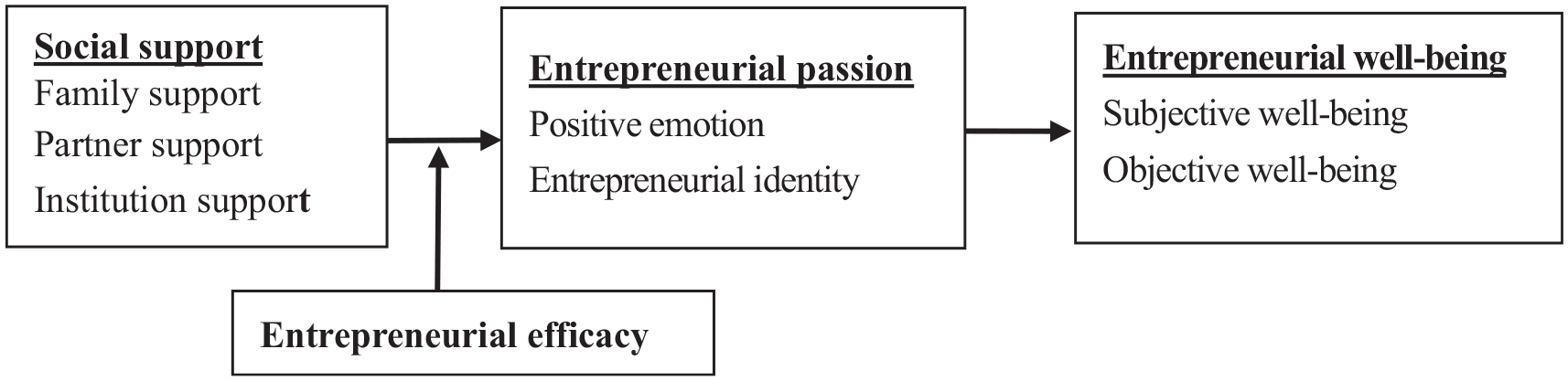
Research conceptual framework.
Method
Procedure and Participants
This study collects data through questionnaire survey. All respondents are entrepreneurs from Youth Business China (YBC) in Fujian, China. With the help of Youth Business China (YBC) teachers, a detailed explanation of the research purposes was given to the participants. The participants were required to complete the questionnaires during the entrepreneurship training classes of Youth Business China (YBC). Upon completion, the questionnaires were immediately collected. To avoid the effect of common method bias, we collected data at two different points in time to strengthen the ability to make a causal inference and to reduce the influence of common method bias. First, pilot test was conducted prior to the formal investigation, and 91 questionnaires were distributed, 78 were returned, and 69 valid questionnaires were remained after questionnaire screening to verify the readability and clarity of all the measurement items. This ensures the internal consistency of our sample. With the assistance of YBC teachers, a total of 330 questionnaires were distributed. The 330 participants in this survey were attendees of entrepreneurship training programs organized by YBC in four cities in Fujian Province(Fuzhou, Xiamen, Quanzhou, and Putian) between June and July 2021. And we received 276 questionnaires from the survey. Out of 276 respondents, 48 responses were found to be incomplete and/or not valid and were not considered.
Among the respondents, 82.9% of respondents below the age 40, a male-to-female ratio of 61% to 39%. In addition, 74.9% respondents had education below the bachelor’s level. Before engaging in entrepreneurship, the average work experience of respondents was 6.65 years.30.3% of the participants have previously ventured into entrepreneurial endeavors.
Measurements
In this study, the measurement instruments for the study variables are derived from previously published literature in both English and Chinese. Prior to translating the English version question items, an editing group is formed, comprising five members. Among them, three members are university professors specializing in the field of entrepreneurship, while the remaining two members are overseas students, both native English speakers and proficient in Chinese. Initially, the authors engaged in a thorough discussion with the two overseas students, outlining the research objectives and providing them with the necessary guidelines for translating the question items. Subsequently, the students are individually tasked with translating the question items into Chinese. After that, the translations are meticulously reviewed by the three professors to ensure the content validity of the items. The checked translation is then subjected to further discussion and deliberation by the entire editing group. With the exception of control variables, participants are asked to rate their level of agreement using a five-point response scale, ranging from 1 (strongly disagree) to 5 (strongly agree). The questionnaire items for each variable are presented in Table 1.
Convergent Validity of the Measurement Model (N = 228).

Social support is measured with 11 items from the classification proposed by Klyver et al. (2017). Among these items, four pertained to family support. An example item is “My family members have provided emotional support throughout my entrepreneurial journey.” Additionally, four items focused on partner support, with an example item being “Business partners give me useful information and knowledge in the process of starting a business.” Lastly, three items are related to institution support, and an example item is “During the entrepreneurial process, I received financial support from the local government.” All measurement items passed the readability and clarity in the pilot test.
To measure entrepreneurship passion, we use six items from Cardon et al. (2013) and Wang and Wang (2020). Of which, three items pertained to positive emotion associated with entrepreneurship. Examples include statement such as “I enjoy embracing various challenges when initiating a business.” Additionally, three items are designed to capture entrepreneurship identity, with example such as “Being a business creator plays a significant role in expressing my identity.” All measurement items passed the readability and clarity in the pilot test.
To evaluate entrepreneurship well-being, we employed a six-item scale developed by Rui (2017). This scale comprised three items related to subjective well-being. An example item from this category is “I perceive a significant improvement in my social status.” Additionally, three items focused on objective well-being, with an example item being “The profitability of my new ventures shows a continuous improvement.” It is important to mention that all measurement items successfully passed the readability and clarity assessment.
Entrepreneurship efficiency was measured with six items from the classification proposed by Forbes (2005). Examples of these items include statements such as “I possess high levels of confidence in my entrepreneurial competence” and “I am capable of overcoming most of the challenges associated with being an entrepreneur.” During the pilot test, five measurement items demonstrated satisfactory readability and clarity. However, one item did not meet the required criteria and was subsequently removed from the scale. As a result, a final set of five measurement items remained for assessing entrepreneurship efficiency.
Based on previous relevant study (Uy et al., 2017), control variables were selected to account for common demographic factors in entrepreneurial behavior. These variables included gender, age, educational background, previous working experience, and entrepreneurial experience.
Results and Discussion
Reliability and Validity
All statistical analysis are performed with SPSS 21.0 and AMOS 24.0. We conduct reliability and confirmatory factor analyses (see Table 1). All Cronbach’s alpha are above .80, and the factor loadings, CR (composite reliabilities), and AVE(average variance extraction)values are higher than their recommended coefficient weights (Fornell & Larcker, 1981).
Correlation Analysis of Variables
As shown in Table 2, the bold numbers in the diagonal direction represent the square roots of AVEs. Because the square roots of AVEs in the diagonal direction are all greater than the off-diagonal numbers, discriminant validity is satisfactory for all constructs. In addition, there are significant correlations among the four variables (social support, entrepreneurial passion, entrepreneurial well-being, and entrepreneurial efficacy) and their dimensions. The relationship among the four variables and their dimensions needs to be explored in depth.
Fornell-Lacker Criterion table (N = 228).

Notes. The items on the diagonal on bold represent the square roots of the AVE; off-diagonal elements are the correlation estimates.
FS = Family support; PS = Partner support; IS = Institution support; PE = Positive emotion; EI = Entrepreneurship identity; SH = Subjective well-being; OH = Objective well-being; EE = Entrepreneurship efficiency.
*indicates significant level of two-tailed test p < .05. ** indicates significant level of two-tailed test p < .01. ***indicates significant level of two-tailed test p < .001.
Fit Degree Test
AMOS24.0 is used to test the overall model, and the MI value correction make all the indicators reach the relatively lenient acceptable fit index criteria, including RMSEA less than 0.08 and GFI greater than 0.8 (Hair et al., 2014). The results in Table 3 show that the fitting indicators of the model (GFI = 0.875; CFI = 0.966; TLI = 0.960; RMSEA = 0.056) all meet the lenient acceptable standard, indicating that the model has good fit indices.
Model Fit Test (N = 228).

Hypothetical Test and Brief Discussion
Direct Effect Test and Brief Discussion
The standardized path coefficient of AMOS24 is used to analyze the relationship path among social support, entrepreneurial passion, and entrepreneurial well-being, as shown in Table 4.
Direct Effects Tests for Structural Equation Models (N = 228).

FS = Family support; PS = Partner support; IS = Institution support; PE = Positive emotion; EI = Entrepreneurship identity; SH = Subjective well-being; OH = Objective well-being.
indicates significant level of two-tailed test p < .05. **indicates significant level of two-tailed test p < .01. ***indicates significant level of two-tailed test p < .001
Firstly, family support positively and significantly affects entrepreneurial subjective well-being (β = .151,p < .05) and entrepreneurial objective well-being (β = .157, p < .01), Therefore, H1a and H1b are supported. This implies that the support received from family members plays a crucial role in enhancing the entrepreneur’s entrepreneurial well-being, including both their personal satisfaction and happiness, as well as their tangible achievements and success. Partner support significantly affects entrepreneurial subjective well-being (β = .158, p < .05). Hence, H1c is supported, but partner support has no significant positive effect on entrepreneurial objective well-being (β = .063, p > .05), thus, H1d isn’t supported. This implies that partner support can have a significant impact on subjective well-being and psychological aspects of the entrepreneur’s journey. However, when it comes to objective measures of success, such as business performance or financial outcomes, the influence of partner support may be less pronounced (Burke et al., 2000). The positive effects of institutional support on entrepreneurial subjective well-being and objective well-being are not significant(p > .05). Therefore, H1e and H1f aren’t supported. This could be due to the level or intensity of institutional support provided to entrepreneurs may not have been substantial enough to produce significant effects on their well-being outcomes. The support might have been limited in terms of resources, guidance, or opportunities, thereby limiting its impact (Stam & Elfring, 2020).
Secondly, family support has a significant and positive effect on entrepreneurial identity (β = .256,p < .001). Hence, H2b is supported. While the positive effect of family support on positive emotion is not significant (β = .019, p > .05), thus, H2a isn’t supported. The insignificant impact of family support on the positive emotion of entrepreneurs may be attributed to the pressures and challenges inherent in the entrepreneurial process, family support can provide emotional support and understanding, it may not fully alleviate the pressures and challenges associated with entrepreneurship. Moreover, entrepreneurs frequently experience guilt over neglecting their families due to their entrepreneurial endeavors, further diminishing the influence of family support on positive emotion (Xu et al., 2020). Therefore, the impact on positive emotion is relatively limited. Partner support had a positive and significant effect on positive emotion (β = .329, p < .01) and entrepreneurial identity (β = .268, p < .001), thus, H2c and H2d are supported. Institutional support also has a significant positive effect on positive emotion (β = .275, p < .001) and entrepreneurial identity (β = .291, p < .001). Hence, H2e and H2f are supported. Evidently, support from partners and institutions can quickly ignite entrepreneurial passion among entrepreneurs, validating the findings of Zhang and Li (2019).
Thirdly, the standardized coefficients of positive emotion affect on entrepreneurial subjective well-being and objective well-being are both 0.353, thus, H3a and H3b are supported. The standardized coefficients of the impact of entrepreneurial identity on each dimension of entrepreneurial well-being are 0.409 and 0.381, both at the significant p < .001 level, thus, H3c and H3d are verified. Indeed, it is evident that entrepreneurial passion can effectively stimulate the entrepreneurial well-being of entrepreneurs, aligning with the previous research findings of S. H. Lee and Kim (2020).
Mediating Effect Test and Brief Discussion
Using AMOS24.0 software and Bootstrap method to test the mediating effect of entrepreneurial passion, the results are shown in Table 5. The indirect effect of family support on entrepreneurial subjective well-being through entrepreneurial passion is estimated to be 0.108, with a confidence interval ranging from 0.025 to 0.228. Notably, the confidence interval does not encompass zero, indicating a significant relationship. Conversely, the direct effect of family support on entrepreneurial subjective well-being through entrepreneurial passion is estimated to be 0.151, but it does not reach statistical significance. Consequently, entrepreneurial passion serves as a significant and complete mediator in the relationship between family support and entrepreneurial subjective well-being. Hence, H4a is verified. Likewise, it can be inferred H4b, H4e and 4f are verified. This suggests that both family support and institutional support influence entrepreneurial well-being through entrepreneurial passion.
Test of the Mediating Effect of Entrepreneurial Passion (N = 228).
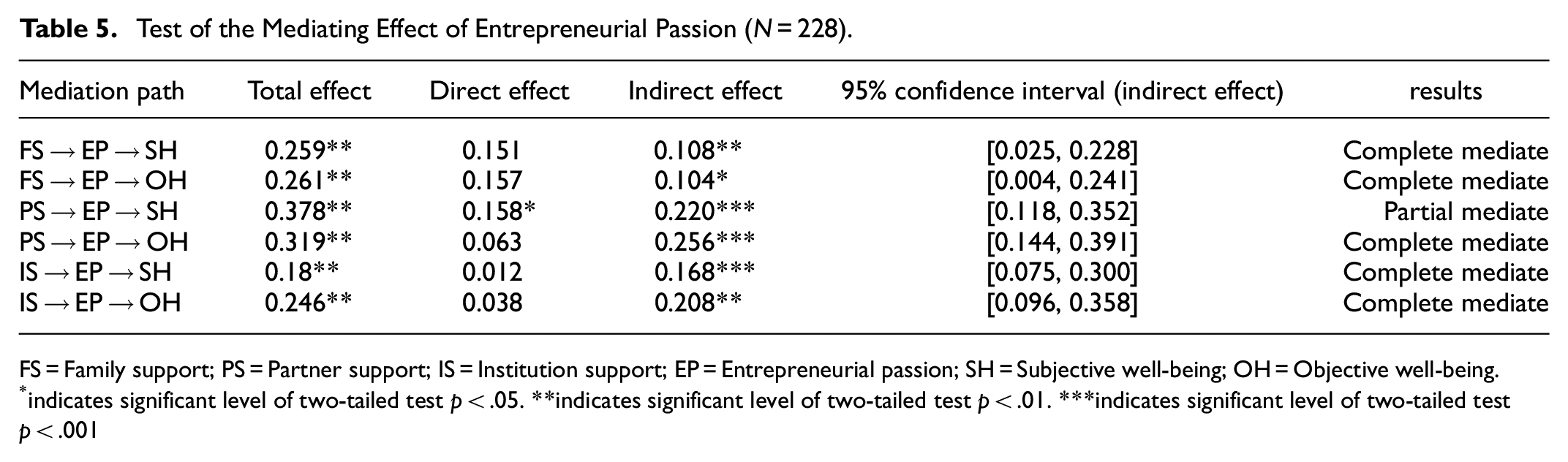
FS = Family support; PS = Partner support; IS = Institution support; EP = Entrepreneurial passion; SH = Subjective well-being; OH = Objective well-being.
indicates significant level of two-tailed test p < .05. **indicates significant level of two-tailed test p < .01. ***indicates significant level of two-tailed test p < .001
The indirect effect of partner support on entrepreneurial subjective well-being through entrepreneurial passion is estimated to be 0.22, with a confidence interval ranging from 0.118 to 0.352. Notably, the confidence interval does not encompass zero, indicating a significant relationship. Furthermore, the direct effect of partner support on subjective entrepreneurial well-being through entrepreneurial passion is estimated to be 0.158 and is statistically significant. Consequently, entrepreneurial passion serves as a partial mediator in the relationship between partner support and entrepreneurial subjective well-being, thus, H4c is verified. This suggests that entrepreneurial passion may be only a partial explanatory factor in the complex relationship between partner support and entrepreneurial subjective well-being, and that there may be other factors influencing this relationship. Moreover, a complete mediating role between partner support and entrepreneurial objective well-being, thus, H4d is verified. It can be seen that in most cases, partner support affects entrepreneurial objective well-being through entrepreneurial passion.
Moderating Effect Test
The moderating effect of entrepreneurial efficacy was analyzed using SPSS 24.0 software and multi-level regression analysis. The results are presented in Table 6. The findings indicate that entrepreneurial efficacy significantly and positively moderates the impact of social support on entrepreneurial passion among entrepreneurs. The moderation coefficient is 0.289 (t = 5.726, p = .000), providing support for hypothesis 5. In other words, for each additional unit of entrepreneurial self-efficacy, the slope of the relationship between social support and entrepreneurial passion increases by 0.289 units. This indicates that having higher entrepreneurial efficacy enables entrepreneurs who receive social support to exhibit greater passion in their entrepreneurial endeavors.
Results of Moderating Effect Test (N = 228).
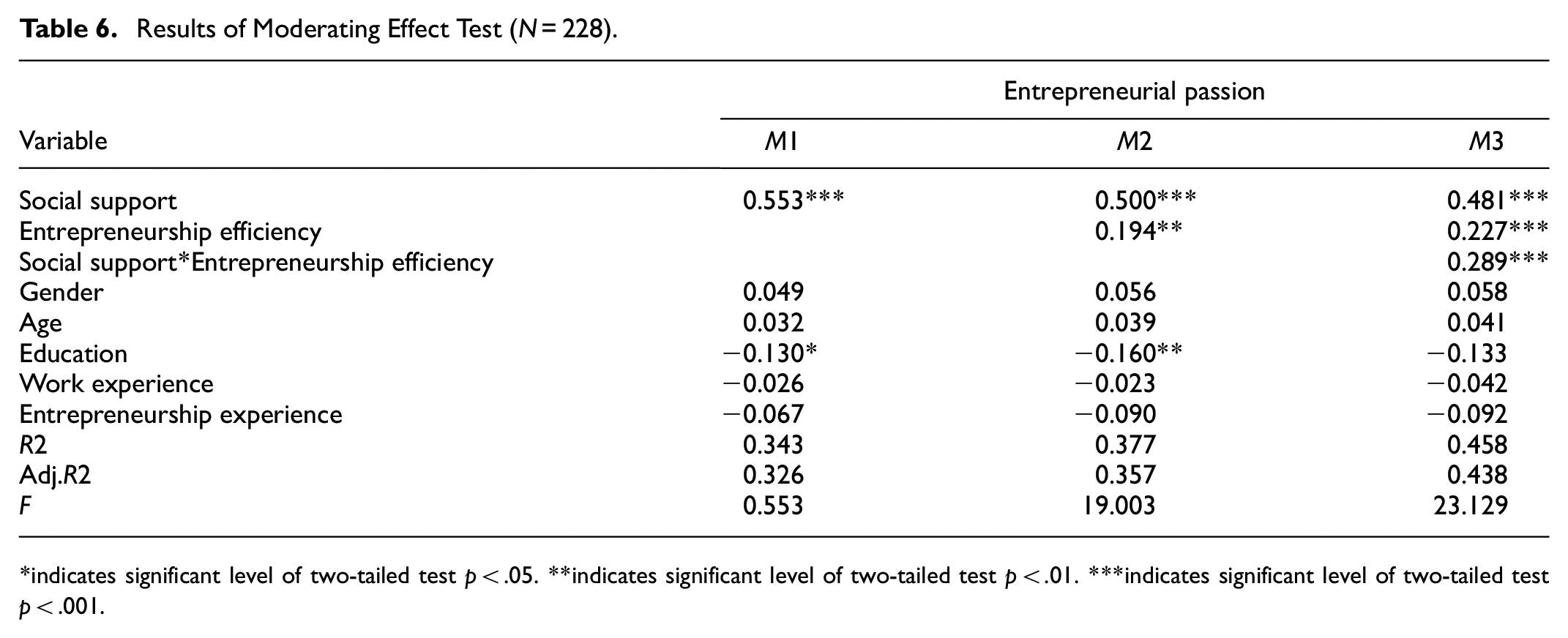
indicates significant level of two-tailed test p < .05. **indicates significant level of two-tailed test p < .01. ***indicates significant level of two-tailed test p < .001.
Conclusion and Implications
Conclusion
Building upon social cognition theory and social support theory, this study develops a conceptual model to examine the influence of social support on entrepreneurial well-being. The empirical findings reach the following conclusions. Firstly, the results demonstrate a positive effect of social support on entrepreneurial well-being, albeit not entirely statistically significant. Notably, family support shows a significant positive impact on entrepreneurial well-being. Entrepreneurs who receive greater support from their families experience enhanced feelings of self-worth and satisfaction throughout the entrepreneurial process (Powell & Eddleston, 2017). Additionally, partner support significantly and positively affects entrepreneurs’ subjective well-being, as evidenced by studies such as Tundui (2013), although it does not significantly impact objective well-being. However, institution support does not exhibit a significant positive impact on entrepreneurs’ entrepreneurial well-being. Secondly, partner support and institutional support have a significant positive impact on entrepreneurial passion, indicating that greater perceived support from partners and institutions leads to increased entrepreneurial enthusiasm and persistence. However, family support does not exhibit a significant positive effect on positive emotion; instead, it significantly contributes to entrepreneurial identity. In other words, receiving support from family members aids entrepreneurs in developing a stronger sense of identity rather than experiencing heightened positive emotion. Thirdly, entrepreneurial passion demonstrates a significant positive impact on entrepreneurial well-being. Perceiving greater emotional, material, and other forms of support from family, partners, and institutions leads to increased levels of satisfaction, pride, and entrepreneurial performance among entrepreneurs. Fourthly, entrepreneurial passion serves as a significant mediator, acting as the mechanism through which social support influences entrepreneurial well-being. Family support and institutional support exert their complete impact on entrepreneurial well-being by influencing entrepreneurial passion. Partner support partially affects subjective well-being in entrepreneurship through entrepreneurial passion, while it fully influences objective well-being through entrepreneurial passion. Finally, entrepreneurial self-efficacy plays a crucial moderating role between social support and entrepreneurial passion, whereby entrepreneurs with higher levels of entrepreneurial self-efficacy are more likely to facilitate the positive impact of social support on entrepreneurial passion.
Theoretical Implications
This paper makes several contributions to the literature. Firstly, entrepreneurship research has predominantly focused on entrepreneurial performance (Shepherd et al., 2019). However, the subjective aspect of entrepreneurial well-being, which is more important than performance-based success (M. H. Chen et al., 2018), has been overlooked. This study breaks through the existing research landscape that primarily revolves around objective outcomes such as entrepreneurial performance, while neglecting subjective utility related to entrepreneurial well-being. Furthermore, this research comprehensively measures entrepreneurial well-being by considering the sense of fulfillment derived from both material and psychological aspects of entrepreneurship. Consequently, it contributes to a more comprehensive understanding of entrepreneurial well-being.
Secondly, entrepreneurship research has witnessed a growing emphasis on localization, and this study specifically examines social support as a crucial explanatory variable. It investigates the direct and indirect effects of support from “strong and weak ties,” including family, partners, and institutions, within the Chinese social context on entrepreneurial well-being. Consequently, this study provides a novel perspective for comprehending the influencing factors of entrepreneurial well-being in the Chinese context.
Thirdly, this study is grounded in social cognition theory and social support theory, providing a comprehensive exploration of the factors contributing to the formation of entrepreneurial well-being. It elucidates the underlying mechanism through which social support influences entrepreneurial well-being by fostering entrepreneurial passion, while also examining the moderating role of entrepreneurial self-efficacy. As a result, this study effectively bridges the existing theoretical gap between social support and entrepreneurial well-being.
Practical Implications
Our findings have practical implications for entrepreneurs and government entities. Firstly, entrepreneurs should recognize the significance of spiritual, material, and informational support provided by their families for entrepreneurship (Cao & Zhou, 2019). When faced with challenges and setbacks, it is recommended that entrepreneurs proactively seek emotional and financial support from their family members. This approach can effectively mitigate negative emotions, reduce stress levels, and ultimately enhance their overall entrepreneurial well-being (Welsh et al., 2014). Secondly, entrepreneurs should fully acknowledge the impact of positive emotions on entrepreneurial well-being. They should prioritize emotional management, maintain a positive mindset, and actively confront the difficulties and challenges encountered in entrepreneurship. By doing so, they can effectively pursue entrepreneurial goals and attain a higher level of entrepreneurial well-being (Murnieks et al., 2014). Thirdly, entrepreneurs can enhance their knowledge and skills through entrepreneurial learning, thus improving their entrepreneurial self-efficacy and facilitating the positive influence of social support on entrepreneurial passion (Li et al., 2020).
From a governmental perspective, there are practical implications as well. Firstly, local governments should enhance the entrepreneurship support system by bolstering the development of an extensive entrepreneurship support network. This can be achieved through the enrichment of entrepreneurship resources and the refinement of policies related to entrepreneurship funds, talent acquisition, psychological counseling, and entrepreneurship training. By implementing such measures, governments can foster a conducive environment for entrepreneurial endeavors (Ming & Hui, 2016). Furthermore, governments should strive to create a favorable entrepreneurial environment that safeguards and stimulates the entrepreneurial passion of individuals. By doing so, they can enhance the entrepreneurial well-being of entrepreneurs and foster the orderly development of entrepreneurial activities.
Limitations
Firstly, it is important to note that the survey data utilized in this study is cross-sectional in nature, which limits the ability to capture the dynamic changes in the relationships among entrepreneurs’ social support, entrepreneurial passion, and entrepreneurial well-being from a longitudinal perspective. In the future, conducting dynamic tracking surveys, such as through case studies, would provide valuable insights into the evolving nature of these relationships (Wikantiyoso et al., 2019). Secondly, it is worth noting that the 228 samples investigated in this study is relatively small. According to Wolf et al. (2013), a sample size of at least 200 to 300 is necessary to ensure model stability and good fit. If the sample size had approached 300, the results of the data analysis of structural equation models might have been more robust. Furthermore, the study primarily focuses on entrepreneurs affiliated with young business creation (YBC) organizations in Fujian, China. To enhance the generalizability of the findings, future research could expand the geographical scope of the research sample, as suggested by Trang et al. (2019). Thirdly, this study mainly introduces entrepreneurial passion as a mediating transmission variable. Entrepreneurial passion has the potential to promote entrepreneurial success and the acquisition of entrepreneurial well-being. However, it can also result in impulsive entrepreneurship and adverse consequences. This study primarily examines the positive effects of entrepreneurial passion and does not delve into its negative effects. Future research could provide a comprehensive analysis of both the positive and negative impacts of entrepreneurial passion. Furthermore, exploring the mediating role of other variables in the relationship between social support and entrepreneurial well-being would be a valuable direction for further investigation.
Footnotes
Declaration of Conflicting Interests
The author(s) declared no potential conflicts of interest with respect to the research, authorship, and/or publication of this article.
Funding
The author(s) disclosed receipt of the following financial support for the research, authorship, and/or publication of this article: The research and publication of this article are supported by the Natural Science Foundation of Fujian Province of China (No.2021J011245) and Social Science Planning Project of Fujian Province of China (No.FJ2021C094).

Data Availability Statement
The raw data supporting the conclusions of this article will be made available by the authors, without undue reservation.