




Abstract
The multiple mechanisms of entrepreneurial intention are still an open issue, and few have explored whether the relationship between entrepreneurial intention and proactive personality is influenced by entrepreneurial passion. This study aims to reveal the mediation role of entrepreneurial passion between proactive personality and entrepreneurial intention with the application of the classic structural equation modeling. A questionnaire survey was conducted on Chinese undergraduates and 647 questionnaires were collected for the further analysis. The main findings shed light on the mechanisms that underpin entrepreneurial passion and contribute to the growing body of knowledge on entrepreneurial intention and will raise implications for both academic entrepreneurial theory and practice.
Introduction
Entrepreneurship, which has remarkable effects on economic, political, and social environment (Montiel & Clark, 2018; Wu et al., 2019), plays an essential role in economic growth, innovative production, and service development (Cardella et al., 2020; Laguía et al., 2018). Entrepreneurial enterprises can create employment opportunities that can alleviate employment pressure (Neneh, 2019a; Sánchez-García et al., 2018). With the growing number of Chinese individuals attending and completing higher education, and international tensions with the COVID-19 outbreak that raise the uncertainty in the job market, employment pressure in China has been increasing. Correspondingly, the Chinese government has been working on stimulating the college graduates to start their own businesses as a response to the white-hot competition in the job market. Meanwhile, starting one’s own business has been preferred by more and more college students, given the rising unemployment rate and richer entrepreneurial opportunities brought by rapid globalization and the marketization. However, the entrepreneurship rate of college graduates is still low in China (around 3%), and only a few (2–3%) can succeed, far below the rates of developed countries (around 20%) (Hu & Ye, 2017; C. Li et al., 2020; W. S. Wang, 2019). The factors that propel college students to run a startup have been a research focus in the entrepreneurship field. Prior studies have investigated entrepreneurial intention has a positive and significant impact on individual entrepreneurial behavior, which is a key indicator to predict the generation of individual behavior (Ajzen & Sheikh, 2013; Bueckmann-Diegoli et al., 2020; Fitzsimmons & Douglas, 2011; Fuller et al., 2018; Krueger, 2017; Liñán & Fayolle, 2015). Hence, in order to effectively promote the generation of individual innovation behavior and achieve entrepreneurial goals, scholars need to clarify the formation mechanism of entrepreneurial intention in the field of entrepreneurial research (Kiani et al., 2020).
Entrepreneurial intention is a state of mind that direct attention, experience, and action toward a business concept (Bird, 1988), which is tightly connected to individuals’ perception of entrepreneurial opportunities and one’s choice to start a business (Thompson, 2009). Prior research found that along with financial setting (Kiani et al., 2020), the personal factors such as age (Meoli et al., 2020), gender (Gielnik et al., 2018; Ward, 2019), and occupational choices (Meoli et al., 2020) can affect individual entrepreneurial intentions. Based on social cognitive theory, personality factors have also received extensive attention in the research on entrepreneurial intentions. Self-confidence, risk-taking, control points, achievement needs, and proactive personality have a positive and significant impact on entrepreneurial intentions (Gu et al., 2018; Hu et al., 2018; Saif & Ghania, 2020; Turker & Sonmez Selcuk, 2009). As an important personal trait, proactive personality facilitates an individual’s intent to directly influence their context, and thus, they are more likely to achieve successful work performance (Chao & Coombs, 2015; Horng et al., 2016). Studies have shown that proactive personality has a significant predictive effect on entrepreneurial intention (C. Li et al., 2018; Parker & Bindl, 2017). Individuals with a high level of proactive personality have higher entrepreneurial intentions (Horng et al., 2016; Naz et al., 2020; Z. Wang et al., 2017). However, few studies have explored the indirect impact of proactive personality on entrepreneurial intention. It is therefore imperative to design new entrepreneurial intention model to fill this gap.
Furthermore, entrepreneurial behavior is passionate, full of emotional energy, drive, and spirit (Bird, 1988). Differing from entrepreneurial cognition, a common emotion that distinguishes entrepreneurs from others is entrepreneurial passion (Cardon et al., 2013; Huyghe et al., 2016). It ignites people’s desire to pursue for the success in the entrepreneurship (Cardon et al., 2017; Hubner et al., 2019). Entrepreneurial passion stimulate people to spot innovative opportunities and promote the generation of entrepreneurial intention (Cardon et al., 2017). Additionally, research has widely shown that entrepreneurial passion for entrepreneurship intention have significant positive influence (Biraglia & Kadile, 2017; Campos, 2017; Karimi, 2020; Schenkel et al., 2019). However, the multiple mechanisms of entrepreneurial intention are still an open issue, and few have explored whether entrepreneurial passion mediates the causal relationship between entrepreneurial intention and proactive personality.
Consequently, against the backdrop of the foregoing discussion, this study aims to investigate the relationship between proactive personality, entrepreneurial passion and entrepreneurial intention, and thus to expand the cognition of entrepreneurial intention and raise implications for both academic entrepreneurial theory and practice based on the social cognition theory. This study makes three important contributions. First, this study try to confirm and generalize this relationship between need for proactive personality and entrepreneurial intention. While the relationship between proactive personality and entrepreneurial intention is well documented and robust (Crant, 1996; Hu et al., 2018; C. Li et al., 2018; Liu & Jantan, 2022; Naz et al., 2020; Parker & Bindl, 2017; Zampetakis & Moustakis, 2006). Nevertheless, How does proactive personality affect the entrepreneurial intention of college students, and what is the influencing mechanism? This research is still exploratory and in the developmental stage. Therefore, we strive to add to these bodies of work by examining the relationship between proactive personality and college students’ entrepreneurial intention in the entrepreneurship context. We suggest below that this relationship may be mediated by entrepreneurial passion.
Second, this study contributes by investigating the mediating role of entrepreneurial passion between the need for proactive personality and entrepreneurial intention. Over the past three decades, based on the social cognitive theory, entrepreneurial self-efficacy plays the vital role in entrepreneurial research, which is a embranchment cognitive factor belong to the field of self-efficacy (Wu et al., 2019). In the context of entrepreneurship, previously a lot of efforts have been done by scholars to investigate the mediating role of entrepreneurial self-efficacy and the valuable outcomes have been achieved (C. Li et al.,. 2018; Miao et al., 2017; Naz et al., 2020; J. H. Wang et al., 2015; Zhang et al., 2014). For instance, J. H. Wang et al. (2015) was taken 295 students as participants to confirm that entrepreneurial self-efficacy play the mediating role in the association between positive personal characters and entrepreneurial intention. Nevertheless, since both cognitive and emotional factors are important aspects of the entrepreneurial process, it isn’t scientific to analyze the forming mechanism of entrepreneurial intention only from the entrepreneurial self-efficacy and proactive personality perspective. Considering the existing research gaps, the current study aims to examine the influence of entrepreneurial passion on entrepreneurial intention, and explore the mediating effect of entrepreneurial passion on the relationships between proactive personality and entrepreneurial intention.
Third, we contributed to the literature on entrepreneurial intention. We highlighted the previously unexplored cognitive and emotional drivers of the formation of entrepreneurial intention by exploring the direct and indirect effects of proactive personality on entrepreneurial intention. Our study demonstrates the importance of improving entrepreneurial passion, and provides a nuanced understanding of the determinants of the formation of entrepreneurial intention, thus increasing the perspective of entrepreneurial intention research.
The paper is structured as follows. After the introduction, we briefly reviewed previous studies that touch on the relationship between proactive personality, entrepreneurial passion, and entrepreneurial intention in section “Literature Review and Hypothesis Development.” This was followed by section “Materials and Methods,” that presented the data collection, methodology and procedures. Then, the relationships among the targeted variables were revealed in section “Results.” Finally, the theoretical and practical significance of the research and limitations of this study are discussed in the “Discussion and Conclusion” section.
Literature Review and Hypothesis Development
Proactive Personality and Entrepreneurial Intention
Proactive personality, which refers that the individuals take positive actions to change his/her environment (Delle & Amadu, 2015; Zampetakis, 2008), has featured prominently in entrepreneurship research. Individuals with proactive personality show initiative and perseverance, are more likely to respond calmly to the situational pressures and keep setting oneself new challenges, and more importantly, make changes to affect the environment (Bateman & Crant, 1993; M. Li et al., 2016; Newman et al., 2019). This gives the proactive individuals greater resilience to their environments (Chipeta & Surujlal, 2017; Fuller et al., 2018). Furthermore, the study of organizational behavior suggests that since extrinsic and intrinsic control can externalize to the behavior, proactive personality individuals are seen as those who ultimately take action to identify good opportunities (Becherer & Maurer, 1999; Laguía et al., 2018; Zampetakis, 2008). The proactive individuals prefer to devote themselves to change the environment and thus are more likely to achieve success in their entrepreneurial practices (Crant, 1996; Kumar & Shukla, 2019).
Earlier research verified proactive personality plays a vital role in the formation of an entrepreneurial intention to entrepreneurial behavior (Neneh, 2019b; Van Gelderen et al., 2008). Fuller et al.(2018) pointed out that numerous individuals have entrepreneurial intention but are unable to translate them into action due to environmental constraints. Whereas, proactive individuals who can directly change the environment are likely to achieve better business performance (Marler et al., 2017; Mustafa et al., 2016; Uy et al., 2015). In addition, scholars have confirmed that proactive personality has a significant positive impact on entrepreneurial intentions through relevant empirical analysis. To cite a few, Crant (1996) confirmed a positive influence of proactive personality on entrepreneurial intentions, and 17% of the dependent variable variance are explained by proactivity. Consistent with Crant (1996), take education, gender and social support as control variables, Becherer and Maurer (1999) reported positive links between proactive personality and entrepreneurial intentions. Prabhu et al. (2012) explained that proactive personality has a significant positive impact on entrepreneurial intentions based on cross-cultural reviews of firms in countries such as Finland, China, the United States, and Russia. Likewise, Travis and Freeman (2017) investigated the entrepreneurial intentions of 471 participants in a private college and public university in the southeastern United States, and confirmed that proactive personality behaviors have significant effects on both entrepreneurial self-efficacy and entrepreneurial intentions. Similarly, in terms of business major students, Hu et al. (2018) empirically proved that students’ proactivity personality influence entrepreneurial intentions significantly and positively. From what has been discussed above, a proactive personality is an inspiring quality that enables prospective individuals to take key actions and engage in business development activities. Hence, we propose the following hypothesis:
Entrepreneurial Passion and Entrepreneurial Intention
The relationship between entrepreneurial passion and intention has been discussed widely. Passion is at the heart of entrepreneurial process, and it is also the significant constituent part of entrepreneurial behavior as well as the entrepreneurial process and its outcomes (Cardon et al., 2013; Santos & Cardon, 2019). Entrepreneurial passion, as an affective state, represents one of the personal factors within the framework of SCT (Bandura, 1989), and can help entrepreneurs to actively face obstacles that may be encountered in the entrepreneurial process (Cardon et al., 2009). A growing body of research indicates that passion could not always be a explicit factor, in fact, it could be capricious force that influences the new business creation process and outcomes (Cardon & Kirk, 2013; Murnieks et al., 2012; Smilor, 1997; Syed et al., 2020). According to Cardon et al. (2009), compare with entrepreneur without passion, the passionate entrepreneur is more likely to be persistent and productive, and optimism when difficulties encountered.
Extant studies on entrepreneurial passion have empirically shown that entrepreneurial passion plays an vital role in entrepreneurial intention (Biraglia & Kadile, 2017; Fellnhofer, 2017; Huyghe et al., 2016; Karimi, 2020; Schenkel et al., 2019; Syed et al. 2020). A higher level of entrepreneurial passion is the foundation for individuals to form entrepreneurial intentions (Cardon et al., 2013; Cardon & Kirk, 2013). Within the social cognitive theory of Bandura (SCT) framework (Bandura, 1989), Cardon et al. (2009) argue that individuals with entrepreneurial passion will normally show strong active feelings in relation to the experienced entrepreneurial activities, and also, they may show the inner impetus to keep those positive feelings. Furthermore, self-efficacy and capacity will also partially stem from passion within the context of entrepreneurial activities (Cardon et al., 2013). By using social cognitive theory, Biraglia and Kadile (2017) confirmed that both personal creativity and entrepreneurial passion are the predictors of entrepreneurial intentions. The research outcomes also uncover that entrepreneurial self-efficacy can act as mediator in the relationship between entrepreneurial passion and intention, and even within this particular context entrepreneurial passion shows significant and positive influence on intentions.
Additionally, Cardon et al. (2017) pointed out that entrepreneurial passion can stimulate individuals to generate new entrepreneurial intentions. Hubner et al. (2019) argue that entrepreneurial passion plays an important role in predicting entrepreneurial intentions. Similarly, Karimi (2020) based on the data of 310 Iranian public university students in different courses, confirmed that entrepreneurial passion and planned behavior theory help students to form entrepreneurial intentions. These previous studies have shown that entrepreneurial passion is the crucial predictor of entrepreneurial intention, which can promote positive emotions in individuals and stimulate entrepreneurial intentions in entrepreneurs. Therefore, it seems reasonable to deduce that entrepreneurial passion can positively influence one’s willingness to take entrepreneurship as future career. Thus, we will predict this hypothesis:
Proactive Personality, Entrepreneurial Passion, and Entrepreneurial Intention
Existing research has confirmed that proactive personality and entrepreneurial passion are positively correlated with entrepreneurial intention. First, the research on passion shows that the strong positive emotion of passion can create individuals’ desire to the venture and can mobilize energies (Cardon et al., 2005, 2009; Vallerand, 2008). According to H. Ma and Tan (2006), the passion is essential for the entrepreneurs to create value and exert an influence. Furthermore, passion can help the future entrepreneurs to activate sufficient strength and organize socioeconomic resources to adapt to the changes and meet the challenge (Cardon et al., 2009). More specifically, passion fuels one’s creativity and need for achievements, which form the essential part of entrepreneurial activities, and related to the roles that are meaningful and vital to the self-recognition of the entrepreneurs (Cardon et al., 2009). Gielnik et al. (2015) confirmed that passion is not only the outcome, but also the predictor and consequent to entrepreneurial actions. Passion shows close relationship with positive entrepreneurial cognitive and emotion, such as creativity, risk-prefer, persistence, resilience, proactive personality, and need for achievement, which are important elements in entrepreneurship (Cardon et al., 2009).
Nevertheless, entrepreneurial passion is caused by the fact that entrepreneurs engaging in activities that related to their own important and relevant self-personality. Proactive personality is moderately consistent and stable, with a single attribute that shows general tendencies and emotions (Naz et al., 2020). Proactive personality perform vital role in the individual’s self-identity, and can stimulate the individual’s positive feelings and attitudes toward entrepreneurial activities, thereby affecting the individual’s entrepreneurial passion (Huyghe et al., 2016). Therefore, it can be reasonably inferred that proactive personality has a positive impact on entrepreneurial passion.
Second, the interpretation of proactiveness is the concept of personal initiative that has positive correlations with factors like inherent leadership (Crant & Bateman, 2000), career success (Seibert et al., 2001), self-confidence, extraversion, perception and need for dominance and achievement (Claes et al., 2005), inspiration for learning (Major et al., 2006), as well as with entrepreneurship (Zampetakis, 2008) and creativity (Kim et al., 2010). In addition, the concept of proactive personality is relevant to the entrepreneurship domain since entrepreneurs are able to take the initiative to examine their environment and identify evolving opportunities to establish innovative enterprises (C. Li et al., 2018; Rauch & Frese, 2007). Studies show that individuals with proactive personality show initiative, challenge the status quo, and even create change by influencing the environment (Horng et al., 2016). Therefore, proactive personality can promote individuals to characterize their personality to a certain extent, and predict individual entrepreneurial intention and entrepreneurial behavior, which is considered to be the impact of proactive personality on entrepreneurial intention.
Furthermore, as the awareness of the important role of proactive personality in entrepreneurial intentions, scholars consider that there is a mediating effect of motivational factors between personality factors and entrepreneurial intentions (Brandstätter, 2011; Shepherd et al., 2013), among which entrepreneurial self-efficacy has attracted a flurry of previous studies (C. Li et al., 2018; Miao et al., 2017; Zhang et al., 2014). Moreover, previous research has shown that entrepreneurial passion arises through entrepreneurs in activities related to the entrepreneur’s important and relevant self-personality. As a motivator, entrepreneurial passion can drive many useful outcomes (Saif & Ghania, 2020), like “entrepreneurial persistence” (Cardon & Kirk, 2013; C. Ma et al., 2017), “entrepreneurial intentions” (Anjum et al., 2021; Biraglia & Kadile, 2017; De Clercq et al., 2013; Kiani et al., 2020), “entrepreneurial endeavor” (C. Ma et al., 2017; Sari, 2011), and so on. Therefore, it is reasonable to inference that entrepreneurial passion plays a mediating role in the relationship between personality characteristics and entrepreneurial intention.
Based on the above analysis, we assume the following hypotheses:
Theoretical Framework
The main objective of the paper is to find the underpinning pathways among proactive personality, entrepreneurial passion and entrepreneurial intention. To accomplish this task, the overall analytical framework for the study was developed based on the social cognitive theory.
Based on the assertion of the social cognitive theory, human is an individual with subjective initiative, self-reflection and self-regulation, and human conduct must be explained in terms of the reciprocal interaction between cognitive, behavioral, and environmental determinants (Bandura, 1986; Carmen, 2016). Behavior is an individual’s deliberate effort to achieve a specific goal, and intention is the predecessor of individual behavior. Entrepreneurial intention is the crucial antecedent of start-up process (Palmer et al., 2019), reflecting one’s willingness to build up their own business as the career options in future (Fitzsimmons & Douglas, 2011; Schjoedt & Shaver, 2007). Entrepreneurial intention is the first stage of new venture creation, which corresponds to the “behavior” dimension of the social cognitive theory of Bandura (SCT) (Biraglia & Kadile, 2017; Neneh, 2020). In the process of entrepreneurship, emotional and cognitive has an important influence on entrepreneurial intention.
Entrepreneurial passion is consciously accessible intense positive feelings experienced by engagement in entrepreneurial activities related to roles that are meaningful to the entrepreneur’s self-identification (Cardon et al., 2009; Neneh, 2020). Prior studies have established that entrepreneurial passion can foster confidence and stimulate entrepreneurs to enhance their entrepreneurial intentions (Biraglia & Kadile, 2017; Cardon et al., 2013). Therefore, it is expected that entrepreneurial passion will have a positive relationship with entrepreneurial intention. This association have been supported by extant studies (Cardon et al., 2017; De Clercq et al., 2013; Hubner et al., 2019; C. Li et al., 2020).
Furthermore, proactive personality is an tendency of individuals to take appropriate action (Chao & Coombs, 2015), which inspires individuals with intentions to take crucial actions and involve themselves in business development activities (C. Li et al., 2020). Individuals with proactive personality show initiative, take the initiative to change the environment, and actively pursue success (Kumar & Shukla, 2019; Marler et al., 2017; Mustafa et al., 2016). Therefore, there is a direct positive relationship between proactive personality and entrepreneurial intention. In addition, proactive personality also has a certain influence on individual emotions (W.-D. Li et al., 2014). Entrepreneurial passion as a positive emotion, can increase individual’s motivation and motivate entrepreneurs to overcome obstacles in the process of starting a business (Cardon et al., 2009; Saif et al., 2020), it is positively affect individual entrepreneurial intention. Thus, following this line of argument, it is expected that proactive personality may also influence entrepreneurial intention indirectly through entrepreneurial passion.
To test the hypotheses above, we conducted a structural equation model to confirm the mediation effect of passion in relationship between proactive personality and entrepreneurial intention, controlling for entrepreneurial self-efficacy. The theoretical model of the present study is shown in Figure 1.

Representation of the research model: Proactive personality, entrepreneurial passion, and entrepreneurial intention.
Materials and Methods
In line with previous studies that examine entrepreneurial intention, we tested our hypotheses with questionnaire data gathered from a sample of Chinese college students, owing to the growing interest in student entrepreneurship (C. Li et al., 2020; Neneh, 2019b; Shirokova et al., 2016) and the emerging trend of entrepreneurs conduct innovative and revenue generating entrepreneurial activities while in school (Neneh, 2020; Shirokova et al., 2016). All participants finished the survey voluntarily and anonymously.
Pilot Testing
Based on the existing validated scale, a preliminary questionnaire was formulated and a pilot study was conducted on 120 randomly selected volunteers enrolled in different schools at universities in Hubei province, Wuhan city, China. As proposed by Brislin (1970), in order to guarantee the translate quality, the scales of all the variables were translated into Chinese, and the accuracy of Chinese version has been assessed by back-translated. The comparison of original scales and target one was performed by an independent bilingual. The updated questionnaire was comprised of 12 items, and all measures described on 5-point Likert scales, with scale anchors ranging from 1 (strongly disagree) to 5 (strongly agree).
Participants
This study used a non-probability sampling technique (convenience sampling) to select participants from 24 universities in China. 784 questionnaires were distributed after the respondents were informed about the anonymity of their identities and full consent was taken, and 688 questionnaires were collected. After removing 41 invalid questionnaires, ultimately produced 647 valid questionnaires, and the effective recovery rate of the questionnaire was 94.04%. The students’ details are showed in Table 1. Regarding the sample characteristics, all of the students were aged between 16 and 25 years, with an average age of 20 years. The sample consisted of 246 (38%) males and 401 (62%) females; 61.1% were from urban areas and 38.9% were from rural area. Around 38.6% of students had a parent who owned a business.
The Participants’ Details.

Note. N = 647.
Instruments
The measurement items for proactive personality, entrepreneurial passion, entrepreneurial intention, and control variables for founding are reported below.
Proactive Personality
To measure the university students’ proactive personality, the Chinese version (Jiang, 2017) of Bateman and Crant’s (1993) 4-item proactive personality scale was used, due to which have been verified and demonstrated to be suitable and applicable in the Chinese population (Gong et al., 2012) . The proactive personality scale includes items “Nothing is more exciting than seeing my ideas turn into reality”; “If I see something I don’t like, I fix it”; “I am always looking for better ways to do things”; and “If I believe in an idea, no obstacle will prevent me from making it happen.”
Entrepreneurial Passion
Entrepreneurial passion was measured using a 4-item scale proposed by Biraglia and Kadile (2017). Items included “Owning a company keeps me energized”; “ I feel enjoyable to nurturing a new business through its emerging success”; “I feel exciting to build up a new company”; “To be an inventor of an enterprise is an essential part of my self-identification.”
Entrepreneurial Intention
This study adopted a 9-item entrepreneurial intention scale by Krueger et al. (2000). We deleted 4 items, which had similar meanings in the Chinese language, and a total of 5 items were included in the scale. We assessed entrepreneurial intentions with 5 items: “EI1. I am ready to do anything to be an entrepreneur,”“EI2. I intended to start my own business sometime in the future,”“EI3. I will make every effort to start and run my own business,”“EI4. I have very seriously thought about starting a company,” and “EI5. I am determined to create a business venture in the future.”
Control Variables
The previous study has shown that proactive personality influence entrepreneurial intention positively, and entrepreneurial self-efficacy shows the mediation effect between them (Tufail at al., 2019). In current study, entrepreneurial self-efficacy was measured using a three-item scale proposed by Chen et al. (1998), with items such as “I believe in an idea that I will find new business opportunities.” In addition, we also investigated controlling for several other variables that might affect entrepreneurial intention and demographic variables, including participation in an entrepreneurship program, a parent owning a business, age, gender, grade, and area.
Assessment of Common Method Bias
The data of this survey were all self-reported by the subjects. In order to avoid common methodological deviations, the study carried out procedural controls: First, the anonymity, confidentiality and usage of the questionnaire were explained to the subjects, and some questions were expressed in reverse. Moreover, Harman single-factor test was used for analysis, and unrotated principal component analysis was performed on the measurement items of variables. The results showed that there were 6 factors with eigenvalues greater than 1 in total, and the variation explained by the first factor was 33.74% (less than 40%), indicating that there was no obvious common method bias in the studies.
Results
Procedure
The three-step procedure was used in current study, as follows: First, Cronbach’s alpha and confirmatory factor analysis (CFA) was performed to evaluate the reliability and the construct validity of the scales integrated into the model. The factor model with optimal validity would be taken into the structural equation modeling (SEM). Second, the correlation between variables and descriptive statistics were analyzed. Third, structural equation modeling (SEM) was performed to test the mediating effect of entrepreneurial passion.
Reliability and Validity of Measures
According to the research of Brown (2002), we used Cronbach’s alpha to assessed the reliability of the constructs. The results showed that Cronbach’s alpha scale of the“proactive personality,”“entrepreneurial Passion,” entrepreneurial intention,” and “entrepreneurial self-efficacy” was .768, .893, .893, .861. Each scale had reliabilities greater than the recommended .70, which was suggested by Khan et al. (2019).
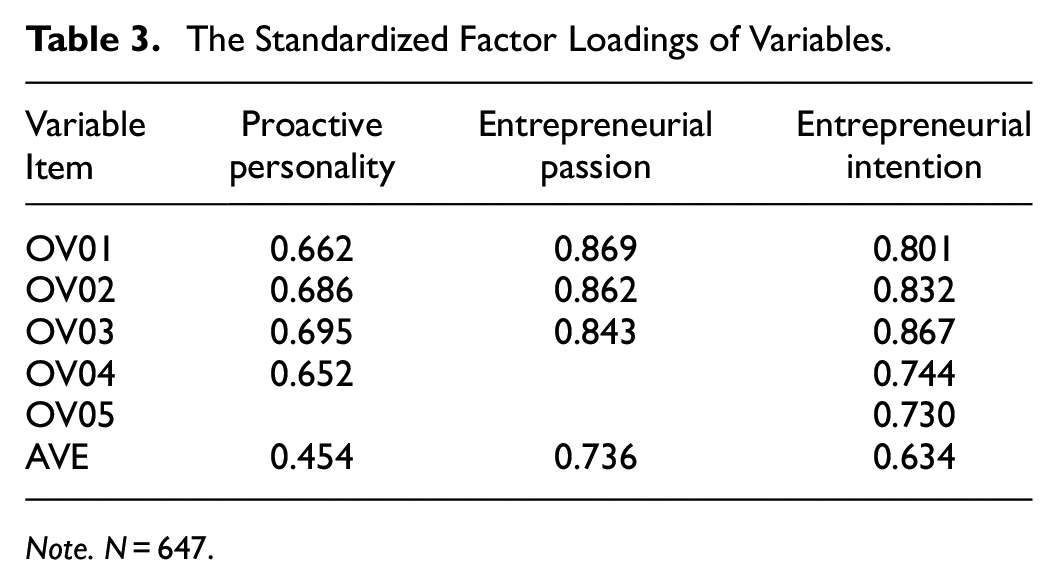
In this study, construct validity was tested using AMOS 17.0 software by performing a confirmatory factor analysis (CFA). Construct validity was determined based on discriminant and convergent validity. Based on the CFA results obtained, Table 2 shows the discriminant validity of variables. The three-factor model had significantly lower Chi-square statistics (χ2 = 125.801, dƒ = 54; p < .05) than a one-factor model with all items loaded on a single construct (χ2 = 1552.464, dƒ = 51; p < .05).This is confirmed by the fact that other indices of the three-factor model (RMSEA = 0.048; GFI = 0.968; CFI = 0.981; TLI = 0.975; IFI = 0.981) fit better than those of the one-factor model (RMSEA = 0.207; GFI = 0.645; CFI = 0.616; TLI = 0.530; IFI = 0.617). This indicated that the three variables involved in this study had good discriminant validity and did represent three different constructs. The convergent validity of each factor was tested against the standardized factor loadings. All of the standardized factor loadings were preferably between 0.5 and 0.95. As shown in Table 3, all 4 items measuring proactive personality had high standardized factor loadings to the construct. These items also had acceptable convergent validity. This implied that the items used to assess students’ proactive personality were valid. The result of CFA performed on the 4 items that measured students’ proactive personality indicated that the items had acceptable convergent validity (AVE = 0.454) The result of CFA performed on the 3 items that measured students’ entrepreneurial passion indicated that the items had acceptable convergent validity (AVE = 0.736). The result of CFA performed on the 5 items that measured students’ entrepreneurial intention indicated that the items had acceptable convergent validity (AVE = 0.634). Hence, the results indicated that each factor achieved convergent validity (standardized factor loadings > 0.5).
The Results of CFA.

Note. N = 647. χ2 = Chi-square statistic. One-factor model: Proactive Personality + Entrepreneurial Passion + Entrepreneurial Intention. Two-factor model 1: Proactive Personality + Entrepreneurial Passion; Entrepreneurial Intention. Two-factor model 2: Proactive Personality; Entrepreneurial Passion + Entrepreneurial Intention. Three-factor model: Proactive Personality; Entrepreneurial Passion; Entrepreneurial Intention
The Standardized Factor Loadings of Variables.
Note. N = 647.
The above results indicate that the core variables involved in the study have good reliability and validity.
Descriptive Statistics and Correlation Analysis
Table 4 shows the mean, standard deviation, and correlation coefficient of proactive personality, entrepreneurial self-efficacy, entrepreneurial passion, and entrepreneurial intention as well as the control variables. The data showed that there were significant correlations among the three core variables involved in the study. The main statistics in Table 2 deliver the following messages: (1) proactive personality was significantly related to entrepreneurial passion and entrepreneurial intention; (2) entrepreneurial passion was significantly related to entrepreneurial intention; (3) all the control variables (gender, age, and entrepreneurship program et al.) are significantly related to entrepreneurial intention.
Means, Standard Deviations, and Correlations Among Study Variables.

Note. N = 647. Internal reliabilities are in parentheses.
Gender is coded as male = 1, female = 0.
Area is coded as rural = 1, urban = 0.
Entrepreneurship program are coded as yes = 1, no = 0.
Parent owning a business is coded as yes = 1, no = 0.
p < .05. **p < .01.
Mediation Model Analysis
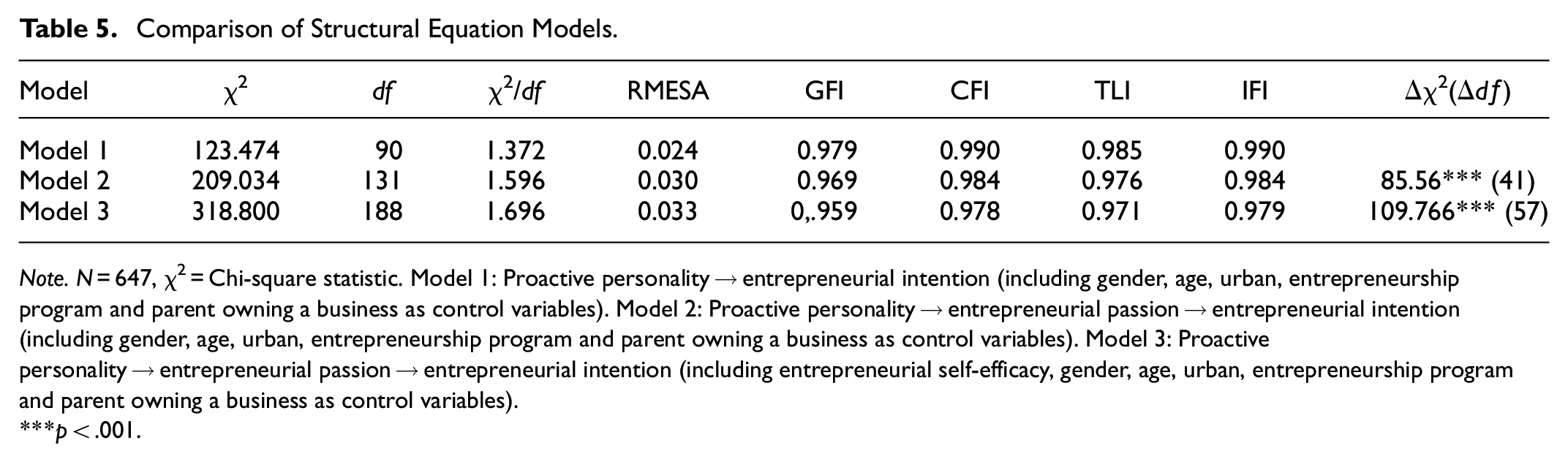
In order to verify the mediation effect model, we first compared model 1 with model 2 to select an optimal model. The comparison of the models was based on the difference in the Chi-square (Δχ2) and the difference in degrees of freedom (Δdƒ). The more parsimonious model should be adopted if the difference is insignificant. The model that is well-fitted with the data and relatively complex should be adopted if the difference is significant. Table 5 shows the results of model comparison. The difference between model 1 and model 2 was found to be significant (Δχ2 = 85.56, Δdƒ = 41, p < .001). Thus, complex model 2 was retained. In addition, combined with the relevant theory in the case of controlling entrepreneurial self-efficacy, model 3 was finally formed. The difference between model 3 and model 2 was also found to be significant (Δχ2 = 109.766, Δdƒ = 57, p < .001), and model 3 (χ2 = 318.8; dƒ = 188; GFI = 0.959; CFI = 0.978; TLI = 0.971; IFI = 0.979; RMSEA = 0.033) was better fitted with the data than model 2 (χ2 = 209.034; dƒ = 131; GFI = 0.969; CFI = 0.984; TLI = 0.976; IFI = 0.984; RMSEA = 0.030). Finally, model 3 was the best-fit model and was adopted in the current study.
Comparison of Structural Equation Models.
Note. N = 647, χ2 = Chi-square statistic. Model 1: Proactive personality → entrepreneurial intention (including gender, age, urban, entrepreneurship program and parent owning a business as control variables). Model 2: Proactive personality → entrepreneurial passion → entrepreneurial intention (including gender, age, urban, entrepreneurship program and parent owning a business as control variables). Model 3: Proactive personality → entrepreneurial passion → entrepreneurial intention (including entrepreneurial self-efficacy, gender, age, urban, entrepreneurship program and parent owning a business as control variables).
p < .001.
To test the hypotheses, we carried out a structural equation analysis of the mediation model of entrepreneurial passion in the relationship between proactive personality and entrepreneurial intention under controlled entrepreneurial self-efficacy. The structural equation modeling (SEM) analysis of the theoretical model in Figure 1 was performed using AMOS 17.0 software. Figure 2 shows the mediating effect of entrepreneurial passion on the relationship between proactive personality and entrepreneurial intention under controlled entrepreneurial self-efficacy. The SEM results showed that the model fit is acceptable (χ2 = 318.8; dƒ = 188; GFI = 0.959; CFI = 0.978; TLI = 0.971; IFI = 0.979; RMSEA = 0.033). Table 6 shows the regression weights, standard errors, and critical ratios of the direct and mediation models. Our findings showed that proactive personality exerted significant effects on entrepreneurial intention when the mediator (entrepreneurial passion) was removed (b = 0.099, p < .05). When the mediator (entrepreneurial passion) was added into the direct model, the results interestingly indicated that proactive personality had indirect effects on entrepreneurial intention although proactive personality exerted insignificant direct effects on entrepreneurial intention (b = 0.047, p > .05). Proactive personality had significant effects on entrepreneurial passion (b = 0.233, p < .001). Meanwhile, entrepreneurial passion had significant effects on entrepreneurial intention (b = 0.214, p < .001). These findings indicated that entrepreneurial passion exerted a mediating effect on the relationship between proactive personality and entrepreneurial intention under controlled entrepreneurial self-efficacy.

Estimated path coefficients of the structural equation model. The numbers represent the beta coefficients for the mediation model (Model 3). The beta coefficients for the direct model are in parentheses (N = 647).
Regression Weights, Standard Errors of Direct and Mediation Models.

Note. N = 647. Standard errors are in parentheses.
p < .05. **p < .01. ***p < .001.
Discussion and Conclusion
Discussion
The empirical evidence of this study supports the research hypothesis. The path coefficient estimated by our structural equation model confirms the positive effect of proactive personality on college students’ entrepreneurial passion and entrepreneurial intention, thus supporting hypothesis 1 and hypothesis 2. Hypothesis 3 is proved by the positive and significant coefficient between entrepreneurial passion and entrepreneurial intention (see Figure 2). A further comparison of the models with and without mediation shows that the influence of the independent variable (proactive personality) on the dependent variable (entrepreneurial intention) is partially mediated by the mediation variable (entrepreneurial passion). Therefore, hypothesis 4 is further confirmed.
In this study, we investigated the underlying mechanisms through which proactive personality motivates entrepreneurial intention. Our study yielded three major findings. First, there is a significant positive correlation between proactive personality, entrepreneurial passion and entrepreneurial intention of college students. Second, proactive personality and entrepreneurial passion have significant positive predictive effect on entrepreneurial intention of college students. Third, entrepreneurial passion partially mediates the effect of proactive personality on individual entrepreneurial intention. The findings of our research have implications for the research into and practice of entrepreneurship.
Implications for Research
First, proactive personality significantly influenced entrepreneurial intention that they want to establish business, and which backs up previous research showing a positive correlation between proactive personality and students’ intentions to become entrepreneurs (Becherer & Maurer, 1999; Kickul & Zaper, 2000; C. Li et al., 2018; Naz et al., 2020; Parker & Bindl, 2017; Prabhu et al., 2012). Accordingly, students’ willingness to start businesses can be reinforced by boosting their intense positive emotions toward the venture activities they take part in and enabling them to reduce situational pressures and influence their environment to find or create new business opportunities (Hu et al., 2018; Naz et al., 2020).
Second, the research proved the hypothesis that entrepreneurial passion has a remarkable positive influence on students’ entrepreneurial intentions (Bandura, 1997; Cardon et al., 2009; Karimi, 2020; Murnieks et al., 2012; Zhao et al., 2005). This highlights entrepreneurial passion as a strong factor helping university students surmount some obstacles in connection with new company foundation (Baum & Locke, 2004; Shane et al., 2003), and entrepreneurial passion can increase the depth of focus without any eventualities or barriers to think over in the actual entrepreneurial process (Biraglia & Kadile, 2017; De Clercq et al., 2013; Moses et al., 2016; Türk et al., 2019).
Third, through the analysis of the path structure between different constructs in the empirical study, it is found that entrepreneurial passion plays an mediation role between proactive personality and the entrepreneurial intentions. In other words, the results showed that proactive personality predicted entrepreneurial intention through entrepreneurial passion. Stroe et al. (2018) argued that entrepreneurial passion influences the decision-making logic which should lead entrepreneurs to high-risk results. The significant impact of entrepreneurial passion on entrepreneurial intention found in this study confirms the associative and complementary effect of entrepreneurial cognitive factors on entrepreneurial behavior (Bryant, 2007; Saif et al., 2020; Trevelyan, 2011; Tumasjan & Braun, 2012). Consequently, these concepts are required to mention in further research so as to better understand entrepreneurial behavior (Pihie & Bagheri, 2013). Based on the current research, they may also apply more entrepreneurial emotional factors other than cognitive factors and use the model generated in this research as a framework for the theoretical development of entrepreneurial behavior.
Implications for Practice
The findings of this research also offer some inspiration for entrepreneurship educators. Our study proves that entrepreneurial passion greatly affects entrepreneurial intention, which is the single best predictor of entrepreneurial action, this is central to explaining new business startups. We recommend that, first, in addition to adopting a proactive personality and entrepreneurial passion and promoting student entrepreneurial intention, university entrepreneurship programs and educators evaluate students’ enthusiasm for entrepreneurship, and carry out a serial of major events for students with the highest enthusiasm for entrepreneurship, as well as activities for students with low entrepreneurial self-efficacy. It is vital to make full use of entrepreneurial passion in the entrepreneurship program, curriculum and extracurricular activities because it is an antecedent that could lead students to take entrepreneurial action. As Vaizler (2011) indicated, a next generation of aspiring entrepreneur is motivated in enterprise classes, which is the main cause of the emerging entrepreneurial action. Second, since the proactive personality is the crucial antecedent of students’ entrepreneurial intention, entrepreneurship educators entrepreneurship educators require to help students optimize the conjunction of individuals’ character, background, experiences, and disposition to chase their dreams of being entrepreneurs (Arenius & Minniti, 2005; Carmen, 2016; Krueger et al., 2000; Shane et al., 2003). Third, educators also motivate pupils and help them cultivate entrepreneurial passion and then enrich engaging experience in venture activities, especially for those students who score high in proactive personality.
Based on the above, it is useful to arouse enthusiasm for enabling them to carry out an entrepreneur’s certain assignment and roles. Hence, the plenty of learning opportunities, such as role modeling, business plan designing, and entrepreneurial case analysis, are needed (Fayolle et al., 2006; Pihie & Bagheri, 2013; Wilson et al., 2007). Furthermore, entrepreneurial education should foster a challenging but supportive entrepreneurial culture for students to stimulate their entrepreneurial action rather than focusing only on entrepreneurship theories (Fuchs et al., 2008; Trevelyan, 2011).
Conclusion and Limitations
This study expounds the significant impact of proactive personality on entrepreneurial intention, and shows that entrepreneurial passion plays a mediation role between proactive trait and entrepreneurial intention. This study is particularly significant as it developed a novel approach to exploring the influencing mechanisms of entrepreneurial intention, and we found that the role of different kinds of entrepreneurial cognitive factors in playing a connection between individualities and entrepreneurial intention is worthy of being studied. Additionally, it is one of the first aim of entrepreneurship education to improve students’ interest in entrepreneurship and exercise their entrepreneurial career options. Through the study of entrepreneurship theory and practice, our research clarifies alternative ways to choose from students, enhance their interest and contribute to academic success. The results of this study offered empirical basis for association between entrepreneurial passion and proactive personality in higher educational institutes involving Chinese university students’ entrepreneurial intentions, and expand the research on entrepreneurial intention.
However, just like any other research, our research is confined to certain important underlying aspects. First of all, although extensive investigation was conducted to ensure the representativeness of the samples, such field surveys relies mostly on self-reported scales to ensure the demonstrative validity and make easier the management process of the survey, which can lead to differences in common methods, and thus the covariance between the explanatory variable and the explained variable cannot be removed. In order to lower the common method bias, simple steps were taken, instruments were elaborately chosen and feedback after the survey was provided. Second, in the present study, based on the existing literature, we attempted to control the possible alternative interpretations shown in the samples, but our results may be influenced by less detailed province-level, university-level, and major-level characteristics. Future studies should consider examining additional cognitive variables other than entrepreneurial passion that may influence university students’ entrepreneurial intention such as creativity, entrepreneurial alertness and career choice, which might yield insights into educational strategies to promote students’ entrepreneurial intention. Furthermore, longitudinal studies on entrepreneurship curricula or education on projects can be useful to prove that entrepreneurial education influences start-up psychology, which may in turn facilitate the necessary adjustments in the university entrepreneurial education framework.
Footnotes
Author Contributions
Rui HU conceived the study idea and designed the work. Rui HU and Tae-Won, KANG drafted the skeleton of the manuscript. Rui HU and Peng BIN critically reviewed the manuscript. Zuxian SHEN, Li WANG, and Shan SUN edited the data, performed the analysis and interpretation. All authors read and approved the final manuscript and participated in the critical appraisal as well as revision of the manuscript.
Availability of Data and Material
The datasets generated during and/or analyzed during the current study are available from the corresponding author on reasonable request.
Declaration of Conflicting Interests
The author(s) declared no potential conflicts of interest with respect to the research, authorship, and/or publication of this article.
Funding
The author(s) disclosed receipt of the following financial support for the research, authorship, and/or publication of this article: This research was funded by the Fundamental Research Funds for the Central Universities (2662022GGYJ005) and the National Natural Science Foundation of China (72041004).
Ethics Approval
Ethics approval for this research was not required as per institutional and national guidelines. Consent from all research participants was obtained by virtue of survey completion.
Consent to Participate
Informed consent was obtained from all individual participants included in the study.
Consent for Publication
The participants signed informed consent regarding publishing their data.
Code Availability
Not applicable.
