



Abstract
As smart city development deepens, its impact on the urban-rural income gap has become a key concern for both the government and society. This article uses panel data from Chinese prefecture-level cities between 2010 and 2022, treating the pilot smart city policy as a quasi-natural experiment, and applying a multi-period difference-in-differences (DID) method to empirically examine how smart city construction affects the urban-rural income gap. It also analyzes the role of economic agglomeration in this process. The research indicates that smart city development has significantly increased the incomes of urban and rural residents and has positively contributed to sharing development benefits between these areas. Mechanism analysis shows that economic agglomeration plays an important mediating and threshold role—smart cities indirectly influence the urban-rural income distribution by fostering economic agglomeration, with this effect showing nonlinear characteristics at different levels of agglomeration. Based on these findings, the article proposes policy recommendations aimed at optimizing economic agglomeration models and advancing urban-rural integrated development, offering theoretical insights and practical strategies for narrowing the income gap and promoting common prosperity.
Plain Language Summary
As smart cities are built, government and societal concerns about how urban and rural development can be balanced arise. To clarify the mediating and threshold effects of economic agglomeration in the development of smart cities on the income gap between urban and rural inhabitants, the difference-in-differences (DID) empirical study technique has been used. The findings of the research indicate that the construction of smart cities has a positive impact on the incomes of both urban and rural residents. However, the study also reveals that this effect is not direct for rural residents but rather occurs through an indirect pathway. This indirect effect is attributed to the mediating and threshold effects of economic agglomeration. In accordance with the findings outlined above, a series of policy recommendations have been formulated with the objective of reducing the difference in income between those living in rural and urban regions.
Introduction
Since the 1980s, China has adopted a series of policies that promote the prosperity of some people and regions first, so that the common prosperity of the whole people can be achieved and promoted. With the aim of achieving common prosperity, the government took various measures aimed at promoting the coordinated development of rural and urban regions and creating favorable conditions for the promotion of common prosperity. According to data from the National Bureau of Statistics, in the long run, the per capita income ratio between urban and rural areas in China continues to decline, thanks to the rapid growth of per capita disposable income in rural areas. This trend has also been confirmed by academic research. Y. Zhou et al. (2023) analyzed county-level panel data from 2013 to 2020 and found that policies such as targeted poverty alleviation significantly increased the income of rural residents, helping to narrow the income gap between urban and rural areas at the county level. In addition, Z. Wang et al. (2024) analyzed the spatiotemporal characteristics since the 21st century and confirmed that the income gap between urban and rural areas in China has narrowed, and urbanization is the key driving force behind this convergence. Recent years have seen the Chinese government make significant efforts to promote common prosperity and realize social justice. Nevertheless, it is an irrefutable fact that the rural inhabitants’ income is significantly lower than that of urban residents.
The concept of smart cities involves the deep integration of information and communication technology with urban systems (Vanolo, 2014; Yigitcanlar & Kamruzzaman, 2018). This integration not only optimizes the allocation of urban resources through technology to support sustainable development but also aims to establish an efficient governance framework for urban development through data-driven methods and multi-party cooperation (Haque et al., 2022; Venumuddala et al., 2024; F. Wang, 2023). The development of smart cities in China closely relates to urbanization and economic agglomeration. Economic agglomeration refers to the process and state where economic factors such as enterprises, labor, capital, and production activities gather and spread within a specific geographic area due to the interaction of increasing returns to scale, transportation costs, and externalities. Its main driving force comes from Marshall externalities like specialized labor sharing, intermediate product input sharing, cross-industry or intra-industry knowledge spillover, as well as the combined effects of natural advantages and policy guidance. Ultimately, these factors influence regional development through agglomeration economies (F. Wang et al., 2022; Hu et al., 2025; Y. Liu et al., 2024; Sun et al., 2024; D. Zhou et al., 2022). Since the reform and opening-up, China’s urbanization rate has significantly increased, with the growth and concentration of urban populations not only driving economic prosperity but also creating new challenges for urban management. To address the pressures on population, resources, and the environment, and to meet the demands of refined and intelligent urban governance, China has been exploring smart cities as an essential strategy since 2008. The initial phase of development started with IBM’s concept of “smart earth” in 2008 and ended around 2012. During this period, smart city construction was primarily driven by industry applications, emphasizing the deployment of information technologies such as wireless communication, optical fiber broadband, GIS (Geographic Information System), remote sensing, and other technologies to upgrade individual systems into informatized forms. Notably, this stage was characterized by decentralized efforts, with independent development by different departments and systems, resulting in numerous information islands. With the acceleration of the Internet of Things and mobile Internet technology applications, China’s smart city construction entered a pilot exploration phase from 2012 to 2015. This stage was initiated amidst rapid urbanization in China, with full deployment of information technologies such as RFID (radio frequency identification), 3G/4G, cloud computing, and SOA (Service-Oriented Architecture). In November 2012, the Ministry of Housing and Urban-Rural Development (MOHURD) issued the Interim Measures for managing the National Smart City pilot, marking the commencement of national-level exploration of smart cities. In January 2013, the Ministry announced the first batch of pilot cities, including 90 cities, districts, counties, and towns. Subsequently, in August 2013, an additional 103 cities were designated as the 2013 National Smart City pilot. The development of these pilot cities has accumulated valuable experience, facilitating the comprehensive growth of future smart cities. Since 2020, with the support of “new infrastructure,” China’s smart city development has taken a new direction. Currently, there is a stronger focus on integrating technology, unifying systems, fusing data, and merging scenes.
Smart city construction can improve the overall welfare of society, but there is also the worry of exacerbating the digital divide (Arion et al., 2024; Han et al., 2024). In 2013, this initiative gained further attention with the release of China’s first list of national smart cities, announced by the Ministry of Housing and Urban-Rural Development (MOHURD), marking the official initiation of this new urban development paradigm. Building smart cities primarily encompasses the integration of highly intelligent modules, including smart livelihood, smart healthcare, and smart finance. Under the concept of new infrastructure, China is building a new model of smart city that is ecological, digital, and intelligent, based on 5G information technology and driven by innovative activities. Smart cities have produced positive effects in economic development, enterprise production and operation, and environmental protection. On the one hand, smart cities rely on information technology to create various kinds of intelligent platforms in the cities through technological innovation to increase urban operations’ efficiency and realize high-speed economic development. On the other hand, smart cities are likely to widen the gap between technologically advanced urban centers and relatively underdeveloped rural regions.
Views on how the development of smart cities relates to the disparity in wealth between urban and rural areas are divided. One view is that smart city construction will exacerbate income disparity between urban and rural areas (Di Virgilio & Serrati, 2022; Smith et al., 2023) and that smart city construction will build advanced information infrastructure, such as high-speed Internet and Internet of Things devices. Differences in investment and capacities in infrastructure construction between the countryside and the city may result in urban residents having a greater resource advantage, while rural residents are unable to enjoy the convenience of smart cities due to insufficient infrastructure, and the digital access and application divides negatively affect rural residents. Therefore, the innovation capacities of smart cities have been improved by leaps and bounds, but the innovation capacities of rural areas are insufficient, which causes the income gap between urban and rural areas to increase. (Caragliu & Del Bo, 2022). An alternative perspective is that the development of smart cities might help to reduce the disparity in income between urban and rural areas. Through the digital economy, digital financial inclusion, and urbanization, smart city construction can help optimize resource allocation, cut the price of financial services, enhance education and healthcare resources, and improve infrastructure, thus easing the urban-rural gap (Gong & Shan, 2023; Liang et al., 2019). It is evident that extant research has overlooked the moderating influence of external factors on the repercussions of smart city construction on the urban-rural income gap. The process of new city construction is often accompanied by the phenomenon of economic agglomeration, which is not only reflected in the concentration of population and industry but also involves the agglomeration of resources, factors, and infrastructure. What role does economic agglomeration play in smart city construction, affecting urban and rural incomes? The response to this inquiry will facilitate a more profound exploration of the cooperative growth of smart cities and rural areas in theory and will also allow for the investigation of the internal relationship and associated mechanisms between the two. Furthermore, it will enhance the efficacy of policies related to building smart cities in practical application, which is very important for harmonizing the development of rural and urban regions in China.
This study has the following marginal contributions: firstly, to deepen existing research. At present, there are inconsistent views on the connection between smart city construction and urban-rural income. This article attempts to reconcile these conflicting views and interpret the effect of smart city development on urban-rural income from the perspective of economic agglomeration. In different economic agglomeration situations, the effect of smart city development on the income of urban and rural regions will vary, which can explain the inconsistency of previous research perspectives. This article can contribute to enriching existing literature. Secondly, the paper puts the construction of smart cities, economic agglomeration, and income disparity within the same analytical framework, revealing the threshold effect of economic agglomeration in smart city construction, deepening the understanding of economic agglomeration and smart city construction, and offering a fresh theoretical viewpoint on the disparity in urban-rural growth. Thirdly, a smart city construction strategy based on economic agglomeration has been proposed, providing specific policy recommendations for policymakers, which help to more effectively promote coordinated urban-rural development.
The following are the paper’s sections: The development of hypotheses and a review of the literature come in the second section; the research methodology, data sources, and pertinent variables are described in the third; the empirical findings are presented in the fourth; the discussion follows in the fifth; and the conclusion and policy implications follow in the sixth.
Literature Review and Hypothesis Development
Smart City and Urban-Rural Income
The construction of smart cities enhances the overall well-being of society (S. Zhou & Ren, 2025; Arion et al., 2024; Han et al., 2024; Lian et al., 2025; F. Wang, 2023). First, the main direction of smart city construction lies in infrastructure, such as transportation, communication, etc., and the improvement of these infrastructures helps to improve the attractiveness and competitiveness of the cities, thus attracting more investment and talents, generating the phenomenon of innovation factor agglomeration (Li et al., 2024; Bonomi Barufi & Kourtit, 2015), and creating more jobs (Kummitha & Crutzen, 2017; J. Wang & Deng, 2022; J. Wang & Zhao, 2025). Secondly, the optimization of resource allocation has a positive effect (Y. Chen et al., 2024; Cui & Cao, 2024; Jiang & Xing, 2024). Smart city construction through information technologies can achieve the optimal distribution of resources and reduce waste, thus helping to improve the overall economic efficiency of the cities (Cui & Cao, 2024; Jiang & Xing, 2024). Third, the innovation-driven effect (Dameri & Ricciardi, 2015; Shin et al., 2021; J. Wang & Deng, 2022). Smart city infrastructure increases innovation efficiency and lowers innovation costs for businesses and the government. Artificial intelligence, cloud computing, big data analytics, and the Internet of Things (IoT) are just a few of the technologies that smart cities include. As a result of these technologies’ integration and use, new goods, services, and business models are constantly emerging (Ji et al., 2024; Li et al., 2024; Y. Qi et al., 2024). The first beneficiaries of the positive impact of smart cities will be the city’s inhabitants, with income growth through productivity gains and the rational allocation of productive resources.
The promotion mechanism of smart city construction for urban residents’ income is direct and diverse. First, its core lies in large-scale investment in advanced infrastructure, such as the Internet of Things, 5G network, and intelligent transportation system, which directly creates many high-tech jobs and raises the demand in the labor market (H. Chen et al., 2024; Li et al., 2024). Thanks to their geographical proximity and human capital advantages, urban residents can more easily access these emerging employment opportunities, increasing their wages. Second, smart cities boost innovation and entrepreneurship by optimizing resource allocation (Jiang & Xing, 2024; J. Wang & Zhao, 2025). Ji et al. (2024) noted that the integrated use of artificial intelligence, cloud computing, and big data has significantly lowered the costs and barriers for innovation among businesses and individuals, leading to new business models and service formats. This innovative effect is mainly felt in urban areas where industries and knowledge are concentrated, making urban residents the primary beneficiaries, as they can increase their income by engaging in high-value economic activities (Li et al., 2024). Based on this, this paper proposes the following hypotheses.
Smart city construction breaks through the traditional agricultural production mode of “relying on the weather” and the transaction dilemma of “small farmers connecting to the big market” by infiltrating digital technology into the whole chain of agricultural production, circulation, and sales, significantly improving agricultural production efficiency and added value of agricultural products, and then improving the operating income of rural residents (H. Chen et al., 2024; J. Wang & Zhao, 2025). The theoretical logic of this process is consistent with the research of Kummitha and Crutzen (2017), which points out that the technology spillover effect of smart cities can be extended to the field of agriculture, and through the application of digital technology, agricultural production, and market demand can be accurately matched, so as to improve farmers’ income. Smart city development increases the sources of wage and transfer income for rural residents by removing technological and institutional barriers to urban-rural factor flow, and enhances rural residents’ development potential through equal access to public services, laying the groundwork for sustained income growth. This approach aligns with the research logic of J. Wang and Zhao (2025) emphasized that the main goal of smart city construction is not only to boost urban efficiency but also to achieve coordinated urban and rural development through factor diffusion and service expansion, thereby raising rural incomes.
Smart Cities and Economic Agglomeration
As the core concept of spatial economics and regional economics, economic agglomeration can be traced back to the “industrial zone” theory proposed by Alfred Marshall, which emphasizes that specialization, labor pool sharing, and knowledge spillover are the three core driving forces for the formation of agglomeration. With the theoretical evolution, scholars have deepened and expanded the connotation of economic agglomeration from different dimensions. Henderson (2000) pointed out in “How Urban Concentration Affects Economic Growth” that the essence of economic agglomeration is the concentration process of production factors (labor, capital, technology) and economic activities in a specific geographical space. This concentration is not only reflected in the enterprise agglomeration at the industrial level, but also reflected in the population agglomeration and resource allocation optimization at the regional level. Its core function is to promote the improvement of regional economic efficiency by reducing transaction costs, improving scale effects, and promoting technological innovation.
Smart city construction has significantly lowered the spatial costs of economic activities by developing an efficient infrastructure network and an environment for information flow, thus creating a foundation for agglomeration. Y. Liu et al. (2024) emphasize in their research that the clustering of economic activities is closely tied to improvements in “transportation infrastructure,” because it boosts the efficiency of urban operations. The smart city further deepens and broadens this logic: more importantly, it encourages the “centripetal force” of agglomeration by stimulating innovation and enhancing the business environment. On one hand, the smart city platform integrates key technologies like big data and artificial intelligence, providing powerful innovation tools and rich application scenarios for businesses and research institutions, effectively promoting technological innovation and knowledge spillover (Ji et al., 2024). As Y. Liu et al. (2024) note, the level of “technological innovation” is a crucial factor for promoting economic growth, and innovation activities tend to display strong spatial clustering characteristics, often occurring in regions with active information exchange and high knowledge density. The innovation ecosystem fostered by smart cities functions like a magnetic field, attracting high-tech companies, R&D centers, and top talent to form innovative industrial clusters. On the other hand, smart cities have significantly improved government efficiency and transparency through the implementation of e-government, open data platforms, and digital public services. Barba-Sánchez et al. (2019) conducted an empirical study based in Spain that shows that these smart city measures effectively create entrepreneurial opportunities and optimize the business environment by simplifying administrative processes, reducing the threshold of information access, and operating costs. The improvement of the business environment has reduced the institutional transaction costs of enterprises, thus enhancing the attractiveness of the city, attracting more investment, new enterprises, and talents, and further consolidating and strengthening the economic agglomeration.
Economic Agglomeration and Urban-Rural Income Gap
As a fundamental concept in spatial economics and regional development research, economic agglomeration has long been regarded as a key mechanism for promoting economic growth and regional coordinated development. With China’s urbanization accelerating and the persistent urban-rural dual structure, the influence of economic agglomeration on the income gap between urban and rural residents has increasingly become a focus for academics and policymakers. Existing studies show that economic agglomeration significantly impacts income distribution through competitive effects. On one hand, research supporting economic agglomeration and its role in narrowing the urban-rural income gap highlights that it attracts substantial rural surplus labor into non-agricultural work via the “labor pool” effect (F. Qi et al., 2024), especially in labor-intensive industries like wholesale and retail, accommodation, and catering, which are effective at absorbing low-skilled workers and directly raise rural residents’ wages (Zhao et al., 2021). Simultaneously, economic agglomeration alleviates resource mismatch through “factor flow effect” and “competition effect,” facilitating the optimal distribution of capital, labor, and technology between urban and rural areas. Digital-era distribution industry agglomeration further enhances resource allocation efficiency and breaks down barriers to factor flow between urban and rural regions via smart logistics, e-commerce platforms, and other means (C. Chen et al., 2023). Additionally, technology spillovers and innovation diffusion driven by agglomeration help improve production efficiency and income levels in rural areas. S. Liu et al. (2021) noted that logistics industry agglomeration promotes the spread of advanced technology and management practices to rural areas by sharing infrastructure and reducing transaction costs. From a spatial perspective, economic agglomeration not only influences regional income distribution but also exerts a significant spatial spillover effect. F. Qi et al. (2024), using a dynamic spatial Dobbin model, found that distribution industry agglomeration negatively impacts the urban-rural income gap in neighboring areas, highlighting the positive regional synergy of the agglomeration economy. Together, these mechanisms support the convergence effect of economic agglomeration on narrowing the urban-rural income gap.
On the other hand, the opposition argues that economic agglomeration can worsen the urban-rural income gap. According to the theory of new economic geography, economic agglomeration might form a “center edge” structure, which promotes further concentration of resources in urban centers and results in rural marginalization (Henderson, 2003). This polarization effect can intensify the imbalance in urban and rural development (X. Wang et al., 2022). Additionally, technological progress associated with economic agglomeration tends to be skill-biased, favoring high-skilled workers; however, rural labor tends to have lower skills, making it harder for them to benefit from technology spillovers and potentially leading to income stagnation due to structural unemployment (C. Chen et al., 2023). Furthermore, China’s long-standing urban-biased policies, including the household registration system, land system, and financial distribution system, amplify inequality during the agglomeration process (S. Wang et al., 2019). Even in the eastern region, where economic development is high, if institutional arrangements do not address urban-rural equity, economic agglomeration might still increase the income gap. These complex mechanisms together form the theoretical foundation suggesting that economic agglomeration could widen the income disparity between urban and rural areas.
The scale effect and congestion effect of economic agglomeration can make smart city construction have different effects on the income disparity between urban and rural regions (Zhang et al., 2023). It employs sophisticated information technologies to enhance urban management and foster economic growth. The effect of building smart cities on reducing differences in income between urban and rural areas is multifaceted. Building smart cities often involves technical innovation and industrial advancement, which draws more investment and businesses, hence generating new job prospects. Since economic agglomeration is often accompanied by the concentration of resources (e.g., capital, technology, and talent) in urban areas, enterprises and individuals in urban regions are thus able to access more investments and opportunities, while rural areas may not be able to match the pace of development and income levels of cities due to a lack of resources. This phenomenon of resource concentration leads to the fact that the main investments and projects for smart city construction are more inclined to urban areas, which in turn makes urban residents receive higher incomes, while the incomes of rural residents grow slowly, exacerbating the wealth inequality between rural and urban areas; on the other hand, when the economy is concentrated to a certain degree, congestion effects manifest in metropolitan areas, resulting in issues such as traffic congestion, environmental degradation, and increased living expenses. These congestion effects will have a negative impact on smart cities. Congestion and high costs in urban areas can prompt some industries to move to rural areas where costs are lower. This industrial gradient transfer may provide job chances in rural regions, stimulate local economic growth, and elevate the income levels of rural inhabitants. As congestion in urban areas increases further, the cost of living for residents rises, including the cost of housing, transportation, food, and public services. This can lead some urban residents to consider relocating to rural areas where the cost of living is lower, in search of a reduced cost of living and a greater quality of life. This reverse flow of people serves to ease the issue of urban overpopulation, and at the same time, stimulates the economic growth of rural regions so that the income disparity between rural and urban regions is no longer exacerbated or even lowered. Therefore, based on the foregoing study,
Based on the past literature, we construct a research framework that integrates economic agglomeration, smart cities, and urban-rural income relationships, as shown in Figure 1.

Theoretical hypothesis diagram.
The development of economic agglomeration has both positive effects, such as the scale effect, and negative effects, like congestion. Therefore, in studying the connection between smart city development and income disparity, it is essential to analyze the role that economic agglomeration plays.
Methodology, Data, and Variable Definition
Methodology
This paper employs the difference-in-differences method as the primary causal identification strategy, mainly because it carefully addresses endogenous issues in smart city policy evaluation. The selection of a smart city pilot is not random; rather, it is often closely related to the regional characteristics, such as economic development level, infrastructure, and administrative resources. These factors themselves may systematically influence the evolution of the urban-rural income gap. Because this policy distribution mechanism depends on the initial characteristics of each city, traditional regression methods struggle to effectively distinguish between the actual policy effect and the pre-existing conditions. The advantage of the difference-in-differences approach is that it can effectively isolate the net impact of the policy by constructing a “quasi-natural experiment” framework—considering the policy implementation as an exogenous influence—and comparing the trends in the urban-rural income gap between pilot and non-pilot cities before and after policy implementation. This approach not only controls for inherent, time-invariant differences between groups but also removes common trend effects that impact all regions over time. Consequently, it provides a reliable way to identify causal relationships between smart city development and the urban-rural income gap. Notably, the phased, multi-point promotion mode used in China’s smart city pilots aligns well with the conditions for applying a multi-stage difference-in-differences method. This gradual rollout not only improves the recognition of policy effects but also creates a solid methodological basis for subsequent robustness checks, such as parallel trend tests and placebo tests, ensuring that the research findings are academically sound. The DID methodology is suitable for the assessment of policy effects, and some studies have previously used the DID methodology to conduct related research (Li et al., 2024; A. Zhang et al., 2022; Chen et al., 2022; Peng et al., 2022; Qin & Cao, 2022). The specific approach of this article is as follows: first, collect relevant data from 295 prefecture-level cities across the country from the China Urban Statistical Yearbook from 2010 to 2022. Next, determine the sample cities for the treatment group based on the list of national smart city pilot cities. This step mainly relies on the three batches of smart city pilot lists published by the MOHURD of China from 2013 to 2015. Cities designated as national smart city pilot cities in those years are selected as the treatment group samples, while the other data serve as the control group samples. Due to data missing issues in some city samples from 2010 to 2022, the final dataset is a 13-year unbalanced panel with an average of 185 observations per year, totaling 2,400 observations. The models created in this article are displayed below. Models 1–3 test the mediating effect of economic agglomeration. Model 4 is a threshold model used to examine the economic agglomeration threshold effect. Treatpostit is the core explanatory variable in Models 1–4, and Treatpostit takes the value of 1 when city i, at moment t, is a national smart city pilot; otherwise, it is 0. All econometric models and empirical tests in this study were conducted using Stata software.




Where
Variable Names and Definitions.

Variable Definition
The primary dependent variables of this research are the per capita income of urban inhabitants, the per capita income of rural people, and the urban-rural income disparity (Thiel Index), respectively. The core independent variable is the smart cities pilot. In the empirical model of this paper, to accurately identify the net effect of smart city initiatives on urban-rural income inequality, we systematically controlled for a series of city-level characteristic variables: using the logarithm of per capita GDP to represent the level of urban economic development, thus reflecting the fundamental impact of regional overall economic strength on income distribution; using the proportion of added value in the tertiary industry to measure urban industrial structure and capture employment and income effects related to advanced economic structures; measuring the level of urbanization through the proportion of urban population to characterize the direct impact of population spatial agglomeration on resource allocation; employing the ratio of actual utilization of foreign capital to gross domestic product to indicate the degree of urban openness, and examining how urban openness impacts income patterns; using the loan-to-deposit ratio of financial institutions to evaluate the level of financial development and reveal the income effects of credit resource allocation during financial deepening; and finally, the number of broadband users reflects the level of urban informatization and controls for the potential impact of digital infrastructure dissemination on income opportunities. Additionally, we included several other important control variables: the education level measured by the number of college teachers per capita, consumption level measured by per capita consumption expenditure, science and technology investment measured by the ratio of R&D expenditure to total government expenditure, the unemployment rate measured as the ratio of unemployed population to total urban population, government expenditure measured as the ratio of government spending to GDP, fiscal revenue measured by per capita fiscal revenue, and medical resources measured by the number of doctors per capita. This multidimensional control variable system covers development stages, economic structure, factor flows, and infrastructure, collectively forming a benchmark framework for identifying the causal effects of smart city policies.
In this study, the variables are defined as follows: Income1 represents the per capita disposable income of urban residents, while Income2 indicates the per capita disposable income of rural residents. The dependent variable Incomegap measures the income gap between urban and rural areas. The key independent variable, Treatpost, is a dummy variable for the smart city policy, showing whether and when a city adopted the smart city initiative. The mediating variable Agg reflects the level of economic agglomeration. Control variables include: Lnpgdp (log of per capita GDP) representing regional economic development; Third (ratio of tertiary industry value-added to GDP) indicating industrial structure progress; Urb (urban population ratio) measuring urbanization; Open (ratio of actual utilized foreign direct investment to GDP) indicating economic openness; Fdel (financial institutions’ deposit-loan balance to GDP) representing financial development; Lnfl (log of broadband user households) capturing digital infrastructure penetration; Puniversityp (education level) measured by the number of college teachers per capita; Pconsumption (consumption level), measured by natural logarithm of the amount of per capita consumption expenditure plus one; Sciencerate (science and technology investment), measured by the ratio of R&D expenditure to total government expenditure; Unemployeerate (the unemployment rate), measured as the ratio of the unemployed population to the total urban population; Govsprate (government expenditure), measured as the ratio of government spending to GDP; Prevenue (fiscal revenue), measured by natural logarithm of the amount of per capita fiscal revenue plus one; and Pdoctor (the level of medical resources), measured by the number of doctors per capita. The specific variable names and definitions are listed in Table 1.
In the empirical model hereafter, we concentrate on the regression coefficients of Treatpost and Agg to test the effect of the smart city.
Data
As study samples, we chose Chinese cities at the prefecture level between 2010 and 2022, and we processed them using the following techniques: ① Excluding cities with missing annual data in the sample cities. ② Exclude cities with incomplete data on key variables. Obtain 2,400 cities’ yearly data through the above steps. A 1% standard was used to winsorize continuous variables in order to take into consideration the impact of extreme values on regression results. This paper’s primary data sources are the China Statistical Yearbook and the China Urban Statistical Yearbook.
Empirical Results
Descriptive Statistics
Table 2 displays the descriptive statistics of the important variables in this work. According to descriptive statistical results, the unbalanced panel dataset used in this study contains 2,400 observations, and the core variables display the following characteristics: the logarithmic mean incomes of urban and rural residents are 10.280 and 9.445, respectively, indicating an income gap between urban and rural areas (mean 0.080). The virtual variable for smart city policy shows that 32.3% of the sample has received policy intervention. The economic agglomeration index reveals uneven development among regions, with a standard deviation of 0.982. Notably, among the controlled variables, the level of financial development fluctuates the most, with a standard deviation of 5.026, while the overall level of openness to the outside world remains relatively low, with a mean of 0.009. These data characteristics provide a solid basis for subsequent empirical analysis.
Descriptive Statistics.

Figures 2 and 3 illustrate a consistent rise in the per capita income of urban and rural populations from 2010 to 2022; however, the correlation between this income growth and the development of smart cities requires additional investigation.

Per capita disposable income of urban residents.

Per capita disposable income of rural residents.
Main Results
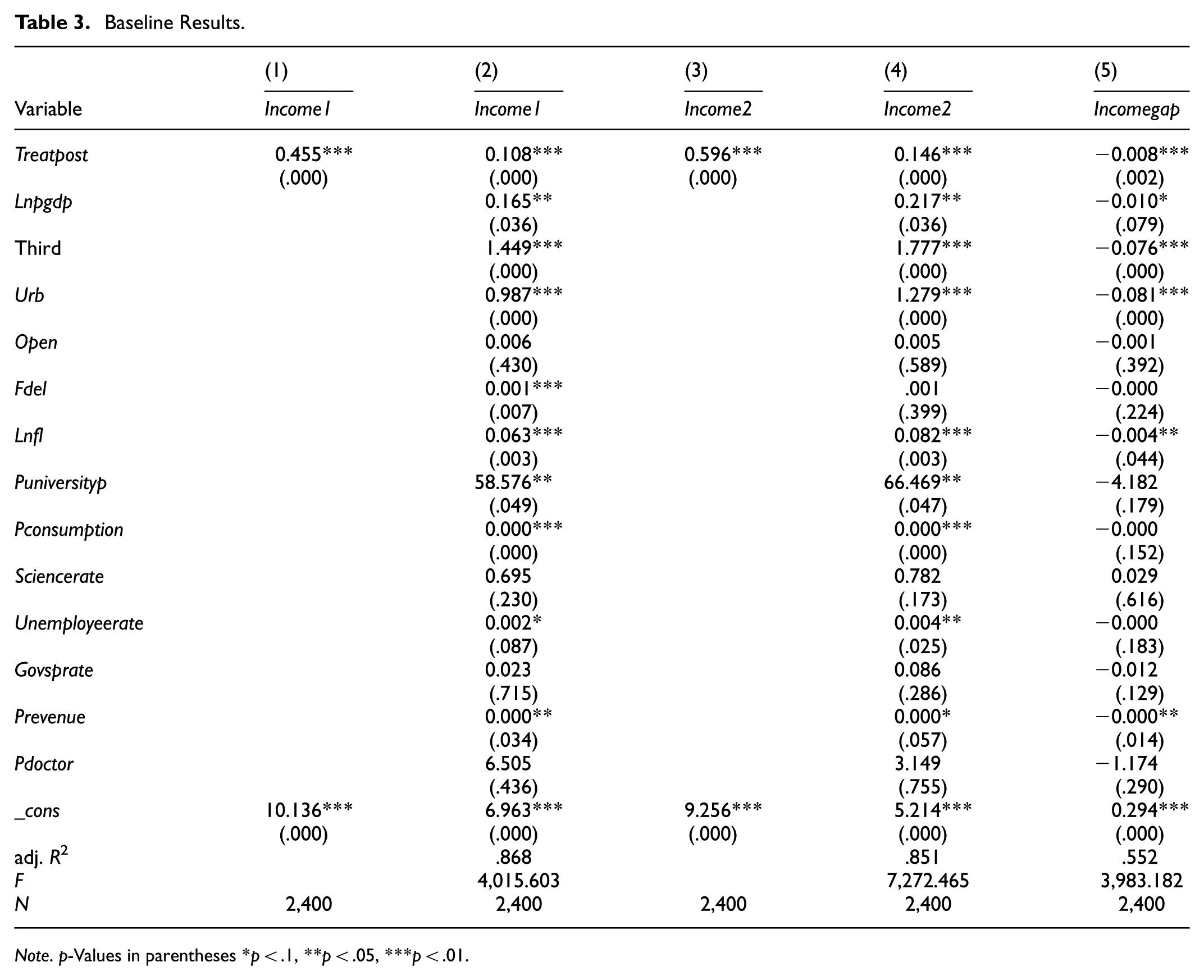
Table 3 presents the baseline regression outcomes. Based on the baseline regression results, the development of smart cities (Treatpost) has significantly affected the income and income disparity between urban and rural residents. After accounting for various urban characteristic variables, the smart city policy markedly increased urban residents’ income (Income1) by about 10.8% (coefficient 0.108 in the second column) and rural residents’ income (Income2) by approximately 14.6% (coefficient 0.146 in the fourth column). Notably, although both urban and rural incomes have improved, the construction of smart cities has had a significant negative impact on the income gap between urban and rural areas (measured by the Theil index), with a coefficient of −.008, significant at the 5% level. This indicates that smart city development has reduced the urban-rural income gap as measured by the Theil index by about 0.8%, suggesting that this policy not only fosters overall growth in urban and rural incomes but also helps to reduce income inequality between these areas, demonstrating its positive role in inclusive development. Meanwhile, it is assumed that
Baseline Results.
Note. p-Values in parentheses *p < .1, **p < .05, ***p < .01.
Mediation Effect
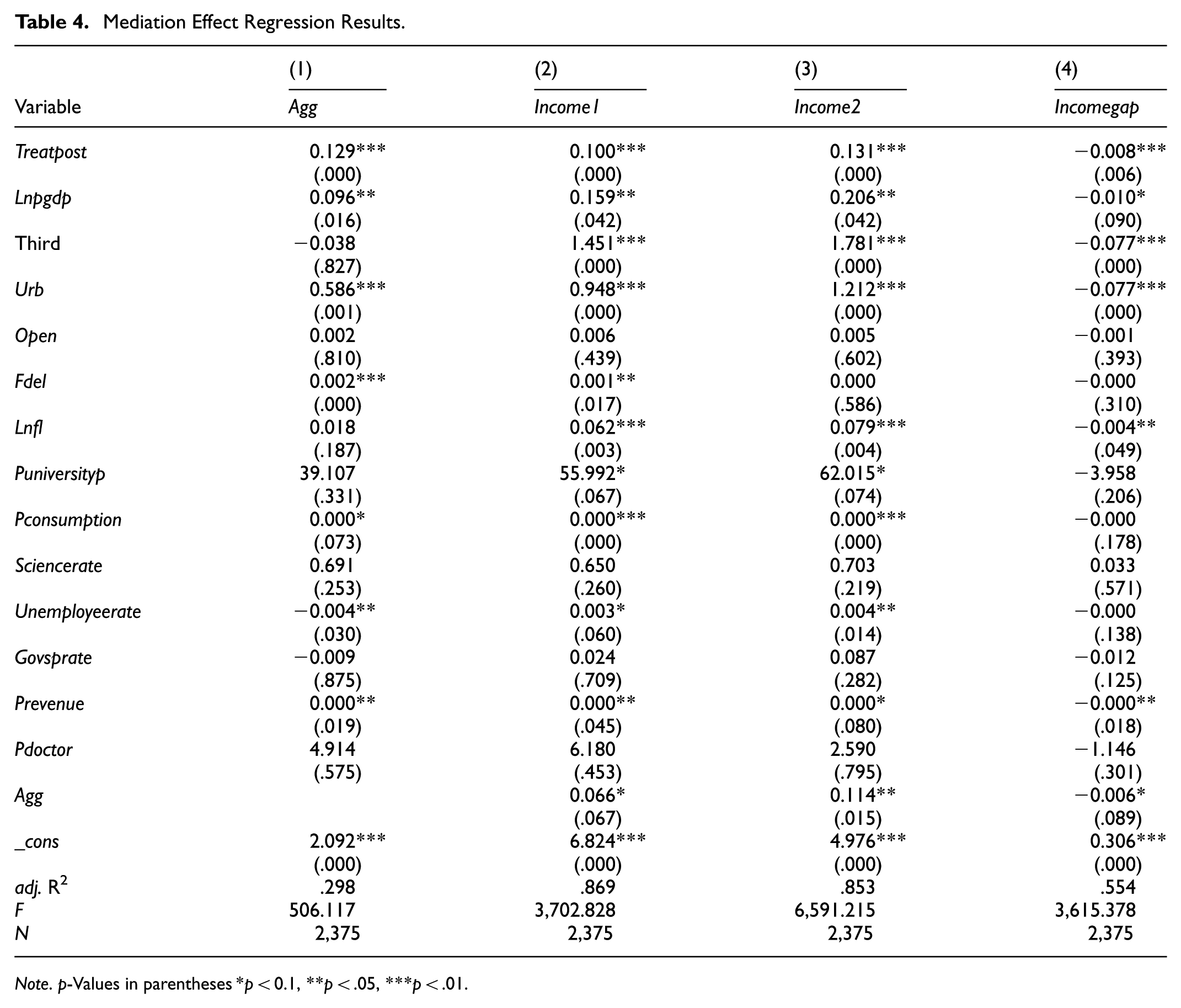
Based on the mediation model regression results, as shown in Table 4, the regression findings indicate that the construction of smart cities (Treatpost) not only directly promotes urban-rural income growth and narrows the income gap but also has indirect effects through the significant channel of promoting economic agglomeration (Agg). Specifically, the construction of smart cities has notably increased the level of economic agglomeration by approximately 12.9%, and the growth of economic agglomeration has a differentiated impact on urban-rural income distribution: on one hand, the effect of economic agglomeration on rural residents’ income (11.4%) is significantly higher than that on urban residents’ income (6.6%); on the other hand, economic agglomeration itself has a notable negative effect on the urban-rural income gap (measured by the Theil index), reducing it by about 0.6%. After accounting for this intermediary pathway, the construction of smart cities still directly increases urban residents’ income by 10.0%, enhances rural residents’ income by 13.1%, and reduces the urban-rural income gap by 0.8%. These results confirm that economic agglomeration plays a vital mediating role in how smart city construction impacts urban-rural income distribution, elucidating the mechanism by which this policy encourages spatial factor agglomeration, fosters income growth in both urban and rural areas, and effectively alleviates the urban-rural income gap. Moreover, the earlier proposed hypothesis
Mediation Effect Regression Results.
Note. p-Values in parentheses *p < 0.1, **p < .05, ***p < .01.
Threshold Effects of Economic Agglomeration
This study utilizes the Hansen panel threshold model (Hansen, 1999) to determine that the threshold value for economic agglomeration (Agg) is 1.355 through an analytical search. This value is derived by treating each economic agglomeration observation as a potential threshold candidate within a grid search, selecting the optimum segmentation point that minimizes the sum of squared residuals, and testing its statistical significance via Bootstrap simulation. Table 5 presents the empirical results, which demonstrate that the effect of smart city construction (Treatpost) on the urban-rural income gap (Theil index) undergoes a significant structural shift, with an economic agglomeration threshold of 1.355 acting as the boundary. When the level of economic agglomeration remains below or equal to this threshold (Agg ≤ 1.355), smart city construction significantly raises the Theil index by 2.1%, thereby widening the urban-rural income gap; however, once the economic agglomeration surpasses this threshold (Agg > 1.355), smart city initiatives lead to a notable 0.9% reduction in the Theil index, effectively narrowing the income disparity between urban and rural areas. This finding highlights the crucial regulatory role of economic agglomeration in moderating the impact of smart city policies on urban-rural income distribution and indicates that the inclusive benefits of smart city development can only be fully realized when regional development attains the necessary agglomeration scale. It provides compelling empirical evidence for understanding the heterogeneity in policy effects.
Threshold Effect Regression Results.

Note. p-Values in parentheses *p < .1, **p < .05, ***p < .01.
The empirical results suggest that China’s current level of economic agglomeration has two major effects: when the agglomeration level is low, the impact of smart city development on urban areas is significantly higher than on rural regions, thereby increasing the income disparity between them; once the threshold is surpassed, the influence of smart city development on rural residents’ income becomes greater than that on cities, reducing the gap. The
Parallel Trend Test
Figure 4 displays a parallel trend test chart. Based on the results of the parallel trend test, there is no systematic difference in the trend of the urban-rural income gap between the treatment and control groups in each period before the smart city policy was implemented. The estimated coefficients fluctuate around zero and do not pass the significance test, confirming the parallel trend hypothesis; starting from the first phase after policy implementation, the estimated coefficient is significantly negative and continues to grow, indicating that the construction of smart cities has indeed had a lasting causal effect on reducing the urban-rural income gap, and the policy’s impact remains dynamically sustainable.

Parallel trend test.
Heterogeneity Analysis
Table 6 presents the heterogeneity test results grouped by urban geographic regions. (1) (2), (3), (4), and (5) correspond to the regression results for cities in North China, Southeast Coast, Central China, Southwest China, and Northwest China, respectively. The dependent variable is the urban-rural income gap, with the main explanatory variable being the construction of smart cities. The results reveal significant regional heterogeneity in the impact of smart city construction on the urban-rural income gap (Theil index). From a policy effectiveness perspective, in the southeastern coastal region, the construction of smart cities has significantly reduced the Theil index of the urban-rural income gap by one percentage point, indicating that the policy has effectively promoted urban-rural income balance in the region. Conversely, in the northwest region, smart city construction has led to a 2.1 percentage point increase in the Theil index, suggesting this policy may temporarily widen local urban-rural income inequality. In contrast, the policy effects in North China, Central China, and Southwest China did not reach statistical significance. These findings underscore that policy effectiveness depends on regional development foundations—in the southeast coastal regions with a developed market economy and comprehensive infrastructure, smart city development can effectively support income balance. In the relatively underdeveloped northwest area, factors such as the digital divide and out-migration may actually heighten the urban-rural development gap in the short term. These insights provide valuable empirical evidence for designing regionally tailored smart city development policies.
Heterogeneity Regression Results: Urban Geographic Regions.

Note. p-Values in parentheses *p < .1, **p < .05, ***p < .01.
Table 7 presents the heterogeneity test results based on whether the cities are provincial capitals. (1) (2) Regression results for provincial capital cities and ordinary prefecture-level cities, respectively. The dependent variable is the urban-rural income gap, while the main explanatory variable is the construction of smart cities. The results show that smart city development has a significant negative effect on the income gap between urban and rural residents (measured by the Taier index) in both groups. Specifically, controlling for other variables, implementing smart city policies in provincial capital cities leads to an average reduction of 0.8% (coefficient −.008) in the Theil index, whereas in ordinary prefecture-level cities, it leads to an average reduction of 0.7% (coefficient −.007). This suggests that constructing smart cities can help narrow the income gap between urban and rural areas, with a slightly greater effect in provincial capital cities than in ordinary prefecture-level cities. The overall model fits well, indicating that city type influences how smart city policies affect income distribution.
Heterogeneity Regression Results: Provincial Capital Cities and Ordinary Prefecture-Level Cities.

Note. p-Values in parentheses *p < .1, **p < .05, ***p < .01.
Robustness Test
Cities are chosen at random to serve as the treatment group for the placebo test in order to guarantee the reliability of the regression findings. Figures 5 and 6 show the t-values of the policy impacts that were obtained after a 1,000-cycle repetition of model (1). Figures 5 and 6 show that the t-values are clustered around 0, whereas the t-values of the policy effect of the pilot cities in the real situation are 5.03 and 1.95, respectively. This indicates that there is no policy effect when the pilot cities are randomly assigned, and that the policy effect only occurs in the real situation when the corresponding cities have built smart cities.

Placebo test 1.

Placebo test 2.
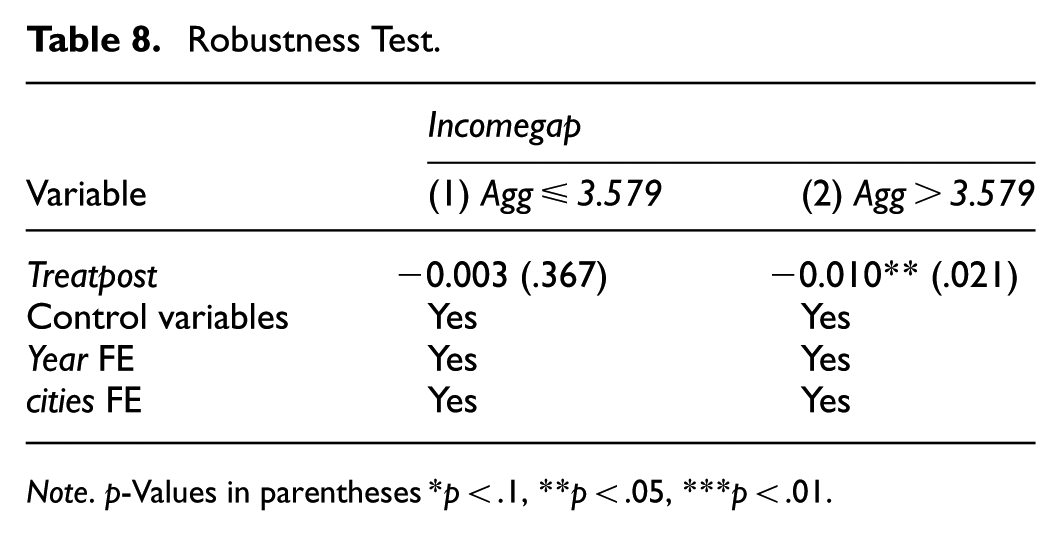
To further improve the robustness, the sample is divided into two groups, high and low, according to the economic agglomeration mean, and the model (2) is re-estimated. Table 8 reports the results of the split-sample regression, and the regression results indicate that the conclusions remain unchanged.
Robustness Test.
Note. p-Values in parentheses *p < .1, **p < .05, ***p < .01.
Discussion
This study uses panel data from Chinese prefecture-level cities between 2010 and 2022 and employs the DID method to empirically analyze how smart city development impacts the urban-rural income gap. It finds that economic agglomeration both exhibits a threshold effect and acts as a mediating factor. This finding uncovers the mechanism through which smart city policies influence urban-rural income distribution, reflecting the deep-rooted characteristics of structural transformation in China’s urbanization process.
Firstly, the different impact of smart city construction on urban-rural income mainly stems from institutional barriers within China’s urban-rural dual structure. On one side, digital infrastructure development and the promotion of intelligent services tend to prioritize cities, leading to relatively low coverage of new infrastructure like 5G base stations and IoT facilities in rural areas, creating a “digital divide of access.” On the other side, rural residents often have fewer digital skills and limited access to information due to lower educational levels and fewer vocational training opportunities. This makes it hard for them to fully benefit from the digital gains of smart cities, resulting in a “capability-based digital divide.” During the early stages of smart city development, this dual digital divide usually favors urban residents first, which could worsen the income gap between urban and rural areas. The gap in digital access and capabilities between these areas is a key reason for this difference (Di Virgilio & Serrati, 2022; Shin et al., 2021). Specifically, the limited coverage of digital infrastructure in rural areas restricts the expansion of intelligent services; at the same time, the overall digital literacy of rural residents is relatively low, making it hard for them to fully participate in new business models and remote job opportunities created by the smart economy. This diminishes their ability to benefit from the development of smart cities.
Secondly, the threshold effect of economic agglomeration shows the phased changes in factor allocation efficiency. At lower levels of agglomeration, high-end factors like capital, talent, and technology tend to circulate within the city, creating a “siphon effect.” At this stage, building smart cities mainly increases the demand for high-skilled labor through industrial upgrading and technological progress, while rural workers struggle to find matching employment due to skill mismatches. When economic agglomeration surpasses the threshold, noticeable “spillover effects” begin to appear: extending industrial chains to rural areas has led to new employment opportunities, such as rural e-commerce and smart agriculture; rising urban living costs have prompted some industries and populations to move to surrounding rural areas; the spread of digital technology has lowered information barriers between urban and rural areas, enabling new employment models like remote work and the gig economy. These changes have diversified income sources for rural residents. After the agglomeration level exceeds a certain threshold, the spatial externalities it generates begin to spread to rural areas, manifesting in three opportunities: first, industrial synergy and knowledge spillover facilitate the transfer of urban industrial links to suburban and rural areas, boosting non-agricultural employment; second, the phenomenon of “returning home mobility” among some skilled or financially invested workers promotes rural human capital development and entrepreneurial activities; third, the reduction of barriers to the flow of urban-rural factors encourages the reconstruction of rural land resources’ value and opens up space for the growth of the collective economy and farmers’ property income (Fernandez-Escobedo et al., 2024; Y. Liu et al., 2024; Pan et al., 2023).
Thirdly, institutional factors play a vital role in shaping how smart cities affect income distribution. China’s registered residence system and related public service disparities hinder the full integration of rural labor into cities, creating a systematic barrier to the convergence of urban and rural incomes. Furthermore, the land system’s specifics make it challenging for rural residents to earn property income through asset capitalization, while the land appreciation benefits from smart city development are mainly captured by urban areas. This institutional backdrop intensifies the income distribution effects that market forces might produce, resulting in an uneven income growth between urban and rural regions due to smart city initiatives. Additionally, the structure of fiscal decentralization and local government competition influences how smart city policies are implemented. Driven by policy evaluation incentives, local governments tend to allocate resources for smart city projects toward urban areas that can quickly boost GDP and tax revenue, while rural investments remain comparatively limited. This incentive mechanism causes a structural imbalance in the distribution of benefits from smart city development, further widening the income gap between urban and rural areas.
It is important to note that during the early stages of economic agglomeration, the development of smart cities may temporarily increase the income gap between urban and rural areas. This issue is closely connected to China’s longstanding urban-rural binary structure (Caragliu & Del Bo, 2022; Zhang et al., 2023). The public service segmentation system, centered on the registered residence system, has limited rural migrant populations’ rights to equal access to urban public resources, such as children’s education and medical security. This restriction hampers their human capital development and prevents the full realization of income growth potential.
Conclusion and Policy Implications
This study constructs a double difference and threshold effect model, based on panel data of Chinese prefecture-level cities from 2010 to 2022, to reveal the nonlinear mechanism of economic agglomeration in the impact of smart city construction on urban-rural income distribution. Research has found that although the construction of smart cities can simultaneously improve the income levels of urban and rural areas, there are significant differences in their effects: they have a direct impact on urban residents, while their impact on rural residents is entirely achieved through the intermediary channel of economic agglomeration. More importantly, economic agglomeration has clear threshold characteristics - when its level is low, the construction of smart cities will actually widen the urban-rural income gap; Once the agglomeration threshold is crossed, balanced income growth between urban and rural areas can be achieved.
The theoretical contribution of this study is mainly reflected in three aspects: firstly, by identifying the threshold effect of economic agglomeration, it reveals the phased characteristics of the impact of smart city policies on income distribution, providing a dynamic perspective for understanding the evolution of urban-rural relations in the digital age; Secondly, the dual path mechanism of how smart cities affect urban-rural income has been clarified, and the different targets of direct and mediating effects have been identified; Finally, combining the theory of digital divide with the reality of China’s urban-rural dual structure deepens the understanding of the role of institutional constraints in the process of technology diffusion.
Based on research findings, we propose the following actionable policy recommendations: Firstly, within the framework of the national digital rural strategy, it is suggested that the Ministry of Industry and Information Technology take the lead in implementing the “Rural Digital Infrastructure Enhancement Plan” in conjunction with the Ministry of Agriculture and Rural Affairs, focusing on promoting the extension of 5G base stations and IoT facilities to rural areas, and setting up special subsidies to encourage telecommunications companies to participate in rural network optimization. Secondly, the Ministry of Education should rely on the “Action Plan for Improving the Quality and Quality of Vocational Education” to develop digital skills training courses for rural residents, and establish a “Digital Literacy Credit Bank” system to link training results with employment and entrepreneurship support policies. Thirdly, it is suggested that the National Development and Reform Commission add the indicator of “coordinated urban-rural development” in the evaluation system of smart city pilot projects, and require local governments to clarify the rural benefit mechanism in the smart city construction plan, such as setting up special bonds for rural revitalization to support the construction of smart agriculture projects. Fourthly, the Ministry of Human Resources and Social Security can establish a “Digital Talent Returning Home Entrepreneurship Support Program” to provide entrepreneurship subsidies, tax reductions, and incubation services for returnees who have mastered digital skills, promoting the diffusion of digital technology to rural areas.
This study also has certain limitations. As a case study based on the Chinese context, the generalizability of its conclusions needs to be further tested in countries with different institutional backgrounds and development levels. Future research can expand cross-border comparative analysis to gain a deeper understanding of the income distribution effects of smart city policies under various urban-rural relationship structures.
Future research can be deepened in three aspects: firstly, conducting cross-border comparative studies to verify the differences in income distribution effects of smart cities under different institutional environments; Secondly, from the perspective of government governance, explore the impact of institutional factors such as fiscal decentralization and official assessment mechanisms on policy implementation effectiveness; The third is to track and study the new urban-rural differentiation risks that emerging technologies such as artificial intelligence and metaverse may bring under the background of digital technology iteration.
Footnotes
Acknowledgements
The authors are thankful to Fujian Provincial Federation of Social Sciences, for funding this project, the editor and the four anonymous referees for valuable suggestions that helped to improve this paper.
Ethical Considerations
This article does not contain any studies with human participants or animals performed by any of the authors.
Funding
The authors disclosed receipt of the following financial support for the research, authorship, and/or publication of this article: Funder: FJ2021B169, Fujian Provincial Federation of Social Sciences, China. URL website:  . The funder had no role in study design, data collection and analysis, decision to publish, or preparation of the manuscript.
Declaration of Conflicting Interests
The authors declared no potential conflicts of interest with respect to the research, authorship, and/or publication of this article.
Data Availability Statement
Data can be made available on request.