




Abstract
Hanfu, in addition to its utilitarian function, is more like a medium or symbolism for tourists to express their social or cultural identity and one of components of contemporary fashion culture which has attracted an increasing number of tourists to wear when they travel. Understanding tourists’ behavioral intention of wearing Hanfu is of great significance in the development of destination management strategies to attract more tourists. Therefore, this study explores the formation mechanism of tourists’ behavioral intention based on the use and gratification theory and the introduction of perceived authenticity. Five motivational factors, namely, entertainment, self-presentation, social, aesthetic and national cultural confidence, were refined through in-depth interviews. Afterwards, the empirical investigation of 679 samples to testify the impacts of these motivational factors with the mediating effect of tourists perceived authenticity on tourists’ behavioral intention has been conducted. Consequently, except tourists’ self-presentation gratification doesn’t correlate with perceived authenticity, all other factors covering tourists’ entertainment, self-presentation, social, aesthetic and national cultural confidence motivations were verified to positively affect tourists perceived authenticity and their behavioral intention. Moreover, tourists perceived authenticity were determined to mediate the correlation between tourists’ social/aesthetic gratification and behavioral intention. Collectively, the research findings would help establish destination management strategies related to establishment of Hanfu-related activities or festivals.
Introduction
In the context of the global era of cultural diversity, relying on traditional cultural resources to drive tourism innovation and upgrading has become a new development trend. Hanfu, a traditional garment of the Chinese people and a prominent symbol of traditional Chinese culture, has begun to flourish and gain popularity in China (H. Zhang et al., 2023; Zong & Tsaur, 2024). In iconic tourist destinations steeped in profound historical and cultural heritage such as the Forbidden City, the Temple of Heaven, and the Grand Tang Mall, experiential tourism featuring Hanfu attire has emerged as an innovative and captivating travel mode in China’s domestic tourism landscape. This phenomenon not only reflects the reassessment of the value of traditional culture in contemporary society, but also reflects the profound transformation of the demand for cultural consumption from the material level to the spiritual connotation.
In the field of tourism, many tourist destinations or attractions have begun to hold relevant events or activities to attract Hanfu lovers by setting or originally-owned historical and cultural atmosphere (Liu et al., 2024). For instance, Hanfu Festival held in Xitang Ancient Town is a symbol of the beginning. In addition, based on their own cultural characteristics and resource endowments, tourist destinations in different regions have carried out differentiated development and innovative practices of Chinese dress tourism. In regions like Chengdu, with its rich historical and cultural heritage, Hanfu-themed tours often combine visits to ancient temples and traditional gardens, allowing tourists to immerse themselves in the ancient charm while wearing Hanfu. In contrast, coastal cities such as Qingdao might incorporate Hanfu into beach-side cultural activities, presenting a unique blend of traditional and modern elements. Gradually, the tourism industry integrates more traditional culture, and this mode attracts young tourists, making “Hanfu + tourist attractions” inject fresh vitality into the tourism market (Wang & Wang, 2021; Yang et al., 2022). More importantly, it has been witnessed that an increasing number of tourists choose to wear Hanfu when traveling. By wearing Hanfu, tourists could obtain different and immersive experiences with these destinations or attractions. To a great extent, travel with wearing Hanfu could not only enrich tourists’ experience but also instill their cultural identity (Brown, 2021). Therefore, exploring tourists’ motivations of Hanfu-wearing in their travel is of great significance to understand their travel experience and subsequently behavioral intention.
Uses & Gratification Theory (UGT) was initially developed to explore how and why people use media to understand the psychological needs that are met by the media (Katz et al., 1973). Gradually, it has been applied to leisure activities such as the reason of listening to music (Lonsdale & North, 2011), online games (H. Li et al., 2015; Mi et al., 2021), travel livestreaming adoption (Z. Li et al., 2023) as well as the women’s motivations to sew clothing (Martindale & McKinney, 2020), etc. Che et al. (2023) explored how gamification design (e.g., goal setting, personalization, interaction) in e-commerce platforms can play a role in driving purchasing behaviors by meeting the path of satisfying users’ psychological needs (competence, autonomy, and social needs) and then driving purchasing behaviors. Yu (2024) develops and validates a multidimensional usage motivation scale reflecting the unique attributes of the meta-universe through UGT to reveal the core drivers behind user behavior. These studies have shown that UGT can effectively dissect people’s behavioral motives in different activities and reveal the psychological need satisfaction mechanism behind the behavior. Wearing Hanfu on their travel could be one of leisure activities that tourists conduct to improve their travel experience. In this notion, UGT could be applied to understand the motivations of tourists’ Hanfu-wearing during their travel. Moreover, Ko et al. (2013) have postulated that consumers perceived authenticity have significant effect on the formation of preferences or positive image to products with traditional culture. X. Li et al. (2023) have verified that consumers’ perceived authenticity mediates consumers’ cultural motivation, identification with products and their purchase intention to Hanfu.
With the rise of “New Chinese” tourism, the mode of “Hanfu+Tourism” is gradually favored by tourists, and more and more people choose to wear Hanfu when traveling. In this context, in-depth research on tourists’ behavioral intention to travel in Hanfu will not only help tourism practitioners better understand the needs of tourists, but also provide strong support for the innovative development of the tourism market. Collectively, this study constructs a research framework from the perspectives of tourists’ motivation and their perceived authenticity to explore the formation of tourists’ behavioral intention to Hanfu-wearing during their travel. The research focuses on the following questions: (1). What factors drive tourists to form the behavioral intention of wearing Hanfu during tourism experiences, and how do these motivational factors facilitate the development of such behavioral intentions? (2). How do tourists perceived authenticity mediate the relationship between tourists’ motivational factors and behavioral intention? The answers to these questions could be of great significance in developing destination marketing strategies to attract more tourists and stimulating new growth engine for the tourist attractions.
Literature Review and Hypotheses Development
Hanfu-Wearing in Travel
Hanfu which has been a Han ethnic costume in Chinese history, has evolved from something related to feudal conservatism to be one of representatives of the revitalization of traditional Chinese culture (X. Li et al., 2023; Zong, 2023). Hanfu, as one type of the clothing with historical and cultural meaning, not only has considerable artistic values as it embodies and expresses human esthetic, intellectual psychology, but simultaneously fuels distinctive form of experience by wearing Hanfu on different occasions (Liu et al., 2024; Richards et al., 2020). In the context of tourism, Hanfu tourism has rapidly increased due to the Hanfu Movement in China in 2003 (H. Zhang et al., 2023), and tourist attractions have emerged as the main destination for those who wearing Hanfu (Liu et al., 2024). By wearing certain traditional clothing in some destinations, tourists can enhance their traveling experience with which these clothing can present a unique culture by acting as a distinctive local cultural resource (Brent Ritchie et al., 2011). Similar to this notion, Zhu and Guo (2021) have stated that when people wear traditional clothing at a destination, they can not only experience the destination culture in an immersive way but also construct cultural identity through the symbolism conveyed by wearing traditional clothing.
Specifically, Zong (2023) has applied photo-elicitation interviews to explore the travel motivation of tourists and as a result, it was found that tourists are motivated by their personal hobby, seeking cultural identity, influence on Hanfu movement and free space for wearing Hanfu created by tourism when they travel with wearing Hanfu. Later, the study by Zhong et al. (2025) have stated that Hanfu, as a cultural symbol, can enhance tourists’ interaction with destination by providing the immersive experience to tourists. Furthermore, Liu et al. (2024) have empirically verified the significant and positive effect of perceived authenticity of tourists on their satisfaction and destination loyalty, emphasizing the importance of Hanfu experience to cultural heritage tourism.
Uses & Gratification Theory (UGT)
Uses and gratification theory (UGT) was proposed by Katz et al. (1973), which emphasizes the dynamic relationship of “need-medium-satisfaction.” It was suggested by UGT that people’s usage of different media is motivated by diverse types of gratifications based on the notion that they believe that the purpose of people’s contact and use of media is to meet their own needs, which are related to social factors and individual psychological factors (Katz et al., 1973). As research continues to deepen, UGT is more often applied to emerging fields such as social media, short videos, and mobile games, based on which scholars have increasingly refined the classification of user satisfaction. H. Li et al. (2015) have divided users’ gratification into hedonic gratification, utilitarian gratification and social gratification to understand individual’s continuous use of social network games. Moreover, Gan and Li (2018) summarized hedonic gratification, social gratification, utilitarian gratification and technical gratification which could contribute to the formation of people’s willingness to continue using WeChat. Afterward, Kaur et al. (2020) have studied the influence of information seeking, escapism, entertainment, exposure, social sharing and emotion on the willingness to buy mobile instant messaging (MIM) stickers and the willingness to continue using MIM. Khelladi et al. (2024) have applied UGT to capture and understand motivational factors contributing to consumers’ purchase intention to the virtual clothes.
Based on the basic notion of UGT, it has been gradually applied in the research of tourism and hospitality. Palos-Sanchez et al. (2021) explored the tourism innovation business model based on UGT, taking the Runnin’ City mobile app as an example, and analyzed the factors that influence tourists’ use of mobile apps to share their tourism experience and generate their willingness to visit the city. Keelson et al. (2024) applied UGT and multilayer structural equation modeling (MLM) to explore the relationship between tourists’ motivations, attitudes, and e-tourist satisfaction in using smartphones. Furthermore, S. E. Kim et al. (2021) have explored that informational, entertaining, remunerative and relational gratifications factors could positively impact on behavioral intention such as attending the event or sharing the information. Moon and An (2022) employed UGT to explore the motivations of e-tourists for their usage of the smartphone during their travel. As results, it was found that tourists were motivated by the social interaction, entertainment, information and convenience provided by the smartphone. In conclusion, UGT has been used to explain tourists’ use of media or other services to satisfy specific needs, Ray et al. (2019) explored the motivations of Indian users to use FDA and its impact on intention to use through a mixed-methods study (qualitative interviews and quantitative surveys) based on the U&G theory. The study found that customer experience, ease of use, and search for restaurant features significantly and positively influence intention to use, and based on this, this study applies the theory to provide further insights into the motivational factors and thus behavioral intentions of people who wear Hanfu while traveling.
Perceived Authenticity
Authenticity is derived from the Greek word meaning “self-made” or “original” which is synonymous with “truth and reliability.” Initially, it was applied in the research of religious and museum to illustrate the quality of being true exhibits or cultural relics which later has been discussed in other fields like psychology, anthropology and sociology (Frisvoll, 2013; Liu et al., 2024). Authenticity is recognized as a social construct that may be perceived differently depending on the evaluator’s perception of the place, situation or object (Grayson & Martinec, 2004). Afterward, Gilmore and Pine (2007) have defined authenticity as “a new consumer sensibility that involves perceptions of the extent to which experiences, services, or products” are novel, real, original, exceptional, or unique.
Authenticity has been an important concept pertinent to the studies of travel experience or motivation as it can reflect the distinctiveness and history of regional culture such as “authentic” product, attraction, food and lifestyle of local residents (MacCannell, 1973; Ramkissoon & Uysal, 2011; Waller & Lea, 1999). Knudsen et al. (2016) emphasize that the authentic experience of tourists is actually a process of self-rationalization, where certain lifestyles, values, and dispositions that are missing in everyday life can be fulfilled through travel. By wearing Hanfu, tourists, especially in the cultural heritage sites, could assist tourists actively involving “authentic” experiences which could overcome the challenges of contemporary life (Zhong et al., 2024). In addition, tourists’ perceptions of authenticity are shaped through interactions with local architecture, people, souvenirs, food, activities, rituals, etc. Rickly-Boyd (2012) also suggests that authenticity is shaped through rituals, traditions, and the distinctive atmospheres of places, which are mutually constitutive in contributing to the state of authenticity.
Hypotheses Development
Gratifications, Perceived Authenticity and Behavioral Intention
This paper explores the motivational factors contributing to tourists’ behavioral intention of Hanfu-wearing during their travel. Specifically, based on the literature combing mentioned above, the interview outline was designed to include six main questions, such as, “Why do you go to tourist attractions to wear Hanfu?”“Nowadays, more and more people go to tourist attractions to wear Hanfu, what is the reason for this phenomenon?” etc. Consequently, in-depth interview data from 12 respondents were used to explore specific dimensions of tourists’ gratifications of Hanfu-wearing during their travels. Theoretical saturation was achieved based on the data of these 12 respondents which consist of tourists, Hanfu-lovers and Hanfu industry practitioners. After performing the thematic analysis of collected data, five major dimensions of tourists wearing Hanfu to travel were synthesized, that is, entertainment gratification, self-presentation gratification, social gratification, esthetic gratification and national cultural confidence gratification. The reliability and validity of the five-dimensional structure of tourists’ gratifications of Hanfu-wearing have been verified by the results shown in the section of Results of Measurement Model.
In general, entertainment gratification refers to the satisfaction of physical and mental pleasure or enjoyment obtained from individuals’ behavior. The study by Hede et al. (2014) has confirmed that museum visitors’ hedonic expectations which are similar to the notion of entertainment gratification sought in this case, are one of the prerequisites for museum visitors perceiving the authenticity of their visiting experiences. Moreover, according to UGT, the hedonic attributes of the information technologies could create positive attitudes toward using the technologies (Ha et al., 2015). And in terms of the VR tourism, meeting the playfulness gratification needs of VR tourists could positively influence their perceived authenticity of experience (M. J. Kim et al., 2020). That is, tourists’ perception of authenticity could be promoted by the fulfilment of their entertainment gratification needs.
Mi et al. (2021) showed that entertainment gratification is the physical and psychological satisfaction or pleasure derived from the users’ relevant behaviors such as liking (Gan & Li, 2018), purchasing (Kaur et al., 2020), etc. Moreover, H. Li et al. (2015) showed that players derive hedonic satisfaction from the experience of playing the game, which subsequently, could stimulate their willingness to use it further. For the traditional clothing wearing during their travel, tourists believe that this is a hedonistic experience in itself which could lead to their future positive behavioral intentions (Zhong et al., 2025). Besides, Zong (2023) has investigated that “personal hobby” which refers to the desire for entertaining was the most mentioned category of Hanfu travel motivation and the fulfilment of diverse experience. Thus, tourists’ behavioral intention concerning Hanfu wearing could be boosted by their entertainment gratification. Overall, based on the above-discussion, the hypotheses among tourists’ entertainment gratification, perceived authenticity and behavioral intention were developed as follows.
Self-presentation gratification refers to the pleasure that people obtained by presenting their best as a way of projecting a good image and attracting more people to participate. Research has found that self-presentation gratification is an important reason for attracting people to continue using Go-pay (Eka Putri et al., 2019) which suggest that the positive impact of individuals’ self-presentation gratification on their future behavioral intentions. More recently, self-presentation has been embodied in Hanfu research, where wearers satisfy their longing for ancient elite women by putting on Hanfu (Xie, 2022). Thus, it would suggest that tourists expect to display their unique self by wearing Hanfu during the travel process and have a higher sense of identification with their own image, which in turn affects their perception of the surrounding environment and travel experience. With the satisfaction of tourists’ self-presentation need, their belief that they are authentically engaging with Hanfu culture could be promoted (Guo et al., 2024).
Moreover, the study by X. Li et al. (2024) has demonstrated that individuals who are motivated by the pursuit of self, demonstrate a preference on products that possess unique elements such as Hanfu. With the meeting of their need of self-presentation, their behavioral intentions like visiting intention (Machado et al., 2021), purchase intention (Y. Kim & Jun, 2020) could be increased. Thus, the hypotheses concerning the correlation among tourists’ self-presentation gratification, perceived authenticity and behavioral intention were established as follows.
Social gratification is the emotional satisfaction of friendship and attribution that is experienced via social connection with others. By wearing Hanfu, tourists can generate interaction with the ordinary tourists and the Hanfu group, especially with the Hanfu group, their distance could be shortened by the cultural symbols provided by Hanfu they wear (Zhong et al., 2025). In this process, the social identification could be generated under the mutual gaze between multi-groups (J. Zhang et al., 2017; Zong, 2023). Furthermore, in the context of social network site (SNS) usage, Chiang (2013) has testified that social interactivity influences attitudes toward using technologies for innovators and early adopters which may be related to authentic experience. More importantly, tourists wearing Hanfu during their travel could more easily foster an immersive experience with constructing the cultural identity through the symbolism embedded in Hanfu, which could lead to their authentic experience of traveling and behavioral intention (M. J. Kim et al., 2020). Collectively, the hypotheses concerning the correlation among tourists’ social gratification, perceived authenticity and behavioral intention were developed as follows.
Currently, Hanfu not only serves as the cloth for its functional usage but also a cultural product for young people to express their consumer awareness and highlight their unique esthetic sense. That is, Hanfu-wearers could perform their human esthetic psychology by selecting different styles of Hanfu (Wang & Wang, 2021). From the perspective of travel, more and more young tourists believe that traveling with wearing Hanfu provides an experience that integrates traditional culture into modern design, allowing them to experience the ancient world in its full bloom as well as fulfilling the modern esthetics (Zhong et al., 2024), which could enhance their behavioral intention such as satisfaction or revisit intention to certain destination with wearing Hanfu. Moreover, Chen et al. (2010) have depicted that the pleasant esthetics of VR games have strong positive relationship with users’ psychological dependency on online games. And gratification needs of VR tourists obtained could positively influence their perceived authenticity of experience (M. J. Kim et al., 2020). Overall, hypotheses concerning the relationships between tourists esthetic gratification and their perceived authenticity, behavioral intention would be established as follows.
Hanfu, as the Chinese traditional costume, serves as a cultural product to assist wearers to gain a sense of identity and belongings (Yang et al., 2022). Similar to the connection of Hanfu, Lee and Lee (2019) have testified that Hanbok, as Korean traditional cloth, can make Korean tourists experience the uniqueness of their national culture and subsequently, improve their satisfaction. As such, wearing these traditional costumes could be a way for tourists to express their identity and love for their national culture. Specifically, in the study by Zhong et al. (2025), it has demonstrated that Hanfu is tourists’ cultural confidence of the motherland and by wearing Hanfu in their travel, they can obtain or deepen the feelings of patriotism. Similar to this, Zong (2023) has illustrated that tourists could be motivated by their cultural identity to wear Hanfu. Additionally, people who have strong national cultural confidence may seek and prefer goods that are “genuine” and “authentic” which can reflect their cultural identity (Kolar & Zabkar, 2010). And the more “authentic” they perceive from the products or experience, the more satisfied they could be (Cinelli & LeBoeuf, 2020). Thus, the hypothesized relationships among tourists’ national cultural confidence gratification, perceived authenticity and their behavioral intention were postulated as follows.
Perceived Authenticity and Behavioral Intention
Prior studies have verified that tourists’ perceived authenticity could positively impact on their behavioral intention concerning the different contexts. Authenticity perceived by tourists has been verified to affect the development of consumers’ intention to slow travel (Meng & Choi, 2016). K. Kim and Baker (2017) have applied the concept of authenticity in the research of restaurant and it was found that the perceived authenticity of food in the restaurant could generate the greatest impact on customers’ revisit intention. To sum up, it could postulate the hypothesis concerning tourists perceived authenticity and behavioral intention as follows.
Consequently, the research framework concerning the correlation among tourists’ gratification obtained by wearing Hanfu during their travel, that is, entertainment gratification, self-presentation gratification, social gratification, esthetic gratification and national cultural confidence gratification as well as tourists perceived authenticity and behavioral intention to Hanfu-wearing was established as indicated in Figure 1.

Proposed research model.
Methodology
Data Collection
Online survey with convenience sampling method through a popular and common professional questionnaire survey site in China (Wenjuanxing which is also known as Questionnaire: www.wjx.cn) was applied to collect empirical data from potential respondents. Chinese version of the questionnaire was coded into Wenjuanxing. Afterward, a certain URL link and QR code were generated and they were posted on diverse popular social media in China such as WeChat, Douyin and Little Red Book for participants to access the questionnaire. With the research objective of understanding why people wear Hanfu to travel, the question “Have you ever worn Hanfu in your travel” was asked at the very beginning of the questionnaire. If the respondents answered “yes,” they would be asked to continue the questionnaire, otherwise, the questionnaire would be terminated and thankfulness would be expressed for their participation. Before conducting the survey, ethical approval was obtained from the ethics committee of the university that the authors worked to ensure the issues concerning the ethical dimensions. Meanwhile, potential participants were assured of confidentiality and sole academic use of collected data.
Overall, the data collection period was from July 5th, 2023 to July 19th. Consequently, a total of 871 questionnaires were collected initially. After excluding those who didn’t have the experience of wearing Hanfu in their travel (86 respondents), those who didn’t fill in the questionnaire validly like straight-line answers or completing questionnaire within a limited time (106 respondents), the remaining 679 samples with a valid rate of 78.0% were used as the empirical data for further data analysis.
Instrument Design
There are three major sections contained in the questionnaire survey. The first section is the screening question to filter research samples to ensure that respondents have the experience of wearing Hanfu in their travel. Furthermore, the second section mainly asks questions concerning the socio-demographic characteristics of respondents such as their age, gender, monthly income as well their experience of Hanfu-wearing like Hanfu price, purpose of wearing Hanfu, etc. Finally, the last section asks questions on seven measurement constructs (i.e., entertainment gratification, self-presentation gratification, social gratification, esthetic gratification, national confidence gratification, perceived authenticity and behavioral intention). All seven measurement constructs were operationalized by multi-items on a Five-Point Likert scale with ranging from 1 representing strongly disagree to 5 standing for strongly agree.
The measurement items in the third section are mainly derived from the previous relevant literature and modified appropriately according to research context and purpose (Sultan et al., 2021). For instance, measuring items of entertainment gratification were mainly adapted from the studies of Kaur et al. (2020), J. H. Wu et al. (2010) and Park et al. (2009). Five measuring items synthesized from studies by Gan and Li (2018), Sangwan et al. (2009) were performed to understand tourists’ self-presentation gratification of wearing Hanfu in tourist attractions, national cultural confidence gratification was measured by seven items adapted from studies by Sangwan et al. (2009), Xie (2022), and the construct of behavioral intention was measured by six items from Ramkissoon and Uysal (2011), Kaur et al. (2020), Luo et al. (2011), etc. Overall, the measurement constructs and contained items as well as their references were summarized in Table 1.
Summary of Measurement Constructs.

Data Analysis
The proposed research model would be examined by partial least square-structural equational modeling (PLS-SEM) with the statistical programs SPSS 22.0 and Smart PLS 3.2.7. PLS-SEM which is used for predicting key drivers and maximizing the variance of dependent construct as well as for the extension of existing theoretical frameworks (J. F. Hair et al., 2011), consists of two major steps, namely, the evaluation of measurement model and the test of structural model (J. F. Hair et al., 2011, 2012). In terms of the evaluation of measurement model, Cronbach’s alpha (CA), composite reliability (CR), average variance extracted (AVE) and three conditions to confirm the discriminant validity consisting of Fornell-Larcker criterion, cross-loadings and heterotrait-monotrait ratio (HTMT) were calculated to verify the internal consistency, reliability, and validity of the developed research model (Benitez et al., 2020; Fornell & Larcker, 1981; J. F. Hair et al., 2021). As for the structural model, the casual relationship among research variables were testified and represented by coefficient of determination (R2), predictive relevance (Q2) and path coefficient (J. F. Hair et al., 2019). At last, the mediating effects of tourists perceived authenticity on the correlation between tourists’ motivational factors and their behavioral intention have been examined.
Results
Sample Profile
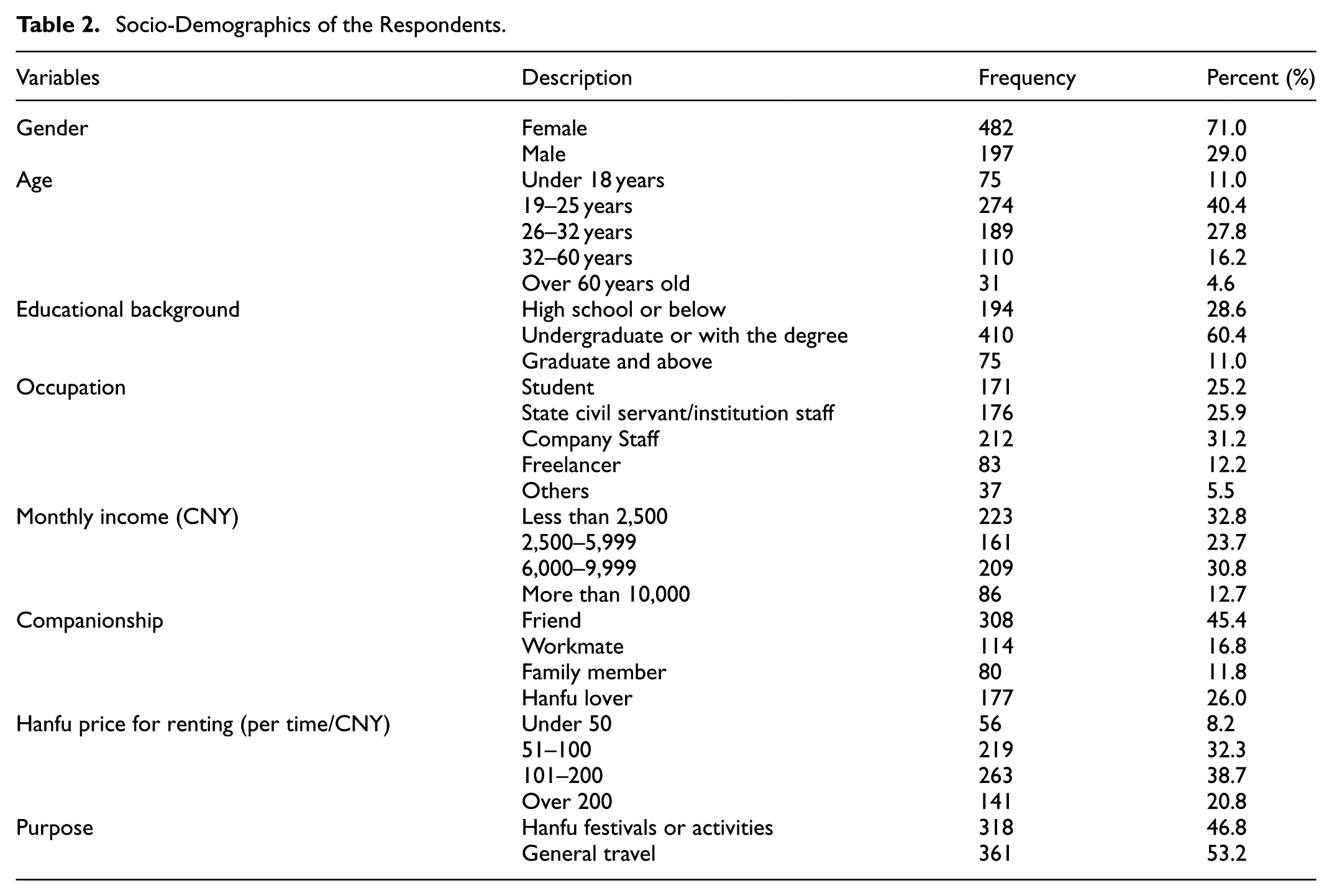
As results, a total of 679 valid samples were used for data analysis with eliminating 192 samples from the initially collected 871 samples. The socio-demographic characteristics of respondents are summarized in Table 2. As can be seen, there are 482 female tourists, accounting for 70.1%, while 197 tourists are male with the proportional share of 29.0%. This finding is consistent with the data from iiMedia Research that female customers have accounted for 89.61% of Hanfu by 2020 (X. Li et al., 2023). Respondents’ age is mainly ranging from 18 to 32 years old, accounting for 68.2% of the total sample, while those under 18 and over 32 accounted for 11.0% and 20.8% respectively. Based on the data provided by Insight and Info (2022), the primary Hanfu consumer demographic in China currently has an average age of 22.34, and 77.13% of them are under 25 years old. This is in line with the age distribution pattern of the present study. Moreover, in terms of education, the vast majority of respondents were undergraduate or with the degree, accounting for 60.4% of the total sample. As for their occupation, over half of respondents have the stable payments with 212 company staff (31.2%) and 176 servants/institution staff (25.9%). About one-third of respondents have the salary less than 2,500 CNY, followed by tourists who have the monthly income in the range of 6,000 to 9,999 CNY (209 respondents, 30.8%). Almost half of tourists (308 respondents, 45.4%) wearing Hanfu with friends for traveling and prefer the Hanfu price between 51 and 100 (219, 32.3%) and 101 to 200 (38.7%). As for the purpose of traveling, the distribution of participating Hanfu festival or activities (318, 46.8%) and general travel (361, 53.2%) are almost even.
Socio-Demographics of the Respondents.
Results of Measurement Model
At the first beginning, the normality issue of research data has been testified with kurtosis and skewness values of all measuring items. As results, the kurtosis values of all items range from −0.693 to 1.057 which is with the critical values of ±2.58 and the skewness value are from −1.219 to −0.444 which met the criterion of recommended value ±1.96, suggesting that sample data violated the assumption of normal distribution. Moreover, the issue of common method bias was testified by Harman’s one-factor test which suggests that if a single component explains no more than 50% of the covariance among research covariance (31.32% in this case), it depicts the non-existence of common method bias (Podsakoff et al., 2003). Thirdly, goodness of fit (GoF) which is varying from 0 to 1 and calculated by the equation
As shown in Table 3, internal consistency of proposed research model was confirmed by values of CA ranging from .831 to .903, and values of CR varying from .872 to .923 which are all higher than the threshold value of 0.7 (J. F. Hair et al., 2012). Moreover, the convergent validity was fulfilled with factor loadings of all measuring items higher than recommended value of 0.6 suggested by E. Hair et al. (2006; see in Table 4) and AVE ranging from 0.577 to 0.662, exceeding the cutoff value of 0.5 suggested by Bagozzi and Yi (1988).
Results of Measurement Model and Discriminant Validity (Fornell Lacker Criterion and HTMT).

Note. Diagonal elements in bold are the square root of AVE and the off-diagonal elements are the correlations among latent variables. Bracketed elements are HTMT. EG = entertainment gratification; SPG = self-presentation gratification; SG = social gratification; AG = esthetic gratification; NCCG = national cultural confidence gratification; PA = perceived authenticity; BI = behavioral intention.
Factor Loading and Cross-Loadings for Discriminant Validity.
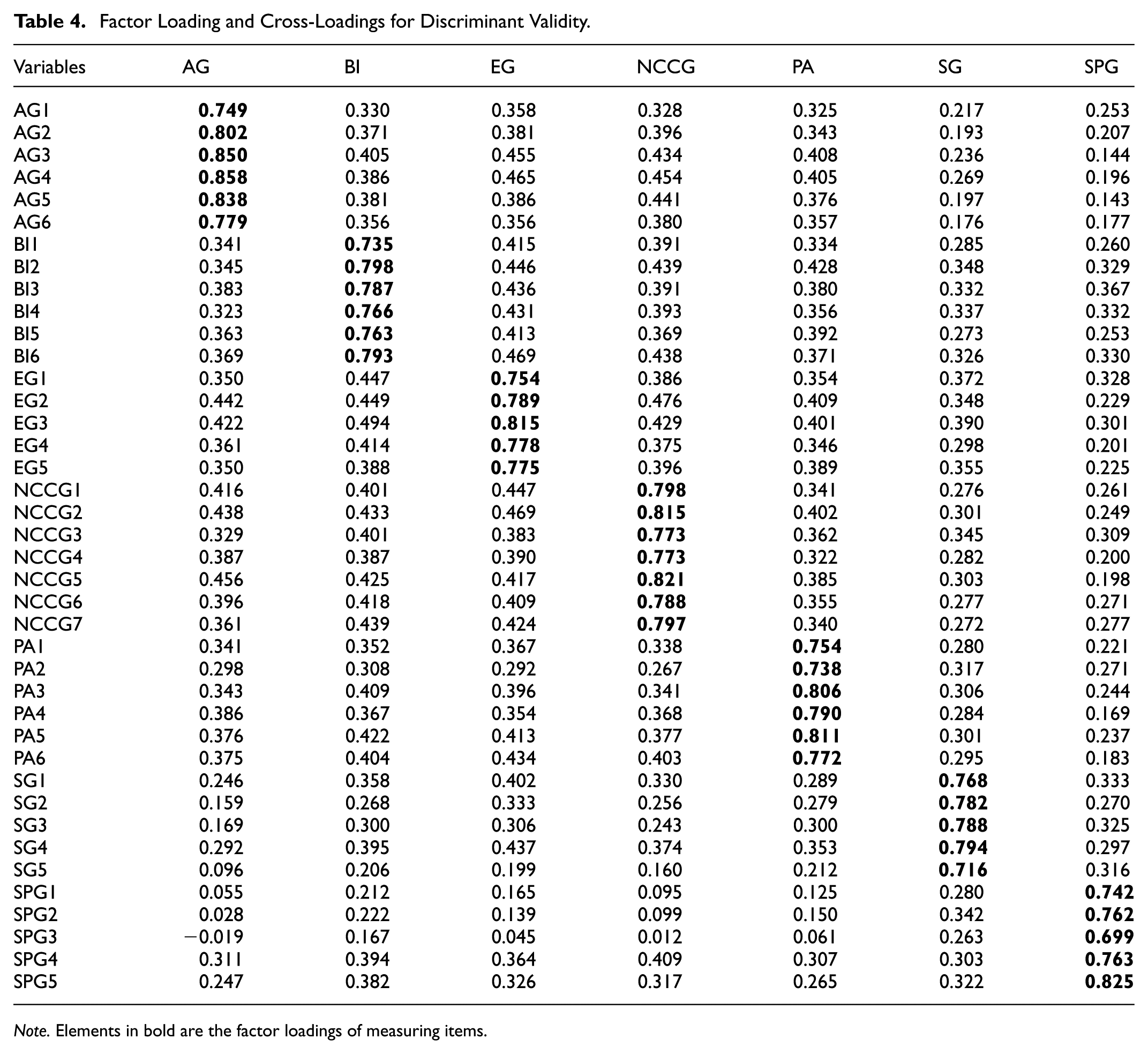
Note. Elements in bold are the factor loadings of measuring items.
Finally, the discriminant validity of the proposed research model was assessed and confirmed by three conditions. As shown in Table 3, discriminant validity was confirmed by Forner-Larcker criterion with which the square root of AVE of each latent construct (diagonal elements in bold) exceeds the correlations coefficients of other constructs in the matrix. Furthermore, all values of HTMT (elements in brackets) are lower than the threshold value of 0.85, fulfilling the discriminant validity by this condition (Henseler et al., 2015). Moreover, the discriminant validity was examined and confirmed by crossing loadings shown in Table 4 and it could be identified that all factor loadings of research variables were higher than the loadings of their corresponding indicators (Chin, 1998). After the confirmation of measurement model, the structural model was assessed subsequently.
Results of Structure Model
Initially, the multicollinearity test was conducted to testify the potential multicollinearity problems of the research variables and indicators. As indicated in Table 5, variance of inflation (VIF) of variables which are varying from 1.253 to 1.720, have met the criteria of non-multicollinearity because all VIF are lower than the value of 5 (J. F. Hair et al., 2019). Moreover, coefficients of determination (R2) which is used to measure the explanatory power of endogenous variables and predictive relevance (Q2) which is used to assess the predictive relevancies of the model variables, were examined. Values of R2 for perceived authenticity and behavioral intention are 0.345 and 0.461, respectively. Based on the suggestion by J. F. Hair et al. (2023), values of 0.25, 0.50 and 0.75 of R2 for target constructs are considered weak, medium and substantial. Thus, the explanatory power of endogenous variables to the behavioral intention of tourists toward Hanfu wearing is considered as moderate. As for the values of Q2, it was suggested by J. F. Hair et al. (2021) that Q2 are considered as small when values are lower than 0.02 and moderate with values varying from 0.02 to 0.15 and large when the values exceed 0.35. Thus, predictive relevancies of all model variables are considered as moderate on the basis of the values of Q2.
Results of Structural Model.
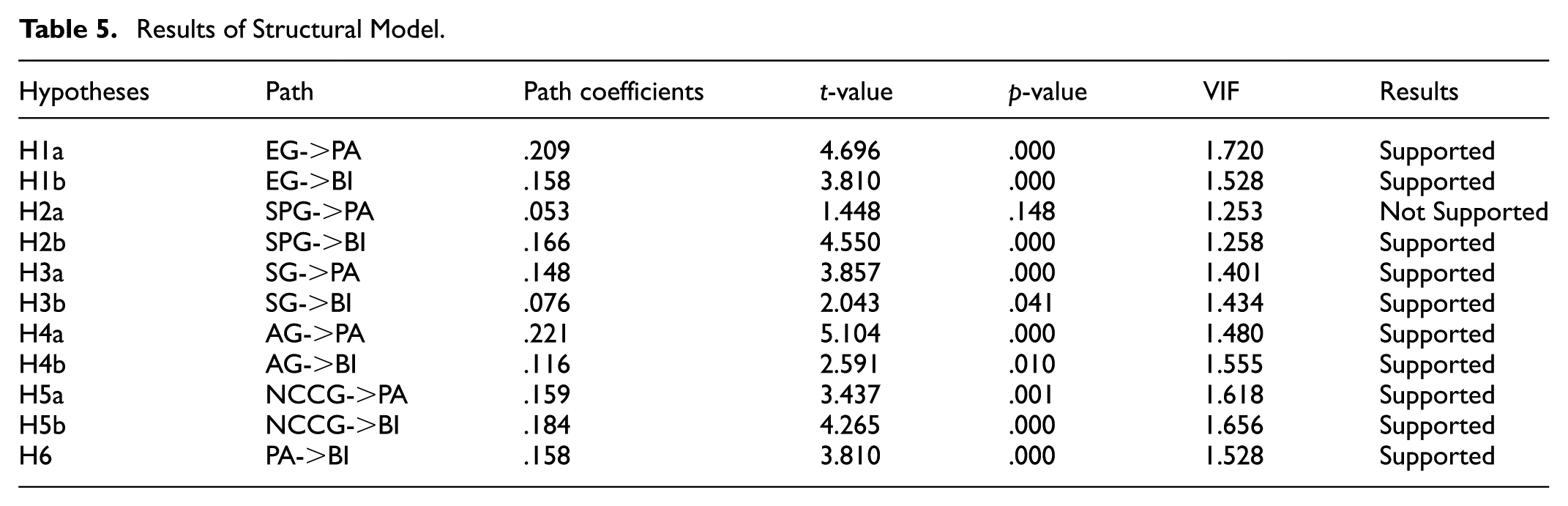
As for hypothesized relationship among research variables, it was empirically verified that entertainment gratification has significant and positive effect on tourists perceived authenticity (β = .209, t = 4.696, p < .001) and behavioral intention (β = .158, t = 3.810, p < .001), therefore supporting
Mediation Test Results
The results of the mediation test are shown in Tables 6 and 7. The bootstrapping with 5,000 times of subsamples was conducted to test the hypothesized relationship among research variables. According to the standard of J. F. Hair et al. (2013), VAF (Variance Accounted For) reached 20% to 80%, which was partially mediated, over 80% was completely mediated, and below 20% was not mediated. As results, perceived authenticity is a partial mediator on the relationship between tourists’ social gratification and behavioral intention (VAF = 23.33%) as well as esthetic gratification and behavioral intention (VAF = 23.17%). That is, tourists perceived authenticity could partially mediate the relationship between tourists’ social/esthetic gratification and behavioral intention of wearing Hanfu with the VAF value higher than 20% but lower than 80%.
Mediation Test Results.

Results of Mediating Effect of Tourists Perceived Authenticity.

Discussion
The present study was conducted to explore and construct the theoretical foundation of the psychological mechanism of tourists’ behavioral intention from the perspectives of tourists’ motivation and their perceived authenticity to Hanfu-wearing during their travels. By the empirical investigation with a valid sample of 679 respondents, this study has verified that except the insignificant relationship between tourists’ self-presentation gratification and their perceived authenticity (not supported by
Additionally, entertainment gratification, social gratification, esthetic gratification and national cultural confidence gratification obtained by tourists could significantly and positively impact on their perceived authenticity and behavioral intention which were supported by
At last, the mediating effects of tourists perceived authenticity on the correlation between tourists’ motivational factors and their behavioral intention have been examined. As results, the associations between tourists’ social gratification, esthetic gratification and behavioral intention were mediated by their perceived authenticity, implicitly suggesting the role of tourist perceived authenticity on the enhancement of their behavioral intention driven by their social gratification and esthetic gratification. The mediating effect of authenticity perception of tourists has been well investigated to explain the relationship between tourists’ motivational factors and their behavioral intentions which is consistent with the prior research findings, for example, tourists perceived authenticity could mediate the relationships between tourists’ motivation and the destination image (Carreira et al., 2022), etc.
Conclusions
With the enhancement of national cultural confidence and the increasing esthetic diversity, Hanfu, as an important part of Chinese culture, has received widespread attention from the public. Especially in recent years, it has been witnessed that an increasing number of tourists have begun to wear Hanfu during their travel. Additionally, more and more tourist attractions have held the relevant festivals or promoted activities to attract tourists by providing them immersive experience (Zhong et al., 2025; Zong & Tsaur, 2024). Gradually, Hanfu and corresponding events have become a booster for tourism development, and the mode of “tourist attraction + Hanfu” has become a new trend in marketing strategy of tourism destinations. This study explores the intrinsic psychological motives that drive tourists to wear Hanfu while traveling, and then analyzes in depth the behavioral intentions it spawns. Specifically, by constructing a framework model of motivation-authenticity-behavioral intention, it reveals the complex psychological and behavioral mechanisms behind the phenomenon of Hanfu tourism, and further demonstrates the new trend of traditional cultural resources empowering the tourism industry to revitalize itself, and that Hanfu are shifting from cultural symbols to the embodiment of tourists’ cultural self-confidence. Moreover, this study also expands the application of UGT in the context of tourism research to depict the motivational factors of tourists’ symbolic consumption.
Theoretical Implications
Several theoretical implications could be aroused from this study. First, in the tourism research, authenticity appears to be a vital factor capable of constructing tourists’ value or behavioral intention. While the perceived authenticity of Hanfu by tourists in the tourism context has not been sufficiently revealed in the existing literature. Therefore, this paper highlights the significance of tourists perceived authenticity of Hanfu with tourist attractions could enforce the construction of their behavioral intention (H. Zhang et al., 2023). Furthermore, UGT has been substantial applied in the field of technology acceptance or media use while this study could be the research paradigm for the future research with the application domain of UGT in the field of symbolic experience or consumption of tourism. Secondly, self-presentation has been examined to insignificantly impact on tourists’ perceived authenticity but positively influence their behavioral intention, exploring the significance of tourists’ self-presentation in the formation of their behavioral intention without the role of perceived authenticity. Thus, for the future research design referring to the traditional costume, tourists’ motivation of self-presentation is one of the most variables to be considered. Similar to this, clothing plays an important role in everyday self-presentation or identity performance and apparently, tourists by wearing Hanu are approaching, building, and confirming ideal personal identifies through performance regarding dress practices (Goffman, 2023). As such, tourists motivated by their self-presentation could directly enhance their behavioral intention. Also, this is in line with the current phenomenon that in order to fit in the modern society, an increasing number of Hanfu have been modified with cultural compatibility to attract more tourists or wearers which is on the contrary of the authenticity (X. Li et al., 2024). Thirdly, perceived authenticity was verified to mediate the relationships between social gratification and behavioral intention as well as esthetic gratification and behavioral intention. Hence, it could infer that for the tourists who are looking for the social gratification and esthetic gratification of the Hanfu-wearing, the promotion of authenticity of destinations are quite essential and pivotal. Naturally, the correlations between tourists’ esthetic gratification, social gratification, perceived authenticity and their behavioral intention concerning the traditional costume in the tourism context are supposed to dig deeper.
Practical Implications
Based on the findings, management implications could be securitized from the following aspects to provide impetus for the development of tourist attractions or destinations. First, according to the socio-demographic characteristics of respondents in the study, young groups account for the majority who are looking for novelty, niche and interest during their traveling. Hanfu-wearing is one of the representative products which is becoming popular alongside with this trend. Therefore, for the tourist attractions/destinations operators or managers, providing Hanfu-renting or purchasing service or developing personalized Hanfu products, building Hanfu photo zone, and creating local Hanfu IP, etc., are essential and primary for the management and promotion. By doing so, tourists’ immersive experience, esthetic experience, culturally-refined experience could be enriched (Zhong et al., 2024). Consequently, their behavioral intentions like satisfaction, loyalty or recommendation could be enhanced accordingly. Furthermore, the specific dimensions of tourists’ motivations consisting of entertainment, esthetic, social, self-presentation and national cultural confidence extracted by this study could be utilized as the baseline information or directions for the promotion of tourist attractions. For instance, they are supposed to develop relevant activities like Hanfu festival with certain theme pertinent to history and cultural connation of China or the rising entertainment game “Script Killing” in ancient towns to make tourists entertained. Finally, consumers wear Hanfu to portray a different image, reflecting how they want others to perceive them to fulfill their needs of self-presentation (X. Li et al., 2023; X. Li et al., 2024). Especially for some general tourists, they tend to see wearing Hanfu in some tourist attractions as an opportunity to show themselves. Therefore, for tourist attractions, especially humanistic tourist attractions, they can attract Hanfu lovers as well as the general public to come to play, watch and learn by organizing activities such as Hanfu runway shows and Hanfu flower boat parades. Meanwhile, operators or managers can combine the traditional culture with the modern trendy culture to create a relaxing and strong cultural tourism atmosphere for the tourists, so that the tourists can experience the charms of the traditional culture in the enjoyable atmosphere, which will stimulate their willingness to travel again.
Limitations and Suggestions for Future Research
Although this study has been completed, several limitations should be taken into consideration when interpreting the findings of the present study. Firstly, only Chinese tourists with Hanfu-wearing experience have been investigated. However, with the globalization trend and the popularity of Chinese culture, foreign tourists coming to China with wearing Hanfu is not the rare case recently. Thus, future research could examine the differences between domestic and international tourists to generalized the research model. In addition, the collected respondents in this study are mainly female tourists because of the convenience sampling method for data collection. And this is consistent with the situation in the market. While still, some male tourists wear Hanfu for their travel. Thus, more consideration can be given to male tourists and the discrepancies between gender could be investigated in the future research. Finally, the samples in this study were mainly tourists who had the experience of wearing Hanfu while traveling, but the influence of respondents’ personal subjective will on their behavioral willingness in the context of cultural diversity was not sufficiently considered, and there were significant differences in motivational factors between Hanfu enthusiasts and ordinary tourists who wore Hanfu while traveling. Future research can expand the scope of research objects to include more types of Hanfu tourism destinations, and at the same time, adopt multi-group analysis methods to explore the behavioral differences between different consumer groups, so as to provide more targeted suggestions for the development of the Hanfu cultural activities.
Footnotes
Acknowledgements
Thanks to the editors and reviewers for their contributions to the publication and revision of the paper.

Ethical Considerations
This study was not involved with medical experiments. The questionnaire survey for data collection has been approved by the Ethical Committee of College of Tourism, Henan Normal University.
Consent to Participate Statement
The informed consent has been obtained from all respondents involved in the study.
Author Contributions
Shuting Tao: Conceptualization, Methodology, Supervision, Writing, Review and editing. Xiaoyu Jin: Conceptualization, Methodology, Data curation, Formal analysis, Investigation, Software, Writing the original draft. Mengke Jia: Supervision, Writing, Review and editing. Shuaige Wang: Reviewing and Editing. All authors have read and agreed to the published version of the manuscript.
Funding
The authors disclosed receipt of the following financial support for the research, authorship, and/or publication of this article: This paper was supported by grants from 2025 Xinxiang Municipal Government Decision Research Tendering Project (No. B24068), 2025 Annual Cultural and Tourism Macro Decision-making Project of the Ministry of Culture and Tourism (No. 2025HGJCG06) and 2025 Annual Social Survey Project of the Social Science Federation in Xinxiang City (SKL-2025-0059).
Declaration of Conflicting Interests
The authors declared no potential conflicts of interest with respect to the research, authorship, and/or publication of this article.
Data Availability Statement
The data that support the findings of this study are available on request from the corresponding author. The data are not publicly available due to privacy or ethical restrictions.