



Abstract
This study investigates the impact of streamers using dialects in tourism live streaming on viewers’ behavioral intentions, perceived streamer authenticity, and destination authenticity. Through two independent experiments, the study verified the role of dialects in enhancing viewers’ behavioral intentions and uncovered the underlying mediation mechanisms. The findings revealed that streamers using local dialects more effectively strengthen viewers’ behavioral intentions (MDialect = 5.278, MMandarin = 5.014, t(143) = 2.946, p = .004; MDialect = 5.490, MMandarin = 5.167, F(1, 90) = 2.527, p = .012) and their perceptions of authenticity regarding both the streamer (MDialect = 5.916, MMandarin = 4.757, F(1, 90) = 8.726, p < .001) and the destination (MDialect = 5.927, MMandarin = 5.423, F(1, 90) = 4.189, p < .001) compared to those using Mandarin. Furthermore, the perception of streamer authenticity was found to be a critical factor influencing viewers’ behavioral intentions (indirect effect = 0.2203; 95% CI [0.0860, 0.3772]), whereas the mediating effect of perceived destination authenticity was not significant (indirect effect = −0.1245; 95% CI [−0.2752, 0.015]). The study also found that the use of dialect by streamers first enhances the perception of streamer authenticity, which in turn boosts viewers’ perception of destination authenticity (indirect effect = 0.4565; 95% CI [0.2433, 0.7137]). This research offers actionable insights for tourism marketing strategies to maximize authenticity perceptions through dialect-based streaming.
Keywords
Introduction
Language, as the most fundamental and complex medium of human communication, serves not only as a vehicle for the conveyance of information but also as a repository of culture, identity, and history (Nagai et al., 2020; Stanley & Wight, 2024). Regional variants of language, known as dialects, with their distinct local characteristics and cultural nuances, profoundly influence daily life and social interactions (Thurlow & Jaworski, 2011). Dialects are also crucial ties that bind community recognition and cohesion, fostering a sense of belonging and identification with a particular region among its inhabitants (Lu et al., 2019; Whitney-Squire, 2016). In recent years, the usage and preservation of dialects have encountered numerous challenges in the wake of accelerated globalization and advancements in information technology (Han, 2023). The widespread education in standardized languages, increased population mobility, and the influence of media have all contributed to diminishing the status of dialects to some extent. The younger generation’s decreasing proficiency and use of dialects not only lead to a loss of linguistic diversity but also pose a threat to the continuity of associated cultural heritage.
As a highly language-dependent medium for information transmission, live streaming has been extensively and profoundly integrated into the realm of tourism marketing. Within the context of tourism live streaming scenarios, streamers occupy a pivotal role, with their commentary services being regarded as the cornerstone that underpins the entire live streaming experience (Liu & Sun, 2024). Streamers vividly present the landscapes of travel destinations and the appeal of tourism products to the audience through real-time commentary and interaction (J. Yang et al., 2022), effectively stimulating viewers’ intentions for positive behavior (Hua et al., 2023). Previous research indicates that elements of communication, such as the streamer’s linguistic style, facial expressions, and body language, play significant roles in enhancing viewer engagement (Su et al., 2024).
Notably, among various streamers, some opt to conduct live streams using regional dialects. They engage with the audience in a distinctive linguistic style that straddles pure dialect and standard language, conveying rich information about the destination and its offerings, and this novel, locally distinctive mode of expression successfully captures substantial attention and affection from many viewers (Q. Yang et al., 2024). However, despite the increasing prevalence and evident attractiveness of tourism streamers using dialects, there remains a lack of thorough understanding regarding the specific impact of dialect usage by these streamers on the audience and the underlying mechanisms at play. Therefore, it is of critical importance and urgency to undertake more detailed research in this area to uncover the unique value and potential effects of dialects in tourism live streaming. Such research would contribute significantly to our understanding of how dialects can enhance the effectiveness of tourism marketing efforts while preserving and promoting cultural diversity and linguistic heritage.
Despite scholars’ considerable interest in live streamers utilizing dialects, critical research gaps remain unaddressed. Firstly, prior studies predominantly focus on the impact of streamer interaction content on audience perception, while neglecting the influence of the streamer’s linguistic style on viewer cognition. Secondly, there is a need for a theoretical understanding of how the use of dialects by streamers impacts audience cognition and emotion. Specifically, Lv et al. (2022) and Wang et al. (2023) have called for more interdisciplinary research to investigate tourist behavioral intentions shaped through both traditional and new media. Thirdly, existing literature on language use by streamers in tourism mainly concentrates on direct interactions between streamers and viewers, overlooking the indirect effects of the streamer’s linguistic style on audience perception.
In summary, this study aims to integrate signaling theory by focusing on the impact of dialect usage by streamers in travel live streaming, thereby constructing a novel theoretical framework to fill the existing void in the research on linguistic styles of streamers in tourism. This study aims (a) to examine the effect of streamers’ dialect use on viewers’ intention to visit destinations. As language choice is a key feature of streamers’ communication style in tourism live streaming, this research addresses the visual-acoustic imbalance in current live streaming studies and proposes an innovative framework for analyzing dialects as communication signals. Specifically, it explores why dialect-based streaming enhances behavioral intentions. (b) To investigate how streamers’ dialect use influences viewers’ perceptions of authenticity regarding both the streamer and the destination. The theoretical role of dialects as auditory markers of authenticity has been largely overlooked in current live streaming research. This study seeks to reveal the effectiveness of dialects in conveying authenticity and to clarify individuals’ cognitive processing of different language types. (c) To analyze the mediating role of perceived streamer and destination authenticity in the relationship between streamers’ dialect use and tourists’ behavioral intentions toward the destination. Authenticity is perceived hierarchically, and this study examines its sequential transfer through dialect use while evaluating how effectively dialects serve as authenticity signals. Furthermore, through mediation analysis, this research aims to unpack the “black box” mechanism underlying the dialect signal effect, explaining how dialect use ultimately influences viewers’ behavioral intentions.
Through these investigations, we aim to deepen our understanding of the role of dialects in travel live streaming and how their utilization can enhance the attractiveness of tourism destinations and viewer engagement.
Literature Review and Hypotheses Development
Signaling Theory
Information asymmetry is a critical factor in decisions related to quality and the intentions of others (X. Li et al., 2024), as it leads to uncertainties for the information receiver. This information asymmetry drives managers and marketers to develop signals to assist potential tourists in evaluating the quality of destinations. Signaling theory posits that signals, which are observable and modifiable attributes containing information about the unobservable characteristics of products and services (Bafera & Kleinert, 2022), are utilized by individuals and organizations to communicate and mitigate the ambiguities and risks associated with information asymmetry (Liang & Wu, 2022). These signals influence the perceptions and choices of the information receiver. The signaling theory comprises four fundamental elements: the signaler, the signal, the receiver, and feedback (Galvagno et al., 2023).
In the context of tourism live streaming, potential tourists encounter information asymmetry due to a limited amount of information regarding the authenticity of destinations. As a highly language-dependent medium, live streaming relies heavily on the streamer’s commentary services (Liu & Sun, 2024), depending not only on content but also on delivery style. According to the signaling theory, the signalers are the streamers of tourism live streaming, who possess information not directly accessible to potential tourists (Alsos & Ljunggren, 2017). The signals are the language types chosen by streamers. The receivers are potential tourists watching the live streams, who may lack information about the destination compared to the streamers. Feedback pertains to the effect of these signals (e.g., language types) on potential tourists’ behavioral intentions. Dialects, deeply rooted in specific regions, are a powerful means of conveying the sense of “place” (Chang et al., 2022; Lu et al., 2019). The extent to which dialects can reduce authenticity-related information asymmetry deserves careful consideration.
Streamers’ Language Types
Language is a vital instrument for human cultural and intellectual communication and also serves as a social tool for communication and coordination within various facets of tourism activities (Su et al., 2024). As an information carrier, language plays a crucial role in tourism marketing (Chang et al., 2022; C. Li et al., 2025; Su et al., 2025). Currently, the field of tourism live streaming research has extensively examined diverse communication elements of streamers (Gao et al., 2019), yet research on language types remains limited (L. Zhang et al., 2024).
Based on their regularity, uniformity, and scope of application, language can be classified into standard language and local dialects (Mai & Hoffmann, 2011; Xu et al., 2023). Standard language, defined by national policies as the official language, is widely adopted in educational systems and represents a country’s officially recognized language (Lu et al., 2019; Su et al., 2025). They symbolize authority and prestige, being perceived as more correct and formal (Morales et al., 2012). Conversely, local dialects are a component of paraverbal communication, reflecting variations in speech style influenced by the speaker’s sociological background and geographic origins (Mai & Hoffmann, 2011; Xu et al., 2023). Regional dialects encompass differences in phonological and prosodic speech characteristics. Dialects serve as communication tools, symbols of local culture, and markers of local personality (Gao et al., 2019; Lu et al., 2019). They are closely tied to local characteristics and customs (Chang et al., 2022) and can enhance perceptions of warmth, competence, and authenticity, thereby improving customer loyalty (Martin & Jenkins, 2024). As such, dialects hold significant value in marketing management (Suwarto et al., 2024; Q. Yang et al., 2024; L. Zhang et al., 2024).
Against the backdrop of Chinese culture, this paper categorizes the language types of tourism streamers into standard Mandarin and local dialects. Standard Mandarin, based on the Beijing dialect of the Mandarin group, is the standardized form of the Chinese language. It serves as the official language in China and has been promoted since the early 20th century to facilitate communication across the country. It is worth noting that various dialects, such as Cantonese, Shanghainese, Sichuanese, and Hokkien, are spoken in different regions of China, each possessing its own distinct phonological, lexical, and grammatical features. These dialects often reflect the cultural identity of the communities that use them.
Perceived Authenticity of Streamers and the Destination
Perceived authenticity is regarded as a vital psychographic construct, given that tourists form their perceptions of authenticity based on the cues they receive (Becker et al., 2019). It has the potential to enhance customer satisfaction, mitigate the perceived risk related to accommodation preferences, and elevate perceived value alongside fostering destination loyalty (Liang et al., 2018; Yi et al., 2018). In the literature on human social media, information asymmetry leads signalers to use multiple signals to enhance their own authenticity and credibility, as well as that of the products they promote (Huang et al., 2021), and authenticity is increasingly highlighted as a core attribute that appeals to followers (Koles et al., 2024). In the context of livestreaming, authenticity means that live streamers show the reality of things and a balance between commercial motivations and sincerity (Becker et al., 2019). Authenticity is reflected in an unpolished personality, behaviors, and beliefs that are genuine and not copied or imitated (J. A. Lee & Eastin, 2021).
The perceived authenticity of a streamer can be defined by the extent to which cues are perceived as reflecting the streamer’s sincerity, truthfulness, endorsement, expertise, and uniqueness, such as their language and appearance (Baker & Kim, 2018). Various authentic cues disseminated by live streamers, serving as sources of information, can help viewers develop a sense of trust, overcome skepticism, and build relationships with the streamers (Sokolova et al., 2020). This, in turn, influences viewers’ attitudes and behavioral intentions toward the destination.
Streamers can provide more detailed and authentic real-time product information about a tourist destination through their personal interpretation services and real-time interactions (Fu et al., 2024). Therefore, the perceived authenticity of a destination depends on the extent to which tourists feel that something is “real” or “genuine” about it (Jimenez-Barreto et al., 2020), such as the comprehensive and authentic product information conveyed by streamers during livestreaming (J. Yang et al., 2022). When the authenticity of the destination presented in tourism livestreams is higher, consumers are also more likely to be interested in the destinations and products (Zheng et al., 2022).
In this paper, it is crucial to explore how viewers perceive the authenticity of both the streamer and the destination when the streamer uses a dialect (vs. Mandarin) for commentary. This approach not only reveals the impact of the streamer’s linguistic style on viewer cognition but also examines the direct and indirect effects of language use on audience perceptions.
Viewers’ Behavior Intentions
Behavior intentions play an important role in marketing, defined as the outcome of customer satisfaction with the products and services provided by service providers (Le Hong & Hsu, 2024). In the field of tourism and hospitality, behavioral intentions are widely used to predict future personal desires and actions across different visit stages (such as pre-visit or post-visit), including intentions to visit or revisit, purchase or repurchase, recommend, and give feedback (Le Hong & Hsu, 2024).
As a strategic tool for assessing the success of marketing efforts, behavioral intentions serve as a key construct for explaining and forecasting audience psychological and behavioral intentions in the context of tourism live streaming. Live tourism acts as an alternative to traditional tourism intentions and the acquisition of future tourism opportunities (Fu et al., 2024; Hua et al., 2023). Its primary goal is to promote tourism destinations and sell tourism products and services online (J. Yang et al., 2022). Therefore, we consider that the behavioral intentions of viewers who have experienced tourism live streaming primarily refer to their intention to purchase tourism products or services recommended by streamers and to travel to attractions featured during the live streaming sessions.
Hypotheses Development
The Effect of Streamers’ Language Types on Viewers’ Behavior: Intentions, Perceived Streamer Authenticity, and Perceived Destination Authenticity
In tourism live streaming, streamers introduce the products and communicate with the audience in real time (J. Yang et al., 2022; Zheng et al., 2022), language plays a key role in this process, and the use of appropriate language style and dialect can further stimulate and strengthen consumers’ continued viewing and purchasing intentions (Fu et al., 2024; L. Zhang et al., 2024). Personalized communication can reinforce the connections between hosts and visitors (T. Yang et al., 2024). Therefore, the use of local dialects by streamers, as part of personalized communication, is important for enhancing the connection between destinations and visitors. Information presented in a local dialect rather than standard Mandarin can evoke a sense of intimacy and resonance among consumers, enhance customers’ perceptions of warmth and trust (Martin & Jenkins, 2024), and lead to greater positive behavioral intentions (Bourdin et al., 2023; L. Zhang et al., 2024). For instance, Bourdin et al. (2023) found that accent can significantly impact customers’ real-world participatory behaviors. L. Zhang et al. (2024) indicated that local dialect can stimulate stronger continuous viewing and purchase intentions among consumers in tourism live streams.
Moreover, according to signaling theory, language is a vital cue that reveals the rich cultural tapestry of a place (Mantra et al., 2020) and plays a key role in tourists’ sense of “being real” and in creating meaningful connections between destination and visitors (Lertchalermtipakoon et al., 2021). Since tourists’ perceptions of authenticity are influenced by multimedia stimuli related to a destination in the online environment (Jimenez-Barreto et al., 2020), the use of local dialects-whether for product introductions or interpersonal interactions-provides visitors with a more authentic and immersive experience during live streaming.
In addition, language is a fundamental aspect of communication (Su et al., 2024). Local dialects, as a distinctive individual characteristic, serve as informational cues that customers use to infer the cultural background, ethnic origin, and identity of the service provider (Bourdin et al., 2023; Mai & Hoffmann, 2011). Therefore, speaking local dialects (vs. standard Mandarin) in live streaming can shape potential tourists’ perceptions of the streamer’s origins, improve the streamer’s credibility and uniqueness, and enhance the streamer’s authenticity. Thus, the hypotheses are proposed as follows:
The Mediating Role of Perceived Streamer Authenticity and Perceived Destination Authenticity
Perceived authenticity of both streamers and destinations in tourism live streaming plays a key role in tourists’ behavior intentions (Fu et al., 2024). Perceived streamer authenticity is likely to promote tourists’ behavior intentions because it is closely related to the credibility and truthfulness of the streamer (Shuqair et al., 2019). On the other hand, the perceived authenticity of the destination tends to positively influence consumers’ sense of presence and trust, while also reducing psychological distance and uncertainty (Zheng et al., 2022). A higher level of destination authenticity demonstrated in tourism live streaming strengthens the credibility of the destination, leading tourists to develop a stronger willingness to visit and a higher purchase intention (Wongkitrungrueng & Assarut, 2020).
Given that streamers’ use of local dialects can evoke viewers’ perceptions of both streamer and destination authenticity, these perceptions may mediate the relationship between the streamer’s language choice and tourists’ behavioral intentions. Specifically, language accent is an essential dimension of an individual’s sense of self and ethnic identity (Bourdin et al., 2023). Therefore, speaking local dialects (vs. Mandarin) would enhance tourists’ assessment of the streamers’ cultural background and origin, thereby increasing the perceived authenticity of the streamer and, consequently, enhancing tourists’ behavior intentions. On the other hand, language is an important construction of local culture (Mantra et al., 2020), and language is a strong indicator of the origin of the organization (Azab & Clark, 2017). The perceived language fit between the destination and the tourism product/service has a significant influence on destination trust in live streaming (Jakic et al., 2017). Thus, speaking local dialects (vs. Mandarin) would enhance tourists’ assessment of the perceived authenticity of the destination, thereby strengthening tourists’ behavioral intentions.
In addition, streamers play a critical role in constructing more comprehensive and perceived authentic destination images and online experience (M. Li et al., 2023). They are responsible for explaining their content and can directly frame their delivery methods to impact viewer behavior. According to signaling theory, streamers serve as cues for viewers evaluating the recommended destination, and the streamers’ use of local dialects signals the regional origin of the destination, inferred from previous literature (Baker & Kim, 2019). Therefore, perceived authenticity of streamers and destination serially mediate the positive effect of speaking dialects by streamers on viewers’ behavioral intentions. Consequently, the following hypotheses are proposed:
Building upon the proposed hypotheses, a theoretical model of the current research is presented in Figure 1.

Research model.
Methodology
Inspired by the research approaches of Sands et al. (2021), Woolley et al. (2022), and F. Li and Ma (2024), who have extensively employed experimental designs and quantitative methods, this paper investigates the positive impact of streamers’ use of dialects on viewers’ behavioral intentions and the underlying mediation mechanisms through two independent experiments. In the first experiment, we examine the effect of dialects on potential viewers’ travel intentions. In the second experiment, we further investigate the mediating roles of perceived streamer authenticity and perceived destination authenticity.
Experiment 1: The Impact of Streamers Using Dialects on Viewers’ Travel Intention
Experiment 1 constructs a hypothetical Qiang Ethnic Cultural Garden as a tourist destination and employs textual descriptions, presented in dialect or Mandarin (both in written form), within an online experimental setting. It then compares the impact of these two languages on the behavioral intentions of potential tourists.
Research Design and Procedure
A single-factor between-groups experimental design was employed, focusing on the variable of streamers’ language types (Dialect vs. Mandarin). Before data collection, we conducted a power analysis using G*Power 3.1 (Faul et al., 2009). A one-way ANOVA was selected, with two groups and four control variables. Setting the effect size at f2 = 0.25 (medium effect) and the significance level at 0.05, the statistical power (1 − β) was determined to be 0.80 (Cohen, 2013). Based on these parameters, the calculated required sample size for this study was 128 participants. A single-factor between-groups experimental design was employed, focusing on the variable of streamers’ language types (Dialect vs. Mandarin). The experimental content featured a tourism anchor introducing the Qiang Ethnic Cultural Garden (see Appendix A). Participants were recruited via an online platform, Credamo (https://www.credamo.com/home.html#/), with an initial pool of 152 individuals. After an attention check, seven participants were excluded, yielding a final sample size of 145 participants. These participants were divided into two groups: 74 in the dialect group and 71 in the Mandarin group. Among the participants, 84 were female (57.9%); 43 were aged 18 to 25 (29.7%), 64 were 26 to 35 years old (44.1%), and 38 were over 36 (26.2%).
The experimental procedure began with participants reading an introduction to the Qiang Ethnic Cultural Garden. Subsequently, they were randomly assigned to one of the two groups, each experiencing a unique live-stream scenario. The dialect group was presented with text materials that incorporated Sichuan dialect phrases and vocabulary, while the Mandarin group received materials written in standard Mandarin. Both sets of texts were written by a university teacher familiar with Sichuan dialect and reviewed by two associate professors of tourism management. This process ensured that while retaining the distinctive characteristics of the Sichuan dialect, the content, word count, and other aspects of the two texts remained equivalent.
After reading the experimental materials, participants responded to questions assessing their comprehension of the content and behavioral intentions. The behavioral intention scale was adapted from H. Zhang et al. (2017) and C. K. Lee et al. (2005), encompassing six items that gauged positive word-of-mouth, recommendations, intention to visit, and intention to revisit. These items included, for instance, “I would inform others about the interesting aspects of this scenic spot” and “In the future, I would recommend this destination to others for travel.” The comprehension of the content was measured through the item, “I can understand the specific meaning and expressive intent of the anchor’s introduction.” All items were rated on a 7-point Likert scale, ranging from 1 = strongly disagree to 7 = strongly agree.
Main Effect Test
The study employed ANCOVA to examine the effect of streamers’ language type (independent variable: Mandarin vs. dialect) on potential tourists’ behavioral intentions (dependent variable), controlling for demographic covariates (gender, age, education level, and occupation). Levene’s test confirmed homogeneity of variances (F(1, 143) = 3.494, p = .064). Participants in the dialect group reported significantly higher behavioral intentions than those in the Mandarin group (MDialect = 5.278, SD = 0.406; MMandarin = 5.014, SD = 0.650; F (1, 139) = 9.473, p = .004, η2 = .064). The significance persisted even in a model without covariates (F(1, 143) = 8.861, p = .004, η2 = .057), supporting H1 (Table 1).
ANCOVA Results in Experiment 1.

Experiment 2: Mediating Mechanisms of the Perceived Authenticity
Research Design and Procedure
To eliminate the potential influence of streamers’ appearance and attire in the live streaming scenario on participants, this experiment adopted an audio medium to investigate the effects of dialect usage by streamers, and further evaluated competitive explanatory mechanisms concerning streamer authenticity and destination authenticity (see Appendix B). Participants were recruited via Credamo. A renowned Chinese tourist destination, Mount Qingcheng in Sichuan, was selected as the experimental stimulus.
Adopting a single-factor between-groups experimental design (Language types: Dialect vs. Mandarin). Two hundred ten participants were recruited through an online platform, with 18 excluded following an attention check, leaving a final sample of 192 valid participants (of which 119 were female, 62.0%; 62 were aged 18 to 25, 32.3%, 87 were 26 to 35, 45.3%, and 43 were over 36, 22.4%). Participants were randomly assigned to either the Dialect Group or the Mandarin Group and listened to a recorded promotional audio of Mount Qingcheng’s tourist attractions, lasting 59 s for the dialect version and 62 s for the Mandarin version. The advertisements highlighted the tourism resources, core attractions, and tourism development of Mount Qingcheng.
Post-exposure, participants completed measures of their behavioral intentions toward Mount Qingcheng, alongside assessments of streamers’ authenticity, destination authenticity. Additionally, comprehension of the audio content was assessed. The behavioral intention scale was adapted from H. Zhang et al. (2017) and C. K. Lee et al. (2005), consistent with the source in Experiment 1. Streamer authenticity was assessed using five items derived from Yoo and Arnold (2019) scale, while destination authenticity was evaluated through six items grounded in the works of Kim and Baker (2017). All these assessments employed a 7-point Likert scale, ranging from 1 (strongly disagree) to 7 (strongly agree). Table 2 provides measurement reliabilities and validity checks.
Measurement Items and Validity Assessment (n = 192).

Note. α = Cronbach’s α; AVE = average variance extracted; CR = composite reliability; FL = factor loading.
Main Effect Test
The independent samples t-test results indicated that the dialect group showed significantly higher behavioral intentions toward Mount Qingcheng compared to the Mandarin group (MDialect = 5.490, SDDialect = 0.872, MMandarin = 5.167, SDMandarin = 0.904, F(190) = 2.527, p = .012), thus confirming H1 once more (Figure 2).
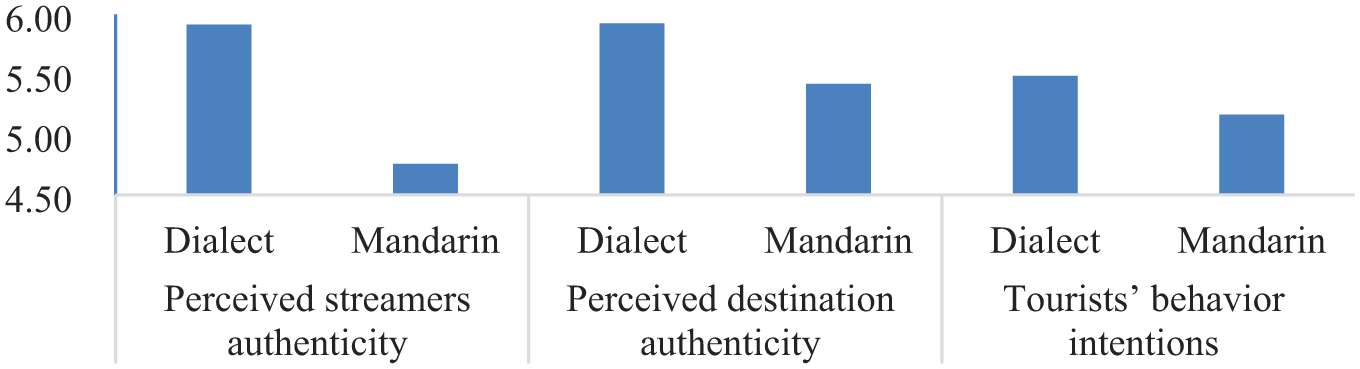
The effect of streamer language use on authenticity and tourist behavioral intentions.
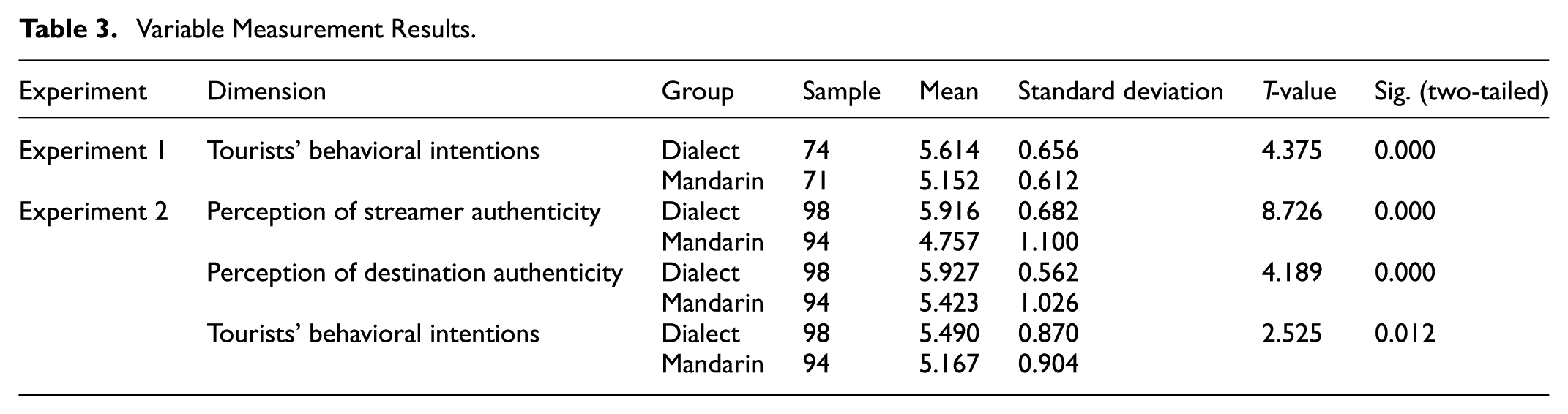
Further, we examined the impact of dialect versus Mandarin on streamers’ authenticity and destination authenticity. Independent samples t-tests revealed that the dialect group scored significantly higher in streamers authenticity than the Mandarin group (MDialect = 5.916, SDDialect = 0.682, MMandarin = 4.757, SDMandarin = 1.101, F(190) = 8.726, p < .001), validating H2; the dialect group also had significantly higher destination authenticity ratings than the Mandarin group (MDialect = 5.927, SDDialect = 0.562, MMandarin = 5.423, SDMandarin = 1.026, F(190) = 4.189, p < .001), supporting H3 (Table 3).
Variable Measurement Results.
Mediation Analysis
The independent variable streamers’ language types were categorical and were transformed into dummy variables (Hayes & Preacher, 2013). Dialect was assigned a value of 1, and Mandarin was assigned a value of 0. Mediation analyses were conducted using the Bootstrapping method with 5,000 bootstrapped samples and CI = 95% through Process version 3.5, as shown in Table 4.
Results of Indirect Effects.

To test Hypotheses H4 to H6, we conducted a series of mediation analyses with the type of streamer language as the independent variable. Perceived streamer authenticity and perceived destination authenticity served as mediators, while behavioral intentions were the dependent variable. Gender, age, education level, and monthly income were included as control variables. Since the independent variable was categorical, it was recoded into two dummy variables (Hayes & Preacher, 2013). Specifically, the group using dialect was coded as 1, and the group using Mandarin was coded as 0. We employed PROCESS Macro Version 3.5 (Hayes, 2017) to perform the mediation analysis using the bootstrapping method. A total of 5,000 bootstrap samples were generated, and 95% confidence intervals (CI) were constructed. The results are summarized in Table 4.
The results showed the direct effect of streamer language type on tourists’ behavior intentions was significant (direct effect = −0.2287, 5% CI [−0.4277, −0.0297]). Perceived streamer authenticity mediated the effect of streamer language type on tourists’ behavioral intentions (indirect effect = 0.2203; 95% CI [0.0860, 0.3772]), supporting H4. However, the results showed perceived destination authenticity did not significantly mediate the effect of streamers’ dialect use on viewers’ behavioral intentions (indirect effect = −0.1245; 95% CI [−0.2752, 0.015]), H5 was defused. Furthermore, the serial mediation of perceived streamers authenticity and perceived destination authenticity was significant (indirect effect = 0.4565; 95% CI [0.2433, 0.7137]), and H6 was supported.
Conclusions, Contributions, and Implications
Conclusion
This study proposes and empirically verifies a conceptual model that examines how the language types used by streamers in live streaming influence tourists' perceptions of streamer authenticity, destination authenticity, and behavioral intentions. The conclusions show that: (a) In tourism live streaming, the local dialect used by streamers can positively influence viewers’ behavioral intentions. (b) The local dialect used by streamers in tourism live streaming positively influences viewers’ perceived authenticity of the streamer, which in turn mediates the effect of dialect on tourism behavioral intentions. (c) The perceived authenticity of the streamer and the destination form a serial mediation process, whereby the streamer’s dialect influences viewers’ behavioral intentions through the sequential impact on perceived authenticity.
The findings address key gaps in the tourism live streaming literature. Specifically, we provide empirical evidence of the role of language in marketing within this context, demonstrating how dialect use influences viewers’ intention to visit. In the literature on marketing and service management, language has consistently been a core concept, with its importance in advertising and face-to-face service interactions extensively validated (Baker & Kim, 2018; Kim & Baker, 2017). Our results not only support the idea that dialects can strongly influence customer behavior (L. Zhang et al., 2024) but also extend this understanding by showing that, in live streaming settings, dialects may have an even more direct and positive effect on viewers’ behavioral intentions. More significantly, we highlight the previously overlooked impact of language types on viewer perception by identifying perceived streamer authenticity as a key mediating mechanism. Our empirical findings show that perceived streamer authenticity is a crucial factor that impacts tourists’ decision-making processes and future behavioral intentions in tourism live streaming (Zheng et al., 2022). At the same time, we constructed a theoretical framework to enhance understanding of how dialect influences viewers’ perception in live streaming. Furthermore, the mediation effect of perceived destination authenticity was not significant, suggesting that viewers do not rely heavily on this psychological perception. Instead, they tend to infer destination authenticity directly from visual elements, such as authentic scenery, landscapes, and local products (Fu et al., 2024).
The confirmed serial mediation of perceived streamer authenticity and perceived destination authenticity indicates that streamers’ use of dialect serves as an audio-based signal conveying information about ethnic identity, trust, warmth, and affinity (Martin & Jenkins, 2024). This is associated with viewers’ perception of streamer authenticity (Baker & Kim, 2019; Kim & Baker, 2017) and exerts an indirect effect on destination authenticity. These findings enhance our understanding of the “streamer–destination–viewer” dynamic in live streaming.
Theoretical Implications
Enhancing the Understanding of Dialects in Tourism Live Streaming. This study contributes to the literature by examining how hosts’ use of dialect influences potential tourists’ behavioral intentions. The findings reveal that a host’s use of dialect can enhance viewers’ perception of the authenticity of the destination. This underscores the significance of dialect as a clear cultural cue in multilingual and multicultural contexts, fostering important connections between viewers and destinations. Additionally, this research uncovers the underlying mechanisms through which hosts’ use of dialect impacts potential tourists’ behavioral intentions—by enhancing the host’s authenticity and the attractiveness of the destination, thereby exerting an indirect influence on tourists’ decision-making. This provides a new perspective on how language types shape audience perceptions and offers a theoretical foundation for future studies.
Expanding Authenticity Research Related to Sensory Cues. According to the study, the use of local dialects by streamers in live streaming enhances audiences’ perception of destination authenticity more than the use of Mandarin. By innovatively incorporating the angle of linguistic types into research on authenticity related to hosts and destinations, this work enriches the authenticity signals in live streaming environments. Including dialect within the scope of sensory cues expands our understanding of how linguistic characteristics can be leveraged to enhance viewer engagement and the perceived authenticity of destinations. It also provides valuable guidance for practitioners, aiding them in better utilizing dialect resources for marketing activities (Jakic et al., 2017).
Constructing a New Framework Based on Signaling Theory. This study aims to integrate signaling theory, focusing on the effects of hosts’ dialect use in tourism live streaming, and constructs a novel theoretical framework that fills a gap in the research on linguistic styles in such broadcasts. The framework not only helps explain the role of language types as signals in informationally asymmetric environments but also serves as a crucial theoretical tool for future studies to evaluate the effectiveness of various linguistic styles across different communication contexts.
Managerial Implications
Optimizing streamer language strategies to enhance live streaming marketing effectiveness. In tourism live streaming, the language choices of streamers significantly impact viewer engagement and perception of the destination (Xie et al., 2022). The research suggests that incorporating local dialects appropriately can enhance the authenticity and warmth of the streamer without compromising the clarity of information delivery. Thus, live streaming platforms and tourism destinations should actively recruit dialect-speaking streamers for location-based promotions, especially for small- and medium-sized tourism businesses and destinations. Working with local dialect streamers represents a low-cost and highly effective promotional strategy to reach niche audiences.
Ensuring clear and universal communication in live streaming. While using local dialects can increase the appeal of live streams, it may also create understanding barriers for some viewers. Therefore, it is recommended to use local dialects in everyday conversations, greetings, specific titles, proper nouns, or expressions of emotion, while reserving Mandarin for critical segments such as product introductions and the exchange of essential information, to ensure clarity and accuracy in communication. This strategy can not only boost viewer participation and establish a stronger emotional connection, but also keep communication professional and easy to understand for a broader audience. As a result, it enhances overall viewer engagement and improves the effectiveness of live streaming marketing.
Balancing personalization and professionalism in communication style. To maximize the effectiveness of live streaming marketing, managers should encourage streamers to balance personalization with the professionalism and comprehensibility of information. Specifically, streamers can showcase their personality and authenticity by using local dialects, while switching to Mandarin when discussing specific products or services to ensure the professionalism and universal understandability of the information. This dual strategy can attract viewer interest while ensuring they receive accurate information. Moreover, managers should train streamers in “dialect storytelling”—that is, how to incorporate local idioms, folklore, and cultural elements into their commentary to enhance authenticity, especially in rural or ethnic regions. In addition, for SMEs (small and medium-sized enterprises), local employees can be encouraged to become streamers and should be provided with essential live streaming guidelines and sample reviews. This support helps them write content that is specific, detailed, and direct, thereby better guiding viewers’ behavioral intentions and promoting positive actions.
Limitations and Future Research Directions
Although this study underscores the central role of authenticity in streamer–viewer interactions, several limitations remain. First, beyond the mechanisms examined here, viewers’ perceptions of destination uniqueness, sense of place, service quality, and both cognitive and emotional engagement may constitute additional mediating pathways. Moreover, variables such as cultural distance, cultural familiarity, dialect familiarity, and viewers’ personality traits may moderate these relationships; these possibilities await future investigation. Second, while we compared streamers using different language varieties, the study context was relatively specific, and the external validity of our findings needs to be tested in more diverse settings. Future research could examine how dialect-speaking streamers activate niche markets through cognitive–affective arousal mechanisms and could compare the differential effects of local versus celebrity influencers in marketing campaigns.
Footnotes
Appendix A: Experimental Design Scenarios
Appendix B: Experimental 2 Design Scenarios

Ethical Considerations
This study is non-interventional in nature, and the data used were obtained from a third-party survey and statistics organization, without direct collection of data from human participants. According to the relevant regulations of the Jiangsu Normal University Ethics Committee on exemption from review, this study meets the criteria for exemption from ethical review; therefore, ethical approval is not required.
Consent to Participate
Electronic informed consent was obtained from all participants before enrollment. The study’s purpose, procedures, and confidentiality measures—including data anonymization and personal information protection—were explained, and participants were explicitly informed of their right to withdraw at any time without penalty. Upon withdrawal, all personally identifiable data were permanently removed from the dataset.
Funding
The authors disclosed receipt of the following financial support for the research, authorship, and/or publication of this article: This work was supported by the National Social Science Fund of China under Grant 25BGL146 and the PhD Programs Foundation of Jiangsu Normal University under Grant No. 22XFRS016.
Declaration of Conflicting Interests
The authors declared no potential conflicts of interest with respect to the research, authorship, and/or publication of this article.
Data Availability Statement
The data are available from the corresponding author on reasonable request.