




Abstract
With the revival of traditional culture, the Hanfu market has expanded rapidly, yet theoretical research on Hanfu consumption remains limited. Drawing upon the Theory of Planned Behavior (TPB) and integrating consumer innovativeness and Chinese cultural identity, this study examines the factors influencing Hanfu purchase intention. A structural equation model was applied to survey data from 204 respondents. Results indicate that both consumer innovativeness and cultural identity exert significant positive effects on purchase intention. Specifically, these antecedents influence attitude, perceived behavioral control, and subjective norms toward Hanfu consumption, which in turn drive purchase intention; among these pathways, attitude emerged as the strongest predictor. Based on these findings, we propose three marketing strategies: first, to enhance the cultural-identity pathway, establish immersive cultural narratives, create ritualized consumption experiences, and adapt traditional symbols for contemporary contexts; second, to leverage the innovativeness pathway, implement technology-enabled decision-support tools, promote lightweight consumption models, and develop user co-creation platforms; third, to foster synergy between pathways through the formation of cultural innovation communities, the design of dual-dimension membership systems, and theme-based event marketing. These strategies not only align with consumer expectations but also contribute to the sustainable development of the Hanfu industry by supporting cultural preservation and market expansion.
Plain Language Summary
Why was this study done? With the revival of traditional culture, the Hanfu market has grown rapidly, attracting many consumers. However, there is still limited research on what drives people to buy Hanfu. This study explores the key factors influencing Hanfu purchase intention, focusing on consumer innovativeness and Chinese cultural identity within the Theory of Planned Behavior framework. What did the researchers do? The researchers surveyed 204 participants and analyzed the data using Structural Equation Modeling. They examined how consumer innovativeness and cultural identity affect attitudes, perceived behavioral control, and subjective norms toward Hanfu consumption, and how these in turn influence purchase intention. Among these factors, attitude was found to be the strongest predictor. What did the researchers find? Both consumer innovativeness and cultural identity positively impact purchase intention by shaping attitudes, perceived control, and social influences. Attitude, meaning consumers’ positive feelings toward Hanfu, plays the most important role in encouraging purchase. What do the findings mean? Based on these results, three marketing strategies are suggested: (1) strengthen cultural identity through immersive stories, ritualized experiences, and modern adaptations of traditional symbols; (2) engage innovative consumers with technology-based tools, lightweight consumption options, and co-creation platforms; (3) build cultural innovation communities, dual-level membership programs, and themed events to blend culture and innovation. These approaches meet consumer expectations and support sustainable growth of the Hanfu market, promoting both cultural heritage and business development.
Keywords
Introduction
With the advancement of globalization and the acceleration of modernization, many traditional cultures are gradually disappearing, and cultural homogenization has become an increasingly serious issue (Abdullahi, 2024). Against this backdrop, China’s cultural revival movement has garnered significant attention, particularly the resurgence of Hanfu, one of the important symbols of Chinese traditional culture. Hanfu has not only highlighted people’s deep emotional connection and identification with traditional culture but has also played an active role in promoting social sustainability (Lin, 2021; Liu et al., 2024). Hanfu refers to garments made by contemporary people that imitate the traditional attire of the Han ethnic group, reflecting the stylistic characteristics of traditional Han clothing and embodying national sentiment (Z. H. Wang et al., 2022).
Hanfu consumption, as a paradigmatic manifestation of the cultural renaissance movement, holds significance not only for heritage preservation but also for creatively reconciling the core tensions inherent in the modernization of traditional cultures. Unlike other forms of traditional dress, Hanfu consumption exhibits a distinctive “dual-coding” characteristic: consumers must decode the cultural semiotics embedded in historical garments while simultaneously recontextualizing their meaning within contemporary settings. Crucially, Hanfu consumption dissolves the boundary between cultural purists and everyday consumers, giving rise to a spectrum that spans “cultural purists” to “fashion experimenters” (Ip & Fan, 2024). This pluralistic ecosystem provides an exemplary case for examining differentiated consumption behaviors during cultural transition. Theoretically, Hanfu consumption’s unique value lies in its dual function of safeguarding collective cultural memory and addressing the innovative demands of modern life, rendering it an ideal construct for testing and extending cultural consumption theories.
Hanfu consumption also plays a critical role in advancing social sustainability. Social sustainability refers to ensuring the long-term stability and prosperity of social systems by enhancing cultural diversity, promoting social inclusion and equity, and preserving and transmitting cultural heritage (Dempsey et al., 2011; Ye & Dela, 2023). Within this framework, the revival of Hanfu represents a combination of cultural inheritance and innovation, not only helping to maintain and enrich the cultural diversity of the Chinese nation but also promoting cultural identity and interaction among social members. Additionally, the rise of the Hanfu industry has provided new economic opportunities for artisans and small-scale producers, supporting regional economic sustainability. The Hanfu industry is witnessing exciting growth and holds immense potential for further development (Y. Y. Zhou & Zhu, 2024). Specifically, the revival and consumption of Hanfu have multiple impacts on social sustainability. Firstly, Hanfu, as an important carrier of cultural identity, enhances individuals’ and society’s sense of cultural identity and promotes cultural diversity and inclusion (Dai, 2023). Second, the revival and preservation of traditional craftsmanship in Hanfu production not only contributes to cultural heritage but also encourages the use of environmentally friendly materials, supporting the development of the green economy (Dai, 2023). Finally, the growth of Hanfu consumption enhances public interest and awareness of traditional culture (Fan & Ip, 2023; Smith, 2009), promoting broader social cultural education and dissemination, thus contributing to long-term social stability and prosperity.
Although the Hanfu market has experienced rapid growth in recent years, some negative factors hindering its development have emerged, such as the uneven quality of Hanfu, unclear marketing targets, and low consumer satisfaction. Consumption intention refers to the degree or tendency of consumers to purchase a particular product, service, or behavior, also known as purchase behavior intention (Fishbein, 2011). Consumption intention can be influenced by various factors, including personal needs, income levels, preferences, and aesthetic values (Ajzen, 1991). It reflects consumers’ attitudes, willingness, and expectations during the purchase decision-making process and is an important factor in predicting actual consumption behavior (Z. Z. Liu, 2020). Therefore, in-depth research on the factors influencing Hanfu consumption intention has become a practical issue. On the one hand, it can improve the theoretical understanding of Hanfu consumption, and on the other hand, it helps Hanfu businesses to implement targeted marketing strategies, expand the influence of Hanfu, and promote social sustainability.
Currently, academic research on Hanfu consumption intention has gained some momentum. Scholars have explored factors such as brand image (Liang et al., 2021), online store design, and store interaction (Y. J. Li, 2019), using structural equation modeling (SEM) to conduct empirical studies, confirming the relationship between these factors and Hanfu consumption intention. However, overall, research on Hanfu consumption intention remains in its early stages, and there is considerable room for improvement in identifying its influencing factors.
A review of the literature indicates that the Theory of Planned Behavior (TPB) has been widely applied across various consumer behavior studies (Ajzen, 1991), yet systematic application within the domain of Hanfu consumption remains notably scarce. This gap, in contrast to TPB’s demonstrated utility in research on cultural product consumption, highlights the need to integrate TPB into investigations of Hanfu purchase intentions.
Notably, Hanfu consumption embodies a duality of tradition and modernity. It serves both as a cultural emblem carrying emotional value tied to heritage identity and as a novel product distinct from everyday dress in contemporary contexts. This duality requires that research on Hanfu consumption address two challenges. First, Hanfu purchase carries ritual significance in cultural revitalization (Fan & Ip, 2023). Second, consumers must negotiate the fit between traditional garment forms and modern usage scenarios (H. Zhang et al., 2023). As a result, Chinese cultural identity and consumer innovativeness emerge as key variables in shaping Hanfu consumption behavior.
Thus, based on the Theory of Planned Behavior (TPB), this study aims to establish a structural equation model (SEM), incorporating two variables—consumer innovativeness and Chinese cultural identity—to explore the influencing mechanisms of Hanfu consumption intention. Through data collection and analysis, this study will empirically test the explanatory and predictive power of this model on Hanfu consumption intention. The research seeks to explore how consumer innovativeness and Chinese cultural identity influence Hanfu consumption intention, and analyzes the underlying mechanisms from the perspectives of attitude, perceived control, and subjective norms. The results aim to provide valuable insights for decision-makers and marketers in the Hanfu industry, and contribute to the promotion of the Hanfu industry and social sustainability.
Literature Review
Theory of Planned Behavior
The Theory of Planned Behavior (TPB), proposed by Ajzen (1985) as an extension of the earlier Theory of Reasoned Action (TRA), is a psychological framework for explaining and predicting individual behavior. According to TPB, behavioral intention is the primary determinant of behavior, and its formation is influenced by three main factors: attitude, subjective norm, and perceived behavioral control (Ajzen, 1991). Specifically, attitude refers to an individual’s positive or negative evaluation of a behavior; subjective norm pertains to the perceived social pressure from others to perform or not perform a behavior; and perceived behavioral control reflects an individual’s perceived ability and external support to execute the behavior (Ajzen, 2002). TPB has been widely used in diverse contexts to understand the psychological mechanisms underlying individual behavior choices.
Since its introduction, TPB has been extensively applied in various studies on consumer behavior, particularly in the areas of sustainable and cultural consumption. For instance, in the field of sustainable consumption, Yadav and Pathak (2016) conducted an empirical study on young consumers in developing countries and found that attitude, subjective norm, and perceived behavioral control significantly predicted purchase intention for environmentally friendly products. Similarly, studies in the hotel industry have demonstrated that perceived behavioral control strongly influences consumers’ intentions to choose green hotels (Han et al., 2010). These findings highlight TPB’s utility in identifying determinants of sustainable consumption.
TPB is also applicable to the consumption of cultural products. For example, Dong et al. (2010) examined youth cultural consumption and found that attitude and subjective norm significantly influenced young people’s intentions to participate in cultural activities. In a study on Korean cultural product consumption, Park et al. (2017) demonstrated that the TPB model effectively revealed the role of cultural identity in shaping consumer behavior. These studies suggest that TPB can provide insights into the underlying motivations of cultural product consumption, including social influences, personal attitudes, and behavioral control, especially for traditional or niche cultural products.
While TPB’s three core constructs effectively explain consumer behavior in many contexts, its basic framework has limitations when applied to specific cultural and product consumption scenarios. In recent years, researchers have introduced external variables into the TPB model, incorporating factors such as emotions, cultural identity, and social media influences. These extensions enhance the model’s flexibility and enable more precise predictions of individual behavior in diverse contexts. For instance, Wu et al. (2022) integrated altruistic values into the TPB model in a study on prosocial behavior, demonstrating that altruistic values significantly strengthened the explanatory power of behavioral intention. Similarly, Xu et al. (2023) incorporated local cultural factors into the TPB model, which not only explained attitudes in consumer loyalty toward regional brand products but also uncovered potential impacts of subjective norms. These studies underscore the importance and effectiveness of combining the TPB model with external variables.
Although the Theory of Planned Behavior has been widely employed in consumer behavior research, its application to Hanfu consumption reveals a significant theoretical gap. First, the framework insufficiently accounts for the distinctive attributes of specific cultural products and contextual factors. Second, existing studies using TPB to explain cultural consumption often overlook the interactive effects of cultural identity and consumer innovativeness, thereby limiting the explanatory power of their models. These shortcomings constrain the applicability of TPB and reduce its effectiveness in capturing the dual traditional-modern nature of Hanfu consumption. Addressing these deficiencies through theoretical integration and innovation will enhance TPB’s utility across a broader range of consumption and social behavior research.
Chinese Ethnic Cultural Identity
Cultural identity refers to an individual’s emotional connection and identification with their culture, reflected in their level of acceptance of traditions, values, and social symbols (Heersmink, 2023). Chinese ethnic cultural identity, as a specific form of this concept, represents the acceptance, emotional attachment, and self-identification of Chinese consumers with Chinese culture (Y. Zhao & Yun, 2024). This sense of identity goes beyond the understanding and recognition of Chinese culture and encompasses recognition of its values, traditions, language, history, and clothing. Understanding Chinese ethnic cultural identity is crucial for promoting national brands, predicting cultural consumption behaviors, and facilitating the international dissemination of traditional Chinese culture.
In recent years, the Chinese government has put forward a series of viewpoints, such as strengthening the awareness of the Chinese national community (Yu, 2023), which has led to a growing interest in the study of Chinese ethnic cultural identity. H. Wang et al. (2022), in their research on the psychological mechanisms and influencing factors of Chinese cultural identity among university students, argue that the psychological mechanism of Chinese cultural identity among university students is a sequential process of cognition, intention, and action, with each stage influencing and interacting with the others. The factors of universities, society, and family all have varying degrees of direct positive effects on students’ cultural identity. In terms of measurement, scholars such as Q. Zhang et al. (2007) and W. Zhao and Chen (2020) have explored Chinese ethnic cultural identity from multiple angles, measuring it through the perspectives of symbols, identity, and values.
Several scholars have also integrated Chinese ethnic cultural identity with the study of clothing. For example, Su and Li (2021) explored the relationship between the fusion of ethnic clothing from the Wei, Jin, Southern and Northern Dynasties to the Sui and Tang periods and Chinese ethnic cultural identity, while Zeng (2021) analyzed the influence of the integration of Han and non-Han cultures, specifically the influence of Sogdian men’s secular clothing on Chinese ethnic cultural identity.
In terms of the impact of Chinese ethnic cultural identity on consumption behavior, first, Chinese ethnic cultural identity significantly affects preferences for national brands and products. Kim et al. (2001), based on social identity theory, studied consumer loyalty and found that cultural identity can enhance brand loyalty by strengthening emotional attachment. For example, H. Y. Zhang and Lu (2022) found a significant positive correlation between Chinese cultural identity and the consumption of domestic Chinese brands, and D. S. Wang et al. (2022) also demonstrated a positive correlation between Chinese cultural identity and consumers’ attitudes toward purchasing from time-honored brands.
Second, there is a close relationship between Chinese ethnic cultural identity and cultural consumption. Existing research indicates that consumers with high cultural identity are more likely to engage in intangible cultural heritage tourism activities, such as attending traditional cultural performances (G. Zhang et al., 2020), thus forming a distinct cultural consumption model compared to mainstream consumption. These consumers not only strengthen their ethnic identity through cultural activities but also tend to purchase culturally symbolic products, such as traditional clothing and festival souvenirs.
Current research on Chinese cultural identity exhibits four key limitations. First, most studies concentrate on macro-level identity measurement and lack investigation into the activation mechanisms of identity within specific consumption contexts. Second, in apparel consumption research, cultural identity is often treated as a static variable, overlooking its dynamic evolution during the decision-making process. Third, existing work fails to differentiate the distinct influence pathways of cultural identity on various psychological antecedents of consumption, particularly its unique roles in attitude formation and the construction of subjective norms. Fourth, the application of cultural identity constructs to emerging ethnic dress consumption remains in its infancy, with little research examining how identity dynamically affects specific garment categories. These theoretical gaps hinder a comprehensive understanding of how cultural identity shapes Hanfu purchase decisions and underscore the value of integrating cultural identity into the TPB framework.
Consumer Innovativeness
Consumer innovativeness refers to the ability of consumers to make independent decisions without communicating, analyzing, or sharing related experiences with others. This concept was first introduced by Midgley and Dowling (1978) in their study on consumers’ new product innovation behaviors. Consumers with this ability tend to embrace new products, ideas, and experiences. They are open to novelty and more willing to try new consumption methods and experiences. The innovation scale they developed laid the foundation for subsequent research. Goldsmith and Hofacker (1991) further refined this scale in their subsequent studies and extended its application to research across different product categories, making the measurement of consumer innovativeness widely applicable in cross-product and cross-cultural studies. Schreier et al. (2007) proposed a multidimensional measurement framework for consumer innovativeness, dividing it into “functional innovativeness” and “hedonic innovativeness.” The former focuses on consumers’ attention to new product functions, while the latter emphasizes the emotional pleasure consumers derive during the innovation process.
Building on this foundation, scholars have continued to expand research into various shopping types, including the fashion industry, online shopping, and electronic information products, concluding that consumer innovativeness positively influences new product purchase behavior. Consumer innovativeness directly affects the adoption rate of new products and brand preference. Consumers with higher innovativeness are more receptive to new brands and are willing to pay a premium for the latest product experiences (Im et al., 2003). Lao (2013) found that green products, due to their advanced technology, innovative functions, and design, align well with consumers’ desire for novelty. Particularly in the technology and sustainable markets, highly innovative consumers are often the “early adopters” of new products, playing a significant role in brand marketing and product promotion through their demonstration effects.
With the increasing prevalence of social media, the role of consumer innovativeness in online interaction and word-of-mouth communication has become even more important. Jacobson and Harrison (2022) pointed out that individuals who often serve as opinion leaders on social media are typically highly innovative, actively sharing their opinions on new products, thus influencing the consumption behavior of others. In the context of cultural and fashion consumption, consumer innovativeness has a distinct impact on the acceptance of cultural products. For example, Z. Li et al. (2021) noted that highly innovative consumers are more likely to accept creative cultural products, showing higher consumption frequency and a willingness to pay higher prices for these products.
Although extensive research over the years has made consumer innovativeness an important component of consumer studies, there are still some gaps. Current research on consumer innovativeness exhibits a pronounced theoretical disconnect in the context of Hanfu consumption. Existing studies predominantly address innovation traits in the development and adoption of modern technological products, with scant attention to the distinctive innovative characteristics required for traditional cultural goods. Moreover, scholars often overlook a critical tension in cultural consumption: the simultaneous demand for creative adaptation and fidelity to heritage. Particularly lacking is a theoretical account of how innovativeness mediates the interplay between tradition and modernity in cross-cultural consumption contexts. These gaps limit the explanatory power of current frameworks in capturing the complex decision-making processes inherent to Hanfu purchase behavior.
The Hanfu Market and Its Consumer Behavior Research
Recently, with the revival of traditional culture and the rise of the “Guochao” (Chinese trend) movement, the Hanfu market and Hanfu consumption have gradually become hot topics in academic research. Existing studies primarily focus on two areas: Hanfu brands and consumer behavior.
In the field of Hanfu brand marketing strategies, scholars have concentrated on analyzing brand development strategies and optimization paths. Du (2023) conducted a study on the SSY brand, pointing out that its online marketing suffers from issues such as a single promotional method and a disconnect between online and offline activities. He suggests optimizing the marketing strategy by building a new media matrix, expanding marketing channels, and enhancing interactive effects. Jin (2021) focused on Hanfu experience stores and proposed a youth-oriented marketing strategy centered around personalized customization, combining online and offline promotion to increase customer engagement. These studies highlight the key challenges in the development of Hanfu brands and provide theoretical support for optimizing marketing strategies, but they primarily focus on individual brands or case studies, lacking generalizability and systematic conclusions.
Regarding research on Hanfu consumer behavior, most studies focus on the factors influencing consumers’ purchase intentions. Y. J. Li (2019) and J. Y. Li (2020) demonstrated that social media significantly affects online Hanfu purchase intentions, with consumers inclined to obtain cultural recognition through social interactions. Tian (2019) and T. Y. Luo (2020) attempted to combine brand and consumer behavior studies, revealing that Hanfu consumers are predominantly young women, typically from well-educated and high-quality aesthetic backgrounds. Consumers purchase Hanfu not only for its practicality but also for its symbolic meaning as a cultural symbol, expressing individuality and identifying with traditional culture.
Overall, existing research provides multi-dimensional analysis on Hanfu brands and consumer behavior, but there are still some limitations. Existing research on Hanfu consumption faces three pressing theoretical challenges. First, the reliance on case-study approaches has yielded findings that lack generalizability and fail to coalesce into a coherent theoretical framework. Second, analyses of consumer motives are overly broad, neglecting to distinguish between culturally driven versus innovation-driven pathways. Third, most studies remain at the level of phenomenon description and do not construct theoretical links between micro-level consumption behaviors and macro-level cultural transformations. These shortcomings not only constrain the depth of scholarly inquiry but also diminish the practical guidance that research can offer to industry stakeholders. By integrating the Theory of Planned Behavior with the distinctive features of Hanfu consumption, this study aims to address these limitations and advance a more robust theoretical foundation.
Materials and Methods
Model and Hypotheses
Based on the Theory of Planned Behavior (TPB) and a review of relevant literature, this study combines research on consumer innovativeness and Chinese cultural identity to construct a theoretical model with six dimensions: Consumer Innovativeness (CI), Chinese National Cultural Identity (CNCI), Hanfu Consumption Attitude (ATT), Perceived Behavioral Control of Hanfu Consumption (PC), Subjective Norms of Hanfu Consumption (SN), and Hanfu Consumption Intention (BI), as shown in Figure 1. The following hypotheses are proposed:

Structural equation model of the factors influencing Hanfu consumption intention.
Hanfu consumption attitude refers to consumers’ evaluation of Hanfu consumption behavior, including both rational cognition and emotional responses. Hanfu, a unique garment that is different from everyday attire, has gradually gained attention in recent years. For consumers, Hanfu has a novel and fashionable appeal, which caters to their desire for newness and novelty, making it highly favored. Existing studies have shown that consumer innovativeness is closely related to a positive attitude toward emerging retro products. For example, Fort-Rioche and Ackermann (2013) found that consumers with higher innovativeness tend to have a positive attitude toward emerging retro products and are more willing to try new products. This provides strong evidence for the positive influence of consumer innovativeness on Hanfu consumption attitude.
Hanfu consumption subjective norm refers to the perception of social pressure and moral expectations that consumers experience when engaging in Hanfu consumption. Hanfu, as a symbol of both innovation and cultural heritage, carries both novelty and the cultural value of tradition. Consumers with higher innovativeness tend to recognize and affirm the value of Hanfu consumption, aligning it with current societal moral views. The stronger a consumer’s innovativeness, the stronger their subjective norm toward Hanfu consumption, as they are more likely to receive social recognition and support. Lao (2013) highlighted that consumers with higher innovativeness are more sensitive to the potential norms and expectations of society regarding the consumption of certain products, which aligns with the mechanism of the positive impact of consumer innovativeness on subjective norm in Hanfu consumption.
Hanfu consumption perceived behavioral control refers to the consumers’ perceived ability and resources to engage in Hanfu consumption. Consumers with higher innovativeness are typically more adept at discovering new things, acquiring new skills, and learning new knowledge, thus leading them to make the necessary preparations for Hanfu consumption, such as gaining knowledge about Hanfu, learning where to purchase it, and ensuring sufficient financial resources. The stronger the consumer’s innovativeness, the greater their perceived behavioral control over Hanfu consumption, reflecting a positive correlation between consumer innovativeness and perceived behavioral control in Hanfu consumption. Y. Z. Liu and Tang (2015) and C. Zhou (2024) have found that consumers with high innovativeness tend to be proactive in acquiring product information and consumer resources, enhancing their perceived behavioral control, providing empirical support for this hypothesis.
Chinese cultural identity refers to the sense of belonging and emotional connection to Chinese culture. Hanfu, as a product combining traditional culture and modern fashion, effectively embodies and promotes Chinese culture. Consumers with a strong sense of Chinese cultural identity are likely to have a positive attitude toward Hanfu, as it represents cultural heritage and national pride. Several studies have confirmed the positive relationship between cultural identity and consumer attitude toward culturally relevant products. For example, Y. Wang and Fan (2024), Hu et al. (2024), and Chen and Qin (2024) found that consumers with a strong local cultural identity tend to show more positive consumption attitudes toward products with cultural elements, providing strong support for the positive influence of Chinese cultural identity on Hanfu consumption attitude.
Consumers with a strong Chinese cultural identity are often influenced by social groups that similarly value traditional culture. Within a social circle that emphasizes traditional culture, purchasing and wearing Hanfu is seen as a behavior that respects and propagates cultural traditions, and this behavior is often praised and recognized by others. Therefore, Chinese cultural identity has a positive impact on Hanfu consumption subjective norm. Minton et al. (2018) indicated that cultural identity drives consumers to integrate into corresponding cultural consumption groups, following the group’s consumption norms and expectations. Different cultures influence subjective norms, which aligns with the mechanism of Chinese cultural identity’s positive impact on Hanfu consumption subjective norm, strengthening the validity of this hypothesis.
Consumers with a strong Chinese cultural identity tend to have a deeper understanding and interest in traditional culture. They are more knowledgeable about Hanfu’s history, cultural background, and wearing methods, which increases their confidence and ability in purchasing and wearing Hanfu. Therefore, Chinese cultural identity positively influences Hanfu consumption perceived behavioral control. Ding and Wei (2023) found that cultural identity positively impacts perceived behavioral control, facilitating the practice of traditional cultural activities. This provides theoretical and empirical support for our hypothesis, indicating that the positive impact of Chinese cultural identity on Hanfu consumption perceived behavioral control is plausible.
Consumption intention refers to the degree to which consumers are inclined to engage in consumption behavior, and it indicates the tendency to perform an action. According to the Theory of Planned Behavior, an individual’s attitude toward a specific behavior influences their behavioral intention (Park et al., 2017). Consumers who have a positive attitude toward Hanfu are more likely to purchase and engage in Hanfu consumption. The more positive the attitude, the stronger the intention, indicating a positive relationship between Hanfu consumption attitude and Hanfu consumption intention. Numerous studies on consumer behavior based on the Theory of Planned Behavior have confirmed this positive relationship between attitude and intention. For example, Tiwari et al. (2024) and García-Salirrosas et al. (2024) have repeatedly validated that consumers’ positive attitudes toward a product are an essential prerequisite for their purchase intention, further supporting the hypothesis that Hanfu consumption attitude positively affects Hanfu consumption intention.
The Theory of Planned Behavior suggests that an individual’s subjective norm regarding a specific behavior can influence their behavioral intention (Ajzen, 1991). Consumers who experience stronger subjective norms related to Hanfu consumption are more willing to engage in Hanfu consumption, which suggests a positive relationship between Hanfu consumption subjective norms and Hanfu consumption intention. Batool et al. (2024) clearly indicated that subjective norms play a crucial role in the formation of consumer behavior intentions. When consumers perceive that their surrounding environment recognizes and encourages a particular consumption behavior, their intention to carry out the behavior is significantly strengthened. This provides strong theoretical support and empirical evidence for the positive impact of Hanfu consumption subjective norms on Hanfu consumption intention.
Another aspect of the Theory of Planned Behavior suggests that an individual’s perceived behavioral control over a specific action also influences their intention to perform the behavior (Ajzen, 1991). Consumers with stronger perceived behavioral control over Hanfu consumption are more likely to exhibit a positive Hanfu consumption intention, meaning there is a positive relationship between Hanfu consumption perceived control and Hanfu consumption intention. Malathi and Mohamed Jasim (2024) found in their study of generic drug consumption behavior that the stronger consumers’ perceived control over the consumption behavior, the more likely they are to engage in the behavior, which aligns with the hypothesis that Hanfu consumption perceived behavioral control positively affects Hanfu consumption intention, providing a reliable reference for our research.
Questionnaire Design
To ensure the scientific rigor of the questionnaire, the construct of Consumer Innovativeness (CI) is based on Hirschman’s (1980) study, drawing on Lao’s (2013) research findings on consumer innovativeness. The questionnaire items on consumer innovativeness were designed with three dimensions: new product acceptance, information gathering, and acquisition. For the construct of Chinese National Cultural Identity (CNCI), the “Ethnic Identity Questionnaire” was used as a foundation, referencing specific questionnaire items from Q. Zhang et al. (2007) and W. Zhao and Chen (2020) regarding cultural identity. The CNCI items were developed based on symbols, identity, and values. The questionnaire items for attitude, perceived control, and subjective norm were adapted from established studies by Lao (2013), based on Ajzen’s Theory of Planned Behavior. The design of the consumption intention (BI) questionnaire primarily referenced the mature items from Lao (2013) and Xing et al. (2017). In summary, the measurement scales employed in this study have repeatedly demonstrated their structural and discriminant validity across extensive practical applications. Therefore, given their established robustness and supporting literature, the structural validity of our instruments can be considered fully assured without the need for additional exploratory factor analysis (Kline, 2012).
To quantify respondents’ consumer innovativeness, attitudes, perceived control, subjective norms, and consumption intentions, this study used a seven-point Likert scale. This scale includes seven options, ranging from “Strongly Disagree” to “Strongly Agree,” corresponding to scores from 1 to 7, indicating the degree of agreement or disagreement with each item. This scale design allows respondents to express their attitudes or opinions on each issue and provides a relatively continuous measurement method. This approach has been applied and proven effective in many studies, ensuring the reliability and validity of the data in this research. Accordingly, five questions were set for Consumer Innovativeness (CI), four for Chinese National Cultural Identity (CNCI), four for Hanfu consumption attitude (ATT), five for Hanfu consumption subjective norms (SN), five for Hanfu consumption perceived control (PC), and six for Hanfu consumption intention (BI), as shown in Table 1.
Questionnaire Design.

Data Collection
To ensure the scientific validity and accuracy of the questionnaire, a pre-survey was conducted to refine the questionnaire. First, content validity was initially tested using the Content Validity Ratio (CVR) method. We invited 25 experts in the field of apparel consumption to evaluate each item in the questionnaire and assess its representativeness and validity for the corresponding measurement dimension. Experts were asked to rate whether each item was “necessary,” using a three-point scale: 1 indicating “necessary,” 0 indicating “uncertain,” and −1 indicating “unnecessary.” Based on these evaluations, the CVR for each item was calculated to quantify its content validity. Items with a CVR value below 0.37 were identified and revised based on expert feedback. Ultimately, all items in the questionnaire passed the content validity test, ensuring the accuracy and representativeness of the questionnaire design. The content validity of the questionnaire was effectively confirmed through the CVR method and expert feedback, ensuring the scientific rigor of the design and the reliability of the data collection process, providing a solid foundation for subsequent data analysis and research conclusions.
Next, a pre-test survey was conducted, using a combination of online and offline methods. The main location for the pre-test was Guangzhou, where 50 responses were collected. The consistency coefficient α for all variables was calculated, yielding a value greater than 0.7, indicating that the manifest and latent variables in the questionnaire design demonstrated reliable consistency and reliability, confirming the readiness for formal survey data collection.
Data were collected via the Wenjuanxing platform, which is widely used in academic research due to its convenience in survey creation and distribution. To ensure representativeness and diversity, we employed stratified convenience sampling (Stratton, 2021) through the following channels: targeted invitations in Hanfu enthusiast communities and forums; recruitment partnerships with Hanfu associations; and broad dissemination on social media. Prior to participation, all respondents signed electronic informed consent forms that clearly explained the research objectives, data usage, and privacy safeguards. Participation was voluntary, with the option to withdraw at any time, and responses were collected anonymously to prevent any linkage to personal identities. This study has obtained approval from the relevant research ethics committee, along with the corresponding ethical approval number.
Over a six-month period, 220 questionnaires were returned. After excluding incomplete or invalid responses, 204 valid questionnaires remained, yielding an effective response rate of 92.7%. According to established guidance, a sample size of at least five times the number of survey items is required to achieve stable parameter estimates (Kyriazos, 2018). With 29 measurement items, the minimum necessary sample size is 145; the present study substantially exceeds this threshold. Participant demographics skewed heavily female and predominantly young adults. In terms of education, 55.9% held bachelor’s degrees and 29.4% held master’s degrees, indicating a highly educated sample. Comparison with prior Hanfu consumer studies (Z. Wang, 2022) reveals similar gender ratios, age distributions, and consumption levels, supporting the representativeness of our sample.
Given the use of self-report Likert scales, common method bias was a potential concern. We addressed this through procedural and statistical controls. Procedurally, survey items were presented in random order to avoid clustering semantically related questions, and anonymity was emphasized to reduce social desirability bias. Statistically, Harman’s single-factor test was conducted via unrotated principal component analysis. The first factor accounted for 32.7% of the total variance, below the 40% threshold, indicating that common method variance did not materially affect the results (Podsakoff et al., 2003).
Empirical Analysis
This chapter employs SPSS 22.0 and AMOS to conduct a systematic empirical examination of the determinants of Hanfu purchase intention using structural equation modeling (SEM). The analysis follows a three-stage procedure—measurement model assessment, structural model estimation, and hypothesis testing. First, reliability and validity of the survey instruments are evaluated via Cronbach’s alpha, composite reliability, and average variance extracted. Second, model fit is assessed in AMOS using multiple indices, including χ2/df and RMSEA, to ensure adequacy of the measurement and structural specifications. Finally, the estimated path coefficients are analyzed to interpret the relationships among latent constructs. This approach guarantees both scientific rigor and robustness in the evaluation of the proposed theoretical framework.
Reliability Analysis
To ensure the reliability and internal consistency of the measurement questionnaire, a reliability analysis was conducted on the collected survey data. The calculations were performed using SPSS software, with Cronbach’s α coefficient employed for reliability testing. The results of all calculations are presented in Table 2. The Cronbach’s α coefficients for the six latent variables—Consumer Innovativeness, Chinese National Cultural Identity, Hanfu Consumption Attitude, Hanfu Consumption Subjective Norms, Hanfu Consumption Perceived Control, and Hanfu Consumption Intention—were 0.895, 0.888, 0.916, 0.944, 0.855, and 0.934, respectively. The overall Cronbach’s α coefficient for all variables was 0.963, exceeding the commonly accepted threshold of 0.9, which indicates good reliability. These results demonstrate that the measurement tools for each latent variable exhibit high internal consistency, with strong correlations and consistency between them, confirming the overall reliability of the study (Ji et al., 2023).
Cronbach’s Reliability Analysis.

Additionally, the Corrected Item-Total Correlation (CITC) values were calculated. The results showed that the CITC values for all observed variables were greater than 0.4 (Teng & Wang, 2014), indicating good correlation among observed variables. This further validates the reliability of the measurement tools used in this study.
Validity Analysis
To assess the validity of the data, both convergent validity and discriminant validity analyses were conducted on the survey data. For convergent validity, confirmatory factor analysis (CFA) was performed, and the calculated values are summarized in Table 3. As shown in Table 3, the standardized factor loadings of the five observed variables for consumer innovativeness were all greater than 0.7. The standardized factor loadings for the four observed variables of Chinese cultural identity were all above 0.6. The standardized factor loadings for the four observed variables of Hanfu consumption attitude were all above 0.7. The standardized factor loadings for the five observed variables of Hanfu consumption subjective norms were all above 0.8. The standardized factor loadings for the five observed variables of Hanfu consumption perceived behavioral control were all above 0.6. The standardized factor loadings for the six observed variables of Hanfu consumption intention were all above 0.7. Additionally, all 29 observed variables in this study were found to be statistically significant at the p < .001 level (M. Luo et al., 2023). Overall, the survey data in this study demonstrated good convergent validity.
Factor Loading Coefficient Table.

Note. Significance level: ***p < .001.
In terms of discriminant validity, confirmatory factor analysis was conducted to calculate the square root of the average variance extracted (AVE) for each latent variable and their respective correlation coefficients (Teng & Wang, 2014). The results are presented in Table 4. According to the calculations, the square root of the AVE for consumer innovativeness is greater than all its inter-factor correlation coefficients, the square root of the AVE for Chinese national cultural identity is greater than all its inter-factor correlation coefficients, the square root of the AVE for Hanfu consumption attitude is greater than all its inter-factor correlation coefficients, the square root of the AVE for Hanfu consumption subjective norms is greater than all its inter-factor correlation coefficients, the square root of the AVE for Hanfu consumption perceived control is greater than all its inter-factor correlation coefficients, and the square root of the AVE for Hanfu consumption intention is greater than all its inter-factor correlation coefficients. These findings indicate that the six dimensions in this study exhibit a satisfactory level of discriminant validity.
Pearson Correlation and Square Root of AVE.

Note. Bold numbers represent the square root of AVE.
Through the analysis of convergent validity and discriminant validity, it is confirmed that the observed variables are significantly associated with their respective latent variables. The discriminant validity results demonstrate that each latent variable is distinct from others, further supporting the validity of the measurement tools and data used in this study.
Structural Equation Model Fit
The collected questionnaire data was fitted to the hypothesized model to comprehensively evaluate the structural equation model. The computed fit indices are presented in Table 5. As shown in the table, the chi-square to degrees of freedom ratio is less than 3, which falls within the ideal range, indicating a good model fit with the data (W. Zhang et al., 2020).
Model Fit Indices.
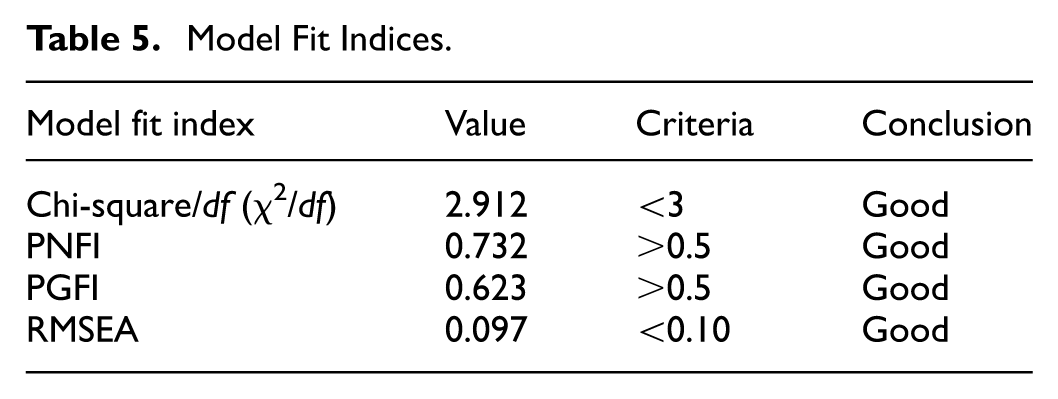
Typically, when performing structural equation modeling, scholars also consider other model fit indices for evaluation. Therefore, several commonly used model fit indices were calculated. The results show that key model fit indices, including PGFI, PNFI, and RMSEA, all fall within the acceptable range, aligning with standard fit criteria (W. Zhang et al., 2020). These findings further enhance the credibility of the structural equation model. According to L. T. Hu and Bentler (1999), a model can be considered to fit well when χ2/df is less than 3 and PNFI exceeds 0.5. In this study, all key indices—χ2/df = 2.912 and PNFI = 0.732—satisfied these benchmarks, indicating that the model has adequate explanatory power. Given the model complexity and the sample size (n = 204), the existing fit indices are sufficient to confirm model validity without the need for additional metrics.
Hypothesis Testing
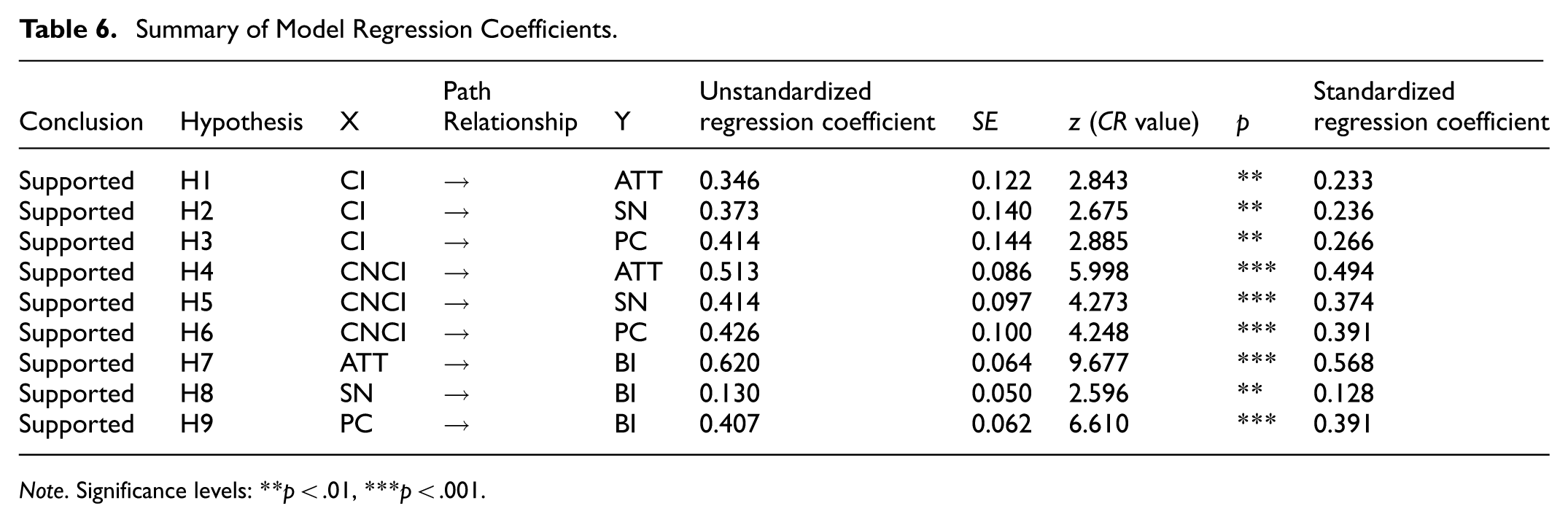
Hypotheses were tested using the questionnaire data, and the results are presented in Table 6 and Figure 2. From these, the following conclusions can be drawn:
H1 Supported: Consumer innovativeness has a significant positive effect on Hanfu consumption attitude (p < .01). This indicates that consumers with higher innovativeness tend to have a more positive attitude toward Hanfu consumption.
H2 Supported: Consumer innovativeness has a significant positive effect on Hanfu consumption subjective norm (p < .01). This suggests that more innovative consumers perceive stronger social norms regarding Hanfu consumption.
H3 Supported: Consumer innovativeness has a significant positive effect on Hanfu consumption perceived behavioral control (p < .01). This implies that consumers with higher innovativeness have a stronger perception of their ability to control Hanfu consumption.
H4 Supported: Chinese national cultural identity has a significant positive effect on Hanfu consumption attitude (p < .001). This suggests that consumers with a strong identification with Chinese national culture tend to have a more positive attitude toward Hanfu consumption.
H5 Supported: Chinese national cultural identity has a significant positive effect on Hanfu consumption subjective norm (p < .001). This indicates that consumers with a high level of cultural identity are more likely to experience positive expectations and normative influences from their social and cultural circles when consuming Hanfu.
H6 Supported: Chinese national cultural identity has a significant positive effect on Hanfu consumption perceived behavioral control (p < .001). This means that consumers with stronger cultural identity have greater confidence and perceived ability to purchase and wear Hanfu.
H7 Supported: Hanfu consumption attitude has a significant positive effect on Hanfu consumption intention (p < .001). This suggests that a more positive attitude toward Hanfu consumption directly enhances consumers’ purchase intention.
H8 Supported: Hanfu consumption subjective norm has a significant positive effect on Hanfu consumption intention (p < .01). This implies that the stronger the social pressure and expectation a consumer perceives, the higher their intention to purchase Hanfu.
H9 Supported: Hanfu consumption perceived behavioral control has a significant positive effect on Hanfu consumption intention (p < .001). This means that consumers with greater confidence in their ability to control and manage Hanfu consumption behavior are more likely to have higher purchase intentions.
Summary of Model Regression Coefficients.
Note. Significance levels: **p < .01, ***p < .001.

Model results diagram.
The path coefficients reveal that Chinese cultural identity exerts its strongest effect on attitude (β = 0.494), markedly higher than its influence on subjective norms (β = 0.374) and perceived behavioral control (β = 0.391). This indicates that consumers’ favorable attitudes toward Hanfu are driven more by a sense of cultural identification than by external social pressure or functional considerations. For example, purchase intention may stem from the belief that “Hanfu symbolizes national culture” rather than from “everyone around me is wearing it.” This finding aligns with Social Identity Theory, which posits that consumption of cultural products serves as a salient form of identity expression.
Consumer innovativeness shows a slightly stronger effect on perceived behavioral control (β = 0.266) than on subjective norms (β = 0.236) and attitude (β = 0.233), suggesting that highly innovative consumers focus more on their own ability to acquire knowledge and styling skills for Hanfu use rather than simply following trends. Although these differences are modest, they resonate with characteristics of early adopters in Diffusion of Innovations Theory, who are inclined to proactively explore new products and overcome usage barriers (Rogers et al., 2014).
Within the TPB framework, attitude has the largest direct impact on purchase intention (β = 0.568), substantially exceeding the effects of subjective norms (β = 0.128) and perceived behavioral control (β = 0.391). This confirms that Hanfu consumption constitutes an emotion-driven behavior in which the degree of personal affinity directly determines purchase intention. The significant path from perceived behavioral control underscores the importance of reducing consumption barriers—such as price and distribution channels—to facilitate adoption, particularly when combined with cultural identity. Overall, the model highlights a central pathway: cultural identity → attitude → purchase intention, while the role of social expectations remains limited.
Discussion and Implications
Discussion
This study, based on the Theory of Planned Behavior, constructs a theoretical model to examine the influence mechanism of consumer innovativeness and Chinese national cultural identity on Hanfu consumption intention. By analyzing 204 valid questionnaire responses, the following conclusions were drawn:
Consumer Innovativeness Significantly and Positively Influences Hanfu Consumption Intention
The findings indicate that consumer innovativeness positively influences Hanfu consumption intention by shaping consumer attitudes, subjective norms, and perceived behavioral control. Consumers with higher innovativeness exhibit a more favorable attitude toward Hanfu, are more susceptible to social norms, and have greater confidence in their ability to control and manage the purchase and use of Hanfu. These results align with prior studies in the fashion consumption field. For instance, Du (2020) and Z. Zhang (2020) found that innovative consumers actively explore new product forms and consumption experiences, develop attitudes toward new products more rapidly and positively, and are more likely to be influenced by social norms and trends. Additionally, they proactively enhance their ability to acquire and utilize products, thereby shaping their consumption intentions. In the context of Hanfu consumption, this driving effect of innovativeness is also evident, as consumers show heightened interest and willingness to try Hanfu products featuring novel designs and unique styles. This further validates the critical role of consumer innovativeness in the formation of consumption intention and the specific paths through which it operates via attitude, subjective norms, and perceived behavioral control.
Chinese National Cultural Identity Significantly and Positively Influences Hanfu Consumption Intention
Consumers with a strong sense of Chinese national cultural identity exhibit more positive attitudes toward Hanfu, are more influenced by social and cultural expectations, and have greater confidence in their ability to engage in Hanfu consumption. This finding aligns with the research of Ding and Wei (2023), which suggests that individuals with a stronger sense of cultural identity are more likely to develop emotional resonance and positive attitudes toward products or activities embodying their cultural heritage. They are also more inclined to follow cultural norms and expectations and, due to their familiarity with the culture, demonstrate greater confidence and competence in acquiring and using related products. As a vital carrier of Chinese traditional culture, Hanfu serves as an excellent example of how cultural identity fosters consumption intention. These results provide empirical evidence for the relationship between cultural identity and consumer behavior.
Attitude as the Primary Driver: Differential Pathways of Cultural Identity and Consumer Innovativeness in Decision Making
Our findings indicate that attitude exerts the strongest influence on purchase intention in the Hanfu consumption decision process, significantly surpassing the effects of perceived behavioral control and subjective norms. This underscores the emotion-driven nature of Hanfu consumption, whereby consumers’ identification with Hanfu cultural meaning and their aesthetic preferences constitute the principal motivators of their purchasing decisions. Notably, Chinese cultural identity predominantly influences purchase intention by fostering a positive attitude, whereas consumer innovativeness encourages consumption behavior primarily by enhancing perceived behavioral control. These differentiated pathways are consistent with previous research (Fan & Ip 2023; C. Zhou, 2024). In practice, consumers with strong cultural identity develop purchase intention through emotional resonance, while innovative consumers convert more readily on account of confidence in their ability to navigate Hanfu styling and acquisition. This insight not only confirms the applicability of the Theory of Planned Behavior across diverse cultural product contexts but also offers guidance for targeted marketing: efforts aimed at culture-oriented consumers should focus on emotional engagement, whereas strategies for innovative consumers should reduce consumption barriers.
Marketing Insights
Based on the empirical findings, the following marketing strategies are proposed:
Deep-Activation Strategies for the Cultural-Identity → Attitude Pathway
First, establish immersive cultural narratives to strengthen emotional resonance. By uncovering the historical anecdotes and symbolic meanings behind Hanfu, brands can develop a “story-driven plus scenario-driven” marketing matrix. For example, a short-form documentary series tracing the evolution of Hanfu styles—such as ma-mian skirts and ao-qun jackets—can illustrate their sociocultural significance in different dynastic contexts. Collaborating with scholars, cultural influencers, and Key Opinion Leaders, brands can launch a “Cultural Research Officer” IP series on social media platforms. Rigorous academic interpretation combined with engaging presentation will deepen consumers’ appreciation of Hanfu’s cultural value. This approach aligns with Huang and Guo’s (2021) theory that “cultural storytelling endows brands with emotional value” and with Qiu et al.’s (2021) finding that celebrity endorsements enhance consumer attitudes and behaviors in their areas of expertise.
Second, create ritualized consumption environments to reinforce collective identity. By organizing Hanfu-themed cultural rituals, brands can embed consumption within participatory cultural practices. For instance, a “Hanfu Culture Month” event in partnered cultural venues might offer hands-on workshops in traditional dyeing and weaving techniques as well as etiquette classes. Such immersive experiences cultivate emotional attachment to Hanfu and echo Ding and Wei’s (2023) finding that cultural practices strengthen identity. Invoking Rook’s (1985) research on ritual consumption, binding consumption to ceremonial contexts can accelerate attitude conversion.
Finally, translate traditional symbols into modern applications to lower cognitive barriers. Integrating Hanfu elements into contemporary wardrobe staples activates positive attitudes among younger consumers. For example, a “Hanfu Commuter Series” might feature a detachable lining within a Song-style skirt to suit office environments. Alternatively, a “Han Element Streetwear” line could combine cloud-pattern embroidery with streetwear silhouettes. This strategy preserves core cultural identifiers while dispelling the stereotype that Hanfu is exclusively period costume. J. Zhang’s (2021) research on cultural products demonstrates that presenting traditional elements with “tangible practicality” enhances consumer attitudes.
Precision Empowerment for the Innovativeness → Perceived-Control Pathway
First, develop a technology-enabled decision support system to enhance consumers’ sense of control. Augmented reality and virtual reality can power an “intelligent virtual fitting and styling” platform that addresses sizing and styling challenges. A 3D-scanning “one-click try-on” app could allow users to upload body measurements, preview different Hanfu silhouettes in real time, and receive personalized fit recommendations. The system might also generate a “Hanfu Styling Calendar,” suggesting outfits based on weather and occasion. Pantano et al. (2022) found that retail technology innovations significantly improve consumer experience and engagement. In addition, AI-powered “Hanfu Styling Advisors” using natural language processing can answer consumers’ care, maintenance, and styling questions, further reducing adoption barriers.
Second, introduce “lightweight” consumption models to lower trial-and-error costs. For innovative consumers who “desire to try but worry about limited use occasions,” flexible options such as rental services and modular ensembles can be offered. A “Hanfu Capsule Wardrobe” subscription could allow consumers to pay a monthly fee to borrow different styles, addressing the pain point of high unit cost and low usage frequency. Modular Hanfu components—such as detachable sleeves or skirts—could enable multiple looks from a single base garment. This approach extends Ha’s (2021) theory that “limited editions stimulate curiosity,” by lowering economic and psychological barriers to initial trial and building consumer confidence. Empirical research by Z. Zhang and Hou (2017) indicates that rental offerings increase trial intention among innovative consumers, with a portion converting to purchases.
Finally, create a user co-creation platform to enhance participatory engagement. Inviting consumers into the design process gives them a sense of ownership. For example, an online “Hanfu Innovation Lab” could allow users to upload original patterns or style modification proposals; successful submissions would be reviewed by experts and, if selected, produced at scale. One brand’s “Ming-style Badge Co-creation Project” invited users to design personalized badge motifs for professional attire, earning strong user feedback. This strategy aligns with Rane et al.’s (2023) theory that “customization enhances loyalty” and with Franke et al.’s (2010) findings on participatory design, which show increased consumer control leads to higher repurchase rates.
Value Co-Creation through Dual-Pathway Synergy
First, form a “cultural-innovation community” that unites emotional identity and experiential innovation. Partnering with cultural institutions, consumer networks, and independent designers, brands can foster a multi-stakeholder ecosystem. For instance, a “Hanfu Cultural Innovation Competition” might invite participants to incorporate modern technological elements into traditional silhouettes; winning entries would undergo review by Hanfu scholars and young consumer panels. This mechanism ensures cultural authenticity while stimulating innovation. Prahalad and Ramaswamy’s (2004) value co-creation theory posits that multi-party collaboration within a shared cultural framework enhances market acceptance.
Second, develop a dual-dimension membership program combining culture and innovation for precision marketing. Based on consumers’ levels of cultural identification and innovativeness, differentiated membership benefits can be offered. Culture-oriented members might gain access to “Intangible Heritage Workshops” or “First-Access Restorative Garment Purchases,” while innovation-oriented members receive “Designer Co-creation Privileges” or “New-Technology Ambassador” status. Consumption data and survey responses can be used to classify members—for example, those who have purchased three or more traditional Hanfu sets and attended cultural events could be labeled as culture-oriented, whereas those who have used modular or rental services are classified as innovation-oriented. This approach draws on Cowan and Ketron’s (2019)“two-dimensional user segmentation model,” enhancing marketing efficiency and user loyalty.
Finally, design “cultural-innovation themed events” to generate viral reach. Through cross-sector collaborations, brands can create events that blend cultural depth with innovative appeal. Dolores et al.’s (2021) theory of cultural event marketing demonstrates that integrating cultural symbols with novel concepts significantly boosts media exposure. Brands can institutionalize such events as annual “Hanfu Culture & Innovation Weeks,” continually reinforcing a brand image that unites heritage preservation with technological innovation.
Research Limitations
This study offers theoretical insights and practical recommendations regarding the determinants of Hanfu purchase intention; however, several limitations should be acknowledged.
Sample Representativeness
Our sample was predominantly composed of young, highly educated females drawn from economically developed cities (e.g., Guangzhou, Wuxi, Hangzhou). This demographic profile may not reflect the broader population of Hanfu consumers. Residents of smaller cities or northern regions, for example, may exhibit different decision-making pathways due to variations in cultural identification, purchasing power, or social contexts. Stratified sampling by age, region, and income should be considered in subsequent studies to enhance generalizability.
Cultural Context Specificity
The results of this study may be influenced by the particular dynamics of China’s traditional culture revival movement. The applicability of these findings to traditional dress consumption in other cultural settings, such as Western countries, warrants further investigation.
Scope of Variables
This research focused on cultural identity and innovativeness as key predictors, but other relevant factors—such as price sensitivity and fashion trends—were not included in the model. Future work should incorporate a broader set of variables to capture the full spectrum of influences on Hanfu consumption.
In summary, while this study elucidates the complex mechanisms through which cultural identity and innovativeness shape Hanfu purchase intention, its findings should be interpreted as exploratory. They suggest several promising avenues for future research. First, the dynamic balance between tradition and modernity in Hanfu consumption merits longitudinal investigation to trace consumers’ transition from initial trials to full cultural internalization. Second, comparing decision processes across subgroups—such as dedicated Hanfu enthusiasts versus general consumers—may yield new insights into cultural product adoption theories. Finally, the role of digital technologies, including virtual try-on and metaverse applications, in mediating traditional culture consumption experiences represents an important interdisciplinary frontier. Advancing these lines of inquiry will contribute to a more comprehensive theoretical framework for traditional cultural consumption.
Footnotes
Acknowledgements
We would like to express our sincere gratitude for the support and assistance received throughout the course of this research. First and foremost, we extend our heartfelt thanks to all the participants in the survey. They generously took time out of their busy schedules to thoughtfully complete the questionnaires, providing invaluable firsthand data for this study. We also wish to acknowledge the financial support from the Jiangsu Social Science Foundation, whose generous funding provided a solid foundation for the research.

Ethical Considerations
The study protocol was reviewed and approved by the Biomedical Research Ethics Committee of Hunan Normal University (Approval No. 2024-822) on December 31, 2024. All procedures were conducted in accordance with relevant ethical guidelines and regulations.
Consent to Participate
Participants provided electronic informed consent after being fully informed of the study objectives, data usage, and measures to protect privacy. Participation was entirely voluntary, and subjects were free to withdraw at any time without penalty. Data were collected anonymously to ensure that individual identities remained untraceable.
Consent for Publication
The three authors confirm that the research work has achieved its phase goals, and the manuscript accurately and comprehensively reflects the research content. We consent to its publication, and future publication matters will be handled strictly in accordance with academic conventions to ensure publication quality.
Author Contributions
Zihuan Wang, study planning, problem definition, literature review, manuscript writing, and questionnaire design; Xinzi Wang, model construction and debugging, language editing, and assisting in refining the research; Le Xing (corresponding author), overall coordination, quality control of the manuscript, and communication with external parties.
Funding
The authors disclosed receipt of the following financial support for the research, authorship, and/or publication of this article: This work was supported by the Jiangsu Social Science Foundation (Grant No. 21YSC009) and the Scientific Research Project of the Hunan Provincial Department of Education (Grant No. 25C0004).
Declaration of Conflicting Interests
The authors declared no potential conflicts of interest with respect to the research, authorship, and/or publication of this article.
Data Availability Statement
The datasets used and analyzed during the current study are available from the corresponding author on reasonable request.