



Abstract
This study integrates PLS-SEM and fsQCA to explore how push and pull motivations, perceived authenticity (object-based, constructive, and existential), satisfaction, and prior knowledge shape two key post-visit behaviors: revisit intention and word-of-mouth intention, in the context of cultural heritage tourism. The PLS-SEM results indicate that motivational factors and authenticity perceptions significantly influence revisit intention but show limited effects on word-of-mouth intention. The fsQCA further reveals multiple distinct configurational pathways leading to both revisit and absence of WOM intentions, highlighting the asymmetric and non-compensatory nature of causal conditions. Notably, some non-WOM configurations feature high levels of cognitive engagement (constructive authenticity and prior knowledge) but lack affective engagement (existential authenticity and satisfaction), suggesting that cognitive understanding alone does not guarantee advocacy behaviors. Moreover, by incorporating prior knowledge as a moderator, the study introduces the concept of the expertise reversal effect into cultural heritage tourism, demonstrating how tourist expertise reshapes motivational influence and co-creation dynamics. These findings extend the theoretical boundary of value co-creation in symbolically rich environments and provide actionable segmentation strategies for heritage site managers based on fsQCA-derived visitor profiles. Additionally, the predictive validity analysis conducted through fsQCA confirms that the identified causal configurations exhibit good predictive power across different sample subsets.
Introduction
Cultural heritage tourism has emerged as a significant driver of both economic development and sociocultural identity, particularly in countries with rich historical legacies such as China (Zhang et al., 2023). Social media platforms and immersive display technologies have transformed heritage spaces into stages for identity expression and value co-creation. This shift suggests that the traditional model of “coexistence” between tourism and heritage may be giving way to a more dynamic model of “co-creation,” where tourists are not only consumers of heritage, but also active participants in its ongoing interpretation and meaning-making (Kastenholz & Gronau, 2020).
Despite increasing scholarly attention on the behavioral intentions of cultural heritage tourists, the current body of literature remains predominantly focused on linear causal relationships, particularly between motivation, satisfaction, and intention (Acharya & Lillywhite, 2021; Li et al., 2023; Yildiz et al., 2023). For example, Acharya and Lillywhite (2021) examined push–pull motivations, satisfaction, and loyalty within the context of agricultural fairs, while Yildiz et al. (2023) explored the linear, cause–effect relationships among cultural travel motivation, authenticity, and satisfaction. These studies provide useful evidence but largely neglect the temporal dynamics of the tourist journey (pre-, on-, and post-visit stages) and the broader value co-creation perspective that captures how motivational, perceptual, and experiential factors interact in a holistic system.
In particular, the notion of authenticity, long recognized as central to cultural heritage tourism, has evolved from an objective property of the site to a multidimensional, perceptually driven construct encompassing existential, constructed, and negotiated dimensions (Cui & Song, 2024; Scott & Campos, 2024). Recent studies have underscored authenticity’s mediating or moderating role in shaping satisfaction and behavioral outcomes (Genc & Gulertekin, 2023; Kovačić et al., 2023), yet few have holistically integrated the cognitive, emotional, and social layers of authentic experience into a coherent analytical model.
Moreover, the prevailing research paradigm often underrepresents the active role of tourists as value co-creators in the cultural heritage experience. The emergent perspective of value co-creation emphasizes tourists’ active engagement in constructing authenticity and negotiating meaning through interpretation, interaction, and engagement (John & Supramaniam, 2024; Leong et al., 2024; L. Zhou et al., 2025). This gap is particularly salient in the context of World Cultural Heritage Sites, where tourists increasingly engage with cultural heritage through social media and experiential modes that transcend traditional notions of staged authenticity (Baker et al., 2023; Bin Azizan et al., 2025). As such, a need exists to move beyond linear models and embrace configurational, multi-method approaches that can capture the interplay between motivational forces, perceptual authenticity, and post-visit behavioral intentions.
To overcome the limitations of linear models of tourist behavior, this study adopts a process-oriented perspective that conceptualizes the tourist experience as a temporal sequence of pre-visit, on-site, and post-visit phases, thereby capturing the dynamic nature of value co-creation in cultural heritage contexts. Such an approach enables a more comprehensive understanding of how heritage tourists navigate, construct, and respond to their experiences across time. In particular, the co-creation logic has been applied to explain how experiential and contextual factors such as authenticity cues, prior knowledge, and travel motivations interact to influence value formation in heritage settings.
To empirically capture this complexity, the study employs a multi-method design, integrating PLS-SEM with the fsQCA. This combined approach allows for the simultaneous identification of complex interrelationships and causal configurations, thereby addressing both additive and combinatorial pathways to tourist behavioral intentions. In doing so, the study contributes to a more holistic understanding of tourists’ behavioral intentions in cultural heritage contexts.
Literature Review
The concept of cultural heritage tourism has its roots in the broader field of cultural tourism, which emerged in the latter half of the twentieth century as scholars began emphasizing the role of culture as a central motivation for travel and as a means of fostering intercultural understanding (McKercher & Du Cros, 2002; Richards, 1996). Early forms of cultural tourism focused primarily on visits to museums, monuments, and artistic events, but over time the scope expanded to include everyday culture, local traditions, and participatory experiences (Richards, 2018).
Cultural heritage tourism represents a more specific and historically grounded dimension of cultural tourism, emphasizing the appreciation, preservation, and interpretation of tangible and intangible heritage resources (Timothy & Boyd, 2003). While cultural tourism broadly concerns contemporary cultural practices and creative engagement, cultural heritage tourism centers on encounters with the past and the meanings embedded in heritage places, artifacts, and traditions. In this study, cultural heritage tourism is thus conceptualized as an integrative form of tourism that connects cultural participation with heritage conservation, enabling visitors to engage in co-creation processes that simultaneously sustain and reinterpret heritage values.
Value Co-Creation in the Context of Cultural Heritage Tourism
The conceptual foundation of value co-creation was first articulated by Prahalad and Ramaswamy (2004), who emphasized the shift from firm-centric value creation to a collaborative process where consumers actively participate in creating personalized experiences. Vargo and Lusch (2008) further advanced this perspective through the Service-Dominant (S-D) Logic, positioning value as co-created through resource integration and interaction among multiple actors. Building on these foundational insights, John and Supramaniam (2024) provided a comprehensive synthesis showing that value co-creation in tourism contexts, particularly those embedded with rich cultural assets, involves emotional, cognitive, and relational participation. Borges-Tiago and Avelar (2025) further emphasized that in heritage settings, co-creation encompasses interpretive dialogue, affective immersion, and collaborative storytelling, all of which move beyond traditional provider-driven models of heritage management. Accordingly, value co-creation in cultural heritage tourism is increasingly viewed as a dynamic and socially embedded process through which meaning, identity, and value are jointly constructed by multiple stakeholders, including visitors, guides, local communities, and cultural institutions, within environments that are historically and symbolically significant (John & Supramaniam, 2024). However, much of the existing research tends to describe co-creation as a desirable process rather than critically interrogating its boundaries, tensions, and contextual dependencies. This study seeks to extend that conversation by examining how co-creation unfolds differently across temporal stages and among visitors with varying levels of prior expertise.
Building on these perspectives, recent research has examined how value co-creation manifests in cultural heritage tourism. In such contexts, co-creation unfolds through interactive storytelling, shared interpretation, and embodied participation, mechanisms that enhance visitor engagement and foster the sustainable valorization of heritage (Campos et al., 2023; Leong et al., 2024). For instance, storytelling co-developed by tourists and hosts facilitates emotional connection and cultural transmission (Campos et al., 2023), while authentic settings and guide interactions encourage interpretive participation (Leong et al., 2024). Recent tourism communication research further reinforced the view that value co-creation is not a peripheral feature but a central process through which meaning, identity, and value are jointly constructed by multiple stakeholders (Borges-Tiago & Avelar, 2025). Together, these insights provide a nuanced understanding of how co-creation manifests within heritage contexts and inform the conceptual framing of this study.
Yet, while prior studies have richly described the interactive mechanisms of co-creation, less is known about the perceptional dimensions that underpin these processes, particularly the role of authenticity in shaping visitors’ engagement and meaning-making. The notion of authenticity remains theoretically fragmented, as objective, constructive, and existential perspectives offer distinct yet overlapping interpretations (Cui & Song, 2024; Scott & Campos, 2024). To address these conceptual ambiguities, the present study adopts and contextualizes the established typology of authenticity proposed by N. Wang (1999). Drawing upon N. Wang (1999) and subsequent heritage tourism literature, objective authenticity is defined as visitors’ perceptions of the tangible genuineness of heritage artifacts and architecture, while constructive authenticity refers to the socially constructed meanings that emerge through interpretive narratives and cultural performances. In contrast, existential authenticity denotes an emotional state of self-realization and being oneself, often evoked through immersion in heritage narratives and participatory experiences.
Thus, authenticity is further situated within a dynamic process of value co-creation that unfolds over time. Drawing on the temporal perspective of value co-creation proposed by Holmqvist et al. (2020), the present study conceptualizes value co-creation in cultural heritage tourism as a continuous process encompassing three interrelated stages: pre-visit, on-site, and post-visit. In this framework, pre-visit motivations are operationalized through push–pull factors, where push motivations represent internal drivers such as seeking knowledge, desire for cultural enrichment, or personal growth (G. Lee et al., 2021), and pull motivations reflect external attractions, including the heritage site’s unique architecture, cultural events, or transportation convenience (Katsikari et al., 2020). On-site experiences capture visitors’ perceptions and satisfaction, with perceived authenticity functioning as a key experiential construct. Post-visit behavioral intentions reflect how co-created value manifests in continued loyalty and advocacy behaviors. This longitudinal framing allows for a more comprehensive analysis of how value is accumulated and transformed throughout the heritage tourism experience, particularly within symbolically charged and culturally embedded environments.
Moreover, this study introduces prior knowledge as a moderating factor that influences how tourists engage in value co-creation across these stages. Specifically, prior knowledge is conceptualized as heritage-related knowledge that moderates the relationships between pre-visit motivations and on-site engagement (perceived authenticity and satisfaction). Tourists with high levels of heritage-related knowledge are more likely to arrive with well-formed expectations, seek deeper interpretive engagement on-site, and construct more nuanced post-visit reflections. Conversely, less knowledgeable tourists may rely more heavily on curated experiences and narrative facilitation (J. Wang et al., 2023; Xu et al., 2022). This logic aligns with the expertise reversal effect (Chen et al., 2017), which posits that as individuals acquire expertise, cognitive load decreases and processing becomes more automated, thereby altering the way value and meaning are constructed during the heritage experience. Accordingly, by incorporating prior knowledge as a segmentation criterion, this research addresses the heterogeneity of tourist profiles and enables a more differentiated understanding of co-creation behaviors. Taken together, this approach refines theoretical models of value co-creation while providing a framework for differentiating visitor engagement across temporal stages.
Hypotheses Development
This study draws upon value co-creation theory and cultural heritage tourism literature to propose a comprehensive framework comprising antecedents, mediators, and outcomes of co-creation behavior across the full visitor journey, as shown in Figure 1.

Conceptual framework.
Push and Pull Motivations as Antecedents
Building on the established push–pull framework, this study further examines how motivational drivers function as antecedents of perceived authenticity within the co-creation process. Specifically, tourists’ intrinsic (push) and extrinsic (pull) motivations are posited to influence how they interpret heritage cues, engage with cultural narratives, and derive satisfaction from their experiences (G. Lee et al., 2021; Yildiz et al., 2023). Prior studies have indicated that culturally oriented motivations enhance sensitivity to authenticity cues, thereby shaping both cognitive and affective evaluations of heritage sites. Thus, the following hypotheses are proposed:
Revisit Intention and WOM Intention as Outcomes
Previous studies in heritage and experience-based tourism contexts have underscored the pivotal role of perceived authenticity and satisfaction in shaping post-visit behavioral intentions. (G. Zhou et al., 2022) found that higher perceived authenticity enhances tourists’ revisit intention, while Deb and Lomo-David (2021) confirmed its significant effect on word-of-mouth (WOM) intention in heritage contexts. However, limited research has examined how different dimensions of authenticity (objective, constructive, and existential) influence both revisit and WOM intentions in cultural heritage contexts. Moreover, satisfaction has been consistently identified as a strong predictor of both revisit and WOM intentions in heritage and leisure tourism (He & Luo, 2020; Rasoolimanesh et al., 2022). Based on this, the following hypotheses are proposed:
Perceived Authenticity and Satisfaction as Mediators
In cultural heritage tourism, perceived authenticity and satisfaction serve as key evaluative mechanisms linking tourist motivations to experiential value and behavioral intentions. Through emotional and cognitive appraisal of heritage experiences, tourists co-create value by engaging with cultural resources. Prior studies have highlighted their mediating roles: satisfaction mediates the effects of push and pull motivations on revisit intention (S. Lee et al., 2018), while perceived authenticity mediates the impact of cultural motivations on behavioral intentions (Li et al., 2023). Although empirical evidence on how different authenticity dimensions mediate between motivations and revisit or WOM intentions remains limited, existing findings suggest such pathways are plausible. Accordingly, this study investigates the mediating effects of objective, constructive, and existential authenticity, as well as satisfaction, between push–pull motivations and revisit and WOM intentions, addressing a key gap in heritage tourism research. Therefore, the following hypotheses are proposed:
Prior Knowledge as a Moderator
Prior knowledge plays a crucial role in shaping how tourists engage with and interpret cultural heritage. Xu et al. (2022) identified it as a moderating factor influencing the relationship between cultural tendencies and involvement, noting that tourists with greater cultural awareness experience deeper engagement. Similarly, Carreira et al. (2022) found that prior knowledge significantly affects authenticity perception. Although often treated as a predictor, its moderating role remains underexplored, particularly in how it conditions the effects of motivational drivers on subsequent evaluations. Accordingly, this study posits that prior knowledge moderates the relationships between push–pull motivations and perceived authenticity and satisfaction, as tourists with richer prior knowledge may interpret heritage experiences more meaningfully and thereby alter these motivational pathways. Thus, the following hypotheses are addressed:
Methodology
This study employed a mixed-method approach integrating PLS-SEM and fsQCA to capture both the general and configurational dynamics of tourist behavior. PLS-SEM was first applied to test the hypothesized relationships and assess the structural links among constructs, consistent with the study’s theory-driven framework. However, as tourist behavior often results from multiple interdependent conditions, fsQCA was subsequently used to identify equifinal combinations of causal factors. The integration of these two methods offers a comprehensive understanding by combining the symmetric, variable-oriented perspective of PLS-SEM with the asymmetric, configuration-oriented insights of fsQCA. Specifically, PLS-SEM enables the estimation of direct and indirect causal effects between constructs (Hair et al., 2014), while fsQCA reveals distinct configurations of conditions leading to the same outcome (Hong & Liang, 2025; Ragin, 2000; Schneider & Wagemann, 2010b). The PLS-SEM analysis was conducted using SmartPLS 4.1, and the fsQCA analysis was performed with fsQCA software version 4.1.
Ethical Considerations
This study involved adult visitors to Xidi Village who voluntarily completed a self-administered questionnaire. Several procedures were implemented to minimize potential risks to participants. First, all questions concerned general perceptions, motivations, and experiences related to tourism, involving no sensitive personal or psychological issues. Second, the survey was anonymous, and no identifying information was collected, thereby ensuring confidentiality and reducing the risk of any potential harm or discomfort.
The potential benefits of this research outweighed the minimal risks involved. The findings contribute to a better understanding of tourist motivation, authenticity, and value co-creation in heritage sites, which can inform destination management and enhance visitors’ overall experience. Participants themselves could also benefit by reflecting on their travel experiences and motivations, a process that many found enjoyable and meaningful.
Informed consent was obtained prior to participation. Before administering the survey, the researcher explained the purpose of the study, the voluntary nature of participation, and assurances of confidentiality in person. Each participant was presented with an information statement on the first page of the electronic questionnaire describing the study purpose, voluntary participation, and data protection measures. Participants indicated their consent by ticking an agreement box before proceeding to answer the questions. No names or identifying details were collected, ensuring full anonymity. Participants were informed that they could withdraw from the study at any time without providing a reason, and that their responses would be used solely for academic research and publication purposes. The study posed minimal risk and adhered to ethical principles outlined in the APA (2020) Ethical Principles of Psychologists and Code of Conduct (Section 8.05).
Measurement and Structural Model
Data were drawn from a field survey conducted at Xidi Village in Anhui Province, China, from August to December 2024. Xidi Village, inscribed as a UNESCO World Cultural Heritage Site in 2000, is renowned for its well-preserved Huizhou-style architecture, ancestral halls, and traditional settlement layout that reflect the cultural legacy of Ming–Qing merchant society. Compared with the nearby Hongcun Village, which is more commercialized, Xidi maintains a relatively authentic and community-oriented atmosphere (Jiang et al., 2009), making it a representative site for studying tourists’ perceptions of authenticity and behavioral intentions.
Data were collected using a tablet-based electronic questionnaire, which was administered to visitors on site. The survey measured visit motivations, perceived authenticity, satisfaction, and behavioral intentions using multi-item scales adapted from prior research. For instance, Objective authenticity was measured with items such as “I perceived that historical buildings are well preserved” and “I perceived that the attractions of this site are mostly genuine” (Kolar & Zabkar, 2010; Seyitoğlu et al., 2022). Detailed measured items and sources are provided in the Table A1.
All measurement items were rated using a 7-point Likert scale (1 = strongly disagree to 7 = strongly agree). A 7-point format was adopted because it offers greater sensitivity and discriminative capacity in capturing attitudinal nuances compared to shorter scales, enhancing the reliability of behavioral intention measures (Finstad, 2010; Preston & Colman, 2000). Completed questionnaires were collected to ensure high data quality and organization, forming a valid dataset for subsequent PLS-SEM, moderation, and fsQCA analyses.
Data were collected through on-site surveys using a convenience sampling approach, which is common in field-based tourism research where a complete sampling frame of visitors is not available. To enhance representativeness, surveys were conducted across different time periods (morning, afternoon, evening), at multiple entry and exit points, and on both weekdays and weekends, ensuring a diverse range of respondents. While this approach does not constitute strict random sampling, it approximates random selection in practice by reducing location and time biases. Thus, a total of 600 complete responses were retained. Among these 600 respondents, 262 were male (43.7%) and 338 were female (56.3%). A majority of 496 visitors (82.7%) were aged between 18 and 45 years. Of all respondents, 538 (89.7%) were first-time visitors and 62 (10.3%) were repeat visitors. Furthermore, VIFs for all constructs were below 3.3 (Hair et al., 2014), indicating that no multicollinearity issues were present in the dataset.
Given the complexity of the research model and the inclusion of two endogenous outcome variables, PLS-SEM was selected over CB-SEM as the preferred analytical technique. Although the study is theory-driven, PLS-SEM was deemed more appropriate because it effectively handles complex structural relationships, accommodates non-normal data distributions, and provides robust estimates of both direct and indirect effects (Hair et al., 2014). Moreover, its predictive orientation aligns with the study’s objective of examining the strength and relative importance of multiple interrelated pathways among latent constructs.
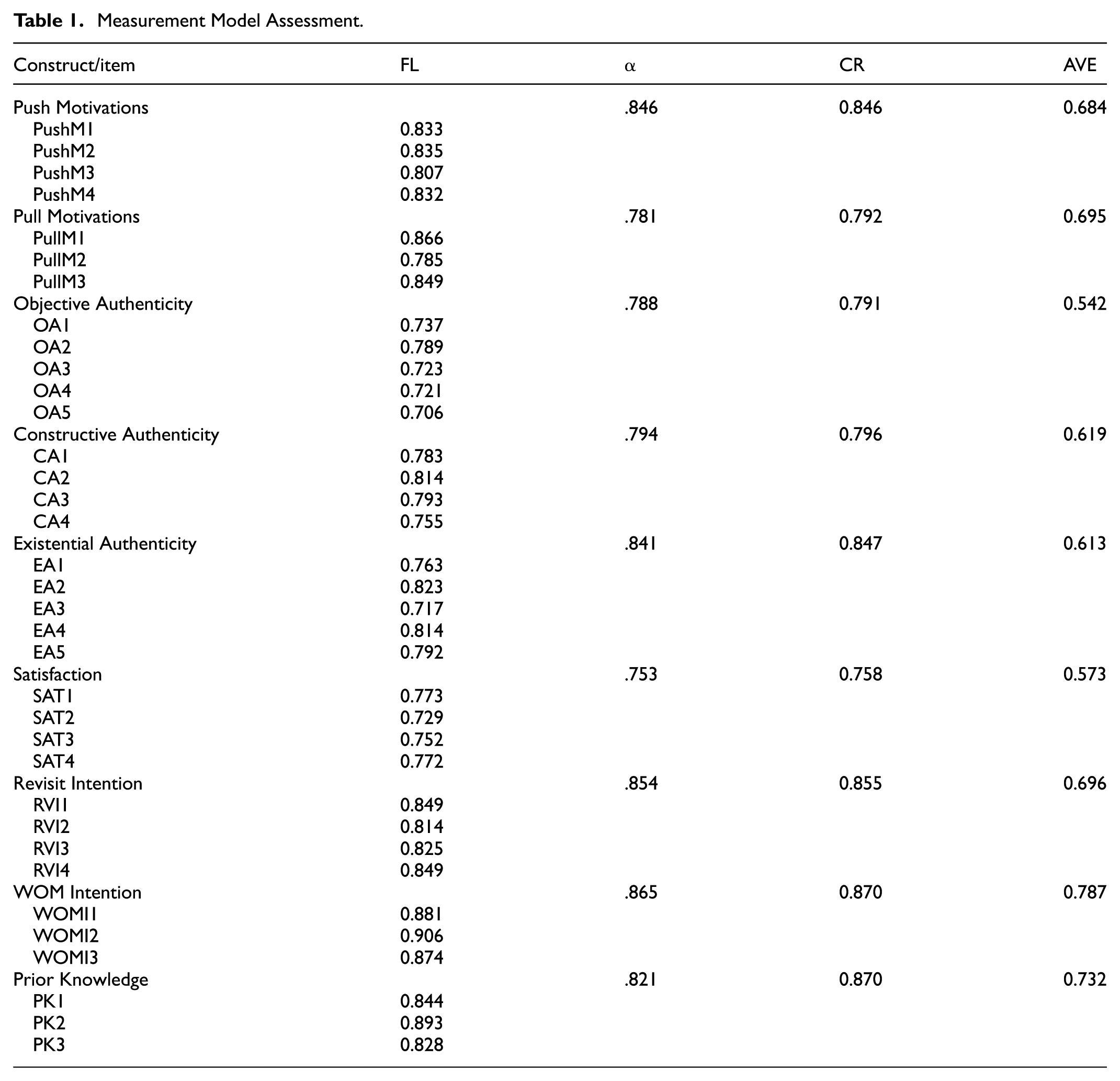
Prior to the structural analysis, the measurement model was refined and validated to ensure indicator reliability and construct validity. All items demonstrated satisfactory factor loadings above the recommended threshold of 0.70 (Hair et al., 2014), and no indicators were removed.
Moderation Analysis
Building on the main structural model, an additional moderation analysis was conducted to examine the role of prior knowledge in shaping the relationships among key constructs. Prior knowledge was measured as a continuous variable using three items adapted from G. Lee et al. (2021), see Table A1.
Selecting prior knowledge as a moderator is both theoretically and practically meaningful. Theoretically, it enables the segmentation of visitors based on their levels of prior knowledge, offering deeper insights into how motivations and perceptual responses vary across visitor groups. Specifically, it tests whether prior knowledge amplifies or attenuates the relationships between motivational drivers and visitors’ perceptual experiences.
Practically, incorporating prior knowledge as a moderator helps identify differentiated visitor needs, enabling heritage site managers to design more targeted interpretation and communication strategies for audiences with varying degrees of familiarity and expertise.
Configurational Analysis
Fuzzy-set Qualitative Comparative Analysis (fsQCA) is a method used to explore complex causal relationships by analyzing the combinations of conditions that lead to a specific outcome (Fiss, 2011). In tourism research, fsQCA is particularly useful for understanding how different combinations of factors such as satisfaction, tourist engagement, and service quality influence tourists’ behavioral intentions, including revisit intention and WOM intention (Eluwole et al., 2024; Hong & Liang, 2025).
In this study, fsQCA was conducted based on the results of the PLS-SEM analysis. Antecedents in the structural model were used as core conditions in the configurational analysis. In addition, prior knowledge was included as a contextual condition to enhance the explanatory power of the model. Data calibration followed standard three-threshold procedures: 0.90 for full membership, 0.50 for crossover, and 0.10 for full non-membership (Schneider & Wagemann, 2010b). This allowed for a nuanced understanding of how different combinations of psychological and experiential factors influenced tourists’ behavioral intentions.
The predictive validity of the fsQCA model was assessed following the procedure proposed by Woodside (2013) and later elaborated by Pappas and Woodside (2021). fsQCA not only enables the identification of multiple sufficient pathways leading to an outcome but also allows for the evaluation of their predictive performance. This assessment strengthens the external validity and practical relevance of the configurational findings.
Results
PLS-SEM Results
Assessment of Measurement Model
As shown in Table 1, the measurement model demonstrated satisfactory reliability and validity. All factor loadings (0.706–0.906) exceeded the recommended threshold of 0.70 (Hair et al., 2019), confirming indicator reliability. Construct reliability was supported by Cronbach’s alpha (.753–.865) and composite reliability (0.758–0.870), both above 0.70. Convergent validity was also established, with all average variance extracted (AVE) values ranging from 0.542 to 0.787, exceeding the 0.50 criterion (Fornell & Larcker, 1981), thereby demonstrating adequate indicator reliability.
Measurement Model Assessment.
Discriminant validity was confirmed using the Fornell–Larcker criterion and the Heterotrait–Monotrait ratio (HTMT). As shown in Tables 2 and 3, the square root of each construct’s AVE was greater than its inter-construct correlations, and all HTMT values were below 0.85 (Kline, 2023), confirming construct distinctiveness.
Fornell-Larcker Criterion.

HTMT0.85 Ratio.

Effect size (f2), predictive relevance (Q2), and cross-loading results, which further support the robustness of the measurement model, are presented in the Supplemental Materials.
Assessment of Structural Model
The structural model was evaluated through path coefficients (β), t-values, p-values, and the explanatory power (R2) of endogenous constructs. As presented in Table 4 and Figure 2, most hypothesized direct relationships were statistically significant (p < .05), except those between authenticity/satisfaction and WOM intention.
Hypothesis Results.


The result of structural model.
Both push and pull motivations positively influenced OA (H1: β = .620, t = 18.654, p < .001; H5: β = .083, t = 2.256, p < .05), CA (H2: β = .435, t = 11.864, p < .001; H6: β = .331, t = 8.426, p < .001), EA (H3: β = .416, t = 10.172, p < .001; H7: β = .375, t = 9.921, p < .001), and SAT (H4: β = .519, t = 11.909, p < .001; H8: β = .206, t = 4.705, p < .001), with push motivations exerting stronger effects overall.
Among the authenticity dimensions, EA had the strongest influence on revisit intention (H11: β = .436, t = 9.923, p < .001), followed by CA (H10: β = .193, t = 4.781, p < .001) and OA (H9: β = .096, t = 2.644, p < .01). Satisfaction also positively affected revisit intention (H12: β = .169, t = 4.238, p < .001). In contrast, only EA significantly predicted WOM intention (H15: β = .187, t = 3.323, p < .01), while OA, CA, and SAT showed no significant effects.
Regarding mediation, CA, EA, and SAT (H18–H24) significantly mediated the relationships between motivations and revisit intention, whereas OA only mediated the effect of push motivations (H17: β = .059, t = 2.620, p < .01). Most mediation effects on WOM intention were insignificant, except through EA (H27, H31).
The model explained 48.4% of the variance in OA, 49.1% in CA, 53.6% in EA, 46.7% in satisfaction, and 57.8% in revisit intention. However, the explained variance for WOM intention was relatively low (8.5%), implying that additional variables may influence this outcome.
Moderation Results
The moderating effects of prior knowledge (PK) were examined to assess its influence on the relationships between motivations and outcome variables (Table 5).
Moderation Results.

For push motivations, PK significantly strengthened the positive effects on EA (H35: β = .140, t = 3.04, p < .01) and SAT (H36: β = .125, t = 2.913, p < .01), indicating that individuals with higher prior knowledge experienced stronger impacts of push motivations on EA and satisfaction.
Conversely, PK weakened the effects of pull motivations, reducing their positive relationships with EA (H39: β = −.113, t = 2.534, p < .05) and SAT (H40: β = −.106, t = 2.237, p < .05).
No significant moderating effects of PK were found for the paths from push motivations to OA (H33) and CA (H34), or from pull motivations to OA (H37) and CA (H38).
Overall, these findings suggest that PK amplifies the influence of internal (push) motivations while dampening that of external (pull) motivations on tourists’ experiences and satisfaction.
fsQCA Results
Based on the PLS-SEM results, the model explained 57.8% of the variance in revisit intention, indicating substantial explanatory power. In contrast, the R2 for WOM intention was only 8.5%, suggesting that the model had limited ability to account for this outcome. Given this low explanatory power, conducting fsQCA on WOM intention would offer limited theoretical insight. Instead, this study focused on the absence of WOM intention to identify the potential configurations leading to weak word-of-mouth behaviors. This complementary approach enables a deeper understanding of the underlying causal complexity beyond the causal relationships captured by PLS-SEM.
All variables included in the structural model were retained for the fsQCA, and three types of analyses were conducted: necessity analysis, truth table analysis, and predictive validity assessment. These procedures provided a more nuanced understanding of causal asymmetry and the sufficiency of different condition sets in explaining both revisit intention and the absence of WOM intention.
Step 1: Analysis of Necessary Conditions
The necessity analysis aimed to determine whether any single condition was indispensable for achieving revisit intention (RVI) or the absence of WOM intention (∼WMI). A condition is considered necessary if its consistency exceeds 0.90 and its coverage exceeds 0.60 (Schneider & Wagemann, 2010a). As shown in Table 6, none of the individual conditions, whether in their presence or absence, met these thresholds, indicating that no single construct alone was necessary for producing either outcome.
Analysis of Necessary Conditions.

Note. ∼WOMI indicates absence of WOM intention; ∼ means absent factor.
For revisit intention, the most consistent conditions were push motivations (consistency = 0.828), EA (0.824), and pull motivations (0.812), suggesting that these factors frequently appear in configurations associated with revisit intention, even if not strictly necessary.
In contrast, for the absence of WOM intention (∼WMI), the absence of EA (∼EA; consistency = 0.729), CA (∼CA; 0.717), and OA (∼OA; 0.715) showed relatively higher consistency. Although OA and CA were not significant predictors of WOM intention in the PLS-SEM model, the fsQCA results indicate that low levels of authenticity perceptions may commonly co-occur with weaker WOM.
These findings provide the foundation for the subsequent truth table and configurational analyses, which focus on identifying combinations of conditions sufficient to explain both outcomes.
Step 2: Solution Analysis
The fsQCA results revealed multiple distinct configurations of antecedent conditions leading to revisit intention. In this analysis, core conditions (large black dots) appear in both the parsimonious and intermediate solutions, indicating strong causal links with the outcome, whereas peripheral conditions (small black dots) appear only in the intermediate solution, reflecting supporting roles. Large hollow circles represent absent factors that act as core conditions, and small hollow circles indicate absent peripheral factors. These patterns underscore the asymmetrical nature of causality in fsQCA, where certain factors play more pivotal roles in producing outcomes (Ragin, 2000).
The overall solution coverage for revisit intention was 0.749, explaining approximately 74.9% of the cases, while the solution consistency was 0.857, indicating high reliability (Pappas & Woodside, 2021). As presented in Table 7, eleven distinct causal configurations emerged. For example, pull motivations and OA acted as core drivers in Solution 3, while push motivations and EA were central in Solutions 4 and 5. In Solution 6, all included conditions were core, representing a comprehensive pathway to revisit intention. Similarly, Solutions 7 to 9 highlighted various combinations of push motivations, CA, EA, and satisfaction as key antecedents, whereas Solutions 10 to 11 underscored the joint presence of push and pull motivations and OA. Overall, push motivations, CA, and EA consistently appeared as core conditions across several configurations, reinforcing their central roles. In contrast, PK and satisfaction often served as peripheral factors, suggesting context-dependent influence. These results exemplify equifinality, where multiple qualitatively distinct causal routes can produce the same outcome.
Truth Table Analysis of Revisit Intention.

Note. “●” indicates the core condition present; “•” indicates the peripheral condition present; “○” indicates the peripheral condition absent; “◯” indicates the core condition absent; blank cells indicate conditions that are irrelevant to the configuration. PK = prior knowledge; PushM = push motivations; PullM = pull motivations; OA = objective authenticity; CA = constructive authenticity; EA = existential authenticity; SAT = satisfaction.
In contrast, the fsQCA also identified multiple configurations associated with the absence of WOM intention, yielding a solution consistency of 0.857 and a solution coverage of 0.508 (Table 8). The configurational results revealed several distinct pathways leading to this outcome. One configuration was characterized by the absence of push motivation and satisfaction combined with the presence of pull motivation, suggesting that visitors driven primarily by external attractions but lacking internal drive or satisfaction were less likely to engage in WOM behavior. Another prominent configuration highlighted the joint absence of objective and existential authenticity and satisfaction, while constructive authenticity was present, indicating that when visitors perceive authenticity mainly through interpretive rather than experiential means, their willingness to share WOM decreases. Additionally, configurations featuring the concurrent absence of push and pull motivations together with low authenticity perceptions (OA and EA) were also associated with reduced WOM intention. In contrast, pathways involving the presence of prior knowledge and constructive authenticity, despite weak motivational factors, suggested that cognitive familiarity and interpretive authenticity alone were insufficient to stimulate WOM behavior. Furthermore, a configuration featuring high existential authenticity but low satisfaction and push motivation indicated that even authentic experiences may not translate into WOM when affective fulfillment is lacking. Overall, these patterns underscore that the absence of motivational and satisfaction factors, particularly when coupled with diminished authenticity perceptions, consistently contributes to lower WOM engagement.
Truth Table Analysis of Non WOM Intention.

Note. “●” indicates the core condition present; “•” indicates the peripheral condition present; “○” indicates the peripheral condition absent; “◯” indicates the core condition absent; blank cells indicate conditions that are irrelevant to the configuration. PK = prior knowledge; PushM = push motivations; PullM = pull motivations; OA = objective authenticity; CA = constructive authenticity; EA = existential authenticity; SAT = satisfaction.
Step 3: Predictive Validity Analysis
To evaluate the external validity and generalizability of the fsQCA findings, a predictive validity analysis was conducted following established procedures (Pappas & Woodside, 2021; Schneider & Wagemann, 2010a). The original dataset was randomly divided into two mutually exclusive subsets, with approximately 70% of cases forming the subsample, used to identify new causal configurations, and 30% forming the holdout sample, used to test their predictive power. The split was performed using a random number generator to ensure unbiased allocation. The configurations derived from the subsample were not identical to those obtained from the full dataset, which is expected due to variations in case distribution and calibration base, as documented in prior set-theoretic research (Fiss, 2011).
The goal of predictive validity analysis is not to replicate the specific configurations from the original model, but to examine whether the general causal logic—that certain combinations of conditions lead to the outcome—holds in an independent data context. This approach moves beyond internal model fit and assesses whether the discovered configurations can effectively predict the same outcome (e.g., revisit intention or absence of WOM intention) in a new sample.
In this study, eight configurations predicting revisit intention and six configurations predicting the absence of WOM intention were identified in the subsample. These were then applied to the holdout sample by calculating solution membership scores and assessing their predictive performance. To simplify the analysis, individual solution memberships were combined into a composite solution set using the maximum-set approach (Schneider & Wagemann, 2010a). Predictive consistency and predictive coverage were computed as follows (Schneider & Wagemann, 2010a):


As shown in Figures 3 and 4, the predictive validity plots demonstrated strong predictive performance. For revisit intention, the solution set achieved a consistency of 0.840 and a coverage of 0.668. For the absence of WOM intention, the corresponding values were 0.883 and 0.416, respectively. Although the configurations identified in the subsample differed from those in the full dataset, the findings confirm the robustness and predictive utility of the configurational framework. This provides additional evidence that the outcomes are shaped by causal complexity, even under varying data conditions, thereby reinforcing the overall validity of the fsQCA model.

Predictive validity plot for revisit intention.

Predictive validity plot for absence of WOM intention.
Discussion
The results of the PLS-SEM analysis generally align with prior studies on tourism motivation and behavioral intention, showing that both PushM and PullM significantly influence OA, CA, EA, and SAT, which in turn significantly affect revisit intention. These findings confirm the robustness of motivational and experiential factors in shaping tourists’ evaluative and revisit behaviors. However, the model explains only 8.5% of the variance in WOM intention, indicating that other affective, social, and contextual factors may play a more dominant role in influencing visitors’ advocacy behaviors.
Although SEM results suggest limited explanatory power for WOM intention, the fsQCA analysis reveals the complex causal configurations underlying its absence. Specifically, perceived authenticity (OA, EA) and satisfaction (SAT) alone are insufficient to generate WOM intention, but their absence consistently precludes it. This indicates that authenticity and satisfaction are necessary conditions for advocacy behaviors, but their presence alone does not guarantee WOM. The fsQCA yielded 11 configurations explaining the absence of WOM intention. Representative configurations included: absence of PushM and SAT with PullM present (Solution 1); absence of OA, EA, and SAT with CA present (Solution 2); joint absence of PushM, PullM, OA, EA, and SAT with CA present (Solutions 3–4); PK and CA present but PushM and PullM absent (Solutions 5–6); EA present with absence of PushM and SAT (Solution 7); and absence of OA, EA, and SAT co-occurring with presence of CA, PullM, or PK (Solutions 9–11).
These configurations can be grouped into three typologies. The Motivational Deficiency Pathway is characterized by lack of PushM/PullM and low SAT (Solutions 1, 3–4, 5–6), indicating that insufficient internal and external motivation combined with low satisfaction leads to absence of WOM intention. This pathway underscores that WOM is a high-engagement behavior requiring both motivational and affective drivers. The Authenticity Deficit Pathway is marked by absence of OA, EA, and SAT despite CA being present (Solutions 2, 10, 11), illustrating that cognitive recognition alone is insufficient; lack of authentic and satisfying experiences prevents advocacy. This highlights the asymmetric effect of different authenticity dimensions on WOM intention. Finally, the Knowledge–Authenticity Mismatch Pathway, where PK and CA are present but PushM/PullM are absent (Solutions 5–6), suggests that cognitive understanding or prior knowledge alone cannot compensate for missing motivation, emphasizing the importance of alignment between knowledge and motivational engagement.
Recent studies further suggest that WOM intention is influenced by a variety of psychological and contextual variables. Emotional responses, personal pleasure, and intrinsic enjoyment can significantly drive WOM, although their effects vary across destination contexts and visitor profiles (Meenakshy et al., 2024; Nieves-Pavón et al., 2024). Individual differences, such as Openness, Conscientiousness, Extraversion, and Neuroticism, also shape online WOM behaviors, while Agreeableness appears less relevant (Fanea-Ivanovici et al., 2023). Even when authenticity positively affects WOM, its generalizability across environments and audiences is uncertain (Zhu et al., 2024). These findings support the notion that WOM intention may operate less as a rational evaluation and more as an affective and socially embedded expression of personal experience. From a theoretical perspective, this aligns with dual-process models (Kahneman, 2011), in which affective and social pathways can dominate over cognitive evaluations. Complementarily, social exchange theory and self-expression theory suggest that visitors may share experiences to gain social recognition, help others, or express their identity (Cook et al., 2013; Sripada, 2016).
In contrast to the complex and asymmetric drivers of WOM intention, revisit intention largely follows more stable cognitive and experiential pathways. PLS-SEM results confirm that PushM, PullM, and experiential factors (OA, CA, EA, SAT) significantly influence revisit intention, explaining a substantial portion of variance. To capture complex interactions beyond SEM results, fsQCA identifies 11 configurations leading to high revisit intention, which can be grouped into 4 visitor types: high motivation and experience, motivation-focused, externally oriented, and niche experiential. These findings reveal that revisit intention arises from multiple motivational–experiential combinations, supporting cognitive and experiential pathways. The near-necessary roles of PushM and EA indicate that tourists’ intrinsic motivations and engagement with authentic experiences jointly drive repeat visitation, as the necessity analysis showed that while no single condition exceeded the 0.90 consistency threshold, both PushM and EA approached this level (0.87–0.89), suggesting their foundational but not strictly indispensable role in motivating revisit behavior. This aligns with value co-creation frameworks in tourism (Orts-Cardador et al., 2025), in which visitors actively participate, interpret, and derive personal value from their experiences, and this co-created value reinforces both satisfaction and behavioral intention.
The moderating analysis indicates that prior knowledge (PK) shapes how motivational factors influence tourists’ experiential perceptions. Specifically, PK enhances the impact of internal Push motivations on both existential authenticity and satisfaction, while dampening the influence of external Pull motivations. This suggests that visitors with greater domain knowledge rely more on self-directed, internal motivations to construct meaningful and satisfying experiences, whereas those with less prior knowledge are more responsive to external cues.
This pattern aligns with the expertise reversal effect, where increasing knowledge shifts cognitive processing from externally guided to internally driven modes (Chen et al., 2017; Tian et al., 2025). More precisely, this highlights that prior knowledge functions as a boundary condition in the motivational-experiential process, shaping the pathways through which motivations translate into authentic and satisfying heritage experiences. It underscores the importance of considering visitor heterogeneity in models of heritage tourism motivation and experience.
Overall, the SEM and fsQCA results demonstrate that while revisit intention largely follows cognitive and experiential pathways, WOM intention reflects more complex, affective, and socially embedded processes. The asymmetric and configurational patterns revealed by fsQCA explain the limited explanatory power of SEM for WOM intention, highlighting the importance of examining multiple interacting conditions to understand post-visit advocacy behavior. This complementary approach not only clarifies why some paths are non-significant in SEM but also addresses a critical research gap by identifying specific combinations of conditions that lead to the absence of WOM intention, a topic largely unexplored in prior tourism studies.
Conclusion
Theoretical Implication
This study advances the theoretical understanding of value co-creation in cultural heritage tourism by highlighting its asymmetric applicability across different behavioral outcomes. The confirmed causal pathways leading to revisit intention demonstrate that motivational drivers, perceived authenticity, and satisfaction jointly facilitate positive post-visit behaviors, supporting the core premise that value emerges through dynamic, participatory interactions between tourists and cultural environments.
In contrast, the findings for word-of-mouth (WOM) intention challenge the universality of traditional value co-creation frameworks. Causal effects of authenticity and satisfaction were non-significant, and explained variance for WOM intention was relatively low, suggesting that cognitive or interpretive engagement alone may be insufficient to drive behavioral advocacy. Instead, WOM intention appears to depend on affective engagement, emotional resonance, and identity-related mechanisms, revealing a theoretical gap in previous research (Nieves-Pavón et al., 2024; Zhu et al., 2024).
Moreover, by explicitly modeling the absence of WOM intention as a theoretically meaningful complement set, this study extends co-creation theory to explain not only why visitors share but also why they remain silent. Understanding silence, despite positive experiences, provides new insight into how social identity signaling (Berger, 2014; González-Soriano et al., 2020) and perceived communicative risk (Roy et al., 2021) constrain advocacy behaviors, offering a more complete account of asymmetric behavioral outcomes in heritage contexts.
The configurational results from fsQCA further illuminate this distinction. Certain combinations, such as high constructive authenticity (CA) and prior knowledge (PK) paired with low existential authenticity (EA) and satisfaction (SAT), lead to low WOM intention. This indicates that even when visitors understand and appreciate cultural heritage intellectually, they may not develop a personal connection or sense of fulfillment. These patterns reveal two distinct breakdown mechanisms in the value co-creation process. The first mechanism arises from insufficient constructive authenticity and limited prior knowledge, which restrict interpretive engagement. When visitors lack either the necessary knowledge or the perception of a site’s constructive authenticity, their cognitive engagement is hindered, indicating that value co-creation in heritage tourism requires a minimum cognitive foundation to translate engagement into meaningful value. Without adequate interpretive resources or perceptions of authenticity, the co-creation process stalls at the intellectual level and fails to generate lasting behavioral outcomes. The second mechanism stems from a disjunction between cognitive understanding and experiential fulfillment. Even when visitors have sufficient prior knowledge and perceive high constructive authenticity, the absence of existential or satisfaction weakens their emotional resonance, which in turn reduces their intention to engage in WOM advocacy. This suggests that value co-creation is inherently multidimensional, relying on both cognitive and affective pathways. Intellectual appreciation alone does not guarantee value realization; tourists must also feel personally connected and emotionally fulfilled to translate understanding into advocacy behaviors.
Together, these mechanisms extend value co-creation theory in cultural heritage tourism by demonstrating that co-creation is not automatically achieved through cognitive engagement alone. Successful value co-creation requires the alignment of knowledge, authenticity perceptions, and existential satisfaction. This insight emphasizes the need to design heritage experiences that balance interpretive depth with emotionally engaging, satisfying interactions, ensuring that tourists can actively co-create value that manifests both cognitively and affectively. Moreover, by incorporating prior knowledge as a moderating factor, this study introduces the expertise reversal effect into the heritage tourism co-creation framework. Higher levels of PK amplify the influence of internal motivations while reducing the impact of external stimuli, suggesting that knowledgeable tourists are better positioned to initiate and sustain co-creation processes independently. This insight further extends existing theories by positioning visitor expertise as a key contextual condition that shapes how co-creation unfolds and how value is perceived, particularly in symbolically rich environments like World Cultural Heritage Sites.
Practical Implication
The fsQCA results provide actionable insights for heritage tourism practitioners to tailor strategies according to different visitor profiles and their behavioral intentions. For visitors with strong revisit intention, engagement strategies should be designed to match their motivations and authenticity perceptions. Highly motivated visitors benefit from immersive experiences that foster deep personal connections and emotional involvement. Those whose engagement is more motivation-driven can be engaged through intrinsically meaningful experiences that go beyond historical facts and resonate with personal interests. Visitors oriented toward external guidance respond well to curated content supported by high-quality interpretative resources, while niche experiential visitors are more likely to appreciate exclusive or specialized offerings, such as expert-led tours or behind-the-scenes access.
Regarding visitors who are less likely to engage in WOM behaviors, the findings indicate that the absence of intrinsic motivation and emotional satisfaction can hinder advocacy. Visitors who are cognitively aware but experientially disengaged may be encouraged to participate in value co-creation through strategies that combine cognitive engagement with emotional resonance, such as interactive exhibits or personalized narratives (Song & Song, 2024; Zhu et al., 2024). For visitors with lower motivation, initial engagement can be enhanced through motivational framing and clear pre-visit expectations, thereby reducing the likelihood of non-advocacy behaviors.
These practical strategies have broader societal and economic implications. Effective visitor engagement and advocacy can enhance cultural dissemination, increase tourism-related revenue, and strengthen community involvement, contributing to the sustainable development of cultural heritage tourism (Jia et al., 2025).
Overall, these insights underscore the importance of segmenting tourists based on their motivations, prior knowledge, and authenticity perceptions, and designing experiences that are tailored to these profiles. By aligning engagement strategies with visitor characteristics, practitioners can facilitate effective value co-creation and promote positive post-visit outcomes.
Limitations
This study has several limitations. First, data were collected from a single cultural heritage site, which may limit the generalizability of the findings. Future research could apply the framework across diverse heritage settings. In addition, as 89.7% of respondents were first-time visitors, including a more balanced mix of repeat and first-time visitors could help capture heterogeneous behavioral patterns more comprehensively.
Second, although the combined use of PLS-SEM and fsQCA addresses configurational complexity, these quantitative methods may not fully capture the emotional, social, and identity-related mechanisms underlying revisit and WOM intentions. Future studies could explore how these mechanisms interact and evolve over time, potentially employing longitudinal designs. Incorporating qualitative approaches such as in-depth interviews or participant observation could also provide richer insights into the subjective experiences driving value co-creation. Moreover, cross-cultural comparisons could examine whether the identified patterns hold across different visitor populations and heritage contexts, further enhancing the framework’s generalizability.
Finally, the reliance on self-administered surveys may introduce common method bias and constrain the depth of responses, suggesting the need for more diverse data collection approaches in future research.
Supplemental Material
sj-docx-1-sgo-10.1177_21582440251410718 – Supplemental material for Tourist Behavioral Intentions in a UNESCO World Cultural Heritage Site in China: A Multi-Method Analysis Integrating PLS-SEM and fsQCA of Motivational and Perceptual Factors
Supplemental material, sj-docx-1-sgo-10.1177_21582440251410718 for Tourist Behavioral Intentions in a UNESCO World Cultural Heritage Site in China: A Multi-Method Analysis Integrating PLS-SEM and fsQCA of Motivational and Perceptual Factors by Xin Su and Suraiyati Rahman in SAGE Open
Supplemental Material
sj-docx-2-sgo-10.1177_21582440251410718 – Supplemental material for Tourist Behavioral Intentions in a UNESCO World Cultural Heritage Site in China: A Multi-Method Analysis Integrating PLS-SEM and fsQCA of Motivational and Perceptual Factors
Supplemental material, sj-docx-2-sgo-10.1177_21582440251410718 for Tourist Behavioral Intentions in a UNESCO World Cultural Heritage Site in China: A Multi-Method Analysis Integrating PLS-SEM and fsQCA of Motivational and Perceptual Factors by Xin Su and Suraiyati Rahman in SAGE Open
Footnotes
Appendix A
Measurement of Scaled Items.

| Constructs/Items | Sources |
|---|---|
| Prior Knowledge I have good knowledge and expertise of this place. I am familiar with the customs and traditions of this place. Through reading and past experiences, I have acquired some general knowledge about this type of cultural heritage. |
G. Lee et al. (2021) |
| Push Motivations (PushM) I visit this heritage site to gain new knowledge and learn new things. I travel to relax and get away from my daily routine. I enjoy taking risks and seeking adventurous experiences while traveling. I prefer visiting heritage destinations that my friends have not experienced. |
Katsikari et al. (2020) |
| Pull Motivations (PullM) This heritage site is well-known for its cultural and historical significance. This heritage site is convenient to access with various transportation options. This heritage site offers a variety of activities and events for tourists. |
He and Luo (2020) |
| Objective Authenticity (OA) I perceived that historical buildings are well preserved. I perceived that layout and furnishing of the Hongcun Village remain as original. I perceived that this site is recognized by authoritative departments and experts. I perceived that the history of this site is clearly documented. I perceived that attractions of this site are mostly genuine. |
Kolar and Zabkar (2010), Seyitoğlu et al. (2022) |
| Constructive Authenticity (CA) This place represents the local community. This place is an opportunity to experience local culture. This place represents local ways of life. This place allows for interaction with local. |
Seyitoğlu et al. (2022) |
| Existential Authenticity (EA) I enjoyed myself in this place. I felt relaxed in this place. I enjoyed the unique spiritual experience. I liked the lively atmosphere during the visit. I felt connected with human history and civilization. |
Seyitoğlu et al. (2022), Yildiz et al. (2023) |
| Satisfaction (SAT) The trip to this site is worth my time and effort. The visit to this site meets my expectation. I am pleased that I visited this site. I am satisfied with the visit to this site. |
Genc and Gulertekin (2023), Yildiz et al. (2023) |
| Revisit Intention (RI) I will revisit this place in the future. If given the opportunity, I will return to this place. The likelihood of my return to this heritage site is high for another heritage trip. The heritage sites will always be my first choice of heritage tourism. |
Mohammed et al. (2022) |
| WOM Intention (WI) I will recommend this heritage destination to lots of people. I will talk about this heritage destination to my friends and relatives. I try to spread the good word about this heritage destination in general. |
Deb and Lomo-David (2021) |

Ethical Considerations
This study involved a self-administered questionnaire explained in person, with participants providing written paper consent. The research posed no more than minimal risk and involved only non-sensitive, anonymous data. In line with the APA Ethical Principles of Psychologists and Code of Conduct (Section 8.05) and Sage’s ethical publishing guidelines, formal institutional ethics approval was therefore not required.
Consent to Participate
Participation was voluntary and confidential, and participants were informed of their right to withdraw at any time. Written consent confirmed their informed agreement to participate and to allow their anonymized responses to be used solely for academic research and publication purposes.
Author Contributions
Xin Su: Conceptualization, Methodology, Data Collection, Formal Analysis, Writing—Original Draft. Suraiyati Rahman: Supervision, Validation, Checking—Review & Editing, Project Administration.
Funding
The authors received no financial support for the research, authorship, and/or publication of this article.
Declaration of Conflicting Interests
The authors declared no potential conflicts of interest with respect to the research, authorship, and/or publication of this article.
Data Availability Statement
The dataset supporting the conclusions of this article is available from the corresponding author upon reasonable request.
Supplemental Material
Supplemental material for this article is available online.
References
Supplementary Material
Please find the following supplemental material available below.
For Open Access articles published under a Creative Commons License, all supplemental material carries the same license as the article it is associated with.
For non-Open Access articles published, all supplemental material carries a non-exclusive license, and permission requests for re-use of supplemental material or any part of supplemental material shall be sent directly to the copyright owner as specified in the copyright notice associated with the article.
