




Abstract
Despite the diverse perspectives on corporate reputation, few studies investigate consumers as a subject of corporate reputation. Thus, this study uncovers the factors that contribute to and comprise the reputation of mobile carriers, compares the magnitude of each factor’s influence, and verifies how reputation influences users’ behavioral intentions. It constructs and validates an integrated model via exploratory factor analysis, confirmatory factor analysis, path analysis of a structural equation model, and multiple mediating effect analysis using bootstrapping, surveying 635 users. Five factors (innovativeness, ethical responsibility, communication authenticity, environmental and philanthropic responsibility, and economic responsibility) had a significant relationship with reputation formation. Reputation positively affected users’ perceptions and behavioral intentions, acting indirectly through other variables, as per the path analysis results. The significant correlation between reputation and cross-buying intention showed that reputation resolves user decision-making uncertainty. The study extends the corporate reputation formation literature and helps establish management strategies.
Keywords
Introduction
Corporations must focus more on their relationships with consumers, especially their reputation among consumers, to survive the intense market competition from technological developments and globalization. Reputation acts as an indicator of consumer perceptions and attitudes, as users increasingly utilize such intangible attributes rather than product or service attributes in decision-making (Fombrun & Low, 2011). Thus, corporate reputation is a vital perception that influences financial and non-financial performance (Barnett et al., 2006; Fombrun, 1996; Joan, 2020; Roberts & Dowling, 2002; Walsh et al., 2009). It can source competitive advantage (Dowling, 2001; Fombrun & Foss, 2001) that differentiates a firm from competitors (Nguyen & Leblanc, 2001) and influences consumers’ decision-making when choosing a product or service (Ryan & Casidy, 2018; Shamma & Hassan, 2009). Scholars probe diverse perspectives to understand the meaning and effects of corporate reputation (Barnett et al., 2006; Dowling, 2001; Herbig & Milewicz, 1995; Nguyen & Leblanc, 2001; Walsh et al., 2009). However, the literature bears some gaps. First, despite the rise in the status and influence of consumers, few studies examine consumers as a subject of corporate reputation. Second, although researchers and firm operators hold the positive view that reputation functions as an asset, few empirical studies sufficiently explain its mechanisms (Walsh & Beatty, 2007). Third, although a firm’s environment and characteristics vary per product and service, thus creating differences among the factors that build reputation and their level of influence, the literature does not adequately reflect these segmented factors.
This study examines mobile carrier users to demonstrate the mechanisms underlying corporate reputation formation and influencing consumer decision-making. The study targeted mobile carriers because they function as core communication infrastructure. Korea’s mobile communication industry has grown rapidly since the launch of mobile services in 1988 because of the increasing demand for latest communication technologies and improved living standards. However, in the early 2000s, subscriptions reached a saturation point, and mobile carriers faced growth stagnation. As mobile communication is an essential service, termination of a contract with one operator directly means signing a contract with another. Mobile carriers struggle with creating differentiators to woo consumers, as call quality and service charges are at a similar level. Mobile carriers need other differentiators regarding consumer choice, where intangible factors such as reputation can be vital. Prior studies find that factors such as corporate image and reputation are important in consumers’ choice of mobile carriers (Choi, 2007; C. K. Kim et al., 2011). However, it is challenging to find current research in this area, and specific explorations of their influence are lacking. It is crucial to understand the perception of customers who choose mobile carrier services to maintain the existing user base and simultaneously discover new growth sectors to attract new customers and generate profits. Hence, this study demonstrates the factors and mechanism that induce the reputation formation of mobile carriers and affect consumers’ decision-making. It identifies the corporate characteristics that affect the reputation of mobile carriers and determines the magnitude and path of the influence of major factors, including reputation, on consumers’ behavioral intentions.
Literature Review
Corporate Characteristics and Reputation
Reputation relates to the recognition of a company and the perceptions around it (Balmer, 2001; Barnett et al., 2006; Post & Griffin, 1997; Roberts & Dowling, 2002). Fombrun (1996) defines corporate reputation as “a perceptual representation of a firm’s past actions and future prospects that describes the firm’s overall appeal to all of its key constituents when compared with other leading competitors” (p. 72). Balmer (2001) defines it as “the enduring perception held of an organization by an individual, group, or network” (p. 257). Per Post and Griffin (1997), it is “a synthesis of the opinions, perceptions, and attitudes of an organization’s stakeholders.” Thus, reputation is a perception rather than an objective reality (Mahon & Mitnick, 2010).
For reputation to form, recognition of the object being evaluated is necessary because evaluation is only possible if a certain degree of familiarity is experienced in the relationship with the object. Company factors associated can be examined from numerous viewpoints, such as products and services, organizational characteristics, and actual behavior. Corporate reputation is formed per how much a company’s attributes perceived by stakeholders meet their expectations and conform to their values (Dowling, 2004). Accordingly, this study selected the corporate characteristics of innovativeness, authenticity, and social responsibility as variables likely to be related to the formation of mobile carrier reputation.
Innovation is “the multi-stage process whereby organizations transform ideas into new/improved products, service or processes, in order to advance, compete and differentiate themselves successfully in their marketplace” (Baregheh et al., 2009, p. 1334); it influences company associations, perceptions, and evaluations. The communication market tends to quickly shift to the next generation of technology rather than settling into a single technology, increasing the importance of who innovates and how innovations are utilized (D. D. Lee & Kim, 2016). Sridhar and Mehta (2018) statistically verify the correlation between service innovation and corporate reputation, explaining that if innovations in a new service satisfy consumer demand, customers form positive behavioral intention; similarly, if such innovations are provided by a company with a good reputation, the behavioral intention is further improved. Fombrun et al. (2015) explain that innovation regards something that has never existed, creating positive emotions, such as respect, which contributes to corporate reputation.
Although existing consumers are motivated by the need for convenience, new consumers are primarily motivated by the pursuit of authenticity (Gilmore & Pine, 2007; Goldsmith, 2001; S. H. Kim et al., 2014). Greyser (2009) claims that authenticity is vital to building and maintaining a reputation, the most effective factor in solving problems being the authenticity perceived by the public in a crisis communication situation. However, authenticity is a measure of behavior and performance, even in non-crisis situations, and helps with publicity, thus greatly impacting the formation of corporate reputation (Molleda, 2010; S. Yoo, 2020). S. W. Yoo (2013) shows that the public is more satisfied with relationships with companies they evaluate as authentic, and the resulting reputation induces consumer behavioral outcomes, such as purchasing behavior and recommendation intention.
A company must expand its focus beyond basic factors, such as products and services, and devote attention to differentiation aspects to form a good reputation. A prime example is social responsibility (Shamma & Hassan, 2009). Carroll (1991) notes four categories of social responsibility companies should perform (economic, legal, ethical, and philanthropic) and explains that many conditions can affect how corporate social responsibility (CSR) is realized, including company size, industry characteristics, and economic conditions.
Perceptions of CSR activities relate to consumer perceptions or company evaluations (Cha & Yang, 2004; Khan et al., 2021; Lai et al., 2010), comprising the reputation formation process. Scholars who share this view emphasize that CSR should be viewed as an investment vehicle rather than an expense because CSR strategies significantly impact corporate reputation and economic and business value (Abugre & Anlesinya, 2020). CSR also relates to consumers’ positive emotional, cognitive, and behavioral responses (Brown & Dacin, 1997; Yoon et al., 2006). Islam et al. (2021) reaffirm that CSR relates to reputation, which is positively related to customer behavior.
Corporate Reputation and Behavioral Intention
A good corporate reputation reduces the risk or uncertainty consumers face when purchasing a company’s products or services (Dawar & Parker, 1994; Walsh et al., 2006) and helps them choose between products or services perceived as functionally similar. Reputation also adds a premium to the product price; consumers sometimes wait to purchase new products launched by a company with a good reputation (Dowling, 2001; Fombrun, 1996). Conversely, consumers are more concerned about products and services of companies with negative reputations and are sensitive to their prices, making them less likely to choose such products or services (Burke et al., 2018; Dowling, 2001).
Shamma and Hassan (2009) probe the relationship between reputation and behavioral intention of customers and non-customers of telecommunications services in the United States. They show that respondents who perceived the company’s reputation as good showed high positive word-of-mouth intention and a high intention to repurchase the company’s products or services. Moreover, the effects of reputation on behavioral intention were positive for non-customers and customers. Most studies show a positive relationship between reputation and consumer behavioral intentions (Herbig & Milewicz, 1995; Ryan & Casidy, 2018; Walsh et al., 2009). As new mobile communication technology is a specialized area, it is challenging for consumers to fully understand the explanations or intentions of companies that provide them. Hence, reputation can greatly influence consumers’ decisions when they lack the knowledge or information to evaluate a service or cannot identify differentiated features among products (Liu & Wu, 2008; Walsh et al., 2009; Yang et al., 2019).
Relationship Between Corporate Reputation and Perceived Quality, Trust, Satisfaction, and Behavioral Intention
The quality of a company’s service is based on a consumer’s perception and judgment, as per a comparison of their expectations with their experience of a service (Cronin & Taylor, 1992; Oliver, 1980; Parasuraman et al., 1985). Given that service quality is influenced by consumers’ perceived subjective factors rather than absolute factors (Yi, 2016), researchers measure quality based on such a perception of service, expressed as “perceived quality” (Babic-Hodovic et al., 2017; Cronin & Taylor, 1992; Gronholdt et al., 2000).
However, corporate reputation may affect consumers’ perceptions of quality. Corporate reputation is a comprehensive assessment of how favorably or poorly a company is viewed. Per this assessment, consumers may judge a company’s service more positively or negatively than in reality. Thus, corporate reputation creates a “halo effect” (Burke et al., 2018; Cha, 2015; Dowling, 2004). The perception and evaluation of a company affect consumers’ perceptions of the quality of its products or services (Dowling, 2001; S. H. Park & Kim, 2014).
Therefore, consumers’ perceived quality induces satisfaction (Johnson & Fornell, 1991; Oliver, 1999). Parasuraman et al. (1985) propose that consumer satisfaction increases with service quality. There is considerable interest in service quality among industry practitioners and researchers, given the idea that service quality induces consumer satisfaction and produces a beneficial effect on corporate performance (Caruana, 2002).
From the consumer’s perspective, the experience of using a company’s product or service, is a process of testing and revising one’s expectations of the company or product. The higher the consumers evaluate a product or service, and the more this experience is repeated, the more the consumers’ company perceptions are positively reinforced for trust building (Eisingerich & Bell, 2008; Sharma & Patterson, 2000).
Trust hinges on the belief in a company’s expertise and capabilities regarding whether it possesses the relevant skills and human resources required for its field (Herbig & Milewicz, 1995; Newell & Goldsmith, 2001; Ohanian, 1990; White, 2005). This attribute of trust allows for inferring correlations with corporate reputation; that is, perceptions or feelings evaluated per product or service experiences. Goldberg and Hartwick (1990) group study participants into positive and negative reputation groups and expose them to the same advertisement and product. The negative reputation group showed less trust in the advertisement and exhibited a less favorable attitude toward the product than the positive reputation group.
Trust in a company helps lower the perceived uncertainty of using or buying company products or services, inducing consumers’ positive evaluations and responses (Islam et al., 2021). Ranaweera and Prabhu (2003) investigate various factors affecting customer retention of landline users in the United Kingdom and find that trust affects satisfaction. Understanding the causes and effects of satisfaction can contribute insights into the market’s way of working (Oliver, 2013). Scholars (Caruana, 2002; Gronholdt et al., 2000; Oliver, 2013) verify the process by which customers satisfied with a company’s service quality build a relationship with the company (Zeithaml, 1988): “service quality”→“customer satisfaction”→“behavioral intentions.”
Moreover, satisfaction can predict customers’ behavioral intentions (Boulding et al., 1993; Gronholdt et al., 2000). According to Verhoef et al. (2002), satisfaction positively relates to customer recommendations and the number of services customers purchase. It also positively affects cross-buying intentions (Liu & Wu, 2008). Given that customers satisfied with a product or service behave in ways that tangibly or intangibly benefit the company (Verhoef et al., 2002; Yi & Lee, 2006), customer satisfaction produces an “offensive effect” regarding acquiring new customers, and a “defensive effect” regarding maintaining existing customers (Yi, 2016). Based on the discussion, the study presents the following research questions and hypotheses:
Methods
Questionnaire and Data Collection
The study obtained variables related to the characteristics and reputation of mobile carriers and consumer behavioral intentions from the literature review to construct questionnaire items. The opinion of six industry experts (three mobile carrier employees in charge of practical affairs, public relations, and communications) and six general users of mobile carrier services helped determine the appropriateness of the terminology used in 70 preliminary questions and their ability to convey the intended meaning. Revising the questionnaire accordingly yielded 67 questions, which were used in a preliminary survey of the current customers (over 6 months) of three mobile carriers in Korea (SK Telecom, KT, and LG U+; N = 182).
The work was commissioned to a research company and conducted as a nationwide online survey of customers using the mobile carrier services. Proportionate stratified sampling was conducted for gender, age, and region of residence. The following items were excluded from the survey: whether participants did not subscribe to the three mobile carriers, whether they had used the service of the currently subscribed carrier for less than 6 months, and whether they worked for the selected companies. The survey subjects were evenly distributed among the three mobile carriers, and invalid responses were winnowed out. Out of the 1,766 participants in the initial survey, 635 valid responses were collected and used in the final analysis. The respondents in the final sample were evenly distributed for gender (male 49.1%, female 50.9%) and age group (20s, 24.6%; 30s, 24.9%; 40 s, 24.9%; 50s, 25.7%) across the three mobile carriers (SK Telecom, 33.4%; KT, 33.1%; LG U+, 33.5%).
Measures
Prior studies (Balmer, 2001; Fombrun, 1996; Post & Griffin, 1997; Roberts & Dowling, 2002) define a mobile carrier’s reputation as the combination of users’ feelings and evaluations of the company (mobile carrier) relative to competitors. Drawing from questions used in studies on corporate reputation (Hsu, 2018; H. Lee & Kim, 2011; Nguyen & Leblanc, 2001; S. W. Yoo, 2013), this study employed seven questions and evaluated the responses on a seven-point scale.
From the literature review, “innovativeness,”“authenticity,” and “social responsibility” were selected as corporate characteristics of the mobile carrier service and users’ demands and values. A mobile carrier’s innovativeness is the degree to which it enhances its competitiveness by changing products and services in response to market conditions and consumer demands; it was measured on a seven-point scale with seven items drawn from previous studies (Fombrun et al., 2015; Hong & Park, 2017; Oh & Kim, 2005; Sridhar & Mehta, 2018). As authenticity is multidimensional, this study targeted the higher-level component of communication to probe the influence of a company’s communication authenticity on its reputation. Communication authenticity is the degree to which a company genuinely exerts efforts to communicate with consumers and address concerns (S. H. Park & Kim, 2014); it was measured on a seven-point scale with six items reflecting the communication factors of the authenticity measurement in prior studies (Jin & Nam, 2017; S. H. Park & Kim, 2014). Social responsibility was measured on a seven-point scale with 18 items based on Carroll’s (1991) social responsibility classification and additional environmental responsibility categories (Jin & Nam, 2017; J. Park et al., 2010).
Perceived quality is a customer’s subjective evaluation of a mobile carrier’s products and services; it was measured on a 7-point scale with items drawn from prior studies while ensuring that the services provided by mobile carriers were equally reflected in the questions (H. Lee & Kim, 2011; Liu et al., 2016; National Information Society Agency, 2018; Woo, 2017). Trust is the belief in company capabilities, measured on a 7-point scale with six questions selected from prior studies (Newell & Goldsmith, 2001; Walsh & Beatty, 2007). Satisfaction is the overall evaluation of a mobile carrier’s service experience, measured on a 7-point scale with five questions based on items measuring user satisfaction in prior research on mobile communications (Eshghi et al., 2008; Homburg & Stock, 2004; Hsu, 2018; Zu & Lee, 2010).
Next, the study established three variables to examine how a mobile carrier’s reputation is related to three user behavioral intention types: recommendation, continued use, and cross-buying intentions. First, recommendation intention is the intention to recommend a mobile carrier service to others; it was measured on a seven-point scale, with four items obtained from the literature (Nguyen & Leblanc, 2001; Walsh & Beatty, 2007; Zeithaml et al., 1996). Continued use intention is the intention to keep using a mobile carrier; it was measured on a seven-point scale with three items adapted from prior research (Hsu, 2018; J. G. Park et al., 2012). Cross-buying intention is the intention to consume a new product or service a mobile carrier introduces; it was measured on a seven-point scale with four questions (Hsu, 2018; Joo & Kwon, 2017; Sridhar & Mehta, 2018). Table 1 presents the measurement items and reliability of major variables, excluding the measurement items of corporate characteristics that affect reputation formation.
Measurement Items and Reliability Analysis Results of Each Variable.

Analysis Method
I conducted four analyses and verified the suitability of the questions configured to measure mobile carrier characteristics through an exploratory factor analysis (EFA) of mobile carrier characteristics. From the analysis results, I conducted a confirmatory factor analysis (CFA) on the corporate characteristics suggested, followed by a path analysis of the overall structural equation model (SEM). The multiple mediating effects examined the causal relationships of the variables, which were verified by constructing a phantom model through bootstrapping. SPSS 22.0 and AMOS 25.0 were used for the statistical processing of the empirical analyses.
Analysis and Results
RQ1 sought to identify the corporate characteristics that influence the reputation of mobile carriers as perceived by users. The reliability coefficient values (Cronbach’s α coefficient) of the 29 items for mobile carrier characteristics used in the survey were at least .9.
Next, the EFA identified the factor structure of the items. The results of the Kaiser-Meyer-Olkin (KMO) and Bartlett’s sphericity tests on the items confirmed their suitability for factor analysis (KMO = 0.965; Bartlett’s χ2 = 16677.448, p < .001). Principal component analysis was performed as part of EFA, and factor loadings were extracted through oblique factor rotation (oblimin). Among the observation variables, items with a factor loading of .5 or less were removed, as were those for which fewer than three observation variables were derived for one factor. I removed five items and conducted a factor analysis on 24 items.
Factor 1 (environmental and philanthropic responsibility) comprised items on mobile carriers’ environmentally and philanthropically responsible activities as society members, explaining 61.24% of the total variance, which was much higher than other factors. Factor 2 (innovativeness) comprised items measuring the degree to which a company changed existing things, explaining 10.93% of the total variance. Factor 3 (communication authenticity) has items on the fulfillment of promises and communication with customers, explaining 5.26% of the total variance. Factor 4 (legal responsibility) comprised items on whether the company performed legally responsible activities, explaining 4.19% of the total variance. Factor 5 (economic responsibility) comprised items on the company’s performance on economically responsible activities, explaining 4.14% of the total variance. Factor 6 (ethical responsibility) has items on the company’s philanthropic activities, explaining 3.58% of the total variance. From the EFA results, the factors affecting mobile carriers’ reputations were structured as six factors and 24 sub-factors, with an explanatory power of 89.34% (Supplemental Appendix, Table A1).
CFA was conducted to evaluate the suitability of the structure of the mobile carrier’s characteristics. I verified the fit of the measurement model comprising the six extracted factors and reputation as latent variables and 31 items as observation variables. The model satisfied the following criteria: (χ2/df = 4.357, IFI = 0.94, TLI = 0.93, CFI = 0.94, NFI = 0.92, RMSEA = 0.07). Next, to verify the convergent validity of reputation and the variables representing mobile carrier characteristics, I examined the standardized factor loading, average variance extracted (AVE), and construct reliability (CR) values of these items. For all items, the standardized factor loadings were higher than the threshold of .7, and the AVE values exceeded .5. The CR for all factors ranged from .833 to .932, exceeding the threshold of .7. I verified the convergent and discriminant validities between the measurement items for mobile carrier characteristics and all variables (Table 2) and constructed a model of the factors influencing the formation of mobile carriers’ reputations (Figure 1).
Results of Correlation Analysis Between Factors.
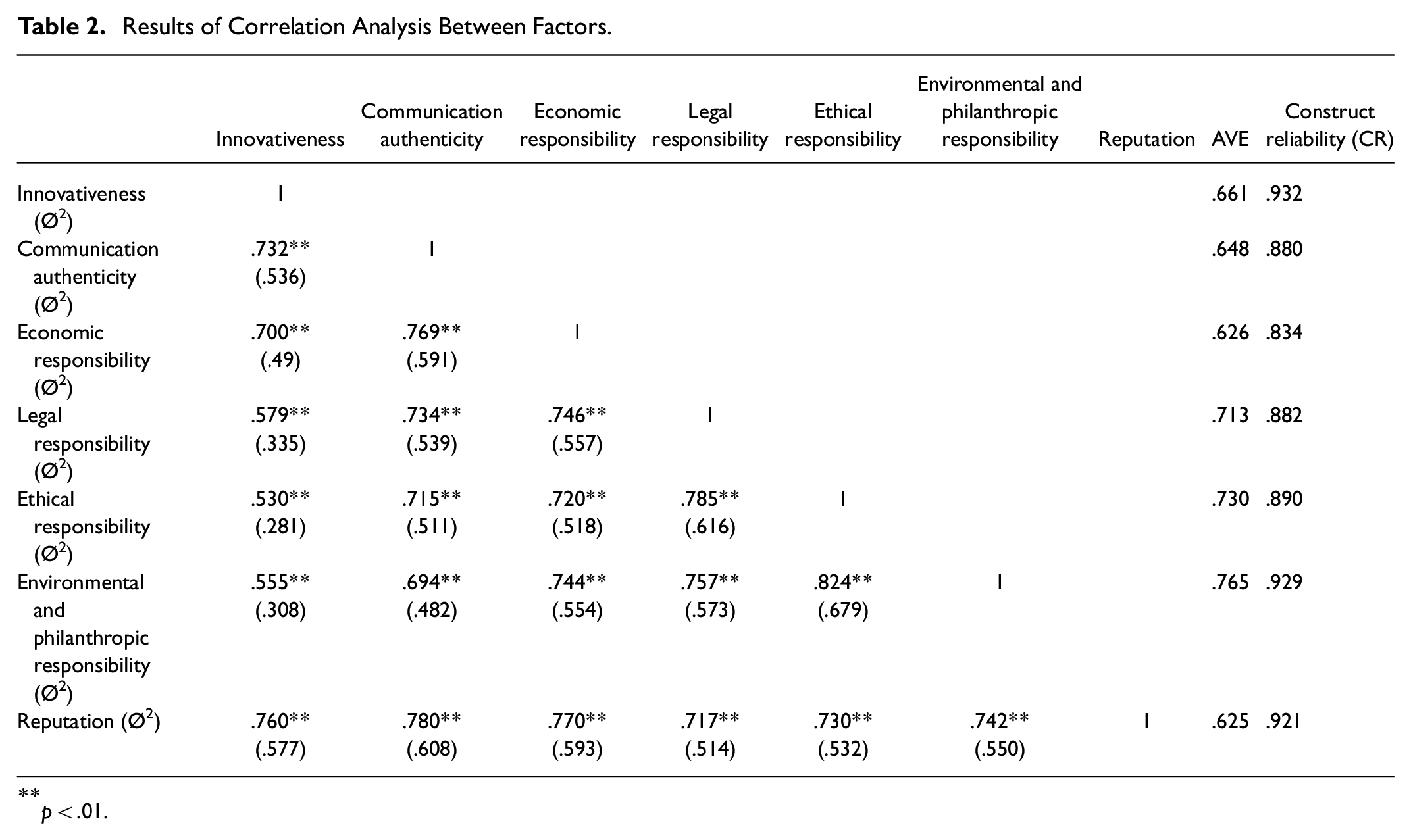
p < .01.

Model of factors affecting the formation of mobile carriers’ reputation based on confirmatory factor analysis.
SEM analysis probed how mobile carrier reputation influenced users’ perceptions and behavioral intentions. From the measurement model fit tests, the IFI, TLI, CFI, and NFI were favorable at .9 or higher. Figure 2 presents the hypotheses test results from the SEM analysis.
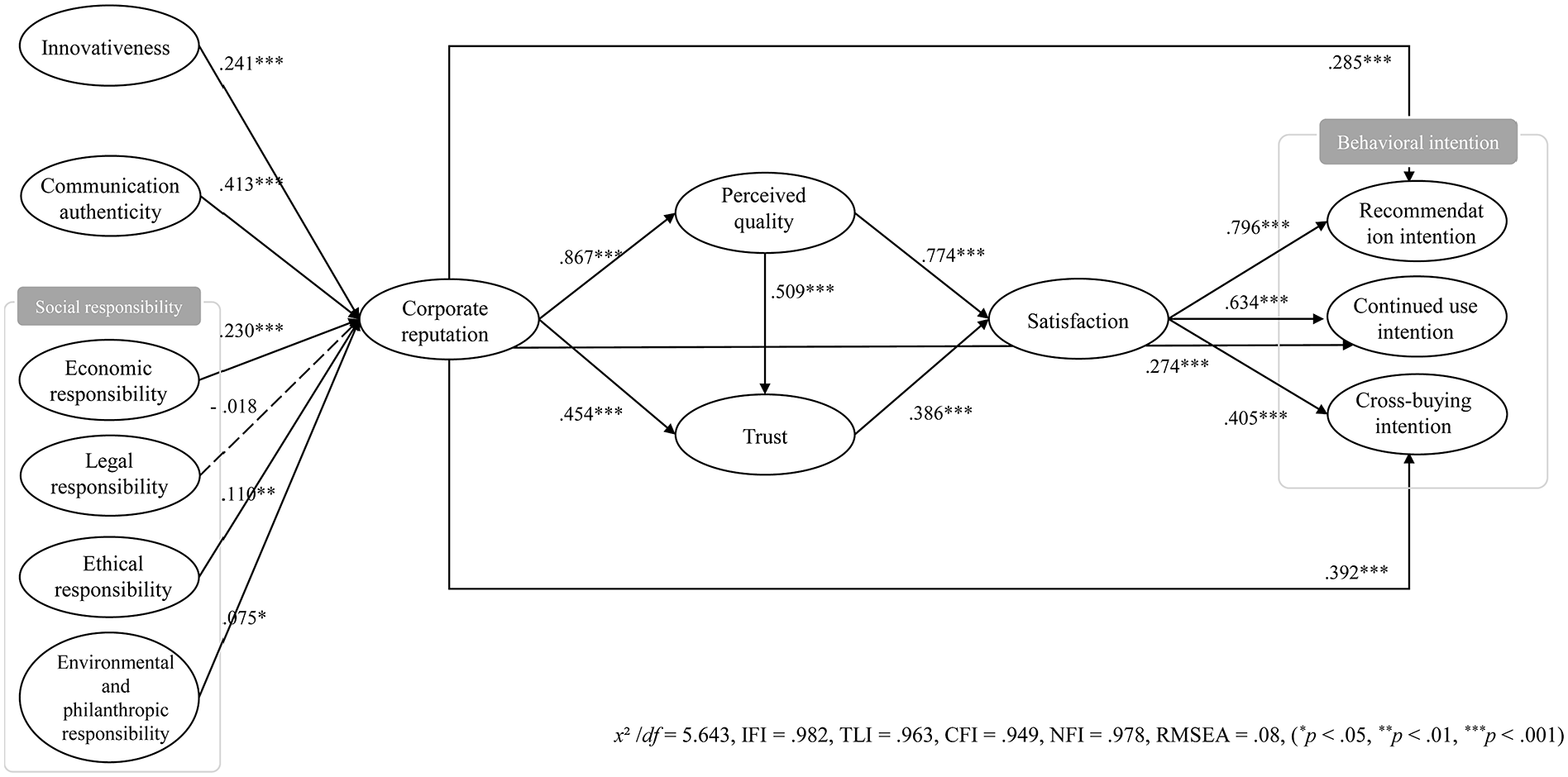
Results of hypothesis testing based on path analysis.
For RQ2, on the effect of each corporate characteristic on mobile carriers’ reputation, their degree of influence differed. All six factors on mobile carrier reputation, except legal responsibility, had a significant effect on mobile carriers’ reputation formation: innovativeness (β = .241, p < .001), communication authenticity (β = .413, p < .001), economic responsibility (β = .230, p < .001), ethical responsibility (β = .110, p < .01), and environmental and philanthropic responsibility (β = .075, p < .05).
Communication authenticity demonstrated the greatest correlation with reputation. Innovativeness, economic responsibility, and ethical responsibility demonstrated a positive relationship with reputation, and environmental and philanthropic responsibility showed the least influence. Within the structure of factors affecting reputation formation, environmental and philanthropic responsibility, innovativeness, communication authenticity, economic responsibility, and ethical responsibility, in that order, had high explanatory power, with environmental and philanthropic responsibility explaining 61.24% of the variance. The impact degree on mobile carrier reputation followed a different order: communication authenticity, innovativeness, economic responsibility, ethical responsibility, and environmental and philanthropic responsibility. Therefore, users mainly consider environmental and philanthropic responsibility as a trait of mobile carriers when evaluating them; instead, they should consider the extent to which mobile carriers make efforts to communicate with users, fulfill promises (communication authenticity), and satisfy expectations through new products and services (innovativeness), representing the carrier’s original professional role.
Reputation and recommendation intention (β = .285, p < .001), continued use intention (β = .274, p < .001), and cross-buying intention (β = .392, p < .001) exhibited a positive relation, supporting H1. Next, regarding the path between the mobile carrier’s reputation and user perception, reputation showed a significant positive effect on perceived quality (β = .867, p < .001) and trust (β = .454, p < .001), supporting H2 and H3. Reputation had a more significant influence on perceived quality than on trust.
Regarding the process of user perception, user-perceived quality showed a significant positive effect on trust (β = .509, p < .001) and satisfaction (β = .774, p < .001), and user trust induced satisfaction (β = .386, p < .001), supporting H4, H5, and H6. A closer examination of the influence of perceived quality and trust, proposed as antecedent variables of satisfaction, revealed that perceived quality is more significant than trust in generating user satisfaction. When the paths were combined, the perceived quality factor was located at the center. Although perceived quality is most affected by reputation, it exerted the largest positive effect on user satisfaction. Perceived quality, trust, and satisfaction are related to user perceptions; however, perceived quality is largely formed by the intrinsic characteristics of a mobile carrier, such as services and technology.
Furthermore, the user behavioral intentions of recommendation (β = .796, p < .001), continued use (β = .634, p < .001), and cross-buying (β = .405, p < .001) exhibited a positive relationship with satisfaction, supporting H7. Next, a multiple mediating effect analysis was performed to determine whether the path from mobile operator characteristics to behavioral intention through reputation, perceived quality, trust, and satisfaction was significant. Phantom variables were used to verify the multiple mediating effects, and a bootstrapping test of 2,000 resamples was performed to confirm the significance of the mediating effect based on whether 0 was included in the 95% bias-corrected confidence intervals.
According to the research model results (Figure 2), there are four possible paths to user behavioral intention for each mobile carrier characteristic: (1) characteristic factor → reputation → behavioral intention, (2) characteristic factor → reputation → trust → satisfaction → behavioral intention, (3) characteristic factor → reputation → perceived quality → satisfaction → behavioral intention, and (4) characteristic factor → reputation → perceived quality → trust → satisfaction → behavioral intention. The multiple mediating effect analysis indicated that all mediating paths from the variables confirmed to influence the formation of mobile carriers’ reputation (i.e., innovativeness, communication authenticity, economic responsibility, and ethical responsibility) to recommendation intention, continued use intention, and cross-buying intention were significant. However, for environmental and philanthropic responsibility, only some paths showed significant multiple mediating effects.
There were two common observations about the paths from each independent variable to behavioral intention. First, the variables regarding consumer perception showed a greater mediating effect in the multiple mediating paths than reputation. Second, among the above four paths from corporate characteristic factors to user behavioral intention, the third path, involving reputation → perceived quality → satisfaction, was more strongly related to recommendation intention and continued use intention than the rest. Meanwhile, among the paths mediated by reputation alone, the behavioral intention to cross-buy showed the greatest correlation. Thus, regarding users’ behaviors, recommendation and continued use intentions occur only if the user first perceives high quality and feels satisfied through the medium of reputation rather than acting based on reputation alone. However, for future decisions such as purchasing a product a user has not yet experienced, reputation can have a relatively significant influence. This interpretation supports the argument that users rely on reputation to make decisions when facing vast amounts of information and uncertainty (Argenti & Forman, 2002).
Discussion
The study identified corporate characteristics that affect mobile carriers’ reputation, compared each factor’s influence level on the formation of reputation, and illuminated the entire process, including the influence degree and direction on how consumers perceive and act accordingly.
I derived six factors comprising corporate characteristics that users perceived when evaluating a mobile carrier’s reputation and confirmed that each had a different influence level on reputation. Communication authenticity and innovativeness showed a high correlation with reputation. Although mobile communications is a field that offers technology-based services, the considerable influence of communication authenticity indicates that users value technology and services and human-related characteristics. Dowling (2001) explains that corporate image is formed by logical and emotional factors, and companies must find a balance between reason and emotion when building and managing their reputation.
The findings shed light on how mobile carrier customers perceive social responsibility, which is essential for corporate survival. A carrier’s social responsibility can be categorized into environmental, philanthropic, economic, legal, and ethical. Of these, environmental and philanthropic responsibility account for 61.24% of the reputation components, suggesting that mobile carrier users likely associate reputation with typical environmental and philanthropic activities. However, examining the relationship between each social responsibility type and reputation revealed that economic responsibility had the greatest influence on mobile carriers’ reputation, as judged by actual users. Moreover, unlike in prior studies, legal responsibility showed no relationship with mobile carrier reputation. Although ethical responsibility and environmental and philanthropic responsibility had a significant relationship with reputation, their influence was negligible, indicating a difference between users’ moral understanding of social responsibility and its impact on their actual perceptions, evaluations, and behaviors. Mobile carriers seeking to influence users’ perceptions and evaluations through CSR activities may find it effective to implement unique activities that fulfill their economic responsibilities with communication authenticity or innovativeness, factors that greatly influence reputation formation. For example, a carrier can introduce a memory-training program using an artificial intelligence speaker to support socioeconomically underprivileged groups (H. Park, 2021).
Next, the mechanisms of reputation were identified via a model path analysis, which revealed the causes and effects of reputation. Though reputation positively affected consumers’ perceptions and behavioral intentions, notably, the path where reputation led to satisfaction and behavior through user perception had greater explanatory power than that where reputation directly affected users’ behavioral intentions. Of the paths between consumers’ perceptions and behavioral intentions, “reputation → perceived quality → satisfaction” showed the greatest explanatory power. This path added reputation as an antecedent variable to the path “perceived quality → satisfaction → behavioral intention,” whose causal relationship with consumer behavioral intention had been verified. The result advances the process of explaining consumer behavior and provides significant implications for reputation mechanisms. Although reputation is a factor influencing user decisions, the process leading to user behavior via other variables is more prominent than merely the influence of reputation. Hence, reputation should not be expected to function as a master key for producing positive effects on companies.
Perceived quality indicated a significant relationship in several paths formed between reputation and users’ behavioral intentions. Mobile carriers must review this factor alongside innovativeness. Innovativeness as a corporate characteristic and consumer perceived quality are elements directly related to communication technology, products, and services, as per prior findings that a company’s reputation arises from its intrinsic nature and attributes (Cha & Yang, 2004; Shamma & Hassan, 2009). However, though this intrinsic nature induces reputation formation, users may evaluate aspects related to the intrinsic attributes (e.g., perceived quality) as an extension of reputation, demonstrating that reputation exerts influence in both directions.
Finally, the main role of reputation in user decisions was to reduce risk and uncertainty. Satisfaction and reputation were set as antecedent variables for users’ behavioral intentions in the research model. Satisfaction influenced users’ recommendation intention the most, while, in the path where reputation induced behavioral intention, the relationship with cross-buying intention was stronger than that with recommendation intention or continued use intention. Hence, reputation acts as a guarantee to offset the risk and uncertainty from products or services consumers have not yet used.
Conclusion
The study yielded three major conclusions. First, the SEM analysis statistically demonstrated the relationship between the variables and the significance of the path. Six factors influencing the formation of mobile carriers’ reputations were derived: environmental and philanthropic responsibility, innovativeness, communication authenticity, legal responsibility, economic responsibility, and ethical responsibility. All factors, except for legal responsibility, showed a significant relationship with reputation formation. The factors highly related to the reputation of mobile carriers were communication authenticity and innovativeness. Although companies must make efforts to improve their products and services, it may be imperative to place and consider users at the foundation of all decision-making and business operations.
Second, reputation positively affected users’ perceptions and behavioral intentions (recommendation intention, continued use intention, and cross-buying intention), and the path analysis results showed that rather than directly influencing, reputation acted through other variables, such as perceived quality, trust, and satisfaction. Third, based on the high correlation between reputation and cross-buying intention, reputation is essential to resolving uncertainty in users’ decision-making process. Thus, although reputation was a major factor influencing users’ decisions, the path analysis demonstrated that it could not be considered to function as a master key that unleashes positive effects for companies.
Islam et al. (2021) establish corporate reputation, satisfaction, and trust as mediators in a study examining the effect of CSR on customer behavior, confirming its significance. Even so, social responsibility could not be subdivided by industry characteristics, inducing an insufficiency in sequentially identifying customer perceptions and behavioral processes per reputation. This study bridged the research gap by supplementing such points for mobile carriers. However, another study reports that the price premium of reputation weakens with an increase in customer experience (Yang et al., 2019). By contrast, the high correlation between reputation and cross-buying intention, which this study confirmed, indicates that it can have a positive effect on customers’ new purchases. This discovery is meaningful and can be used by telecommunication companies keen to secure future growth by expanding their businesses and upgrading technologies.
This study identified factors affecting reputation formation that reflect mobile carriers’ characteristics and user needs and verified the processes through which reputation and other factors influence consumer decisions. The findings serve as a theoretical basis for expanding academic discussions, on the processes and effects of corporate reputation formation and establishment of effective strategies for reputation management in practice. However, there are some limitations. First, it is challenging to apply and generalize the mechanisms of reputation formation elaborated in this study to all markets because it reflects the characteristics of the mobile carrier. Multidimensional and specific explanations of reputation can be provided, after accumulating research findings in various industries. Second, the characteristics identified as factors influencing mobile carriers’ reputations were chosen subjectively, based on a literature review. Future studies can apply various criteria to classify consumers’ experiences, that affect reputation formation.
Supplemental Material
sj-docx-1-sgo-10.1177_21582440231154486 – Supplemental material for Corporate Reputation and Users’ Behavioral Intentions: Is Reputation the Master Key That Moves Consumers?
Supplemental material, sj-docx-1-sgo-10.1177_21582440231154486 for Corporate Reputation and Users’ Behavioral Intentions: Is Reputation the Master Key That Moves Consumers? by Mo Ran Yi in SAGE Open
Footnotes
Declaration of Conflicting Interests
The author declared no potential conflicts of interest with respect to the research, authorship, and/or publication of this article.
Funding
The author received no financial support for the research, authorship, and/or publication of this article.

Data Availability Statement
The datasets generated and/or analyzed during the current study are available from the corresponding author upon reasonable request.
Supplemental Material
Supplemental material for this article is available online.
References
Supplementary Material
Please find the following supplemental material available below.
For Open Access articles published under a Creative Commons License, all supplemental material carries the same license as the article it is associated with.
For non-Open Access articles published, all supplemental material carries a non-exclusive license, and permission requests for re-use of supplemental material or any part of supplemental material shall be sent directly to the copyright owner as specified in the copyright notice associated with the article.
