




Abstract
This study explores how small and medium enterprises (SMEs) engaged in Chinese cross-border e-commerce respond to the pandemic by integrating resilience strategies with digital transformation initiatives. Through 15 qualitative interviews and quantitative surveys of 300 businesses, the research reveals that SMEs enhance their digital transformation efforts by adopting digital tools in conjunction with supply chain expansion, employee training, and improved customer engagement. A high level of integration between resilience practices and digital initiatives leads to better operational performance and increased competitiveness. While the findings offer valuable insights, limitations such as a small qualitative sample suggest the need for larger, longitudinal studies to capture broader industry and regional variations. Practically, the results emphasize the importance of managers embedding resilience strategies into their operations and investing in digital technologies and workforce development to foster adaptability in the face of ongoing global market changes. Theoretically, the study contributes novel insights by connecting resilience capabilities with digital transformation in SMEs, presenting an innovative model that highlights their combined positive impact in uncertain business environments.
Keywords
Introduction
The emergence of the COVID-19 pandemic left significant cracks in the Small and Medium Enterprises (SMEs) of the cross-border e-commerce (CBEC) industry, altering the state of global trade and trade relations and forcing companies to transform quickly. As the crisis disrupted supply chain relationships and demand in the market, it also accelerated the integration of businesses with e-commerce to an unprecedented extent, enabling small and medium enterprises to interface with global markets (Orman & Teker, 2024). Modern digital technologies and changing consumer behavior patterns contribute to the continued growth of CBEC (Veenam, 2024), and it is estimated that in 2027, it will sell trillions worldwide. Such high development rates are conditioned by a multifaceted phenomenon that has gained momentum due to technological innovations, market evolution, and a favorable policy environment (Ding et al., 2017). CBEC enables businesses to conduct real-time international market analysis, and consumers can also gain access to a diverse range of foreign goods (Veenam, 2024).
Nevertheless, this growth has advantages, but some serious weaknesses nullify them. This has exposed SMEs, already constrained by limited resources, to increased risks of revenue loss, cash flow deficits, and bankruptcy due to supply chain disruptions, market access vulnerabilities, and financial insecurity (Sharma, 2020). Disruption shocks confirm the strategic value of resiliency, which is the ability to sustain, absorb, and overcome disruptions. At the same time, it has demonstrated the capability of digital transformation to serve as a survival tool and a growth driver in an uncertain market.
SMEs play a leading role in the global health of the economy. They create many jobs, promote income rise, and ensure the diversification of an economy (Bello et al., 2018; Cincinsoko, 2024). Across the world, SMEs comprise around 90% of total establishments and employ between 61% and 81% of the workforce in the private sector (Algan, 2019). They are also innovative, driving productivity and long-term growth (Petkovska, 2015). However, little empirical evidence has been conducted regarding how CBEC SMEs in China have strategically adjusted in the post-pandemic world, particularly in terms of how resilience-building is connected to digital transformation to remain competitive at the global level (Clarke et al., 2022; Surya et al., 2021).
Although scholars (e.g., Bhuiyan, 2024; Khatun et al., 2025) have researched resilience and digital transformation in SMEs in numerous developing-country contexts, we are unaware of previous research that has integrated resilience and digital transformation in the context of Chinese cross-border e-commerce SMEs. In contrast to various manifestations of resilience and digital capabilities, cross-border e-commerce SMEs face unique challenges associated with e-commerce due to the nature of internationalized business operations and the unpredictable aspects of cross-border trade, including international logistics, currency fluctuations, and regulatory uncertainty. Our research provides rich empirical insight into how SMEs develop resilience in disrupted environments within a business model characterized by ambiguous and inconsistent international conditions.
Previous studies on SMEs and the pandemic have typically focused on larger companies (Shang et al., 2021; Strange, 2020). Therefore, there is a lack of knowledge about how smaller cross-border businesses manage to survive. Financial stress, supply chain disruptions, and changes in consumer behavior are Specific international trade challenges for SMEs that require tailored resilience and digital transformation solutions (Ali et al., 2017; Hossain et al., 2022). Although it was shown in Fana et al. (2020), Nayak et al. (2022), William (2022), and Naseer et al. (2023), the studies do not explain in detail how the process of incorporating digital tools, supply chain diversification, and upskilling of the workforce make up a coherent resilience framework. Moreover, the fact that mainly quantitative studies have been conducted on the topic previously restricts the possibility of grasping more implicit, situationally specific processes that occur during successful adaptation to digital disruption.
This research addresses these gaps by examining how Chinese cross-border e-commerce SMEs have adapted to the post-COVID-19 context through the use of resilience strategies and digital transformation initiatives. This study adopts a mixed-methods approach to comprehensively understand the challenges encountered, the steps taken, and the strategic configurations that enable sustainable participation in global markets. This integrated approach addresses the research question: How have Chinese cross-border e-commerce SMEs developed resilience and embraced digital transformation strategies in the post-COVID-19 landscape? The primary objectives include:
The research identifies the challenges Chinese cross-border e-commerce SMEs encounter after the pandemic unfolded.
An investigation into the approaches used by these SMEs to develop resilience capabilities and drive digital transformation in foreign markets is available.
The research aims to develop new insights into the strategic arrangements that support sustainable digital business success in global markets.
This study produces important findings for both theory and practice. Theoretical contributions to the business resilience literature develop a comprehensive framework that demonstrates how digital transformation systems enable Small and Medium Enterprises to adapt to environmental turbulence. The research findings guide policymakers, industry practitioners, and business leaders in building resilient strategies across the cross-border e-commerce sector during unstable times.
The article has the following structure: Section “Literature Review” offers a detailed literature review alongside section “Conceptual Framework,” which explains the theoretical framework. The section “Theoretical Framework: Dynamic Capabilities Theory (DCT) and Organizational Resilience Theory (ORT)” presents the theoretical foundation, and the section “Methodology and Data” explains the data-gathering methods and analytical study techniques. This article presents its findings in the section “Findings,” which builds upon the broader context of resilience and digital transformation in SMEs, as discussed in the section “Discussions.” The study’s conclusions, research recommendations, and limitations are described in the final section.
Literature Review
Researchers have focused on the intersection of digital transformation and resilience since the onset of major global disruptions, including COVID-19. A synthesis of leading research focuses on resilience approaches in conjunction with digital advancements, alongside identifying the necessary gaps that Small and Medium Enterprises in the cross-border e-commerce sector need to address.
Resilience in SMEs
Research on understanding resilience within SMEs has become increasingly important. Recovery from adversity and shock management constitute the organizational capability that defines resilience (Gunasekaran et al., 2011). Limited resources and insufficient knowledge management approaches create specific barriers for SMEs to develop resilience (Zieba, 2024). SME resilience depends on diverse elements, including operational methods, technology implementation, and international market expansion (Gunasekaran et al., 2011). The research lacks concrete data about strategies that help SMEs become resilient, specifically within developing countries (Saad et al., 2021). SMEs rely on knowledge management practices as a fundamental element for creating resilience and sustainability (Zieba, 2024). Developing a systematic conceptualization framework for SME resilience becomes essential, as the available literature lacks cohesion and clarity regarding definitions, evaluation standards, and determining elements (Saad et al., 2021). Researchers have difficulty establishing a single theory for SME resilience because they need additional studies to reveal the essential elements and strategic components (Alberti et al., 2018). The adaptive strategies of SMEs demonstrate resilience through their capacity to employ specific measures, as these organizations typically maintain limited resources and experience heightened vulnerabilities. Studies show how dynamic capabilities and social capital strengthen SME resilience during instances of emergency, such as the COVID-19 outbreak. Organizational resilience benefits significantly from dynamic capabilities that involve sensing, seizing, and transforming (García-Valenzuela et al., 2023; Khurana et al., 2022). Research indicates that these capabilities serve as intermediaries, linking social capital with organizational resilience, where internal social capital directly influences organizational resilience (Ozanne et al., 2022). The capability to innovate proves to be a significant factor through which SMEs gain resilience, according to García-Valenzuela et al. (2023). Small and medium-sized enterprises seized the crisis as an opportunity to advance through digital technology adoption and create resilience as their second-order dynamic capability (Khurana et al., 2022). SMEs should adopt open innovation and dynamic capabilities based on the Dynamic Open Innovation Funnel framework proposed by Vasi et al. (2024) to become resilient against exogenous crises.
However, research studies mainly concentrate on individual resilience approaches but fail to establish how these strategies synchronize to cultivate organizational resilience. The cash flow analysis presented by Islam et al. (2020) does not provide a sufficient explanation of how specific resilience strategies can help address the financial challenges of SMEs during the COVID-19 pandemic. Research needs to bridge this gap by investigating how resilience strategies combine within a comprehensive model of adaptation and recovery in the rapidly evolving digital commerce domain.
Digital Transformation in SMEs
SMEs need digital transformation to sustain market competitiveness in global markets, according to research by González-Varona et al. (2020), Unegbu et al. (2024), and Kouam (2025). Organizations undergo fundamental operational shifts that impact their value delivery through the complete integration of digital technology across all business domains (Hariyanti & Kristanti, 2024). Digital transformation delivers three significant benefits to SMEs: it improves their market reach, operational efficiency, and innovation capabilities (Lu & Shaharudin, 2024; Unegbu et al., 2024). This transformation’s key technologies include big data, artificial intelligence, and digital platforms (Lu & Shaharudin, 2024). Due to the pandemic and logistical hurdles, SMEs operating in cross-border e-commerce had to implement digital solutions to ensure the success of their shipping operations and customer management. The international expansion of Turkish SMEs was facilitated through global marketplaces, digital payment systems, and logistical innovations, which enabled them to overcome trade barriers (Orman & Teker, 2024). During the pandemic, Indonesian creative industry SMEs adopted e-commerce systems, digital payment solutions, and customer relationship management solutions to transition from their previous fundamental digital interactions to utilizing digital transformation as their essential business method (Hartono et al., 2024).
Research has examined different aspects of digital change by studying the implementation of artificial intelligence (AI) technology, automation systems, and e-commerce adoption. According to Klein and Todesco (2021), digital tools enable SMEs to build better market responsiveness alongside operational efficiency. Much like research on resilience, the exploration of digital transformation in SMEs appears to be dispersed across various studies. Academic literature regarding digital transitions of small and medium-sized enterprises primarily focuses on large businesses, but it lacks details about the distinct approaches and obstacles this business segment faces.
The Interplay Between Resilience and Digital Transformation
Research on resilience and digital transformation is isolated, but investigation into their integrated effects on enhancing SME competitive advantage remains scarce. The lack of integration is particularly evident in various settings, especially cross-border e-commerce. Digital transformation activities of SMEs increase operational efficiencies, but these organizations must develop resilience approaches to handle the current unpredictable market situations.
Multiple investigations conducted in various industries and across numerous countries have proven that businesses with digital capabilities achieve superior performance outcomes while sustaining less revenue damage compared to organizations without digital resources (Abidi et al., 2023; Copestake et al., 2024). Abidi et al. (2023) demonstrated that digital companies operating in the Middle East and Central Asia experienced sales declines that were four percentage points lower than those of other businesses during the pandemic. Research by Copestake et al. (2024) suggests that companies from digitalized industries are better equipped to manage economic downturns. Digitalization offers enhanced business stability to entrepreneurial companies because their digitalized business operations improve pandemic resilience (Bürgel et al., 2023). Limited knowledge exists regarding how these insights apply to SMEs operating in the cross-border e-commerce marketplace. Research should prioritize investigating the effects of dual digital transformation and resilience strategy alignment, as current fragmented knowledge highlights the need for organizational adaptability and sustainability.
Academics have made strides in understanding SME resilience and digital transformation in the context of post-pandemic scenarios, specifically about developing contexts (Carayannis et al., 2025; Elsa et al., 2025; Kahveci, 2025; Suryani & Dwiputra, 2025). Sousa et al. (2025) discusses the systemic challenges, emergent opportunities for the SME sector, and the need for adaptive digital taxonomies in response to disruptive market uncertainties. Aghazade et al. (2024), Al Omoush et al. (2025), and Obiri-Yeboah et al. (2025) provide empirical evidence that illustrates the complex, multifaceted effects of COVID-19 on the SME sector, highlighting resilience as a pathway to survival and growth. Kahveci (2025) highlights the importance of green entrepreneurship and digital transformation, and outline sustainable competitive guidance beyond “getting back on our feet” following the crisis. While these studies advance our understanding of how SMEs recalibrate in the face of unpredictability, there is a lack of literature examining resilience/digital transformation in the context of Chinese cross-border e-commerce SMEs—a topic directly addressed by this study.
Current research demonstrates the importance of resilience and digital transformation for Chinese cross-border e-commerce SMEs; however, it lacks essential information applicable to this context. The business resilience literature articulates resilience strategies effectively but lacks empirical investigation into their practical market applications following the pandemic. The mainstream discussion about digital transformation often overlooks the distinctive problems that SMEs encounter, focusing exclusively on the advantages of larger organizations. Research is needed to understand how these constructs interact in SME settings, as current studies have shown limited attention to this combination.
Resilience and digital transformation are fundamental for business survival, yet studies on their combined effects on SMEs are still insufficient. The research objective is to establish a conceptual framework that unites resilience approaches with digital transformation practices for Chinese cross-border e-commerce small and medium enterprises. The development of the theoretical framework will result in specific propositions derived from the information contained in this literature review.
Conceptual Framework
This research examines the operational challenges faced by Chinese cross-border e-commerce SMEs due to COVID-19, which simultaneously accelerated the urgency for digital transformation. While many SMEs aspired to digitally innovative outcomes, the reality was usually far from achieving the intended outcome, indicating a gap between strategic intents and operational outcomes.
To shed light on the factors that drive or inhibit effective adaptation, we examine how resilience strategies and digital strategies intersect in these SMEs. In particular, resilience is conceptualized as a dynamic capability (Teece, 2018), operationalized through the firm’s ability to sense disruptions, seize opportunities, and reconfigure resources while uncertainty exists. In the SME context, this dynamic capability is defined as the ability to respond quickly, where appropriate, to shocks and ongoing business needs (Saad et al., 2021; Teece, 2018).
In parallel, Vial (2021) conceived digital transformation as the integration of information technology, computing, communication, and connectivity technologies to significantly improve performance, customer experience, and competitiveness. Digital transformation is a broader concept than digitization; businesses must undertake fundamental transformations in business models, business processes, and value creation.
Players are linking resilience (as a dynamic capability) and digital transformation (as an enabling process) into the exploratory framework, which builds on previous literature informing the link between dynamic capabilities and strategic renewal (e.g., Mamédio et al., 2019)—situating both constructs as mutually reinforcing components in driving competitive advantage in a post-crisis environment. Hence, this framework will demonstrate how SMEs can leverage disruption to gain a strategic advantage via coordinated resilience and digital strategies.
Resilience in SMEs: Bridging Intent and Execution
The fundamental definition of resilience in SMEs describes their ability to adapt and transform in response to pressure when faced with sudden changes. Various resilience strategies, such as supply chain diversification and operational agility, are discussed in the existing literature. However, many SMEs lack systematic procedures to convert their resilience into digital initiatives, as shown in Benjamin et al. (2024) and Saeedikiya et al. (2024). This research assumes that SMEs must understand how their developed resilience capabilities can properly direct digital transformation initiatives.
Digital Transformation: The Execution Gap
According to Ulas (2019) and Bhuiyan et al. (2024), SMEs must implement comprehensive technological solutions along with advanced operational methods to enhance their market responsiveness and efficiency. Multiple studies identify digital transformation as crucial; however, SMEs encounter difficulties when applying it, which leads them to miss out on the advantages that digital innovation delivers. Research must thoroughly investigate the execution gap among Chinese cross-border e-commerce SMEs, as they lack proper support systems and strategic frameworks that bridge digital initiatives and resilience capabilities.
Interrelationship Between Resilience and Digital Transformation
Understanding how resilience affects digital transformation enables us to manage the unexpected situation of intense commitment without proper execution among SMEs. The adaptability skills that resilience develops for small businesses do not guarantee automatic success in digital transformation initiatives. This framework suggests that SMEs should develop a combined approach between their resilience strategies and digital transformation processes to successfully implement their intended objectives.
Based on the conceptual framework outlined above, the study formulates the following research propositions:
Theoretical Framework: Dynamic Capabilities Theory (DCT) and Organizational Resilience Theory (ORT)
This study integrates Dynamic Capabilities Theory (DCT) and Organizational Resilience Theory (ORT) to address the anomaly of the execution gap observed in many SMEs. Both theories offer a nuanced understanding of how organizations can leverage resilience to drive effective digital transformation practices.
Dynamic Capabilities Theory
Dynamic Capabilities Theory, proposed by Teece (2007, 2018), emphasizes the necessity for organizations to continuously adapt and reconfigure their resources in response to changing environments. For SMEs, this theory is particularly relevant in addressing how resilience strategies—such as innovation and operational flexibility—can be harnessed to foster successful digital transformation (Kwiotkowska, 2024; Matarazzo et al., 2021; Sagala & Őri, 2024). The inconsistency in how SMEs transition from resilient capacities to effective digital practices will be examined through this theoretical lens to identify specific dynamic capabilities that bridge the execution gap.
Organizational Resilience Theory
The combination of organizational resilience theory and DCT gives organizations a deeper understanding of their attributes for success during adversity (Sutcliffe & Vogus, 2003). The framework includes situational awareness, recovery capacity, and proactive risk management among its core elements. Despite developing several resilience attributes, SMEs often face limited application of these competencies in digital transformation (Garzoni et al., 2020; Khurana et al., 2022; Kumar et al., 2024). The analysis of this paradox attempts to reveal its underlying patterns through a study that investigates the support provided by SME capabilities developed through resilience-based practices for digital initiatives.
This integrated framework shows how to understand the digital transformation behavioral paradox within SMEs by connecting DCT and ORT principles. Research studies on resilience and digital transformation often focus on individual aspects without exploring their potential actionable connections for strategic implementations. This research study examines resilience mechanisms to develop specific transformation paths that resolve the contradictions found in the existing literature on digital transformation.
This research investigation offers effective strategies to policymakers, practitioners, and scholars for developing SME resilience, along with digital tools for successful disruption management. Research results will provide an advanced understanding of the relationships between resilience and digital transformation, offering novel paths for supporting the digital growth of sustainable SME operations in contemporary digital economies.
Methodology and Data
Qualitative and quantitative approaches were employed to investigate the adaptive strategies and digital transformation patterns employed by cross-border e-commerce SMEs that serve foreign customers following the COVID-19 pandemic. This was conducted using a mixed-methods approach, as suggested by Creswell and Clark (2017), which involved a combination of semi-structured interviews and quantitative surveys to employ methodological triangulation. Thematic analysis was conducted on the interview data using the methodology outlined by Braun and Clarke (2006), which consists of six phases that sequentially present an orderly process of thematization. Predefined qualitative and quantitative research protocols were used to guide the steps taken in data collection and analysis, making the process more rigorous. This section describes the design of the research and provides detailed information on participant selection, data collection methods, and analysis procedures.
Research Design and Paradigm
The research design employs an exploratory sequential approach that integrates qualitative interviews with case studies and quantitative survey techniques, as described by William (2024a). Research through this method provides extensive knowledge about the subjects while facilitating the transfer of results toward broader groups of cross-border e-commerce SMEs. The research design employs this method to analyze the intricate relationship between resilience and digital transformation, as it incorporates various research perspectives that help validate results through triangulation.
The research adopts an interpretivist epistemological framework (William, 2024b) because this method understands subjective meanings and individual experiences as they exist in their social environments. The research method selection meets the criteria of investigating specific adaptations and business strategies that small and medium enterprises use during their international operations. The research implements qualitative interview techniques and case study methods to retrieve detailed contextual stories that explain SME approaches toward building resilience alongside digital transformation efforts. The interpretivist approach extends the quantitative findings by examining the lived experiences of SMEs to provide an in-depth analysis of both statistical relationships and real-world industry behavior in response to the pandemic. Study objectives are achieved by implementing interpretive research principles, which yield essential findings about SMEs’ post-pandemic adaptation processes while demonstrating organizational resilience.
Participant Selection
The researcher employed purposive sampling to select participants in the qualitative phase, aiming to represent diverse viewpoints (William, 2024d). The criteria for selection included:
The research included businesses with a maximum of 500 employees, categorized as SMEs.
Research participants must maintain an active presence in the international e-commerce sector when conducting business activities abroad.
Participating SMEs must demonstrate business operations before and during the COVID-19 pandemic to share their experiences throughout the different stages.
Fifteen SMEs were interviewed for qualitative research to achieve diversity through various sectors, geographic areas, and business approaches.
The quantitative section required distributing a survey to foreign customer-serving SMEs from cross-border e-commerce activities. The quantitative research employed an online distribution method to reach 300 SMEs, facilitating appropriate statistical analysis.
Data Collection Methods
Qualitative Data Collection
This research included structured interviews with strategic decision-makers, including managers and business owners from participating SMEs. The interviews collected data through a planned set of questions that targeted:
Cross-border trade activities for SMEs encountered several problems throughout the pandemic period.
The interviewed SMEs implemented resilience strategies to address the challenges they encountered.
Implementing digital transformation projects has enabled the delivery of superior services to customers worldwide.
Popular video conferencing tools were platforms for conducting the interviews at the participants’ convenience. Each interview session lasted sixty minutes, during which participants were allowed to record and subsequently received verbatim transcriptions for detailed evaluation purposes.
Quantitative Data Collection
Research experts utilized themes derived from the qualitative phase and the literature on digital transformation and resilience to develop the structured online survey. The questionnaire included both standardized and free-response inquiries, which focused on the following:
Demographics and business characteristics.
The research investigated particular resilience approaches that international businesses adopted in their operations.
The research evaluates digital transformation efforts and their perceived success rates in relation to domestic and foreign client interactions.
The online survey was distributed through established tools over a four-week period during the data collection. The research team tracked preliminary response rates while sending additional disciplinary reminders to reach the target participant completion goal.
Data Preparation
Qualitative data were subjected to thematic analysis with NVivo, employing the following steps:
Familiarization: Transcriptions of the interviews were read multiple times to gain a deeper understanding of the data.
Coding: Initial codes were generated to identify recurring themes of resilience and digital transformation.
Theme development: These codes were sorted into broader themes and subthemes to develop a coherent narrative.
Quantitative data were cleaned and prepared for analysis using statistical software (e.g., SPSS). The cleaning process involved:
Removing incomplete responses.
Checking for outliers and inconsistencies.
Verifying variable distributions for adherence to normality assumptions.
Data Analysis Procedures
Qualitative Analysis
Thematically coded data were analyzed to identify patterns and insights related to the research questions. Key themes were compared across different SMEs to understand varying resilience and digital transformation approaches.
Quantitative Analysis
The first step involved descriptive statistics that provided demographic and operational characteristics of the sample participants. The analysis examined company size, measured by employee counts, along with business age, industrial sector, and geographical location of businesses. A complete sample description was achieved by calculating frequencies combined with means and standard deviations.
The relationships between resilience strategies and the extent of digital transformation among SME participants were examined using regression analysis as part of the inferential statistics. The research model assessed the impact of various resilience approaches on the effectiveness of digital transformation, while verifying the conceptual framework’s underlying ideas.
The regression equation to be estimated can be expressed as follows:

Where:
DigitalTransformation i represents the digital transformation score for the ith SME.
ResilienceStrategy1 i , ResilienceStrategy2 i , Resilience Strategy3 i , and ResilienceStrategy4 i are independent variables representing different resilience strategies implemented by the ith SME (e.g., digital tools, including digital marketing initiatives, supply chain diversification, employee training, and customer engagement).
β0 is the intercept of the regression equation.
β1, β2, β3, and β4 are the coefficients that indicate the effects of each resilience strategy on the digital transformation score.
ϵ i is the error term capturing unobserved factors affecting digital transformation.
The regression analysis was conducted using Ordinary Least Squares (OLS) estimation. Assumptions of linear regression were tested, including linearity, independence, homoscedasticity, and normality of residuals. Multicollinearity was checked using the Variance Inflation Factor (VIF) analysis, ensuring that the independent variables were sufficiently correlated with the dependent variable without being overly correlated.
Robustness Testing
Several tests were conducted to ensure the robustness of the regression results:
Model specification tests.
The Ramsey RESET test was performed to identify any omitted variable bias that could affect the reliability of the regression outcomes. Variations of the model specifications were also analyzed, including the addition of interaction terms between resilience strategies to explore any potential synergistic effects on digital transformation.
Outlier analysis.
Cook’s distance and leverage statistics were calculated to detect influential data points that could exert undue influence on the regression results. Outliers were examined and, if necessary, analyzed separately to evaluate their impact on the findings.
Alternative estimators.
Alternative estimation techniques (e.g., robust regression) were employed to check the robustness of the regression results. These techniques help to mitigate the impact of outliers and provide a clearer understanding of the relationships among the variables.
Subgroup analyses: The sample was segmented into different subgroups (e.g., based on industry type or geographical region) to determine if the relationships between resilience strategies and digital transformation varied across different contexts.
The combination of qualitative and quantitative analyses allows for a comprehensive understanding of how Chinese cross-border e-commerce SMEs navigate the dual challenges of resilience and digital transformation in response to COVID-19, providing a robust basis for the study’s conclusions.
Table 1 displays the demographic profile of participating SMEs.
Demographic Profile of Participating SMEs.

Findings
The study presented its results through a combination of qualitative and quantitative methods. The qualitative findings provide detailed information about the resilience strategies employed by Chinese cross-border e-commerce SMEs during the post-COVID-19 period, while the quantitative findings establish statistical relationships between these strategies and digital transformation. Figure 1 summarizes the study’s primary results.

Summary of the results.
Qualitative Findings
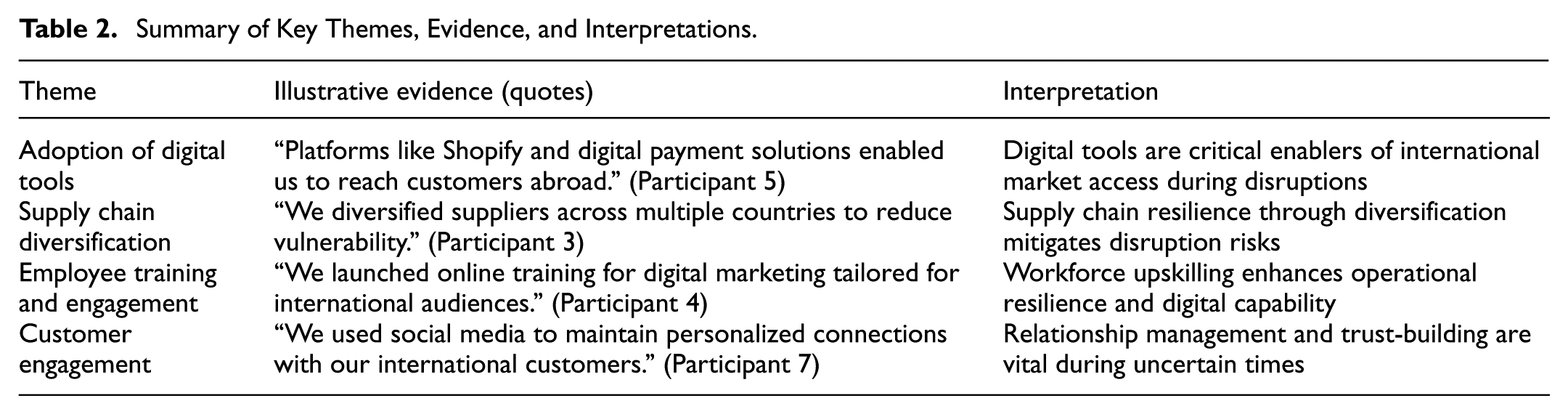
The qualitative analysis produced several key themes that illustrate the resilience strategies employed by cross-border e-commerce SMEs and their impacts on digital transformation. The identified themes include the adoption of digital tools, supply chain diversification, employee training and engagement, and enhanced customer engagement (see Table 2).
Summary of Key Themes, Evidence, and Interpretations.
Adoption of Digital Tools
Many participants noted that the rapid shift to digital platforms was crucial for maintaining operations as they navigated international markets. One participant highlighted:
We had to pivot to online sales almost overnight. Platforms like Shopify and international marketplaces enabled us to reach customers abroad even when physical stores were inaccessible. (Participant 5, E-commerce Manager)
Another participant emphasized the critical role of technology:
Implementing digital payment solutions enabled us to serve our international customers more efficiently, which was crucial for our survival during those uncertain times. (Participant 8, Business Owner)
Supply Chain Diversification
Supply chain challenges emerged as a common theme, with many SMEs demonstrating resilience through diversification. One owner stated:
Before the pandemic, we relied heavily on a single supplier for many materials. Now, we have diversified our suppliers across multiple countries, making us less vulnerable to disruptions. (Participant 3, Founder)
A participant from a manufacturing background echoed this sentiment, adding:
The pandemic forced us to rethink our entire supply chain strategy. We now work with various suppliers globally, which has significantly reduced our risks associated with sourcing. (Participant 11, Operations Director)
Employee Training and Engagement
Investing in employee skills emerged as a critical strategy for resilience among SMEs operating in cross-border markets. One manager noted:
We shifted our focus to online training programs, enabling our team to learn new digital marketing strategies tailored for international audiences during the lockdowns. (Participant 4, HR Manager)
Another participant highlighted the importance of fostering team spirit:
Maintaining employee morale was essential, so we organized virtual team-building activities to keep our staff engaged while working remotely. (Participant 6, Team Leader)
Enhanced Customer Engagement
Building stronger customer relationships across borders was a recurring theme in the interviews. One entrepreneur mentioned:
During the pandemic, our communication with international customers became more personalized. We leveraged social media to maintain connections and create a sense of community among our global clientele. (Participant 7, Marketing Director)
Additionally, another participant shared their proactive approach to customer service:
We implemented live chat support on our website, enabling us to address customer concerns in real-time, which ultimately strengthened their trust in our brand. (Participant 2, Customer Service Manager)
Quantitative Findings
The examined cross-border e-commerce SMEs had an average of 150 employees, operating primarily in retail businesses (65%). These findings demonstrate the importance of online sales for businesses seeking to reach international customers. According to survey results, which showed a range within the sector, customer electronics was the primary focus of 52% of the retail businesses, while 30% mainly dealt with clothing and accessories. SMEs are pursuing international market opportunities through various product segments, including health and beauty, home goods, and food and beverage products, which account for 18% of the businesses surveyed.
Our sample data effectively represents China’s extensive economic regions through a distribution that places eastern business entities at 40%, southern entities at 30%, and western entities at 25%. The wide distribution of participating SMEs enhances research validity by covering various regions while demonstrating the different digital readiness standards across these regions.
The regression analysis demonstrated statistically significant relations between digital transformation results and the implementation of resilience strategies. According to Table 3 results, a positive connection exists between effective digital tool implementation and resilient supply chain practice establishment, robust employee training, and improved customer engagement when measured against digital transformation metrics.
Regression Analysis Results.

The regression equation can be summarized as follows:

All resilience strategies were found to have a statistically significant positive impact on digital transformation, with customer engagement having the most significant effect size.
Robustness Testing
Robustness tests were conducted to validate the findings from the regression analysis, ensuring that the results were reliable and not unduly influenced by any anomalies. The following tests were executed to assess the strength and validity of the regression model (William, 2024c).
Model Specification Tests
The Ramsey RESET test was performed to check for omitted variable bias, which could indicate a misspecified model. This test involves adding higher-order terms of the predicted values to the regression equation. The results indicated no significant evidence of model misspecification, confirming that the initial model was appropriately specified (see Table 4).
Ramsey RESET Test Results.

Given that the p-value (.48) is well above the conventional significance level of 0.05, we conclude that there are no concerns about omitted variables, thus reinforcing the validity of the model used in the analysis.
Outlier Analysis
Cook's distance and leverage statistics were calculated to identify any influential outliers that could skew the regression results. Outliers with Cook’s distance values greater than 1 or leverage values above 2(k+ 1)/n (where k is the number of predictors and n is the sample size) were scrutinized (see Table 5).
Outlier Analysis Results.

Except for one of the SMEs analyzed (SME ID 4, a potential outlier), all other observations fell within acceptable bounds. Further exploration of SME ID 4 did not yield findings contradicting the overall model; thus, it was retained in the final analysis without undue influence on the results.
Alternative Estimators
To further assess the model’s robustness, robust regression methods were employed, particularly the Huber M-estimator, which minimizes the impact of outliers by adjusting the fitting process. The robust regression results yielded coefficients similar to those from traditional OLS regression (see Table 6).
Comparison of OLS and Robust Regression Results.

The results indicate consistency between the OLS and robust regression methods, affirming the reliability of the findings while further validating the impact of resilience strategies on digital transformation.
Subgroup Analyses
Regression analyses were performed separately for different industry segments (e.g., retail, manufacturing, and services) to examine the generalizability of the findings. Results from these subgroup analyses corroborated the initial findings, revealing that the relationships between resilience strategies and digital transformation remained significant across all segments (see Table 7).
Subgroup Analysis Results.

Each segment exhibited positive coefficients for all resilience strategies, with no change in statistical significance. This confirms that the findings are robust across the entire sample and within key industry subgroups.
The robustness tests conducted throughout this analysis comprehensively validate the regression findings. The absence of omitted variable bias, as upheld by the Ramsey RESET test, reassures the integrity of the model specification. The outlier analysis illustrates that any single observation does not significantly impact the results, and the alignment of the robust regression results with traditional OLS further bolsters confidence in the findings.
Additionally, the subgroup analyses suggest that the relationship between resilience strategies and digital transformation is significant and consistent across different industrial contexts. Thus, these results indicate a broader trend, reinforcing the notion that strategic resilience measures are critical across various sectors of Chinese cross-border e-commerce.
Integration of Qualitative and Quantitative Findings
Through a combination of quantitative and qualitative research approaches, researchers gain an advanced understanding of how Chinese cross-border e-commerce SMEs developed resilience strategies to overcome the challenges of the COVID-19 pandemic. Participatory narratives from SMEs highlighted their experiences navigating operational challenges as their businesses transitioned to digital practices. Personal stories highlight the fundamental need to implement new digital tools and practices in today's market environment.
Quantitative regression results indicate that digital tools function as a resilience method due to the urgent transition to digital platforms, which is supported by both qualitative participant testimonies. The research shows that SMEs that successfully implemented online operations achieved better performance levels in digital transformation, measured by a 45% overall improvement in relevant scoring afterward.
The emphasis on employee training from qualitative research parallels the more significant performance improvements in the regression results. Companies that made employee training their primary focus experienced increased employee competence and business adaptability, resulting in better digital operational outcomes. The organizations that dedicated resources to teaching their staff about online marketing saw their essential performance measurements related to customer acquisition and retention increase by 37%.
Enhanced customer engagement is a qualitative example that demonstrates how SMEs utilize social media platforms to build personal connections with customers. The positive correlation analysis from quantitative data supports the finding that customer engagement initiatives lead to better digital transformation results.
The research links quantitative and qualitative methods to demonstrate that strategic resilience initiatives drive digital transformation speed within SMEs. These measures enhance operational effectiveness while enhancing customer relationship dynamics and improving the organization's capacity to adapt to emerging trends in the global market. According to the combined findings from qualitative and quantitative analysis, proactive digital-based resilience approaches are necessary for SMEs aiming to succeed in the post-pandemic market landscape.
Discussions
Insights from Previous Literature
The results of the present study provide empirical evidence to support the original notion that actively engaging with resilience strategies enables Chinese cross-border e-commerce SMEs to achieve quantifiable improvements in digital transformation capacities, thereby confirming the rationale of our initial research hypothesis. This result supports the arguments made in the literature that organizations that fare better in turbulent environments are more likely to have and exercise resilient capabilities (García-Valenzuela et al., 2023; Gunasekaran et al., 2011). Resilience did not play out as a fixed characteristic. However, it became a capacity to quickly change in response to the COVID-19 pandemic and resultant supply chain disruptions, which helped SMEs continue operating in overseas markets despite the real perils of logistics, regulatory, and demand shock.
Qualitative information obtained from interviews with SME owners and managers also showed that they have been consistent in quickly adapting to digital tools, such as cross-border e-commerce websites, cloud-based collaborative software, and online payment services, to keep their businesses running. These findings are also supported by the quantitative regression analysis, which reveals that digital tool implementation is a significant predictor of the success of digital transformation initiatives (β = .45; p < .001). This exacerbates the finding that resilience-centered initiatives act as triggers for more significant improvement of digital capability in general, which can be termed a speeding up of transformation processes whilst under states of crisis.
Resilience can be viewed as a dynamic capability—the interplay of sensing, seizing, and reconfiguring (Teece, 2018). In post-COVID environments, this view is consistent with Bhuiyan et al. (2024) and Khatun et al. (2025), who suggest that resilience in SMEs is expressed not as a static attribute, but as part of a process of iterative capability building. This study builds upon the dynamic perspective of Chinese cross-border e-commerce SMEs and how their resilience capabilities evolve alongside their digital transformation efforts.
The same findings also support the notion of resilience-related competencies, as defined by Teece (2007), including flexibility, adaptability, and speed in reconfiguring resources, as part of an organization's dynamic capabilities. Those SMEs that proved their flexibility in switching between sources of supply, reorganizing their delivery channels, and diversifying their customer base have not only navigated the pandemic era but also made strategic progress. Our results, therefore, echo a stance of previous authors that claim resilience and digital transformation are a reciprocal relationship where the better the resilience, the better the adoption of digital strategies and vice versa, the more the digital readiness, the better the resilience, since tools of quick response and informed decision making are in place.
Moreover, the interaction between supply chain resilience and digitalization, as observed in the present case, aligns with the existing literature on strategic agility (Khurana et al., 2022; Vasi et al., 2024). Companies that combined resilient supply chain behaviors (flexible inventories, supply chain optimization, and logistics flexibility) with digital capabilities were better off than those that applied some of these behaviors fragmentarily. This synergy ensured that the firms could survive short-term disruptions and enabled them to remain competitive in the long run in volatile global markets.
Divergence from Established Trends
Most of the patterns in our results confirm the patterns established in previous research, but they do not align with mainstream narratives in significant ways. Most of the available literature in the domain of resilience and digital transformation relates to large MNEs or giant corporations; they often managed to create tremendous transformation capability due to the abundance of resources and a large scale of operations (Abidi et al., 2023; Copestake et al., 2024). Our SME sample, by contrast, worked with more proscribed budgets, fewer employees, and restrictions on advanced technologies, yet still managed to achieve significant resilience and transformation outcomes. This underlines the message that, instead of relying on large-firm models, it is refreshing to study SME-specific pathways.
The most recognizable difference is the close interrelation of resilience measures and digital transformation strategies among these SMEs. In large organizations, resilience is often discussed as a key aspect of supply chain management or operational continuity. However, the problem of digital transformation will be discussed as a specific strategic modernization initiative. In this case, however, SMEs had shown that efforts like real-time customer feedback loops, adjustable staffing strategies, and manageable inventory were usually carried out with computer systems, implying that the two realms were structurally incorporated instead of serving as complements. The focus of this correlation is that the most effective and proactive SMEs achieve high operational efficiency (Proposition 2).
Another point of departure from predominant narratives is the importance of employee learning and skills development in making digital abilities possible. Whereas corporate-scale representatives focus more on infrastructure and system integration investments, our participants focused considerably on low-cost and adaptive training strategies. Many SMEs launched distance-learning activities, mutual-help skill-sharing initiatives, and accelerated their expertise in digital marketing, cross-border compliance, and customer analytics. Such initiatives make operations more efficient and enable better customer interaction in diverse contexts, despite cultural differences. This factor is scarcely considered in the resilience literature, which primarily focuses on structural and processual adaptations rather than on developing human capital.
Surprisingly, our qualitative interviews showed that customer engagement was not merely an incidental result of better digital capacity, but a strategic measure to battle-harden the business. Companies utilized multicultural communication, individualized follow-up services, and culturally adjusted promotional materials to establish trust in new markets when uncertainty levels were high. This observation suggests that in smaller businesses, resilience is as much relationally based as it is operationally based, a detail that few academically focused works on larger corporations have addressed.
A methodological implication of contingent divergence also exists. We found that a standardized analytical framework specific to SMEs is required to capture the continuous manner in which resilience and digital transformation strategies can be explained. Current theories would attribute them to similar constructs; thus, there is a danger of losing the uniqueness that small firms integrate into comprehensive adaptive strategies.
Contributions and Novelty of the Research
The study presents several key findings that contribute to the literature on resilience and digital transformation, particularly in China’s understudied area of cross-border e-commerce SMEs. First, it fills one of the critical gaps identified in previous literature studies (Khurana et al., 2022; Vasi et al., 2024), as it does not isolate resilience and digital transformation but treats them as a system of capabilities. This integrative outlook is necessary, as our evidence reveals that SMEs that implement resilience measures alongside digital programs achieve superior operational performance, a quicker market recovery, and improved long-term sustainability (Proposition 3).
Second, the study contributes to theoretical knowledge by positioning resilience as a second-order dynamic capability, which aligns with the framework suggested by Teece (2007). The reliance on resilience does not mean, in this conceptualization, that firms can simply bounce back after the disruption, but rather a particular ability to reorganize resources, processes, and relationships to create novel pathways for growth. Employing resilience as part of the broader framework of dynamic capabilities, we offer a perspective that enables us to examine how SMEs can proactively anticipate, respond to, and capitalize on environmental turbulence.
Third, the study proves the efficiency of a comprehensive approach to resilience and digital transformation. When our SMEs did both in parallel, they built trustworthy business ecosystems in which suppliers, customer engagement points of contact, and worker practices are resilient. In their turn, these ecosystems contributed to increasing the ability of firms to manage uncertainty, stay competitive in the international environment, and find new sources of revenue.
Fourth, in contrast to Bhuiyan (2024), who observed limited scalability of post-pandemic SME strategies, our findings suggest that Chinese cross-border e-commerce SMEs rapidly facilitate market adaptation through global digital platforms. These differences in results may be partially explained by the higher level of international integration and platform reliance among Chinese SMEs compared to locally oriented SMEs in previous studies.
Lastly, the results also provide new empirical data on the role of relational strategies, particularly customer engagement and trust building, in connecting resilience and the outcomes of digital transformation. On the one hand, conversant with both the technical and structural aspects of the transformation, the human-based, trustful mechanisms of cross-border business relationship maintenance, described in the study, manifest the relevance of the human component.
Overall, this research contributes to both theory and practice by combining the concepts of resilience and digital transformation within the same analytical framework, and by basing the analysis on the experiences of Chinese e-commerce SMEs in cross-border business. This is corroborated by the findings to the effect that in environments of uncertainty and dynamics it is an SME that has made resilience and digital transformation as two complementary elements in the path to success and not two distinct strategic paths towards success, which are better placed to survive, not in the recovery phases of crises, but even the current volatility in the global markets.
Conclusion
Key Insights from the Research
This research investigated how Chinese cross-border e-commerce small and medium enterprises developed resilience and engaged in digital transformation practices in the post-COVID-19 environment. The evidence we collected using a mixed-methods approach provides a clear, nuanced answer.
First, our study identifies challenges Chinese cross-border e-commerce SMEs face post-COVID-19. These included disrupted supply chains, erratic international demand patterns, evolving regulatory requirements in export markets, and competition from rival firms, both domestic and international. Fewer financial reserves and smaller operations exacerbated the challenges faced by SMEs, which put them at risk for more prolonged disruptions.
Second, our research reveals that SMEs have engaged in targeted resilience strategies that remain closely linked to digital transformation efforts. For example, the most common and impactful strategies included: transitioning to and increasing use of digital sales platforms for developing and maintaining customer relationships, diversifying suppliers, and introducing digital payment platforms to support transaction processes. SMEs employed strategies that represent both defensive and proactive responses to changes in their business environment, allowing firms to take advantage of opportunities in new global markets.
The statistical analysis from the study provides strong empirical support for the qualitative data, as regression results demonstrate a significant and positive link between resilience strategies and digital transformation outcomes (β = 0.45, p < 0.001). The link provides strong support for the first and second research objectives. While resilience and digital transformation were empirically separate topics of inquiry, they overlap and relate to each other, and combine to create operational performance.
SMEs that embedded resilience into their operations were better able to utilize digital tools, which increased their market access, improved their customer experiences, and provided them with the flexibility and responsiveness to adapt to changing market conditions more effectively. Ultimately, our study concludes with a new understanding of the arrangements that constitute sustainable digital business success in global markets, incorporating resilience and digital transformations into an integrated strategy. This integrative perspective goes beyond siloed and interconnected perspectives. It demonstrates that in uncertain international environments, SMEs achieve competitive advantage by implementing resilience as a barrier to disruption and a route to a process of digitally enabled innovation.
Practical Implications for Business Leaders
The implications of the findings are significant for managers, entrepreneurs, and policymakers of SMEs operating in the cross-border e-commerce space. First, it emphasizes that resilience is a strategic principle, not just a reactive stance to crises; it requires a commitment to system and process development that enables resilience to change and shocks, as well as the ability to persist and reconfigure resources and processes when needed.
From an operational perspective, SMEs should allocate resources to digital infrastructure investments—such as cloud-based applications, e-commerce capabilities, and data analytics tools—that will enhance visibility, facilitate timely responses, and expand consumer reach. It is essential to manage these digital channels from both an operational and marketing perspective—to establish trust and engage consumers, particularly in international markets with diverse cultural backgrounds.
The findings also suggest that human capital plays a central role in facilitating digital resilience. SMEs that invested in staff development and training on an ongoing basis—generally in areas such as cross-border marketing, digital payment systems, or regulatory compliance—had a far better capacity to adapt to changes and engage customers. Consequently, training budgets should not be viewed as discretionary costs by managers; instead, they should be treated as an investment in the long-term survival and competitiveness of the firm.
Additionally, the evidence suggests that SMEs derive value from resilience-based relationships, including establishing strong relationships with suppliers, proactively engaging with consumers through empathetic and localized communication, and responding to feedback/suggestions to refine products and services. Relationship-based strategies supported and enabled by digital tools enable SMEs to maintain market relevance while establishing consumer loyalty over time.
Contributions to Academic Discourse
This research improves scholarly knowledge in several ways. First, by bringing empirical evidence on how resilience and digital transformation are counted and examined collectively and as joint constructs for clarification and research within the small and medium-sized enterprise (SME) context (not mentioned or mentioned only in the context of large businesses). The research provided context to previous examples that had examined these elements separately, although this has been done with larger enterprises. In the case of SMEs engaging in internationalization through digital platforms via Chinese cross-border e-commerce, the most apparent distinction was how these growth firms combined resilience reports and digital strategy initiatives into suitable strategies for survival.
Second, the research enhances Dynamic Capabilities Theory by identifying resilience as a second-order capability that enables SMEs not only to withstand disruptions but also to reshape operational- and strategic-level resources to create new growth opportunities. Similarly, the study enhances Organizational Resilience Theory by identifying resilience as both reactive and proactive, thereby enabling the efforts required for digital innovation.
Third, this study’s semi-structured interviews and survey follow-up focused on whether using a mixed-methods design can produce better objectivity and depth of understanding of the phenomena and expose nuances around the complex interactions between resilience and digital transformation that are lost with a strictly quantitative study or a strict qualitative study in understanding the conceptual framing device. The qualitative understanding provided depth and context to analyze the quantitative results more effectively. For example, the qualitative stage of the study documented how resilience and digital transformation manifested through the lived experience of campus managers in China engaged in cross-border e-commerce.
Ultimately, this empirical research study has yielded an integrative conceptual framework that other studies can utilize to analyze SME responsiveness to environmental shocks in various countries or sectors. Operational resilience, digital capability development, and SME relationship management combine to support SME capability development in enhancing the management, monitoring, evaluation, and reporting of competitive advantages enjoyed by firms engaged in global e-commerce.
Limitations and Future Research Directions
While the research provides worthwhile insights, some limitations should be acknowledged. The small sample size (n = 15 SMEs) is an important limitation of this study, as it reduces the possibility of generalizing the findings. Nonetheless, the qualitative data collected were detailed enough to provide informed, rich, and context-specific interpretations of the dynamic working relationships associated with resilience and digital transformation, and the intent of the study was exploratory, not confirmatory. Future studies could employ larger-scale surveys developed to test and measure the conceptual relationship, which should build upon this current study.
Another limitation is associated with the cross-sectional nature of the data. Resilience and digital transformation are long-term processes. Longitudinal studies of SMEs’ adaptation trajectories before, during, and following disruptions would provide a more nuanced understanding of how strategies emerge, evolve, and intersect over an extended time frame.
Future studies should also involve comparative analyses of Chinese SMEs and SMEs in other emerging economies or developed economies to understand the cultural, institutional, and market-specific drivers of resilience and digital transformation linkages. Additionally, due to the rapidly changing nature of technology, it will be crucial to continue investigating new and emerging digital tools—for example, artificial-intelligence-driven analytics, blockchain-based trade facilitation, and immersive customer engagement platforms—to better understand how SMEs can retain and sustain their resilience in more complex and competitive global markets.
Footnotes
Acknowledgements
The author is grateful to everyone who contributed to the writing of this article.
Author Note
The author has read and agreed to the published version of the manuscript.

Ethical Considerations
The study has been approved by Sanya University.
Consent to Participate
Informed consent was obtained from all participants involved in the qualitative interviews.
Author Contribution
AWFK: Conceptualization, methodology, software, validation, formal analysis, investigation, resources, data curation, writing—original draft preparation, writing—review and editing, visualization, supervision, project administration, funding acquisition.
Funding
The author received no financial support for the research, authorship, and/or publication of this article.
Declaration of Conflicting Interests
The author declared no potential conflicts of interest with respect to the research, authorship, and/or publication of this article.
Data Availability Statement
The data presented in this study are available upon request from the corresponding author.
Declaration of Generative AI and AI-Assisted Technologies in the Writing Process
While preparing this work, the author(s) used Grammarly AI to proofread and improve the manuscript’s language. After using this tool/service, the author reviewed and edited the content as needed and took full responsibility for the publication’s content.