




Abstract
Utilizing the Technology, Environment, and Organization (TOE) framework, the purpose of this study was to look into the influence of the environment on the adoption of the four levels of cross-border e-commerce (CBEC) on SMEs in China. The data was acquired using an online survey form, with a sample size of N = 208. Data were analyzed via Structural Equation Modeling (SEM) by using Smart PLS 3 software. The results indicate that except level 1, the environmental context has a positive impact on all levels of CBEC adoption and organizational context. It was further found that organizational context positively influences all four levels of CBEC adoption. Furthermore, the mediating role of organizational context was also tested between environmental context and the four levels of CBEC adoption. These data supported our hypotheses for level 2 and 3 whereas, for level 1 and 4, we did not find any support. Several theoretical and practical implications are discussed in the concluding part of this paper.
Keywords
With the rapid technological development and the widespread availability of high-speed internet to commons around the globe, trading online—also called e-commerce—has been advancing rapidly from the last decade or so. E-commerce is referred to the practices and buying and selling of products and services online from various platforms and merchants (Giuffrida et al., 2021). E-commerce provides cost-effective platforms and touchpoints for consumers, suppliers, merchants, marketing, after-sales, customer services and procurement, etc. (Alsoud et al., 2021). This widespread growth is not limited to one country only. In fact, the growing use of the internet and smartphones are providing cost-effective solutions to produces and consumers across the world and are virtually blurring the boundaries between various countries. This phenomenon is called Cross-Border E-Commerce (CBEC), where buyers and sellers connect with each other from other countries and make purchases of products, services, and information. Studies suggest that CBEC gives the opportunity and a chance to developing counties to connect with the developed world and sell their products, services, and information in a much cheaper way (Goldman et al., 2021; Molla & Licker, 2005; Tavengerwei, 2018).
CBEC is a new and innovative mode of entry into a different country and market and is gaining huge momentum, particularly in China because of the widespread culture of buying online among the people and the rapid growth of e-commerce platforms in the country (Gomez-Herrera et al., 2014). Through CBEC, companies are entering into different other countries by integrating both trans-national trade and e-commerce (Xue et al., 2016). This paves the way to creating huge economic and business opportunities across the countries and regions where everyone can realize their dividends. According to studies, e-commerce has resulted in a dramatic shift in how individuals connect and collaborate for commercial objectives (Mainardes et al., 2020). The importance of CBEC can be understood from the example of B2C online retailing where the market has reached a whooping $676 billion US dollars in 2018 with a 27.5% growth over the last year (Yang et al., 2020). CBEC has become more important in the light of COVID-19 pandemic because of which several countries have taken measures to restrict movement of people such as social distancing, travel, and imposed lockdowns across the globe. On one side, big online retailers such as JD.com, Amazon, Alibaba, etc. have started more investment in CBEC but also other retailers, distributors, private equity dealers and even governments are focusing on this mode of trade (Giuffrida et al., 2017). Resultantly, the value of global e-commerce has touched US $26.7 trillion in 2019 with a growth of 4% from 2018. China is considered as a leader in promoting CBEC and resultantly giants like AliExpress, LightInTheBox, DHgate, vip.com, wish.com, etc. came into existence. Past studies also suggest that e-commerce is the only option to reach the Chinese market because of its remarkable growth rate which is about 50% year on year.
Following the initiation of One Belt One Road (OBOR) initiative by China in 2016, the importance of CBEC has further increased because it will play an effective role in increasing joint ventures, connectivity, business, policies, trade, and population across OBOR countries (Yu et al., 2020). Chinese business with countries along OBOR has experienced an average annual growth of 6.1% from 2014 till 2019 with a volume of more than 44 trillion yuan, thereby becoming the biggest trading partner of 25 countries (Yu et al., 2020). As such, sales in China via CBEC platforms have increased manifold mainly due to better internet connectivity, increased internet user base, better infrastructure, and a better business environment for CBEC related business (X. Wang et al., 2021). The existing of CBEC research on has so far concentrated on the logistical aspect (Hsiao et al., 2017), behavioral perspective (Cui et al., 2019), or its effects (Y. Wang et al., 2017). Similarly, existing literature such as Cui et al. (2020), Y. S. Wang et al. (2016), and Xue et al. (2016) have left some gray areas while conducting their research on CBEC.
Consequently, several questions remain unanswered in the existing literature on CBEC, particularly, from Chinese perspective. For example, existing literature remains elusive about the factors that force or motivate a firm to adopt the levels of CBEC (Qi et al., 2020). Similarly, despite the numerous studies available on CBEC, little attention is given to its antecedents and motivations for small and medium enterprises to adopt CBEC on its various levels (Qi et al., 2020; Shi et al., 2020). Particularly, the adoption of CBEC is an organizational level decision and must be seen from the enterprise lens (Jia et al., 2017). We argue that knowing the answers to the above questions are imperative to build more successful CBEC related firms. Therefore, the goal of this study is to look at the influence of the environment—an organizational level variable—on various levels of adoption of CBEC. Limited, if any, studies have explored this relationship despite being the most important dimension of research which captures the complex nature of adoption of CBEC. Environmental contexts include the pressure from competition and suppliers, the pressure from distanced customers, regulatory and legal bodies, the country’s e-readiness and support, and the targeted country’s e-readiness and support system (Oliveira & Fraga Martins, 2011; Tornatzky & Fleischer, 1990). Past studies from environmental aspects have studied the impact of culture, organizational risk, and advantage to early movers (Cheng et al., 2019).
Similarly, another important dimension of CBEC literature is to explore the underlying mechanism through which various factors such as environmental context impacts the adoption of level of CBEC (Qi et al., 2020). Past studies suggest that SME’s level of adoption of CBEC determines its dividends (Lefebvre et al., 2005). One such variable which has the potential to play an intermediary role between environment and the adoption of CBEC is organizational context. Several qualities and resources of an organization, such as its size, top management support, human resource, technical resource, decentralization level, and formalization level, are all part of the organizational context (Tornatzky & Fleischer, 1990). We believe that organizational context plays a key mediating role between environmental context and all four levels of CBEC.
In order to address the gaps highlighted above, this study aims to investigate the influence of environmental context on the levels of CBEC in small and medium Chinese firms. Furthermore, the study also explores the mediating function of organizational context between environment and the four levels of CBEC. Another contribution of this study is the theoretical lens through which the above-mentioned relationships are explained. More specifically, this study is adopting the Technology-Organization-Environment (TOE) framework (Tornatzky et al., 1990) Originally designed to understand the uptake of information technology. This approach has been commonly utilized in technology-related research publications, such as e-commerce adoption (Gibbs & Kraemer, 2004; Teo et al., 2006). It is argued that organizational and environmental factors are imperative to understand the adoption of levels of CBEC, therefore, TOE is the best suited framework for explaining our proposed model.
The structure of this paper is as follows: In the next part, a discussion about theoretical framework and hypotheses development is given. Following this, a detailed methodology is explained. Results of the data are explained after methodology by detailed discussion, theoretical, and practical implications in that order. Limitations and future research will make the concluding part of the paper.
Theoretical Framework and Hypotheses Development
Levels of CBEC, TOE, and Environment
The adoption of e-commerce has become more crucial for small and medium enterprises (SMEs) to effectively address their needs. However, this effect depends on the level of adoption of CBEC by these SMEs. This is one of the gray areas in the extant literature to assess the extent of SMEs adoption of the level of CBEC. Previous studies have mainly focused on the broader view of CBEC adoption and its implications (Elbeltagi et al., 2016). Extant literature on the adoption of CBEC found that organizations have adopted the same at various stages or levels. At the first level, a general trend is that SMEs start with a simple static website through which they secure their online foothold. Such simple and static websites provide basic information about the company and its product lines or services and their contact details (Elbeltagi et al., 2016). In the second level, SMEs increase their online presence by building a dynamic website through which they can interact with the buyers and sellers thereby, enabling two-way communication through online mediums. At the third level, SMEs established themselves by going a step forward and providing the facility of online search and purchasing, customizing, and placing their orders, and online payment facilities, etc. Finally, at the fourth level, “SMEs electronically integrate their business operations with supply chain partners and suppliers, constituting an online collaboration” (Elbeltagi et al., 2016, p. 9). Lefebvre et al. (2005) provided six levels of adoption of CBEC; however, the non-adopters and SMEs who want to adopt it in the future are represented by the first two levels of this approach. This study excludes these two levels since our focus is on those SMEs who have adopted CBEC at a certain level.
As mentioned earlier that for explaining the underlying relationships between the study variables, TOE framework will be used. According to this framework, three principles affect the adoption of technological changes in an organization, that is, (i) Technological factors, (ii) organizational factors, and (iii) environmental factors. This model is the best suited for our study because it is grounded on strong empirical evidence (Han & Kim, 2019; Oliveira & Fraga Martins, 2011). This framework is also superior over others because it is covering the most essential context which affects the adoption of CBEC, that is, the environment (Schmitt et al., 2019). This framework places its focus on people instead of roles and underlines the fact that people cannot be replaced (Awa et al., 2017). Past studies have also used T-O-E framework to explain to identify smart contracts in the internet of things (IoT; Schmitt et al., 2019); eCRM systems adoption by hospitality organizations (Racherla & Hu, 2008); adoption of building information modeling (BIM) by architectural firms (Ahuja et al., 2016); and technology adoption in independent hotel chain (Cobos et al., 2016).
The environmental context is those settings in which an organization operates its business. As previously stated, the environmental context includes the pressure from competition and suppliers, the pressure from distanced customers, regulatory and legal bodies, the country’s e-readiness and support, and the targeted country’s e-readiness and support system (Awa et al., 2011; Oliveira & Fraga Martins, 2011; Tornatzky & Fleischer, 1990). The pressure from competition forces an organization to adopt innovative methods of operations and adopt new technologies to increase their efficiency. Similarly, the pressure from suppliers, customers, trading partners, govt’s rules and regulations, and the infrastructure’s readiness and support system across the boundaries would force organizations to adopt CBEC at a certain level (Awa et al., 2017). The greater the pressure of these environmental forces, the more levels of adoption of CBEC. Ignoring the influence of these factors would lead to negative repercussions for the organizations by missing earnest prospects (Akbulut, 2003). For example, ignoring legal requirements and the rules and regulations may lead to fines and other litigations. However, facilities such as the allowance of smart contracts may open up new opportunities for an organization to get into business across borders. Similarly, if the customer’s perception toward the usage of technology is positive, the adoption of CBEC will be high on its four levels. Whereas, if it is negative, the customer may not accept product purchases through technology (Schmitt et al., 2019) which will lead to decrease the level of adoption of CBEC. Past studies also found positive impact of environmental context on the adoption of CBEC (Awa et al., 2011; Landsbergen & Wolken, 2001; Oliveira & Fraga Martins, 2011; Schmitt et al., 2019). On the other hand, it is also important to note that environmental context will also play a positive role in impacting the organizational context. For example, the pressure of competition and customers will force organizations to improve its products quality and services which will result in improved organizational conditions, more decentralization (Schmitt et al., 2019; Tornatzky & Fleischer, 1990), and empowering line managers to improve customer services. Satisfied customers will increase sales and therefore organization will grow.
Keeping in view the above discussion, the following hypotheses are proposed.
H1: Environmental context has a significant positive impact on Level 1 of CBEC.
H2: Environmental context has a significant positive impact on Level 2 of CBEC.
H3: Environmental context has a significant positive impact on Level 3 of CBEC.
H4: Environmental context has a significant positive impact on Level 4 of CBEC.
H5: Environmental context has a significant positive impact on organizational context.
Organizational Context and Levels of CBEC Adoption
According to Tornatzky and Fleischer (1990), the organizational context refers several characteristics and resources of an organization such as its size, top management support, Human resources, technology resources, decentralization levels, and formalization levels, etc. As far as the size is concerned, studies suggest that the more the size of an organization increases, the more complex its operations becomes and therefore, the organization’s dependence on the adoption of innovative technologies increases (Giuffrida et al., 2017). The larger the size of an organization, the more budget they have to afford the latest technology and experiment with innovative technologies (Zhu & Kraemer, 2005). Past studies also argue that an organization’s size has a key role in the adoption of new technologies because of its capacity to take the risk and demonstrate more flexibility (Lin & Lin, 2008; Hossain & Quaddus, 2011; M.-H. Wang et al., 2012). “
Similarly, the role of top management is also considered critical for the adoption of new technologies such as the levels of CBEC. According to studies, senior management’s positive attitude toward the adoption of new technology might encourage creativity (Awa et al., 2017). Since top management is responsible for making the strategic decisions, providing a vision and a direction to the organization and has the power to shape organizational operations, therefore, their favorable attitude and communication play a key role in the adoption of new technologies (Balaid et al., 2014). Furthermore, the readiness and availability of the trained human resource are also critical for the adoption of new technologies. The more skills human resource is available, the better positioned an organization would be to adopt CBEC. Skilled human resource enhances the capability of an organization to handle technical tasks and complex situations (Cheng et al., 2019; Grant, 1996). Lai (2001) argued that the strong association between human resources and the adoption of IT will help organizations tap on the numerous opportunities available for organizations as well as for human resource. Studies suggest that if SMEs invest more heavily in HR, the likelihood of adoption of new technologies will be increased (Carroll & Wagar, 2010).
Likewise, this is the case with other organizational factors such as the decentralization and formalization level. The more decentralized and formalized the decision-making is, the better positioned an organization would be for the adoption of new technology. Researchers argue that decentralization and passing on some powers to the lower-level managers would make them better positioned to facilitate the adoption of innovative technologies (Coughlan et al., 1972; Khan, 2020), such as CBEC. Similarly, Moch and Morse (1977) found that organizations with high centralization tend to inhibit the adoption of innovative technologies. Other authors like Hirst et al. (2011), Li et al. (2018), and Cheng et al. (2021) also support similar findings. Therefore, keeping in view the above discussion, we propose that:
H6: Organizational context has a positive significant impact on Level 1 of CBEC.
H7: Organizational context has a positive significant impact on Level 2 of CBEC.
H8: Organizational context has a positive significant impact on Level 3 of CBEC.
H9: Organizational context has a positive significant impact on Level 4 of CBEC.
Organizational Context as Mediator
Past studies have argued that environmental conditions have a strong influence on the structural adaptation in organizations. For example, Staw et al. (1981) and Oliveira et al. (2019) argued that environmental pressures push organizations toward more formalization of procedures and increased standardization. They further argued that environmental pressures such as legal challenges and the pressure of competition, etc. portray threats to the organizational operations and therefore, managers often must come up with innovative strategies to tackle those threats. Another study by Yasai-Ardekani (1989) argues that at times while responding to environmental cues, top management would delegate powers to the lower level to better equip them in responding more quickly. Such delegations empower employees to respond more efficiently and address the challenge at hand. The study further argues that mistakes and errors under such circumstances will be neglected while the focus will remain on the rapid removal of constraints and challenges aroused from environmental pressures. More flexibility will be infused with the deployment of highly specialized and skilled people to deal with the challenges (Liu et al., 2018). They will also spare more resources to for a better response.
Therefore, one can infer that in the face of environmental challenges faced by an organization, their organizational context will be affected thereby triggering a response from the top management. Resultantly, highly skilled, and specialized people along with the required resources, less formalization and a greater degree of freedom will be deployed. All these are critical ingredients for coming up with innovative solutions such as the adoption of technology to respond more effectively, in our case, the adoption of CBEC. Organizational context is one of the most studied fields in terms of its influence on the adoption of technology (Damanpour, 1992; Ramdani et al., 2013). The bigger the size and complex structure of an organization, the more motivation it will have in the adoption of CBEC in order to bring more efficiency in responding to the customers’ complaints, resolving suppliers’ issues, and reaching a mass market with less cost.
A study conducted by Awa et al. (2017) found that the support from top management, the size of a firm, and the scope of business are positively associated with technology adoption. The same study also explored the two environmental variables, that is, normative and mimic pressures and found them critical for the adoption of technology. More specifically, they argued that firms observe and copy the best practices from their competitions and mimic the same within their own organization to extract its dividends for their organization especially in the adaptation of the technology, in this case, the levels of CBEC adaptation. Therefore, consistent with the previous studies, it is argued that environmental pressures such as the customers feedback, the pressure of competition, the challenges of legal obligations, etc. all trigger critical organizational drivers of CBEC adoption such as top management’s support, decentralization of decision making, empowering lower-level managers to make decisions, and deploying skilled human resource to address the challenges. Hence, we propose the following:
H10: Organizational context has a positive significant mediating role between environmental context and adoption of Level 1 CBEC.
H11: Organizational context has a positive significant mediating role between environmental context and adoption of Level 2 CBEC.
H12: Organizational context has a positive significant mediating role between environmental context and adoption of Level 3 CBEC.
H13: Organizational context has a positive significant mediating role between environmental context and adoption of Level 4 CBEC.
Methodology
Research Design
The purpose of this empirical study was to look at the influence of environmental context on CBEC adoption levels, with the involvement of organizational context as a mediating factor. Figure 1 represents the conceptual framework of the study. An online questionnaire-based survey was acquire to collect the data from foreign managers and owners of foreign trade SMEs in China. We targeted only owners and CEOs because of the focus of our study. Since we aimed to collect the data at the organizational level instead of individual, therefore, it was reasonable to collect the data from those individuals who are involved in decision making at the organizational level.

Conceptual framework.
The data collection tool for each variable was derived from previous relevant literature. Prior to the administration of the questionnaire for data collection, the questionnaire was sent to three Specialized Academics and three e-commerce experts in China to get their opinions about its suitability. All items on the scales were measured using Liker scale ranging from strongly agree = 5 to strongly disagree = 1. Following this, the questionnaire was also sent to three (3) managers with an MBA qualification for pilot testing.
Data Collection
The data collection was done through an electronic survey (e-survey) was administered from mid-Aug to early September 2020. The electronic data collection method was chosen because during the COVID-19 pandemic, restrictions were placed on movements and social distancing was imposed. This method has also several other benefits such as a faster response, lower handling costs, increased respondent involvement, and a more adaptable data gathering instrument, as well as the elimination of data re-entry mistakes (Dillman, 1978; Lavrakas, 2013). We sent the question questionnaire to 288 SMEs, We excluded those respondents who spent less than 200 seconds on filling out the survey form. Therefore, a final total number of respondents, after excluding such responses, was recorded as 208. The response rate was 72.2%.
Measures
Levels of CBEC
The scale for measuring the levels of CBEC was adopted from (Lefebvre et al., 2005). All four levels included three items each. A sample item from this scale was “We use internet to communicate with customers.”
Organizational context
The scale for measuring organizational context was divided into different subcategories, that is, top management support (Teo & Ranganathan, 2004), firm size (Y. S. Wang et al., 2016), human resources, technology resources, decentralization level, formalization level adapted from Teo and Ranganathan (2004) and Y. S. Wang et al. (2016). It was a 19 items’ scale with a different number of items for each category. A sample item from top management support is “Top management is aware of the benefits of CBEC.”
Environmental context
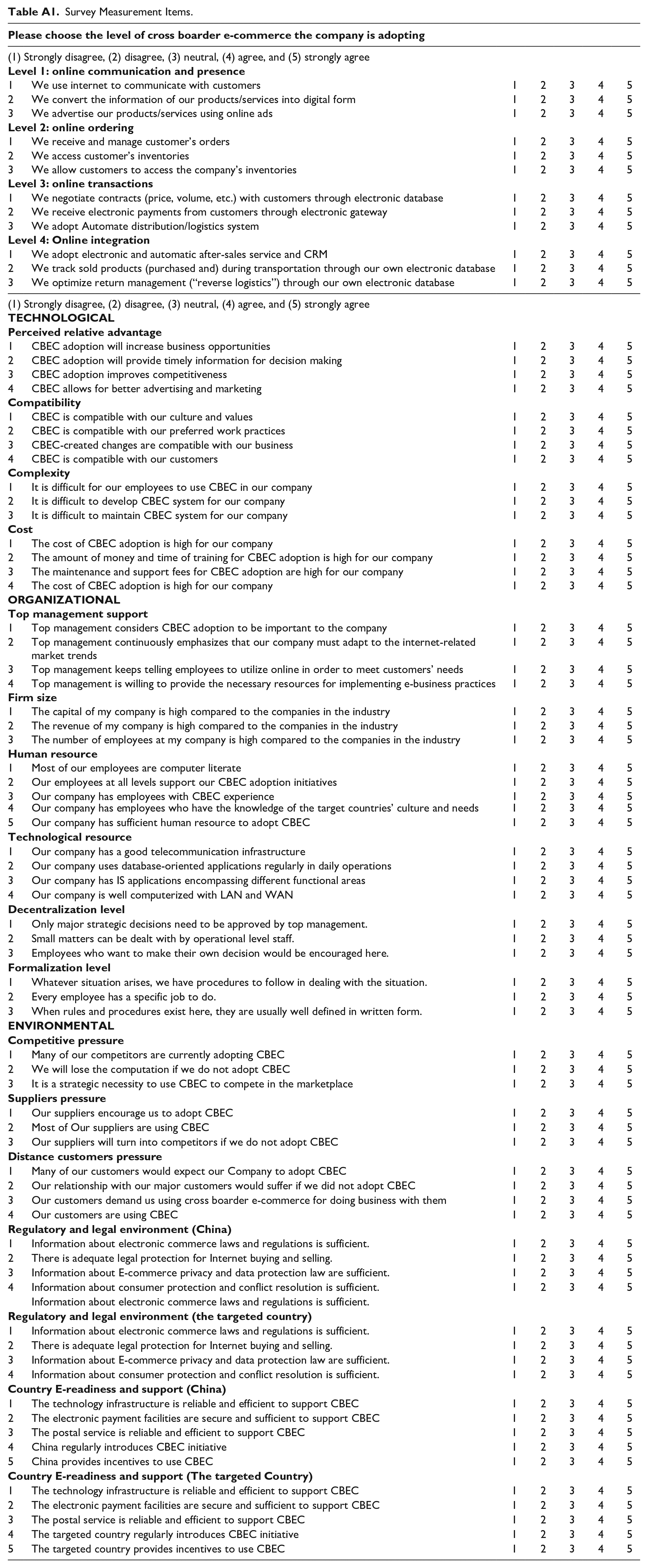
When it comes to the environmental context, this variable was measured via eight-dimensional 28 items’ scale, that is, competitive pressure (3 items), suppliers’ pressure (3 items), distance customers pressure (4 items), regulatory and legal environment, China (4 items), regulatory and legal environment, the targeted country (4 items), Country E-readiness and support, China(5 items), Country E-readiness and support, the targeted country(5 items) adapted from the studies of Ching and Ellis (2004), Al-Qirim (2007), Wu and Lee (2005), Heng and Low (1993), and Kuan and Chau (2001). A sample item from competitive pressure is “Many of our competitors are currently adopting CBEC.” All measurement items are summarized in Appendix A.
Data Analysis Technique
Following the data collection, various descriptive statistics were measured. After this, the reliability and validity of the study variables were checked. Following this, structural Equation Modeling was used to examine the data. via Smart PLS 3 software. Results are given in the next part of the paper.
Common Method Bias
To avoid common method bias issues. Three steps were taken by the authors. First, the respondents were informed of their anonymity and confidentiality, which helped to restrict their desire to please and give incorrect answers (Uddin et al., 2019).Second, the authors examine the variance explained by the factors using Harman’s one-factor test. According to the result, no single factor explains more than 50% of the overall variance. Finally, the correlation matrix is checked to see if any two constructs have a correlation of greater than .90 (Pavlou et al., 2007). This conclusion implies that in this study, common method bias is not an issue.
Data Analysis and Results
Reliability and Validity Analysis
Structural equation modeling is divided into the assessment of measurement and structural models. The measurement model is assessed to ascertain the construct reliability and validity. Both lower-order and higher-order constructs were assessed for reliability and validity. First, all of the model’s factor loadings are more than the minimum allowable value of 0.50 (Hair et al., 2010). Due to low factor loadings, none of the objects were deleted. Due to high cross-loadings, just one item (ORGFL2) was deleted in the current study. Cronbach’s alpha and composite reliability were used to determine reliability, and both statistics were higher than the acceptable standard of .700 (Wasko & Faraj, 2005) for both lower-order constructs and the higher-order constructs (Table 1), hence, indicating good reliability (Henseler et al., 2016). Because the AVE was .500 for all of the lower order variables, convergent validity was acceptable. Despite the fact that the AVE value for the upper higher-order construct of ORG was .491, it is still around 500. Hence, convergent validity was also established for higher-order constructs (ENV and ORG). The square root of AVE was used to compare the correlations among the latent variables to determine discriminant validity. (Fornell & Larcker, 1981). The construct’s square root of AVE is greater than its association with the other constructs. As a result, discriminant validity for lower-order (Table 2) and higher-order (Table 3) constructs is established.
Reliability and Validity Analysis for Lower Order Constructs.

Note. CR = composite reliability; AVE = average variance extracted, CESH = country E-readiness and support (China); CEST = country E-readiness and support (the targeted country); CP = competitor’ pressure; DCP = distance customers pressure; RLCH = regulatory and legal environment (China); RLTC = regulatory and legal environment (the targeted country); SP = suppliers’ pressure; DL = decentralization level; FL = formalization level; FS = firm size; HR = human resource; TECHR = technological resource; TMS = top management support.
Discriminant Validity—Lower Order Constructs—Fornell-Larcker Criterion.

Note. The AVE’s square roots are emphasized and diagonalized. Correlations between the construct’s values are listed below the diagonal elements.
Discriminant Validity—Higher Order Constructs—Fornell-Larcker Criterion.

Note. The square roots of the AVE are diagonal and emphasized. The correlations between the construct’s values are shown below the diagonal elements.
Structural Model
The R2, Q2, and importance of routes are used to evaluate a structural model. The strength of each structural path was measured by the R2 value for the dependent variable in order to assess the model’s quality. (Briones Peñalver et al., 2018), the R2 statistics shall be equal to or over .1 to establish predictive capability (Falk & Miller, 1992). The results in Table 4 show that all R2 values are over .1, establishing the predictive capability. About 11.7 percentage change in level 1 is being accounted by environment context and or organizational context, 18.5 percentage change in level 2 is being accounted by environment context and or organizational context, 15.7 percentage change in level 3 is being accounted by environment context and or organizational context, 12.3 percentage change in level 4 is being accounted by environment context and or organizational context. Besides, Q2 determines the predictive relevance of the endogenous variables. Q2 statistic over 0 confirms the predictive relevance. The results (Table 4) show Q2 is over 0 for all endogenous constructs, hence confirming predictive relevance.
Testing Direct Relationships.

To assess the significance of the relationship, several hypotheses were examined. H1 evaluates whether ENV has a significant impact on each of the levels of adoption. The results revealed that ENV has an insignificant direct effect on Level 1 (β = .027, t = 0.291, p = .771), significant impact on Level 2 (β = .183, t = 2.435, p = .015) and Level 3 (β = .279, t = 3.444, p = .001) whereas ENV had partial direct effect Level 4 (β = .147, t = 1.846, p = 0.065). Hence, H1 was not supported while H2, H3, and H4 were supported.
The results revealed that ENV has a significant impact on ORG (β = .562, t = 8.334, p < .001). Hence, H5 was supported.
The findings indicated that Organizational Context has a significant influence on Level 1. (β = .326, t = 3.951, p < .001), Level 2 (β = .300, t = 3.712, p < .001), Level 3 (β = .166, t = 2.050, p = .040), and Level 4 (β = .246, t = 3.314, p = .001), supporting H6, H7, H8, and H9.
Hypotheses testing results are summarized in Table 4.
Mediation Analysis
The role of Organizational Context in mediating the relationship between Environmental Context and various levels of adoption was investigated using mediation analysis. The findings (see Table 5) demonstrated that Organizational Context has a major moderating effect in the relationship between ENV and Level 1(H10: β = .183, t = 3.475, p = .001), Level 2 (H11: β = .168, t = 3.588, p < .001), Level 3 (H12: β = .093, t = 1.987, p = .047), and Level 4 (H13: β = .138, t = 2.965, p = .003). Since, the direct effects from ENV to Level 2, Level 3, and Level 4 were significant, this shows partial mediation of organizational context between ENV and Level 2, Level 3, and Level 4, while full mediation of organizational context between ENV and Level 1 as the direct effect was insignificant.
Mediation Analysis.

Discussion and Implications
Discussion
Utilizing the TOE framework, the influence of environmental and organizational context on CBEC adoption levels was explored in this article. The article also looked at the effect of organizational context in mediating the link between environmental context and CBEC adoption levels. Overall, 13 hypotheses were proposed to achieve our aim. Data collected were analyzed through Smart PLS 3 software. Discussion of the findings is given below.
Hypothesis H1, we proposed the positive impact of environmental impact on the adoption of level 1 of CBEC. Contrary to our proposition, this hypothesis was not supported. This finding also contradicts the previous studies conducted by Lefebvre et al. (2005) and Elbeltagi et al. (2016). One possible reason for this could be that access to technology has become so common around the globe and particularly in China, that people may be taking level 1 of CBEC for granted. They might be taking level 1 adoption of CBEC as an essential component for every business and therefore, no matter there is environmental pressure or not, organizations would adopt level 1 of CBEC.
Furthermore, for hypotheses H2, H3, and H4, we found a significant positive impact of environmental context on level 2, 3, and 4 of CBEC. This observation is in line with the past research conducted by Lefebvre et al. (2005) who suggested that SMEs increasingly take e-commerce initiatives and are going beyond providing simple information about products, services, and business addresses only. Instead, the focus of these SMEs is on more complex processes such as online transactions, complaints filing, negotiating online contracts, etc. It also underlines the fact that SMEs favor more customer-centric approach with sales and after-sales services (Lefebvre et al., 2005). These findings are also consistent with the findings of Elbeltagi et al. (2016) who conducted their study on US and Egyptian firms. Finally, consistency in our findings was also found with the study conducted by Haque et al. (2019), who found that organizational context and environmental context are significant contributors toward the adoption of social networking sites. These findings also mean that SMEs in China are demonstrating high maturity in the adoption of levels of CBEC.
Likewise, the study also found a positive significant impact of environmental context on organizational context thereby supporting our hypothesis H5. This finding is in line with the previous studies that argued that environmental pressures play a critical role in shaping organizational strategies and responses (Staw et al., 1981; Yasai-Ardekani, 1989). This finding also seconds the previous research on uncertain environmental factors and their influence on organizational context. For example, researchers argue that environmental pressures result in high flexibility, greater top management support, less formalization, and greater empowerment in decision making (Cheng et al., 2021; Li et al., 2018)
Furthermore, Hypotheses H6, H7, H8, and H9 investigated the influence of organizational context on CBEC adoption levels. The data supported all these proposed hypotheses which suggest that organizational context plays a key role in decision making for adopting CBEC at different levels. Our findings are in line with the previous studies which explored the impact of certain organizational context on the adoption of technology. For example, Alamgir (Hossain & Quaddus, 2011) found that size of an organization plays a critical role in the adoption of technology. Likewise, these findings are also in line with the study conducted by Awa et al. (2017) which suggests that is the adoption of technology is more dependent on the TOE factors than on individual factors. The results also suggest that organizational factors influence the adoption of CBEC at all levels, hence, organizations realize the importance of e-commerce in China and therefore, organizational factors such as top management support, size, human resource, decentralization, etc. all are key determinants of adoption of CBEC at all four levels.
Finally, Hypotheses H10, H11, H12, and H13 investigated the function of organizational context in moderating the link between environmental context and CBEC adoption levels. the results for H10 show full mediation of organizational context between environment context and Level 1. since there was no direct relationship of environment context on level 1 of CBEC, therefore, this result was expected. Another possible explanation for level 1 is that Chinese firms have become so mature in adopting e-commerce that it has become an essential part of organizations to have some online presence and therefore they may not relate it to the environmental or organizational contexts but a basic requirement of a business just like other basic requirements. The third possible explanation is that SMEs may not be able to differentiate between the four levels of CBEC adoption and may look at it through a different lens.
On the other side, the mediating role of organizational context on level 2, level 3, and level 4 was in line with the previous studies (Elbeltagi et al., 2016; Haque et al., 2019; Lefebvre et al., 2005). In general, either environmental pressures such as the adoption of legal procedures or pressure of competition which forces an organization to either copy and adopt or come up with their unique and innovative solutions to take a lead. These pressures trigger top management’s reaction to deploy the best people for the task, giving them reasonable autonomy and access to adequate resources for inventing innovative ways of improving the business operations, such as adopting CBEC.
Implications (Theoretical and Practical)
Several theoretical implications can be noted from this study. First of all, utilizing the TOE framework, is among the very few, if any, studies which explore the impact of environmental context on the adoption levels of CBEC. Particularly, this study addressed the research gap where studies emphasized on exploring the motives behind adopting the levels of CBEC from an enterprise lens than the individual lens (Qi et al., 2020). Secondly, the study explored the impact of environmental context such as the pressure of competition, customers, suppliers, govt. legislations, etc. on the four levels of CBEC adoption. No study to the best of the author’s knowledge has explored this relationship on the different levels of CBEC. Therefore, this is another theoretical contribution of our study in the existing scholarship on CBEC and its antecedents. Third, we also explored the impact of organizational context such as size, top management support, human resource and decentralization, etc. on the four levels of CBEC adoption. Bringing empirical evidence in this dimension is also a novel contribution of this study to the existing scholarship. Finally, we explored the mediating role of organizational context between environmental context and the four level of CBEC adoption. This was another important contribution because past studies have emphasized exploring the underlying enterprise level mechanism through which CBEC is adopted (Awa et al., 2017; Qi et al., 2020; Tornatzky & Fleischer, 1990). In other words, the mediating role of enterprise level variables was missing. Our study has provided empirical evidence of the mediating role of organizational context on level 2, level 3, and level 4 of CBEC adoption, a novel contribution to the existing scholarship.
This study also has several practical implications. First, through empirical evidence, we have proved that environmental context triggers the adoption of levels of CBEC. Therefore, policymakers must understand the environmental factors at the time policy-making for promoting CBEC in their countries. Second, the importance of organizational context also came into light from this study. Important implications for managers from this finding is that top management must ensure their strongest support, focus on enhancing the skills of their employees and adopt a more decentralized structure in the organization if they want to promote and adopt CBEC at all levels. Third, it is also important to understand that more formal organizations with decision-making in the hands of a few individuals may not help in the successful adoption of technology and CBEC. Organizations must ensure that in order to avoid failure in the adoption of CBEC, all elements of organizational context, as well as environmental context, are important for consideration. Fourth, understanding the different levels of adoption of CBEC would help the managers form effective strategies to incrementally adapt and progress through each level. Fifth, the findings have several implications for policymakers and the government. For example, the government can promote the usage of CBEC by establishing favorable legislation. They must also create procedures to avoid unethical and criminal hacking actions. The government should also invest in the creation of supportive infrastructure, such as high-speed internet access. Finally, they may provide incentives for small businesses to embrace CBEC.
Limitations and Future Research
Before interpreting the findings of this study, it’s important to keep a few limitations in mind. First, the study is conducted in China only. Being the market leader in e-commerce, it is understandable that such study may be conducted in China, however, past studies have revealed that cultural differences play a key role in responding to or adopting various technologies and must not be taken for granted (Awa et al., 2017). Therefore, similar studies can be replicated elsewhere to establish the generalizability of its findings. Second, the cross-sectional nature of the study limits the true understanding of the conditions and forces in play for the adoption of CBEC. Hence, a more longitudinal study would help in broadening our understanding of CBEC adoption. Third, our focus of the study was on the firm level contextual factors. There may other individual level factors such as the leadership style of the top management, in adopting CBEC. Future studies may consider such individual level factors and their impacts on CBEC adoption. Fourth, the sample size could be another limitation of this study, Future studies may test the same on larger datasets to validate the results. Finally, studies on variables which may inhibit or mitigate the strength of the relationship between environmental context, organizational context and CBEC adoption are also an unexplored area which can be focused on in future studies.
Conclusion
Studies on cross-border e-commerce are gaining momentum, particularly from Chinese perspective since the country has become a market leader in CBEC. The goal of this quantitative study was to see how the environment affected the adoption of four different levels of CBEC. The study also explored the mediating role of organizational context between the dependent and independent variables. To achieve this aim, the Technology-Organizational-Environment (TOE) framework was utilized. Data were gathered from small and medium-sized organizations in China. A total sample size of N = 208 was recorded. A total of 13 hypotheses were tested through structural equation modeling technique via Smart PLS 3 software. Our of the total 13 hypotheses, 10 were found significant. Several theoretical and practical implications were discussed followed by limitations and future research which concludes our study.
Footnotes
Appendix A
Survey Measurement Items.
|
|
||||||
|---|---|---|---|---|---|---|
| (1) Strongly disagree, (2) disagree, (3) neutral, (4) agree, and (5) strongly agree | ||||||
|
|
||||||
| 1 | We use internet to communicate with customers | 1 | 2 | 3 | 4 | 5 |
| 2 | We convert the information of our products/services into digital form | 1 | 2 | 3 | 4 | 5 |
| 3 | We advertise our products/services using online ads | 1 | 2 | 3 | 4 | 5 |
|
|
||||||
| 1 | We receive and manage customer’s orders | 1 | 2 | 3 | 4 | 5 |
| 2 | We access customer’s inventories | 1 | 2 | 3 | 4 | 5 |
| 3 | We allow customers to access the company’s inventories | 1 | 2 | 3 | 4 | 5 |
|
|
||||||
| 1 | We negotiate contracts (price, volume, etc.) with customers through electronic database | 1 | 2 | 3 | 4 | 5 |
| 2 | We receive electronic payments from customers through electronic gateway | 1 | 2 | 3 | 4 | 5 |
| 3 | We adopt Automate distribution/logistics system | 1 | 2 | 3 | 4 | 5 |
|
|
||||||
| 1 | We adopt electronic and automatic after-sales service and CRM | 1 | 2 | 3 | 4 | 5 |
| 2 | We track sold products (purchased and) during transportation through our own electronic database | 1 | 2 | 3 | 4 | 5 |
| 3 | We optimize return management (“reverse logistics”) through our own electronic database | 1 | 2 | 3 | 4 | 5 |
| (1) Strongly disagree, (2) disagree, (3) neutral, (4) agree, and (5) strongly agree | ||||||
|
|
||||||
|
|
||||||
| 1 | CBEC adoption will increase business opportunities | 1 | 2 | 3 | 4 | 5 |
| 2 | CBEC adoption will provide timely information for decision making | 1 | 2 | 3 | 4 | 5 |
| 3 | CBEC adoption improves competitiveness | 1 | 2 | 3 | 4 | 5 |
| 4 | CBEC allows for better advertising and marketing | 1 | 2 | 3 | 4 | 5 |
|
|
||||||
| 1 | CBEC is compatible with our culture and values | 1 | 2 | 3 | 4 | 5 |
| 2 | CBEC is compatible with our preferred work practices | 1 | 2 | 3 | 4 | 5 |
| 3 | CBEC-created changes are compatible with our business | 1 | 2 | 3 | 4 | 5 |
| 4 | CBEC is compatible with our customers | 1 | 2 | 3 | 4 | 5 |
|
|
||||||
| 1 | It is difficult for our employees to use CBEC in our company | 1 | 2 | 3 | 4 | 5 |
| 2 | It is difficult to develop CBEC system for our company | 1 | 2 | 3 | 4 | 5 |
| 3 | It is difficult to maintain CBEC system for our company | 1 | 2 | 3 | 4 | 5 |
|
|
||||||
| 1 | The cost of CBEC adoption is high for our company | 1 | 2 | 3 | 4 | 5 |
| 2 | The amount of money and time of training for CBEC adoption is high for our company | 1 | 2 | 3 | 4 | 5 |
| 3 | The maintenance and support fees for CBEC adoption are high for our company | 1 | 2 | 3 | 4 | 5 |
| 4 | The cost of CBEC adoption is high for our company | 1 | 2 | 3 | 4 | 5 |
|
|
||||||
|
|
||||||
| 1 | Top management considers CBEC adoption to be important to the company | 1 | 2 | 3 | 4 | 5 |
| 2 | Top management continuously emphasizes that our company must adapt to the internet-related market trends | 1 | 2 | 3 | 4 | 5 |
| 3 | Top management keeps telling employees to utilize online in order to meet customers’ needs | 1 | 2 | 3 | 4 | 5 |
| 4 | Top management is willing to provide the necessary resources for implementing e-business practices | 1 | 2 | 3 | 4 | 5 |
|
|
||||||
| 1 | The capital of my company is high compared to the companies in the industry | 1 | 2 | 3 | 4 | 5 |
| 2 | The revenue of my company is high compared to the companies in the industry | 1 | 2 | 3 | 4 | 5 |
| 3 | The number of employees at my company is high compared to the companies in the industry | 1 | 2 | 3 | 4 | 5 |
|
|
||||||
| 1 | Most of our employees are computer literate | 1 | 2 | 3 | 4 | 5 |
| 2 | Our employees at all levels support our CBEC adoption initiatives | 1 | 2 | 3 | 4 | 5 |
| 3 | Our company has employees with CBEC experience | 1 | 2 | 3 | 4 | 5 |
| 4 | Our company has employees who have the knowledge of the target countries’ culture and needs | 1 | 2 | 3 | 4 | 5 |
| 5 | Our company has sufficient human resource to adopt CBEC | 1 | 2 | 3 | 4 | 5 |
|
|
||||||
| 1 | Our company has a good telecommunication infrastructure | 1 | 2 | 3 | 4 | 5 |
| 2 | Our company uses database-oriented applications regularly in daily operations | 1 | 2 | 3 | 4 | 5 |
| 3 | Our company has IS applications encompassing different functional areas | 1 | 2 | 3 | 4 | 5 |
| 4 | Our company is well computerized with LAN and WAN | 1 | 2 | 3 | 4 | 5 |
|
|
||||||
| 1 | Only major strategic decisions need to be approved by top management. | 1 | 2 | 3 | 4 | 5 |
| 2 | Small matters can be dealt with by operational level staff. | 1 | 2 | 3 | 4 | 5 |
| 3 | Employees who want to make their own decision would be encouraged here. | 1 | 2 | 3 | 4 | 5 |
|
|
||||||
| 1 | Whatever situation arises, we have procedures to follow in dealing with the situation. | 1 | 2 | 3 | 4 | 5 |
| 2 | Every employee has a specific job to do. | 1 | 2 | 3 | 4 | 5 |
| 3 | When rules and procedures exist here, they are usually well defined in written form. | 1 | 2 | 3 | 4 | 5 |
|
|
||||||
|
|
||||||
| 1 | Many of our competitors are currently adopting CBEC | 1 | 2 | 3 | 4 | 5 |
| 2 | We will lose the computation if we do not adopt CBEC | 1 | 2 | 3 | 4 | 5 |
| 3 | It is a strategic necessity to use CBEC to compete in the marketplace | 1 | 2 | 3 | 4 | 5 |
|
|
||||||
| 1 | Our suppliers encourage us to adopt CBEC | 1 | 2 | 3 | 4 | 5 |
| 2 | Most of Our suppliers are using CBEC | 1 | 2 | 3 | 4 | 5 |
| 3 | Our suppliers will turn into competitors if we do not adopt CBEC | 1 | 2 | 3 | 4 | 5 |
|
|
||||||
| 1 | Many of our customers would expect our Company to adopt CBEC | 1 | 2 | 3 | 4 | 5 |
| 2 | Our relationship with our major customers would suffer if we did not adopt CBEC | 1 | 2 | 3 | 4 | 5 |
| 3 | Our customers demand us using cross boarder e-commerce for doing business with them | 1 | 2 | 3 | 4 | 5 |
| 4 | Our customers are using CBEC | 1 | 2 | 3 | 4 | 5 |
|
|
||||||
| 1 | Information about electronic commerce laws and regulations is sufficient. | 1 | 2 | 3 | 4 | 5 |
| 2 | There is adequate legal protection for Internet buying and selling. | 1 | 2 | 3 | 4 | 5 |
| 3 | Information about E-commerce privacy and data protection law are sufficient. | 1 | 2 | 3 | 4 | 5 |
| 4 | Information about consumer protection and conflict resolution is sufficient. | 1 | 2 | 3 | 4 | 5 |
| Information about electronic commerce laws and regulations is sufficient. | ||||||
|
|
||||||
| 1 | Information about electronic commerce laws and regulations is sufficient. | 1 | 2 | 3 | 4 | 5 |
| 2 | There is adequate legal protection for Internet buying and selling. | 1 | 2 | 3 | 4 | 5 |
| 3 | Information about E-commerce privacy and data protection law are sufficient. | 1 | 2 | 3 | 4 | 5 |
| 4 | Information about consumer protection and conflict resolution is sufficient. | 1 | 2 | 3 | 4 | 5 |
|
|
||||||
| 1 | The technology infrastructure is reliable and efficient to support CBEC | 1 | 2 | 3 | 4 | 5 |
| 2 | The electronic payment facilities are secure and sufficient to support CBEC | 1 | 2 | 3 | 4 | 5 |
| 3 | The postal service is reliable and efficient to support CBEC | 1 | 2 | 3 | 4 | 5 |
| 4 | China regularly introduces CBEC initiative | 1 | 2 | 3 | 4 | 5 |
| 5 | China provides incentives to use CBEC | 1 | 2 | 3 | 4 | 5 |
|
|
||||||
| 1 | The technology infrastructure is reliable and efficient to support CBEC | 1 | 2 | 3 | 4 | 5 |
| 2 | The electronic payment facilities are secure and sufficient to support CBEC | 1 | 2 | 3 | 4 | 5 |
| 3 | The postal service is reliable and efficient to support CBEC | 1 | 2 | 3 | 4 | 5 |
| 4 | The targeted country regularly introduces CBEC initiative | 1 | 2 | 3 | 4 | 5 |
| 5 | The targeted country provides incentives to use CBEC | 1 | 2 | 3 | 4 | 5 |
Declaration of Conflicting Interests
The author(s) declared no potential conflicts of interest with respect to the research, authorship, and/or publication of this article.
Funding
The author(s) received no financial support for the research, authorship, and/or publication of this article.
Ethical Approval
This manuscript is in compliance with the ethical standards of SAGE Open.
