




Abstract
Cross-border e-commerce (CBEC) is reshaping how consumers engage with global markets. While most prior studies focus on CBEC purchase or repurchase intentions, little is known about the factors that drive consumers to switch from domestic e-commerce platforms to CBEC platforms. To address this gap, this study employs the push–pull–mooring (PPM) framework to investigate the factors underlying consumers’ switching intention toward CBEC. A mixed-methods approach was used. First, qualitative interviews helped identify relevant constructs. Subsequently, a quantitative survey that received 727 valid responses was used to empirically test the proposed model. A partial least squares (PLS) analysis was conducted, and the results revealed that push factors (perceived high domestic prices), pull factors (product uniqueness, pricing competitiveness, CBEC platform reputation, the general country image of the CBEC platform, and consumer informedness), and mooring factors (perceived behavioral control and variety seeking) significantly drive consumers’ intentions to switch to CBEC platforms. Furthermore, mooring factors moderately influence the relationship between push factors and switching intentions and the relationship between pull factors and switching intentions. This research deepens our understanding of the factors influencing consumers’ switching intentions toward CBEC platforms. Additionally, the findings of this research offer practical guidance that can help CBEC managers and practitioners develop strategies that effectively attract and retain more consumers.
Plain Language Summary
This study investigates why Chinese online shoppers switch from domestic to cross-border e-commerce (CBEC) platforms. The results show that high domestic prices push consumers away from local platforms. Moreover, pull factors such as competitive pricing, unique products, reputable CBEC platforms, a favorable country image, and clearer product information attract users to international platforms. Additionally, individuals who enjoy novelty or feel confident in their ability to manage online purchases are more inclined to adopt CBEC. These findings offer valuable insights for CBEC managers aiming to align their strategies with evolving consumer preferences and behaviors.
Keywords
Introduction
Driven by digital innovation and globalization, cross-border e-commerce (CBEC) 1 has become a vital force in reshaping consumer shopping behavior across national boundaries (Lu et al., 2021; Ma et al., 2025; Mou, Cohen, Dou, & Zhang, 2020). CBEC platforms utilize advanced digital infrastructures and global logistics systems to facilitate seamless cross-border transactions (Hazarika & Mousavi, 2022; Y. J. Xu et al., 2022; Y. Xu et al., 2025; Zhu et al., 2020). CBEC appeals to individuals looking for unique, premium, or authentic goods that are not readily available through domestic e-commerce providers (Lee & Xiong, 2024). Despite this growing appeal, CBEC platforms face intense competition from well-established domestic e-commerce platforms. It is therefore crucial to understand the factors that drive consumers to shift from local platforms to foreign platforms. Understanding such behavioral switching represents a significant opportunity for international market development. However, the underlying motivations and mechanisms behind this consumer transition remain underexamined in both academic and practical contexts.
While existing CBEC research has focused primarily on consumers’ purchase and repurchase intentions (Bao et al., 2022; Do et al., 2023; Gui et al., 2022; Han et al., 2018; Jian et al., 2023; Lee, 2024; Ma et al., 2019; Mou, Zhu, & Benyoucef, 2020; Shao et al., 2021; Sun & Li, 2022; Xiao et al., 2019; Y. J. Xu et al., 2022; X. Y. Xu et al., 2023; X. Yang et al., 2023; Zhu et al., 2019), relatively little attention has been paid to understanding consumers’ switching intentions—specifically, their decisions to move from traditional (domestic) e-commerce platforms to CBEC platforms. Understanding switching intentions is critical, as they are strong predictors of actual switching behavior (Bansal et al., 2005; Lee & Wang, 2023). These behaviors play a vital role in the processes of driving CBEC sector growth, enabling market expansion, and ensuring long-term profitability. When consumers transition from domestic to CBEC platforms, their choices reflect more than merely their personal preferences. These shifts reshape international market dynamics, impact customer retention strategies, and change how companies compete. Ultimately, such consumer behavior plays a key role in determining the global success of CBEC providers (Lee & Xiong, 2024).
Several important gaps in the current CBEC literature remain with respect to our understanding of consumers’ switching intentions toward CBEC platforms. First, most studies emphasize the advantages of CBEC platforms in attracting consumer purchases (Lee & Xiong, 2024; Y. Xu et al., 2024), but they overlook the role of dissatisfaction with domestic e-commerce platforms in prompting consumers to seek alternatives (i.e., CBEC platforms). Shortcomings such as high product prices on domestic platforms may be critical triggers for consumer migration, but they have received limited scholarly attention. Second, current research often neglects the influence of consumer-side psychological and behavioral traits, such as individuals’ confidence in navigating cross-border purchases (Ajzen, 1991) or their inclination to seek variety (Bansal et al., 2005), which are vital for understanding switching behavior. Third, most crucially, prior studies rarely consider how factors at the CBEC platform level, domestic e-commerce platform level, and individual level interact. Integrated research that simultaneously examines the perceived limitations of domestic e-commerce platforms, the attractiveness of CBEC platforms, and the personal tendencies of consumers in shaping their switching intentions is lacking. This gap limits both theoretical understanding and practical insights into consumer decision-making in the increasingly competitive global e-commerce landscape. Therefore, this analysis reveals significant gaps in CBEC research, thereby prompting the formulation of the following research question:
To answer this question, this study uses push–pull–mooring (PPM) theory (Bansal et al., 2005) to develop a research model to explore how push, pull, and mooring factors influence consumers to switch from domestic e-commerce platforms to CBEC platforms. Specifically, push factors refer to shortcomings in the current product or service that drive users away. Pull factors capture the appealing attributes of an alternative that attract users. Moreover, mooring factors represent individual or social influences that either constrain or facilitate consumers’ decisions to switch platforms (Bansal et al., 2005; Lee & Wang, 2023). This study identifies eight key factors on the basis of qualitative interviews. Perceptions of high prices on domestic e-commerce platforms serve as a push factor that drives consumers to CBEC. In contrast, product uniqueness, price competitiveness, CBEC platform reputation, the general country image of the CBEC platform and consumer informedness function as pull factors that attract users. Additionally, perceived behavioral control and variety seeking are identified as mooring factors that shape switching behavior. These factors are then tested through a quantitative study via 727 valid survey responses and analyzed via partial least squares (PLS), a robust method for assessing relationships.
This study makes several key contributions. First, this study adopts a theory-driven yet context-sensitive approach to identify switching factors in the CBEC context. Unlike most PPM-based studies that select variables solely through a literature review, this research integrates semistructured interviews to inductively uncover key push, pull, and mooring factors. This approach enhances the contextual validity of the PPM framework and demonstrates its flexibility in capturing nuanced consumer motivations in global digital commerce. Second, this study highlights the often overlooked push effect resulting from dissatisfaction with domestic e-commerce platforms rather than focusing solely on CBEC attractiveness. Third, it emphasizes the role of individual consumer traits—specifically, mooring factors such as perceived behavioral control and variety seeking—which prior studies have largely neglected. Fourth, by presenting an integrated model that considers the dynamic interplay between platform characteristics and user dispositions, this study extends the explanatory scope of the PPM framework and provides a more holistic foundation for understanding consumer migration in CBEC settings. The practical contribution of this study lies in its ability to enhance the understanding of consumers’ switching decisions from domestic e-commerce platforms to CBEC platforms, thereby enabling platform operators and marketers to formulate targeted strategies for attracting users. By identifying the key factors that influence switching behavior, this research offers actionable insights for improving consumer acquisition and retention in the competitive CBEC landscape.
Literature Review
PPM Model and Switching Intentions
The PPM framework, originally rooted in migration studies (Boyle & Halfacree, 1998), has been widely adopted to explain consumer switching behavior across various service domains, including mobile payments, smartphone brands, and sharing economy platforms (Bansal et al., 2005; Chen & Keng, 2019; Lee & Wang, 2023; Liu et al., 2021). In this framework, push factors refer to negative or dissatisfying aspects of the current option that drive users away, pull factors emphasize the attractive features of an alternative that draws users in, and mooring factors represent personal influences that either facilitate or restrain switching behavior (Bansal et al., 2005; Lee, 2024). While the push and pull dimensions may resemble a strength–weakness analysis, the PPM framework progresses beyond this dichotomy by explicitly integrating mooring effects. These effects capture a range of psychological constraints or enablers that shape migration decisions. Importantly, mooring variables not only directly influence switching intentions but also can moderate the relationships between push/pull factors and switching, either amplifying or dampening their effects (Chen & Keng, 2019; Lee, 2024). By incorporating all three dimensions, the PPM framework offers a more comprehensive and nuanced explanation of consumer mobility. It enables researchers to understand not only the comparative appeal of the current option and alternatives but also how individual traits interact to reinforce or inhibit switching—something that a strength–weakness typology cannot adequately address.
This study adopts the PPM framework to examine consumers’ intentions to switch from domestic e-commerce to CBEC platforms for several reasons. First, the PPM model is fundamentally designed to explain behavioral migration (Lee & Wang, 2023), making it well suited for analyzing consumer transitions across platform boundaries. Unlike prior studies that focus primarily on purchase intentions within CBEC platforms, the PPM framework explicitly addresses the dynamics of moving from an existing option to a new alternative, which directly aligns with the phenomenon of consumers leaving domestic platforms for CBEC platforms. Second, just as migration decisions are often shaped by individuals’ past residential experiences (Hsieh et al., 2012; Lee, 2024), switching to CBEC platforms is influenced by consumers’ prior dissatisfaction with domestic platforms. These parallels highlight the fact that switching is not only a forward-looking evaluation of alternatives but also a process embedded in past experiences and contextual limitations (Bansal et al., 2005). Third, the PPM framework captures the interplay among three critical forces—push (dissatisfaction with domestic platforms, such as high product prices), pull (attractive features of CBEC platforms, including price competitiveness and product uniqueness), and mooring (individual conditions such as perceived behavioral control and variety seeking) factors. This tripartite structure enables a more comprehensive and nuanced understanding of switching decisions. By integrating these dimensions, the PPM framework provides a theoretically robust and contextually appropriate perspective on consumer migration to CBEC platforms.
Recent Studies on CBEC
In recent years, a growing number of consumers worldwide have transitioned from domestic e-commerce platforms to CBEC platforms (DHL, 2025; Witek-Hajduk & Grudecka, 2024; Y. Xu et al., 2025). According to DHL (2025), nearly 59% of global online shoppers have made purchases from international retailers. This trend has been driven by improved access to digital infrastructure, advancements in global logistics networks, and increasing consumer demand for greater product variety and quality beyond those that are available in local markets. Such behavior reflects a broader shift toward globalized consumption and the rise of consumer cosmopolitanism, where shoppers actively seek diversity, better value, and access to international brands across borders. As the world’s largest e-commerce market, China plays a pivotal role in this global transition. China has over 1 billion internet users and a highly developed digital economy; thus, Chinese consumers have become increasingly active participants in CBEC. An increasing number of consumers are relying on CBEC platforms to purchase goods from overseas sellers and brands (Lee & Xiong, 2024; Y. Xu et al., 2024). These behavioral patterns underscore the need to obtain a better understanding of the psychological and practical motivations that drive consumers’ decisions to switch from domestic to CBEC platforms. Gaining such insights is essential for researchers seeking to expand CBEC theory and for practitioners aiming to improve platform competitiveness in an increasingly globalized digital marketplace.
Unlike routine purchasing decisions made on domestic platforms, switching to CBEC platforms requires consumers to evaluate both the limitations of domestic platforms and the perceived benefits offered by CBEC alternatives. Understanding consumers’ switching intentions toward CBEC platforms is crucial, as it offers deeper insights into their decision-making processes within the context of a globalized digital marketplace. Table 1 summarizes the key studies in the CBEC literature from a consumer perspective. The majority of existing research focuses on Chinese consumers, reflecting their strong engagement and active participation in CBEC. At the same time, we identify only a small number of studies that examine CBEC consumer behavior from a European perspective, such as Valarezo et al. (2018), Witek-Hajduk and Grudecka (2022), and Witek-Hajduk and Grudecka (2024). Table 1 also highlights the research focus, theoretical foundations, methodological approaches, and main findings of these studies. This overview provides a structured understanding of how prior research has approached CBEC consumer behavior and helps to identify important gaps that warrant further investigation. While existing studies have focused primarily on purchase intentions and their influencing factors (Bao et al., 2022; Chen & Tang, 2021; Gui et al., 2022; Han et al., 2018; Huang & Chang, 2019; Jian et al., 2023; Lee & Xiong, 2024; Mou, Zhu, & Benyoucef, 2020; Shao et al., 2021; Sun & Li, 2022; Witek-Hajduk & Grudecka, 2024; Xiao et al., 2019; Y. J. Xu et al., 2022; X. Y. Xu et al., 2023; X. Yang et al., 2023; Zhu et al., 2019), and some have explored repurchase intentions within the CBEC context (Do et al., 2023; Li et al., 2024; Ma et al., 2019), relatively few studies have investigated the underlying factors that drive consumers to switch from domestic to CBEC platforms. Addressing this gap is essential for improving our understanding of platform competition and for helping businesses develop more effective strategies for consumer acquisition and long-term retention.
Summary of the Key Literature on CBEC Consumer Behavior.

Source. Adapted from Lee and Xiong (2024).
As illustrated in Table 1, most CBEC studies emphasize the pull factors that attract consumers to cross-border platforms, such as lower prices, unique product assortments, legal protection, and a strong platform reputation (Jian et al., 2023; Lee & Xiong, 2024; Witek-Hajduk & Grudecka, 2022, 2024; Y. J. Xu et al., 2022; Y. Xu et al., 2025). These studies have contributed valuable insights into purchase and repurchase intentions within CBEC contexts. However, they tend to overlook the push factors, particularly dissatisfaction with domestic e-commerce platforms. For instance, high product prices on local platforms may discourage consumers and prompt them to explore CBEC alternatives. In the broader platform switching literature, such negative experiences have been identified as critical drivers of migration behavior (Bansal et al., 2005; Hsieh et al., 2012). However, in CBEC research, these push-related triggers remain relatively underexplored, thus limiting our understanding of why consumers disengage from domestic platforms in favor of cross-border options. In addition, while prior CBEC research has largely focused on platform attributes and product-related factors, such as product description, display, and content (e.g., Gui et al., 2022; Lee & Xiong, 2024; Y. Xu et al., 2025; X. Yang et al., 2023; Zhu et al., 2020), as summarized in Table 1, much less attention has been given to individual-level mooring factors. In particular, perceived behavioral control (i.e., consumers’ confidence in handling logistics, customs, and returns; Ajzen, 1991) and variety-seeking tendencies (Bansal et al., 2005) are likely to play critical roles in shaping switching intentions. Evidence from PPM research suggests that these psychological and behavioral influences can moderate the effects of push and pull factors (Bansal et al., 2005) and are essential for understanding consumer decision-making. However, CBEC studies have rarely integrated such individual-level variables into their models. This omission creates a research blind spot, thus making it difficult to explain why some consumers choose to switch to CBEC platforms while others, facing similar conditions, do not.
Moreover, existing studies on CBEC consumer behavior have drawn on diverse theoretical perspectives, such as technology affordance theory (Li et al., 2024), motivation–opportunity–ability theory (X. Y. Xu et al., 2023), signaling theory (Huang & Chang, 2019; Jian et al., 2023; Shao et al., 2021), the theory of planned behavior (Han et al., 2018; Witek-Hajduk & Grudecka, 2024), commitment–involvement theory (Mou, Zhu, & Benyoucef, 2020; Zhu et al., 2019), transaction cost theory (Lee & Xiong, 2024), and adaptive structuration theory (Han & Kim, 2019). These frameworks offer varied perspectives that can be used to interpret buyer intentions and decision-making processes in the CBEC context. The literature has yet to extensively apply the PPM framework to examine user behavior in the context of CBEC. By leveraging this framework, our study provides a theoretically grounded and structured lens through which to analyze the complex decision-making process involved in consumers’ platform migration. Specifically, the PPM framework makes it possible to simultaneously investigate three core mechanisms: push factors, which capture the dissatisfying elements of domestic e-commerce platforms that drive consumers away; pull factors, which represent the attractive attributes of CBEC platforms that draw consumers in; and mooring factors, which encompass the personal influences that either inhibit or facilitate CBEC switching decisions. The application of the PPM framework in this context not only enhances the analytical rigor of the study but also enables a more holistic and systematic understanding of why consumers transition from established domestic platforms to CBEC platforms. It also bridges the gap between internal (psychological and behavioral) and external (platform-based) influences, offering a comprehensive explanation of consumer switching behavior that has been largely overlooked in prior CBEC research. Therefore, in this study, a PPM model is used to explore and investigate the factors affecting consumer switching to CBEC platforms, and the relationships between different factors and switching intentions are discussed to draw a more comprehensive conclusion in this context.
Factors Selected via a Qualitative Approach
To identify key determinants influencing CBEC switching, this study adopted a qualitative screening process inspired by prior research (e.g., Claudy et al., 2015; Lee, 2024). Rather than purely relying on interview findings, we followed a literature-driven approach supplemented by semistructured interviews, following the procedure suggested by Lee et al. (2024). First, we reviewed the academic literature comparing domestic and CBEC platforms to extract potential push, pull, and mooring factors. Push and pull dimensions were derived from comparative advantages and disadvantages, while mooring factors were selected based on established constructs related to switching behavior. We then conducted 30-min interviews with 30 experienced consumers—balanced in gender, age, and income—to validate and rate these factors. Each participant evaluated push and pull factors on a 0 to 3 scale, where 0 indicated “not a reason” and 3 indicated “very influential,” and the participant assessed the mooring items on a similar agreement scale (Lee et al., 2023). Factors were retained if their average rating exceeded the threshold mean of 1.5. The analysis confirmed that high price perceptions (mean = 2.42, SD = 0.27) served as a key push factor for dissatisfaction with domestic platforms. Pull factors included product uniqueness (mean = 2.33, SD = 0.23), price competitiveness (mean = 2.08, SD = 0.29), CBEC platform reputation (mean = 2.17, SD = 0.11), the general country image of the CBEC platform (mean = 1.79, SD = 0.25) and consumer informedness (mean = 1.86, SD = 0.31). Moreover, perceived behavioral control (mean = 1.82, SD = 0.42) and variety seeking (mean = 1.88, SD = 0.25) were selected as relevant mooring variables reflecting users’ internal dispositions toward switching behavior.
A review of the literature reveals divergent practices in the modeling of push, pull, and mooring constructs. While some scholars (Lee, 2024) conceptualize them as reflective second-order constructs, others (e.g., H. L. Yang & Lin, 2019) adopt a formative perspective. Drawing on the criteria outlined by Jarvis et al. (2003), we opted for the reflective approach in this study. This decision is grounded in the nature of the indicators, which are assumed to reflect the overarching construct, share conceptual consistency, and remain valid even if one is excluded. Our operationalization aligns with the dominant modeling strategy in this research domain. A detailed breakdown of each construct is provided below.
Research Model and Hypothesis Development
In this study, a model based on the PPM framework is developed. High price perceptions represent push effects, whereas pull effects include product uniqueness, price competitiveness, CBEC platform reputation, the general country image of the CBEC platform, and consumer informedness. Mooring effects, namely, perceived behavioral control and variety seeking, also moderate the influence of push and pull factors on switching intentions. Corresponding hypotheses are developed (Figure 1).

Proposed research model.
Push Factors
High price perceptions occur when consumers compare the actual price of a product with their expected price, leading to judgments about whether the price is too high or reasonable (Bansal et al., 2005). Bansal et al. (2005) reported that when consumers perceive the price offered by their current provider as being excessively high, they are more likely to consider switching to alternative providers. This principle is especially relevant in the context of CBEC platforms. In the context of purchasing foreign products through domestic e-commerce platforms, consumers often face additional costs, such as customs duties, import taxes, and higher shipping fees. These factors can inflate the overall price, leading to perceptions that purchasing foreign products domestically is more expensive than buying them directly from international CBEC platforms. As a result, when consumers perceive that domestic platforms charge higher prices for the same foreign products, they are more likely to explore and switch to CBEC platforms to make their purchases. Therefore, when the domestic cost of purchasing foreign goods exceeds the anticipated price, consumers are encouraged to explore alternatives that provide better pricing on CBEC platforms, which in turn enhances their intention to purchase from these platforms.
Pull Factors
Product Uniqueness
Product uniqueness refers to consumers’ perception that CBEC platforms provide items that are distinct from local e-commerce offerings (Huang & Chang, 2019). Product uniqueness is a critical driving factor when consumers select platforms for their shopping needs, especially in the context of CBEC (Huang & Chang, 2019). Several factors, such as import–export policies, corporate strategies, and market availability, can limit consumers’ access to certain products within their domestic markets. As a result, consumers often turn to CBEC platforms, which have broader international reach and involve multiple countries, offering a more diverse range of unique and hard-to-find products. By tapping into international markets, CBEC platforms are well positioned to cater to consumers who seek distinctive or rare products that may not be readily available on domestic platforms. As CBEC platforms are able to provide these unique offerings, they become more attractive to consumers who are specifically seeking products that differ significantly from those offered locally. Consequently, the more unique and differentiated the products offered by CBEC platforms are, the greater the likelihood that consumers will switch from domestic platforms to CBEC platforms to meet their shopping needs.
Price Competitiveness
Price competitiveness refers to the ability of cross-border e-commerce (CBEC) platforms to offer more attractive pricing than domestic e-commerce platforms do (Huang & Chang, 2019). For consumers, price remains a pivotal factor in purchasing decisions, often driving platform selection. By leveraging factors such as lower exchange rates, reduced tax rates, and potentially more favorable supplier arrangements, CBEC platforms can offer consumers reduced shipping expenses, highlighting their price advantage (Huang & Chang, 2019). In this context, price competitiveness becomes a critical determinant of consumers’ purchasing decisions. When CBEC platforms provide lower prices for similar products than are provided by domestic alternatives, they are more likely to attract consumers seeking better deals. The lower the price is, the greater the perceived value, which in turn increases the likelihood of a successful transaction. This price advantage can significantly influence consumer behavior, encouraging consumers to switch from domestic platforms to CBEC platforms to meet their shopping needs. Thus, when CBEC platforms are able to offer more favorable pricing, consumers are more inclined to switch platforms to exploit these cost savings.
CBEC Platform Reputation
Reputation refers to consumers’ overall perceptions of a company’s product strategy, reliability, and future prospects (Huang & Chang, 2019). A positive reputation contributes to forming a strong brand image, which in turn helps reduce consumers’ distrust when they make purchases. In the context of CBEC, where information asymmetry is common, domestic consumers often struggle to fully understand the offerings and reliability of CBEC platforms. As a result, a strong reputation becomes a key reference point for consumers when they decide whether to switch to CBEC platforms (Lee & Xiong, 2024). A platform with a good reputation can inspire trust and confidence among consumers, reducing concerns related to the risks of cross-border transactions (Lee & Xiong, 2024). For example, when purchasing from international Amazon platforms, consumers tend to trust these platforms’ reliability and product authenticity, which encourages them to shop confidently. Previous research has demonstrated that the better the reputation of an online store is, the stronger the consumer trust in that platform (Hsu et al., 2014). Consequently, when consumers perceive a CBEC platform as having a good reputation, they are more likely to switch to that platform, driven by their increased sense of security and trust in the shopping experience.
Consumer Informedness
Consumer informedness refers to the extent to which consumers can access and understand relevant information about sellers and the purchasing process when they make decisions, particularly on CBEC platforms (Han & Kim, 2019). Owing to the inherently higher risks associated with CBEC, such as dealing with unfamiliar sellers, complex logistics, and potential uncertainties in product quality, consumers often require comprehensive information to feel confident in their purchasing decisions (Kim et al., 2017). This information includes critical details such as the seller’s background, order confirmation processes, logistics policies, return policies, and any additional transaction-related elements. In environments characterized by high information asymmetry, such as CBEC, consumers may experience hesitation and uncertainty when they are faced with insufficient or unclear information. This lack of transparency can lead to a reluctance to make purchases because of perceived risks and a lack of trust. However, the more detailed and comprehensive the information provided by CBEC platforms is, the greater the likelihood that consumers will feel a sense of trust, which can significantly increase their purchase intentions (Lee & Xiong, 2024). When consumers feel well informed, they are better equipped to make decisions, which mitigates concerns about the risks associated with cross-border transactions. Transparent and thorough information about CBEC sellers and the purchasing process reduces perceived uncertainty and builds consumer confidence (Lee & Xiong, 2024), ultimately fostering a greater willingness to switch to CBEC platforms.
The General Country Image of the CBEC Platform
In the context of CBEC, the country of origin associated with a CBEC platform serves as a critical extrinsic cue that shapes consumer perceptions. Consumers often associate the platform’s country image with attributes such as transaction security, technological sophistication, and institutional trustworthiness (Hao et al., 2021; Roth & Diamantopoulos, 2009). Specifically, the general country image reflects consumers’ overall impressions of the country’s technological advancement, regulatory standards, product quality, and global credibility (Bao et al., 2022). These perceptions are particularly salient in CBEC settings, where high levels of uncertainty and information asymmetry frequently characterize transactions (Bao et al., 2022). According to signaling theory, when consumers encounter incomplete or ambiguous information about a platform, they tend to rely on accessible external signals, such as the country of origin, to infer trustworthiness and quality (Lee & Xiong, 2024). For instance, CBEC platforms originating from countries such as Singapore, Japan, or the United States may be perceived as more secure, reputable, and technologically advanced, thereby increasing consumers’ willingness to switch from domestic platforms. Empirical evidence supports this reasoning: a favorable country image has been found to enhance shopping credibility, increase perceived value, and strengthen consumers’ purchase motivation (Bao et al., 2022; Zeugner-Roth et al., 2015). In this study, the general country image of the CBEC platform is conceptualized as a pull factor, which serves as a persuasive influence that increases consumer motivation and encourages migration to CBEC platforms.
Mooring Factors
Perceived Behavioral Control
Perceived behavioral control reflects an individual’s belief about the ease or difficulty of executing a behavior (Ajzen, 1991). When individuals feel that they have sufficient control over their actions, they are more likely to adapt and make changes, especially when faced with decisions that require behavioral shifts (Mainardes et al., 2020; Sembada & Koay, 2021). Previous research highlights the fact that perceived behavioral control is a direct predictor of both attitudes and behaviors, influencing the likelihood of action. For instance, Mainardes et al. (2020) demonstrated that perceived behavioral control is a significant determinant of consumers’ purchasing decisions in the context of e-commerce. In the case of the CBEC environment, consumers are often confronted with various risks and uncertainties, including logistics costs, delivery time, and potential product damage during shipment. These risks can deter consumers from switching to CBEC platforms unless those consumers perceive themselves as having sufficient control over these aspects of their purchasing decision. Confidence in overcoming such obstacles, in addition to a strong sense of control, may mitigate perceived risks, thus enhancing consumers’ willingness to explore and switch to CBEC platforms. Consumers who believe that they can manage or mitigate these uncertainties are more likely to engage in cross-border shopping. Consequently, perceived behavioral control can act as a crucial driver of behavioral switching, particularly in environments that involve more complexity and risk, such as CBEC.
Variety Seeking
Variety seeking refers to the inherent tendency of consumers to opt for diverse products during their decision-making process (Javornik et al., 2021). Bansal et al. (2005) established that this tendency significantly influences personal preferences, which subsequently impact consumers’ switching behaviors. When consumers are presented with a wider array of products, especially on CBEC platforms, they are likely to feel more satisfied, as the variety aligns with their intrinsic need for diversity. This satisfaction, driven by a larger range of options, plays a critical role in shaping individual decision-making preferences. In contrast, domestic e-commerce platforms often suffer from product homogenization, limiting the diverse choices available to consumers. By offering a global selection, CBEC platforms fill this gap by providing consumers access to a broader spectrum of product types and unique offerings. This diversification can meet the variety-seeking tendencies of consumers, enhancing their overall satisfaction and influencing their platform-switching behavior. Given the growing preference for product diversification and the limitations posed by domestic e-commerce platforms, we speculate that consumers with stronger variety-seeking tendencies are more inclined to switch to CBEC platforms to meet their purchasing needs. The greater the consumer’s tendency to seek product variety is, the stronger his or her willingness to switch to CBEC platforms.
The Influence of Mooring Factors as Moderators
According to migration theory (Boyle & Halfacree, 1998), mooring variables play a moderating role in the relationship between push/pull factors and migration decisions. This moderating effect has also been supported in the research on switching behavior (e.g., Bansal et al., 2005; Lee, 2024; Liu et al., 2021). While push and pull factors shape CBEC switching intentions, accounting for the influence of mooring variables in this process is essential. Specifically, when consumers possess a high level of perceived behavioral control, they feel more confident in their ability to handle the potential risks and uncertainties commonly associated with CBEC purchases, such as logistical challenges, customs procedures, and product return policies. This sense of control reduces the perceived barriers to engaging with CBEC platforms. As a result, when faced with high price perceptions on domestic e-commerce platforms, these consumers are more likely to consider switching to CBEC platforms, as they believe that they can successfully navigate the complexities of international transactions. Since they perceive themselves as being capable of overcoming any potential difficulties, the high prices on domestic platforms serve as an even stronger motivator to switch. In essence, their increased confidence amplifies the push effect of high price perceptions, making the option of using CBEC platforms more attractive.
Additionally, consumers with a strong inclination toward variety-seeking behavior are driven by their desire to explore and experience a wide array of diverse and unique products. When confronted with higher prices on domestic e-commerce platforms, these consumers are more motivated to switch to CBEC platforms, where they can find a broader selection of distinctive products that may not be readily available domestically. This variety-seeking tendency amplifies the appeal of CBEC platforms, as they offer access to global markets, introducing consumers to new, innovative, or niche products that successfully respond to their quest for diversity. For consumers who perceive domestic platforms as being costly, dissatisfaction with high domestic prices, combined with their intrinsic desire for variety, creates a compelling push toward CBEC platforms. Therefore, the greater the consumer’s tendency for variety seeking, the greater the likelihood that he or she will switch to CBEC platforms when he or she perceives domestic platforms as offering high prices.
When consumers perceive a high level of behavioral control, they feel more confident in their ability to manage the risks associated with cross-border transactions, such as shipping, customs clearance, or product returns. This confidence amplifies the influence of pull factors—including product uniqueness, competitive pricing, CBEC platform reputation, the general country image of the CBEC platform, and consumer informedness—on their switching intentions. For instance, consumers who trust their ability to navigate international transactions are more likely to be attracted to unique and competitively priced products on CBEC platforms, as they believe that they can handle any complexities that arise. Furthermore, when consumers are well informed about CBEC platforms, such as seller credibility, logistics, and purchasing policies, their confidence in managing uncertainties further increases their likelihood of switching. Moreover, consumers with a strong variety-seeking tendency are driven by a desire to explore diverse and novel products. This inclination amplifies the attractiveness of CBEC platforms, which often provide a broader assortment of distinctive offerings, competitive pricing, trustworthy reputations, favorable country images, and transparent information. For variety-seeking consumers, these pull factors are especially compelling, as they present opportunities to discover new experiences and engage with products that are not readily available through domestic platforms. When consumers are also well informed about CBEC platforms, such as seller credibility, transaction processes, and policies, their sense of security increases, thus reinforcing their switching intentions. Consequently, the stronger the consumer’s variety-seeking behavior and level of informedness, the greater the likelihood that he or she will migrate to CBEC platforms, particularly when these platforms offer superior product variety, price advantages, and reliable information supported by a strong country image.
Research Methods
Data Collection and Sample
To examine the proposed model and hypotheses, we employed a questionnaire survey targeting Chinese consumers with experience using both domestic and cross-border e-commerce platforms. The questionnaire development followed a four-step process: the adaptation of existing scales, expert evaluation, pretesting, and final revision. First, measurement items were drawn from established scales and adjusted to fit the CBEC context. A back-translation method (Brislin, 1970) was used to translate items in English into Chinese. Next, three industry experts and two professors reviewed the items to ensure content and face validity. A pretest involving 30 CBEC-experienced consumers led to further refinements for clarity and comprehension. The final version was structured according to the questionnaire design principles recommended by Lee and Xiong (2024), beginning with an introductory section that defined CBEC and key constructs. To help participants better understand the study’s context, we referenced well-known CBEC platforms such as Amazon.us (Lee & Xiong, 2024). Prior to initiating formal data collection, we employed G*Power software (Faul et al., 2009) to determine the requisite sample size for validating our proposed model via partial least squares (PLS) analysis. Drawing from the studies of Lee et al. (2024), we configured the software parameters with an effect size of 0.15 (average value), a power level of 0.95, and a maximum permissible error of 0.05. Our model incorporates a maximum of three predictors, all of which are indicators of the construct “switching intentions.” On the basis of these specified parameters, the software recommended a minimum sample size of 119.
To enhance the reach of this study and improve the representativeness of our sample, we followed the approach of Lee et al. (2025) and adopted a dual sampling strategy that combined random sampling with nonprobability snowball sampling; this strategy was specifically designed to access hard-to-reach segments of CBEC consumers (Emerson, 2015). First, we collaborated with a professional online survey platform, Sojump (www.sojump.com), to efficiently collect high-quality responses. Given its extensive panel database, random sampling was feasible and preferable to convenience sampling (Lee & Wang, 2023). A total of 500 questionnaires were distributed through the platform. Screening questions ensured that participants had prior experience with both domestic and CBEC purchases. After incomplete responses, outliers, and those without CBEC experience were removed, 465 valid responses were retained. To complement this approach, we employed snowball sampling to reach underrepresented populations, particularly middle-aged and elderly consumers, who may not be well represented on professional survey platforms. Initial participants were recruited through the researchers’ social networks and were invited to share the questionnaire within their personal circles. This process yielded 300 additional responses, of which 262 were valid after data screening. In total, we obtained 727 valid responses, far exceeding the minimum sample size of 119 required for model analysis, as determined by G*Power calculations. By integrating both random and nonrandom sampling methods, we not only expanded the diversity of our respondent base but also reduced potential common method bias (Kock et al., 2021), thereby enhancing the overall robustness and generalizability of the dataset. The demographic characteristics of the final sample are presented in Table 2.
Sample Characteristics (N = 727).

Measures
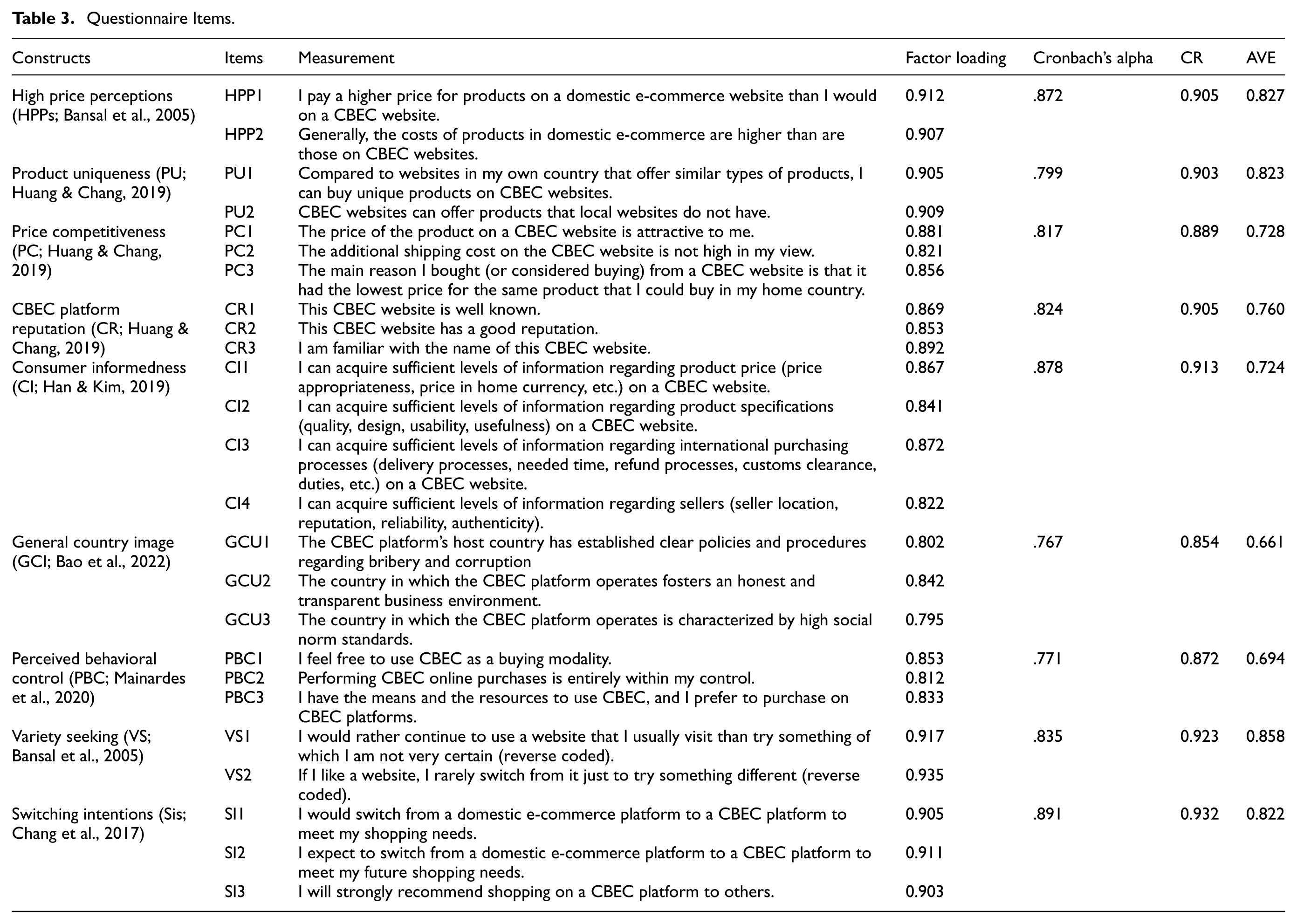
All variables in this study were measured on a 7-point Likert scale, with items adapted from previously validated instruments and refined for this context (see Table 3). The push factor—high price perceptions—is measured with two items from Bansal et al. (2005). Pull factors include product uniqueness, price competitiveness, CBEC platform reputation, the general country image of the CBEC platform and consumer informedness, assessed with the assistance of scales adapted from Huang and Chang (2019), Bao et al. (2022) and Han and Kim (2019). Mooring factors include perceived behavioral control, measured with three items from Mainardes et al. (2020), and variety seeking, assessed with two items from Bansal et al. (2005). Switching intentions are measured on the basis of a three-item scale from Chang et al. (2017).
Questionnaire Items.
Common Method Bias (CMB)
To address common method bias (CMB), this study applied both preventive (ex ante) and diagnostic (post hoc) strategies, following MacKenzie and Podsakoff (2012). During the survey design phase, we varied the scale types and anchor formats, avoided revealing construct names, and randomized the item order to minimize response bias. Participants were also informed that similar-sounding items measured different aspects, encouraging them to read carefully. For post hoc detection, Harman’s single-factor test was conducted via unrotated principal component analysis. The first factor explained 35.23% of the variance, which was below the 50% threshold, suggesting minimal CMB. We also followed Lee et al. (2021) by checking variance inflation factors (VIFs) at the construct level; all values were below the cutoff of 3, further confirming that CMB was not a concern in this study.
Data Analysis and Results
Partial least squares (PLS) was selected for data analysis because of its suitability for complex models with multiple predictors and higher-order constructs (Hair et al., 2021; Lee & Chen, 2022). In this study, the model includes two reflective second-order constructs, that is, pull and mooring factors, which aligns with the ability of PLS to address such hierarchical structures (Lee et al., 2021). PLS also performs well under conditions of small sample size, nonnormal data, and potential multicollinearity. Given these advantages, SmartPLS software (Ringle et al., 2015) was used to estimate the model.
Measurement Model
The PLS analysis consists of two main stages: evaluating the measurement model and assessing the structural model. The measurement model is tested for reliability and validity. As shown in Table 3, all constructs exceed the accepted thresholds for internal consistency, with Cronbach’s alpha values between .767 and .891 and composite reliability (CR) ranging from 0.854 to 0.932 (Hair et al., 2021). Convergent validity is also supported, as all factor loadings (0.795–0.935) are above 0.70 and the average variance extracted (AVE) values (0.661–0.858) exceed 0.50. Discriminant validity is confirmed by reference to the heterotrait–monotrait (HTMT) ratio, in which context all values are below the 0.85 cutoff (Henseler et al., 2015; see Table 4). These results confirm that the model meets psychometric requirements and is suitable for structural analysis.
HTMT Ratios.

Structural Model
The structural model assessment involves analyzing path coefficients (β), their significance (p values), and the model’s explanatory power (R2). Following Hair et al. (2021), we applied bootstrapping with 10,000 resamples to test the statistical significance of each hypothesized relationship. The results show that all the hypotheses are supported (see Figure 2 and Table 5). Specifically, we found that push factors (high price perceptions) increase consumers’ switching intentions toward CBEC (β = .151, p < .05), thus supporting H1. Pull factors, such as product uniqueness, price competitiveness, CBEC platform reputation, the general country image of the CBEC platform, and consumer informedness, contribute to increasing consumers’ intentions to switch to CBEC (β = .388, p < .001), which supports H2. Mooring factors, including perceived behavioral control and variety-seeking behavior, significantly increase consumers’ intention to switch to CBEC (β = .522, p < .001), thereby supporting H3. With respect to the moderating effect, we found that the effect of push factors on CBEC switching intentions is positively moderated by mooring factors (β = .161, p < .05), thereby supporting H4. Similarly, the impact of pull factors on switching intentions is also positively influenced by mooring factors (β = .185, p < .05), thereby supporting H5. In addition, the R2 value of switching intentions is .623, thus indicating significant explanatory power (Hair et al., 2021). Furthermore, effect size estimates (see Table 6) were calculated on the basis of f2 values, where 0.02, 0.15, and 0.35 represent small, medium, and large effects, respectively (Lee et al., 2021). All significant paths in the model demonstrated at least a small effect. Among the predictors of switching intentions, mooring factors had the strongest effect (f2 = 0.356), followed by pull factors (f2 = 0.188), whereas push factors had a marginal effect (f2 = 0.028).

Results of the proposed model.
PLSpredict Results of the Proposed Model.

Results of the Hypotheses.

p < .05. ***p < .001.
To assess the model’s out-of-sample predictive ability, we employed the PLSpredict procedure with 10-fold cross-validation and one repetition, following the guidelines of Shmueli et al. (2019) and Sharma et al. (2023). All indicators of the focal construct, switching intentions, produced Q2_predict values greater than zero (see Table 5), indicating satisfactory predictive performance. Furthermore, for all indicators within the switching intention construct, the PLS model outperformed the linear regression (LM) benchmark in terms of a lower root mean square error (RMSE), further demonstrating its superior predictive accuracy. We validated this result by performing the cross-validated predictive ability test (CVPAT), as recommended by Liengaard et al. (2021) and Ringle et al. (2023). This approach compared our model against two benchmarks: the naïve indicator average (IA) and linear regression models (LM). As shown in Table 7, the PLS model consistently produced lower prediction errors than the IA model did across the key construct, switching intentions. It also outperformed the LR model for switching intentions, underscoring its superior out-of-sample predictive power. Overall, these results confirm that our model not only is robust but also exhibits strong predictive validity.
CVPAT Results of the Proposed Model.

Note. Cross-validated predictive ability tests with 10 folds and 10 repetition.
Examination of an Alternative Model
In this study, we modeled the pull and mooring factors as reflective second-order constructs. However, some prior studies (e.g., H. L. Yang & Lin, 2019) have employed a formative modeling approach. To assess the robustness of our proposed model, we tested an alternative specification in which both pull and mooring were conceptualized as formative second-order constructs influencing users’ CBEC switching intentions. 2 In this alternative model, the pull construct consisted of five indicators: product uniqueness, price competitiveness, CBEC platform reputation, the general country image of the CBEC platform, and consumer informedness. The mooring construct consisted of two indicators: perceived behavioral control and variety seeking. To evaluate the model’s predictive robustness in further detail, we compared it against this alternative specification using predictive ability as the evaluation criterion (Ringle et al., 2023). Following the recommendations of Liengaard et al. (2021) and Sharma et al. (2023), we conducted the CVPAT to assess out-of-sample performance. The CVPAT provides a rigorous test of whether one model demonstrates significantly better predictive accuracy than another does. The results of the average loss comparison (see Table 8) revealed no statistically significant difference between the two models. In other words, the alternative formative model did not improve predictive performance. Therefore, the original reflective model was retained for its stronger theoretical foundation and comparable predictive performance, thus reinforcing its validity in explaining users’ CBEC switching intentions.
Model Comparisons Using the CVPAT Results.

Note. Cross-validated predictive ability tests with 10 folds and 10 repetitions. PM = proposed model; AM = alternative model; ns = nonsignificant.
Discussion and Contributions
Discussion of the Results
This study reveals that push factors (e.g., high price perceptions of domestic platforms) and pull factors (e.g., product uniqueness, price competitiveness, informedness, the general country image of the CBEC platform, and CBEC platform reputation) significantly drive consumers’ switching intentions toward CBEC. Moreover, mooring factors, such as perceived behavioral control and variety seeking, strengthen these effects by amplifying the impact of both push and pull factors. Specifically, in terms of push factors, higher product prices in domestic e-commerce encourage consumers to consider and switch to CBEC for purchasing. This result is consistent with Bansal et al.’s (2005) finding that price plays a crucial role in affecting consumers shifting to other service providers. With respect to the pull factors, the more unique the products on CBEC platforms are, the easier it is for consumers to switch to such platforms. Compared with domestic e-commerce consumers, consumers are more willing to switch to CBEC for shopping when they can pay lower prices. A stronger reputation of the CBEC platform, along with a positive country image, can enhance consumers’ trust in the platform, thereby increasing their willingness and confidence to switch to CBEC platforms. These findings are consistent with those of Huang and Chang’s (2019) and Bao et al.’s (2022) investigations of CBEC purchase intentions. In addition, broader and more in-depth CBEC purchase information is conducive to enhancing consumers’ switching intentions, which echoes Han and Kim’s (2019) perspective that consumer informedness with respect to overall CBEC purchase processes is critical for CBEC development.
With respect to mooring factors, the tendency toward variety seeking stimulates consumers to buy from CBEC platforms with diverse international products. These results are consistent with Bansal et al.’s (2005) finding that variety seeking influences consumers’ ability to switch to alternative service providers. The effect of perceived behavioral control on consumers’ sense of control in CBEC purchase processes significantly affects their ability to switch to CBEC. This finding extends Mainardes et al.’s (2020) research on domestic e-commerce by confirming that consumers’ behavioral control is also critical for CBEC consumer purchases. Furthermore, this study finds that mooring factors moderate the effects of both push and pull factors on switching intentions. Consistent with prior research (e.g., Bansal et al., 2005; Chen & Keng, 2019; Hsieh et al., 2012; Liu et al., 2021), the results show that consumers with stronger perceived behavioral control and a tendency to seek variety are more likely to shift to CBEC when they are dissatisfied with high prices on domestic platforms. These consumers also respond more positively to the appeal of CBEC, such as unique products, better pricing, informative content, and platform credibility, making them more inclined to switch.
Moreover, although both interaction terms—Push Effect × Mooring Effect and Pull Effect × Mooring Effect—are statistically significant (p < .05), their corresponding f2 values (0.056 and 0.131, respectively) suggest only small effect sizes. These results indicate that while mooring factors moderate the links between push/pull effects and switching intentions, their influence is relatively limited compared with that of the main effects. In contrast, the direct effect of mooring factors (β = .522, f2 = 0.356) is substantially stronger, underscoring their role as a dominant force in consumer switching decisions rather than as strong amplifiers of push or pull dynamics. This asymmetry highlights the fact that mooring factors exert a greater influence directly on switching intentions than conditionally through interactions. Notably, small moderating effects are common in behavioral research, particularly when the primary predictors already explain a large share of the variance in the outcome (Aguinis et al., 2005). Despite their modest size, the significance of both interaction terms provides empirical support for the theorized moderating role of mooring factors within the PPM framework.
Theoretical Contributions
This study makes several important theoretical contributions to the CBEC literature. First, while prior research has focused predominantly on consumers’ purchase intentions (Bao et al., 2022; Chen & Tang, 2021; Gui et al., 2022; Han et al., 2018; Huang & Chang, 2019; Jian et al., 2023; Lee & Xiong, 2024; Mou, Zhu, & Benyoucef, 2020; Shao et al., 2021; Sun & Li, 2022; Witek-Hajduk & Grudecka, 2024; Xiao et al., 2019; Y. J. Xu et al., 2022; X. Y. Xu et al., 2023; X. Yang et al., 2023; Zhu et al., 2019) and repurchase intentions (Do et al., 2023; Ma et al., 2019; Mou, Cohen, Dou, & Zhang, 2020), only limited attention has been paid to switching intentions from domestic e-commerce platforms to CBEC platforms. This study offers a theoretically grounded and empirically rigorous approach to the task of identifying key switching factors in the CBEC context. Unlike most prior studies that have used the PPM framework and relied solely on literature reviews to select push, pull, and mooring variables (e.g., Chen & Keng, 2019; Hsieh et al., 2012; Lee & Wang, 2023; Liu et al., 2021), this research employs an inductive approach that combines a literature review with semistructured interviews to identify context-specific drivers. This method offers a more accurate reflection of the psychological and situational dynamics influencing consumers’ switching behavior from domestic to CBEC platforms. This approach not only reaffirms the applicability of the PPM framework to CBEC but also highlights its flexibility in uncovering nuanced mechanisms of consumer decision-making in international digital commerce environments. By doing so, this study contributes to the theoretical depth of PPM-based research and provides a fine-grained understanding of how various motivational forces interact to shape consumer switching intentions in an increasingly globalized marketplace. Second, this study advances our theoretical understanding by shedding light on the often overlooked role of dissatisfaction with domestic e-commerce platforms, such as high price perceptions, as a fundamental driver of consumers’ CBEC switching. While the majority of prior CBEC studies have focused on the advantages and benefits offered by CBEC platforms (e.g., product variety and price competitiveness; Huang & Chang, 2019), they have tended to understate or overlook the negative experiences that push consumers away from their current domestic platforms. By introducing this perspective, our study emphasizes that switching is a matter of not only attraction but also dissatisfaction, thereby enriching the theoretical framing of consumer migration behavior in the CBEC context.
Third, we extend the theoretical scope of CBEC behavioral research by incorporating consumer-side psychological and behavioral characteristics—specifically, perceived behavioral control and variety-seeking tendencies—as critical predictors of switching intentions. These mooring factors reflect internal cognitive and motivational orientations that influence consumers’ ability and willingness to engage in cross-border shopping. Such individual-level constructs have received limited attention in the CBEC literature, which has traditionally prioritized platform-level or product-level features (Han & Kim, 2019; Huang & Chang, 2019; Lee & Xiong, 2024; Mou, Zhu, & Benyoucef, 2020). Importantly, perceived behavioral control reflects consumers’ internal evaluation of whether they have sufficient resources, knowledge, and confidence to navigate cross-border platforms and manage the inherent risks of CBEC transactions. When individuals believe that they have control over the switching process, they are more likely to overcome inertia and take action. Moreover, variety seeking represents a psychological drive for novelty, exploration, and the avoidance of boredom, which can motivate consumers to try unfamiliar CBEC platforms despite the associated uncertainties. This motivational trait reflects hedonic and experiential consumption goals, complementing rational evaluations of price and product features. By empirically validating the influence of these psychological mechanisms, our study highlights the value of integrating internal drivers into migration-based decision models. We demonstrate that mooring factors are not static background conditions; rather, they are active cognitive-motivational forces that shape how consumers interpret and act upon push and pull cues. This richer theoretical integration advances a more comprehensive and psychologically grounded understanding of consumer switching intentions in the CBEC context.
Finally, this study offers a comprehensive and integrated perspective on consumers’ switching intentions toward CBEC platforms by simultaneously examining factors related to both domestic and CBEC platforms, as well as individual-level characteristics, within a unified framework. This integrative approach moves beyond the previously fragmented emphasis on the advantages of CBEC platforms commonly seen in prior research, and it provides a more holistic understanding of how various dimensions interact to influence consumers’ decisions to transition from domestic e-commerce platforms to CBEC platforms. By applying the PPM framework in this context, we substantially extend its explanatory power in the domain of international digital commerce. The empirical results from our structural model indicate that mooring factors—specifically, perceived behavioral control (β = .882) and variety-seeking behavior (β = .837)—have the strongest influence on switching intentions. These results underscore the pivotal influence of individual traits on facilitating consumer engagement in CBEC. Notably, among the pull factors, consumer informedness was identified as the most impactful, thus highlighting the fact that clear and accessible information plays a crucial role in reducing uncertainty and increasing trust. Although push factors, such as perceptions of high domestic prices, had a weaker effect, they still significantly contributed to dissatisfaction, thereby prompting users to consider switching to CBEC platforms.
Practical Contributions
We offer actionable implications for domestic and CBEC platforms, which can guide the development of effective business and marketing strategies to attract and retain consumers. Our findings reveal that high price perceptions (push factor) of domestic e-commerce platforms significantly increase consumers’ switching intentions toward CBEC platforms. To counter such intentions, domestic platforms should focus on building stronger long-term relationships with local suppliers and enhancing early supplier involvement. By doing so, they can reduce product acquisition costs and differentiate local goods from foreign offerings, helping retain domestic consumers by delivering more competitive pricing and unique local products. On the other hand, pull factors such as product uniqueness, price competitiveness, consumer informedness, and CBEC platform reputation, along with mooring factors such as perceived behavioral control and variety-seeking tendencies, drive consumers to switch to CBEC platforms. To capitalize on this finding, CBEC platforms should expand their product range by offering items that are not readily available in consumers’ home countries, thus improving product uniqueness and diversity. By broadening their supplier network and increasing product categories, CBEC platforms can better meet the variety-seeking tendencies of consumers, further motivating them to switch to CBEC platforms.
Moreover, CBEC platforms should focus on optimizing their global supply chains to lower procurement costs, thereby strengthening their price competitiveness. Providing transparent information about the purchasing process, logistics, and relevant tariff policies can increase consumer informedness, reduce the perceived risks associated with cross-border transactions and increase consumers’ confidence in managing these uncertainties. By improving transparency, CBEC platforms can help minimize consumers’ perceived transition and uncertainty costs, reinforcing their sense of control throughout the CBEC purchase journey. Finally, CBEC platforms should invest heavily in media advertising and word-of-mouth campaigns to build and enhance their platform reputation. A strong reputation not only fosters trust among existing users but also attracts a broader base of potential consumers from around the world, thereby promoting platform growth and market penetration.
Limitations and Directions for Future Research
This paper makes various contributions to the CBEC industry in terms of both theory and practice, but it has certain limitations that must be addressed in future research. First, this study was conducted exclusively in China with Chinese consumers. Although China represents one of the largest and most dynamic CBEC markets, unique contextual factors, for example, cultural traits such as collectivism, may have influenced the findings. These factors could limit the generalizability of the results to other cultural or economic contexts. Future studies should replicate this research in other countries or adopt cross-national comparative designs to improve generalizability. Including consumers from both developed and developing economies or from Eastern and Western cultures would help test the robustness of the model and broaden its applicability. Moreover, integrating cultural frameworks (e.g., Hofstede’s cultural dimensions; Hofstede, 2011) could offer deeper insights into how national context shapes CBEC switching behavior. Second, this study used data that were collected at a single point in time (i.e., surveys) to measure consumers’ intentions to move to CBEC platforms. Since consumers’ intentions and the characteristics of CBEC platforms may evolve over time, a longitudinal research design is suggested to address this limitation and provide more robust conclusions.
Third, this study identified price dissatisfaction as the primary push factor driving consumers to switch from domestic platforms to CBEC platforms, as revealed by interviews with 30 participants. Notably, no other dissatisfaction factors were mentioned, which may reflect the overall maturity and reliability of domestic e-commerce services. Nonetheless, future research should explore additional push factors that did not emerge in our qualitative data. For instance, lower perceived product quality, such as concerns over authenticity or durability on domestic platforms, may still influence consumer switching decisions, particularly in different cultural or economic contexts. Furthermore, in the era of the experience economy and increasing reliance on social media, emotional engagement and experiential value have become increasingly important in shaping online shopping behaviors. Consumers who feel emotionally disconnected from domestic platforms may be more inclined to switch to CBEC platforms, while the immersive and differentiated experiences offered by CBEC platforms could further strengthen adoption. To address these evolving dynamics, future researchers should extend the PPM framework by incorporating these underexplored dimensions. Such an extension would provide a more nuanced and comprehensive understanding of consumer switching behavior in the CBEC landscape.
Footnotes
Ethical Considerations
The procedures conducted in this study fully comply with the ethical standards of the Declaration of Helsinki. According to the ethics policy of Beijing Normal University at Zhuhai ( ), although the study involves sociological data collection, it does not include medical research, biospecimens, health data, or sensitive personal identifiers. Institutional Article 32 states: “Scientific studies involving human data or biospecimens that do not cause harm to the human body, do not involve sensitive personal information or commercial interests, and do not pertain to life sciences or medical issues may be exempt from ethical review to reduce unnecessary burdens on researchers and promote the development of life science and medical research.” In line with Article 32, Item 2, our study, which used fully anonymous and voluntary survey data, qualifies for ethical review exemption.
Consent to Participate
Participants provided informed consent through a cover letter attached to the questionnaire. The authors confirm that consent was secured and that anonymized responses were used solely for academic research. Personal information remained confidential and was not publicly released.
Funding
The authors disclosed receipt of the following financial support for the research, authorship, and/or publication of this article: This research is supported by the Guangdong Science and Technology Program (grant number: 2024A0505050010).
Declaration of Conflicting Interests
The authors declared no potential conflicts of interest with respect to the research, authorship, and/or publication of this article.
Data Availability Statement
The data supporting the findings of this study are available from the corresponding author upon reasonable request.