



Abstract
In the context of carbon peaking and carbon neutrality, this study addresses how the integration of digital economy and real economy (IDRE) influences regional low-carbon transitions (RLCT). Such exploration enhances the high-quality evolution of China’s economic landscape and contributes insights to the worldwide efforts against climate change and sustainable progress. Through the entropy method, this investigation develops a comprehensive index to evaluate IDRE using provincial panel data spanning 2011 to 2022. A coupling coordination degree (CCD) model is used to evaluate the integration levels across China’s 30 provinces (including municipalities and autonomous regions). Moreover, this research employs a bidirectional fixed effect model, a mediation effect model, a threshold model, and a spatial econometric model to empirically probe the effects and underlying mechanisms of IDRE on RLCT. The key findings are as follows: (a) IDRE significantly promotes RLCT, particularly in eastern regions; (b) IDRE facilitates RLCT by enhancing green technological innovation and advancing new urbanization, though it exhibits nonlinear characteristics such as rebound effects and diminishing returns; and (c) IDRE generates significant spatial spillover effects on RLCT. This study reveals how IDRE promotes RLCT through green technological innovation (GTI), new urbanization (NUR) pathways, and spatial spillover effect.
Plain Language Summary
In the context of carbon peaking and carbon neutrality, this study addresses how the integration of the digital and real economies (IDRE) influences regional low-carbon transitions (RLCT). Such exploration enhances the high-quality evolution of China’s economic landscape and contributes insights to the worldwide efforts against climate change and sustainable progress. Through the entropy method, this investigation develops a comprehensive index to evaluate IDRE using provincial panel data spanning 2011 to 2022. A coupling coordination model is used to evaluate the integration levels across China’s 30 provinces (including municipalities and autonomous regions). Moreover, this research employs bidirectional fixed effects models, mediation effect models, threshold models, and spatial econometric models to empirically probe the effects and underlying mechanisms of IDRE on RLCT. The key findings are as follows: (1) IDRE significantly promotes RLCT, particularly in eastern regions; (2) IDRE facilitates RLCT by enhancing green technological innovation and advancing new urbanization, though it exhibits nonlinear characteristics such as rebound effects and diminishing returns; and (3) IDRE generates significant spatial spillover effects on RLCT. This study reveals how IDRE promotes RLCT through green innovation, new urbanization pathways, and spatial spillover effect.
Keywords
Introduction
As global temperatures reach unprecedented levels and extreme weather events intensify, the challenges to human development escalate. The 28th United Nations Climate Change Conference in 2023 emphasized the need for accelerated global action to diminish carbon emissions and protect lives and livelihoods. According to the China Emission Accounts and Datasets, carbon emissions from China and the rest of the world followed a rising trend from 1990 to 2022, with China accounting for about 30% of the global total (Figure 1). The rapid advance of industrialization and urbanization has markedly degraded the environment, with urban areas accounting for over 70% of energy-related carbon emissions (Wang and Liu, 2017). This increase in emissions heightens greenhouse gas emissions and energy security concerns and poses substantial risks to public health and sustainable development, thus necessitating a swift shift toward regional low-carbon models in China (Hepburn et al., 2021; Tian et al., 2022). As the world’s leading emitter of carbon dioxide, China is committed to peaking its emissions by 2030 and achieving carbon neutrality by 2060, thereby catalyzing RLCT (Zhao et al., 2022). Against this backdrop, understanding the systemic pathways of carbon emissions is a crucial theoretical prerequisite for advancing RLCT. The structure and intensity of carbon emissions at the regional scale determine the atmospheric concentration of greenhouse gases and the geographic heterogeneity of climate responses (Xie et al., 2013). Although carbon emission sources exhibit significant regional heterogeneity, their atmospheric impacts are global. Therefore, investigating the driving mechanisms of regional socioeconomic factors on carbon emissions is not only essential for formulating local emission reduction strategies but also provides foundational support for understanding the source-side evolution of atmospheric carbon fluxes. The mechanism identification framework of IDRE and RLCT constructed in this study is developed precisely based on this logic.

Trend chart of carbon emissions in China and the world from 1990 to 2022.
Given that existing studies often approach from a singular perspective of either the digital economy or green development, lacking systematic analysis of how deep integration between the digital and real economies affects RLCT, and with incomplete identification of its mechanisms, threshold constraints, and spatial spillovers, this study focuses on the following research questions: (a) Does IDRE significantly support RLCT? (b) How does IDRE achieve RLCT goals through GTI and NUR? (c) Under varying levels of GTI and NUR, is the relationship between IDRE and RLCT nonlinear? (d) Does IDRE exhibit spatial spillover effects, impacting RLCT in neighboring regions? By systematically addressing these questions, this paper aims to uncover the mechanisms, thresholds, and spatial diffusion pathways through which IDRE influences RLCT.
The marginal contributions of this study are as follows: (a) Theoretical innovation: This study extends the analytical framework of endogenous growth theory to the context of GTI driving RLCT, expanding the theoretical implications of the Environmental Kuznets Curve. It identifies a significant nonlinear threshold effect of IDRE on RLCT, breaking through the limitations of traditional linear analysis. It provides a systematic mechanism analysis and theoretical support for regional low-carbon development. (b) Perspective innovation: Traditional studies often focus on a single perspective, such as the digital economy or green development, while this study approaches the issue from the perspective of IDRE. It explores the direct, indirect, and nonlinear complex effects of IDRE on RLCT. This fills the research gap in the interdisciplinary field. (c) Methodological innovation: Based on the latest classification standards from the China National Bureau of Statistics, a comprehensive evaluation system for IDRE was developed, and the CCD model was used for measurement. By comprehensively using the bidirectional fixed effect model, mediation effect, and threshold models, this study systematically identifies the direct effect of IDRE on RLCT, as well as the mediation and nonlinear moderating mechanisms of GTI and NUR. Further, the spatial spillover effect of IDRE is revealed through the spatial Durbin model (SDM), which validates its cross-regional collaborative emission reduction mechanism through the coordination of multiple methods. This provides a more comprehensive and rigorous empirical analysis of the topic. (d) Practical value innovation: This study reveals the promoting effect of IDRE on RLCT. Against the backdrop of global green transformation, IDRE has become an important development direction. This study not only provides a practical framework for RLCT in China, but its experiences can also offer valuable insights for other emerging economies.
The structure of this paper is organized in the following manner: Literature Review presents a review of the relevant literature; Theoretical Analysis and Research Hypotheses delineates the theoretical framework; Research Design describes the research design; Empirical Results conducts the empirical analysis; Discussion and Conclusions discusses the findings and concludes the study.
Literature Review
Concept of the Digital Economy and Real Economy
The digital economy and the real economy jointly constitute the two pillars of the modern economic system and exhibit interdependence throughout the development process. The concept of the digital economy has undergone a transformation from a technological tool to a novel economic paradigm. Early researchers considered it a product emerging from information and communication technologies, highlighting the inherent network externalities of digital information (Lyytinen et al., 2016; Tapscott, 1996). With the advent of mobile internet and platform economies, the G20 (2016) defined the digital economy as a systemic transformation centered on digital knowledge and information as key production factors, and research increasingly focused on the marketization of data resources (Fernández-Rovira et al., 2021) and digital governance mechanisms (Hanisch et al., 2023). In recent years, the World Bank (2021) introduced a data–algorithm–computing power triadic framework, and CAICT (2022) proposed a fourfold model encompassing digital industrialization, industrial digitalization, governance digitalization, and integrated applications. Contemporary research emphasizes value creation through the integration of virtual and real sectors and decentralized economic structures (Meng et al., 2023). By contrast, the real economy, serving as the foundation of the modern economic system, was initially viewed as the material production sector, in contrast to financial speculation (Fisher, 1934). Keynes (1936) highlighted its role in generating tangible goods and services, and subsequent scholars, including Stiglitz (2010), expanded the real economy concept to encompass areas such as education and healthcare. According to the OECD (2023), the real economy fundamentally revolves around the production, distribution, and consumption of goods and services, whose intrinsic feature is the generation of actual use value.
Research on the Integration of Digital Economy and Real Economy
The digital age heralds a significant shift in the trajectory of societal evolution, with the digital economy becoming a pivotal element in the strategic plans of numerous nations (Bowman, 1996). Despite this, the real economy remains foundational to economic development, necessitating continued focus and integration with digital advancements to sustain both economic and societal growth. IDRE, as defined by some scholars, involves integrating digital activities into traditionally non-digital sectors (Xin et al., 2023). According to Shi and Sun (2023), implementing IDRE means fully utilizing digital technologies such as big data, artificial intelligence, and blockchain within real economy sectors, thereby fostering interactions that create a virtuous cycle of growth. At its core, IDRE leverages data as a key production factor that infiltrates production and circulation processes within the real economy, generating vital information and knowledge (Xu et al., 2021). This integration not only optimizes resource allocation and enhances economic efficiency but also fosters a new economic paradigm (Hong & Ren, 2023). Research in this field primarily explores two main areas. Firstly, the assessment of IDRE focuses on measuring the depth of integration. Guo and Quan (2022) used an entropy-weighted coupling evaluation model to measure aspects such as digitization, networking, intelligence, and platformization in the digital economy, along with scale, environment, benefits, and potential in the real economy. Their findings indicate a progressive deepening in the coupling and coordination between provincial digital and real economies. Similarly, Dan and Guanlin (2023) employed this model to evaluate IDRE, examining dimensions such as the digital and real economies. Their research suggests that the level of IDRE in China remains at a nascent stage, which corroborates the findings of Zhang et al. (2022). Secondly, the mechanisms of IDRE are scrutinized. Chen (2022) discusses the deep integration pathways at the product, enterprise, and industry levels, highlighting foundational technological breakthroughs as essential to the digital and intelligent evolution of traditional sectors. This integration phase is shifting from B2C to B2B, emphasizing the strategic necessity of co-construction and investment in digital infrastructure, alongside establishing mechanisms for technological innovation, comprehensive policy support, and regulation.
Research on Regional Low-Carbon Transitions
RLCT is a development model that balances economic growth, environmental protection, and ecological governance, emphasizing the positive interaction among economic, natural, and social cycles (Xing et al., 2023). Essentially, it aims to achieve optimal economic and social output with fewer resources and controlled pollution, representing an “intensive and efficient” development model (He, 2016). Amid the dual carbon objectives, regional low-carbon transformation has garnered global consensus and become pivotal in China’s contemporary developmental policies (Zhu et al., 2024). Contemporary academic investigations into RLCT have concentrated on several critical domains. From the perspective of environmental regulation, the intensification of environmental legislation has heightened scrutiny and created penalties for polluting corporate practices. These punitive measures have led to the exclusion of non-compliant businesses from the market, thereby propelling RLCT forward (Balta-Ozkan et al., 2015). Moreover, as environmental standards tighten, Carbon-intensive industry enterprises face increased production costs, which compel them to either discard obsolete technologies or invest in low-carbon innovations. This shift mitigates the adverse externalities associated with regional carbon emission pressure and promotes RLCT (Lee et al., 2022). From the technological advancement angle, innovations driven by technological growth reduce energy consumption intensity, boost sustainable environmental development capabilities, and enhance total factor productivity. These contributions are critical to fostering a low-carbon economy, and technological progress is consistently viewed as a primary catalyst for RLCT (Kang et al., 2018; Wang et al., 2020). Additionally, the rapid expansion of the digital economy promotes the integration of extensive information and digital data into corporate production and R&D endeavors, accelerating the transition toward more intelligent and digitized operations, thus furthering RLCT (Tan et al., 2024).
Research on the Integration of the Digital Economy and Real Economy and Green Development
IDRE exerts a profound impact on green development, as evidenced by recent studies (Ma & Zhu, 2022; Sun et al., 2024). On one front, the digital transformation of physical industries catalyzed by the digital economy not only accelerates the developmental pace but also boosts the efficiency of resource utilization within the real economy (Ran et al., 2023). This enhancement significantly curtails resource consumption and the environmental burden traditionally linked with economic expansion (Reilly, 2012). On the other front, the expanded growth of digital industries facilitates the transformation and modernization of regional economies, thereby diminishing regional pollution emissions and reducing costs associated with environmental governance (Feng et al., 2022). Digital industries are typically characterized by low emissions, high added value, and robust innovation capabilities (Chong et al., 2024), producing economic output with minimal resource depletion or excessive waste emissions (Nwaila et al., 2022). Industries like big data, cloud computing, and animation are notable for their high input-output efficiency, which restructures regional industrial frameworks and mitigates regional carbon emission pressure (De Propris & Bailey, 2021). Moreover, the confluence of the digital economy with urban governance, public welfare, and public services significantly bolsters urban environmental management (He et al., 2024). For example, digital monitoring platforms constantly gather data on regional ecological conditions and corporate emissions, enhancing the efficacy of regulatory oversight (Meng et al., 2024).
Literature Summary
In summary, although existing studies have explored RLCT pathways from multiple dimensions such as environmental regulation, technological progress, and digital development, three prominent shortcomings remain: first, research on the impact of IDRE on RLCT is still scarce, with most literature focusing solely on the digital economy dimension, neglecting the importance of its synergy with the real sector; second, few studies treat GTI and NUR as intrinsic mechanisms through which IDRE influences RLCT, nor do they identify potential nonlinear threshold effect; third, the spatial spillover effect of IDRE have not been adequately addressed, and its external impact on neighboring regions green transition remains unexplored. Therefore, there is an urgent need to construct a comprehensive research framework encompassing integration-mechanism-threshold-spillover to systematically reveal the logic and evolutionary mechanisms by which IDRE empowers RLCT, thereby expanding relevant theoretical systems and providing empirical support for regional policies.
Theoretical Analysis and Research Hypotheses
Against the backdrop of the global green transitions, the deep IDRE has become a key driver of RLCT. Figure 2 illustrates the impact effects of IDRE on RLCT. The direct effect indicates that IDRE can significantly promote RLCT. The indirect effect shows that IDRE promotes RLCT through GTI and NUR. Moreover, the effect of IDRE exhibits threshold characteristics: once the level of GTI surpasses a critical point or NUR reaches a moderate stage, its promotion of RLCT becomes more pronounced. The spatial effect is manifested in that IDRE drives the cross-regional transmission of RLCT through spillover or siphon effects.

The mechanism of integration of the digital and real economies’ impact on regional low-carbon transitions.
The Direct Effect of the Integration of Digital Economy and Real Economy on Regional Low-Carbon Transitions
With the surge in data generation, rapid advancements in digital technologies, and the expanding ecosystems of digital platforms, the digital economy is thriving, facilitating a profound IDRE. This integration enhances resource allocation, modernizes production processes, and reshapes industrial structures, promoting intensive and efficient regional development (Pan et al., 2022). Firstly, based on production function theory, technological progress, as an essential exogenous variable, improves resource utilization and boosts the marginal productivity of factors. IDRE significantly curtails energy consumption and resource wastage in production and distribution by enhancing resource allocation efficiency (Nižetić et al., 2019). Digital technologies allow firms to more precisely match supply with demand, optimize production schedules, and manage energy usage in real time, leading to production models that consume less energy (Teng et al., 2021). Secondly, the theory of technological progress posits that as technology evolves, negative externalities associated with production processes can be mitigated through technological innovation (Magat, 1978). In this context, IDRE catalyzes the intelligent transformation of production processes. Utilizing technologies such as the Internet of Things and the Industrial Internet, enterprises can better monitor and manage the energy consumption of production equipment, minimizing inefficiencies and excessive energy use (Abdelaziz et al., 2011). This enhancement in intelligence not only increases production efficiency but also supports the transition to green production methods. Thirdly, supported by digital technology, energy-intensive industries are increasingly moving toward smarter and greener operational models, which bolsters the growth of the tertiary sector and sustainable, low-carbon industries. This shift leads to the optimization and modernization of the industrial structure (Tao et al., 2024). Based on the above analysis, the following hypothesis is proposed:
The Indirect Effect of the Integration of Digital Economy and Real Economy on Regional Low-Carbon Transitions
The Transmission Effects of the Integration of Digital and Real Economies on Regional Low-Carbon Transitions
GTI effects of IDRE. Endogenous growth theory posits that technological progress is the core driver of long-term economic growth, with sustained innovation relying on financial support, information access, and risk management (Li et al., 2023). IDRE provides favorable conditions for GTI in precisely these aspects. In terms of financial support, digital inclusive finance and industrial digitalization expand the financing channels of green enterprises, improve credit evaluation, and alleviate financial bottlenecks; in terms of information access, well-developed digital infrastructure and research environments reduce information asymmetry, promote knowledge diffusion and technological upgrading, and accelerate the R&D process of GTI; in terms of risk management, industrial digitalization and the upgrading of the real economy enhance the capacity to identify and share market and technological risks, thereby increasing the predictability of the commercialization of GTI. On the other hand, GTI provides technological support for RLCT through production, governance, and industrial structure. On the production side, green processes and energy-saving equipment significantly improve energy efficiency, reduce dependence on fossil fuels, and cut carbon emissions at the source (Perez, 2002); on the governance side, environmental monitoring and intelligent governance technologies improve pollution control and remediation capacity, enabling the “technology compensation effect” to outweigh “compliance costs,” thereby effectively improving environmental quality; on the industrial structure side, GTI facilitates the gradual phase-out of energy-intensive industries, fosters the development of clean energy industries and green services, and advances the green upgrading of the economic structure (Ahmed et al., 2022).
NUR effects of IDRE. Sustainable development theory emphasizes the coordinated integration of economic, social, and environmental dimensions, and NUR represents a concrete manifestation of this theory in the context of regional development (Basiago, 1998). On the one hand, IDRE inherently embodies green attributes, which strongly align with the low-carbon development principles advocated by NUR, thereby accelerating its progress across demographic, economic, social, and environmental dimensions. At the demographic level, the digital industry optimizes population mobility and employment structures, facilitates labor transfer to green industries, and enhances human capital quality; at the economic level, IDRE serves as a new growth driver that enhances resource allocation efficiency and productivity, promoting industrial upgrading toward greener and higher value-added structures; at the social level, digital governance and smart city initiatives improve public resource management and service provision, enhancing urban operational efficiency (Chen et al., 2025); at the environmental level, digital technologies drive the transformation of energy systems and infrastructure toward intelligence and greenness, injecting low-carbon momentum into NUR. On the other hand, NUR demonstrates significant energy-saving and emission-reduction advantages across the dimensions of production, lifestyle, and ecology. At the production dimension, industrial agglomeration effects and digital empowerment drive green manufacturing and clean energy adoption, gradually replacing energy-intensive industries; at the lifestyle dimension, smart city development optimizes spatial layouts and transportation systems, promotes the diffusion of green consumption concepts, and fosters sustainable low-carbon lifestyles (Neirotti et al., 2014); at the ecological dimension, intelligent governance and green infrastructure construction strengthen environmental monitoring and remediation capacities, enhancing the environmental carrying capacity of urban systems. Based on the above analysis, the following hypothesis is proposed:
The Nonlinear Effects of the Integration of Digital Economy and Real Economy on Regional Low-Carbon Transitions
The Environmental Kuznets Curve (EKC) theory suggests that the impact of economic development on environmental quality differs significantly across stages of development (Grossman & Krueger, 1995). IDRE can promote RLCT, but its effect is significantly constrained when the level of GTI is insufficient. On the one hand, insufficient R&D capacity, limited talent reserves, and a lack of industrial support hinder the effective transformation of digital technologies into GTI outcomes (Guo et al., 2025), weakening the absorption and diffusion of GTI and thereby reducing the emission-reduction effectiveness of IDRE. On the other hand, when green technologies are immature, digitalization tends to serve capacity expansion and efficiency enhancement rather than green process optimization and energy efficiency improvement, which may trigger a “rebound effect” and result in rising rather than declining carbon emissions (Lu & Lu, 2024). Hence, when GTI remains at a low level, the role of IDRE in advancing RLCT is substantially attenuated.
The theory of diminishing marginal returns states that early investments usually generate high unit benefits, but as investment continues to rise, the initial high benefits gradually decline, unit returns decrease, and may even reach zero or turn negative (Varian, 2003). In the process where IDRE affects RLCT, the theory of diminishing marginal returns reveals the nonlinear variation of the NUR effect. When NUR level is at an early stage, with an underdeveloped digital infrastructure and low resource allocation efficiency, IDRE can significantly enhance RLCT. However, as NUR advances and surpasses a threshold, the low-carbon effect of IDRE may exhibit diminishing marginal returns (Fan et al., 2023). On the one hand, as urban system complexity increases, traffic congestion, building energy use, and high-end consumption activities significantly raise carbon emissions, offsetting the energy-saving and emission-reduction effects brought by digital governance. On the other hand, highly concentrated urban infrastructure produces a “stock-locking effect,” making short-term green transformation difficult and constraining the emission-reduction potential of IDRE. At the same time, the growing complexity of governance increases policy coordination and enforcement challenges, reducing the efficiency of applying digital technologies in environmental governance. Therefore, at higher levels of NUR, the role of IDRE in promoting RLCT will be weakened. Based on the above analysis, the following hypothesis is proposed:
The Spatial Effect of the Integration of Digital Economy and Real Economy on Regional Low-Carbon Transitions
The first law of geography, as articulated by Tobler (1970), asserts that everything is related to everything else, but near things are more related than distant things. This principle profoundly influences the dynamics of the IDRE and its impact on RLCT. First, IDRE facilitates the diffusion of RLCT effects to neighboring regions through enhanced information flow, technology diffusion, and industrial collaboration, thereby improving resource allocation efficiency and carbon reduction capabilities in these areas (Meng et al., 2023). Second, the factor agglomeration effect, driven by the regional flow of labor, capital, and technology, extends the low-carbon production models pioneered by IDRE to adjacent areas. This promotes the adoption of RLCT practices and creates cross-regional synergies (Liu et al., 2024). Third, the innovation and application of IDRE technologies typically begin in core regions. As these technologies mature and become more widely adopted, they spread to neighboring areas, accelerating the pace of RLCT in these regions (Bai et al., 2024). Finally, the positive externalities of IDRE, such as technology spillovers and shared experiences, enable neighboring regions to minimize the costs and risks associated with adopting advanced low-carbon development pathways, thus fostering coordinated low-carbon development across regions (Chang & Wang, 2025). Based on the above analysis, the following hypothesis is proposed:
Research Design
Research Variables
Regional Low-Carbon Transitions
Existing studies often use either total carbon emissions or carbon emission intensity as indicators to measure RLCT (Yu et al., 2021; Zhang et al., 2024). Total carbon emissions can directly reflect changes in carbon output, whereas carbon emission intensity further accounts for the relationship between economic growth and carbon emissions under differences in regional economic levels (Xu et al., 2016). Therefore, this study uses carbon emission intensity (tons per 100 million yuan) as an indicator to reflect RLCT, applying a log-transformation after adding one; and this is a reverse indicator. The data on regional carbon emissions are derived following the approach of Cong et al. (2014), aggregating both direct and indirect emissions from energy activities, industrial production processes, agriculture, land use change and forestry, and waste management activities.
Integration of Digital Economy and Real Economy
The measurement of the IDRE level is based on the construction of indicator systems for the digital economy and the real economy. The selection of primary and secondary indicators follows these principles: first, accessibility all indicator data are obtainable from authoritative statistical yearbooks such as the China Statistical Yearbook and the China Industrial Statistical Yearbook; second, representativeness and comparability each category of sub-indicators has been used in existing literature to measure regional digitalization levels or real economic activity, ensuring industry representativeness and cross-regional comparability; third, structural and logical integrity the indicators form a complete value chain nesting, spanning from infrastructure to output, and from resource inputs to industrial structural changes. The specific measurement approach is as follows:
First, separate indicator systems for the digital economy and the real economy should be constructed. The digital economy section mainly follows the Statistical Classification of the Digital Economy and Its Core Industries (2021) issued by the National Bureau of Statistics, and draws on mainstream quantitative methods used by Sun et al. (2024), constructing four major dimensions: digital infrastructure, digital industrialization, industrial digitization, and digital economy development environment. The real economy part is based on the OECD industry classification method and the National Economic Industry Classification Standard (GB/T 4754-2017), combined with indicator selection approaches from studies by Xin et al. (2023), among others, including six key industries-agriculture, industry, construction, transportation, warehousing and postal services, wholesale and retail, and accommodation and catering-within the core real economy domain. Second, composite indices for the digital economy and real economy are calculated respectively using the entropy method. The indicator system is shown in Table 1. The calculation process follows the study of Han et al. (2023). The details are as follows.
Due to the differences in dimensions, magnitude, and the positive and negative orientations of the indicators, the original data need to be standardized. The standardization method for the positive and negative indicators is as follows:
For positive indicators:

For negative indicators:

In the equation,
2. Calculate the proportion of the j-th indicator value for the i-th province:

In the equation, m represents the number of years evaluated.
3. Calculate the information entropy of the indicator:

4. Calculate the redundancy of information entropy:

5. Calculate the weight of the indicator based on the redundancy of information entropy:

6. Calculate the composite score of the i-th province:

Measurement Index for the Integration of the Digital Economy and Real Economy.

Finally, the CCD model is used to calculate the integration index between the digital and real economies. The calculation process follows the study of Liu et al. (2021). And the details are as follows:

In the equation, C represents the coupling degree between the digital economy and the real economy, U denotes the development level of the digital economy, and V represents the development level of the real economy. The value of C ranges from [0, 1], with a value closer to 1 indicating better coupling between the digital economy and the real economy, and vice versa. Although the coupling degree reflects the intensity of the coupling between the two, it does not measure the consistency between them. Therefore, this study introduces the CCD model to reflect the coordination of the interaction between the digital economy and the real economy.


In the equation, D represents the CCD, C is the coupling degree calculated earlier, TC is the comprehensive evaluation index, α is the weight of the digital economy, and β is the weight of the real economy. Given that the digital economy and the real economy are mutually integrated and permeate each other in the development of the national economy, this study assumes that both have an equal status in national economic development, thus setting α=β= .5. The value of D ranges from [0, 1], with a larger value of D indicating a higher degree of coordinated development between the digital economy and the real economy, and a smaller value indicating poorer coordination.
Based on the above indicator system, this study measures IDRE index using the CCD model, and additionally uses principal component analysis (PCA) to measure the index. In subsequent robustness tests, the PCA-derived IDRE index is used as an alternative variable for regression to verify the robustness of the results. The calculation process of PCA is as follows: First, the raw data of each indicator in Table 1 is standardized to eliminate the influence of different units. Then, Bartlett’s test of sphericity and the KMO test are applied to verify the applicability of PCA (Jolliffe & Cadima, 2016). The Bartlett test p-value was significant at the 1% statistical level, and the KMO value reached 0.899, far higher than 0.5, indicating that PCA is suitable for use. Finally, IDRE index is calculated based on the weights of each indicator. The dynamic IDRE index is obtained based on the above two methods.
Mediator Variables
Based on the transmission mechanisms through which IDRE affects RLCT, this study selects GTI and NUR as mediating variables. For GTI, this study adopts the methodology outlined by Wu et al. (2022), utilizing international classification codes and green patent lists provided by the World Intellectual Property Organization. Green patent application data is sourced from the China National Intellectual Property Administration, aggregated at the provincial level, and transformed logarithmically to address skewness and enhance analytical precision. For measuring NUR, the approach follows Cai et al. (2021), employing the entropy method to construct an indicator system from four dimensions: population, economy, society, and environmental urbanization. This methodology ensures that each dimension is weighed according to its variability, providing a balanced and comprehensive measure of NUR. The construction of these indicators allows for a detailed analysis of how urbanization contributes to RLCT at the regional level. The specifics of this indicator system, including the variables and their respective dimensions, are detailed in Table 2.
New Urbanization Indicator Evaluation System.

Control Variables
To ensure the accuracy and reliability of the empirical estimates, this study strictly controls for other potential influencing factors when analyzing the impact of IDRE on RLCT, referencing the studies by relevant researchers such as Balta-Ozkan et al. (2015) and Chen et al. (2023). First, this study includes the economic development level to control for differences in environmental quality demands based on the development stage of different regions, in line with the pattern revealed by the Environmental Kuznets Curve. Regional per capita GDP (in 10,000 yuan) is used as a measure. Second, this study controls for the energy structure, as a consumption structure dominated by fossil fuels is a fundamental constraint to achieving low-carbon transformation. Regional electricity consumption as a proportion of total national electricity consumption is used as a measure. Third, the labor force level is introduced to control for the economic scale effect, as a larger scale of economic activity may be associated with a higher baseline of energy consumption. The number of employees is measured by taking the natural logarithm. Fourth, Openness to foreign investment is used to capture the potential green technology spillover effects or industry transfer effects brought about by foreign direct investment. Actual foreign direct investment is measured (in billions of USD). Fifth, environmental regulation is a direct indicator of the local government’s enforcement of environmental protection and policy pressure, and is a traditional core driver of emission reduction. It is measured by the ratio of industrial pollution control investment to industrial added value. In addition to the above control variables, this study also controls for the provinces and years in the model to eliminate the influence of individual characteristics and time effects.
Data Sources
The data used in this study comprise a balanced provincial panel dataset of 30 provinces in China spanning from 2011 to 2022, totaling 360 observations. Green patent data were obtained from the official website of the China National Intellectual Property Administration, while other data were sourced from yearbooks such as the China Statistical Yearbook, China Environmental Statistical Yearbook, and China Industrial Statistical Yearbook. Considering data omissions and inconsistent statistical calibers for Tibet, Hong Kong, Macao, and Taiwan, these regions were excluded. For missing indicators in certain years during data collection, linear interpolation was applied to fill gaps, and extreme values were winsorized at the 1% upper and lower limits. Descriptive statistics for the main variables are presented in Table 3.
Descriptive Statistics of Variables.

Models
Basic Model
The baseline regression model is used to examine the direct utility of IDRE on RLCT. Since the bidirectional fixed effect model can effectively control unobservable individual characteristics and time effects, it reduces the estimation bias caused by omitted variables, thereby more accurately identifying the net effect of IDRE on RLCT. To test H1, referencing the study by Sun et al. (2024), the following regression model is built:

In the equation, i and t represent provinces and years, respectively.
Mediation Effect Model
The mediation effect model is used to examine the transmission mechanism of IDRE on RLCT. Since the mediation effect model can effectively reveal the mechanism of action between the independent and dependent variables, it helps understand whether their relationship is influenced by other factors and clarifies the transmission path of this effect. To test H2, referencing the study by Baron and Kenny (1986), the following mediation effect model is constructed based on model (11):


In the equation,
Threshold Effect Model
The threshold effect model is used to examine the nonlinear impact of IDRE on RLCT. Since the threshold effect model can effectively analyze whether the impact of the independent variable on the dependent variable varies significantly under different conditions, it reveals the nonlinear relationship between the variables. To test H3, referencing the study by Hansen (1999), the following threshold effect model is constructed:

In the equation,
Spatial Econometric Model
The spatial econometric model is used to examine the spatial effects of IDRE on RLCT. The spatial econometric model primarily focuses on inter-regional interdependence and spillover effects, while the threshold effect model emphasizes the nonlinear impact of the independent variable on the dependent variable. The combination of both models allows for a comprehensive analysis of the nonlinear effects of the independent variable in the spatial dimension, providing more precise guidance for regional policy formulation. To test H4, referencing the study by Anselin and Griffith (1988), the following spatial econometric model is constructed:


In the equation,
This study constructs the spatial weight matrix based on the geographical distance between provinces. This matrix can more accurately capture the interactions among regions in pollution control, technology diffusion, and industrial linkages, avoiding the bias introduced by administrative boundaries and better revealing the spatial spillover effects of RLCT. The specific expression is as follows:

Here,
Empirical Results
Baseline Regression Result
Table 4 outlines the baseline regression outcomes examining the impact of the IDRE on RLCT. After adjusting for fixed effects, the coefficient for the core explanatory variable, dp, in column (1) is significantly negative, suggesting that a higher level of IDRE in each region effectively fosters RLCT. Subsequent columns (2) to (6), which progressively include various control variables, show that the regression coefficients and their levels of significance remain stable, thus validating the robustness of the results and confirming Hypothesis 1 (H1).
Baseline Regression Results.

Note. t Statistics in parentheses.
p < .05. ***p < .01.
Endogeneity and Robustness Test
Endogeneity Test
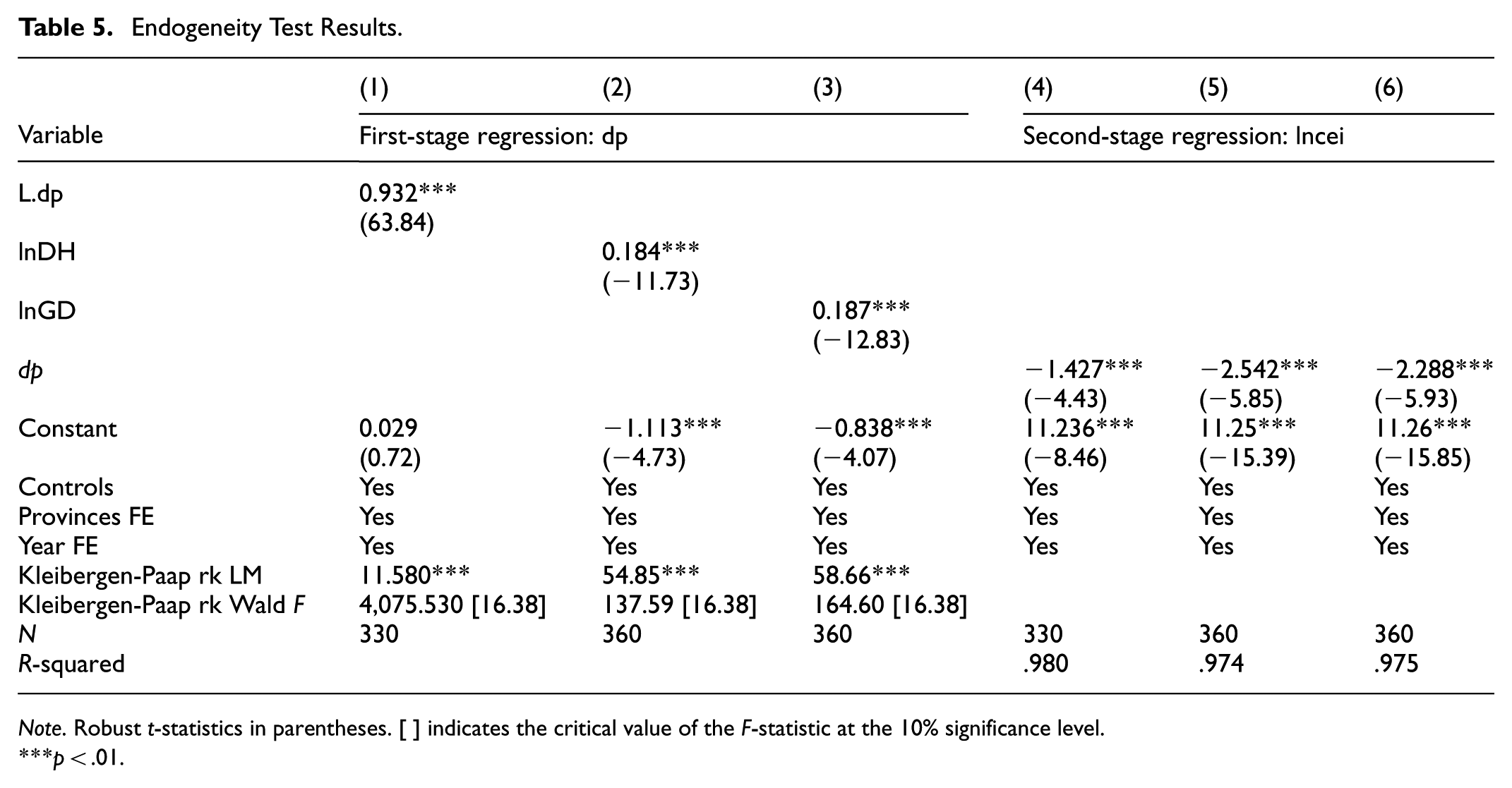
To address potential endogeneity arising from reverse causality and omitted variables between IDRE and RLCT, this study employs an instrumental variable (IV) approach. Following the approach of Nunn and Qian (2014) and Ma et al. (2025), the number of fixed telephones per million people and the number of post offices in each province in 1984 were interacted with the previous year’s national internet user count to construct IVs for IDRE. These historical communication facilities are strongly correlated with digital economic development but predate the current RLCT process, satisfying both relevance and exogeneity conditions. Both interaction terms are log-transformed, denoted as lnDH and lnDG, respectively; additionally, the first lag of IDRE (L.dp) is included as a supplementary IV. Finally, two-stage least squares (2SLS) is applied to conduct the endogeneity test.
Table 5 reports the results of the instrumental variable tests. It can be seen that the conclusions drawn from the first-order lag of the IDRE index and the other two instrumental variables are consistent with the baseline regression results. To assess the reliability of the instrumental variables, we conducted LM and Wald tests on the model: the Kleibergen-Paap rk LM test yielded p-values of 0, which significantly reject the null hypothesis of “under-identification of the instruments”; and the Kleibergen-Paap rk Wald test produced F-statistics exceeding the 10% critical value of 16.38, thereby significantly rejecting the null hypothesis of “weak instruments.” These results indicate that the selection of instrumental variables is valid.
Endogeneity Test Results.
Note. Robust t-statistics in parentheses. [ ] indicates the critical value of the F-statistic at the 10% significance level.
p < .01.
Robustness Analysis
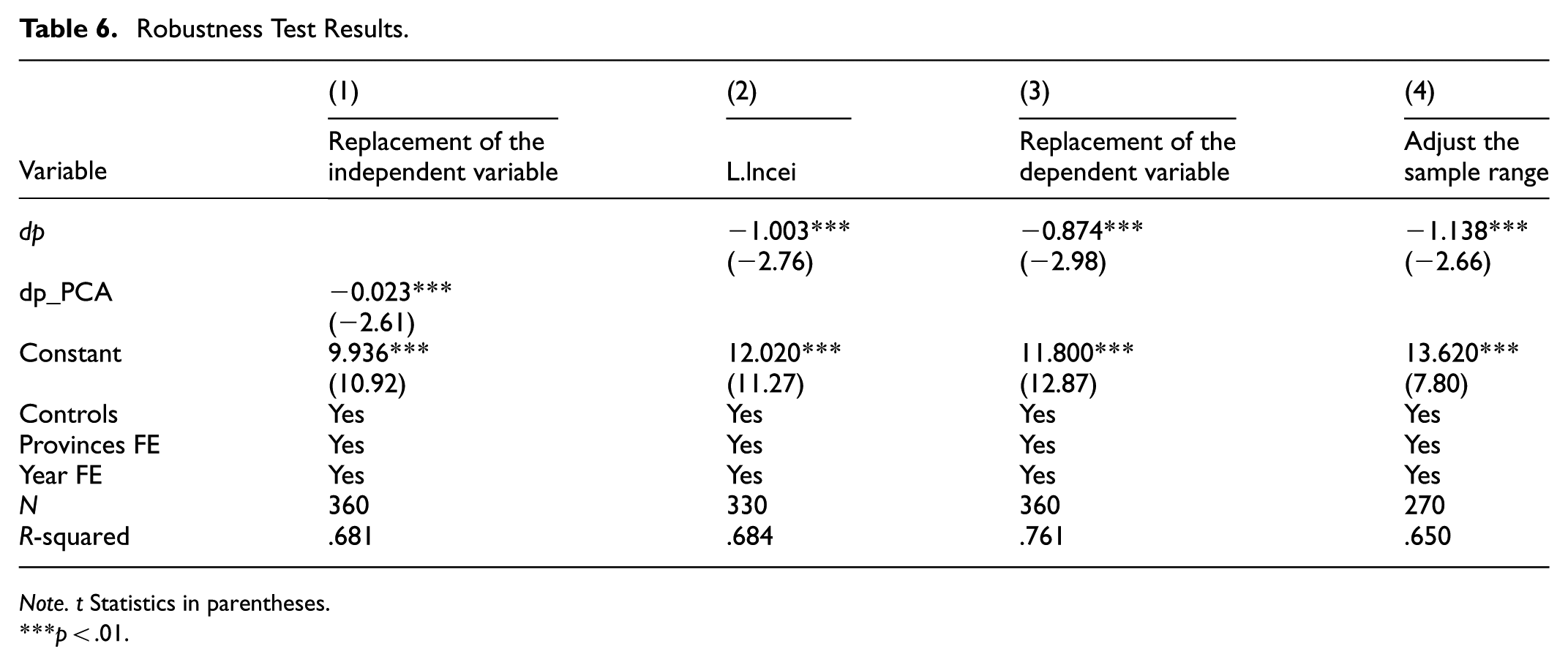
To eliminate the bias in the regression results caused by the measurement of the independent variable, this study uses principal component analysis to measure the IDRE index and re-evaluates the impact of IDRE on RLCT by replacing the independent variables. Column (1) of Table 6 reports the corresponding regression results. The results show that even when the measurement method of the independent variable is changed, the regression results remain robust.
Considering the potential lag effect of IDRE, this study further uses the lagged level of RLCT as the dependent variable to re-evaluate the impact of IDRE on RLCT. Column (2) of Table 6 reports the corresponding regression results. The results show that even after considering the lag effect of IDRE, the core conclusion of this study remains robust, indicating that IDRE has a sustained and stable positive effect on promoting RLCT.
To test the stability of the results under different measurement standards and data settings, and ensure that the research conclusions have greater generalizability, reliability, and external validity. This study also replaces the dependent variable and uses total carbon emissions as an alternative dependent variable. Column (3) of Table 6 reports the corresponding regression results. The results show that even when the dependent variable is replaced, the regression results remain robust.
Considering the significant impact of the COVID-19 pandemic on China’s economy and society from 2020 to 2022, this study excludes the data from 2020 to 2022 and re-estimates the regression. Column (4) of Table 6 reports the corresponding regression results. The results show that even when the sample is reduced, the regression results remain robust.
Robustness Test Results.
Note. t Statistics in parentheses.
p < .01.
Mediation Effect Test
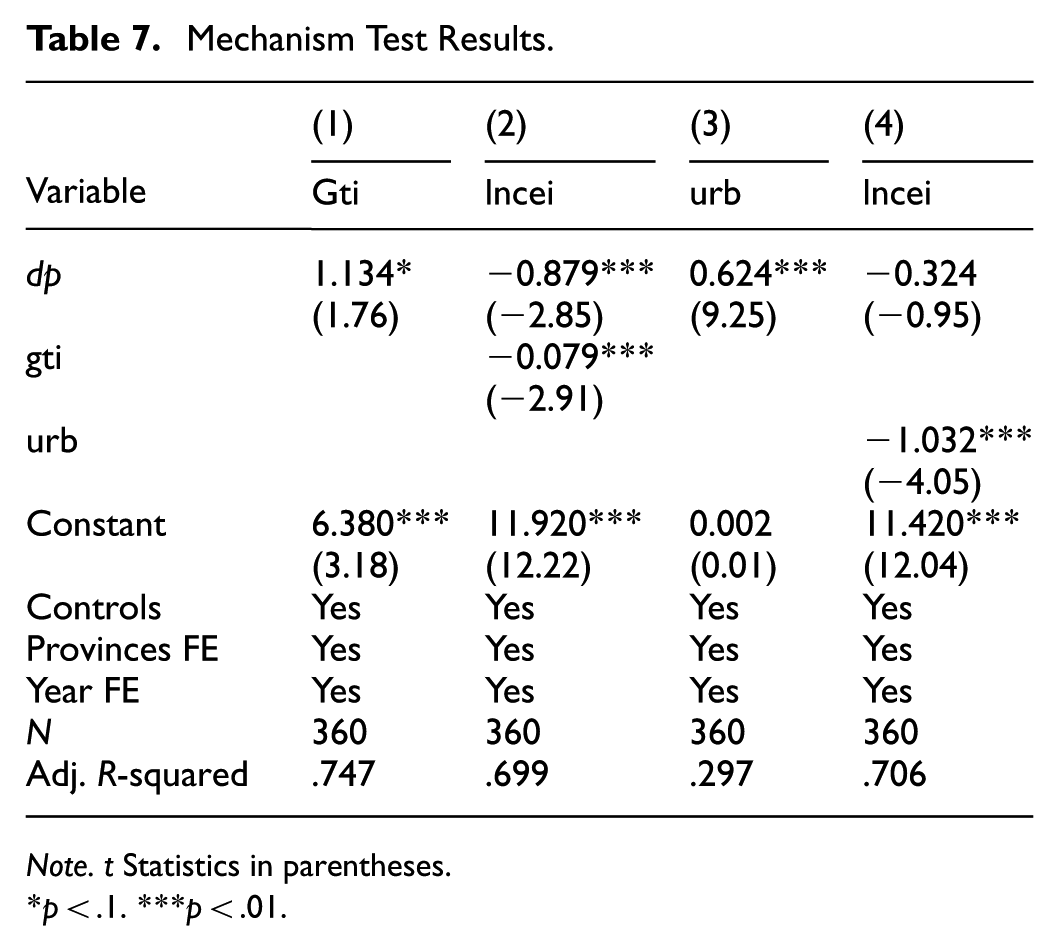
The theoretical framework identifies GTI and NUR as key mechanisms through which the IDRE influences RLCT. Analysis of these impact mechanisms is conducted using a mediation effect model. In Table 7, column (1), where GTI serves as the dependent variable, the regression coefficient for IDRE is 1.134, significant at the 10% level. This indicates a substantial promotion of GTI by IDRE. When IDRE and GTI are simultaneously included in the regression model, as seen in column (2), both variables show significantly negative coefficients, suggesting that GTI partially mediates the effect of IDRE on RLCT. Similarly, column (3) of Table 7 considers NUR as the dependent variable, where the regression coefficient for IDRE is 0.624, significant at the 1% level, demonstrating that IDRE positively affects NUR. In column (4), with both IDRE and NUR included, the regression coefficient for IDRE turns negative and is not statistically significant, whereas NUR has a regression coefficient of −1.032, significant at the 1% level. This pattern indicates that NUR acts as a full mediator in the relationship between IDRE and RLCT.
Mechanism Test Results.
Note. t Statistics in parentheses.
p < .1. ***p < .01.
Threshold Effect Test
To examine the nonlinear impact of IDRE on RLCT, prior to threshold regression, we adopt Hansen’s (1999) bootstrap method to calculate the p-value of the threshold variable and determine the existence of a threshold effect.
According to Table 8, using GTI and NUR as threshold variables reveals significant findings. For GTI, the F-statistics are significant at the 1% level for both one and two thresholds, with p-values less than .01, confirming the presence of two thresholds in the model. Similarly, the analysis for NUR shows the presence of one threshold, highlighting distinct nonlinear impacts of IDRE on RLCT mediated through these variables.
Threshold Effect Test.

Figure 3 illustrates the likelihood ratio function graphs for two threshold values of GTI at 6.0913 and 7.1601, both within the 95% confidence interval. Meanwhile, Figure 4 displays the likelihood ratio function graph for a single threshold value of NUR at 0.5041. In these graphs, the lowest point on the LR statistic curve indicates the actual threshold value. The dashed line, representing the critical value of 7.35, sits above the threshold values, thereby affirming the validity of the identified thresholds. This confirms that the impact of the IDRE on RLCT is nonlinear, varying according to the levels of GTI and NUR.
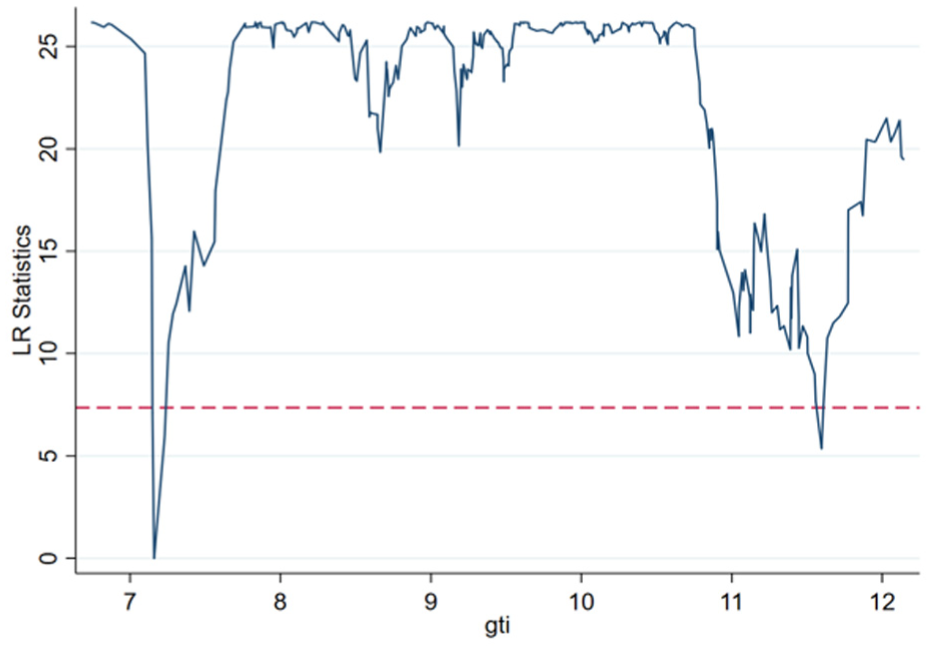
Results of the dual threshold estimation for green technology innovation.

Results of the single threshold estimation for new urbanization.
In addition to establishing the threshold values, the regression outcomes that explore the impact of the IDRE on RLCT, using GTI and NUR as threshold variables, are detailed in Table 9.
Threshold Model Regression Results.

Note. t Statistics in parentheses.
***p < .01.
The regression results using GTI as the threshold variable reveal distinct dynamics between the IDRE and RLCT. When GTI is less than or equal to 6.0913, the regression coefficient for IDRE on RLCT is 2.862, which is significant at the 1% level. This indicates that at lower levels of GTI, an increase in IDRE is actually detrimental to RLCT. For GTI values between 6.0913 and 7.1601, the coefficient drops to −0.321 and is not statistically significant, indicating that IDRE impact on RLCT is negligible within this range. When GTI exceeds 7.1601, the coefficient becomes −1.637, again significant at the 1% level, implying that at higher levels of technological innovation, IDRE significantly contributes to RLCT. The reason for the above results may be that in regions with low levels of GTI, if IDRE progresses rapidly without adequate GTI support, it may lead to increased total energy consumption and higher carbon intensity, thereby reinforcing reliance on high-carbon development pathways and even resulting in a “carbon lock-in effect.”
Regression results with NUR as the threshold variable indicate that while IDRE significantly promotes RLCT, the effect varies depending on the level of NUR. Specifically, when NUR is below the threshold value of 0.5041, IDRE has a strong positive effect on RLCT. However, once NUR exceeds this threshold, the positive impact of IDRE on RLCT diminishes. There are several potential reasons for this shift. First, when NUR reaches a certain level, the marginal benefits of IDRE technologies may decrease, leading to a reduced contribution to RLCT. Second, rapid urbanization can result in uneven resource distribution and create bottlenecks in the development of digital infrastructure, hindering the widespread application of IDRE technologies. Third, residents’ social and behavioral resistance to environmental protection and sustainable practices may slow the adoption of new technologies, while delays in implementing effective environmental regulations may further limit the role of IDRE in promoting RLCT.
Spatial Effect Test
Spatial Correlation Test
Global Moran’s I: Prior to performing spatial econometric analysis, the global Moran’s I for IDRE and RLCT was calculated using a geographic distance matrix (Table 10). The results indicate that from 2011 to 2022, the indices, despite some fluctuations, remained positive, with most passing the 1% significance level, demonstrating significant spatial autocorrelation and clustering.
Results of the Global Moran’s I Test for Integration of the Digital Economy and Real Economy and Regional Low-Carbon Transitions.
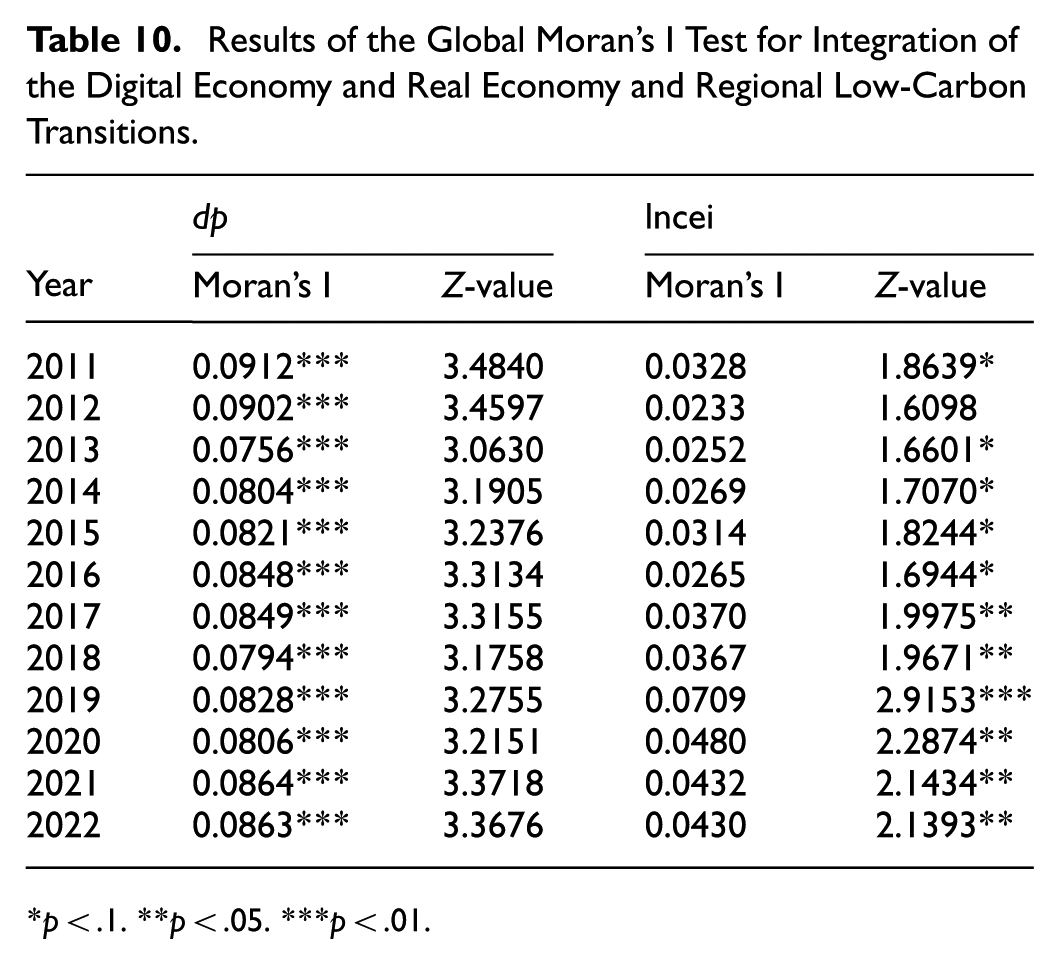
p < .1. **p < .05. ***p < .01.
Local Moran’s I: To further investigate regional correlations, local Moran scatterplots for IDRE and RLCT in 2011 and 2022 were produced (Figure 5). The results reveal that provincial data points for IDRE and RLCT are primarily clustered in the first and third quadrants, indicating strong positive spatial correlation, which is consistent with the conclusions from the global Moran’s I. Hence, spatial factors should be taken into account when selecting models.

Moran’s I scatterplot for integration of the digital economy and real economy and regional low-carbon transitions in 2011 and 2022.
Selection of Spatial Econometric Models
Step one, the LM Test: To identify the type of spatial effect and guide the selection of the appropriate spatial econometric model, this study conducts spatial correlation tests on the ordinary static panel regression (OLS), including the LM-Lag test, robust LM-Lag test, LM-Error test, and robust LM-Error test. As shown in Table 11, all four tests reject the null hypothesis (H0), confirming that the data exhibit both SAR and SEM effects. Given that the SDM captures both these effects and functions as a general form of the spatial econometric model, the preliminary selection of the SDM is considered appropriate for this analysis.
LM Test.

Step two, model Comparison: This study constructs SAR, SEM, and SDM, with results summarized due to space constraints. Based on the Hausman test results, both the SAR and SEM favor random effects, while the SDM’s Hausman statistic of 105.34 is significant at the 1% level, indicating that a fixed effects specification is more appropriate. Additionally, when comparing the spatial econometric models, the SDM reports the smallest value of σ2, further confirming that the SDM (fe) is the optimal choice. The detailed results of this comparison are provided in Table 12.
Spatial Econometric Regression Results.

Note. t Statistics in parentheses.
p < .05. ***p < .01.
Step three, known as the LR test, an evaluation is conducted using the SDM (fe) to determine whether it can be simplified into either a SAR or a SEM. As shown in Table 12, the LR test yields values of 225.54 and 241.35, both of which strongly reject the null hypothesis (H0) at the 1% significance level. Similarly, the Wald test results, with values of 24.98 and 31.78, also reject H0 at the 1% significance level. These results confirm that the SDM (fe) cannot be reduced to simpler spatial models, affirming its appropriateness for the analysis.
In conclusion, this study employs the SDM (fe) to examine how the IDRE influences RLCT. The model choice allows for an in-depth analysis of spatial dependencies and interactions, providing a more accurate understanding of the relationship between IDRE and RLCT.
Analysis of Regression Results From the Spatial Durbin Model
According to the results of column (3) in Table 12, the estimated coefficients of IDRE are significantly negative at the 5% significance level, indicating that, once spatial dependence is taken into account, the development of IDRE is conducive to RLCT. In addition, the spatial autocorrelation coefficients (ρ) of both the SDM and the SAR are significantly positive, indicating that from a spatial perspective, the development of IDRE exerts a significant spatial spillover effect on RLCT.
A further analysis of the spatial interaction terms shows that the spatial correlation of IDRE (Wxdp) is significantly negative under the geographical distance matrix, suggesting that the spatial interaction of IDRE across regions is strong, with evident spatial spillover effects. This implies that the development of IDRE not only positively promotes the RLCT within a given region, but also exerts positive effects on neighboring regions through spatial spillover effects, thereby affecting RLCT over a broader spatial scope.
Since the results of SDM cannot directly reflect the true magnitude of spatial effects, this study decomposes these effects using the partial differential approach proposed by LeSage and Pace (2009).
Table 13 reports the effect decomposition results of the SDM. The direct effect indicates that the estimated coefficient of IDRE on RLCT is significantly negative, which is consistent with the conclusions of the benchmark regression model, suggesting that IDRE can effectively promote RLCT at the local level, and the estimates are highly robust. The indirect effect is also significantly negative, implying that the impact of IDRE is not confined to the local region, but also significantly promotes RLCT of neighboring regions through spatial spillover effects. The total effect remains significantly negative, further confirming that, from the perspective of the overall spatial system, improvements in IDRE significantly accelerate the overall process of RLCT. In summary, IDRE demonstrates RLCT effects at the local level, while also playing an active role through cross-regional linkages and synergies, thereby advancing the achievement of low-carbon development goals on a broader spatial scale.
Results of Spatial Effect Decomposition.

Note. t Statistics in parentheses.
p < .1. **p < .05.
Heterogeneity Analysis
Given the considerable differences in resource endowments and industrial structures among eastern, central, and western China, this study conducts region-specific regressions to examine the heterogeneous impact of IDRE on RLCT (Table 14). The results show that the IDRE coefficient is significantly negative in the eastern region, while it is not significant in the central and western regions. This indicates that the positive effect of IDRE on RLCT is currently only evident in the eastern region. The likely reason is that the eastern region has a strong economic foundation, well-developed digital infrastructure, and a relatively advanced industrial structure, whereas the central and western regions lack sufficient financial and technological support, and have relatively underdeveloped digital infrastructure.
Results of Heterogeneity Analysis.

Note. t Statistics in parentheses.
p < .01.
Discussion and Conclusions
Discussion
In terms of research content, although numerous scholars (Balta-Ozkan et al., 2015; Holtz et al., 2018; Wang et al., 2024) have conducted extensive studies on RLCT with significant findings, research from the perspective of IDRE remains limited. In particular, the spatial spillover effects arising from the IDRE process have not been fully investigated. Moreover, the development of IDRE may result in a technology-biased energy rebound effect, which could increase local energy consumption and hinder RLCT. This paper addresses both IDRE and RLCT within a unified framework, thereby contributing to and expanding the body of research in this field.
In terms of research methods, Ai et al. (2024) employed a bidirectional fixed effect model and a mediation effect model to explore the impact of the digital economy on RLCT, primarily focusing on direct relationships and pathways of influence. Expanding on this foundation, the present study extends the analysis by examining not only the direct impacts and pathways of IDRE on RLCT but also by exploring its nonlinear and spatial effects. To achieve this, we utilize threshold effect and spatial econometric models, providing a deeper understanding of the complexities in these relationships.
In terms of theoretical application, endogenous growth theory is mainly employed to explain the sustainability and drivers of economic growth, particularly highlighting the central role of technological progress and knowledge accumulation in fostering long-term growth (Warr & Ayres, 2012). In the digital age, with disruptive advancements in technologies like big data, artificial intelligence, and 5G communications, this paper extends the application of endogenous growth theory to the study of RLCT, thereby broadening its theoretical scope.
Overall, the empirical findings of this study not only confirm the positive role of IDRE in promoting RLCT but also broaden theoretical understanding by incorporating nonlinear dynamics and spatial externalities into the analytical framework. These findings emphasize the importance of adopting a multidimensional perspective when evaluating the contribution of IDRE to RLCT.
Conclusions
This paper is based on the balanced panel data of 30 provinces (municipalities, and autonomous regions) in China from 2011 to 2022. From the perspective of IDRE, a systematic index system for this integration is constructed, and its level is quantitatively measured. By applying the bidirectional fixed effect, mediation effect model, threshold model, and spatial econometric model, this paper thoroughly analyzes the relationship between IDRE and RLCT, and systematically tests its impact effects and mechanisms.
The research results show that IDRE significantly promotes RLCT, especially in the eastern regions, where its effect is particularly significant, reflecting the heterogeneity of RLCT across regions. In contrast, the impact of IDRE is more limited in the central and western regions, revealing the significant role of the “Matthew Effect” at the regional level during the RLCT process. Further analysis shows that IDRE significantly promotes RLCT by driving GTI and accelerating the process of NUR. However, the effect of IDRE exhibits significant nonlinear characteristics, manifested as “rebound effects” and “marginal diminishing effects.” In regions with low levels of GTI, if IDRE progresses rapidly without adequate GTI support, it may lead to increased total energy consumption and higher carbon intensity, thereby reinforcing reliance on high-carbon development pathways and even resulting in a “carbon lock-in effect.” However, as technology matures and costs decrease, this rebound effect is alleviated, which in turn promotes RLCT. At the same time, although NUR plays a significant role in improving digital infrastructure, leveraging economies of scale, and promoting human capital agglomeration, its marginal effect on RLCT gradually diminishes once a certain threshold is exceeded as NUR levels rise. In addition, the integration of digital and real economies also has a significant spatial spillover effect, not only positively driving RLCT in the region but also triggering the RLCT process in neighboring regions. This phenomenon indicates that the impact of RLCT has extensive spillover effects, and enhancing the level of IDRE in a region can effectively promote RLCT in neighboring provinces (municipalities, and autonomous regions), further emphasizing the importance of regional collaborative development.
Based on the findings of this paper, the Chinese government and other emerging economies can consider the following points when formulating relevant policies:
IDRE can significantly promote RLCT, but there is significant heterogeneity between the eastern, central, and western regions. To narrow the regional gap, policies should focus on strengthening digital infrastructure construction in the central and western regions, and provide targeted financial and technical support. For example, China’s “Broadband China” strategy, through targeted infrastructure investment, has significantly improved digital infrastructure levels in several central provinces; the green finance pilot project in Chongqing’s Digital Industry Park illustrates how local governments have accelerated digital–real integration by combining infrastructure upgrades with financial and institutional support. These mature experiences provide a paradigm to follow for enhancing the level of digital–real integration in the central and western regions.
In advancing IDRE, the government should prioritize the development and strengthening of GTI systems, avoiding the mere pursuit of digital scale expansion while neglecting the associated energy consumption and emission effects. Structural policy guidance should be employed to foster deep integration of digitalization and greening across multiple levels, including technological R&D, industrial collaboration, and institutional design, thereby fully leveraging the positive effects of IDRE on RLCT.
The construction of NUR should achieve a strategic shift from “speed expansion” to “quality improvement,” with greater emphasis on sustainable urban planning, digital infrastructure development, and regional collaborative development. This is to effectively maintain the promoting effect of NUR on RLCT and mitigate the risk of diminishing marginal returns.
The government should also encourage cross-regional low-carbon transitions cooperation, especially between neighboring provinces, promoting regional collaborative development and experience sharing. By establishing a policy framework for regional collaborative development, the government should encourage local governments to strengthen cooperation in RLCT, share the achievements brought by IDRE, form regional cluster effects, and improve the overall level of RLCT.
As the largest developing country in the world, China’s experience holds significant implications for the global low-carbon transitions, and the related conclusions may also serve as a reference for other emerging economies. For example, the mechanism by which IDRE promotes RLCT through GTI has broad relevance for many emerging economies. However, China’s unique institutional background must also be taken into consideration; otherwise, the conclusions may not be directly generalizable to other countries. Therefore, when drawing lessons from China’s experience, each country should adapt it to their own specific institutional context.
Although this study has made some contributions, the following limitations must be acknowledged: First, while the construction of the IDRE index system was based on the classification from the National Bureau of Statistics of China and referenced previous studies, there remains a certain degree of subjectivity. Second, RLCT data at the sectoral level suffer from inconsistencies in coverage and statistical standards across provinces, which is particularly pronounced in the services sector. This limitation constrains analyses at finer sectoral granularity. Future research should expand sector-level data development to support more in-depth analyses and yield more valuable insights.
Footnotes

Funding
The authors disclosed receipt of the following financial support for the research, authorship, and/or publication of this article: This work was supported by the Chongqing Social Science Planning Cultivation Project: “Study on the Long-term Mechanism and Path of Driving the New Quality Productivity Enhancement of Chengdu-Chongqing Economic Circle through Digital-Real Economies Integration” (No. 2024PY44); Major Decision-Making Consultation and Research Project of Chongqing Municipality: “Research on Improving the Rural Basic Financial Service System in Chongqing” (No. 2025ZB09).
Declaration of Conflicting Interests
The authors declared no potential conflicts of interest with respect to the research, authorship, and/or publication of this article.
Data Availability Statement
Data sharing not applicable to this article as no datasets were generated or analyzed during the current study.