




Abstract
The long-standing sloppy economic growth model that has led to resource misallocation between regions and industries has caused China’s economic development to enter a period of decelerated growth even though it has soared to the top class of the global economy. The issue of resource misallocation in China has been examined in previous studies, but less focus has been placed on whether resource misallocation has spatial spillover effect and the internet’s involvement in it. To fill in the gaps in the literature, this study uses data from China’s inter-provincial panel from 2010 to 2019 to measure four aspects of internet development: software and information technology services, key internet indicators, service capacity of the telecommunication industry, and the communication capacity of the telecommunication industry. This is done by using a multi-factor estimation method to approximate the actual real-world situation. With an appropriate selection of spatial matrix and threshold variables, a non-dynamic panel threshold model is built to empirically investigate the impact of internet development on resource mismatch. There are several significant findings in this study. First, internet development in China differs and correlates spatially. Second, as internet development advances, there is a significant negative impact on resource misallocation within the region itself and spillover effect to other regions. Third, there is regional variation in how resource misallocation is affected by internet development. Fourth, the connection between internet development and resource misallocation is threshold-dependent on the level of governmental support. To overcome the resource bottleneck and achieve coordinated development, we suggest that local governments should step up their support for the development of internet infrastructure, and underdeveloped regions should fully utilize the spillover effect of internet resources from developed regions.
Plain language summary
Purpose: This paper investigates whether internet development can mitigate resource misallocation in China. Methods: Using provincial panel data from China and a multi-factor estimation method to construct a comprehensive index for internet development, we apply the gravity model to test the interregional interaction and the spatial Durbin model to examine the impact of internet development on resource misallocation. The threshold effect of government support is also being tested. Conclusions: First, internet development in China differs and correlates spatially. Second, as internet development advances, there is a significant negative impact on resource misallocation within the region itself and spillover effect to other regions. Third, there is regional variation in how resource misallocation is affected by internet development. Fourth, the connection between internet development and resource misallocation is threshold-dependent on the level of governmental support. Implications: To overcome the resource bottleneck and achieve coordinated development, we suggest that local governments should step up their support for the development of internet infrastructure, and underdeveloped regions should fully utilize the spillover effect of internet resources from developed regions.
Keywords
Introduction
China’s economy has been downshifted to a new normal of slower growth, of which the misallocation of resources is a crucial restricting factor. One of the key reasons for the misallocation is the factor market distortion. In the light of the current economic situation, the unbalanced development between and within regions confines the flow and distribution of capital, labor, and other factors. Zheng (2007) argues the internet has evoked dynamic changes to the state power and social forces in China. Particularly after the outbreak of the COVID-19 pandemic, the internet has played unique roles in guaranteeing consumption, promoting the resumption of work and production, and coordinating inter-regional resources (Ling et al., 2020). In October 2020, China’s 14th Five-Year Plan proposed to promote the deep amalgamation of the internet with all industries and thus achieve a powerful network. The internet’s linkability can make it possible for regional economic resources to be fairly integrated. The free flow of resource factors will be increased as a result of the internet’s ability to transcend time and space constraints. Therefore, can internet development effectively alleviate China’s current misallocation of resources? Is there any internet spatial correlation among different regions of China? Is there any spatial spillover effect as well? Is the relationship between the internet and the distortion of resource allocation linear or nonlinear? These are the key issues to be investigated in this study, and the answers to these issues will be meaningful to both academic scholars and policymakers.
Current literature attributes the reasons for resource misallocation to two aspects. One is the imperfection or distortion of the factor market and the restriction of institutional and policy factors (Du, 2016; Restuccia & Rogerson, 2008). Second, there are differences in factor prices between different industries or between marginal output and actual returns, resulting the heterogeneous input-output ratios among enterprises (Liu et al., 2021). Hsieh and Klenow (2009) find out total factor productivity gain could reach 30% to 50% in China’s manufacturing industry if capital and labor could be reallocated hypothetically. Luo et al. (2012) verify the per capita GDP level in China could increase by 115.6% after removing policy distortion from the calibration mode. Lu et al. (2018) point out the efficiency of China’s traditional economic growth mode relying on government intervention is declining, but the economic development will be accelerated if economic structural factors, industrial linkage intensity, and service industry productivity can be adequately enhanced. All these necessary conditions can be basically satisfied by the internet.
Some studies reveal that the amalgamation of digital factors and traditional factors of production in the development of the internet can help to reconstruct resource allocation (Y. Y. Zhao & Zhao, 2019)and improve the distribution efficiency of financial and labor resources (Cong & Yu, 2020; L. Y. Zhao & Xiang, 2019) . Other studies show that the innovation caused by the internet has the potential to advance technological progress in certain economic functions (Brynjolfsson & Hitt, 2000; W. Z. Zhao & Jiahua, 2020), reduce the capital threshold, and optimize the structure of the labor force effectively (Atkinson & Ezell, 2013; L. J. Xie et al., 2020). The internet is becoming a new driving force of regional innovative development (X. F. Han et al., 2019).
Overall, extant research has provided us with very organized and in-depth perspectives on resource misallocation, but there are still some gaps to be filled in. First, the measurement of internet development is mainly based on a single indicator, such as internet technology penetration rate or the development of internet industry (Bai et al., 2022; C. G. Han & Zhang, 2019; D. A. He & Zhou, 2022), which lacks the comprehensive views on the real development of the internet. Second, the majority of the studies on the internet, the resource mismatch and the relationship between the two (Gai et al., 2022; Wei, 2021), do not consider spatial correlations, differences, spillover, or crowding out effect between regions. Third, existing studies consider a non-linear relationship between the internet and resource mismatch with a single threshold (Wu et al., 2022; Zhu & Song, 2020). In the selection of threshold variables, the degree of government intervention is mainly measured by the ratio of government local fiscal expenditure to GDP (B. Shi & Shen, 2013; Z. D. Zhang & Zhao, 2021), which does not reflect the specific status of government support for internet development.
To fill in the gaps in current research, the main contributions of this study are as follows. First, we use multi-factor analysis to construct a comprehensive index for internet development from four dimensions: software and information technology services, key internet indicators, service capacity of the telecommunication industry, and the communication capacity of the telecommunication industry, to fully reflects the development of internet in China. Second, we estimate spatial correlation and differences in internet development between different provinces of China and visualize the correlation strength. By using the spatial econometric model, we shows that internet development has a spatial spillover effect on mitigating resource misallocation. Third, we consider a non-linear model with a multi-threshold case to verify the effect of government support on the relationship between the internet and resource misallocation. The ratio of the length of optical cables to the regional land area is used to measure the level of government support, which can reflect the specific government support for internet development. It shows the influence of government support helps internet development to ease the degree of resource misallocation and this effect is magnified as government support goes beyond a certain scale.
The rest of this study is arranged as follows: Section “Literature Review” presents the literature review; Section “Hypotheses Development and Research Methodology” illustrates the research hypotheses and the research methodology, including variables selection, data source, and model specification; Section “Empirical Results” shows the empirical results and discussion; Conclusions and implications are provided in the final part.
Literature Review
On Internet Development
Internet development, which has clear technical, decentralized, public, and permeable characteristics, can reshape economic and social form, structure, and government governance by providing the economy, society, organizations, or individuals with certain rights and technologies to control things and relationship networks (Wang & Zhen, 2016). The internet has triggered the transformation of new technology and economic paradigm, and created innovative production factors, production modes and industrial models through technological innovation (Hu et al., 2019; W. W. Zhang et al., 2023).
First, the internet, as a platform for efficient and low-cost access to products and services, has improved the efficiency of the operation of economic and social systems (S. L. Yang et al., 2016). On the one hand, by collecting, organizing and analyzing the relevant data of production factors through internet technologies, such as cloud computing and big data, accurate and even precise information about production factors can be obtained, which reduces the information asymmetry and facilitates the free flow of production factors (Long, 2017). On the other hand, an internet platform can weaken the trade barriers of time and space, lowers the threshold of factor market access, and widens the scope of market participants, thus improving the level of factor market integration and forming a new factor organization and distribution pattern (Ma, 2022).
Second, the digital elements of the internet can realize data sharing of upstream and downstream enterprises in the industry chain through big data platform, which provides the software bases for enterprises to carry out more refined and intelligent production (Sun et al., 2015). Through big data analysis technology, enterprises can carry out targeted production by tracking market demand changes and consumer demand preferences timely according to knowledge sharing and exchange via the internet (Kambatla et al., 2014), which improves the strategic flexibility of the organizational production mode (Guo & Luo, 2016). In the research and development, internet development has brought technological progress and promoted the R&D innovation of enterprises (Zhuang et al., 2018), which helps to improve the application of intelligent products in the industrial production process and improve the production efficiency of manufacturing enterprises by reducing transaction costs (Jimenez et al., 2014).
Third, internet development promotes the development of internet-based and high-end industrial models through “integration-transformation-innovation” (Czernich et al., 2011). The “Internet Plus” has accelerated the formation of intelligent internet in industries. These new industries are successfully ahead of traditional industries by the construction of intelligent information processing systems and high-speed Internet of Things. The internet prompts industries to gradually change the production, transportation, sales channels, and industrial chain, and to create a new production pattern that integrates and promotes the internet and traditional industries, contributing to the continuous improvement of industrial structure (Cheng & Li, 2021).
The Relationship Between Internet Development and Resource Misallocation
Information asymmetry is one of the common problems in Chinese industry, which will not only lead to the imbalance of industrial supply and demand, making chaos and a downturn of production in the whole industry, but also make it difficult for production factors to flow to efficient enterprises, resulting in the inefficiency of resource allocation. As a general technology, the internet has an important impact on resource allocation in the factor market. The information barriers are gradually weakened, and the information asymmetry between regions, industries, and enterprises is reduced. Accordingly, the cost of information search and exchange among enterprises is decreased as well, and the quality of information required by enterprises is improved (D. Han et al., 2022). The internet provides a platform and technical support for the dissemination and sharing of information, across time and space, and promotes the fast and efficient linkage and reorganization of factors of production (X. L. Zhang et al., 2017). Therefore, the integration of the internet with factor markets helps to a certain extent to compensate for the defects of traditional factor markets and promote the formation of competitive and orderly factor markets, thus improving the efficiency of resource allocation (Dana et al., 2022). The impact of the internet on factors can be reflected in three aspects.
First, the internet has broadened the scope of factor market participants, making them more popular. For example, the emergence of online shopping platforms, such as Taobao and JD, and their corresponding ways of financing, such as Yu Ebao and JD White Bar, provide a more convenient transaction service platform for small and micro enterprises and individual consumers, and also facilitate equal access to inclusive finance for all social classes (D. He et al., 2019; P. Xie & Zou, 2012), thus promoting the effective flow and allocation of capital factors.
Second, as a new technological tool, there is a skill biased technological change effect in the application of the internet (Berman et al., 2018), and the labor force can easily obtain a skill premium from the internet (Fulvio & Clara, 2018), which contributes to the improvement of labor productivity and marginal output. With the continuous development of online platforms, such as “DingTalk” and “Tencent,” the workforce can handle their daily work through online offices, and “cloud” way of working, such as online meetings, online lectures, and online medical care, can reduce labor production costs and improves labor production efficiency, while also continuously improving its adaptability and integration with the internet (Bai et al., 2022; Torro et al., 2021).
Finally, with the internet, urban and regional spaces will continue to generate new structures, and spatial aggregation and diffusion become more flexible and convenient (Tian et al., 2022). The internet breaks the space-time constraint and no longer functions within a region alone, making long-distance spatial connections no longer limited. For example, internet development can promote coordinated urban-rural development and reduce the urban-rural income gap (F. Z. Yang & Li, 2022). The internet allows elements in different spaces to be linked and reorganized quickly and efficiently according to different needs, accelerating the effectiveness of cross-regional resource integration, and enabling the reorganization of economic and social development factors across regions, thus having an important impact on the resource allocation (Gu & Li, 2016).
Hypotheses Development and Research Methodology
Hypotheses Development
The theory of the Space of Flows provides an important theoretical basis for understanding the interactions between informational and geographical space (Castells, 1996). That is, the internet makes different regional spaces no longer static and closed, but a flow space of interactive coupling between the virtual and physical world (Malecki, 2002). The internet has a great impact on the economic, social, and spatial layout, and makes spatial agglomeration and diffusion more flexible (Lin, 2019). The internet breaks through the limitation of time and space, realizing the effective processing and integration of distributed information (Nelson & Phelps, 1966). Thus, the internet can exhibit strong regional correlations after various spatial elements are efficiently consolidated and reorganized. However, as internet development is affected by infrastructure construction and technological innovation capabilities, regional differences can play a part and the phenomenon of the “digital divide” makes the information gap even more disparate (Guillen & Suarez, 2005). Therefore, we put forward the following hypothesis:
Resource misallocation is attributable mainly to the distortion of the factor market, which leads to the distribution of resources deviating from the Pareto Optimality. The internet is engendering a new round of change in the paradigm of economics. In other words, new technological innovation for the internet is originating new factors and modes of production (Manyika et al., 2011). The internet has accelerated the efficiency of innovation in China and realized the optimal allocation of strategic resources (H. M. Yang & Jiang, 2021). The functions of information sharing and cross-space communication of the internet facilitate the effective integration of human, capital, technology, and other factors of production among regions. This kind of super linkability is upgrading the ability of inter-regional cooperation (Salvador & Ikeda, 2014). The internet could reshape the inter-regional spatial structure and achieve the agglomeration and diffusion of factors in a more flexible way among different spaces (H. J. Li et al., 2014), which is therefore conducive to the improvement of resource misallocation in neighboring regions. Hence, we propose that:
At present, the factor resource endowment is quite diverse across different regions in China and the economic development is unbalanced consequently. Most provinces of the eastern region have a relatively high level of economy, science, technology, supporting infrastructure, and a faster overall growth rate than those in the central and western provinces. Although the central and western regions are falling behind, internet development in these areas may have more room for improvement. Therefore, the relationship between the internet and resource misallocation in the central and western regions could be significantly different from that in the eastern region (X. Z. Li & Wang, 2020). Accordingly, we propose that:
The distinction between the internet and other transportation infrastructure is that the information superhighway has a substantial network effect on the economic system (Katz & Shapiro, 1985), which will be instantly magnified after reaching a critical scale. Because of the existence of the network effect, resource misallocation may be alleviated at a nonlinear rate with the continuous improvement of the internet. This critical scale, beyond which the network effect of the internet can be realized, is the threshold effect in the sense of econometrics (Roller & Waverman, 2001). The development of the internet industry is affected not only by the market mechanism, but also by government behavior, as government can influence resource distribution and economic development (Moll, 2014). High-quality economic development based on the improvement of total factor productivity relies upon the support of targeted government interventions (Z. D. Zhang & Liao, 2019). Fundamentally, the role of internet development in promoting the economy is inseparable from the guarantee of a proactive government. Under different levels of government support, the influence of internet development on resource misallocation can also present different characteristics. Thereby, we put forward the following hypothesis:
Research Methodology
Provincial Panel Data
China has a large number of provinces across the vast territory and provincial governments are the primary body of local regulations, therefore, inter-provincial panel data can be used to fully examine regional spatial and geographical correlations, thus providing a reference and basis for local governments to formulate pertinent local policies.
The Gravity Model
The gravity model is one of the most common formulations of the spatial interaction methods, which can be used to estimate the interaction between or among two different regions (Parr, 1997), therefore, this study examines the correlation between the internet development in each region through the gravity model to test Hypothesis 1 and visualize the association with ArcGIS10.2 software.
Spatial Durbin Model
As production factors are mobile, factors in one province can be influenced by that from other provinces and ignoring the spatial correlation of regional resource misallocation may result in the wrong setting of the model (X. Li et al., 2022). Therefore, a spatial Durbin model is used to examine the impact of the internet on resource misallocation and verify whether there are spatial spillover effects and differences in hypotheses 2 and 3.
Variables Selection
Degree of Resource Misallocation
Currently, the production function, the profit function, and the cost function are the dominant approaches to measuring the degree of resource misallocation. The production function approach evaluates the degree of resource misallocation by analyzing the relationship between the input and output of factors (Hopper, 1965). The profit function approach is mostly used to estimate the degree of resource misallocation of micro-enterprises by comparing the current situation with theoretical optimal profit (Hsieh & Klenow, 2009). The cost function method calculates the degree of resource misallocation by comparing the shadow cost function with the true cost function (Parker, 1995). We adopt the Cobb-Douglas production function to calculate the degree of resource misallocation as Equation 1.

where

where
The marginal product of capital


Using


where

r in Equation 5 computed by Equation 7 is the actual return of capital factor in the market;
Internet Development Level
Measurement of internet development level can be divided into two categories: single-factor and multi-factor estimation methods. Single-factor estimation mostly adopts a particular indicator such as internet penetration rate or the number of CN domain names (Guo & Luo, 2016; B. Z. Shi, 2016). Multi-factor estimation method selects multi-dimensional internet indicators and principal component analysis is often employed to develop a comprehensive index (X. Z. Li & Wang, 2020). Compared with the single-factor estimation, the multi-factor estimation of internet development is more inclusive, and the estimation results are closer to the real-world situation. Therefore, we use multi-factor analysis in this study.
Restricted by data availability, we select ten indicators from four dimensions to construct a measurement scheme for internet development, as shown in Table 1. Data on the indicators can be obtained from Statistical Report on Internet Development in China released by China Internet Network Information Center (CNNIC) from 2011 to 2020.
Internet Development Measurement Scheme.

By standardizing the data, errors caused by different dimensions could be eliminated. The sampling adequacy is examined by KMO and Bartlett’s test. The results of KMO 0.828 and Bartlett test sig. <.000 indicate the validity of variables and the reliability for principal component analysis (see Table 2).
KMO and Bartlett’s Test.

Table 3 shows the eigenvalues of the first two components are >1 and their cumulative variance contribution is >80%, which can explain most of the information contained in the sample. Thus, the first two components can be retained to construct the index for internet development.
Eigenvalues and Total Variance Explained.

After extracting the principal components, the proportion of the original variables in the principal components is calculated, and the original variables are scored as shown in Table 4.
Component Matrix.

From Table 3, we can calculate the index for internet development by Equation 8.

where Component 1 and 2 can be computed by Equations 9 and 10, based on the scores of each variable in Table 4.

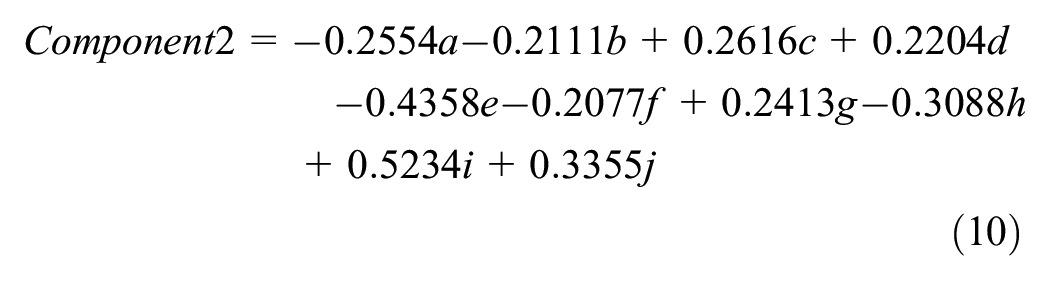
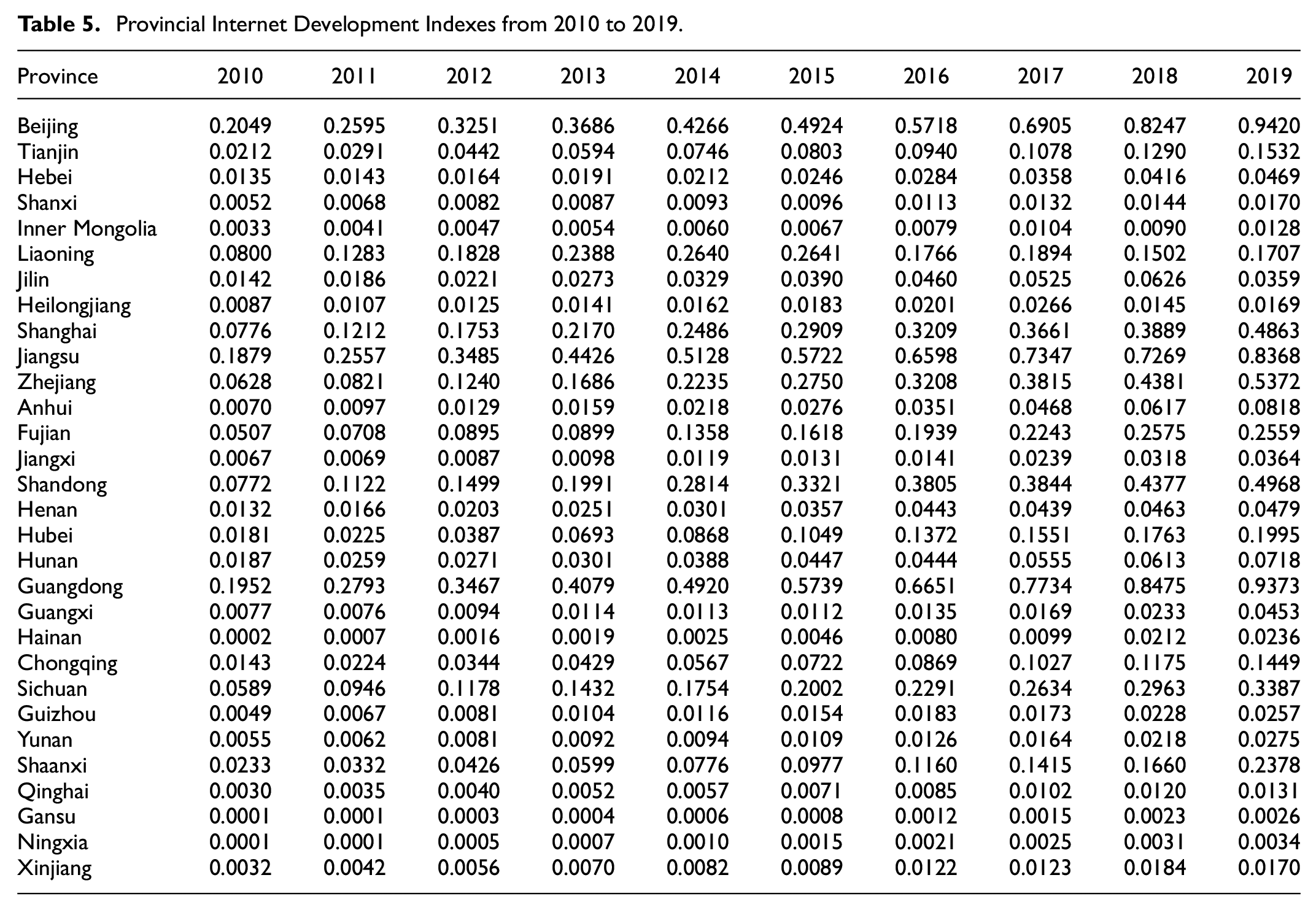
According to Equations 8 to 10, the internet development indexes of 30 provinces or municipalities are calculated and shown in Table 5. The internet development level of each province in China maintains an upward trend over the years. In 2019, the three provinces or municipalities with the highest internet development index are Beijing, Guangdong, and Jiangsu. Overall, the eastern region develops faster than the central and western regions.
Provincial Internet Development Indexes from 2010 to 2019.
Threshold Variable
Government support
Control Variables
Apart from the increase in investment and population, the flow of inter-regional factor resources in China has been accelerated by the rapid development of the tertiary industry, the level of urbanization, the Open-Door Policy, and the construction of transportation infrastructures over the past few years. All of these factors have promoted the flow of production factors across regions and alleviated the problem of misallocation of resources. Therefore, we include these factors as the control variables in our models.
The provincial development level of the tertiary industry (TIit) is measured by the proportion of the tertiary industry in the provincial GDP. The level of urbanization (Urbanit) is measured by the proportion of the urban population in the provincial population. Open Door Policy (Tradeit) is measured by the proportion of import and export trade volume in provincial GDP. The construction of transportation infrastructures (Infrait) is measured by the ratio of the provincial length of roads, railways, and waterways to regional land area to reflect transportation density.
Data Source and Descriptive Statistics
The data source used in this study comes from the Statistical Yearbook of 30 provinces of China and the Statistical Report on Internet Development in China from 2011 to 2020. We obtain 300 observations and the descriptive statistics of the variables involved are detailed in Table 6.
Descriptive Statistics of Variables.

Model Specification
Model for Hypothesis 1
To verify Hypothesis 1, the gravitation model (Witt & Witt, 1995) is used to calculate the spatial correlation of internet development in different provinces as Equation 11.

where
Models for Hypotheses 2 and 3
To verify Hypotheses 2 and 3, we first consider the general spatial econometric models (Kapoor et al., 2007), as Equations 12 to 14.


where


where
Furthermore, to determine the appropriate form of the spatial econometric models, we apply Moran’s test to both dependent and independent variables for spatial autocorrelation, using
Moran’s Test Results for Internet Development Level, Misallocation of Capital, and Labor.

, **, and * represent the significance level of 1%, 5%, and 10%, respectively. It is the same for the rest of the study.
From 2010 to 2019, most of Moran’s indexes for the misallocation of capital disk and labor disl are statistically significant at 10% for
Moran’s indexes for internet development int are all significant at 5% for


Without spatial geographic impact on the internet, we adopt panel-data spatial auto-regressive model (PSARM), as Equations 19 and 20.


Model for Hypothesis 4
To verify Hypothesis 4, we set the non-dynamic panel data model (Hansen, 1999), Equation 21, where the level of government support

where
Empirical Results
Spatial Correlation and Differences of Internet Development
To check the validity of Hypothesis 1, the gravity model in Equation 1 is used to estimate spatial correlation and difference of internet development in different provinces of China.
Spatial Correlation of Internet Development
Spatial correlation is closely related to the size and distance of the two. On the basis of the comprehensive indexes we construct, the spatial correlation coefficients of internet development between provinces are evaluated and the relationship between different regions is displayed by ArcGIS 10.5 as shown in Figure 1. Due to a large number of provinces, it is difficult to show the correlation between all provinces. Thus, 20 provinces or municipalities with the highest correlation coefficients are chosen and the capital city of each province is used as the endpoint of the display. To find out the change in this correlation during the research period, the data from 2005, 2010, and 2019 are selected for comparative analysis. The spatial correlation of internet development in the three different years is shown separately in Figure 1a–c.
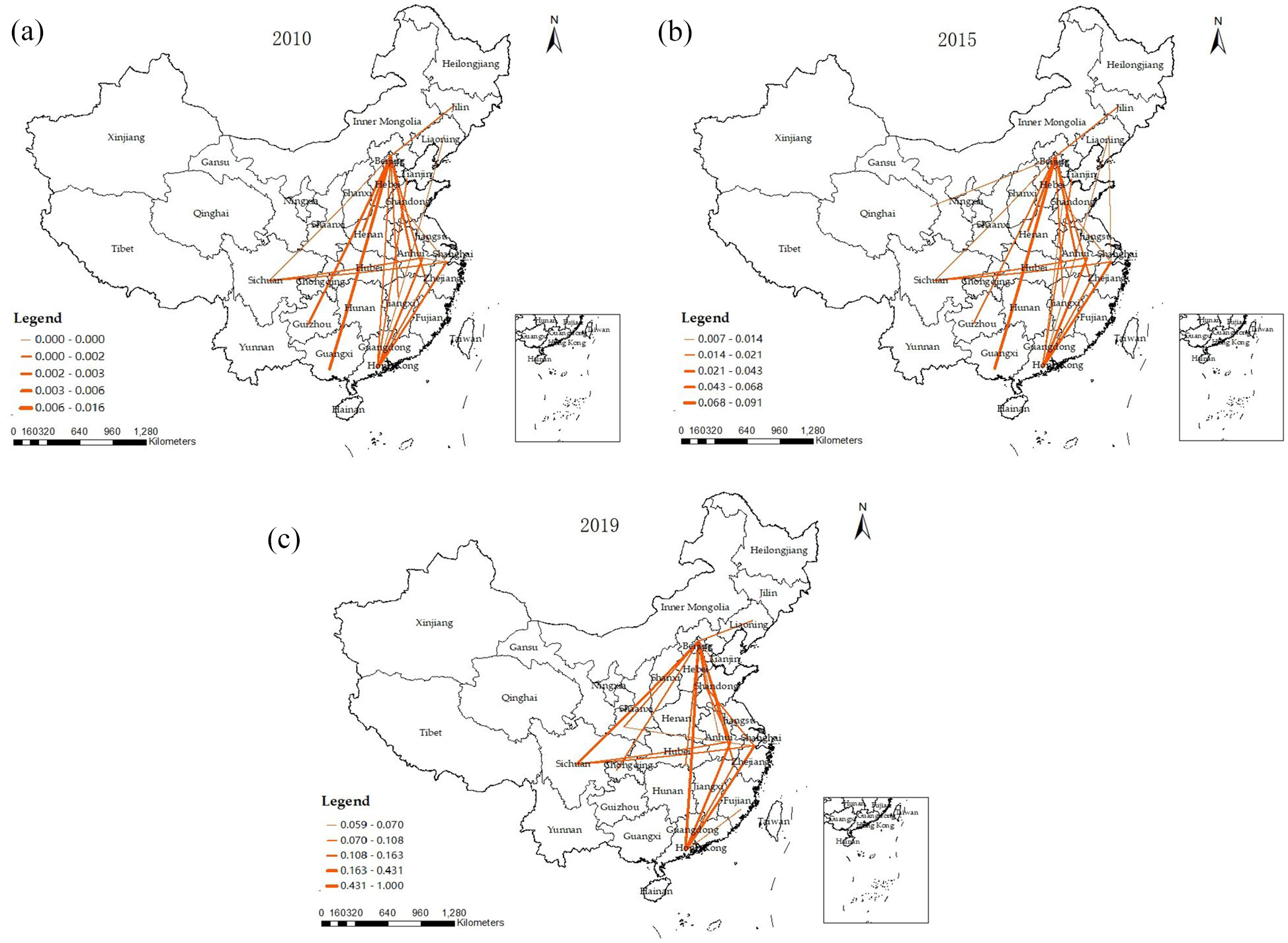
(a) Spatial correlation of internet development in 2010, (b) spatial correlation of internet development in 2015, (c) spatial correlation of internet development in 2019.
On the whole, due to the fast development of the internet, the strength of the internet correlation in all provinces is growing rapidly. The correlation coefficient of the top 20 provinces or municipalities grows tenfold in ten years. According to the seventh Five-Year Plan, all provinces in China can be categorized into the eastern, central, and western regions in view of both economic conditions and geographic locations (refer to Note). From the regional perspective, there are strong internet development correlations among the eastern provinces and between the eastern and part of central regions, while the relationships among the western provinces and between the western and other regions are relatively weak. Down to individual provinces or municipalities, Beijing has a robust correlation with other provinces, especially with Guangdong and Shanghai. Most of the strongly connected regions are correlated to Beijing, Guangzhou, and Shanghai.
Spatial Difference of Internet Development
Internet development is affected by a variety of factors. In virtue of the diverse economic and natural resources, the gaps in internet development are large among provinces over time. The internet development level of the top 20 provinces or municipalities in 2010, 2015, and 2019 are visually demonstrated by ArcGIS 10.5, as shown in Figure 2a–c. The color of the diagrams is getting darker from 2010 to 2019, indicating the internet development level in all provinces has progressed quickly during the research period.

(a) Provincial internet development level in 2010, (b) provincial internet development level in 2015, (c) provincial internet development level in 2019.
In a given year, there are apparent spatial differences among different regions. Provinces with the highest internet development level are concentrated in the eastern coastal areas. Internet development in provinces of the central region is at the medium level. Except for Sichuan, Chongqing, and Shaanxi, internet development in other provinces of the western region is the lowest nationwide. This spatial difference among regions remained nearly unchanged over the research period, so the gaps in internet development between different regions are significant.
As analyzed above, Hypothesis 1 is verified that there are spatial correlations and differences in internet development among different regions in China.
The Impact of Internet Development on Resource Misallocation
To check the validity of Hypothesis 2, models in Equations 17 to 20 are applied to estimate the impact of internet development on resource misallocation. The regression results are displayed in Table 8. In both PSARM and PSDM, the coefficients of Spatial
The Impact of Internet Development on Resource Misallocation.

Note. t-value in the parenthesis.
Specifically, the one-period lagged coefficients of capital and labor misallocation L.disk/L.disl are significantly positive at 1% level, which evidence the time lag effect of capital and labor misallocation. Internet development index int is negatively correlated with resource misallocation indexes. However, according to LeSage and Pace (2009), a change associated with an independent variable can have a direct effect on the dependent variable in a single region and potentially an indirect or spillover effect for all other regions. The results show that the direct effect of internet development on capital and labor misallocation is significantly negative in both models, indicating that the improvement of internet development can alleviate the misallocation of capital and labor in the region itself. The coefficients of direct effect in PSDM imply that every 1% increase in the level of internet development will lead to a reduction of capital and labor misallocation by 20.1% and 12.01%. The spillover or indirect effect of internet development is significantly negative, except for capital allocation in PSARM. This result still reveals that internet development will produce a negative spillover effect, that is, the improvement of internet development will ameliorate resource misallocation for the neighboring regions. The coefficients of spillover effect in PSDM imply that every 1% increase in the level of internet development will relieve the degree of capital and labor misallocation by 5.4% and 2.23% for neighboring regions. Overall, the coefficients of the total effect of internet development on capital and labor misallocation are significantly negative at 1% and 5% levels.
Based on the above analysis, Hypothesis 2 is verified that the development of the internet can mitigate resource misallocation and generate spatial spillover effects.
Heterogeneity in the Impact of Internet Development on Resource Misallocation
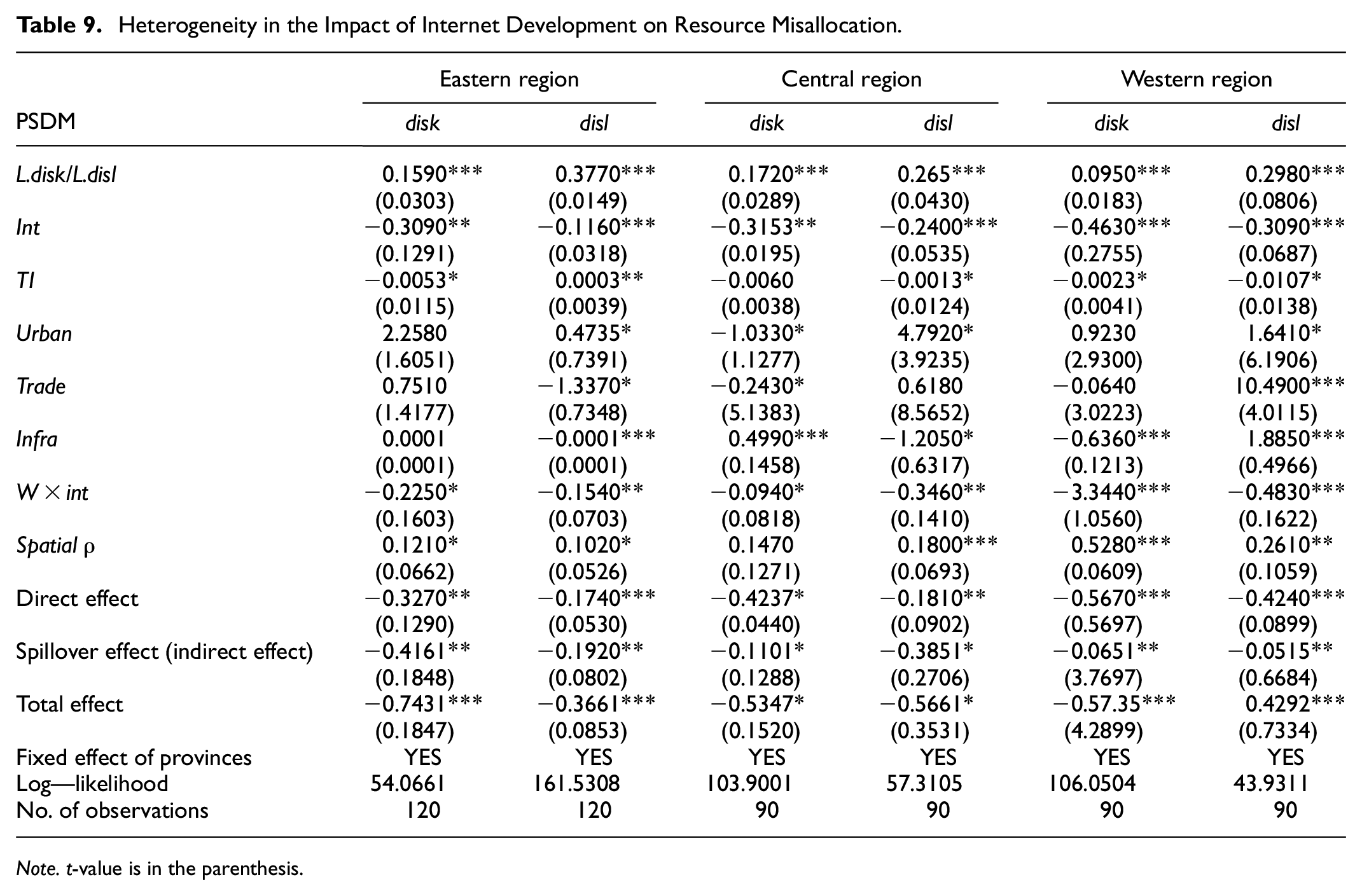
To check the validity of Hypothesis 3, models in Equations 17 and 18 are applied to test the heterogeneity in the impact of internet development on resource misallocation among the eastern, central, and western regions. The regression results are displayed in Table 9.
Heterogeneity in the Impact of Internet Development on Resource Misallocation.
Note. t-value is in the parenthesis.
Both the direct and spillover effect of internet development on capital and labor misallocation is significantly negative in all regions, indicating that internet development can reduce the degree of resource misallocation not only in the region itself, but also in other regions. The coefficients of direct effect show that internet development in the western region has the largest mitigation effect on capital and labor misallocation, followed by the central and eastern regions. The coefficients of the spillover effect show that internet development in the eastern region has the largest mitigation effect on capital misallocation for other regions. That is, every 1% increase in the level of internet development in the eastern region will lead to a 41.61% decline in capital misallocation for neighboring regions, while this spillover effect in the western region is only 6.51%. Moreover, the spillover effect of internet development on labor misallocation is highest in the central region, followed by the eastern and western regions.
Therefore, Hypothesis 3 is verified that the impact of internet development on resource misallocation is heterogeneous among different regions in China.
Endogenous Test
In terms of data sources, this study uses officially published data, which are more reliable and can reduce the endogenous problems caused by measurement errors. The GMM method is employed to mitigate the interference of potential endogenous problems with conclusions. The GMM regression result is presented in Table 10. The coefficients of int on the disk and disl are significantly negative, and all passed AR (2) and the Hansen tests, indicating that the internet development alleviates the resource misallocation, which is consistent with the previous results and confirms the hypotheses.
Endogenous Test Results.
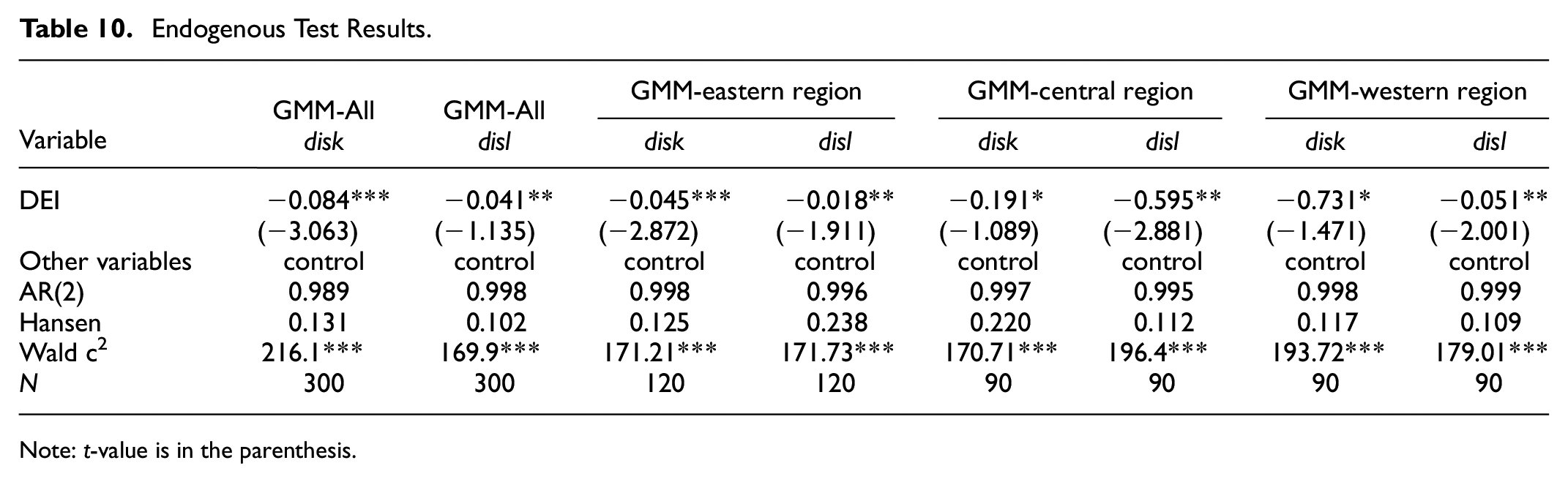
Note: t-value is in the parenthesis.
Threshold Effect Test
To check the validity of Hypothesis 4, the model in Equation 21 is applied to test the threshold effect of government support in the relationship between internet development and resource misallocation.
Threshold Identification
Before we apply the threshold regression model, the number of thresholds and the threshold value need to be identified. We select the level of government support as the threshold variable and use the bootstrap self-sampling method to test the existence of thresholds.
According to the threshold effect test results in Table 11, the statistics F value for a single threshold in the capital misallocation model is significant with a bootstrap p-value of .09, while the F value of both a double threshold and a triple threshold are not statistically significant. In the labor misallocation model, F value is significant for both a single and a double threshold with the bootstrap p-value of .00 and .08. Therefore, we conclude that there is a single threshold in the capital misallocation model and a double threshold in the labor misallocation model.
Threshold Effect Test for Government Support.

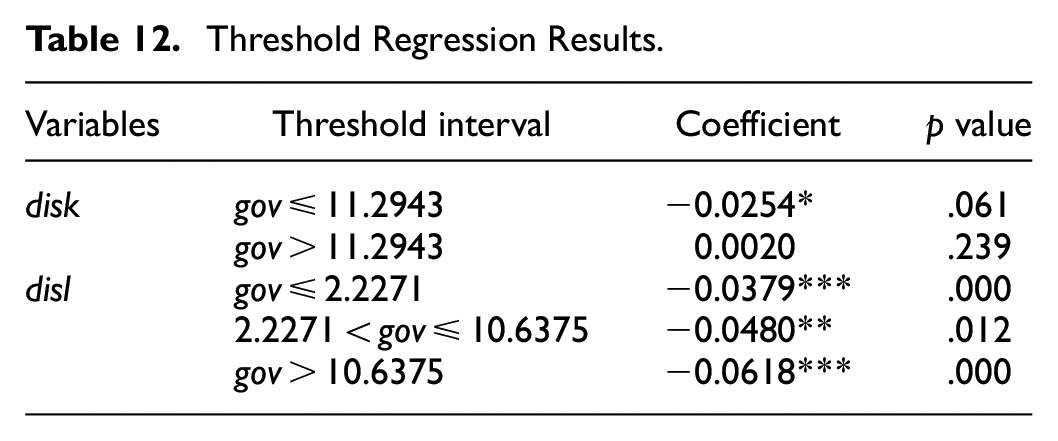
Furthermore, based on the threshold estimates, we plot the concentrated likelihood ratio function of the capital and labor misallocation models respectively in Figure 3, which supports the conclusion that there is a single threshold in the capital misallocation model and a double threshold in the labor misallocation model. Thus, the sample in the capital misallocation model is divided into two intervals based on a single threshold of government support, a high level (gov > 11.2943) and a low level (gov ≤ 11.2943). Accordingly, the sample in the labor misallocation model is divided into three intervals, a high level (gov > 10.6375), a medium level (2.2271 < gov ≤ 10.6375), and a low level (gov ≤ 2.2271).

(a) Threshold effect in capital misallocation model, (b) threshold effect in labor misallocation model.
Threshold Regression Analysis
Threshold regression is then applied to check whether the impact of internet development on resource allocation changes with different levels of government support. The results are shown in Table 12. In terms of capital misallocation, when the level of government support is low, internet development can produce a significant negative effect; while when the level of government support is high, the coefficient is positive but not significant. In terms of labor misallocation, when the level of government support increases from low to high, all the coefficients of internet development on labor misallocation are significantly negative and change from −.0379 and −.0618, indicating that the impact of internet development on resource misallocation is influenced by varying government support levels. The betterment of government support helps internet development to ease the degree of resource misallocation and this effect is magnified as government support goes beyond a certain scale. Thereby, Hypothesis 4 is verified that government support has a significant threshold effect on the impact of internet development on resource misallocation.
Threshold Regression Results.
Discussion
Temporal and Spatial Relevance of Internet Development
With the rapid development of the internet in China, a very obvious “coastal vs inland” spatial divergence pattern has been formed at the national level. In general, the internet correlation intensity of each province is growing rapidly, which is growing at a pace of about ten times in the top 20 provinces. From a regional perspective, developed provinces have a higher correlation intensity than less developed regions. In spite of the increase in correlation intensity, the internet development between regions does not converge, and the disparity in development continuously expands, and the phenomenon of the internet “digital divide” is more self-evident, with higher improvement in developed eastern regions and more noteworthy advancement potential in less developed central and western regions. Our findings support the study of X. L. Zhang et al. (2017) on the spatiotemporal association of the internet, but they use the number of internet pages as a measure of internet development level, which is slightly less thorough than our study.
Impact of Internet Development on Resource Misallocation
According to the results of spatial econometric analysis, on the one hand, regions with higher resource allocation efficiency have positive spillover effects on the misallocation of resources in neighboring regions, and economic factors reinforce the spatial interdependence; on the other hand, the internet development can alleviate resource misallocation, and the geographical factor plays a positive role in promoting the development of the internet. From the sub-regional regression results, there is a time lag in resource misallocation within the region and spatial spillover effects between regions. The improvement of internet development in the neighboring areas will alleviate the resource mismatch in the target areas, but there are regional differences in the impact. Because the internet foundation of the backward areas is poor and the room for improvement is large, the impact on the backward western regions is higher than that on the developed eastern and central regions. The conclusion of this study is consistent with that of C. G. Han and Zhang (2019), but where only the economic space weight matrix is used for spatial measurement weight matrix analysis. In our study, the influence of the geographical distance weight matrix and economic space weight matrix are both considered on the measurement of the internet and resource misallocation.
Threshold Effect of Government Support
In this study, there is a single threshold for government support on capital misallocation and a double threshold for labor misallocation, which confirms that the increase in government support can contribute to the mitigation of resource misallocation through internet development. Z. D. Zhang and Zhao (2021) examine the effect of internet industry agglomeration on resource misallocation by using government intervention as a threshold variable, and conclude that there is a single threshold for both capital and labor misallocation. The threshold variable used in their study is the ratio of government local fiscal expenditure to GDP, which is too general to reflect the specific government support for internet development.
Conclusions and Implications
An important way to boost national production efficiency is to reduce misallocation of resources. To completely universalize the network benefit, enhance resource allocation, and promote efficient economic development, it is of great practical importance to clarify the relationship between the internet and regional resource misallocation in light of the rapid development of the internet. Based on Chinese provincial panel data from 2010 to 2019, this study constructs a comprehensive internet development index and applies the appropriate spatial econometric models to empirically examine the impact of internet development on resource misallocation. The conclusions are drawn as follows: First, there are spatial correlations and differences in internet development in China. On average, spatial correlation in eastern China is stronger and where the internet development is also higher than that in central and western China. Second, the improvement of internet development can alleviate the problem of resource misallocation in China and generate spatial spillover effects among regions. Third, the impact of internet development on the distortion of resource allocation is heterogeneous. Both the direct effect and the spillover effect are significantly different in eastern, central, and western China. Fourth, the influence of internet development on resource misallocation has a nonlinear threshold effect. The threshold variable, government support, is of great importance to it.
The implications of our findings include: First, increase government support for internet development. The influence of internet development on resource misallocation has a network effect and is persistent. The energy of the internet can be gradually released, so local governments should beware of the importance of the internet and enhance the support for its development. It is essential for not only China but also other countries to boost investment in the construction of internet infrastructures, such as optical cable and broadband; increase the number of broadband ports in the access networks; expand the coverage area of wireless internet to break through space restrictions. It is also necessary to encourage the internet industry to enhance the service capacity and give full play to the internet as public infrastructure. In particular, the underdeveloped regions, such as the central and western regions in China, should strengthen internet development by increasing the internet penetration rate, so as to narrow down the economic development gap with the developed region. Second, make full use of the spatial spillover effect of internet development to ameliorate the misallocation of resources among regions. Since the mitigation effect of internet development on resource misallocation is higher in the underdeveloped regions than that in the developed region, internet development in the underdeveloped regions can have a greater space for improvement and obtain more benefit from the whole process. Meanwhile, the spillover effect in the developed region is stronger than that in the underdeveloped regions. Therefore, underdeveloped regions can utilize the internet resources of the developed region and even integrate the factor resources from all over the country. Developing emerging industries such as the mobile internet, big data, and cloud computing could make up for the weaknesses in the underdeveloped regions, to turn the disadvantages of being a latecomer into development advantages. If the allocation of resources can be optimized in all regions, the resource bottleneck will be broken through, and a higher coordinated economic development will be achieved. Third, promote deeper integration of the internet with the capital and labor markets. The integration and development of the internet and the capital market are conducive to shortening the intermediate links of capital allocation and reducing the circulation cost of capital, thus promoting capital allocation. Meanwhile, supporting and encouraging independent and flexible employment via internet platforms, such as live-streaming sales, drip drivers and takeaway riders, can balance the supply and demand in the labor market and promote labor allocation efficiency while easing the employment pressure in the labor market.
Regarding the research on internet development and resource misallocation, our study brings about improvements in the measurement of internet development, the selection of spatial measurement model matrix and the threshold variables, and the findings have some meaningful implications for countries with resource misallocation problems. The limitation of this study is that we didn’t check the impact mechanism of the internet on resource misallocation empirically. Future research can consider the mechanism research from the perspectives of the degree of marketization, the openness to the outside world, and the financial development.
Footnotes
Author Note
Eastern region includes Beijing, Tianjin, Hebei, Liaoning, Shanghai, Jiangsu, Zhejiang, Fujian, Shandong, Guangdong, Guangxi and Hainan. Central region includes Shanxi, Inner Mongolia, Jilin, Heilongjiang, Anhui, Jiangxi, Henan, Hubei and Hunan. The remaining provinces are included in western region.
Declaration of Conflicting Interests
The author(s) declared no potential conflicts of interest with respect to the research, authorship, and/or publication of this article.
Funding
The author(s) disclosed receipt of the following financial support for the research, authorship, and/or publication of this article: This research was funded by The National Social Science Fund of China, with grant number 20BJY106.
Ethical Approval
Is not applicable.

Data Availability Statement
The datasets generated during and/or analyzed during the current study are available from the corresponding author on reasonable request.