




Abstract
As digital transformation (Digital) accelerates globally, conventional enterprise production models are proving increasingly insufficient to meet the demands of today’s dynamic market landscape. China has innovated the concept of New Quality Productivity (NQPF), and exploring its functioning is critical to promoting high-quality enterprise development. This study examines the impact mechanism of Digital on NQPF in manufacturing firms by applying spatial econometric models—including the spatial Durbin model, spatial mediation model, and spatial threshold model—to panel data from A-share listed manufacturers (2013–2022). The results indicate that digital transformation significantly influences the level of NQPF, exhibiting spatial spillover effects and spatial attenuation boundaries. This influence initially promotes and subsequently inhibits productivity. The analysis of the spatial mediation effect reveals that Digital affects enterprise productivity levels by influencing total factor productivity. Furthermore, the spatial threshold effect analysis indicates that higher total enterprise assets enhance the positive impact of Digital on NQPF. These results provide robust micro-level empirical evidence to inform manufacturing enterprise development strategies.
Keywords
Introduction
As countries increasingly pursue digital transformation, the competition for technological dominance intensifies. This transformation underscores the critical role of emerging production factors—particularly technology, data, and knowledge capital—while simultaneously exposing the limitations of conventional growth models characterized by insufficient indigenous innovation and strategic technological vulnerabilities. In response to these challenges, particularly acute in developing economies, China has pioneered the conceptual framework of “new quality productive forces” as a strategic solution. Central to this concept is leveraging next-generation digital technologies to optimize production factors, foster scientific and technological innovation, resolve technological bottlenecks, enhance enterprise efficiency, and drive breakthrough innovations. According to the “China New Quality Productivity Industry Development Trend Report 2024,” industries powered by new quality productive forces, including artificial intelligence, the low-altitude economy, humanoid robots, and the 5G industry, have experienced rapid growth and become new drivers of economic expansion. The report systematically demonstrates that Digital serves as a crucial catalyst in cultivating and advancing NQPF. As a critical growth engine, it facilitates high quality development of the economy through three synergistic mechanisms: production factor optimization, technological innovation stimulation, and industrial structure advancement, thereby establishing a solid foundation for cultivating and scaling NQPF. However, despite China’s ranking as 8th in the Global Digitalization Index (GDI) and being a leader in digital transformation, Chinese enterprises still face numerous challenges. Small and medium-sized enterprises face a tripartite challenge encompassing capital shortages, technological deficits, and talent gaps, which collectively constrain the accelerated development of NQPF. Firms operating in China’s central, western, and northeastern provinces face significant challenges in terms of inadequate infrastructure development and scarcity of skilled personnel, which consequently constrains the advancement of NQPF in these regions. Furthermore, empirical evidence suggests that digital transformation alone proves insufficient for certain enterprises to enhance NQPF, as deficiencies in managerial innovation and productivity optimization mechanisms persistently constrain performance outcomes. Consequently, investigating the underlying mechanisms through which Digital influences NQPF carries substantial practical significance for addressing these pressing challenges.
Based on this, the paper collects panel data from 436 non-ST manufacturing firms spanning 2013 to 2022. It analyzes the relationship between Digital and the development level of NQPF in manufacturing firms using spatial Durbin, spatial mediating effect, and spatial threshold models. The study ultimately identifies the geographic threshold of spatial spillover effects through double difference models. Guided by the core research theme, this study seeks to advance current scholarship through three key expansions: (1) There is no precise definition of NQPF in academia; most scholars rely on capital theory and Marx’s definition of productivity to establish the index system as the basis for research. Departing from conventional approaches, this study innovatively operationalizes its variables by examining three fundamental dimensions of modern manufacturing enterprises—labor force, means of production, and production objects—thereby making substantive theoretical extensions to existing research. (2) The concept of NQPF currently lacks a precise, universally accepted definition in academia. While most existing studies approach NQPF from a theoretical perspective or rely on macro-level provincial data, this study breaks new ground by examining NQPF at the micro level using firm-specific data from manufacturing firms. By doing so, it not only provides empirical evidence to advance the conceptual understanding of NQPF but also contributes to the development of its theoretical framework. (3) Most research on the spatial spillover effect remains limited to basic regression analysis. In contrast, this article, drawing on the work of Qingfeng (2020), verifies spatial correlation and determines the influence range of the spatial spillover effect through spatial attenuation boundaries. This approach provides a novel reference for scholars studying spatial econometrics. (4) Additionally, this article employs the spatial mediation effect model and the spatial threshold model to analyze the mechanism by which the Digital impacts the development level of NQPF. This enriches the theoretical research on the NQPF of enterprises.
Literature Review and Research Hypotheses
Literature Review
New Quality Productive Force (NQPF) of Enterprises
NQPF is fundamentally rooted in the classical Marxist framework of productive forces, while simultaneously extending its theoretical boundaries through contemporary reinterpretation. Building upon classical productive forces theory, Lin (2024) contends that NQPF manifest through three transformative processes: technological breakthroughs, factor allocation innovations, and industrial upgrading. This perspective emphasizes NQPF's essential quality—the enhanced dynamic relationship between human labor, production tools, and worked-upon materials. From the worker’s standpoint, NQPF incorporates cutting-edge technologies and advanced machinery that demand sophisticated human-machine collaboration. This technological paradigm necessitates workers to develop new competencies in interacting with intelligent production systems. A study by Kimiagari and Baei (2022) found that many individuals exhibit technophobia towards new technological advancements, negatively affecting their intention to engage in similar interactions. Liu’s (2024) framework positions NQPF within a sociotechnical matrix, identifying three critical interaction modalities: interpersonal coordination (human-human), interface management (human-machine), and distributed cognition systems (human-machine-human). This further underscores the importance of workers in these NQPF.
From the perspective of labor objects, NQPF represents a fundamental shift in resource utilization—transitioning from traditional natural resources to advanced, knowledge-intensive inputs. These include new materials, new energy sources, data, biological genes, and virtual space, making these forces applicable across a wide range of industries. For instance, ShanYing et al. (2024) explored the research directions of NQPF technology in areas such as zero-carbon energy supply, fossil energy utilization, and carbon dioxide capture and utilization. Ming et al. (2024) and others have investigated the impact of NQPF on the division of labor in GVCs through cross-country empirical studies, highlighting that the optimization of labor objects is crucial for enhancing a country’s position in GVCs.
From the perspective of labor means, NQPF encompass various aspects such as digitization, intelligence, and greening. These are key factors driving the qualitative transformation of productive forces. These novel labor means not only alter the mode of production but also provide a robust material foundation for high-quality development. X. P. Zhang et al. (2024) empirically demonstrate how the progressive development of NQPF in healthcare has facilitated significant improvements in medical service delivery, particularly through enhanced precision, operational efficiency, and personalization of patient care. Lin et al. (2024) examined NQPF in agriculture and discovered that the application of advanced agricultural science and technology allows for more in-depth analysis and testing of arable soils. This facilitates precise fertilization techniques, effectively enhancing soil nutrient status and leading to higher-quality agricultural development.
NQPF is examined through the lens of endogenous growth theory. Endogenous growth theory posits that sustainable economic expansion is fundamentally driven by endogenous factors—particularly systematic technological advancement and cumulative knowledge development—rather than external forces. The framework emphasizes how institutional arrangements (market structures), incentive mechanisms, and policy frameworks collectively shape innovation dynamics and knowledge dissemination patterns within an economy. Baoping and Peiwei (2024) analysis positions NQPF within national innovation systems theory, where the co-evolution of breakthrough technologies (e.g., AI, green tech), factor market reforms (e.g., data markets), and industrial ecosystem restructuring collectively drive productive force quality upgrading. This concept aligns closely with endogenous growth theory, which underscores the importance of continuous intellectual capital growth through innovation to achieve economic growth.
In summary, emerging quality productive forces enable developing countries to reduce their technological and market dependence on developed nations, thereby increasing their economic autonomy. By fostering indigenous emerging and future industries, developing countries can transition from being “locked in at the low end” to “moving up” in global value chains. This model not only enhances economic independence but also promotes a green economy and sustainable development.
Research Hypotheses
Digital of the Manufacturing Industry and NQPF of Firms
Emerging empirical evidence suggests that enterprise digital transformation constitutes a fundamental enabler for cultivating NQPF, providing the necessary technological infrastructure and organizational capabilities. For instance, research by Song and Zhang (2024) technical analysis reveals that digital transformation drives NQPF through interconnected systems: product lifecycle acceleration (via digital twins), knowledge management systems (for practice dissemination), integrated digital architectures (combining IoT and enterprise software), platform-based business model innovation, smart supply chain networks, and cloud-based simulation environments. Chen et al. (2024) establish through empirical analysis that Digital exerts a mitigating effect on stock price crash risk, particularly in technology-intensive sectors. Their research identifies dual mechanisms—enhanced market transparency and reduced information asymmetry—that create more stable financial conditions conducive to developing NQPF.
From the perspective of the digital economy framework theory, there is a profound intrinsic link between Digital and NQPF. First, regarding digital innovation, it emphasizes data value extraction, information interconnection, and intelligent decision-making support, bringing unprecedented efficiency and competitiveness to the industry. A study by Li et al. (2022) identified two transmission channels whereby digital innovation promotes quality development: reducing costs and improving labor efficiency. The research of Wu et al. (2023) proved that the digital innovation capability can effectively improve the total factor productivity of enterprises, thus helping them to achieve high-quality development. Wang et al. (2024) showed that Digital of firms promotes firms' growth by improving supply chain efficiency and correcting overinvestment to improve investment efficiency. Qun and Qian (2024) contended that smart manufacturing serves as both the core engine propelling the manufacturing industry toward high-quality development and a crucial indicator of NQPF during industrial upgrading. This process accelerates the creation and growth of NQPF within the manufacturing industry, providing strong impetus for its transformation and upgrading. Zhou et al. (2024) theorize that digital transformation substantially enhances breakthrough innovation in manufacturing enterprises through systematic integration of the Ability-Motivation-Opportunity (AMO) human capital framework, thereby cultivating NQPF characterized by advanced technological capabilities.
From the perspective of the three elements of productivity, the digitization of enterprises can foster a significant advancement in the integration and optimization of workers, means of labor, and objects of labor. NQPF is efficiently integrated with the digital platform, which can be likened to a fertile land requiring cultivation and refinement by skilled workers. Xu and Man (2024) observed that the NQPF on digital platforms face challenges such as the mismatch between digital platform laborers and NQPF, the difficulty in adapting digital platform labor materials to the requirements of these forces, and the inability of the labor objects on digital platforms to support the continuous improvement of NQPF. Zheng and Xiaopeng (2024) argue that the means of labor, comprising a complex, diverse, and extensive material system used by laborers to shape or transform their labor objects, have been present throughout the development of human society. They note that a wide variety of means of labor have emerged and evolved, a process that not only facilitates leaps in productive forces but also leads to adaptive changes in production relations. Additionally, the latest labor materials cultivate new labor objects by reducing raw material waste through digital production, expanding labor objects through new product development, and exploring the potential value of labor objects more deeply. Based on the theoretical foundations established above, this paper propose the following core hypothesis:
Spatial Spillovers Among Manufacturing Enterprises
Driven by digital technology, the speed of information flow has increased rapidly, leading to more frequent communication and cooperation among enterprises. Meanwhile, from the perspective of the new development concept and the principle of high-quality development, enterprises should innovate in the five dimensions of green development, openness, sharing and efficiency. Li and Liu (2024) found that close cooperation and communication among enterprises in synergistic agglomeration areas can stimulate innovation. Productive service enterprises provide innovation support for manufacturing enterprises, while the demands of manufacturing enterprises drive productive service enterprises to pursue technological and service model innovations. Zhang and Sun (2024a) discovered that the co-agglomeration of financial and manufacturing firms promotes positive spillovers of agglomeration economies, offering a meaningful approach to foster green development. Zhang and Sun (2024b) further revealed significant spatial heterogeneity in manufacturing agglomeration effects, demonstrating that when analyzing cities stratified by Eastern, Central, and Western regions, the impacts on total factor carbon productivity (TFCP) exhibit distinct patterns, ultimately mediating the efficacy of manufacturing upgrading policies. Nguyen (2024) empirically established that domestic firms’ integration into global production networks (GPNs) facilitates bidirectional productivity spillovers, with foreign-invested enterprises transmitting technological and managerial advancements through both backward (supplier) and forward (buyer) linkage channels. Therefore, manufacturing enterprises need to positively impact their surrounding areas through various mechanisms, such as the dissemination of knowledge and technology, the extension and expansion of industrial chains, and the optimal allocation of markets and resources.
When leveraging the spatial spillover effect to foster enterprise, it is crucial to acknowledge the constraints imposed by various factors, including the scale and intensity of economic activities, geographic location, transportation conditions, policy environment, and time. Generally, the more developed and large-scale the economic activities, the closer the geographic location, the more convenient the transportation conditions, and the more favorable the policy environment, the broader the potential scope of the spatial spillover effect. Elhorst et al. (2024) used a parameterized spatial weight matrix to quantify and graphically illustrate the spatial extent of the distance decay effect and spillover effect in the spatial Durbin (SD) model. Liu et al. (2024) examined the spatial spillover effect resulting from the collaborative clustering of diverse firms. Their study revealed that once the geographic distance threshold exceeds the boundary, the spatial spillover effect initially grows and then diminishes. Liao et al. (2025) discovered that at different stages of regional synergistic development, the spatial spillover effect on urban sprawl exhibits wavy spatial distance decay characteristics, with the radiation boundary shrinking as regional synergistic development progresses. These studies collectively suggest that spatial spillover effects are characterized by spatially decaying boundaries. Based on this reasoning, the following hypothesis is formulated in this article:
Mediating Effects of Total Factor Productivity (TFP)
TFP of firms functions as a vital indicator for assessing how efficiently a firm utilizes all production factors, including labor, capital, and land, in its production processes. A significant increase in TFP is the core symbol of NQPF. Tang (2024) empirical analysis revealed that the digital economy exhibits significant spatial spillover effects on enterprise TFP enhancement. Furthermore, the study identified a convergence effect whereby the combined influence of digital economic development and market competition on TFP becomes increasingly pronounced as firms' productivity levels rise. Zhong et al. (2024) discovered that manufacturing enterprises can achieve technological innovation and replace low-efficiency labor labor through AI, ultimately significantly increasing TFP. Feng et al. (2024) demonstrated that the TFP of cultural firms is primarily enhanced through digital transformation, which improves efficiency in content creation, facilitates access to financing, and increases research and development investment. The analysis reveals this impact is particularly pronounced among smaller firms operating in central and western China, as well as those positioned upstream in the industrial value chain. Zhao et al. (2024) through the lens of structural stickiness, demonstrated that systematic productivity shocks significantly elevated aggregate TFP levels in technologically sensitive industries, particularly in computer/electronic equipment manufacturing, specialized equipment manufacturing, and general equipment manufacturing sectors. This suggests that the structural changeability of TFP in these industries is stronger, with stronger NQPF. Xiangjie and Zhengchu (2024) examined the interconnection between NQPF and TFP, revealing that both factors drive parallel advancements through technological innovation and human capital optimization, with NQPF additionally exhibiting distinct spatial spillover effects. Therefore, it is hypothesized that there is a link between TFP and NQPF, as shown in Figure 1. Consequently, the following hypothesis is proposed in this article:

Mediating effects of TFP.
Research Design and Data Description
Data Sources
This study selects Chinese A-share listed manufacturing firms as the research sample for the period from 2013 to 2022. The financial data of these firms were sourced from the CSMAR database and the Wind database, while other data were obtained from official financial reports and specific indexes published by Shanghai Huazheng Information Service Co., Ltd. Following existing studies, the data processing method in this article is as follows: (1) the sample excludes firms receiving special treatment (ST/PT designation) during the observation period to ensure data consistency; (2) excluding delisted firms; (3) excluding companies with missing main research variables. (4) to mitigate the impact of outliers, this paper applied Winsorization to all continuous variables at the 1st and 99th percentiles. The final analytical sample consisted of 436 continuously operating manufacturing firms listed during the study period.
Definition of Variables
Explained Variable: New Quality Productive Force (NQPF)
This article adopts the entropy value method to construct the NQPF index of listed companies in the manufacturing industry, which provides a comprehensive measure of their NQPF development level. The construction of NQPF must fundamentally maintain the three classical productivity components—laborers, means of labor, and objects of labor—while simultaneously instilling innovative qualitative characteristics into these elements. Adopting the conceptual framework established by Ren et al. (2024), we operationalize NQPF measurement by selecting impactful indicators for laborers, means of production, and objects of labor that best capture the distinctive characteristics of our research subjects. Following Jia et al. (2024) and based on endogenous growth theory, this article measures labor force quality using three key indicators: R&D personnel ratio, R&D salary proportion, and higher education ratio (employees holding bachelor’s degrees or above relative to total workforce). Given that the focus of this study is on manufacturing enterprises that are undergoing digital transformation, and considering that NQPF involves substantial tangible assets such as machinery, equipment, plant, and production raw materials, this paper regards the fixed assets of these enterprises as the labor material component of the NQPF indicator. Additionally, to highlight the emphasis that enterprises place on scientific and technological innovation, the proportion of R&D-related expenses is incorporated into the labor resources indicator. For labor objects, this article adopts Yang and Yu (2025) approach to capture the scientific innovation attributes of NQPF through three indicators: the number of invention patent applications, the number of utility model patent applications, and the level of real economy integration. These indicators reflect both technological output and industrial application. Furthermore, to reflect the NQPF’s emphasis on environmental protection and sustainable development, this article incorporates the firm’s total pollution equivalent, investment in environmental protection, green transformation efforts, and ESG rating into the labor objects indicator. Finally, this paper use the entropy weighting method to calculate the scores for each index, as illustrated in Table 1.
Indicators of NQPF of Enterprises.

Note. Efficacy indicates whether the indicator is positive or negative, and an efficacy of + (−) means that the larger the indicator’s value, the better (worse) it is.
Explanatory Variables: Digital Transformation of Firms (Digital)
Extending Wu et al.’s (2021) digital transformation taxonomy, our content analysis of A-share disclosures examines five constitutive elements: intelligent algorithms, data analytics systems, distributed computing platforms, decentralized protocols, and operational technology integrations. A keyword library for text retrieval related to digital intelligence transformation was constructed. Using Python’s natural language processing tools, we systematically analyzed corporate annual reports to extract and quantify digital transformation indicators across all sample firms. Given the data’s typical right-skewed distribution, a logarithmic transformation was applied.
Mediating Variable: Total Factor Productivity (TFP)
The existing literature primarily utilizes the LP method and OP method to measure the TFP of enterprises. This paper, drawing on Tao et al. (2023), employs an enhanced version of the OP method by incorporating the LP method and combines it with the approach of Lu and Lian (2012), which uses intermediate goods inputs as a proxy variable. This adjustment results in less sample loss and effectively mitigates endogeneity issues. Therefore, this paper adopts TFP measured by the LP method as a proxy variable in the benchmark regression.
Threshold Variables
Total enterprise assets as the most direct variable affecting the development of the enterprise, this paper takes total enterprise assets (Cap) as the threshold variable.
Control Variables
This article has selected a number of variables that may affect business planning, as shown in Table 2.
Definitions of Control Variables.

Model Building
To examine how digital promotes NQPF in manufacturing enterprises, this paper establish the following baseline regression model:

i indicates individual manufacturing enterprises, tNQPF indicates new quality productive forces, Digital indicates enterprise digital transformation,
In order to determine whether there is a nonlinear disturbance mechanism in the process of Digital to promote the development of NQPF of firms, this paper constructs the following panel threshold model:


ρ is the spatial autocorrelation coefficient, τ indicates the spatial error term of the control variables,
To determine the spatial extent of the spillover effects arising from manufacturing enterprises’ digital transformation in promoting the development of NQPF, firstly, this article sets different distance thresholds according to formula (4) to construct multiple sets of geographic distance matrices; thereafter, substitute the furthest geographic distance obtained by continuous regression of spatial spillover effect coefficients obtained by formula (3) which is not significant, and this is the spatial attenuation boundary.

Where

Where
Empirical Analysis
Descriptive Statistics
The descriptive statistics of the research variables are summarized in Table 3. It can be seen that NQPF mean value of the firms for the period 2013 to 2022 is .0483, the standard deviation is .0443, the minimum value is .0207, and the maximum value is .3903. Digital mean value is 13.77, the standard deviation is 24.85, the minimum value is 1.00, and the minimum value is 282.00.The results reveal significant variations in both the level of NQPF and the extent of digital across firms.
Results of Descriptive Statistics of Variables.

Base Regression Analysis
To determine whether digital has a positive impact on NQPF, a baseline regression test was conducted, with the specific results presented in Table 4. It can be observed that regardless of whether the digital on NQPF is considered in isolation or with the addition of control variables or fixed time effects, the regression results indicate a significant positive impact. Hypothesis H1 is thus confirmed, allowing for the subsequent experiments to proceed.
Analysis of Baseline Regression Results.

Note. T-statistics in parentheses.
p < .05. ***p < .01.
Spatial Correlation Regression Analysis
The spatial autocorrelation of NQPF in manufacturing enterprises and digital is analyzed using Moran’s I index, as shown in Table 5. The results indicate that the Moran’s I index for both NQPF in manufacturing enterprises and digital remains positive and significant from 2013 to 2022, regardless of whether the adjacency matrix or the economic distance matrix is used. This demonstrates that both NQPF in manufacturing firms and their digital transformation exhibit positive spatial dependence, thus meeting the prerequisites for employing spatial econometric models.
Global Moran Index Values.

Note. Statistical significance levels are denoted as *p < .1, **p < .05, and ***p < .01.
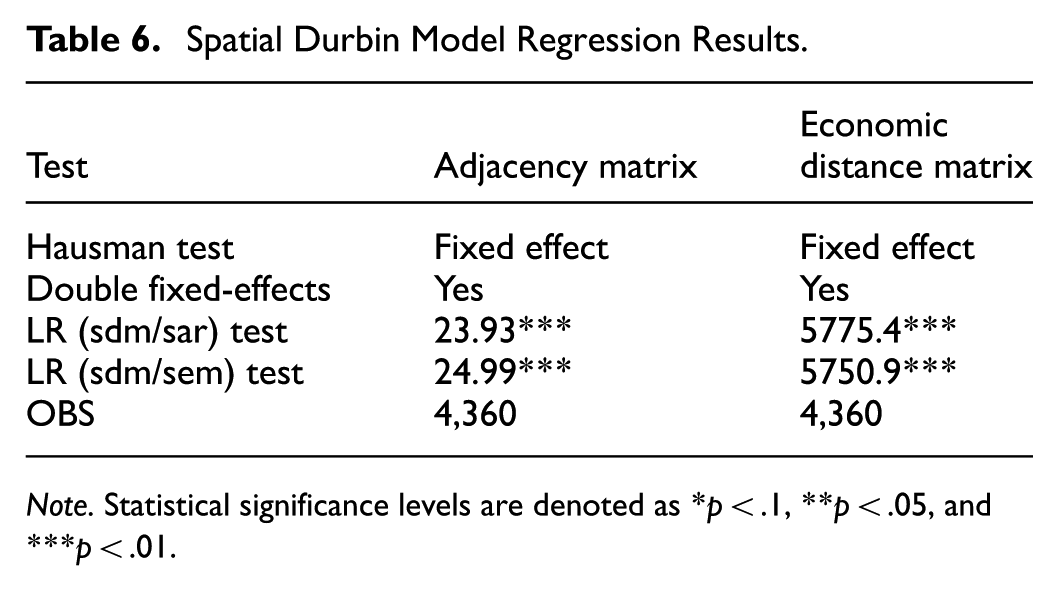
To select the optimal spatial econometric specification, we performed a battery of diagnostic tests, including Hausman and likelihood-ratio (LR) tests, with results presented in Table 6. The spatial Hausman tests for both weight matrices yielded statistically significant results, decisively rejecting the null hypothesis of random/mixed effects in favor of fixed effects specifications. The likelihood-ratio tests for both spatial weight matrices produced statistically significant results, confirming the existence of spatial spillover effects from manufacturing firms' digital transformation to NQPF development. Additionally, the LR test results indicated that the SDM could not be reduced to either the SAR model or the SEM model. Consequently, this study ultimately employs the panel Durbin model with both time and space fixed effects to analyze the spatial spillover effect of Digital in manufacturing enterprises on the development of NQPF.
Spatial Durbin Model Regression Results.
Note. Statistical significance levels are denoted as *p < .1, **p < .05, and ***p < .01.
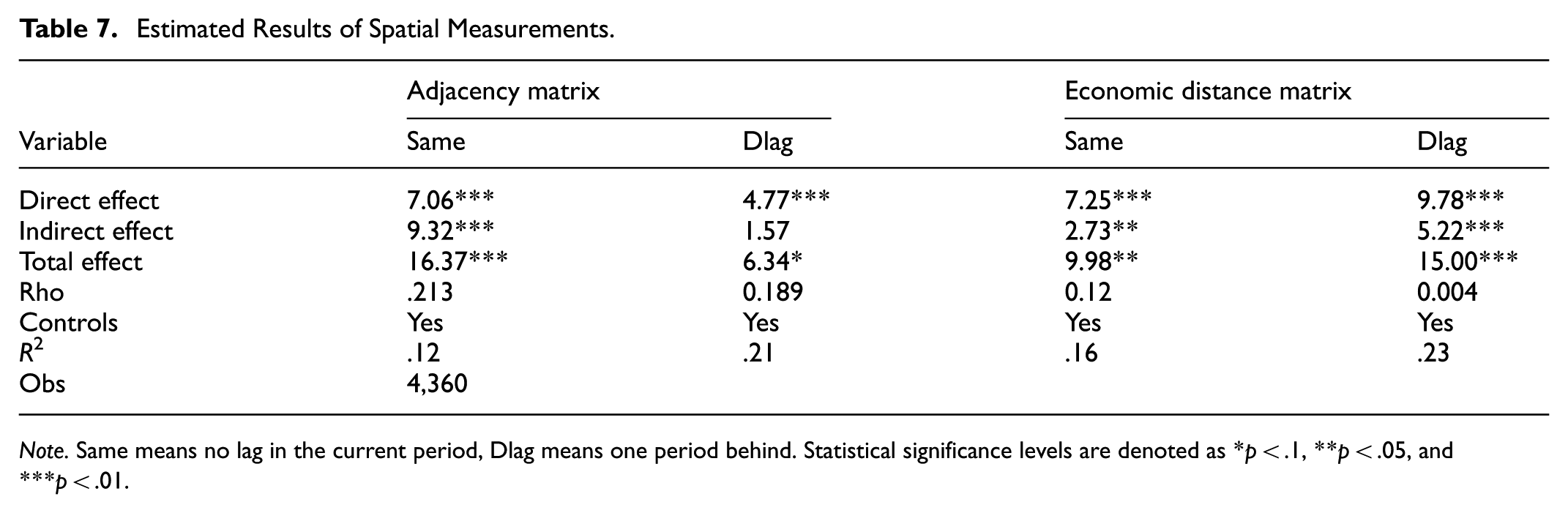
Table 7 reports the spatial regression estimates, including both direct and indirect (spillover). First, the regression results for the direct effects are all significant, this mean the Digital of manufacturing firms promotes NQPF within the firms. Second, the coefficients of the indirect effects of Digital on the NQPF of neighboring firms are also all significant. This suggests that Digital can enhance the NQPF of neighboring enterprises to some extent. Meanwhile, to capture the time dynamics, we conducted a one-period lagged regression analysis. The results are consistent, but the effect size is attenuated, suggesting that the spatial spillover effect of Digital on NQPF exhibits persistence and a measurable time lag. Hypothesis 1 is thus confirmed, while Hypothesis 2 is initially tested.
Estimated Results of Spatial Measurements.
Note. Same means no lag in the current period, Dlag means one period behind. Statistical significance levels are denoted as *p < .1, **p < .05, and ***p < .01.
The potential reasons are as follows: For Hypothesis 1, manufacturing enterprises primarily rely on producing products or providing services such as finishing for profitability. The digital optimizes products and improves efficiency in the manufacturing industry, thereby advancing the level of NQPF within the firms. For Hypothesis 2, in the digital era, the ease of obtaining information is relatively high, and cooperation and competition among enterprises are more frequent. This reduces communication barriers between enterprises. Additionally, the introduction and improvement of talent quality break down many technological barriers, allowing a number of manufacturing enterprises in the region to be influenced by regional similarities. From an endogenous theory perspective, economic activities such as research and development, innovation, and knowledge spillover can indeed drive the endogenous growth of technology.
Space Decay Boundaries
To determine attenuation bounds for spatial spillover effects, this article constructed a spatial adjacency matrix for continuous regression based on Equation 4, with 50 km as the base period and 50 km as the step distance. The results are presented in Table 8. From the results, the spatial spillover effect exhibits distance thresholds between 50–100 km and 350–450 km. Beyond the initial 50 to 100 km interval, the spatial spillover effect coefficients are significantly positive, all passing the 1% significance test until the second-stage threshold. Once the 350 to 450 km second-stage threshold is surpassed, the coefficients of the spatial spillover effect become significantly negative, maintaining significance at the 1% level until 550 km. However, the coefficients in columns (7) and (8) within the 550 to 600 km range are no longer significant. This suggests that the spatial spillover effect diminishes significantly at a distance of approximately 550 km.
Spillover Boundaries for Space Effects.

Note. Statistical significance levels are denoted as *p < .1, **p < .05, and ***p < .01.
The regression results, as depicted in Figure 2, highlight the spatial spillover effect of the digital on the enhancement of NQPF. This effect exhibits attenuation boundaries and distance thresholds. Overall, the trend initially rises and then declines. Specifically, the distance threshold of 50 to 350 km corresponds to intra-provincial distances, suggesting that enterprises within the same province and neighboring provinces experience a positive impact, while distances beyond this range exhibit a negative effect.

Spatial spillover decay boundaries per 50 km.
Furthermore, as the study focuses on an enterprise sample, a more precise determination of the spatial spillover effect’s attenuation boundary and distance threshold is required. To achieve this, a spatial adjacency matrix will be constructed using 20 km as the base period and incrementing by 20 km. Successive regressions will be conducted to produce Figures 3 and 4.

Spatial spillover decay boundaries per 20 km.

360 to 600 km spatial spillover effect decay boundary.
From Figure 3, it can be observed that the spatial spillover effect is positive at 100 km in the first interval and reaches its peak at approximately 160 km. The spillover effect diminishes as the distance threshold increases and becomes insignificant beyond 360 km. This phenomenon is primarily due to the progress of enterprise digitization within the region, which generates a variety of high-quality elements and knowledge innovation spillovers, thereby fostering industrial development. Additionally, cooperation among neighboring enterprises allows them to reduce innovation time and trial-and-error costs by leveraging the rich technological innovation and operational experience of advanced enterprises, thus improving innovation efficiency and enhancing the level of NQPF. However, as the distance threshold increases, opportunities for inter-enterprise communication decrease and cooperation costs rise, leading to a decline in the spillover effect. This attenuation trend of the spatial spillover effect in digital aligns with the marginal diminishing effect.
From Figure 4, this article observe that in the second interval, the spatial spillover effect becomes significant again after surpassing the distance threshold of 360 km, showing a negative value. This indicates that beyond this threshold, the spatial spillover effect inhibits the development of NQPF within the same industry until it becomes insignificant again after 550 km. This phenomenon is primarily due to the fact that, typically, a distance of more than 360 km is equivalent to crossing provincial boundaries, leading local enterprises to resist foreign enterprises. This resistance not only reduces cooperation and exchange but also results in boycotts. Additionally, significant differences exist in development reliance among long-distance enterprises, including policy disparities and varying access to high-quality labor. Some underdeveloped regions blindly follow trends and imitate others, which leads manufacturing enterprises to stray from leveraging their regional advantages. Consequently, these enterprises incur high costs for knowledge and technology spillovers from developed regions without effectively converting them into local benefits, hindering their development. Beyond 550 km, communication between enterprises is minimal, rendering their influence negligible and leading to insignificant regression results.
In summary, Digital to foster the development of NQPF exhibits a spatial spillover effect with a spatial decay boundary, thereby confirming Hypothesis 2.
Analysis of Spatial Mediating Effects
To further explore the mechanism by which the Digital affects NQPF, TFP is incorporated as a mediating variable in the regression analysis to examine potential transmission mechanisms. This article refers to the methodology of Fang and Wen (2023), which utilizes a three-step approach and bootstrapping to analyze the mediating effect. Additionally, spatial weight matrix coefficients are incorporated into the tested variables to imbue the regression results with spatial attributes, as shown in Table 9.
Mediated Effects Test.

Note. Statistical significance levels are denoted as *p < .1, **p < .05, and ***p < .01.
First, using the three-step method, the initial step examines the correlation between NQPF and Digital, revealing a significant and positive regression coefficient. The second step assesses the correlation between TFP and NQPF, which also yields a significant and positive regression coefficient. Finally, the third step tests the correlation among TFP, NQPF, and Digital, again finding a significant and positive regression coefficient. This preliminary analysis suggests the possibility of a mediating effect.
Subsequently, the bootstrap method is employed, calculating 500 iterations. The results indicate that, on one hand, Digital increases TFP, thereby indirectly promoting the development of NQPF, with an effect size of 1.76. On the other hand, the Digital directly promotes the development of NQPF, with an effect size of 16.69. Therefore, hypothesis 3 is supported.
Further Research and Analysis
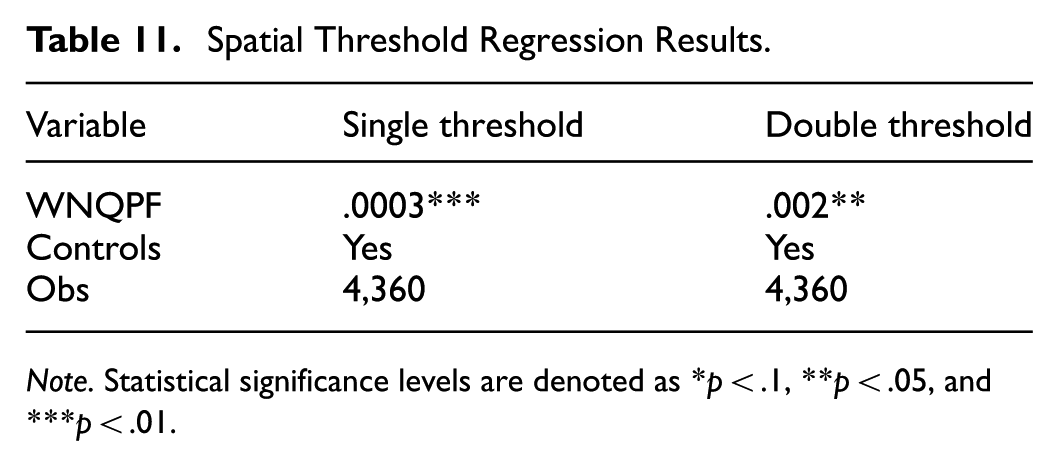
Based on the previous model design, the spatial weight matrix is integrated with the threshold model to derive a spatial threshold model. The specific results are presented in Table 10. The spatial weight matrix employed here is a geographic distance matrix, and the findings indicate that the total assets of a firm exhibit a double threshold. This suggests that the digital requires a certain level of enterprise assets to enhance the NQPF.
Tests for Spatial Threshold Effects.

Note. Statistical significance levels are denoted as *p < .1, **p < .05, and ***p < .01.
The results are further validated as shown in Figure 5. The dotted line represents the critical value of the LR statistic at the 5% significance level. The threshold value falls below the dotted line within the acceptance region of the null hypothesis, indicating that the single threshold value is consistent with the true value.

Spatial threshold estimates and 95% confidence intervals.
Continuing to analyze the spatial threshold regression results as shown in Table 11, it can be observed that upon crossing the first threshold, a 1% increase in the total assets of the firm results in a .03% increase in the level of NQPF. When crossing the second threshold, a 1% increase in the total assets leads to a .02% increase in the level of NQPF, indicating a marginal diminishing effect, which aligns with logical expectations.
Spatial Threshold Regression Results.
Note. Statistical significance levels are denoted as *p < .1, **p < .05, and ***p < .01.
Robustness Tests
Replacement of the Weighting Matrix
In research within the fields of economics or geography, spatial weight matrices are frequently employed to describe the spatial relationships between different regions. For instance, when examining the impact of outward foreign direct investment (FDI) on the industrial structure upgrading in Chinese provinces, a spatial weight matrix based on geographic proximity can be utilized for preliminary analysis. To verify the robustness of the results, this paper replaces the economic inverse distance model based on the strength of economic ties and presents the findings in Tables 12 and 13. The results indicate that, aside from numerical changes, the significance of the global Moran index and the spatial spillover effect remain largely unchanged, confirming the reliability of the conclusions.
Moran’s Index for the Economic Inverse Distance Matrix.

Note. Statistical significance levels are denoted as *p < .1, **p < .05, and ***p < .01.
Spatial Durbin Model Regression Results.

Note. Statistical significance levels are denoted as *p < .1, **p < .05, and ***p < .01.
Endogeneity Test
This paper addresses the endogeneity problem by applying a double differencing method, as outlined by Liu et al. (2023). This involves using a placebo test with a dummy policy year instead of the actual policy year to front-load the time of policy onset. This article use the green financial reform and innovation pilot zone policy as the shock variable. Huiyu et al. (2023) found that the establishment of this pilot zone effectively reduced pollution emissions from heavily polluting enterprises within the area. The effect was statistically stronger for large firms and firms in financially developed regions. The specific results are illustrated in Figure 6.

Parallel trend test.
Continue with the placebo test. A number of individuals were randomly selected from the sample as “pseudo-treated individuals” without replacement, and DID estimation was performed to obtain an estimate of the placebo effect. The placebo test was conducted through 500 random permutations, generating the null effect distribution presented in Figure 7. In the figure, the treatment effect estimate lies in the right tail. If the treatment effect were truly zero, such an extreme treatment effect estimate would not be observed in the sample. Therefore, the original hypothesis that “the treatment effect is zero” is rejected, and the spatial placebo test is passed.

Spatial placebo test.
Finally, to further enhance the rigor of the article, this article also uses the propensity score matching method (PSM-DID) to test the endogeneity problem. The industry annual median as a way to take the value, the construction of treat variables, which is greater than the median take 1 less than the median take 0, the test results are shown in Table 14. The table shows that most of the variables after matching the standardized deviation (%bias) is less than 10%, and only the deviation of the proportion of independent directors is 22.2%. And most of the test results do not reject the treatment group and the control group original hypothesis of no systematic differences. Following propensity score matching, t-tests revealed no statistically significant differences (p if.10) in previously imbalanced covariates between treatment and control groups, confirming the matching procedure successfully balanced the samples. The results of the PSM regression analysis are shown in Table 15.
Balanced Hypothesis Testing.

Note. U orunmatched group; M = matched group.
PSM Regression Analysis.

Note. Statistical significance levels are denoted as *p < .1, **p < .05, and ***p < .01.
Heterogeneity Test
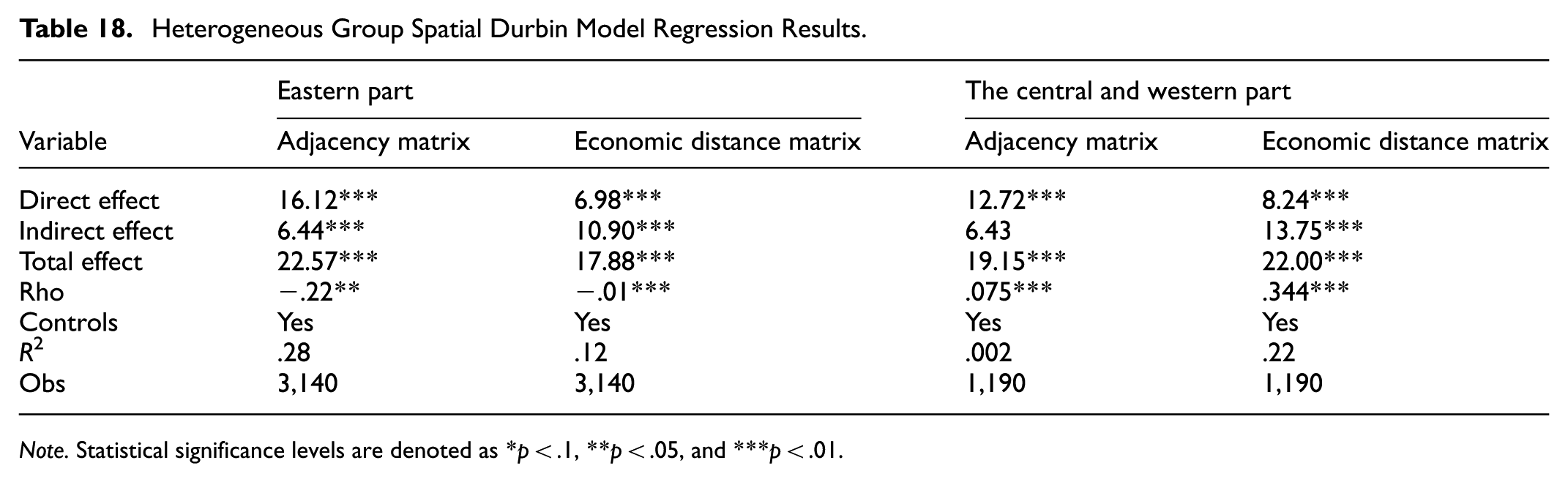
Since different levels of development and resource allocation in regions may have an impact on the results, this article groups the 436 firms according to the geographic region in which they are located, and eventually into three subgroups: eastern, central, and western. Enterprises that have relocated are excluded from the analysis. This article group 314 manufacturing enterprises from the eastern developed region and combine the remaining 119 manufacturing enterprises from the central and western regions into a single group for heterogeneous grouping. The spatial spillover effects of these two groups are analyzed using the same methodology as in the previous section. The results, presented in Tables 16 to 18, indicate that aside from changes in value and significance in certain years, the overall situation remains stable. Therefore, the test results are deemed reliable following the heterogeneity test.
Moran’s Index for the Heterogeneity Test Group.

Note. Statistical significance levels are denoted as *p < .1, **p < .05, and ***p < .01.
Heterogeneous Group Spatial Durbin Model Regression Results.

Note. Statistical significance levels are denoted as *p < .1, **p < .05, and ***p < .01.
Heterogeneous Group Spatial Durbin Model Regression Results.
Note. Statistical significance levels are denoted as *p < .1, **p < .05, and ***p < .01.
Conclusions and Implications
Conclusions
This study utilizes panel data from 436 A-share listed manufacturing firms spanning the years 2013 to 2022. By employing the spatial Durbin model, spatial mediation effect model, and spatial threshold model, it examines the relationship between Digital and NQPF in these enterprises, yielding the following conclusions:
(1) There is a clear correlation between NQPF and Digital across manufacturing firms. The more advanced the Digital, the higher NQPF. (2) NQPF in the manufacturing industry and digital exhibit a spatial spillover effect. This effect diminishes over distance, showing a positive impact within 80 to 100 km, turning negative between 340 and 360 km, and becoming negligible beyond 540 km. This indicates the presence of a geographic threshold. Additionally, heterogeneity analysis confirms that this spillover effect persists across different distribution areas. (3) Digital can enhance NQPF in manufacturing enterprises by increasing total factor productivity. (4) Digital positively correlates with the enhancement of NQPF in manufacturing firms, with the level of improvement increasing alongside the total assets of the firm. The greater the assets, the higher the enhancement level of NQPF.
Theoretical Contributions
This article makes several theoretical contributions, outlined as follows. First, it extends empirical research on the concept of “new quality productive forces” at the level of manufacturing enterprises. In contrast, most previous studies have focused either on provincial indicators of NQPF or on theoretical analyses related to this concept. For instance, Su (2024) investigates the impact of artificial intelligence on NQPF and its mechanisms of action across Chinese provinces in his study. Bo and Lilu (2024) proposed the development of a comprehensive and systematic financial empowerment program tailored to the local conditions based on the characteristics of the industries in each region of the country as well as the country’s mandatory requirements for quality development. In fact, NQPF exhibit significant variation at the inter-enterprise level, while provincial-level analysis tends to be overly homogeneous, neglecting the disparities in inter-enterprise development. This situation necessitates an improvement in the relevant theories through empirical analysis at the enterprise level. This study focuses on manufacturing enterprises as a case sample, analyzing the relationship between Digital and NQPF. This article elaborate on the mechanisms underlying this relationship and examine both the spatial mediation effect and the spatial threshold effect, thereby clarifying the process involved.
Second, this article analyze the impact mechanism of Digital and NQPF from a spatial perspective. Although some previous studies have explored the relationship between Digital and NQPF, they primarily focus on simple linear relationships. For instance, Zhang and Zhang (2025) argue that Digital enhances the level of NQPF in firms by alleviating financing constraints and improving their ESG performance. What's more, previous research has focused on the firm itself, ignoring its spatial effects. In contrast, our research reveals the existence of spatial spillovers resulting from Digital on the emergence of NQPF, along with a precise estimation of the spatial decay boundary.
This study effectively illustrates the relationship between Digital and the advancement of NQPF in manufacturing firms, while also serving as a reference for future research in this area.
Summary of Innovations
Firstly, from the perspective of NQPF, existing research shows that the generation and evolution of NQPF, at the micro level, is mainly reflected in the systematic changes achieved by enterprises through technological innovation, factor reorganization and industrial leapfrogging. As the basic unit of economic operation, the strategic behavior of firms directly maps the dynamic trajectory of productivity paradigm shift. Using firm-level microdata, we can more accurately portray the deep impact of digital on the allocation efficiency and synergy mechanism of production factors—labor, labor materials, and labor objects. Specifically, firm-level indicators such as R&D investment intensity, patent stock and structure, and asset exclusivity can be used to build a multi-dimensional and quantifiable NQPF evaluation framework, and achieve exponential measurement with the help of entropy and other objective empowerment techniques. In contrast, macro data based on provincial or industry aggregates are often difficult to capture heterogeneous micro mechanisms due to insufficient granularity, leading to smoothing and homogenization of measurement results. Existing literature mostly focuses on macro-narrative or normative analyses, and pays little attention to the micro-foundations and empirical evidence of NQPF. The introduction of firm-level data can not only provide a verifiable microfoundation for classical paradigms such as the endogenous growth theory and Marx’s three-factor productivity theory, but also promote the theory of NQPF from conceptual interpretation to mechanism identification and causal inference, and thus achieve two-way optimization in theory deepening and policy design.
Second, traditional measurement models ignore spatial correlation between firms, while digital creates geographic dependence between neighboring firms through knowledge diffusion, industry chain synergy and technology spillovers. The spatial measurement model is able to quantify this spillover effect and verify whether the improvement of NQPF is spatially conductive, which makes up for the limitations of traditional regression. Through the spatial threshold model, the spatial spillover range of Digital on NQPF is empirically determined, and the effective radius of radiation of policy intervention is clarified, which provides a scientific basis for firm location selection and regional synergistic development. Furthermore, the spatial mediation effect model is introduced, and it is found that there is spatial correlation of total factor productivity (TFP) in the transmission path of Digital's impact on NQPF, which breaks through the assumption of “local independence” in the traditional mediation analysis, and reveals the complex mechanism of cross-regional productivity enhancement.
In summary, by utilizing firm-level data, this study enriches the micro-empirical foundation of NQPF research. Meanwhile, spatial econometric techniques shed light on the cross-firm synergies of Digital and its geographical boundaries. These results not only deepen the understanding of NQPF formation, but also provide a scientific basis for the formulation of regional differentiation policies.
Policy Recommendations
The level of digital can significantly influence the development of NQPF, providing a theoretical foundation for the future evolution of these forces in countries that have established a basis for digital transformation. For such countries, the primary objective is to continuously enhance their level of digitization, ensuring comprehensive coverage and precise support for the innovation of digital intelligence technology and the digital processes of firms.
Furthermore, as NQPF underscore the importance of human contributions in production, nations should prioritize the accumulation of high-quality human capital. This involves strengthening the focus on high-end talent while simultaneously promoting and popularizing science and technology to enhance societal acceptance.
Additionally, the results of spatial spillover effects indicate that NQPF can generate a driving effect among enterprises. The government should leverage this by facilitating increased scientific and technological exchanges to strengthen cooperation among enterprises, thereby fostering the growth of NQPF within each enterprise.
Finally, findings related to spatial heterogeneity suggest that the impact of digital on NQPF varies by region. Therefore, the government should devise appropriate policies and programs tailored to the characteristics of regional economies, ultimately assisting the country in addressing economic development challenges.
Research Outlook
The construction of NQPF indicators in this paper is based on the theory of NQPF framework, which is somewhat novel, but since NQPF is a newly proposed concept in recent years, there has not yet been a unified definition in the academic world, and the related disciplines have just been established, so there is still room for improvement in the selection and definition of indicators. For example, since increased labor specialization is beneficial to economic development, it might be more scientific to add labor specialization to the sub-indicators of NQPF. Due to the availability of data, this study only collects the data of Chinese A-share manufacturing companies from 2013 to 2022, and we hope to add data from more industries or even more regions or countries in the future.
Footnotes
Author Note
Lu Yang is supervisor of Min Tianwei who is doing the Master’s degree.

Ethical Considerations
This article belongs to the field of economics and does not involve human or other biological experiments, there are no moral or ethical issues, the data for the study were obtained from publicly available databases, there is no risk of harm to the study participants, and all participants involved in this study read the content of this article and agreed to its publication.
Author Contributions
Concept and design: Lu Yang and Min Tianwei; Data collection and analysis: Min Tianwei; Critical revision of the article for important intellectual content: Lu Yang; Provided suggestions and content changes to the article: Tony Fang. All the authors approved the final article.
Funding
The authors disclosed receipt of the following financial support for the research, authorship, and/or publication of this article: This work was supported by the 2023 Jiangxi Provincial Social Science Foundation Project “Research on the Impact and Countermeasures of Digital Economy Development on the Employment Structure and Quality in Jiangxi Province” (Project No. 23YJ55D) and the 2022 Research Project on Humanities and Social Sciences in Jiangxi Colleges and Universities “Research on the Power Mechanism and Countermeasures of Industrial Digitization Boosting the High-Quality Development of Jiangxi’s Manufacturing Industry” (Project No. JJ22218).
Declaration of Conflicting Interests
The authors declared no potential conflicts of interest with respect to the research, authorship, and/or publication of this article.
Data Availability Statement
All data that support the findings of this study are included in this manuscript and its supplementary information files.