




Abstract
In upper Gelana watershed of Ethiopia, this study investigates the ways in which gender roles impact attitudes toward and implementation of climate-smart agriculture (CSA) practices. The study used a concurrent mixed-methods design. In total, 150 randomly chosen homes participated in structured surveys to gather quantitative data, which was then analyzed using chi-square tests, descriptive statistics, and a Multivariate Probit Model (MPM) to take interdependent CSA adoption decisions into consideration. Focus groups and key informant interviews provided qualitative insights into the sociocultural norms, gender dynamics, and household decision-making. According to the findings, the most popular CSA practice was irrigation (30%), which was followed by inter-cropping (17.3%), drought-resistant crops (14.7%), soil and water conservation (19.3%), and better stoves (4.7%).The MPM found inter-dependencies among practices (ρ = .25–0.40, p < .05) and indicated land tenure security (β = .28–0.35*), NGO assistance (β = .42–0.50**), and training access (β = .61***) as important predictors of adoption. With the exception of drought-resistant crops, where gender was significant (β = .42**), ***, **, and * statistically significant at 1%, 5%, and 10% probability levels, respectively chi-square tests showed no significant gender differences overall (χ2 = 4.387, p = .495). However, qualitative results revealed enduring disparities: women’s adoption was restricted by social norms, restricted land rights, and dependence on unofficial networks, whereas men had easier access to loans, cooperatives, and extension services. The study comes to the conclusion that CSA adoption is influenced by gendered access and systemic injustices rather than just gender. For policy include encouraging integrated CSA packages, improving women’s access to credit and land tenure, and fortifying gender-sensitive extension services.
Plain Language Summary
Unpredictable rainfall, soil erosion, and regular droughts are some of the effects of climate change that farmers in Ethiopia’s upper Gelana watershed are facing. Families find it more difficult to cultivate enough food and support themselves as a result of these difficulties. CSA which encompasses techniques like irrigation, inter-cropping, conserving soil and water, drought-resistant crops, and enhanced stoves, is one viable remedy. This study looked at how men and women in the watershed are aware of climate change and whether they are adopting CSA practices. We surveyed 150 households and also held interviews and focus group discussions to understand people’s experiences. The results showed that irrigation is the most widely used practice because it directly helps farmers deal with water shortages. Other methods, such as inter-cropping and soil conservation, are adopted less often, while improved stoves are the least used. Access to training, support from NGOs, and secure land rights were found to be key factors that encouraged adoption. According to statistical study, the overall rates at which men and women adopt CSA practices are comparable. Deeper discussions, however, uncovered significant hidden disparities. While women frequently encounter societal and cultural obstacles that restrict their capacity to embrace resource-intensive methods, men are more likely to gain from access to loans, land, and extension services. Women frequently have less decision-making authority in households and are more dependent on unofficial networks. According to the study’s findings, systemic injustices that hinder women’s access to the tools and assistance required to adopt CSA are the real issue, not just gender differences. In order to increase adoption in a fair manner, the report suggests: extending training and extension initiatives that are gender-sensitive; enhancing women’s land rights and financing availability; encouraging CSA package
Keywords
Introduction
Climate change poses a challenge to Ethiopia’s agricultural output and food security, especially in smallholder farming systems that depend on rainfall (Food and Agriculture Organization (FAO), 2023). Similarly, farmers in South Wollo’s upper Gelana watershed are more vulnerable to climate hazards due to variable rainfall, soil degradation, and socioeconomic issues (Mohammed et al., 2020; Tesfahun et al., 2025). Ethiopian farmers have been fighting climate change and its effects by employing traditional techniques that date back hundreds of years (Gezie, 2019). Examples of indigenous knowledge pertaining to environmental conservation across Ethiopia include the Konso soil and water conservation methods (Engidawork, 2014; Megento, 2017; Taye & Megentu, 2017); the Gedio traditional agroforestry knowledge and the Borana traditional natural resource conservation concepts (Ahmed, 2022, Takele, 2025). Natural resources and livelihoods cannot be sustained solely by indigenous techniques in the face of land depletion and climate change (Muluken et al., 2018; Perez et al., 2015). Despite efforts for more than ten years, climate-smart agriculture has only recently been implemented in Ethiopia (Assefa et al., 2024).
Climate-smart agriculture lowers emissions, builds resilience, and increases food security, productivity, and revenue (Food and Agriculture Organization (FAO), 2010; CGIAR Research Program on Climate Change, Agriculture and Food Security (CCAFS), 2015). Improved crops, agroforestry, diversification, irrigation, off-farm labor, asset sales, food aid, soil and water conservation, tree planting, and migration are some of the ways Ethiopian smallholder farmers adjust (Abraham et al., 2025; Gezie, 2019; Lankamo et al., 2025; Teklay et al., 2025). The 2030 Sustainable Development Goals emphasize the connection between gender equality and climate-smart agriculture (Atapattu et al., 2024; Food and Agriculture Organization (FAO), & International Fund for Agricultural Development (IFAD), 2015). Nonetheless, farmers’ decisions are influenced by various factors, including temperature, ago-ecological zones, social capital, household wealth, gender, age, education level, and access to extension services and loans (Margaret et al., 2024; Tewodros et al., 2025). Climate adaptation is hampered for Ethiopian smallholder women by a lack of awareness, inadequate training, restricted land rights, and financial limitations (Fekadu & Engdawork, 2019; Gezie, 2019; Meseret et al., 2020). Ethiopian policies place a high premium on gender equality and the empowerment of women in agriculture (Boudalia et al., 2024; Kristie et al., 2020). In reality, though, there is a 23% gender productivity gap in Ethiopia, in part due to women’s limited access to needs-specific extension programs (Daudu et al., 2025).
Even with the increasing amount of studies on Ethiopia’s adoption of climate-smart agriculture (CSA), there are still a number of important gaps, especially in the upper Gelana watershed. Despite the fact that gender variations in adoption have been recorded, little is known about how gendered labor positions, sociocultural norms, and householder decision-making influence adoption trends. Moreover, less is known about the impact of gendered social capital, particularly in relation to group labor, knowledge sharing, and network access. Furthermore, the efficiency of institutional and policy support systems, such as water management programs, land tenure reforms, extension services, and loan availability, in fostering fair CSA adoption has not been fully evaluated. The previous works also frequently use quantitative data, ignoring the contextual information that qualitative methods may offer (Aguilar et al., 2015; Yalmewud et al., 2022). A thorough understanding of CSA adoption dynamics and the development of focused policy solutions would result from filling these gaps through mixed-methods, and gender-sensitive research. Through the integration of the theory of access and decision-making theory, this work seeks to fill these research gaps. While the theory of access highlights that resource ownership, social networks, and institutional barriers determine whether farmers can effectively utilize CSA, the decision-making theory highlights how individual roles, risk preferences, and authority within the household impact technology choices (Ribot & Peluso, 2003).
The study’s primary goal is investigate how structural disparities and gender roles affect Ethiopians’ perceptions of and adoption of CSA practices. And, specifically; to evaluate how the upper Gelana watershed’s rural families view and understand climate change; to investigate how gendered family dynamics affect CSA adoption decision-making; to look into how households’ capacity to implement CSA practices is impacted by structural disparities (such as access to credit, land, and extension services). The study uses a contemporaneous mixed-methods approach, integrating qualitative information from focus groups and interviews with quantitative data examined using a Multivariate Probit model. This approach makes it easier to comprehend adoption patterns in a more complex way, as well as how CSA practices are interdependent and how adoption is shaped by institutional and sociocultural factors.
In order to achieve the 2030 Sustainable Development Goals (SDGs), especially SDG 2: End Hunger, this study employs sustainable farming approaches. In order to accomplish SDG 5: Gender Equality, it also tackles gender differences in farming and decision-making. Through the promotion of sound climate smart agriculture practices based on context-specific knowledge, the study seeks to benefit both local communities and the greater region. With an emphasis on the gendered adoption of different CSA practices, it offers empirical data on the connections between gender, family decision-making, resource access, and the adoption of climate-smart agriculture (CSA) practices. In the upper Gelana watershed and other comparable Sub-Saharan African contexts, the results are meant to direct gender-sensitive programs, policy development, and focused support for smallholder farmers. The results from this study will be used to improve the work of gender and climate-smart agriculture groups and gender and environmental researchers.
Materials and Methods
Overview of the Research Area
The upper Gelana sub-watershed is located in the Tehuledere district in the South Wollo zone of Ethiopia’s Amhara region (Figure 1). It occupies 24,972 hectares and is situated around 491 km north of Addis Ababa. The elevation above mean sea level varies from 2,006 to 2,736 m. The study area is made up of rough terrain and a fairly low-lying plain on the western escarpment of Ethiopia’s Afar rift valley. The watershed drains into the Awash River, and the research area’s slope grade varies from flat to somewhat steep.

Map of the study area.
The primary soil types in the study area include Vertisols, Regosols, Leptosols, and Cambisols (Belay et al., 2025). The Gelana sub-watershed is one of the most densely populated places in the district, with an estimated 64,965 inhabitants in 2007 and an average population density of 260 persons per km2 (Central Statistics Agency (CSA), 2008). The primary economic activity and source of income in the watershed has always been agriculture; the farming system is a mixed crop-livestock production at the subsistence level (Weber, & Tiba, 2018). Cereals like wheat, sorghum, maize, and barley are the main crops farmed in the region, and 4,500 hectares are anticipated to be planted with Teff (Mohammed Tolossa, 2016). Fruits and vegetables are also grown by farmers; typical crops like avocados, oranges, bananas, papayas, mangoes, and lemons are regularly grown. However, the ecosystem has changed recently due to chat (Catha edulis) becoming the primary source of income in the study area and an important cash crop. A major export from Ethiopia, chat brings in substantial revenue and foreign exchange for the nation. Notwithstanding its significance, Ethiopia’s production, distribution, and use of chat are not regulated by law or policy (Tsedey et al., 2024). There are two classifications for the upper Gelana watershed (1,701–2,886 m): Weina Dega (semi-humid) and Dega (cool, humid) (Tadesse et al., 2024). In the upper Gelana watershed, households’ socioeconomic standing is defined by subsistence-based means of livelihood, and a heavy dependence on traditional institutions (Baloch et al., 2025; Tesfahun et al., 2025). While farming is still done the old-fashioned way, 82% produce primarily for domestic use, while just 23% receive non-farm income (Tesfahun et al., 2025). Social engagement is substantial, with 82% in cooperatives and 88.7% in traditional institutions (Iddir, Equib), which are crucial in reducing food insecurity and rallying community support, despite the formal safety nets’ poor coverage of 17% (Tesfahun et al., 2025).
Data Collection Tools
The data for this study was collected over the three months of January through March in 2023. According to some research, seasonal fluctuations have affected the adoption of CSA (Iqbal et al., 2024). Since the data primarily pertain to long-term socioeconomic characteristics (education, landholding, household size, income, livestock ownership, institutional membership), as well as perceptions of climate and climate-smart practices, the validity of this study remains unaffected by conducting household surveys between January and March. Due to their structural nature and long-term stability, these variables are not very susceptible to transient seasonal variations. In order to gather demographic, socioeconomic, and experience data, a carefully crafted questionnaire comprising both closed-ended and open-ended questions was used for a household-level survey. More open-ended questions were added for deeper insights after pilot testing found that the closed-ended items’ wording was imprecise and had a narrow scope. Administrator feedback helped to improve the questionnaire’s accuracy, and enumerators were trained to collect data consistently. The goal of the study was explained both orally and on the cover page. Three Development Agents and seven important informants were also interviewed in-depth to gather local expertise on watershed management and natural resource management.
Population and Sampling Methodology
The study’s emphasis was deliberately chosen to be the upper Gelana watershed because a sizable fraction of people experiencing chronic food insecurity reside in this region, which is surrounded by areas in northeastern Ethiopia that are prone to famine and drought (Dessalegne et al., 2024). Furthermore, households seeking sustainable livelihoods are increasingly turning to international migration as a strategy (Alemmeta & Singh, 2018). Moreover, due to its diverse biophysical and topographic conditions and long WSM experience, the location was chosen. In addition, a large part is due to its accessibility and track record of collaboration with both governmental and non-governmental organizations to manage watershed development practices. Aba Weyzer, Wokel Amba, Metekate, and Kori are the four micro watersheds that comprise upper Gelana. Since the number of houses in the watershed is known and finite, Yamane’s simple sample-size formula was employed in this study instead of Kothari’s or other methods; Yamane’s formula is widely used in Ethiopian agricultural research, requires just two parameters (N and e), is resource-efficient for field surveys, and explicitly accounts for population size and a selected margin of error (Nithya et al., 2022; Tesema, 2022; Yamane, 1967). Using Yamane’s (1967) formula with a sampling error of 8%, a representative sample size of 150 households was determined from the 4,152 population in Kebele 08.
Research Design and Approach
This study adopted a cross-sectional survey design to examine gendered patterns of CSA adoption at a single point in time, allowing for quantitative assessment of socioeconomic and resource-related factors. A concurrent mixed-methods approach was employed, integrating structured surveys with qualitative interviews and focus group discussions. The quantitative component analyzed determinants of CSA adoption using multivariate probit model, while the qualitative component provided insights into household decision-making, sociocultural norms, and gendered access to resources. This integrated approach strengthens the validity of the findings by triangulating statistical trends with contextual understanding.
Variables and Measurement
A binary variable, with 1 denoting the adoption of at least one CSA practice and 0 denoting none, was used to describe adoption. While gender, access to extension, credit, water, and information were included as dummy factors (0 = no, 1 = yes), schooling was treated as an interval variable to capture disparities in educational attainment. Adoption of CSA methods, including inter-cropping, irrigation, drought-resistant crops, improved stoves, better animal feed, and soil and water conservation, was the dependent variable. Household factors and resources such as age, education, financial access, irrigation management, cooperative participation, extension services, CSA -related information (from radio or networks), technological know-how, and social capital were all included as explanatory variables (Table 1).
Climate-Smart Agriculture Practices and Control Variables with Unit Measurements.

Note. Binary variables indicate adoption or presence (1) versus non-adoption or absence (0). Education is measured on an interval scale.
Methods of Data Analysis
The data collected was examined using software from the Statistical Program for Social Sciences (SPSS, V-27). This software facilitated descriptive statistical analysis and inferential statistics (chi-square test & multivariate pivot model). The basic patterns (means) and percentage distribution of the households’ socioeconomic backgrounds were examined using descriptive statistics. Inferential statistics were used to evaluate the association between gender and adoption of CSA practices using a chi-square test (χ2). A non-parametric method for analyzing relationships between categorical variables, including gender and adoption status, is the chi-square test (Agresti, 2002; Gudina & Alemu, 2024; McHugh, 2013). For this study, it helps determine whether factors such as gender, land tenure, or NGO support are significantly associated with the adoption of CSA. Because there were several associated adoption outcomes in this study, a multivariate probit technique was used instead of multi nominal regression. The joint influence of predictors across several binary outcomes cannot be evaluated simultaneously using multi nominal regression, despite the fact that it is appropriate for modeling a single categorical dependent variable with many levels. While accounting for inter-correlations between the dependent variables, a multivariate method enables the simultaneous assessment of the effects of variables like gender, training, and institutional support on a number of adoption indicators. By estimating overall impact sizes and lowering the possibility of Type I error that results from performing independent studies for every outcome, this contributes to a more thorough knowledge of agricultural innovation uptake. The multivariate probit model is especially suitable for the data set since it includes the adoption of more than two CSA techniques. Previous studies conducted in Ethiopia have employed this method. For instance, (Hailemariam et al., 2012; Teklu et al., 2023) use multivariate and ordered probit models to examine interrelated sustainable agricultural practices, and (Hailemariam et al., 2012) use a multivariate probit model to analyze adoption decisions of improved varieties for multiple crops in the Ethiopian highlands. To capture farmers’ perspectives and experiences, open-ended question responses were examined and compiled thematically. The descriptive analysis was employed to support and enhance the interpretation of the quantitative results.
Results
Household’s Demographic Background
An overview of the frequency distribution of several important variables, including gender, educational attainment, and access to water, credit, extension services, and other characteristics, is provided in (Table 2) for a sample of 150 respondents. Male respondents make up a substantially larger percentage of the sample (66%) than female respondents (34%). The majority of Ethiopian rural households are led by men because to sociocultural and economic discrimination, and more homes with women than men participate in non-farm economic activity (Yirga et al., 2015). According to this study, the majority of respondents (>82%) are classified as “illiterate” or “read and write only,” indicating that the participants have a low level of education (Table 2). Only 18.1% of respondents have completed elementary school or above. The extremely low proportion of respondents (5.4%) with a high school or college degree may indicate that this demographic has limited access to formal education, which may affect their willingness to adopt new agricultural technologies and practices like CSA (Table 2).
Demographic Background of the Respondents.

The vast majority of respondents (81.3%) have access to extension services, which is encouraging because it indicates that most participants have access to outreach, education, and agricultural support (Table 2). Given that extension services frequently promote contemporary agricultural methods and offer technical support, this access to services may be a major factor in the adoption of CSA technology. The overwhelming majority of respondents (91.3%) have access to water, which is consistent with previous research showing that water availability significantly boosts CSA technology adoption. This broad availability implies that water shortage, a crucial consideration for farming and CSA uptake, may not be a major problem in this specific sample. As a result, 80% of those surveyed concurred that they can obtain credit. This implies that the majority of farmers may have access to funds that would allow them to make investments in equipment, technologies, and agricultural inputs. The 20% without credit, however, might find it challenging to adopt costly technologies. The most popular method of conserving water is pond construction (42.7%), which is followed by river diversion (25.3%) and roof rain collection (32.0%). These practices show that farmers use a range of water-saving strategies, with building ponds being a particularly common option.
The respondents’ varied approaches to water conservation demonstrate their understanding of the importance of managing water resources. The sample is nearly evenly dispersed in terms of information availability, with slightly more respondents (52.7%) not having access to information. Learning about new farming techniques and CSA technologies requires having access to knowledge. The comparatively high percentage of respondents without access might make it more difficult for them to keep up with new advancements, which would hinder their ability to use cutting-edge farming methods. This demographic may face significant obstacles when implementing more sophisticated CSA that require knowledge and understanding because the majority of them are either illiterate or possess only basic literacy skills, and more than half do not have access to information. The large percentages of people who have access to financing (80%), water (91.3%), and extension services (81.3%) are encouraging signs for the potential uptake of agricultural innovations.
These resources provide the infrastructure, funding, and support required to invest in and implement CSA practices. The farming community’s significant knowledge of and response to water conservation concerns is indicated by the adoption of numerous water conservation techniques, with pond building being the most prevalent. This emphasis on watershed management likely stems from how crucial water access is to improving agricultural outcomes. The case processing summary typically highlights key socioeconomic traits of this group, such as low educational attainment, easy access to agricultural resources and services, and unequal information availability. The extensive use of water-saving methods demonstrates the importance of managing water resources in this community. More advanced CSA technologies may not be widely adopted, though, due to poor educational attainment and limited information availability, underscoring the necessity of focused educational and informative campaigns.
Climate-Change in the Upper Gelana Watershed
Ethiopia is often regarded as a desert, despite its varied climate and topography. Increased evapotranspiration, decreased soil moisture, and an increase in the frequency of droughts and floods are the main causes of the nation’s rising average temperatures and declining precipitation (Kiros et al., 2021). Ethiopia’s strong reliance on rain-fed agriculture and limited capacity for adaptation make it among the countries most vulnerable to climate change. A significant majority (85.3%) of the households in the research zone agreed that the temperature had increased over the last 20 years, as seen in Figure 2. Variations in rainfall patterns were noted by a similarly high percentage (81.3%). Responses regarding the length of rainfall were more divided, with 57.3% indicating a decrease and 44% stating an increase. The recent studies by Tadesse et al. (2024) analyzed monthly, seasonal, and yearly rainfall data and found significant rainfall variability throughout the upper Gelana watershed, are consistent with this impression of households higher variability in January and lower variability in August are indicated by the research area’s Coefficient of Variation (CV). Furthermore, for all agro-ecological zones, CV values are higher for the Belg season than for the Kiremt season and yearly rainfall. Rainfall distribution abnormalities range from moderate to severe, according to the Precipitation Concentration Index (PCI), with 64% of upper Woinadega and 53.8% of lower Woynadega showing significant irregularity (PCI > 20) (Tadesse et al., 2024). Additionally, seasonal deficits of 17.9% in lower Woynadega and 15.4% in upper Woinadega are displayed by the Standardized Rainfall Anomaly (SRA) (Tadesse et al., 2024). Deficits during the Belg years are 17.9% in the Dega Kiremt years and 20.5% in both lower and higher Woinadega. According to reports, annual deficits for upper Woinadega are 23.1%, while those for lower Woynadega and Dega are 20.5% (Tadesse et al., 2024). It’s interesting to note that 60.7% of respondents reported no rainfall-related concerns, compared to just 20.7% that did. According to this statistic, fewer respondents have encountered direct threats, even though the majorities are aware of climatic variability (temperature increases and fluctuations in rainfall). The significant degree of surrounding rainfall duration and dangers may indicate the need for enhanced communication of climate impacts or a deeper understanding of these phenomena.

Perception of households about exhibited climate change.
The study also assessed household experiences through research to ascertain the extent to which climate change affects them (Figure 3). The majority of respondents identified the primary problems caused by climate change in the area as the loss of pasture (80.7%), increased agricultural expenses (74%), and inadequate rainfall (68.7%). Additionally, they have witnessed the extinction of plant species, the drying up of rivers, the failure of crops to thrive, the death of animals, and, finally, the local population’s desire to leave the area in order to avoid poverty.

Climate change-related impacts.
Climate-Smart Agriculture in the Upper Gelana Watershed
The upper Gelana watershed exhibits differing degrees of technology adoption for climate-smart agriculture (CSA) practices (Table 3). The most popular intervention (30%) was irrigation, underscoring the critical role that water management plays in maintaining agricultural productivity in the face of changing weather patterns. This result is consistent with earlier research showing that farmers’ ability to adopt CSA technologies and adjust to climate stressors is greatly improved by consistent access to water (Aryal et al., 2018; Food and Agriculture Organization of the United Nations, 2013). Farmers’ awareness of the potential benefits of agroforestry (19.3%), inter-cropping (17.3%), drought-resistant crops (14.7%), and improved feed (14.0%) was reflected in their moderate adoption, which also suggested potential obstacles like limited access to inputs, a lack of extension services, or financial limitations (Bryan et al., 2013; Teklewold et al., 2019).
Adoption of Climate-Smart Agriculture Practices in the Upper Gelana Watershed.

Note. Based on the total number of respondents (N = 150), percentages are calculated.
Remarkably, only 4.7% of respondents said they used improved stoves, a practice that helps reduce emissions and improve household energy efficiency but is frequently limited by high upfront costs, a lack of training, and a lower perceived relevance than technologies related to crops (Climate Change, Agriculture & Food Security (CCAFS), 2015; Smith et al., 2014). The difference in adoption rates indicates that farmers give priority to methods that are directly related to immediate food and water security, but technologies that target co-benefits and long-term sustainability are given less consideration. In order to increase the perceived value of underutilized technology, such as improved stoves and feed, focused interventions should not only increase their accessibility and affordability but also fortify awareness campaigns and extension assistance. Overall, the evidence suggests that both institutional barriers that prevent diversification into other CSA techniques and practical necessity—which favors irrigation—shape adoption in the watershed.
Factors Influencing the Adoption of CSA
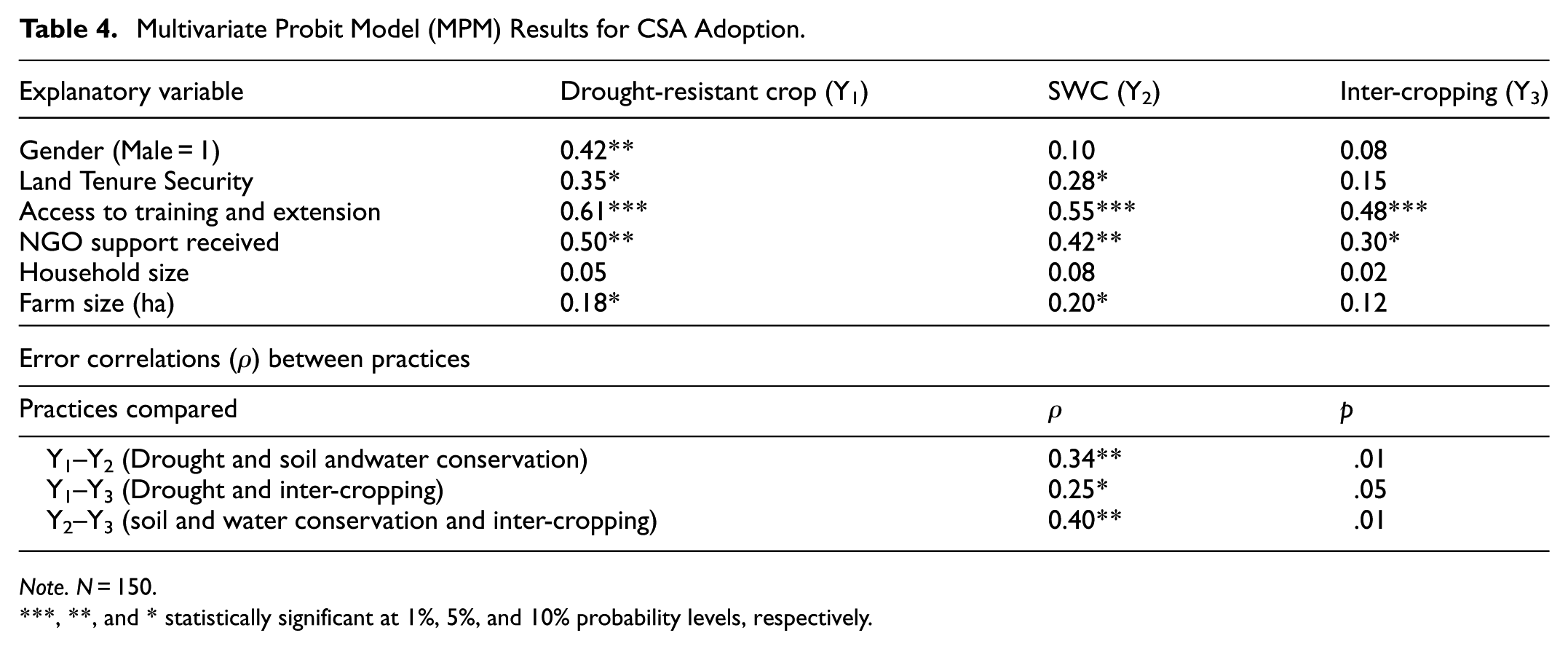
The Multivariate Probit Model (MPM) is particularly suitable for this study because farmers’ adoption decisions for multiple climate-smart agriculture (CSA) practices are potentially interdependent. To ensure the model is statistically valid, a goodness-of-fit and suitability analysis is conducted. These tests verify that the explanatory variables meaningfully explain adoption decisions and confirm whether modeling practices jointly is appropriate, given possible correlations among error terms (rho values) (Train, 2009). To ensure model validity, goodness-of-fit and suitability analyses were performed. The Wald test for joint significance of explanatory variables yielded χ2 = 85.42, p < .001, indicating that the model variables significantly explain adoption decisions. Additionally, likelihood ratio tests for correlation among error terms (rho values) showed significant interdependence (ρ12 = 0.38, p = .02; ρ13 = .44, p = .01; ρ23 = 0.31, p = .03), confirming that the adoption of one CSA practice influences the probability of adopting others (Table 4). These significant results justify the use of MPM over separate binary or multi nominal models, ensuring robust parameter estimates and reliable policy implications.
Multivariate Probit Model (MPM) Results for CSA Adoption.
Note. N = 150.
, **, and * statistically significant at 1%, 5%, and 10% probability levels, respectively.
Gender was a significant predictor only for the adoption of drought-resistant crops (β = .42, p < .01). Land tenure security was positively associated with adoption of drought-resistant crops (β = .35, p < .05) and soil and water conservation (β = .28, p < .05). Training attendance emerged as a strong predictor across all three practices, with the largest effect observed for drought-resistant crops (β = .61, p < .001). Similarly, receiving NGO support significantly increased the likelihood of adopting drought-resistant crops (β = .50, p < .01), soil and water conservation (β = .42, p < .01), and inter-cropping (β = .30, p < .05). Farm size was positively associated with adoption of drought-resistant crops (β = .18, p < .05) and soil and water conservation (β = .20, p < .05), though not with inter-cropping. Household size did not significantly predict adoption of any practice. The error correlations (ρ) across practices indicate significant interdependence in adoption decisions. Adoption of drought-resistant crops and soil and water conservation were positively correlated (ρ = 0.34, p = .01), as were drought-resistant crops and inter-cropping (ρ = 0.25, p = .05). The strongest correlation was observed between soil and water conservation and inter-cropping (ρ = 0.40, p = .01). These findings suggest that CSA practices tend to be adopted jointly rather than independently.
Gender and Adoption of CSA in the Upper Gelana Watershed
The Pearson Chi-Square test (χ2 = 4.387, df = 5, p = .495) shows that the observed gender differences in CSA adoption are not statistically significant at the conventional 5% level (p > 0.05) (Table 5). Similarly, the likelihood ratio (χ2 = 4.601, p = .467) and the linear-by-linear association (χ2 = 0.211, p = .646) confirm the absence of a significant association between gender and adoption of specific CSA technologies (Table 5). Observed counts reveal that men headed households adopt drought-resistant crops and other resource-intensive technologies more than expected, while women headed households adopt some technologies (e.g., agroforestry) at near-expected levels. Two cells had low expected counts (<5), suggesting caution in interpretation. Overall, gender alone does not significantly influence CSA adoption in this sample, though descriptive patterns highlight practical disparities that merit attention in policy and extension programs.
Chi-Square Analysis of Gender and Adoption of CSA (Observed, Expected Counts, and Percentages).
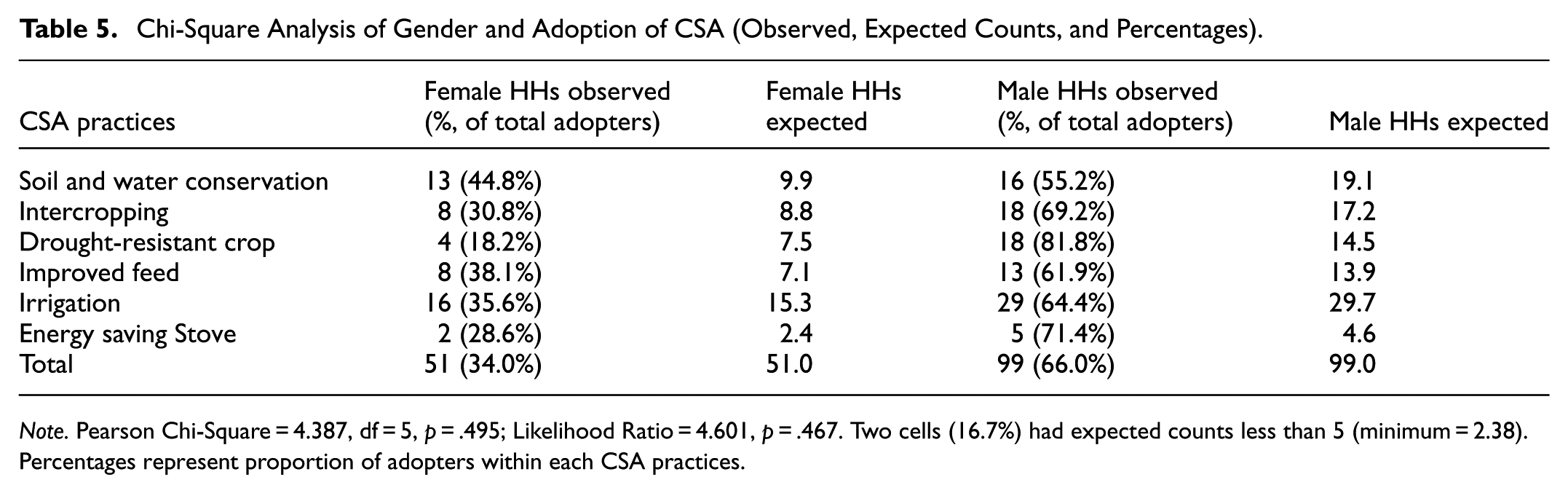
Note. Pearson Chi-Square = 4.387, df = 5, p = .495; Likelihood Ratio = 4.601, p = .467. Two cells (16.7%) had expected counts less than 5 (minimum = 2.38). Percentages represent proportion of adopters within each CSA practices.
Discussion
Climate Change in Upper Gelana Watershed
According to the findings, farmers in the upper Gelana watershed are extremely susceptible to soil erosion, rainfall fluctuations, and frequent droughts, all of which severely limit agricultural output and household food security (Amsalu & de Graaff, 2007; Bewket, 2009; Kassie et al., 2013). Although check dams, stone bunds, and terraces are examples of traditional soil and water conservation techniques that have historically bolstered local resilience, policy-driven water management programs have the potential to further lessen these vulnerabilities (Baloch et al., 2023; Hussein et al., 2023; Iqbal et al., 2023; Meng et al., 2024). In South Wollo, for instance, the government’s encouragement of small-scale irrigation has allowed some households to switch to cash crops and irrigated vegetables, stabilizing incomes and lowering reliance on unpredictable rainfall (Jat Baloch et al., 2022). Watershed restoration operations implemented as part of Ethiopia’s Sustainable Land Management (SLM) activities have also improved groundwater recharge, decreased erosion, and increased water infiltration in the area (Asayehegn et al., 2012). But, the advantages of such investments are not shared equally: poorer households are frequently left behind due to a lack of institutional support, limited financial resources, and unequal access to irrigation infrastructure (German et al., 2007). Additionally, as improperly managed irrigation can lead to soil salinization or groundwater depletion, water management plans must carefully balance immediate productivity benefits with long-term sustainability (Awulachew et al., 2007; Teshome et al., 2013). Stronger climate resilience in upper Gelana smallholder farming systems thus depends on combining inclusive and well-coordinated water management strategies with locally rooted adaptive knowledge.
Awareness, Adoption Trends, Barriers of CSA
Overall, it seems that men and women are adopting CSA at a fairly similar rate, with a few exceptions, such as drought-resistant crops, where men are adopting at a higher rate than women. Men are more likely than women to embrace drought-resistant crops, which can be explained by institutional and structural reasons. In general, men have stronger decision-making authority within households, more secure land tenure, and easier access to loans, inputs, and extension services. On the other hand, women frequently face obstacles related to financial capital, resource ownership, and training program participation, which limit their ability to adopt. Additionally, men are more likely to invest in enhanced types of food security crops, whereas women are more likely to prefer traditional crops for home consumption. The observed gender gap in adoption is a result of these dynamics taken together. Most observed counts are close to the expected counts, with drought-resistant crops being a possible exception. This suggests that gender has little influence on the adoption of the majority of CSA. Adoption of CSA is also significantly influenced by gendered social capital. Adoption of high-resource, risk-intensive practices is typically facilitated by men’s increased access to formal networks, cooperatives, and extension services (Kristjanson et al., 2017; Meinzen-Dick et al., 2014). Contrarily, women could rely on unofficial networks that offer robust peer support but restricted access to technical knowledge and group work. These variations affect the time of adoption, the scope of interventions, and who adopts certain CSA techniques. It is possible to encourage equitable adoption, improve community-wide resilience, and guarantee that both men and women gain from climate-smart measures by bolstering women’s social capital through focused farmer groups, inclusive governance, and easily available knowledge conduits (Jost et al., 2016). Furthermore, societal elements are crucial in determining the adoption of CSA, especially when it comes to gendered resource access. The adoption of certain CSA methods is influenced by traditional conventions that assign women to oversee household-level production and men to make the majority of decisions regarding cash crops (World Bank, FAO, & IFAD, 2015). Women’s adoption of labor- or resource-intensive methods, including drought-resistant crops or soil conservation measures, is further hampered by time and labor constraints, limited access to land or credit, and restricted engagement in community networks (Doss & Meinzen-Dick, 2020; Njuki et al., 2016). It is possible to increase equitable CSA adoption and boost overall resilience in smallholder farming systems by addressing these sociocultural hurdles through gender-sensitive extension services, inclusive community participation, focused credit and input programs, and support for women’s cooperatives. Adoption of CSA also influenced by roles, authority, and access to resources within households and communities in addition to biological sex, according to a complex perspective of gender in agricultural decision-making (Kristjanson et al., 2017; Njuki et al., 2016). The adoption of resource-intensive CSA is facilitated by the fact that men frequently control land, high-value crop decisions, and input availability (Bryan et al., 2013). Despite overseeing domestic food production and putting in a lot of work for conservation efforts, women may encounter limitations because of sociocultural norms, limited decision-making authority, and financial availability (Aryal et al., 2018; Bryan et al., 2021). Equal adoption and the overall efficacy of CSA can be increased by encouraging collaborative decision-making, expanding women’s access to resources, and guaranteeing gender-sensitive extension services (Jost et al., 2016; Meinzen-Dick et al., 2014).
Conclusions and Recommendations
Conclusion
The implementation of climate-smart agriculture (CSA) in Ethiopia’s upper Gelana watershed is examined in detail in this study, which emphasizes the interaction of institutional support, gendered roles, and structural inequities. In contrast to other practices like improved stoves, drought-resistant crops, and agroforestry, which see moderate to low uptake due to barriers related to access, knowledge, and perceived relevance, irrigation is widely adopted because of its direct impact on water and food security, according to the findings. The multivariate probit model’s demonstration of the interdependence of CSA behaviors emphasizes how adoption choices are interrelated, indicating that interventions should take into account integrated technology packages as opposed to discrete actions.
Qualitative data reveals enduring inequalities originating from household decision-making, sociocultural norms, and unequal access to social networks and resources, despite quantitative research revealing no statistically significant gender differences in overall CSA adoption. While women’s contributions to family food production and conservation techniques are limited by limited authority, labor pressures, and restricted access to information networks, men’s greater control over land, credit, and extension services makes it easier for them to adopt resource-intensive activities. These results provide a more nuanced view of the obstacles to equitable agricultural innovation uptake by shedding light on the crucial role that gendered social capital and household dynamics play in influencing CSA adoption.
This study’s cross-sectional design limits causal inference, and the use of self-reported data may result in recollection or social desirability bias. Additionally, just a few economic and environmental elements were looked at, and women’s viewpoints might be underrepresented because of institutional and cultural limitations.
Implications for Future Research and Policy
Future studies should use longitudinal designs and take into account both biophysical and economic elements in order to accurately capture the results of Climate-Smart Agriculture (CSA) over time. Gender-transformative techniques must also be put into practice in order to address structural imbalances that impact women’s access to resources and decision-making. To guarantee participative, context-specific interventions that strengthen women’s empowerment and institutional ties, policymakers should incorporate gender-responsive CSA efforts into national agriculture and climate policies.
Recommendations
Water-related policies, including irrigation expansion and water conservation initiatives, have the potential to significantly enhance CSA adoption in Ethiopia. Access to reliable water through small-scale irrigation or soil and water retention structures reduces farmers’ exposure to rainfall variability and drought risk, making the adoption of practices such as drought-resistant crops and inter-cropping more feasible. Integrated watershed management policies that link water availability with CSA programs can improve soil moisture retention, reduce erosion, and encourage long-term investment in climate-smart practices. Prioritizing marginalized farmers, including women and resource-poor households, ensures equitable access to water resources and strengthens overall resilience. Coupling these interventions with training and extension support can maximize the effectiveness of water-related policies in promoting sustainable CSA adoption.
The report makes the following strategic recommendations for policymakers:
By adjusting credit programs, information campaigns, and training to the requirements of female farmers and encouraging collaborative decision-making within households, gender-sensitive extension services can be strengthened.
To optimize synergies and adoption efficiency, promote integrated CSA technology packages that combine agroforestry, drought-resistant crops, irrigation, and soil and water conservation.
Increase institutional assistance by implementing land tenure reforms, providing fair credit, and implementing participatory water management initiatives that tackle social and technical obstacles.
Leverage social capital by lending support to peer networks, cooperatives, and inclusive farmer groups that promote knowledge exchange, group action, and the adoption of risky CSA methods.
Focus on raising knowledge and developing ability to promote the use of underutilized technology, like better stoves and feed interventions, by highlighting their long-term advantages for household livelihoods and climate resilience.
Footnotes

Ethical Consideration
Ethical approval followed the Ethiopian National Research Ethics Review Guideline.
Consent to Participate
Written informed consent was obtained from all participants, with confidentiality and voluntary participation ensured.
Funding
The authors received no financial support for the research, authorship, and/or publication of this article.
Declaration of Conflicting Interests
The authors declared no potential conflicts of interest with respect to the research, authorship, and/or publication of this article.
Data Availability Statement
Data will be made available on request.